Volume 4, Number 2, 2013, 235-244
© Copyright 2013 the authors. 235
Optimizing System of Rice Intensification Parameters Using Aquacrop Model for Increasing Water Productivity and Water Use Efficiency on Rice Production in Tanzania
Zacharia Katambara1, Frederick C. Kahimba2, Winfred B. Mbungu2, Paul Reuben2, Muyenjwa. Maugo3, Fikiri D. Mhenga2, andHenry F. Mahoo2
1Department of Civil Engineering, Mbeya University of Science and Technology, P.O. Box 131, Mbeya, Tanzania
2Department of Agricultural Engineering and Land Planning, Sokoine University of Agriculture, P.O. Box 3003 Morogoro, Tanzania
3Ministry of Agriculture, Food Security and Cooperatives, P.O. Box 9192, Dar es Salaam, Tanzania
Corresponding author: Zacharia Katambara, Department of Civil Engineering, Mbeya University of Science and Technology, P.O. Box 131, Mbeya, Tanzania
Abstract. Producing more rice while using less water is among the calls in water scarce regions so as to feed the growing population and cope with the changing climate. Among the suitable techniques towards this achievement is the use of system of rice intensification (SRI), which has been reported as an approach that uses less water and has high water productivity and water use efficiency. Despite its promising results, the use of SRI practice in Tanzania is limited due to less knowledge with regard to transplanting age, plant spacing, minimum soil moisture to be allowed for irrigation, and alternate wetting and drying interval for various geographical locations. The AquaCrop crop water productivity model, which is capable of simulating cro p water requirements and yield for a given parameter set, was used to identify suitable SRI parameters for Mkindo area in Morogoro Region, Tanzania. Using no stress condition on soil fertility, plant spacings ranging from 5 cm to 50 cm were evaluated. Results suggest that the yield and biomass produced per ha increase with decreasing spacing from 50 cm to 20 cm. Preliminary field results suggest that the optimum spacing is round 25 cm. However, the model structure does not take into consideration number of tillers produced. As such, the study calls for incorporation of the tillering processes into AquaCrop model.
Introduction
Against the background of increasing water demands to produce more food so as to feed the overgrowing population, the challenge has further been worsened by climate change (Ndiiri et al., 2012). Rice is among the most commonly grown cereal crops which requires large amount of water when grown under conventional practices. Apart from being one of the important staple crops consumed by majority of the population (approximately >70%), much of the rice is produced by smallholder farmers in irrigated fields with high production costs. However, this is likely to become a difficult challenge with dwindling water resources, competition with other sectors on the use of the water, as well as problems posed by the impacts of land use/cover and climate change. To improve food security, Tanzania as well as other countries in East Africa and Sub-Saharan Africa has to increase the resilience of water resource base and intensify rice productivity. To counteract this, good water management and agronomic practices must be tested for their suitability under local environment. System of rice intensification (SRI), which originates from Madagascar, is an approach that provides a new avenue for significantly increasing rice yields per hectare (Vishnudas, 2009). The suitability of SRI has been reported in various studies. In Kenya studies indicate that under SRI practice the yield of rice ranges from 6 to 8 ton/ha, water saving could be up to 25%, healthy grains can be produced that weigh 100-110 kg per bag, and it produces quality grains with stronger aroma (Mati, 2012; Ndiiri et al., 2012). In Madagascar it has been reported that SRI can increase the rice yield by 25% - 100% while reducing the amount of water used to 25% - 50%, and is considered as an incentive to a rice grower (Satyanarayana et al., 2007). In China it has been reported that up to 46% of water saving has been attained under SRI practice and yield increase of similar value (Xiaoyun et al., 2005). All these studies provide evidence on the suitability of SRI practice in saving water use while increasing yields to feed the growing population.
From the agronomic point of view, SRI practice is considered as a representation of empirical practices that vary in a manner that significantly reflect local
conditions (Dobermann, 2004). Therefore, the knowledge on the principles and the bio-physical mechanisms are imperative under a range of different agro-ecological environments (Stoop et al., 2002). On-farm participatory research activities under well defined farming-systems approach are necessary so as to adequately validate the practical relevance and risks associated with practising SRI under local conditions (Stoop et al., 2002). Among the parameters that need to be tested are transplanting age, spacing of the seedling, minimum soil moisture to allow irrigation, alternate wetting and drying interval, and cultivars for various geographical locations. All these require adequate time and resource to make appropriate decisions. In Tanzania SRI practice is not popular and this merits a need to test these parameters using a less resource dependent approach such as the use of crop simulation model. This study attempts to simulate rice yield and water requirements using AquaCrop model, a crop water productivity model developed by FAO. The suitable parameter set obtained is thereafter compared to the first season yield from Mkindo area in Morogoro region, Tanzania.
The AquaCrop Model and its Application
The Food and Agriculture Organization’s model, AquaCrop, is a result of scientific and experimental progress in water relation as well as the necessity to improve water productivity so as to cope with water scarcity (Raes et al., 2009a; Raes et al., 2009b). The model is capable of simulating yields of several herbaceous crops as a function of water consumed under any of the four conditions, which are rainfed, supplemental, deficit, and full irrigation (Steduto et al., 2009a; Steduto et al., 2009c). Therefore, the crop growth engine considered in the model is water-driver and calculates the transpiration from crop canopy cover, which is further translated into biomass that is related to evaporative demand and CO2 (Steduto et al., 2009d). Crop yield is determined as a product of biomass and Harvest index. Further information is given in (Steduto et al., 2009b). A major strength of the model lies in its ability to balance simplicity, accuracy, and robustness while using fewer parameters (Izzi et al., 2009; Steduto et al., 2009a; Steduto et al., 2007; Steduto et al., 2009b; Steduto et al., 2009c).
The AquaCrop model has been tested with crops such as maize, cotton, and quinoa. In Spain, the model was evaluated using maize crop (Steduto et al., 2009a). The model was noted to simulate satisfactorily crop water use (ET) under very high ET and wind conditions. In addition, the model pe rformed well in simulating the growth of above ground biomass, grain yield, and canopy cover (CC) in the non-water-stress treatments and mild stress conditions (Steduto et al., 2009a). With respect to cotton, the model has been reported to accurately simulate the canopy cover, evapotranspiration, biomass, and yield within acceptable ranges (Izzi et al., 2009). In Bolivia, the quinoa crop was simulated and satisfactory results were obtained for the simulation of total biomass and seed yield with values of Nash-Sutcliff efficiency being higher than 0.79 (Geerts et al., 2009). All these studies recommend on the model’s ability to satisfactorily simulate crop yield and water use efficiency under rainfed conditions, supplementary and deficit irrigation, and on-farm water management strategies. However, limited studies have been done on the suitability of the model in simulating rice crop in a manner that attempts to identify appropriate parameters for the SRI practices and this study is a contribution towards that direction.
Methodology
The AquaCrop model was setup to simulate paddy rice under conditions of unlimited soil fertility and no water stress for Mkindo experimental area. The general soil characteristic is clay loam with clay 44%, loam 37%, and sand 19% (Kombe, 2011). Climatic files were generated using ETo Calculator. The data include air humidity, wind speed, and maximum and minimum temperature. The meteorological station of Morogoro was used for the estimation of evapotranspiration and effect of distance between Mkindo and Morogoro was considered to be not significant. The rainfall data used was from Dakawa rainfall station, which is close to Mkindo area. The rice breed used was TXD 306 (SARO 5) and the study examined the effect of transplanting spacing on the yield. Three treatments were used as indicated in Table 1.
Table 1: Treatments for the experimental sites
Treatment Spacing
T1 25cm x 25cm
T2 30cm x 30cm
T3 35cm x 35cm
Results and Discussion
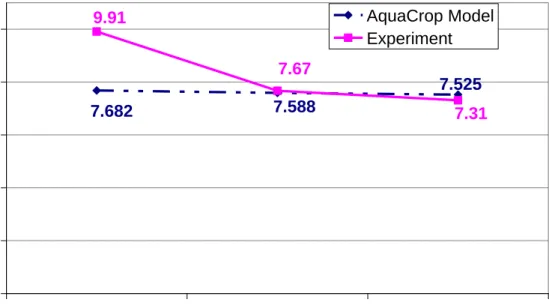
The suitability of a model in simulating a process depends on how realistic model results represent the actual biophysical process. As such, results obtained from simulations using the AquaCrop model were compared to first season measured yield of January 2013. The grain yield obtained from the experimental filed and by using the AquaCrop model are shown in Figure 1. The yield from the experimental plots and the model yield indicate some significant variation for T1 whose spacing was 25 cm x 25 cm. The grain yield obtained was 9.91 tons/ha for the experiment plots and 7.682 tons/ha for the simulated, suggesting that the model underestimated the yield by 22%. For other treatment of T2 whose spacing is 30 cm x 30 cm, and that of T3 whose spacing was 35 cm x 35 cm there is an insignificant difference in the yields. Considering the plant spacing, each single and widely spaced plant ensures enough space for tillering (Stoop et al., 2009). However, the model structure and mechanism takes less consideration of the variation in the number of productive tillers as well as the number of panicles, which are influenced by the spacing. Spacing has been noted to substantially increase the yield as reported in several studies (Mati, 2012; Satyanarayana et al., 2007; Xiaoyun et al., 2005). Figure 2 and Figure 3 show variations of number of panicles and tillers per hill. The number of panicles and the number of tiller per hill increases with increase in spacing, which is contrary to the grain yield, which increased with decrease in spacing. The findings suggest that for Mkindo area, the spacing of 25 cm or less was considered to be the optimum spacing that led to higher grain yield, though this needs to be further investigated with lower spacing.
In addition, SRI has been reported to likely produce health grains that are suitable for being used as seeds (Katambara et al. 2013); however, the effect that
the spacing have on the quality of the seeds produced requires some further investigation. The variation of the grain yield, number of tiller and number of panicles provide evidence that SRI is really empirical and call for the application of some modelling approach which are less data dependent, incorporate uncertainties and capable of incorporating human reasoning and include the fuzzy based approach. The fact that the yield of the model being similar to that of SRI for T2, suggest that AquaCrop model can be used by water basin officers for water allocation purposes in which SRI practices must be implemented.
7.682 7.588 7.525 7.31 7.67 9.91 0 2 4 6 8 10 T1 (25cm x 25cm) T2 (30cm x 30cm) T3 (35cm x 35cm) Treatments Gra in Yi eld (to ns/h a) AquaCrop Model Experiment
0 25 50 75 100 125 150 175 T1 (25cm x 25cm) T2 (30cm x 30cm) T3 (35cm x 35cm) Treatment Numb er of gra ins p er panicle
Figure 2: Number of panicles per tiller for different plant spacing.
0 5 10 15 20 25 30 35 40 T1 (25cm x 25cm) T2 (30cm x 30cm) T3 (35cm x 35cm) Treament Numb er of Tillers p er hill
Conclusion and Recommendations
The performance of AquaCrop model in simulating rice yield under SRI practice has been evaluated for Mkindo area in Morogoro Tanzania. At higher spacing of above 30 cm x 30 cm, the simulated and measured grain yields have been noted to have insignificant difference, but at a spacing of 25 cm x 25 cm SRI produced more than the model estimates. These findings call for more investigation on spacing smaller than 25 cm by 25 cm so as to identify the optimum spacing, since the number of tillers per hill and the number of panicles increased with increase in spacing. Modelling approaches such as fuzzy inference system approaches, which are capable of incorporating human reasoning, are less data intense, but incorporate uncertainty (Katambara and Ndiritu, 2010) that necessitates further study. The AquaCrop model estimates suggest that the model can be used in water allocation process for rice irrigation and water rights.
Acknowledgement
The authors acknowledge the financial support received from the Commission of Science and Technology of Tanzania (COSTECH), and FAO for providing the AquaCrop model as open source software.
References
[1] Dobermann, A., 2004. A critical assessment of the system of rice intensification (SRI).
Agricultural Systems, 79(3): 261-281.
[2] Geerts, S., Raes, D., Garcia, M., Miranda, R., Cusicanqui, J., Taboada, C., Mendoza, J., Huanca, R., Mamani, A., Condori, O., Mamani, J., Morales, B., Osco, V. and Steduto, P., 2009. Simulating Yield Response Of Quinoa To Water Availability With Aquacrop. Agronomy
Journal, 101(3): 499-508.
[3] Izzi, G., Farahani, H.J. and Oweis, T.Y., 2009. Parameterization and evaluation of the AquaCrop model for full and deficit irrigated cotton. Agronomy Journal, 101(3): 469-476. [4] Katambara, Z. and Ndiritu, J.G., 2010. A hybrid conceptual-fuzzy inference streamflow
modelling for the Letaba River system in South Africa. Physics and Chemistry of the Earth, Parts A/B/C, 35(13-14): 582-595.
[5] Katambara, Z., Kahimba, F. C., Mbungu, W. B., Maugo, M., Mhenga, F., and Mahoo, H. F. (2013), Adopting the system of rice intensification (SRI) in Tanzania: A review. Agricultural Sciences 4(8): 369-375,
[6] Kombe, E. (2012), The system of rice intensification (SRI) as a strategy for adapting to the effects of climate change and variability: a case study of Mkindo Irrigation scheme in Morogoro, Tanzania, Masters Dissertation, Sokoine University of Agriculture, Morogoro, Tanzania.
[7] Mati, B., 2012. System of Rice Intensification (SRI): Growing More Rice While Saving on Water. Kenya_SRI_Manual (http://sri.ciifad.cornell.edu/countries/kenya/index.html). [8] Ndiiri, J.A., Mati, B.M., Home, P.G., Odongo, B. and Uphoff, N., 2012. Comparison of water
savings of paddy rice under system of rice intensification (SRI) growing rice in Mwea, Kenya.
International Journal of Current Research and Review, 4(6): 63-73.
[9] Raes, D., Steduto, P., Hsiao, T.C. and Fereres, E., 2009a. AquaCrop-The FAO crop model to simulate yield response to water. AquaCrop reference manual. FAO, Rome.
[10] Raes, D., Steduto, P., Hsiao, T.C. and Fereres, E., 2009b. Aquacrop the Fao Crop Model To Simulate Yield Response To Water: Ii. Main Algorithms and Software Description. Agronomy Journal, 101(3): 438-447.
[11] Satyanarayana, A., Thiyagarajan, T. and Uphoff, N., 2007. Opportunities for water saving with higher yield from the system of rice intensification. Irrigation Science, 25(2): 99-115. [12] Steduto, P. et al., 2009c. AquaCrop: a new model for crop prediction under water deficit
conditions. Options Mediterraneennes, Series A: 285-292.
[13] Steduto, P. et al., 2009d. AquaCrop: a new model for crop prediction under water deficit conditions. FAO, Rome.
[14] Steduto, P., Hsiao, T., Evett, S., Heng, L.K. and Howell, T., 2009a. Validating the FAO AquaCrop model for irrigated and water deficient field maize. Agronomy J ournal, 101(3): 488-498.
[15] Steduto, P., Hsiao, T.C., Fereres, E. and Raes, D., 2007. AquaCrop: The FAO field-crop model to predict yield response to water.
[16] Steduto, P., Hsiao, T.C., Raes, D. and Fereres, E., 2009b. Aquacrop -The Fao Crop Model To Simulate Yield Response To Water: I. Concepts And Underlying Principles. Agron. J., 101(3): 426-437.
[17] Stoop, W.A., Adam, A. and Kassam, A., 2009. Comparing rice production systems: A challenge for agronomic research and for the dissemination of knowledge-intensive farming practices. Agricultural Water Management, 96(11): 1491-1501.
[18] Stoop, W.A., Uphoff, N. and Kassam, A., 2002. A review of agricultural research issues raised by the system of rice intensification (SRI) from Madagascar: opportunities for improving farming systems for resource-poor farmers. Agricultural Systems, 71(3): 249-274.
[19] System of Rice Intensification website (http://sri.ciifad.cornell.edu/countries/kenya/ index.html).
[20] Vishnudas, C.K., 2009. System of rice intesification (SRI) in Wayanda: Experiences of RASTA. http://www.indiawaterportal.org/node/359.
[21] Xiaoyun, L., Xiuli, X. and He, L., 2005. A socio-economic assessment of the System of Rice Intensification (SRI): A case study of Xinsheng Village, Jianyang County, Sichuan Province. Report for College of Humanities and Development, China Agricultural University, Beijing.