July 2012
Volume XV - Issue No. 3
Use of material is subject to credit being given to source: FAO
Rice Market Monitor Trade and Markets Division
Food and Agriculture Organization of the United Nations Contact or enquiries
Facsimile: ++(39-06) 570-54495 Telephone: ++(39-06) 570-54136 E-mail: [email protected] Also available on the Internet at the following address:
http://www.fao.org/economic/est/publications/rice-publications/rice-market-monitor-rmm/en/
ROUND-UP
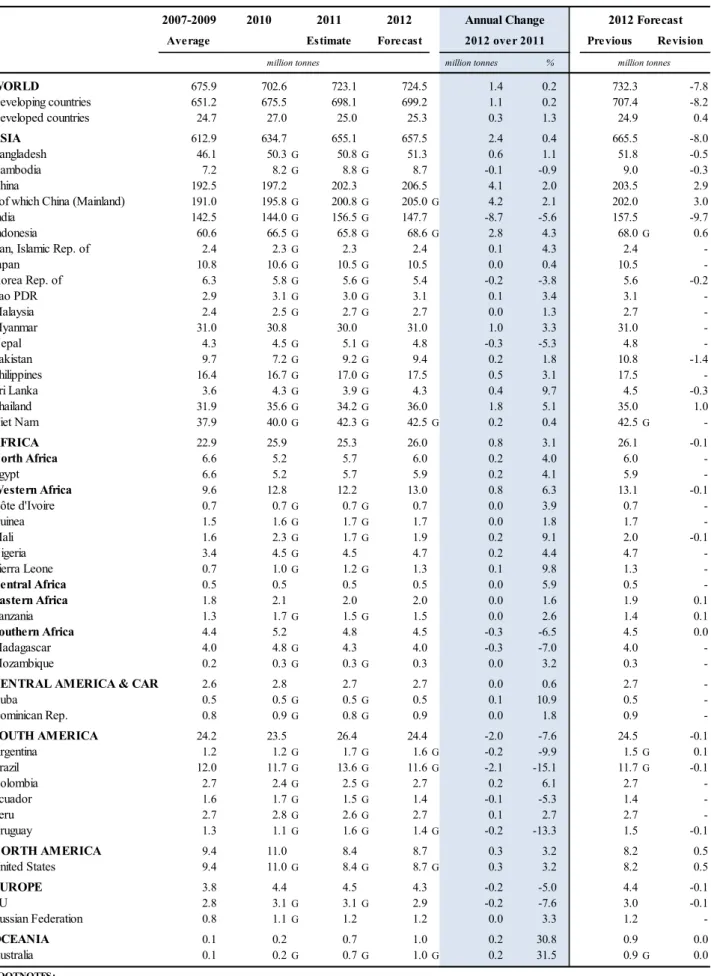
• FAO has lowered its April forecast of global paddy production in 2012 by 7.8 million tonnes following a worsening of the outlook in Asia. The downward revision mainly concerned India, where the critical monsoon rains were 22 percent short of the Long Period Average by mid-July. As the season progressed, production forecasts for Bangladesh, Brazil, Cambodia, the Democratic People’s Republic of Korea, the Republic of Korea, Mali, Pakistan and Sri Lanka were also downgraded. On the positive side, the 2012 production forecasts in China (Mainland), Indonesia, the United Republic of Tanzania, Thailand and the United States were all scaled up. At the new forecast level of 724.5 million tonnes (483.1 million tonnes, milled basis), global production in 2012 would be only marginally above the excellent 2011 results, recently further revised upwards. Across the various regions, Asia is predicted to reap 657 million tonnes in 2012, 0.4 percent above the outstanding 2011 performance. Such a modest growth reflects expectations of a poor season in India, but also in Cambodia, the Chinese Province of Taiwan, the DPR Korea, the Rep. of Korea and Nepal, all of which may see production drop in 2012. By contrast, China (Mainland), Indonesia and Thailand are anticipated to record sizeable gains, with smaller, but widespread, increases expected in the rest of the region. Production in Africa looks set to recover in 2012, possibly jumping by 3 percent, which, to a large extent, draws on expectations of an improved performance in western Africa. Prospects are also positive in Eastern and Northern Africa, but the season may end negatively in the Southern part of the continent. In Latin America and the Caribbean (LAC), a lack of precipitation and a shift towards more remunerative products in Brazil, Argentina, Paraguay and Uruguay are behind a 7 percent drop of production in the region in 2012. Yet, prospects remain positive for Bolivia, Colombia, Guyana, Peru and Venezuela. In the other regions, Australia already concluded the season with an outstanding 32 percent area-led increase. As for output in the United States, it is officially anticipated to recover from last year’s low, yet remaining well short of pre-2011 volumes. By contrast, production may fall in the EU, owing to a lingering drought in Spain. • Based on trade performance so far this year, FAO has lowered its April forecast of global rice trade
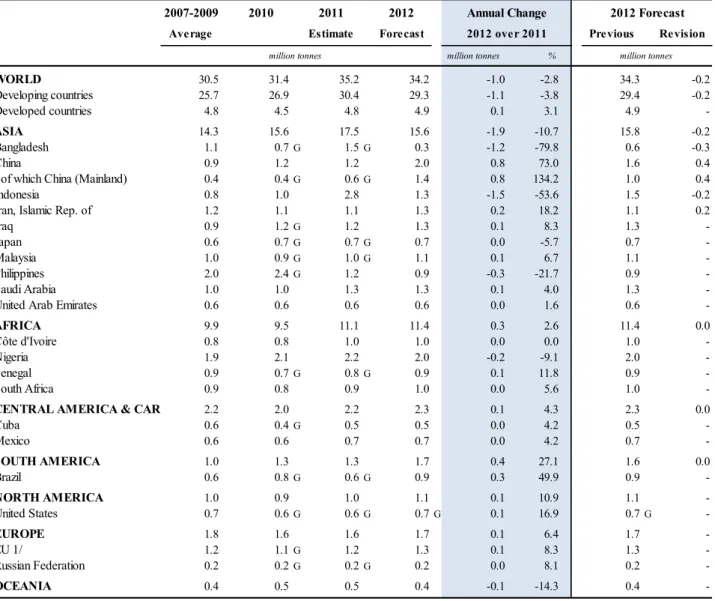
in calendar 2012 by 160 000 tonnes to 34.2 million tonnes. Import forecasts were trimmed for
Bangladesh and Indonesia, but raised for China (Mainland) and the Islamic Republic of Iran. As for export forecasts, deliveries from Pakistan, Thailand and Viet Nam have been lowered since April, outweighing upward revisions for Argentina, Brazil, India and the United States. At 34.2 million tonnes, global rice trade in 2012 would be about 1.0 million tonnes smaller than the 2011 record. Reduced import demand by countries in Far East Asia are behind this fall, as deliveries to Africa, LAC, Europe and North America are expected to rise compared with 2011. As for exports, Thailand is predicted to face a sharp decline in 2012, with Argentina, Brazil, China (Mainland), Myanmar, Uruguay and Viet Nam also foreseen to ship less. Part of these reductions are expected to be offset by greater sales, especially by India, but also Australia, Cambodia, Pakistan and the United States. • Global rice utilization in 2012/13 is projected to hover around 474 million tonnes (milled basis), 6
million tonnes more than the 2011/12 estimate. Of these, 400 million tonnes are estimated to be used as food, up from 395 million tonnes in the previous year. This would keep rice food consumption per capita stable around 56.6 kilo per annum, even though domestic prices in many locations are above those prevailing one year ago. Utilizations of rice for feed and for other uses are anticipated to change little, at 12.6 million and 61.4 million tonnes, respectively.
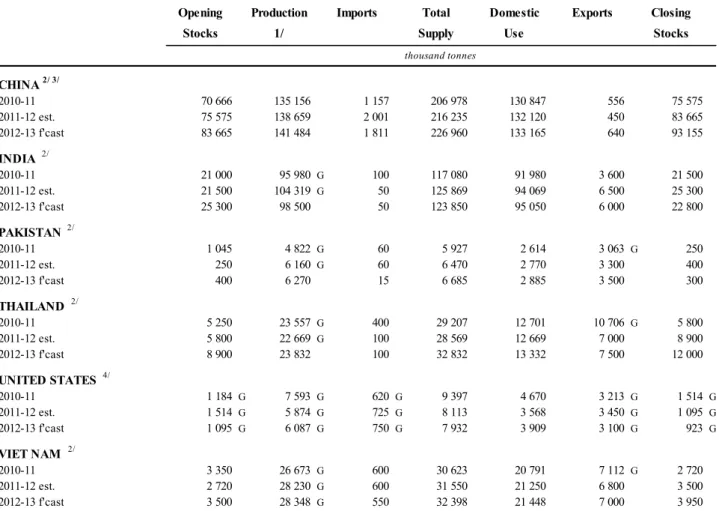
• The FAO forecast of global rice inventories at the close of the 2012-2013 marketing years has been revised up by 200 000 tonnes to 164.5 million tonnes (milled basis). At that level, carryover stocks would be 6 percent (or 8.6 million tonnes) larger than the previous year, marking the eighth consecutive season of stock accumulation. As a result, the global stock-to-use ratio would be up to an estimated 34 percent in 2013. Much of the reserve building this season is expected to be concentrated among exporting countries, while reduced imports may result in smaller reserves held by traditionally importing countries.
• After gaining 2 percent in May, international rice prices have remained surprisingly stable, in sharp contrast with trends observed in the maize and wheat markets. Although the abundance of rice supplies lessens the prospect of a strong rebounding of prices in the coming months, still much uncertainty prevails as to their future direction. For instance, the necessity for Thailand to release stocks ahead of the new harvest in October must be weighed against India’s possible consideration of a reinstatement of export restrictions, in spite of the country’s ample inventories. Developments in the other cereal markets, will also need to be closely monitored.
140 145 150 155 160 165 550 570 590 610 630 650 670 690 710 730 750 2003 2004 2005 2006 2007 2008 2009 2010 2011 2012 Production Area million hectares million tonnes
Global Rice Paddy Production and Area
f'ca
st
INFORMATION UPDATE AS OF 20 JULY 2012
I. PRODUCTION
A slow advancement of the monsoon rains in Asia depresses prospects for global production growth in 2012
At this time of the year, the 2011 rice season has come to a close and producers are concentrating on their 2012 crops. Northern-hemisphere producing countries are either engaged in or have concluded planting of their 2012 main crops, while these have already been harvested along or south of the equator.1 Thus, the weather pattern prevailing in the forthcoming few months, corresponding to a critical period for rice crop development in several of the most important producing countries, will be decisive to the outcome of the season.
Since the April issue of the RMM, various governments have released new estimates of output in 2011 and, as a result, world paddy production last season is now estimated to have totalled a record of 723.1 million tonnes (482.3 million tonnes, milled basis), 3.1 million tonnes more than previously reported and 3 percent above the already outstanding 2010 outcome. The upward revision mainly reflects more buoyant estimates in India, Indonesia and Thailand, which more than offset reductions in Colombia, Egypt, the Islamic Republic of Iran and, specially, Pakistan.
Turning to the 2012 season, FAO has lowered the global production forecast by 7.8 million tonnes to 724.5 million tonnes (483.1 million tonnes, milled basis). The adjustment primarily reflects a deterioration of crop prospects in Asia, especially for India, but also for Bangladesh, Cambodia, the Democratic People’s Republic of Korea, the Republic of Korea, Pakistan and Sri Lanka. By contrast, forecasts were raised for China (Mainland), Indonesia and Thailand. In the other regions, the 2012 outputs in Brazil and Mali were revised downwards, while they were upgraded for the United Republic of Tanzania and the United States. The revised 2012 production forecast of 724.5 million tonnes (483.1 million tonnes, milled basis), would imply a marginal increase of 0.2 percent, or 1.4 million tonnes, in world paddy production, compared with last year. The outlook is still subject to much uncertainty, especially in view of the growing probability of an El Niño event developing over the August to October period, as predicted by several weather prediction centres. There is already evidence that the onset of the rainy season in Asia, of critical importance to predominantly rainfed main crops, has got off to a difficult start. Still, and partly a reflection of the strong government assistance that the sector enjoys, the paddy season in Asia is expected to end with an overall positive result. In Oceania, a larger crop has already been collected in Australia, while outputs in Africa and North America are set to recover. On the other hand, production is expected to decline in Latin America and the Caribbean and in Europe.
1 The 2012 rice production season normally includes rice from the main paddy crops whose harvests fall in 2012, to
which rice from all subsequent secondary crops, if any, is added. In the case of northern hemisphere countries, this principle implies that production in 2012 comprises the main rice crop, which is usually collected in the latter part of the year, plus the volume obtained from the successive secondary crops, commonly harvested in the first half of 2013. In the case of southern hemisphere countries, production in 2012 normally comprises rice from the main paddy crops assembled in the first part of 2012, plus rice from the secondary crops, generally gathered in the latter part of 2012. This
A. ASIA
China (Mainland), Indonesia and Thailand behind a small increase in Asia’s paddy production in 2012
With the harvest of secondary paddy crops in northern-hemisphere producing countries completed, the 2011 season has come to a full close in Asia. Overall, the region is estimated to have produced 655.1 million tonnes (437.1 million tonnes, milled basis), 3.2 million tonnes more than previously foreseen. Compared to figures reported in April, the production estimate is now significantly higher in Thailand, now assessed to have incurred substantially less damage to the 2011 floods than originally thought. Climatic setbacks also impacted crops in other countries, especially in Indonesia, Myanmar and Sri Lanka. Despite these losses, aggregate output in the region is estimated to have topped the 2010 outcome by 3 percent. An exceptional performance in India made possible by favourable weather, was largely behind the increase, although sizeable gains were also registered in China (Mainland), Pakistan, and Viet Nam.
As for the 2012 season, it is at early stages in many important Asian producing countries. FAO’s latest forecast for production in the region points to a small 0.4 percent, or 2.4 million tonne, expansion from the 2011 excellent outcome, to 657.5 million tonnes (438.5 million tonnes, milled basis). Much of the progress is expected to reflect gains in China (Mainland), as well as recoveries in Indonesia and Thailand. Despite being subject to downward revisions, output prospects remain favourable for Bangladesh, Pakistan and Sri Lanka, with larger crops also anticipated in Japan, the Islamic Republic of Iran, the Lao People’s Democratic Republic, Myanmar, the Philippines and Viet Nam. On the other hand, the slow and erratic advancement of the southwest monsoon has warranted a downgrading of production prospects for India, now anticipated to face a contraction from 2011. Unfavourable climatic conditions are also behind expectations of smaller crops in Cambodia, the Chinese Province of Taiwan, the Democratic People’s Republic of Korea, the Republic of Korea and Nepal.
In Bangladesh, the 2012 season is still at early stages, with the harvest of the Aus crop, the first and smallest of the three crops produced every year, currently underway. Whilst lowered by 450 000 tonnes, FAO’s production outlook for the country remains favourable pointing to a harvest of 51.3 million tonnes (34.2 million tonnes, milled basis) or 1 percent above the 2011 record. This is notwithstanding prospects for falling farm prices and profit margins. Indeed, average wholesale prices in Dhaka during June stood 11 percent below their level a year earlier at Taka 28.5 per kilo (USD 344 per tonne).2 The Government is, however, taking steps to provide relief to producers, who since 2011 have faced higher prices of energy, fuel and fertilizers. Officials announced in May that the state would procure 900 000 tonnes of Boro rice and 150 000 tonnes of paddy at Taka 28 and 18 per kilo (USD 338 and 217 per tonne) respectively, from 3 May until 30 September 2012.
2 All currency conversions are as on 1 July 2012.
0 100 200 300 400 500 600 700 2008 2009 2010 2011 2012
Rice Paddy Production in Asia
Others Viet Nam Bangladesh Indonesia India China million tonnes
This is on top of the 350 000 tonnes of 2011 Aman rice already procured by the public sector. Further to the continuing distribution of subsidised seeds and fertilisers, plans have also been laid out to expand public food storage infrastructure for a total capacity of 2.2 million tonnes by 2015. Additional incentives have been announced as part of the 2012 budgetary outlays, including the exemption of agricultural machinery and processing equipment from value added taxes.
In Cambodia, farmers are busy planting their main season crops, which will only be gathered between December and January. Based on official assessment of crop progress to June, below average rainfall conditions have slowed the sowing of the main crop, now standing at 857 000 hectares, 69 000 hectares behind the previous year’s extension. Much as a result of these delays, FAO now anticipates 8.7 million tonnes to be gathered in the country during the season (5.6 million tonnes, milled basis), 1 percent below the 2011 outcome, but still the second largest on record. Despite some localised drought problems and concerns over pest attacks, semi-official forecasts of rice production in China (Mainland) released by the China National Grain and Oils Information Centre suggest that the first early rice crop will be 1 percent larger than in 2011, reaching some 33.0 million tonnes (22.6 million tonnes, milled basis). The outlook is even more favourable for the intermediate crop, currently at vegetative stage. On the back of expanded area, this most important crop, which accounts for roughly two-thirds of the seasonal output, is anticipated to surpass the previous year’s level by 2 percent, to reach 136.1 million tonnes (93.2 million tonnes, milled basis), adding to an expected stable late rice harvest of 35.9 million tonnes (24.6 million tonnes, milled basis). As a result, overall production in China (Mainland) is predicted to reach 205.0 million tonnes (140.4 million tonnes, milled basis), 3.0 million tonnes more than previously foreseen and 2 percent above last year’s record. The continuous production gains recorded since the early 2000s are consistent with the strong government support granted to the cereal sector, including heightened support prices over the season.
Prospects are not as favourable in the Chinese Province of Taiwan, where the collection of the season’s main crop is nearing completion. Indeed, 13 000 hectares of paddies were damaged by torrential rains and floods brought by the June landfall of Tropical Storm Talim. As a consequence, production in the Province is now anticipated to fall to 1.45 million tonnes (1.06 million tonnes, milled basis), 6 percent below the 2011 estimate. Affected producers are to be assisted, however, in particular through the purchase of damaged produce and extension of subsidised credit.
Following the harvest of secondary Rabi crops completed in May and based on the “Fourth Advanced Estimates”, officials in India have raised the 2011 production figure to a new record of 156.5 million tonnes (104.3 million tonnes, milled basis), up 9 percent year-on-year and 1.4 million tonnes more than previously assessed. On the other hand, the 2012 season opened with the arrival of the southwest monsoon over the coast of Kerala on 5 June, four days behind its usual arrival date. Since then, progress of the seasonal rains has been slow and erratic, with the cumulative precipitation for the country as a whole between 1 and 18 July gauged 22 percent below the Long Period Average. Important producing states such as Punjab, West Bengal and Uttar Pradesh have all received deficient precipitation, although rains have fared better over eastern producing areas. The slow advancement has implied significant delays in plantings of the predominantly rainfed Kharif crops, as, by 20 July, 14.5 million hectares were reported to have been put under paddy, 6 percent below normal and 10 percent less than in 2011. With the optimal period for sowing activities coming nearly to a close, the persistent dryness could not only cancel out area gains, but also entail some yield losses. Against this background, FAO has lowered its April forecast for production in India by 9.8 million tonnes to 147.7 million tonnes (98.5 million tonnes, milled basis), which would imply a 6 percent contraction from the 2011 high. Indeed, and provided deficient rains don’t compromise supplies of water availability for irrigation, part of the losses resulting from the unfavourable climate could still be recuperated with the secondary Rabi crop. This would be
particularly the case considering public support provided to the sector, which this season also includes a 16 percent increase in minimum support prices to Rupees 12 500 per tonne of common varieties and Rupees of 12 800 per tonne of Grade A paddy (USD 224 and 229 per tonne, respectively).
India – Rainfall during monsoon season No. of Meteorological
Sub-Divisions with rainfall
For the period from 1st June to:
18 July
2007 16 July 2008 15 July2009 21 July2010 20 July2011 18 July2012 Excess Normal Total 16 13 29 14 08 22 02 12 14 05 21 26 08 22 30 01 10 11 Deficient Scanty No rain Total 07 00 00 07 13 01 00 14 20 02 00 22 10 00 00 10 06 00 00 06 22 03 00 25 Data Inadequate 00 00 00 00 00 00 TOTAL 36 36 36 36 36 36 Notes:
Excess = + 20% or more than normal rainfall; Normal = +19% to 19%; Deficient = 20% to 59%; Scanty = 60% to -99%
Source: India Meteorological Department (Ministry of Earth Sciences)
India – Minimum Support Prices (MSP) for Paddy Rice (Rupees/tonne)
2008/09 2009/10 2010/11 2011/12 2012/13
Common 8,500 1/ 9,500 2/ 10,000 10,800 12,500
Grade ‘A’ 8,800 1/ 9,800 2/ 10,300 11,100 12,800
1/ Subject to an additional incentive bonus of Rs. 500 per tonne. 2/ Subject to an additional incentive bonus of Rs. 500 per tonne. Source: Ministry of Agriculture, Department of Agriculture & Cooperation.
On the other hand, with over two months left for the purchasing campaign to be completed, public procurement in India continued at an unprecedented pace: as of 13 July, state agencies had purchased 34.5 million tonnes of rice, which compares to 34.1 million tonnes during the full 2010-2011 campaign and an initial procurement target of 35.3 million tonnes. Despite a more active involvement of the country in the export market since September 2011, such an active pace of purchases has put considerable pressure on state granaries, specially against the backdrop of equally record breaking wheat procurement. The situation has prompted a number of measures to be announced to buttress state storage and handling capacity. Officials have also been encouraged to offload greater quantities to the local market, including by raising subsidised sales of wheat and rice through the Public Distribution System by an additional 5.0 million tonnes for Below Poverty Line families and by 6.0 million tonnes for families categorized as Above Poverty Line.
Located in the southern hemisphere, Indonesia has already collected the bulk of its 2012 paddy crops. Based on July official forecasts, the season is likely to unfolded well, with a return to normal weather conditions facilitating a 1.8 percent increase in area to 13.4 million hectares. Moreover, as favourable weather conditions and fewer pest attacks are expected to boost yields, output in the country could reach 68.6 million tonnes (43.2 million tonnes, milled basis), up 2.8 million tonnes from the poor 2011 outcome. Much of the year’s projected recovery is anticipated to originate in Java, which normally accounts for over half of total output. Pressure, in Java, to convert agricultural land to other uses is encouraging the authorities to promote rice cultivation outside of this isle. The
latest of such initiatives aims to put 100 000 hectares of land under rice cultivation in Kalimatan. Similar programmes were launched in 2009, with the purpose of opening over a million hectares in estate farms in the Papua region for the cultivation of various crops, including rice. The project appears to have made little headway since then, constrained by difficulties in securing access to land and insufficient infrastructure capacity to sustain productive activities. These factors would have recently led officials to rescale the project’s target extension for cultivation to 200 000 hectares.
The 2012 paddy crop in Japan is at a vegetative stage, having been sown between April and May. FAO has kept its production forecast for the country unchanged, with output expected to remain largely stable at 10.5 million tonnes (7.6 million tonnes, milled basis).
The outlook for the Democratic People’s Republic of Korea is less favourable. Planting activities of paddy crops, which normally take place in May-June, were hindered this season by a prolonged dry spell that started in May. Above average temperatures and deficient rains affected crops in important producing areas, including South Hwanghae, and North and South Pyongyang, compounding on the country’s already constrained irrigation capacity and limited availability of agricultural inputs. Consequently and while the full extent of damages to paddy crops caused by the drought is not yet clear, FAO has tentatively set its production forecast for the country at 2.3 million tonnes (1.5 million tonnes, milled basis), which would be 7 percent below the 2011 outcome.
Severe precipitation shortfalls have also impacted the Republic of Korea, in what has been the worst drought recorded in the country since 1908. Whilst early July rains are reported to have provided some respite to crops, which are predominantly grown under irrigated conditions, delayed plantings due to the prolonged spell, potentially also entailed some yield losses. These, coupled with a declining area driven by official incentives, are presently foreseen to lead to a 4 percent output contraction in the country to 5.4 million tonnes (4.0 million tonnes, milled basis).
At this time of the year, the bulk of the 2012 paddy crop has already been collected in Malaysia. FAO’s current outlook foresees the country replicating the excellent 2011 outcome with output amounting to 2.7 million tonnes (1.7 million tonnes, milled basis). At this level, local production would be sufficient to cover nearly 70 percent of the country’s domestic food needs, matching the self-sufficiency target established in the Tenth Malaysia Plan (2011-2015). Recent official statements, however, suggest that the officials would be considering raising the target to 80 percent by the year 2020, primarily through yield gains. Emphasis on productivity enhancement, value addition, marketing, research and development are at the heart of the National Agro-Food Policy 2011-2020, the current framework for the country’s food security policy.
Sowing of early paddy crops is still underway in Nepal. In 2011,the country officially reported to have gathered a record crop of 5.1 million tonnes (3.3 million tonnes, milled basis), predominantly thanks to higher yields, which were boosted by timely and abundant rains and good availability of agricultural inputs. For 2012, FAO anticipates Nepal to gather 4.8 million tonnes (3.2 million tonnes, milled basis), somewhat less than last year. The decline rests on expectations of average yields returning to more normal levels, especially as shortages of inputs, namely fertilisers, have been reported to be hampering planting activities in the western part of the country.
In Pakistan the official 2011 production estimate has been subject to a 1.1 million tonne downward revision to 9.2 million tonnes (6.2 million tonnes, milled basis). The adjusted figures would still imply an impressive 28 percent upturn from the 2010 level, which was severely impacted by devastating floods. Turning to the 2012 season, rice crops have just been put on the ground and will not be harvested before September-October. FAO foresees Pakistan to reap 9.4 million tonnes of paddy rice (6.3 million tonnes, milled basis), 1.4 million tonnes less than previously foreseen, but
still 2 percent more than in 2011. The outlook has been somewhat dampened by reports of protracted water shortages in Sindh, as well as sustained concerns in Punjab over the stagnating basmati yields and its substitution with common varieties. The sector is also constrained by energy shortages, which have impacted the local urea industry, putting significant upward pressure on domestic fertilizer prices. Still, the forecast rice production growth is expected to rely on larger plantings, as prospects of favourable returns have stimulated a switch from other crops to rice cultivation.
Pakistan – Average retail prices of fertilizers (Rupees/50 Kg. bags)
2007/08 2008/09 2009/10 2010/11 2011/121/ Urea 581 751 799 1,035 1,705 Diammonium Phosphate 1,934 2,578 2,267 3,236 4,118 Nitrophosphate 1,267 1,700 1,452 2,108 2,768 1/ Provisional (Jul-Mar)
Source: Pakistan Bureau of Statistics- National Fertilizer Development Centre
In the Philippines the 2011 season has just come to a close with the harvest of dry-season paddy crops. Officials assessed the volume collected in April-June 2012 at 7.9 million tonnes (5.2 million tonnes, milled basis), up 4 percent year-on-year. This increase was sufficient to offset the 1 percent decline in the storm-reduced main crop, bringing total production for the 2011/12 season to 16.98 million tonnes (11.1 million tonnes, milled basis), 1.5 percent above the previous season’s level. As to the 2012 season, FAO has kept its outlook for the country unchanged at 17.5 million tonnes (11.5 million tonnes, milled basis), or 3 percent more than the current 2011 estimate. Based on a Government survey of planting intentions, 3.4 million tonnes are to be produced between in July and September this year, with much of this growth deriving from area expansions. The Government of the Philippines is also keen to stimulate further output gains, in a bid to fulfil its rice self-sufficiency ambitions by 2013. To this effect, it allocated Pesos 2.6 billion (USD 62 million) for distribution of machinery and equipment to producers during the year, under an initiative set out in the Food Staples Self-sufficiency Roadmap (FSSR). Officials would be further reviewing proposals to form a joint-venture with Saudi Arabian investors, which would concern up to 200 000 hectares of land under paddy cultivation.
The 2012 season is fairly advanced in Sri Lanka, where the main (Maha) crop has already been collected. The outlook for the country has deteriorated somewhat since April, due to the development of drought conditions, which are impacting the secondary (Yala) crop. Precipitation shortfalls, specially over North-western and North Central provinces, are estimated to have induced a 28 percent contraction in Yala plantings to 349 000 hectares. This compares to a 515 000 hectare extension initially targeted for the crop. While the dry spell is presently expected to cut 2012 Yala output by an estimated 33 percent to 1.9 million tonnes (1.3 million tonnes, milled basis), the shortfall is likely to be more than compensated by a larger Maha crop. Indeed, harvest of this main crop is officially estimated to have struck a new high of 3.0 million tonnes (2.0 million tonnes, milled basis), supported by favourable growing conditions. As a result, Sri Lanka is foreseen to gather 4.3 million tonnes (2.9 million tonnes, milled basis) over the full season, still 10 percent above the flood-reduced 2011 outcome, but short of the record 4.3 million tonnes gathered in 2010.
In Thailand, the 2011 production estimate has been officially raised to 34.2 million tonnes (22.7 million tonnes, milled basis), 4 percent less than in 2010, but 2.6 million tonnes more than previously reported. The severe floods that affected the country are now gauged to have curtailed the main-crop output by 10 percent to 22.99 million tonnes (15.2 million tonnes, milled basis). On the other hand, officials have confirmed expectations of an 11 percent increase in the March started second crop harvest to 11.2 million tonnes (7.5 million tonnes, milled basis), resulting from greater area coverage stimulated by high prices under the government pledging programme. Regarding the 2012 season, output from the main crop is officially forecast to rebound by 13 percent to 25.88 million tonnes (17.1 million tonnes, milled basis). For the full season FAO anticipates Thailand to harvest a record of 36.0 million tonnes (23.8 million tonnes, milled basis), up 5 percent from the 2011 estimate, largely on expectations of generally normal rainfall performance between June and September 2012.
Meanwhile, mortgaging of the 2011 secondary rice crop under the offseason round of the paddy pledging programme has been progressing fast. After absorbing 6.8 million tonnes of paddy from 2011 main crop output, 9.5 million tonnes of the secondary crop are reported to have been mortgaged by 986 000 farmers, between 1 March and 8 July. This compares to an initial expected volume of 8.0 million for the full second round of the programme. Thai officials have already announced plans to extend the programme to the 2012 crops. While it has been suggested that the timing of the programme may be adjusted in order to ensure coverage of out-of-season crops, official statements indicate that mortgaging prices will remain unchanged. Under the programme’s current conditions, farmers receive between Baht 13 800 and 20 000 (USD 431-625) per tonne of paddy they choose to pledge, for a maximum quantity of 33 tonnes or value equivalent of Baht 500 000 (USD 15 615).
In Viet Nam producers are busy harvesting the summer-autumn paddy, the second of the three crops produced each year. The season progressed well to date, with the June completed harvest of the most important winter–spring crop officially assessed at 20.25 million tonnes (13.5 million tonnes, milled basis), up 2.4 percent from 2011, primarily due to higher yields. As of 15 of June, area coverage of the summer-autumn paddy, largely concentrated in the Mekong Delta region, was reported to be slightly ahead of its pace in 2011. As a result, and provided the climate remains favourable throughout the remainder of the season, FAO anticipates the country to reap 42.5 million tonnes (28.3 million tonnes, milled basis), up slightly from the 2011 record.
In July, Vietnamese authorities announced a stockpiling plan of 500 000 tonnes of summer-autumn paddy, to be undertaken between July and August. The initiative is geared at ensuring that farmers receive a 30 percent profit margin for their produce. It follows a 1.0 million tonne procurement drive similarly undertaken to support the 2012 winter-spring harvest. In May, the Vietnamese Government also took steps to arrest the conversion of area dedicated to rice cultivation to other uses, requiring any transfer to meet specific criteria and receive prior approval by authorities. With a fund of Dong 4 trillion (USD191 million) announced for implementation, the new provisions, effective 1 July 2012, also extend Dong 500 000 (USD 25) of financial support per hectare of wet paddy cultivated each year, covering between 50-70 percent of costs of fertilisers and other inputs
0 3 6 9 12 15 0 8 16 24 32 40 2002 2003 2004 2005 2006 2007 2008 2009 2010 2011 2012 Million/Ha. Million Mt.
Main Minor Area
Thailand: Paddy Production 2002-2012
f'ca
when crops incur significant damages to natural disasters or disease. Financial provisions to support land reclamation or rehabilitation for paddy cultivation purposes were also included. The measures intend to ensure that the area planted to paddy does not fall below 3.8 million hectares by 2020.
B. AFRICA
Larger crops in West Africa behind expected 3 percent output recovery in the region At this time of the year, Eastern and Southern African countries have already collected main paddy crops, while producers in various West African countries are still engaged in planting activities that were launched with the arrival of the seasonal rains. FAO’s 2012 production outlook for Africa points to a 773 000 tonne recovery in output to 26.0 million tonnes (17.0 million tonnes, milled basis). Much of the forecast growth is expected to stem from gains in Western African countries, although overall prospects are also positive for Eastern African and Egypt. Based on the latest figures, these gains would be more than sufficient to compensate for declines in southern parts of the continent.
In Northern Africa, the 2011 production estimate for Egypt has been revisited, based on a slightly lower estimate of area under paddy. Production in the country is nonetheless estimated to have surpassed the 2010 low level by 10 percent to 5.7 million tonnes (3.9 million tonnes, milled basis). Over the 2012 season, producers are expected to continue expanding rice acreage, based on prospects of remunerative prices, but also of a potential review of existing restrictions on rice exports following the instalment of a new Government administration. As a result, FAO forecast production by Egypt to amount to 5.9 million tonnes (4.1 million tonnes, milled basis), up 4 percent year-on-year.
In Western Africa, the 2012 paddy campaign was launched between April and June, with the arrival of the season’s first rains. May predictions of rainfall performance over the sub-region pointed to average to above-normal precipitation in eastern parts of the Sahel, West African coastal nations and portions of Burkina Faso, Togo, Benin and Ghana, but to average-to-deficient precipitation in parts of Mali, Mauritania and Senegal. Assuming no major shock throughout the rest of the season, West African countries are forecast to gather a total of 13.0 million tonnes (8.2 million tonnes, milled basis). This level would represent a 6 percent recovery from the 2011 season, when crops in various countries were negatively impacted by late and erratic precipitation. Based on the latest figures, Benin, Burkina Faso, Ghana, Guinea, Liberia, and Togo are all set to gather larger crops, with particularly large increases anticipated in Mali, Nigeria, Senegal and Sierra Leone.
In Liberia, the launch of 2012 planting activities in April is reported to have taken place under generally favourable conditions, on the backdrop of a timely arrival of rains. FAO anticipates production in the country to amount to 300 000 tonnes in 2012 (195 000 tonnes, milled basis), up 1 percent from the 2011 result. While efforts to promote the adoption of low land varieties are underway, the country is also set to benefit from financial assistance under a project financed by the Africa Development Bank. The initiative seeks to raise production of cassava and rice across twelve of the fifteen existing counties, by boosting research and storage capacity, technical training and marketing.
While planting activities are ongoing in Mali, officials have announced a production target of 2.58 million tonnes (1.8 million tonnes, milled basis) for 2012, a level that, if achieved, would beat the 2010 record by 12 percent. The Office du Niger is foreseen to harvest 701 295 tonnes, or roughly 40 percent of the total. These output objectives are expected to be supported by a continuance of
agricultural input subsidies on items such as seeds and fertilisers. However, FAO’s outlook for 2012 is more modest, mainly due to the political unrest currently affecting the country, which has resulted in large population displacements, disrupted markets and reduced availability of productive assets. Mali is currently foreseen to gather 1.9 million tonnes (1.3 million tonnes, milled basis), a level that would nonetheless point to 9 percent recovery from the 2011 poor outcome.
FAO currently anticipates Nigeria to harvest 4.7 million tonnes of paddy (2.8 million tonnes, milled basis) in 2012, or 4 percent more than in 2011. Since first announcing the Agricultural Transformation Action Plan (ATAP), officials have taken several measures to promote growth in the local rice sector. These have involved an overhaul of the fertiliser distribution system, the elevation of border protection and the introduction of a scheme geared at improving producer access to credit. Although efforts to boost output in the country have traditionally relied on the promotion of NERICA varieties, hybrid rice is to be introduced through a partnership with China. China is also to assist in the construction of 100 mills across the country.
In Senegal, the 2012 season started with the June-July planting of main season crops. FAO foresees production in the country to recover from last year unfavourable growing conditions, reaching 610 000 tonnes (427 000 tonnes, milled basis), or 39 percent more than in 2011. The new Senegalese administration would also appear to support the previous government’s rice self-sufficiency objective. Based on official statements, this is to be pursued through the reclamation of up to 100 000 hectares of land and support to the predominantly rainfed southern and eastern areas, including the important producing region of Casamance.
In Eastern Africa, FAO has lowered its 2011 production estimate for Ethiopia, following the release of an official figure of 90 000 tonnes (59 000 tonnes, milled basis). This would imply a 36 percent year-on-year decline, imputable to area reductions, as farmers reacted to more attractive prices of alternative crops. In 2012, production is forecast to recover to 104 000 tonnes (67 000 tonnes, milled basis), still short of the 2010 high of 140 000 tonnes, mainly due to the delayed and erratic rainfall.
The 2012 paddy harvest in Kenya is anticipated to remain largely unchanged from the previous year, at some 45 000 tonnes (29 000 tonnes, milled basis). Rice in Kenya is predominantly grown under irrigation and support programmes have primarily focused on expanding irrigation capacity. Although planned outlays for 2012 appear to confirm the continuation of irrigation development projects, the Government has also outlined debt relief measures for producers of rice and other crops.
In the United Republic of Tanzania, the production estimate for 2011 has been lowered, following the release of an official figure that points to a larger decline than previously foreseen. Authorities estimated that 1.46 million tonnes (950 000 tonnes, milled basis) were harvested in 2011, 14 percent below a revised 2010 output of 1.7 million tonnes (1.1 million tonnes, milled basis). For the ongoing season, which is currently at the main crop harvest stage, FAO anticipates production in Tanzania to recover by 3 percent to 1.5 million tonnes (975 000 tonnes, milled basis). Despite an erratic performance of the rains over some regions and reported input shortages in Zanzibar, the
0 4 8 12 16 20 24 28 2008 2009 2010 2011 2012
Rice Paddy Production in Africa
Egypt Nigeria Madagascar Mali Others million tonnes
expected increase in output rests on expectations that favourable price prospects will boost plantings. Meanwhile, plans to enhance irrigation capacity, alongside investment in rice processing and marketing have been laid out, through a Shillings 16.7 billion (USD 10.5 billion) allocation under the Tanzania Agriculture and Food Security Investment Plan (TAFSIP). The initiative is geared at guiding the implementation of the country’s commitments under the Comprehensive Africa Agriculture Development Programme (CAADP). It will focus on boosting output through private sector alliances over 350 000 hectares across five regions.3
In Southern Africa, the 2012 main season harvest was concluded in June in Madagascar. FAO’s production outlook for the country remains negative pointing to a second consecutive season of contractions to 4.0 million tonnes (2.7 million tonnes, milled basis). The 7 percent year-on-year fall is mainly attributable to damages from the passage of storms, although late and erratic rains also impacted activities at the onset of the season.
By contrast, Mozambique is estimated to have ended the 2012 rice campaign with an output of 280 000 tonnes (187 000 tonnes, milled basis), or 3 percent above 2011. This is despite some localised damage to crops caused by intense rains and floods. The January inundations would have inflicted some damage to the country’s largest irrigation scheme, Chokwe, where salinity problems are additionally being reported. Repair and upgrade works would however be presently ongoing thanks to external support, including that of China. A separate major irrigation perimeter in the Gaza province also looks set to benefit from support by the Asian country, mainly in the area of technical training to boosting yields, while separate investments to raise processing capacity would be equally underway. Meanwhile, officials in Zambia estimate area declines to have resulted in an 8 percent drop of production to 45 000 tonnes (30 000 tonnes, milled basis).
C. CENTRAL AMERICA AND THE CARIBBEAN
Little change in production foreseen in 2012
Main paddy crops are already in the ground in most countries located in Central America and the Caribbean, as planting of the 2012 new crops were launched in most of the sub-region from April to May, coinciding with the arrival of the seasonal rains. The success of these crops will depend, to a significant extent, on the unfolding of the Atlantic Hurricane season, which extends from June to November. Based on May forecasts released by NOAA’s Climate Prediction Centre (CPC) hurricane activity in the Atlantic basin is to remain at near-normal levels this season, which would imply a less intense hurricane activity than witnessed in recent years. FAO’s production outlook for Central America and the Caribbean indicates little change relative to the 2011 level, with 2.7 million tonnes (1.8 million tonnes, milled basis), expected to be gathered, up 0.6 percent year-on-year. The forecast reflects expectations of production gains in Cuba, the Dominican Republic, Mexico and Nicaragua, which are expected to outweigh declines in Costa Rica and Panama. In Cuba, producers have just concluded the planting of 2012 spring crops, which will be harvested between October and December. In support of productive activities this season, Cuban officials have announced that up to USD 108 million would be spent over the year to provide machinery and inputs to producers. The funds would be part of a USD 450 million package, to be released through 2016, to purchase machinery and equipment, boost seed production and improve storage and processing capacity. Partly reflecting these efforts to reduce reliance on imports, FAO currently anticipates Cuba’s production to expand 50 000 tonnes to 510 000 tonnes in 2012 (340 000 tonnes, milled basis). The outlook is likewise positive for Nicaragua, where FAO forecasts a 4 percent
growth of output to 440 000 tonnes (286 000 tonnes, milled basis). Under a “Crissol Program”, the Government will be assisting some 6 500 smallholders to produce rice over 9 000 hectares through an interest-free credit facility, as part of an overall strategy to boost cereal output by 6 percent this year. Elsewhere in the sub-region, Panama is anticipated to face a production drop of 12 percent to 268 000 tonnes (175 000 tonnes, milled basis), asunremunerative prices and rising production costs are reported to be encouraging producers to substitute paddy for other crops.
D. SOUTH AMERICA
2012 production in South America to fall 8 percent short of the 2011 record
The 2012 season has already concluded or is nearing completion in various South American countries. Overall, the season yielded negative results, as unfavourable weather compounded on lower prices and higher production costs. Overall, the region is estimated to have gathered 24.4 million tonnes in 2012 (16.4 million tonnes, milled basis), representing a 8 percent area-led decline from the 2011 record output level. At a country level, Brazil was responsible for much of the contraction, although expectations of lower prices and dry conditions under the influence of the La Niña event also impaired production in Argentina, Paraguay and Uruguay. The season is unfolding more positively in Bolivia and Guyana, while production in Colombia, Peru and Venezuela also registered recoveries.
The latest assessment of production in Argentina points to a 10 percent contraction from the 2011 high to 1.55 million tonnes (1.1 million tonnes, milled basis). Much of the decline concentrated in the second most important producing region of Entre Rios, where output fell by 23 percent to 571 000 tonnes (388 000 tonnes milled basis), as producers turned to more profitable crops. Inadequate water availability also constrained production in Corrientes, the largest producing region, which experienced a 10 percent decline to 629 000 tonnes (428 000 tonnes, milled basis). The 2012 season harvest has been completed in Bolivia. FAO estimates production in the country to have reached 600 000 tonnes (412 000 tonnes, milled basis), up 3 percent from the already favourable 2011 harvest, owing to an expansion in plantings. Notwithstanding the favourable outcome, the season was not without setbacks. Dryness impacted crops early in the season, while heavy rainfall and localised floods were reported to have inhibited gathering activities over 10 000 hectares, potentially also compromising the quality of produce in affected areas.
While the bulk of the 2012 crop has already been harvested in central and southern Brazil, farmers in northern and north-eastern regions are still busy collecting crops. CONAB’s July crop assessment has only slightly revisited Brazil’s 2012 production forecast, which still indicates a 15 percent, or 2.1 million tonne drop to 11.6 million tonnes (7.7 million tonnes, milled basis) from the 2011 record. The production decline was mainly driven by a contraction of plantings, much of which was concentrated in the major producing state of Rio Grande do Sul, where difficulties in marketing the 2011 record harvest led farmers to shift to other products. While, overall average productivity is
0 4 8 12 16 20 24 28 32 2008 2009 2010 2011 2012
Rice Paddy Production in Latin America and the Caribbean
Brazil Colombia Peru Uruguay Others million tonnes
estimated at a relative high level of 4.7 tonnes per hectare, this was less than the 4.8 tonnes per hectare obtained in 2011, reflecting scanty rainfall, particularly in upland rice areas.
Brazil: Paddy Production by Region in 2011 and 2012 (for Brazil: 2010/11 and 2011/12 paddy seasons)
Region
Area
(000 ha) (kg/ha) Yields Production (000 Mt)
2011 2012 Var% 2011 2012 Var% 2011 2012 Var%
Brazil 2,820 2,453 -13.0 4,827 4,712 -2.4 13,613 11,559 -15.1 North 359 317 -11.6 2,854 2,904 1.8 1,024 921 -10.0 Northeast 683 612 -10.5 1,792 1,237 -31.0 1,225 757 -38.2 Centre-West 356 233 -34.6 3,132 3,201 2.2 1,115 745 -33.2 South East 61 53 -12.9 2,611 2,877 10.2 159 152 -4.0 South 1,362 1,239 -9.0 7,412 7,252 -2.2 10,091 8,984 -11.0
Source: CONAB – Tenth Crop Assessment – July 2012
The season is not as advanced in Colombia, where the main summer crop is presently being gathered. FAO has left the country’s 2012 production forecast unchanged at 2.7 million tonnes (1.8 million tonnes, milled basis), which is 6 percent more than in 2011. Meanwhile, in a bid to assist the agricultural sector through a lowering of production costs, in May the Colombian Government took steps to simplify procedures to source supplies, such as fertilizers and pesticides, from abroad. Any legal person or entity is now permitted to import agricultural inputs directly for its own use. In Ecuador, the 2012 main crop harvest has already been concluded and producers are now planting the secondary paddy crops. The production outlook for the country has deteriorated since April, on evidence of greater losses having been caused by excessive rains and floods that hit the country early this year. While measures have been taken to contain plagues, widespread infestations (mainly of golden apple snails, but also of fungal diseases) have also been reported. As a result, FAO now anticipates output in the country to amount to 1.4 million tonnes (798 000 tonnes, milled basis), down 5 percent from a revised 2011 level. On the policy front, minimum prices were raised by 7 percent in May, bringing the value of a 200 pounds sack of paddy to USD 33.25 (USD 367 per tonne).
At this time of the year, the bulk of the 2012 paddy crop has already been collected in Peru. FAO estimates generally favourable weather conditions and sufficient supplies of water for irrigation to have fostered a 3 percent recovery of plantings to 370 000 hectares. Mainly reflecting these gains, production in Peru is forecast to reach 2.7 million tonnes (1.8 million tonnes, milled basis), 3 percent more than last year. Declining producer prices have nonetheless proved a concern to the sector, especially as it faced rising production costs. To assist producers, the Peruvian Government has allocated funds to support harvesting and marketing activities and set-out debt-relief measures. In addition, plans would have officials purchasing 20 000 tonnes from farmers in main producing regions through the National Food Assistance Program (PRONAA) as well as promoting rice exports.
July marks the end of the 2012 harvest in Uruguay, where officials estimate production to have contracted by 13 percent to 1.4 million tonnes (997 000 tonnes, milled basis). Part of the decline reflected constraints in the availability of water for irrigation, as well as pressure from rising production costs. Moreover, setbacks that were incurred at sowing time due to untimely rains are now assessed to have depressed average yields by 7 percent to 7.9 tonnes per hectare, down from the record 8.4 tonnes per hectare in 2011. Although still very early, given that planting activities are not set to start until October, an official assessment of planting intentions for the 2013 season, points to further area declines in the country, with a total of 179 000 hectares expected to go under paddy over the next season, which compares with 181 000 hectares harvested in 2012.
After reaching a high of 1.4 million tonnes in 2008, paddy production in Venezuela was significantly constrained by unfavourable weather conditions in 2010 and 2011. FAO anticipates production to recover in 2012 to some 1.1 million tonnes (785 000 tonnes, milled basis), up 33 percent year-on-year. A return to a more normal weather conditions is anticipated to support the output growth, along with government assistance in the form of higher producer prices, distribution of inputs and subsidised credit. Reports, however, point to agricultural activities in the important producing areas of Portuguesa and Guárico being hindered by shortages of electricity and fuel.
E. NORTH AMERICA, EUROPE AND OCEANIA
2012 Production prospects improve for the United States but worsen for the EU Zone In North America, planting of 2012 crops in the United States was completed in June. Based on the USDA’s survey of area coverage, relatively poor prices fostered a retrenchment in plantings from 1.088 million hectares in 2011 to 1.077 million hectares this year, the lowest since 1987, with all of the fall imputable to medium-grain varieties. So far, rice crops have benefited from generally favourable climate: conditions by 8 July were reported good to excellent for 69 percent of the crop, which compares to 61 percent for the corresponding period in 2011, a year in which output was marred by both floods and drought. Assuming growing conditions remain satisfactory, yields are expected to reach 8.1 tonnes per hectare. The new area and yield forecasts for 2012 outdo the ones released in April and lift the production outlook by some 500 000 tonnes to 8.67 million tonnes (6.1 million tonnes, milled basis), representing a 3 percent increase from last year.
In Europe, the production outlook for the EU-27 zone has deteriorated, now pointing to an 8 percent decrease to 2.9 million tonnes (1.7 million tonnes, milled basis). Much of the expected year-on-year fall would be on account of Spain, the second largest EU producer, where the sector has been hit by a prolonged winter drought. Based on assessments by the Spanish government, reduced water availability for irrigation led to a 5 percent contraction of plantings, with much of the decline concentrated in the regions of Aragón and Navarra. Moreover, with the dryness also likely to depress yields, production in Spain may end 13 percent lower than last year, at 811 000 tonnes (487 000 tonnes, milled basis). Prospects are also unfavourable in Italy, where expectations of lower prices may have prompted a 3 percent area-led contraction to 1.45 million tonnes (870 000 tonnes, milled basis). Production outlooks in the other EU member states are favourable for Bulgaria and Romania, but point to contractions in Hungary, France, Greece and Portugal. Elsewhere in the continent, expectations remains positive in the Russian Federation, where output may grow by 3 percent to 1.2 million tonnes (827 000 tonnes, milled basis).
In Oceania, the 2012 season is well over in Australia. Overall, the campaign ended with favourable results, notwithstanding cold temperatures, inundations and pest attacks having depressed yields by an estimated 10 percent to an average of 8.8 tonnes per hectare. Based on a 45 percent surge of the area, officials assess 955 000 tonnes to have been collected (637 000 tonnes, milled basis) in 2012, 32 percent more than in 2011 and the fourth consecutive year of recoveries from prolonged drought.
II.
INTERNATIONAL TRADE IN RICE
World trade in rice in 2012 to fall 3 percent short of the 2011 record
FAO’s forecast of global rice trade in calendar 2012 has changed little since the previous issue of the RMM, now standing at 34.2 million tonnes, 160 000 tonnes less than reported in April. At the country level, Bangladesh and Indonesia are now foreseen to import less than previously thought, while forecasts of purchases by China (Mainland) and the Islamic Republic of Iran were revised upwards. Amongst exporters, sales from Pakistan, Thailand and Viet Nam were lowered, while they were raised for Argentina, Brazil, India and the United States.
At the new forecast level, global rice trade would be about 1.0 million tonnes shorter than the 2011 high. Weak import demand in Far Eastern Asian markets is expected to drive this fall, more than offsetting projected increases of deliveries to Africa, Latin America and the Caribbean, Europe and North America. On the export side, the contraction is expected to primarily reflect a sharp fall in shipments by Thailand, although deliveries by Argentina, Brazil, China (Mainland), Myanmar, Uruguay and Viet Nam are similarly set to fall. Reductions in these countries are expected to be only partly compensated by greater consignments by India, but also Australia, Cambodia, Pakistan and the United States.
Imports in 2012
Rice imports to fall in Asia, but growing flows forecast elsewhere
Asia is currently foreseen to be responsible for all of the expected contraction in world rice imports in 2012, taking delivery of 15.6 million tonnes, down 11 percent year-on-year. Looking at the major buyers in the region, Bangladesh and Indonesia are expected to account for much of the cut, reflecting their success in boosting domestic output and refurbishing stocks through local purchases. The Philippines and Nepal are also anticipated to buy less. On the other hand, China (Mainland), the Chinese Province of Taiwan, the Democratic People’s Republic of Korea, the Republic of Korea and Malaysia are foreseen to import more. Demand by Near East Asian countries, especially the Islamic Republic of Iran, Iraq, Saudi Arabia and the United Arab Emirates, is also anticipated to remain strong.
Bangladesh is now foreseen to take delivery of300 000 tonnes in 2012, half the amount anticipated in April and a fraction of the 1.5 million tonnes purchased in 2011. Indeed, an abundant crop and lower prices have encouraged the Government to procure rice for the public distribution system locally rather than through imports. Officials announced in May that the state would purchase 900 00 tonnes of Boro rice and 150 000 tonnes of paddy from the domestic market between 3 May and 30 September 2012, on top of the 350 000 tonnes of Aman rice already bought. By 28 June, nearly 320 000 tonnes had been purchased by the state, while 851 000 tonnes had already been contracted. The pace of purchases is officially reported to have facilitated the replenishment of public sector stocks, which by 28 June stood at 1.05 million tonnes.
-50 100 150 200 250 300 350 10 15 20 25 30 35 40 2003 2004 2005 2006 2007 2008 2009 2010 2011 2012
Exports FAO Rice Export Price Index
million tonnes, milled eq. 2002-2004=100
f'c
as
t
On the backdrop of high domestic prices and local shortfalls, rice deliveries to China (Mainland) between January and May were officially reported at 965 000 tonnes. To take account of this fast pace of shipments, FAO has raised its forecast of overall imports for 2012 by 400 000 tonnes to 1.4 million tonnes, 400 000 tonnes more than in 2011. Much of the country’s rice imports are sourced traditionally from Thailand and Viet Nam, but this year Pakistan has emerged as an important supplier to China. Moreover, 2012 has seen Indian basmati rice gain access to the Chinese market, and more recently also rice originating from the Chinese Province of Taiwan and Cambodia.
Faced with a weather reduced harvest and considerable pressure on domestic prices, Indonesia was the single most important Asian destination of rice in calendar 2011, taking in an estimated 2.8 million tonnes of rice and contracting an additional 770 000 tonnes for delivery between January and March 2012. Although, the domestic supply situation appears much improved this year local retail prices have remained stubbornly high, being quoted at Rupiah 10 286 (USD 1.1) per kilo in May, 18 percent above their value a year earlier. Such high prices do not appear to have inhibited local procurement activities by Bulog as they did last year, however. By early July, the agency was reported to have purchased up to 2.4 million tonnes locally, which compares to 1.3 million tonnes in the corresponding period in 2011. As a result and consistent with the improved production outlook for the country, FAO has lowered the 2012 import forecast for Indonesia to 1.3 million tonnes, 200 000 tonnes less than anticipated in April.
Rice imports by Japan continue to be governed by WTO commitments. Accordingly, the country is forecast to take 700 000 tonnes in calendar 2012. This volume compares to 742 000 tonnes in 2011. Similarly, the Republic of Korea is scheduled to raise purchases by 6 percent to 368 000 tonnes, in order meet its WTO obligations.
FAO currently foresees Malaysia to import 1.1 million tonnes in calendar 2012, 7 percent more than in 2011. The volume will continue to be sourced in its entirety by the local agency, BERNAS, after the Malaysian Government, last year extended exclusive rights over rice imports to the entity until 2021. The exclusive treatment may not hold beyond then, however, at least not for imports from Australia. Indeed, commitments made under the Malaysia-Australia Free Trade Agreement, signed in May 2012 and scheduled to come into force in January 2013, include provisions for Australian deliveries to be undertaken under an open licensing system, permitting any entity to apply for rice import licences as of 2023. The same year will also mark the introduction a bound tariff of 30 percent for shipments from Australia, which will be reduced annually until they are phased out completely in 2026.
Reflecting the ample supply situation facilitated by record level production, imports by Nepal are expected to remain small in 2012, sliding by 60 percent to 100 000 tonnes. Nepal has been the latest of countries to announce the removal of restrictions on rice exports, first instituted in 2008. Based on a July decision by authorities, 10 000 tonnes of rice would be permitted for delivery to China, although earlier proposals would have considered between 50 000 and 100 000 tonnes of rice shipped abroad. Asia Africa Others 0.0 5.0 10.0 15.0 20.0 2011 2012 F
Rice Imports by Regions in 2011 and 2012 (million tonnes, milled equivalent)
F=forecast
Amongst other Asian buyers, the Philippines, is seen to cut imports by 22 percent to 900 000 tonnes. This year, in its quest for self-sufficiency in rice the government limited rice import allocations to 500 000 tonnes, 120 000 tonnes of which were reserved to the National Food Authority and successfully bid out in June, with the remainder purchased by the private sector. Meanwhile, negotiations over the extension the WTO special treatment, already expired on 30 June, which allowed the country to maintain non-tariff barriers on rice have yet to conclude. Based on official statements, whilst a decision is being taken, the out-of-quota rate of 50 percent will continue to apply for volumes imported outside of the 350 000 tonne minimum access volume. The Philippines was already successful in renewing the special treatment on rice in 2006.
Notwithstanding a deteriorated production outlook due to drought, Sri Lanka is unlikely have to rely on imports to cover domestic needs, largely thanks to sufficient supplies in stock. Indeed, reflecting the comfortable level of supplies facilitated by an unprecedented 2012 Maha crop, purchases by the Paddy Marketing Board, the state entity entrusted with maintaining buffer stocks, were reported to have reached a new high, surpassing 100 000 tonnes. However, the unfavourable climate compromised the country’s ambition to export rice this year, as in a bid to advert potential price rises, in June officials prohibited all rice shipments until supplies from the forthcoming 2013 Maha crop arrive in local markets.
The anticipated weakening of import demand in 2012 is only expected to concern Far Eastern markets, as prospects point to larger purchases by Near East Asian countries. Foremost amongst these is the Islamic Republic of Iran, which is now forecast to take 1.3 million tonnes, nearly 200 000 tonnes more than anticipated in April. The upward revision follows evidence of a fast pace of consignments in the first four months of the year, which saw almost 717 000 tonnes delivered to the country, more than double the quantity imported during the corresponding period in 2011. This is notwithstanding the imposition of financial sanctions on the country, which made it difficult to make payments in hard currencies, a difficulty circumvented through the introduction of a Rupee payment mechanism for produce originated from India, its largest supplier. Imports by Iraq are similarly foreseen to rise by 8 percent to 1.3 million tonnes, a volume that will be channelled to the population through the public food rationing system. Strong local demand is anticipated to lead Saudi Arabia to take in a similar volume over the course of the year, while domestic supply shortages from a bad crop may prompt Afghanistan to raise purchases by 50 000 tonnes to 260 000 tonnes.
The current forecast of 2012 rice imports by countries in Africa point to an aggregate level of 11.4 million tonnes, 3 percent more than in 2011. At a country level, the increase is expected to stem from larger purchases by Burkina Faso, Chad, Gambia, Guinea Bissau, Mali and Niger, all of which faced poor harvests in 2011. In the case of Mali, they are expected to surge to 180 000 tonnes, up from an estimated 10 000 tonnes in 2011. The rise would also mirror the exemption of rice from import duties approved earlier in the year and extended in May until 8 August, alongside a reduction of the price ceiling to FCFA 315 (USD 595 per tonne) per kilo at wholesale level and of FCFA 340 per kilo (USD 643 per tonne) at retail level. Indeed, numerous African countries are facing abnormally high cereal prices, a situation that has prompted Governments to institute policy measures to dampen pressure on consumers. These have involved expanded distribution of supplies to vulnerable groups, but also the instatement of price ceilings. This has been the case of Cote D’Ivoire, where officials have approved maximum prices for imported rice ranging from FCFA 297 to 447 (USD 561-846 per tonne) per kilo, depending on the various varieties and origins. FAO currently foresee the country to take delivery of 950 000 tonnes, a volume that would include 240 000 tonnes reportedly sourced from Thailand under a government-to-government agreement. In Senegal, rice shipments are foreseen to rise by 12 percent to 900 000 tonnes. Consultations with industry stakeholders also resulted in the setting of reference prices in the country, of FCFA 280 per kilo of ordinary rice and of FCFA 435 per kilo in the case of fragrant rice (USD 529 and USD 822
per tonne, respectively). FAO anticipates consignments to Nigeria, traditionally one of the major rice importing country, to decline by 9 percent to 2.0 million tonnes. The expected reduction follows the imposition of higher protective measures through steeper import tariffs, which will be applied on a higher benchmark price for customs valuations of USD 699 per tonne.
In the eastern part of the continent, rice deliveries to Kenya are foreseen to rise by 4 percent to 350 000 tonnes in 2012. The increment will be facilitated by the renewal of exemptions to the East African Community’s (EAC) Common External Tariff (CET) for an additional year, which will keep tariffs on rice at 35 percent or at USD 200 per tonne, whichever is higher. This is substantially less than the 75 percent duty rate that rice normally accrues under the block’s CET. Since its coming into force in 2005, Kenya has made recursive use of CET exemptions to meet local needs. However, on the backdrop of poor production results and considerable increases in domestic quotations, other east African countries have also appealed to apply lower tariffs for the year. For instance, Burundi announced in May the removal of the 75 percent rice import duty until December. For a period of one-year period, Rwanda will also apply a lower rate of 30 percent, or USD 200 per tonne. Purchases from the two countries are, however, expected to stay small and in the order of 4 000 tonnes and 23 000 tonnes, respectively. In the United Republic of Tanzania they are anticipated to remain steady at 100 000 tonnes. Elsewhere in Africa, high local quotations have also encouraged Egypt to source supplies for its public rationing system abroad, a move that may drive deliveries to the country up by 8 percent to 400 000 tonnes. Meanwhile, strong domestic demand is foster a 6 percent rise in purchases by South Africa to 950 000 tonnes, while Madagascar may require 300 000 tonnes to make up for production losses endured this year.
Volumes delivered to Latin America and the Caribbean countries in 2012 are foreseen to reach 3.97 million tonnes, 13 percent above 2011. The increase mainly reflects expectations of a 300 000 tonne rebounding in deliveries to Brazil to 900 000 tonnes, necessary to compensate for the poor 2012 production results and maintain a level of exports. Amongst other countries in South America, Colombia is also forecast to step up purchases to 84 000 tonnes, from 34 000 tonnes in 2011. Much of this volume is expected to originate from the United States, following the coming into force of the U.S.- Colombia Free Trade Agreement in May, which has established an initial tariff-rate quota of 79 000 tonnes for rice originated from the United States. In April, the Colombian authorities also approved the importation of 35 000 tonnes of paddy from fellow Andean Community countries, namely Bolivia, Ecuador and Peru. On 31 July 2012, Venezuela is to become a full member of the Common Market of the Southern Cone (MERCOSUR). The country’s application to the block had originally been scheduled for 2006, but its full accession stalled pending ratification by Paraguay, who was in turn suspended from MERCOSUR in June. The 2006 terms of Venezuela’s accession outline a four-year period for the country to adopt the block’s Common External Tariff (CET), with a deadline of 1 January 2012 to remove all tariffs for goods originating from MERCOSUR partners.4 Sensitive products would be an exception to this timeframe, for which an extension to January 2014 was set out. However, it is still unclear whether rice is to be considered a sensitive product. FAO currently anticipates the country to take delivery of 340 000 tonnes, unchanged from 2011. Consignments to Central American and Caribbean countries are similarly foreseen to rise, combined, reaching 2.3 million tonnes. The 4 percent year-on-year expansion would be largely attributable to greater purchases by Cuba, Haiti, Honduras, Mexico and Panama, while Costa Rica and Nicaragua cut theirs.
In the other regions, successive seasons of output c may entail that the European Union raise its 2012 purchases by 8 percent to 1.3 million tonnes. Following the instatement in January of more rigorous controls on containers originating from China, found presence of unauthorised genetically modified strains in imports continue to be reported in the region. The latest of such cases concerns