SECURITY ANALYSIS OF NETWORK PROTOCOLS:
COMPOSITIONAL REASONING AND
COMPLEXITY-THEORETIC FOUNDATIONS
A DISSERTATION
SUBMITTED TO THE DEPARTMENT OF COMPUTER SCIENCE AND THE COMMITTEE ON GRADUATE STUDIES
OF STANFORD UNIVERSITY
IN PARTIAL FULFILLMENT OF THE REQUIREMENTS FOR THE DEGREE OF
DOCTOR OF PHILOSOPHY
Anupam Datta September 2005
I certify that I have read this dissertation and that, in my opin-ion, it is fully adequate in scope and quality as a dissertation for the degree of Doctor of Philosophy.
John C. Mitchell (Principal Adviser)
I certify that I have read this dissertation and that, in my opin-ion, it is fully adequate in scope and quality as a dissertation for the degree of Doctor of Philosophy.
Dan Boneh
I certify that I have read this dissertation and that, in my opin-ion, it is fully adequate in scope and quality as a dissertation for the degree of Doctor of Philosophy.
David L. Dill
Approved for the University Committee on Graduate Stud-ies.
Abstract
This dissertation addresses two central problems associated with the design and security analysis of network protocols that use cryptographic primitives. The first problem pertains to the secure composition of protocols, where the goal is to develop methods for proving properties of complex protocols by combining independent proofs of their parts. In order to address this problem, we have developed a framework consisting of two formal systems: Protocol Derivation System (PDS) and Protocol Composition Logic (PCL). PDS supports syntactic derivations of complex protocols, starting from basic components, and combin-ing or extendcombin-ing them uscombin-ing a sequence of composition, refinement, and transformation operations. PCL is a Floyd-Hoare style logic that supports axiomatic proofs of protocol properties. The eventual goal is to develop proof methods for PCL for every derivation operation in PDS, thereby enabling the parallel development of protocols and their security proofs. In this dissertation, we present proof methods for reasoning about protocol compo-sition and a class of protocol refinements. The compocompo-sition theorems are formulated and proved by adapting ideas from the assume-guarantee paradigm for reasoning about dis-tributed systems. PDS and PCL have been successfully applied to a number of industrial network security protocols, in several instances identifying serious security vulnerabilities. The second problem pertains to the computational soundness of symbolic protocol anal-ysis. At a high-level, this means that a logical method for protocol analysis should have an associated soundness theorem, which guarantees that a completely symbolic analysis or proof has an interpretation in the standard complexity-theoretic model of modern cryp-tography. Our approach to this problem involves defining complexity-theoretic semantics and proving a soundness theorem for a variant of PCL which we call Computational PCL.
The final result in the dissertation spans both the problems. An alternative way of specifying and reasoning about protocol composition is through equivalence or simulation between the real protocol and an ideal protocol, which is secure by construction. We prove that, under reasonable assumptions about the communication model, three simulation-based definitions for protocol security–universal composability, black-box simulatability, and process observational equivalence–express the same properties of a protocol. The proofs are axiomatic and are carried out using process calculus equational principles. Since these equational principles are rather general, the proofs carry over to a number of process calculi, in particular, the probabilistic poly-time process calculus, whose execution model is consistent with the complexity-theoretic model of cryptography. We also observe certain important differences between the composition paradigm of universal composability, and the assume-guarantee paradigm of PCL.
Acknowledgements
I would like to thank my advisor, John Mitchell, for valuable guidance. I have learnt a lot from him. I would also like to thank the faculty members on my reading and orals commit-tees: Dan Boneh, David Dill, Rajeev Motwani, and Stanley Peters for providing feedback on the research results. Additional thanks to Dan and David for teaching an excellent set of courses which helped me greatly in my research. I would also like to express my gratitude towards Dusko Pavlovic and Andre Scedrov for providing direction and advice. Much of the work on the logic and derivation system presented in this dissertation was carried out in collaboration with Dusko.
I was fortunate to be part of a very active research group here at Stanford. I have worked closely with and learnt a lot from several students, postdocs and visitors in our group. Spe-cial thanks to Ante Derek and Ajith Ramanathan for the excellent brain-storming sessions and the fun times. Each chapter in this dissertation is joint work with at least one of them. Thanks also to Andrei Aron, Dan Auerbach, Michael Backes, Adam Barth, Changhua He, Cary Kempston, Ralf K¨usters, Mathieu Turuani, Arnab Roy, Vitaly Shmatikov, Mukund Sundararajan, and Bogdan Warinschi for fruitful collaborations and interesting conversa-tions.
I would also like to express my gratitude towards several faculty members at IIT Kharag-pur who got me excited about research and who continue to provide encouragement. Fi-nally, I would like to thank my friends for their company, and my (extended) family for unconditional support and understanding over the years.
Abstract v
Acknowledgements vii
1 Introduction 1
2 Protocol Derivation System 7
2.1 Derivation of the STS Family . . . 8
2.1.1 Components . . . 9 2.1.2 Composition . . . 10 2.1.3 Refinements . . . 10 2.1.4 Transformations . . . 12 2.1.5 The Derivation . . . 14 2.1.6 Other Issues . . . 22
3 Protocol Composition Logic 24 3.1 Cord Calculus . . . 25
3.2 Protocol Logic . . . 27
3.2.1 Syntax . . . 27
3.2.2 Semantics . . . 29
3.3 Proof System . . . 30
3.3.1 Axioms for Protocol Actions . . . 30
3.3.2 Axioms relating Atomic Predicates . . . 31
3.3.3 Modal Axioms and Rules . . . 31 viii
3.3.4 Axioms and Rules for Temporal Ordering . . . 34
3.3.5 The Honesty Rule . . . 34
3.3.6 Soundness Theorem . . . 37
4 PCL Proof Methods 38 4.1 Compositional Proof Method . . . 38
4.1.1 Composition Theorems . . . 40
4.1.2 Illustrative Example . . . 44
4.2 Abstraction-Refinement Proof Method . . . 54
4.2.1 Cords and Protocol Logic with Function Variables . . . 55
4.2.2 Abstraction and Refinement Methodology . . . 56
4.2.3 Illustrative Examples . . . 58
4.2.4 Protocol Logic Extensions . . . 70
5 Complexity-Theoretic Foundations for PCL 73 5.1 Protocol Syntax . . . 74 5.2 Logic Syntax . . . 76 5.3 Proof System . . . 77 5.4 Example . . . 79 5.5 Protocol Execution . . . 79 5.6 Computational Semantics . . . 83
6 Unifying Compositional Protocol Security Definitions 88 6.1 Process Calculus . . . 91
6.1.1 Equational Principles . . . 92
6.1.2 Buffers, dummy adversaries, and asynchronous communication . . 94
6.2 Security Definitions . . . 95
6.3 Black-box Simulatability and Universal Composability . . . 99
6.4 Process Equivalence and Black-box Simulatability . . . 100
6.5 Applications to specific process calculi . . . 103
6.5.1 Probabilistic Poly-time Process Calculus . . . 104
6.5.2 Spi-Calculus and Appliedπ-Calculus . . . 108 ix
7.3 Secure protocol composition . . . 112
7.4 Computationally sound symbolic protocol analysis . . . 115
8 Conclusions and Future Work 116 Bibliography 120 A Cord Calculus 133 A.1 Terms, Actions, Strands and Cords . . . 133
A.2 Cord Spaces, Agents and Processes . . . 135
A.3 Protocols . . . 140
A.3.1 Intruder roles . . . 141
A.3.2 Buffer cord . . . 141
A.3.3 Configurations and runs . . . 141
A.3.4 Events and traces . . . 142
A.3.5 Protocol properties . . . 142
B Semantics of Protocol Logic 144 C Soundness of Axioms and Proof Rules 147 C.1 Axioms for protocol actions . . . 147
C.2 Possession axioms . . . 149
C.3 Encryption and signature . . . 150
C.4 Uniqueness of Nonces . . . 151
C.5 Subterm relationship . . . 151
C.6 Modal axioms . . . 152
C.7 Temporal ordering of actions . . . 152
C.8 Axioms for Diffie-Hellman key exchange . . . 153
C.9 Generic rules . . . 154
C.10 Sequencing rule . . . 154 x
C.11 The Honesty rule . . . 155 C.12 Composition theorems . . . 155
3.1 Syntax of the logic . . . 28
3.2 Axioms for protocol actions . . . 30
3.3 Basic Axioms . . . 32
3.4 Modal Axioms and Rules . . . 33
3.5 Axioms and rules for temporal ordering . . . 35
4.1 Diffie-Hellman Axioms . . . 47
4.2 Deductions ofXˆ executingInitrole of Challenge-Response Protocol . . . 52
4.3 Deductions ofXˆ executingInitrole ofCR0protocol . . . 53
4.4 Deductions ofAˆexecutingInitCRrole . . . 71
4.5 ComputesAxioms . . . 72
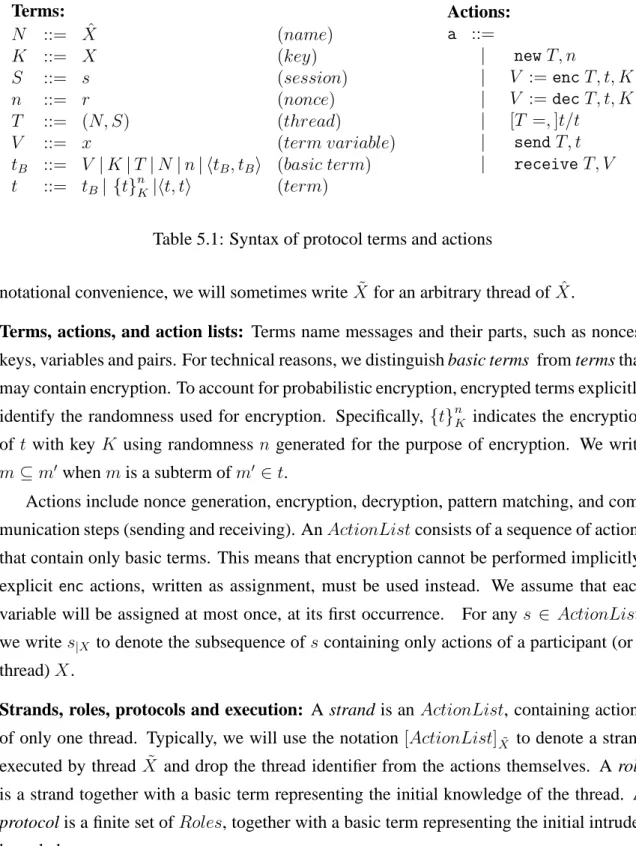
5.1 Syntax of protocol terms and actions . . . 75
5.2 Syntax of the logic . . . 76
5.3 Fragment of the proof system . . . 78
6.1 Equivalence Principles . . . 93
6.2 Black-Box Simulatability implies Universal Composability (Synchronous Communication) . . . 99
6.3 Universal Composability implies Black-Box Simulatability (Synchronous Communication) . . . 100
6.4 Universal Composability implies Black-Box Simulatability (Asynchronous Communication) . . . 102
6.5 Black-Box Simulatability implies Process Equivalence (Asynchronous Com-munication) . . . 103 A.1 Syntax of terms, actions and strands . . . 134 A.2 Basic reaction steps . . . 136
2.1 An example of a binding transformation . . . 12
2.2 An example of a cookie transformation . . . 13
2.3 Derivation graph of the STS protocol family . . . 15
3.1 ISO-9798-3 as arrows-and-messages . . . 26
3.2 Cords for ISO-9798-3 . . . 26
4.1 Illustrating the Methodology . . . 59
4.2 Instantiations of the Challenge-Response template . . . 62
4.3 Protocol that is an instantiation of both CR and ENC templates . . . 65
4.4 Instantiations of authenticated key-exchange templates . . . 68
6.1 Universal Composability . . . 96
6.2 Black Box Simulatability . . . 97
6.3 Process Equivalence . . . 98 6.4 Universal Composability implies Black Box Simulatability: Proof Sketch . 101
Chapter 1
Introduction
Protocols that enable secure communication over an untrusted network constitute an im-portant part of the current computing infrastructure. Common examples of such protocols are SSL [53], TLS [44], Kerberos [106], and the IPSec [73] and IEEE 802.11i [1] protocol suites. SSL and TLS are used by internet browsers and web servers to allow secure transac-tions in applicatransac-tions like online banking. The IPSec protocol suite provides confidentiality and integrity at the IP layer and is widely used to secure corporate VPNs. IEEE 802.11i provides data protection and integrity in wireless local area networks, while Kerberos is used for network authentication.
The design and security analysis of such network protocols presents a difficult prob-lem. In several instances, serious security vulnerabilities were uncovered in protocols many years after they were first published or deployed [105, 59, 1, 16, 104, 68]. While some of these attacks rely on subtle properties of cryptographic primitives, a large fraction can be traced to intricacies in designing protocols that are robust in a concurrent execution setting. To further elaborate this point, let us consider the concrete example of the SSL protocol. In SSL, a client typically sets up a key with a web server. That key is then used to protect all data exchanged between them. A single client can simultaneously engage in sessions with multiple servers and a single server concurrently serves many clients. Let us consider a scenario in which all network traffic is under the control of the adversary. In addition, the adversary may also control some of the clients and servers. The protocol should guaran-tee certain security properties for honest agents even in such an adversarial environment.
Specifically, if an honest client executes an SSL session with an honest server, the attacker should not be able to recover the exchanged key. This is called the key secrecy property. Furthermore, an attacker should not be able to fool an honest client into believing that she has completed a session with an honest server unless that is indeed the case. This property is called authentication. The security proof that SSL does indeed provide these guaran-tees, even when the cryptography is perfect, turns out to be far from trivial [108, 60]. The central problem is ensuring that the attacker cannot combine data acquired from a possibly unbounded number of concurrent sessions to subvert the protocol goals.
Over the last two decades, a variety of methods and tools have been developed for an-alyzing the security guarantees provided by network protocols. The main lines of work include specialized logics [24, 121, 55], process calculi [6, 3, 77, 116] and tools [89, 119], as well as theorem-proving [110, 109] and model-checking methods [79, 102, 117, 118] us-ing general purpose tools. (The cited papers are representative but not exhaustive; see [91] for a more comprehensive survey.) There are several points of difference among these ap-proaches. While most model-checking tools can only analyze a finite number of concurrent sessions of a protocol, some of the logics, process calculi, and theorem-proving techniques yield protocol security proofs without bounding the number of sessions. With the exception of the BAN family of logics [24], most approaches involve explicit reasoning about possi-ble attacker actions. Finally, while security properties are interpreted over individual traces in the majority of these methods, in the process calculi-based techniques, security is defined by an equivalence relation between a real protocol and an ideal protocol, which is secure by construction. Inspite of these differences, all of these approaches use the same symbolic model of protocol execution and attack. This model seems to have developed from posi-tions taken by Needham-Schroeder [105], Dolev-Yao [47], and much subsequent work by others. In this model, the adversary is allowed to choose non-deterministically among the set of possible actions; messages are represented as abstract terms, not sequences of bits; and encryption and other cryptographic primitives are modelled in an abstract black-box manner. This idealization has been a major enabling factor in the development of the above mentioned array of tools and techniques.
As this research area comes of age, several important open problems have been iden-tified (cf. [91]). One significant problem has to do with secure composition of protocols.
3
Many modern protocols like IKEv2 [71], IEEE 802.11i [1], and Kerberos [106] comprise of several different sub-protocols and modes of operation. The challenge is to develop proof methods that allow security proofs of such composite protocols to be built up by combin-ing independent proofs of their parts. Composition is a difficult problem in security since a component may reveal information that does not affect its own security but may degrade the security of some other component in the system. A second important problem pertains to the model of protocol execution and attack used while carrying out the security analysis task. As mentioned before, almost all extant approaches for symbolic protocol analysis use an idealized model where cryptography is assumed to be perfect. This idealization makes the protocol analysis problem more amenable to automation. However, the abstraction de-tracts from the fidelity of the analysis since attacks arising from the interaction between the cryptosystem and the protocol lie outside the scope of this model. The goal then is to develop logical methods for protocol analysis with associated soundness theorems, which guarantee that a completely symbolic analysis or proof has an interpretation in the standard complexity-theoretic model of modern cryptography. At an informal level, this means that a machine-checkable or generated proof should carry the same meaning as a hand-proof done by a cryptographer. This turns out to be a difficult problem since the security defi-nitions of cryptographic primitives and protocols involve complex probability spaces and quantification over all probabilistic polynomial time attackers. In this dissertation, we ini-tiate a program and take several steps towards solving these two problems. In the following paragraphs, we summarize our main results and sketch several directions for future work.
We have developed a framework consisting of two formal systems: Protocol Deriva-tion System (PDS) and Protocol ComposiDeriva-tion Logic (PCL). Within the protocol analysis spectrum, this work can be placed in the category of specialized logics. PDS supports syntactic derivations of complex protocols, starting from basic components, and combin-ing or extendcombin-ing them uscombin-ing a sequence of composition, refinement, and transformation operations. PCL is a Floyd-Hoare style logic [52, 64] that supports axiomatic proofs of protocol properties. The eventual goal is to develop proof methods for PCL for every derivation operation in PDS, thereby enabling the parallel development of protocols and their security proofs. In this dissertation, we present proof methods for reasoning about protocol composition and a class of protocol refinements. The composition theorems are
formulated and proved by adapting ideas from the assume-guarantee paradigm for reason-ing about distributed systems. PDS and PCL have been successfully applied to a number of industrial network security protocols, in several instances identifying serious security vul-nerabilities. Specifically, PCL has been applied to the IEEE 802.11i protocol suite (which includes TLS as a component) [60] and to the IETF GDOI protocol for secure group com-munication [92]. The second case study identified a previously undiscovered flaw in the protocol. In ongoing work, PCL is being used to analyze IKEv2 [71], IEEE 802.16e [2], Kerberos [106], and Mobile IPv6 [70] protocols. While the semantics of PCL is defined with respect to the idealized, symbolic model, we also present complexity-theoretic foun-dations and prove a soundness theorem for a variant of PCL which we call Computational PCL. The soundness proof uses standard proof techniques from cryptography, in particular, complexity-theoretic reductions. Although the basic form of the logic remains unchanged, there are certain important differences involving the interpretation of implication in terms of conditional probability and the semantics of the predicates used to capture secrecy prop-erties.
The final result in the dissertation spans both the problems. An alternative way of specifying and reasoning about protocol composition is through equivalence or simulation between the real protocol and an ideal protocol, which is secure by construction. We prove that, under reasonable assumptions about the communication model, three simulation-based definitions for protocol security–universal composability, black-box simulatability, and process observational equivalence–express the same properties of a protocol. The proofs are axiomatic and are carried out using process calculus equational principles. Since these equational principles are rather general, the proofs carry over to a number of process calculi, in particular, the probabilistic poly-time process calculus, whose execution model is consistent with the complexity-theoretic model of cryptography. We also observe certain important differences between the composition paradigm of universal composability, and the assume-guarantee paradigm of PCL.
Although these results represent significant advances in the state-of-the-art, we expect that it will take several people a number of years to fully accomplish the goals of this pro-gram. One current effort seeks to extend and further refine PCL [10]. A second direction is to extend PCL to reason about security in different threat models. Threat models can
5
differ on several respects, in particular, the computational capabilities of protocol princi-pals and adversaries, and the degree of control the adversary has over the network. For example, in the symbolic model the adversary’s computational abilities are restricted to a fixed set of actions while in the complexity-theoretic model of cryptography, she can carry out any probabilistic polynomial time computation. Also, in applications like Mobile IPv6, it might be reasonable to assume that the adversary does not have access to all commu-nication paths over the network. A third direction is to continue the work on formalizing PDS to develop a systematic theory of protocol design and to apply it during the design phase of a standards-track protocol. Tool implementation efforts for PCL and PDS are also underway. Finally, the results in this dissertation provide a good starting point for a deeper investigation of the composition problem in computer security and cryptography. The im-portance of compositional methods in the design and analysis of secure systems is now widely recognized (cf. [126]). However, there is no comprehensive foundational theory for secure composition of secure systems and software. We believe that the assume-guarantee paradigm developed for PCL might be applicable to these other kinds of security mecha-nisms. In the field of cryptography also, the composition problem has received significant attention. One current approach to this problem is the framework of universal composabil-ity [26, 114]. The universal composabilcomposabil-ity condition provides strong composition guaran-tees: a primitive or protocol that satisfies this condition retains its security guarantees in any environment in which it is used. In contrast, the assume-guarantee paradigm of PCL only allows conditional composability: a protocol is secure only in an environment which satisfies a certain set of invariant assumptions associated with the protocol. The ability to reason about protocols under assumptions about the way they will be used offers greater flexibility and appears essential for developing modular proofs about certain classes of pro-tocols. In addition, a number of impossibility results about the realizability of UC-secure primitives and protocols [26, 29, 40] indicates that the UC condition may be too stringent to apply to certain protocols of interest.
The rest of the dissertation is organized as follows. Chapter 2 presents the protocol derivation system. Chapter 3 describes the syntax, semantics, and proof system of PCL. Chapter 4 presents the proof methods in PCL associated with the protocol derivation op-erations in PDS. The composition theorems are presented in Section 4.1 while the proof
method for reasoning about protocol refinements is presented in Section 4.2. Chapter 5 presents complexity-theoretic semantics for a variant of PCL and an associated soundness theorem for its proof system. Chapter 6 presents the results on equivalence between var-ious simulation based security definitions. Related work is discussed in Section 7. Final conclusions and directions for future work are presented in Section 8.
Chapter 2
Protocol Derivation System
Many researchers and practitioners working in the field of protocol security recognize that common authentication and key exchange protocols are built using an accepted set of stan-dard concepts. The common building blocks include Diffie-Hellman key exchange, nonces to avoid replay, certificates from an accepted authority to validate public keys, and en-crypted or signed messages that can only be created or read by identifiable parties. An informal practice of presenting protocols incrementally, starting from simple components and extending them by features and functions, is used in [46], with efforts to formalize the practice appearing in [23]. More recently, Bellare, Canetti and Krawczyk [19], for exam-ple, have studied protocol transformations that add authentication to a protocol scheme. However, there is no comprehensive theory about how each standard protocol part works, and how properties of a compound protocol can be derived from properties of its parts. In this chapter, we summarize some steps we have taken towards developing such a theory.
Our framework for deriving security protocols consists of a set of basic building blocks called components and a set of operations for constructing new protocols from old ones. These operations may be divided into three different types: composition, refinement and transformation. A component is a basic protocol step or steps, used as a building block for larger protocols. Diffie-Hellman key exchange and challenge-response are examples of basic components. A composition operation combines two protocols. Parallel composition and sequential composition are two examples of composition operations. A refinement operation acts on message components of a single protocol. For example, replacing a
plaintext nonce by an encrypted nonce is a refinement. A refinement does not change the number of messages or the basic structure of a protocol. A transformation operates on a single protocol, and may modify several steps of a protocol by moving data from one message to another, combining steps, or inserting one or more additional steps. For example, moving data from one protocol message to an earlier message (between the same parties) is a transformation.
In principle, there may be many possible protocol refinements and transformations. Our goal in this chapter is to show how protocol composition, refinement, and transformation may be used by working out some examples. In the next section, we examine the structure of a set of key exchange protocols (which we call the STS family) to illustrate the use of this method. Among the derived protocols are STS [46], the standard signature-based challenge-response protocol [93], JFKi, JFKr, ISO-9798-3 [8], and the core of the IKE protocol [59].
2.1
Derivation of the STS Family
The STS family includes protocols like IKE which have been deployed on the Internet and JFKi and JFKr which were considered by IETF as replacements for IKE. The security properties relevant to the STS family of protocols include key secrecy, mutual authentica-tion, denial-of-service protecauthentica-tion, identity protection and computational efficiency. Com-putational efficiency is achieved by reusing Diffie-Hellman exponentials across multiple sessions.
We begin by describing the basic components, and the composition, refinement and transformation operations used in deriving the STS family of key exchange protocols. The components and operations are presented tersely, with additional intuition and explanation given where they are used.
In informally describing the derivation system, we use a standard messages-and-arrows notation for protocol steps. Experience suggests that this simple notation is useful for conveying some of the central ideas. However, the reader should bear in mind that, in addition, a protocol involves initial conditions, communication steps, and internal actions. When we derive a protocol, the derivation step may act on the initial conditions, network
2.1. DERIVATION OF THE STS FAMILY 9
messages, or internal actions.
2.1.1
Components
A protocol component consists of a set of roles (e.g., initiator, responder, server), where each role has a sequence of inputs, outputs and protocol actions. Intuitively, a principal executing a role of the protocol starts in a state where it knows the inputs (e.g. its private signing key), executes the prescribed actions (e.g., generates nonces, sends or receives messages) and then produces the outputs (e.g., a shared key if the protocol is a key exchange protocol). In this derivation, we use Diffie-Hellman key exchange and a signature-based authenticator as basic components.
Diffie-Hellman component,C1
The Diffie-Hellman protocol [45] provides a way for two parties to set up a shared key (gir) which a passive attacker cannot recover. There is no authentication guarantee: the secret is shared between two parties, but neither can be sure of the identity of the other. Our componentC1contains only the internal computation steps of the Diffie-Hellman protocol. The initiator and responder role actions are given below.
I: generates random valueiand computesgi (for previously agreed baseb)
R: generates random valuerand computesgr(for previously agreed baseb)
In this component no messages are sent; the exponentials are considered to be the output of this protocol fragment.
Signature-based authenticator,C2
The signature-based challenge-response protocol shown below is a standard mechanism for one-way authentication (see Section 10.3.3 of [93])
I →R:m
R→I :SIGR(m)
It is assumed thatmis a fresh value or nonce and that the initiator,I, possesses the public key certificate of responder,R, and can therefore verify the signature.
2.1.2
Composition
The composition operation used is sequential composition of two protocol components with term substitution. The precise definition of this operation is in Section 4.1.1. Intuitively, the roles of the composed protocol have the following structure: the input sequence is the same as that of the first component and the output is the same as that of the second component; the actions are obtained by concatenating the actions of the first component with those of the second (sequential composition) with an appropriate term substitution—the outputs of the first component are substituted for the inputs of the second.
2.1.3
Refinements
While defining refinements, we use the notation a ⇒ b to indicate that some instance of message componentain the protocol should be replaced byb.
Refinement R1 SIGX(m) ⇒ EK(SIGX(m)), whereK is a key shared with the peer. The purpose of this refinement is to provide identity protection against passive attackers. In all the protocols that we consider here, everything signed is public. So, an attacker can verify guesses at identities of a principal if the signature is not encrypted.
RefinementR2 SIGX(m)⇒ SIGX(HM ACK(m, IDX)), where K is a key shared with the peer. While the signature by itself proves that this term was generated by X, the keyed hash in addition proves thatX possesses the keyK. This additional property is crucial for mutual authentication guaranteed by IKE. It is further elaborated in the deriva-tion below.
RefinementR3 SIGX(m)⇒SIGX(m), HM ACK(m, IDX), whereK is a key shared with the peer. This refinement serves the same purpose asR2 and is used to derive the core of the JFKr protocol.
RefinementR4 SIGX(m)⇒SIGX(m, IDY), whereY is the peer. It is assumed thatX possesses the requisite identifying information forY, e.g.,Y0spublic key certificate, before
2.1. DERIVATION OF THE STS FAMILY 11
the protocol is executed. This assumption can be discharged if X receives Y0s identity in an earlier message of the protocol. In public-key based challenge-response protocols, the authenticator should identify both the sender and the intended recipient. Otherwise, the protocol is susceptible to a person-in-the-middle attack. Here, the signature identifies the sender and the identity inside the signature identifies the intended recipient. In an encryption-based challenge-response protocol (e.g., Needham-Schroeder [105]), since the public encryption key identifies the intended recipient, the sender’s identity needs to be included inside the encryption. The original protocol did not do so, resulting in the property discovered nearly twenty years later by Lowe [78].
Refinement R5 gx ⇒ gx, n
x, wherenx is a fresh value. In many Diffie-Hellman based key exchange protocols, the Diffie-Hellman exponentials serve two purposes: (a) they pro-vide the material to derive secret keys; (b) they propro-vide the freshness guarantee for runs required in order to prevent replay attacks. However, Diffie-Hellman exponentials are ex-pensive to compute. This refinement makes participants exchange nonces in addition to Diffie-Hellman exponentials, thereby offloading function (b) onto the nonces. The use of nonces enables the reuse of exponentials across multiple sessions resulting in a more effi-cient protocol. On the other hand, when exponents are reused, perfect forward secrecy is lost. This tradeoff is offered both by JFKi and JFKr.
RefinementR6 SIGX(m)⇒ SIGX(m), IDX, whereIDX denotes the public key cer-tificate of X. Since the other party may not possess the signature-verification key, it is necessary to include the certificate along with the signature. Unlike refinementsR1andR5
above, which add properties to a protocol (identity protection and efficiency respectively), this is an example of a refinement which discharges the assumption that the principals pos-sess each other’s public key certificates before the pos-session.
RefinementR7 EK(m)⇒EK(m), HM ACK0(role, EK(m)), whereK andK0are keys shared with the peer androleidentifies the protocol role in which this term was produced (initiator or responder). This refinement is used in the derivation of JFKr. Here, each party includes a keyed hash of the encrypted signature and its own role (i.e., initiator or
responder) in addition to the signature. The hash serves the same purpose as in refinements
R2,R3. The protocol role is included inside the hash to prevent reflection attacks.
2.1.4
Transformations
Message component move,T1
This transformation moves a top-level field t of a message m to an earlier message m0, where m and m0 have the same sender and receiver, and if t does not contain any data freshly generated or received between the two messages. One reason for using this trans-formation is to reduce the total number of messages in the protocol.
Binding,T2
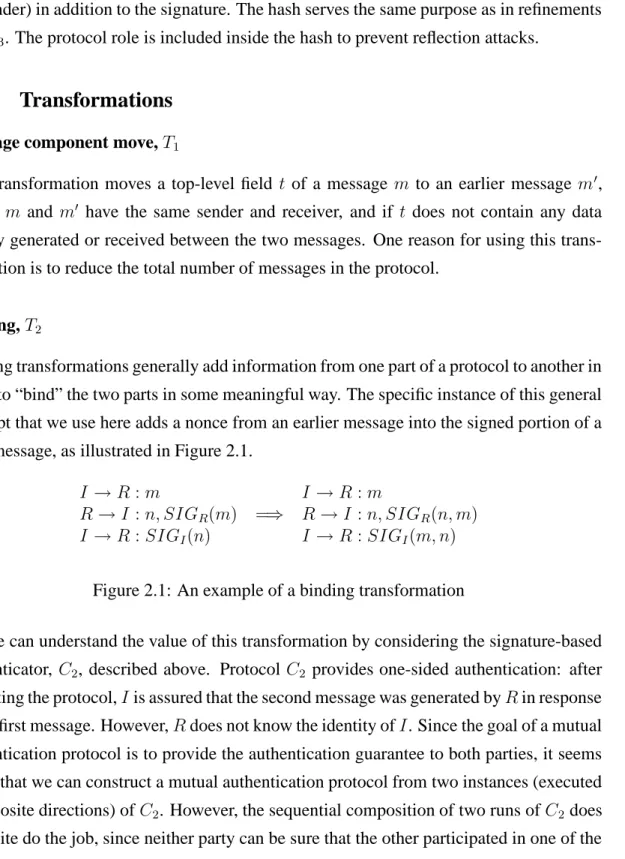
Binding transformations generally add information from one part of a protocol to another in order to “bind” the two parts in some meaningful way. The specific instance of this general concept that we use here adds a nonce from an earlier message into the signed portion of a later message, as illustrated in Figure 2.1.
I →R:m I →R :m
R→I :n, SIGR(m) =⇒ R →I :n, SIGR(n, m)
I →R:SIGI(n) I →R :SIGI(m, n)
Figure 2.1: An example of a binding transformation
We can understand the value of this transformation by considering the signature-based authenticator, C2, described above. Protocol C2 provides one-sided authentication: after executing the protocol,Iis assured that the second message was generated byRin response to the first message. However,Rdoes not know the identity ofI. Since the goal of a mutual authentication protocol is to provide the authentication guarantee to both parties, it seems likely that we can construct a mutual authentication protocol from two instances (executed in opposite directions) ofC2. However, the sequential composition of two runs ofC2does not quite do the job, since neither party can be sure that the other participated in one of the runs. If we take the protocol obtained by sequential composition of two instances ofC2,
2.1. DERIVATION OF THE STS FAMILY 13
apply transformationT1on noncento obtain the protocol on the left side of Figure 2.1, and
then apply the binding transformation to obtain the one on the right, the resulting protocol with both nonces inside the signatures ensures thatmandnbelong to the same session.
We note, however, that the protocol on the right side of Figure 2.1 does not guarantee mutual authentication in the conventional sense. Specifically, afterI completes a session withR, initiatorI cannot be sure thatR knows she has completed the same session with
I. The stronger guarantee may be achieved by including the peer’s identity inside the signatures, as discussed further in Section 2.1.5. Also, note that our formal model does not allow type confusion attacks, which is essential for the soundness of this transformation.
Cookie,T3
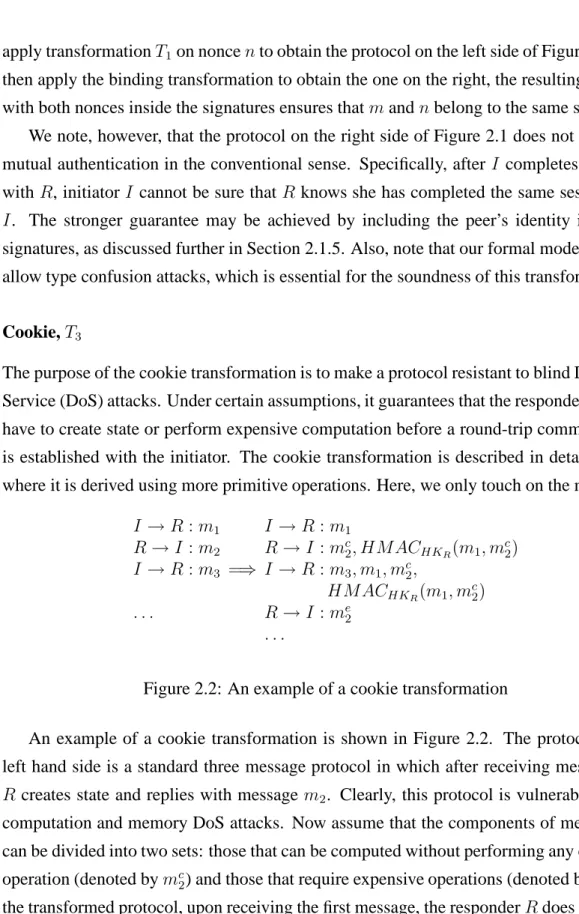
The purpose of the cookie transformation is to make a protocol resistant to blind Denial-of-Service (DoS) attacks. Under certain assumptions, it guarantees that the responder does not have to create state or perform expensive computation before a round-trip communication is established with the initiator. The cookie transformation is described in detail in [43], where it is derived using more primitive operations. Here, we only touch on the main idea.
I →R:m1 I →R :m1 R→I :m2 R →I :mc 2, HM ACHKR(m1, m c 2) I →R:m3 =⇒ I →R :m3, m1, mc 2, HM ACHKR(m1, m c 2) . . . R →I :me 2 . . .
Figure 2.2: An example of a cookie transformation
An example of a cookie transformation is shown in Figure 2.2. The protocol on the left hand side is a standard three message protocol in which after receiving messagem1, R creates state and replies with message m2. Clearly, this protocol is vulnerable to both computation and memory DoS attacks. Now assume that the components of messagem2
can be divided into two sets: those that can be computed without performing any expensive operation (denoted bymc
2) and those that require expensive operations (denoted byme2). In
local state and does not perform any expensive computation. Instead,Rsends an unforge-able token (cookie) back toIwhich captures the local state, and resumes the protocol only after the cookie is returned byI. Here the cookie is a keyed hash of messagem1 andmc
2.
The key used for this purpose,HKR, is known only toR. Since expensive computation and creation of state is deferred till it is established that the initiator can receive messages at the IP address which it claimed as its own, the resulting protocol is resistant to blind DoS attacks.
2.1.5
The Derivation
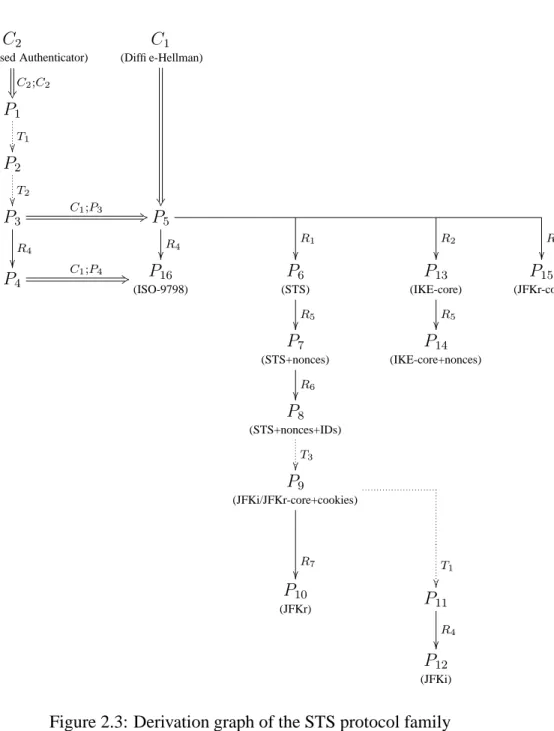
We now use the components and operations of the derivation system defined above to sys-tematically derive the protocols in the STS family. The complete derivation graph is shown in Figure 2.3. In what follows, we trace the derivations of the various protocols in the graph. At each derivation step, we explain what property that step helps achieve.
ProtocolP1 Obtained by sequential composition of two symmetric copies of component
C2.
I →R:m
R→I :SIGR(m)
R→I :n
I →R:SIGI(n)
This is the first step in constructing a mutual authentication protocol from two instances of an unilateral authentication protocol. Here, it is assumed thatmandnare fresh values and thatI andRpossess each other’s public key certificates and so can verify the signatures.
Protocol P2 Obtained from protocolP1 by using transformation T1: the component of message3is moved up to message2.
I →R:m
R→I:n, SIGR(m)
I →R:SIGI(n)
2.1. DERIVATION OF THE STS FAMILY 15 C2 (Signature-based Authenticator) C2;C2 C1 (Diffie-Hellman) P1 T1 P2 T2 P3 R4 C1;P3 + 3P5 R4 R1 R2 R3 P4 C1;P4 +3 P16 (ISO-9798) P6 (STS) R5 P13 (IKE-core) R5 P15 (JFKr-core) P7 (STS+nonces) R6 P14 (IKE-core+nonces) P8 (STS+nonces+IDs) T3 P9 (JFKi/JFKr-core+cookies) R7 T1 P10 (JFKr) P11 R4 P12 (JFKi)
ProtocolP3 Obtained from protocolP2 by using the binding transformation,T2.
I →R:m
R→I :n, SIGR(n, m)
I →R:SIGI(m, n)
After executing this protocol,I is assured thatRgenerated the second message and more-over that the message was freshly generated. However, as elaborated below, it would be incorrect ofIto conclude thatRbelieves that she was talking toI. The source of the prob-lem is that the authenticator does not indicate who the message was meant for. One way to get around it is by applying refinementR4 mentioned in the previous section. There are other ways too as we will see while proceeding with the derivation.
The following attack describes a scenario in whichRandI hold different beliefs about who they completed the session with. Attacker M intercepts and then forwards the first two messages, obtaining noncesm and n. Then M blocks the final message from I and substitutes SIGM(m, n). After these steps, I believes nonces m and n were exchanged withR, butRbelieves the noncemwas generated by imposterM.
ProtocolP5 Obtained by composing componentC1with protocolP3.
I →R:gi
R→I :gr, SIGR(gr, gi)
I →R:SIGI(gi, gr)
The nonces m and n were instantiated to Diffie-Hellman exponents gi and gr. The as-sumption that m and n are fresh values is still valid as long as i and r are fresh. This is an example of composition by term substitution. Intuitively, the actions that any prin-cipal carries out inP5 is the sequential composition of the actions that she carries out in C1 and inP3, except that instead of sending and receiving nonces, she sends and receives
Diffie-Hellman exponentials. That is why it makes sense to regard term substitution as a composition operation. Protocol P5 possesses all the properties of protocol P3. In addi-tion, wheneverI completes a session supposedly withR, then ifRis honest, thenIandR
share a secret,gir. Note that since the person-in-the-middle attack described above is still possible,Rmay not believe that she has a shared secret withI.
2.1. DERIVATION OF THE STS FAMILY 17
After protocol P5, four different derivation paths can be seen in Figure 2.3. The first
path includes STS, JFKi and JFKr; the second path includes the core of IKE; the third path includes a protocol that forms the core of IKE-sigma [75] and JFKr; the fourth path includes the ISO-9798-3 protocol. We now describe these derivation paths one by one.
Path 1: STS, JFKi and JFKr
ProtocolP6 Obtained by applying refinementR1to protocolP5, whereKis a key derived
from the Diffie-Hellman secret. This is the STS protocol.
I →R:gi
R→I :gr, EK SIGR(gr, gi)
I →R:EK SIGI(gi, gr)
In addition to the properties ofP5,P6provides identity protection against passive attackers. As mentioned before, refinementR1is geared towards adding this property to the protocol on which it is applied.P6also provides a mutually authenticated shared secret. The person-in-the-middle attack described while presenting protocol P3 (and which is applicable to protocolP5 too) does not work anymore since an attacker cannot compute the encryption key, K, which depends on the Diffie-Hellman secret, gir, and hence cannot replace I’s signature in the third message by her own. However, Lowe describes another attack on this protocol in [79]. It is not quite clear whether that attack breaks mutual authentication.
ProtocolP7 Obtained by applying refinementR5to protocolP6.
I →R:gi, ni
R→I :gr, nr, EK SIGR(gr, nr, gi, ni)
I →R:EK SIGI(gi, ni, gr, nr)
P7 retains all the properties of P6 except perfect forward secrecy. As mentioned while describing refinementR5, the use of fresh nonces enables the reuse of Diffie-Hellman ex-ponentials across multiple sessions resulting in a more computationally efficient protocol.
ProtocolP8 Obtained by applying refinementR6to protocolP7. I →R:gi, ni R→I :gr, nr, EK SIGR(gr, nr, gi, ni), IDR I →R:EK SIGI(gi, ni, gr, nr), IDI
By applying refinementR6 toP7, no new properties are introduced. Instead, the
assump-tion that the protocol principals possessed each other’s public key certificates apriori is discharged by explicitly exchanging certificates alongside the signatures.
ProtocolP9 Obtained by applying the cookie transformation,T3, to protocolP8.
I→R:gi, ni R→I :gr, nr, HM ACHKR(g r, n r, gi, ni) I→R:gi, ni, gr, nr, HM ACHKR(g r, n r, gi, ni), EK SIGI(gi, ni, gr, nr), IDI R→I :EK SIGR(gr, nr, gi, ni), IDR
The cookie transformation ensures that in addition to the properties of protocolP8, this protocol also possesses the additional property of resistance to blind Denial-of-Service attacks.
At this point, we have derived a protocol that provides key secrecy, mutual authentica-tion, identity protection (for initiator against passive attackers and for responder against active attackers), DoS protection and computational efficiency, i.e., all the stated security properties for this family of protocols. Both JFKi and JFKr are obtained fromP9 and only
differ in the form of identity protection that they offer.
Path 1.1: JFKr
Protocol P10 Obtained by applying refinement R7 to P9. This is essentially JFKr. We ignore some of the message fields (e.g., the security association and the group identifying
2.1. DERIVATION OF THE STS FAMILY 19
information) which can be added using two more refinements.
I →R:gi, ni R→I :gr, nr, HM ACHKR(g r, n r, gi, ni) I →R:gi, ni, gr, nr, HM ACHKR(g r, n r, gi, ni), EK SIGI(gi, ni, gr, nr), IDI , HM ACK0 I, EK SIGI(gi, ni, gr, nr), IDI R→I :EK SIGR(gr, nr, gi, ni), IDR , HM ACK0 R, EK SIGR(gr, nr, gi, ni), IDR
P10 retains all the properties ofP9. The keyed hash of the encrypted signature appears to serve the same purpose as the encryption of the signature in protocolP6. It guarantees that since the computation of the keysKandK0requires knowledge ofgir, the adversary cannot launch the person-in-the-middle attack described while presenting protocol P3, since she cannot compute the encrypted signature and the keyed hash.
Path 1.2: JFKi
ProtocolP11 Obtained by applying transformationT1to protocolP9.
I →R:gi, ni R→I :gr, nr, IDR, HM ACHKR(g r, n r, gi, ni) I →R:gi, ni, gr, nr, HM ACHKR(g r, n r, gi, ni), EK SIGI(gi, ni, gr, nr), IDI R→I :EK SIGR(gr, nr, gi, ni)
The message component IDR is moved from message 4 in P9 to message 2 here. The reason for applying this transformation becomes clear in the next step when the principals include the peer’s identity inside the signatures. SinceI’s signature is part of the third mes-sage of the protocol, she must possessR’s identity before she sends out that message. This protocol retains all the properties ofP9except for the fact that the form of identity protec-tion is different. UnlikeP9, here the responder’s identity is not protected. The initiator’s identity is still protected against active attackers.
ProtocolP12 Obtained by applying refinementR4 to protocolP11. This is JFKi (except for one additional signature in the second message which can be added using one more
transformation). As with JFKr, some of the message fields which do not contribute to the core security property are ignored.
I→R:gi, ni R→I :gr, nr, IDR, HM ACHKR(g r, n r, gi, ni) I→R:gi, ni, gr, nr, HM ACHKR(g r, n r, gi, ni), EK SIGI(gi, ni, gr, nr, IDR), IDI R→I :EK SIGR(gr, nr, gi, ni, IDI)
The refinement added the peer’s identities inside the signatures. IDRandIDI are added insideI’s andR’s signatures in message3and message4respectively. Including the iden-tities inside the signatures obviates the attack described while presenting protocol P3 and Lowe’s attack on STS [79]. P12retains all the properties ofP11.
Path 2: IKE
We now consider the second path starting from protocolP5. This path includes two proto-cols closely related to IKE [59].
ProtocolP13 Obtained by applying refinementR2 to protocolP5. This protocol has been
described as the core for IKE in [8].
I →R:gi
R→I :gr, SIGR HM ACK(gr, gi, IDR)
I →R:SIGI HM ACK(gi, gr, IDI)
Instead of just signing the Diffie-Hellman exponentials, each principal now signs a keyed hash of the exponentials and their own identities. Since the key used is derived from the Diffie-Hellman secret, gir, which is known only toI and R, an adversary cannot launch the person-in-the-middle attack described while presentingP3and to whichP5is also sus-ceptible. This protocol therefore provides both mutual authentication and a shared secret betweenI andR.
2.1. DERIVATION OF THE STS FAMILY 21
ProtocolP14 Obtained by applying refinementR5 to protocolP13.
I →R:gi, ni
R→I :gr, nr, SIGR HM ACK(gr, nr, gi, ni, IDR)
I →R:SIGI HM ACK(gi, ni, gr, nr, IDI)
This step in the derivation exactly parallels the step in the derivation of JFKi and JFKr where, in addition to Diffie-Hellman exponentials, nonces where exchanged. The purpose, as before, is to allow reuse of Diffie-Hellman exponentials across multiple sessions re-sulting in a more efficient protocol. The tradeoff is that perfect forward secrecy is lost in the process. Note that the original IKE specification did not stipulate the reuse of Diffie-Hellman exponentials across sessions.
Path 3: JFKr/SIGMA-core
The third path starting from protocolP5 consists of a protocol that has been described as the core for JFKr and IKE-SIGMA in [8].
ProtocolP15 Obtained by applying refinementR3 to protocolP5.
I →R:gi
R→I :gr, SIGR(gr, gi), HM ACK(gr, gi, IDR)
I →R:SIGI(gi, gr), HM ACK(gi, gr, IDI)
This protocol is very similar to protocol P13 and possesses exactly the same properties
(mutual authentication and shared secret). The only difference is that instead of signing the keyed hash, the principals send the hash separately. Since computation of the hash requires possession of the Diffie-Hellman secret,gir, which is known only toIandR, an adversary cannot launch the person-in-the-middle attack described while presentingP3 and to which
Path 4: ISO-9798-3
ProtocolP16 Obtained by applying refinementR4 to protocolP5. This is the ISO-9798-3 protocol.
I →R:gi
R→I :gr, SIGR(gr, gi, IDI)
I →R:SIGI(gi, gr, IDR)
This protocol provides a means for I and R to set up a mutually authenticated shared secret. The person-in-the-middle attack possible on protocolP5 (and described while pre-senting protocol P3) is not possible in this protocol since the principals indicate who the authenticated message is intended for by including the identity of the intended recipient in-side the signature. Thus the attackerM cannot forward the second message of the protocol thatRsends to her toIsince the signature will containIDM and notIDI.
Alternative Derivation of the ISO-9798-3 Protocol Now we present a derivation of protocolP16, ISO-9798-3 .
Protocol P4 Obtained by applying refinement R4 to protocol P3. This is the standard challenge-response protocol.
I →R:m
R→I :n, SIGR(n, m, IDI)
I →R:SIGI(m, n, IDR)
P3is refined so that the peer’s identity is included inside the signatures. Consequently, the person-in-the-middle attack onP3doesn’t succeed againstP4. P4therefore provides mutual
authentication. ProtocolP16is now derived by composing componentC1 with protocolP4
in exactly the same way thatP5 was derived.
2.1.6
Other Issues
Commutativity of Rules
As suggested by protocolP16above, many protocols have several different derivations, ob-tained by applying compositions, refinements and transformations in different orders. Such
2.1. DERIVATION OF THE STS FAMILY 23
commutativities of the derivation steps are usually justified by the fact that the properties that they realize are logically independent. For instance, the refinements R1 (encrypting the signatures) and R5 (adjoining nonces to the exponentials) commute, because the cor-responding properties - identity protection and reusability of exponentials - are logically independent.
Generalization of Refinements
In this introductory presentation, we often selected the refinements leading to the desired properties by a shortest path. Building a library of reusable derivations of a wider family of protocols would justify more general rules. For example, refinementR1is a special case of a general refinement: m ⇒ EK(m), wherem is any term and K is a shared key. The purpose of this refinement would be to remove the termmfrom the set of publicly known values.
Protocol Composition Logic
Protocol Composition Logic (PCL) is a logic for proving security properties of network protocols. A preliminary version of PCL was presented in [49, 50]. In subsequent work [35, 36, 39, 37, 60], we have significantly extended the logic and developed new proof methods. Currently, we are able to prove authentication and secrecy properties of common security protocols by derivations of twenty to sixty lines of proof. The reason for this succinctness is that the proof rules of the logic state general properties of protocol traces that can be reused for many different protocols. The logic is different from previous “belief” logics like BAN [24] and from explicit reasoning about protocol participants and the intruder as in Paulson’s Inductive Method [110]. In a sense, the goal of this work was to retain the readability and ease of use of BAN logic while providing the same degree of assurance in the security of protocols as Paulson’s Inductive Method.
The logic is designed around a process calculus with actions for each protocol step. Protocol actions are annotated with assertions in a manner resembling dynamic logic for sequential imperative programs. The semantics of our logic is based on sets of traces of protocol executions, following the standard symbolic model of protocol execution and attack. Security proofs involve local reasoning about properties guaranteed by individual actions and global reasoning about actions of honest principals who faithfully follow the protocol. One central idea is that assertions associated with an action will hold in any protocol execution that contains this action. This observation gives us the power to reason about all possible runs of the protocol without explicitly reasoning about possible steps
3.1. CORD CALCULUS 25
carried out by the adversary. The soundness of most of the axioms and inference rules are based on this observation. A second important insight is that since honest principals faithfully follow the protocol, invariants for the programs for the roles of the protocol also hold in all runs, irrespective of the intruder actions. This idea is codified in the proof system in the honesty rule.
The rest of this section is organized as follows. Section 3.1 describes cord calculus, the process language for representing protocols. The syntax and semantics of PCL are presented in Section 3.2. The proof system and soundness theorem are presented in Sec-tion 3.3.
3.1
Cord Calculus
One important part of security analysis involves understanding the way honest agents run-ning a protocol will respond to messages from a malicious attacker. The common informal arrows-and-messages notation is generally insufficient, since it only presents the executions (or traces) of the protocol that occur when there is no attack. In addition, our protocol logic requires more information about a protocol than the set of protocol executions obtained from honest and malicious parties; we need a high-level description of the program exe-cuted by each agent performing each protocol role so that we know not only which actions occur in a run, but why they occur.
As explained in [49], we used a form of process calculus that we call cords. Cords form an action structure [96, 97, 111], based onπ-calculus [99], and related tospi-calculus [4]. The cords formalism is also similar to the approach of the Chemical Abstract Machine formalism [22], in that the communication actions can be viewed as reactions between “molecules”. Cord calculus serves as a simple “protocol programming language” which supports our Floyd-Hoare style logical annotations, and verifications in an axiomatic se-mantics. Cord calculus is summarized in Appendix A.
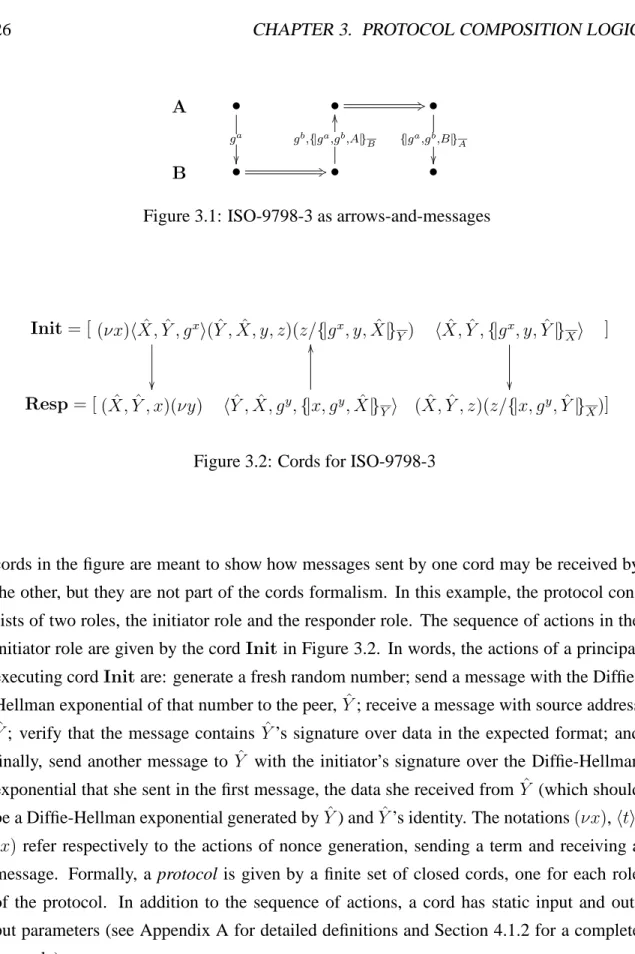
In this section, we show how protocols are represented in cord calculus with an exam-ple. Figure 3.1 shows the ISO-9798-3 protocol [66] in the informal arrows-and-messages notation. The roles of the same protocol are written out as cords in Figure 3.2, writing Xˆ
A • ga • +3• {|ga,gb,B|} A B • +3• gb,{|ga,gb,A|} B O O •
Figure 3.1: ISO-9798-3 as arrows-and-messages
Init= [ (νx)hX,ˆ Y , gˆ xi ( ˆY ,X, y, zˆ )(z/{|gx, y,Xˆ|} Y) hX,ˆ Y ,ˆ {|gx, y,Yˆ|}Xi ] Resp= [ ( ˆX,Y , xˆ )(νy) hY ,ˆ X, gˆ y,{|x, gy,Xˆ|} Yi O O ( ˆX,Y , zˆ )(z/{|x, gy,Yˆ|} X)]
Figure 3.2: Cords for ISO-9798-3
cords in the figure are meant to show how messages sent by one cord may be received by the other, but they are not part of the cords formalism. In this example, the protocol con-sists of two roles, the initiator role and the responder role. The sequence of actions in the initiator role are given by the cordInit in Figure 3.2. In words, the actions of a principal executing cordInitare: generate a fresh random number; send a message with the Diffie-Hellman exponential of that number to the peer,Yˆ; receive a message with source address
ˆ
Y; verify that the message contains Yˆ’s signature over data in the expected format; and finally, send another message to Yˆ with the initiator’s signature over the Diffie-Hellman exponential that she sent in the first message, the data she received from Yˆ (which should be a Diffie-Hellman exponential generated byYˆ) andYˆ’s identity. The notations(νx),hti, (x) refer respectively to the actions of nonce generation, sending a term and receiving a message. Formally, a protocol is given by a finite set of closed cords, one for each role of the protocol. In addition to the sequence of actions, a cord has static input and out-put parameters (see Appendix A for detailed definitions and Section 4.1.2 for a complete example).
3.2. PROTOCOL LOGIC 27
3.2
Protocol Logic
3.2.1
Syntax
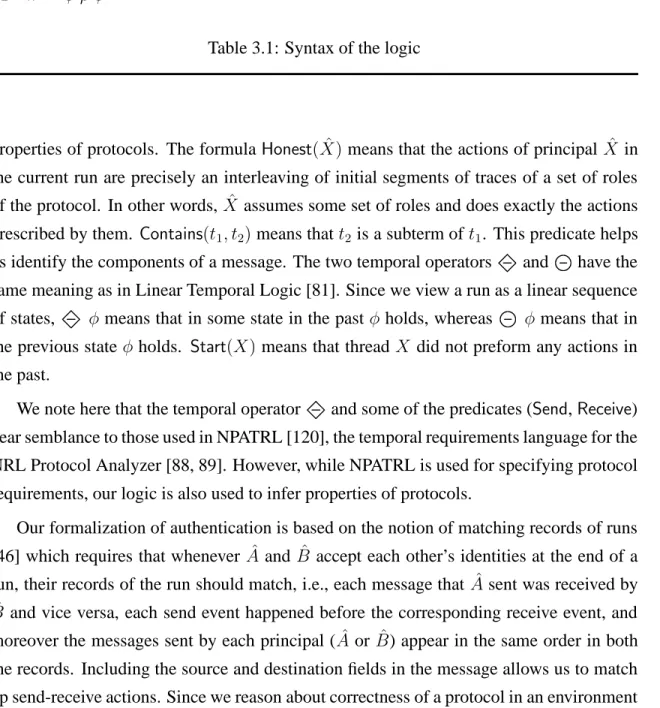
The formulas of the logic are given by the grammar in Table 3.1, whereρmay be any role, written using the notation of cord calculus. Here, t and P denote a term and a thread, respectively. A thread is a sequence of actions by a principal executing an instance of a role, e.g., Alice executing the initiator role of a protocol. As a notational convention, we use Xˆ to refer to the principal executing the threadX. We use φ and ψ to indicate predicate formulas, and m to indicate a generic term we call a “message”. A message has the form (source, destination, protocol-identifier, content), giving each message source and destination fields and a unique protocol identifier in addition to the message contents. The source field of a message may not identify the actual sender of the message since the intruder can spoof the source address. Similarly, the principal identified by the destination field may not receive the message since the intruder can intercept messages. Nonetheless, the source and destination fields in the message may be useful for stating and proving authentication properties while the protocol-identifier is useful for proving properties of protocols.
Most protocol proofs use formulas of the formθ[P]Xφ, which means that after actions
P are executed in threadX, starting from a state where formulaθis true, formulaφis true about the resulting state ofX. Here are the informal interpretations of the predicates, with the basis for defining precise semantics discussed in the next section.
The formula Has(X, x)means that principal Xˆ possesses information xin the thread
X. This is “possesses” in the limited sense of having either generated the data or received it in the clear or received it under encryption where the decryption key is known. The formulaSend(X, m)means that the last action in a run of the protocol corresponds to prin-cipal Xˆ sending message m in the thread X. Receive(X, m), New(X, t), Decrypt(X, t), andVerify(X, t)are similarly associated with the receive, new, decrypt and signature veri-fication actions of a protocol. Fresh(X, t)means that the term tgenerated inX is “fresh” in the sense that no one else has seen any term containingtas a subterm. Typically, a fresh term will be a nonce and freshness will be used to reason about the temporal ordering of actions in runs of a protocol. This form of reasoning is useful in proving authentication
Action formulas
a ::= Send(P, m)|Receive(P, m)|New(P, t)|Decrypt(P, t)|Verify(P, t) Formulas
φ ::= a|Has(P, t)|Fresh(P, t)|Honest(N)|Contains(t1, t2)|φ∧φ| ¬φ| ∃x.φ| φ| φ|Start(P)
Modal formulas Ψ ::= φ ρ φ
Table 3.1: Syntax of the logic
properties of protocols. The formulaHonest( ˆX)means that the actions of principal Xˆ in the current run are precisely an interleaving of initial segments of traces of a set of roles of the protocol. In other words, Xˆ assumes some set of roles and does exactly the actions prescribed by them. Contains(t1, t2)means thatt2is a subterm oft1. This predicate helps us identify the components of a message. The two temporal operators and have the
same meaning as in Linear Temporal Logic [81]. Since we view a run as a linear sequence of states, φ means that in some state in the pastφ holds, whereas φ means that in
the previous stateφ holds. Start(X)means that thread X did not preform any actions in the past.
We note here that the temporal operator and some of the predicates (Send,Receive) bear semblance to those used in NPATRL [120], the temporal requirements language for the NRL Protocol Analyzer [88, 89]. However, while NPATRL is used for specifying protocol requirements, our logic is also used to infer properties of protocols.
Our formalization of authentication is based on the notion of matching records of runs [46] which requires that whenever Aˆand Bˆ accept each other’s identities at the end of a run, their records of the run should match, i.e., each message that Aˆsent was received by
ˆ
B and vice versa, each send event happened before the corresponding receive event, and moreover the messages sent by each principal (Aˆor Bˆ) appear in the same order in both the records. Including the source and destination fields in the message allows us to match up send-receive actions. Since we reason about correctness of a protocol in an environment in which other protocols may be executing concurrently, it is important that when Aˆand
3.2. PROTOCOL LOGIC 29
ˆ
B accept each other’s identities, they also agree on which protocol they have successfully completed with the other. One way to extend the matching histories characterization to capture this requirement is by adding protocol identifiers to messages. Now if Aˆ and Bˆ
have matching histories at the end of a run, not only do they agree on the source, destination and content of each message, but also on which protocol this run is an instance of.
3.2.2
Semantics
A formula may be true or false at a run of a protocol. More precisely, the main semantic relation, Q, R |= φ, may be read, “formula φ holds for run R of protocol Q.” In this relation,R may be a complete run, with all sessions that are started in the run completed, or an incomplete run with some principals waiting for additional messages to complete one or more sessions. If Qis a protocol, then let Q¯ be the set of all initial configurations of protocolQ, each including a possible intruder cord. LetRuns( ¯Q)be the set of all runs of protocolQwith intruder, each a sequence of reaction steps within a cord space. If φhas free variables, thenQ, R |= φif we haveQ, R |= σφfor all substitutionsσ that eliminate all the free variables inφ. We writeQ |=φifQ, R|=φfor allR∈Runs( ¯Q).
The inductive definition of Q, R |= φ is given in Appendix B. Because a run is a sequence of reaction steps, each step resulting from a principal executing an action, is possible to assert whether a particular action occurred in a given run and also to make assertions about the temporal ordering of the actions. An alternative view, similar to the execution model used in defining Linear Temporal Logic (LTL) semantics, is to think of a run as a linear sequence of states. Transition from one state to the next is effected by an action carried out by some principal in some role. Associating that action with the state that the system ends up in as a consequence, allows us to use the well-understood terminology of LTL in our logic. A formula is true in a run if it is true in the last state of that run. An action formula a is therefore true in a run if it is the last action in that run. On the other hand, a past formula a is true if in the past the action formulaa was true in some state, i.e., if the action had occurred in the past.
AA1 φ[a]X a
AA2 Fresh(X, t)[a]X (a ∧ Fresh(X, t))
AN2 φ[(νn)]X Has(Y, n)⊃(Y =X)
AN3 φ[(νn)]X Fresh(X, n)
ARP Receive(X, p(x))[(q(x)/q(t))]X Receive(X, p(t))
Table 3.2: Axioms for protocol actions
3.3
Proof System
The proof system contains a complete axiom system for first-order logic (not listed since any axiomatization will do), together with axioms and proof rules for protocol actions, tem-poral reasoning, and a specialized form of invariance rule. The axioms and inference rules specific to reasoning about protocols are presented briefly here, with additional explanation given in Appendix C.
3.3.1
Axioms for Protocol Actions
The axioms about protocol actions are listed in Table 3.2. All the axioms state properties that hold in the state reached by executing one of the actions from a state in which a pre-condition related to the action is assumed. Note that theain axiomsAA1andAA2is any one of the5actions anda is the corresponding predicate in the logic. AA1states that if a principal has executed an action in some role, then the corresponding predicate asserting that the action had occurred in the past is true. AA2states that if a termtis fresh in some state, then it remains fresh until the corresponding thread executes an action. If threadX
generates a new valuenand does no further actions, thenAN2says that no one else knows
3.3. PROOF SYSTEM 31
3.3.2
Axioms relating Atomic Predicates
Table 3.3 lists axioms relating various propositional properties, most of which follow natu-rally from the semantics of atomic formulas. The possession axioms characterize the terms that a principal can derive if it possesses certain other terms. ORIGand RECstate re-spectively that a principal possesses a term if she freshly generated it (a nonce) or if she received it in some message. TUPandENCenable construction of tuples and encrypted terms if the parts are known. PROJ and DEC allow decomposition of a tuple into its components and decryption of an encrypted term if the key is known. The next two axioms are aimed at capturing the black-box model of encryption and signature. VERrefers to the unforgeability of signatures while SECstipulates the need to possess the private key in order to decrypt a message encrypted with the corresponding public key. The additional condition requiring principal Xˆ to be honest guarantees that the intruder is not in posses-sion of the private keys. An important axiom is N1 which states that if a thread X has generated a valuen, then that value is distinct from all other values generated in all other roles. N2states that freshly generated values within the same thread are distinct from each other (hereAfter(a,b) is a shorthand for (b∧ a)). F1states that fresh values
gen-erated in different threads are distinct. N1,N2, andF1together capture the intuition that fresh nonces and Diffie-Hellman exponentials are unique. Finally,CONstates that a term contains its subterms.
3.3.3
Modal Axioms and Rules
Table 3.4 collects the inference rules and some additional axioms. The generic inference rules follow naturally from the semantics. G2is exactly of the same form as the rule of consequence in Hoare Logic. It is clear that most predicates are preserved by additional actions. For example, if in some stateHas(X, n)holds, then it continues to hold, whenX
executes additional actions. Intuitively, if a thread possesses some information at a point in a run, then she remembers it for the rest of the run. Note, however, that theFreshpredicate is preserved only if the fresh termtis not sent out in a message (seeP2). Sequencing rule
S1gives us a way of sequentially composing two cordsP andP0 when post-condition of
Possession Axioms:
ORIG New(X, n)⊃Has(X, n)
REC Receive(X, x)⊃Has(X, x)
TUP Has(X, x)∧Has(X, y)⊃Has(X,(x, y))
ENC Has(X, x)∧Has(X, K)⊃Has(X,{|x|}K)
PROJ Has(X,(x, y))⊃Has(X, x)∧Has(X, y)
DEC Has(X,{|x|}K)∧Has(X, K)⊃Has(X, x) Encryption and Signature:
SEC Honest( ˆX)∧ Decrypt(Y,{|n|}X)⊃( ˆY = ˆX)
VER Honest( ˆX)∧ Verify(Y,{|n|}X)∧Xˆ 6= ˆY ⊃ ∃X.∃m.( Send(X, m)∧Contains(m,{|n|}X))
Uniqueness of Nonces:
N1 New(X, n)∧ New(Y, n)⊃(X =Y)
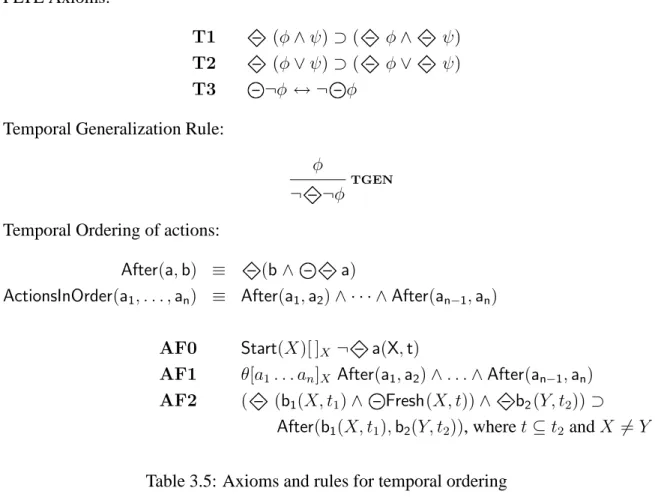
N2 After(New(X, n1),New(X, n2))⊃(n1 6=n2)
F1 Fresh(X, t)∧ Fresh(Y, t)⊃(X =Y) Subterm Relation:
CON Contains((x, y), x)∧Contains((x, y), y)
3.3. PROOF SYSTEM 33 Generic Rules: θ[P]Xφ θ[P]Xψ G1 θ[P]Xφ∧ψ θ[P]Xφ θ0 ⊃θ φ⊃φ0 G2 θ0[P]Xφ0 φ G3 θ[P]Xφ Sequencing rule: φ1[P]Aφ2 φ2[P0]Aφ3 S1 φ1[P P0]Aφ3
Preservation Axioms: (ForPersist∈ {Has, φ})
P1 Persist(X, t)[a]XPersist(X, t)
P2 Fresh(X, t)[a]XFresh(X, t), wheret 6⊆aora6=hmi
P3 HasAlone(X, n)[a]XHasAlone(X, n), wheren 6⊆v aora6=hmi
HasAlone(X, t)≡Has(X, t)∧(Has(Y, t)⊃X =Y) Freshness Loss Axiom:
F θ[hmi]X¬Fresh(X, t), where(t⊆m)