Policy Forum
Closing the Policy-Practice Gap in the Management of
Child Contacts of Tuberculosis Cases in Developing
Countries
Philip C. Hill1*, Merrin E. Rutherford1, Rick Audas2, Reinout van Crevel3, Stephen M. Graham4,5
1Centre for International Health, Department of Preventive and Social Medicine, University of Otago School of Medicine, Dunedin, New Zealand,2Department of Preventive and Social Medicine, University of Otago School of Medicine, Dunedin, New Zealand,3Department of Medicine, Radboud University Njimegen Medical Centre, Njimegen, The Netherlands,4Centre for International Child Health, Department of Paediatrics, University of Melbourne, Melbourne, Australia,5International Union Against Tuberculosis and Lung Disease, Paris, France
The Policy-Practice Gap Regarding Children in Contact with a Tuberculosis Case
The prevention, diagnosis, and treatment of tuberculosis (TB) in children are of particular importance in developing coun-tries where TB is endemic [1]. Child contacts of an adult with sputum smear– positive TB are at high risk of infection with
Mycobacterium tuberculosis and subsequent early progression to TB disease [2]. Anti-tubercular antibiotic prophylaxis is highly effective in preventing progression to disease in children infected withM. tuberculosis, with protection of up to 90% [3]. Therefore, the World Health Organization (WHO) recom-mends that all children,5 years who are a household contact of a sputum smear– positive case should receive preventive treatment, once TB disease has been ruled out [4]. Box 1 summarises the 2006 WHO recommendation for contact management as a symptom-based approach, whereby most child contacts can be placed immedi-ately on preventive treatment without the need for formal clinical evaluation.
Of concern, the WHO recommendation for the management of child contacts of a sputum smear–positive index case is rarely implemented, despite being incorporated widely into National TB Control Program (NTP) guidelines [5–7]. Possible reasons for this include that limited NTP resources are focused on the management of TB disease, the perceived need for specialised services and investigations to provide adequate clinical evaluation, and concerns regarding re-infection and poor adherence in relation to the development of resistance [7–10].
Furthermore, attempts to implement the policy have been characterised by low attendance for screening, poor adherence to preventive treatment, and high default-ing rates [9,11,12]. Specific barriers in relation to preventive treatment that have been identified include issues of knowledge, understanding, and perception in TB patients and TB program staff [5,13], lack of an appropriate management structure and necessary tools [6], treatment side effects [14], transport difficulties, and cost [10,13,14]. However, the literature with respect to barriers in the management of child contacts of TB cases in developing countries is relatively sparse.
It is clear that there is a policy-practice gap that needs to be addressed. Here, we propose an evidence-based approach to close this gap and show how this can lead to the management of child contacts of TB cases being properly incorporated into NTP activities, applied in the community and clinic, and formally evaluated.
Closing the Gap
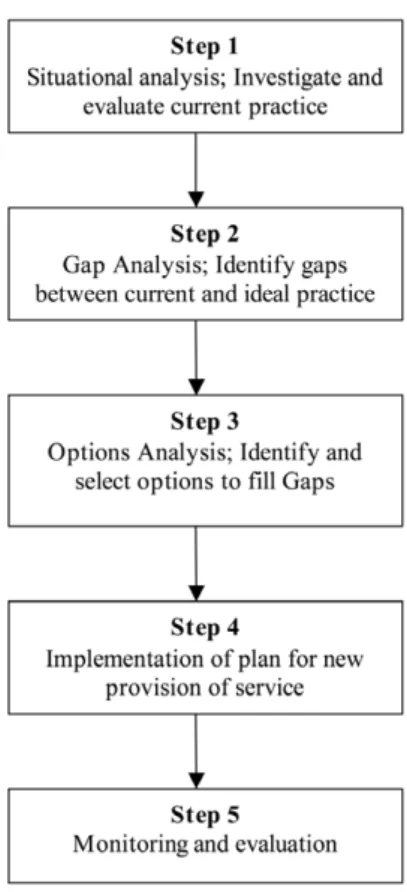
We propose the employment of an innovative combination of a health needs assessment (HNA) public health frame-work, integrated research tools, and a clinical evaluation plan in those child contacts with symptoms. The key steps of
an HNA as a public health framework are described in Figure 1 [15]. An initial situational analysis of current practice is followed by identification of the gaps between current and ideal practice. This is followed by a process whereby options for filling the gaps are considered and the most appropriate recommended. These are then brought together and implement-ed as new routine practice. Once imple-mented, the new service is monitored and evaluated. This public health framework has been used to match health needs and provision in populations [15]. Quantita-tive and qualitaQuantita-tive research tools have been integrated to provide a clear under-standing of need [16]. The framework can be applied to specific health issues. For example, it has been adopted as a tool to develop a way forward for the rational use of oxygen in child pneumonia in West Africa [17,18]. To the best of our knowledge, other than the step of situa-tional analysis [5], it has not been applied to child TB case contact management. Situational Analysis
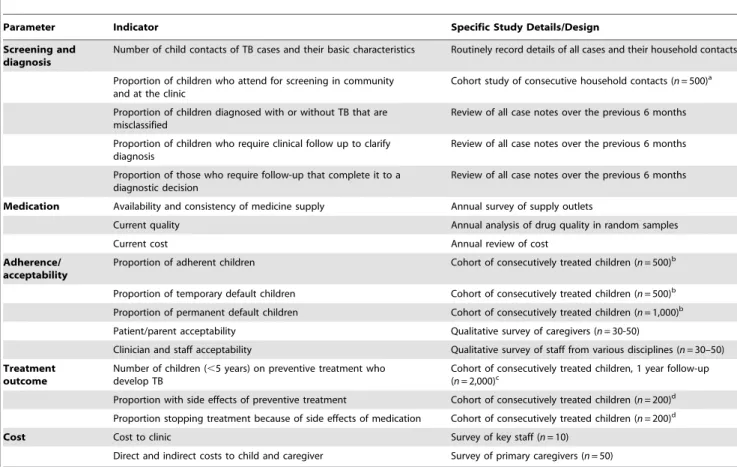
The indicators that should be included in the situational analysis of the manage-ment of child contacts of adult TB cases are summarised in Table 1. These cover basic demographic details of the TB cases
The Policy Forum allows health policy makers around the world to discuss challenges and opportunities for improving health care in their societies.
Citation:Hill PC, Rutherford ME, Audas R, van Crevel R, Graham SM (2011) Closing the Policy-Practice Gap in the Management of Child Contacts of Tuberculosis Cases in Developing Countries. PLoS Med 8(10): e1001105. doi:10.1371/journal.pmed.1001105
PublishedOctober 11, 2011
Copyright: ß2011 11 Hill et al. This is an open-access article distributed under the terms of the Creative Commons Attribution License, which permits unrestricted use, distribution, and reproduction in any medium, provided the original author and source are credited.
Funding:No specific funding was received for writing this article.
Competing Interests:The authors have declared that no competing interests exist.
Abbreviations:HNA, health needs assessment; NTP, National TB Control Program; TB, tuberculosis; WHO, World Health Organization
* E-mail: [email protected]
that attend clinics and their child contacts, the performance and capacity of the system to deliver proper evaluation and management of TB contacts, key aspects of drug supply and quality, adherence and defaulting in relation to preventive and curative treatment, treatment outcome, attitudes and acceptability of child contact management by staff and primary care-givers, and cost analyses.
The research tools that are required include relatively large cross-sectional and cohort studies as well as qualitative methods and focused cost questionnaires. We note that longitudinal follow-up of those placed on preventive treatment currently offers limited information at the situational analysis stage if preventive treatment is not practiced. We propose a single cohort study with recruitment extended to meet the requirements of each question (up to a maximum of 2,000 contacts for the disease outcome) and sufficient follow-up time of 1 year. Such an approach enables risk factors and barriers related to particular gaps to be identified (Table 2) and fed into the evidence base for the options process (Table 3). It is not absolutely necessary to have a secondary disease outcome indica-tor, as the efficacy of preventive therapy can be assumed from the literature. However, a baseline understanding of the incidence rate of secondary disease in a particular population is valuable for future
comparisons. Cost analyses include both direct (costs to the patient/contacts and the health care provider to access care and provide treatment) and indirect costs (non-health care costs that result from engage-ment with the health system). By collecting direct and indirect cost information for exposed children who have preventive treatment and those who do not, the importance of economic barriers to screening and therapy can be established. For such an evaluation, an asset-based measure of wealth can be used to estimate the extent to which financial constraints impact on caregivers’ decisions [19]. The qualitative studies provide new insights into factors that may be important with respect to attendance at screening and adherence to medication, as well as caregiver and staff knowledge and atti-tudes.
Gap Analysis
During the gap analysis, disparities between current and ideal practices are quantified for each component. Table 2 shows examples of how each gap can be identified and described. This is undertaken for each component of the situational analysis. In most situations, it is expected that the extent of the gap can be clearly defined. However, it may be necessary to estimate the gap based on limited informa-tion. If this estimate is too imprecise, further research may be required to define the gap.
Options Analysis
Following the identification of gaps between the current and ideal practices, options for closing these are reviewed. Each option is considered for scientific evidence of efficacy, feasibility in the specific setting, and cost evaluation from case contact household and societal per-spectives. For each gap, an option to take forward for implementation is then rec-ommended. Table 3 shows how the options can be presented.
Besides indicating the best possible intervention to improve the program, the options analysis will also lead to identifi-cation of information gaps in the literature where options for addressing an aspect of the current situation are unclear or unproven. In such circumstances, research may need to be undertaken to provide the necessary information. These research projects may range from simple cross-sectional evaluations to randomised inter-vention trials with follow-up. However, it is anticipated that a ‘‘best guess’’ for a decision on a way forward in some areas may simply be pragmatically necessary to develop a multi-component management
Summary Points
N
Children in contact with an adult with smear-positive tuberculosis (TB) are at high risk of being infected themselves and progressing to TB disease.N
The World Health Organization recommends that such children, if aged under 5years, should receive preventive treatment once TB disease has been ruled out.
N
This policy is rarely implemented and attempts to do so have had disappointingresults.
N
We propose a new approach using a health needs assessment framework, research tools, and a strategy for clinical evaluation.N
We show how this approach could be applied and evaluated by National TB Control Programs.Box 1. A symptom-based approach to child contacts of adult TB cases
Children who are household contacts of a sputum smear–positive adult TB case are initially evaluated in the community. If asymptomatic and less than 5 years of age, they are immediately commenced on preventive treatment. If they have symptoms consistent with TB disease they are referred for clinical workup. Those diagnosed with TB disease undergo a full course of multi-drug treatment. Those less than 5 years of age who are not diagnosed with TB disease receive preventive treatment.
2006 WHO Guidance for National Tuberculosis Programmes on the Management of Tuberculosis in Children.
Figure 1. A health needs assessment framework for addressing the policy-practice gap in the management of child contacts of TB cases.
plan that can be piloted in reasonable time.
Clinical Evaluation of Child Contacts with Symptoms of TB Disease
A child TB contact management plan with a view to routine use of preventive
treatment in those without symptoms of disease needs to include an approach to the diagnosis/exclusion of TB disease in symptomatic contacts of any age. The implication of using the WHO symptom-based approach is that those children who are asymptomatic can go directly onto
preventive treatment, while those with defined symptoms immediately enter a clinical evaluation plan that either leads to full TB treatment for disease or, if active disease is excluded, to commencement of preventive treatment (see Box 1). Indeed, the process of contact screening will
Table 1.Indicators of system performance in child TB case contact management.
Parameter Indicator Specific Study Details/Design
Screening and diagnosis
Number of child contacts of TB cases and their basic characteristics Routinely record details of all cases and their household contacts Proportion of children who attend for screening in community
and at the clinic
Cohort study of consecutive household contacts (n= 500)a Proportion of children diagnosed with or without TB that are
misclassified
Review of all case notes over the previous 6 months Proportion of children who require clinical follow up to clarify
diagnosis
Review of all case notes over the previous 6 months Proportion of those who require follow-up that complete it to a
diagnostic decision
Review of all case notes over the previous 6 months Medication Availability and consistency of medicine supply Annual survey of supply outlets
Current quality Annual analysis of drug quality in random samples
Current cost Annual review of cost
Adherence/ acceptability
Proportion of adherent children Cohort of consecutively treated children (n= 500)b Proportion of temporary default children Cohort of consecutively treated children (n= 500)b Proportion of permanent default children Cohort of consecutively treated children (n= 1,000)b Patient/parent acceptability Qualitative survey of caregivers (n= 30-50)
Clinician and staff acceptability Qualitative survey of staff from various disciplines (n= 30–50) Treatment
outcome
Number of children (,5 years) on preventive treatment who develop TB
Cohort of consecutively treated children, 1 year follow-up (n= 2,000)c
Proportion with side effects of preventive treatment Cohort of consecutively treated children (n= 200)d Proportion stopping treatment because of side effects of medication Cohort of consecutively treated children (n= 200)d
Cost Cost to clinic Survey of key staff (n= 10)
Direct and indirect costs to child and caregiver Survey of primary caregivers (n= 50) a
Index cases interviewed at diagnosis to identify case, contact, and household factors associated with non-attendance. A study of 500 contacts is advised, assuming non-attendance of at least 20%.
b
Cohort study of 500 enables evaluation of risk factors for non-adherence (taking,80% of doses) and temporary defaulting (not taking medicine for at least one week), assuming at least 20% non-adherence; enlarged to 1,000 assuming permanent default rate is at least 10%.
c
n= 2,000 is estimated to identify ‘‘secondary cases’’ on the basis of 60%–90% efficacy of preventive therapy, an assumption of.80% adherence and a natural progression off treatment of up to 20% over one year [2].
d
Cohort of 200 is based on an expected incidence of symptomatic hepatotoxicity due to IPT of,10% over a treatment course in children [25]. doi:10.1371/journal.pmed.1001105.t001
Table 2.Possible examples of identification of gaps with respect to IPT and possible relevant site-specific risk factors identified from the situational analysis.
Issue Current Reality Ideal Gap Site-Specific Factors Identified
Screening and diagnosis Proportion attending screening 30%
Target.80% to attend screeninga
.50% of expected case contacts are not screened
Knowledge in TB cases and staff, cost of attendance and travel time Proportion of children
screened that are diagnosed with TB disease 50% ,10% are expected to have TB disease at screening [10] .40% of children evaluated are inappropriately diagnosed with TB
Overuse and over-diagnosis of X-rays
Adherence/acceptability 40% adherence to preventive treatment Target.80%a adherence to preventive treatment .40% excess of non-adherent children
Poor adherence, especially in the second half of treatment due to cumulative travel, time, and cost factors a
Targets for adherence to screening and treatment suggested here are broadly in line with WHO targets for the identification and management of tuberculosis cases. doi:10.1371/journal.pmed.1001105.t002
improve case-detection and treatment of TB because of the high prevalence of disease in contacts of any age [20]. The International Union Against Tuberculosis and Lung Disease has developed training tools that include management algorithms for the evaluation of symptomatic children [21]. It is recommended that each NTP develop a clinical evaluation plan using the following steps:
1. Design and implementation of a clin-ical management algorithm following input from paediatric services at the provincial level.
2. A clear decision pathway leading to anti-TB treatment or preventive treat-ment.
3. A follow-up plan.
4. Evaluation of the overall strategy.
Implementation and Evaluation From the options analysis, a compre-hensive strategy is then developed for implementation. This can be piloted and rolled out after modification. After imple-mentation, a monitoring and evaluation
strategy is put in place using measurable indicators and key research tools as described in Table 1. A before and after indicator approach is well suited to multi-component public health intervention in TB control [22], although more complex implementation research tools could be used [23]. It is anticipated that such an ‘‘effectiveness study’’ would be conducted over approximately 2 years. Longer-term effectiveness evaluation could be incorpo-rated through various methods. For ex-ample, the same studies could be repeated, or there may be a focus on under-performing areas with other areas subject to less intensive study.
Operational Considerations
Operational research is, by definition, intimately related to the operations of the NTP. Therefore, the implementation plan in particular requires project management and funding to be coordinated between operations managers and operational re-searchers. Discussions should be held at an early stage regarding the coordination of changes to operational activities and the accompanying operational research. One
solution is to establish a steering commit-tee of key people [24]. This group needs to be carefully constructed, with expertise in operations and operational research, and have clear accountabilities and terms of reference. A key task of this steering group is to ensure that the new strategy is consistent with and incorporated into the National Guidelines, that it is successfully rolled out across the country, and is evaluable and sustainable.
Conclusions
There is a significant gap between policy and practice in relation to child contacts of TB cases across the developing world. Here, we have proposed a way forward to address this problem, combin-ing a HNA framework with research tools and a workable approach to clinical evaluation. We envisage that this ap-proach will help close the gap between policy and practice in TB control in children. As such, it will contribute to the achievement of Millennium Development Goal number four, to reduce child mor-tality. In addition, it will help reduce the
Table 3.Examples of possible options analyses and recommendations to address gaps that are identified in the management of child contacts of adult TB cases.
Problem Options Evidence Analysis Feasibility Analysis Recommendation
Low screening attendance due to knowledge gap, distance, and cost issues
1. Educational video Well received in relation to TB disease [26] Subject to equipment and expertise availability
Develop and evaluate educational video for TB patients and contacts
2. Decentralised sym-ptom-based screening in the community and at community health centres
Decentralised provision of TB treatment improves uptake and completion [27]; symptom-based screening is safe [28]
Low cost; increased community clinic work load.
Symptom-based screening in the community; clinical evaluation and management at community clinics 3. Cash transfer to
stimulate attendance and subsequent adherence
Conditional cash transfer systems increase attendance at preventive treatment programmes [29]. Cost effectiveness is unclear.
Significant cost implications up front that need to be addressed
Pilot a cash transfer intervention with before and after evaluation, subject to finances Over-diagnosis of TB disease in children 1. Specialised training in diagnosis of TB disease in children
Limited published evidence of effect on diagnostic accuracy
2 day centralised training courses are the most cost-effective
Introduce 2- to 5-day in-country training in diagnosis of child TB disease annually
2. Remote interpretation of digital chest X-rays by WHO-accredited radiologists
Quality of X-rays and reading is acceptable and reliable
High cost of installation of digital X-ray machines
Consider digital X-ray and remote reading if high levels of over-diagnosis persist after training Low adherence 1.Changing therapy
from 6 months INH to 3 months RIF and INH
Efficacy is equivalent in adults but unclear if side effect profile is worse for 3-month regimen [30]. Some evidence of equivalent efficacy and improved adherence in children [8].
Lower cost; one extra medicine
Cohort study required for side effect profile in children before a change to 3-month regimen
2. Parallel DOTs for children on preventive treatment with DOTs for index case
Some evidence that DOTs for preventive treatment would be effective [8]
Increased cost to provide DOTs, although economies of scale optimised if in parallel to index case DOTs
Introduce a modified DOTs programme for preventive treatment in parallel and overlapping with index case DOTs. Before and after evaluation. DOT, directly observed therapy; INH, Isoniazid; RIF, rifampicin.
reservoir of M. tuberculosisin the commu-nity, which is necessary for TB elimina-tion. Since this is an operations and operational research plan it will need to be carefully coordinated with local NTP activities, and a steering committee is strongly advised to facilitate this. A limited number of urban and rural sites per country need to adopt the approach described here, as resulting new routine practice can be rolled out more widely.
Evidence from the application of the approach in different settings will also be able to inform the options analyses of others. Ultimately, the solutions that are identified and implemented on the basis of this approach will need to be sustainable. A key component will be building the capacity of local staff in operational research. Proper integration of operational research into NTP activities will only enhance global TB control.
Author Contributions
Conceived and designed the experiments: PH MR RA RvC SG. Wrote the first draft of the manuscript: PH. Contributed to the writing of the manuscript: PH MR RA RvC SG. ICMJE criteria for authorship read and met: PH MR RA RvC SG. Agree with manuscript’s results and conclusions: PH MR RA RvC SG.
References
1. Swaminathan S, Rekha B (2010) Pediatric tuberculosis: global overview and challenges. Clin Infec Dis 50(Suppl 3): S184–S194.
2. Marais BJ, Gie RP, Schaaf HS, Hesseling AC, Obihara CC, et al. (2004) The natural history of childhood intra-thoracic tuberculosis: a critical review of literature from the pre-chemotherapy era. Int J Tuberc Lung Dis 8: 392–402. 3. Smieja MJ, Marchetti CA, Cook DJ, Smaill FM
(2000) Isoniazid for preventing tuberculosis in non-HIV infected persons. Cochrane Database Syst Rev: CD001363.
4. WHO (2006) Guidance for national tuberculosis programmes on the management of tuberculosis in children. WHO reference number: WHO/ HTM/TB/2006.371; WHO/FCH/CAH/ 2006.7. Geneva: WHO.
5. Banu Rekha VV, Jagarajamma K, Wares F, Chandrasekaran V, Swaminathan S (2009) Con-tact screening and chemoprophylaxis in India’s Revised Tuberculosis Control Programme: a situational analysis. Int J Tuberc Lung Dis 13: 1507–1512.
6. Van Wyk SS, Hamade H, Hesseling AC, Beyers N, Enarson DA, et al. (2010) Recording isoniazid preventive therapy delivery to children: operational challenges. Int J Tuberc Lung Dis 14: 650–653.
7. Claessens NJ, Gausi FF, Meijnen S, Weis-muller MM, Salaniponi FM, et al. (2002) Screening childhood contacts of patients with smear-positive pulmonary tuberculosis in Malawi. Int J Tuberc Lung Dis 6: 362–364.
8. van Zyl S, Marais BJ, Hesseling AC, Gie RP, Beyers N, et al. (2006) Adherence to anti-tuberculosis chemoprophylaxis and treatment in children. Int J Tuberc Lung Dis 10: 13–18. 9. Marais BJ, van Zyl S, Schaaf HS, van Aardt M,
Gie RP, et al. (2006) Adherence to isoniazid preventive chemotherapy: a prospective commu-nity based study. Arch Dis Child 91: 762–765. 10. Zachariah R, Spielmann MP, Harries AD,
Gomani P, Graham SM, et al. (2003) Passive versus active tuberculosis case finding and isoniazid preventive therapy among household
contacts in a rural district of Malawi. Int J Tuberc Lung Dis 7: 1033–1039.
11. Smieja MJ, Marchetti CA, Cook DJ, Smaill FM (2000) Isoniazid for preventing tuberculosis in non-HIV infected persons. Cochrane Database Syst Rev: CD001363.
12. Nyirenda M, Sinfield R, Haves S, Molyneux EM, Graham SM (2006) Poor attendance at a child TB contact clinic in Malawi. Int J Tuberc Lung Dis 10: 585–587.
13. Tornee S, Kaewkungwal J, Fungladda W, Silachamroon U, Akarasewi P, et al. (2005) Factors associated with the household contact screening adherence of tuberculosis patients. Southeast Asian J Trop Med Public Health 36: 331–340.
14. Machado A, Jr., Finkmoore B, Emodi K, Takenami I, Barbosa T, et al. (2009) Risk factors for failure to complete a course of latent tuberculosis infection treatment in Salvador, Brazil. Int J Tuberc Lung Dis 13: 719–725. 15. Wright J, Williams R, Wilkinson JR (1998)
Development and importance of health needs assessment. BMJ 316: 1310–1313.
16. Murray SA, Graham LJ (1995) Practice based health needs assessment: use of four methods in a small neighbourhood. BMJ 310: 1443–1448. 17. Hill SE, Njie O, Sanneh M, Jallow M, Peel D,
et al. (2009) Oxygen for treatment of severe pneumonia in The Gambia, West Africa: a situational analysis. Int J Tuberc Lung Dis 13: 587–593.
18. Howie SR, Hill S, Ebonyi A, Krishnan G, Njie O, et al. (2009) Meeting oxygen needs in Africa: an options analysis from the Gambia. Bull World Health Organ 87: 763–771.
19. Hentschel J LP (1996) Constructing an indicator of consumption for the analysis of poverty: principles and illustrations with reference to Ecuador. Washington (D.C.): World Bank. 20. Morrison J, Pai M, Hopewell PC (2008)
Tuber-culosis and latent tuberTuber-culosis infection in close contacts of people with pulmonary tuberculosis in low-income and middle-income countries: a
systematic review and meta-analysis. Lancet Infect Dis 8: 359–368.
21. Graham SM (2010) Desk guide for diagnosis and management of TB in children. Paris: Interna-tional Union Against Tuberculosis and Lung Disease. 30 p.
22. Rocha C, Montoya R, Zevallos K, Curatola A, Ynga W, et al. (2011) The Innovative Socio-economic Interventions Against Tuberculosis (ISIAT) project: an operational assessment. Int J Tuberc Lung Dis 15: S50–S57.
23. Squire SB, Ramsay AR, van den Hof S, Millington KA, Langley I, et al. (2011) Making innovations accessible to the poor through implementation research. Int J Tuberc Lung Dis 15: 862–870.
24. van Leth F, Cobelens FG, Onozaki I (2008) Organisation of a tuberculosis prevalence survey. Int J Tuberc Lung Dis 12: 1365–1369. 25. Devrim I, Olukman O, Can D, Dizdarer C (2010)
Risk factors for isoniazid hepatotoxicity in children with latent TB and TB: difference from adults. Chest 137: 737–738.
26. Martin M, Brookes L, Cham A, Sowe DM, Khan S, et al. (2005) Tuberculosis education in an endemic setting: application of participatory methods to video development in The Gambia. Int J Tuberc Lung Dis 9: 550–555.
27. Thim S, Sath S, Sina M, Tsai EY, Delgado JC, et al. (2004) A community-based tuberculosis program in Cambodia. JAMA 292: 566–568. 28. Marais BJ, Gie RP, Hesseling AC, Schaaf HS,
Lombard C, et al. (2006) A refined symptom-based approach to diagnose pulmonary tubercu-losis in children. Pediatrics 118: e1350–e1359. 29. Lagarde M, Haines A, Palmer N (2007)
Condi-tional cash transfers for improving uptake of health interventions in low- and middle-income countries: a systematic review. JAMA 298: 1900–1910.
30. Ena J, Valls V (2005) Short-course therapy with rifampin plus isoniazid, compared with standard therapy with isoniazid, for latent tuberculosis infection: a meta-analysis. Clin Infect Dis 40: 670–676.