Wolfgang Mayrhofer (Austria), Astrid Reichel (Austria)
Looking for the Holy Grail? Tracking human resource management
developments over time – reflections on theoretical and
methodological issues
The identification and estimation of change are a core issue for social sciences in general and for human resource man-agement (HRM) in particular. The conceptualization of change, however, is very complex. For the field of HRM, this paper identifies three major issues that emerge when defining and comparing change. First, the paper determines which conceptual framework to use for identifying relevant variables. Finding a fitting framework in the rather fragmented field is especially relevant when focusing not only on a single variable but a broader segment of or HRM as a whole. Second, it adds to the debate about the use of cross-sectional versus longitudinal cohorts for empirical studies of change. We point out that panels, although mostly regarded superior compared to quasi-longitudinal data sets, have their limitations in capturing change, whereas cross-sectional design can, in fact, add considerably to the understanding of change. Using a sample of 270 Austrian companies we compare these two empirical approaches and show similari-ties and differences between them. Third, the paper is concerned with the conceptualization of similarity over time. Convergence is often used as a measure of similarity/difference over time but conceptualized in various ways. We differentiate between directional, final and majority convergence.
Keywords: Human Resource Management, development, change, method, convergence.
JEL Classification: M12. Introduction27
Have things changed – and, when comparing them to others, have they changed in a similar way? This constant question of every day life is frequently answered in a straightforward way. For example, managerial, consultancy and everyday rhetoric often claims that “the present is always an exciting, chal-lenging time to be contrasted with a stable past” (Collin, 1998, p. 412), in other words: of course, change is happening, especially nowadays.
The identification and estimation of change is a core issue for social sciences in general and for human resource management (HRM) in particular, too. A vivid example of this is the debate in HRM about emerging models of dealing with personnel such as the partly heated debate about commonalities and differences between personnel and human resource management (see, e.g., Guest, 1987) or the devel-opment of national or regional models of HRM, such as European HRM (see, e.g., Brewster, 1995; Guest, 1990) or HRM in Asia (see, e.g., Budhwar, 2004) and their relationship to the ‘dominant’ U.S. model (see, e.g., Sparrow et al., 1994; Aycan et al., 1999; Ignjatovic and Sveltic, 2003; Brewster, 2004). In HRM, there emerge three major issues when identifying and comparing change, especially when focusing not only on a single variable but a broader segment of HRM such as compensation, training, strategic integration or HRM as a whole. First, what is the conceptual framework that helps to identify relevant variables? Second, what is the data basis for claims about change or its absence? Third, how
© Wolfgang Mayrhofer, Astrid Reichel, 2008.
should similarities or differences of developments be conceptualized over time? This paper deals with all three issues in turn.
First, analyzing developments over time of a larger area of HRM or of HRM as a whole requires a concep-tual framework identifying what is important in this respect. However, a look at the literature shows a high amount of fragmentation in terms of frameworks (see, e.g., the models and frameworks presented in Legge, 2005). While some broad schools of thinking can be identified, frameworks used in various studies are usually highly heterogeneous and hardly comparable. The paper will very briefly exemplify this fragmenta-tion, discuss consequences for the analysis of HR de-velopments over time and propose ways towards a fruitful and cumulative research.
Second, analyzing change in HRM usually leads to a fierce debate about using cross-sectional vs. longi-tudinal cohort studies. Advocates of the latter point out that only by sticking to the same organisations change ‘truly’ can be identified. Arguments in fa-vour of cross-sectional studies draw attention to the fact that a cohort study pays the price of sacrificing the variety created by the dynamic and turbulent situation of modern business where organisations appear, disappear, merge, demerge etc., thus leading to false or limited conclusions. Building on a sample of 270 Austrian companies within the Cranet study (for information on Cranet see Brewster et al., 2004; Brewster et al., 2000b), this paper will use two dif-ferent sets of data – longitudinal cohort data and representative cross-sectional data – to compare developments over time in Austria. Using this as an example, it will show similarities and differences
between these two approaches and generate recom-mendations for the use of these approaches.
Third, in terms of the conceptualization of similarity or difference over time the paper proposes to differ-entiate between directional, final and majority de-velopments that enable researchers to distinguish between various types of development over time (see Mayrhofer et al., 2002). Applying this differen-tiation to empirical findings of European HRM from Cranet, the paper will demonstrate its conceptual richness and discuss consequences for empirical HRM research targeted at developments over time. 1. Major issues
The great heterogeneity of HRM approaches, the question of how to capture developments over time in HRM and the issue of conceptualizing converg-ing/diverging developments over time are dealt with in turn.
1.1. HRM – a territory with many charts? HRM appeared in the 1980ies as an alternative to the classic personnel management. Initially, there was partly heated discussion about similarities and differences between personnel and human resource management. While some claimed that there were little differences beneath surface and labelling, others detected early on that HRM constituted a new and more business oriented approach. Meanwhile, there seems to be a widely shared understanding that human resource management as a concept has replaced personnel management and the discussion about similarities and differences as well as about what HRM is all about has more or less died down (Bach, 2005). Typically, there is a number of dimensions used to differentiate between these two basic approaches such as degree of strategic orientation, the orientation towards different stakeholder groups or the relationship to the external environment.
Looking at HRM, it would definitely go beyond the scope of this article to show the enormous variety of HRM concepts and the very different applications of these concepts in empirical research. Hence, this paper just exemplifies the great variety at various levels. At the conceptual level, a number of proposals to chart the HRM territory can be found. Prominent examples include the differentiation between hard and soft HRM as illustrated by the Michigan (Fombrun et al., 1984) and Harvard (Beer et al., 1984; Beer et al., 1985) models, respectively; the differentiation between universalist and contextual orientation (for an overview see Brewster et al., 2000a); or the differentiation between normative,
descriptive-functional, descriptive-behavioral and critical-evaluative (Legge, 2005).
At the empirical level, the picture becomes even more diverse. Compared to the theoretical level, heterogeneity is even greater since there are very different routes to deal empirically with similar theoretical categories. To put it more metaphori-cally: on the route from construct via dimension and variable to operationalization there are many cross-roads where decisions about next steps have to be taken. Even with an identical theoretical framework the opportunities to reflect the theory at the empiri-cal level through variables and operationalizations are manifold.
Some steps have been taken to offer a more unified and intergrated way of looking at HRM. For exam-ple, in the area of international comparative HRM, Bhudwar and Sparrow have proposed an integrative framework that allows the understanding cross-national human resource management practices (Budhwar and Sparrow, 2002). While this frame-work definitely is a way forward, it cannot escape the fundamental drive towards diversity and hetero-geneity that arises when applying such a concept empirically.
1.2. Longitudinal and cross-sectional – apples vs. oranges or all roads lead to Rome? Longitudinal cohort studies are often regarded as the silver bullet when tracking changes over time. At the same time, using a series of cross-sectional studies is looked down at. Referred to in a slightly euphemistic way as quasi-longitudinal design, they are regarded as lower quality solutions for the problem of tracking change over time. To what extent is this justified? A closer look shows that a differentiated view has to be taken in order to shownm b the strengths and weaknesses of each approach.
1.2.1. Contributions and limitations. Identifying causal relationships through cross-sectional studies requires a clear and convincing theoretical frame-work for the assumed causal relationships between different variables. Only on the basis of such a framework causality can be argued, either at a purely theoretical level and supported or at least not contradicted by non-causal empirical evidence such as correlations, or by building causal models used in statistical techniques such as path-analysis.
A major value of longitudinal cohort studies lies in their contribution to detect cause-effect-relationships by providing the necessary empirical basis. In longitudinal studies, having the same units
of analysis128– be it organisations, groups or
indi-viduals – and acquiring data from them allows to make a clear differentiation between occurrence in time and, following that, causal relationship2.29
However, a simple longitudinal cohort study will not do. It requires a quite sophisticated design to set apart different types of causal effects. Take, for example, the case of changing leadership behavior over time in a specific cohort of managers that one is observing. Let us assume that Austrian managers born around 1960 in later stages of their career use more power tactics compared to their behavior at career entry. What does this tell us about potential causes? Three potential broad reasons can be identi-fied as underlying this behavioral change. First, the change may be due to past professional experiences, increasing cynicism or desperation. Second, it might be caused by the specific experience that all mem-bers of this cohort have been exposed, e.g., the ef-fects in the aftermath of 1968 or the experience in the educational system of the 1970ies. Third, this might be the result of an overall societal, political or business climate that favors this type of behavior. Generally speaking, only an elaborated 3-cohort-design with ‘continuous real time’ analysis can differentiate between age, cohort and period ef-fects. The data allow to set apart changes attrib-uted to individual developments over time (age/developmental effects), to specific circum-stances of one cohort only, e.g., belonging to the baby boom generation (cohort effects), and to specific circumstances affecting all cohorts, e.g., prevalence of internet in personal and business life (period effects). In HRM research, three ma-jor drawbacks constitute serious limitations of such an approach.
First, designing longitudinal cohort studies and keeping them going is extremely time-consuming, complex and costly. It requires a lot of investment with returns lying far in the future. Only in rare cases such an approach is feasible for individual researchers or research groups. Most often, re-searchers have to use existing ongoing projects, usually funded and conducted by governmental or supra-national institutions. German examples for databases that can be used for such purposes
in-1
To what degree these units are really the same is a question of its own. This ultimately leads to quite philosophical and epistemological ques-tions about reality and its development. A more down-to-earth facet of this problem is addressed through panel effects that occur in such studies, e.g., individuals changing their behaviour they are constantly asked about because they consciously reflect on something they did not worry about before.
2 Unless, of course, one believes in parallel temporal spheres or magical foresight.
clude, e.g., the Socio-Economic Panel (SOEP) at the individual and the IAB-company panel at the organ-isational level. Likewise, commercial databases such as Amadeus can provide valuable information on specific topics, e.g., company performance data. Of course, little tailoring to one’s research focus and theoretical approach can be made in such a case. Researchers have to use existing data and adapt their arguments and analyses accordingly rather than the other way round.
Second, panel studies inevitably suffer from a cer-tain cohort death rate. While filling up the cohort is basically possible and often used in such a research design, it is not easy to do and often requires some retrospective data gathering of which is far from ideal in such a design.
Third, longitudinal panel studies can be misleading. If cause-effect relationships are at the centre of at-tention, then longitudinal cohort studies are fine. For example, researchers interested in the effects of management development issues on various organ-izational performance outcomes would probably vote for a longitudinal cohort design. However, if the research focuses on the developments in a cer-tain region, culture or country, such a design can be misleading. In this case, the unit of analysis is no longer the organization but a country. Using a longi-tudinal cohort design can be misleading for a num-ber of reasons. The cohort comprises only organiza-tions that survive over a longer period of time. New organizations are often not included. In addition, the difficult problem of mergers & acquisitions arises: To what extent a company such as Daimler will be still ‘the same’ after its acquisition of Chrysler? If such changes are not included, the adequacy of a longitudinal cohort study is questionable as the units of the cohort do not represent the underlying basic population. Hence, research focusing not at the or-ganizational, but at the region/culture/country level, might prefer series of cross-sectional studies repre-senting the basic population in terms of major di-mensions as best as possible.
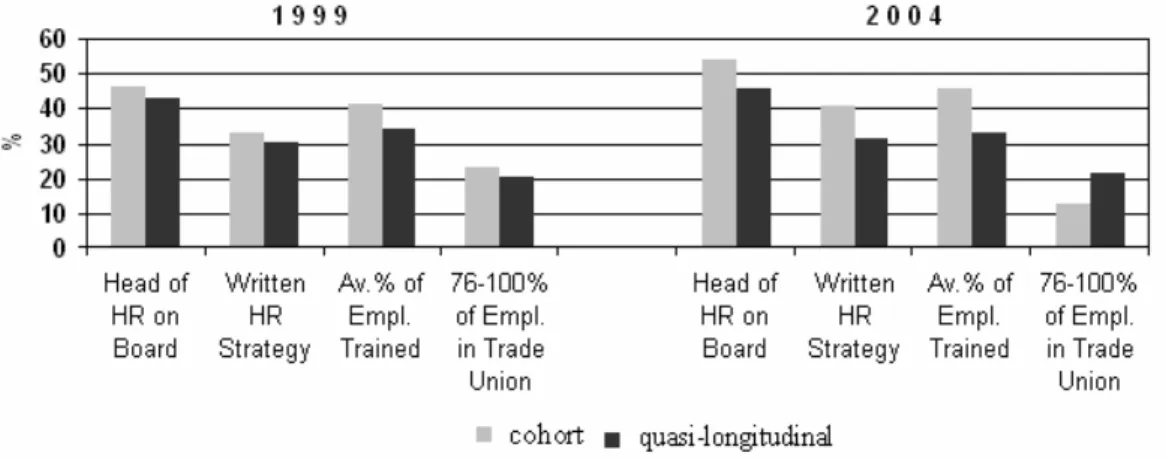
1.2.2. Empirical illustrations. Using 270 Austrian organizations from Cranet as an example, ‘cohort organizations’ which are the part of two consecutive rounds in 1999 and 2004 (N = 78) are compared with two cross-sectional samples in 1999 and 2004 representing the Austrian organizational landscape in terms of size and sector (N = 406). Looking at four variables – membership of the HR leader in the highest board of the organization; existence of a written HR strategy; average percentage of employ-ees trained; high unionization, i.e. more than 75% – the following picture emerges (see Fig. 1.).
Fig. 1. Longitudinal cohort and quasi-longitudinal/cross-sectional sample – a comparison
None of the differences between the longitudinal-cohort and the cross-sectional sample in the two survey rounds are significant1.30Likewise, looking at
developments over time, very similar results can be observed for the variables chosen. With the excep-tion of the unionisaexcep-tion variable, all other develop-ments are more or less similar.
1.3. Convergence/divergence – as simple as that?
In the HR literature, convergence231is used in a number of ways. On the one end of the spectrum, convergence is simply used to describe similarity between HRM in two different entities of analyzis at a certain point in time. For example, analysing commonalities and differences between HRM in locally owned units and MNC subsidiaries, Chen, Lawler & Bae (2005) use convergence to denote the degree of similarity between the two types of organization. In a similar way, Warner (2003) uses the term when discussing whether the handling of personnel/human resources in China resembles ‘Western’ HRM. While the time aspect is built in to some degree, it does not have overarching significance. Likewise, the concept of convergence is rather broad. On the other end of the spectrum, some contributions clearly have a more refined concept of convergence in mind and, at the same time, explicitly look at longer term developments
1 1999: Head of HR on Board: Chi2 (1) = .137, p = .711 (2-tailed).
i Written HR Strategy: Chi2 (1) = .018, p = .895 (2- tailed).
i Average % of Employees trained: t (174) = 1.298, p = .196 (2- tailed).
i 76-100% of Employees in Trade Union: Chi2 (1) = .000, p = 994 (2- tailed).
2004: Head of HR on Board: Chi2 (1) = .997, p = .318 (2- tailed).
i Written HR Strategy: Chi2 (1) = .695, p = .404 (2- tailed).
i Average % of Employees trained: t (93) = 1.848, p = .068 (2- tailed).
i 76-100% of Employees in Trade Union: Chi2 (1) = 2.310 p = 129 (2- tailed).
2 Obviously, mutatis mutandis the same is true for divergence.
(e.g., Gooderham and Brewster, 2003; Brewster and Tregaskis, 2003; Tregaskis and Brewster, 2006).
1.3.1. Conceptual considerations. Building on this, Mayrhofer et al. (2002) have pointed towards three potential meanings of convergence that can be of value when looking at developments in HRM over time. They propose that one should differentiate between three different forms of convergence: direc-tional convergence, final convergence, and majority convergence.
When comparing the developments between various countries one can speak of directional convergence if the development tendency goes into the same direc-tion. Regardless of a starting level in each country the variable analyzed changes in the same direction in each country. Figure 2 shows the basic idea. As one can see from the table, both in countries A and B the developments point into the same direction, e.g. the use of a certain management tool in each country increases. Nevertheless, the frequency of use in the two countries is at a different level.
Development over time
0 20 40 60 80 100 t t+1 time % Country A Country B
Fig. 2. Directional convergence
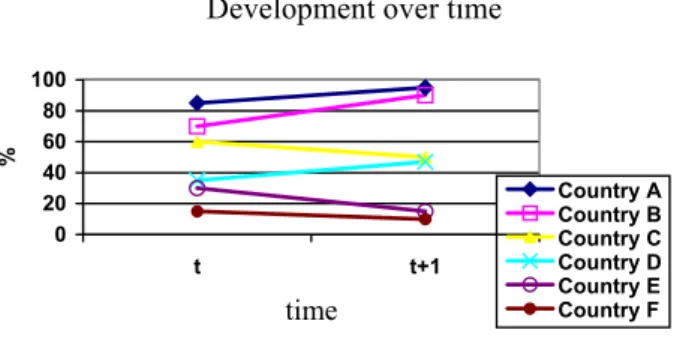
Final convergence emerges if the developments of a variable in different countries point towards a com-mon end point. In other words, the differences be-tween countries decrease. This development is inde-pendent of directional convergence (type 1) as dif-ferent developments in terms of, for example, fre-quency of use of a certain management tool, still can result in final convergence. Figure 3 shows three country pairs as examples of final convergence.
Development over time 0 20 40 60 80 100 t t+1 time % Country A Country B Country C Country D Country E Country F
Fig. 3. Final convergence
The third type of convergence – majority conver-gence – occurs if organizations in a country become more homogeneous or heterogeneous, respectively, using a certain management concept or tool. For example, if 50% of the organizations in a country use a specific management tool and 50% do not, one can assume maximum divergence within a country since there is a clear ‘split’ in the concrete use of this tool. However, if this value changes to 75% of the organizations using this tool, majority conver-gence has occurred. Note that this cannot simply be equated with an increase since one would also speak of an increase in majority convergence if the value would have dropped to 25%. In this case, there would have been an increased understanding by the companies not to use this tool. In more general terms: the closer a value in a country has moved to the 50% level, the greater the majority divergence has become. Vice versa, the more the value ap-proaches the 100% or 0% level, the greater the ma-jority convergence has become. In Figure 4 one can see parallel developments in terms of increased use of a certain management tool in both countries. However, in country A this is regarded as a move towards majority convergence whereas in country B this is a move towards majority divergence.
Development over time
0 25 50 75 100 t t+1 time % Country A Country B
Fig. 4. Majority convergence
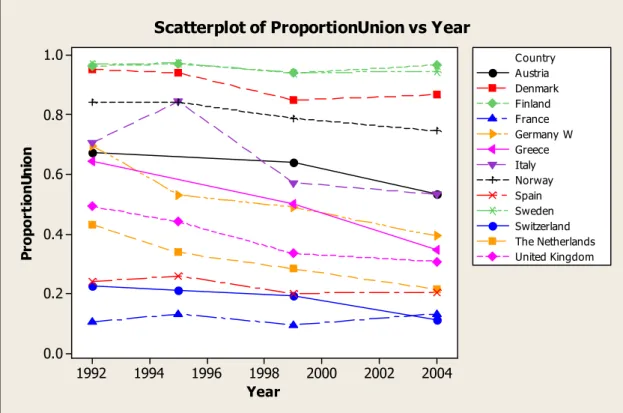
1.3.2. Empirical illustration. The following exam-ples demonstrate the potential usefulness of the dif-ferentiation into different types of convergence. Looking at the development of the proportion of companies with more than 25% of their employees being members of trade unions in 13 European
countries132over the period of 1992-2004, the
follow-ing picture emerges (see Fig. 5).
Looking at these results from the perspective of different forms of convergence, the following pic-ture emergence: in terms of directional conver-gence, the overall trend across the countries is negative, indicating a shrinking proportion of com-panies with more than 25% of unionization2.33Thus,
directional convergence occurs. When looking at the differences between countries, not very much happens. Unionization in the countries observed does not move towards a common endpoint, indi-cated by a reduction in the variation across coun-tries3.34In other words, no final convergence can be
observed. Finally, the Netherlands, Switzerland and the UK show clear moves towards majority convergence. These countries move towards the lower end of unionization ratio4,35indicating that
companies in these countries converge in their reduction of unionization.
1 Austria, Denmark, Finland, France, Germany, Greece, Italy, Nether-lands, Norway, Spain, Sweden. Switzerland and UK; private sector companies; N = 11,867; data from the Cranet survey on human resource management (see Brewster et al., 2004).
2 ProportionUnion = 0.6138 - 0.01114 (Year-1992) (Year-1992). Slope = -0.01114; StdError = 0.002379; t-ratio = -4.69; p-value = 0.0005. We are indebted to our colleague Johannes Ledolter from the University of Iowa for directing us in this direction (see also next footnote) and making the calculations. The model behind this relates the variable of interestY to time T = i and that allows the intercepts and the slopes to vary across countries (index j). We consider the model k(i,j) i j j ijk Į ȕT İ
Y , where the vector of country-specific intercepts and slopes (Įj,ȕj),j = 1, 2, …, 13, is treated as a vector random variable with mean vector (Į,ß) and 2x2 covariance matrix Ȉ (which we assume diagonal). The errors İk(i,j) are random with mean zero and variance ıİ2, and they are assumed independent of (Įj,ȕj).
3 Test for equality of variances in 1992, 1995, 1999, 2004; Bartlett test: p-value = 0.9762; no evidence that variances are different; Levine test: p-value = 0.8930; no evidence that variances are different. Behind this is a random effects model
k(i,j) j(i) i ijk Į ȕ İ
Y is used where the
coef-ficients Įi (i = 1, 2, 3, 4) represent the four yearly means and they are assumed to be fixed effects. The ȕj(i) are random country effects, where j is the country and where the subscript j(i) expresses the fact that country effects are nested within year. The country effects vary around zero, with variances ıȕ2(i) that depend on year. Theİk(i,j) are random errors reflecting the variability among firms around their respective country/year mean; they have mean zero and variance ıİ2. The random effects
j(i)
ȕ and İk(i,j) are independent random errors that are assumed to follow a normal distribution.
4 Average country proportions of companies with more than 25% of their employees belonging to trade unions:
Netherlands 1992: .43; 1995: .34; 1999: .28; 2004: .21. Switzerland 1992: .22; 1995: .21; 1999: .19; 2004: .11. UK 1992: .49; 1995: .44; 1999: .33; 2004: .31.
Year Pr op or ti on Un io n 2004 2002 2000 1998 1996 1994 1992 1.0 0.8 0.6 0.4 0.2 0.0 C ountry Finland France Germany W Greece Italy Norway Spain Sweden Switzerland The Netherlands A ustria United Kingdom Denmark Scatterplot of ProportionUnion vs Year
Fig. 5. Development of unionization – 1992-2004 2. Tracking developments over time – lessons
learned and calls for action
Looking at the three major issues discussed above, some core lessons emerge regarding tracking devel-opments over time.
2.1. Conceptual variety and heterogeneity of HRM is a resource/opportunity, but not everybody might agree – especially gate keepers in the field. The enormous variety of existing theo-retical concepts as well potential further develop-ments of these concepts for empirical research pro-vide researchers with the opportunity to tailor their theoretical frame to the respective research focus and empirical design. The great varieties of existing approaches allow researchers usually several choices at theoretical crossroads when constructing the conceptual story for the question at hand.
However, this lack of a coherent view on the field – comparable to the dynamics typical for the devel-opment of scientific paradigms (Kuhn, 1989) – also raises issues in terms of relative importance of the various approaches. Beyond the ‘hard fact’ level that requires a match between the research question and the focus of the theory, more subtle issues emerge. They include aspects such as the strive for theoretical dominance of the field, power struggles between different schools of thought clustered around theoretical or methodological basic assump-tions, concrete institutions or regions or conceptual imperialism touching on the issue of dealing with
‘aberrant’ views of a phenomenon. While this might be less relevant in the ‘ideal’ world of competing ideas leading to further insight, it leads to sometimes hard-felt consequences in the ‘real’ world of publishing, getting research grants and striving for honours. When certain theoretical views are banned from the access to these resources by important gate-keepers to scientific reputation or looked down upon, this influences re-search behavior. With the exception of some stubborn researchers highly detached from such incentive struc-tures, research will be framed along activities that are rewarded. In the long run, this can lead to a substantial narrowing of perspectives.
While this is no unique phenomenon for the concep-tual basis when tracking developments over time in HR, it becomes evident there, too. In the ‘ideal’ world of science, a decision by HR researchers to follow the dictum of cumulative research demanding long-term efforts where current steps draw on previous work and continue, intensify and enlarge them would lead to a problem-related choice of a theoretical framework. Building on this decision, they would develop the work and the framework. In the ‘real’ world of science confounded with all types of political power struggles sometimes disguised as ‘competition of ideas’ this is much less likely. On the contrary, theoretical choices are heavily influenced by guesses about preferences of potential reviewers, favorite frameworks of targeted journals or caution about one’s own reputation in the scientific community.
2.2. Empirical based causality arguments require longitudinal cohort design. For research focused on the empirical discovery of causal relation, a longitudinal cohort design offers many advantages. While theoretical reasoning is a conditio sine qua non, the empirical support and line of reasoning are greatly enhanced if it can draw on longitudinal cohort data. Sequential data selection allows introducing a clear temporal differentiation providing a basis for a causal argument. In this respect, a call for more longitudinal research in HRM is more than timely.
2.3. ‘Cross-sectional’ and ‘longitudinal’ depends on the chosen level of analysis. While in some cases it is clearly evident what can be considered as ‘cross-sectional’ and ‘longitudinal’, in other cases this is far less clear. A prominent example is tracking the development of organizational management practices in different countries, regions or cultures over time. Repeated questionnaire data collection aiming at a sample of organizations representative for the broader unit of analysis, e.g. country, has a janus-like characteristic to it. From an organizational perspective, this constitutes an example for a series of cross-sectional surveys. However, if the research focuses on the development of management practices in an entity above the organization, e.g. the country, the picture changes. From this angle, an ‘adequate’ reflection of the development at the country level requires such ‘cross-sectional’ studies which are actual longitudinal-cohort as they aim at the same unit of analysis, in this case: country.
Hence, it becomes evident that for tracking devel-opments over time an adequate research design has to be chosen. This requires careful and accurate
analysis of the kind of research question and the analytical level at hand.
2.4. Looking for converging developments requires a differentiated concept of convergence.
Tracking developments over time often leads sooner or later to the question whether the observed units have become more ‘similar’, either to each other or to a specific benchmark. Deciding whether ‘similarity’ occurs and what kind of ‘similarity’ can be found requires a differentiated conceptualization that takes into account the dynamic of developments as well as different dimensions of ‘similarity’. The concept of directional, final and majority convergence can provide such a framework and allows disentangling various types of developments over time.
Concluding remark
This paper obviously is not an empirical contribution in the classical sense. While heavily drawing on theoretically guided empirical research, it is primarily an invitation to reflect. On the surface, it invites to reflect developments and typical constellations in one area of the field of HRM, i.e. efforts to track developments over time. At a more basic level, it invites to reflect issues and developments in the field of HRM. While the paper’s examples and arguments are linked to a specific area, they are by no means restricted to it. Power issues, the question of causality, the fit between research question, targeted answers and empirical data base and the call for a more differentiated view are major issues for HRM as a whole – and deserve, at least in the authors’ views, more reflection than currently is given to them.
References
1. Aycan, Z., R.N. Kanungo, J.B.P. Sinha. Organizational Culture and Human Resource Management Practices: The Model of Culture Fit // Journal of Cross-Cultural Psychology, 1999. – No 4. – pp. 501-526.
2. Bach, S. Managing Human Resources: Personnel Management in Transition. – Oxford et al.: Blackwell, 2005. 3. Beer, M., B. Spector, P.R. Lawrence, D.Q. Mills, R.E. Walton. Managing Human Assets. – New York: The Free
Press, 1984.
4. Beer, M., B. Spector, P.R. Lawrence, D.Q. Mills, R.E. Walton. Human Resource Management. – New York, Lon-don: Free Press, 1985.
5. Brewster, C. Towards a 'European' Model of Human Resource Management // Journal of International Business Studies, 1995. – No 1. – pp. 1-21.
6. Brewster, C. European perspectives on human resource management // Human Resource Management Review, 2004. – No 4. – pp. 365-382.
7. Brewster, C., W. Mayrhofer, M. Morley. (2000a). The Concept of Strategic European Human Resource Manage-ment. In C. Brewster, W. Mayrhofer, and M. Morley (Eds.), New Challenges for European Human Resource Management, (pp. 3-33). London: Macmillan.
8. Brewster, C., W. Mayrhofer, M. Morley (Eds.) New Challenges in European Human Resource Management. Lon-don: Macmillan (2000b).
9. Brewster, C., W. Mayrhofer, M. Morley (Eds.) Human Resource Management in Europe. Evidence of conver-gence? Oxford: Elsevier/Butterworth-Heinemann (2004).
10. Brewster, C., O. Tregaskis (2003). Convergence or Divergence of Contingent Employment Practices? Evidence of the Role of MNCs in Europe. In W. Cooke (Ed.), Multinational Companies and Global Human Resource Strate-gies, (pp. 143-166). Greenwood, Ill.: Quorum Books.
11. Budhwar, P.S. (Ed.). Managing Human Resources in Asia-Pacific. London et al.: Routledge (2004).
12. Budhwar, P.S., P.R. Sparrow. An Integrative Framework for Understanding Cross-National Human Resource Management Practices // Human Resource Management Review, 2002. – No – pp. 377-403.
13. Chen, S.-J., J.J. Lawler, J. Bae. Convergence in Human Resource Systems: A Comparison of Locally Owned and MNC Subsidiaries in Taiwan // Human Resource Management, 2005. – No 3. – pp. 237-256.
14. Collin, A. New Challenges in the Study of Career // Personnel Review, 1998. – No 5. – pp. 412-425.
15. Fombrun, C.J., N. Tichy, M.A. Devanna. Strategic Human Resource Management. – New York et al: Wiley,1984. 16. Gooderham, P., C. Brewster. Convergence, Stasis or Divergence? The Case of Personnel Management in Europe //
Beta, 2003. – No 1. – pp. 6-18.
17. Guest, D. E. Human Resource Management and Industrial Relations // Journal of Management Studies, 1987. – No 5. – pp. 503-521.
18. Guest, D.E. Human Resource Management and the American Dream // Journal of Management Studies, 1990. – No 4. - pp. 377-397.
19. Ignjatovic, M., I. Sveltic. European HRM Clusters // Estonian Business Review, 2003. – No – pp. 25-39. 20. Kuhn, T.S. Die Struktur wissenschaftlicher Revolutionen. – Frankfurt am Main: Suhrkamp, 1989.
21. Legge, K. Human Resource Management. Rhetorics and Realities. - Houndsmills, Basingstoke: Palgrave Macmil-lan, 2005.
22. Mayrhofer, W., M. Müller-Camen, J. Ledolter, G. Strunk, C. Erten. The Diffusion of Management Concepts in Europe – Conceptual Considerations and Longitudinal Analysis // Journal of Cross-Cultural Competence & Man-agement, 2002. – No – pp. 315-349.
23. Sparrow, P., R.S. Schuler, S.E. Jackson. Convergence or Divergence: Human Resource Practices and Policies for Competitive Advantage Worldwide // International Journal of Human Resource Management, 1994. – No 2. – pp. 267-299.
24. Tregaskis, O., C. Brewster. Converging or Diverging? A Comparative Analysis of Trends in Contingent Employ-ment Practice in Europe over a Decade // Journal of International Business Studies, 2006. – No 1. – pp. 111-126. 25. Warner, M. China's HRM Revisited: A Step-Wise Path to Convergence? // Asia Pacific Business Review, 2003. –