econ
stor
www.econstor.eu
Der Open-Access-Publikationsserver der ZBW – Leibniz-Informationszentrum Wirtschaft The Open Access Publication Server of the ZBW – Leibniz Information Centre for EconomicsNutzungsbedingungen:
Die ZBW räumt Ihnen als Nutzerin/Nutzer das unentgeltliche, räumlich unbeschränkte und zeitlich auf die Dauer des Schutzrechts beschränkte einfache Recht ein, das ausgewählte Werk im Rahmen der unter
→ http://www.econstor.eu/dspace/Nutzungsbedingungen nachzulesenden vollständigen Nutzungsbedingungen zu vervielfältigen, mit denen die Nutzerin/der Nutzer sich durch die erste Nutzung einverstanden erklärt.
Terms of use:
The ZBW grants you, the user, the non-exclusive right to use the selected work free of charge, territorially unrestricted and within the time limit of the term of the property rights according to the terms specified at
→ http://www.econstor.eu/dspace/Nutzungsbedingungen By the first use of the selected work the user agrees and declares to comply with these terms of use.
zbw
Leibniz-Informationszentrum Wirtschaftvon Hirschhausen, Christian R.; Cullmann, Astrid
Working Paper
Efficiency Analysis of German Electricity Distribution
Utilities : Non-Parametric and Parametric Tests
Dresden discussion paper in economics, No. 06/05 Provided in cooperation with:
Technische Universität Dresden
Suggested citation: von Hirschhausen, Christian R.; Cullmann, Astrid (2005) : Efficiency Analysis of German Electricity Distribution Utilities : Non-Parametric and Parametric Tests, Dresden discussion paper in economics, No. 06/05, http://hdl.handle.net/10419/22723
Dresden University of Technology
Faculty of Business Management and Economics
Dresden Discussion Paper Series
in Economics
Efficiency Analysis of German Electricity
Distribution Utilities
Non-Parametric and Parametric Tests
CHRISTIAN VON HIRSCHHAUSEN
ASTRID CULLMANN
Dresden Discussion Paper in Economics No. 06/05
Address of the author(s):
Christian von Hirschhausen Dresden University of Technology
Dpt. of Business Management and Economics DREWAG-Chair of Energy Economics 01062 Dresden
Germany
e-mail : [email protected]
Astrid Cullmann
DIW Berlin (German Institute for Economic Research) International Economics Koenigin-Luise-Str. 5 14195 Berlin Germany e-mail : [email protected] Editors:
Faculty of Business Management and Economics, Department of Economics Internet:
An electronic version of the paper may be downloaded from the homepage:
http://rcswww.urz.tu-dresden.de/wpeconomics/index.htm
English papers are also available from the SSRN website:
http://www.ssrn.com
Working paper coordinator: Dominik Maltritz
Dresden Discussion Paper in Economics No. 06/05
Efficiency Analysis of German Electricity Distribution
Utilities
Non-Parametric and Parametric Tests
Christian von Hirschhausen Astrid Cullmann
Dresden University of Technology DIW Berlin (German Institute for Economic Research) Dpt. of Business Management and Economics International Economics
01062 Dresden 14195 Berlin
[email protected] [email protected]
Abstract:
This paper applies parametric and non-parametric and parametric tests to assess the efficiency of electricity distribution companies in Germany. We address traditional issues in electricity sector benchmarking, such as the role of scale effects and optimal utility size, as well as new evidence specific to the situation in Germany This paper applies parametric and non-parametric and parametric tests to asses the efficiency of electricity distribution companies in Germany. We use labor, capital, and peak load capacity as inputs, and units sold and the number of customers as output. The data covers 307 (out of 553) German electricity distribution utilities. We apply a data envelopment analysis (DEA) with constant returns to scale (CRS) as the main productivity analysis technique, whereas stochastic frontier analysis (SFA) with distance function is our verification method. The results suggest that returns to scale play a minor role; only very small utilities have a significant cost advantage. Low customer density is found to affect the efficiency score significantly in the lower third of all observations. Surprisingly, East German utilities feature a higher average efficiency than their West German counterparts. The correlation tests imply a high coherence of the results.
JEL-Classification: L51, L43, L94, C14
INTRODUCTION
Efficiency analysis has played a crucial role in defining regulatory policies, mainly in industries characterized by natural monopolies and/or by public ownership (such as telecommunication, transport, energy, schooling, and hospitals), but also in other industries subject to sector-specific analysis (e.g. Latruffe, et al., 2004, on crop and livestock farms, and Färe, Grosskopf and Weber, 2004, on banking). In the electricity sector, efficiency analysis has played a particularly important role in the liberalization process towards a competitive industry structure and market-orientated regulation, both in electricity transmission and electricity distribution. The objective of this paper is to assess the relative efficiency of decision-making units, (here: electricity distribution companies), in order to generate information for an incentive-oriented regulation, with benchmarking and yardstick competition.
Data envelopment analysis (DEA) and stochastic frontier analysis (SFA) are the most commonly used methods in the literature on benchmarking and efficiency analysis in the electricity sector. They have been particularly useful in the regulatory process in Great Britain, Switzerland, the Nordic States, the Netherlands, and Austria. Many authors concentrate on scale effects, and the optimal size and relative efficiency of utilities. Jamasb and Pollitt (2001) give an extensive comparison of international efficiency studies for the electricity sector, stressing the importance of the proper variable choice. In a subsequent paper, Jamasb and Pollitt (2003) perform an international benchmarking study of 63 utilities from six European countries comparing several SFA and DEA specifications. Although they determine a high correlation among the models, the results for single utilities differ noticeably. Using panel data of 59 Swiss distribution companies over eight years, Farsi and Filippini (2004) argue that different methodologies may lead to different results, but that the reasonable out-of-sample “prediction errors suggest that panel data models can be used as a prediction instrument in order to narrow the information gap between the regulator and regulated companies” (p.2). In a similar panel data analysis for six Latin America countries, Estache, Rossi and Ruzzier (2004) also show that national regulators can reduce information asymmetry through cross-country efficiency analysis.
Other examples of panel-data approaches are Burns, Davies and Riechmann (1999) with a dynamic benchmarking analysis for 12 regional electricity distribution utilities in
Great Britain, Hjalmarsson’ s (1992) analysis of Swedish electricity retail distributors, and the productivity study of Norwegian electricity utilities conducted by Forsund and Kittelsen (1998). Quality is explicitly taken into account and related to benchmarking in a study by Giannakis, et al. (2004) on the UK electricity distribution utilities.
The present paper is the first productivity analysis of German electricity distributors to date. We address both traditional issues of electricity sector benchmarking, such as the role of scale effects and optimal utility size, as well as new evidence specific to the situation in Germany. Regarding the latter, we consider the potential effects of three structural variables: consumer density, grid composition (cable versus aerial lines), and differences between East and West German distribution companies. Our empirical section thus follows the structural criteria set out by the German association agreements (“Verbändevereinbarung Strom VV II+”). The data covers 380 (out of 553) German
electricity distribution utilities.
Our study is motivated by two factors: first, efficiency analysis in electricity distribution currently faces serious issues in determining whether there are significant returns to scale. The question arises whether or not smaller utilities do have systematically lower efficiency scores than larger ones, implying increasing returns (“big is beautiful”). Filippini (1998), Filippini, Hrovatin and Zoric (2004), and a number of other studies suggest significant economies of scale in “small” electricity distribution systems, e.g. Switzerland and Slovenia. Smaller utilities could reduce costs by merging and thereby extending their sub-optimal service territory size. This would suggest that the current, atomized structure of the German electricity utilities may be subject to structural change as well. Second, in the wake of liberalization, the German electricity industry is currently undergoing structural change from local monopolies to regulated competition. Observers suggest that liberalization will lead to a structural change of the sector, which has up to now comprised a large number of companies: four in high-voltage transmission, 56 in regional distribution, and 553 in local electricity distribution. These numbers contrast sharply with the U.K. system, for instance, which features only 13 regional electricity companies altogether.
The next section briefly describes the institutional context of electricity sector reform in Germany. Section 3 presents our methodology and data. Results from the basic model, and from several extended models, estimated by using DEA and SFA are provided in
Section 4; we also carry out a correlation analysis of different estimations. Section 5 concludes.
1. ELECTRICITY SECTOR REFORMS IN GERMANY
Germany is the largest electricity producer and consumer in the European Union, and thus plays an important role in the liberalization of the sector launched by the European Commission in the mid 1990s. However, until recently, Germany has held the red lantern of the countries resisting European electricity deregulation for a long time together with France and a few other countries. Subsequently the European Union has speeded up its attempts towards liberalization and vertical unbundling of the electricity sector. The so-called “acceleration directive” (2003/54/EC) requires legal unbundling of electricity distribution companies with more than 100,000 connected customers, i.e. creating legally independent commercial units for generation, transmission, and distribution. This goes well beyond the former EU electricity directive 96/92. Given the slow progress of liberalization in most member states, the acceleration directive also calls for an intensification of regulatory oversight and the introduction of an explicit regulatory body in each country, responsible for regulating electricity distribution. Consequently, in Germany the electricity industry will now be subordinated to ex-ante regulation for the first time in its history. Under the former directive 96/92, Germany had implemented a model of negotiated access and had – to that end – authorized industry self-regulation. The electricity industry and the large electricity consumers were given freedom to negotiate network access prices and conditions in so-called association agreements (“Verbändevereinbarungen”). Given the systemic information advantage of the electricity industry over the customers, and the hesitation of the German government to establish a sufficient countervailing power in a regulatory agency, self-regulation did not succeed in bringing prices down, or in establishing a significant level of competition. In its annual benchmarking reports, the European Commission has regularly criticized the German approach of self-regulation of network
access charges (e.g. European Commission, 2003).1 The new German energy law, due
to come into force in 2005, therefore sets up a regulatory agency and requires ex-ante
1 See Brunekreeft (2003, 2005) for a detailed account of the regulatory context in
regulation of network access. As observed in other countries implementing UK-style reforms, e.g. the Netherlands and Austria, the process of unbundling and the introduction of ex-ante regulation are likely to lead to conflicts between the incumbent operators, potential market entrants, and the regulatory authorities. These conflicts revolve around the absolute level of access tariffs, the relative level, and non-tariff discrimination.
Surprisingly, the literature on that issue in Germany is sparse: Riechmann (2000) investigates the efficiency of the 53 regional distributors in Germany with DEA and finds significant cost reduction potentials. Haupt, Kinnunen and Pfaffenberger (2002) compares network access prices of German electricity distributors and identify reasons for differences beyond the decision framework of the companies. They consider structural variables in order to take explicit account of regional specificities, for example settlement density and consumer structure; but they do not include a comparative efficiency analysis. Growitsch and Wein (forthcoming) try to explain the high network charges in German electricity distribution, but efficiency considerations are not included in the analysis. In a study for the German energy consuming industry, Frontier Economics and Consentec (2003) assess a sample of 27 regional and local electricity distributors, using turnover as input, and peak load, units sold, and structural parameters as output. Interestingly, a regional distributor in East Germany was found to be on the efficiency frontier, indicating that the traditional post-reunification bias towards higher costs in East German distribution may have decreased by now.
3. METHODOLOGY AND DATA
3.1. Methodology
To measure the relative efficiency of the German distribution utilities we use traditional data envelopment analysis (DEA) as well as stochastic frontier analysis (SFA), including the multi-output multi-input version of the distance function, mainly as a verification method. Our analysis is confined to the measurement of technical efficiency. DEA is a non-parametric approach determining a piecewise linear efficiency frontier along the most efficient utilities to derive relative efficiency measures of all other utilities. The efficiency scores can be obtained either within a constant returns to scale (CRS) approach or a less restrictive variable returns to scale (VRS) approach. The
VRS approach compares companies only within similar sample sizes; this approach is appropriate if the utilities are not free to choose or adapt their size. Therefore we argue that the CRS approach is more relevant for our analysis. It assumes that companies are flexible to adjust their size to the one optimal firm size at least in the German context. However, we also calculate the VRS model in order to report scale efficiency information, which is delivered by the difference between the CRS and VRS scores. The determination of the efficiency score of the i-th firm in a sample of N firms in the
CRS model is equivalent to the following optimization: minθ,λθ
s.t.
-yi + Yλ≥ 0,
θxi – Xλ≥ 0,
λ≥ 0.
θ is the efficiency score, and λ a N*1 vector of constants. Assuming that the firms use
E inputs and M outputs, X and Y represent E N* input and M*N output matrices,
respectively. The input and output column vectors for the i-th firm are represented by
i
x and yi. The constraints ensure that the i-thfirm is compared to a linear combination
of firms similar in size. To determine efficiency measures under the VRS assumption a further convexity constraint ∑λ=1 has to be considered. The system is solved once for each firm (for details, see Jamasb and Pollitt, 2003, 1612, and Coelli, et al., 1998, Chapter 6).
We chose an input orientated approach that considers the output to be fixed so that the input has to be adjusted in order to maximize efficiency. It is reasonable to assume the output fixed in a market with the legal duty to serve all customers in a predefined service territory.
DEA is a relatively uncomplicated approach. The determination of an explicit production function is not required. However, since DEA is a non-parametric approach the impact of the respective input factors on the efficiency cannot be determined. Furthermore, DEA does not account for possible noise in the data and outliers can have a large effect on the result. We therefore introduce a second methodology, the stochastic frontier analysis (SFA).
SFA delivers a parametric approach to efficiency benchmarking. The theory of stochastic frontier production functions was originally proposed by Aigner, Lovell and Schmidt (1977) as well as Meeusen and van den Broeck (1977). This approach requires the definition of an explicit production or cost function. Based on the usual OLS regression a parallel shift of the original production function yields the efficiency frontier. This is caused by an underlying assumption splitting the error term into a stochastic residuum (noise) and an inefficiency-term. Usually, stochastic errors are assumed to be distributed half-normally. Originally the model was specified for cross-sectional data. Hence, the mathematical expression of the production process is:
Yi =xi
β
+(vi −ui), i=1,...,N (1) where Yi is output (or the logarithm of output) of the i-th firm,xi is a k*1 vector of input quantities of the i-th firm,
β
is a vector of parameters to be estimated,i
v are random variables which are assumed to be iid. N(0,σv 2), independent of
i
u .
i
u are non-negative random variables usually assumed to be half normal
distributed (iid. |N(0,σU2)|), thereby accounting for individual technical
inefficiency.
This original specification has been extended by different assumptions on the distribution of ui, such as truncated normal or two-parameter gamma distributions. The
further extension of the model to panel data, systems of equations, and time-varying technical efficiencies follows more recent developments in econometrics and productivity analysis.
SFA is more complex than DEA in terms of data requirements and handling, but has the advantage of allowing to deal with multiple-outputs multiple-inputs in the form of a distance function, originally proposed by Shephard (1970). The basic idea is that in the case of a given production possibility frontier, for every producer the distance from the
production frontier is a function of the vector of inputs used, X , and the level of
outputs produced, Y. For the output-oriented model the distance function is defined as:
( , ) min{ : ( / ) ( )}
o
D X Y =
θ
Yθ
∈P x (2)where ( , )D X Yo is the distance from the firm’ s output P X( )set to the production
frontier. ( , )D X Yo is non-decreasing, positively linearly homogeneous and convex in Y,
and decreasing in X. θ is the scalar distance by which the output vector can be deflated (Coelli 2002) and can be interpreted as the level of efficiency. The output distance function aims at identifying the largest proportional increase in the observed output vector Y provided that the expanded vector ( / )Y
θ
is still an element of the originaloutput set (Grosskopf et al., 1995). If Yis located on the outer boundary of the
production possibility set then D X Yo( , )= =θ 1 and the utility is 100% efficient. On the other hand, values of D X Yo( , )= ≤θ 1 indicate inefficient enterprises lying within the efficiency frontier.
The input orientated approach is defined on the input set L Y( ) and considers, by
holding the output vector fixed how much the input vector may be proportionally contracted. The input distance function is expressed by:
{
}
( , ) max : ( / ) ( ) i D X Y =ρ
Xρ
∈L Y (3) ( , ) iD X Y is non-decreasing, positively linearly homogeneous and concave inX , and
increasing in Y.
ρ
is the scalar distance by which the input vector can be deflated. If( , ) 1 i
D X Y = =
ρ
, X is located on the inner boundary of the input set and the utility is100% efficient.
The first step is to estimate the distance from the frontier. Therefore both the efficiency frontier as well as the relationship between inputs and outputs have to be determined. These considerations also include the case of multi-output production functions which can not be estimated with conventional SFA techniques. The most common and appropriated functional form is the translog production function. The translog input distance function in its parametric form with M m( =1, 2,...,M)M outputs and
( 1, 2,... )
( )
0 1 1 1 1 1 1 1 1 1 ln ln ln ln ln 2 1 ln ln ln ln 2 M M M K m m mn m n k k i m m n k K K K M km k l km k m k l k m D y y y x x x x yα
γ
γ
β
β
δ
= = = = = = = = = + + + + +∑
∑ ∑
∑
∑ ∑
∑ ∑
(4)In order to maintain the homogeneity and symmetry a number of restrictions need to be imposed. For homogeneity the following restrictions have to be considered:
1 1 1 1, 0 and 0 K K K k kl km k l k
β
β
δ
= = = = = =∑
∑
∑
(5) For symmetry, two other restrictions have to be observed:and
mn nm kl lk
γ
=
γ
β
=
β
(6) Imposing homogeneity and symmetry restrictions and normalizing equation (4) by dividing it by one of the inputs delivers the estimating form of the input distance function:( )
0 1 1 1 1 1 1 1 1 1 1 1 1 1 ln ln ln ln ln 2 1 ln ln ln ln ln 2 M M M K k K m m mn m n k K m m n k K K K M k l k kl km m I K K K k l k m x x y y y x x x x y D x x xα
γ
γ
β
β
β
− = = = = − − − = = = = ⎛ ⎞ − = + + + ⎜ ⎟ ⎝ ⎠ ⎛ ⎞ ⎛ ⎞ ⎛ ⎞ + ⎜ ⎟ ⎜ ⎟+ ⎜ ⎟ − ⎝ ⎠ ⎝ ⎠ ⎝ ⎠∑
∑ ∑
∑
∑ ∑
∑ ∑
(7) lnDi can be interpreted as error term which reflects the difference between theobserved data realizations and the predicted points of the estimated function. Replacing lnDi by a composed error term (the stochastic error vi and the technical inefficiency
i
u ) yields the common SFA form. It can be estimated by a stochastic frontier
production function defined as y= f x( )+ −v u. For I i( =1,..., )I firms, this
econometric specification with lnD0i = −
ν
i ui, in its normalized form is expressed by:( )
0 1 1 1 1 1 1 1 1 1 1 1 1 1 ln ln ln ln ln 2 1 ln ln ln ln 2 M M M K ki Ki m mi mn mi ni k Ki m m n k K K K M ki li ki kl km mi i i Ki Ki Ki k l k m x x y y y x x x x y v u x x xα
γ
γ
β
β
β
− = = = = − − − = = = = ⎛ ⎞ − = + + + ⎜ ⎟ ⎝ ⎠ ⎛ ⎞ ⎛ ⎞ ⎛ ⎞ + ⎜ ⎟ ⎜ ⎟+ ⎜ ⎟ + − ⎝ ⎠ ⎝ ⎠ ⎝ ⎠∑
∑ ∑
∑
∑ ∑
∑ ∑
(8)As discussed above, a certain distribution for ui has to be assumed in order to separate
stochastic and inefficiency effects. Most common are the normal distribution,
2
~ ( , )
i
u N
µ σ
and the half-normal distribution truncated at zero, ui ~ (0,Nσ
2).Further, the inefficiency can also be assumed to be constant over time resulting in
(
)
{
}
(
exp)
it i
u =u
η
T−t (Battese and Coelli, 1992).3.2. Choice of Variables and Data
In this paper as well as in the literature in general, a wide variety of different specifications is employed depending on what exactly is being investigated and which variables are being used as inputs and as outputs.2 The choice of variables for input and output needs to take into account the international experience with electricity distribution benchmarking and is constrained by data availability. In this respect, Germany has to be ranked among the least developing countries. The absence of a regulatory culture has thus far prevented the systematic collection of the relevant data. We therefore have to cope with a data set pieced together from a variety of sources and providing a representative sample for one year only (2001).
We estimate a base model, using the traditional input and output variables, and then add variations to this model. The base models include labor, grid size, and peak load (as the proxy for transformation capacity) as inputs, and units sold, the number of customers, and the inverse density index as outputs. In the extended models, we disaggregate both the consumers (number of industrial and number of residential customers) and the type of cable (aerial and underground), and we introduce an additional input variable: the electricity losses by each company. Last but not least, we compare the performance of utilities in East Germany and in West Germany to check whether this historical distinction still causes a structural difference between the two regions. The data specification is as follows:
2 For example, most studies consider the grid size as an input to approximate the capital
costs whereas other studies cited by Jamasb and Pollitt (2001) specify the total length of line as output variable to approximate the complexity of the grid structure. Likewise, the transformer capacity is found to be an input in 11 of the 20 studies analysed, whereas two of the studies chose it as an output.
- Labor input is estimated by the number of workers.3 As employment data covers all workers in the electricity utility, we subtract one employee for each 20 GWh electricity produced (following Auer, 2002, p.128);
- capital input is approximated by the length of the existing electricity cables. We differentiate between voltage levels (high, medium and low voltage) by introducing a cost factor for each type of line.4 In addition, in one of the extended models, we distinguish between the cable grid and the aerial grid (following Auer, 2002, and others); cable is supposed to be more expensive than aerial grid. Thus, we substitute the simple grid size variable of the basic model by a weighted sum of cable and aerial grid;5
- in one model we also take into account the maximum peak load as a further cost factor to approximate transformer capacity;
- the amount of electricity distributed to end users (units sold) and the total number of customers are used as output variables; in an extended model we use turnover instead of units sold as a further output variable.6 Due to data limitations, we cannot differentiate between operating costs (OPEX) and capital costs (CAPEX);
- losses are included as a proxy for the technical quality of the grid or the service quality of the grid. We consider losses as an input;7
- the use of the inverse density index (settled area in kilometers per customers supplied) in the base model specification is motivated by the argument that utilities with a dense customer structure have a natural cost advantage over those with a
3 We are aware of the criticism of this choice of variable due to the potentially distorting
effect of outsourcing: an utility can improve its efficiency simply by switching from in-house production to outsourcing.
4 Following standard practice: factor 5 for high voltage, 1.6 for medium voltage, and 1
for low voltage cables.
5 The share of cable lines of total lines is one of the structural variables in the German
association agreements.
6 For curiosity reasons, we have also run a model specification using turnover as the
only input. If one assumes identical profitability among the distribution companies, then turnover can be used as a proxy for total costs (TOTEX).
weak customer density. When taken as an output, the inverse density index improves the performance of sparsely inhabited distribution areas;8
- in addition, we distinguish between utilities situated in West Germany and those in East Germany (the former GDR). The latter are expected to display particularities due to their socialist heritage which may have a significant effect on their efficiency scores.
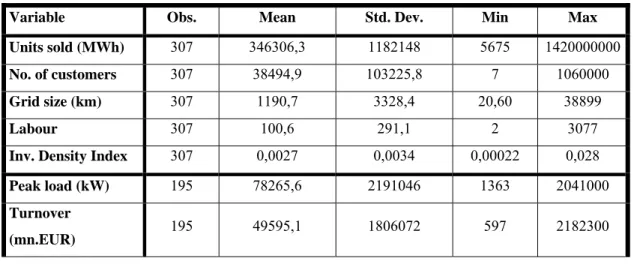
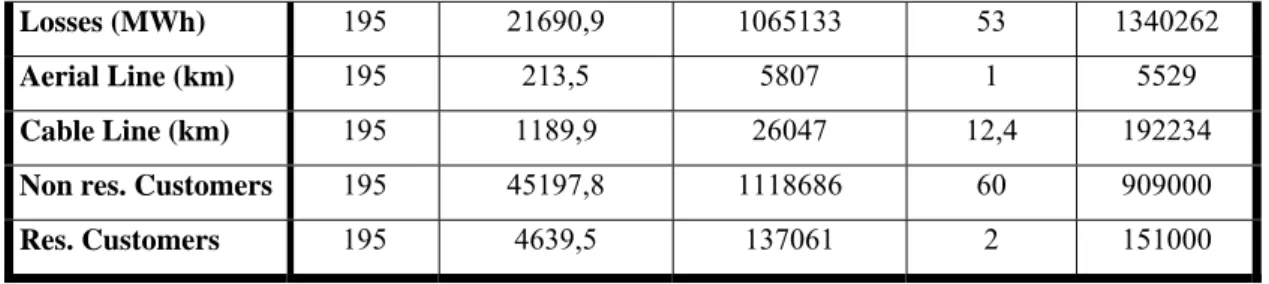
The electricity distribution data used in this study include information on 307 German distribution companies in the year 2001 (or, for some variables, previous years). The data was collected from publicly available sources.9We have verified that the sample is representative: it covers 56% of the total number of utilities, and 60.3% of the electricity sold. For the models 3-7, we have 197 observations. Summary statistics of the data are presented in Table 1.
Table 1: Sample Summary Statistics
Variable Obs. Mean Std. Dev. Min Max
Units sold (MWh) 307 346306,3 1182148 5675 1420000000
No. of customers 307 38494,9 103225,8 7 1060000
Grid size (km) 307 1190,7 3328,4 20,60 38899
Labour 307 100,6 291,1 2 3077
Inv. Density Index 307 0,0027 0,0034 0,00022 0,028
Peak load (kW) 195 78265,6 2191046 1363 2041000
Turnover
(mn.EUR) 195 49595,1 1806072 597 2182300
8 Density is also one of the structural variables defined in the German association
agreements.
9 The sources of the data are the following:
Verlags- und Wirtschaftsgesellschaft der Elektrizitätswerke m.b.H. – VWEW:
-„Jahresdaten der Stromversorger 2001“; VWEW Energieverlag GmbH, Frankfurt am Main, Heidelberg. (2002) for number of customers, units sold, number of employees and grid data.
-VDEW-Statistik 1996/1997 Leistung und Arbeit; VWEW-Verlag, Frankfurt am Main; (1997/98) for inverse density index and peak load.
Losses (MWh) 195 21690,9 1065133 53 1340262
Aerial Line (km) 195 213,5 5807 1 5529
Cable Line (km) 195 1189,9 26047 12,4 192234
Non res. Customers 195 45197,8 1118686 60 909000
Res. Customers 195 4639,5 137061 2 151000
4. EMPIRICAL RESULTS 4.1 Overview of the Model Runs
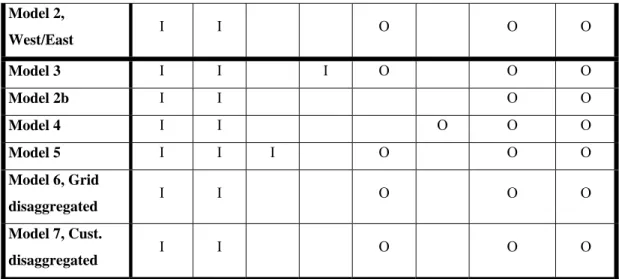
The presentation of results is divided into two broad sections: in the first section, the base model is developed, consisting of two inputs (labor, network size) and three outputs (units sold, no. of customers, inverse density index). Subsequently, we run variations of the base model, including the use of turnover as a monetary variable (instead of units sold), a disaggregation of the consumers (industrial and residential), as well as a disaggregation of the network (into aerial lines and underground cable). Further, we consider peak load as a proxy for transformer capacity (for which no data is available). To extend the classical efficiency measurement approach quality is included: grid quality is approximated by the sum of losses as a further input variable. Results for East and West Germany will also be discussed separately. Models 1 and 2 are separately estimated with DEA (CRS and VRS) and SFA, and the correlations and rank-correlations are checked (Kruskal-Wallis test). For models 3-7, we limit ourselves to DEA. The limited data availability for firm-specific characteristics leads to a reduced data sample of 195 utilities in the second approach. Since model 2 is estimated with the full data sample as well as with the reduced data sample, it serves as reference model to compare results obtained in the two parts. Table 2 lists the different model specifications in more detail.
Table 2: Model Specification for the Analysis Labour Grid Size Losses Peak Load Units Sold Turn-over No. of Customers Inverse Density Index Model 1 I I O O Model 2 I I O O O Model 2, VRS I I O O O
Model 2, West/East I I O O O Model 3 I I I O O O Model 2b I I O O Model 4 I I O O O Model 5 I I I O O O Model 6, Grid disaggregated I I O O O Model 7, Cust. disaggregated I I O O O
4.2. Results from the Base Model 4.2.1. Model 1
Model 1 considers two inputs (labor and grid size) and two output (units sold and number of customers). DEA delivers the efficiency estimates depicted in Fehler! Verweisquelle konnte nicht gefunden werden..10 The average efficiency for model 1 is 63.2%. Twelve utilities are on the efficiency frontier. We observe a positive correlation between the size of the utility and its efficiency score: the average efficiency for the 154 largest utilities is 69%, whereas for the smaller half of the sample it is only 57%. In particular, there seems to be a problem with very small utilities: the 25 smallest distribution companies average an efficiency score of only 41.4 %.
Figure 1: DEA Analysis, Model 1 with CRS
10 In all subsequent figures, the utilities are ordered by units sold and, thereby, by size.
DEA, Model 1, CRS 0% 20% 40% 60% 80% 100% 1 16 31 46 61 76 91 106 121 136 151 166 181 196 211 226 241 256 271 286 301 utility number Efficiency in % Average efficiency: 63.20%. 307 utilities.
Input: labour, grid size. Output: customers, units sold.
If we use the VRS specification of model 1 instead, the efficiency scores rise significantly: 32 of the 307 utilities are 100% efficient. This can be explained by the fact that now utilities of similar size are compared with each other and not with the best ones in the sample. With VRS, the average efficiency increases to 68.3%, 5.1% higher than the results under the CRS assumption. For individual utilities, this improvement is significantly higher, in particular for the smaller ones. However, also the largest companies are considered more efficient under the VRS assumption.
However, all in all, the average efficiency is low in both of the models. Analyses and specifications will show that some of these inefficiencies can be explained by further firm-specific characteristics or structural variables.
4.2.2. Impact of Structural Particularities
In the following analysis we address the first two structural variables that are used in the association agreement’ s assessment of potential cost drivers: density, and East-West structure. It is reasonable to assume that regional particularities can have a strong impact on the efficiency of distribution utilities, although they are outside their decision framework. An example is increasing costs because of the rough surface a utility has to cope with; another one is the density of a territory that a utility has to serve.
In model 2 we measure the first structural variable that is the inverse density index, defined as service territory in kilometers divided by the number of inhabitants of the
region, to take account of the topographical particularities. This structural variable increases the efficiency of utilities in sparsely settled regions.11
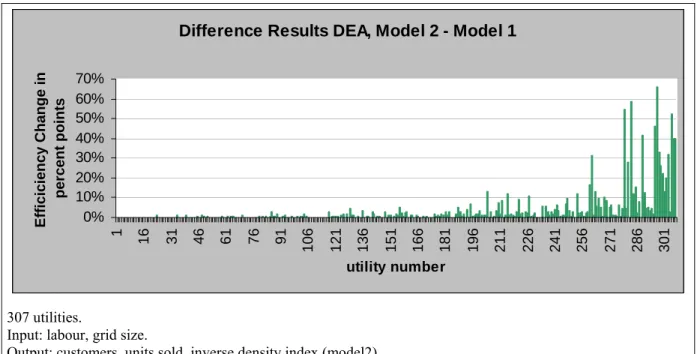
The average productivity for model 2 increases significantly compared to model 1, from 63.2% to 66.7%. Fifteen utilities are 100% efficient, three more than under the CRS assumption for model 1. Figure 2 compares the CRS result for model 2, including the inverse density index, with the CRS result from model 1 (without structural variable). It is evident that for the 190 largest utilities, the structural effect is insignificant (average efficiency increase of 0.4%), whereas for the smaller ones, density is an important cost driver (average increase of 6.9%); the effect is particularly strong for the 50 smallest utilities.12
Figure 2: Differences for each Utility between Measures of Model 2 and Model 1
Difference Results DEA, Model 2 - Model 1
0% 10% 20% 30% 40% 50% 60% 70% 1 16 31 46 61 76 91 106 121 136 151 166 181 196 211 226 241 256 271 286 301 utility number Efficiciency Change in percent points 307 utilities.
Input: labour, grid size.
Output: customers, units sold, inverse density index (model2)
11 DEA considers this effect under the present specification as an increase in output that
will consistently increase the estimated efficiency of utilities in sparsely settled areas. Therefore, in our case, companies with a higher inverse density index and thereby a territory with few customers per square kilometer will increase their efficiency.
12 The extreme case is utility no. 378, which increases its efficiency score by 80
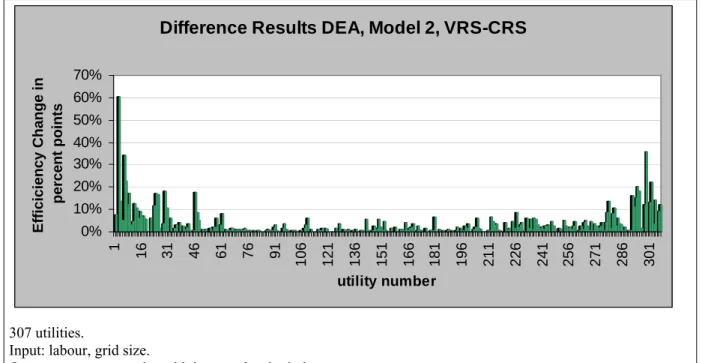
If we use the VRS specification of model 2 instead, the efficiency scores rise significantly. 35 of the 307 utilities are 100% efficient, which can again be explained by the fact that now utilities of similar size are compared with each other, and not with the best ones in the sample. With VRS, the average efficiency increases to 69,9%, 3,2% higher than the results under the CRS assumption. For individual utilities, this improvement is significantly higher, in particular for the smaller ones. Figure 3 shows the difference in efficiency scores between the VRS and the CRS model. It seems that the optimal utility size, i.e. the one where the VRS and the CRS efficiency scores converge, is around utility number 100 in our sample. This corresponds to about 200 GWh sold.13 Figure 3 also makes one issue clear: smaller utilities could significantly gain in efficiency by merging; in this area, considerable economies of scale can be realized.
Figure 3: Difference Results DEA, Model 2, VRS-CRS
Difference Results DEA, Model 2, VRS-CRS
0% 10% 20% 30% 40% 50% 60% 70% 1 16 31 46 61 76 91 106 121 136 151 166 181 196 211 226 241 256 271 286 301 utility number Efficiciency Change in percent points 307 utilities.
Input: labour, grid size.
Output: customers, units sold, inverse density index.
4.2.3. Correlation analysis and verification with SFA
Before we continue the DEA estimations of the extended models we check the robustness of our results with a stochastic frontier analysis (SFA), the input distance
13 To make a definitive statement about the optimal utility size for the German
approach. The correlation analysis of the results serves as verification of the obtained DEA efficiency measures. For verification with SFA we use a translog input distance function specification. In fact, this is a curved productivity function, similar to DEA-VRS where economies of scales are not considered to be relevant for efficiency. Therefore, it is more appropriate to compare our SFA results with DEA VRS.
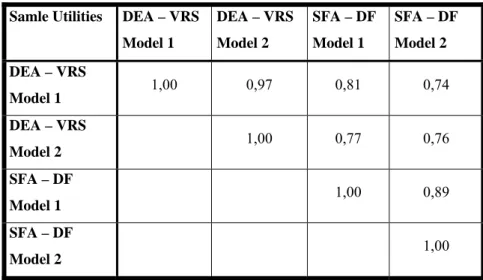
Table 3: Correlation Analysis for Models 1 to 2, Sample Size 307 Samle Utilities DEA – VRS
Model 1 DEA – VRS Model 2 SFA – DF Model 1 SFA – DF Model 2 DEA – VRS Model 1 1,00 0,97 0,81 0,74 DEA – VRS Model 2 1,00 0,77 0,76 SFA – DF Model 1 1,00 0,89 SFA – DF Model 2 1,00
Table 3 presents the correlation between the DEA and the SFA approaches for our first two models. All correlations are above 75% and thus seem to be significant. We can conclude that the obtained DEA measures can generally be assumed to be robust and coherent.
For the following analyses, we apply the (stricter) constant returns to scale approach to the sample. This implies that the size of companies is flexible. Given the recent liberalization of the sector, and the fact that mergers do occur regularly, this seems to be the more realistic assumption.
4.2.4. Analysis of Differences between East and West Germany
The model also permits an analysis of structural differences in efficiency between West and East German distribution utilities. In fact, the association agreement includes a structural variable “East-West”, implying that East German utilities have on average higher costs than their West German counterparts. This is supposedly due to the structural legacy inherited from socialist times, as well as to the drop in electricity consumption in East Germany after reunification, whereas network sizes have remained constant. In order to test the East-West hypothesis, we split up the sample into 259 West
German utilities and 48 East German ones. The results of the East-West comparison are somewhat surprising: East German utilities feature an average efficiency of 77%, against a West German average of 65%.
This result may suggest that investment efforts of the last decade have led to an accelerated modernization process in East Germany, and thus a more efficient use of resources. Electricity production and distribution can now revert to a modernized power station park distribution system. The results tend in the same direction as those of Frontier Economics and Consentec (2003, p. 19), which find that some East German utilities have some of the higher efficiency scores.
4.3 Results from the Extended Model
We now estimate the efficiency taking into account a broader set of variables. In order to keep the results comparable, we estimate our base model with the reduced data sample of 195 utilities (“model 2b”).
4.3.1 Peak Load, Turnover and Quality
In addition to the traditional inputs, grid line and labor, we consider peak load (as a proxy for transformer capacity, for which no data is available) to be a separate cost factor. Model 3 thus contains three input and three output variables. The efficiency estimates are slightly higher than before, averaging 73%. We find no structural correlation between the size of a utility and its peak load as a structural variable affecting efficiency. In the case of lacking cost data, it may therefore make sense to work with two different variables accounting for capital costs.
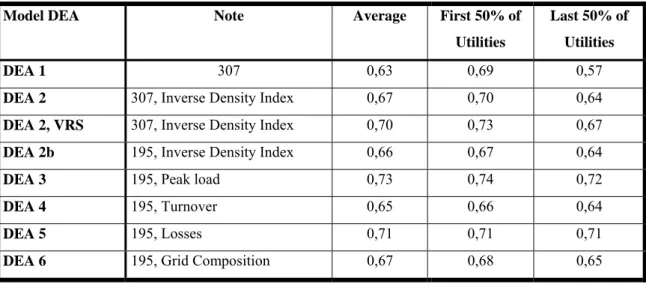
Table 4: Efficiency Differences between large and small Utilities
Model DEA Note Average First 50% of
Utilities
Last 50% of Utilities
DEA 1 307 0,63 0,69 0,57
DEA 2 307, Inverse Density Index 0,67 0,70 0,64 DEA 2, VRS 307, Inverse Density Index 0,70 0,73 0,67 DEA 2b 195, Inverse Density Index 0,66 0,67 0,64
DEA 3 195, Peak load 0,73 0,74 0,72
DEA 4 195, Turnover 0,65 0,66 0,64
DEA 5 195, Losses 0,71 0,71 0,71
DEA 7 195, Customer structure 0,69 0,71 0,68
In model 4, we introduce a monetary variable, turnover, as output measure. The results are not significantly different from those obtained with model 2: the average efficiency decreases by about 1% point. This is due only to the drop of the average efficiency of the 50% largest distribution utilities. The average of the smallest one remains the same. An explanation of this uneven effect of the turnover variable could be that larger utilities generally have more industrial customers in relation to household customers. Since industrial customers obtain lower prices and thus lead to a lower average per unit revenue, this has an adverse effect on the efficiency score.
Model 5 attempts to identify the relation between quality and efficiency. We define the quality of distribution by the electricity losses that occur during this process. As could be expected, the average efficiency of all utilities increases when we introduce this additional input. We do not detect any difference in the relative change of efficiency scores between the large and small utilities. This result contradicts the common view that large utilities are in possession of better grids.
4.3.2. Grid Composition and Customer Structure
A third structural variable that may have an impact on efficiency scores is the composition of the grid, i.e. the relation of aerial lines to cable lines. The idea behind this reasoning is that cable lines are on average more expensive than aerial lines. However, regional utilities are often not free to choose the most appropriate grid type. This is particularly true in densely settled areas where national law prohibits aerial lines. We approach the issue in the following way: to show the real cost structure of the capital input we substitute in model 6 the simple grid size variable of the basic model by a weighted sum of cable and aerial grid. Since cable lines are on average more expensive we define an upwards factor of 1.25 for each km of cable line, and thereby indirectly consider higher prices for cables. This takes into account the disadvantage of the utilities that are forced to maintain a high proportion of cable lines.
The first noticeable result is that average efficiency remains almost unchanged; it increases slightly to 67.0% compared to the 66% in the original specification (model 2b). The modest change in efficiency is not surprising: some utilities use a grid with a
higher proportion of cable lines, others with more aerial lines. These two tendencies compensate each other while the average productivity remains almost the same. The efficiency of single utilities, in contrast, changes more significantly: utilities with a higher share of cables benefit from this transformation. All in all, the grid composition does not add much to the interpretation of results, a finding also suggested by Frontier Economics and Consentec (2003, p. vii) who doubt that grid composition is a significant cost driver.
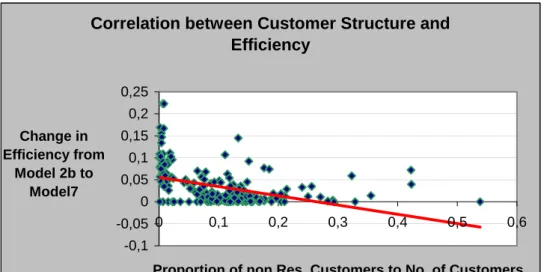
In addition, we now consider the structure of customers. We distinguish between industrial and households customers taking into account the difference in the price structure of the end user prices. Figure 4 shows that higher is the share of industrial customers to total customers lower is the efficiency increase from model 2b to 7. In model 4 we already noticed the same result: that an increase of the share of industrial customers represents a disadvantage for the utilities in terms of efficiency.
Figure 4: Correlation between Customer Structure and Efficiency
Correlation between Customer Structure and Efficiency -0,1 -0,05 0 0,05 0,1 0,15 0,2 0,25 0 0,1 0,2 0,3 0,4 0,5 0,6
Proportion of non Res. Customers to No. of Customers Change in
Efficiency from Model 2b to
Model7
4.3.3 Correlation analysis of DEA models
In this section we again check the robustness of our results by conducting a correlation analysis for the respective model specifications. Table 4 shows the correlation analysis for models 2b to 7. Overall, the correlation among the models is high. All are above 79%. Thus we can conclude that the obtained DEA efficiency measures can generally be assumed to be robust.
DEA – Model 2b CRS DEA – Model 3 CRS DEA – Model 4 CRS DEA – Model 5 CRS DEA – Model 6 CRS DEA – Model 7 CRS DEA – Model 2b CRS 1,00 0,93 0,90 0,90 1,00 0,98 DEA – Model 3 CRS 1,00 0,82 0,86 0,93 0,93 DEA – Model 4 CRS 1,00 0,79 0,90 0,89 DEA – Model 5 CRS 1,00 0,90 0,88 DEA – Model 6 CRS 1,00 0,97 DEA – Model 7 CRS 1,00 5. CONCLUSIONS
This paper has extended the literature on efficiency analysis to the electricity distribution sector in Germany. In addition to conventional DEA analysis, we have performed SFA distance function estimations, and find relatively high correlations between the two methods. We have addressed the general issue of optimal utility size and specific issues related to the ”Balkanization” of the German electricity distribution industry. The results suggest that returns to scale play only a minor role: only very small utilities have a significant cost disadvantage. Low customer density is found to affect the efficiency score significantly in the lower third of the sample. The grid composition does not produce systematic effects. Surprisingly, East German utilities show a higher average efficiency than their West German counterparts. Peak load as a structural input variable does not seem to be an important determinant of efficiency, when compared to
the base model without peak load. Utilities with a high share of industrial customers seem to suffer a disadvantage by the efficiency analysis.
Further research should focus on using cost data for the inputs to make comparison of allocative efficiency possible. Additional analysis of quality and its relation with efficiency seems to be the most urgent policy relevant question, but it would require a substantial effort in data collection and treatment.
REFERENCES
Auer, H. (2002): Benchmarking und Regulierung elektrischer Netze in Liberalisierten Strommärkten: Grundlagen, internationale Erfahrungen und Anwendung auf Österreich, Energy Economics Group, Technical University Wien, Wien.
Battese, G.E. and T.J. Coelli (1992): Frontier Production Function, technical efficiency and panel data: with application to Paddy Farmers in India, Journal of Productivity Analysis, Vol.3 , 153-169.
Brunekreeft, G. (2003): Regulation and Competition Policy in the Electricity Market - Economic Analysis and German Experience, Nomos, Baden-Baden.
Brunekreeft, G. (2005): The electricity market in Germany: RegTP or REGTP? forthcoming in Energy Journal.
Burns, P., J. Davies and C. Riechmann (1999): Benchmarking von Netzkosten - Data Envelopment Analyse am Beispiel der Stromverteiler in Großbritannien, Zeitschrift für Energiewirtschaft, Vol.99, No.4, 285-301.
Burns, P. and T. Weyman-Jones (1996): Cost Functions and Cost Efficiency in Electricity Distribution: A Stochastic Frontier Approach, Bulletin of Economics Research, Vol.48, No.1, 41-64.
CEPA (2003): Background to Work on Assessing Efficiency for the 2005 Distribution Price Control Review, Scoping Study - Final Report, prepared for Ofgem.
Coelli, T. (2002): On the Econometric Estimation of the Distance Function Representation of a Production Technology, Draft Version, University of New England.
Coelli, T. and S. Perelman (1998): A comparison of Parametric and Non-parametric Distance Functions: With Application to European Railways, European Journal of Operations Research, Vol.117, 326-339.
Coelli, T., D.S. Prasada Rao and G. E. Battese (1998): An Introduction to Efficiency and Productivity Analysis, Bostron/Dordrecht/London, Kluwer Academic Publishers.
Estache, A., M. A. Rossi and C. A. Ruzzier (2004): The Case for International Coordination of Electricity Regulation: Evidence from the Measurement of Efficiency in South America, Journal of Regulatory Economics, Vol.25, No.3,
271-295.
European Commission (2003): Second Benchmarking Report on the Implementation of the Internal Electricity and Gas Market. Update Brussels, Commission Staff Working Paper, SEC (2003) 448 (April 7).
Färe, R., S. Grosskopf, and W. L. Weber (2004): The Effect of Risk-Based Capital Requirements on Profit Efficiency in Banking, Applied Economics, Vol.36, No.15,
1731-1743.
Farsi, M. and M. Filippini (forthcoming): Regulation and Measuring Cost Efficiency with Panel Data Models: Application to Electricity Distribution Utilities, Review of Industrial Organization.
Filippini, M. (1998): Are Municipal Electricity Distribution Utilities Natural Monopolies? Annals of Public and Cooperative Economics, Vol.69, No.2, 157-174.
Filippini, M., N. Hrovatin and J. Zoric (2004): Regulation of the Slovenian Electricity Distribution Companies, Energy Policy, Vol.32, 335-344.
Filippini, M. and J. Wild (2001): Regional Differences in Electricity Distribution Costs and their Consequences for Yardstick Regulation of Access Prices, Energy Economics, Vol.23, 477-488.
Forsund, F. and S. Kittelsen (1998): Productivity Development of Norwegian Electricity Distribution Utilities, Resource and Energy Economics, Vol.20,
207-224.
Frontier Economics and Consentec (2003): Netzpreisaufsicht in der Praxis, Final Report to VIK and BDI, London.
Giannakis, D., T. Jamasb and M. Pollitt (2003): Benchmarking and Incentive Regulation of Quality of Service: An Application to the UK Electricity Distribution Utilities. Cambridge, CMI Working Paper No. 35.
Grosskopf, S., D. Margaritis and V. Valdmanis (1995): Estimating Output Substitutability of Hospital Services: A Distance Function Approach, European Journal of Operational Research, Vol.80, No.3, 575-587.
Growitsch, C. and T. Wein (forthcoming): Network Access Charges, Vertical Integration, and Property Rights Structure – Experiences from the German Electricity Market, Energy Economics.
Haupt, U., K. Kinnunen and W. Pfaffenberger (2002): Anwendung der Vergleichsmarktanalyse auf die Netzentgelte in der Stromwirtschaft, Bremer Energie Institut, Bremen, Expertise for EnBW AG.
Hjalmarsson, L. and A. Veiderpass (1992): Productivity in Swedish Electricity Retail Distribution, Scandinavian Journal of Economics, Vol.94, 193-205.
Jamasb, T. and M. Pollitt (2001): Benchmarking and Regulation: International Electricity Experience, Utilities Policy, Vol.9, 107-130.
Jamasb, T. and M. Pollitt (2003): International Benchmarking and Yardstick Regulation: An Application to European Electricity Distribution Utilities, Energy Policy, Vol.31, 1609-1622.
Kumkar, L. (2002): The European Electricity Market: Centralization of Regulation of Competition between Regulatory Approaches? Kieler Diskussionsbeiträge, 387.
Latruffe, L., K. Balcome, S. Davidova, and K. Zawalinska (2004): Determinants of Technical Efficiency of Crop and Livestock Farms in Poland, Applied Economics,
Vol.36, No.12, 1255-1263.
Müller, C. and W. Wienken (forthcoming): Degree of Market Openness of the German Electricity Supply Industry, Utilities Policy, Vol.12, No.3.
Pollitt, M. (1995): Ownership and Performance in Electric Utilities: The International Evidence on Privatization and Efficiency, Oxford, Oxford University Press.
Riechmann, C. (2000): Kostensenkungsbedarf bei Deutschen Stromverteilern,
Dresden Discussion Paper Series in Economics
13/03 Choi, Jay Pil / Thum, Marcel: The economics of repeated extortion
14/03 Broll, Udo / Eckwert, Bernhard: Transparency in the Foreign Exchange Market and the Volume of International Trade
15/03 Graff, Michael / Karmann, Alexander: What Determines the Finance-Growth Nexus? An Endogenous Growth Model and Empirical Evidence
16/03 Steinmann, Lukas / Dittrich, Gunnar / Karmann, Alexander / Zweifel, Peter: Measuring and Comparing the (In)Efficiency of German and Swiss Hospitals
17/03 Lehmann-Waffenschmidt, Marco / Reina, Livia: Coalition formation in multilateral negotiations with a potential for logrolling: an experimental analysis of negotiators’ cognition processes
18/03 Lehmann-Waffenschmidt, Marco / Böhmer, Robert: Mentality Matters – Thorstein Veblens ‚Regime of Status‘ und Max Webers ‚Protestantische Ethik‘ aus der Sicht des (radikalen) Konstruktivismus. Eine Anwendung auf die ökonomischen Probleme des deutschen Wiedervereinigungsprozesses
19/03 Eisenschmidt, Jens / Wälde, Klaus: International Trade, Hedging and the Demand for Forward Contracts
20/03 Broll, Udo / Wong, Kit Pong: Capital Structure and the Firm under Uncertainty
01/04 Lehmann-Waffenschmidt, Marco: A Note on Continuously Decomposed Evolving Exchange Economies
02/04 Friedrich, B. Cornelia: Competition and the Evolution of Market Structure in the E-conomy. 03/04 Berlemann, Michael / Dittrich, Marcus / Markwardt, Gunther: The Value of Non-Binding
Announcements in Public Goods Experiments. Some Theory and Experimental Evidence
04/04 Blum, Ulrich / Schaller, Armin / Veltins, Michael: The East German Cement Cartel: An Inquiry into Comparable Markets, Industry Structure, and Antitrust Policy
05/04 Schlegel, Christoph: Analytical and Numerical Solution of a Poisson RBC model 06/04 Lehmann-Waffenschmidt, Marco: Die ökonomische Botschaft in Goethes „Faust“
07/04 Fuchs, Michaela / Thum, Marcel: EU Enlargement: Challenges for Germany's New Laender 08/04 Seitz, Helmut: Implikationen der demographischen Veränderungen für die öffentlichen Haushalte
und Verwaltungen
09/04 Sülzle, Kai: Duopolistic Competition between Independent and Collaborative Business-to-Business Marketplaces
10/04 Broll, Udo / Eckwert, Bernhard: Transparency in the Interbank Market and the Volume of Bank Intermediated Loans
11/04 Thum, Marcel: Korruption
12/04 Broll, Udo / Hansen, Sabine / Marjit, Sugata: Domestic labor, foreign capital and national welfare 13/04 Nyamtseren, Lhamsuren: Challenges and Opportunities of Small Countries for Integration into the
Global Economy, as a Case of Mongolia
01/05 Schubert, Stefan / Broll, Udo: Dynamic Hedging of Real Wealth Risk
02/05 Günther, Edeltraud / Lehmann-Waffenschmidt, Marco: Deceleration - Revealed Preference in Society and Win-Win-Strategy for Sustainable Management. Concept and Exprimental Evidence 03/05 Sennewald, Ken: Controlled Stochastic Differential Equations under Poisson Uncertainty and with
Unbounded Utility
04/05 Sennewald, Ken / Wälde, Klaus: "Itô's Lemma" and the Bellman equation: An applied view 05/05 Neumann, Anne / Siliverstovs, Boriss: Convergence of European Spot Market Prices for Natural
Gas?
06/05 Hirschhausen, Christian von / Cullmann, Astrid: Efficiency Analysis of German Electricity Distribution Utilities