A MINING FRAMEWORK TO DETECT NON-TECHNICAL LOSSES
IN POWER UTILITIES
F´elix Biscarri, I˜nigo Monedero, Carlos Le´on, Juan I. Guerrero
Department of Electronic Technology, University of Seville, C/ Virgen de Africa, 7, 41011 Sevilla, Spain [email protected], [email protected], [email protected], [email protected]
Jes´us Biscarri, Roc´ıo Mill´an
ENDESA Distribuci´on, Avda. de la Borbolla, S/N, 41092 Sevilla, Spain [email protected], rmill´[email protected]
Keywords: Data mining, power utilities, fraud detection, non-technical losses.
Abstract: This paper deals with the characterization of customers in power companies in order to detect consumption Non-Technical Losses (NTL). A new framework is presented, to find relevant knowledge about the particular characteristics of the electric power customers. The authors uses two innovative statistical estimators to weigh variability and trend of the customer consumption. The final classification model is presented by a rule set, based on discovering association rules in the data. The work is illustrated by a case study considering a real data base.
1
INTRODUCTION
In the electricity sector, non-technical losses (NTL) of the utility are all of losses except the technical losses (result of the effect of the power dissipation in the electrical network components such as trans-mission lines, power transformers, measurements sys-tems, etc.). For the electrical distribution business, minimizing NTL is a very important activity because it has a high impact in the company profits. Normally, we will refer in this paper as fraud detection but we could strictly talk about NTL. In Spain, the percent of fraud in terms of energy with respect to the total NTLs round about 35%-45%.
Not too many authors offer an estimation about these losses. Yap et al (K.S.Yap et al., 2007) estimate distribution losses as 15%, in Sabah State, Malaysia. J.R. Filho et al, (Filho and als, 2004) expose a fraud identification per number of in-situ inspection per-centage as low as 5%, in Brasil. This rate varies about 5%-10%, according J.E. Cabral et al (Cabral et al., 2004) (Cabral et al., 2006).
The goal of this reseach is to significativaly im-prove the inspection success and the profitability rate, highly dependent of the cluster of customers researched, i.e, of the set of features that made the cluster and the class of customers researched (do-mestic customers, medium or high consumption
cus-tomers,. . . ). The main difficulty is the low rate of NTL’s in the Power Companies (Cabral et al., 2006). Besides, in the companies and/or areas with very low percentages of losses, from 1% to %2, it is inefficient policy to reduce these losses if the companies do not identify them by some way. The enormous cost of in-specting in-situ many customers does not compensate the return of the energy recovered in a few of them. That’s why Endesa is investing in this research, ex-ploiting its databases to identify customers with non invoiced energy in a profitable way. So the number of inspections is reduced only to a small group of cus-tomers identified asanomalous, with an energy con-sumptionsuspiciousof being different of the amount invoiced, because some company error or customer fraud. As seen below, potential anomalous high con-sumption customers can be identified by: abrust and negative changes in their historical consumption pat-tern (a 30% drop, for example, as see in (Cabral et al., 2008)), changes in the consumption pattern compared with changes to the other consumers from the same cluster at the same time (changes detected in the vari-ability on electric consumption (Biscarri et al., 2008)) and others non-obvious features, as previous fraudu-lent activities or anomalous and unstable power factor (Sforna, 2000).
Many researches have been published, from the 90s to the present day, about our main research topic:
”NTL detection in electricity consumers”, and specif-ically ”fraud detection in electricity consumers”.
In 1998, J.R. Galv´an et al (Galv´an et al., 1998) presented a methodology to guide inspection cam-paigns by the characterisation of the temporal evolu-tion of consumpevolu-tion features of the customers. They used a non supervised classification method: the study of a probability density function (pdf) estimator on some electrical features. Not result of real inspec-tions after the study are done.
In 2000, M. Sforna (Sforna, 2000) reported a data mining system based on the application of statistics to aggregate values, calculate new meaningful variables and the application of a self-organizing Kohonen map of customers behavior patterns. Results are summa-rized in terms of automatic identification of anoma-lous consumption values, according the hours of us-age of the contracted active demand, reactive demand or monthly power factor.
In 2002, R. Jiang et al (Jiang et al., 2002) pro-posed an analysis to identify fraud in Australian elec-tricity distribution networks using wavelet techniques and combining multiple classifiers. They exposed that the classification accuracy reached 70% on the testing data set, with a high number of data profiles (about 1200) and using a relative small amount of data.
In 2004, J. Reis et al (Filho and als, 2004) used a decision tree and a database composed by 5 monthly features, with customers that had undergone inspec-tion in the last year, classified into normal, fraud or faulty equipment. They expounded a 40% right fraud classification rate.
In 2004 and 2006, Jos´e E. Cabral et al (Cabral et al., 2004) (Cabral et al., 2006) proposed an ap-plication that used rough sets to classify categorical attributes values in order to detect fraud of electrical energy consumers. The system reached a fraud right-ness rate of around 20%.
In 2008, Jos´e E. Cabral and Joao P. Pinto (Cabral et al., 2008) have studied high voltage consumers us-ing Self-Organizus-ing Maps (SOM) and a 15 minutes consumption period sample. They are still waiting confirmation of suspicions effectively confirmed as fraud for the real inspection in-situ.
And at last, authors of this paper have presented a work highlighting the importance of the variabil-ity of the customer consumption in NTLs detection in power utility companies (Biscarri et al., 2008). A lodging sector customers example are shown, with 35 customers proposed to be inspected ’in-situ’ by the automatic detection system, 15 of them inspected by the Endesa staff and 8 of these 15 classified as ’anomalous’, fraudulent or with faulty measuring equipment.
2
Customer Characterization
The propossed study process structure is fragmented into different steps with different degrees of complex-ity and different periods of time.
2.1
Data Selection
The customers selected for the mining process have been choosen based on the following feature charac-terization:
• Period of time of recorded invoices: We use monthly and bimonthly invoices belonging to the sample of customers. Hourly or daily data are not available.
• Geographical localization: All customers are lo-cated in a Spanish region.
• Contractual power: All customers belong to price code 4.0 and price code 3.0.2. These codes mean these customers consume more than 15 KW dur-ing more than 8 hours per day.
• Economic Activity Classification (CNAE). Some economic sectors historically present a high rate of NTLs. The research is centered in these sectors.
• Consumption range. At first, the target of research is to cover the greater range of electrical consump-tion as possible. But customers can only be com-pared, or studied together, if they have a similar range of consumption. The solution of the prob-lem is to divide the full consumption range into subsets, obtaining subsamples of customers with similar characteristics. Each of these subsamples will be studied independently. For the purpose of this work, the continuous value of the customer consumption is sectioned in 10 bins.
• History of customer inspection. Methods used in NTLs detection can be mainly classified into supervised and unsupervised methods. Unsuper-vised approach allows the discovery of natural patterns in data, detected or not detected before. For this reason, initially of our research, we have used an unsupervised approach, based on Koho-nen Maps and the statistical outlier detection as a classification methods. But the verification of the results have been really expensive and time consuming. In order to obtain a statistic of the NTLs right classified rate, all the suspected cus-tomers should be inspected ’in situ’ by the En-desa staff. The results can be interpreted in a very biased way, because often it is not possible to check all the clusters discovered several times. The improvement of the methodology was highly depending of the success of this inspections.
The supervised approach is an interesting work-ing method if we have a very large database to cover many of the NTL cases. The results can be quickly and systematically checked. And, as we have said, we can concentrate our efforts toward cluster of customers with a high rate of historical NTLs.
2.2
Data Preprocessing
With respect to data cleaning, the authors avoid reject-ing any data from a set. However, customers with less than 6 monthly register per year were eliminated and also customers who had negative values on consump-tion attributes. On the other hand, reflecconsump-tion exercise about lecture consumption data and billed consump-tion data are necessary. Normally, the consumpconsump-tion billed is the result of consumption read, but it is not always true. If the company has no access to read the data, and there is no doubt of a consumption has been made, company experts estimate the actual con-sumption, based on the recent historical consumption. Several and continuous differences between read data and billed data show abnormal behavior. The study and the use of statistical estimator based on read data is a new contribution of this paper regarding works cited in the bibliographical review. In this sense, a filling up of missing values has been performed.
2.3
Data Mining Techniques.
Descriptive Data Mining
We describe three descriptive techniques: one based on the variability of customer consumption, another based on the consumption trend and a third one that summarizes other feature contributions to NTL detec-tion.
2.3.1 The Variability Analysis
We propose in this section an algorithm that empha-sizes customers with a high variability of monthly consumption respect to other customers of similar characteristics.
The classic approach to the study of the variability classifies data in ’normal data’ and outliers. Outliers, with regard to consumption feature, can be caused by measurement error or by fraud in customer consump-tion. But, alternatively, outliers may be the result of inherent data variability. Thus, outliers detection and analysis is an interesting data mining task. The main objective is the estimation of the variance data (or the standard deviation estimation, STD), from a sample.
The research presented in this paper present three main differences regarding the classic approach:
1. The estimation of the STD, main task of the vari-ability analysis, is performed in a non classical way. We use a preprocessed sample in which there are no interactions present between time and space. The temporary component and the local geographical location component have been fil-tered.
2. Consumptions for a group of customers are com-pared against their group signature to determine if the behavior of an individual customer is anoma-lous. In classic research, new consumption for a customer is compared against their individual signature to determine if the user’s behavior has changed.
3. The classic approach classifies data into ’normal data’ and outliers. In order to classify data, a cen-ter line (CL), the average of the STDs, is esti-mated. Also anupper control limit (UCL) and a lower control limit (LCL) are estimated. In clas-sical way, thresholds of STD (LCL and UCL) are estimated by the mean of STD multiplied by a constant (usually, 1.96 is used, corresponding to a level of significanceσ=0.05). Data outside con-trol limits are classified as outliers. We don’t use the estimated STD to obtain outliers and directly propose them to be inspected by the Endesa staff. We do not establish any control limits. We sim-ply add to each customer a new feature, referred to the estimatedST D, that will be used as an input for a supervised detection method, showed in the Predictive Data MiningSection.
The sample is previously divided in 10 bins ac-cording the yearly consumption feature. Each bin will be studied independently. Once the ST D∆l is
esti-mated (the standard deviation associate with each cus-tomer with regard to the rest of cuscus-tomers and without inherent variability), the following variability estima-tor is defined:
ES variabilityl=
ST D∆l−CLi
CLi
WhereES variabilityis a new customer estimated feature, dependent of the customer, l, and also depent of his the yearly consumption bin, i.CLiis thecenter
line refering to bin i.
To maintain the shape of the variability diagrams and compare the diagrams among them, in consump-tion pattern terms, each diagram can be normalized. We use the CL of each bin (CLi) to normalize the
sam-ple. Figure 1 shows the evolution of this estimator through the whole sample studied, through all bins.
Figure 1: 10-BINS ES variability
The advantages of the proposed algorithm with re-spect to recent studies are:
• The elimination (or, at least, reduction) of the tem-porary component and the local geographical lo-cation component of the customer consumption.
• The study of the comparative consumption among clients of similar characteristics.
• The use of theST D∆l estimated as an input to a
classification model.
2.3.2 The Consumption Trend. A Streak Based Algorithm
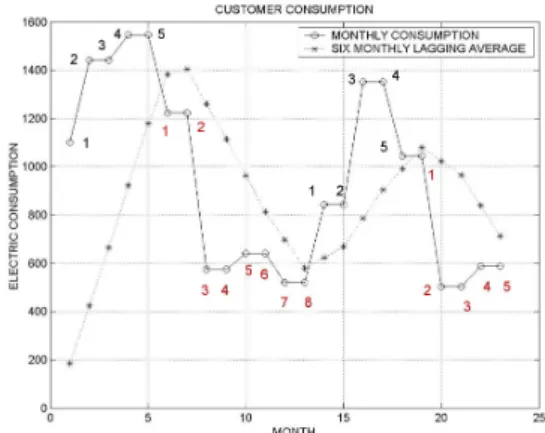
Streaks of past outcomes (or measurements), for ex-ample of gains or losses in the stocks market, are one source of information for a decision maker trying to predict the next outcome (or measurement) in the se-ries. The discovery of the theoretical consumption model is not the target of this paper. This model is strongly dependent of the cluster of customers con-sidered and highly changeable amongst different clus-ters. But it is very interesting the study of the in-dividual trend consumption and also the comparative among trends of customer with similar characteristics. There are several ways to measure this feature. We show a simple and useful algorithm, based on the six-month lagging moving average of customer consump-tion, described subsequently:
1. The input data are, for each customer from each cluster, 24 monthly consumptions, billed data. The cluster characterization is described in the Data SelectionSection of this paper.
2. We calculated the six-month simple moving aver-age, for each customer consumption.
3. We counted how many times the consumption line is over the mean line (positive streaks, pos) and
Figure 2: Consumption Trend. Customer with long and few streaks
how many times the consumption line was below the mean line (negative streaks,nes). The whole
number of streaks is
Ns=pos+nes.
The proposed algorithm does not distinguish pos-itive from negative streaks. It simply count its. Also the number of measurements in each streak (nj) is registered. The number of streaks
for each customer offers interesting information about their consumption behavior but it is also in-teresting to know the weight of each streak. 4. Finally, we sum up all the information in one
cuadratic estimator: ES streakl= s Ns ∑ t=1 (nt)2 Ns
Wherelis the customer identifier, Ns is the num-ber of streaks of this customer andntis the
num-ber of measurements of the streak t.
Figure 2 shows the consumption behavior of a par-ticular customer (Ns=4). The number of measure-ments in each streak are also counted (n1=5,n2=8,
n3=5 and n4=5). ES streakl =
√
52+82+52+52
4 =
0.90. The estimator summarizes and models the trend behavior.
2.3.3 Other Features
There are some feature levels or some feature rela-tions quite serious with reference to NTLs detection. We describe some of them used in our framework:
• The hours of consumption at maximum con-tracted power (HMP). It is the rate between the contracted power (CP) and the daily con-sumption (DC). For example, if CP=15 KW and DC=150KWh then HMP=10 hours.
• Minimum and maximum values of consumption in different time zones of the day. In some tariffs, the day is divided into different time zones with different rates. Our sample is divided into three zones: cheap (zone 1), normal (zone 2), expen-sive (zone 3). Suspect fraudulent customers have relatively very low consumption in normal and ex-pensive time zones.
• The number of valid consumption lectures (NL). Usually, when there is not a valid lecture value and the company is sure that consumption existed, the consumption is estimated and billed.
2.4
Data Mining Techniques. Predictive
Data Mining
The major goal of the predictive module is the infer-ence of a rule set to characterize each of two following classes: ’normal’ customer or ’anomalous’ customer. We characterized each consumer by means of the at-tributes described in the last section.
The predictive (or classification) model uses su-pervised learning. Main attributes in NTL detection are:
• ES variability: The proposed variability estima-tor, calculated from invoices (ES variability i) or from lectures (ES variability l).
• ES streak i: The proposed consumption trend es-timator, calculated from invoices (ES streak i) or from lectures (ES streak l).
• HMP i: The hours of consumption at maximum contracted power, to refer to the time zonei(i=
{1,2,3}).
• Maximum i: The maximum value of consump-tion, in KWH, in time zonei(i={1,2,3}).
• Minimum i: The minimum value of consumption, in KWH, in time zonei(i={1,2,3}).
• NL: The number of valid consumption lectures in the period of study (NL={1,2, . . . ,24}). A feature named ’suspect’ are added. if ’sus-pect’=1, the customer had a non technical loss during the period of study. We should clarify that our exper-iment refers to real cases, including more than 10000 customers, and the available database has a signifi-cant limitation: although ’suspect’=0, it is possible that the customer had a non detected NTL. As often
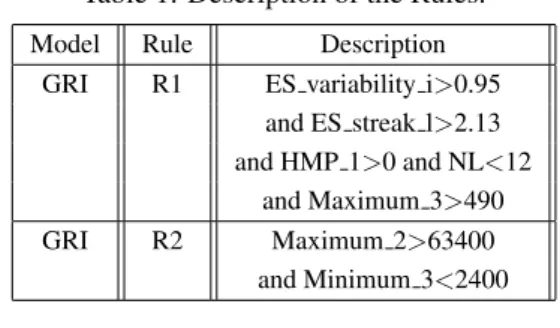
Table 1: Description of the Rules. Model Rule Description
GRI R1 ES variability i>0.95 and ES streak l>2.13 and HMP 1>0 and NL<12 and Maximum 3>490 GRI R2 Maximum 2>63400 and Minimum 3<2400 Table 2: Rule Set for NTL Detection. IF CUSTOMERS∈(SAMPLE1∩R1) THEN ’SUSPECT’ IF CUSTOMERS∈(SAMPLE1∩(R1∪R2)) THEN ’SUSPECT’
occurs in power companies, it is not very realistic to assume that all the customers from a large sample are inspected.
The classification algorithm use the Generalized Rule Induction (GRI) model. The GRI model dis-covers association rules in the data. The advantage of association rule algorithm over the more standard decision tree algorithms is that associations can exist betweenanyof the attributes. A decision tree algo-rithm GRI extracts rules with the highest information content based on an index that takes both the gener-ality (support) and accuracy (confidence) of rules into account. GRI can handle numeric and categorical in-puts, but the target must be categorical: ’suspect’∈ {0; 1}.
Table 1 shows the description of the obtained rules. Table 2 shows the application of the rule set.
The structure of this classification module is the following: the full sample studied is composed by 10279 customers, 188 of them with detected NTL in the period of study (feature ’suspect’=1) and 10091 ’normal’ or not detected, with ’suspect’=0. First, Rule 1 applies to 102 customers, 78 of them classified with ’suspect’=0 and 24 with ’suspect’=1. Customers in-cluded in Rule 1 are removed to the rest of the sam-ple.
The remaining sample is made up of from 10177 customers, 164 of them with detected NTLs in the period of study (feature ’suspect’=1) and 10013 with ’suspect’=0. Rule 2 applies to 117 customers, 103 of them classified as ’suspect’=0 and 14 with ’sus-pect’=1.
The test of the set of rules generates four val-ues, according to the following classifications (Cabral et al., 2006):
i) True positives (TP): quantity of test registers cor-rectly classified as fraudulent.
Table 3: Test of the Set of Rules. Rule Support Confidence TP FP
R1 1.0% 23.5% 24 78
R1∪R2 2.1% 17.3% 38 181
falsely classified as fraudulent.
Table 3 summarizes the described test and adds support and confidence data.
The model evaluation is performed using ten-fold cross validation (Witthen and Frank, 2000). This kind of evaluation was selected to train the algorithms using the entire data set and obtain a more precise model. This will increase the computational effort but improves the model’s capacity for generating differ-ent data sets. The evaluation is performed by splitting the initial sample in 10 sub-samples in order to fill consumption range. The model is trained using 9/10 of the data set and tested with the 1/10 left. This is performed 10 times on different training sets and fi-nally the ten estimated errors are averaged to yield an overall error estimate. The overall accuracy obtained is around 80%.
3
Conclusion
This classification results can be interpreted in a prac-tical way. This classification can be used to assign new customers to existing classes and/or to inspect customers that had not been previously inspected but that belong to a class with a high rate of historical NTL. In this last sense, Endesa staff action is required. The Endesa staff, due to the extremely high cost of the in-situ inspection for this class of customers, usually only revises and inspects small samples (a hundred or so medium-high consumption customers). The quality of this framework is illustrated by a case study that uses a real database. Only 188 of 10279 customers (less than 2%) of the selected registers for mining present results of NTLs inspect. Regar-less of the difficulty to study real data instead of simulated data, rate of correct fraud identification (about 20%) significatively improved previous com-pany detection campaigns, refering to medium-high consumption customers.
Acknowledgment
The authors would like to thank the Endesa Company for providing the funds for this project (since 2005).
The authors are also indebted to the following col-leagues for their valuable assistance in the project: Gema Tejedor, Miguel Angel L´opez and Francisco Godoy. Special thanks to Juan Ignacio Cuesta, Tom´as Blazquez and Jes´us Ochoa for their help and cooper-ation to extract the data from Endesa.
REFERENCES
Biscarri, F., Monedero, I., Le´on, C., Guerrero, J., Bis-carri, J., and Mill´an, R. (June 12-16, Barcelona, Spain, 2008). A data mining method based on the variabil-ity of the customers consumption. In10th Interna-tional conference on Enterprise Information Systems ICEIS2008.
Cabral, J., Pinto, J., Gontijo, E. M., and Reis, J. (2004). Fraud detection in electrical energy consumers using rough sets. In2004 IEEE International Conference on Systems, Man and Cybernetics. IEEE press.
Cabral, J., Pinto, J., Linares, K., and Pinto, A. (2006). Methodology for fraud detection using rough sets. In2006 IEEE International Conference on Granular Computing. IEEE press.
Cabral, J., Pinto, J., Martins, E., and Pinto, A. (April 21-24, 2008). Fraud detection in high voltage electric-ity consumers using data mining. In IEEE Trans-mision and Distribution Conference and Exposition T&D. IEEE/PES.
Filho, J. and als (The Hague, The Netherlands, 2004.). Fraud identification in electricity company costumers using decision tree. InIEEE International Conference on Systems, Man and Cibernetics. IEEE/PES. Galv´an, J., Elices, E., noz, A. M., Czernichow, T., and
Sanz-Bobi, M. (Nov. 2-6, 1998). System for detection of abnormalities and fraud in customer consumption. In 12th Conference on Electric Power Supply Industry. IEEE/PES.
Jiang, R., Tagiris, H., Lachsz, A., and Jeffrey, M. (Oct. 6-10, 2002). Wavelet based features extraction and multi-ple classifiers for electricity fraud detection. In Trans-mission and Distribution Conference and Exhibition 2002: Asia pacific. IEEE/PES.
K.S.Yap, Hussien, Z., and Mohamad, A. (April 2-4, Phuket, Thailand, 2007). Abnormalities and fraud electric me-ter detection using hybrid support vector machine and genetic algorithm. InProceeding of the Third IASTED International Conference Advances in Computer Sci-ence and Technology. IASTED PRESS.
Sforna, M. (England, 2000). Data mining in power com-pany customer database. In Electric Power Systems Reseach, 55, 201-209. Elsevier Press.
Witthen, I. and Frank, E. (2000). Data Mining–Practical Machine Learning Tools and Techniques with Java Implementations. Morgan Kaufmann, Academic Press, New York and San Mateo, CA.