16
Cloud-Based Malware Detection for Evolving Data Streams
MOHAMMAD M. MASUD, TAHSEEN M. AL-KHATEEB, and KEVIN W. HAMLEN, University of Texas at Dallas
JING GAO, University of Illinois at Urbana-Champaign
LATIFUR KHAN, University of Texas at Dallas
JIAWEI HAN, University of Illinois at Urbana-Champaign
BHAVANI THURAISINGHAM, University of Texas at Dallas
Data stream classification for intrusion detection poses at least three major challenges. First, these data streams are typically infinite-length, making traditional multipass learning algorithms inapplicable. Second, they exhibit significant concept-drift as attackers react and adapt to defenses. Third, for data streams that do not have any fixed feature set, such as text streams, an additional feature extraction and selection task must be performed. If the number of candidate features is too large, then traditional feature extraction techniques fail.
In order to address the first two challenges, this article proposes a multipartition, multichunk ensemble classifier in which a collection ofvclassifiers is trained fromrconsecutive data chunks usingv-fold partition-ing of the data, yieldpartition-ing an ensemble of such classifiers. This multipartition, multichunk ensemble technique significantly reduces classification error compared to existing single-partition, single-chunk ensemble ap-proaches, wherein a single data chunk is used to train each classifier. To address the third challenge, a feature extraction and selection technique is proposed for data streams that do not have any fixed feature set. The technique’s scalability is demonstrated through an implementation for the Hadoop MapReduce cloud computing architecture. Both theoretical and empirical evidence demonstrate its effectiveness over other state-of-the-art stream classification techniques on synthetic data, real botnet traffic, and malicious executables.
Categories and Subject Descriptors: H.2.8 [Database Applications]: Data mining; D.4.6 [Security and Protection]: Invasive software
General Terms: Algorithms, Security
Additional Key Words and Phrases: Data mining, malware detection, data streams, malicious executable, n-gram analysis
ACM Reference Format:
Masud, M. M., Al-Khateeb, T. M., Hamlen, K. W., Gao, J., Khan, L., Han, J., and Thuraisingham, B. 2011. Cloud-based malware detection for evolving data streams. ACM Trans. Manag. Inform. Syst. 2, 3, Article 16 (October 2011), 27 pages.
DOI=10.1145/2019618.2019622 http://doi.acm.org/10.1145/2019618.2019622
This material is based on work supported by the AFOSR under awards FA9450-08-1-0260 and FA9950-10-1-0088 and by NASA under award 2008-00867-01.
Authors’ addresses: M. M. Masud (corresponding author), T. M. Al-Khateeb, and K. W. Hamlen, Computer Sci-ence Department, University of Texas at Dallas, Dallas, TX; email: [email protected]; J. Gao, Computer Science Department, University of Illinois at Urbana-Champaign; L. Khan, Computer Science Department, University of Texas at Dallas, Dallas, TX; J. Han, Computer Science Department, University of Illinois at Urbana-Champaign; B. Thuraisingham, Computer Science Department, University of Texas at Dallas, Dallas, TX.
Permission to make digital or hard copies of part or all of this work for personal or classroom use is granted without fee provided that copies are not made or distributed for profit or commercial advantage and that copies show this notice on the first page or initial screen of a display along with the full citation. Copyrights for components of this work owned by others than ACM must be honored. Abstracting with credit is permitted. To copy otherwise, to republish, to post on servers, to redistribute to lists, or to use any component of this work in other works requires prior specific permission and/or a fee. Permissions may be requested from Publications Dept., ACM, Inc., 2 Penn Plaza, Suite 701, New York, NY 10121-0701 USA, fax+1 (212) 869-0481, or [email protected].
c
2011 ACM 2158-656X/2011/10-ART16 $10.00
1. INTRODUCTION
Malware is a potent vehicle for many successful cyber attacks every year, including data and identity theft, system and data corruption, and denial of service; it therefore constitutes a significant security threat to many individuals and organizations. The average direct malware cost damages worldwide per year from 1999 to 2006 have been estimated at $14 billion USD [Computer Economics, Inc. 2007]. This includes labor costs for analyzing, repairing, and disinfecting systems, productivity losses, revenue losses due to system loss or degraded performance, and other costs directly incurred as the result of the attack. However, the direct cost does not include the prevention cost, such as antivirus software, hardware, and IT security staff salary, etc. Aside from these monetary losses, individuals and organizations also suffer identity theft, data theft, and other intangible losses due to successful attacks.
Malware includes viruses, worms, Trojan horses, time and logic bombs, botnets, and spyware. A number of techniques have been devised by researchers to counter these attacks; however, the more successful the researchers become in detecting and preventing the attacks, the more sophisticated malicious code appears in the wild. Thus, the arms race between malware authors and malware defenders continues to escalate. One popular technique applied by the antivirus community to detect malicious code is signature detection. This technique matches untrusted executables against a unique telltale string or byte pattern known as a signature, which is used as an identifier for a particular malicious code. Although signature detection techniques are widely used, they are not effective against zero-day attacks (new malicious code), polymorphic attacks (different encryptions of the same binary), or metamorphic attacks (different code for the same functionality) [Crandall et al. 2005]. There has therefore been a growing need for fast, automated, and efficient detection techniques that are robust to these attacks. This article describes a data mining technique that is dedicated to automated generation of signatures to defend against these kinds of attacks.
1.1. Malware Detection as a Data Stream Classification Problem
The problem of detecting malware using data mining [Schultz et al. 2001; Kolter and Maloof 2004; Masud et al. 2008a] involves classifying each executable as eitherbenign ormalicious. Most past work has approached the problem as a static data classification problem, where the classification model is trained with fixed training data. However, the escalating rate of malware evolution and innovation is not well suited to static training. Detection of continuously evolving malware is better treated as adata stream classification problem. In this paradigm, the data stream is a sequence of executa-bles in which each data point is one executable. The stream isinfinite-length. It also observesconcept-driftas attackers relentlessly develop new techniques to avoid detec-tion, changing the characteristics of the malicious code. Similarly, the characteristics of benign executables change with the evolution of compilers and operating systems.
Data stream classification is a major area of active research in the data mining community, and requires surmounting at least three challenges: First, the storage and maintenance of potentially unbounded historical data in an infinite-length, concept-drifting stream for training purposes is infeasible. Second, the classification model must be adapted continuously to cope with concept-drift. Third, if there is no predefined feature space for the data points in the stream, new features with high discriminating power must be selected and extracted as the stream evolves, which we call feature evolution.
Solutions to the first two problems are related. Concept-drift necessitates refine-ment of the hypothesis to accommodate the new concept; most of the old data must be discarded from the training set. Therefore, one of the main issues in mining
concept-drifting data streams is the selection of training instances adequate to learn the evolving concept. Solving the third problem requires a feature selection process that is ongoing, since new and more powerful features are likely to emerge and old features are likely to become less dominant as the concept evolves. If the feature space is large, then the running time and memory requirements for feature extraction and selection becomes a bottleneck for the data stream classification system.
One approach to addressing concept-drift is to select and store the training data that are most consistent with the current concept [Fan 2004]. Other approaches, such as Very Fast Decision Trees (VFDTs) [Domingos and Hulten 2000], update the existing classification model when new data appear. However, past work has shown that en-semble techniques are often more robust for handling unexpected changes and concept-drifts [Wang et al. 2003; Scholz and Klinkenberg 2005; Kolter and Maloof 2005]. These maintain an ensemble of classifiers and update the ensemble when new data appear.
We propose a multipartition, multichunk ensemble classification algorithm that gen-eralizes existing ensemble methods. The generalization leads to significantly improved classification accuracy relative to existing single-partition, single-chunk ensemble ap-proaches when tested on real-world data streams. The ensemble in our approach con-sists ofKv classifiers, where K is a constant andv is the number of partitions, to be explained shortly.
Our approach divides the data stream into equal sized chunks. The chunk size is chosen so that all data in each chunk fits into the main memory. Each chunk, when labeled, is used to train classifiers. Whenever a new data chunk is labeled, the ensemble is updated as follows. We take thermost recent labeled consecutive data chunks, divide theserchunks intov partitions, and train a classifier with each partition. Therefore,
vclassifiers are trained using therconsecutive chunks. We then update the ensemble by choosing the best Kv classifiers (based on accuracy) among the newly trained v classifiers and the existing Kv classifiers. Thus, the total number of classifiers in the ensemble remains constant. Our approach is therefore parameterized by the number of partitionsv, the number of chunksr, and the ensemble sizeK.
Our approach does not assume that new data points appearing in the stream are immediately labeled. Instead, it defers the ensemble updating process until labels for the data points in the latest data chunk become available. In the meantime, new unlabeled data continue to be classified using the current ensemble. Thus, the approach is well suited to applications in which misclassifications solicit corrected labels from an expert user or other source. For example, consider the online credit card fraud detection problem. When a new credit card transaction takes place, its class (fraudor authentic) is predicted using the current ensemble. Suppose a fraudulent transaction is misclassified as authentic. When the customer receives the bank statement, he identifies this error and reports it to the authority. In this way, the actual labels of the data points are obtained and the ensemble is updated accordingly.
1.2. Cloud Computing for Malware Detection
If the feature space of the data points is not fixed, a subproblem of the classification problem is the extraction and selection of features that describe each data point. As in prior work (e.g., Kolter and Maloof [2004]), we use binaryn-grams as features for malware detection. However, since the total number of possiblen-grams is prohibitively large, we judiciously selectn-grams that have the greatest discriminatory power. This selection process is ongoing; as the stream progresses, newer n-grams appear that dominate the oldern-grams. These newern-grams replace the old in our model in order to identify the best features for a particular period.
Na¨ıve implementation of the feature extraction and selection process can be both time- and storage-intensive for large datasets. For example, our previous work [Masud
et al. 2008a] extracted roughly a quarter billion n-grams from a corpus of only 3500 executables. This feature extraction process required extensive virtual memory (with associated performance overhead), since not all of these features could be stored in main memory. Extraction and selection required about 2 hours of computation and many gigabytes of disk space for a machine with a quad-core processor and 12GB of memory. This is despite the use of a purely static dataset; when the dataset is a dynamic stream, extraction and selection must recur, resulting in a major bottleneck. In this article we consider a much larger dataset of 105 thousand executables for which our previous approach is insufficient.
We therefore propose a scalable feature selection and extraction solution that lever-ages a cloud computing framework [Dean and Ghemawat 2008]. We show that depend-ing on the availability of cluster nodes, the runndepend-ing time for feature extraction and selection can be reduced by a factor ofm, wheremis the number of nodes in the cloud cluster. The nodes are machines with inexpensive commodity hardware. Therefore, the solution is also cost effective as high-end computing machines are not required.
1.3. Contributions and Organization of the Article
Our contributions can therefore be summarized as follows. We propose a generalized multipartition, multichunk ensemble technique that significantly reduces the expected classification error over existing single-partition, single-chunk ensemble methods. A theoretical analysis justifies the effectiveness of the approach. We then formulate the malware detection problem as a data stream classification problem and identify draw-backs of traditional malicious code detection techniques relative to our data mining approach. We propose a scalable and cost-effective solution to this problem using a cloud computing framework. Finally, we apply our technique to synthetically gener-ated data as well as real botnet traffic and real malicious executables, achieving better detection accuracy than other stream data classification techniques. The results show that our proposed ensemble technique constitutes a powerful tool for intrusion detec-tion based on data stream classificadetec-tion.
The rest of the article is organized as follows: Section 2 discusses related works. Section 3 discusses the classification algorithm and proves its effectiveness analytically. Section 4 then describes the feature extraction and selection technique using cloud computing for malware detection, and Section 5 discusses data collection, experimental setup, evaluation techniques, and results. Section 6 discusses several issues related to our approach, and finally, Section 7 summarizes our conclusions.
2. RELATED WORK
Our work is related to both malware detection and stream mining. Both are discussed in this section.
Traditional signature-based malware detectors identify malware by scanning un-trusted binaries for distinguishing byte sequences orfeatures. Features unique to mal-ware are maintained in a signature database, which must be continually updated as new malware is discovered and analyzed. Traditionally, signature databases have been manually derived, updated, and disseminated by human experts as new malware ap-pears and is analyzed. However, the escalating rate of new malware appearances and the advent of self-mutating, polymorphic malware over the past decade have made manual signature updating less practical. This has led to the development of auto-mated data mining techniques for malware detection (e.g., Kolter and Maloof [2004], Schultz et al. [2001], Masud et al. [2008a], and Hamlen et al. [2009]) that are capable of automatically inferring signatures for previously unseen malware.
Data-mining-based approaches analyze the content of an executable and classify it as malware if a certain combination of features are found (or not found) in the
executable. These malware detectors are first trained so that they can generalize the distinction between malicious and benign executables, and thus detect future instances of malware. The training process involves feature extraction and model building using these features. Data-mining-based malware detectors differ mainly on how the features are extracted and which machine learning technique is used to build the model. The performance of these techniques largely depends on the quality of the features that are extracted.
Schultz et al. [2001] extract DLL call information (usingGNU binutils) and charac-ter strings (usingGNU strings) from the headers of Windows PE executables, as well as 2-byte sequences from the executable content. The DLL calls, strings, and bytes are used as features to train models. Models are trained using two different machine learn-ing techniques, RIPPER [Cohen 1996] and Na¨ıve Bayes (NB) [Michie et al. 1994], to compare their relative performances. Kolter and Maloof [2004] extract binaryn-gram features from executables and apply them to different classification methods, such ask -Nearest Neighbor (KNN) [Aha et al. 1991], NB, Support Vector Machines (SVM) [Boser et al. 1992], decision trees [Quinlan 2003], and boosting [Freund and Schapire 1996]. Boosting is applied in combination with various other learning algorithms to obtain im-proved models (e.g., boosted decision trees). Our previous work on data-mining-based malware detection [Masud et al. 2008a] extracts binaryn-grams from the executable, assembly instruction sequences from the disassembled executables, and DLL call in-formation from the program headers. The classification models used in this work are SVM, decision tree, NB, boosted decision tree, and boosted NB.
Hamsa [Li et al. 2006] and Polygraph [Newsome et al. 2005] apply a simple form of data mining to generate worm signatures automatically using binaryn-grams as features. Both identify a collection ofn-grams as a worm signature if they appear only in malicious binaries (i.e., positive samples) and never in benign binaries. This differs from the traditional data mining approaches already discussed (including ours) in two significant respects: First, Polygraph and Hamsa limit their attention ton-grams that appear only in the malicious pool, whereas traditional data mining techniques also considern-grams that appear in the benign pool to improve the classification accuracy. Second, Polygraph and Hamsa define signature matches as simply the presence of a set ofn-grams, whereas traditional data mining approaches build classification models that match samples based on both the presence and absence of features. Traditional data mining approaches therefore generalize the approaches of Polygraph and Hamsa, with corresponding increases in power.
Almost all past work has approached the malware detection problem as a static data classification problem in which the classification model is trained with fixed training data. However, the rapid emergence of new types of malware and new obfuscation strategies adopted by malware authors introduces a dynamic component to the problem that violates the static paradigm. We therefore argue that effective malware detection must be increasingly treated as a data stream classification problem in order to keep pace with attacks.
Many existing data stream classification techniques target infinite-length streams that exhibit concept-drift (e.g., Aggarwal et al. [2006], Wang et al. [2003], Yang et al. [2005], Kolter and Maloof [2005], Hulten et al. [2001], Fan [2004], Gao et al. [2007], Hashemi et al. [2009], and Zhang et al. [2009]). All of these techniques adopt a one-pass incremental update approach, but with differing approaches to the incremental updat-ing mechanism. Most can be grouped into two main classes: supdat-ingle-model incremental approaches and hybrid batch-incremental approaches.
Single-model incremental updating involves dynamically updating a single model with each new training instance. For example, decision tree models can be incre-mentally updated with incoming data [Hulten et al. 2001]. In contrast, hybrid
batch-incremental approaches build each model from a batch of training data using a traditional batch learning technique. Older models are then periodically replaced by newer models as the concept drifts [Wang et al. 2003; Bifet et al. 2009; Yang et al. 2005; Fan 2004; Gao et al. 2007]. Some of these hybrid approaches use a single model to classify the unlabeled data (e.g., Yang et al. [2005] and Chen et al. [2008]) while others use an ensemble of models (e.g., Wang et al. [2003] and Scholz and Klinkenberg [2005]). Hybrid approaches have the advantage that model updates are typically far simpler than in single-model approaches; for example, classifiers in the ensemble can simply be removed or replaced. However, other techniques that combine the two approaches by incrementally updating the classifiers within the ensemble can be more complex [Kolter and Maloof 2005].
Accuracy Weighted classifier Ensembles (AWE) [Wang et al. 2003; Scholz and Klinkenberg 2005] are an important category of hybrid-incremental updating ensemble classifiers that use weighted majority voting for classification. These divide the stream into equal-sized chunks, and each chunk is used to train a classification model. An ensemble of Ksuch models classifies the unlabeled data. Each time a new data chunk is labeled, a new classifier is trained from that chunk. This classifier replaces one of the existing classifiers in the ensemble. The replacement victim is chosen by evaluating the accuracy of each classifier on the latest training chunk. These ensemble approaches have the advantage that they can be built more efficiently than a continually updated single model, and they observe higher accuracy than their single-model counterparts [Tumer and Ghosh 1996].
Our ensemble approach is most closely related to AWE, but with a number of sig-nificant differences. First, we apply multipartitioning of the training data to build v classifiers from that training data. Second, the training data consists ofrconsecutive data chunks (i.e., a multichunk approach) rather than from a single chunk. We prove both analytically (in Section 3.2) and empirically (in Section 5.4) that both of these en-hancements, that is, multipartitioning and multichunk, significantly reduces ensemble classification error. Third, when we update the ensemble,vclassifiers in the ensemble are replaced byvnewly trained classifiers. Thevclassifiers that are replaced may come from different chunks; thus, although some classifiers from a chunk may have been removed, other classifiers from that chunk may still remain in the ensemble. This dif-fers from AWE, in which removal of a classifier means total removal of the knowledge obtained from one whole chunk. Our replacement strategy also contributes to error reduction, as discussed in Section 5.4. Finally, we use simple majority voting rather than weighted voting, which is more suitable for data streams, as shown in Gao et al. [2007]. Thus, our multipartition, multichunk ensemble approach is a more generalized and efficient form of that implemented by AWE.
Our proposed work extends our previously published work [Masud et al. 2009]. Most existing data stream classification techniques, including our previous work, assumes that the feature space of the data points in the stream is fixed. However, in some cases, such as text data, this assumption is not valid. For example, when features are words, the feature space cannot be fully determined at the start of the stream since new words appear frequently. In addition, it is likely that much of this large lexicon of words has low discriminatory power, and is therefore best omitted from the feature space. It is therefore more effective and efficient to select a subset of the candidate features for each data point. This feature selection must occur incrementally as newer, more discriminating candidate features arise and older features become outdated. Therefore, feature extraction and selection should be an integral part of data stream classification. In this article, we propose an efficient and scalable feature extraction and selection technique using a cloud computing framework [Zhao et al. 2009; Dean and Ghemawat 2008]. This approach supersedes our previous work in that it considers the real
D1 · · · Dn−r+1 · · · Dn
last labeled chunk
· · · data stream
Merge, shuffle, and
partition intov
equal parts
d1
D= d2 · · · dv
vnewly trained classifiersAn={An1,. . ., Anv}
(whereAni is trained fromD−di) Current ensemble: A={A1, A2,. . ., AKv}
New ensemble: bestKvclassifiers inAn∪A
Fig. 1. Building an ensemble from data chunks.
challenges in data stream classification that occur when the feature space cannot be predetermined. This facilitates application of our technique to the detection of real malicious executables from a large, evolving dataset, showing that it can detect newer varieties of malware as malware instances evolve over time.
3. TECHNICAL APPROACH
Our Extended, MultiPartition, multi-Chunk (EMPC) ensemble learning approach maintains an ensemble A= {A1,A2, . . . ,AKv}of the most recent, best Kv classifiers. Each time a new data chunk Dn arrives, it tests the data chunk with the ensemble A. The ensemble is updated once chunk Dnis labeled. The classification process uses simple majority voting.
3.1. Ensemble Construction and Updating
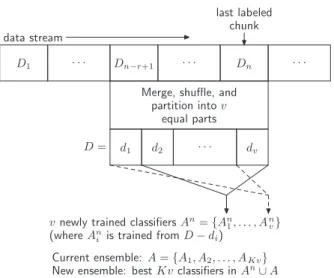
The ensemble construction and updating process is illustrated in Figure 1 and sum-marized in Algorithm 1.
Lines 1–3 of the algorithm compute the error of each classifier Ai ∈ Aon chunk Dn, where Dnis the most recent data chunk that has been labeled. Let Dbe the data of the most recently labeledr data chunks, including Dn. Line 5 randomly partitions Dinto v equal parts{d1, . . . ,dv}such that all the parts have roughly the same class
distributions.
Lines 6–9 train a new batch ofv classifiers, where each classifier An
j is trained with dataset D−dj. The error of each classifier Anj ∈ An is computed by testing it on its corresponding test data dj. Finally, line 10 selects the best Kv classifiers from the Kv+vclassifiers inAn∪Abased on the errors of each classifier computed in lines 2 and 8. Note that any subset of thenth batch ofvclassifiers may be selected for inclusion in the new ensemble.
3.2. Error Reduction Analysis
As explained in Algorithm 1, we build an ensembleAofKvclassifiers. A test instance x is classified using a majority vote of the classifiers in the ensemble. We use simple majority voting rather than weighted majority voting (refer to Wang et al. [2003]), since simple majority voting has been theoretically proven the optimal choice for data
ALGORITHM 1:Updating the classifier ensemble
Input: {Dn−r+1, . . . ,Dn}: thermost recently labeled data chunks
A: the current ensemble of bestKvclassifiers
Output: an updated ensembleA
1: foreach classifier Ai∈ Ado
2: e(Ai)←error of AionDn// test and compute error
3: end for
4: D← ∪n j=n−r+1Dj
5: PartitionDinto equal parts{d1,d2, . . . ,dv}
6: for j=1 tovdo
7: An
j←newly trained classifier from dataD−dj
8: e(An
j)←error of A
n
jondj// test and compute error
9: end for
10: A←bestKvclassifiers fromAn∪Abased on computed errore(.)
streams [Gao et al. 2007]. Weighted voting can be problematic in these contexts because it assumes that the distribution of training and test data are the same. However, in data streams, this assumption is violated because of concept-drift. Simple majority voting is therefore a better alternative. Our experiments confirm this in practice, obtaining better results with simple rather than weighted majority voting.
The following argument shows that EMPC can further reduce the expected error in classifying concept-drifting data streams compared to Single-Partition, single-Chunk (SPC)approaches, which use only one data chunk for training a single classifier (i.e., r =v =1). Intuitively, there are two main reasons for the error reduction. First, the training data per classifier is increased by introducing the multichunk concept. Larger training data naturally leads to better trained model, reducing the error. Second, rather than training only one model from the training data, we partition the data into v partitions, and train one model from each partition. This further reduces error because the mean expected error of an ensemble ofv classifiers is theoreticallyv times lower than that of a single classifier [Tumer and Ghosh 1996]. Therefore, both the multichunk and multipartition strategy contribute to error reduction.
Given an unlabeled test instancex, the posterior probability distribution of classais p(a|x). A classifier is trained to learn a function fa(·) that approximates this posterior probability
fa(x)=p(a|x)+βa+ηa(x), (1) where βa is the bias of the classifier, andηa(x) is the variance of the classifier given input x [Tumer and Ghosh 1996]. These biases and variances are the added error beyond the Bayes error. We limit our attention to the variance term because we would like to analyze the error introduced by training the classifiers on different data chunks. (The bias may differ with varying classifiers if they are trained with different learning algorithms, but in our case the same learning algorithm is used in different data chunks.)
The expected error of a classifier is given by Err= σ
2 ηa(x)
s , (2)
whereσ2
ηa(x)is the variance ofηa(x), andsis independent of the learned classifier [Tumer and Ghosh 1996]. Let C = {C1, . . . ,CK}be an ensemble of K classifiers, where each
classifier Ci is trained from a single data chunk (i.e.,C is an SPC ensemble). If we average the outputs of the classifiers in a K-classifier ensemble, then the ensemble
output fCabecomes fCa= 1 K K i=i fCia(x)=p(a|x)+ηaC(x), (3) where fCa is the output of the ensembleC, fCia(x) is the output of theith classifierCi, andηa
C(x) is the average error of all classifiers, given by
ηa C(x)= 1 K K i=1 ηa Ci(x). (4) Here,ηa
Ci(x) is the added error of theith classifier in the ensemble. Assuming the error variances are independent, the variance ofηa
C(x) is given by σ2 ηa C(x)= 1 K2 K i=1 σ2 ηa Ci(x)= 1 Kσ¯ 2 ηa C(x). (5) where σ2 ηa Ci(x) is the variance ofη a Ci(x), and ¯ση2a
C(x) is the common variance. In order to simplify the notation, we denoteση2a
Ci(x)asσ 2 Ci(x).
Let A= {A1,A2, . . . ,AKv}be the ensemble of Kvclassifiers, where each classifier Ai is trained usingrconsecutive data chunks (i.e., the EMPC approach). The following lemma proves that EMPC reduces error over SPC by a factor ofrvwhen the outputs of the classifiers in the ensemble are independent.
LEMMA 1. LetσC2(x) be the error variance of SPC. If there is no concept-drift, and the errors of the classifiers in the ensemble A are independent, then the error variance of EMPC is a fraction(rv)−1of that of SPC.
σ2 A(x)= 1 rvσ 2 C(x) (6)
PROOF. Each classifier Ai ∈ Ais trained onrconsecutive data chunks. If there is no
concept-drift, then a classifier trained onrconsecutive chunks may reduce the error of the single classifier trained on a single chunk by a factor ofr[Wang et al. 2003]. It follows that σ2 Ai(x) = 1 r2 r+i−1 j=i σ2 Cj(x) (7) whereσ2
Ai(x)is the error variance of classifierAi trained using data
r+i−1
j=i Di, andσCj2(x)
is the error variance ofCj, trained using a single data chunk Dj. Combining Eqs. (5) and (7) and simplifying, we obtain
σ2 A(x)= 1 K2v2 Kv i=1 ⎛ ⎝1 r2 r+i−1 j=i σ2 Cj(x) ⎞ ⎠, = 1 K2v2r Kv i=1 ⎛ ⎝1 r r+i−1 j=i σ2 Cj(x) ⎞ ⎠,
= 1 K2v2r Kv i=1 ¯ σ2 Ci(x) = 1 Krv 1 Kv Kv i=1 ¯ σ2 Ci(x) , = 1 Krvσ¯ 2 C(x) = 1 rvσ 2 C(x), (8)
where ¯σCi2(x)is the common variance ofσCj2(x)for j∈[i,i+r−1], and ¯σC2(x)is the common variance of ¯σ2
Ci(x)fori∈[1,Kv].
Although it may appear from Lemma 1 that by makingrarbitrarily large, error can be made arbitrarily small, this is not true in practice because of concept-drift. We will elaborate this issue in Lemma 3.
Lemma 1 does not consider the effects of possible correlation among the classifiers in the ensemble. Such correlations are potentially significant in our approach because each set of v classifiers is trained fromr consecutive data chunks. As a result, each pair of thesevclassifiers has overlapping training data. This can result in considerable correlations between the classifiers, which must be taken into consideration in any realistic analysis of the expected error reduction of the system. The following lemma accounts for these effects by introducing a mean correlation termδ to the analysis of Lemma 1.
LEMMA 2. LetσC2(x)be the error variance of SPC. If there is no concept-drift, then the error variance of EMPC is a fraction(v−1)/(rv)of that of SPC, wherev >1.
σ2 A(x)≤ v−1 rv σ 2 C(x) (9)
PROOF. The error variance of ensemble A, given some mean correlation δ of error
among the classifiers in the ensemble, is
σ2 A(x) = 1+δ(Kv−1) Kv ¯ σ2 A(x), (10) where ¯σ2
A(x)is the common variance ofσ 2
Ai(x). Mean correlationδis given by δ= 1 (Kv)(Kv−1) Kv m=1 m=l corr(ηm, ηl), (11)
wherecorr(ηm, ηl) is the correlation between the errors of classifiersAmandAl [Tumer and Ghosh 1996].
To simplify the computation of error correlation between AmandAl, we assume that if they are trained with overlapping data thencorr(ηm, ηl)=1, and if they are trained with disjoint data, thencorr(ηm, ηl)=0. Given this assumption, the correlation between
Amand Al can be computed as follows. corr(ηm, ηl)=
v−2
v−1 ifAm,Al ∈ A i
0 otherwise (12)
That is, the error correlation between classifiers Amand Al is nonzero only if they are in the same batch of classifiers Ai. If A
m and Al are from the same batch, they have
v−2 partitions of training data in common. This is because our algorithm trains each classifier usingv−1 partitions of training data, and each batch containsvpartitions in total. However, if the classifiers are not from the same batch, they do not have any common training data.
In the worst case, all v classifiers of the ith batch will remain in the ensemble A. This worst case is probably infrequent, since the ensemble updating algorithm allows some classifiers in theith batch to be replaced while others remain in the ensemble. However, in the worst case the ensemble is updated each time by a replacement of a whole batch ofv classifiers by a new batch ofvclassifiers. In this case, each classifier will be correlated withv−1 classifiers. The mean correlation therefore becomes
δ ≤ 1 (Kv)(Kv−1)Kv(v−1) v−2 v−1 = v−2 Kv−1. (13)
Substituting this bound forδinto Eq. (10), and following logic similar to that used in the proof of Lemma 1, we obtain
σ2 A(x) ≤ 1+Kv−v−21(Kv−1) Kv σ¯ 2 A(x) =v−1 Kv σ¯ 2 A(x) = v−1 Kv 1 Kv Kv i=1 σ2 Ai(x).
Now first using Eq. (7) and then (8) we can deduce
= v−1 Kv 1 Kv Kv i=1 ⎛ ⎝1 r2 r+i−1 j=i σ2 Cj(x) ⎞ ⎠ = v−1 rv σ 2 C(x) (14)
For example, ifv = 2 andr = 2 then we anticipate an error reduction by a factor of approximately 4.
Lemma 2 accounts for correlation between the classifiers in each ensemble, but it does not account for concept-drift in the data stream. In order to analyze error in the presence of concept-drift, we must introduce a new term for themagnitude of drift.
Definition 1. The magnitude of drift ρd is the maximum error introduced to a classifier due to concept-drift. That is, every time a new data chunk appears, the error variance of a classifier is incrementedρdtimes due to concept-drift.
For example, let Dj(with j∈[i,i+r−1]) be a data chunk in a window ofrof consec-utive data chunks{Di, . . . ,Di+r−1}, and letCjbe the classifier trained with data chunk Dj. In addition, letσCj2(x)be the error variance ofCjin the absence of concept-drift. The actual error variance ˆσ2
Cj(x)of classifierCjin the presence of concept-drift is then given
by
ˆ
σ2
Cj(x) =(1+ρd)(i+r−1)−jσCj2(x). (15)
In other words, ˆσ2
Cj(x)is the actual error variance of the jth classifierCjin the presence
of concept-drift when the last data chunkDi+r−1in the window appears. The following
lemma generalizes the results of Lemma 2 to account for such concept-drift.
LEMMA 3. LetσˆA2(x)be the error variance of EMPC in the presence of concept-drift, let σ2
Error varianceσˆ2 A(x) is bounded by ˆ σ2 A(x) ≤ (v−1)(1+ρd)r−1 rv σ 2 C(x). (16)
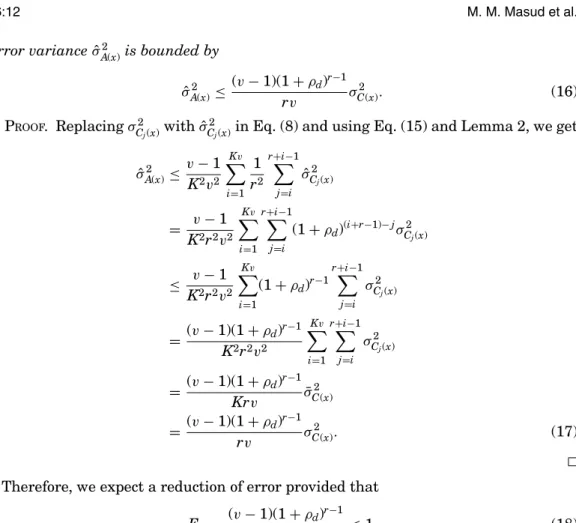
PROOF. ReplacingσCj2(x)with ˆσCj2(x)in Eq. (8) and using Eq. (15) and Lemma 2, we get
ˆ σ2 A(x)≤ v−1 K2v2 Kv i=1 1 r2 r+i−1 j=i ˆ σ2 Cj(x) = v−1 K2r2v2 Kv i=1 r+i−1 j=i (1+ρd)(i+r−1)−jσCj2(x) ≤ v−1 K2r2v2 Kv i=1 (1+ρd)r−1 r+i−1 j=i σ2 Cj(x) = (v−1)(1+ρd)r−1 K2r2v2 Kv i=1 r+i−1 j=i σ2 Cj(x) = (v−1)(1+ρd)r−1 Krv σ¯ 2 C(x) = (v−1)(1+ρd)r−1 rv σ 2 C(x). (17)
Therefore, we expect a reduction of error provided that ER=
(v−1)(1+ρd)r−1
rv ≤1. (18)
That is, the ratio ERof EMPC error to SPC error in the presence of concept-drift must be no greater than 1. As we increaserandv, the relative error therefore decreases up to a certain threshold, after which it flattens or increases. We next empirically seek ideal values ofrandvfor reducing error in the presence of concept-drift.
3.3. Empirical Error Reduction
For a given partition size v, increasing the window sizer only yields reduced error up to a certain point. After that, increasingr actually hurts the performance of our algorithm, because inequality (18) is violated. The upper bound ofr depends on the magnitude of driftρd.
Figure 2 shows the relative error ER for v = 2, and different values of ρd, for in-creasingr. It is clear from the graph that for lower values ofρd, increasingrreduces the relative error by a greater margin. However, in all cases afterrexceeds a certain threshold, ERbecomes greater than one.
Although it may not be possible to know the actual value ofρdfrom the data, we may determine the optimal value of r experimentally. In our experiments, we found that for smaller chunk sizes, higher values ofr work better, and vice versa. However, the best performance-cost trade-off is found forr=2 orr=3. We have usedr=2 in our experiments. Similarly, the upper bound ofvcan be derived from inequality (18) for a fixed value ofr. It should be noted that ifv is increased, running time also increases. From our experiments, we obtained the best performance-cost trade-off forv=5.
0 0.2 0.4 0.6 0.8 1 10 20 30 40 Relative error (E R ) r Pd=0.1 Pd=0.2 Pd=0.3 Pd=0.5 (a) 0 0.2 0.4 0.6 10 20 30 40 Relative error (E R ) v No correlation Correlated with 1 Correlated with 2 (b) Fig. 2. Error reduction by increasingrandv. 3.4. Time Complexity of EMPC
The time complexity of the algorithm isO(vn(Ks+ f(rs))), wherenis the total number of data chunks, s is the size of each chunk, and f(z) is the time required to build a classifier on a training data of sizez. Since v is constant, the complexity becomes O(n(Ks+ f(rs))). This is at most a constant factorrv slower than the closest related work [Wang et al. 2003], but with the advantage of significantly reduced error.
4. MALICIOUS CODE DETECTION
Malware is a major source of cyber attacks. Some malware varieties are purely static; each instance is an exact copy of the instance that propagated it. These are relatively easy to detect and filter once a single instance has been identified. However, a much more significant body of current-day malware is polymorphic. Polymorphic malware self-modifies during propagation so that each instance has a unique syntax but carries a semantically identical malicious payload.
The antivirus community invests significant effort and manpower toward devising, automating, and deploying algorithms that detect particular malware instances and polymorphic malware families that have been identified and analyzed by human ex-perts. This has led to an escalating arms race between malware authors and antiviral defenders, in which each camp seeks to develop offenses and defenses that counter the recent advances of the other. With the increasing ease of malware development and the exponential growth of malware variants, many believe that this race will ultimately prove to be a losing battle for the defenders.
The malicious code detection problem can be modeled as a data mining problem for a stream having both infinite length and concept-drift. Concept-drift occurs as polymor-phic malware mutates, and as attackers and defenders introduce new technologies to the arms race. This conceptualization invites application of our stream classification technique to automate the detection of new malicious executables.
Feature extraction using n-gram analysis involves extracting all possible n-grams from the given dataset (training set), and selecting the bestn-grams among them. Each suchn-gram is a feature. That is, ann-gram is a sequence ofnbytes. Before extracting n-grams, we preprocess the binary executables by converting them to hexdump files. Here, the granularity level is one byte. We apply the UNIXhexdumputility to convert the binary executable files into text files (hexdump files) containing the hexadecimal numbers corresponding to each byte of the binary. This process is performed to ensure safe and easy portability of the binary executables. In a nondistributed framework, the feature extraction process consists of two phases: feature extraction and feature selection, described shortly. Our cloud computing variant of this traditional technique is presented in Section 4.2.
4.1. Nondistributed Feature Extraction and Selection
In a nondistributed setting, feature extraction proceeds as follows. Each hexdump file is scanned by sliding an n-byte window over its content. Each n-byte sequence that appears in the window is ann-gram. For eachn-gramg, we tally the total numbertgof file instances in whichgappears, as well as the total numberpg≤tgof these that are positive (i.e., malicious executables).
This involves maintaining a hash table T of all n-grams encountered so far. Ifg is not found in T, theng is added to T with counts tg = 1 and pg ∈ {0,1} depending on whether the current file has a negative or positive class label. Ifgis already inT, thentgis incremented andpgis conditionally incremented depending on the file’s label. When all hexdump files have been scanned, T contains all the uniquen-grams in the dataset along with their frequencies in the positive instances and in total.
It is not always practical to use all n-gram features extracted from all the files corresponding to the current chunk. The exponential number of such n-grams may introduce unacceptable memory overhead, slow the training process, or confuse the classifier with large numbers of noisy, redundant, or irrelevant features. To avoid these pitfalls, candidaten-gram features must be sorted according to a selection criterion so that only the best ones are selected.
We chooseinformation gainas the selection criterion, because it is one of the most effective criteria used in literature for selecting the best features. Information gain can be defined as a measure of the effectiveness of an attribute (i.e., feature) for classifying the training data. If we split the training data based on the values of this attribute, then information gain measures the expected reduction in entropy after the split. The more an attribute reduces entropy in the training data, the better that attribute is for classifying the data.
Given an instance set I with positive instances P⊆ I, and an attribute R: I →V that maps instances to values, the information gain is given by
G(R)=H(p,t)− v∈V |IRv| t H |IRv∩P|,|IRv|, (19) where p= |P|is the total number of positive instances,t= |I|is the total size of the instance set, IRv = {i ∈ I | R(i)=v}is the set of instances in which attribute Rhas valuev, and entropyHis given by the formula
H(x,y)= −x ylog2 x y −y−x y log2 y−x y . (20)
In the context of malware detection, we consider eachn-gram g to be an attribute Rg: I→ {0,1}that maps each instancei∈ Ito 1 ifgis present iniand to 0 otherwise. Thus,|IRg1| = tg is the total number of instances that containg, and |IRg0| = t−tg is the total number that do not. Likewise,|IRg1∩P| = pgis the total number of positive
instances that containg, and|IRg0∩P| = p−pgis the total number of positive instances that do not. Substituting these formulas into Eqs. (19) and (20) we obtain
G(Rg)=H(p,t)−tg t H(pg,tg)− t−tg t H(p−pg,t−tg). We henceforth write ˆ G(pg,tg,p,t)=G(Rg). (21)
The feature set can therefore be pruned by selecting the S features with greatest information gain G(Rg) based on the preceding. This can be efficiently accomplished with a min-heap data structure of size S that stores the S best features seen so far,
keyed by information gain. As new features are considered, their information gains are compared against the heap’s root. If the gain of the new feature is greater than that of the root, the root is discarded and the new feature inserted into the heap. Otherwise the new feature is discarded and feature selection continues.
4.2. Distributed Feature Extraction and Selection
There are several drawbacks related to the nondistributed feature extraction and se-lection approach just described.
—The total number of extractedn-gram features might be very large. For example, the total number of 4-grams in one chunk is around 200 million. It might not be possible to store all of them in main memory. One obvious solution is to store then-grams in a disk file, but this introduces unacceptable overhead due to the cost of disk read/write operations.
—If colliding features in hash tableT are not sorted, then a linear search is required for each scanned n-gram during feature extraction to test whether it is already in T. If they are sorted, then the linear search is required during insertion. In either case, the time to extract alln-grams is worst case quadratic in the total number N ofn-grams in each chunk, an impractical amount of time whenN≈108.
—Similarly, the nondistributed feature selection process requires a sort of then-grams in each chunk. In general, this requiresO(NlogN) time, which is impractical when Nis large.
In order to efficiently and effectively tackle the drawbacks of the nondistributed feature extraction and selection approach, we leverage the power of cloud computing. This allows feature extraction, n-gram sorting, and feature selection to be performed in parallel, utilizing the HadoopMapReduceframework.
MapReduce [Dean and Ghemawat 2008] is an increasingly popular distributed pro-gramming paradigm used in cloud computing environments. The model processes large datasets in parallel, distributing the workload across many nodes (machines) in a share-nothing fashion. The main focus is to simplify the processing of large datasets using inexpensive cluster computers. Another objective is ease of usability with both load balancing and fault tolerance.
MapReduce is named for its two primary functions. The Mapfunction breaks jobs down into subtasks to be distributed to available nodes, whereas its dual,Reduce, aggre-gates the results of completed subtasks. We will henceforth refer to nodes performing these functions asmappersandreducers, respectively. The details of the MapReduce process forn-gram feature extraction and selection are explained in the Appendix. In this section, we give a high-level overview of the approach.
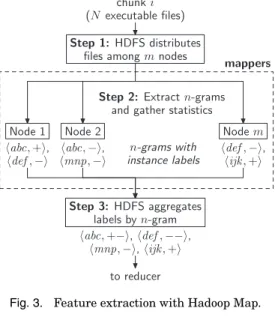
Each training chunk containing N training files are used to extract the n-grams. These training files are first distributed among mnodes (machines) by the Hadoop Distributed File System (HDFS) (Figure 3, step 1). Quantitymis selected by HDFS depending on system availability. Each node then independently extractsn-grams from the subset of training files supplied to the node using the technique discussed in Section 4.1 (Figure 3, step 2). When all nodes finish their jobs, then-grams extracted from each node are collated (Figure 3, step 3).
For example, suppose Node 1 observes n-gram abcin one positive instance (i.e., a malicious training file) while Node 2 observes it in a negative (i.e., benign) instance. This is denoted by pairsabc,+ andabc,− under Nodes 1 and 2 (respectively) in Figure 3. When then-grams are combined, the labels of instances containing identical n-grams are aggregated. Therefore, the aggregated pair forabcisabc,+−.
The combinedn-grams are distributed toqreducers (withqchosen by HDFS based on system availability). Each reducer first tallies the aggregated labels to obtain a
chunki
(Nexecutable files)
Step 1:HDFS distributes
files amongmnodes
Node 1 Node 2 Nodem
abc,+, def, abc, , mnp, def, , ijk,+
Step 2:Extractn-grams and gather statistics
n-grams with instance labels Step 3:HDFS aggregates labels byn-gram abc,+ , def, , mnp, , ijk,+ mappers to reducer
Fig. 3. Feature extraction with Hadoop Map.
from mapper
Step 4:HDFS distributes aggregated
n-grams amongqnodes
Node 1 Node 2 Nodeq
S n-grams S n-grams S n-grams
Step 5:Select bestS n-grams based on information gain
Step 6:Select bestS n-grams
from the selectedqS n-grams
and generate feature vector
reducers
reducer
Fig. 4. Feature selection with Hadoop Reduce.
positive count and a total count. In the case ofn-gramabc, we obtain tallies of pabc=1 and tabc = 2. The reducer uses these tallies to choose the best S n-grams (based on Eq. (21)) from the subset ofn-grams supplied to the node (Figure 4, step 5). This can be done efficiently using a min-heap of size S; the process requires O(WlogS) time, where W is the total number of n-grams supplied to each reducer. In contrast, the nondistributed version requires O(WlogW) time. Thus, from theqreducer nodes, we obtainqS n-grams.
From these, we again select the bestSby running another round of the MapReduce cycle in which the Map phase does nothing but the Reduce phase performs feature selection using only one node (Figure 4, step 6). Each feature in a feature set is binary; its value is 1 if it is present in a given instance (i.e., executable) and 0 otherwise. For each training or testing instance, we compute the feature vector whose bits consist of the feature values of the corresponding feature set. These feature vectors are used by the classifiers for training and testing.
5. EXPERIMENTS
We evaluated our approach on synthetic data, botnet traffic generated in a controlled environment, and a malware dataset. The results of the experiments are compared with several baseline methods.
5.1. Datasets
5.1.1. Synthetic Dataset. To generate synthetic data with a drifting concept, we use a moving hyperplane, given by di=1aixi = a0 [Wang et al. 2003]. If
d
i=1aixi ≤ a0,
then an example is negative; otherwise it is positive. Each example is a randomly generated d-dimensional vector {x1, . . . ,xd}, where xi ∈ [0,1]. Weights {a1, . . . ,ad} are also randomly initialized with a real number in the range [0,1]. The value of a0 is adjusted so that roughly the same number of positive and negative examples
are generated. This can be done by choosinga0 = 12
d
i=1ai. We also introduce noise
randomly by switching the labels of ppercent of the examples, where p= 5 in our experiments.
There are several parameters that simulate concept-drift. We use parameters iden-tical to those in [Wang et al. 2003]. In total, we generate 250,000 records and four dif-ferent datasets having chunk sizes 250, 500, 750, and 1000, respectively. Each dataset has 50% positive instances and 50% negative.
5.1.2. Botnet Dataset. Botnets are networks of compromised hosts known asbots, all un-der the control of a human attacker known as thebotmaster[Barford and Yegneswaran 2006]. The botmaster can issue commands to the bots to perform malicious actions, such as launching DDoS attacks, spamming, spying, and so on. Botnets are widely regarded as an enormous emerging threat to the internet community. Many cutting-edge bot-nets apply Peer-to-Peer (P2P) technology to reliably and covertly communicate as the botnet topology evolves. These botnets are distributed and small, making them more difficult to detect and destroy. Examples of P2P bots include Nugache [Lemos 2006], Sinit [Stewart 2003], and Trojan.Peacomm [Grizzard et al. 2007].
Botnet traffic can be viewed as a data stream having both infinite length and concept-drift. Concept-drift occurs as the bot undertakes new malicious missions or adopts dif-fering communication strategies in response to new botmaster instructions. We there-fore consider our stream classification technique to be well suited to detecting P2P botnet traffic.
We generate real P2P botnet traffic in a controlled environment using the Nugache P2P bot [Lemos 2006]. The details of the feature extraction process are discussed in Masud et al. [2008b]. There are 81 continuous attributes in total. The whole dataset consists of 30,000 records, representing one week’s worth of network traffic. We gener-ate four different datasets having chunk sizes of 30 minutes, 60 minutes, 90 minutes, and 120 minutes, respectively. Each dataset has 25% positive (botnet traffic) instances and 75% negative (benign traffic).
5.1.3. Malware Dataset. We extract a total of 38,694 benign executables from differ-ent Windows machines, and a total of 66,694 malicious executables collected from an online malware repository [VX Heavens 2010], which contains a large collection of ma-licious executables (viruses, worms, trojans, and back-doors). The benign executables include various applications found at the Windows installation folder, as well as other executables in the default program installation directory.
We select only the Win32 Portable Executables (PE) in both cases. Experiments with the ELF executables are a potential direction of future work. The collected 105,388 files (benign and malicious) form a data stream of 130 chunks, each consisting of 2000 instances (executable files). The stream order was chosen by sorting the malware by
version and discovery date, simulating the evolving nature of Internet malware. Each chunk has 1500 benign executables (75% negative) and 500 malicious executables (25% positive). The feature extraction and selection process for this dataset is described in Sections 4.1–4.2.
Note that all these datasets are dynamic in nature. Their unbounded (potentially infinite-length) size puts them beyond the scope of purely static classification frame-works. The synthetic data also exhibits concept-drift. Although it is not possible to accurately determine whether the real datasets have concept-drift, theoretically the stream of executables should exhibit concept-drift when observed over a long period of time (see Section 1). The malware data exhibits feature evolution as evidenced by the differing set of distinguishing features identified for each chunk.
5.2. Baseline Methods
For classification, we use the Weka machine learning open-source package [Hall et al. 2009]. We apply two different classifiers: J48 decision tree and Ripper. We then compare each of the following baseline techniques to our EMPC algorithm.
BestK.This is a single-partition, single-chunk (SPC) ensemble approach, where an ensemble of the best Kclassifiers is used. The ensemble is created by storing all the classifiers seen so far, and selecting the best K based on expected error on the most recent training chunk. An instance is tested using simple majority voting.
Last.In this case, we only keep the classifier trained on the most recent training chunk. This can be considered an SPC approach withK=1.
AWE. This is the SPC method implemented using Accuracy-Weighted classifier En-sembles [Wang et al. 2003]. It builds an ensemble of K models, where each model is trained from one data chunk. The ensemble is updated as follows. LetCnbe the clas-sifier built on the most recent training chunk. From the existing K models and the newest model Cn, the K best models are selected based on their error on the most recent training chunk. Selection is based on weighted voting where the weight of each model is inversely proportional to the error of the model on the most recent training chunk.
All.This SPC uses an ensemble of all the classifiers seen so far. The new data chunk is tested with this ensemble by simple voting among the classifiers. Since this is an SPC approach, each classifier is trained from only one data chunk.
As mentioned in Section 3.3, we obtain the optimal values ofrandv to be between 2 and 3, and between 3 and 5, respectively, for most datasets. Unless mentioned other-wise, we user=2 andv =5 in our experiments. To obtain a fair comparison, we use the same value forK(ensemble size) in EMPC and all baseline techniques.
5.3. Hadoop Distributed System Setup
The distributed system on which we performed our experiments consists of a cluster of ten nodes. Each node has the same hardware configuration: an Intel Pentium IV 2.8 GHz processor, 4GB main memory, and 640GB hard disk space. The software en-vironment consists of a Ubuntu 9.10 operating system, the Hadoop-0.20.1 distributed computing platform, the JDK 1.6 Java development platform, and a 100MB LAN net-work link.
5.4. Performance Study
In this section we compare the results of all five techniques: EMPC, AWE,BestK,All, and Last. As each new data chunk appears, we test each ensemble/classifier on the
EMPC AWE BestK All Last 10 15 20 25 30 2 4 6 8 Error (%) Ensemble size (K) (a) 10 15 20 25 30 250 500 750 1000 Error (%) Chunk size (b) Fig. 5. Error rates for synthetic data.
EMPC AWE BestK All Last
0 1 2 3 4 5 2 4 6 8 Error (%) Ensemble size (K) (a) 0 1 2 3 4 5 30 60 90 120 Error (%)
Chunk size (Minutes)
(b) Fig. 6. Error rates for botnet data.
new data and update its accuracy, false positive rate, and false negative rate. In all the results shown here we fix the parameter values ofv =5 andr =2, and the base learner is a decision tree unless stated otherwise.
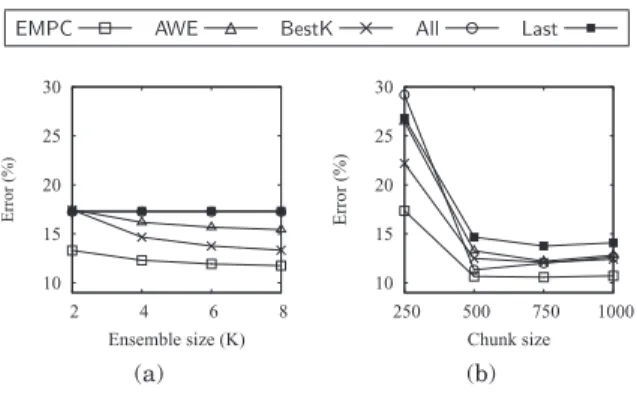
Figure 5(a) shows the error rates for different ensemble sizesK, averaged over four different chunk sizes on synthetic data. It is evident that EMPC has the lowest error among all approaches. The accuracy does not improve much afterK=8. Methods AWE andBestK also show similar characteristics. MethodsAll andLastdo not depend on K, so their error rates remain the same for anyK.
Figure 5(b) shows the error rates for four different chunk sizes of each method averaged over different ensemble sizes K on synthetic data. Again, EMPC has the lowest error of all. The error of EMPC is also lower for larger chunk sizes, since these provide more training data for each classifier.
Figure 6(a) shows the error rates for botnet data over different ensemble sizes K averaged over four different chunk sizes. Figure 6(b) shows the error rates for the same data over four different chunk sizes averaged over the different ensemble sizes K. In all cases, EMPC has the lowest error rate among all approaches.
Figure 7(a) shows the error rates for different ensemble sizes K on malware data. EMPC outperforms all other methods and reaches the lowest error rate whenK=3. Figure 7(b) shows the error rates for the same data over different feature set sizes. EMPC outperforms all other methods and reaches the lowest error rate when the feature size is 2000.
Tables (a) and (b) of Table I report the error rates for decision tree and Ripper learning algorithms, respectively, on synthetic data for different ensemble sizesKand
EMPC AWE BestK Last 0 1 2 3 4 5 6 2 4 6 8 Error (%) Ensemble size (K) (a) 0 1 2 3 4 5 6 500 1000 1500 2000 2500 3000 Error (%)
Feature set size
(b) Fig. 7. Error rates for malware data.
Table I. Error Rates on Synthetic Data
(a) Decision tree Chunk
size
K=2 K=4 K=8
All Last EMPC AWE BestK EMPC AWE BestK EMPC AWE BestK
250 19.3 26.8 26.9 17.3 26.5 22.1 16.2 26.1 19.5 29.2 26.8 500 11.4 14.8 14.7 10.6 13.2 12.4 10.2 12.4 11.3 11.3 14.7 750 11.1 13.9 13.9 10.6 12.1 11.9 10.3 11.3 11.2 15.8 13.8 1000 11.4 14.3 14.3 10.7 12.8 12.2 10.3 11.9 11.4 12.6 14.1 (b) Ripper Chunk size K=2 K=6 K=8 All Last EMPC AWE BestK EMPC AWE BestK EMPC AWE BestK
250 19.2 26.5 26.0 17.6 26.2 22.4 16.8 25.9 20.9 30.4 26.3 500 11.5 14.2 13.9 10.8 13.0 12.3 10.5 12.5 11.5 11.6 14.1 750 11.0 13.4 13.3 10.6 12.1 12.0 10.5 11.5 11.5 15.7 13.3 1000 11.1 13.8 13.7 10.6 12.5 12.3 10.2 11.9 11.8 12.6 13.6
Table II. Error Rates on Malware Data Using Decision Tree
Feature set size
K=3 K=5 K=8
Last
EMPC AWE BestK EMPC AWE BestK EMPC AWE BestK
500 3.88 4.37 4.84 3.96 4.40 5.07 4.08 4.35 5.36 4.41 1000 3.02 3.90 4.06 3.09 4.05 4.35 3.21 4.34 4.95 3.95 2000 2.79 3.62 3.80 3.15 3.72 4.05 3.36 3.95 4.30 3.69 3000 2.96 3.46 3.46 3.20 3.41 3.34 3.31 3.58 3.64 3.45
chunk sizes. In all tables, we see that EMPC has the lowest error rate for all ensemble sizes (shown in bold).
Table II reports the error rates for malware data over different ensemble sizesKand feature set sizes. Once again, EMPC has the lowest overall error rate for all values of Kand feature set size (shown in bold).
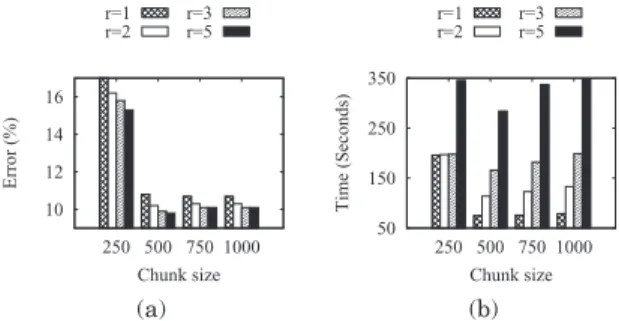
Figure 8 shows the sensitivity of parameterron the EMPC error rates and runtimes over synthetic data. Figure 8(a) shows the error rates over different values of r for fixed parameters v =5 and K = 8. The highest reduction in error rate occurs when r is increased from 1 to 2. Note thatr =1 means single-chunk training. We observe no significant reduction in error rate for higher values of r, which follows from our analysis of parameterron concept-drifting data in Section 3.3. However, the runtime keeps increasing, as shown in Figure 8(b). The best trade-off between runtime and error therefore occurs forr=2.
10 12 14 16 250 500 750 1000 Error (%) Chunk size r=1 r=2 r=3 r=5 (a) 50 150 250 350 250 500 750 1000 Time (Seconds) Chunk size r=1 r=2 r=3 r=5 (b) Fig. 8. Sensitivity ofron error rate and runtime.
10 12 14 16 250 500 750 1000 Error (%) Chunk size v=1 v=3 v=5 v=7 (a) 50 100 150 200 250 500 750 1000 Time (Seconds) Chunk size v=1 v=3 v=5 v=7 (b) Fig. 9. Sensitivity ofvon error rate and runtime.
EMPC AWE BestK All Last
30 80 130 180
250 500 750 1000
Running time (Seconds)
Chunk size
(a) synthetic data
0 2 4 6 8 10 30 60 90 120
Running time (Seconds)
Chunk size (Minutes)
(b) botnet data Fig. 10. Total runtimes.
Figure 9 shows a similar trend for parameterv. Note thatv=1 (i.e., a single partition ensemble) is the base case, and v > 1 is the multipartition ensemble approach. We observe no significant improvement afterv=5, although the runtime keeps increasing. This result is also consistent with our analysis of the upper bounds ofv, explained in Section 3.3. We choosev=5 as the best trade-off between time and error.
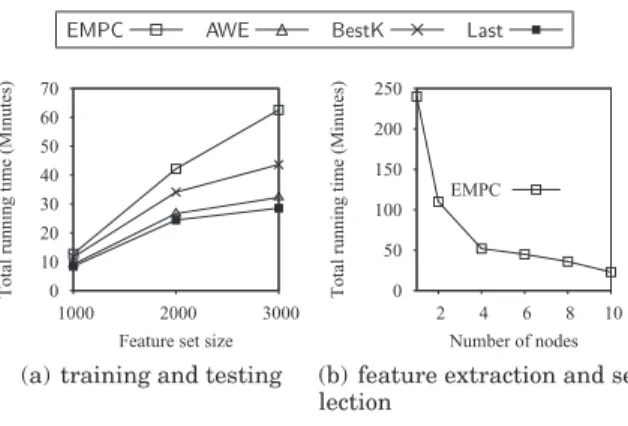
Figure 10(a) shows the total running times of different methods on synthetic data forK =8,v =5 andr =2. Note that the runtime of EMPC is within 5 times of that of AWE. This supports our complexity analysis in Section 3.4, which concludes that the runtime of EMPC is at most rv times that of AWE. The runtimes of EMPC on botnet data shown in Figure 10(b) have similar characteristics. All runtimes shown in Figure 10 include both training and testing time. Although the total training time of EMPC is higher than that of AWE, the total testing times are almost the same for