Indiana Math Pathways
Indiana Math Pathways
2
Preface
In 2014, Complete College America, in collaboration with the Charles Dana Center at the University of Texas-Austin, invited Indiana and five other states ( Colorado, Missouri, Montana, Nevada and Ohio) to participate in a two-year initiative to dramatically increase the percentage of students who pass gateway math courses and enter programs of study within one academic year by building math pathways.
The Math Innovation Council is Indiana’s task force for this initiative, charged with publishing and implementing recommendations for differentiated, program-aligned mathematics in support of student success.
Indiana’s Math Innovation Council Membership
Institution Type / Role Member Organization/Institution
4-year research (co-chair) Jeff Watt IUPUI
2-year (co-chair) Carrie McCammon Ivy Tech Community College
2-year Rick Kribbs Vincennes University
4-year comprehensive Liz Brown Indiana State University 4-year comprehensive Kathy Rodgers University of Southern Indiana 4-year regional Henry Wyzinski Indiana University
4-year regional James Hersberger IPFW
4-year regional Catherine Murphy Purdue Calumet 4-year regional Kenneth Holford Purdue North Central 4-year research Kay Roebuck Ball State University
4-year research Dennis Groth IU Bloomington
4-year research Greg Buzzard Purdue West Lafayette
Co-Facilitator Sarah Ancel Commission for Higher Education
Co-Facilitator Ken Sauer Commission for Higher Education
Indiana Math Pathways
3
I.
Introduction
A paradox exists in American culture. To be illiterate carries with it social shame. To be innumerate (or, more commonly, to be “bad at math”) is not only accepted, but even, on occasion, applauded as a sign of normalcy. The future of our economy and American competitiveness depends on correcting this paradox and bolstering the importance our society places on mathematical competency.
What is the role of mathematics in society?
Mathematics’ enduring relevance to students, society and civilization is self-evident. We rely on it to fuel advances in engineering and technology, medicine and physics, manufacturing and logistics, and security and finance. We rely on it to analyze data and perform complex modeling and simulations. And because of its versatility, we use it to translate the discoveries and progress in one field to problems and
questions in another.1
In recent years, the explosion of data across business and government – and the attendant need to make sense of and use these data – has only increased the demand for mathematical fluency. “The world has gone quantitative,” the Department of Education concluded in 20062, and given the ongoing
shift toward a knowledge-based economy, a fluency in mathematical concepts is increasingly necessary to secure a spot in the middle class.
Beyond the professional realm, we use mathematics to craft our household budgets and make other personal finance decisions. We use it to assess the claims made by those entrusted to lead our political, financial, and other social institutions – and to scrutinize the data and evidence marshaled in support of those claims.
At the most basic level, mathematics provides a language – whether through graphs, symbols, diagrams – to convey complex ideas across a range of disciplines.3
What can be improved in the mathematics curriculum now?
Despite significant changes to the American university in the postwar era – changes aimed at meeting the needs of a growing population and changing economy – mathematics requirements look much as they did fifty or more years ago. Keeping these curricular requirements static in higher education has created a dissonance between the skills needed for the modern economy and the coursework required for graduation. A survey of academic leaders in Indiana’s institutions revealed that the skills they identified as critical for college and career success are not necessarily those taught in College Algebra – the course that often serves as the advising default, even for those students enrolled in majors that clearly do not require advanced mathematics courses, such as Calculus, for which College Algebra is a pre-requisite. Indeed, although “mastery of Algebra II is widely thought to be a prerequisite for success
1 “Fueling Innovation and Discovery: The Mathematical Sciences in the 21st Century,” a joint publication of the
Committee on the Mathematical Sciences in 2020, Board on Mathematical Sciences and Their Applications, and the Division on Engineering and Physical Sciences (Washington, DC: National Academies Press), pp 1-2.
2 U.S. Department of Education, “The Toolbox Revisited: Paths to Degree Completion from high School Through
College” (February 2006): http://www2.ed.gov/rschstat/research/pubs/toolboxrevisit/index.html
Indiana Math Pathways
4
in college and careers,” one study concluded, “fewer than five percent of American workers and an even smaller percentage of community college students will ever need to master the courses in this sequence in their college or in the workplace.”4 Providing students with a modernized mathematical experience in
college will better serve their long-term career pursuits and better prepare them to be thoughtful and productive members of society.
How do we restructure mathematics to meet the needs of today’s students?
In collaboration with the Charles Dana Center at the University of Texas-Austin, Complete College America invited Indiana, as one of six states, to participate in a two-year initiative that aims to address this very problem.
In support of these efforts, Indiana’s recently-created Math Innovation Council has been charged with designing reforms that will “dramatically increase the percentage of students who pass gateway math courses and enter programs of study in one academic year.” To meet this charge, the Council identified four questions that would guide its work:
1. How can we increase success rates in gateway courses without compromising the integrity of mathematics?
2. How can we best align mathematics requirements to give students competency in the kinds of mathematical tasks that will be required for their career success?
3. What additional courses need to be developed in Indiana to accomplish the goals in (1) and (2)? 4. How might program requirements be enhanced to help accomplish goals (1) and (2)?
The Council must look at this issue, particularly as it relates to College Algebra, through two lenses. First, are students required to take College Algebra as a requirement of the program? Second, for students with multiple options for fulfilling a math requirement, are they choosing or being advised to take College Algebra despite having other options? The answer to these questions will drive the resulting recommendations: is the answer revised requirements, revised advising protocol and degree mapping, or both?
The Council must look at this issue, particularly as it relates to College Algebra, through two lenses. First, are students required to take College Algebra as a requirement of the program? Second, for students with multiple options for fulfilling a math requirement, are they choosing or being advised to take College Algebra despite having other options? The answer to these questions will drive the resulting recommendations: is the answer revised requirements, revised advising protocol and degree mapping, or both?
How will mathematics innovation be put in place?
Indiana has three main clusters of activities that can help the Math Innovation Council’s
recommendations: (1) the Core Transfer Library, which is maintained by faculty panels and the CTL Subcommittee of STAC, (2) implementation of streamlined transfer pathways (Statewide Transfer General Education Core and Transfer Single Articulation Pathways), based on competencies and learning
4 “What Does It Really Mean to Be College and Work Ready?” A Report from the National Center on Education and
Indiana Math Pathways
5
outcomes, and (2) its Guided Pathways to Success work with Complete College America. To support these activities, the Commission and Indiana’s colleges and universities have established faculty panels in a number of different content areas, which are working to build consensus among the public
institutions about core curriculum and program requirements. Indiana has also created cross-sectional teams, including advisors, admissions officers, transfer coordinators, academics, registrars, dual credit coordinators, and others who are responsible for implementing operational changes related to course scheduling, degree mapping, transfer pathways, meta majors, and more. These teams can be utilized to implement academic or operational changes related to mathematics innovation as well.
What is the expected effect on student outcomes?
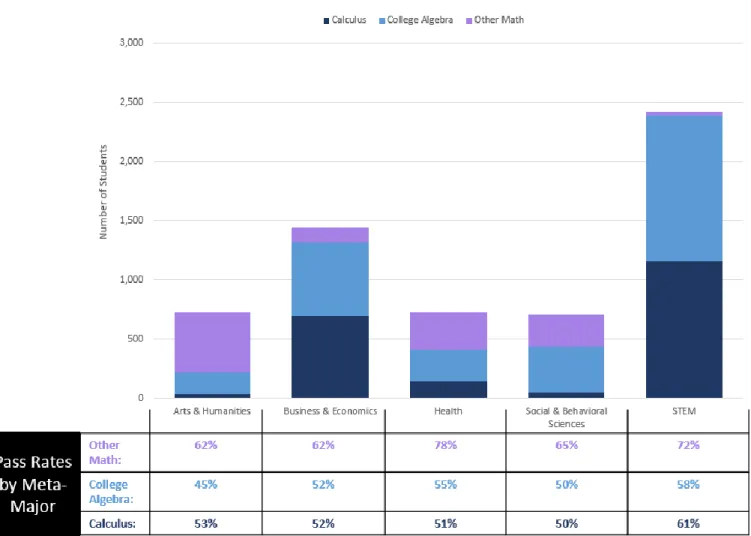
Data from Indiana students indicate that College Algebra has by far the lowest success rate of any other college-level mathematics course. College calculus, finite, technical math and other math courses
statewide have success rates 10 to 16 points higher than that of College Algebra (see Appendix Figure 1). If pass rates are low but the skills taught in those courses are clearly essential to the academic and professional enrichment of all students, then our remedy for low pass rates would be more
straightforward: we would simply have to figure out a better way to teach College Algebra and support students. But given that Indiana has identified a different set of requisite skills for the success of its graduates—skills already taught in such courses as finite math and quantitative reasoning—a positive by-product to this work may be higher pass rates and fewer repeated courses as students advance toward graduation. This will likely reduce the time and money it takes for students to graduate (and increase their chances of doing so).
Indiana Math Pathways
6
II.
First principles: What does quantitative literacy in the 21
stcentury look like?
Just as mathematics’ significance began to expand in the digital, globalizing economy of the early 1990s, so too did the collective anxiety over America’s poor quantitative aptitude. Scholars, educators, and policymakers, alarmed by the average American’s dismal mathematical ability, voiced concern over the societal consequences of “innumeracy.” Subsequently, over roughly the last two decades academic leaders have pushed to codify the quantitative skills and “habits of mind” demanded by the
professional, personal and civic realms of the 21st Century. Of the many names given to describe this
collection of skills – numeracy, mathematical literacy, quantitative reasoning (to name a few) – perhaps the most common is “quantitative literacy.”
At the heart of quantitative literacy is the ability to think and reason in numerical terms, to scrutinize and use data to make informed judgments, and to perform calculations and analyses in a range of applications and contexts. One leading scholar characterizes quantitative literacy as an “approach to problems that employs and enhances both statistics and mathematics,” a discipline “anchored in data derived from and attached to the empirical world.”5 Echoing this definition, the applied mathematician
Henry Pollak described quantitative literacy as “real world problem solving…the use of mathematics in everyday life, on the job, and as an intelligent citizen.” Such problem solving, he continued, “must be both mathematically defensible and useful in the real world.”6
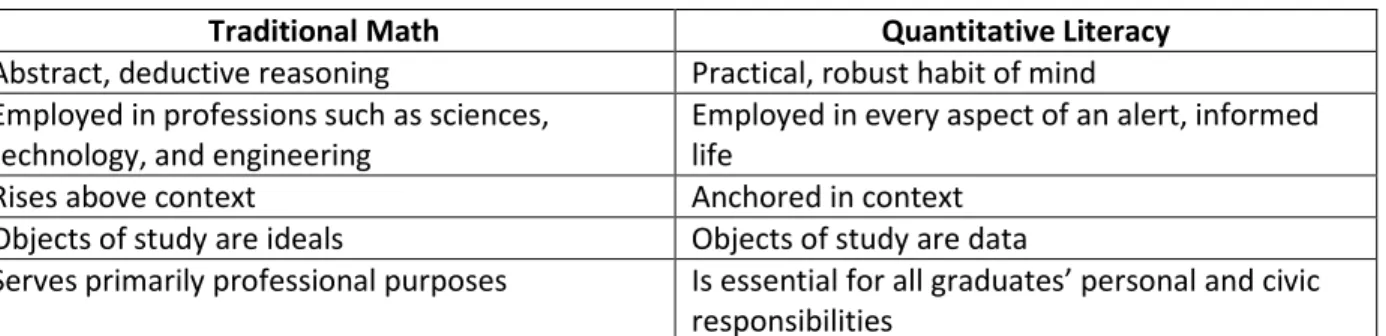
Lynn Arthur Steen, a pioneer of the quantitative literacy movement, has taken care to note that quantitative literacy is not “watered down math,” as some might initially suspect. In fact, there are important qualitative differences between traditional mathematics and quantitative literacy. “One,” he writes,
is an abstract, deductive discipline created by the Greeks, refined through the centuries, and employed in every corner of science, technology, and engineering. The other is a practical, robust habit of mind anchored in data, nourished by computers, and employed in every aspect of an alert, informed life.7
Not only is quantitative literacy distinct from traditional mathematics; it is also just as challenging, Steen convincingly argues, as the comparable mathematics a student might take.8
5 Steen, Lynn Arthur. “The Case for Quantitative Literacy” in Mathematics and Democracy, prepared by the
National Council on Education and the Disciplines (2001), 5.
6 Pollak, Henry. https://www.stolaf.edu/other/extend/Numeracy/defns.html, Adapted with permission from "Why
Numbers Count: Quantitative Literacy for Tomorrow's America," Copyright (c) College Entrance Examination Board, 1997.
7 Steen, “Everything I Needed to Know about Averages…I Learned in College,” Peer Review, Vol. 6, No. 4 (Summer
2004).
8 Steen, “Case,” 5. According to Steen, AP exam results show that students of similar ability have a harder time
solving data-based statistical reasoning problems than they do solving traditional symbol-based mathematical reasoning problems.
Indiana Math Pathways
7
Figure 1: Comparing Traditional Math and Quantitative Literacy9
Traditional Math Quantitative Literacy
Abstract, deductive reasoning Practical, robust habit of mind Employed in professions such as sciences,
technology, and engineering
Employed in every aspect of an alert, informed life
Rises above context Anchored in context
Objects of study are ideals Objects of study are data
Serves primarily professional purposes Is essential for all graduates’ personal and civic responsibilities
Definitions of quantitative literacy invariably accent different skills and contexts. For example, a British government report from the early 1980s described an “at homeness with numbers” and “mathematical skills” which support the “practical demands of everyday life.”10 Two decades later, the International Life
Skills Survey presented a more expansive definition that included quantitative literacy’s application to the world of work, describing
An aggregate of skills, knowledge, beliefs, dispositions, habits of mind, communication capabilities, and problem solving skills that people need in order to engage effectively in quantitative situations arising in life and work.11
In its 2006 standards document, Beyond Crossroads, the American Mathematical Association of Two-Year Colleges cited a definition emphasizing quantitative literacy’s importance to an informed
citizenry.12 Originally put forth by the Programme for International Student Assessment, this definition
describes quantitative literacy as
An individual’s capacity to identify and understand the role that mathematics plays in the world, to make well-founded mathematical judgments and to engage in mathematics in ways that meet the needs of that individual’s current and future life as a constructive, concerned and reflective citizen.13
Perhaps seeking to capture the breadth of quantitative literacy, the Mathematical Association of America described it as the ability “to adequately use elementary mathematical tools to interpret and manipulate quantitative data and ideas that arise in an individual’s private, civic, and work life.” Like general literacy, the definition continues, quantitative literacy constitutes a “habit of mind” shaped through “exposure in many contexts.”14
9 Comparisons drawn from Steen, “Everything I Needed to Know about Averages”
10 Cockcroft, Wilfred H. Mathematics Counts. London: Her Majesty’s Stationery Office, 1982. Quoted in “The Case
for Quantitative Literacy,” 6. Emphasis added.
11 International Life Skills Survey (ILSS). Policy Research Initiative. Statistics Canada, 2000. Quoted in “The Case for
Quantitative Literacy,” 7.
12 Blair, Rikki, Ed., “Beyond Crossorads: Implementing Mathematics Standards in the First Two Years of College,”
American Mathematical Association of Two-Year Colleges (November 2006), 10.
13 OECD, UNESCO Institute for Statistics (2003). Literacy Skills for the World of Tomorrow—Further Results from PISA 2000. Quoted in “Beyond Crossroads,” 10.
14 The Mathematical Association of America Special Interest Group on Quantitative Literacy:
Indiana Math Pathways
8
Although the definitions above – and many others – contain subtle differences, they do tend to revolve around a discrete set of mathematical skills and more general intellectual competencies. Professor Steen has distilled these skills and competencies into a useful shortlist. The following is excerpted from his case statement written on behalf of the Quantitative Literacy Design Team under the auspices of the National Council on Education and the Disciplines:
Confidence with Mathematics. Being comfortable with quantitative ideas and at ease in applying quantitative methods. Individuals who are quantitatively confident routinely use mental estimates to quantify, interpret, and check other information. Confidence is the opposite of “math anxiety”; it makes numeracy as natural as ordinary language.
Cultural Appreciation. Understanding the nature and history of mathematics, its role in
scientific inquiry and technological progress, and its importance for comprehending issues in the public realm.
Interpreting Data. Reasoning with data, reading graphs, drawing inferences, and recognizing sources of error. This perspective differs from traditional mathematics in that data (rather than formulas or relationships) are at the center.
Logical Thinking. Analyzing evidence, reasoning carefully, understanding arguments,
questioning assumptions, detecting fallacies, and evaluating risks. Individuals with such habits of inquiry accept little at face value; they constantly look beneath the surface, demanding
appropriate information to get at the essence of issues.
Making Decisions. Using mathematics to make decisions and solve problems in everyday life. For individuals who have acquired this habit, mathematics is not something done only in mathematics class but a powerful tool for living, as useful and ingrained as reading and speaking.
Mathematics in Context. Using mathematical tools in specific settings where the context provides meaning. Notation, problem-solving strategies, and performance standards all depend on the specific context.
Number Sense. Having accurate intuition about the meaning of numbers, confidence in estimation, and common sense in employing numbers as a measure of things.
Practical Skills. Knowing how to solve quantitative problems that a person is likely to encounter at home or at work. Individuals who possess these skills are adept at using elementary
mathematics in a wide variety of common situations.
Prerequisite Knowledge. Having the ability to use a wide range of algebraic, geometric, and statistical tools that are required in many fields of postsecondary education.
Indiana Math Pathways
9
Symbol Sense. Being comfortable using algebraic symbols and at ease in reading and
interpreting them, and exhibiting good sense about the syntax and grammar of mathematical symbols.15
In its rubric of quantitative literacy skills, the Association of American Colleges & Universities (AAC&U) echoes many of Steen’s themes but pares down its list even further, identifying the following as core elements of quantitative literacy:
Interpretation. The ability to explain information presented in mathematical forms
Representation. The ability to convert relevant information into various mathematical forms Calculation. The ability to execute mathematical calculations clearly and concisely
Application/Analysis. The ability to make judgments and draw appropriate conclusions based on the quantitative analysis of data, while recognizing the limits of such analysis
Assumptions. The ability to make and evaluate important assumptions in estimation, modeling, and data analysis
Communication. The ability to express quantitative evidence in support of an argument 16
The attention given to quantitative literacy has continued to grow in recent years. Comparing it to the writing-across-the-curriculum programs of previous decades, for example, Susan Elrod recently argued that quantitative reasoning “deserves the same institutional attention and focus,”17 and highlights
several developments that point in this direction. For example,
The Association of American Colleges & Universities included quantitative literacy as one of its LEAP (Liberal Education for America’s Promise) Essential Learning Outcomes.
The Lumina Foundation placed quantitative fluency in its Degree Qualifications Profile (DQP) – a list of the most important intellectual skills a student should develop.
Quantitative reasoning was listed among the five core competencies the Western Association of Schools and Colleges (WASC) identified as part of its revised institutional review process.18
Examining various descriptions of quantitative literacy leads to a significant observation. Over two decades a remarkable consensus has taken shape among scholars and academic bodies. Despite minor variations in emphasis, descriptions of quantitative literacy reflect agreement, rather than dissent, on which mathematical competencies are necessary for the 21st Century.
Towards Quantitative Literacy in Indiana: Early Progress
Like their colleagues nationwide, academic leaders in Indiana have begun to think about mathematics in terms of a different set of core competencies. In 2013, faculty and academic leaders from all two- and four-year public institutions reached consensus around a set of broad-based competencies that would
15 Steen, “The Case for Quantitative Literacy,” 8-9.
16 https://www.aacu.org/sites/default/files/files/VALUE/QuantitativeLiteracy.pdf
17 Susan Elrod, “Quantitative Reasoning: The Next ‘Across the Curriculum’ Movement,” Peer Review, Vol. 16, No. 3
(Summer 2014).
Indiana Math Pathways
10
be part of the Statewide Transfer General Education Core. This “Transfer Core” consists of a set of learning outcomes, grouped in six competency areas, to be mastered over 30 semester hour credits, which then transfer as a block among all of Indiana’s public institutions. One of the three foundational intellectual skills that comprise the Transfer Core is Quantitative Reasoning, defined as the ability to:
Interpret information that has been presented in mathematical form (e.g. with functions, equations, graphs, diagrams, tables, words, geometric figures)
Represent information/data in mathematical form as appropriate (e.g. with functions, equations, graphs, diagrams, tables, words, geometric figures)
Demonstrate skill in carrying out mathematical (e.g. algebraic, geometric, logical, statistical) procedures flexibly, accurately, and efficiently to solve problems
Analyze (1) mathematical arguments, determining whether stated conclusions can be inferred; and (2) mathematical results in order to determine the reasonableness of the solution
Communicate which assumptions have been made in the solution process Cite the limitations of the process where applicable
Explain clearly the representation, solution, and interpretation of the math problem
The significance of the Transfer Core is that it serves to establish a statewide consensus regarding which skills are necessary for quantitative literacy in the 21st Century – a consensus that aligns with the views
of other mathematics and postsecondary leaders nationwide. It is also closely aligned with AAC&U’s “VALUE Rubric” used to evaluate quantitative literacy.
Building From Competencies to Course Content
The concept of quantitative literacy does not fit into a single disciplinary pigeonhole. It contains
elements of arithmetic, statistics, logic and reasoning, data visualization, and even basic accounting and finance. Its chief aim is to cultivate a certain mental disposition, a kind of quantitative agility that prepares one for personal, professional, and civic obligations. Cultivating quantitative literacy, then, requires colleges and universities to rethink traditional disciplinary (and, in some cases, departmental) lines.
As a result, institutions at the forefront of this movement have found that a broad-based, cross-disciplinary mathematics course designed to cultivate the skills and “habits of mind” of quantitative literacy is necessary. Although small, often private, liberal arts colleges may have been among the earliest adopters of this approach19, larger, state-supported institutions are beginning to offer similar
courses themselves.
Several of Indiana’s public and private institutions have developed such a course, known primarily as “Quantitative Reasoning,” and still other institutions have courses that incorporate some or many elements of Quantitative Reasoning. Perhaps the most notable example is Ivy Tech Community College, which developed a Quantitative Reasoning course that now serves as the gateway mathematics course
Indiana Math Pathways
11
for many of its programs in the non-transfer division (transfer division students are still required to take College Algebra or Finite Math coursework in nearly all cases).
Ivy Tech’s story illuminates a challenge in Indiana: because our state contains seven separate public institutions, we can only transfer mathematics coursework in a seamless way if we reach consensus among institutions on which courses are appropriate for which major(s). The Transfer Core guarantees the transferal of 30 credits, but it does not guarantee that a student has completed the particular mathematics required for the academic program into which s/he is transferring. For example, a student completing a Quantitative Reasoning course at one institution could (and likely would) be required to take a second gateway mathematics course after transferring if the second institution required College Algebra or Finite Math. A review of the gateway course requirements on our campuses demonstrates significant variation in the mathematics required for similar programs.
Indiana has made important progress to ensure seamless transfer among public postsecondary
institutions. To sustain this progress, these institutions must agree on which particular gateway course is required for each category of majors. Moreover, these agreements should be built upon the premise that some form of quantitative reasoning should be the default requirement unless the academic program demands mastery of more advanced skills.
Indiana’s Statewide Approach to Quantitative Reasoning Coursework
If Indiana is to make the transition to a new gateway math course for many majors, it must identify the specific mathematical content that should be taught in that course and ensure that the related
competencies are consistent with the quantitative reasoning requirements for the Transfer Core. As a starting point, in the spring of 2015 the Math Innovation Council asked the deans and mathematics chairs of Indiana’s postsecondary institutions to identify which skills students should develop in an ideal quantitative reasoning course. Of 14 potential areas of study, over 50 percent of survey respondents identified the following 10 areas as “very important” or “important:”
Logical and Critical Thinking Students will critically analyze quantitative information and logical assertions from social media outlets, written news, etc.; be able to distinguish valid arguments from invalid arguments; develop number sense in relation to making realistic estimations to judge the accuracy of figures encountered in daily living. (87.7% of respondents ranked this area “Very Important” or “Important”)
Data Analysis Students will learn how to use basic tools to view vast amounts of information dispensed by popular media with a critical view, when data is presented in tabular or graphical form, and the visual consequences of presenting data in this manner. (86.7% of respondents ranked this area “Very Important” or “Important”)
Introduction to Statistics Students will explore univariate data, compute appropriate numerical measures (mean, median, range, mode), and will learn to recognize outliers and the impact of outliers on results. (84.5% of respondents ranked this area “Very Important” or “Important”) Introduction to Probability Students will gain basic knowledge of probability to enhance students’ abilities to make wise decisions using topics like weather reports, medical tests, risk
Indiana Math Pathways
12
management, and gambling. (81.1% of respondents ranked this area “Very Important” or “Important”)
Conditional Probability, Independence, and Random Experiments Students will know the definition of a random experiment, as well as that of an outcome, sample space, and event; use tree diagrams to count the number of outcomes in the sample spaces of random experiments; know and use the definition of conditional probability and independence to find probabilities of events in the sample spaces of random experiments. (66.7% of respondents ranked this area “Very Important” or “Important”)
Proportional Reasoning Students will explore dimensional analysis of data; applications to voting schemes and allocations; comparison of additive versus multiplicative relationships; understanding quantity relationships and change, discriminate proportional from non-proportional situations; compare and predict ratios; and model patterns of constant rate. (62.2% of respondents ranked this area “Very Important” or “Important”)
Introduction to Finance Students will be able to determine compound interest and understand its impact on both saving and borrowing; realize the advantages of long-term savings and amortization; and other general topics of borrowing, savings, credit and installment loans. (53.4% of respondents ranked this area “Very Important” or “Important”)
Curve Fitting and Correlation Students will be able to identify existing relationships between two or more variables, and express this relationship in mathematical form. (52.2% of
respondents ranked this area “Very Important” or “Important”)
Graph Theory Students will explore connections to efficient routes; connectedness; with examples from spell checkers, social networks such as Facebook, epidemics, spread of information or misinformation. (50.0% of respondents ranked this area “Very Important” or “Important”)
Introduction to Logic Students will be able to translate an argument into symbolic form; construct truth tables to determine truth values and validity of compound statements; and determine whether a statement is a tautology or contradiction. (50.0% of respondents ranked this area “Very Important” or “Important”)
Indiana Math Pathways
13
Figure 2: Percentage of Respondents Ranking Skills “Very Important” or “Important”
These survey results yield two significant observations. First, the skills identified by Indiana’s experts are remarkably consonant with those emphasized by national experts and the quantitative literacy
movement at large. And, taken as a whole, they suggest the range of contexts and applications in which educated men and women of the data-drenched 21st century will be expected to demonstrate
quantitative fluency: in school, at work, at home, and in the realm of public affairs, among others.20
Second, besides preparing students for a broad range of endeavors, a quantitative reasoning course focused on the skills above would provide an additional, and often overlooked, benefit. For students anticipating graduate and/or professional studies, a quantitative reasoning course might be the single most effective training ground for the kinds of quantitative and reasoning skills tested on the GRE, GMAT and LSAT. Of course, a single, three-credit hour class would by no means cover the full range of concepts and competencies tested on any one of these exams. But to a remarkable extent it could cultivate and test the fundamental skills of basic computation, data analysis, problem solving, and analytic reasoning these exams seek to measure.
The Root Cause: The Impact of Course Requirements, Advising and Student Choice
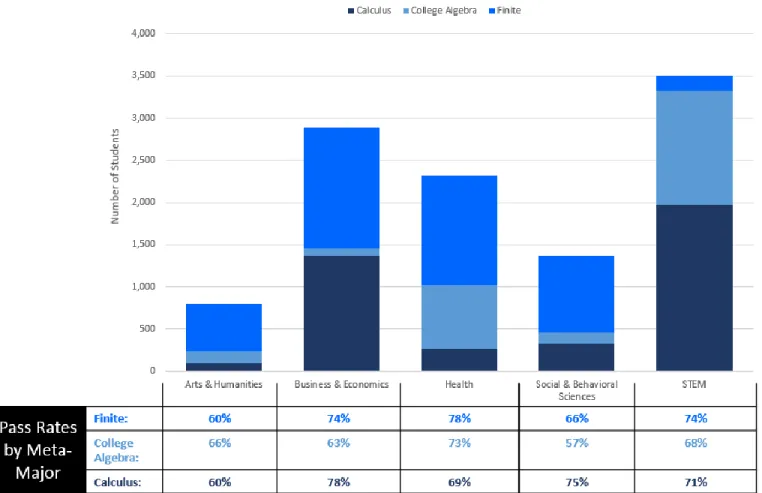
Each summer, as incoming college freshmen meet with their academic advisors and begin scheduling their first year of classes, many have been shepherded traditionally into an upper-level College Algebra or introductory-level Calculus course. According to data compiled from the state’s public postsecondary institutions, over 60% of students take either College Algebra or Calculus to fulfill their university’s mathematics requirement.21
The predominance of Algebra and Calculus in students’ first-year schedules begs an obvious question: why do these courses – with many notable exceptions, both in Indiana and nationwide – serve as the
20 See Lynn Arthur Steen’s illuminating and expansive set of examples in “The Case for Quantitative Literacy,” 9-15. 21 See Appendix for statewide and institutional-level data on math-taking patterns.
50 50 52.2 53.4 62.2 66.7 81.1 84.5 86.7 87.7 0 20 40 60 80 100 Intro to Logic Graph Theory Curve Fitting and Correlation Intro to Finance Proportional Reasoning Conditional Probability, Independence,…
Intro to Probability Intro to Statistics Data Analysis Logical and Critical Thinking
Indiana Math Pathways
14
to mathematics requirement for incoming students? Are students being required to take these courses or simply choosing to do so voluntarily?
To be sure, many students are required to take College Algebra or Calculus as their gateway
mathematics course – and likely the only they will ever take. However, evidence also suggests that many students who do not have to take Algebra or Calculus to fulfill their mathematics requirement still do so. Why are so many students opting for College Algebra or Calculus if they have another option? There are several possibilities. Students may arrive on campus having earned college-level credit in Algebra or Calculus through dual credit or Advanced Placement. They may be uncertain of their academic and career goals and want to take the course that is most likely to count toward any major. Some think that doing so will “keep the most doors open.” Others are steered into these courses as the result of advising or institutional conventions.
The problem with the current arrangement is this: neither College Algebra, taken on its own, imparts the kind of rich quantitative literacy that prepares students to lead thoughtful, informed lives.
The primary purpose of Algebra is to facilitate a progression into Calculus, and Calculus into upper-level mathematics coursework. These courses establish the analytic framework and basic problem solving techniques on which many advanced mathematics courses and other quantitative disciplines are based. Thus, for students aspiring to higher level coursework in mathematics and related fields – e.g.,
Economics, Chemistry, Engineering, Physics, Statistics – College Algebra and Calculus represent the first steps in a long line of mathematics (or math-heavy) courses that will cultivate a meaningful degree of quantitative literacy.
But for the many students who have no intention of pursuing such higher-level coursework, taking College Algebra does little to achieve quantitative literacy. These are discrete mathematical disciplines dealing primarily with the abstract manipulation of symbols. The kind of quantitative literacy envisioned by national and state leaders, by contrast, is inherently cross-disciplinary, a hybrid competency that deals primarily with real-world data and their applications. This is not to suggest that Algebra and Calculus do not foster worthwhile problem-solving faculties, but that a certain segment of the state’s college population would be better served by a different math course, one explicitly designed to develop the broad skills and competencies associated with quantitative literacy.
This points to a secondary challenge for implementing a new approach to mathematics. While it may be tempting for the Math Innovation Council to look solely at course requirements, the recommendations contained in this report also address advising protocols, degree maps, and other means by which students are steered into a particular course. If quantitative reasoning coursework is truly the best option for many students and majors, preferable to College Algebra or Calculus, strategies must be put in place to make it more likely that students register for that course – even if other options are available to allow for the application of AP and dual credit already earned.
Indiana Math Pathways
15
III.
Recommendations of the Math Innovation Council
Having determined that making quantitative reasoning the recommended gateway math course for many majors would better serve a sizeable segment of the undergraduate population, we turn to the question of who, exactly, falls into this segment. Framed another way: if quantitative reasoning is the default course, who needs a different kind of mathematics?
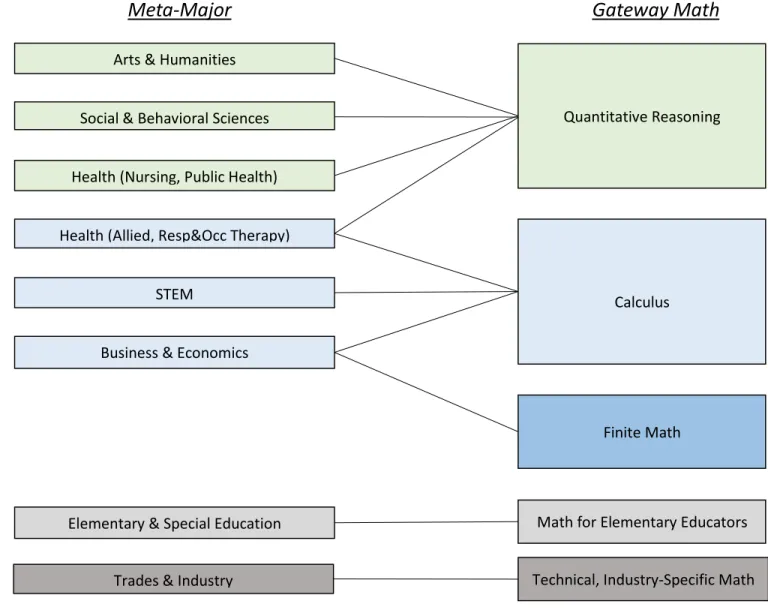
As part of its investigation into gateway math courses, the Math Innovation Council developed a set of “meta-majors” – clusters of related areas of study – to determine which gateway math course a student should take. For students pursuing degrees in the arts and humanities, social and behavioral sciences, and nursing and public health, quantitative reasoning is recommended to become the default instead of College Algebra.
Figure 3: Meta-Major List with Recommended Gateway Math Course
Technical, Industry-Specific Math Arts & Humanities
STEM
Math for Elementary Educators Finite Math
Health (Allied, Resp&Occ Therapy) Health (Nursing, Public Health)
Business & Economics Social & Behavioral Sciences
Trades & Industry Elementary & Special Education
Calculus
Quantitative Reasoning
Indiana Math Pathways
16
For the math-heavy meta-majors such as STEM and Business, this gateway course is often Calculus. While many students in these fields take College Algebra, they do so solely to prepare for Calculus and the College Algebra course does not fulfill a degree requirement. In essence, for students who must complete Calculus, their coursework in College Algebra is developmental. For students outside of such math-heavy programs, a quantitative reasoning course is prescribed, leaving no place for college-level Algebra in the list of recommended gateway courses.
The math pathways in figure 3 depict an ideal-state scenario, the end toward which Indiana’s public institutions are moving. Establishing quantitative reasoning as the default gateway math course
represents a paradigmatic shift on the part of these institutions – one that will require no small amount of time, planning, and patience. Administrators implementing this model might conceivably break down the process into three recommended phases, each of which is considered below.
Phase 1: Develop and Vet Quantitative Reasoning Courses by the Core Transfer Library Math Panel The first step in implementing the Council’s recommendations is to have the CTL Math Panel review the content and learning outcomes of Quantitative Reasoning courses that are currently being offered or are under development. The Panel should also review the content of courses currently being offered that contain significant elements of Quantitative Reasoning, although these courses are not titled Quantitative Reasoning. Taking into account the results of this analysis, as well as the work of the Council’s own subcommittee contained in Section IV of this report, the Panel should then reach consensus on the content and learning outcomes of courses that might reasonably be grouped in Indiana under the heading of Quantitative Reasoning, irrespective of what a particular institution chooses to call the course.
At this point, each institution should then review its own current or potential course offerings in light of the Math Panel’s consensus around Quantitative Reasoning and consider its response. After each institution has communicated its response to the Math Panel, the Panel, working with the Core Transfer Library Subcommittee of STAC, should then determine whether Quantitative Reasoning should be included in the Core Transfer Library.
Phase 2: Align Meta-Majors with Appropriate Gateway Math Course
The second component of implementation is to align majors to their appropriate gateway math course by modifying program requirements. Grouping majors by general topic, or “meta-major,” and then matching these meta-majors to the appropriate math course, is an important first step in this phase. Faculty are ultimately the best positioned to determine which majors should go where. Although there are bound to be discrepancies from one institution to the next – e.g., into which meta-major should Economics fall: Business, or Social & Behavioral Sciences? – this approach enables students to pursue the math course that is best suited to their general area of interest and ensure that those switching majors within a meta-major need not take a separate math course to fulfill the new major’s
requirements. Further, the more consensus Indiana reaches among its public institutions in how the foundational requirements for meta-majors are constructed, the greater assurance transfer students will have that their quantitative reasoning course will count toward degree requirements at the receiving institution.
Indiana Math Pathways
17
Phase 3: Professional Development, Change Management, and Advising
The third and final phase is focused on academic advising. Students will have more choices once these courses are developed, so it is critical that students are advised to take the appropriate course for their meta-major. Simply creating a general quantitative reasoning course will not ensure that the students for whom it is intended will enroll. It is just as crucial that academic advisors are trained to make the appropriate recommendation; more specifically, it is crucial that advisors treat quantitative reasoning – rather than College Algebra – as the default gateway mathematics course (save for students requiring Calculus or a specialized vocational course). The same holds for degree maps, which serve as a student advisor of sorts. Degree maps for meta-majors with quantitative reasoning as the preferred gateway course should present that course as the default.
Certainly some students will enter a meta-major with College Algebra or Calculus credits from dual credit, AP Calculus exams, or, in the case of students with rather dramatic shifts in academic focus (such as from STEM to the Humanities), from previous coursework. In such cases, it may be in the best interest of the student and his on-time graduation prospects to allow alternate mathematics courses to fulfill the major’s requirement. These cases should represent the exception to the default, leaving students who do not have these exceptional circumstances with a clear message through both degree maps and in-person advising that quantitative reasoning is the course they should take, not just one of their options. Besides administering significant curricular changes, institutions will need to provide additional training and information to advisors as they adapt to a new advising model – one that defies decades of
traditional practices. Arguably the most ingrained myth to do away with is the notion that College Algebra “keeps your doors open.” Repeated and reinforced over many years, this erroneous belief has achieved a staying power that will prove hard to shake. However, by educating students, training advisors, and simultaneously underscoring a different message – that quantitative reasoning is the true multi-purpose mathematics course – we can make meaningful progress toward changing student behavior and ushering in a new paradigm for college mathematics.
Indiana Math Pathways
18
IV.
Outcomes for Quantitative Reasoning Course
The Math Innovation Council convened a subcommittee whose charge was to identify learning objectives, course content, and other guidelines for institutions that will be developing a quantitative reasoning course.
Draft Outcomes for QR Course for Consideration by the Indiana Core Transfer Library Math Panel Course Philosophy
Students will interpret and communicate mathematical, statistical and quantitative information. This includes reading and interpreting authentic texts, written and oral critique and analysis, using mathematical language and symbols as appropriate, and using technology as appropriate. All course topics are modeled in context. Students will be engaged in open-ended questions, where multiple solutions and solution paths are possible, requiring analysis and synthesis of multiple calculations, data summaries and/or models. This includes justifying decisions or conclusions. Students will engage in productive struggle and deliberation with other students, with the support of the instructor. Students will use spreadsheets and other technology to support their analyses.
Required Course Content Descriptive Statistics:
Interpret, create and use displays of large, authentic data sets using appropriate technology. Calculate, interpret and compare various measures of central tendency and dispersion using appropriate
technology. Interpret correlations. Numbers in the Real World:
Use and misuse of ratios, percentages, rates, and absolute and relative change. Distinguish between proportional and non-proportional situations in real settings (examples may include conversion of units, scale factors in maps or blueprints, concentrations or dosages). Solve financial problems including interest rates, compound interest, mortgages, credit cards and savings. Interpret probabilities in a real world context (e.g., false positives and false negatives in tests) including the difference between theoretical and experimental probabilities. The focus is on making sense of the numbers (not computations).
Other optional topics as determined by the institution as long as they are taught in the spirit of the course.
Indiana Math Pathways
19
Appendix
The following institutional fact sheets have been created using data submitted by Indiana’s public institutions for Fall 2012 through Spring 2014 using meta-major designations that have been attached by Commission staff to the Academic Program Inventory (API).
Other math courses, as described in these profiles, are similar but not necessarily aligned with the course content or rigor of the Quantitative Reasoning course recommended in this report. Courses designated as “Other Math” for the purpose of these profiles include the following:
Applied Math Fundamentals (VU), Applied Mathematics (VU), Basic Mathematics (IUNW), Business Mathematics (VU), Communication with Statistics (IPFW), Consumer Mathematics (VU), Excursions in Mathematics (IUSE), Fundamentals of Mathematics (VU), Math for Business & Social Science (IUEA), Math for Liberal Arts (IPFW), Math Topics for Non-Majors (IUEA), Math Applications (BSU), Math for the
Humanities (IUEA), Mathematics in the World (IUSB), Math and Its Applications (VU), Quantitative Literacy (IUSE, ISU), Quantatitive Reasoning (Ivy Tech), Topics in Mathematics (IUKO), Topics in Probability and Statistics (IUKO)
Profiles exclude both the education meta-major and the Math for Educators course type. Math requirements are already aligned for this meta-major.
Profiles also exclude developmental algebra courses, which cannot serve as gateway courses, as well as statistics courses, which typically do not fulfill gateway math requirements.
“Pass Rate,” for the purpose of the table, represents the percentage of students who completed the course with a letter grade of C or better.
Indiana Math Pathways
20
Indiana Math Pathways
21
Indiana Math Pathways
22
Indiana Math Pathways
23
Indiana Math Pathways
24
Indiana Math Pathways
25
Indiana Math Pathways
26
Indiana Math Pathways
27
Indiana Math Pathways
28
Indiana Math Pathways
29
Indiana Math Pathways
30
Indiana Math Pathways
31
Indiana Math Pathways
32
Indiana Math Pathways
33
Indiana Math Pathways
34
Indiana Math Pathways
35
Indiana Math Pathways
36
Indiana Math Pathways
37