A Decoupled Scheduling Approach for
the GrADS Program Development Environment
Holly Dail*†, Henri Casanova*†and Fran Berman*†
*Department of Computer Science and Engineering University of California at San Diego
†San Diego Supercomputer Center University of California at San Diego
[hdail, casanova, berman]@sdsc.edu
Abstract—
Program development environments are instrumen-tal in providing users with easy and efficient access to parallel computing platforms. While a number of such environments have been widely accepted and used for traditional HPC systems, there are currently no widely used environments for Grid programming. The goal of the Grid Application Development Software (GrADS) project is to develop a coordinated set of tools, libraries and run-time execution facilities for Grid program de-velopment.
In this paper, we describe a Grid scheduler compo-nent that is integrated as part of the GrADS software system. Traditionally, application-level schedulers (e.g. AppLeS) have been tightly integrated with the tion itself and were not easily applied to other applica-tions. Our design is generic: we decouple the scheduler core (the search procedure) from the application-specific (e.g. application performance models) and platform-specific (e.g. collection of resource information) com-ponents used by the search procedure. We provide ex-perimental validation of our approach for two represen-tative regular, iterative parallel programs in a variety of real-world Grid testbeds. Our scheduler consistently outperforms static and user-driven scheduling methods.
This material is based upon work supported by the National Science Foundation under Grant #9975020.
SC2002, Baltimore Maryland.
0-7695-1524-X/02 $17.00 (c) 2002 IEEE
I. INTRODUCTION
With recent improvements in wide-area network performance and the pervasiveness of commodity re-sources, distributed parallel computing can benefit from an increasingly rich computational platform. However, as shown by many focused development ef-forts, taking advantage of these Computational Grid environments [13] requires extensive labor and support by distributed computing experts. Grid infrastructure projects such as Globus [12], Legion [16], and Con-dor [21] have greatly simplified the processes of appli-cation development and deployment on Computational Grids. However, since such middleware generally does not account for the specific needs of applications, ad-ditional measures are usually necessary before accept-able performance can be achieved. Today, applica-tion developers typically perform all transacapplica-tions that require specific knowledge of the application; such transactions may be performed by hand, or the devel-oper may build special-purpose, application-specific software. Examples of such transactions include se-lecting an appropriate subset of available resources, staging data and binaries on selected machines, and, for long-running applications, monitoring application progress. Hence, while many scientists could bene-fit from the extensive resources offered by Computa-tional Grids, application development remains a daunt-ing proposition.
The Grid Application Development Software Project (GrADS) [4] seeks to address these issues with a
com-prehensive application development system. The end goal is to integrate Grid-enabled libraries, application compilation, scheduling, staging of binaries and data, application launch, and monitoring of application ex-ecution progress. A key feature of this system is that application characteristics are recorded and/or discov-ered by components such as a specialized compiler and Grid-enabled libraries. These application characteris-tics are communicated via well-defined interfaces to components that provide program execution services (e.g. the scheduler). Through this interaction, com-ponents such as the scheduler can be general-purpose, while still providing services that are appropriate to the application at hand.
In this paper, we propose a scheduling approach de-signed for the GrADS environment. We address the problems of discovering available resources, selecting an application-appropriate subset of those resources, and mapping of data and/or tasks onto selected re-sources. Our scheduling approach focuses on mini-mizing the execution time of a single application exe-cution on a set of potentially shared resources. This ap-proach has been termed application-level scheduling. In Section II we compare application-level scheduling and meta-scheduling, a related scheduling approach that considers the performance of many applications at once to improve overall system performance.
Our scheduler design seeks flexibility through mod-ularity: our design explicitly decouples the scheduler core (the search procedure) from application-specific (e.g. performance models) and platform-specific (e.g. resource information collection) components used by the search procedure. We present a new schedule search procedure which is general-purpose and effec-tive at identifying desirable groups of resources. We describe this search procedure in detail, and show it to be efficient due to its low complexity. To provide application-appropriate scheduling, our approach de-pends on the availability of two application-specific components: a performance model (an analytic met-ric for the performance expected of the application on a given set of resources) and mapper (directives for mapping logical application data or tasks to physical resources). Other members of the GrADS project are developing methods for automatic generation of such
components and results to date are promising [18]. As this work matures, we hope to obtain such components automatically.
To validate our approach in the absence of such fa-cilities, we hand-built performance models and map-pers for two applications. As an initial validation, we tested our scheduler in a variety of scheduling sce-narios with these applications, several testbeds includ-ing both local-area and wide-area networks, problem sizes spanning a wide range of application require-ments, and different scenarios for resource information availability. In these experiments, our scheduler pro-vided significantly improved performance relative to a user-directed approach. These results indicate that our approach is a feasible solution to generic scheduling within GrADS.
This paper is organized as follows: Section II de-scribes related work, Section III dede-scribes the sched-uler design itself, Section IV presents the results we obtained when applying our methodology in real-world Computational Grid environments, and Sec-tion V contains a final discussion of the work.
II. RELATED WORK
The importance of application scheduling for the de-velopment and deployment of applications on Compu-tational Grids has been recognized for some time [3], and many successful strategies have been devel-oped; examples include the AppLeS Project [5], and application-specific schedulers developed within the GrADS project [22, 26]. These schedulers were gen-erally developed as prototypes to support research into application-level scheduling algorithms for specific applications; they were not general-purpose, public-domain schedulers that one could download and use.
With these goals in mind, two successful and pop-ular scheduler engineering strategies are to (1) bed scheduling logic in the application or (2) to em-bed application-specific information in the scheduler. As we have experienced with our previous AppLeS work [5, 9, 30, 31], in either case such schedulers are time-consuming to build and are not easily re-targeted for other applications or execution environments. In this paper, we explicitly decouple application-specific components from scheduling components; this
decou-pling provides a flexible scheduler which can be ap-plied to diverse applications and environments.
Condor Matchmaker [27], Nimrod/G [1], and two previous AppLeS efforts [6, 29] have each developed flexible, retargetable scheduling approaches. How-ever, the AppLeS and Nimrod/G schedulers targeted parallel master-slave applications and the Condor Matchmaker scheduler targets only single processor tasks which are scheduled independently. Our work does not restrict application type, but will likely pro-vide the largest performance advantage for loosely-synchronous, parallel applications.
Prophet [36, 35] is another run-time scheduling ef-fort which targeted heterogeneous systems and in-cluded parallel applications with inter-processor com-munications. The Prophet approach is similar to our work in that it exploits application structure and sys-tem resource information to promote application per-formance. However, Prophet requires the target appli-cation be written in the Mentat programming language and the approach has only been tested in local-area en-vironments. If possible, we would like to compare the performance of our strategy to those of Prophet, though it may be difficult to find a suitable scenario for comparison that satisfies the requirements of both strategies.
A number of projects [32, 15, 17, 34] have fo-cused on meta-scheduling: the optimization of some metric averaged over the performance of multiple ap-plications. Examples of such metrics include av-erage slow down, wait time, and system through-put. Meta-scheduler designs often employ a three phase approach: (1) application-level schedulers are used to determine schedules for each application, and (2) the meta-scheduler evaluates the performance of multiple applications in the system, and then (3) the meta-scheduler modifies the application-specific schedules to improve overall system performance. Our application-level scheduling approach could be paired with such a meta-scheduling approach; we plan to do so for a meta-scheduler under development for the GrADS framework [34].
III. SCHEDULING
This section describes our scheduling approach. To provide context for this description, we first detail the scheduling scenario we address. A user has an appli-cation and wishes to execute that appliappli-cation on Com-putational Grid resources. The application is parallel and may involve significant inter-process communica-tion. The target Computational Grid consists of het-erogeneous workstations connected by LANs and/or WANs. When the user is ready to run the application, the scheduler is contacted. The scheduler retrieves re-source, application, and user information; searches for a desirable subset of available resources; calculates a mapping of data and/or tasks to those resources; and then returns the “best” such schedule. “Best” is de-fined by some performance metric; in this paper we assume that metric is the lowest estimated application execution time. Finally, the application is launched on the selected resources and is allowed to run to comple-tion. Rescheduling will be added through additional efforts in the GrADS collaboration.
A. Architecture
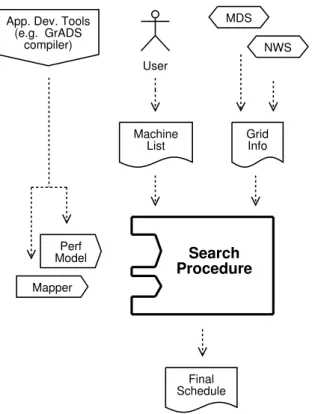
Figure 1 presents the primary components of our scheduler and the interactions among those compo-nents. The goal of our design is to decouple the core algorithms required for the scheduling process (the search procedure) and the components and informa-tion required by those algorithms (all other compo-nents in Figure 1).
To initiate an application-run, the user submits a machine list containing the names of all machines available to him or her. For each machine in this machine list, the scheduler collects resource informa-tion such as CPU speed, available physical memory, and bandwidth between hosts. This information is re-trieved from resource information providers such as the Network Weather System (NWS) and the Meta-computing Directory Service (MDS); we discuss these services in Section III-C. Our approach requires an application-specific performance model and mapper, which we expect ultimately to obtain from applica-tion development tools such as the GrADS compiler. The performance model is an analytic metric for pre-dicting application execution times on a given set of
Final Schedule Grid Info Machine List Mapper Perf Model User NWS MDS Search Procedure App. Dev. Tools
(e.g. GrADS compiler)
Fig. 1. Scheduler design.
resources with a given map. The mapper provides directives for mapping logical application data and/or tasks to physical resources; the goal of the mapper is to develop a map which minimizes application execu-tion time. This mapping process may include work-load balancing and / or arrangement of processors in a communication topology to reduce communication costs.
A schedule consists of an ordered list of machines and a mapping of data and / or tasks to those machines. The search procedure selects the “best” schedule and returns it as the Final Schedule. In the next section, we describe the schedule search process in detail.
B. Search procedure
To find good schedules, the search procedure first identifies groups of machines with both of the follow-ing qualities: (1) desirable individual machine charac-teristics and (2) desirable characcharac-teristics as an aggre-gate. For example, such groups would ideally be com-posed of computationally fast machines (an individual
characteristic) and those machines would be connected by low-delay networks (an aggregate characteristic). We call such groups of machines candidate machine groups (CMGs).
The most straightforward approach for the search for CMGs is an exhaustive search over all possible groups of machines. For a machine list with p ma-chines, an exhaustive search will identify 2p CMGs. For many testbed sizes of interest (dozens of ma-chines), such a search will introduce unacceptable scheduling overheads and is therefore not a feasible solution. However, if the scheduler is going to provide reasonable application performance, it must identify CMGs that are reasonable for the application. There-fore, our search procedure uses extensive but careful pruning of the search space.
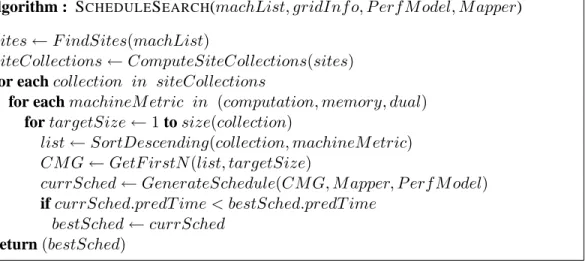
Pseudo-code for our schedule search procedure is given in Figure 2. In each for loop the list of target CMGs is refined based on a different resource set char-acteristic: connectivity in the outer-most loop, compu-tational and memory capacity of individual machines in the second loop, and selection of an appropriate re-source set size in the inner-most loop. The goal is to generate only a moderate number of CMGs while ensuring that we do not exclude performance-efficient CMGs.
The first step of our search procedure is to call the FindSites method; this method takes a list of machines and organizes them into disjoint subsets, or sites, such that the network delays within each subset are lower than the network delays between subsets. As a first im-plementation, we group machines into the same site if they share the same domain name; we plan to consider more sophisticated approaches [28, 24] in future work. The ComputeSiteCollections method computes the power set of the set of sites (we exclude the null set). As an example, for the set of sites{A,B,C}, there are seven site collections: {A,B,C,A∪ B,A∪ C,B ∪ C, A ∪ B ∪ C}. Once all machine collections have been identified, the outer-most loop of the search pro-cedure examines each one in turn.
In the middle loop of the search procedure, we seek to identify machines that exhibit high local memory and computational capacities. Generally we will not know a priori which machine characteristic will have
Algorithm : SCHEDULESEARCH(machList, gridInf o, P erf M odel, M apper) sites←F indSites(machList)
siteCollections←ComputeSiteCollections(sites)
for eachcollection in siteCollections
for eachmachineM etric in (computation, memory, dual) fortargetSize←1tosize(collection)
list←SortDescending(collection, machineM etric)
CM G←GetF irstN(list, targetSize)
currSched←GenerateSchedule(CM G, M apper, P erf M odel)
ifcurrSched.predT ime < bestSched.predT ime bestSched←currSched
return(bestSched)
Fig. 2. Schedule search procedure.
the greatest impact on application performance; we therefore define three metrics that are used to sort the machine list: the computation metric emphasizes the computational capacity of machines, the memory
metric emphasizes the local memory capacity of
ma-chines, and the dual metric places equal weight on each factor.
The inner-most loop exhaustively searches for an appropriately-sized resource group. Resource set size selection is complex because it depends on problem parameters, application characteristics, and detailed resource characteristics. Rather than miss potentially good resource set sizes based on poor predictions, we include all resource set sizes in the search. Note that an exhaustive search at this level of the procedure is only feasible due to the extensive pruning performed in the first two loops. The SortDescending method sorts the input machine list collection by the machine character-istic machineMetric in descending order (the most de-sirable machines will be first). The GetFirstN method call simply returns the first targetSize machines from the sorted list.
A key aspect of our approach is that no
application-specific characteristics or components have been in-volved in the search procedure to this point. We have
simply generated a large number of CMGs that could be of interest to applications in general.
Next, to evaluate each CMG, the GenerateSched-ule method (1) uses the Mapper to develop a data mapping for the input CMG, (2) uses the Performance
model to predict the execution time for the given
schedule (predtime), and (3) returns a schedule struc-ture which contains the CMG, the map, and the pre-dicted time. Finally, schedules are compared to find the schedule with the minimum predicted execution time; this schedule is returned as the bestSched.
Given a base machine list of size p withs distinct sites, the upper bound on the number of CMGs that must be evaluated by our search procedure is 3p2s; see [8] for details of this bound development. An ex-haustive search requires evaluation of 2p CMGs. As long as the number of sites is significantly smaller than the number of resources (universally true in produc-tion Computaproduc-tional Grids today), then our search pro-cedure greatly reduces search space as compared to an exhaustive search.
C. Use of Grid information
Computational Grids are highly dynamic environ-ments where compute and network resource availabil-ity varies and Grid information sources can be period-ically unavailable. We strive to provide best-effort ser-vice by supporting multiple information sources, when possible, for each type of information required by the
scheduler.
We currently support information collection from the two most widely used Grid resource infor-mation systems, the Metacomputing Directory Ser-vice (MDS) [7] and the Network Weather SerSer-vice (NWS) [37]. The MDS is a Grid information man-agement system that is used to collect and publish system configuration, capability, and status informa-tion. Examples of the information that can typically be retrieved from an MDS server include operating system, processor type and speed, number of CPUs available, and software availability and installation lo-cations. The NWS is a distributed monitoring sys-tem designed to track and forecast resource conditions. Examples of the information that can typically be re-trieved from an NWS server include the fraction of CPU available to a newly started process, the amount of memory that is currently unused, and the bandwidth with which data can be sent to a remote host.
Our scheduling methodology utilizes several types of resource information: a list of machines available for the run, local computational and memory capac-ities for each machine, and network bandwidth and latency information. The list of machines is cur-rently obtained directly from the user; versions of the MDS which support secure publishing mechanisms have been released recently and we plan to experiment with obtaining the list of machines from the MDS. Lo-cal machine computational and memory capacity data are used to sort machines in our search procedure and will be needed as input to typical performance model and mapper implementations. Network bandwidth and latency data will similarly be required as input to typi-cal performance model and mapper implementations.
Our use of static and dynamic Grid information is based upon the successes of previous application-level schedulers in using such information [9, 31, 6]. An important distinction between this work and many pre-vious efforts is that the scheduler gracefully copes with degraded Grid information availability. Whenever possible, we support more than one source for each type of resource information required by the scheduler. Furthermore, when a particular type of information is not available for specific machines in the machine list, but is required by the scheduler, the scheduler excludes
those machines from the search process. In our expe-rience, most application schedulers do not gracefully handle such situations, leading to frequent scheduler failures.
IV. VALIDATION
In this section, we present validation results which investigate the following questions about our sched-uler.
i. Does our scheduling approach provide flexibility
and ease of use? As shown by a large base of
soft-ware engineering research, these are difficult qualities to demonstrate; while we do not expect to prove such qualities, we hope to provide evidence that they are true. We incorporate a large variety of scheduling sce-narios in our experiments including a span of applica-tions, testbeds, resource information availabilities, and problem sizes. Each of these scenarios was easily han-dled by our scheduler with only minor modifications to a configuration file.
ii. Does the scheduler provide reduced application
execution times relative to user-directed schedul-ing approaches? Our previous AppLeS efforts [5] have shown that special-purpose application-level schedulers consistently outperform user-directed ap-proaches. We compare our scheduling strategy against a user-directed strategy to test whether this impor-tant characteristic holds for our decoupled approach as well.
A. Validation scenarios
In this section we describe the variety of scheduling scenarios in which we test our scheduling strategy.
Applications – As initial test cases for our sched-uler design, we selected two iterative, mesh-based ap-plications [14]: Jacobi [2] and Game of Life [10]. We plan to test more complex applications in future work; we chose these applications as our initial test cases because they are well-known and representative of many important iterative, data-parallel science and engineering codes. Additionally, these applications includes significant communication and synchroniza-tion and are therefore significant test cases for capa-bilities of our scheduling approach. We implemented each application as a SPMD-style computation using
C and MPI. For execution over the wide-area, we used MPICH-G [11]. Jacobi and the Game of Life are each dominated by an iterative application phase involving repeated application of a set of operations over a 2-dimensional array of data. We consider only square data sets and refer to problem size as N, the size of each dimension.
As described in Section III, our approach utilizes an application-specific performance model and map-per to assist the schedule search procedure. To test our approach, we hand-built a performance model and mapper for each test application. Conceptually similar models and mappers have been integrated within our previous AppLeS schedulers [9, 5]. Our performance models are procedural and use simple models of com-putation and communication to predict application it-eration times. Our mappers search for a data map whereby the machines in the computation are as time-balanced as possible; in an ideal data map, no machine is ever idle during application execution. We frame work-allocation constraints as a constrained optimiza-tion problem and we use the freely availablelp solve package [23] to solve it. Our mappers also re-arrange machine ordering to limit wide-area communication costs. For details on these designs the interested reader is referred to [8].
Testbeds – Our experiments were performed on a subset of the GrADS testbed composed of worksta-tions at the University of Tennessee, Knoxville (UTK), the University of Illinois, Urbana-Champaign (UIUC), and the University of California, San Diego (UCSD). AtUTKand atUCSDthe resources we targeted were on a single LAN. AtUIUC, we targeted two distinct re-source groups: the Opus cluster and the Major cluster. Figure 3 depicts a snapshot of our testbed and Table 1 summarizes testbed resource characteristics. This col-lection of resources is typical of Computational Grids: it is used by many users for an array of purposes on an everyday basis, the resources fall under a variety of administrative domains, and the testbed is both dis-tributed and heterogeneous.
Experiments were performed on the full three-site testbed with all 24 machines available to the sched-uler, and on a one-site testbed with only 6UCSD ma-chines available to the scheduler.
UTK LAN 83.8 Mbps UIUC-M LAN 88.6 Mbps UCSD LAN 90.8 Mbps 4.4 Mbps 2.7 Mbps 3.0 Mbps 1.5 Mbps 6.0 Mbps 5.9Mbps WAN UIUC-O LAN 88.6 Mbps
Fig. 3. A snapshot of testbed resources. Network links are labeled with available bandwidth in megabits per sec-ond; these values were collected on November 1, 2001 at 5:30 PM by Network Weather Service sensors.
Problem sizes – We ran experiments on the one-site testbed with problem sizes of N = {600, 1200, 2400, 4800, 7200, 9600}and on the three-site testbed with N ={600, 4800, 9600, 14400, 16800, 19200}. We selected these sizes to exercise the scheduler for a wide range of application behavior and resource re-quirements. For example, aggregate application mem-ory requirements for these sizes range from 3 MB for N = 600 to 3375 MB forN = 19200.
Availability of resource information – We also tested the capacity of the scheduler to function with de-graded resource information availability. Specifically, we perform experiments where dynamic resource in-formation is available to the scheduler at run-time (e.g., NWS is “up”) and where dynamic information is not available at run-time (e.g., NWS is “down”).
B. Experimental procedure
The basis of our experiments is a comparison of the performance achieved by three scheduling strategies. i. The dynamic strategy uses our scheduler, schedul-ing decisions are made at run-time, and the sched-uler uses both dynamic resource information from the NWS (CPU availability, free memory, and avail-able bandwidth) and static information from the MDS (CPU speed).
Circus machines Torc machines Opus machines Major machines
Domain ucsd.edu cs.utk.edu cs.uiuc.edu cs.uiuc.edu
Nodes 6 8 4 6
Names dralion, mystere torc1, torc2 opus13-m amajor, bmajor
soleil, quidam torc3, torc4 opus14-m cmajor, fmajor
saltimbanco torc5, torc6 opus15-m gmajor, hmajor
nouba torc7, torc8 opus16-m
Processor 450 MHz PIII 550 MHz PIII 450 MHz PII 266 PII dralion, nouba
400 MHz PII others
CPUs/Node 1 2 1 1
Memory/Node 256 MB 512 MB 256 MB 128 MB
OS Debian Linux Red Hat Linux Red Hat Linux Red Hat Linux
Kernel 2.2.19 2.2.15 SMP 2.2.16 2.2.19
Network 100 Mbps 100 Mbps 100 Mbps 100 Mbps
shared ethernet switched ethernet switched ethernet shared ethernet
Table 1. Summary of testbed resource characteristics.
ii. The static strategy also uses our scheduler, but scheduling decisions are made off-line and employ pri-marily static resource information.
iii. The user strategy is designed to emulate the scheduling process that a typical Grid user might em-ploy. We assume that users will generally only in-vest time in scheduling once per application config-uration; static resource information is therefore suf-ficient since scheduling occurs off-line. We also as-sume that users have a preferred ordering of resources; for example, most users will utilize their “home” re-sources before rere-sources on which they are a “guest”. For the three-site testbed, we assume a resource or-dering of {UCSD, UTK,UIUC}. We assume a typ-ical user will not have a detailed performance model, but may be able to estimate application memory usage. The strategy therefore selects the minimum number of resources that will satisfy application memory require-ments.
Comparison of our scheduler against the perfor-mance achieved by an automated, run-time scheduler would clearly be a desirable addition. Unfortunately, there is currently no comparable Grid scheduler that is effective for the applications and environments that we target. We described other Grid scheduler efforts
in Section II; we plan to investigate these and other applications and environments for which a reasonable scheduler comparison could be made.
A scheduling strategy comparison experiment consists of back-to-back runs of the three schedulers. In each application execution, 104 iterations were per-formed; an average and standard deviation of the iter-ation times was then taken of all but the first 4 “warm up” iterations. Based on the characteristics of iterative, mesh-based applications, we compare application per-formance based on the worst average iteration time re-ported by any processor in the computation. To avoid undesirable interactions between each application ex-ecution and the dynamic information used by the next scheduler test, we included a three-minute sleep phase between tests.
We selected experiments to run with the goals of ob-taining (1) a broad survey of the performance of the scheduling strategies in many different scenarios and (2) statistically significant results. We ran scheduling strategy comparison experiments for all combinations of the two applications, the two testbeds, and six prob-lem sizes (for a total of 2*2*6 = 24 testing scenarios). We performed 10 repetitions of each testing scenario for a total of 240 comparison experiments involving
720 scheduling strategy tests.
Strategy comparisons. We use a common com-parison metric for comcom-parisons of scheduling strate-gies, percent degradation from best [20]. For each experiment we find the lowest average iteration time achieved by any of the strategies, itT imebest, and
compute
degF romBest= 100∗ itT ime−itT imebest itT imebest , for each strategy. The strategy that achieved the mini-mum iteration time is thus assigneddegF romBest=
0. Note that an optimal scheduler would consistently achieve a 0% degradation from best.
C. Aggregate results
Figure 4 presents the average of the percent degra-dation from best achieved by each scheduling strat-egy across all scheduling stratstrat-egy comparison exper-iments. Each bar in the graph represents an aver-age of approximately 70 values. Table 2 presents additional statistics for the same data set. In all application-testbed combinations, the user strategy is outperformed, on average, by the other strategies. This result verifies that our scheduler does provide consis-tently improved application performance relative to a user-directed strategy, thus answering question ii in the affirmative. In addition to good performance on aver-age, our approach performed well across the variety of scenarios tested in these results. For example, notice the Avg and Std lines in Table 2; the dynamic strat-egy shows a low standard deviation in performance for all four application-testbed combinations. In three of the application-testbed scenarios, the user strategy is never the best strategy (i.e. the Min statistic is greater than 0). These results provide evidence for answering
question i: our approach seems flexible and
applica-ble to a range of scenarios. These experiments also demonstrate that our strategy benefits greatly from the availability of dynamic resource information (i.e. the dynamic strategy consistently outperforms the static strategy), but, when such information is not available, our approach still provides a performance advantage
relative to a user-directed approach (i.e. the static strat-egy consistently outperforms the user stratstrat-egy).
0 100 200 300 400
Percent degradation from best
Game of Life Game of Life Jacobi Jacobi One−site Three−site One−site Three−site
User Static Dynamic
Fig. 4. Average percent degradation from best for each scheduling strategy and each application-testbed com-bination.
D. Case study
We detail experimental results for the Jacobi appli-cation on the three-site testbed with a problem size of 16800. We performed 10 repetitions of this experiment over a period from 10/16/2001 - 11/10/2001. Specifi-cally, we collected reps 1-3 on October 16-17, reps 4-6 on November 6-7, and reps 7-10 on November 9-10.
Figure 5 presents average iteration times for each scheduling strategy for each of the 10 repetitions; er-rorbars represent the standard deviation of iteration times. No times are reported for the user strategy in the ninth repetition because the application failed to com-plete in this run. The dynamic strategy yields more consistent iteration times (smaller errorbars) and leads to more consistent performance across experiment rep-etitions (between 2 and 3 seconds in each of the 10 repetitions).
Figure 6 shows the number of processors selected from each site for each of the scheduling strategies. Since the user and static strategies are run only once per scheduling scenario, only one resource group is displayed. For the dynamic strategy, processor se-lection occurs at run-time so we display each of the 10 resource groups selected. We did not have space here to display the exact processor selections, but the static and dynamic strategies do differentiate among
Game of Life - 1 site Game of Life - 3 site Jacobi - 1 site Jacobi - 3 site
User Stat Dyn User Stat Dyn User Stat Dyn User Stat Dyn
Avg 240.0 37.3 5.1 381.9 30.8 3.8 210.3 17.2 5.7 410.3 61.3 12.7
Std 152.0 40.4 12.9 466.6 63.3 10.7 130.6 28.2 12.6 212.7 145.8 40.6
Min 7.7 0 0 45.3 0 0 16.4 0 0 0 0 0
Max 507.7 156.9 69.3 2748.0 421.8 68.5 466.4 90.5 69.7 862.9 739.2 215.1
Table 2. Summary statistics for percent degradation from best for each scheduling strategy over all application-testbed scenarios. 1 2 3 4 5 6 7 8 9 10 0 10 20 30
Iteration Times (sec)
Repetition
user static dyn.
Fig. 5. Average and standard deviation in iteration times for the Jacobi application on the three-site testbed, problem size of 16800. UTK UIUC−M UIUC−O UCSD 6 6 5 4 6 6 4 6 6 4 6 6 4 6 8 7 7 8 6 4 6 8 8
User Stat Dyn1 Dyn2 Dyn3 Dyn4 Dyn5 Dyn6 Dyn7 Dyn8 Dyn9 Dyn10
Fig. 6. Processor selections for each scheduling strategy for the Jacobi application on the three-site testbed, problem size of 16800.
resources within each site based on computational and memory capacities.
For the user strategy we see that processor selection followed the preference ordering of {UCSD, UTK, UIUC} and that, given this list of resources, 12 pro-cessors were required to fulfill application memory re-quirements for this problem size. Note that the number of resources required will vary with the memory ca-pacities of the resources. The static strategy selected 15 processors, taken from the UCSD and UIUC re-sources. Given that UTK offers the most powerful in-dividual resources (refer to Table 1), it may seem sur-prising that UTK resources were not included by this strategy. However, the Jacobi application involves sig-nificant communication costs and the bandwidth be-tween UTK and either of the other sites tends to be sig-nificantly lower than that between UCSD and UIUC. Given these conditions, the static strategy avoided these high-delay links and determined that the most performance efficient resource set included resources from UCSD and UIUC. For the dynamic strategy, re-source selection decisions are made at run-time and involve dynamic bandwidth, CPU, and memory avail-ability estimates. In repetitions 1, 2, 3, and 8 this strat-egy predicted that a UCSD+UIUC resource set would prove most performance efficient, in agreement with the choice of the static strategy. In the other repeti-tions, the dynamic strategy predicted that the smaller, more tightly coupled resource group of only UTK resources would be more performance efficient. In all cases the strategy avoided schedules spanning the UTK-UIUC and UTK-UCSD links. Although the dy-namic strategy utilized a varying resource group across the 10 repetitions, it was the strategy with the most consistent iteration times. Run-time scheduling al-lowed this strategy to avoid loaded networks and sys-tems, thus providing the user of the scheduler with more consistent performance.
E. Scheduling overheads
The performance metrics we reported in this paper do not incorporate the cost of the scheduling process itself. The scheduling process is dominated by two phases: resource information retrieval and the sched-ule search process itself. In each test, we measured
the time required for collection of resource informa-tion and the time required for the search procedure it-self. We performed 10 repetitions of each test and cal-culated an average. All tests were performed with the full 24-machine three-site testbed; we expect that over-head times will be higher for larger sets of machines and lower for smaller sets.
All tests were performed from a 450 MHz Pentium III shared workstation located in San Diego, Califor-nia. Since our approach can be used in a variety of scenarios, we measured scheduling overheads for sev-eral different information service configurations. We utilized the following servers for these configurations. i. A remote MDS server - the GrADS MDS server lo-cated in Los Angeles, California.
ii. A remote NWS server - the GrADS NWS server, which was located in Knoxville, Tennessee during these experiments.
iii. A local MDS cache - a file-based cache of MDS data located on the experiment machine in San Diego. iv. A local NWS server - an NWS server located on the experiment machine in San Diego.
For all experiments reported in earlier sections of this paper, we utilized an NWS nameserver and an MDS cache which were local to the scheduler. In these conditions, collection of resource information required an average of 2.0 seconds and the search procedure re-quired an average of 2.5 seconds. In total, a scheduling time of 4.5 seconds is reasonable relative to execution times for applications of even moderate problem size. When the same experiments were performed with a re-mote NWS nameserver, resource information retrieval required an average of 59.6 seconds (62.4 seconds overall for scheduling). When both a remote NWS nameserver and a remote MDS server were used, infor-mation retrieval required an average of 1087.5 seconds (1088.4 seconds overall for scheduling). We assume that a Grid user will probably be willing to wait 60 seconds for scheduling, but will probably not be will-ing to wait 1000 seconds. These results indicate that, given the technologies available at the time of these ex-periments, our scheduling approach may be used with either a local or a remote NWS server, but is only fea-sible when used with a local MDS cache. Newer ver-sions of the NWS and MDS have been released since
these experiments were conducted; reports indicate the new versions are more efficient than those reported on here. We plan to repeat these experiments with the newer technologies.
V. DISCUSSION
A. Scope of the work
Our scheduling approach can be expected to provide the largest performance advantage under the following conditions.
i. Dynamic and/or static resource information is avail-able for the target testbed. While we attempt to func-tion despite poor resource informafunc-tion, our approach will be most effective when resource information is available.
ii. An application performance model and mapping strategies are already available or can be easily cre-ated. These components need not be sophisticated or precise, but the advantage provided by the scheduler will vary with the quality of application information available to it.
iii. We have focused on shared Computational Grid environments that do not include dedicated machines or batch schedulers (e.g. the GrADS testbed). Hence, in this work we do not focus on issues such a co-scheduling and advanced reservation.
iv. Our strategy is most effective for applications that have ”moderate” computation to communication ratios (e.g. loosely synchronous applications). By compari-son, synchronous applications perform well only on clusters or supercomputers with high-performance net-works, and embarrassingly parallel applications can be easily scheduled via other schedulers [1, 6, 27].
B. Future Work
We plan to extend our validation to other appli-cations from a range of application classes. As de-scribed in Section II, work has begun on a GrADS meta-scheduler [34]; we plan to investigate ways in which application-level and system-level schedulers can coordinate to balance application and system per-formance. As part of this effort, we also plan to test our approach for performance metrics other than execution time and extend our approach, if necessary. Finally, other members of the GrADS research community are
investigating the feasibility of compiler generation of application information and performance models [18], as well as the inclusion of such models in Grid-enabled libraries [18, 25]. As this work matures, we expect to use such models for application scheduling.
C. Conclusions
In this paper we presented a decoupled scheduling approach for parallel applications in Computational Grid environments. Our approach explicitly decouples a general schedule search procedure from components and information specific to the application and execu-tion environment. We tested our software prototype for a wide range of scheduling scenarios on real-world Computational Grids. These experiments showed that i. our approach reduces application execution times as compared to user-directed scheduling approaches; and ii. our scheduler successfully exploits dynamic re-source information when it is available, and can grace-fully tolerate lack of such information.
In recent collaborative work with GrADS re-searchers at Rice and UTK, we have developed APIs for component interactions within the GrADS system, including interactions with the scheduler described herein. We have also integrated our software prototype into the main GrADS software base [19]. In conjunc-tion with this effort, a researcher from UTK applied our scheduler prototype to the ScaLAPACK applica-tion in less than 2 days, and found that the scheduler worked well for that application [33]; as our prototype improves, we expect this time to decrease. In our pre-vious AppLeS work, schedulers were fundamentally tied to the application itself, and therefore could not be re-used for other applications without significant adap-tation time.
These results support and extend the results of previ-ous application-level scheduling efforts within the Ap-pLeS project [5]. In the context of application-level scheduling in general, our results are particularly no-table because they were not obtained with a special-purpose, application-specific scheduler. Instead, these results were obtained with a decoupled scheduler de-sign that is easy to apply in a variety of scheduling scenarios.
VI. ACKNOWLEDGMENTS
This work benefited greatly from collaborations with the GrADS team. We especially thank the In-novative Computing Laboratory at UTK and the Pablo group at UIUC for allowing us to run experiments on their resources. We thank Otto Sievert and Renata Teixeira for their insightful comments on previous ver-sions of this manuscript. Finally, we thank the review-ers whose suggestions have greatly improved the final paper.
REFERENCES
[1] ABRAMSON, D., GIDDY, J.,ANDKOTLER, L. High per-formance parametric modeling with Nimrod/G: Killer appli-cation for the global Grid? In International Parallel and Distributed Processing Symposium (May 2000).
[2] BARRETT, R., BERRY, M. W., CHAN, T. F., DEMMEL, J., DONATO, J., DONGARRA, J., EIJKHOUT, V., POZO, R., ROMINE, C.,AND VAN DERVORST, H. Templates for the Solution of Linear Systems: Building Blocks for Iterative Methods, 2nd Edition. SIAM, Philadelphia, PA, 1994. [3] BERMAN, F. The Grid: Blueprint for a New Computing
Infrastructure. Morgan Kaufmann Publishers, Inc., 1999, ch. 12: High-Performance Schedulers, pp. 279–309. [4] BERMAN, F., CHIEN, A., COOPER, K., DONGARRA, J.,
FOSTER, I., GANNON, D., JOHNSSON, L., KENNEDY, K., KESSELMAN, C., MELLOR-CRUMMEY, J., REED, D., TORCZON, L.,ANDWOLSKI, R. The GrADS Project: Soft-ware support for high-level Grid application development. International Journal of Supercomputer Applications 15, 4 (2001), 327–344. To appear.
[5] BERMAN, F., WOLSKI, R., FIGUEIRA, S., SCHOPF, J., ANDSHAO, G. Application level scheduling on distributed heterogeneous networks. In Proceedings of Supercomputing (November 1996).
[6] CASANOVA, H., OBERTELLI, G., BERMAN, F.,ANDWOL -SKI, R. The AppLeS Parameter Sweep Template: User-level middleware for the Grid. In Proceedings of Supercomputing (November 2000).
[7] CZAJKOWSKI, K., FITZGERALD, S., FOSTER, I., AND KESSELMAN, C. Grid information services for distributed resource sharing. In Proceedings of the 10th IEEE Sympo-sium on High-Performance Distributed Computing (August 2001).
[8] DAIL, H. A modular framework for adaptive scheduling in grid application development environments. Master’s thesis, University of California at San Diego, March 2002. Avail-able as UCSD Tech. Report CS2002-0698.
[9] DAIL, H., OBERTELLI, G., BERMAN, F., WOLSKI, R., AND GRIMSHAW, A. Application-aware scheduling of a magnetohydrodynamics application in the Legion Metasys-tem. In Proceedings of the 9th Heterogenous Computing Workshop (May 2000).
[10] FLAKE, G. W. The Computational Beauty of Nature: Com-puter Explorations of Fractals, Chaos, Complex Systems, and Adaptation. MIT Press, Cambridge, MA, 1998. [11] FOSTER, I., GEISLER, J., GROPP, W., KARONIS, N.,
LUSK, E., THIRUVATHUKAL, G.,ANDTUECKE, S. Wide-area implementation of the Message Passing Interface. Par-allel Computing 24, 12 (1998), 1735–1749.
[12] FOSTER, I.,ANDKESSELMAN, C. The Globus Project: A status report. In Proceedings of the 7th Heterogeneous Com-puting Workshop (1998).
[13] FOSTER, I., AND KESSELMAN, C., Eds. The Grid: Blueprint for a New Computing Infrastructure. Morgan Kaufmann Publishers, Inc., 1999.
[14] FOX, G. C., WILLIAMS, R. D.,ANDMESSINA, P. C. Par-allel Computing Works! Morgan Kaufmann, San Francisco, CA, 1994. Available athttp://www.npac.syr.edu/ pcw.
[15] GEHRING, J., AND PREISS, T. Scheduling a metacom-puter with uncooperative sub-schedulers. In Proceedings of JSSPP’99 (1999), pp. 179–201.
[16] GRIMSHAW, A., FERRARI, A., KNABE, F., AND HUMPHREY, M. Wide-Area Computing: Resource sharing on a large scale. IEEE Computer 32, 5 (May 1999), 29–37. [17] HAMSCHER, V., SCHWIEGELSHOHN, U., STRIET, A.,
ANDYAHYAPOUR, R. Evaluation of job-scheduling strate-gies for grid computing. In Proceedings of Grid’00 (2000), pp. 191–202.
[18] KENNEDY, K., BROOM, B., COOPER, K., DONGARRA, J., FOWLER, R., GANNON, D., JOHNSSON, L., MELLOR -CRUMMEY, J.,ANDTORCZON, L. Telescoping languages: A strategy for automatic generation of scientific problem-solving systems from annotated libraries. Journal of Parallel and Distributed Computing 61, 12 (2001), 1803–1826. [19] KENNEDY, K., MAZINA, M., AYDT, R., MENDES, C.,
DAIL, H., ANDSIEVERT, O. GrADSoft and its Applica-tion Manager: An execuApplica-tion mechanism for Grid applica-tions. GrADS Project Working Document V, available at http://hipersoft.cs.rice.edu/grads/ publications_reports.htm, Oct 2001.
[20] KWOK, Y.-K., ANDAHMAD, I. Benchmarking and com-parison of the task graph scheduling algorithms. Journal of Parallel and Distributed Computing 59, 3 (1999), 381–422. [21] LITZKOW, M. J., LIVNY, M., AND MUTKA, M. W.
Condor—a hunter of idle workstations. In Proceedings of the 8th International Conference on Distributed Computing Systems (June 1988).
[22] LIU, C., YANG, L., FOSTER, I.,ANDANGULO, D. Design and evaluation of a resource selection framework for Grid applications. In Proceedings of the 11th IEEE Symposium on High-Performance Distributed Computing (July 2002). To appear.
[23] lp solve FTP site at
ftp://ftp.es.ele.tue.nl/pub/lp_solve. [24] MILLER, N.,ANDSTEENKISTE, P. Collecting network
sta-tus information for network-aware applications. In INFO-COM’00 (March 2000).
[25] MIRKOVIC, D., MAHASOOM, R.,ANDJOHNSSON, L. An adaptive software library for fast fourier transforms. In Pro-ceedings of the 2000 International Conference on Supercom-puting (2000).
[26] PETITET, A., BLACKFORD, S., DONGARRA, J., ELLIS, B., FAGG, G., ROCHE, K.,ANDVADHIYAR, S. Numerical li-braries and the Grid. International Journal of High Perfor-mance Computing Applications 15, 4 (2001), 359–374. To appear.
[27] RAMAN, R., LIVNY, M.,ANDSOLOMON, M. Matchmak-ing: Distributed resource management for high throughput computing. In Proceedings of the 7th IEEE Symposium on High-Performance Distributed Computing (July 1998). [28] SHAO, G., BERMAN, F., ANDWOLSKI, R. Using
Effec-tive Network Views to promote distributed application per-formance. In Proceedings of the 1999 International Confer-ence on Parallel and Distributed Processing Techniques and Applications (1999).
[29] SHAO, G., WOLSKI, R., ANDBERMAN, F. Master/slave computing on the Grid. In Proceedings of the 9th Heteroge-nous Computing Workshop (May 2000).
[30] SMALLEN, S., CIRNE, W., FREY, J., BERMAN, F., WOL -SKI, R., SU, M.-H., KESSELMAN, C., YOUNG, S., AND ELLISMAN, M. Combining workstations and supercomput-ers to support Grid applications: The parallel tomography experience. In Proceedings of the 9th Heterogenous Com-puting Workshop (May 2000).
[31] SU, A., BERMAN, F., WOLSKI, R.,ANDSTROUT, M. M. Using AppLeS to schedule simple SARA on the Compu-tational Grid. International Journal of High Performance Computing Applications 13, 3 (1999), 253–262.
[32] SUBRAMANI, V., KETTIMUTHU, R., SRINIVASAN, S., AND SADAYAPPAN, P. Distributed job scheduling on computational grids using multiple simultaneous requests. In Proceedings of the 11th IEEE Symposium on High-Performance Distributed Computing (July 2002). To appear. [33] VADHIYAR, S., May 2002. Personal Communication. [34] VADHIYAR, S. S.,ANDDONGARRA, J. J. A metascheduler
for the Grid. In Proceedings of the 11th IEEE Symposium on High-Performance Distributed Computing (July 2002). To appear.
[35] WEISSMAN, J. Prophet: Automated scheduling of SPMD programs in workstation networks. Concurrency: Practice and Experience 11, 6 (1999).
[36] WEISSMAN, J.,ANDZHAO, X. Scheduling parallel applica-tions in distributed networks. Journal of Cluster Computing 1, 1 (1998), 109–118.
[37] WOLSKI, R., SPRING, N. T.,ANDHAYES, J. The Network Weather Service: A distributed resource performance fore-casting service for metacomputing. The Journal of Future Generation Computing Systems (1999).