Website: www.MicroSave.org Website: www.meda.org
Human Resource Management for MFIs
Toolkit
August 2005
Mennonite Economic Development Associates
Table of Contents
Table of Contents ...i
List of Figures...v
List of Handouts ...vi
Section 1: Introduction to Human Resource Management
What is Human Resource Management? ...1Why is Human Resource Management Important? ...2
How can Human Resource Management contribute to a MFIs success?...2
What factors affect Human Resource Management? ...3
Who is responsible for HRM?...4
Where does HRM fit into the organizational chart? ...5
How does HRM evolve as the MFI grows? ...5
How can HR help the MFI manage growth?...6
What is institutional culture? ...7
What kind of organizational structure is best? ...8
How is HRM handled in branch offices? ...8
How can we tell if we have good morale? ...9
How do we respond to employee feedback? ...9
Points to Remember ...10
Section 2: Human Resource Policies
What are HR policies? ...11Why should we have HR policies? ...11
What are the challenges of implementing HR policies? ...11
What should I remember when writing an HR policy?...12
Why should we include staff when creating the HR policies?...12
What should be included in a policy and why?...12
How do you distribute the HR policy?...15
How do you maintain the HR policy?...15
Can HR policies help us deal with HIV/AIDS? ...15
Section 3: Salary, Benefits and Incentives
What is compensation? ...19
Why is compensation important?...19
Who is responsible for determining employee compensation?...20
What factors influence how we compensate staff? ...20
What is a salary system? ...21
What are the key elements of a salary system? ...21
How do we create a salary administration system?...21
Step 1: Document Job Descriptions ...22
Step 2: Create Job Levels ...23
Step 3: Conduct a Market Survey ...23
Step 4: Create Salary Ranges ...24
Step 5: Communicate the System to Employees...25
Step 6: Maintain the Salary System ...25
What are benefits?...26
What are the advantages of benefits?...26
How do we determine which benefits are best suited for our MFI? ...27
What are incentives and rewards?...27
Which behaviours do we want to recognize through financial incentives? ...28
Are incentive indicators and employee job objectives one and the same? ...28
What are the risks of implementing an ineffective financial incentive system? ...28
How can we ensure incentives are motivating? ...29
What are non-financial options for rewarding staff?...29
Points to Remember ...30
Section 4: Recruitment, Selection and Orientation
What is recruitment and selection? ...31Why is recruitment and selection important?...31
What are the costs of hiring the wrong person? ...31
How can you tell if you’ve hired the wrong person? ...31
Why do we make poor hiring decisions? ...31
How can we make good hiring decisions? ...32
Are there legal and cultural issues we need to consider? ...32
What about hiring friends and family?...33
Step 1: Establish a Search Committee ...35
What role should head office play in the recruitment process? ...35
Step 2: Define Needs: Task and Person ...36
What is a job description? ...36
What are job requirements? ...36
What are you institutional requirements? ...37
How do we document our needs in a job posting? ...38
Step 3: Source Candidates...38
Where do we look for candidates?...38
Step 4: Review Resumes / Application Forms...39
Tips for sorting resumes ...40
Should we use an application form? ...40
Step 5: Test...40
How should we administer the test? ...41
What is pre-employment training? ...41
Step 6: Interview ...42
How do you conduct a successful interview?...42
How do you evaluate the candidate after the interview? ...43
Step 7: Reference ...43
How do you conduct a reference check? ...44
What questions should we ask? ...44
Who should we contact for a reference?...44
How many references should we contact?...45
When should we contact references?...45
Step 8: Make a Decision ...45
One final candidate ...45
What if there are several final candidates? ...46
What if there are no qualified candidates? ...46
Step 9: Make an Offer ...46
Orientation...47
Why conduct an orientation? ...47
What should we include in the orientation? ...47
When should the orientation occur?...48
Where should the orientation occur?...49
How can we ensure that the orientation we have planned will be effective?...49
Does the orientation need to be customized for each new employee? ...50
Points to Remember ...50
Section 5: Staff Performance Management Process
Development and Training
What is staff performance management? ...51Why is staff performance management important? ...51
What is the purpose and goal of a system for staff performance management? ...51
What are the benefits of a structured Performance Management Process?...52
What are some challenges of a Performance Management Process?...52
What does a Performance Management Process look like?...53
What are the employee’s responsibilities? ...55
What are the manager’s responsibilities?...55
What are HRM’s responsibilities? ...56
What are the critical steps to an effective PMP?...56
Step 1: Setting Performance Objectives...56
Why should individual performance objectives be aligned to the overall MFI’s goals? ...56
What can happen if objectives are not set?...58
How do we go about setting individual objectives? ...59
Why are performance objectives jointly set by the manager and employee?...59
How do you measure individual performance? ...59
What are General Standards of Performance?...61
Step 2: Interim Performance Reviews: “On-Going Feedback”...61
Why is on-going feedback important?...61
Why are staff management skills so important to an effective Performance Management Process? ...62
What are essential qualities for effective staff management?...62
With on-going feedback, why do we need a formal mid-term review?...63
Step 3: Year-End Performance Appraisal ...64
What is the year-end performance appraisal all about? ...64
How do you conduct performance appraisal discussions? ...66
Training and Staff Development ...68
What are the benefits of training? ...68
What are the benefits of staff development? ...69
Who is responsible for creating and training and staff development plan? ...69
How do you prepare a personal development plan? ...70
How do we close performance gaps?...71
How should Human Resource Management be involved in closing gaps? ...71
What if performance gaps are not closed? ...72
How do we handle terminations? ...72
Who should be involved in the termination? ...72
How do we plan the termination? ...72
What are the benefits of paying attention to how we terminate? ...73
A final word on terminations ...73
What is 360 Degree Feedback?...74
How does the process work?...74
What makes a 360 Degree Feedback program successful?...75
What is succession planning?...75
What are the objectives of succession planning? ...75
What are the best practices for succession planning? ...76
What happens when a successor is not identified? ...77
What is the role of human resources in training and staff development? ...78
Where do we go from here? ...79
Bibliography and Additional Resources ...80
List of Figures
Section 1: Introduction to Human Resource Management 1.1: Human Resource Management Model...21.2: Dealing with HIV/AIDS ...4
1.3: The Components of Institutional Architecture...6
1.4: Indirect Ways to Communicate Institutional Culture ...7
1.5: Supporting HRM in Branch Offices ...9
Section 2: Human Resource Policies 2.1: Human Resource Policy Handbook Table of Contents...13
Section 3: Salary, Benefits and Incentives
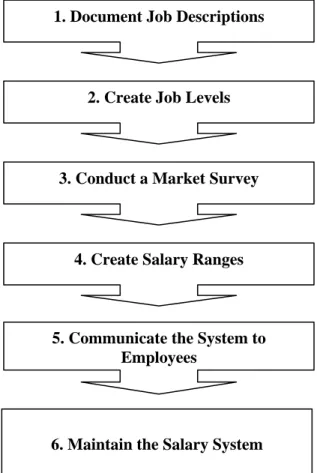
3.1: Steps to Create a Salary Administration System...22
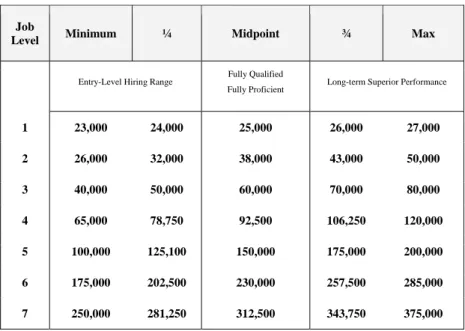
3.2: Sample Salary Ranges for a MFI ...25
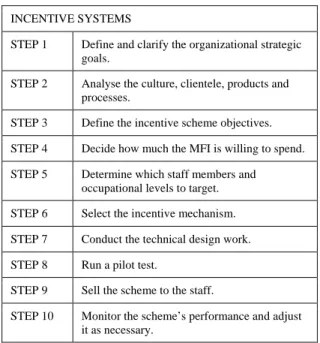
3.3: Ten Steps to Developing an Incentive System...27
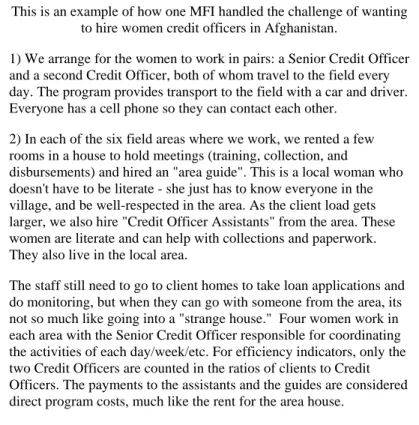
Section 4: Recruitment, Selection and Orientation 4.1: Cultural Issues in Recruitment/Selection: Women in Islamic Countries ...32
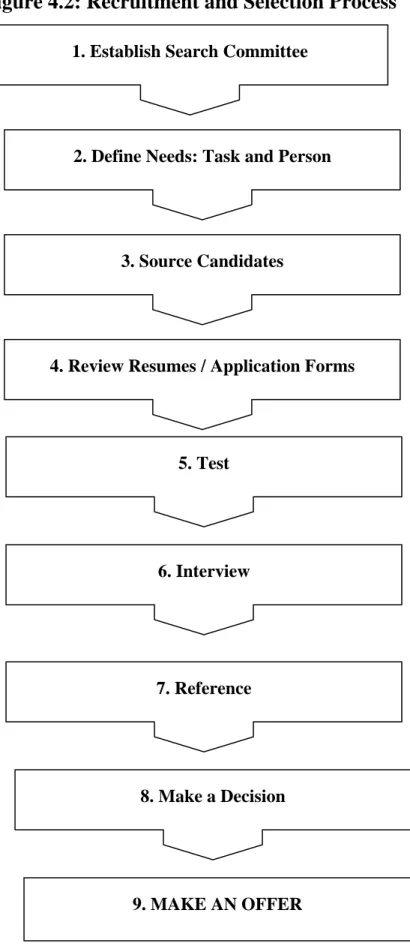
4.2: Recruitment and Selection Process ...34
4.3: Job Analysis ...36
4.4: Positive Personal Qualities...37
Section 5: Staff Performance Management Process Development and Training 5.1: Staff Performance Management Process ...54
5.2: Performance Management Cycle ...55
5.3: Linking Institutional Objectives to Individual Performance...57
5.4: Revenue Target within a MFI ...57
5.5: Customer Service Target within a MFI...58
5.6: Individual Performance Standards ...60
5.7: Sample Performance Objectives for a Credit Officer ...60
5.8: Annual Performance Objectives ...63
5.9: Phases of Year-End Appraisal ...64
5.10: Performance Appraisal Form ...65
5.11: Training Opportunities ...69
5.12: Personal Development Form...70
List of Handouts
Section 1: Introduction to Human Resource Management
1.1: Responsibility for HRM Functions in Medium to Large MFIs
1.2: Effective Human Resource Management in Microfinance Institutions: The Case of CAPA
1.3: Organizational Chart for a Small MFI 1.4: Organizational Chart for a Medium MFI 1.5: Organizational Chart for a Large MFI 1.6: Levels of Institutional Culture 1.7: Sample Staff Survey
Section 2: Human Resource Policies
2.1: Sample Human Resource Policy Handbook for MFIs 2.2: Human Resource Information System
Section 3: Salary, Benefits and Incentives
3.1: Sample Terms of Reference for a Salary Consultant 3.2: Job Evaluation Form
3.3: Sample Job Description 3.4: Sample Job Evaluation System 3.5: Sample Salary Ranges
3.6: Guidelines for Determining Salary Increases 3.7: Salary Administration System: Staff Handout
Section 4: Recruitment, Selection and Orientation
4.1: Profile of an Effective Credit Officer 4.2: Sample Application Form
4.3: Sample Interview Questions
4.4: Sample Interview Assessment Form 4.5: Sample Reference Check Questions
Section 5: Staff Performance Management Process Development and Training
5.1: Sample Performance Objectives
5.2: Preparing Performance Management Meetings 5.3: Performance Appraisal Form
5.4: Guide to Creating a Personal Development Plan 5.5: Analyzing Performance Problems
5.6: Checklist for Planning and Conducting Terminations 5.7: Step-by-Step Guide for Conducting Terminations 5.8: Sample Training Policy for a MFI
Section 1: Introduction to Human Resource
Management
What is Human Resource Management?
Simply put, Human Resource Management (HRM) provides an institution with an effective work force in order to meet its mission. Effective human resource management uses systems and tools to bring together:
the right number of people,
with the right attitude and skills, in the right place,
at the right time.
The goal of human resource systems, tools and activities is to help the individual employees who make up your MFI to be successful at their jobs and to work well together. In order to accomplish this goal, Human Resource Management (HRM) must be an integral part of the strategic plans of your MFI and have the full support of your senior management and board of directors.
MFI’s leadership, including the board and senior management must fully endorse HRM functions. This includes not only verbally supporting HRM initiatives, but more importantly, actively modeling the systems and tools. It is with this support that HRM will have an opportunity to impact the success and growth of the MFI.
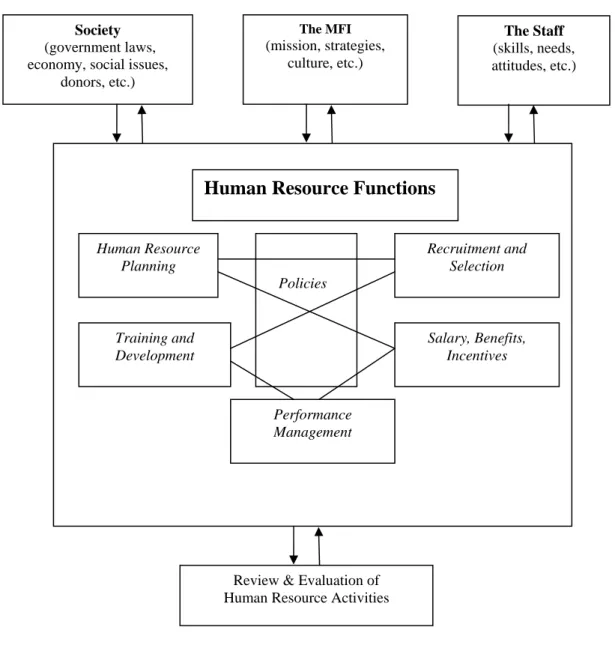
Based on years of work in Human Resource Management for the microfinance industry, MEDA has developed a Human Resource Management Model as shown in Figure 1.1. This model divides the primary activities of HRM in the context of microfinance into six broad categories:
1. Human Resource Planning 2. Human Resource Policies 3. Recruitment and Selection 4. Salary, Benefits and Incentives 5. Performance Management 6. Training and Development
These functional responsibilities are influenced by the external context in which your MFI operates and well as your MFI’s internal strategies, goals, mission, and institutionalculture. It is also
important to include a process of review and evaluation to ensure that your systems and tools continue to be appropriate as your MFI evolves. Each of the six HR functions plays an important role in the effective operations of your MFI. Throughout this toolkit, you will learn about these functions and how, when applied appropriately, Human Resource Management can propel your institution toward success.
Figure 1.1: Human Resource Management Model
Society(government laws,
economy, social issues,donors, etc.) The MFI (mission, strategies, culture, etc.) Performance Management Human Resource Planning Recruitment and Selection Training and Development Salary, Benefits, Incentives
Human Resource Functions
Policies
Review & Evaluation of Human Resource Activities
The Staff (skills, needs, attitudes, etc.)
Why is Human Resource Management important?
Your institution requires two major resources to operate: capital and people. The microfinance industry gives significant attention to the financial issues of operations. While finance is essential, it is only a tool in the hands of your people. Money does not manage itself; people manage it. Human Resource Management tools and systems are critical in finding, training, managing, motivating, and developing a team of staff who will effectively carry out your MFI’s mission. By building strong, well functioning human resource systems and tools, your institution will be poised for growth, ready to manage the challenges of an evolving environment, and responsive to the needs of your clients.
How can Human Resource Management contribute to an MFI’s
success?
All institutions are comprised of an interdependent network of individuals. In order for your MFI to be successful, the individuals within it must be productive, efficient, and effective. Attention to the management of these individuals can not only enhance the success of the individuals, but can encourage a team effort capable of reaching goals beyond what one person can do alone.
All employees, regardless of their position in your MFI, need the same things to be successful. Everyone needs to:
1. Identify with your MFI’s mission
2. Understand their role, and how that contributes to the mission 3. Know specifically what is expected of them
4. Have the capacity, resources, and environment which makes success possible
5. Receive encouragement, constructive feedback, and o to develop and improve
pportunities The work of Human Resource Management is to implement systems and tools that will provide these key elements to help the individuals within your MFI to be highly motivated and successful. When individuals are successful, your MFI will be successful.
What factors affect Human Resource Management?
Three main factors that affect the work and goals of Human Resource Management are noted in the top three boxes in Figure 1.1. These three main factors are society, the MFI, and the staff. In managing your MFI’s human resources, it is important to consider each of these stakeholders.
Society
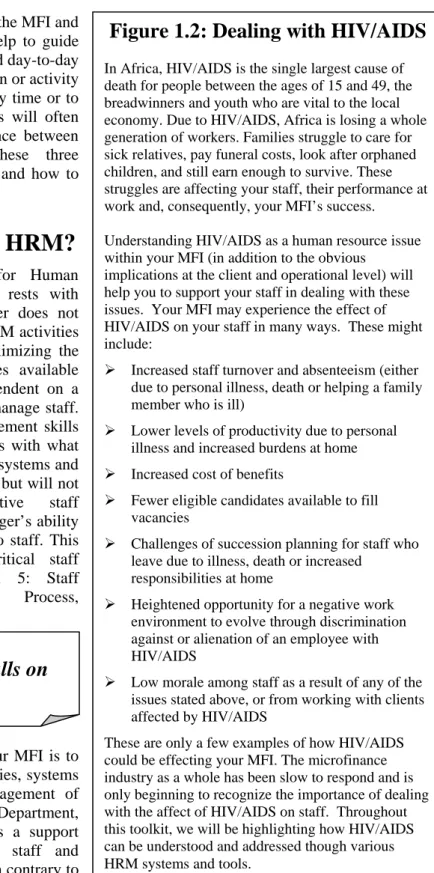
The external environment in which you operate can heavily influence HRM. By its very nature, part of your MFI’s mandate is to respond to some of society’s needs and challenges. In your region, these might include issues such as poverty, high rates of illiteracy, environmental concerns, and high crime rates. Other external factors that will affect HRM could include competition in the microfinance sector, and even your relationship with donors. In addition to dealing with these challenges, your MFI must also understand and comply with the legal requirements and labour laws in your region. This will impact your human resource management policies and procedures. Many informal rules or expectations within society may also have an influence on the issues your MFI must address in staff management. In Africa, one widespread societal issue that impacts microfinance is HIV/AIDS. Special attention is given to this issue in Figure 1.2 and throughout other sections in the toolkit.
The MFI
The major aim of Human Resource Management is to contribute to the success of your MFI. Therefore, the mission, strategy and goals of your MFI will form the basis of how you approach human resource issues. The structure and functions of HRM should be at a level that is appropriate to the size and needs of your MFI. You could be wasting precious resources if HRM systems and tools are more or less sophisticated than what your institution needs or can afford.
The Staff
Effective Human Resource Management will seek success for your MFI through supporting the contribution of each employee. As noted above, your institution’s success is highly dependent on the success of each of your staff. Many Human Resource Management systems and tools are available to support each employee to be productive, thereby contributing to your MFI’s success.
These three stakeholders (society, the MFI and the staff) are beacons that will help to guide your human resource strategies and day-to-day activities. Not every HRM decision or activity will affect these stakeholders every time or to the same degree. HR Managers will often need to find an appropriate balance between the competing interests of these three stakeholders and will learn when and how to compromise appropriately.
Who is responsible for HRM?
Ultimately, the responsibility for Human Resource Management activities rests with each MANAGER. If a manager does not accept this responsibility, then HRM activities will only get partially done. Maximizing the potential of the human resources available within your MFI is directly dependent on a manager’s skills and abilities to manage staff. Leadership and good staff management skills are essential to provide employees with what they need to be successful. HRM systems and tools can provide a good structure but will not guarantee success. Effective staff management hinges on each manager’s ability to provide leadership and relate to staff. This toolkit will briefly address critical staff management skills in Section 5: Staff Performance Management Process, Development and Training.
The role of HRM staff within your MFI is to support each manager with strategies, systems and tools for the effective management of their staff. Just like the Finance Department, Human Resource Management is a support service with “internal clients”: staff and managers. This concept may seem contrary to what you might expect. Many staff within
your MFI might assume that the designated HRM staff person should complete all HRM functions. While this is true for the development, administration, review and monitoring of HRM systems, in order for those systems to be effective, your managers must understand their role and responsibility in using those systems and tools for effective staff management. Handout 1.1: Responsibility Chart for HRM Functions in Medium to Large MFIs is a chart that describes the different responsibilities of staff managers and the HR Manager for each of the HR functions.
Figure 1.2: Dealing with HIV/AIDS
In Africa, HIV/AIDS is the single largest cause of death for people between the ages of 15 and 49, the breadwinners and youth who are vital to the local economy. Due to HIV/AIDS, Africa is losing a whole generation of workers. Families struggle to care for sick relatives, pay funeral costs, look after orphaned children, and still earn enough to survive. These struggles are affecting your staff, their performance at work and, consequently, your MFI’s success.Understanding HIV/AIDS as a human resource issue within your MFI (in addition to the obvious
implications at the client and operational level) will help you to support your staff in dealing with these issues. Your MFI may experience the effect of HIV/AIDS on your staff in many ways. These might include:
¾ Increased staff turnover and absenteeism (either due to personal illness, death or helping a family member who is ill)
¾ Lower levels of productivity due to personal illness and increased burdens at home ¾ Increased cost of benefits
¾ Fewer eligible candidates available to fill vacancies
¾ Challenges of succession planning for staff who leave due to illness, death or increased
responsibilities at home
¾ Heightened opportunity for a negative work environment to evolve through discrimination against or alienation of an employee with HIV/AIDS
¾ Low morale among staff as a result of any of the issues stated above, or from working with clients affected by HIV/AIDS
These are only a few examples of how HIV/AIDS could be effecting your MFI. The microfinance industry as a whole has been slow to respond and is only beginning to recognize the importance of dealing with the affect of HIV/AIDS on staff. Throughout this toolkit, we will be highlighting how HIV/AIDS can be understood and addressed though various HRM systems and tools.
Everything rises and falls on
leadership.
Where does HRM fit into the organizational chart?
The answer to this question will be different for each MFI and will depend on the size and structure of the institution. The mission, vision and culture of the MFI will influence the role that HRM plays. In addition, HRM functions should be kept at a level that is appropriate to the MFI’s needs. As the institution grows, deciding how to manage HRM functions will evolve with the MFI. Let’s take a look at how HRM fits into various stages and sizes of MFI operations.
How does HRM evolve as the MFI grows?
From the beginning, it is important to put HRM systems in place so the MFI will be ready to cope with the administrative burdens that increase as more employees are added. Institutionalizing these structures during the start-up phase will help to ensure that effective Human Resource Management practices are ingrained into your organizational culture. These HRM structures would include but not be limited to recruitment and selection procedures, personnel policies, orientation and training for new staff, and staff performance management tools. At the beginning, these systems and procedures do not need to be complicated or elaborate. They can evolve as the MFI grows. Regardless of size, putting HRM systems in place at the beginning will help Human Resource Management to evolve along with your MFI. An excellent example of this evolution is available in Handout 1.2: Effective Human Resource Management in Microfinance Institutions: The Case of CAPA.
Small MFIs (up to 20 staff)
For start-up MFIs with up to 20 staff, the functions of Human Resource Management are usually shared among various employees. For example, the finance department may administer salary and benefits. Handout 1.3: Organization Chart for a Small MFI, illustrates how HRM tasks are typically divided in a small MFI. In most start-up MFIs, the Executive Director is involved in all HRM functions, such as recruitment, termination, salary, etc. As such, HRM naturally plays a strategic role in institutional planning and design. This senior level involvement is an excellent way to formulate and establish institutional culture. An effective Executive Director will mentor and empower staff to take on these Human Resource Management functions over time.
Medium MFIs (20 to 49 staff)
As the MFI grows beyond 20 staff, the complexity and importance of Human Resource Management increases. During this stage, one staff position (usually on a part-time basis) should be designated to work on HRM administration. This part-time HR Administrator may report to the Manager of Finance and Administration, or another senior level manager as appropriate. This transition can be difficult and may evolve over time. A good place to start is to define HRM tasks that can be done by a current employee who has complimentary duties in another role. As your MFI grows, this role will gradually expand and the transition into a full time HRM position may seem a very natural progression. During this growth phase, it is common for HRM activities to become administrative and lose some of their strategic importance, especially if the HR Administrator does not report to the Executive Director. Handout 1.4: Organizational Chart for a Medium MFI shows where HRM functions are typically housed.
At this stage in a MFI’s life cycle, many MFIs hire an outside HR expert or consultant to help in the further development of polices and procedures. An expert can assist in the design and staffing of an appropriate HRM department and can train the HR staff. As with all experts, it is important to find a qualified practitioner who is experienced in the challenges of Human Resource Management in microfinance institutions.
Large MFIs (50+ staff)
For large MFIs with more than 50 staff, the management of human resources becomes more involved; therefore, a whole department within the organizational structure may be dedicated to work on HRM issues. A very general guideline is to have one full time HR position for every 50 to 75 employees. Depending on your size, the HRM department may have several staff, some of which are specialized in a specific Human Resource Management function. For example, you may have a Trainer or Recruiter on staff. The manager of the HR department should be a senior and experienced manager who reports to the Executive Director, and participates in the senior management meetings. It is through this representation and senior level responsibility that HRM regains credibility and strategic importance within the MFI and has the necessary support to facilitate the success of the institution. If a MFI has aggressive growth and expansion targets, it may be necessary to hire additional HR staff to support this growth. Contract HR hires can be considered. Please refer to Handout 1.5: Organizational Chart for a Large MFI.
How can HR help the MFI manage growth?
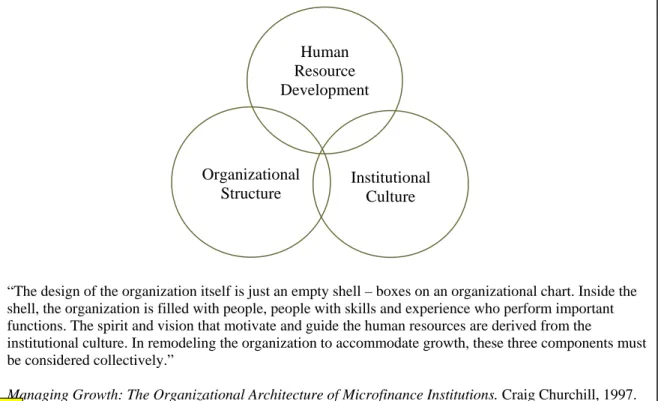
Building solid and lasting institutions is a difficult and challenging task. Managing Growth: The Organizational Architecture of Microfinance Institutions by Craig Churchill is an excellent discussion of this challenge. As outlined in this paper, the key elements in this task are human resource development, organizational structure, and institutional culture. A synopsis of the interplay between these factors during various phases of MFI growth is captured in Handout 1.6: Levels of Institutional Development. Figure 1.3 depicts how each of these three areas are distinct, yet overlap and influence each other. Human resource development is the area we are addressing in this toolkit and it plays a large role in influencing organizational structure and institutional culture. An MFI must be strong in all three areas in order to be well prepared to meet the demands of growth. In the next few paragraphs we will discuss how organizational structure and institutional culture relate to Human Resource Management.
Figure 1.3: The Components of Institutional Architecture
Human Resource Development Organizational Structure Institutional Culture
“The design of the organization itself is just an empty shell – boxes on an organizational chart. Inside the shell, the organization is filled with people, people with skills and experience who perform important functions. The spirit and vision that motivate and guide the human resources are derived from the institutional culture. In remodeling the organization to accommodate growth, these three components m be considered collectively.”
ust
What is institutional culture?
Each institution has its own unique culture. The core values, mission, vision, and code of conduct form the basis of this culture which is also heavily influenced by the Executive Director and senior management team. However, institutional culture can be hard to pinpoint, as it is not something that is readily apparent on the organizational chart. Rather, culture is reflected in the informal procedures, staff interactions and work environment that emerge from the institution’s day-to-day operations. Effective Human Resource Management is one of the most valuable tools you can use to “institutionalize” culture. The most important HRM tools and practices that shape institutional culture are:
“Making the transition from good to great doesn’t require a high profile CEO, the latest technology, innovative change management, or even a fine tuned business strategy. At the heart of those truly rare and truly great companies was a CORPORATE CULTURE that rigorously found and promoted disciplined people to think and act in a disciplined manner.”
From the best selling book Good to Great” by Jim Collins ¾ A “guiding principles/values”
statement based on your MFI’s mission and vision
¾ HR Policies which reflect your MFI’s values
¾ General standards of
performance that form a part of the performance management system
¾ Well designed advertisements, application forms and recruitment processes that create a first and lasting impression and describe your MFI during recruitment
¾ An employment contract that references your MFI’s values statement
¾ A thorough orientation process to ensure new staff understand and support your MFI’s guiding principles
Overall, it is critical to understand that throughout the development and use of HRM systems and tools, you will be formally and directly setting the tone and communicating to staff about your MFI’s culture. You can also use indirect methods to transmit culture. For example, Equity Bank regularly communicates their institutional cultural norms through their Intranet and FINCA TZ issues a weekly newsletter. Figure 1.4 gives a few ideas of how to establish and promote the kind of culture you want in your MFI.
Figure 1.4: Indirect Ways to Communicate Institutional Culture
The principles of transmitting organizational culture are pretty simple: senior management mustcommunicate and lead by example. It sounds easy but is difficult in practice. How this is applied within your unique MFI needs to be determined by you. In addition to the direct tools noted above, here are some of the ways that MEDA communicates our organizational culture:
1. Before staff meetings, we have someone from the group share a personal reflection.
2. We have an internal newsletter sent to all staff that tells stories from work, interesting things in the news that relate to MEDA, and personal staff news.
3. In between newsletters, we send out staff announcements to all MEDA staff.
4. The President and other senior staff travel frequently to other MEDA offices, and often all the staff in that office have lunch together and share about what is happening in offices.
5. At team meetings, the department leader often takes time to give an update on corporate MEDA. 6. Financial statements are shared with staff on a monthly basis with comments on trends and issues. 7. Regular staff gatherings include: weekly staff meetings to review workload, specific planning sessions
and special social events.
8. We have an all-staff retreat every 2-3 years for a few days to do team-building, training, and share experiences.
What kind of organizational structure is best?
Literature indicates that a flat, lean and simple organizational structure is the best model for a growing institution. A “team business unit” approach should be considered to increase efficiency, productivity, and responsiveness to the target market. This could involve organizing your staff into teams by branch, different products, regions, or types of clients. Employees prefer working in smaller business teams where they find more challenging and interesting work and where there is a better chance to see their ideas adopted. Small teams also help to foster a higher sense of accomplishment. An organizational structure that facilitates teamwork will increase your success and growth potential. Expanding MFIs should create a dynamic, decentralized organizational
structure that encourages strong branch offices. This works better than an organizational structure that grows in a hierarchical fashion. The decentralization process, while critical to managing growth, can create administrative challenges; therefore, communication must remain an important element. The discussion below highlights how HRM functions are handled in a structure with decentralized branches.
How is HRM handled in branch offices?
For larger MFIs with several branches, the challenge of managing HRM functions becomes key. It is best to retain the overall responsibility for HRM at head office. HRM polices and practices must be consistent in all branches to ensure fair and equitable treatment of all staff, regardless of location. This helps to ensure a consistent corporate culture. With the responsibility for HRM centralized, the critical issue to implementing HRM systems effectively is to ensure supervisors at the branch level have the necessary skills to address HRM issues. As noted earlier, each manager must understand their role and responsibility in staff management and their levels of decision-making and authority in relation to various HRM functions.
The HRM staff from head office can support and facilitate effective HRM practices through the off-site managers. Ultimately, the Branch Manager should have the responsibility for HRM activities in their branch, in coordination with the HR Manager at head office. The MFI can then support these managers in handling HRM functions using a variety of tools and methods.
A grassroots approach to transmitting HR functions to branches is demonstrated by a large MFI in Uganda. Branches of this MFI have staff welfare committees of 2-3 people, elected by their peers. These committees meet with the Branch Manager monthly to discuss staff welfare issues and concerns, which are then delivered to the Head Office through a monthly report and quarterly meetings of staff welfare committees.
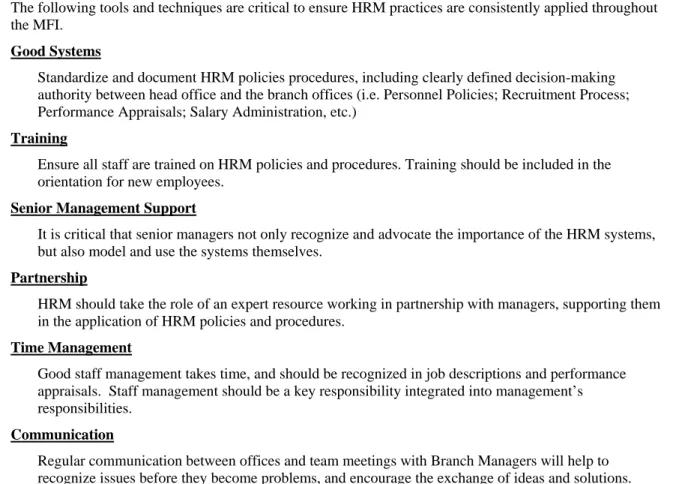
One of the most important factors to support branch offices is good lateral relationships within head office between support departments (such as HRM, Finance, and Operations). Ensuring good working relationships will help to coordinate efforts and streamline communications to the branches. A high level of trust and respect built through a strong corporate culture will encourage these lateral relationships and will foster employee satisfaction and good morale. Figure 1.5 suggests other tools and techniques support effective Human Resource Management in branch offices.
Figure 1.5: Supporting HRM in Branch Offices
The following tools and techniques are critical to ensure HRM practices are consistently applied throughout the MFI.
Good Systems
Standardize and document HRM policies procedures, including clearly defined decision-making authority between head office and the branch offices (i.e. Personnel Policies; Recruitment Process; Performance Appraisals; Salary Administration, etc.)
Training
Ensure all staff are trained on HRM policies and procedures. Training should be included in the orientation for new employees.
Senior Management Support
It is critical that senior managers not only recognize and advocate the importance of the HRM systems, but also model and use the systems themselves.
Partnership
HRM should take the role of an expert resource working in partnership with managers, supporting them in the application of HRM policies and procedures.
Time Management
Good staff management takes time, and should be recognized in job descriptions and performance appraisals. Staff management should be a key responsibility integrated into management’s responsibilities.
Communication
Regular communication between offices and team meetings with Branch Managers will help to recognize issues before they become problems, and encourage the exchange of ideas and solutions.
How can we tell if we have good morale?
Many tools exist to measure employee satisfaction and overall morale. A staff opinion survey or climate survey can be a quick and easy way to solicit feedback from employees. Examples of both of these surveys are included as Handout 1.7: Sample Staff Survey, and Handout 1.8: Sample Climate Survey. Please remember that you will have a better chance of receiving honest feedback if you can assure staff their responses are anonymous and confidential. The ideal use of a staff opinion survey is to be proactive and administer this survey on an ongoing basis. This will allow the HR Manager to watch for trends and address issues before it negatively affects morale. In addition to surveys, you may also consider suggestion boxes, staff welfare committees, or even a staff focus group to provide feedback on your MFI’s work environment.
How do we respond to employee feedback?
Implementing feedback mechanisms such as a staff survey or suggestion box can begin to open up internal communications, but it is very important to follow up on feedback from staff. When feedback is not addressed, employees will not only feel neglected, but will be less inclined to provide valuable feedback in the future. Respond to staff comments promptly to build their confidence that someone is listening and cares about their concerns.
If an MFI receives feedback that the institution has poor internal communications and a poor response to staff concerns, these issues can often point to ineffective (or nonexistent) Human Resource Management systems and tools. As indicated in this toolkit, one of the best ways to ensure your HR systems are appropriate for your MFI is to incorporate staff input when improving or establishing these systems. By focussing attention on HRM you will also work at the issues of internal communication and responsiveness to staff concerns. The staff survey can be an important tool to
improve communication, however itshould not replace one of the most important forms of feedback: one-on-one personal feedback between staff and managers.
About this toolkit…
Now that you have a good understanding and appreciation of the important role that Human Resource Management can play in the success of your MFI, you are ready to learn more about systems and tools that make up effective Human Resource Management. The following sections in this toolkit will discuss HRM policies, compensation, recruitment and selection, staff performance management, and training and development. These sections will refer to the accompanying handouts that are available on the MicroSave website. Additional resources and further reading is available in the bibliography.
The material and examples presented in this toolkit are generally based on a large-sized MFI with the organizational structure presented in Handout 1.5: Organizational Chart for a Large MFI. When describing HRM functions and responsibilities, we will refer to the “HR Manager”. However, these responsibilities may be housed within other positions in your MFI, depending on your size and structure. We have chosen to always refer to the HR Manager to be clear and consistent throughout the document; however, all principles presented are equally applicable to any size MFI.
Most of the examples provided in the text and handouts are centered around the credit operations of an MFI; however, please remember that these HRM principles apply to all staff. We choose to highlight credit officers because it is a function that many MFIs have in common. Please note that these tools should be adapted and used for all the positions in your institution.
Each MFI should have some form of a “Senior Management Team”. This team would include most senior level managers who have responsibility for the strategic direction of the MFI. Where possible it is advisable to have HRM representation on the senior management team. Senior managers should meet together regularly to discuss current issues and future plans. We refer to this group as “senior management” in the text to indicate whatever form this takes in your MFI.
Points to Remember
¾ For maximum effectiveness, Human Resource Management must have support from senior management.
¾ HRM must have excellent working relationships with other departments and be open to input from all staff.
¾ Each staff manager in your MFI must understand and accept their role and responsibilities in staff management and HR functions.
¾ HRM systems and tools must be appropriate to your MFI.
¾ Institutional culture is directly transmitted through senior management attitudes and modeling of HRM systems and tools.
Section 2: Human Resource Policies
What are HR policies?
Human Resource policies are the documented procedures and guidelines that provide structure to work expectations. These guidelines define the roles and responsibilities of both the MFI and the employee. Topics such as work conditions, legal requirements (in accordance with local and national labour laws), salary administration, and many other issues are generally included in a written HR Policy Handbook. This section will define specific suggestions for writing, distributing and maintaining HR policies for your MFI.
Why should we have HR policies?
Human Resource policies provide consistency, fairness, and efficiency in dealing with staff. Having a written policy document also gives you the ability to establish and communicate the rights and responsibilities of the MFI and your staff. HR policies can be a valuable tool to:
¾ Ensure all employees are treated equally
¾ Save time required to research past precedent and make a decision on every individual case
¾ Communicate to staff what is expected of them, what your MFI provides, and what procedures will be followed
¾ Handle legal issues with employees
¾ Reinforce institutional culture by treating employees fairly and providing benefits that reinforce your MFI’s values
What are the challenges of implementing HR policies?
Although it is very helpful to have HR policies, many MFIs still do not have policies in place. The most common roadblocks MFIs face to implementing HR policies include:
¾ Up-front costs: Creating and administering HR Policies Handbook properly takes time. However, this initial cost will increase efficiency in dealing with employees through a standard set of rules.
¾ Poorly prepared policies: If insufficient time is spent on creating and implementing appropriate and meaningful HR policies, you may risk adding more confusion than clarity and support.
¾ Ongoing administration: Although the biggest commitment is the initial time to create and implement HR policies; to be effective, you will also need to allocate time to maintain and administer the policies.
¾ Cannot cover everything: Not every situation you or your staff may experience can be detailed; therefore, you will still need to address special circumstances.
¾ Focus on rights and entitlements: Your staff may get lost in the rules. Therefore, you will still need to remember that you are dealing with people, and their best interest should be taken to heart in the application of the policies.
“Even if only a draft version is available… since the first moment, the institution should have at least a skeleton of a procedures manual and HR toolkit. Little by little, the team can build up these manuals based on experience and learnings from other institutions.”
- CAPA, Romania Creditare, Asistenta, si Pregative prentru Afaceri (Credit, Consulting and Training for Small Business)
What should I remember when writing an HR policy?
Writing an HR policy is fairly straightforward. Handout 2.1: Sample Human Resource Policy Handbook for MFIs provides an example of what a HR policy might look like for a MFI. Using this as a base, try to obtain HR policies from other MFIs or related organizations to help you understand what you might want to include in your HR Policy Handbook. Review the legislative requirements that you must follow for your location. You may also consider involving staff in the development of your policies.
Why should we include staff in creating the HR policies?
There are several advantages of involving staff in the process of creating HR policies.
¾ Staff will more strongly support the policies if they have a chance to contribute
¾ Staff input opens up an opportunity to find out what is important to staff and gear policies to meet staff needs. Policies might then be used as motivator for staff
¾ Staff may bring in ideas from other organizations where their friends and family work A simple confidential staff survey can be created to solicit staff input. Handout 1.7: Sample Staff Survey and Handout 1.8: Sample Climate Survey are designed to assess current staff morale, but can easily be adapted to focus more specifically on benefits and policies.
What should be included in a policy and why?
Once you have identified the policies you need to include in your toolkit, you are ready to prepare the document. When writing your own HR Policy Handbook, it is important to use clear, simple and positive language.
Remember that this document will communicate your institutional culture. To staff, this is apparent not only in the types of policies you set, but also in the writing style and tone of the document. After you have completed the handbook, you may want to ask a lawyer to review it. Remember at a
minimum your policies must adhere to labour legislation.
The HR Policy Handbook should be a simple, straightforward document. It will contain very specific material that is relevant to your MFI. However, the format and topics for HR policies may be similar throughout the microfinance industry. Figure 2.1 shows part of the table of contents from Handout 2.1: Sample Human Resource Policy Handbook for MFIs. The following paragraphs provide further detail and explanation on each section of the HR Policy Handbook and what your MFI should be considering when writing your own handbook.
Introduction
The introductory sections are to provide background information to the policies and will help to set the tone for the overall document. This section is very important as it is a valuable opportunity to communicate your MFI’s institutional culture to your staff. You can demonstrate this through the inclusion of one or more of the following sections:
1. Corporate statement: This can include one or more of the following: mission and vision statements, guiding principles, core values, or code of conduct. This section states “who we are, what we do, and where we are headed.” This will help to remind the staff of your purpose and puts the policies in context.
2. Purpose of the policy: By implementing HR policies, your MFI is intending to create a culture of fairness, consistency, and an enhanced work environment for all staff. 3. Scope of policy: This section states who is
included in the policy, and various circumstances where this policy will or will not apply. By including this section, you are able to set clear guidelines, resulting in less confusion for employees.
4. Effective date of policy: Recording the date when the HR Policy Handbook was last updated is a simple way of keeping track of the most recent copy and when it should be updated next.
5. Definitions: It is important to include a list of definitions to ensure clarity. Such definitions could include the criteria by which your MFI defines full-time employees, contract employees, managers,
supervisors, etc. You will also want to define family members (immediate/extended) in terms of eligibility for insurance or other benefits.
Figure 2.1: Human Resource Policy
Handbook
Table of Contents
Effective: August 2005
A. INTRODUCTION...1
B. GENERAL POLICIES AND PROCEDURES ...3
1.0 Terms of Employment ...3
2.0 Salary ...3
3.0 Allowances...4
4.0 Employee Loans and Salary Advances ...5
5.0 Leaves ...6
6.0 Travel and Expenses Procedure...8
7.0 Recruitment and Selection ...9
8.0 Training and Staff Development Procedure ...9
9.0 Grievance Procedure... 10
10.0 Disciplinary Procedure ... 10
11.0 Termination Procedure ... 11
12.0 Personnel Files ... 12
C. CORPORATE POLICIES ... 12
1.0 Conflict of Interest Policy ... 12
2.0 Whistle-blower Protection Policy ... 13
3.0 Anti-Harassment Policy ... 13
4.0 HIV/AIDS Policy ... 14
5.0 Crisis and Security Policy ... 15
6. Administration and policy updates: This section states the title of the person(s) responsible for administering and updating the HR Policy Handbook, as well as communicating changes to staff.
Specific Policies
After the introduction, the next sections should describe the specific HR policies of your MFI. For most MFIs, this means outlining the terms of employment, benefits, allowances, and administrative procedures.
¾ Contract: Although not always part of the HR Policy Handbook, you are advised to follow a defined template for all of your employment contracts. Make note in the contract that all policies stated in the HR Policy Handbook will apply; otherwise this should include information such as start date, salary, manager, location, and job title. The contract should also state any conditions that are special for a particular employee.
¾ Hours and times of work
¾ Salary administration / incentive program: A full description of the salary administration system and incentive program should be separate documents; however, the HR policy should refer to those documents. Many MFIs have policies on salary advances and loans that would be included in this section as well.
¾ Benefits / allowances: this may include options such as medical assistance, life insurance and other benefits.
¾ Travel and expense: Having a clear policy regarding expense allowances and reimbursement will give the employee an understanding of his or her limitations and responsibilities. If this is part of your financial toolkit, you should reference that toolkit in your HR Policy Handbook.
HR Procedures
The purpose of these procedures is to inform employees of how things work within Human Resource Management and your MFI as a whole. By including these procedures in the HR Policy Handbook, you have the opportunity to shape and communicate your institutional culture with all staff. When staff have read and received orientation on your handbook, they can be accountable for their rights and responsibilities in the workplace. The following are procedures that can be included in this section:
¾ Recruitment and selection: Describe any hiring policies that your MFI follows. This may include a policy on hiring family members or outline a pre-employment testing phase or refer to your MFI Recruitment Manual.
¾ Training and development procedures: Describe how your MFI addresses training and staff development, including orientation, eligibility for training, training expense reimbursement, and referencing any appropriate forms or manuals.
¾ Performance management procedures: Although a full description of the performance management process should be a separate document, the HR Policy Handbook should refer to this document and help to set the tone for your MFI’s commitment to this process.
¾ Disciplinary procedures: Making sure each employee understands the consequences for his or her actions can make disciplining easier, while giving clear-cut rules for each person to follow.
¾ Grievance procedures: It is almost impossible to avoid employee complaints. By establishing clear procedures to formally deal with disputes, a resolution is more likely to occur.
¾ Termination conditions and procedures: If this process is handled properly, there will be less suffering for everyone including the employer, other employees, and your MFI’s all-around reputation. It is extremely important to detail how your institution will handle terminations including the rights and responsibilities of the employee and MFI. This is a critical area that you should consider having a lawyer review to ensure you are following legal requirements. Although not pleasant, explaining termination procedures during orientation can save a lot of hassle and headaches if you do need to terminate.
Corporate Policies
Establishing Corporate Policies is another effective method of institutionalizing culture within your MFI. Please remember that the phrasing and words you use to describe these policies sets the tone and communicates to staff about the overall attitude and approach of your MFI. These policies are in place to make employees aware of the “rules” of your MFI. Some common policies include:
¾ Harassment / Discrimination / Equal Opportunity Policy
¾ HIV/AIDS Policy
¾ Crisis and Security Policy
¾ Whistle-blower Protection Policy
How do you distribute the HR policy?
Once you have put all the effort in to creating your HR Policy Handbook, it is important to make sure it doesn’t collect dust on the shelf. An effective way to convey your MFI’s commitment to follow the handbook is to hold a staff meeting to introduce it. At the meeting, give each employee a copy, making him or her responsible to know what it contains. Take time to talk to employees about the HR Policy Handbook, why you have it, what it means, and their rights and responsibilities. Asking staff to sign a paper stating they have read and understood the policies also demonstrates the fact that you take it seriously. It is also important to ensure that each new employee receives a copy and training on the HR Policy Handbook.
MEDA considers the HR Policy Handbook a component of the contract. When the employee signs their employment contract, it also indicates their acceptance of all the HR policies.
How do you maintain the HR policy?
To be effective, it is best to designate one person to regularly update your HR Policy Handbook, answer staff questions, apply the handbook in decision-making, and ensure that procedures outlined in the handbook are followed (e.g. expense reimbursement, performance management, etc.). HR Policies should be monitored on
an ongoing basis to ensure compliance with current employment legislation. Every two to three years, you should update the handbook to reflect changes and growth within your MFI, staff feedback, and marketplace changes. In order to be relevant, the handbook needs to be reviewed often to keep pace with these factors. It is important to put a defined procedure in place to communicate and distribute the updated handbook to all staff.
Human Resource Information Systems (HRIS)
Much of the administration of the HR policies will require tracking information for each employee on an ongoing basis. This can be time-consuming and lead to inaccuracies, or even inconsistent application of your policies. A consideration, particularly for large MFIs, is to use technology to systematize this data tracking function. Many software programs exist to keep track of employee data; however, it is very important to understand your needs before using an off-the-shelf package that may not fit and may end up causing more work. Handout 2.2: Human Resource Information System
provides further discussion and tips on how to use technology to streamline HRM functions in your MFI.
Can HR policies help us deal with HIV/AIDS?
As noted in Section 1: Introduction to Human Resource Management, HIV/AIDS is the single largest cause of death for people between age 15 and 49 in Africa. Those affected may be your clients or staff. Understanding HIV/AIDS as a Human Resource Management issue within your MFI (in addition to the obvious implications at the client and operational level) will help you to support your staff in dealing with these issues. As a starting point, consider incorporating some of these ideas into your policies, procedures and planning to assist your MFI in dealing with the HIV/AIDS crisis.
Policies
¾ Adopt an HIV/AIDS policy that addresses your MFI’s approach to the issue. The HIV/AIDS policy, shown in Handout 2.1: Sample Human Resource Policy Handbook for MFIs, is an excellent example of an HIV/AIDS policy that you can adapt for your MFI. Remember that putting the policy in place is only the first step. You must then ensure you are following and implementing that policy.
¾ Define your HR policies on sick leave, bereavement leave, and insurance benefits with HIV/AIDS in mind. When determining these benefits, consider both the time and financial cost involved. If you include staff in this decision, you will have greater support for the policy limitations you put in place. Local legislation may also dictate your obligation for providing certain benefits.
¾ Consider other benefits you might be able to give staff as part of your compensation, for example, the opportunity for a loan or salary advance in order to pay for funeral costs. This may not only boost morale, but could serve to attract new staff.
¾ Research unique insurances – perhaps the MFI association in your region can provide insurance at a better rate. Work with insurance providers to find appropriate insurance that would benefit your staff.
¾ Ensure that education on your MFI’s HIV/AIDS policy and procedures is included as part of each new staff person’s orientation. Provide information on organizations/clinics in your region who deal with HIV/AIDS issues.
¾ Consider establishing an Employee Assistance Program (EAP). An EAP is a benefit that provides counseling services for employees and their families. You can contract with a local counseling centre to provide confidential counseling for your staff to help them deal with the stress of working with HIV/AIDS-affected clients, or in dealing with their own issues. This can be an excellent resource to help staff deal with HIV/AIDS before these issues start to affect their performance.
Recruitment
¾ Always be on the lookout for new staff. The challenges of recruiting from an unskilled work force combined with the risk of HIV/AIDS affecting your staff make it doubly important to continually network and hire good employees when you find them. Don’t wait for a vacancy to hire good people.
Succession Planning
¾ Consider “over-staffing” for a position, particularly Credit Officers, to ensure that you will have enough staff to carry the work load during staff absences.
¾ Pay extra attention to staff planning. Identify potential managers and work at ways to train them to be ready to take on additional responsibilities. Staff planning is discussed in detail in Section 5: Staff Performance Management Process Development and Training.
Training and Development
¾ Look for ways to cross-train your staff so they are knowledgeable and flexible to cover a variety of job duties during other staff’s absences. Incorporate cross-training goals into each employee’s personal development plan and review progress on a regular basis. More on personal development planning is covered in the Section 5: Staff Performance Management Process Training and Development.
¾ Prepare documents and share information with your staff. One of the greatest losses when a staff person leaves for any reason, is the knowledge they have built up about their job, your institution, their clients and the industry as a whole. Ensure regular paperwork is up to date.
Be diligent in asking staff to prepare “how to” manuals for technical aspects of their job or write papers discussing lessons learned by them or the institution in a certain situation (opening a new branch, dealing with fraud, starting a new loan product, etc.). Share this information with other staff, and encourage the exchange of ideas through staff meetings, newsletters, or informal discussions.
¾ Provide specific training for your staff (including credit officers and managers) to handle and communicate with clients who are affected by or infected with HIV/AIDS. It will be extremely helpful to link with experts in your area to find organizations who can provide training and education for your staff on HIV/AIDS health issues.
It is of utmost importance to stay current with how the MF industry and your community are dealing with the HIV/AIDS issue. This will help you to know how to direct your MFI in addressing HIV/AIDS.
The microfinance industry has been slow to respond to the HIV/AIDS crisis and many of these ideas are untested. As more MFIs understand the importance of addressing this issue and its impact on their staff, success stories and new ideas will emerge to help the industry as a whole cope with the overwhelming challenge of HIV/AIDS. More information can be found in DAI/AMAP’s manual:
Microfinance and HIV/AIDS: Defining Options for Strategic and Operational Change.
Points to Remember
¾ Adhere to local legislative requirements.
¾ Involve employees in determining policies and ensure senior management’s support.
¾ Be clear and direct in communicating policies to staff.
¾ Ensure policies fit with your MFI.
¾ Remember that HR Policies are living documents that should evolve and change with the institution as it grows and reacts to internal and external changes.
¾ Never let a policy get in the way of doing the right thing. Keep your employees well-being at the forefront when applying the policies. This does not mean always letting employees have special treatment. Rather, it means being flexible and considering that certain circumstances may call for an exception to the policy.
Section 3: Salary, Benefits and Incentives
What is compensation?
Compensation includes all financial and non-financial benefits an employee earns for their work. This includes a combination of salary, benefits and incentives. An employee’s salary is simply the fixed amount of pay they receive for their work, which is usually referred to as an annual or monthly amount. Benefits complement salary by providing additional monetary or non-monetary compensation to the employee. Incentives (both financial and non-financial) are additional rewards designed to encourage staff to work effectively and efficiently.
Why is compensation important?
Many institutions recognize that staff are a valuable asset and know that salaries and compensation can be a large part of operating costs. It is not unusual for MFIs to spend up to 70% of their operating budget on employee compensation. The impact on your budget is obvious. However, the complete compensation package also impacts staff morale, employee job satisfaction, and overall productivity. If designed effectively, your compensation package can positively affect staff attitudes and productivity through:
¾ Demonstrating your MFI’s commitment to
internal and external fairness and equity – a big boost for staff morale
“…Employees should have a strong incentive to perform their job in a responsible and competent manner. Employees who do not feel sufficiently compensated will be much less likely to carry out their job with the necessary thoroughness and attention to detail. Likewise, they are much more vulnerable to committing fraud, especially in economies where sums that they handle daily represent months or even years of salary. A competitive salary is a strong preventive control in deterring sloppy or fraudulent employee behaviour.”
Boulder MFT, Internal Control and Fraud Prevention, pg. 3
¾ Motivating staff to advance along the salary scale
¾ Providing consistent pay to staff of similar hierarchical level, length of service and relative performance
¾ Building strong teams through incentives based on collective branch outputs
¾ Shaping desired staff behaviours through linking incentives to specific performance outputs (such as a bonus to a credit officer for reaching a portfolio-at-risk target)
As a MFI grows, compensation systems become more complex. Adjusting the compensation system for an
increase in staff is not as simple as entering additional names on the pay list. Your compensation strategy and structure must be revisited frequently. Additional staff usually mean a more sophisticated employee hierarchy with new positions and lines of accountability. Therefore, the compensation system must be adjusted to ensure it is fair, cost effective and motivating for staff.
The external environment will also affect the design of your compensation system. For example, many African MFIs find it difficult to recruit and retain qualified employees. HIV/AIDS and other diseases further reduce this recruitment pool, making staff retention and employee morale even more important. These and other related health issues further affect MFI operations through absenteeism, increased use of health benefits, and employee distraction. Although you cannot fully address these issues through your compensation program, you can support your staff through various benefits while also promoting a
healthy and desirable work environment. For example, one Latin American MFI sets itself apart from the competition by providing meal services for field staff who are away from home. Successful compensation systems create loyalty and foster staff retention by providing attractive benefits that are valued by staff.
A compensation system motivates staff most effectively when complemented by
good staff management and a positive corporate culture.
Who is responsible for determining employee compensation?
The HR Manager, who can provide expertise in compensation trends and motivating staff performance, should spearhead the process of designing the compensation package. With the direct impact compensation has on operating budgets, senior management must have input into the compensation package. Many MFIs, regardless of size, will contract an outside consultant to assist with the initial creation of a compensation system. As with other HR systems, it is also valuable to seek staff input on the compensation package. Staff input will not only help you to create an appropriate system, but will improve the likelihood that the system will motivate staff. You can use a staff survey like the one in
Handout 1.7: Sample StaffSurvey or Handout 1.8: Sample Climate Survey for this purpose.
Once HR and senior management have designed the compensation package and appropriate structures, staff managers participate in administering the program. Through a process guided by the HR Manager, the staff manager will recommend salary increases for each of their staff according to the parameters set by the salary system. These recommendations are then reviewed by the next levels of management, with final review and approval by the HR Manager, Executive Director, and other senior managers as appropriate.
Because implementation and monitoring of the compensation system requires a high level of attention, the role should be assigned to a specific person. This will allow for consistency and help with issues of confidentiality. In a small MFI that does not have an HR department, this task may fall to an administrative role with similar functions. Often salary and compensation will be housed with the accounting department until the MFI is large enough to designate a HR Manager. In some cases, some of the financial administration of the compensation system may stay with accounting even after a HR department is established.
What factors influence how we compensate staff?
Compensation is influenced by many internal and external factors. Some of these factors include:
¾ Local market: Your salary scales will be influenced by the wages of other MFIs or similar organizations within your region. When possible, it is a good idea to benchmark your salary levels to ensure that you stay competitive.
¾ Location: The cost of living in your region will also dictate salary levels. Generally, MFIs in urban environments need to offer more competitive compensation due to a higher cost of living than rural areas. If the difference is significant, you may consider having different salary ranges for various branch locations, which reflect the cost of living.
¾ Value of the US dollar: Although local staff is typically paid in local currency, some MFIs determine salaries based on the US dollar, and adjust salaries annually for inflation.
¾ Organizational structure: If your MFI has a complex structure, you will need a compensation system with a greater number of salary scales and varying compensation packages. In this case, it is imperative to ensure equity throughout your compensation system.
¾ Profitability of the MFI: Your MFI’s profitability will determine the degree to which you can offer attractive salary levels. It is always a balancing act. Due to internal budget constraints, you may not be able to offer your desired level of employee compensation.
¾ Legal issues: The importance of recognizing employment laws, such as minimum wage, unions, and mandatory national holidays and taxes cannot be understated. Ignoring legal requirements can end up costing your MFI a tremendous amount of money and staff time.
¾ Incentive systems: If you decide to incorporate financial incentives, the additional cost must be factored into the salary scale as part of the entire compensation package. Incentive systems will be discussed later in this section.
What is a salary system?
Salary is typically the largest expense and forms the base of the compensation package. Since salary will vary from employee to employee, it is extremely important to develop a clear, transparent and fair structure to administer salaries. The system design should be openly communicated to employees to demonstrate your commitment to equity and to foster an environment of trust. To be clear: individual salaries should be confidential, only salary ranges should be available to staff.
Sometimes senior management may resist sharing salary ranges with staff. This may be due to the difference in the salaries of senior managers and lower paid staff. Disclosing salary ranges that have a large disparity could create feelings of dissatisfaction and unfairness. However, if your salary ranges have been created through a systematic process like the one described below which is based on objective evaluation and comparison with the market, you will have more staff support for your salary ranges.
What are the key elements of a salary system?
Salary systems are comprised of job descriptions, job levels, salary ranges, and a pay policy. These elements build on each other to create an effective and fair system.
¾ Job Descriptions typically highlight the job purpose, scope of an employee’s responsibilities and tasks, and the reporting manager.
¾ Job Levels are a hierarchical categorization of positions within your institution, which group similar jobs together.
¾ Salary Ranges establish a minimum and maximum salary range for each job level.
¾ Pay Policy sets your MFI’s compensation strategy relative to the market. You should also develop guidelines for determining, delivering and increasing pay.
How do we create a salary administration system?
The most important component of your overall compensation program is a well-defined salary ad