theRepository at St. Cloud State
theRepository at St. Cloud State
Culminating Projects in Information Assurance Department of Information Systems
12-2019
Comparative Analysis Based on Survey of DDOS Attacks’
Comparative Analysis Based on Survey of DDOS Attacks’
Detection Techniques at Transport, Network, and Application
Detection Techniques at Transport, Network, and Application
Layers
Layers
Mustafa Khambatta [email protected]
Follow this and additional works at: https://repository.stcloudstate.edu/msia_etds
Recommended Citation Recommended Citation
Khambatta, Mustafa, "Comparative Analysis Based on Survey of DDOS Attacks’ Detection Techniques at Transport, Network, and Application Layers" (2019). Culminating Projects in Information Assurance. 91.
https://repository.stcloudstate.edu/msia_etds/91
This Starred Paper is brought to you for free and open access by the Department of Information Systems at theRepository at St. Cloud State. It has been accepted for inclusion in Culminating Projects in Information
Assurance by an authorized administrator of theRepository at St. Cloud State. For more information, please contact [email protected].
Comparative Analysis Based on Survey of DDOS Attacks’ Detection Techniques at Transport, Network, and Application Layers
by
Mustafa Khambatta
A Starred Paper
Submitted to the Graduate Faculty of St. Cloud State University
in Partial Fulfillment of the Requirements for the Degree of
Master of Science in Information Assurance
December, 2019
Starred Paper Committee: Mark Schmidt, Chairperson
Dennis Guster Lynn Collen
Abstract
Distributed Denial of Service (DDOS) is one of the most prevalent attacks and can be executed in diverse ways using various tools and codes. This makes it very difficult for the security researchers and engineers to come up with a rigorous and efficient security
methodology. Even with thorough research, analysis, real time implementation, and application of the best mechanisms in test environments, there are various ways to exploit the smallest vulnerability within the system that gets overlooked while designing the defense mechanism. This paper presents a comprehensive survey of various methodologies implemented by
researchers and engineers to detect DDOS attacks at network, transport, and application layers using comparative analysis. DDOS attacks are most prevalent on network, transport, and application layers justifying the need to focus on these three layers in the OSI model.
Acknowledgments
This research was initially supported by first advisor Dr. Tirthankar Ghosh. It was a pleasure working with him, who helped me understand, encouraged me to explore this topic further. He is no longer working at St. Cloud State University as he found a new opportunity in a different university. I would like to further thank Dr. Mark Schmidt who was my second advisor that has helped me be part of the Las Vegas security conference and SCSU Research Colloquium in 2017, that immensely helped me in getting more interested in this research and security in general.
I would also like to thank Dr. Dennis Guster and Dr. Lynn Collen of their continuous support in my endeavor of writing this starred research paper. It was with their help in critically analyzing every process of this paper that helped me improve overall in both my writing and delivering of information.
Lastly, I would like to thank my parents, siblings, and family, who have been a great support in my academic and professional journey.
Table of Contents Page List of Tables ...6 List of Figures ...7 Chapter I. Introduction ...8 Introduction ...8 Problem Statement ...9
Nature and Significance of the Problem ...9
Objective of the Research ...10
Research Questions and/or Hypothesis ...11
Shortcomings ...12
Definition of Terms...12
Summary ...18
II. Background and Review of Literature ...19
Introduction ...19
Background Related to the Problem ...19
Literature Related to the Problem ...20
Transport Layer Attacks ...20
Network Layer Attacks ...24
Application Layer Attacks ...25
Chapter Page
Transport Layer Detection Techniques ...28
Network Layer Detection Techniques ...36
Application Layer Detection Techniques ...42
Summary ...56
III. Methodology ...57
Introduction ...57
SVM, Fuzzy C-Means ...58
Design of the Study ...64
Data Collection ...64
Tools and Techniques Used ...65
Summary ...65
IV. Data Presentation and Analysis ...66
Analysis Techniques Used ...66
Transport Layer Attack Detection-Quantitative Analysis ...67
Network Layer (ICMP) Attack Detection-Quantitative Analysis ...69
Application Layer Attack Detection-Quantitative Analysis ...71
V. Recommendations and Conclusions ...73
Recommendations ...73
Conclusions ...74
List of Tables
Table Page
1. Confusion Matrix for MLP ...35
2. Confusion Matrix for Random Forest ...35
3. Confusion Matrix for Naïve Bayes ...36
4. Comparison with Previous works (Low, Medium, and High) ...48
5. Quantitative Analysis of the Various Methodologies for Transport Layer Attacks ...69
6. Quantitative Analysis of the Various Detection Methodologies for Network Layer Attacks ...70
7. Quantitative Analysis of the Various Detection Methodologies for Application Layer Attacks ...72
List of Figures
Figure Page
1. TCP 3-way Handshake ...21
2. TCP SYN Flood Attack Demonstration ...22
3. Variants of the Attack ...22
4. UDP Flood ...24
5. ICMP Flooding ...25
6. FFSc Methodology to Detect Attacks ...29
7. Design for ANN Methodology ...37
8. First Part of SVD-RM Detection Architecture ...45
9. Second Part of SVD-RM (Flowchart)...47
10. Classification Result of the Four Types of Application Layer DDOS Attacks ...48
11. Changes in the Number of Unique Botnets in Lithuania ...49
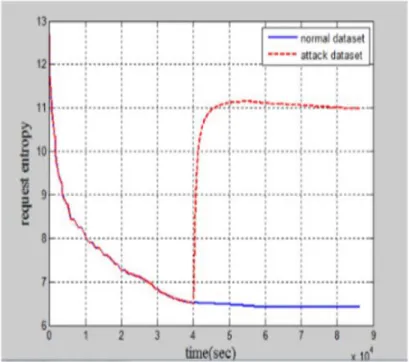
12. Normal and Attack Request Entropy ...54
Chapter I: Introduction Introduction
Distributed Denial of Service (DDOS) attacks are one of the most prevalent threats among other cyber-attacks. Among many DDOS attacks on the seven OSI layers, the ones executed on network, transport, and application layer are of the highest volume (network and transport—46% and application—54%) (Kostadinov, 2013).
This paper’s focus is to study the vulnerabilities within a network and application layer
that leads to DDOS attacks and to compare various detection techniques used to secure these two OSI layers. It will delve into specific network and application layer attacks and their detection techniques in a way to cover ample information for comparative analysis which will be conducted using specific performance metrics.
The paper will be divided into three sections. The first section will be transport layer attacks and detection techniques, the second section will be network layer attacks and detection techniques, and the third section will be application layer attacks and detection techniques.
In the first section, there will be literature reviews of specific attack’s detection and mitigation techniques. These techniques will be analyzed either quantitatively or qualitatively based on the performance metrics used within a particular research article/paper.
The performance metrics like false positive/false negative rates (high or low), memory consumption, high rate traffic accuracy detection, and low rate traffic accuracy detection are used to conduct the comparative analysis of various detection techniques. The paper will also have qualitative analysis based on the advantages or disadvantages of the mitigation techniques.
The results of the paper would focus on the best five mitigation techniques that proved to be efficient in delivering the results based on the comparative analysis.
The most common DDOS Application layer attacks consist of HTTP GET Floods, HTTP POST floods, PUSH floods, and HEAD floods. The application layer DDOS attacks are way more difficult to mitigate and are not easily prevented using firewall layer security or just blocking IP’s. There is ongoing research being conducted in this area and not much information
is out there in terms of discovering an extremely effective solution to this layer of DDoS attacks.
Problem Statement
DDOS attacks on network, transport, and application layers are one of the most predominant cyber-attacks and are of the highest volume compared to other OSI layers. Moreover, application layer attacks are difficult to prevent because they are low rate attacks (sneaky) making it appear as normal traffic. This paper presents a comprehensive survey of various methodologies implemented by researchers and engineers to detect DDOS attacks at network, transport, and application layers with their comparative analysis.
Nature and Significance of the Problem
Network, transport, and especially application layer DDOS attacks are becoming common since the last few years. Application layer DDOS attacks are more cost effective, easy to evade defenses, difficult to detect, and causes extensive damage. This research paper’s aim is
to compare the detection techniques/methodologies provided by researchers from various mathematical (machine learning engineers) and security backgrounds. It would showcase the wide usage of machine learning in regard to detecting these attack scenarios. It is also necessary to keep in mind that machine learning is still in its development stages and monitoring its results
and inputs on a frequent basis is of utmost importance. This paper would not only help with DDoS attacks, but the machine learning methodologies’ fundamentals explained here would be helpful in other security related threat/vulnerability scenarios.
Objective of the Research
The objective is to present a comprehensive survey of various detection techniques for DDOS attacks at network, transport, and application layers and present a comparative analysis to help prepare different mitigation approaches. This is a theoretical approach using quantitative data from various tested methodologies and its varying results in a test environment. This paper’s focus is to provide future researchers with the fundamental knowledge of machine learning algorithms for DDoS detection and the capabilities it holds regarding molding these algorithms to work for mitigating these attacks. This will not only impact the way we approach security, but the policies involved while dealing with security threats and vulnerabilities. It is about entering a technological era where we need to be more vigilant of the tools (like machine learning)
available to us that could be useful (if used carefully). It is important to understand these methodologies because not only it has implementations in detection and mitigation but also in creating new attacks. If we do not understand these techniques then bad actors using these methodologies to create attacks could have a disastrous impact on a
company/organization/nation during a security threat/emergency due to our lack of knowledge/understanding of the attack tools (like machine learning) that could have been potentially used. As the famous saying goes in cyber-security “a defender has to know
everything in order to protect valuable information from attackers; whereas an attacker just needs to know/exploit a single vulnerability within a system to render all defenses useless” making it
highly important to know every aspect of security threats. Machine learning could prove to be one which if not studied and developed well by the good guys for defense, then an attack (using ML alg.) by bad actors can be quite difficult to mitigate.
Research Questions and/or Hypothesis
• Research Question 1. What is the false positive and false negative rate?
(Quantitative)—the before and after study. This is the most challenging part of the paper as it would be difficult to compare the results or performance of a detection technique since each would have a different rate of attack flow. For this reason, I would simplify it and trim it down to the detection rate accuracy, false positive, and false negative rate, forming better understanding.
• Research Question 2. How effective is it in terms of detecting these attacks? (Quantitative Analysis-Survey Comparison)
The above questions can later help with the longitudinal study of being able to do continuing research to find resolutions and solutions for the vulnerabilities which were not addressed or left out due to the limitations of these mechanisms. Therefore, this research paper could be helpful for other researchers who want to do thesis or continue the study on DDOS attacks prevention mechanism (more effective than the ones discussed in this paper). This is more of a retrospective and non-experimental study for the fact that the results obtained are from the past tests done within a test or real environments; which are being used for the comparative analysis.
Shortcomings
This research would not be able to test out the machine learning algorithms’ tools as it is
practically not feasible to create a scenario to generate a high volumetric DDoS attack or varied behavioral application layer attacks due to the time constraint (it would take months just to test out one algorithm and making it learn different attack patterns to test out its true efficiency or effectiveness and let alone create a volumetric attack (it would require a high network bandwidth and big data centers to create a real scenario)). To just test out on a small network or a laptop/PC would be meaningless; since the real attack scenario would be way more complicated and/or would consist of high-volume network attack traffic. Therefore, it would not develop the correct test results necessary to be able to determine its true efficiency and/or effectiveness in a real-world situation.
Definition of Terms
➢ ARP: Address resolution protocol matches the physical address to right IP address when
a host needs to send packets across a physical network. It could be between Ethernet and IP addresses or ATM (asynchronous transfer mode) and Ethernet.
➢ BGP: Border Gateway Protocol is the protocol responsible for transmitting data to the
client using the best route (hops) available. It performs this task based on the available paths and network policies set by the network admin.
➢ Botnet: It is a group of connected computers used to perform repetitive tasks. It is also
used by attackers through infecting these computers also called as zombies to perform DDOS attacks.
➢ Cache: The most common caches are memory cache, processor cache, browser cache,
and disk cache. It is a temporary storage of information by a computer, browser application, or processor that can later be accessed by a that program at a much faster rate.
➢ CDN: Content Distribution Network is a group of servers that cache content and are
distributed across many geographical locations; help in delivering the content faster. The web server accesses the server (CDN network) closest to your location.
➢ Datagram: It is like a packet, but it does not need a confirmation (connectionless
communication) that it was received. It is popular amongst streaming services due to its efficiency of continuous delivery over reliability.
➢ DDOS: In this attack, multiple machines operate together as a botnet to flood the target
system. It is the same concept as DOS except it done on a large scale.
➢ Deep Learning: It is a subset of ML that uses perceptron like our human brain to compute
various features based on the assigned weight or the weight assigned by the algorithm if it is unsupervised. Artificial Neural Networks (ANN) can be a good example of deep learning algorithms.
➢ DNS: Domain Name System helps translates domain names (e.g., google.com) into IP
addresses; thereby allowing you to access a website using their domain name (google.com).
➢ DOS: Denial of Service is a cyberattack where the attacker tries to consume network
resources, devices, or host systems and flood it to the point that it is no longer available for normal users to access.
➢ Fuzzy C Means: This algorithm is a clustering methodology where each data point is assigned to the cluster based on the distance between the data point and the cluster’s
centroid. The results (both clusters centroid and the data points assignment to a cluster) are recomputed till we get an efficient and effective result.
➢ HTTP: Hypertext transfer protocol is used for communication between a browser and a web server or “between intermediate machines and web server.” It operates at the
application level and uses TCP as a reliable transmission method since it does not provide its own reliability.
➢ HTTP-GET request: This is the browser that sends the GET request and to this the server
responds with the information that was requested.
➢ HTTP-POST request: This sends the data to the server and it usually done using HTML
form.
➢ I/O bandwidth: Bandwidth is the rate at which data gets transmitted. I/O bandwidth
means the rate at which the data is transmitted to (input) or from (output) a device. ➢ ICMP: Internet control message protocol is used by routers to send error or control
messages to other routers or hosts. It provides communication between various Internet Protocol software.
➢ IPV4: This is the fourth version and one of the core Internet protocol. It is described in
RFC 791.
➢ ISP: This is the Internet Service providers like Comcast, Qwest, and others. They provide services for users to access or participate in the online world (Internet). ISP’s can provide
these services through multiple methods like DSL, dial-up, cable, and wireless.
➢ K-means: This is an unsupervised clustering algorithm where the number of clusters (k)
is fixed beforehand. The data points are assigned different clusters based on the data points features. Each cluster has its centroid
➢ KNN: K-nearest neighbor is a classification method where the probability of a data point
(X) belonging to one group or another relies on the distance of other data points (belonging to a group) closest to X.
➢ Machine Learning: This is a form of computer learning done using various algorithm that
are fed data for different purposes to create an autonomous system that can perform a task at high efficiency and speed. The algorithms that are fed data improve over time as they learn new patterns and behaviors.
➢ Multinomial Naïve Bayes: In multinomial Naïve Bayes, each data point from one
classification is related to another data point from a different classification. It also takes into consideration of multiple instances.
➢ Naïve Bayes: This algorithm works using Bayes theorem that relies on classification of
objects based on the features. It is probabilistic since each data point can be reassigned if new developments are made. Each datapoint is independent of the other.
➢ NAT Table: The Network Address Translation table is the most important part of the
NAT functionality. It is processed within a router or a NAT enabled device for incoming and outgoing packets. The table keeps track of all the re-assigned IP addresses and ports.
This helps in sending the message to the right local host IP received by the public through translating the public IP to local host IP and port number.
➢ OSI Model: This is called Open Systems Interconnection Model created by International
Organization for Standardization (ISO) which contains seven layers in this order: Physical Layer, Data Link Layer, Network Layer, Transport Layer, Session Layer, Presentation Layer, and Application Layer.
➢ PCA-Naïve Bayes: PCA is a statistical method that is used for extracting relevant
information from multidimensional datasets. This is then combined with Naïve Bayes algorithm used in certain situations.
➢ Python: This is an object-oriented language that has clear syntax with its ability to work
across various platforms like UNIX, MAC, and Windows.
➢ SCAPY: This is a python program mainly used to inspect, send, sniff, or forge network
packets.
➢ Sci-kit Learn: This is a machine learning library that consists of algorithms like SVM,
Random Forests, K-means, DBSCAN for classification, regression, and clustering; created using python programming language.
➢ Slowloris: This is a DDOS attack conducted from a computer requiring minimal bandwidth by sending partial HTTP requests to the target’s web server.
➢ SMTP: Simple Mail Transport protocol is used to send mail over the internet through
applications like Outlook, Thunderbird, and eM client. It is simpler than MTP where the communication between two machines/servers contains readable ASCII text.
➢ Smurf Attack: Smurf-malware is a way to conduct DDOS attack at Network layer using ICMP and IP protocols’ vulnerabilities.
➢ Sockets: This is related to network. A computer application/program establishes
connection with the internet through socket; which allows data to be read and written over the network.
➢ SQL Injection: This is a vulnerability related to the database. It is done by injecting
malicious code into an application that is not designed keeping security in mind. Any vulnerabilities in the database related to sql queries can be exploited; thus, giving the attacker the access to potential sensitive information.
➢ SVM: Support Vector Machine is a machine learning algorithm used for classification
and regression analysis.
➢ TCP: Transmission Control Protocol is a standard that uses three-way handshake to
establish and maintain reliable network communication via IP network; which is used by application programs to exchange data.
➢ UDP: This is called User Datagram Protocol that sends messages between machines
using IP through connectionless delivery service. It is best used for VOIP and DNS lookup due to its effectiveness in fast message delivery as it does not use any “handshake” method for secure transmission.
➢ Wordpress XMLRPC: This method of data transmission is done using HTTP as
transportation method and XML to encode the information. It makes communication of Wordpress with different systems efficient.
➢ XSS: Cross-Site Scripting (XSS) is an attack that inject malicious code into a web
application. So, once a victim opens a website containing that injected code, it (victim’s computer/device) gets infected with the malware or virus.
Summary
This chapter focused on the brief introduction of DDOS attacks, the problems associated with it, detection methodologies that may be used, questions that need to be answered related to this study, and the shortcomings of this research paper.
Chapter II: Background and Review of Literature Introduction
The chapter “Literature Related to the Problem” focuses on analyzing attack
scenarios/methodologies on transport (Layer 4), network (Layer 3), and application (Layer 7) layers of the OSI Model and the vulnerabilities present within these three layers that are exploited to carry out a successful DDoS attack. The most widely used protocols within these layers to carry out DDoS are UDP, TCP, ICMP, and HTTP methods. After careful description of the problem the next section “Literature related to the methodology” delves into various
detection techniques to help identify anomalies within the network infrastructure. After careful and rigorous research into various methodologies used to detect DDoS, machine learning is the most promising one due to its capability to adapt to new varied attack patterns and behaviors.
Background Related to the Problem
The main focus of this section would be addressing the attack scenarios (problem) to understand the traffic flow and how one can carefully differentiate between normal flood traffic (normal surge times during the day-where this is observed on a regular basis) and the anomalous flood traffic that can be detected through an identifiable pattern. This section would also focus on the slow-rate application layer attacks that are more difficult to identify. After a thorough
explanation of the attack scenarios, this section would continue with the analysis of research articles’ detection techniques as an “exploratory research” to provide future researchers with
Literature Related to the Problem
According to Sieklik (2016), web threats were almost up to 600% by year 2015. Most of these web threats were DOS and DDOS attacks. This article talks about Amplified DOS attack which is causing havoc in the past few years. DOS Amplification is the most frequently used attack methodology. An attack in 2013 on Spamhus caused a peak flow of 300 Gbps and there were other reported attacks in 2014 of which one was of 421 Gbps. The DDoS Amplification attack could be carried out using uninfected machines suffering from ‘protocol or other flaws’
(Sieklik, 2016). Though DDoS attacks are quite significant, the complex DDoS attacks are more of a concern as per the article (Sieklik, 2016). There are some claims made that DDoS attacks take almost about 5% of the total Internet traffic which is a huge number when it results in a bandwidth of terabytes per second regardless of the time in the day. Moreover, the survey done by Corero Network Security shows that 38% of United States enterprises experienced DDOS attacks in 2013 whereas 42% of these companies have gone through multiple attacks
(Vadlamani, 2013).
Transport Layer Attacks
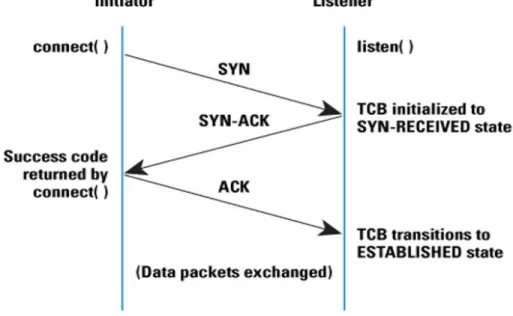
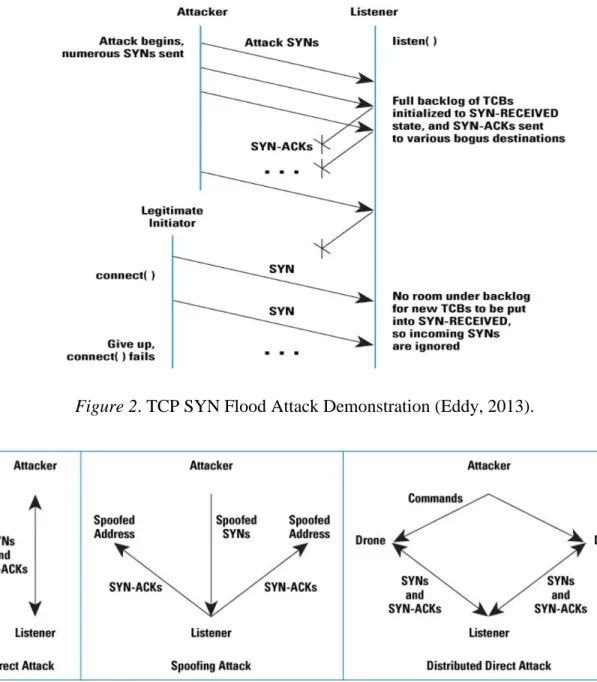
TCP-SYN: SYN Flooding is an attack where the client sends SYN packets continuously to every single port possible on a server using spoofed IP address. The server responds to the client with ACK packets but the client (hostile) never responds to these servers with an ACK packet. Instead, the client keeps sending SYN packets and since its IP is spoofed there is no way for the server to close the connection by sending RST packets. Its connection stays open and before there can be a time-out, the server receives another SYN packet from the hacker’s machine (client) and this is SYN Flood attack which is also called half-open connection. The
reason it is called half-open is due to the fact that a TCP connection needs a three way handshake between a client and the server in order to establish a connection whereas in a SYN flood attack only SYN packets sent to the server is needed, to which the server sends an ACK packet but never receives SYN-ACK (acknowledging the request to connect) from the client. In a three-way handshake the client sends SYN packet to which the server sends an ACK packet and finally the client sends SYN-ACK packet to the server. The SYN packets consume the server to an extent that it is unable to receive any communication from legitimate clients. UDP flooding is like ping attacks where continuous flow of these packets is sent on the ports of the server to make it unavailable for the legitimate traffic (users). The maximum size of its packet could be set to 65000 bytes leading it to flood an Ethernet network in case of multiple zombies being used. UDP is considered, to be much more effective on a smaller network since the size of their packets is huge (Subramani, 2011).
Figure 2. TCP SYN Flood Attack Demonstration (Eddy, 2013).
Figure 3. Variants of the Attack (Eddy, 2013).
• TCP Reset: Forged TCP resets are sent to the victim’s server/host by sniffing victim’s IP and port addresses as well as current TCP connection sequence numbers. The attacker gathers the required information to forged reset packets by tricking the victim to connect
to a malicious Wi-Fi or by sniffing WIFI packets if the victim is in close range. The attack is carried out using SCAPY in python through the tcp-reset.py script.
• TCP Fragmentation: The attack is carried out to bypass firewall’s filtering rules by fragmenting TCP packets with the header flag field pushed into the second fragment. Another method involves overlapping fragments where the first segment passes through the filter whereas the second fragment overwrites the TCP header data with malicious payload. These fragments could also be sent at a low time-rate to avoid any timeout for any of these fragmented packets’ connection which later puts load on the resources trying to assemble the packet and waiting a long time for defragmentation. At a higher layer it creates overhead in the bandwidth (for transmission) since each fragment possesses both L2 and L3 headers. In this case smaller fragments lead to higher overhead.
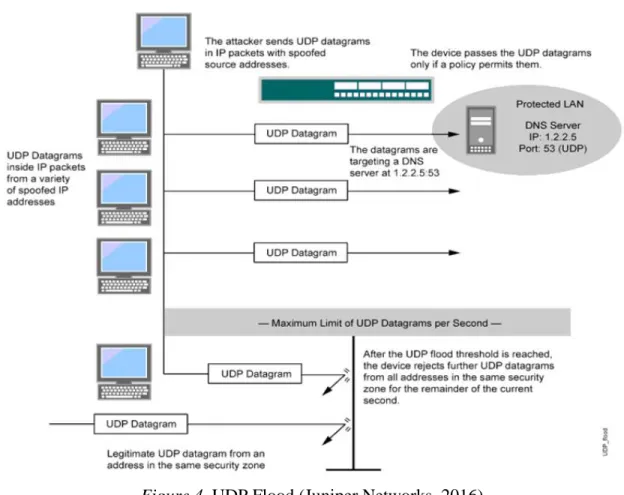
• UDP flooding: It is a little like ICMP flood attack except the server does not reply-back to the attacker’s machine. It rather involves sending extensive amount of large UDP
packets to either random ports or a destination address. Moreover, it is easily spoofed as it is a connectionless protocol which does not have the three-way handshake method of connecting with the server. Most of these attacks are executed at the firewall level to block the internet connection making it inaccessible for the normal users. Here is the diagram showcasing the working of the attack:
Figure 4. UDP Flood (Juniper Networks, 2016).
Network Layer Attacks
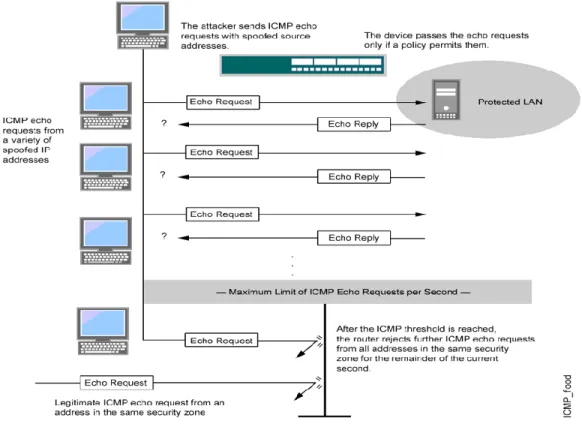
ICMP or Smurf attack. ICMP flood attack is basically ping attacks done on the victim’s server which involves an attacker consuming the server’s resources with ping packets (echo
requests) using spoofed IP addresses. So, when the server tries to echo reply back to the user (attacker) it is unable to reach the destination as its IP address is spoofed. ICMP flooding or ping flooding is where a host (victim) gets sent thousands of ping packets. Ping of death is where the victim gets sent corrupt packets leading to a possible system crash. The article by Juniper Networks (2016) explained the workings of the ICMP attack using the diagram shown below:
Figure 5. ICMP Flooding (Jupiter Networks, 2016).
Application Layer Attacks
Application Layer Attacks are stealthier for the main reason that it is a low rate (low bandwidth) attack requiring minimal resources which then gets accompanied by network layer attacks. It is targeted for the purpose of causing disruptions in transactions, search functions, web browser function, email services, and access to databases. This leads to consumption of available memory, server dependent requests; or acquiring sensitive information like IP address and version of the software used. This attack falls under DDoS only when more than three to five nodes on various networks are being consumed otherwise it’s a DOS attack (Patrikakis, Masikos, & Zouraraki, 2015).
There are two major application layer DDoS attacks: HTTP Flood and Slowloris among others such as DNS dictionary attacks, VoIP (SIP Invite Flood attack), and SMTP buffer
overflow attacks (Kostadinov, 2013). There are three HTTP flood attacks which includes HTTP GET, HTTP POST, and HTTP Slow read. HTTP GET is where the attackers try to download a file from a website using large number of botnets; thereby consuming the webpage with thousands of download requests. A legitimate user ends up waiting for infinite amount of time for the file to finish downloading since the server or database powering the web page is flooded with attackers GET request packets. In a HTTP POST flooding attack, the hackers use a form like customer feedback, questions, or login page to send large number of http post request packets. The hackers can also create an XSS script attack using http post method. This could further lead to other attacks such as SQL injection thereby corrupting or deleting the database. This attack type can also focus on exhausting the server resources like sockets, CPU, memory, disk/database bandwidth, and I/O bandwidth.
Many companies these days are implementing CDN (content distribution network) service which is caching the web content on separate servers located at different geographical locations to help provide the users a fast access to the website. CDN has its own firewall implemented but attackers can bypass these firewalls and reach the backend server. The vulnerabilities found within this system of which one out of many others is “login and authentication pages are not cached but are linked to the main server” which also stores the users’ database. Hackers can execute HTTP POST flood attack using either the login or
authentication pages. This is more of a slow-send HTTP POST attack which can be executed using the Slowloris tool as it delves into tying up server’s resources through continuous flow of
incomplete legitimate HTTP request packets that is in open state waiting for the completion of the request (Gonzalez, Stakhanova, & Ghorbani, 2013). The slow read attack is where the attacker sends a legitimate HTTP request to the server and then reads the response at a very low speed. Since, the attacker sends the zero TCP window size (or close to zero) to the server, the server is in the pretense that the attacker is reading the data, thereby keeping the connection open. Its main idea is to drain the TCP receive buffer, leading to a heavy consumption of the server’s resources, and thwarting normal users’ requests for connection to the server.
These attacks can be mitigated by the ISP or an enterprise level organization using BGP that reroutes the traffic to a DDOS mitigation provider, such as DDOS-Guard, Redware,
NetScout (just used as an example and not promoting it or concluding it to be great or bad), which are also called scrubbing centers that analyzes and scrubs the malicious traffic.
Literature Related to the Methodology
After thorough and intensive research into various methodologies like signature-based algorithms used to detect DDoS, machine learning seems to be the best way as they show the promise in terms of adapting to the varied behavior of the attacks. Overtime it can learn from its past attack patterns and attack algorithms, provided the method to detect is a supervised and/or semi-supervised machine learning algorithm (since unsupervised algorithm though could be effective, the results might not always be as desired and the algorithm’s adaptive learning strategy is still under development). After doing intensive research and study on machine learning algorithms, the unsupervised algorithm is the most unpredictable in terms of detecting and has the potential to generate high false positive rate.
To be able to implement ML algorithm (especially creating a new one) it is recommended that one has enough knowledge and proficiency in statistics, calculus, and python to be able to understand the workings and implications; so as to ensure its efficiency. One can still use the ML algorithms that are already released and proven to be effective, but a basic understanding of statistics and python can go a long way in terms of understanding the use of parameters (supervised and semi-supervised) in determining the outcome of the results. Some of the well-known ML algorithms used for DDOS detection are SVM, KNN, K-means, Fuzzy C Means, and Naïve Bayesian.
Another subset of machine learning is deep learning which has the potential to look for minor anomalies within the data-packets which can be conducted using structured supervised and/or semi-supervised implementations.
Transport Layer Detection Techniques
Research Article 1. As per the article by Hoque, Bhattacharyya, and Kalita (2016), a covariance analysis model is considered to be very useful in detecting SYN flooding DDoS attacks or any other attacks which shows activity for even minimal abnormal behavior (DDOS attack). Another method proposed by Peng (2004) (another source used within this article (Hoque, 2016) is a sequential nonparametric change points that uses IP addresses to analyze network traffic and detect the bandwidth DDoS attacks. This methodology is very useful as it detects the attack way before it is executed on the server. For low rate DDoS attack such as ‘generalized entropy and information distance metric’(Hoque, 2016), a trace-back methodology which adjusts the value of order α of the generalized entropy and information distance metrics
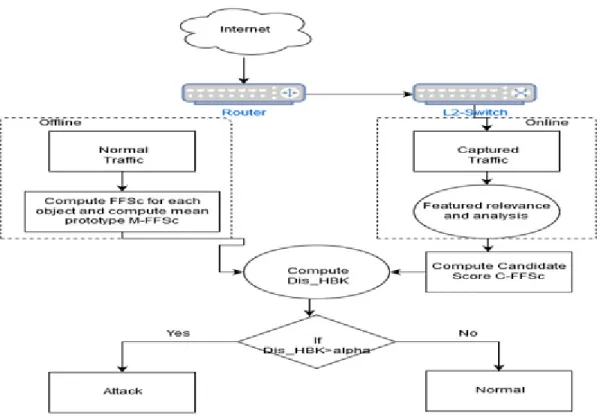
could be useful according to Xiang. Furthermore, the article talks about its own methodology for detecting the attacks called FFSc measure that analyzes every single network traffic sample and object. There are two phases of this methodology i.e. ‘(i) normal traffic analysis phase and (ii) captured traffic analysis phase’ (Hoque et al., 2016). Figure 6 shows the description of the
methodology:
Figure 6. FFSc Methodology to Detect Attacks (Hoque et al., 2016).
Research Article 2. This article mentions using SVM as the detection technique for DDoS attacks. SVM is used as a classifier to help get the best margin between training patterns and decision boundaries. It is a part of kernel methods to prevent the quadratic growth in the memory. They used feature selection method by implementing genetic algorithm created as a parallel algorithm using MapReduce program focusing on extracting source and destination ports, sequence and acknowledgement numbers, the SYN and ACK-TCP flags, and TTL for the
classification of anomalous vs. normal traffic. In respect to extracting the anomalous and normal traffic they used TShark from the pcap files; where their specific study had total 7126 feature vectors out of which 4999 were DDoS and 2127 were normal traffic. Later this data obtained by SVM was evaluated using cross-validation method that divides data into various partitions; and these partitions are separated to be used either for testing or training. This study created an equal 10 partitions where one partition was used for testing and the remaining nine were used for training. Later this process was repeated for about 10 times to get the average of the cross-validation method. Additional measures like sensitivity, specificity, average classification
accuracy, F-measure and ROC curve were taken to evaluate the accuracy of the metrics (Masetic, 2017).
Sensitivity is a measure that identifies the performance of its classifier in
determining true positives; which is defined by the formula 𝑇𝑃
𝑇𝑃+𝐹𝑁∗ 100 (TP=number of
true positives, FN=number of false negatives) (Masetic, 2017).
Specificity is a measure that identifies the performance of the classifier in
determining true negatives; which is defined by the formula 𝑇𝑁
𝑇𝑁+𝐹𝑃∗ 100 (TN=number of
true negative, FP=number of false positives).
Average classification accuracy looks into the average of both the True Positives (Sensitivity) and True Negatives (Specificity); which is defined by the
formula𝑆𝑒𝑛𝑠𝑖𝑡𝑖𝑣𝑖𝑡𝑦+𝑆𝑝𝑒𝑐𝑖𝑓𝑖𝑐𝑖𝑡𝑦
F-measure checks for the performance of the model itself; which is defined by the
formula 2𝑇𝑃𝑖
2𝑇𝑃𝑖+𝐹𝑃𝑖+𝐹𝑁𝑖 (TPi=true positive rate of ith class, FPi= false positive rate of the ith
class, FNi= false negative rate of the ith class).
ROC curve is a measure that identifies the ability to differentiate various statistical methods by plotting true positives on y axis and false positives on x-axis. Later the classification performance is measured by calculating the various means of “area under the curve” (Masetic, 2017). The size of the area directly corresponds to the effectiveness and efficiency of the classification model (large area=more efficient model).
Using all these factors and analytical methods they were able to generate results that showcased that their algorithm was able to detect true positives and true negatives with the accuracy of 100%.
It seems to be very promising in the training environment but when this method was tested in the actual environment where attacks were performed by various outside (similar to a production environment) members than this study proved to be less accurate and efficient. This proves that the algorithm though effective needs a long duration of learning time for the
researchers to have the ability to modify the methodology design as necessary.
Research Article 3. This research focused on using three different clustering methods namely K-means clustering with single arbitrary set of initial k-means, K-groups of clusters, and K-means clustering with optimal initial means. The ML training datasets used for this study was MIT DARPA, Auckland-I, Auckland-II, and SETS.
As we know about the TCP protocol, it has dependencies when in communication between two parties in respect to the flags generated. For example: SYN/ACK is followed by a
SYN packet received from the client and an ACK packet is followed by the SYN/ACK received from the server to the client. It is important to ensure that combinations like SYN/ACK and FIN/ACK are not considered malicious as it is part of normal traffic and communication. The idea of this research in respect to detecting TCP protocol DDoS attacks were to look within the abnormal combination of TCP flags (generally never seen in a normal traffic-like XMAS (FIN/PSH/URG) attack, SYN/FIN, SYN/FIN/PSH, SYN/FIN/RST, SYN/FIN/RST/PSH, and others (total of 15 combinations)), windows size burst error caused by zero-windows-size, fragmented packets less than 400 bytes for IPV4 and less than 1280 bytes for IPV6,
acknowledgement number, sequence number, and the payload within the traffic received by the server. There were also parameters for detecting valid flag combinations that are rarely seen in traffic (13 combinations in this research).
Using these parameters, a probability distribution was created as follows: 1. Observables were grouped into 6 (T1 to T6).
2. Discrete Random Variable Xiper observable group i= number of packets of type Ti observed in a window.
3. Outcome set Oi= {0,1,2,3. . . N}, where N= window size.
4. The probability of observing ci packets of type Ti in a window is P(Xi=ci). 5. 5.P(Xi=ci) =number of windows with ci packets/T, where T= Total number of
training windows.
6. Probability of a window W with c1 packets of T1, c2 packets of T2…c6 packets of T6 (c1+···c6 = window size N) =P(X1=c1) ∗···P(X6=c6), by NB independence assumptions. (Vijayasarathy, 2012)
Research Article 4. Multiple algorithms were used in this research paper to study the effects of Transport Layer attacks (namely UDP and TCP). Classifiers such as Naïve Bayes, MLP-ANN, Decision Trees, and SVM were used to compare and analyze the accuracy, precision, recall rates of both DDOS and normal packets (Alkasassbeh, 2016).
Decision trees are non-parametric supervised learning method widely used in data mining for classification and regression analysis. The main idea of using this methodology in this study is to create an efficient model predicting the value of a target variable through continuous learning of simple decision rules that are implied using the data features. The structure of decision tree contains three nodes: root node which is the top node that has no input but zero to multiple outputs, internal node has one incoming input and two or more outgoing outputs, and leaf node has one incoming edge (input) and no outgoing outputs. The parameter used to
categorize transport layer traffic into normal, anomalous, or other is source port, destination port, number of SYN flags from a source to a destination port, packet id, packet type, packet size, flags, FID, sequence numbers, number of packets, number of bytes, packet-in, packet-out, packet-rate, byte-rate, packet average size, utilization, packet delay, packet send time, packet reserved time, first packet sent, last packet received, node name from and to, and from and to a node.
Naïve Bayes was used by first setting a set a variables such as 𝑋 = {𝑥1, 𝑥2, 𝑥3, … 𝑥𝑛} for the event 𝐶𝑗 where 𝐶 = {𝑐1, 𝑐2, 𝑐3, … 𝑐𝑛}. Based on Bayes theorem we get
𝑝(𝐶𝑗|𝑥1, 𝑥2, 𝑥3, , 𝑥𝑛) ∝ 𝑝(𝑥1, 𝑥2, 𝑥3, , 𝑥𝑛|𝑝(𝐶𝑗). 𝑃(𝐶𝑗)); where p(𝐶𝑗|𝑥1, 𝑥2, 𝑥3, , 𝑥𝑛) is the
probability, such that X belongs to 𝐶𝑗. Based on the Naïve-Bayes algorithm which defines the
equation (“product of terms”) is rewritten from 𝑝(𝑋|𝐶𝑗) ∝ ∏𝑘=1𝑑 𝑝(𝑥𝑘|𝐶𝑗) to 𝑝(𝐶𝑗|𝑋) ∝
𝑝(𝐶𝑗)∏𝑘=1𝑑 𝑝(𝑥𝑘|𝐶𝑗), where 𝐶𝑗 represents jth class of classes {1,2,3…v}, 𝑥𝑘 represents feature
vectors of kth sample of samples {1,2,3…w}, 𝑝(𝑋|𝐶𝑗) is the probability to observe the pattern x
given that it is in class 𝐶𝑗, 𝑝(𝐶𝑗|𝑋) is the probability of pattern/event x occurring given that it
belongs to class 𝐶𝑗; and a new case X is now labeled with class 𝐶𝑗, thus achieving the highest
posterior probability. Posterior probability is the probability of a sample i belonging to a class j given its observed feature-vector 𝑥𝑘values.
Based on another research article’s (Riadi, 2017) explanation of the ANN algorithm which is used to detect transport and network layer DDOS attacks, can help support the results of this research study. So, in brief ANN is a computational model that is inspired by biological neural networks found in human brain composed of neurons with various processing capability. ANN can have either single or multiple layers of neurons. The study by Sofi, Mahajan, and Mansotra (2017) used confusion matrices as part of the ANN algorithm; which is basically a form of visualization that helps in understanding the performance of the neural network. The paper also used SVM to help in distinguishing and separating IP addresses based on different classes (normal and anomalous). The specific SVM used is the (C-SVC) c-support vector classification for training the algorithm and then testing the normal and attack traffic datasets. The datasets were created by the researchers using the process of collecting and auditing network traffic, preprocessing it to remove redundant data, and then using feature extraction to identify relevant parameters for detection.
The dataset is evaluated using the WEKA 3.8 tool in Ubuntu 16.04 LTS platform. The algorithms are trained using the 66% collected data and the rest 34% using test data created in
the experiment phase. They also used k-folds (here k=10) cross validation, where the original sample is randomly partitioned into 10 equal sized subsamples. Out of the 10 subsamples, one subsample is reserved as the validation data for testing the models and the remaining nine samples are used as training data. The class label of training data was eliminated through the conversion of csv file format to ARFF file format. Including the class label there are 28 attributes present, which is evaluated for performance using the confusion matrix as presented in Tables 1, 2, and 3 (Alkasassbeh, 2016).
Table 1
Confusion Matrix for MLP (Alkasassbeh, 2016)
Table 2
Table 3
Confusion Matrix for Naïve Bayes (Alkasassbeh, 2016)
The Confusion Matrix is calculated using the following equations for accuracy, precision and recall:
Accuracy is where it measures the rate of the correctly classified attack instances of both classes”(Alkasassbeh, 2016) represented as 𝐴𝑐𝑐𝑢𝑟𝑎𝑐𝑦 = 𝑇𝑃+𝑇𝑁
𝑇𝑃+𝑇𝑁+𝐹𝑁+𝐹𝑃
“Precision is the ratio of the number of relevant attacks retrieved to the total number of irrelevant and relevant attacks retrieved” (Alkasassbeh, 2016) represented as
𝑃𝑟𝑒𝑐𝑖𝑠𝑖𝑜𝑛 = 𝑇𝑃
𝑇𝑃+𝐹𝑃
Recall is a ratio of the number of relevant attacks retrieved to the total number of relevant
attacks, which is represented as 𝑅𝑒𝑐𝑎𝑙𝑙 = 𝑇𝑃
𝑇𝑃+𝐹𝑁
Network Layer Detection Techniques
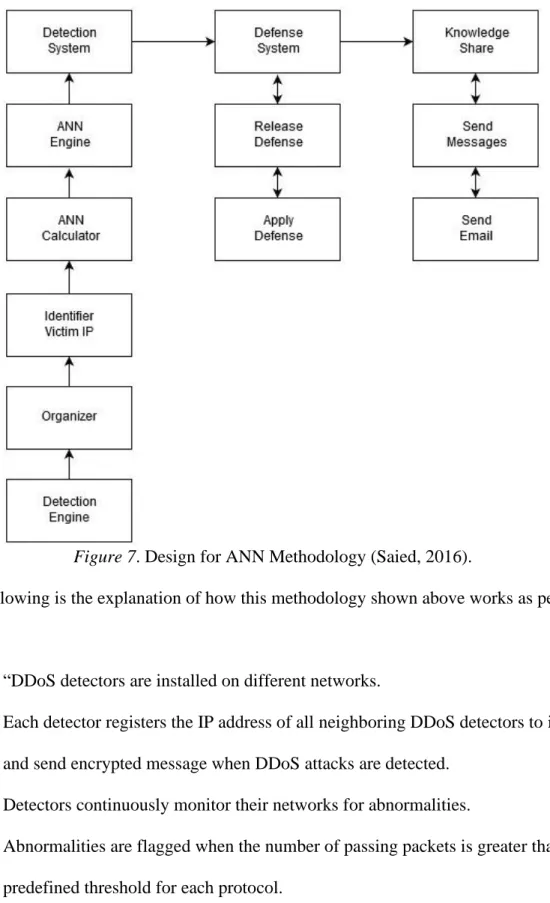
Research Article 1. To detect DDOS attacks, Saied (2016) talks about using Artificial Neural Network (ANN) Algorithm. This algorithm is focused on detecting known and unknown attacks in real time while separating the DDOS attack traffic from genuine traffic to make sure that the genuine traffic is not dropped. Here is the image showing the design of the methodology of ANN:
Figure 7. Design for ANN Methodology (Saied, 2016).
Following is the explanation of how this methodology shown above works as per Saied (2016):
1. “DDoS detectors are installed on different networks.
2. Each detector registers the IP address of all neighboring DDoS detectors to inform and send encrypted message when DDoS attacks are detected.
3. Detectors continuously monitor their networks for abnormalities.
4. Abnormalities are flagged when the number of passing packets is greater than a predefined threshold for each protocol.
5. If the number of packets is greater than the threshold, then: a. The organizer sorts the packets accordingly.
b. The IP identifier identifies the victim's IP addresses.
c. The ANN calculator calculates retrieved patterns and prepares them for the ANN engine
d. The trained ANN engine takes the patterns as inputs and produces one output (1=attack or 0=normal).
e. Before activating the defense system, the steps under point 5 above are repeated twice more, producing a total of 3 outputs.
6. The defense system receives the outputs from the detection component and:
a. If the outputs are (0,0,0), then no action is required by the defense system, as the traffic is clean.
b. If the outputs are (1,1,1), (1,1,0), (1,0,1) or (0,1,1), it activates defense and stops the attack while allowing genuine traffic to pass through.
c. If the outputs are (1,0,0), (0,1,0) or (0,0,1), the solution repeats point 5. If the outputs of the new retrieved traffic are:
I. (1,1,1), (1,1,0), (1,0,1) or (0,1,1), activate the defense system.
II. (1,0,0), (0,1,0) or (0,0,1), deploy mitigation as this is considered to be a low rate attack.
III. (0,0,0), no actions are required.
d. However, if the output is none of the above, then the system generates value 2. This means the traffic is unidentified (not used in training) by the ANN. At this
point, the solution checks its local record to learn if the same traffic is received and detected by neighboring DDoS detectors. If the received traffic from the neighboring detectors is 1 or 0 then the algorithm is outdated since its detection was 2 while other detectors identified the traffic as 1 or 0. This means the algorithm on the local DDoS detector needs to be retrained (off-line) with both existing and new patterns. Otherwise no action is taken.
7. The knowledge sharing component sends encrypted messages containing the type of the attack; destination IP address and protocol involved to all registered neighboring DDoS detectors. Such information is also composed by the email element and sent to the security offices to take countermeasures if required or for the purpose of logistics or forensics.” (Saied, 2016, pp. 385-393)
If this methodology gets proven to be successful and is implemented, then it could help in minimizing killing all traffic (incl. genuine traffic) while trying to protect the system from
DDOS traffic.
Research Article 2. The proposed method for detection of ICMP attacks in this research experiment was Semi-Supervised Fuzzy C-Means Clustering. The process used to detect and for learning stages is as follows:
I. Learning stage involves:
a. Forming a set of parameters based on past and current knowledge obtained from various researches and the IT security industry that are relevant in the detection of DDOS attack.
b. Showcasing the obtained information about these attacks based on the parameters studied to identify the attack.
II. Detection stage technique involves:
a. Collecting inbound and outbound traffic for our dataset
b. Extracting relevant parameters from the traffic that can be used for the identification of a potential DDOS attack and to create parameter-vectors. c. Building the parameter-vectors from the information available in the network
traffic.
d. Implementing the algorithm as per the parameter-vectors used to label it as either attack traffic or normal.
e. Isolation of hosts that are affected by the attack.
The parameters/features used to help identify an attack are p (transmission protocol), 𝑓𝐼𝑂
is a Boolean feature to identify if an inbound traffic has a correlated outbound traffic, 𝑝𝑂𝐷 is the number of packages that are transmitted on its journey from origin to destination, 𝑏𝑂𝐷 is the
“number of bytes transmitted from origin to destination” (Lysenko & Savenko, n.d.), 𝑑𝐶 is the
time-duration of the connection, 𝑑𝐸𝐿 is the duration of the connection as it is observed from the starting of the inbound and/or outbound traffic until the end of the connection, 𝑙𝑝 is the average
payload length of each connection, 𝑏𝑇𝐶 is the total number of bytes transmitted per connection,
𝑏𝐸𝐻 is the total number of bytes per connection while eliminating the header, 𝑛𝑃𝑆𝐹 is the number
identifying various sized packets transferred to total number of framer per connection, 𝑝𝑠 is the total number of packets in a session, 𝑏𝑠 is the total size for each session in bytes, 𝑑𝑃𝑆𝐵 standard deviation of packet size within the session and it is measured in bytes, 𝑣𝑂𝐵𝑃, 𝑣𝐼𝐵𝑃 is the “velocity
of outbound/inbound traffic which is measured in bytes per packet” (Lysenko & Savenko, n.d.),
𝑣𝑂𝐵𝑆, 𝑣𝐼𝐵𝑆 is the “velocity of outbound/inbound traffic measured in bits per second” (Lysenko &
Savenko, n.d.), 𝑣𝑂𝑃𝑆, 𝑣𝐼𝑃𝑆 is the “velocity of outbound/inbound traffic measured in packets per second” (Lysenko & Savenko, n.d.), 𝑜𝑆𝑆, 𝑖𝑆𝑆 is the “self-similarity of the outbound/inbound
packets in the session, determined by examining the variance in size of the outbound/inbound packets using the Hurst component” (Lysenko & Savenko, n.d.), 𝑛𝐷𝑃 is the total number of packets denied, 𝑛𝑁𝐴𝑇 is the “number of packets in the NAT/PAT table” (Lysenko & Savenko, n.d.), 𝑛𝐴𝑅𝑃 is the number of ARP requests, 𝑓𝑇𝐶𝑃 is the invalid TCP flag values present in the session, 𝑓𝐺𝐸𝑂 is the geo-location parameter based on an IP address, 𝑝𝑅 is the value of the router’s
processor time represented in %, 𝑚𝑅 is the size of the memory used by a router in megabytes,
and 𝑠𝑅𝑇 is the server’s response time in milliseconds. The feature vectors are labeled to create clusters that are separated based on the information collected from the parameters to define attack vectors. The presence of the feature vector 𝑥𝑘 in the i-th cluster either shows a presence of
DDOS attack or absence of it. To compute the centroid of the i-th cluster, they need to assume the labeled data 𝑣𝑖. “Each feature vector 𝑥𝑘of the labeled data belongs to one of the predefined clusters” (Lysenko & Savenko, n.d.). The algorithm is basically dependent on the minimization
of this objective function: 𝐽𝑘 = ∑𝑐𝑖−1∑𝑁𝑘=1𝜇𝑖𝑘𝑝𝑑2𝑖𝑘+ 𝛼 ∑𝑐𝑖=1∑𝑁𝑘=1(𝜇𝑖𝑘− 𝑓𝑖𝑘𝑏𝑘)𝑝𝑑𝑖𝑘2 , where “N is the total number of the feature vectors that will need to be clustered (labeled and unlabeled feature vectors), 𝜇𝑖𝑘 is the membership value for the k-th feature vector in the i-th cluster, 𝑓𝑖𝑘 is the membership value of the k-th labeled feature vector in the i-th cluster, 𝑑𝑖𝑘 is the distance between the k-th feature vector and the prototype of the i-th cluster, b=[𝑏𝑘] which is the Boolean
indicator that distinguishes the labeled and unlabeled feature vectors such that 𝑏𝑘= 1, if feature
vector 𝑥𝑘 is labeled and 0 otherwise.
The centroid of the i-th cluster, vi, and the partition matrix 𝜇𝑖𝑘 are calculated using the formula:
, where ∝ is the scaling factor to maintain a balance between the supervised and un-supervised component within the optimization mechanism” (Lysenko & Savenko, n.d.).
The next step involves collecting the inbound and outbound traffic to be sent to the classifier for further analysis. Later, the local hosts are localized based on the MAC and IP addresses that are shown to be malicious. In this experiment, 80 hosts were used to carry out the DDOS attacks and it lasted for 24 hours. Network traffic was obtained through tcpdump
functionality, where 15% of feature-vectors were labeled for the training dataset.
Application Layer Detection Techniques
Research Article 1. According to Ni, Gu, Wang, and Li (2013), the entropy of HTTP GET requests per source IP address (HRPI) is best suited for the application layer DDoS attacks since these attacks consist of the distribution of source IP address and HTTP GET request frequency. The precision of this methodology lies in using HRPI time series as a
the Kalman filter. Moreover, this detection technique also uses SVM (support vector machine) trained by AAR parameters of HRPI time series and then applied to identify the current state of network traffic and application layer DDoS attacks. The experiment was carried out in two groups; one consisting of detecting the attacks in normal traffic and the other in flash crowd. The attack itself was carried out in a NS-2 network simulator on Linux platform. The simulation consisted of 50 zombie machines and a web server. In this case, the attack rates were 20, 30, until 60 HTTP Get requests which mimic the attack rates of the worm “Mydoom” where every
attack lasts for 1800sec. This methodology has shown results of high efficiency in detecting the DDoS attacks in flash crowd as well as in normal traffic. The detection time on average is 10seconds which is efficient considering that the sampling interval time is 0.1 sec and the HRPI time series of length N is 100. One of the main disadvantages of SVM algorithm is its difficulty to understand and analyze accurately as there are variations in the data set obtained and the choice of the kernel. In training and testing there are certain speed and size limitations (takes up more time to train for large data sets) which make it in-efficient for a volumetric DDoS attack. The memory required for detection of a volumetric DDoS attack is very high rendering its detection methodology almost useless for such attacks.
Research Article 2. This paper by Sreeram and Venkata (2019) focused on the bio inspired bat algorithm (developed by Xin-She Yang in 2010) which has proven to be very efficient as it can analyze a large set of data. It implements a sort of stochastic optimization technique where a set of randomly generated values are analyzed to come up with a solution. It can come up with a better solution using few computational resources/efforts as compared to the optimization algorithms or simple heuristics. Since the http flood attacks are randomly generated
and quite difficult to detect; this methodology is particularly efficient because it deals with randomly generated data. This research article focuses on the usage of bat algorithm
methodology and machine learning metrics for detecting the HTTP flood DDoS attacks. It is considered a much more efficient technique as it can solve single and multiple objective
optimization problems. It is derived from the study of bats’ behavior using frequency modulated signals for echo location (this algorithm mimics the technique of echo location to detect
anomalous behavior in a http flood traffic) which is a population based evolutionary algorithm.
Research Article 3. The article by Liao, Li, Kang, and Liu (2015) discussed a
methodology which uses “cluster with label based on sparse vector decomposition and rhythm matching” (Liao et al., 2015, p. 3111) to detect these types of attacks. There are various methodologies mentioned in the paper invented by other researchers but has ample number of flaws and are difficult to implement it in real time. The methodology the paper chose to pursue is in relation to the four categories of application layer attacks which are single URL repeated attacks (it sends multiple repeated requests that can be conducted at fixed speed or not), multiple URL repeated attacks (this can have fixed speed or a variation in the speed), scanning of target websites and finding allpage links of which random page links are selected for attacks, and session repeated DDoS attacks (considered the most difficult of application layer attacks to be detected). The methodology focuses on the user behavior patterns based on the extraction of certain features in server web log. It uses feature vectors to differentiate between normal users and attackers which is called SVD-RM (Sparce vector decomposing and rhythm matching). So when a user accesses a web page this methodology will take in affect where only useful
active server pages, java server pages, common gateway interface, and dynamic page
information (hypertext preprocessor) will be obtained and the rest of the redundant data will be filtered out.
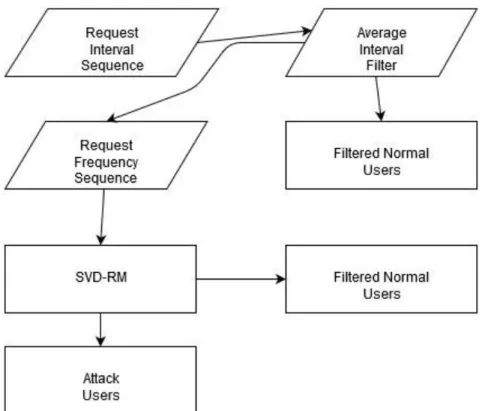
The first algorithm is created to distinguish attackers from normal or hybrid users and it is used while assuming that users take more time browsing a web page compared to attackers as their requests are program generated. This screening filters out only 100% real users and the rest of records will have attackers and other real users. So, if it is 100% guarantee of a record to be from a real user then only it would pass through the first stage. Its structure looks something like this:
The mechanism (equation used) for this first part is as follows: “Let T represent the threshold of average interval, 𝑥𝑖 be the i-th record, 𝑦𝑖 be 𝑥𝑖′𝑠 label, and 𝑡𝑖 be the average interval of 𝑥𝑖; where 𝑦𝑖 = 0, 𝑡𝑖 ≥ 𝑇” (Liao et al., 2015, p. 3112). The next step is considered the most important step as it would determine if this methodology stands up to what it claims or fails to provide the results. Here it applies the complete SVD-RM methodology. It uses the element in SVD-RM vector algorithm where the value 0 for the DDoS application layer attack detection shows group access behaviors rather than just single user behavior helping to distinguish based on the pattern of the 0 values. SVD-RM looks into each user request frequency sequence as sparse vector while decomposing it into two parts i.e. order vector and value vector (Liao et al., 2015). The SVD-RM forms multiple clusters by using the order vector rhythm matching; since the DDoS application layer attacks would have program generated accesses and attackers' behavior similar to each other; whereas the normal user will have diverse behavior patterns helping in distinguishing between attackers and normal users. Here is the figure showing Step 2 of the SVD-RM methodology:
Figure 9. Second Part of SVD-RM (Flowchart) (Liao et al., 2015).
The result of the SVD-RM using these two steps as methodology is that the first three types of attacks are detected quite well; whereas the fourth type of attack detection is not
efficient as the attackers' behavior imitates the normal users’ behavior. Here are the four types of attacks mentioned with the rate of frequency:
The above-mentioned attacks can be classified as Type 1, Type 2, Type 3, and Type 4 attacks respective to their order in the table.
Figure 10 shows the accuracy of SVD-RM algorithm methodology between these four types of attacks:
Figure 10. Classification Result of the Four Types of Application Layer DDOS Attacks (Liao et al., 2015).
As per the tests mentioned in the journal article, this methodology seems to work out quite well and its performance compared to the other methodologies are shown to have worked out quite good as well in terms of application layer DDoS attacks. Here is the table comparing the current methodology with the methodologies created by other researchers:
Table 4
Comparison with Previous Works (Low, Medium, and High) (Liao et al., 2015)
Accuracy Scalability Complexity
HSMM High Low High
Botz-4-Sale Unknown Medium Medium
Traffic Analysis Medium High Low
Wavelet Medium Low Medium
Covariance Medium Low Medium
Backbone High High Medium
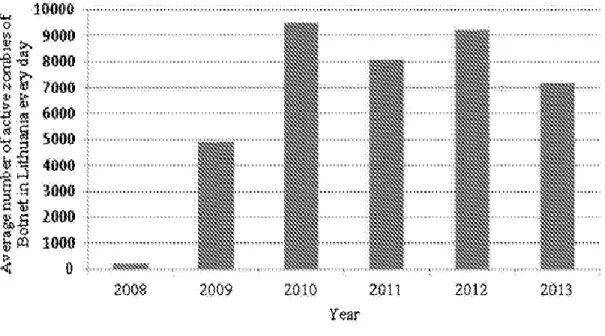
Research Article 4. Another article focuses on the Botnets to analyze the effectiveness of the various Botnet agent allocation strategies and estimating victim resistance probability against DDoS attacks (Ramanauskaite, 2015). Figure 11 shows an example of active botnets in Lithuania over the past six years representing analysis of everyday scenario:
Figure 11. Changes in the Number of Unique Botnets in Lithuania (Ramanauskaite, 2015). The article proposes to use a DDoS attack simulation as a way of finding the Botnet agent attack patterns to prevent the attacks by increasing the resources and filtering attack traffic. Their methodology is focused mainly on thinking like an attacker and coming up with different
strategies of DDoS attack patterns using different botnet allocation methods. They found out that changing the agent allocation speed changes the attack power and therefore the attacks can never be conducted in a stable form. The major issue with this methodology is that it is easy to block one zombie computer but there are other million other infected zombies (botnets) which all have different viruses and trojans and are difficult to detect and prevent them to be a part of the attack.
Moreover, the IP addresses of these zombies could be spoofed making it difficult to detect them and stop or block them.
CAPTCHA is considered to be a good security measure by some of (Umarani & Sharmila, 2014)the research articles like (Umarani & Sharmila, 2014; Vadlamani, 2013). It seems to be a good solution for DDOS attacks as most of them are executed using botnets (automated
computer bots) but it is not a security measure in preventing a slow rate application layer attack. The slow rate attack does not need a botnet or bot and can be executed by a malicious user whose sole purpose is to infect the backend server’s database. Therefore, CAPTCHA can be
considered a good solution for mitigating HTTP GET flood attack but not quite for the HTTP POST attack.)
Research Article 5. This paper uses the http traces from 1998 world cup website for detecting the Layer 7 DDOS attacks. Three methodologies have been used namely KNN, PCA-Naïve Bayes, and PCA-Naïve Bayes. The data set belongs to the timeline of April 30,1998 to July 26, 1998 which consists of total 1,352,804,107 http requests obtained from 33 various world cup http servers from four locations (Paris-France, Plano-Texas, Herndon-Virginia, and Santa Clara-California). The parameters used to differentiate between normal and attack traffic is converted into binary to save space and processing time. The parameters are timestamp (Epoch time-converted to GMT), ClientID, object-ID (unique identifier for the URL), size (number of bytes), method (found in client request), status (the first 2 bits are the http version and the rest 6 bits are the response status code), type (type of file that was requested), server (the specificity of the server that handled the request).
They also used PCA Naïve Bayes which focuses on reducing the number of variables that are uncorrelated. By using these variables, the average vector is computed through the formula
𝜇̅ =1
𝑇∑ 𝑎̅𝑡 𝑇
𝑡=1 where T is the total number of variables in the data set and 𝑎̅𝑡 is the variable t.
Later this PCA methodology is used to minimize the data with multidimensions through the computation of characteristic value (eigenvalue) associated with characteristic vector of linear transformation (non-zero vector or eigenvector) which are then used in singular value
decomposition (SVD). In the geometrical terms the eigenvector that belongs to a non-zero eigenvalue goes in the direction at which it was stretched through the transformation, and this eigenvalue is a factor used for the stretch.
After conducting the test using Naïve Bayes, it was found that the detection rate of Naïve Bayes excelled by 2.56% and 1.7% in comparison to KNN and Naïve Bayes. For the PCA-Naïve Bayes, the detection rate only improved by 0.9% and its False positive rate by 4.11%.
Research Article 6. OC-SVM is a methodology where only one class is used to train a specific set of data. It will be fed only good/normal traffic as a training data set for the algorithm to recognize normal users. Through this, if it detects any behavior that represents even a small chance of abnormal/attack traffic then it would place it into another class (the attack traffic class). It is an anomaly-based detection technique in which any traffic that deviates from the normal traffic (the training data fed to OC-SVM) gets labeled as anomalous traffic. It is used to essentially map the data points from input space to feature space through the method of non-linear kernel function. The training data would end up in one class, once mapping the data in feature space is completed. Later, a boundary is created in feature space that separated normal and anomalous traffic (She, Wen, Lin, & Zheng, 2017).