Text Categorization
Musa Mammadov, John Yearwood, and Lei Zhao
Graduate School of information Technology and Mathematical Science, University of Ballarat, Ballarat, VIC, 3350, Australia
{m.mammadov,j.yearwood,l.zhao}@ballarat.edu.au
Abstract. In text categorization, different supervised term weighting methods have been applied to improve classification performance by weighting terms with respect to different categories, for example, Infor-mation Gain,χ2 statistic, and Odds Ratio. From the literature there are three term ranking methods to summarize term weights of different cate-gories for multi-class text categorization. They are Summation, Average, and Maximum methods. In this paper we present a new term ranking method to summarize term weights, i.e. Maximum Gap. Using two dif-ferent methods of information gain andχ2statistic, we setup controlled experiments for different term ranking methods. Reuter-21578 text cor-pus is used as the dataset. Two popular classification algorithms SVM and Boostexter are adopted to evaluate the performance of different term ranking methods. Experimental results show that the new term ranking method performs better.
1
Introduction
The task of text categorization is to assign unlabelled documents to predefined categories (topics or themes) according to their contents. Due to the growth in the volume of electronic documents, text categorization has been widely re-searched and applied in organizing as well as in finding information on the huge electronic resources.
Term weighting is an important issue for text categorization. In recent years, we have witnessed an increasing number of term weighting methods published. [1] classify the term weighting methods into two categories according to whether the method makes use of known information on the membership of training documents or not, namely,supervised term weighting methods andunsupervised term weighting methods. For example,tf andtf-idf [2] weighting methods belong to the unsupervised term weighting methods; information gain,χ2statistic, and
odds ratio [3,4] are classified as supervised term weighting methods.
Although different approaches have been explored [4], not much attention has been paid towards specific class-oriented and local, context-dependent filters [5]. In particular, for multi-class text categorization, after being weighted by certain weighting methods, for example, information gain, term weights need to be summarized in to a single weight according to different categories.
J. Li (Ed.): AI 2010, LNAI 6464, pp. 102–111, 2010. c
The literature indicates that there are only three methods to summarize term weights. The most common method is called the Summation method [3,6], which sums up all terms’ weights with respect to all categories. We denote this method byfsum(ti) =
c k=1
f(ti, ck), wheref(ti, ck) denotes termti’s weight with respect to categoryck. [4] employ two other methods. One is the average weight of term ti with respect to all categories, denoted byfavg(ti) =
c k=1
P(ck)f(ti, ck), where P(ck) is the proportion of documents belong to categoryck in the whole corpus. The other is the Maximum method fmax(ti) = maxc
k=1{f(ti, ck)}, which ranks
terms according to their maximum weights across all categories. Among these three methods, [6] prefer the salient terms which are unique from one category to another, that is the Maximum approach. [3] also declare that the Maximum method outperformed both the Summation method and the Average method, but the experimental results are not given. Therefore, a question arises here, “ Can we perform extensive experimental comparison of these methods, moreover, can we propose a better method than these existing ones?”
In our research, based on existing supervised term weighting methods, we propose a new term ranking method, the Maximum Gap. We illustrate by con-crete example that this method can better distinguish those terms which can better differentiate one or more categories from the others than some existing ones, namely, the Summation, Maximum, and Average methods (see [3,6,4]). We conduct a series of comparative experiments on the Reuter-21578 text corpus. SVM and Boostexter are adopted as the learning algorithms. Average precision is used as the evaluation method. In our numerical experiments, Maximum Gap outperforms the other three term ranking methods.
This paper is organized as follows: In Section 2 we survey the existing term-category weighting methods and term ranking methods, then we propose a new term ranking method. In Section 3 we describe the detailed experimental set-tings. In Section 4 we report experimental results and discussion. We conclude in Section 5.
2
A New Feature Ranking Method
In this section, we review existing term weighting methods (information gain andχ2 statistic) as well as term ranking methods (Summation, Maximum, and
Average methods), introduce a new term ranking method for text categorization, and provide an example to demonstrate the effectiveness of the new method on Reuter-21578 text corpus.
2.1 Term-Category Weighting
Over the years, a number of methods have been developed to measure the dis-criminating power of various terms with respect to different categories, such as
information gain, odds ratio, and χ2 statistic. In this research, we discuss
in-formation gain andχ2 statistic, which have been shown to be effective for text
categorization [4].
For term ti and class ck, the general functions of information gain and χ2 statistic can be shown as:
IG(ti, ck) =P(ti, ck) log P(ti, ck) P(ti)P(ck)+P(ti, ck) log P(ti, ck) P(ti)P(ck) (1) χ2(ti, ck) = n[P(ti, ck)P(ti, ck)−P(ti, ck)P(ti, ck)] 2 P(ti)P(ti)P(ck)P(ck) (2) where P(ti, ck) denotes the probability a document is from categoryck when termti occurs at least once in it,P(ti, ck) denotes the probability a document is not from categoryck when termti occurs at least once in it,P(ti, ck) denotes the probability a document is from categoryck when termti does not occur in it, P(ti, ck) denotes the probability a document is not from category ck when termti does not occur in it,ndenotes the number of documents.
Text categorization problems on multi-class datasets can be simplified into multiple independent binary classification problems. In each experiment, a cho-sen categoryck can be tagged as 1, and the other categories in the same corpus are combined together as 0. A contingency table (see Table 1) can be used to record the number of documents which contain termtiand do not contain term tiunder categoryckandck, and the sum of these four elements,n, is the number of documents of the dataset.
Table 1.The contingency table for categoryckand termti
ti ti
Positive Category: ck a b Negative Category:ck c d
Notation:
a: Number of documents in classck that contain termti b: Number of documents in classckthat do not contain termti c: Number of documents in classck that contain termti
d: Number of documents in classckthat does not contain termti
[6] use these four elements in Table 1 to estimate the probabilities in formula (1) and (2). The functions of information gain andχ2 are rewritten as:
IG(ti, ck) = a nlog an (a+b)(a+c)+ c nlog cn (c+b)(a+c) (3) χ2(ti, ck) = n(ad−bc) (a+c)(b+d)(a+b)(c+d) (4)
2.2 Maximum Gap
The formulas (3) and (4) define weights for each termti according to different categoriesck, k = 1,· · ·, c. We denote these weights byf(ti, ck). In this paper, two cases will be considered:fig(ti, ck) =IG(ti, ck) andfχ2(ti, ck) =χ2(
ti, ck). To rank all the terms, we need to define a weight for each termti with respect to all categories. As mentioned before we will investigate three different methods – Maximum, Summation, and Average methods defined by: (see [3,6,4])
fmax(ti) =maxc k=1{f(ti, ck)} (5) fsum(ti) = c k=1 f(ti, ck) (6) favg(ti) = c k=1 P(ck)f(ti, ck) (7)
In this section, we propose a new term ranking method that will be called Maxi-mum Gap (MG). Unlike the above approaches, this method aims to distinguish, in terms of weights, those terms which can better differentiate one or more cat-egories from the others.
First, we organize termi’s weights{f(ti, ck)}ck=1 as follows: f(ti, ck1)≥f(ti, ck2)≥ · · ·f(ti, ckc)
then the Maximum Gap of termti is defined as fmg(ti) =maxc−1
j=1{f(ti, ckj)−f(ti, ckj+1)} (8)
In the following example, we demonstrate why MG might be more efficient than the other three methods.
Example: From Reuter-21578 corpus, we select the top 30 terms selected by different term ranking methods. For both clarity and briefness, we only compare Maximum Gap and Maximum methods, where terms are weighted by informa-tion gain. The Maximum method is chosen because it is accepted that (see for example, [3]) this method is better compared to Summation and Average meth-ods. Note that our experimental results in Section 4 also support this opinion.
Among the top 30 selected terms ranked by Maximum Gap and Maximum methods respectively, Table 2 lists 14 terms that are not selected by the opposite term ranking method (those 23 terms selected by both methods are omitted).
It can be seen that the terms exclusively selected by the Maximum Gap method are more closely related to the top 10 categories (see Table 2) than those terms that selected by Maximum method. For example, us (this refers to us or USA),the,central, andnoteselected by Maximum method are less related to the top 10 categories, while all terms selected by Maximum Gap
Table 2.Terms exclusively selected by Maximum Gap and Maximum term weighting methods out of top 30 terms. The top10 categories of Reuter-21578 are acq, corn, crude, earn, grain, interest, money-fx, ship, trade, and wheat.
Maximum Maximum Gap
1 us surplu 2 the petroleum 3 market acquisit 4 loss bui 5 export tariff 6 central yen 7 note energi 0.00E+00 5.00E-03 1.00E-02 1.50E-02 2.00E-02 2.50E-02 3.00E-02 3.50E-02 4.00E-02 4.50E-02 5.00E-02
earn trade grain corn wheat money-fx crude ship acq interest
category
we
igh
t
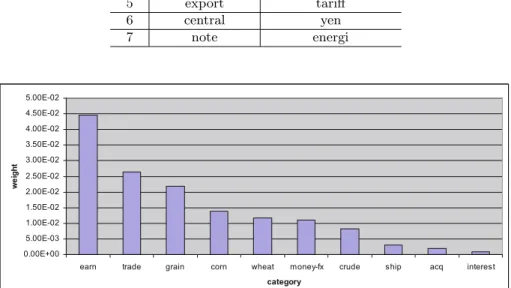
Fig. 1.Term-Category weights (calculated by information gain, Equation 3) of term “us” in Reuter-21578 top 10 categories (ordered by weights)
method are closely related to the top 10 categories. Here we should note that the selected terms have been stemmed by Porter Stemmer [7], for example, the original spelling of surplu, bui, and energi are surplus, buy, and energy. This concrete example can give us a direct explanation why Maximum Gap method might be better than Maximum method.
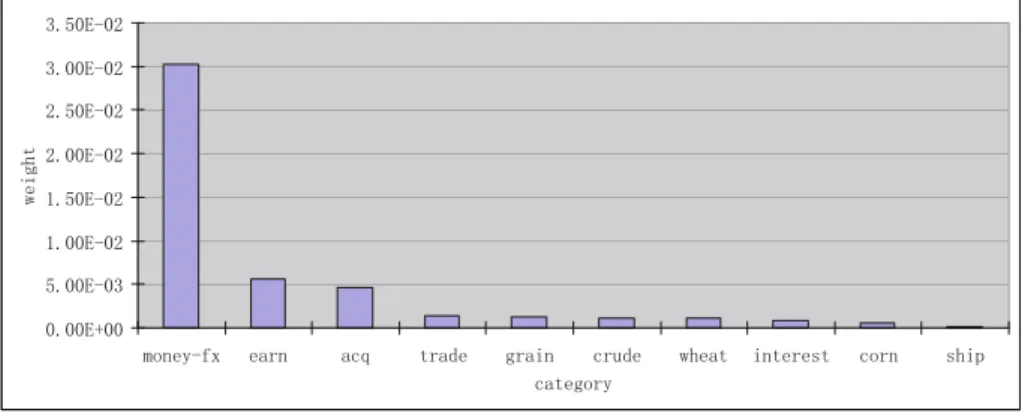
To provide insight into the performance of Maximum Gap, as an example we investigate the weights fig(ti, ck) of term us and term yen1, with respect to the top 10 categories. These two terms are selected respectively by Maximum method and Maximum Gap method. Fig. 1 and 2 lists the sorted weights of
us and yen with respect to top 10 categories. Compared with term us, the 1 In the data set, termus appears 6216 times representing theUnited State (U.S.) (5767 times), theUS Dollar (171 times), and the wordus (278 times) respectively. Termyenappears 629 times, which stands for Japanese currency only. It is clear that
yenis a more predictable term, which is highly related to the category Money Foreign Exchange (money-fx), while termusappears frequently almost in all categories (See Figure 1, and Figure 2).
( ( ( ( ( ( ( (
PRQH\I[ HDUQ DFT WUDGH JUDLQ FUXGH ZKHDW LQWHUHVW FRUQ VKLS FDWHJRU\
ZH
LJKW
Fig. 2.Term-Category weights (calculated by information gain, Equation 4) of term “yen” in Reuter-21578 top 10 categories (ordered by weights)
Maximum Gap of termyenis bigger, but Maximum, Summation, and Average values are smaller. This is why termusis selected by Maximum, while termyen
is selected by Maximum Gap.
3
Experiments
In this section, we describe the relevant details related to our experiments.
Dataset: In this controlled experiment, Reuter-21578 [8] is adopted as the benchmark dataset. In particular, the documents of the top 10 topics are tracted, from which 9393 related documents out of 21578 documents are ex-tracted. Taking into account a large number of documents (9393) in the data set, we use 4-fold cross validation for the purpose of evaluation. Because docu-ments are multilabel, we arrange these folds as follows. The first step, we consider all the combinations of multi-labeled classes and partition them based on the classes they belong to. The second, we fold each of the partitions, rather than the entire dataset, so that we could always keep the pattern for a particular classs combination from the testing set in the training set.
Learning Algorithms:In terms of learning algorithms, SVM and Boostexter are selected. For SVM, we use Chih-Jen Lin’s LIBSVM (see [9]). Boostexter (see [10]) is based on the Boosting concept in Machine Learning. It has been proved as one of the most efficient classification algorithms and widely applied in many areas. Both SVM and Boostexter have shown competitive performance on text categorization [11,10].
Supervised Term Weighting Methods: In our experiment, we select two methods to weight the terms across different categories, namely information gain given by Equation (3) and the χ2 statistic given by Equation (4). These methods have been shown effective and suitable for text categorization [4].
Performance Evaluation:In general, recall, accuracy or confusion matrix are used to evaluate the performance of the classification. These approaches are com-monly used for binary or multiclass classification, where correct or not correct results can be evaluated without difficulty. According to multilabel classification problem, the ranking information of the predicted labels are also need to be con-sidered. Average precision [12,10] is an evaluation method that are designed for multilabel classification problems, where the degree of accuracy can be measured by a single number that is more convinient for comparison purposes. Average precision is a performance measure previously used for evaluation of informa-tion retrieval (IR) systems [13]. In our experiments, we use a modified Average Precision (see [14]).
Given classifier (h, H) , predicted labels are denoted by H(x) , actual labels are denoted by Y(x) . Let Y(x) ={l ∈ {1, . . . , c} : Yl(x) = 1} be the set of actual labels of document x and H(x) ={H1(x),· · ·,Hc(x)} be predicted
labels. We denote by T(x) the set of all ordered labels τ = {i1, . . . , ic}
satisfying the condition
Hi1(x) ≥ . . . ≥ Hic(x);
whereik ∈ {1, . . . , c} andik=im ifk=m.
In the case, when the numbers Hi(x), i = 1,· · ·, c, are different, there is just one order τ satisfying this condition. But if there are labels having the same value then we can order the labels in different ways; that is, in this case the set T(x) contains more than one order.
Given order τ = {τ1, . . . , τc} ∈ T(x), we define the rank for each label
l ∈ Y(x) as rankτ(x;l) = k, where the number k satisfies τk = l. Then
Precisionis defined as:
Pτ(x) = | 1 Y(x)| l∈Y(x) |{k∈Y(x) : rankτ(x;k)≤rankτ(x;l)}| rankτ(x;l) .
Here, we use the notation|S|for the cardinality of the setS.This measure has the following meaning. For instance, if all observed labels Y(x) have occurred on the top of orderingτ thenPτ(x) = 1.Clearly the number Pτ(x) depends on orderτ.We define
Pbest(x) = max τ∈T(x)Pτ
(x) and Pworst(x) = min τ∈T(x)Pτ
(x),
which are related to the “best” and “worst” ordering. Therefore, it is sensible to define thePrecisionas the midpoint of these two versions:
P(x) =Pbest(x) +Pworst(x)
2 .
Average Precisionover all recordsX will be defined as: Pav = 1
|X | x∈X
4
Experimental Results
In this Section, we present the experimental results and compare the performance of the four term ranking methods discussed above.
To compare the performance of different term ranking methods, we use filter methods to select terms and test by SVM and Boostexter. We useSn to denote the set of the top n terms ranked by certain term ranking methods. In our experiments, if a very small term subset is adopted, many documents of the corpus can not be included in training and test sets. Different term weighting methods can have different training and test subsets included, and they can not be compared appropriately. Actually, in our experiments, the selected terms can cover almost all the documents of our corpus if we have more than 20 terms selected. We only select 9 groups of sequential term subsets from Reuter-21578 corpusS20⊂S30⊂S40⊂S50⊂S60⊂S70⊂S80⊂S90⊂S100.
The performance of four term ranking methods is shown in Table 3. Informa-tion gain andχ2 statistic are used to weight terms across all categories
respec-tively. Therefore, we have four different combinations of term weighting methods and text categorization algorithms shown in four columns in Table 3. The value in the table is the average performance among 9 groups of term subsets. The highest value according to different ranking methods is indicated by bold font.
In Table 4, 5, and 6, we make pairwise comparisons of different term ranking methods. The numbers in the second and the third columns of Table 4, 5, and 6 describe how many groups of term subsets show better evaluation performance.
Table 3. Terms are weighted by information gain andχ2statistic respectively. SVM and Boostexter are adopted as text categorization algorithms. Text categorization per-formances are evaluated by average precision. The average performance of 9 groups of term subsets are calculated according to four term ranking methods.
IG-SVM χ2-SVM IG-Boostexter χ2-Boostexter
mg 93.751 93.264 95.345 95.121
max 93.601 93.058 95.226 94.782
sum 93.128 92.395 94.923 94.493
avg 92.397 93.131 94.039 95.120
Table 4.Pairwise comparison of Maximum Gap and Maximum on 9 different term sets. 2 different term weighting methods (IG and χ2 statistics) and 2 categorization algorithms (SVM and Boostexter) applied. In total, Maximum Gap perform better in 25 cases out of 36.
Maximum Gap Maximum
IG-SVM 5 4
IG-Boostexter 7 2
χ2-SVM 6 3
χ2-Boostexter 7 2
Table 5.Pairwise comparison of Maximum Gap and Summation on 9 different term sets. 2 different term weighting methods (IG and χ2 statistics) and 2 categorization algorithms (SVM and Boostexter) applied. In total, Maximum Gap perform better in 34 cases out of 36.
Maximum Gap Summation
IG-SVM 8 1
IG-Boostexter 9 0
χ2-SVM 8 1
χ2-Boostexter 9 0
total 34 2
Table 6. Pairwise comparison of Maximum Gap and Average on 9 different term sets. 2 different term weighting methods (IG and χ2 statistics) and 2 categorization algorithms (SVM and Boostexter) applied. In total, Maximum Gap perform better in 27 cases out of 36.
Maximum Gap Average
IG-SVM 9 0
IG-Boostexter 5 4
χ2-SVM 9 0
χ2-Boostexter 4 5
total 27 9
In all of our controlled experiments, Maximum Gap outperforms other term ranking methods in terms of the average performance of the 9 selected feature subsets. In the pairwise comparison with the existing methods, Maximum Gap method also performs very well. The only exception is the comparison with Average method by χ2-Boostexter (see Table 6), but the difference between
them is very close (4 to 5).
5
Conclusion
We present a new term ranking method for text categorization that is called Maximum Gap. This method is compared with three other similar methods: Maximum, Summation, and Average methods. Numerical experiments are car-ried out on the Reuter-21578 dataset. Experimental results show that the Maxi-mum Gap outperforms other term ranking methods in selecting better terms for the text categorization task.
References
1. Lan, M., Tan, C.L., Low, H.-B.: Proposing a new term weighting scheme for text categorization. In: AAAI. AAAI Press, Menlo Park (2006)
2. Salton, G., Buckley, C.: Term-weighting approaches in automatic text retrieval. Information Processing & Management 24(5), 513–523 (1988)
3. Debole, F., Sebastiani, F.: Supervised term weighting for automated text catego-rization. In: SAC, pp. 784–788. ACM, New York (2003)
4. Yang, Y., Pedersen, J.O.: A comparative study on feature selection in text cat-egorization. In: Fisher, D.H. (ed.) ICML, pp. 412–420. Morgan Kaufmann, San Francisco (1997)
5. Duch, W., Duch, G.: Filter methods. In: Feature Extraction, Foundations and Applications, pp. 89–118. Physica Verlag, Springer (2004)
6. Liu, Y., Loh, H.T., Youcef-Toumi, K., Tor, S.B.: Handling of Imbalanced Data in Text Classification: Category-Based Term Weights. In: Kao, A., Poteet, S.R. (eds.) Natural Language Processing and Text Mining, p. 171 (2006)
7. Porter, M.F.: An algorithm for suffix stripping. Program 14(3), 130–137 (1980) 8. Lewis, D.D.: Reuters-21578 text categorization test collection. Distribution 1.3
(2004)
9. Hsu, C.W., Chang, C.C., Lin, C.J., et al.: A practical guide to support vector classification (2003)
10. Schapire, R.E., Singer, Y.: Boostexter: A boosting-based system for text catego-rization. Machine Learning 39(2/3), 135–168 (2000)
11. Joachims, T., Nedellec, C., Rouveirol, C.: Text categorization with support vector machines: learning with many relevant. In: N´edellec, C., Rouveirol, C. (eds.) ECML 1998. LNCS, vol. 1398, pp. 137–142. Springer, Heidelberg (1998)
12. Li, T., Zhang, C., Zhu, S.: Empirical studies on multi-label classification. In: ICTAI, pp. 86–92. IEEE Computer Society, Los Alamitos (2006)
13. Salton, G.: Developments in automatic text retrieval. Science 253(5023), 974–980 (1991)
14. Mammadov, M.A., Rubinov, A.M., Yearwood, J.: The study of drug-reaction re-lationships using global optimization techniques. Optimization Methods and Soft-ware 22(1), 99–126 (2007)