Deep Learning With Sentiment Inference For
Discourse-Oriented Opinion Analysis
Ana Marasovi´c
Department of Computational Linguistics
Heidelberg University
This dissertation is submitted for the degree of
Doctor of Philosophy
External examiner: Prof. Dr. Bonnie Webber Submission date: 30.11.2018.
Acknowledgements
I would first like to thank my supervisor Anette Frank for taking me as her student although I had almost no experience in natural language processing. Since then, many doors have opened for me and I will always be grateful to Anette for it. Her valuable and regular guidance throughout my stay at Heidelberg University has shaped my thoughts on language, research, and life in general. Thank you, Anette, for also having patience and understanding for my numerous special requests.
I would like to thank my second supervisor Michael Strube and external examiner Bonnie Webber for proofreading this Ph.D. thesis. Special thanks to Jeff Kuntz for finding grammatical, punctuation, and spelling mistakes. I also thank Maria Becker, Bhushan Kotnis, and Todor Mihaylov for providing their feedback on a draft of this thesis.
I would like to thank everyone I have had the pleasure to meet over the past three years at the Department of Computational Linguistics at Heidelberg University, HITS, and TU Darmstadt as well as those whom I have encountered at conferences, summer schools, and during my internship in Amazon. I would like to give special thanks to Todor Mihaylov for helping me to deal with TensorFlow, encouraging me to apply to internships and future jobs, sharing his thoughts on many topics, and last but not least, teaching me how to juggle. Sincere thanks go to student researchers Leo Born, Juri Opitz, and Mengfei Zhou whose help in processing data enabled me to progress faster in my research. I also thank the researchers who gave excellent tutorials in Heidelberg and Darmstadt over the past three years. A special source of inspiration was the tutorial by Guillaume Bouchard and invited talks by Claire Cardie, Eduard Hovy, Sebastian Riedel, Dan Roth, and Bonnie Webber.
My three years stay in Heidelberg has been a wonderful journey. Sincere thanks go to all my flatmates for making my time in Heidelberg so enjoyable.
Finally, I could write as many words as there are in this thesis to thank my parents Davor and Silvana, my sister Andrea, and to my life companions Maša and Petar. Thank you for staying by my side.
Abstract
Opinions are omnipresent in written and spoken text ranging from editorials, reviews, blogs, guides, and informal conversations to written and broadcast news. However, past research in NLP has mainly addressed explicit opinion expressions, ignoring implicit opinions. As a result, research in opinion analysis has plateaued at a somewhat superficial level, providing methods that only recognize what is explicitly said and do not understand what is implied.
In this dissertation, we develop machine learning models for two tasks that presumably support propagation of sentiment in discourse, beyond one sentence. The first task we address is opinion role labeling, i.e. the task of detecting who expressed a given attitude toward what or who. The second task is abstract anaphora resolution, i.e. the task of finding a (typically) non-nominal antecedent of pronouns and noun phrases that refer to abstract objects like facts, events, actions, or situations in the preceding discourse.
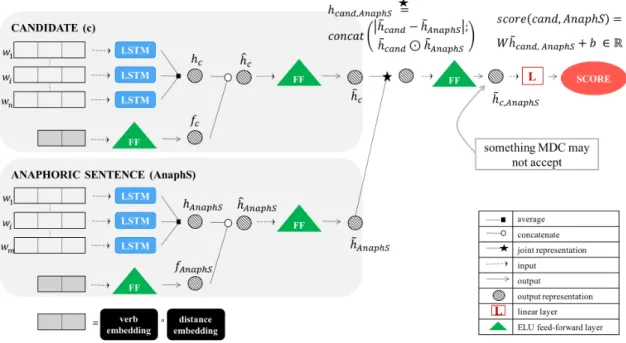
We propose a neural model for labeling of opinion holders and targets and circumvent the problems that arise from the limited labeled data. In particular, we extend the baseline model with different multi-task learning frameworks. We obtain clear performance improvements using semantic role labeling as the auxiliary task. We conduct a thorough analysis to demonstrate how multi-task learning helps, what has been solved for the task, and what is next. We show that future developments should improve the ability of the models to capture long-range dependencies and consider other auxiliary tasks such as dependency parsing or recognizing textual entailment. We emphasize that future improvements can be measured more reliably if opinion expressions with missing roles are curated and if the evaluation considers all mentions in opinion role coreference chains as well as discontinuous roles.
To the best of our knowledge, we propose the first abstract anaphora resolution model that handles the unrestricted phenomenon in a realistic setting.
We cast abstract anaphora resolution as the task of learning attributes of the relation that holds between the sentence with the abstract anaphor and its antecedent. We propose a Mention-Ranking siamese-LSTM model (MR-LSTM) for learning what characterizes the mentioned relation in a data-driven fashion. The current resources for abstract anaphora resolution are quite limited. However, we can train our models without conventional data for abstract anaphora resolution. In particular, we can train our models on many instances of
antecedent-anaphoric sentence pairs. Such pairs can be automatically extracted from parsed corpora by searching for a common construction which consists of a verb with an embedded sentence (complement or adverbial), applying a simple transformation that replaces the embedded sentence with an abstract anaphor, and using the cut-off embedded sentence as the antecedent. We refer to the extracted data as silver data.
We evaluate our MR-LSTM models in a realistic task setup in which models need to rank embedded sentences and verb phrases from the sentence with the anaphor as well as a few preceding sentences. We report the first benchmark results on an abstract anaphora subset of the ARRAU corpus (Uryupina et al., 2016) which presents a greater challenge due to a mixture of nominal and pronominal anaphors as well as a greater range of confounders. We also use two additional evaluation datasets: a subset of the CoNLL-12 shared task dataset (Pradhan et al., 2012) and a subset of the ASN corpus (Kolhatkar et al., 2013a). We show that our MR-LSTM models outperform the baselines in all evaluation datasets, except for events in the CoNLL-12 dataset. We conclude that training on the small-scale gold data works well if we encounter the same type of anaphors at the evaluation time. However, the gold training data contains only six shell nouns and events and thus resolution of anaphors in the ARRAU corpus that covers a variety of anaphor types benefits from the silver data. Our MR-LSTM models for resolution of abstract anaphors outperform the prior work for shell noun resolution (Kolhatkar et al., 2013b) in their restricted task setup. Finally, we try to get the best out of the gold and silver training data by mixing them. Moreover, we speculate that we could improve the training on a mixture if we: (i) handle artifacts in the silver data with adversarial training and (ii) use multi-task learning to enable our models to make ranking decisions dependent on the type of anaphor. These proposals give us mixed results and hence a robust mixed training strategy remains a challenge.
Table of Contents
1 Introduction 1
1.1 Analyzing Opinions in Discourse . . . 1
1.2 Fine-Grained Opinion Analysis . . . 2
1.3 Abstract Anaphora Resolution . . . 4
1.4 Research Questions . . . 7 1.5 Contributions . . . 7 1.6 Thesis Overview . . . 8 1.7 Published Work . . . 9 2 Background 11 2.1 Sentiment Inference . . . 11
2.2 Fine-Grained Opinion Analysis . . . 25
2.3 Abstract Anaphora Resolution . . . 34
2.4 Neural Multi-Task Learning and Adversarial Training . . . 47
3 Sentence-Level Neural Fine-Grained Opinion Analysis 57 3.1 Similarities and Divergences in the Opinion and Semantic Role Labeling Annotation Schema . . . 58
3.2 Neural MTL for SRL and ORL . . . 60
3.3 Experimental Setup . . . 61
3.4 Experiments . . . 64
3.5 Analysis of What Works and What is Next . . . 66
3.6 Summary . . . 73
4 Resolving Abstract Anaphors in a Relational Neural Model 75 4.1 Challenges and Working Toward the Models . . . 76
4.2 MR-LSTM: Mention-Ranking LSTM-Siamese Neural Network . . . 78
4.4 Experimental Setup . . . 84
4.5 Performance of the MR-LSTM Model . . . 91
4.6 MR-LSTM with Adversarial Training . . . 115
4.7 MR-LSTM with Multi-Task Learning . . . 120
4.8 Summary . . . 128
5 Outlook and Conclusions 131 5.1 Contributions and Takeaways . . . 131
5.2 Discussion . . . 134
5.3 Direction for Future Work . . . 135
A MPQA Pre-processing 139
B Comparison between MR-LSTM and the Prior Work in Shell Noun Resolution143 C Quality Evaluation of the VC-SS-Extract Method 145
D Data Management 181
List of Figures 183
List of Tables 185
List of Abbreviations 193
Chapter 1
Introduction
1.1
Analyzing Opinions in Discourse
Modern NLP techniques perform well at tasks such as dependency parsing (Dozat and Manning, 2017), named entity recognition (Akbik et al., 2018), and semantic role labeling (He et al., 2017); but tasks like making conversation (Mrkši´c et al., 2017), fact checking (Thorne and Vlachos, 2018), summarization (Chen and Bansal, 2018), or understanding opinionated text (Katiyar and Cardie, 2016) remain a challenge. These tasks require abstraction, cognition, reasoning, and knowledge about our world. In other words, it is not possible to solve these problems as long as we do not build systems that recognize bothwhat is saidandwhat is not said but is implied. Consider the following text snippet.1
(1) Registrar General Tobaiwa Mudede announced on state television that Mugabe was re-elected with 1,685,212 votes against 1,258,758 votes for Tsvangirai, leader of the Movement for Democratic Change (MDC). [...] "The election was massively rigged", he told a packed press conference. "Wetherefore asMDC::::: do not acceptthis result". Applying state-of-the-art opinion analysis systems (Yang and Cardie, 2013, 2014a) on the final sentence: We therefore as MDC do not accept this result, would inform us that MDC explicitly expressed a negative attitude toward theresultby not accepting it. A human reader can easily infer that the result refers to the fact that Mugabe was re-elected with 1,685,212 votes against 1,258,758 votes for Tsvangiraiand understand what is implied: if MDC is negative toward there-electionthen it is likely thatMDCis negative toward the person who was re-elected,Mugabe, and positive toward the person who was not elected, 1Examples (1–2) are taken from the Multi-Perspective Question Answering Corpus (MPQA) dataset (Wiebe et al., 2005).
Tsvangirai. This inference step—enabled once we realized what theresultis—gives us a deeper understanding of opinionated text since we also observe implicit attitudes which are a distinctive aspect of subjective language.2
Deng et al. (2013a, 2014) and Deng and Wiebe (2014, 2015a) proposed the first computa-tional approaches to sentiment inference. They focus on sentiment implicatures that arise in the presence of explicit sentiments and events that positively (GOODFOR) or negatively (BADFOR) affect entities. In Example (1),re-electedis a GOODFORevent as it benefits the theme—the person who is re-elected (Mugabe). Their systems are designed to utilize the fact thatMDCis explicitly negative toward this event and propagate the negative attitude to Mugabe—the theme who benefits from the eventMDCis negative about.
However, computationally modeling this inference step is difficult as it involves an interplay of some challenging subtasks:
(i) Detecting whoexplicitlyexpressed what kind of attitude toward what or whom (e.g., thatMDCis negative about theresult).
(ii) Finding a (typically) non-nominal antecedent of pronouns and noun phrases that refer to abstract objects like facts, events, actions, or situations in the preceding discourse (e.g., detecting that this result refers to the fact that Mugabe was re-elected with 1,685,212 votes against 1,258,758 votes for Tsvangirai).
(iii) Resolving noun phrases referring to concrete objects or entities in the real world (e.g., realizing thatwerefers toMDC).
(iv) Propagating sentiment in discourse, beyond one sentence (e.g., inferring thatMDC is negative towardMugabeand positive towardTsvangirai).
In the research presented in this thesis we focus on the first and second subtasks. We aim to develop machine learning models for them and hence potentially support propagation of sentiment in discourse beyond one sentence. In the remainder of this chapter, we further motivate the research conducted in the thesis (Sections 1.2–1.3), formulate main research questions (Section 1.4), summarize our contributions (Section 1.5), present the outline of the thesis (Section 1.6), and describe which parts of the thesis were published (Section 1.7).
1.2
Fine-Grained Opinion Analysis
Sentiment inference systems of Deng and Wiebe (2014, 2015a) and Deng et al. (2014) require information about who explicitly expressed what kind of sentiment toward what or whom.
1.2 Fine-Grained Opinion Analysis 3
Significant research efforts have been invested on document- and sentence-level subjec-tivity detection and polarity classification (Pang and Lee, 2008; Liu, 2015). In contrast, there has been less work on other tasks in opinion analysis such as detecting entities that express an attitude (holders) and objects that the attitude is directed towards (targets). These tasks are vital for various applications such as opinion summarization and sentiment inference. Furthermore, it is often even impossible to determine the document- and sentence-level polarity3 since a given text may contain opposing views. For example, in (2) theteamis
positive toward thepresidential election, but theWestexpressed negative attitude toward the claim thatthe presidential election was substantially free and fair.
(2) The team met President Mugabe at Zimbabwe House where it briefed him of its opinion that the presidential election was substantially free and fair, despite a view to the contrary by the West.
In contrary to determining overall polarity of text, Fine-Grained Opinion Analysis (FGOA) aims to: (i) detect opinion expressions that convey attitudes such as sentiments, agreements, beliefs, or intentions (likedo not acceptin Example (1) on page 1), (ii) measure their intensity (e.g., strong), (iii) identify their holders i.e. entities that express an attitude (e.g.,weorMDC), (iv) identify their targets i.e. entities or propositions at which the attitude is directed (e.g.,this result), and (v) classify their target-dependent attitude (e.g., negative sentiment). Hovy (2011) argues that all subtasks (i–v) need to be addressed to properly define and understand opinions. In his own words,
An opinion is a decision made by someone (the holder) about a topic4. This decision assigns the topic to one of a small number of classes (the valences)5that affect the role that the topic will play in the holder’s future goals and planning decisions.
Although FGOA is crucial for understanding opinionated text, the state-of-the-art Con-ditional Random Field (CRF) model (Yang and Cardie, 2013) and the neural competitor (Katiyar and Cardie, 2016) achieve about 55% F1 score for predicting which targets relate to which opinions in the benchmark corpus MPQA (Wiebe et al., 2005).6 Thus, these models are not yet ready to answer the question this line of research is generally motivated with:
3At least in the standard categories: positive, negative, and neutral. 4That is, a target.
5Hovy (2011) defines two kinds of opinions: judgment and belief. The valance of judgment opinions can be positive, negative, mixed, neutral, or unstated. The valance of belief opinions can be believed, disbelieved, unsure, neutral, or unstated. In practice, a much broader valance set is used: positive, negative, neutral.
6To be precise, they address (i), (iii), and (iv), which is still generally considered as the fine-grained opinion analysis task.
"Who expressed what kind of sentiment toward what?", and consequently assist applications such as sentiment inference.
We recognize benefits of the neural FGOA model (Katiyar and Cardie, 2016), despite the fact that it still lags behind the feature-based CRF (Yang and Cardie, 2013) for labeling of opinion holders and targets, i.e. for Opinion Role Labeling (ORL). In particular because neural models are adaptive to heterogeneous sources since they do not depend on external resources such as dependency parsers, named entity recognizers, sentiment lexicons, and other resources that are usually available only for English and for certain domains.
In this thesis we aim to investigate the limitations of neural models in solving ORL and to gain a better understanding of what is solved and what is next. We speculate that scarcity of labeled data is a major obstacle for neural ORL models and address this problem using Multi-Task Learning (MTL) with appropriate auxiliary tasks. A promising auxiliary task candidate for ORL is Semantic Role Labeling (SRL), the task of predicting predicate-argument structure of a sentence, which answers the question: "Who did what to whom, where and when?". However, obstacles for properly exploiting SRL training data with MTL could be specificities, inconsistencies, and the incompleteness of the MPQA annotations (see the discussion on challenges of the MPQA corpus in more detail in Chapter 3). This observation leads to the first main research question:can we improve neural opinion role labeling models by using MTL with a related task which has substantially more data, i.e., SRL, even though there are divergences in the annotation schemes of opinion and semantic role labeling in the benchmark corpora?We address this research question by adopting one of the recent successful architectures for SRL (Zhou and Xu, 2015) and by applying different MTL schemes.
1.3
Abstract Anaphora Resolution
In addition to FGOA, we need to resolve different types of anaphors to be able to properly utilize proposed sentiment inference systems. For Example (1) on page 1, we need to understand what the result is to infer thatMDC is negative toward Mugabe and positive towardTsvangirai.
Current research in anaphora (or coreference) resolution is focused on noun phrases referring to concrete objects or entities in the real world (e.g.,weandMDCwhich represent the same real-world organization "The Movement for Democratic Change"). Distinct from these are diverse types of abstract anaphora (Asher, 1993) where reference is made to propositions, events, properties, or facts such as thatMugabe was re-elected with 1,685,212 votes against 1,258,758 votes for Tsvangirai.
1.3 Abstract Anaphora Resolution 5
Abstract Anaphora Resolution (AAR) is a difficult task because there is a number of lexical, semantic, and syntactic properties associated with abstract anaphora. These properties are outlined in Chapter 2 (Section 2.3.2). The standard coreference resolution features such as agreement or saliency cannot be applied to AAR. For example, the state-of-the-art neural coreference resolver (Lee et al., 2017) is not designed to capture abstract anaphora and hence is not able to point to what theresultin (1) refers to.7
Furthermore, even humans do not generally agree on the exact boundaries of the an-tecedent. The reported inter-annotator agreement on exact match for antecedent selection is around Krippendorff’s alpha of 0.55 in the ARRAU corpus (Poesio and Artstein, 2008). The difficulty of annotating data for AAR resulted in limited labeled data for this task.
Since designing a good feature space and annotating data is challenging, automatic resolution of abstract anaphors is still relatively unexplored, although abstract anaphors are frequent across languages (Vieira et al., 2005; Poesio and Artstein, 2008; Dipper and Zinsmeister, 2009). Moreover, it has been shown that their understanding is valuable for computational systems in machine translation (Le Nagard and Koehn, 2010; Hardmeier et al., 2015), summarization (Steinberger et al., 2005; Or˘asan, 2007), question answering (Quarteroni, 2007; Vicedo and Ferrández, 2008), and, as we hypothesize in Chapter 2 (Section 2.1), most likely for sentiment inference too. This insight leads us to the second main research question of the thesis: can we apply computational methods to resolve abstract anaphors automatically?
We approach this challenging research question following the intuition that we can learn what is the correct antecedent for a given abstract anaphor by learning the relation that holds between the sentence with the anaphor and its antecedent. In Example (1) this relation is somethingMDCmay not accept. Since antecedents differ in distance, syntactic type, and other properties, we opt for a neural model that learns relevant features from data and does not force us to make certain assumptions that might be limiting.
However, even if our modeling assumptions are plausible, we still have the problem of the scarcity of labeled training data. Fortunately, we can train our models to learn what characterizes mentioned relations, such as whatMDC might not accept, if we train them on many instances of antecedent-anaphoric sentence pairs that we are able to automatically extract. We harvest such pairs from parsed corpora in the following way: (i) we search for constructions with a verb with an embedded sentential argument (3a), (ii) apply a simple transformation that replaces the embedded sentence with an abstract anaphor (such asthisin (3b)), and (iii) use the cut-off embedded sentence as the antecedent (3c).8
7According to the available demo:http://demo.allennlp.org/coreference-resolution/NDA2NjAw. 8This is a real example used in experiments.
(3) a. While few lawmakers[VPanticipated[S’that[Sthe humanitarian aid would be cut off next month]]], Mr. Ortega’s threat practically guarantees that the humanitarian aid will be continued.
b. Anaphoric sentence: While few lawmakers anticipated this, Mr. Ortega’s threat practically guarantees that the humanitarian aid will be continued.
c. Antecedent:The humanitarian aid would be cut off next month.
Some follow-up challenges emerge. First, extracted antecedents do not occur in a natural context once they are extracted from their original sentences. For this reason, we cannot use sequence labeling techniques that label each word of a given text as the part of the antecedent or outside of it. Therefore we use ranking models that rank each candidate for the antecedent where candidates are sub-constituents of few preceding sentences and the antecedent. Our models calculate a score for each candidate from a joint representation of the anaphoric sentence(the sentence in which the anaphor occurs) and the candidate. That is, we do not use the context of the candidate for the antecedent to calculate its score. Candidates are then ranked using the calculated score.
Moreover, an extracted antecedent does not have a distance from the anaphor. However, information about the distance between the anaphor and the antecedent plays an important role in anaphora resolution systems since it can narrow down the search scope of candidates for antecedents (Mitkov, 2014, p. 17). Therefore, we sample a distance for every extracted antecedent on the basis of a distribution calculated from natural abstract anaphors from a development set.
Next, we make pre-processing decisions to make our harvested examples more similar to natural cases. However, there still might be other more complex properties that cannot be captured with pre-processing decisions. For instance, in (4b) the anaphor does not occur in a natural position in the sentence. A more plausible anaphoric sentence is in (4c). To ensure that our models do not fit such artifacts we proposeadversarial training. In theory, it should force our models to capture only features which occur in both harvested and natural data.
(4) a. "The main feature of the new organization[VPis[S’that[Seach local manager will have both the authority and accountability for profitable and technically sound operations"]]], said Charles E. Spruell, president of the Mobil Unit.
b. Anaphoric sentence: "The main feature of the new organization is this", said Charles E. Spruell, president of the Mobil Unit.
c. More natural anaphoric sentence: "This is the main feature of the new organiza-tion", said Charles E. Spruell, president of the Mobil Unit.
1.4 Research Questions 7
d. Antecedent:Each local manager will have both the authority and accountability for profitable and technically sound operations.
Finally, we aim to propose a single model for all types of abstract anaphors: pronouns, noun phrases, shell nouns, or eventualities. However, different features may be relevant for different anaphora types and resolving each type could be considered as a different related task. For this reason, we extend our models withmulti-task learning.
1.4
Research Questions
In Sections 1.2 and 1.3, we raised two main research questions. Some follow-up questions and research opportunities naturally emerge from them. We organize them in two groups.
Opinion Role Labeling (ORL). In this thesis, we investigate whether exploiting data of a similar task (SRL) through Multi-Task Learning (MTL) helps to improve ORL models. In particular, we wonder whether MTL can overcome divergences in the annotation schemes of opinion and semantic role labeling. We finalize the ORL study by reflecting on what is solved and what is next for ORL.
Resolving abstract anaphors automatically. In this thesis, we raise a series of questions to determine whether computational methods can be used for the automatic resolution of abstract anaphors. First, we wonder is it plausible to formulate the task of finding the correct antecedent for a given abstract anaphor as learning the characteristics of the relation between the sentence with a given abstract anaphor and its antecedent? Second, can such characteristics be captured with an LSTM-Siamese neural model that: (i) ranks candidates for the antecedent on the basis of joint representations of the sentence that contains a given abstract anaphor and candidates for the antecedent, (ii) is trained with pairs of antecedents and anaphoric sentences? Can we reliably extract such pairs from parsed corpora? Next, can our models make use of sampled distances for extracted antecedents to narrow down the search scope of candidates for antecedents? Finally, can adversarial training filter artifacts that occur in extracted training data? Does multi-task learning give our models power to make predictions dependent on the anaphor type?
1.5
Contributions
Sentiment inference. We develop novel models for tasks that presumably support prop-agation of sentiment in discourse: Opinion Role Labeling (ORL) and Abstract Anaphora Resolution (AAR).
Opinion Role Labeling (ORL). We exploit SRL data using different Multi-Task Learning (MTL) techniques and obtain significant improvements for ORL. Our improvements with MTL suggest that the scarcity of labeled training data is an obstacle for neural ORL models trained on the benchmark corpus MPQA. We propose a new experimental setup that is more suitable for the evaluation of neural models if we cannot afford to train our models many times. We conduct a thorough analysis that illustrates what is solved and what is next.
Abstract Anaphora Resolution (AAR). We approach AAR as learning characteristics of the relation between the sentence with the given abstract anaphor and its antecedent. We propose a stable baseline neural model for the core phenomenon that is able to find the abstract antecedent from a wider context. We learn how to reliably extract and integrate training data. We test adversarial training for addressing differences between harvested and natural data and multi-task learning for differences between anaphora types.
1.6
Thesis Overview
The remainder of the thesis is organized as follows.
Chapter 2 reviews background of sentiment inference, fine-grained opinion analysis, abstract anaphora resolution, and multi-task learning. In this thesis, we do not propose new models for sentiment inference. However, in Section 2.1, we thoroughly analyze the most prominent approaches to sentiment inference to illustrate (i) the reliance of the available sentiment inference models on existing approaches for detecting explicit opinion expressions and their roles, and (ii) how they could benefit from anaphora resolution. In Section 2.2 we focus on extraction and categorization of opinion expressions and their roles in news articles. Since an extensive overview of the literature related to the phenomenon of abstract anaphora has been written by Kolhatkar et al. (2018), the central topic of Section 2.3 is to establish (i) terminology related to the phenomenon of abstract anaphora and (ii) to investigate the reasons why the resolution of abstract anaphors is still relatively unexplored. Finally, Section 2.4 covers the basics of most deep learning approaches for representation learning of text and the well-received MTL techniques. Reading this section is necessary to follow the descriptions of our models in following chapters.
1.7 Published Work 9
Chapter 3 describes how specificities, inconsistency, and the incompleteness of the MPQA annotations could be an obstacle for properly exploiting SRL data with MTL. In this chapter, we discuss how well-received MTL techniques could adapt to different cases of opinion role labeling. We then evaluate these MTL approaches and analyze what has been solved and what is next for the task.
Chapter 4investigates our models for abstract anaphora resolution. We first reflect on the observed challenges from the related work, note other issues that emerge, and propose ways to address them. We then describe our ranking neural models and the training data extraction method in detail. We provide a thorough evaluation of our models.
Chapter 5summarizes the findings of this thesis and discusses potential future directions of research.
1.7
Published Work
The majority of the research presented in this thesis is an extension of published research first-authored by the author of this thesis.
The majority of material presented in Chapter 3 is described in Marasovi´c and Frank (2018). Chapter 4 is an extension of Marasovi´c et al. (2017). In the paper, we present our core model and a method for extracting training data. We evaluated the model following the experimental setup of the prior work on shell noun resolution (Kolhatkar et al., 2013b). Their models rank all sub-constituents (even unlikely noun phrases) of the sentence that contains the antecedent. This is a restricted experimental setup compared to a more realistic setting where a system needs to find the antecedent in at least a few preceding sentences. In the restricted setup our models outperform the state of the art (Kolhatkar et al., 2013b) in shell noun resolution (see Appendix B). In the thesis, we evaluate our models in a realistic experimental setup in which models need to rank (embedded) sentences and verb phrases from the sentence with the anaphor as well as a few preceding sentences.
We addressed modal sense classification in Marasovi´c et al. (2016) and Marasovi´c and Frank (2016). This was the first step to identify senses of verbs, explore methods to automatically harvest training data, and to address further aspects of sentiment inference that relate to modal sense classification. In the initial phases, we investigated different deep learning approaches to learning textual representations. In this thesis, we consistently use recurrent neural networks but we also explored convolutional neural networks in Marasovi´c and Frank (2016). Finally, in joint work with Zopf et al. (2018) we showed that sentiment annotations can serve as useful features for the notion of "information importance" in text summarization.
The code for processing the data as well as training and evaluating models presented in this thesis are listed in Appendix D.
Chapter 2
Background
This chapter reviews background relevant to the research questions we address in this thesis. We start by surveying the most prominent sentiment inference approaches in Section 2.1. The aim of this section is to demonstrate the importance of the proper detection ofopinion roles(i.e. holders and targets) for the proposed sentiment inference approaches and how the resolution of anaphors can benefit them. We then survey and discuss approaches relevant for detection of opinion roles (Section 2.2). Next, we consider work on the resolution of abstract anaphors (Section 2.3). Finally, we review work on neural multi-task learning and adversarial training techniques because they are shown to be a powerful tool for addressing problems that arise in the presence of limited labeled data (Section 2.4).
2.1
Sentiment Inference
2.1.1
Overview of Deng and Wiebe’s Work
Opinions are omnipresent in written and spoken text ranging from editorials, reviews, blogs, guides, and informal conversations to written and broadcast news. As a result there is a large amount of research on automatic identification and characterization of opinions in text (see Section 2.2). However, past research in NLP has mainly addressed explicit opinion expressions, ignoring implicit opinions. As a result, research in opinion analysis has plateaued at a somewhat superficial level, providing methods that exhibit a fairly shallow understanding of subjective language.
Deng et al. (2013a, 2014) and Deng and Wiebe (2014, 2015a) are among the first to develop systems which detect both explicit and implicit sentiments expressed among entities
and events in the text. They focus on sentimentimplicatures1 that arise in the presence of explicit sentiments and events that positively or negatively affect entities. They refer to these events asBENEFACTIVE/MALEFACTIVE(Deng et al., 2013a), GOODFOR/BADFOR (Deng and Wiebe, 2014), or +EFFECT/-EFFECTevents (Deng and Wiebe, 2015a). We use the GOODFOR/BADFORnotation.
Deng and Wiebe (2014) showcase two examples which illustrate how sentiment implica-ture rules may be utilized to propagate explicitly expressed sentiment to other entities.
(5) a. The bill
agent
would lower
BADFOR
health care costs
theme
, which would be atremendous positive
explicit sentiment
changeacross the entire health-care system.
b. POSITIVEPAIR(writer,agent)∧BADFOR(event)⇒POSITIVEPAIR(writer,event)∧ BADFOR(event)⇒NEGATIVEPAIR(writer,theme)
(6) a. The bill agent would curb BADFOR skyroceting explicit sentiment
health care costs
theme
.
b. NEGATIVEPAIR(writer,theme)∧BADFOR(event)⇒POSITIVEPAIR(writer,event) ⇒POSITIVEPAIR(writer,agent)
Since the writer describes the bill as atremendous positive changein (5a), the writer is positive toward thebill. Given that thebill is also the agent of the event lower which negatively effects its themecosts, it may be concluded that the writer is negative toward the costs. The sentiment implicature rule supporting this inference is given in (5b).
Similarly, in Example (6a), the writer is explicitly negative toward thecostsbecause the writer describes them asskyrocketing. Since the writer is negative toward the theme, it may be concluded that the writer is positive toward the event that negatively effects it, i.e.curb. Moreover, if the writer is positive toward the event, it is likely that the writer is positive toward the agent of the event, i.e. toward thebill. The sentiment implicature rule supporting this inference is given in (6b).
In their work, Deng and Wiebe represent and utilize sentiment implicature rules in three different kinds of learning models: a graph-based model with Loopy Belief Propagation (LBP) algorithm (Deng and Wiebe, 2014), an Integer Linear Programming (ILP) framework (Deng et al., 2014), and a Probabilistic Soft Logic (PSL) model (Deng and Wiebe, 2015a).
In the rest of this section we describe details of these models to illustrate (i) the reliance of the available sentiment inference models on existing approaches for detecting explicit opinion expressions and their roles, and (ii) how could they benefit from anaphora resolution.
1Implicaturedenotes either (i) the act of meaning or implying one thing by saying something else, (ii) or the object of that act (Davis, 2014).
2.1 Sentiment Inference 13
The summary at the end of this section recaps the most important aspects of Deng and Wiebe’s work pertaining to the research questions addressed in this thesis.
2.1.1.1 Data for Sentiment Inference
GOODFOR/BADFORCorpus Deng and Wiebe (2014) and Deng et al. (2014) train and evaluate their model with the GOODFOR/BADFOR corpus (Deng et al., 2013a)2 which consists of 134 opinionated documents (blogs and editorials) about a controversial topic: the Affordable Care Act. In the data, GOODFOR/BADFOR triples are annotated with the spans of the GOODFOR/BADFORevent, its agent, and its theme, as well as the effect class of the event (GOODFORor BADFOR) and the writer’s attitude toward the agent and theme (positive, negative, or neutral). However, there are many false negatives of sentiments toward other entities that do not participate in GOODFOR/BADFORrelations and sentiments from entities other than the writer. Hence, the corpus does not support the training of a model that detects explicit sentiment. The effect of a GOODFOR event may be changed to BADFOR by a reverser (and the other way around). For example, inThe reform will not worsen the economy,not is a reverser and it reverses the effect from BADFORto GOODFOR. In contrast, a retainer is a word whose effect is to retain the effect of a GOODFOR/BADFORevent. In total, there are 1,762 annotated GOODFOR/BADFORtriples, out of which 692 are GOODFOR (or retainers) and 1,070 are BADFOR(or reversers). From the writer’s perspective, 1,495 noun phrases are annotated positive, 1,114 are negative, and the remaining 8 are neutral.
MPQA 3.0 Deng and Wiebe (2015a) train and evaluate their models using the MPQA 3.0 dataset which we describe in more detail in Section 2.2.1. Currently, there are 70 documents, 1,634 sentences, and 1,921 opinion expressions3in total.
2.1.1.2 Graph-Based Sentiment Inference Model
Deng and Wiebe (2014) proposed a graph-based model of entities and the GOODFOR/BAD-FORrelations between them to enable sentiment propagation from entities associated with explicit sentiment to entities associated with implicit sentiment. In particular, nodes in a GOODFOR/BADFORentity graph are noun phrase agents or theme spans which are linked with an edge if they co-occur in at least one⟨agent, GOODFOR/BADFOR event, theme⟩ triplet. Finally, Loopy Belief Propagation (LBP) (Pearl, 1982; Yedidia et al., 2005) is applied
2http://mpqa.cs.pitt.edu/corpora/gfbf/
3Here opinion expressions can also be so-called expressive subjective elements such asfull of absurditiesin
bill lower (bf) costs
scorebill(pos)=1
scorebill,costs(pos,pos)=scorebill,costs(neg,neg)=0 scorebill,costs(pos,neg)=scorebill,costs(neg,pos)=1
bill costs
scorebill(pos)=1 scorecosts(pos)=0
scorecosts(pos)=0.5
scorebill(neg)=0 scorecosts(neg)=0.5 scorebill(neg)=0 scorecosts(neg)=1
Fig. 2.1 The GOODFOR/BADFORgraph of Example (5a): The bill would lower health care costs, which would be a tremendous positive change across the entire health-care system.
to accomplish sentiment propagation to nodes without explicit sentiment. Fig. 2.1 illustrates the GOODFOR/BADFORgraph of Example (5a) on page 12.
Dependence on existing opinion analysis approaches. In their LBP formulation each node is associated with two scores, and each edge with four scores. A score of the positive labelsi(positive)of a nodeni is 1 if the writer explicitly expressed positive sentiment to
the corresponding agent or theme, and 0 otherwise. A similar process applies for a score of the negative labelsi(negative). Since the GOODFOR/BADFORcorpus does not support
training a model that detects explicit sentiments (see Section 2.1.1.1), they are detected using available resources. In particular, Deng and Wiebe (2014) use two opinion analysis systems: the OpinionFinder system4 and the system of Johansson and Moschitti (2013), and three lexica: OpinionFinder (Wilson et al., 2005), General Inquirer (Stone et al., 1966), and the connotation lexicon (Feng et al., 2013). Two systems and three lexica make for five votes. Before explicit sentiment classification, each node ni has the positive value
si(positive)of 0.5 and the negative valuesi(negative)of 0.5. The number of positive votes
multiplied by 0.1 is added to the score of positive labelsi(positive) = 0.5and the number of
negative votes multiplied by 0.1 is added to the score of negative valuesi(negative) = 0.5.
If the positive value is larger, the positive value is maintained, and the negative value is assigned to besi(negative) = 1−si(positive)(similarly if the negative value is larger).
The scores before the LBP inference are illustrated in Fig. 2.1 in light grey. The polarity of an opinion is assigned to each word that occurs in themod orobj dependency relation with the opinion expression.5 For example, the word skyrocketing in (6a) on page 12 is negative and because it occurs in themoddependency relation with the nouncosts, negative sentiment is also assigned tocosts. Finally, they assume that the writer’s sentiments toward the GOODFOR/BADFORevents in the clauses of the given sentence, the previous sentence, and the next sentence are the same and refer to this assumption as thediscourse heuristic.
4http://mpqa.cs.pitt.edu/opinionfinder/opinionfinder_2/ 5A system that identifies the opinion target was not available at the time.
2.1 Sentiment Inference 15
Ruleset
1 SENTIMENT(GoodFor/BadFor event) ⇒ SENTIMENT(theme)
POSPAIR(writer,gf event)
⇒
POSPAIR(writer,theme)
NEGPAIR(writer,gf event) NEGPAIR(writer,theme) POSPAIR(writer,bf event) NEGPAIR(writer,theme) NEGPAIR(writer,bf event) POSPAIR(writer,theme)
Ruleset
2 SENTIMENT(theme) ⇒ SENTIMENT(GoodFor/BadFor event)
POSPAIR(writer,theme)
⇒
POSPAIR(writer,gf event) NEGPAIR(writer,theme) NEGPAIR(writer,gf event) POSPAIR(writer,theme) NEGPAIR(writer,bf event) NEGPAIR(writer,theme) POSPAIR(writer,bf event)
Ruleset
3 SENTIMENT(GoodFor/BadFor event) ⇒ SENTIMENT(agent)
POSPAIR(writer,gf event)
⇒
POSPAIR(writer,agent) NEGPAIR(writer,gf event) NEGPAIR(writer,agent) POSPAIR(writer,bf event) POSPAIR(writer,agent)
NEGPAIR(writer,bf event) NEGPAIR(writer,agent)
Ruleset
4 SENTIMENT(agent) ⇒ SENTIMENT(GoodFor/BadFor event)
POSPAIR(writer,theme)
⇒
POSPAIR(writer,gf event) NEGPAIR(writer,theme) NEGPAIR(writer,gf event) POSPAIR(writer,theme) POSPAIR(writer,bf event) NEGPAIR(writer,theme) NEGPAIR(writer,bf event)
Table 2.1 Sentiment implicature rulesets of Deng and Wiebe (2014). Sentiment in the first column is explicitly stated in text and implies sentiment in the second column. POSPAR(writer,theme/event) denotes that the writer of a given document is positive to-ward theme of an event or event itself (and similarly for NEGPAIR).
The conducted error analysis shows that 21.32% of errors come from incorrectly detected explicit sentiments, and 31.89% of the errors are due to nodes not assigned polarity, but given incorrect values because their subgraph has an incorrect polarity, and 4.62% error come from the discourse heuristic. These results confirm that we are in need of better explicit sentiment analyzers and a better understanding of sentiment in discourse.
Representation and integration of sentiment implicature rules Scoressij(yk, yl),yk, yl ∈
{positive, negative}of an edge between two nodesniandnj represent the likelihood that
the nodeni has the polarityykandnj the polarityyl. From the sentiment implicature rules
(Table 2.1) it may be noticed that regardless of the writer’s sentiment toward the event, if the event is GOODFOR, then the writer’s sentiment toward the agent and theme are the same, while if the event is BADFOR, the writer’s sentiment toward the agent and theme are opposite. Deng and Wiebe (2014) refer to this observation as asentiment constraint and they decide thatsij(positive, positive) = sij(negative, negative) = 1 if two nodes
Data: The GOODFOR/BADFORcorpus (Deng et al., 2013a).
1 initialize allmi→j(pos) = mi→j(neg) = 1whileallmi→j stop changingdo
2 foreachni ∈N do
3 foreachnj ∈N eighbor(ni)do 4 foreachy∈ {pos, neg}do 5 calculatemi→j(y)
6 end
7 normalizemi→j(pos) +mi→j(neg) = 1
8 end 9 end 10 end 11 foreachni ∈N do 12 argmax y∈{pos,neg} si(y)· Y nk∈N eighbor(ni) mk→i(y)
13 neutral, in case of a tie 14 end
Algorithm 1:Sentiment Inference via Loopy Belief Propagation.
are linked by a GOODFORedge and zero otherwise. Likewise,sij(positive, negative) =
sij(negative, positive) = 1if two nodes are linked by a BADFORedge, and zero otherwise.
It is important to note that this is the way rules are integrated into the system; the values of sij(yk, yl)are based on sentiment implicature rules (Table 2.1) and sentiment is propagated
with regard to the scores.
Finally, LBP is an iterative message passing algorithm and propagation of sentiment works as follows. A message from ni to nj over the edge between them has two values,
(i) mi→j(pos), how much information from nodeni indicates nodenj is positive, and (ii)
mi→j(neg), how much information from nodeniindicates nodenj is negative. To calculate
mi→j(pos)they use the score that nodeniis positive itself, the likelihood that the nodeni is
positive andnj is positive, and the positive messageni’s neighbors (besidesnj) carry to it
(Equation 2.1) (and similarly formi→j(neg)). The full procedure is shown in Algorithm 1.
mi→j(pos) = sij(pos, pos)·si(pos)·
Y
nk∈N eighbor(ni)/nj
mk→i(pos)+
sij(neg, pos)·si(neg)·
Y
nk∈N eighbor(ni)/nj
mk→i(neg)
2.1 Sentiment Inference 17
Sentence:We therefore as MDC do not accept this result.
Opinion holder:MDC
Opinion target:result
Abstract anaphor:result
Antecedent:Mugabe was re-elected with 1,685,212 votes against 1,258,758 votes for Tsvangirai MDC do not accept (bf) result
Mugabe
re-elected (gf)
MDC do not accept (bf) result
Mugabe
re-elected (gf)
AAR
Sentence:Foreign governments all but dismissed the outcome even before it was announced, threatening to leave Mugabe internationally isolated despite his victory.
Opinion holder:foreign governments (FG)
Opinion target:outcome
Abstract anaphor:outcome
Antecedent:Mugabe was re-elected with 1,685,212 votes against 1,258,758 votes for Tsvangirai FG all but dismiss (bf) outcome
Mugabe
re-elected (gf)
FG all but dismiss (bf) outcome
Mugabe
re-elected (gf)
AAR
POSITIVEPAIR(MDC, foreign governments)
Fig. 2.2 Example how resolution of anaphors results in more explicit sentiments relations and hence better sentiment propagation in the graph-based sentiment inference model.
Benefit from anaphora resolution. Fig. 2.2 demonstrates how the graph-based model could benefit from resolution of anaphors that refer to facts, events, plans, actions, or situations. First, assume that the model is extended to capture sentiments from entities other than the writer. Then the upper part of Fig. 2.2 illustrates the perspective ofMDCand the lower part the perspective of theforeign governments. The showcased sentences occur in the same MPQA document. If we extend the model to detect that theresultand theoutcome refer to the fact thatMugabe was re-elected with 1,685,212 votes against 1,258,758 votes for Tsvangirai, we would be able to a priori determine that a negative label score for the re-electionnodescorere-election(negative)is 1. Since the re-election is a GOODFORevent for
would assign the negative score toMugabe. Such a propagation of sentiment in discourse is more plausible that the simplistic discourse heuristic.
Furthermore, consider an additional sentiment implicature rule that regards the fact that entities in supportive social relations tend to share similar sentiment toward each other and are often mutually positive (Lazarsfeld and Merton, 1954; Choi et al., 2016). When we resolve anaphorsresultandoutcomewe capture that theMDCand theforeign governments are negative toward the same entities. The new rule then says that it is likely that theMDC and theforeign governmentssupport each other and hence are mutually positive.
2.1.1.3 Integer Linear Programming (ILP) Sentiment Inference Model
Deng and Wiebe (2014) did not adequately consider that utilizing GOODFOR/BADFOR infor-mation for sentiment inference requires resolving several ambiguities: (i) given a document, which spans are GOODFOR/BADFORevents?, (ii) given a GOODFOR/BADFOR text span, what is its effect, GOODFORor BADFOR?, (iii) is the effect of a GOODFOR/BADFORevent being reversed?, (iv) which noun phrase in the sentence is the agent and which is the theme?, and (v) what are the writer’s sentiments toward the agent and theme, positive or negative?. Therefore, Deng et al. (2014) employed an ILP optimization framework which exploits these inter-dependencies to jointly resolve the ambiguities instead of having a pipeline approach. In particular, they formulated the ILP objective function such that the model selects a set of labels that optimizes two goals. First, the selected set of labels maximizes the scores given by three local models: a GOODFOR/BADFORevent scorer, a GOODFOR/BADFORreverser scorer, and a sentiment scorer. Second, the selected set of labels minimizes the cases where the sentiment implicatureconstraintsof Deng and Wiebe (2014) are violated. Optimization is performed over two sets of variables. The first set SGf Bf contains a variable for each
GOODFOR/BADFORevent in the document and each variable in this set is assigned either a GOODFORor BADFOReffect label. The other setSEntity contains a variable for each agent
or theme candidate6. Only one agent candidate is assigned a positive or negative label; the other is considered to be an incorrect agent of the GOODFOR/BADFORevent (similarly for 6They extract two agent candidates and two theme candidates for each GOODFOR/BADFORevent (one of each will ultimately be chosen by the ILP model). The candidates are extracted using the output of the SENNA SRL tool (Collobert et al., 2011) and the dependency parser (Chen and Manning, 2014). If SENNA labels a span as A0 of the GOODFOR/BADFORevent, they consider it as thesemantic agent; if there is no A0 but A1 is labeled, they consider A1; if there is no A0 or A1 but A2 is labeled, they consider A2. Similarly, to extract the semantic themecandidate, they consider A1, A2, A0 in order. To extract thesyntactic agentcandidate, they find the nearest noun in front of the GOODFOR/BADFORspan, and then extract any other word that depends on the noun according to the dependency parse. To extract thesyntactic themecandidate, the same procedure is conducted as for the syntactic agent, but the nearest noun should be after the GOODFOR/BADFOR.
2.1 Sentiment Inference 19
the theme candidates). The goal is to assign optimal labels to variables inSEntity ∪SGf Bf
and at the same violate sentiment constraints as little as possible.
Dependence on existing opinion analysis approaches. Deng et al. (2014) adopt the local sentiment detector from Deng and Wiebe (2014), i.e. they use available resources to detect writer’s sentiments toward agent and theme candidates. Therefore, since we observed that the graph-based model is in need of better explicit sentiment analyzers, the same holds for the ILP model.
Representation and integration of sentiment implicature rules. Deng et al. (2014) use the same sentiment implicature constraints as Deng and Wiebe (2014): (i) the writer has the same sentiment toward entities in a GOODFORrelation (GOODFORimplicature constraint), and (ii) the writer has opposite sentiments toward entities in a BADFORrelation (BADFOR implicature constraint). However, the GOODFOR/BADFORimplicature constraints are now integrated as ILP constraints:
| X
a,⟨a,e,t⟩
ua,pos−
X
t,⟨a,e,t⟩
ut,pos|+|ue,gf −ue,r| ≤1 +ξa,e,t,∀e ∈SGf Bf (2.2)
| X
a,⟨a,e,t⟩
ua,neg−
X
t,⟨a,e,t⟩
ut,neg|+|ue,gf −ue,r| ≤1 +ξa,e,t,∀e ∈SGf Bf (2.3)
| X
a,⟨a,e,t⟩
ua,pos+
X
t,⟨a,e,t⟩
ut,pos−1|+|ue,bf −ue,r| ≤1 +δa,e,t,∀e∈SGf Bf (2.4)
| X
a,⟨a,e,t⟩
ua,neg+
X
t,⟨a,e,t⟩
ut,neg−1|+|ue,bf −ue,r| ≤1 +δa,e,t,∀e∈SGf Bf (2.5)
whereua,pos, ua,neg ∈ {0,1}(ut,pos, ut,neg ∈ {0,1}) are the binary indicator variables
which indicate whether the sentiment labelposor neg is assigned to the agenta (theme t) variable,ue,gf, ue,bf ∈ {0,1}are the binary indicator variables representing whether the
event is GOODFOR/BADFOR,ue,r is the binary indicator variables representing whether the
event is reversed, andξa,e,t(δa,e,t) are binary variables that take value1if the corresponding
triplet⟨a, e, t⟩violates the GOODFOR(BADFOR) implicature constraint.
In contrast to the graph-based model which utilizes only the GOODFOR/BADFOR senti-ment implicature constraints, the ILP framwork has additional constraints:
(i) A GOODFOR/BADFORevent must be either GOODFORor BADFOR, but the model is free to choose whether it is being reversed:P
(ii) Every GOODFOR/BADFORevent has two agent candidates and only one is indicated as agent and only one polarity is assigned to it:P
a∈SEntity,⟨a,e,t⟩∈ST riple P
l∈pos,negua,l.
In this way, the framework disambiguates the agent span and sentiment polarity simultaneously (similarly for themes).
(iii) If there is more than one GOODFOR/BADFORevent in a sentence, the path between the two GOODFOR/BADFORevents in a dependency parse contains only the coordinating conjunction (conj) or open clausal complement (xcomp) dependency relation, and there is no other noun between the latter GOODFOR/BADFORand the conjunction, then it is safe to assume that two agents are the same and the sentiments toward them should also be the same. These assumptions can be written as an ILP constraint similar to the GOODFORconstraint in Equations (2.2–2.3). Henceforth, we refer to this assumption as thecoreference constraint.
Benefit from anaphora resolution. Similarly to the coreference constraint, we can capture additional sentiments with anaphors that refer to facts, events, situations, or actions. If there is an explicit sentiment toward a theme of a GOODFOR/BADFORevent and the theme co-refers with a fact, event, situation, or action, we can make assumptions about the sentiment label scores of the co-referring event’s agent and theme. Assume that the ILP is extended to handle multiple holders and consider again Example (1) on page 1. The local explicit sentiment analysis scorer assignsuresult,neg = 1on the basis of the final sentence. Since theresultand
re-electionare coreferent, then there is also negative sentiment associated with there-election. Furthermore,re-elected is a GOODFORevent so negative sentiment is also directed to its theme i.e.uM ugabe,neg = 1. As with the coreference constraint, these assumptions can be
written as an ILP constraint similar to the GOODFORconstraint in Equations (2.2–2.3).
2.1.1.4 Probabilistic Soft Logic (PSL) Sentiment Inference Model
Deng and Wiebe (2015a) address some limitations of the prior sentiment inference approaches. They expand the set of sentiment implicature rules of Deng and Wiebe (2014) such that they allow opinion holders other than the writer and opinion targets that may be any of the entities or events (Table 2.2). Moreover, under their new rules, the targets of sentiments may be other sentiments (Ruleset 2 in Table 2.2). They encode inference rules in a Probabilistic Soft Logic (PSL) framework which supports assigning weights to first-order logical rules combining a diverse set of inference rules and performing sound probabilistic inference. Moreover, this framework enables them to work directly with sentiment implicature rules in contrast
2.1 Sentiment Inference 21
Ruleset 1: Aggregation Rules
1.1. HOLDER(y,h)∧ETARGET(y,t)∧POS(y) ⇒ POSPAIR(h,t) 1.2. HOLDER(y,h)∧ETARGET(y,t)∧NEG(y) ⇒ NEGPAIR(h,t)
Ruleset 2: Inference Rules
2.1. POSPAIR(h1,y2)∧HOLDER(y2,h2) ⇒ POSPAIR(h1,h2) 2.2. POSPAIR(h1,y2)∧ETARGET(y2,t2)∧POS(y2) ⇒ POSPAIR(h1,t2) 2.3. POSPAIR(h1,y2)∧ETARGET(y2,t2)∧NEG(y2) ⇒ NEGPAIR(h1,t2) 2.4. NEGPAIR(h1,y2)∧HOLDER(y2,h2) ⇒ NEGPAIR(h1,h2) 2.5. NEGPAIR(h1,y2)∧ETARGET(y2,t2)∧POS(y2) ⇒ NEGPAIR(h1,t2) 2.6. NEGPAIR(h1,y2)∧ETARGET(y2,t2)∧NEG(y2) ⇒ POSPAIR(h1,t2)
Ruleset 3: Inference Rules over GOODFOR/BADFOREvent Information
3.1. POSPAIR(h,e)∧AGENT(e,a) ⇒ POSPAIR(h,a) 3.2. POSPAIR(h,e)∧THEME(e,th)∧GF(e) ⇒ POSPAIR(h,th) 3.3. POSPAIR(h,e)∧THEME(e,th)∧BF(e) ⇒ NEGPAIR(h,th) 3.4. NEGPAIR(h,e)∧AGENT(e,a) ⇒ NEGPAIR(h,a) 3.5. NEGPAIR(h,e)∧THEME(e,th)∧GF(e) ⇒ NEGPAIR(h,th) 3.6. NEGPAIR(h,e)∧THEME(e,th)∧BF(e) ⇒ POSPAIR(h,th) 3.7. POSPAIR(h,a)∧AGENT(e,a) ⇒ POSPAIR(h,e) 3.8. POSPAIR(h,th)∧THEME(e,th)∧GF(e) ⇒ POSPAIR(h,e) 3.9. POSPAIR(h,th)∧THEME(e,th)∧BF(e) ⇒ NEGPAIR(h,e) 3.10. NEGPAIR(h,a)∧AGENT(e,a) ⇒ NEGPAIR(h,e) 3.11. NEGPAIR(h,th)∧THEME(e,th)∧GF(e) ⇒ NEGPAIR(h,e) 3.12. NEGPAIR(h,th)∧THEME(e,th)∧BF(e) ⇒ POSPAIR(h,e)
Table 2.2 Sentiment implicature rulesets of Deng and Wiebe (2015a). Information in the first column is explicitly stated in text and implies sentiment in the second column.
to Deng and Wiebe (2014) and Deng et al. (2014) who integrate the sentimentconstraints gathered from the sentiment implicature rules.
Representation and integration of sentiment implicature rules. A PSL model is defined using a set of atoms to be grounded and a set of weighted if-then rules expressed in the first-order logic. For example, FRIEND(x,y)∧ VOTESFOR(y,z)⇒VOTESFOR(x,z), means that a person will likely vote for the same person as his or her friend. Each predicate in the rule is anatom(e.g.FRIEND(x,y)). Aground atomis produced by replacing variables with constants(e.g.FRIEND(Tom,Mary)). Each rule is associated with a weight, indicating the importance of this rule in the whole rule set.
Given a dataset, a PSL model first constructs a set of ground atoms. Some of the atoms have fixed truth values and some have unknown truth values. For every assignment of truth
values to the unknown atoms, the model gets a set of weighted distances from satisfaction. A key distinguishing feature of PSL is that each ground atom has a soft, continuous truth value in the interval[0,1]rather than a binary truth value as in most other probabilistic logic frameworks. PSL seeks the interpretation (i.e. the mapping from atoms to soft truth values) with the minimum distance to satisfaction, d(r), which defines how far a rule r is from being satisfied, and which satisfies all rules to the extent possible. For example, for the rule: FRIEND(x,y)∧VOTESFOR(y,z)⇒VOTESFOR(x,z), the model prefers interpretations where a person’s vote agrees with many friends, that is, satisfies many groundings of the rule. If there is a rule with a higher weight, it will be prioritized.
Dependence on existing opinion analysis approaches. Deng and Wiebe (2015a) argue that recognizing and inferring both explicit and implicit sentiments toward entities and events requires solving three sub-problems for every opinion: (i) classifying its polarity, (ii) identifying its holder, and (iii) identifying its entity-level target (i.e., ETARGET). They intentionally utilize previous work on span-based sentiment analysis instead of building an entity/event-level sentiment system from scratch. Their first PSL model aggregates sentiments toward span-based targets into sentiments toward targets at the entity or event level (Ruleset 1 in Table 2.2). The additional two PSL models build upon the first to infer additional sentiments (Rulesets 2–3 in Table 2.2). We refer to these models as PSL1, PSL2, and PSL3, respectively.
ForPSL1, Deng and Wiebe (2015a) use three systems for sentiment aggregation: (S1) the model of Yang and Cardie (2013) trained on MPQA 2.07to collect⟨holder span, opinion span, target span⟩triplets, (S2) the model of Yang and Cardie (2014a) trained on MPQA 2.0 to collect opinion expressions and classify their polarity, and (S3) the model of Socher et al. (2013) trained on movie review data to collect opinion expressions and classify their polarity. The set of opinions is union of opinion expressions collected with all three systems.
For each opinionyfrom this set, a ground atom POS(y) or NEG(y) is created as follows. If S2 assigns a polarity, then the polarity S2 predicts is used. If S2 does not assign a polarity, but S3 does, then the polarity S3 predicts is used. If neither S2 nor S3 assign a polarity, then the MPQA subjectivity lexicon (Wilson et al., 2005) is used.
For each opiniony, if S1 assigns a holderhfor it, a ground atomHOLDER(y,h) and score 1.0 is assigned to it. Otherwise, if S3 extracts opiniony, a ground atomHOLDER(y,writer) is created with the score 1.0 (since S3 assumes the holder is always the writer). Otherwise, the nearest named entity to the opinion span on the dependency graph is treated as the holder
2.1 Sentiment Inference 23
and the score is the reciprocal of the length of the path between the opinion span and the holder span in the dependency parse.
For each opinionyand for eachETARGETcandidatet, the ground atomETARGET(y,t) is created in three ways: (ET1) all the nouns and verbs in the sentence are considered, (ET2) all the nouns and verbs in the target spans and opinion spans that are automatically extracted by systems S1, S2 and S3 are considered, and (ET3) the heads of the target and opinion spans that are automatically extracted by systems S1, S2 and S3 are considered. ET3 also considers the heads of siblings of target spans and opinion spans. In addition, for the ETARGETcandidate set extracted by ET2 or ET3, Deng and Wiebe (2015a) run the Stanford coreference system (Recasens et al., 2013; Lee et al., 2013; Clark and Manning, 2015) to expand the set in two ways: (i) the referring entities of everyETARGETcandidate are added to the candidate set and (ii) words which the Stanford system judges to be entities, regardless of whether they have any referent or not, are added to the candidate set as well. An SVM classifier with simple syntactic features is trained on MPQA 2.0 to assign a score to the ground atomETARGET(y,t).
PSL2infers sentiments using the atoms and rules in PSL1 (Ruleset 2 of Table 2.2 on page 21).
ForPSL3, GOODFOR/BADFORevent atoms and rules are added to PSL2 for the infer-ence of additional sentiments (Ruleset 3 of Table 2.2 on page 21). First scores to atoms GOODFOR(e), BADFOR(e), AGENT(e,a), andTHEME(e,th) are calculated. The scores of GOODFOR(e) and BADFOR(e) are assigned using the +/- sense-level lexicon (Choi and Wiebe, 2014). An SVM classifier is run to assign scores to AGENT(e,a), and another SVM classifier is run to assign scores to THEME(e,h). Both SVM classifiers are trained on the GOODFOR/BADFORcorpus (Deng et al., 2013a). SVM features include unigram, bigram, and syntax information.
The outcome is that the currently available span-based sentiment analysis systems alone (i.e. PSL1) do not provide enough accurate information for sentiment analysis at the entity or event level. Furthermore, when a certain opinion expression is not extracted by any span-based system, it is not input into PSL and PSL cannot possibly find its ETARGETS. Therefore, the simple baseline ET1 that considers all the nouns and verbs in the sentence results in better PSL accuracy than ET2 and ET3 that take outputs of S1, S2, and S3 as well as a comparable F-score. ET1 considers moreETARGETcandidates and consequently gives PSL a greater opportunity to remove true negatives leading to an overall increase in accuracy.
Benefit from anaphora resolution. In this section, we have seen that a good recall of span-based opinion analysis systems is crucial for their PSL models. We have previously
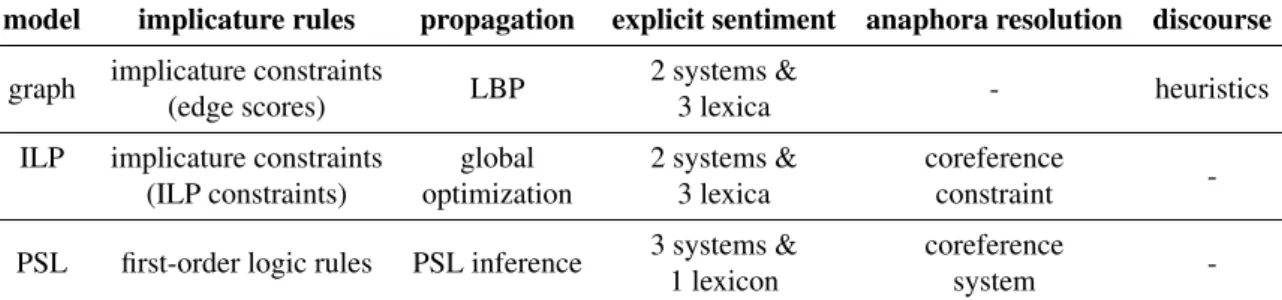
model implicature rules propagation explicit sentiment anaphora resolution discourse
graph implicature constraints LBP 2 systems & - heuristics
(edge scores) 3 lexica
ILP implicature constraints global 2 systems & coreference
-(ILP constraints) optimization 3 lexica constraint
PSL first-order logic rules PSL inference 3 systems & coreference
-1 lexicon system
Table 2.3 The recap of Deng and Wiebe’s work on sentiment inference with emphasis on the following: dependence on existing systems for capturing explicit sentiment, usage of anaphora resolution, and focus on discourse beyond a single sentence.
shown that we can infer more opinions once we resolve abstract anaphors. Therefore, their model would likely benefit from the resolution of anaphors that refer to facts, event, situations, and actions, in addition to resolving anaphors that refer to concrete objects.
2.1.1.5 Summary
In this section we reviewed the three most prominent learning approaches to sentiment inference having two questions in mind: (i) how reliant are available sentiment inference models on existing approaches for detecting explicit opinion expressions and their roles and (ii) how could they benefit from anaphora resolution. In this thesis, we will not integrate or evaluate our models for detecting explicit opinion expressions and abstract anaphora resolution into the described models for sentiment inference. The observations from this section serve as a motivation for our work.
In their studies, Deng and Wiebe intentionally exploit available systems and lexica for detection and categorization of opinion expressions and their roles (column 4 in Table 2.3). However, they repeatedly show that the imperfections of these systems and lexica considerably effect the performance of their sentiment inference approaches.
They acknowledge the benefit of anaphora resolution for the ILP and PSL frameworks, but only of anaphors that refer to concrete entities that exist in the real world i.e. coreference resolution (column 5 in Table 2.3). However, in the survey we recurrently notice that their models could also benefit from resolution of anaphors that refer to facts, events, situations, and actions i.e. from Abstract Anaphora Resolution (AAR). Moreover, we illustrated that once there is an available system that resolves such type of anaphors, its output can be easily integrated in their models. Finally, we showed that AAR enables a better propagation of sentiment in discourse beyond one sentence. The discourse-oriented propagation is nearly
2.2 Fine-Grained Opinion Analysis 25
completely ignored in their work (column 6 in Table 2.3), except in the simplistic discourse heuristic in the graph-based model which performs poorly.
Deng and Wiebe’s sentiment inference approaches (Section 2.1.1) are based on the GOODFOR/BADFORlexicon (Deng et al., 2013a; Choi et al., 2014; Choi and Wiebe, 2014; Choi et al., 2017). In the meantime, alternative lexica have been proposed: effect functors (Ruppenhofer and Brandes, 2016), connotation frames (Feng et al., 2013; Rashkin et al., 2016), sentiframes (Klenner, 2015; Klenner and Amsler, 2016), to name a few.
2.2
Fine-Grained Opinion Analysis
Although there has been a lot of research on subjectivity detection and polarity classification, less attention has been paid to the extraction ofopinion roles, i.e. opinion holders and targets. The exception is the extraction of opinion targets in the product review domain (Hu and Liu, 2004; Jakob and Gurevych, 2010; Liu et al., 2013a,b, 2014, 2015). However, Wiegand et al. (2015) argue that the review domain is not suitable for studying opinion role extraction. The first reason for this is that product reviews typically reflect only the author’s views on a particular product. Therefore, the majority of explicitly mentioned opinion holders refer to the author of the review. Second, opinion expressions in reviews are mostly adjectives. Third, the review domain is typically focused on products and hence only specific semantic types are eligible for opinion roles. For example, persons are less likely to be opinion targets. For all these reasons, opinion role extraction from product reviews is not a challenging task. On the other hand, news corpora typically tend to be multi-topic. As a consequence, opinion targets can be of different semantic types. For example, persons can function both as opinion holders and targets. Moreover, we do not have a bias toward adjectives. In the MPQA corpus (Section 2.2.1), Wiegand et al. (2015) found that there are 10% more opinion verb mentions than opinion adjective mentions. In this section we survey the literature on extraction and categorization of opinion expressions and their roles in news articles.
2.2.1
MPQA Opinion Corpus
The Multi-Perspective Question Answering (MPQA) Opinion Corpus8 consists of news
articles and other text documents manually annotated for opinions and otherprivate states (Quirk et al., 1985): opinions, beliefs, thoughts, feelings, emotions, goals, evaluations, and judgments. MPQA is the only commonly accepted corpus for English containing manual annotation of both opinion holders and targets.
original MPQA ULA ULA-LU
economic collapse in Argentina travel guides emails related to the Enron case Bush’s 2002 State of the Union Address transcriptions of spoken conversation spoken language transcripts detention of prisoners in Guantanamo Bay fundraising letters newswire text
U.S. State Department Human Rights Report a chapter of the 9/11 report Wall Street Journal texts U.S. State Department report on human rights a chapter from a linguistics textbook translations of Arabic source texts Israeli settlements in Gaza and the West Bank articles from Slate magazine
space missions of various countries relationship between Taiwan and China presidential coup in Venezuala 2002 presidential election in Zimbabwe
Table 2.4 MPQA 2.0 topic categories.
MPQA 1.0 (Wiebe et al., 2005). The first version consists of 535 documents from 187 different foreign and U.S. news sources, dating from June 2001 to May 2002. About two thirds of the documents were selected to be on one of ten specific topics (e.g. economic collapse in Argentina) listed in the first column in Table 2.4. The annotation scheme is centered on the notion ofprivate statedescribed as the state of anexperiencerholding an attitude, optionally toward atarget. They create two private state frames for three main types of private states: (i) explicit mentions of private states, (ii) speech events expressing private states, and (iii) expressive subjective elements. An example of each type can be found in (7).
(7) a. "The U.S. fears
explicit
a spill-over," said
speech
Xirao-Nima. b. "The report is full of absurdities
expressive subjective
," Xirao-Nima said.
Direct subjective frames are used to represent Direct Subjective Elements (DSEs), i.e. both speech events expressing private states and explicitly mentioned private states. Expressive subjective element frames are used to represent Expressive Subjective Elements (ESEs). The agent frame is used to mark noun phrases that refer to holders of private states and speech events. For example, agent frames are created forU.S.andXirao-Nimain sentence (7a).
MPQA 2.0 (Wilson, 2008). The important differences between the first and second ver-sions are that MPQA 2.0 contains additional sets of documents, it is extended to be a multi-genre corpus, and it also covers attitudes other than sentiments. Additional sets of documents are the Opinion Question Answering (QpQA) subset of 98 documents, 85 Wall Street Journal texts from the Penn TreeBank (XBank), the Unified Linguistic Annotation (ULA) subset of 48 documents, and the Language Understanding (ULA-LU) subset of 24 documents. ULA and ULA-LU subsets contain documents other than news articles (columns 2–3 in Table 2.4).
2.2 Fine-Grained Opinion Analysis 27
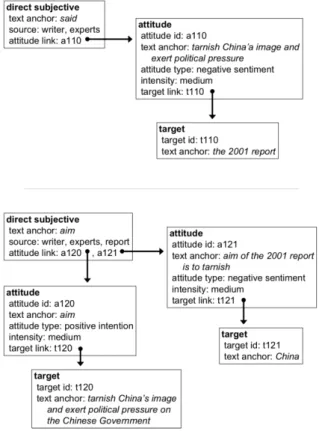
Fig. 2.3 MPQA annotation scheme. Figure from Wilson (2008).
Private states in language are often quite complex in terms of the attitudes they express and the targets of those attitudes. For example, Wilson (2008) showcased the private state represented by the direct subjective phraseare happy:
(8) I think peopleare happybecause Chavez has fallen.
From this sentence we understand thatpeopleexpressed a positive sentiment toward the fall of Chavez. However, there is a second attitude, a negative sentiment toward Chavez himself, which can be inferred from the phrasehappy because Chavez has fallen. Just as a private state may involve more than one type of attitude, an attitude may be directed toward more than one target. In the original annotation scheme, attitudes are represented with the attitude type attribute in direct subjective and expressive subjective element frames, and targets are represented with the target attribute in direct subjective. In the new representation, attitudes and targets are annotation frames