
Class binarization with self-adaptive algorithm to improve human activity recognition
47
0
0
Full text
(2) U. PM. CLASS BINARIZATION WITH SELF-ADAPTIVE ALGORITHM TO IMPROVE HUMAN ACTIVITY RECOGNITION. By. ©. C. O. P. MUHAMMAD NOORAZLAN SHAH BIN ZAINUDIN. Thesis Submitted to the School of Graduate Studies, Universiti Putra Malaysia, in Fulfilment of the Requirements for the Degree of Doctor of Philosophy. May 2018.
(3) COPYRIGHT. ©. C. O. P. U. Copyright © Universiti Putra Malaysia. PM. All material contained within the thesis, including without limitation text, logos, icons, photographs and all other artwork, is copyright material of Universiti Putra Malaysia unless otherwise stated. Use may be made of any material contained within the thesis for non-commercial purposes from the copyright holder. Commercial use of material may only be made with the express, prior, written permission of Universiti Putra Malaysia..
(4) DEDICATION. In the name of Allah, most Gracious and Most Merciful, To my beloved Father and Mother,. And being best parents ever, For my lovely supportive supervisors, For being the part of my journeys, For family members, For being the best brothers and sister, and in-laws, For your well wishes and prayers, For my lab members and colleagues, For your supports and guidance, And for everyone who has touched my life,. ©. C. O. P. I dedicate this to all of you.. U. And always being there for me,. PM. Your love, support and belief in me, gave me strength,.
(5) Abstract of thesis presented to the Senate of Universiti Putra Malaysia in fulfillment of the requirement for the degree of Doctor of Philosophy. By. PM. CLASS BINARIZATION WITH SELF-ADAPTIVE ALGORITHM TO IMPROVE HUMAN ACTIVITY RECOGNITION. May 2018. Chairman Faculty. U. MUHAMMAD NOORAZLAN SHAH BIN ZAINUDIN. : Associate Professor Md. Nasir Sulaiman, PhD : Computer Science and Information Technology. ©. C. O. P. Flourishing research in Human Activity Recognition (HAR) is essential in improving the quality of an individual’s health. Low cost and privacy interest, sensing technology becomes an imperative topic in activity monitoring applications. Nevertheless, the presence of high interclass similarity from similar activities mainly involving stairs activities yields to degrade the recognition accuracy. These kind of activities highly sparsely distributed in the input space which is problematic to be distinguish using traditional classifier model. Even though deep learning becomes a recent imperative topic, model complexity is considered as a foremost drawback and impractical to be conducted. Furthermore, although better recognition of stairs activities is accomplished, recognition of stationary activities is less reported due to less sensitivity of lesser waveform. Somehow, it might occur some of extracted features are insignificant to describe the activity. Even if a ranking method is widely utilized in solving numerous of dimension reduction problems such as in bioinformatics and high spectral images, most of works are disregarding the boundary to discard the irrelevant features.. In order to improve recognition of high interclass similarity activities, One-VersusAll (OVA) binarization strategy is introduced by transforming original multi-class classification problems into a series of two-class classification problems. However, the learning complexity of classification is increased due to the expansion number of learning model. Therefore, feature selection using Relief-f with self-adaptive Differential Evolution (rsaDE) algorithm is proposed to select the most significant features. To enhance the selection of most highly ranking features, irrelevant features are ‘pruned’ based on determined boundary threshold. In order to estimate the quality of ‘pruned’ features, self-adaptive DE algorithm is proposed. Two parameters (population size and generation numbers) are adaptively adopted from number of i.
(6) PM. remaining ranking features. Also, self-adaptive scaling factor and crossover probability control parameters are introduced to diminish time of finding an optimal parameter to produce the best population. In order to investigate the correlation between features and class, generated feature subsets are rearranged according to its mutual information. In such circumstances, frequency domain features are proposed due to their less susceptible to signal quality variations and beneficial to recognize stationary activity. These features are combined with statistical features to improve the ability of classifier model in distinguishing between locomotion, stationary and complex activities.. ©. C. O. P. U. Two publicly activity datasets are used; Wireless Sensor Data Mining (WISDM) and Physical Activity Monitoring for Aging People (PAMAP2). WISDM consists of six different types physical activity, while PAMAP2 covers eighteen activities comprising various simple and complex activities. In comparison, WISDM utilizes an accelerometer sensor embedded in Android smartphone. Meanwhile, PAMAP2 utilizes an accelerometer sensor equipped with three Inertial Measurement Unit (IMU) devices attached to three different placements. Performance of the proposed method is compared with several benchmark works. Experimental results have significantly promised an improvement of activity recognition level, mainly involving very similar activities.. ii.
(7) Abstrak tesis yang dikemukakan kepada Senat Universiti Putra Malaysia sebagai memenuhi keperluan untuk ijazah Doktor Falsafah. PEMBINARIAN KELAS DENGAN ALGORITMA PENYESUAIAN DIRI UNTUK MENINGKATKAN PENGECAMAN AKTIVITI MANUSIA. PM. Oleh. Mei 2018. Pengerusi Fakulti. U. MUHAMMAD NOORAZLAN SHAH BIN ZAINUDIN. : Profesor Madya Md. Nasir Sulaiman, PhD : Sains Komputer dan Teknologi Maklumat. ©. C. O. P. Penyelidikan berleluasa di dalam Pengecaman Aktiviti Manusia (HAR) adalah penting untuk meningkatkan kualiti kesihatan individu. Kos yang rendah serta mengambil kira isu peribadi, teknologi penderian menjadi topik penting di dalam aplikasi sistem pemantauan aktiviti. Walaubagaimanapun, kehadiran persamaan yang tinggi dari aktiviti yang sama terutamanya yang melibatkan aktiviti tangga merendahkan ketepatan pengiktirafan. Aktiviti ini sangat tersebar di dalam ruangan input di mana ianya amat sukar untuk dibezakan dengan menggunakan model pengelas tradisional. Walaupun pembelajaran mendalam telah menjadi topik penting baru-baru ini, kerumitan model dianggap sebagai kelemahan utama dan tidak praktikal untuk dijalankan dalam persekitaran masa nyata. Selain itu, walaupun pengiktirafan yang lebih baik telah dicapai bagi aktiviti tangga, pengiktirafan aktiviti pegun dilaporkan kurang. Tambahan lagi, ia mungkin berlaku beberapa ciri yang diekstrak tidak penting untuk menggambarkan aktiviti tersebut. Walaupun kaedah kedudukan telah digunakan secara meluas dalam menyelesaikan pelbagai masalah pengurangan dimensi seperti dalam bioinformatika dan imej berspektrum tinggi, sebahagian besar hasil kerja itu tidak menghiraukan nilai sempadan untuk membuang ciri-ciri yang tidak relevan.. Untuk menangani masalah membezakan aktiviti persamaan yang tinggi di antara kelas, strategi binari Satu-Lawan-Semua (OVA) diperkenalkan dengan mengubah masalah pengelasan pelbagai kelas menjadi satu siri masalah klasifikasi dua kelas. Walau bagaimanapun, kerumitan pembelajaran klasifikasi meningkat disebabkan bilangan pengembangan model pembelajaran. Sehubungan dengan itu, pemilihan ciri menggunakan Relief-f dengan algoritma Berbeza Evolusi (rsaDE) penyesuaian diri diperkenalkan untuk memilih ciri-ciri yang paling penting. Ciri-ciri yang tidak berkaitan 'dipangkas' mengikut sempadan ambang yang dipilih. Untuk iii.
(8) U. PM. menganggarkan kualiti ciri-ciri yang 'dipangkas', algoritma DE penyesuaian diri dicadangkan. Dua parameter (saiz populasi dan bilangan generasi) disesuaikan mengikut penggunaan bilangan ciri yang kekal di senarai kedudukan. Juga, kaedah penyesuaian diri bagi faktor skala dan parameter kawalan kebarangkalian penyeberangan untuk mengurangkan masa mencari parameter optimum untuk menghasilkan populasi yang terbaik diperkenalkan. Untuk menyelidik korelasi di antara ciri-ciri dan kelas, subset ciri yang dihasilkan telah disusun semula mengikut maklumat bersama. Dalam keadaan ini, ciri-ciri pengukuran kekerapan spektrum dicadangkan kerana ia kurang terdedah untuk memberi isyarat variasi yang berkualiti dan dapat meningkatkan keupayaan model pengelas bagi mengenali aktiviti pegun. Ciri-ciri ini digabungkan dengan ciri-ciri statistik untuk membezakan di antara aktiviti pergerakan, pegun dan kompleks.. ©. C. O. P. Dua set data aktiviti awam; perlombongan data penggera tanpa wayar (WISDM) dan pemantauan aktiviti fizikal bagi golongan tua (PAMAP2) telah digunakan. WISDM terdiri daripada enam jenis aktiviti fizikal yang berbeza, sementara PAMAP2 meliputi lapan belas aktiviti yang terdiri daripada pelbagai aktiviti yang mudah dan kompleks. Sebagai perbandingan, WISDM menggunakan deria pecutan yang terbenam di dalam telefon pintar Android. Sementara itu, PAMAP2 menggunakan deria pecutan yang dilengkapi dengan tiga peranti unit pengukuran inersia (IMU) yang diletakkan kepada tiga posisi yang berbeza. Prestasi kaedah yang dicadangkan dibandingkan dengan beberapa kerja ukur yang telah dihasilkan. Hasil kajian telah menjanjikan peningkatan tahap pengiktirafan aktiviti, terutamanya yang melibatkan aktiviti yang sangat serupa.. iv.
(9) ACKNOWLEDGEMENTS. PM. In the name of Allah s.w.t., I would like to express my earnest gratitude to my beloved and most supportive supervisor, Assoc. Prof. Dr. Md. Nasir Sulaiman for always being here and support my journey along my PhD study. Very much thank you for your patient, enthusiasm, and knowledge, always gave me positive support and guidance helped me to complete my research and thesis.. U. I also would like to thank to supervisory committee; Assoc. Prof. Datin Dr. Norwati Mustapha, Dr. Thinagaran Perumal and Dr. Azree Shahrel Ahmad Nazri for their encouragement, supports, comments and enormous knowledge. I am also taking this opportunity to thank to all members from “merepek meraban” (raihani, sufry, nizam, hisham, rafiez, hazrina, ana salwa, harnani, arzila and liyana) for being my partners along this journey. They always give full support in term of emotional and physical, positive vibes and always spending the time together no matter what happened.. ©. C. O. P. Last but not least, I greatly appreciate to my father, mother, sisters, brothers, in laws, colleagues and for everyone who bore on my spirit. Assalamualaikum w.b.t.. v.
(10) © P. O. C. U. PM.
(11) Md. Nasir bin Sulaiman, PhD Associate Professor Faculty of Computer Science and Information Technology Universiti Putra Malaysia (Chairman). U. Datin Norwati binti Mustapha, PhD Associate Professor Faculty of Computer Science and Information Technology Universiti Putra Malaysia (Member). PM. This thesis was submitted to the Senate of Universiti Putra Malaysia and has been accepted as fulfilment of the requirement for the degree of Doctor of Philosophy. The members of the Supervisory Committee were as follows:. Thinagaran Perumal, PhD Senior Lecturer Faculty of Computer Science and Information Technology Universiti Putra Malaysia (Member). O. P. Azree Shahrel bin Ahmad Nazri, PhD Senior Lecturer Faculty of Computer Science and Information Technology Universiti Putra Malaysia (Member). ©. C. ___________________________ ROBIAH BINTI YUNUS, PhD Professor and Dean School of Graduate Studies Universiti Putra Malaysia. Date:. vii.
(12) Declaration by graduate student. U. PM. I hereby confirm that: x this thesis is my original work; x quotations, illustrations and citations have been duly referenced; x this thesis has not been submitted previously or concurrently for any other degree at any institutions; x intellectual property from the thesis and copyright of thesis are fully-owned by Universiti Putra Malaysia, as according to the Universiti Putra Malaysia (Research) Rules 2012; x written permission must be obtained from supervisor and the office of Deputy Vice-Chancellor (Research and innovation) before thesis is published (in the form of written, printed or in electronic form) including books, journals, modules, proceedings, popular writings, seminar papers, manuscripts, posters, reports, lecture notes, learning modules or any other materials as stated in the Universiti Putra Malaysia (Research) Rules 2012; x there is no plagiarism or data falsification/fabrication in the thesis, and scholarly integrity is upheld as according to the Universiti Putra Malaysia (Graduate Studies) Rules 2003 (Revision 2012-2013) and the Universiti Putra Malaysia (Research) Rules 2012. The thesis has undergone plagiarism detection software. Signature:. Date:. ©. C. O. P. Name and Matric No: Muhammad Noorazlan Shah Bin Zainudin, GS 42148. viii.
(13) Declaration by Members of Supervisory Committee. Associate Professor Dr. Datin Norwati binti Mustapha. Signature: Name of Member of Supervisory Committee:. Dr. Thinagaran Perumal. O. P. Signature: Name of Member of Supervisory Committee:. U. Signature: Name of Chairman of Supervisory Associate Professor Committee: Dr. Md. Nasir bin Sulaiman. PM. This is to confirm that: x the research conducted and the writing of this thesis was under our supervision; x supervision responsibilities as stated in the Universiti Putra Malaysia (Graduate Studies) Rules 2003 (Revision 2012-2013) were adhered to.. Dr. Azree Shahrel bin Ahmad Nazri. ©. C. Signature: Name of Member of Supervisory Committee:. ix.
(14) TABLE OF CONTENTS Page i iii v vi viii xiii xv xvii. PM. ABSTRACT ABSTRAK ACKNOWLEDGEMENTS APPROVAL DECLERATION LIST OF TABLES LIST OF FIGURES LIST OF ABBREVIATIONS. U. CHAPTER. INTRODUCTION 1.1 Motivation 1.2 Problem Statement 1.3 Research Objectives 1.4 Research Scope 1.5 Research Contributions 1.6 Structure of Thesis. 2. LITERATURE REVIEW 2.1 Introduction 2.2 Background of Study 2.2.1 Vision-based Sensor 2.2.2 Environment-based Sensor 2.2.3 Wearable-based Sensor 2.3 Wearable Sensor Approach in HAR 2.4 Challenges and Issues in HAR 2.4.1 Interclass similarities and intraclass variations in HAR 2.4.2 Curse of Irrelevant Features in HAR 2.5 Signal Filtering and Noise Reduction 2.6 Data Segmentation and Feature Extraction 2.7 Feature Selection Method 2.8 HAR Classification Method 2.8.1 Traditional Classification Strategy 2.8.2 Binarization Classification Strategy 2.9 Summary. ©. C. O. P. 1. x. 1 1 3 4 4 5 6. 7 7 7 8 9 10 11 13 13 20 25 27 29 32 33 36 38.
(15) 39 39 39 40 44 45 45 46 46 48. METHODOLOGY 3.1 Introduction 3.2 The Framework of Proposed HAR 3.2.1 Data Collection 3.2.2 Signal Preprocessing Stage 3.2.3 Feature Extraction Stage 3.2.4 Feature Selection Stage 3.2.5 Classification Stage 3.3 Validation and Performance Indicators 3.4 Summary. 4. A FRAMEWORK OF THE PROPOSED HUMAN ACTIVITY RECOGNITION 4.1 Introduction 4.2 The HAR Framework 4.3 Feature Extraction of Acceleration Signal 4.3.1 Statistical Features 4.3.2 Frequency Domain Features 4.4 Feature Selection Method using Combination of Relief-f with Self-adaptive Differential Evolution Algorithm 4.4.1 Relief-f Feature Ranking Subset Evaluation 4.4.2 Differential Evolution Evolutionary Algorithm Subset Generation 4.4.3 Adaptive Parameter of Population Size and Generation Size 4.4.4 Self-adaptive Scaling Factor and Crossover Probability Parameters 4.4.5 Entropy and Mutual Information 4.5 Proposed Class Binarization Strategy Classification Method 4.5.1 One-Versus-All (OVA) 4.5.2 One-Versus-One (OVO) 4.5.3 Random Forest Ensemble Classifier 4.6 Flowchart of Overall HAR 4.7 Summary. C. O. P. U. PM. 3. ©. 5. EXPERIMENTAL RESULTS AND DISCUSSIONS 5.1 Introduction 5.2 Preprocessing of WISDM and PAMAP2 Data sets 5.2.1 Signal Filtering using Butterworth Low Pass Filter 5.2.2 Feature Extraction using Sliding Window Segmentation 5.3. Experimental Result of WISDM Data Sets 5.3.1 Experimental Result of Binarization Classification Methods 5.3.2 Experimental Result of Relief-f Subset Evaluation. xi. 49 49 49 49 49 51. 52 52 54 56 57 61 64 65 67 69 71 74. 75 75 75 77 77 78 80 83.
(16) 5.5 5.6. CONCLUSION AND FUTURE WORK 6.1 Conclusion 6.2 Recommendation for Future Work. 113 113 117. U. 6. PM. 5.4. 5.3.3 Experimental Result of Self-adaptive Differential Evolution Algorithm (saDE) 87 5.3.4 Experimental Result using rsaDE 92 Experiment of PAMAP2 Data Sets 96 5.4.1 Experimental Result using rsaDE 96 5.4.2 Experimental Result of All Placements using rsaDE 99 Comparison Result with Benchmark Studies 103 Summary 112. ©. C. O. P. REFERENCES APPENDICES BIODATA OF STUDENT LIST OF PUBLICATIONS. xii. 120 139 148 149.
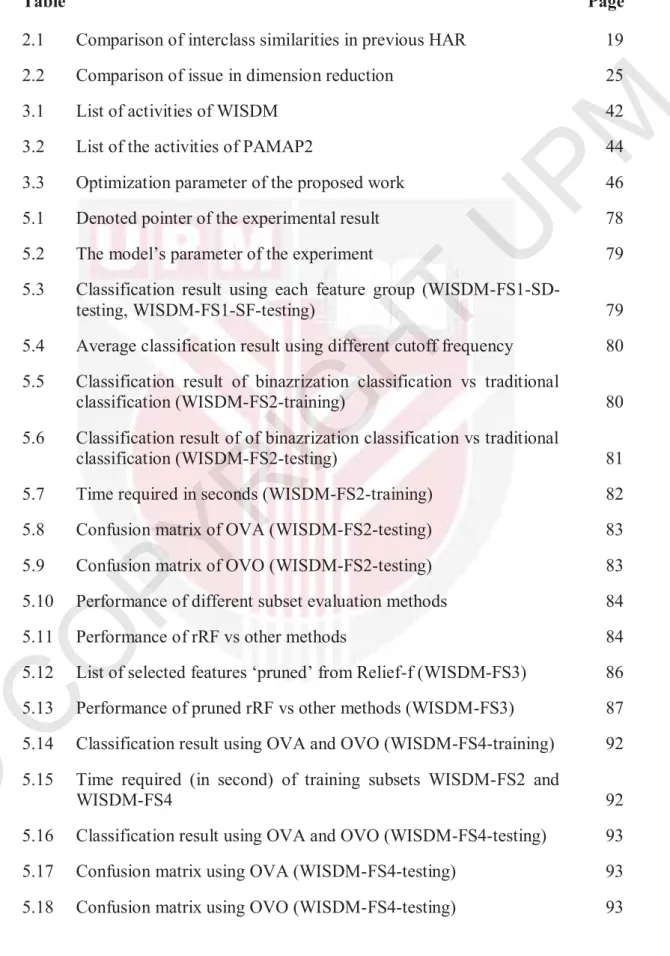
(17) LIST OF TABLES. Comparison of interclass similarities in previous HAR. 19. 2.2. Comparison of issue in dimension reduction. 25. 3.1. List of activities of WISDM. 42. 3.2. List of the activities of PAMAP2. 3.3. Optimization parameter of the proposed work. 5.1. Denoted pointer of the experimental result. 5.2. The model’s parameter of the experiment. 5.3. Classification result using each feature group (WISDM-FS1-SDtesting, WISDM-FS1-SF-testing). 79. 5.4. Average classification result using different cutoff frequency. 80. 5.5. Classification result of binazrization classification vs traditional classification (WISDM-FS2-training). 80. Classification result of of binazrization classification vs traditional classification (WISDM-FS2-testing). 81. 5.7. Time required in seconds (WISDM-FS2-training). 82. 5.8. Confusion matrix of OVA (WISDM-FS2-testing). 83. 5.9. Confusion matrix of OVO (WISDM-FS2-testing). 83. 5.10. Performance of different subset evaluation methods. 5.11. P. 84. Performance of rRF vs other methods. 84. 5.12. List of selected features ‘pruned’ from Relief-f (WISDM-FS3). 86. 5.13. Performance of pruned rRF vs other methods (WISDM-FS3). 87. 5.14. Classification result using OVA and OVO (WISDM-FS4-training). 92. 5.15. Time required (in second) of training subsets WISDM-FS2 and WISDM-FS4. 92. 5.16. Classification result using OVA and OVO (WISDM-FS4-testing). 93. 5.17. Confusion matrix using OVA (WISDM-FS4-testing). 93. 5.18. Confusion matrix using OVO (WISDM-FS4-testing). 93. xiii. C. PM. 2.1. 5.6. ©. Page. O. Table. 44. U. 46. 78. 79.
(18) Comparison result of rsaDE vs non-self adaptive methods. 94. 5.20. Comparison performance of rsaDE+OVARF vs rsaDE+traditional classifier methods. 95. Classification result of dominant wrist, chest and dominant ankle placements using OVA (PAMAP2-FS4-training). 97. Classification result of dominant wrist, chest and dominant ankle placements using OVO (PAMAP2-FS4-training). 98. Classification result of dominant wrist, chest and dominant ankle placements using OVA (PAMAP2-FS4-testing). 98. Classification result of dominant wrist, chest and dominant ankle placements using OVO (PAMAP2-FS4-testing). 99. Classification result of all sensor placements using OVA and OVO (PAMAP2-FS5). 100. Confusion matrix of all sensor placements using OVA (PAMAP2FS5). 101. Confusion matrix of all sensor placements using OVO (PAMAP2FS5). 102. Comparison of non self-adaptive vs rsaDE (PAMAP2-FS3 and PAMAP2-FS5) using OVA. 103. Comparison result of rsaDE+OVARF vs non selfadaptive+traditional classifier models for WISDM - Arif et al. (2014). 104. Comparison result of (rsaDE vs non self-adaptive) with traditional and binarization classification method for WISDM – Arif et al. (2014). 105. Comparison result of rsaDE+OVARF vs non selfadaptive+traditional classification method for PAMAP2 - Arif et al. (2015). 106. Comparison result of (rsaDE vs non self-adaptive) with traditional and binarization classification method for PAMAP2 Arif et al. (2015). 107. Comparison result of (rsaDE vs non self-adaptive) with traditional and binarization classification method for PAMAP2 - Arif and Kattan (2015). 108. 5.23 5.24 5.25 5.26 5.27 5.28 5.29. 5.30. C. O. 5.31. U. 5.22. P. 5.21. PM. 5.19. ©. 5.32. 5.33. xiv.
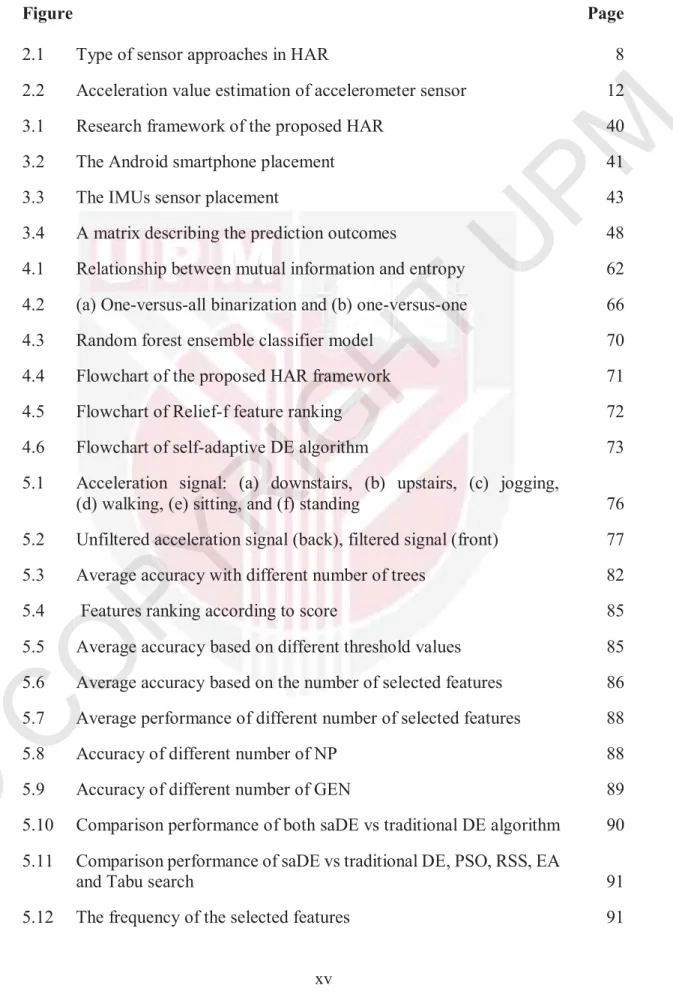
(19) LIST OF FIGURES. 2.1. Type of sensor approaches in HAR. 2.2. Acceleration value estimation of accelerometer sensor. 3.1. Research framework of the proposed HAR. 3.2. The Android smartphone placement. 3.3. The IMUs sensor placement. 3.4. A matrix describing the prediction outcomes. 4.1. Relationship between mutual information and entropy. 62. 4.2. (a) One-versus-all binarization and (b) one-versus-one. 66. 4.3. Random forest ensemble classifier model. 70. 4.4. Flowchart of the proposed HAR framework. 71. 4.5. Flowchart of Relief-f feature ranking. 72. 4.6. Flowchart of self-adaptive DE algorithm. 73. 5.1. Acceleration signal: (a) downstairs, (b) upstairs, (c) jogging, (d) walking, (e) sitting, and (f) standing. 76. 5.2. Unfiltered acceleration signal (back), filtered signal (front). 77. 5.3. Average accuracy with different number of trees. 82. 5.4. Features ranking according to score. 5.5. P. 85. Average accuracy based on different threshold values. 85. 5.6. Average accuracy based on the number of selected features. 86. 5.7. Average performance of different number of selected features. 88. 5.8. Accuracy of different number of NP. 88. 5.9. Accuracy of different number of GEN. 89. 5.10. Comparison performance of both saDE vs traditional DE algorithm. 90. 5.11. Comparison performance of saDE vs traditional DE, PSO, RSS, EA and Tabu search. 91. The frequency of the selected features. 91. C ©. Page. O. Figure. 5.12. 8. PM. 12 40. 41. xv. U. 43. 48.
(20) Comparison of rsaDE vs non self-adaptive methods. 94. 5.14. Comparison performance of rsaDE+OVARF vs rsaDE+traditional classifier methods. 96. Comparison result of rsaDE+OVARF vs non selfadaptive+traditional classifier models for WISDM - Arif et al. (2014). 109. Comparison result of rsaDE vs non self-adaptive feature selection method for WISDM – Arif et al. (2014). 109. Comparison result of rsaDE+OVARF vs non selfadaptive+traditional classification methods for PAMAP2 - Arif et al. (2015). 110. 5.16 5.17. 5.18. Comparison result of rsaDE vs non self-adaptive feature selection methods for PAMAP2 Arif et al. (2015). 110. Comparison result of (rsaDE vs non self-adaptive) with traditional classification methods for PAMAP2 - Arif and Kattan (2015). 111. ©. C. O. P. 5.19. U. 5.15. PM. 5.13. xvi.
(21) LIST OF ABBREVIATIONS. AI. Artificial Intelligence. ANN. Artificial Neural Network. BDE. Binary Differential Evolution. BMI. Body Mass Index. CR. Crossover Probability. CS. Chi-Squared. DE. Differential Evolution. DFT. Discreet Fourier Transform. DNF. Desired Number of Features. EA. Evolutionary Algorithm. ELM. Extreme Leaning Machine. F. Scaling factor. FFT. Fast Fourier Transform. GA. Genetic Algorithm. GFFSM. Genetic Fuzzy Finite State Machine. GPS. Geographical Positioning System. GR. Gain Ratio. HAR. Human Activity Recognition. ICC. Correlation Coefficient. O. ID3. U. Iterative DiChaudomiser. IG. Information Gain. IMU. Inertial Measurement Unit. C ©. PM. Analog-to-Digital Converter. P. ADC. KNN. K-Nearest Neighbour. MEMs. Micro-machine Electromechanical Sensor. MLP. Multilayer Perceptron. MRMC. Maximal Relevance Maximal Complementary. MRMD. Max-Relevance-Max-Distance. NF. Number of Features. OR. One-R. xvii.
(22) One-Versus-All. OVO. One-Versus-One. PAMAP2. Physical Activity Monitoring for Aging People 2. PCA. Principle Component Analysis. PSO. Particle Swarm Optimization. RF. Random Forest. rsaDE. Relief-f ranking with self adaptive differential evolution. Reduced Scatter Search. SBE. Sequential Backward Elimination. SFS. Sequential Forward Selection. SS. Scatter Search. SU. Symmetrical Uncertainty. SVM. Support Vector Machine. TS. Tabu Search. WHO. World Health Organization. WISDM. Wireless Sensor Data Mining. ©. C. O. P. RSS. xviii. U. algorithm. PM. OVA.
(23) CHAPTER 1. 1. Motivation. PM. 1.1. INTRODUCTION. U. The advancement of sensing technology in ambient assisted living nowadays has become a major topic. Plentiful of intelligent human applications have become prevalent, particularly in the area of security surveillance (Lara & Labrador, 2013), human-computer interaction (Murthy & Jadon, 2010) as well as in human healthcare application (Guiry et al., 2014). Additionally, Human Activity Recognition (HAR) research has currently emerged as an active area in sensing technology and plays a vital role in human interaction with interpersonal relations. This research provides a fascinating field to increase more exploration in smart environment by improving the current technology to be more intelligent, comfort, usable, and secure. Activity recognition utilizes the connection from various aspects such as machine learning, artificial intelligence, ubiquitous computing, human-computer interaction, psychology, and sociology (Khan, 2011).. ©. C. O. P. The subjective method is primarily collected by questionnaires which may lead to biases or inaccurate data. Hence, the subjective data collection method is shown to be unreliable and it is recommended to replace it with an objective method such as activity recognition system in order to collect more reliable and valid data. The role of activity recognition is to recognize human’s actions or events, by observing the object behaviour with environmental characteristics. In such situations, the projected expansion of sensing device has facilitated the process of collecting the attributes which are related to the individuals with the surroundings (Lara & Labrador, 2012). From this perspective, people may manage their daily home routine by controlling their stuff remotely. For example, residents could monitor their electrical usage and also control the home appliances through their smartphones when they were away from their home for a specified period of times. Other than that, activity recognition also offers an option to monitor the resident’s regular activities. The system could remind them about everyday chores such as taking medicine, activating security alarm, and feeding their pet. On top of that, activity recognition also allows the medical expert to investigate the diversity of healthcare applications. Moreover, the risk for non-communicable diseases such as obesity, heart failure, and diabetes is higher among the people who do not meet recommended amount of physical activity. Consequently, people are emboldened to go through a simple behaviour improvements that lead to healthy way of living. The awareness and modifications towards our lifestyle choices are essential to improve the quality of life (Dobbins et al., 2016). For instance, smartphone application will notify the carrier to use the staircase rather than using an elevator when there is no action detected for a specific period. They also might receive a 1.
(24) notification to walk around when they have been sitting within the duration of 30 minutes (Su et al., 2014). Today’s activity recognition however is aimed at strengthening the monitoring of simple variables such as counting steps, stairs, and measuring distance. Hence, the exploration to improve activity recognition in providing overall health status is indispensable.. U. PM. Furthermore, people could monitor and uphold their daily physical activities by using their body-worn device. Wearable sensor such as accelerometer utilises multivariate time-series classification problem which makes use of data streams from sensors to recognize the activity that has been carried out. In such states, additional features or attributes are required in order to describe the action and to differentiate it between stationary, locomotion and complex activity. Previous work has reported successful in stationary activity, but incapable to recognize locomotion activity. Stationary or postural acitivity is considered as the activity that requires less energy expenditure such as sitting, standing, and watching TV. The activities that need more intensity in movement such as running and walking on the other hand are considered as locomotion while the complex activity consists of sequence of actions to be performed. In such circumstances, this body-worn sensor device is attached to a specific placement of the human bodies in order to sense the signal. Therefore, it will result in hundreds to thousands of samples from each type of activity performed. However, to process the large number of samples is believed to be a challenge for activity recognition (Bolón-Canedo et al., 2013).. ©. C. O. P. Activity recognition is not only significant to identify the activity but also the types of event performed. Besides, different kinds of activities such house cleaning may encompass sequence of actions that are regularly accomplished on a daily basis. Therefore, to recognize this activity with high accuracy will be challenging. In such circumstances, there might exist various activities that are fundamentally different in the experimental ground but produce a very similar characteristic signal pattern (Bulling et al., 2014). Hence, it becomes problematic to distinguish between these types of activities with high accuracy performance. On the other hand, selection of the most meaningful features is another challenge. More features are recommended in order to identify more precisely between stairs activity with other stride activities such as walking and running. The difficulties arise since the signals received are similar to another level of walking for each human (Capela et al., 2016). However, the selection of optimal parameter values also becomes challenges to balance the exploitation and exploration particularly in population-based algorithm. Selfadaptive parameter mechanism is introduced by automatically adjusting the parameters without relying on thorough process. Hence, this parameter meachnism will gradually control the parameter value by learning from the previous experiences in generating promising solutions (Li and Yin, 2016).. 2.
(25) 1.2. Problem Statement. U. PM. The presence of interclass similarity of different activities is a challenge in activity recognition (Poorani et al., 2017; Zhang et al., 2017). Interclass similarity occurs when the activity are fundamentally different by classes (eg. ascending and descending walking), but show very similar characteristics in sensor signal forms (Bulling et al., 2014). The similarity exists in the sense of distinguishing between ascending and descending walking with other stride activities such as walking and running (Albert et al. , 2017; Chowdhury et al., 2017; Daghistani & Alshammari, 2016; Micucci et al., 2017; Ronao & Cho, 2016; Tian et al., 2017). Deep Convolutional Neural Network (CNN) has proven an outstanding accuracy and able to differentiate high interclass similarity activities (Alsheikh et al., 2015; Hagenbuchner et al., 2015; Ravi et al., 2016; Ronao & Cho, 2016). Unfortunately, the CNN is incapable of producing high accuracy for stationary activity due to the sensitivity of lesser waveform (Ronao & Cho, 2016).. ©. C. O. P. The selection of features is another considerable challenge as some of the features are less useful and may be insignificant to portray the activity. The statistical features are broadly employed as it is less complicated and beneficial in describing stationary activity. However, the use of these features alone might not be reliable to recognize the locomotion activity (Arif et al., 2014; Arif et al., 2015). Likewise, some of the features might be redundant (Machado et al., 2015) and this matter would possibly increase the false classification rate (Martinoyić et al., 2014). Although Arif et al. (2015) had successfully produced a decent accuracy on average, the chosen number of features is still considerably large. The advantages of ranking methods which are used for selecting the features due to less complex and are able to handle large number of instances (Wang et al., 2016). However, most of the works did not define the feature boundary that discard the lower ranking features (Ghosh et al., 2013). On the other hand, population-based optimization methods have extensively been employed in solving global optimization problems (Olvera-Lopez et al., 2010). The computational cost of iteration and population re-evaluation of finding an optimal parameter have restrictively increased when dealing with ample number of features (Brown et al., 2016). Somehow, the chosen parameter that is useful for one problem may not necessarily be good for another problem. Hence, an automatical parameter mechanism could be further explored particularly in promising an outstanding performance.. 3.
(26) 1.3. Research Objectives. Based on the problem statements, this research has several research objectives. The primary goals of this research is to improve the recognition of high interclass similarity activities by utilizing minimal number of features. In order to achieve this objective, sub-objectives are as followed:. U. PM. 1. To propose feature selection using Relief-f with self-adaptive Differential Evolution algorithm (rsaDE) based on mutual information in order to select the most significant features to be classified. 2. To propose class binarization classification strategies using One-Versus-All (OVA) with the context of an ensemble-based tree classifier model to improve the recognition of high interclass similarity activities. 3. To propose features fusion from frequency domain features with statistical features to distinguish between stationary, locomotion and complex activities.. 1.4. Research Scope. O. P. This research primarily focuses on improvement of the recognition of human activity particularly in differentiating high interclass similarity activities. Two publicly available accelerometer physical activity datasets; WISDM and PAMAP2 from two different environment conditions (laboratory controlled and free-living environment) are employed. Each dataset contains variation of activities type that are broadly covered in the daily human basis. WISDM utilizes an accelerometer sensor deeply set within the Android smartphone. Meanwhile, PAMAP2 uses an accelerometer sensor equipped with three Inertial Measurement Unit (IMU) devices which are attached to several placements of human’s body. This work do not cater the problems in real-time environment conditions.. ©. C. In order to make a fair comparison with several published benchmark studies, only sensor data stream from an acceleration signal is utilized. Various types of simple and complex activities are included in both data sets without relying on the transition between two or more actions. The experiment is conducted separately for each dataset and each experimental analysis is compared according to the experimental setup from the chosen work. The proposed class binarization strategies involve the use of OVA and One-Versus-One (OVO) are evaluated separately for each data set. Three benchmark works from Arif et al. (2014) and Arif et al. (2015), and Arif and Kattan (2015) are chosen and compared with our experimental result.. 4.
(27) 1.5. Research Contributions. PM. A mentioned before, this research is carried out in order to recognize different human activities based on recorded data stream from an accelerometer sensor. The main contribution of this study is to improve the recognition of high interclass similarity activities by using a minimum number of features. Thus, this study produces several contributions. 1. The effectiveness of integration of several sensor placements (dominant wrist, chest, and dominant ankle) is investigated to recognize different types of simple and complex activity.. U. 2. The correlation between statistical features and frequency domain features are explored to differentiate between stationary, locomotion and complex activities. 3. The highly ranking features are selected by using Relief-f feature ranking method and optimal threshold to define the feature boundary is introduced. 4. The effectiveness of combinational feature selection using Relief-f with selfadaptive differential evolution algorithm is analyzed and compared with traditional state-of-the-arts subset generation algorithm. 5. Two parameters (population size and generation size) are adaptively defined from input dimension of pruned ranking features.. 6. Self-adaptive control parameters mechanism for scaling factor and crossover probabilities are introduced. The accuracy level has also been compared with a traditional differential evolution algorithm and several state-of-the-art subset generation methods.. O. P. 7. The generated feature subsets from proposed feature selection method is rearranged based on the correlation measured by mutual information.. C. 8. The class binarization classification strategies using One-Versus-All (OVA) is introduced to accommodate the trade-off in distinguishing between high interclass similarity activity specifically in diverges types of stride activities.. ©. 9. The effectiveness of OVA is evaluated in the aspect of ensemble decision tree classifier model by introducing self-adjusted tree parameter.. 5.
(28) 1.6. Structure of Thesis. The thesis is structured and organized into six chapters.. PM. Chapter 1 gives brief introduction on the background of activity recognition from various perspectives. The current trend and challenges in activity recognition from numerous viewpoints have also been discussed. Limitation of present work, research objectives, scopes and contribution of this research are explained in this chapter.. U. Chapter 2 discusses the related work in the field of activity recognition, including types of sensor used in detail, previous work regarding the wearable sensor. The feature extraction and feature selection method that customarily applied in solving classification problem also been discussed.. Chapter 3 describes an overview of the conceptual research framework methodology of proposed improved activity recognition. Some compulsory stages to implement the activity recognition is carried out, including preprocessing stage, feature extraction stage, feature selection stage, and classification stage. Chapter 4 presents the proposed extracted features and feature selection methods using Relief-f with self-adaptive differential evolution algorithm in details. The selection criteria, optimal parameter setting, as well as proposed adaptive and selfadaptive control parameter mechanism are described. The proposed binarization classification strategies using OVA and OVO to improve the difficulty of distinguishing between high interclass similarity activities are also discussed.. O. P. Chapter 5 explains the experimental setting and analysis result that are conducted for each dataset. All the experiments that are carried out in order to produce an optimal accuracy performance are analyzed. A comparison between the results and previously published work are also discussed.. ©. C. Chapter 6 presents the conclusion of the entire research to ascertain that the problem highlighted is solved and is aligned with the objective stated. The recommendation based on the work for upcoming research is also presented.. 6.
(29) REFERENCES. Abidine, M. B., & Fergani, B. (2012). Evaluating C -SVM , CRF and LDA Classification for Daily Activity Recognition. In International Conference on Multimedia Computing and Systems (ICMCS), 2012. http://doi.org/10.1109/ICMCS.2012.6320300. PM. Acharjee, D., Mukherjee, A., Mandal, J. K., & Mukherjee, N. (2016). Activity recognition system using inbuilt sensors of smart mobile phone and minimizing feature vectors. Microsystem Technologies, 22(11), 2715–2722. http://doi.org/10.1007/s00542-015-2551-2. U. Adnan, M. N., & Islam, M. Z. (2015). One-Vs-All Binarization Technique in the Context of Random Forest. In European Symposium on Artificial Neural Networks, Computational Intelligence and Machine Learning. (pp. 22–24).. Akhavian, R., & Behzadan, A. H. (2015). Construction equipment activit y recognition for simulation input modeling using mobile sensors and machine learning classifiers. Advanced Engineering Informatics, 29(4), 867–877. http://doi.org/10.1016/j.aei.2015.03.001 Al-Ani, A., Alsukker, A., & Khushaba, R. N. (2013). Feature subset selection using differential evolution and a wheel based search strategy. Swarm and Evolutionary Computation, 9, 15–26. http://doi.org/10.1016/j.swevo.2012.09.003 Alam, M. R., Member, S., Bin, M., Reaz, I., Alauddin, M., & Ali, M. (2012). A Review of Smart Homes — Past , Present , and Future. IEEE TRANSACTIONS ON SYSTEMS, MAN, AND CYBERNETICS, 42(6), 1190–1203.. O. P. Albert, M. V., Azeze, Y., Courtois, M., & Jayaraman, A. (2017). In-lab versus athome activity recognition in ambulatory subjects with incomplete spinal cord injury. Journal of NeuroEngineering and Rehabilitation, 14(1), 1–6. http://doi.org/10.1186/s12984-017-0222-5. ©. C. Ali, M., Pant, M., & Abraham, A. (2009). Simplex differential evolution. Acta Polytechnica Hungarica, 6(5), 95–115. Alsheikh, M. A., Selim, A., Niyato, D., Doyle, L., Lin, S., & Tan, H.-P. (2015). Deep Activity Recognition Models with Triaxial Accelerometers. In TheWorkshops of the Thirtieth AAAI Conference on Artificial Intelligence (pp. 1–8). Retrieved from http://arxiv.org/abs/1511.04664. Alzahrani, M., & Kammoun, S. (2016). Human Activity Recognition: Challenges and Process Stages. International Journal of Innovative Research in Computer and Communication Engineering, 4(5), 1111–1118. http://doi.org/10.15680/ijircce.2015.. 120.
(30) Anguita, D., Ghio, A., Oneto, L., Parra, X., & Reyes-Ortiz, J. L. (2012). Human activity recognition on smartphones using a multiclass hardware-friendly support vector machine. Lecture Notes in Computer Science (Including Subseries Lecture Notes in Artificial Intelligence and Lecture Notes in Bioinformatics), 7657 LNCS, 216–223. http://doi.org/10.1007/978-3-64235395-6_30. PM. Anguita, D., Ghio, A., Oneto, L., Parra, X., & Reyes-Ortiz, J. L. (2013). A Public Domain Dataset for Human Activity Recognition Using Smartphones. European Symposium on Artificial Neural Networks, Computational Intelligence and Machine Learning, (April), 24–26. Retrieved from http://www.i6doc.com/en/livre/?GCOI=28001100131010. U. Apolloni, J., Leguizamón, G., & Alba, E. (2016). Two hybrid wrapper-filter feature selection algorithms applied to high-dimensional microarray experiments. Applied Soft Computing Journal, 38, 922–932. http://doi.org/10.1016/j.asoc.2015.10.037 Arif, M., Bilal, M., Kattan, A., & Ahamed, S. I. (2014). Better physical activity classification using smartphone acceleration sensor. Journal of Medical Systems, 38(9), 1–10. http://doi.org/10.1007/s10916-014-0095-0 Arif, M., & Kattan, A. (2015). Physical activities monitoring using wearable acceleration sensors attached to the body. PLoS ONE, 10(7), 1–16. http://doi.org/10.1371/journal.pone.0130851 Arif, M., Kattan, A., & Ahamed, S. I. (2015). Classification of Physical Activities Using Wearable Sensors. Intelligent Automation and Soft Computing, (September 2016), 1–10. http://doi.org/10.1080/10798587.2015.1118275. P. Awan, M. A., Guangbin, Z., Kim, C.-G., & Kim, S.-D. (2014). Human Activity Recognition in WSN: A Comparative Study. Journal of Chemical Information and Modeling, 53(4), 160. http://doi.org/10.1017/CBO9781107415324.004. ©. C. O. Ayu, M. A., Ismail, S. A., Abdul Matin, A. F., & Mantoro, T. (2012). A comparison study of classifier algorithms for mobile-phone’s accelerometer based activity recognition. Procedia Engineering, 41(Iris), 224–229. http://doi.org/10.1016/j.proeng.2012.07.166 Balakrishnan, U., Venkatachalapathy, K., & Marimuthu, G. S. (2016). An enhanced PSO-DEFS based feature selection with biometric authentication for identification of diabetic retinopathy. Journal of Innovative Optical Health Sciences, 9(6), 1650020. http://doi.org/10.1142/S1793545816500206. Banos, O., Galvez, J., Damas, M., Pomares, H., & Rojas, I. (2014). Window Size Impact in Human Activity Recognition. Sensors, 14, 6474–6499. http://doi.org/10.3390/s140406474. 121.
(31) Bao, L., & Intille, S. S. (2004). Activity Recognition from User-Annotated Acceleration Data. Pervasive Computing, 1–17. http://doi.org/10.1007/b96922 Bayat, A., Pomplun, M., & Tran, D. a. (2014). A Study on Human Activity Recognition Using Accelerometer Data from Smartphones. Procedia Computer Science, 34, 450–457. http://doi.org/10.1016/j.procs.2014.07.009. PM. Bennasar, M., Hicks, Y., & Setchi, R. (2015). Feature selection using Joint Mutual Information Maximisation. Expert Systems with Applications, 42, 8520–8532. http://doi.org/https://doi.org/10.1016/j.eswa.2015.07.007. U. Bernardos, A. M., & Casar, R. (2013). Activity logging using lightweight classification techniques in mobile devices. Pers Ubiquit Comput, 17, 675–695. http://doi.org/10.1007/s00779-012-0515-4 Bharathi, P. T., & Subashini, P. (2014a). BASED FEATURE SUBSET SELECTION FOR RECOGNITION OF RIVER ICE TYPES. Journal of Theoretical and Applied Information Technology, 67(1), 254–262. Bharathi, P. T., & Subashini, P. (2014b). Optimal Feature Subset Selection Using Differential Evolution and Extreme Learning Machine. International Journal of Science and Research (IJSR), 3(7), 1898–1905. http://doi.org/2319-7064 Bhatia, S., & Vishwakarma, V. P. (2016). Feed Forward Neural Network Optimization using Self Adaptive Differential Evolution for Pattern Classification. In Feed Forward Neural Network Optimization using Self Adaptive Differential Evolution for Pattern Classification (pp. 184–188). Bolon-Canedo, V., Sanchez-Marono, N., & Alonso-Betanzos, A. (2013). A review of feature selection methods on synthetic data. Knowledge and Information Systems, 34(3), 483–519. http://doi.org/10.1007/s10115-012-0487-8. O. P. Bolon-Canedo, V., Sanchez-Marono, N., & Alonso-Betanzos, A. (2014). Data classification using an ensemble of filters. Neurocomputing, 135, 13–20. http://doi.org/10.1016/j.neucom.2013.03.067. ©. C. Bolón-Canedo, V., Sánchez-Maroño, N., & Alonso-Betanzos, A. (2013). A review of feature selection methods on synthetic data. Knowledge and Information Systems, 34(3), 483–519. http://doi.org/10.1007/s10115-012-0487-8 Bossard, L., Guillaumin, M., & Van Gool, L. (2014). Food-101 - Mining discriminative components with random forests. Lecture Notes in Computer Science (Including Subseries Lecture Notes in Artificial Intelligence and Lecture Notes in Bioinformatics), 8694 LNCS(PART 6), 446–461. http://doi.org/10.1007/978-3-319-10599-4_29 Brajdic, A., & Harle, R. (2013). Walk detection and step counting on unconstrained smartphones. Proceedings of the 2013 ACM International Joint Conference on Pervasive and Ubiquitous Computing - UbiComp ’13, 225. http://doi.org/10.1145/2493432.2493449 122.
(32) Breiman, L. (2001). Random forests. Machine Learning, 45(1), 5–32. http://doi.org/10.1023/A:1010933404324 Brest, J., Greiner, S., Bošković, B., Mernik, M., & Zumer, V. (2006). Self-adapting control parameters in differential evolution: A comparative study on numerical benchmark problems. IEEE Transactions on Evolutionary Computation, 10(6), 646–657. http://doi.org/10.1109/TEVC.2006.872133. PM. Brezovan, M., & Badica, C. (2013). A review on vision surveillance techniques in smart home environments. Proceedings - 19th International Conference on Control Systems and Computer Science, CSCS 2013, 471–478. http://doi.org/10.1109/CSCS.2013.30. U. Brown, C., Jin, Y., Leach, M., & Hodgson, M. (2016). μ JADE: adaptive differential evolution with a small population. Soft Computing, 20(10), 4111–4120. http://doi.org/10.1007/s00500-015-1746-x Brunner, C. (2012). Scale Problems. Journal of Machine Learning Research, 13(1), 2279–2292. Bulling, A., Blanke, U., & Schiele, B. (2014). A tutorial on human activity recognition using body-worn inertial sensors. ACM Computing Surveys, 46(3), 1–33. http://doi.org/10.1145/2499621 Capela, N. A., Lemaire, E. D., & Baddour, N. (2015). Feature selection for wearable smartphone-based human activity recognition with able bodied, elderly, and stroke patients. PLoS ONE, 10(4), 1–18. http://doi.org/10.1371/journal.pone.0124414. P. Capela, N. A., Lemaire, E. D., Baddour, N., Rudolf, M., Goljar, N., & Burger, H. (2016). Evaluation of a smartphone human activity recognition application with able-bodied and stroke participants. Journal of NeuroEngineering and Rehabilitation, 13(1), 5. http://doi.org/10.1186/s12984-016-0114-0. O. Catal, C., Tufekci, S., Pirmit, E., & Kocabag, G. (2015). On the use of ensemble of classifiers for accelerometer-based activity recognition. Applied Soft Computing Journal, 37, 1018–1022. http://doi.org/10.1016/j.asoc.2015.01.025. ©. C. Chaminda, H. T., Klyuev, V., Naruse, K., & Osano, M. (2012). Recognition of coupling-paired activities in daily life. Proceedings of the 2012 Joint International Conference on Human-Centered Computer Environments HCCE ’12, 124. http://doi.org/10.1145/2160749.2160776 Chandrashekar, G., & Sahin, F. (2014). A survey on feature selection methods. Computers & Electrical Engineering, 40(1), 16–28. http://doi.org/10.1016/j.compeleceng.2013.11.024 Chen, L., Hoey, J., Nugent, C. D., Cook, D. J., & Yu, Z. (2012). Sensor-based activity recognition. IEEE Transactions on Systems, Man and Cybernetics Part 42(6), 790–808. C: Applications and Reviews, 123.
(33) http://doi.org/10.1109/TSMCC.2012.2198883 Chernbumroong, S., Cang, S., & Yu, H. (2015a). Expert Systems with Applications Maximum relevancy maximum complementary feature selection for multisensor activity recognition. EXPERT SYSTEMS WITH APPLICATIONS, 42(1), 573–583. http://doi.org/10.1016/j.eswa.2014.07.052. PM. Chernbumroong, S., Cang, S., & Yu, H. (2015b). Genetic Algorithm-Based Classifiers Fusion for Multisensor Activity Recognition of Elderly People. IEEE JOURNAL OF BIOMEDICAL AND HEALTH INFORMATICS, 19(1), 282–289. http://doi.org/10.1109/JBHI.2014.2313473. U. Choi, S. J., Kim, E. W., & Oh, S. H. (2013). Human Behavior Prediction for Smart Homes Using Deep Learning. 22nd International Symposium on Robot and Human Interactive Communication, 1(dataset 2), 173–179. http://doi.org/10.1109/ROMAN.2013.6628440 Chowdhury, A. K., Tjondronegoro, D., Chandran, V., & Trost, S. G. (2017). Physical Activity Recognition using Posterior- adapted Class-based Fusion of MultiAccelerometers data. IEEE Journal of Biomedical and Health Informatics, 2194(c), 1–8. http://doi.org/10.1109/JBHI.2017.2705036 Dadafshar, M. (2015). Accelerometer and Gyroscopes Sensors: Operation, Sensing, and Applications - Application Note - Maxim. Retrieved from https://www.maximintegrated.com/en/app-notes/index.mvp/id/5830. Daghistani, T., & Alshammari, R. (2016). Improving Accelerometer-Based Activity Recognition by Using Ensemble of Classifiers. International Journal of Advanced Computer Science and Applications, 7(5), 128–133. http://doi.org/10.14569/IJACSA.2016.070520. O. P. Deng, W., Yang, X., Zou, L., Wang, M., Liu, Y., & Li, Y. (2013). An improved selfadaptive differential evolution algorithm and its application. Chemometrics and Intelligent Laboratory Systems, 128, 66–76. http://doi.org/10.1016/j.chemolab.2013.07.004. ©. C. Dernbach, S., Das, B., Krishnan, N. C., Thomas, B. L., & Cook, D. J. (2012). Simple and Complex Activity Recognition Through Smart Phones. In 2012 Eighth International Conference on Intelligent Environments (pp. 214–221). http://doi.org/10.1109/IE.2012.39 Ding, W., Liu, K., Fu, X., & Cheng, F. (2016). Profile HMMs for skeleton-based human action recognition. Signal Processing: Image Communication, 42, 109– 119. http://doi.org/10.1016/j.image.2016.01.010 Dobbins, C., Rawassizadeh, R., & Momeni, E. (2017). Detecting Physical Activity within Lifelogs towards Preventing Obesity and Aid Ambient Assisted Living. Neurocomputing: Special Issue on Learning Systems for Ambient Assisted Living, 230(June 2015), 110–132. 124.
(34) Duarte, F., Lourenço, A., & Abrantes, A. (2014). ScienceDirect Classification of Physical Activities using a Smartphone: evaluation study using multiple users. Procedia Technology, 17, 239–247. http://doi.org/10.1016/j.protcy.2014.10.234. PM. Eiben, A. E., Michalewicz, Z., Schoenauer, M., & Smith, J. E. (1999). Parameter control in evolutionary algorithms. IEEE TRANSACTIONS ON EVOLUTIONARY COMPUTATION, 3(2), 124–141. http://doi.org/10.1007/978-3-540-69432-8_2. U. Ellis, K., Kerr, J., Godbole, S., Lanckriet, G., Wing, D., & Marshall, S. (2014). A random forest classifier for the prediction of energy expenditure and type of physical activity from wrist and hip accelerometers. Physiological Measurement, 35, 2191–2203. http://doi.org/10.1088/0967-3334/35/11/2191. Ertuǧrul, Ö. F., & Kaya, Y. (2016). Determining the optimal number of body-worn sensors for human activity recognition. Soft Computing, 1–8. http://doi.org/10.1007/s00500-016-2100-7 Fang, H., He, L., Si, H., Liu, P., & Xie, X. (2014). Human activity recognition based on feature selection in smart home using back-propagation algorithm. ISA Transactions, 53, 1629–1638. http://doi.org/http://dx.doi.org/10.1016/j.isatra.2014.06.008 Fanyu Kong Hollie A. Raynor, Jindong Tan, H. H. (2015). DietCam: Multi-view regular shape food recognition with a camera phone. Pervasive and Mobile Computing, 19(C), 108–121. Feng, Z., Mo, L., & Li, M. (2015). A Random Forest-Based Ensemble Method for Activity Recognition. In IEEE (pp. 5074–5077).. O. P. Fida, B., Bernabucci, I., Bibbo, D., Conforto, S., & Schmid, M. (2015). Varying behavior of different window sizes on the classification of static and dynamic physical activities from a single accelerometer. Medical Engineering and Physics, 37(7), 705–711. http://doi.org/10.1016/j.medengphy.2015.04.005. ©. C. Figo, D., Diniz, P. C., Ferreira, D. R., & Cardoso, M. P. (2010). Preprocessing Techniques for Context Recognition from Accelerometer Data. Personal and Ubiquitous Computing, 14(7), 645–662. Fish, B., & Khan, a. (2012). Feature selection based on mutual information for human activity recognition. … , Speech and Signal …, 1729–1732. http://doi.org/10.1109/ICASSP.2012.6288232 Fleury, A., Vacher, M., & Noury, N. (2010). SVM-based multimodal classification of activities of daily living in health smart homes: Sensors, algorithms, and first experimental results. IEEE Transactions on Information Technology in Biomedicine, 14(2), 274–283. http://doi.org/10.1109/TITB.2009.2037317. 125.
(35) Fullerton, E., Heller, B., & Munoz-Organero, M. (2017). Recognizing Human Activity in Free-Living Using Multiple Body-Worn Accelerometers. IEEE Sensors Journal, 17(16), 5290–5297. http://doi.org/10.1109/JSEN.2017.2722105 Fürnkranz, J. (2002). Pairwise Classification as an Ensemble Technique. Machine Learning ECML 2002, 2430(2000), 9–38. http://doi.org/10.1.1.14.7446. PM. Gaikwad, V. S., & Kulkarni, P. J. (2012). One Versus All classification in Network Intrusion detection using Decision Tree. International Journal of Scientific and Research Publications, 2(3), 1–5.. U. García López, F., García Torres, M., Melián Batista, B., Moreno Pérez, J. A., & Moreno-Vega, J. M. (2006). Solving feature subset selection problem by a Parallel Scatter Search. European Journal of Operational Research, 169(2), 477–489. http://doi.org/10.1016/j.ejor.2004.08.010. Ghosh, A., Das, S., Chowdhury, A., & Giri, R. (2011). An improved differential evolution algorithm with fitness-based adaptation of the control parameters. Information Sciences, 181(18), 3749–3765. http://doi.org/10.1016/j.ins.2011.03.010 Ghosh, A., Datta, A., & Ghosh, S. (2013). Self-adaptive differential evolution for feature selection in hyperspectral image data. Applied Soft Computing Journal, 13(4), 1969–1977. http://doi.org/10.1016/j.asoc.2012.11.042 Goh, K. L., Member, I., Lim, K. H., Member, I., Gopalai, A. A., Member, I., & Chong, Y. Z. (2014). Multilayer Perceptron Neural Network Classification for Human Vertical Ground Reaction Forces. In 2014 IEEE Conference on Biomedical Engineering and Sciences (pp. 8–10).. P. Gonuguntla, V., Mallipeddi, R., & Veluvolu, K. C. (2015). Differential evolution with population and strategy parameter adaptation. Mathematical Problems in Engineering, 2015. http://doi.org/10.1155/2015/287607. ©. C. O. González, S., Sedano, J., Villar, J. R., Corchado, E., Herrero, A., & Baruque, B. (2014). Features and models for human activity recognition. Neurocomputing, 167, 52–60. http://doi.org/10.1016/j.neucom.2015.01.082. Gu, T. ., Wang, L. ., Wu, Z. ., Tao, X. ., & Lu, J. . (2011). A pattern mining approach to sensor-based human activity recognition. IEEE Transactions on Knowledge and Data Engineering, 23(9), 1359–1372. http://doi.org/10.1109/TKDE.2010.184. Guiry, J. J., van de Ven, P., Nelson, J., Warmerdam, L., & Riper, H. (2014). Activity recognition with smartphone support. Medical Engineering and Physics, 36(6), 670–675. http://doi.org/10.1016/j.medengphy.2014.02.009 Guiry, J. J., Ven, P. Van De, Nelson, J., Warmerdam, L., & Riper, H. (2014). Medical Engineering & Physics Activity recognition with smartphone support. Medical 126.
(36) Engineering & Physics, 36, http://doi.org/http://dx.doi.org/10.1016/j.medengphy.2014.02.009. 670–675.. Gupta, P., & Dallas, T. (2014). Feature Selection and Activity Recognition System Using a Single Triaxial Accelerometer. IEEE TRANSACTIONS ON BIOMEDICAL ENGINEERING, 61(6), 1780–1786. http://doi.org/10.1109/TBME.2014.2307069. PM. Hagenbuchner, M., Cliff, D. P., Trost, S. G., Van Tuc, N., & Peoples, G. E. (2015). Prediction of activity type in preschool children using machine learning techniques. Journal of Science & Medicine in Sport, 18(4), 426–431. http://doi.org/10.1016/j.jsams.2014.06.003.Participants. U. Hall, M. a., & Smith, L. a. (1998a). Practical feature subset selection for machine learning. Computer Science, 98, 181–191. Retrieved from http://researchcommons.waikato.ac.nz/handle/10289/1512. Hall, M. a, & Smith, L. a. (1998b). Feature subset selection: A correlation based filter approach. Progress in Connectionist-Based Information Systems, Vols 1 and 2, 855–858. Hazelhoff, L., creusen, I. M., & de With, P. H. N. (2014). Optimal performanceefficiency trade-off for Bag Of Words classification of road signs. In 2014 22nd International Conference on Pattern Recognition (pp. 2996–3001). http://doi.org/10.1109/ICPR.2014.517 He, Z., & Jin, L. (2009). Activity Recognition from acceleration data Based on Discrete Consine Transform and SVM. In 2009 IEEE International Conference on Systems, Man, and Cybernetics (pp. 5041–5044).. P. Hedar, A. R., Wang, J., & Fukushima, M. (2008). Tabu search for attribute reduction in rough set theory. Soft Computing, 12(9), 909–918. http://doi.org/10.1007/s00500-007-0260-1. ©. C. O. Hemalatha, C. S., & Vaidehi, V. (2013). Frequent Bit Pattern Mining Over Tri-axial Accelerometer Data Streams For Recognizing Human Activities And Detecting Fall. In International Conference on Ambient Systems, Networks and Technologies (Vol. 19, pp. 56–63). http://doi.org/10.1016/j.procs.2013.06.013 Heng, X., Wang, Z., & Wang, J. (2016). Human activity recognition based on transformed accelerometer data from a mobile phone. International Journal of Communication Systems, 29(5), 1981–1991. http://doi.org/10.1002/dac Hoseini-tabatabaei, S. A., Gluhak, A., & Tafazolli, R. (2013). A Survey on Smartphone-Based Systems for Opportunistic User. ACM Computing Surveys, 45(3), 1–51. Huang, Z., & Chen, Y. (2013). An Improved Differential Evolution Algorithm Based on Statistical Log-linear Model. Journal of Control Science and Engineering, 159(11), 277–281. 127.
(37) Huitzil, C. T., & Landero, A. A. (2015). Mobile Health. CHEST Journal, 147(5), 1429. http://doi.org/10.1378/chest.14-2459 Hung, T. Y., Lu, J., Hu, J., Tan, Y. P., & Ge, Y. (2013). Activity-based human identification. In ICASSP, IEEE International Conference on Acoustics, Speech and Signal Processing Proceedings (pp. 2362–2366). http://doi.org/10.1109/ICASSP.2013.6638077. PM. Hussain, S., Erdogen, S. Z., & Park, J. H. (2009). Monitoring user activities in smart home environments. Information Systems Frontiers, 11, 539–549. http://doi.org/10.1007/s10796-008-9124-1. U. Ignatov, A. (2018). Real-time human activity recognition from accelerometer data using Convolutional Neural Networks. Applied Soft Computing, 62, 915–922. http://doi.org/10.1016/j.asoc.2017.09.027 Ignatov, A. D., & Strijov, V. V. (2016). Human activity recognition using quasiperiodic time series collected from a single tri-axial accelerometer. Multimedia Tools and Applications, 75(12), 7257–7270. http://doi.org/10.1007/s11042-015-2643-0 Ijjina, E. P., & Mohan, C. K. (2014). Human action recognition using action bank features and convolutional neural networks. 2014 Asian Conference on Computer Vision (ACCV), 178–182. http://doi.org/10.1109/ICMLA.2014.33 Kagaya, H., & Aizawa, K. (2015). New Trends in Image Analysis and Processing -ICIAP 2015 Workshops, 9281, 350–357. http://doi.org/10.1007/978-3-31923222-5. P. Khan, A., Hammerla, N., Mellor, S., & Ploetz, T. (2016). Optimising sampling rates for accelerometer-based human activity recognition. Pattern Recognition Letters, 73, 33–40. http://doi.org/10.1016/j.patrec.2016.01.001. O. Khan, A. M. (2011). Human Activity Recognition Using A Single Tri-axial Accelerometer. Computer Engineering. http://doi.org/10.1587/transfun.E93.A.1379. ©. C. Khushaba, R. N., Al-Ani, A., & Al-Jumaily, A. (2011). Feature subset selection using differential evolution and a statistical repair mechanism. Expert Systems with Applications, 38(9), 11515–11526. http://doi.org/10.1016/j.eswa.2011.03.028. Khushaba, R. N., Al-Ani, A., AlSukker, A., & Al-Jumaily, A. (2008). A Combined Ant Colony and Differential Evolution Feature Selection Algorithm. Ant Colony Optimization and Swarm Intelligence, 5217, 1–12. http://doi.org/10.1007/978-3-540-87527-7_1 Kikhia, B., Gomez, M., Lorna Jiménez, L., Hallberg, J., Karvonen, N., & Synnes, K. (2014). Analyzing body movements within the Laban effort framework using a single accelerometer. Sensors (Switzerland), 14(3), 5725–5741. 128.
(38) http://doi.org/10.3390/s140305725 Kim, Y. J., Kang, B. N., & Kim, D. (2015). Hidden Markov Model Ensemble for Activity Recognition Using Tri-Axis Accelerometer. In Proceedings - 2015 IEEE International Conference on Systems, Man, and Cybernetics, SMC 2015 (pp. 3036–3041). http://doi.org/10.1109/SMC.2015.528. PM. Kim, Y., Kim, Y., Ahn, J., & Kim, D. (2016). Integrating Hidden Markov Models based on Mixture-of-Templates and k -NN 2 Ensemble for Activity Recognition. In 23rd International Conference on Pattern Recognition (ICPR) Cancún (pp. 1636–1641). http://doi.org/10.1109/ICPR.2016.7899871. U. Kononenko, I. (1994). Estimating attributes: Analysis and extensions of RELIEF. Machine Learning: ECML-94, 784, 171–182. http://doi.org/10.1007/3-54057868-4. Kotsiantis, S. B., Zaharakis, I. D., & Pintelas, P. E. (2006). Machine learning: A review of classification and combining techniques. Artificial Intelligence Review, 26(3), 159–190. http://doi.org/10.1007/s10462-007-9052-3 Krawczyk, B. (2016). Learning from imbalanced data : open challenges and future directions. Progress in Artificial Intelligence. http://doi.org/10.1007/s13748016-0094-0 Kwapisz, J. R., Weiss, G. M., & Moore, S. a. (2011). Activity recognition using cell phone accelerometers. ACM SIGKDD Explorations Newsletter, 12, 74. http://doi.org/10.1145/1964897.1964918. P. Lara, O. D., & Labrador, M. a. (2012). A mobile platform for real-time human activity recognition. In Consumer Communications and Networking Conference (CCNC), 2012 IEEE (pp. 667–671). http://doi.org/10.1109/ccnc.2012.6181018. O. Lara, O. D., & Labrador, M. A. (2013). A Survey on Human Activity Recognition using Wearable Sensors. IEEE Communications Surveys & Tutorials, 15(3), 1192–1209. http://doi.org/10.1109/SURV.2012.110112.00192. ©. C. Li, Y., Shi, D., Ding, B., & Liu, D. (2014). Unsupervised learning for human activity recognition using smartphone sensors. Expert Systems with Applications, 41, 6067–6074. http://doi.org/10.1016/j.eswa.2014.04.037. Liu, J., & Lampinen, J. (2005). A Fuzzy Adaptive Differential Evolution Algorithm. Soft Computing, 9(6), 448–462. http://doi.org/10.1007/s00500-004-0363-x Liu, M., Wang, M., Wang, J., & Li, D. (2013). Comparison of random forest , support vector machine and back propagation neural network for electronic tongue data classification : Application to the recognition of orange beverage and Chinese vinegar. Sensors and Actuators B : Chemical, 177, 970–980. http://doi.org/http://dx.doi.org/10.1016/j.snb.2012.11.071. 129.
(39) Lu, Y., Wei, Y., Liu, L., Zhong, J., Sun, L., & Liu, Y. (2016). Towards unsupervised physical activity recognition using smartphone accelerometers. Multimedia Tools and Applications. http://doi.org/10.1007/s11042-015-3188-y. PM. Machado, I. P., Luisa Gomes, A., Gamboa, H., Paixao, V., & Costa, R. M. (2015). Human activity data discovery from triaxial accelerometer sensor: Nonsupervised learning sensitivity to feature extraction parametrization. Information Processing and Management, 51(2), 201–214. http://doi.org/10.1016/j.ipm.2014.07.008 Machine, P., & Tools, L. (2005). Data Mining, Practical Machine Learning and Techniques.. U. Mala, S., & Latha, K. (2014). Feature Selection in Classification of eye movements using electrooculography for activity recognition. Computational and Mathematical Methods in Medicine, 2014. http://doi.org/http://dx.doi.org/10.1155/2014/713818 Mallipeddi, R., & Suganthan, P. (2008). Empirical study on the effect of population size on differential evolution algorithm. In 2008 IEEE Congress on Evolutionary Computation (CEC 2008) (pp. 4–11). http://doi.org/10.1109/CEC.2008.4631294. Mandal, I., Happy, S. L., Behera, D. P., & Routray, A. (2014). A Framework for Human Activity Recognition Based on Accelerometer Data. In 5th International Conference -Confluence The Next Generation Information Technology Summit (Confluence), 2014 (pp. 600–603).. P. Mannini, A., Intille, S. S., Rosenberger, M., Sabatini, A. M., & Haskell, W. (2013). Activity recognition using a single accelerometer placed at the Wrist or Ankle. Medicine and Science in Sports and Exercise, 45(11), 2193–2203. http://doi.org/10.1249/MSS.0b013e31829736d6.Activity. O. Mannini, A., Sabatini, A. M., & Intille, S. S. (2015). Accelerometry-based recognition of the placement sites of a wearable sensor. Pervasive and Mobile Computing, 21, 62–74. http://doi.org/10.1016/j.pmcj.2015.06.003. ©. C. Martínez, J., Iglesias, C., Matías, J. M., Taboada, J., & Araújo, M. (2014). Solving the slate tile classification problem using a DAGSVM multiclassification algorithm based on SVM binary classifiers with a one-versus-all approach. Applied Mathematics and Computation, 230, 464–472. http://doi.org/10.1016/j.amc.2013.12.087. Martinoyić, G., Bajer, D., & Zorić, B. (2014). A differential evolution approach to dimensionality reduction for classification needs. International Journal of Applied Mathematics and Computer Science, 24(1), 111–122. http://doi.org/10.2478/amcs-2014-0009. 130.
(40) Masood, A., & Al-jumaily, A. (2015). Semi Advised SVM with Adaptive Differential Evolution Based Feature Selection for Skin Cancer Diagnosis. Journal of Computer and Communications, 3(November), 184–190.. PM. Mathews, S. M., Kambhamettu, C., & Barner, K. E. (2017). Centralized Class Specific Dictionary Learning for wearable sensors based physical activity recognition. In 51st Annual Conference on Information Sciences and Systems (CISS). Retrieved from https://www.researchgate.net/profile/Sherin_Mary/publication/316945574_Ce ntralized_class_specific_dictionary_learning_for_wearable_sensors_based_ph ysical_activity_recognition/links/591c6b250f7e9b7727da0bef/Centralizedclass-specific-dictionary-learning-fo. U. Maurer, U., Smailagic, A., Siewiorek, D. P., & Deisher, M. (2006). Activity recognition and monitoring using multiple sensors on different body positions. Wearable and Implantable Body Sensor Networks, 2006. BSN 2006. International Workshop on, 4--pp. http://doi.org/10.1109/BSN.2006.6 Micucci, D., Mobilio, M., & Napoletano, P. (2017). UniMiB SHAR: a new dataset for human activity recognition using acceleration data from smartphones. Applied Sciences, 7(1101), 1–19. http://doi.org/10.3390/app7101101 Milgram, J., Cheriet, M., & Sabourin, R. (2006). “One Against One” or “One Against All”: Which One is Better for Handwriting Recognition with SVMs? Tenth International Workshop on Frontiers in Handwriting Recognition, 1–6. Retrieved from http://hal.inria.fr/inria-00103955 Min, J., & Cho, S. (2007). Multiple decision templates with adaptive features for fingerprint classification. International Journal of Pattern Recognition and Artificial Intelligence, 21(8), 1323–1338.. O. P. Mukhopadhyay, S. C. (2015). Wearable Sensors for Human Activity Monitoring : A Review. IEEE SENSORS JOURNAL, 15(3), 1321–1330. http://doi.org/10.1109/JSEN.2014.2370945. ©. C. Murthy, G. R. S., & Jadon, R. S. (2010). Hand gesture recognition using neural networks. In Advance Computing Conference IACC 2010 IEEE 2nd International (pp. 134–138). http://doi.org/10.1109/IADCC.2010.5423024 Nazabal, A., Garcia-Moreno, P., Artes-Rodriguez, A., & Ghahramani, Z. (2016). Human Activity Recognition by Combining a Small Number of Classifiers. IEEE Journal of Biomedical and Health Informatics, 20(5), 1342–1351. http://doi.org/10.1109/JBHI.2015.2458274. Ng, S. S. Y., Tse, P. W., & Tsui, K. L. (2014). A One-Versus-All Class Binarization Strategy for Bearing Diagnostics of Concurrent Defects. Sensors, 14, 1295– 1321. http://doi.org/10.3390/s140101295. 131.
(41) Novaković, J., Strbac, P., & Bulatović, D. (2011). Toward optimal feature selection using ranking methods and classification algorithms. Yugoslav Journal of Operations Research, 21(1), 2334–6043. http://doi.org/10.2298/YJOR1101119N. PM. Nwankwor, E., Nagar, A. K., & Reid, D. C. (2013). Hybrid differential evolution and particle swarm optimization for optimal well placement. Computational Geosciences, 17(2), 249–268. http://doi.org/10.1007/s10596-012-9328-9 Olvera-Lopez, J. A., Carrasco-Ochoa, J. A., Martinez-Trinidad, J. F., & Kittler, J. (2010). A review of instance selection methods. Artificial Intelligence Review, 34(2), 133–143. http://doi.org/10.1007/s10462-010-9165-y. U. Pant, M., & Thangaraj, R. (2008). Hybrid differential evolution-particle swarm optimization algorithm for solving global optimization problems. … , 2008. Icdim 2008. …. Retrieved from http://ieeexplore.ieee.org/xpls/abs_all.jsp?arnumber=4746766 Park, S., & Johannes, F. (2007). Efficient Pairwise Classification. Machine Learning ECML 2007, 4701, 658–665. http://doi.org/10.1007/978-3-540-74958-5_65 Poorani, M., Vaidehi, V., & Varalakshmi, P. (2017). Performance analysis of triaxial accelerometer for activity recognition. In 2016 Eighth International Conference on Advanced Computing (ICoAC) (pp. 170–175). http://doi.org/10.1109/ICoAC.2017.7951764 Qin, A. K., Huang, V. L., & Suganthan, P. N. (2009). Differential evolution algorithm with strategy adaptation for global numerical optimization. IEEE Transactions on Evolutionary Computation, 13(2), 398–417. http://doi.org/10.1109/TEVC.2008.927706. P. Quinlan, J. R. (1986). Induction of Decision Trees. Machine Learning, 1(1), 81–106. http://doi.org/10.1023/A:1022643204877. ©. C. O. Rai, A., Yan, Z., Chakraborty, D., Wijaya, T. K., & Aberer, K. (2012). Mining complex activities in the wild via a single smartphone accelerometer. Proceedings of the Sixth International Workshop on Knowledge Discovery from Sensor Data SensorKDD ’12, 43–51. http://doi.org/10.1145/2350182.2350187 Ravi, D., Wong, C., Lo, B., & Yang, G.-Z. (2016). A deep learning approach to onnode sensor data analytics for mobile or wearable devices. IEEE Journal of Biomedical and Health Informatics, 1–8. http://doi.org/10.1109/JBHI.2016.2633287 Ravi, N., Dandekar, N., Mysore, P., & Littman, M. L. (2005). Activity Recognition from Accelerometer Data. American Association for Artificial Intelligence, 1541–1546.. 132.
(42) Reiss, A., Hendeby, G., & Stricker, D. (2014). A novel confidence-based multiclass boosting algorithm for mobile physical activity monitoring. Personal and Ubiquitous Computing, 19, 105–121. http://doi.org/10.1007/s00779-014-0816x. PM. Reiss, A., & Stricker, D. (2012). Introducing a new benchmarked dataset for activity monitoring. Proceedings - International Symposium on Wearable Computers, ISWC, 108–109. http://doi.org/10.1109/ISWC.2012.13 Ren, X., & Chen, Z. (2010). Differential Evolution Using Smaller Population. In 2010 Second International Conference on Machine Learning and Computing Differential Evolution Using Smaller Population Xuan (pp. 76–80). http://doi.org/10.1109/ICMLC.2010.9. U. Reyes Ortiz, J. L. (2015). Smartphone-Based Human Activity Recognition. http://doi.org/10.1007/978-3-319-14274-6 Robnik-Sikonja, M., & Kononeko, I. (2003). Theoretical and empirical analysis of RelifF and RReliefF. Mach Learning, 53, 23–69. Ronao, C. A. (2014). Human Activity Recognition Using Smartphone Sensors With Two-Stage Continuous Hidden Markov Models. In 2014 10th International Conference on Natural Computation (pp. 681–686). Ronao, C. A., & Cho, S.-B. (2016). Human activity recognition with smartphone sensors using deep learning neural networks. Expert Systems with Applications. http://doi.org/10.1016/j.eswa.2016.04.032. Santos, V., Datia, N., & Pato, M. P. M. (2014). Ensemble Feature Ranking Applied to Medical Data. Procedia Technology, 17, 223–230. http://doi.org/10.1016/j.protcy.2014.10.232. O. P. Shin, J. H., Lee, B., & Park, K. S. (2011). Detection of abnormal living patterns for elderly living alone using support vector data description. IEEE Transactions on Information Technology in Biomedicine : A Publication of the IEEE Engineering in Medicine and Biology Society, 15(3), 438–448. http://doi.org/10.1109/TITB.2011.2113352. ©. C. Shoaib, M., Bosch, S., Durmaz Incel, O., Scholten, H., & Havinga, P. J. M. (2014). Fusion of smartphone motion sensors for physical activity recognition. Sensors (Switzerland) (Vol. 14). http://doi.org/10.3390/s140610146. Shoaib, M., Bosch, S., Incel, O. D., Scholten, H., & Havinga, P. J. M. (2015). A Survey of Online Activity Recognition Using Mobile Phones. Sensors, 15, 2059–2085. http://doi.org/10.3390/s150102059 Shoaib, M., Bosch, S., Incel, O. D., Scholten, H., & Havinga, P. J. M. (2016). Complex human activity recognition using smartphone and wrist-worn motion sensors. Sensors (Switzerland), 16(4), 1–24. http://doi.org/10.3390/s16040426. 133.
Figure
Related documents
• Storage node - node that runs Account, Container, and Object services • ring - a set of mappings of OpenStack Object Storage data to physical devices To increase reliability, you
In the previous sections, we dis- cuss the expectation that a neural network exploiting the fractional convolution should perform slightly worse than a pure binary (1-bit weights
Political Parties approved by CNE to stand in at least some constituencies PLD – Partido de Liberdade e Desenvolvimento – Party of Freedom and Development ECOLOGISTA – MT –
ter mean to the prototypes computed from the true labels of all the samples. Similar to the semi-supervised scenario, we use a PN trained in the episodic mode as the feature
$1000 and a complimentary letter to Mary Patten for her heroic work in bringing the fast sailing clipper ship safely around the dangerous Cape Horn?. When Mary and Captain
During the thesis work, I measured six different parameters: the number of emergency processes, hash table entry number, caching replacement policy, cache entry
We also deal with the question whether the inferiority of the polluter pays principle in comparison to the cheapest cost avoider principle can be compensated
Comments This can be a real eye-opener to learn what team members believe are requirements to succeed on your team. Teams often incorporate things into their “perfect team
