Institut f¨
ur Geod¨
asie und Geoinformation
Bereich Photogrammetrie
Sequential Learning Using
Incremental Import Vector Machines
for Semantic Segmentation
Inaugural-Dissertation zur
Erlangung des Grades Doktor-Ingenieur
(Dr.-Ing.) der
Hohen Landwirtschaftlichen Fakult¨at der Rheinischen Friedrich-Wilhelms-Universit¨at zu Bonn vorgelegt am 25. 07. 2012 von Ribana Roscher aus Erlabrunn
Referent: Prof. Dr.-Ing. Dr. h.c. mult. Wolfgang F¨orstner Korreferent: Prof. Dr. Hans-Peter Helfrich
Tag der m¨undlichen Pr¨ufung: 24. 09. 2012 Erscheinungsjahr: 2012
Zusammenfassung
Sequentielles Lernen mit inkrementellen Import Vector Machines f¨ur die seman-tische Segmentierung
Wir entwickeln einen neuen maschinellen Lernalgorithmus f¨ur die Klassifikation namens inkrementelle Import Vector Machines. Der Klassifikator ist speziell f¨ur die Aufgabe des sequentiellen Lernes entworfen, bei dem die Daten nacheinander dem Klassifikator pr¨asentiert werden.
Die Motivation f¨ur diese Arbeit entstand aus der ¨Uberzeugung, einen Klassifikator for-mulieren zu k¨onnen, der die Herausforderungen des sequentiellen Lernens bew¨altigen kann und dabei leistungsstark bez¨uglich der Klassifikationsgenauigkeit, Effizienz und aussagekr¨afti-ger Ergebnisse ist. Eine Herausforderung des sequentiellen Lernens ist, dass die Daten dem Lerner zu einem bestimmten Zeitpunkt nicht vollst¨andig zur Verf¨ugung stehen, und in der Regel das Warten auf eine repr¨asentative Anzahl von Daten nicht erw¨unscht und unprak-tisch ist. Um eine Klassifikation von gegebenen Daten zu jeder Zeit zu erm¨oglichen, muss somit die Lernphase des Klassifikatormodells umgehend begonnen werden, auch wenn nicht alle Trainingsbeispiele verf¨ugbar sind. Eine weitere Herausforderung ist, dass die Anzahl von nacheinander ankommenden Daten sehr groß oder sogar unendlich sein kann und somit nicht alle Daten gespeichert werden k¨onnen. Dar¨uber hinaus kann die Verteilung der Daten ¨uber die Zeit variieren, und das Klassifikationsmodell muss stabil bleiben bez¨uglich nicht-relevanter Daten, aber auch flexibel bez¨uglich neuer, relevanter Daten.
Unser Hauptbeitrag besteht daher in der Entwicklung, Analyse und Evaluierung eines lei-stungsf¨ahigen inkrementellen Lerners f¨ur das sequentielle Lernen, den wir inkrementelle Im-port Vector Machines (I2VMs) nennen. Der Klassifikator basiert auf den nicht-inkrementellen Import Vector Machines, die von Zhu and Hastie (2005) entwickelt wurden. I2VM ist ein kernel-basierter, diskriminativer Klassifikator und ist deswegen in der Lage mit komplexen Datenverteilungen umgehen zu k¨onnen. Desweiteren ist der Klassifikator d¨unnbesetzt, was ein effizientes Training und Testen erm¨oglicht, und er ist probabilistisch. Ein zentraler Bei-trag dieser Arbeit ist der Nachweis und die Analyse der diskriminativen und rekonstruktiven Modellkomponente von IVM und I2VM. W¨ahrend diskriminative Klassifikatoren versuchen die Klassen so gut wie m¨oglich zu trennen, streben Klassifikatoren mit rekonstruktiver Kom-ponente danach, m¨oglichst viel Informationen ¨uber die Daten zu erhalten um die Verteilung approximieren zu k¨onnen. Beide Eigenschaften sind notwendig um einen leistungsf¨ahigen inkrementellen Klassifikator zu erhalten. Ein weiterer zentraler Beitrag ist die Formulierung der inkrementellen Lernstrategie f¨ur I2VM. Die Strategie enth¨alt das Hinzuf¨ugen und Entfer-nen von Datenpunkten und das Update der aktuellen Modellparameter. Desweiteren k¨onEntfer-nen sowohl neue Klassen als auch Merkmale hinzugef¨ugt werden. Die Lernstrategie adaptiert kontinuierlich das Modell, h¨alt es aber gleichzeitig stabil und effizient.
In unseren Experimenten untersuchen wir die Eignung von I2VM f¨ur die semantische Seg-mentierung von Bildern aus einer Bilddatenbank, f¨ur die Klassifikation von Landbedeckungen großer Gebiete in ¨uberlappten Fernerkundungsdaten und f¨ur die Objektverfolgung in Bild-folgen. Wir zeigen, dass I2VM h¨ohere oder kompetitive Klassifikationsgenaugkeiten wie ver-gleichbare Klassifikatoren erzielen kann. Ein bedeutender Beitrag dieser Arbeit ist, dass die G¨ute von I2VM unabh¨angig von der Reihenfolge der Daten ist und dass bereits bearbeitete Daten nicht nochmal f¨ur das Lernen in Betracht gezogen werden m¨ussen. Ein weiterer Beitrag besteht darin, dass I2VM in der Lage ist, ohne Verlust an Effizienz, mit langen Bildsequenzen umgehen zu k¨onnen . Desweiteren liefert I2VM verl¨assliche a posteriori Wahrscheinlichkei-ten, sodass Datenpunkte mit hohen Wahrscheinlichkeiten akkurat klassifiziert werden und Datenpunkte mit niedriger Wahrscheinlichkeit eher falsch klassifiziert sein k¨onnen.
Summary
Sequential learning using incremental import vector machines for semantic seg-mentation
We propose an innovative machine learning algorithm called incremental import vector machines that is used for classification purposes. The classifier is specifically designed for the task of sequential learning, in which the data samples are successively presented to the classifier.
The motivation for our work comes from the effort to formulate a classifier that can man-age the major challenges of sequential learning problems, while being a powerful classifier in terms of classification accuracy, efficiency and meaningful output. One challenge of se-quential learning is that data samples are not completely available to the learner at a given point of time and generally, waiting for a representative number of data is undesirable and impractical. Thus, in order to allow for a classification of given data samples at any time, the learning phase of the classifier model needs to start immediately, even if not all training samples are available. Another challenge is that the number of sequential arriving data sam-ples can be very large or even infinite and thus, not all samsam-ples can be stored. Furthermore, the distribution of the sample can vary over time and the classifier model needs to remain stable and unchanged to irrelevant samples while being plastic to new, important samples.
Therefore our key contribution is to develop, analyze and evaluate a powerful incremental learner for sequential learning which we call incremental import vector machines (I2VMs). The classifier is based on the batch machine learning algorithm import vector machines, which was developed by Zhu and Hastie (2005). I2VM is a kernel-based, discriminative classifier and thus, is able to deal with complex data distributions. Additionally, the learner is sparse for an efficient training and testing and has a probabilistic output. A key achievement of this thesis is the verification and analysis of the discriminative and reconstructive model components of IVM and I2VM. While discriminative classifiers try to separate the classes as well as possible, classifiers with a reconstructive component aspire to have a high information content in order to approximate the distribution of the data samples. Both properties are necessary for a powerful incremental classifier. A further key achievement is the formulation of the incremental learning strategy of I2VM. The strategy deals with adding and removing data samples and the update of the current set of model parameters. Furthermore, also new classes and features can be incorporated. The learning strategy adapts the model continuously, while keeping it stable and efficient.
In our experiments we use I2VM for the semantic segmentation of images from an image database, for large area land cover classification of overlapping remote sensing images and for object tracking in image sequences. We show that I2VM results in superior or competitive classification accuracies to comparable classifiers. A substantial achievement of the thesis is that I2VM’s performance is independent of the ordering of the data samples and a reconsid-ering of already encountered samples for learning is not necessary. A further achievement is that I2VM is able to deal with very long data streams without a loss in the efficiency. Furthermore, as another achievement, we show that I2VM provide reliable posterior proba-bilities since samples with high class probaproba-bilities are accurately classified, whereas relatively low class probabilities are more likely referred to misclassified samples.
Contents
1 Introduction 9
1.1 Overview . . . 9
1.2 Motivation . . . 10
1.3 Goal and Achievements of the Thesis . . . 10
1.4 Applications of the Proposed Classifier . . . 12
1.5 Organization of the Thesis . . . 14
2 Related Work 17 2.1 Sequential Learning . . . 17
2.2 Incremental Learning Methods . . . 19
2.3 Semantic Segmentation . . . 22
2.3.1 Semantic Segmentation in Single Images . . . 23
2.3.2 Semantic Segmentation in Image Databases . . . 23
2.3.3 Semantic Segmentation in Image Sequences . . . 24
3 Theoretical Background 27 3.1 Notation . . . 27
3.2 Supervised Sequential Learning Problem . . . 27
3.2.1 Learning Task . . . 28
3.2.2 Sequential Learning Task . . . 28
3.2.3 Learning with Sequential Data . . . 29
3.2.4 Reconstructive and Discriminative Model Components of Classifiers . 30 3.2.5 Discriminative Models for Classification . . . 33
3.2.5.1 Generalized Linear Models . . . 33
3.2.5.2 Classes of Kernels for Machine Learning . . . 34
3.2.5.3 Loss-functions . . . 34
3.3 Import Vector Machines . . . 37
3.3.1 Basis Model: Logistic Regression . . . 37
3.3.1.1 Parameter Estimation with Iteratively Reweighted Least Squares 39 3.3.1.2 Kernel Logistic Regression . . . 40
3.3.1.3 Sparse Kernel Logistic Regression . . . 41
3.3.2 Basic Import Vector Machines Algorithm . . . 42
3.3.3 Revised Import Vector Machines Algorithm . . . 43
3.4 Semantic Image Segmentation . . . 45
3.4.1 Definition of Semantic Image Segmentation . . . 45
3.4.2 Semantic Image Segmentation Problem . . . 45
4 Discriminative and Reconstructive Properties of IVM 49
4.1 Statement of the Problem . . . 49
4.2 Hypothesis . . . 49
4.3 Empirical Study on the Distribution of Import Vectors . . . 54
4.3.1 Data . . . 55
4.3.2 Experimental Setup . . . 55
4.3.3 Results and Discussion . . . 56
4.3.3.1 On the Usage of Various Kernels . . . 56
4.3.3.2 Analysis of the Distribution of Import Vectors . . . 56
4.3.3.3 Comparison to SVM Regarding the Distribution of Support Vectors . . . 59
4.4 Summary . . . 60
5 Incremental Learning with Import Vector Machines 63 5.1 Conceptual Procedure for an Incremental Update Step . . . 63
5.2 Representing the Current State of the Learner . . . 63
5.3 Learning Procedure for Incremental Import Vector Machines . . . 64
5.4 Incremental and Decremental Update . . . 65
5.4.1 Adding and Removing Training Vectors . . . 65
5.4.1.1 Adding Training Vectors . . . 65
5.4.1.2 Removing Training Vectors . . . 66
5.4.2 Adding and Removing Import Vectors . . . 67
5.4.2.1 Adding Import Vectors . . . 67
5.4.2.2 Removing Import Vectors . . . 68
5.5 Incorporation of New Classes and Features . . . 68
5.5.1 Incorporating New Classes . . . 68
5.5.2 Incorporating New Features . . . 69
5.6 Criteria for Removing Training Vectors . . . 69
5.6.1 Overview . . . 69
5.6.2 Cross-entropy . . . 70
5.6.3 Linear Independence . . . 70
5.6.4 Cook’s Distance . . . 71
5.6.5 Weighted Sampling . . . 72
5.6.6 Increase of the Negative Log-likelihood Function . . . 73
6 Applications 75 6.1 Classification of Benchmark Data Sets . . . 76
6.1.1 Comparison of I2VM to IVM and Recent Incremental Classifiers . . . 76
6.1.2 Data . . . 76
6.1.3 Methods . . . 77
6.1.4 Experimental Setup . . . 77
6.1.5 Results and Discussion . . . 77
6.1.5.1 Static Data . . . 77
6.1.5.2 Data with Concept-Drift . . . 78
6.1.6 Summary . . . 78
6.2 Semantic segmentation of Image Databases . . . 79
6.2.1 Comparison of Criteria for the Removal of Training Samples . . . 79
6.2.2 Data . . . 79
6.2.4 Results and Discussion . . . 82
6.2.4.1 Synthetic Data Set . . . 82
6.2.4.2 MSRC Object Recognition Image Database . . . 84
6.2.5 Summary . . . 85
6.3 Large Area Land Cover Classification . . . 86
6.3.1 Evaluation of I2VM for Large Area Land Cover Classification with Self-training . . . 86
6.3.2 Recent Approaches for Large Land Cover Classification . . . 86
6.3.3 Self-Training for Sequential Mosaic Classification . . . 87
6.3.4 Data . . . 89
6.3.5 Experimental Setup . . . 90
6.3.6 Results and Discussion . . . 91
6.3.7 Summary . . . 92
6.4 Tracking-by-Segmentation . . . 93
6.4.1 Evaluation of the Applicability of I2VM for Data Streams . . . 93
6.4.2 Data Sets . . . 93
6.4.3 Tracking Framework . . . 95
6.4.3.1 Tracking Scheme . . . 95
6.4.3.2 Superpixel Tracking . . . 96
6.4.3.3 Features for Object Representation . . . 97
6.4.3.4 Segmentation . . . 97
6.4.4 Experimental Setup . . . 98
6.4.5 Results and Discussion . . . 98
6.4.5.1 FlowerImage Sequence . . . 99
6.4.5.2 SegTrack Database . . . 99
6.4.5.3 Adafrag Database . . . 100
6.4.5.4 Long Image Sequences . . . 102
6.4.6 Summary . . . 103
7 Conclusion and Outlook 105 A Derivatives of the Negative Log-likelihood Function 107 A.1 Derivatives of the Posterior ProbabilitiesPnc w.r.t the Linear Functiongnc = αTcxn . . . 107
A.2 Derivative of the Negative Log-likelihood Function w.r.t. the Parameters . . . 108 B Relation Between Newton-Raphson and IRLS 111 C Matrix Inversion with Sherman-Morrisson Woodbury formula 113
Chapter 1
Introduction
1.1
Overview
This thesis formulates and evaluates an innovative machine learning algorithm that is used for classification purposes. Machine learning is a field of computer science, concerned with the development of computer programs that are able to learn from data samples collected through sensors. A more precise definition was formulated by Mitchell (1997) to specify the term “machine learning”: “A computer program is said to learn from experience E with respect to some class of tasks T and performance measure P if its performance at tasks in
T, as measured by P, improves with experience E.” In this thesis we address a program that learns from samples with given class-membership in order to solve a semantic image segmentation task, i.e. a partitioning of an image in semantically meaningful regions. In the first stage, we learn from experience decision boundaries between samples that are assigned to pre-defined classes. In the second stage, we use the learned decision boundaries in order to classify each sample from which we want to know the class-membership.
Particularly, we focus on the development of a machine learning algorithm which is specif-ically designed for the task of sequential learning. Sequential learning treats the data succes-sively, either because the task was designed in this way or the data does not allow any other access. Instead of all data samples being available at once to the learning algorithm, the sam-ples arrive over time (i.e. in streams), one by one or in batches. Abatch is defined as group of samples which arrive simultaneously. The most common data stream is a video sequence, in which each image comprises a batch of samples. Sequential learning is also applied if the data is completely available (in one batch), but has to be processed sequentially. This occurs when the data set is too large to fit into the memory or to be processed in a practically tractable way. Although sequential data has a time reference, this is not necessarily important for the learning. The reference to time is due to the fact that a sample is made available to the learner at a certain point of time. This is not necessarily the acquisition time. In the case of real-time applications with continuous data streams the time of acquisition and usage can coincide. Thus, we define sequentially processed data also as sequential data.
We define learning with sequential data as incremental learning, or more precisely: We define sequential learning as the task to incrementally train a classifier with samples becoming successively available, one at time or in blocks. A learner is incremental if the classifier model is constantly updated with respect to the samples arriving sequentially. The model is built upon a limited number of samples and its former model. Throughout this thesis we use sequential learning and incremental learning interchangeably.
1.2
Motivation
Machine learning methods have to manage three major challenges when dealing with sequen-tial data:
(a) The samples are not completely available to the learner at a given point of time and generally, waiting for a representative number of data is undesirable and impractical. Thus, in order to allow for a classification of given data samples at any time, the learning phase of the classifier model needs to start immediately.
(b) The number of sequentially arriving data samples can be very large or even infinite and thus not all samples can be stored.
(c) In general sequentially arriving data does not follow the same static underlying dis-tribution. The variation in the distribution is called concept-drift. Different types of drifts are discussed in Hoens et al. (2012) and Jaber et al. (2011).
Batch learning algorithms, i.e. algorithms trained on one batch of data, are not able to deal with sequential data. According to (a) and (b) waiting for a representative number of data is undesirable and impractical for large data sets and even impossible for infinite data sets. Since the number of sequential data increases over time, a storage of all samples for a simultaneous processing is intractable. According to (c) batch learning algorithms ignore all new samples and therefore cannot be adapted to important changes in the data distribution. Once they have been learned, they are unable to describe newly arrived data samples.
In contrary to these algorithms an incremental learner can start to learn without any delay and can be updated constantly regarding the sequentially arriving samples. Therefore, these methods can adapt immediately to new samples. Furthermore, the learner does not need to store all samples and can remove a part or all samples with respect to a suitable criterion. Nevertheless, according to (c) an incremental learner is confronted with the so-called stability-plasticity dilemma (Grossberg, 1988) which deals with the question how the learner remains stable and unchanged to irrelevant samples while being plastic (i.e. flexible) to new, important samples.
Due to the positive properties of incremental learners, several classifiers have been pro-posed, extending classical and state-of-the-art batch classifiers. One classifier that has not been extended yet are the import vector machines (IVMs) developed by Zhu and Hastie (2005). They turn out to have properties which are useful for a powerful incremental learn-ing and thus, IVM appears to be a suitable startlearn-ing point for an incremental classifier. This thesis focuses on the development of an incremental version of IVM and shows that the classifier can manage the mentioned challenges when dealing with sequential data.
1.3
Goal and Achievements of the Thesis
The goal of this thesis is to develop and evaluate a powerful incremental learner for sequential learning which we call incremental import vector machines (I2VMs). The learner is based on the batch machine learning algorithm IVM, which was developed by Zhu and Hastie (2005). A key achievement is the analysis of the yet unexplored properties of the learning scheme of IVM which turns out to be useful for incremental learning. We show that under certain conditions the IVM algorithm, though being a discriminative classifier, also has a
reconstructivemodel component. While discriminative classifiers try to separate the classes as well as possible, classifiers with a reconstructive component aspire to have a high information
content in order to approximate the distribution of the data samples. Both properties are necessary for a powerful incremental classifier. We analyze the IVM classification model in detail and show that IVM has both a high discriminative power as well as reconstructive abilities. Contrary to discriminative classifiers, IVM implicitly samples important parts of the underlying distribution. These representative samples can be used as an approximation to the distribution.
A further key achievement is the formulation of the incremental learning strategy of I2VM. The strategy deals with adding and removing data samples and the update of the current set of model parameters. Furthermore, I2VM is able to incorporate new classes and features, which has been paid only little attention in the literature so far. The I2VM algorithm has the following properties:
(a) Competitive performance. It performs comparably to its batch learning counter-part. When applied to the same data samples, it is independent from the ordering of the data. Thus, the learner is able to handle concept-drifts in data distribution without suffering a loss in performance.
(b) Discriminative power. It separates the classes well, regardless of the complexity of data distribution.
(c) Long sequences. It is able to deal with arbitrarily long data streams.
(d) Probabilities. It provides reliable posterior probabilities in order to allow for a mean-ingful evaluation, to serve as input for further processing steps, e.g. graphical models, or to provide criteria to decide on irrelevant data to keep the model sparse.
To meet requirements (a) and (b), incremental methods in general need a reconstructive model component and should have a discriminative model component. A reconstructive model component represents the significant sub-domain of the data distribution. It offers robustness against the sequence of data samples as well as being effective in the case of many competing classes. Additionally, it is also capable of adapting to actual or apparent changes in the data distribution which appear as concept-drifts to the learner caused by either changes within the class (intra-class variability) or by changes between the classes (inter-class variability). A discriminative model component, though not necessary, is recommendable in order to be efficient for distinguishing similar classes. Moreover, kernel-based learning methods have shown good results when dealing with complex data distributions.
In order to meet requirement (c), I2VM is able to add and remove data samples while at the same time adapting the classifier model to the current conditions. In contrary to kernel-based batch methods, incremental kernel-kernel-based approaches such as I2VM demand strategies for adding and removing data samples. However, the criteria for the addition and removal of samples may differ depending on the application. When dealing with long data streams, a long-term memory may be necessary; this requires a memory-efficient classifier model. Among the diverse classifiers, sparse kernel-based batch learning methods have been shown considerable success for achieving good performance with highly complex data distribution while at the same time being sparse and therefore efficient.
In order to meet requirement (d), I2VM is be based on the probabilistic IVM classifier model. While probabilistic models tend to rely on more computational resources than non-probabilistic models, probabilities are often of interest and give the opportunity for further processing steps.
In our experiments we prove that I2VM can meet all requirements. We show that I2VM results in competitive classification accuracies to comparable classifiers. A key achievement
of the thesis is that I2VM’s performance is independent of the ordering of the data samples and a reconsideration of already encountered samples for learning is not necessary. A further achievement is that I2VM is able to deal with very long data streams without a loss in the efficiency. Furthermore, as another achievement, we show that I2VM provide reliable posterior probabilities since samples with high class probabilities are accurately classified, whereas relatively low class probabilities are more likely assigned to misclassified samples.
1.4
Applications of the Proposed Classifier
The applications of incremental learners are wide-ranging. They extend the scope of batch learners to areas in which a sequential data treatment is necessary. We subdivide these applications into the following groups:
(a) The generation of samples or blocks of samples is time-dependent.
(b) New samples arrive one by one or in blocks in arbitrary intervals in which the time-dependency is not of interest.
(c) The data set is completely available but processed sequentially, because it is too large to either fit into the memory or to be processed simultaneously in a practically tractable way.
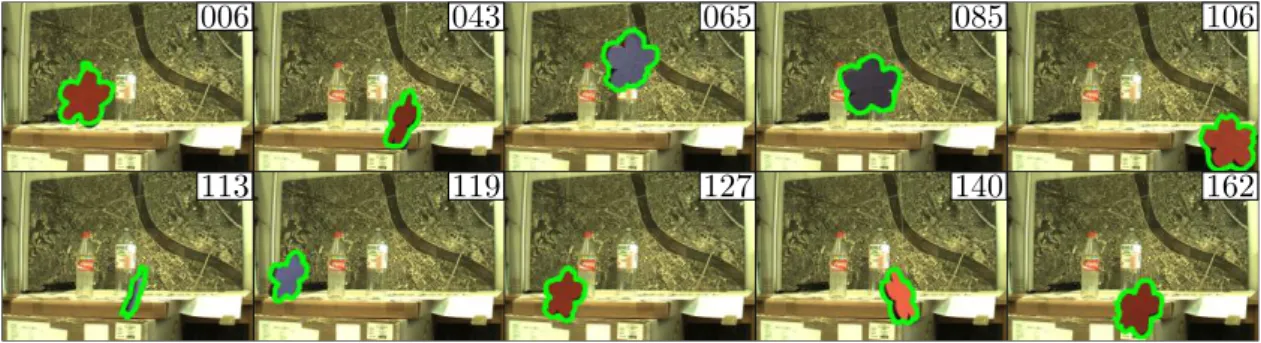
Case (a) comprises all applications that deal with streams, i.e. samples which arrive time-dependently. The most common streams are time series data and video sequences, which we will discuss in Section 2.3.3. As an example, Figure 1.1 shows representative images of a video sequence, in which a rotating flower is meant to be tracked. The green contour indicates the detected boundary of the tracked object. The image sequence includes for each image to varying degrees, the challenge of changing color appearance, interframe motion and change in object shape. A sequential learning algorithm can learn the appearance of both the object and the background and is able to adapt to the changes automatically (Roscher et al., 2012; Santner et al., 2010; Tang et al., 2007; Avidan, 2007). Additonally, the time-dependency of the data stream can be exploited by introducing temporal relations between pixels or regions of successive frames and enforcing a temporal consistency of their predicted labels.
006 043 065 085 106
113 119 127 140 162
Figure 1.1: Representative frames (numberstin the top right corners) of the tracking results for the image sequence.
Remote Sensing, as another example for case (a), deals with data becoming available in blocks or intervals. Earth sensing satellites acquire a large amount of data on worldwide environmental changes over time such as e.g. tropical rain forest deforestation, climate in-formation such as meteorological, oceanographic or atmospheric data or the amount of snow
and ice in the polar regions. The intervals can range from a few hours, depending on the tem-poral frequency of the satellite, to monitor short term changes, over few months to monitor glacier surface velocities (Raup et al., 2007). The interval can also be several years to monitor changes in vegetation (e.g. Stow et al. (2004); Turner (1990)). Of course, if the interval is large enough, the task can also be solved by a non-incremental learner. Nevertheless, due to the large amount of accumulated data, an incremental learner will be necessary because not all data can be processed simultaneously.
Typical applications for (b) are those that use the so-called active learning. It is an umbrella term for methods that are suitable for a sequential acquisition of samples using an oracle that defines the label of the samples. Since the labeling of data is time-consuming, expensive or potentially difficult, active learning enables a continuous training of the classifier. For a comprehensive literature survey, we refer to Tuia et al. (2009) and Settles (2009). Self-training can be considered as the easiest type of active learning. Starting with a limited number of labeled samples, the classification result is used to acquire new labeled samples in order to improve the classification result (Roscher et al., 2012; Li and Fei-Fei, 2010). Also co-training (Blum and Mitchell, 1998) is used to update a classifier model by using different, ideally complementary views of the data. These methods are also common in recent tracking approaches (see Sec. 2.3.3). Another example is a land cover classification of large areas, which consists of several composite remote sensing images. Generally, the images are not or only partly labeled and they are characterized by both spatial and temporal differences, see Figure 1.2. Thus, the labeled samples cannot represent the distribution of the features in all images. In order to obtain a classification of the whole area, active learning is applied for the acquisition of labeled samples in all images (Roscher et al., 2012; Knorn et al., 2009). The example given in Figure 1.2 shows an area of about 285000 km2 around Rondonia in South America. The data set contains 9 Landsat 5 TM images from 2009, in which only the center image comes with labeled samples. Applications like large area land cover classification benefit from sequential learning strategies, because the classifier can be updated each time new acquired data is available and need not to be retrained from scratch.
Figure 1.2: The area of Rondonia with 9 overlayed Landsat images displayed with bands 4-3-2. The three image strips are acquired in September (images 1, 4 and 7), July (images 2, 5 and 8), and August 2009 (images 3, 6 and 9). The underlaid image is taken from Google Earth. The classification aims at 4 land cover classes, focused onForest,Agriculture,WaterandUrban.
According to case (c), besides infinite data streams, also finite data sets can be too large to either fit into the memory or to be processed in a practically tractable way. Csat´o et al. (2001) predict wind speed and direction over the ocean surface over a huge area of several km2 which is important for planning and construction activities in the oceanic area. They present an approach to sequentially update an approximation to the posterior distribution of the wind vectors which cannot be computed at once. In order to cluster huge amount of data samples, such as astronomic data or document collections of web sites, Littau and Boley (2009) sequentially scan each data sample in these data sets in order to find an approximation to the whole data set. The subset can be clustered more efficiently than using the original data set.
Also applications like the classification of large image databases can utilize sequential learning algorithms in order to learn the appearance of many classes in a practically tractable way by processing the images sequentially rather than simultaneously. One example for such an application is illustrated in Figure 1.3, in which images of the Microsoft Research Cambridge object recognition image database (Winn et al., 2005) are meant to be classified. The appearance of the classes may change with each newly processed image and therefore the classifier needs to be adapted during the learning process.
(a) (b) (c) (d)
Figure 1.3: (a)(c) Images of Microsoft Research Cambridge object recognition image database. (b)(d) Manual classification aiming on the classesbuilding(red),grass(green),tree(light green),sky(gray). Black pixels have the classvoid.
The application of incremental learners are numerous. In this thesis we focus on the field of semantic image segmentation in which each pixel is assigned to a pre-defined class. By grouping adjacent pixels with the same class, we obtain segments with a semantic meaning. In our experiments we exploit I2VM for the semantic segmentation of images from an image database, for large area land cover classification of overlapping remote sensing images and for object tracking in image sequences.
1.5
Organization of the Thesis
The organization of the thesis is as follows. Chapter 2 gives an overview about sequential learning strategies. We define the term “sequential learning” in order to define the considered task in this thesis. We further review currently used algorithms for incremental learning and their application using single images, image databases and image sequences. The review of existing algorithms focuses on the properties mentioned in Section 1.3. Chapter 3 introduces the theoretical background of the IVM classifier. Additionally, we discuss the relation of IVM to similar classifiers. In Chapter 4 we show that IVM though being a discriminative model inherently have a reconstructive component. We verify this by means of the analysis of the objective function. Further, we underline our findings by an empirical study on the distribution of the import vectors and discuss the requirements which must be met in order to develop the reconstructive component. The core of the thesis is the formulation of the
I2VM learner, an incremental realization of IVM. Chapter 5 develops the incremental learning scheme and describes the addition and removal of data samples and the incremental update of the classifier model. Furthermore, the incorporation of new classes and features is shown. Chapter 6 presents experimental results showing the performance of I2VM. Our conducted experiments comprise the classification of well-known benchmark data sets with and without ordering effects, the semantic segmentation of large image databases, large area land cover classification and an object tracking application. We conclude in Chapter 7 and discuss possible further developments of IVM and I2VM.
Chapter 2
Related Work
The overall goal in this thesis is to formulate, analyze and evaluate the learner I2VM for sequential learning with focus on semantic segmentation. This chapter provides on overview of the most recent and significant work in the fields of the sequential learning problems, se-quential learning algorithms and the application of sese-quential semantic segmentation. The first section reviews different views on the sequential learning task in order to distinguish this work from other conceptions. The second section reviews recently used algorithms which are developed to solve sequential learning problems. In the last section we introduce some appli-cations in which the samples are treated successively with focus on semantic segmentation.
2.1
Sequential Learning
In the field of machine learning, the term “sequential learning” is treated in different ways. As stated in Chapter 1 we use sequential learning and incremental learning interchangeably throughout this thesis, in which we define sequential learning as the task to incrementally train a classifier with samples becoming successively available, one at time or in blocks. The main distinction in the literature is what the word “sequential” is referred to; either to the arrangement of the data or the learning task itself. One the hand the learning task can be defined as the identification of a particular sequence of labels, in which the sequence has a meaning (Dietterich, 2002). Such sequences are for example words as concatenation of letters (Krallinger et al., 2008; Brefeld et al., 2005)) or DNA sequences (Leslie et al., 2002). These samples are not drawn independently and identically from an joint distribution over the class memberships and the samples themselves. On the other hand the term “sequential” does not refer to the arrangement of the data but rather to the learning task, in which the learner has a sequential access to the data. We define sequential learning as the task to incrementally train a classifier with samples becoming available over time, one by one or in blocks. It is important to note that although the data become available over time, this does not necessarily mean that the time at which the sample is made available to the learner is of concern. We will restrict ourselves to sequentially treated data independently of their nature.
Our point of view of sequential learning is also known as incremental learning. The learning process deals with sequentially arriving data samples. The data can be of any nature, which can make dealing with them challenging. The overall data stream can be massive (Witten et al., 2011; Li and Fei-Fei, 2010; Hulten and Domingos, 2002), i.e. of high density with many samples arriving in short intervals over a long period, or even infinite (Monteleoni et al., 2011; Monteleoni and Kaariainen, 2007). To solve this learning task, incremental learning algorithms are exploited that are specially designed for this purpose. Although this
type of understanding is not new, Jain et al. (2006) and Giraud-Carrier (2000) have helped to analyze and define the term “incremental learning” to make it better understood.
In the literature there exist several approaches considering different aspects of incremental learning. They can be subdivided into three groups, namely
(a) the way how old samples are used,
(b) the kind of information that can be incorporated, (c) the choice of the update interval.
The way how old samples are used. Reinke and Michalski (1988) introduced the term full-memory learning. During the learning process the classifier model is updated by using the newly arrived samples. However, the learner does also make use of all saved previous training samples. In many applications, this would be impossible since the storage of the data is not feasible.
A good compromise is to store only a bounded number of chosen examples, which are selected by age (as in tracking scenarios, see Sec. 2.3.3) or by subset selection procedures. Lange and Zilles (2003) show that learning with a limited number of carefully chosen samples can be enough to ensure a good performance of incremental learners. Engelbrecht and Cloete (1999) identify and retain the most informative samples, i.e. those samples that have the highest influence on the learning objective. For example, the learning objective can be the reduction of the misclassification error. The approach has been extended by Engelbrecht and Brits (2001) by using only the most informative sample, which is identified by clustering a group of newly incoming data samples. Maloof and Michalski (2000) introduced the term “partial memory learning” in order to describe the usage of a bounded number of training samples. They restrict the number of newly acquired samples by choosing only the extreme ones, which are positioned near to the decision boundary. In a similar way, Zhang (1994) use only critical examples to train the incremental learner. The criterion for selecting critical samples depends on the information gain yielded by adding an sample. The information gain is defined by the reduction in the objective function after adding the sample. The sample, which leads to the largest reduction is chosen to be added.
Another possibility to retain knowledge seen so far is to built up a long-term memory, which can be seen as prior knowledge. Ferrari and Jensenius (2008) use an optimization problem to learn with newly arrived samples, subject to the prior knowledge formulated as constraints. Holmes et al. (2004) take a different approach by remembering models learned from groups of data rather than the data samples themselves. They divided the data set into single batches and learn each one non-incremental. After all batches have been proposed they combine the models learned in each batch to one global model.
Most work, however, strictly define incremental learning as an iterative learning of the classifier, which has only access to the newly arrived data and the last model. In this case, the classifier has no sample-memory. We will review such approaches regarding the used algorithm in Section 2.2.
The kind of information that can be incorporated. Zhou and Chen (2002) introduced the terms “example-incremental learning”, “class-incremental learning” and “attribute incre-mental learning”. Example-increincre-mental learning updates a classifier model using only a few or none of previous seen samples. The new acquired knowledge of the samples is incorporated into the model. When using class-incremental learning, the classifier model is updated regard-ing the used classes. A new class is added without sacrificregard-ing the learned model too much.
In attribute-incremental learning the model is updated by adding new attributes (i.e. fea-tures) without sacrificing the previous learned model. For the last two methods there is only little work in literature, since most algorithms have been proposed dealing with example-incremental learning (see Section 2.2). Wenzel and Hotz (2010) subsequently add classes, one class after the other to analyze the role of sequences for incremental learning. Also Po-likar et al. (2001) add classes that may be introduced with newly acquired data samples. Guan and Li (2001) sequentially add relevant features and thus, the feature dimension of the samples increases. They retain the old classifier model and combine it with a newly trained model with increased feature dimension to form an overall updated model. Skocaj et al. (2006) proposed an incremental learning method that can both incorporate new features and classes.
The choice of the update interval. Syed et al. (1999) introduced another distinction of incremental learning by introducing the so-called “instance learning” and “block-by-block learning”. Instance-learning updates the model after each newly arrived sample, whereas block-by-block learning updates the model after grouping newly arrived samples into blocks of a suitable size. Also Hoens et al. (2012) define incremental learning as learning with data becoming available over time in streams of samples or batches, in which one batch is a block of samples. Langley (1995) distinguish between three different temporal resolutions in which the samples are processed. At the finest temporal resolution, the learner has access to features of an sample, one at a time. At the intermediate resolution, the learner is updated regarding the samples, one at a time and at the highest temporal resolution, the learner has access to distinct blocks of samples, one at a time. Most of the proposed algorithms (see Section 2.2) incrementally train the classifier using the samples one by one even if the samples arrive in blocks. This can be time-consuming because the incremental update steps need to be repeatedly applied to each single sample. Karasuyama and Takeuchi (2010), for example, extended the approach of Cauwenberghs and Poggio (2001) by using an optimization technique called parametric programming to perform the update with blocks of samples in a single step rather than a series of optimization problems.
We have reviewed different views on sequential learning, which are concerned mostly in the literature. In the next section, we discuss several recently used incremental classifiers, which are designed particularly to solve sequential learning problems.
2.2
Incremental Learning Methods
Several incremental learning methods have been suggested, extending classical and state-of-the-art batch methods. In the literature batch learning algorithms are also refereed to as offline classifiers and incremental classifiers are often denoted as online algorithms. We use the terms “incremental” or “sequential” and “batch” throughout the thesis. In this section, we review common incremental learners with respect to the properties of I2VM mentioned in Section 1.3. I2VM is a probabilistic multi-class learner with a high discriminative power, showing a comparable performance to IVM . We will later show, that IVM inherently has a reconstructive component to represent important parts of the underlying distribution.
Competitive performance. Incremental learning methods in general show comparable performances to their batch version when there is no change in the data distribution over time. The most recent methods showing these property vary from online discriminative ker-nel density estimation (Kristan and Leonardis, 2010), on-line random forests (ORF) (Saffari
et al., 2009), incremental support vector machines (Zheng et al., 2010; Karasuyama and Takeuchi, 2010; Bordes et al., 2007; Fung and Mangasarian, 2002; Cauwenberghs and Poggio, 2001), online boosting algorithms (Grabner and Bischof, 2006) to online nearest neighbor classifier (Gu et al., 2010). These methods are able to handle complex distributions, in con-trast to incremental linear subspace learning with linear discriminant analysis and principal component analysis (Uray et al., 2007; Kim et al., 2007). To deal with more complex data, some incremental subspace methods have been extended to a kernel version (Chin and Suter, 2007).
If the distribution of the samples changes over time, we speak ofconcept-drifts. They may cause severe problems for incremental learners. Like in tracking applications, old examples are often misleading, which is why newly gathered training vectors should be more beneficial than older ones. The incremental learner should be able to adapt to changes in the underlying distribution of data samples. For example, Gu et al. (2010), Tang et al. (2007) and Grabner et al. (2008) show that this necessary for a powerful object tracking. Explicitly identifying and handling concept-drift has been considered by Scholz and Klinkenberg (2007) and Klinkenberg and Joachims (2000), which show that incremental learner as online boosting and incremental support vectors machines can deal well with detected drifts.
A weaker but nevertheless relevant drifting-effect may result from changing the sequence of data samples, which results in so-called pseudo-concept-drifts, as shown by Wenzel and Hotz (2010), Langley (1995) and Cornu´ejols (1993). Such drifts can occur for example in medical experiments if the data is collected for one patient at a time or in controlled experiments with a test plan for which process parameters are tested successively, as already stated by R¨uping (2001). Several approaches have been suggested to overcome this problem. Talaveral and Roure (1998) introduced a buffer to store difficult samples for a later evaluation or McKusick and Langley (1991) rearranged the sequence . Bengio et al. (2009) introduced a schedule to present the samples in a special order to a neural network classifier to increase the performance. These methods are not useful for an incremental learner since in practice one usually cannot wait until a sufficient part or even all data samples are ready for processing.
To deal with concept-drifts Uray et al. (2007) and Skocaj et al. (2006) stated that in-cremental methods generally need a reconstructive model component. This is an inherent property of generative approaches. They model the joint probability of the labels and the features, and in a Bayesian way use priors to derive posterior probabilities. Incremental generative classifier, such as online discriminative kernel density estimation (Kristan and Leonardis, 2010), online nearest neighbors (Gu et al., 2010), an incremental Bayesian ap-proach (Fei-Fei et al., 2007) or incremental linear discriminant analysis (Uray et al., 2007; Pang et al., 2005), can therefore represent current and even previously removed training samples. The approaches are very efficient, because the models can be defined by a few pa-rameters describing the underlying distribution. This however requires the structure of the underlying distribution to be known and to be approximable with sufficient accuracy. This is not the case for many real-world data sets that have a complicated distribution without known underlying structure. To overcome this problem, non-parametric density estimation techniques such as k-nearest neighbor or kernel density estimation are used (Kristan and Leonardis, 2010; Gu et al., 2010). Although they have several advantages, these models can become very complex when the data distribution is approximated and the models have to be reduced for incremental learning settings. Generative models are able to directly incorporate unlabeled samples (Lasserre et al., 2006) and the model can be used as approximation of discarded training samples, which is needed for robust incremental learning (Skocaj et al., 2006; Uray et al., 2007).
Discriminative power. In contrary to generative classifiers, discriminative classifiers such as logistic regression directly model the posterior probability but do not contain a reconstruc-tive component. Also support vector machines (SVMs) (Vapnik, 2000) that directly map the inputs into decisions by determining a discriminant function do not contain this component. Likewise decision trees (Breiman et al., 1984) are also based on the estimation of discriminant functions. During the induction of a decision tree the training data is sequentially partitioned into smaller increasingly homogeneous subsets by using a set of decision boundaries defined at each node. Usually only the most relevant feature is used at each node, resulting in many rather simple decision boundaries that are parallel to the axis in the feature space. The accuracy of decision tree classifiers is often improved by using ensemble strategies. Classi-fiers ensembles are based on the combination of independent variants of the same classifier, i.e. the base classifier. Various strategies for generating variants of the same classifier have been introduced, like boosting (Viola and Jones, 2004; Freund and Schapire, 1996), bagging (Breiman, 1996) and random subspace methods (Ho, 1998). The decision tree-based classi-fier ensemble random forests (Breiman, 2001) is a powerful alternative that combines the two latter strategies.
It has been shown for various applications that discriminative classifiers can achieve higher classification accuracies than generative classifiers if the posterior is a lot simpler than the underlying distribution (Kumar and Hebert, 2006; Vapnik, 2000). This transfers to incre-mental learners such as increincre-mental SVM or ORF which present good performances, e.g. in tracking tasks (Tang et al., 2007; Saffari et al., 2009).
Logistic regression is one of the oldest discriminative models, which historically goes back early up to 19th century (Cramer, 2003). The basic concept has been extended in many respects, such as by Friedman et al. (2000), which integrated the concept of boosting to an additive logistic regression model or by Deselaers et al. (2011), which have incorporated latent variables. Logistic regression is the basis for advanced models such as incremental logistic regression (Bishop, 2006), kernel logistic regression (Karsmakers et al., 2007; Keerthi et al., 2005; Cawley and Talbot, 2004; Roth, 2001) and sparse kernel logistic regression (Cawley et al., 2007; Tipping, 2001). IVM constitutes a realization of sparse kernel logistic regression. Among various developments of kernel discriminant classifiers, SVMs are presently one of the most popular approach in recent applications. However, (Roscher et al., 2012; Braun et al., 2011; Zhang et al., 2011) have shown that IVMs are comparable to SVMs regarding the performance. A comprehensive empirical comparison of common batch classifiers was conducted by Caruana and Niculescu-Mizil (2006).
The positive properties of generative and discriminative models have been integrated in hybrid generative/discriminative classifiers. The motivation is to formulate a classifier with a reconstructive component while exploiting the discriminative power. Most of the approaches combine a generative and a discriminative classifier (Xue and Titterington, 2010; Uray et al., 2007; Skocaj et al., 2006; Fritz et al., 2005). Others learn a generative model using a sequence of discriminative models (Tu, 2007), interpolate between generative and discriminative parameter estimation (McCallum et al., 2006; Lasserre et al., 2006; Raina et al., 2003) or learn a sparse generative model while retaining as much discriminative power as possible (Kristan and Leonardis, 2010). In considerations about IVM, we will show that the model develops a reconstructive component while at the same time possessing a high discriminative power. In contrary to this, discriminative classifiers such as SVM and random forests inherently do not have a reconstructive component.
Long sequences. Incremental linear subspace learning methods adapt the model param-eters by processing newly available data samples, while directly discarding the samples after
they have been processed. In contrast, kernel-based algorithms allow a simple adaption of the model by adding new training samples. In order to avoid a steadily increasing complexity of the model when learning over a long time, all kernel-based learners need a component for removing data. Approaches such that of Karasuyama and Takeuchi (2010), Kivinen et al. (2004) or Fung and Mangasarian (2002) show considerable success in incremental learning settings and in general provide update steps to remove data samples in a similar way as data samples are added. The challenge is to perform efficient incremental update steps without suffering a loss in performance.
Probabilities. Besides the predicted class labels of test data, a probabilistic output of the classifier is often of interest. The probabilities can serve as confidence and can therefore be used for either a more accurate evaluation of the classifier or for a further analysis of the classified data. Giacco et al. (2010) for example use the probabilities for uncertainty analysis of landcover classes. The probabilities can also serve as input into a graphical model, as carried out by Roscher et al. (2012) and Kumar and Hebert (2006). In the context of active learning, the probabilities can be used to decide on what data samples are useful in order to extend or replace the current training set (Li et al., 2011; Iglesias et al., 2011). Roscher et al. (2011) have shown that active learning can be performed using an incremental learner without the need to repeatedly retrain the classifier. The probabilities are used to identify relevant samples for updating the incremental learner, and non-informative samples are removed by exploiting diagnostics tools. In contrast to kernel-based probabilistic models such as IVM and sparse multinomial kernel logistic regression (Cawley et al., 2007; Krishnapuram et al., 2005; Tipping, 2001), SVM is non-probabilistic. However, the output of SVM can be transformed to be probabilistic. The most common technique to transform the output to a probability is to fit a sigmoid to the output as proposed by Platt et al. (2000). Other methods are proposed by Grandvalet et al. (2005) and Sollich (2002). Though resulting in an output lying in the range [0,1], this does not imply that the transformed output is a good approximation of the posterior, i.e. the reliability of these values could be inadequate (R¨uping, 2004; Tipping, 2001). The most recent discussion about this aspect can be found in (Franc et al., 2011), in which a generative and semi-parametric probabilistic model is presented that is equivalent to linear SVM. Decision trees provide probability estimates, which arise from frequency-based calculations at the leaf nodes. Simply using the counts of classes at the leaf nodes does not give good probability estimates, as already stated by Chawla and Cieslak (2006). Therefore smoothing methods (Niculescu-Mizil and Caruana, 2005; Provost and Domingos, 2003; Zadrozny and Elkan, 2001) or bagging (Chawla and Cieslak, 2006) have been used to improve the reliability of the estimates, which is why random forests generate better estimates than decision trees.
We have discussed several classifiers regarding their performance, discriminative power, their ability to deal with long-sequences and the their possibly probabilistic output. In the next section, we review the application of incremental classifiers for semantic segmentation.
2.3
Semantic Segmentation
In this thesis, we focus on the application of I2VM for semantic image segmentation, in which each pixel is assigned to a pre-defined class. By grouping adjacent pixels with the same class, we get segments with a semantic meaning. Like all incremental learners discussed before, I2VM is not restricted to this application. In this section, we review the application of incremental learners for the semantic segmentation in single images, images from large databases and image sequences.
Since semantic segmentation is a crucial step for automatic image understanding, the field of applications and algorithms is wide-ranging. The variety of further applications include e.g. object detection/recognition, content-analysis, image understanding or image retrieval and indexing. A review of batch/off-line methods for image segmentation can be found in (Shankar, 2007), (Rogowska, 2000) and (Pal and Pal, 1993).
2.3.1 Semantic Segmentation in Single Images
In the field of semantic segmentation of single images incremental learning can be used to adapt an pre-learned coarse model to the current image. Since the pre-learned model already provides a good approximate solution to the final segmentation in the current image, usually no further human interaction is necessary. Li et al. (2007) incrementally segment skin regions or Wism¨uller et al. (2004) segments magnetic resonance data sets of the human brain by an incremental self-organized model adaptation.
Remotely sensed single images can be very large and labeling is costly. Therefore, active learning is widely used to incrementally update the set of labeled samples to improve the classification result (Tuia et al., 2009). Furthermore, a large land cover area may be divided into multiple scenes, in which each of them can have both spatial and temporal differences. For the sequential classification of the individual scenes, the classification model must be adapted to the current spectral features. In contrary to Knorn et al. (2009), which re-train the classifier after each data acquisition step, Roscher et al. (2012), Roscher et al. (2012) and Bruzzone and Fern`andez Prieto (1999) also update the classifier incrementally.
Incremental supervised methods are used in the field of user-interactive image segmen-tation. The user specifies strokes or regions (Duchenne et al., 2008; Rother et al., 2004; Boykov and Jolly, 2001), boxes (Lempitsky et al., 2009; Rother et al., 2004) or contours (Mortensen and Barrett, 1995) within the image to define the training data. The training data is used to learn the classifier model, which is directly applied to the whole image. Once the segmentation has been obtained it can be refined by user-interaction. While most of the approaches re-train the classifier after each refining step, Zhang and Ji (2011) update the classifier model based on the former model. Besides semantic segmentation approaches that classify the image into pre-defined classes such as object and background, contour-based methods search for an optimal contour in the image between these classes. So-called live-wire approaches such as intelligent scissors (Mortensen and Barrett, 1998) or live live-wire on the fly (Falco et al., 2000), or the more efficient live lane approaches (Kang and Shin, 2002) sequentially obtain a segmentation by defining the contour of the object step-by-step with the help of human user interaction with the mouse. The user roughly traces the boundary by setting some seed points, in which the algorithm chooses the minimum cost contour. The cost function is adapted depending on the previous defined contour. These applications show that incremental learners are useful to efficiently segment in single images.
2.3.2 Semantic Segmentation in Image Databases
Similar to incremental learning in single images, also large image databases can be treated sequentially. The images in the database are presented sequentially to the classifier, because the database can either be too large to be processed simultaneously or the number of images increases continuously.
Vachkov (2010) classifies sequentially arriving images from an image database by com-paring them to a core set of images, which define categories using some similarity measure. The core set is extended by a further category if the current image is dissimilar to all given
images in the core set. This approach would be equally well suited for semantic image seg-mentation, where the first few classes with associated features are defined and further classes are added sequentially. Ozawa et al. (2005) and Artac et al. (2002) use incremental PCA to sequentially learn and recognize images in image databases, while keeping only the subspace representation of the input images.
Another approach is online dictionary learning for sparse coding (Mairal et al., 2009), which can treat millions of training samples. The goal is the ability to approximate each part in an image as a linear combination of a few elements from the dictionary, which is also known as sparse coding. Each dictionary element can additionally have a class label, as proposed by Jiang et al. (2011), Ramirez et al. (2010) and Mairal et al. (2008) and dictionary elements with the same class labels can be comprised to a class-specific dictionary. This approach can be used for semantic segmentation by searching for this class-specific dictionary that can approximate a part of the image best. Mairal et al. (2009) sequentially learn from image databases by adapting the content of each dictionary to current images presented to the learning algorithm.
These applications show that incremental learning algorithms are necessary to adapt to current appearances of the classes. In the mentioned application the time-reference is unimportant. Thus, the sequence of the images presented to the learner can be arbitrary and should not influence the overall segmentation result of all images to be tested. The situation is different when using image sequences in which the acquisition time and the time the image is presented to the learner coincide. Instead of treating each image independently, the time can be uses to formulate temporal relation between the image, which can improve the performance of a classifier.
2.3.3 Semantic Segmentation in Image Sequences
One of the largest application for incremental learning is the tracking of objects in image sequences. The main approaches are tracking-by-detection and tracking-by-segmentation. In both cases the tracking task is defined as a classification of successively arriving images into object and background. In contrast to tracking-by-detection where often only a bounding box or an ellipse around the object is obtained, tracking-by-segmentation enables a tight object boundary.
In the last years several tracking-by-detection approaches have emerged which use incre-mental learning methods in order to handle appearance variability of a tracked object and/or the background. The variability among others comprises pose variations, shape deformations, illumination changes and camera motion. Lim et al. (2004) and Ross et al. (2004) use incre-mental subspace learning to update the tracking model and Avidan (2007) use an adaptive ensemble of classifiers. Grabner and Bischof (2006) use an incremental version of AdaBoost in order to handle appearance changes and drifting of the detected object boundary. To overcome the drifting problem that occurs when the update of the learner is performed with incorrectly labeled data, the approach was extended to semi-supervised boosting (Grabner et al., 2008). Tang et al. (2007) use semi-supervised online SVM in a co-training frame-work utilizing color and histogram-of-gradients features (Dalal and Triggs, 2005). Santner et al. (2010) use ORF as adaptive learner in combination with a complementary non-adaptive template-based tracking approach to be robust against the drifting problem while at the same time being adaptive to appearance changes. Babenko et al. (2011) introduce a robust tracker that uses so-called multiple instance learning. This variation of supervised learning deals with groups of acquired samples, which are labeled as object or background instead of labeling each single data sample, which makes the tracking approach more robust against label errors.
Several methods have been proposed treating tracking as a pixelwise binary classification of object and background, which is also known as tracking-by-segmentation. Donoser et al. (2011) deal with an adaptive semantic segmentation in images in an unsupervised manner, whereby the current segmentation is constrained to be consistent to that one in the latter frame. Similarly to this, Charron and Hicks (2010) update a learned mixture of Gaussian model in subsequent frames enforcing coherency across successive frames. Ren and Malik (2007) use a conditional random field (Lafferty et al., 2001) combining an adaptively learned appearance model with the prior knowledge of a temporal-spatial model. Wang et al. (2011) extract simple linear iterative clustering (SLIC) superpixels (Achanta et al., 2010) in each image frame and update a learned generative appearance model to distinguish between the object and the background. Chockalingam et al. (2009) also divide an image into multiple regions and represent the object as a Gaussian mixture in feature-spatial space, i.e. each region is represented by one sub-distribution of the mixture model. The regions are adapted to the current image by a region growing procedure and the Gaussian mixture model is updated by using the average mean of the last and current image statistics. Level-sets are exploited to obtain accurate object contours.
The review indicate that incremental methods are necessary to adapt to the current appearance of object and background. A static model only would be able to track an object as long as its appearance do not change. The review also show that recent approaches use temporal information in order to increase the performance of the algorithm.
The literature review about applications in the field of semantic segmentation shows that the field of applications using incremental learning methods is wide-ranging and most recent approaches have shown that incremental learners are more flexible than batch methods in the mentioned applications. Incremental methods can adapt to current appearance changes, what batch learner are not able to. Given the large area of applications, the biggest challenge is to overcome the stability-plasticity dilemma, which deals with the question how the learner can be stable to irrelevant samples and adaptive to new samples. After the classification of our conception of sequential learning, the review of current incremental learners and applications, in the next chapter we will introduce the theoretical background for the formulation of the I2VM classifier.
Chapter 3
Theoretical Background
This chapter aims at specifying the theoretical background to formulate the incremental classifier I2VM and the task which is meant to be solved by I2VM. In Section 3.1 we define our notation that it used throughout the thesis. In Section 3.2 we describe the supervised sequential learning task comprising the task formulation and the definition of the class of classification model that is used in this thesis. The theoretical background of the I2VM classifier is presented in Section 3.3. In the last section we specify the sequential semantic segmentation problem by means of the formulation of the learning task, the evaluation criteria and the learning experience.
3.1
Notation
In this section we summarize the notation that is used throughout the thesis. We denote vectorsg= [gi] = [g1, . . . , gI]Twith small bold symbols and matricesG = [gij] = [g1, . . . ,gJ]
with elements gij and column vectors gj with capital symbols. We use calligraphy symbols
for sets. The elements (scalars or vectors) of a set G can be collected in a vector g or a matrix G by concatenation, using the same letter of the alphabet. The matrix or vector of the concatenated elements of a subset F ∈ G are denoted with GF orgF, respectively.
In order to simplify the representation of certain matrix-operations, we use a selection operator ΨI(B), selecting the rowsI from aN ×M matrix B, defined as
B−= ΨI(B) =eNi T
i∈I B. (3.1)
with eNi thei-th unit vector of length N. In a similar manner, the removal of columns can be formulated with the transposition of the considered matrix.
3.2
Supervised Sequential Learning Problem
In this section we specify the generallearning task for supervised classification problems and expand it to the sequential learning task. Furthermore, we define groups of classification models, define the reconstructive and discriminative model components and discuss their meanings for incremental learning. In the last part we consider linear discriminative models for classification which are meant to solve classification problems.
3.2.1 Learning Task
In the following we denote the involved data and define the supervised learning task. We assume to have a training set
{xn, yn} ∈ T, n= 1, . . . , N (3.2)
ofN labeled samples withM-dimensional feature vectorsxn∈IRM and class labelsyn∈ C= {1, . . . , c, . . . , C}. The observations are collected in the (M×N)-matrixX = [x1, . . . ,xN]T, while the corresponding labels are summarized in the vectory= [y1, . . . , yN]T. Furthermore,
we have given a test set
{xu, yu} ∈ U, u= 1, . . . , U (3.3)
of U samples with M-dimensional feature vectors xu ∈ IRM and class labels yu ∈ C = {1, . . . , c, . . . , C}.
We define the task of supervised learning as follows: Our goal is to infer a function f
e
yU =f(XU,M), (3.4)
which models the dependency of the labels yU to given feature vectors XU, so that the functionf behaves similar as learned on the training set T. In the ideal case the predicted labelsyeU are equal or at least close to the true labelsyU. The learned model is represented withMand the functionf is fixed and parametrized byM.
The function f can be of a different nature: In this thesis we specify f as a nonlinear function, as described in Section 3.2.5. The function can also be a set of simple decision rules as for decision trees or a set of sub-functions as this is the case for ensemble classifiers. Depending on the specified function, the model M comprises the following entities: model parametersα and optionally the training set T and meta-parameters such as a graph struc-ture or tuning parameters. We refer to the function f, the components of Mand the values of the components as theinternal representation of a classifier.
Until now we have assumed that the training and test data are available a priori. In the next section we define the learning task for successively arriving training and test samples. 3.2.2 Sequential Learning Task
When learning from successively arriving training samples, we assume that at time step t
there exist a learned modelMtcomprising a training set
{X,y}t∈ Tt (3.5)
and the current parameters. The training set Tt consists of a subset of Tt−1 and the new encountered samples. At time stept+ 1 a training setTt+1 including labeled training samples is made available to the classifier. Given a test set
{XU,yU}t∈ Ut (3.6)
the learned model Mt provides a (probabilistic) class label yeU,t for XU,t. The test set may
remain the same over time, but can also change steadily. The time step is referred to as the time when the data is presented to the learner rather than the acquisition time. The task of sequential supervised learning is defined as follows: At time step t our goal is to infer a functionft
e
which models the dependency of the labels yUt to given feature vectors XU
t. This function also depends on the last modelMt−1. The predicted labelsyeUt should be as close as possible to the true labels yUt.
We have described the learning task if the samples successively become available to the learner. In the next section we describe different schemes to learn with sequential data in order to solve a sequential learning task.
3.2.3 Learning with Sequential Data
In this section we mention various examples for learning with sequential data by means of the change of the internal representation of a classifier. The most common changes are listed below:
Adaption of the parameters. The model parameters are adapted with respect to the new encountered samples. The adaptation is performed by adjusting the values of the parameters. Examples using this approach are incremental logistic regression (Bishop (2006), Chapter 3) and incremental subspace methods (Skocaj and Leonardis, 2003). The new samples are discarded immediately after they have been processed and the number of parameters remains the same.
Adaption of the number of parameters. The number of parameters are adjusted. For example, online kernel density estimation (Kristan and Leonardis (2010)) determines the class-conditional distribution of all data samples seen so far using a mixture model. If the distribution changes, the number of used mixture components is adapted resulting in a changed number of parameters. The number of parameters also changes if the number of considered features or the number of classes changes, as this is the case for models such as incremental logistic regression (Wenzel and Hotz (2010)).
Adaption of the set of training samples. Various classification methods need to store training samples besides the model parameters. Thus, the set of stored samples changes when new encountered samples are added or non-representative ones are removed. Examples using this approach are incremental SVM (Bordes et al. (2007)) and I2VM. In this case, because the decisions made for the classification process arise from a linear combination of the stored training samples and the model parameter, an adaption of the set of training samples means at the same time an adaption of the parameters.
Adaption of the internal complexity. Sparse classification models only use a part of the current internal representation to make decisions for classification purposes. For example, incremental SVM only use a subset of the stored training samples and just the parameters assigned to these samples are non-zero. The complexity changes if the set of used samples changes. Another example are online random forests (Saffar