CA Layer 7
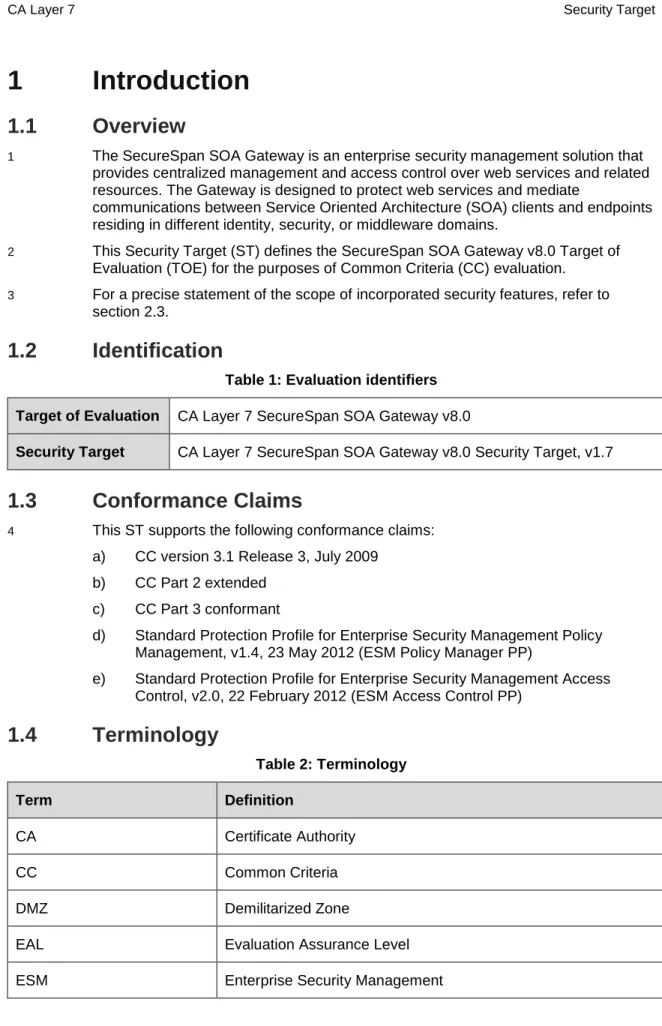
SecureSpan SOA Gateway v8.0
Security Target
May 2014
Document History
Version Date Author Description
1.0 29 January 2013 L Turner Initial release for evaluation.
1.1 12 April 2013 L Turner Update to address EDR001.
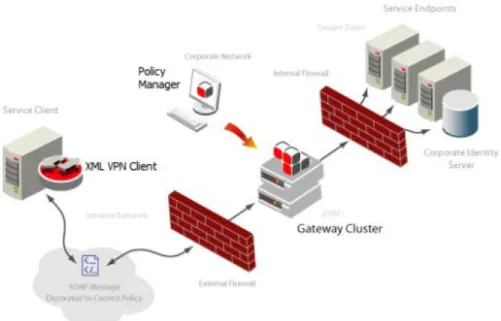
1.2 11 December 2013 L Turner Update to address validator comments and
re-branding.
1.3 13 December 2013 L Turner Update FAU_SEL and add build numbers.
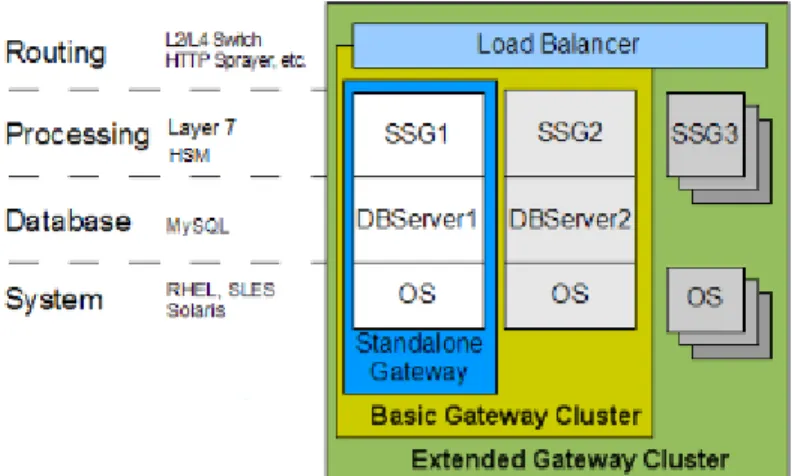
1.4 5 March 2014 L Turner Update to address validator sync session
comments.
1.5 14 April 2014 L Turner Update to address validator comments – scope
revised.
1.6 15 May 2014 L Turner Update to address lab observations.
Table of Contents
1 Introduction ... 5 1.1 Overview ... 5 1.2 Identification ... 5 1.3 Conformance Claims ... 5 1.4 Terminology ... 5 2 TOE Description ... 82.1 Type and Usage ... 8
2.2 Architecture ... 9
2.3 Evaluated Configuration ... 11
2.4 Security Functions ... 12
2.5 Physical Scope ... 14
2.6 Logical Scope ... 16
3 Security Problem Definition ... 22
3.1 Threats ... 22
3.2 Organizational Security Policies ... 23
3.3 Assumptions ... 23
4 Security Objectives ... 25
4.1 Objectives for the Operational Environment ... 25
4.2 Objectives for the TOE ... 26
5 Security Requirements ... 28
5.1 Conventions ... 28
5.2 Extended Components Definition ... 28
5.3 Functional Requirements ... 29
5.4 Assurance Requirements ... 47
6 TOE Summary Specification ... 48
6.1 Access Control Policy Definition ... 48
6.2 Access Control Policy Enforcement ... 50
6.3 Policy Security ... 51
6.4 System Monitoring... 52
6.5 Robust Administrative Access ... 53
6.6 Continuity of Enforcement ... 54
6.7 TLS and SSH Details ... 54
7 Rationale ... 56
7.1 Conformance Claim Rationale ... 56
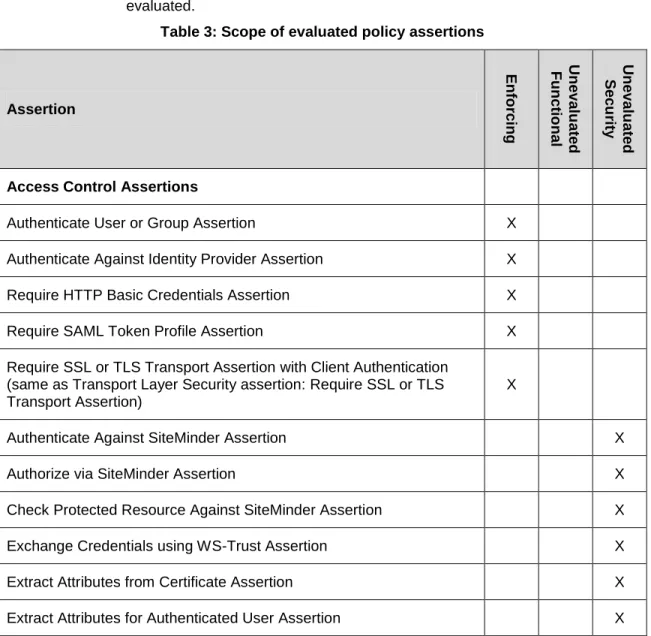
7.2 Security Objectives Rationale ... 59
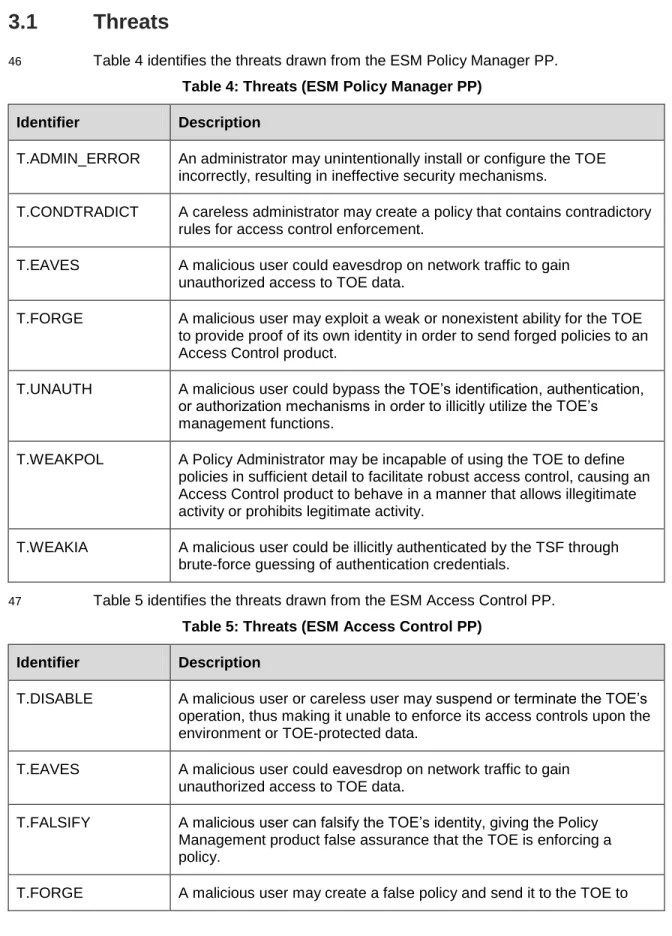
7.3 Security Requirements Rationale ... 59
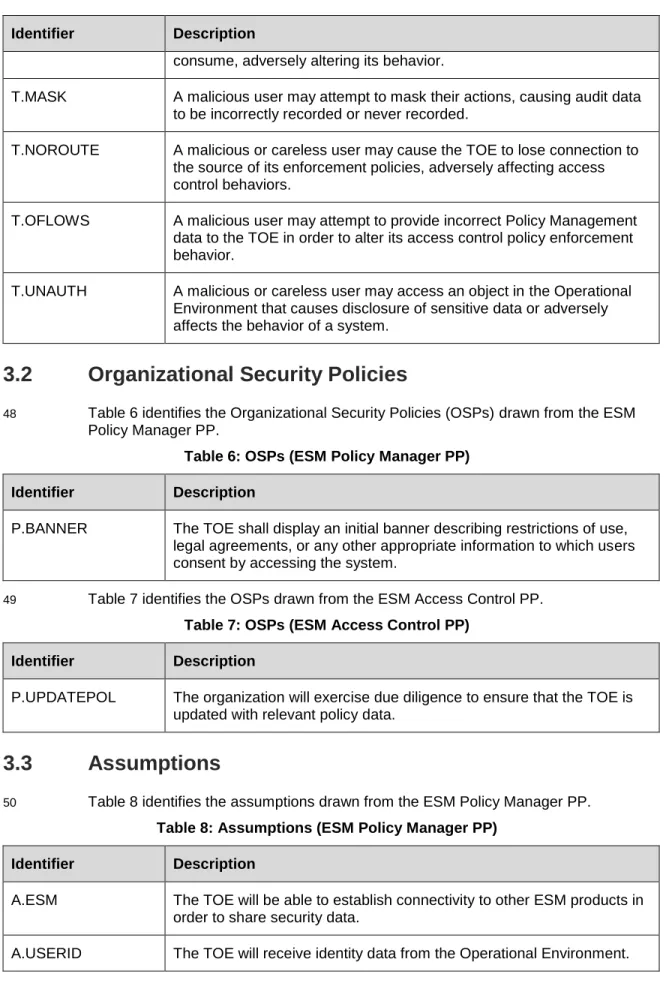
7.4 TOE Summary Specification Rationale ... 59
Annex A: Assurance Activities ... 62
Annex A.1: ESM Policy Manager PP Assurance Activities ... 62
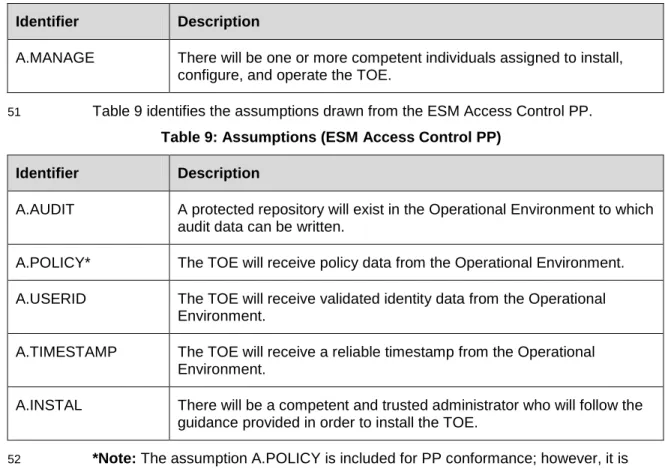
Annex A.2: ESM Access Control PP Assurance Activities ... 70
List of Tables
Table 1: Evaluation identifiers ... 5Table 3: Scope of evaluated policy assertions ... 17
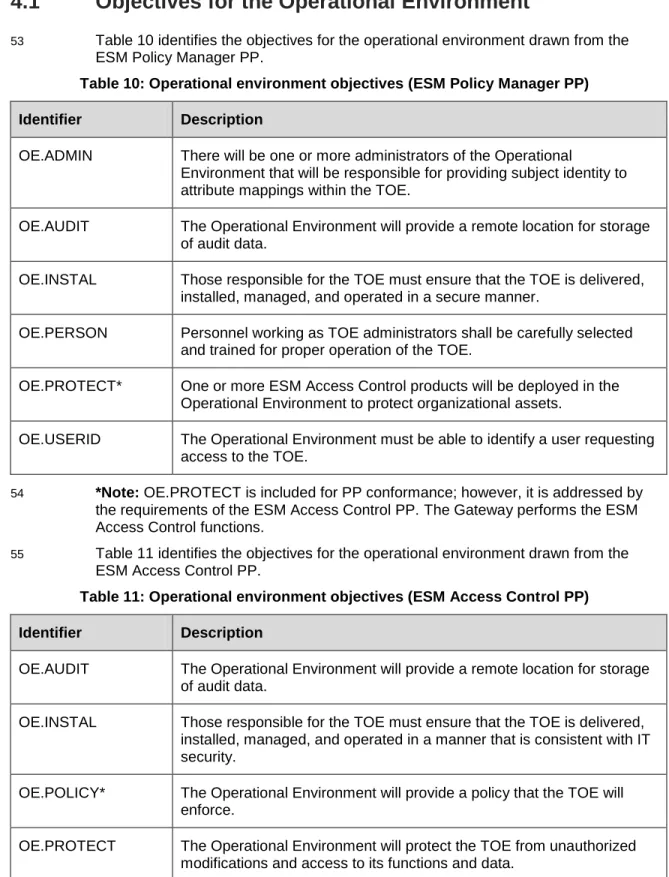
Table 4: Threats (ESM Policy Manager PP) ... 22
Table 5: Threats (ESM Access Control PP) ... 22
Table 6: OSPs (ESM Policy Manager PP) ... 23
Table 7: OSPs (ESM Access Control PP) ... 23
Table 8: Assumptions (ESM Policy Manager PP) ... 23
Table 9: Assumptions (ESM Access Control PP) ... 24
Table 10: Operational environment objectives (ESM Policy Manager PP) ... 25
Table 11: Operational environment objectives (ESM Access Control PP)... 25
Table 12: Security objectives (ESM Policy Manager PP)... 26
Table 13: Security objectives (ESM Access Control PP) ... 27
Table 14: Extended Components ... 28
Table 15: Summary of SFRs ... 29
Table 16: Auditable events ... 32
Table 17: Roles and permissions ... 40
Table 18: Management Functions within the TOE ... 43
Table 19: Assurance Requirements ... 47
Table 20: Duplicate SFRs ... 56
Table 21: Optional SFRs ... 57
Table 22: Map of SFRs to TSS Security Functions ... 59
List of Figures
Figure 1: TOE deployment scenario ... 81
Introduction
1.1
Overview
1 The SecureSpan SOA Gateway is an enterprise security management solution that
provides centralized management and access control over web services and related resources. The Gateway is designed to protect web services and mediate
communications between Service Oriented Architecture (SOA) clients and endpoints residing in different identity, security, or middleware domains.
2 This Security Target (ST) defines the SecureSpan SOA Gateway v8.0 Target of
Evaluation (TOE) for the purposes of Common Criteria (CC) evaluation.
3 For a precise statement of the scope of incorporated security features, refer to
section 2.3.
1.2
Identification
Table 1: Evaluation identifiers
Target of Evaluation CA Layer 7 SecureSpan SOA Gateway v8.0
Security Target CA Layer 7 SecureSpan SOA Gateway v8.0 Security Target, v1.7
1.3
Conformance Claims
4 This ST supports the following conformance claims:
a) CC version 3.1 Release 3, July 2009
b) CC Part 2 extended
c) CC Part 3 conformant
d) Standard Protection Profile for Enterprise Security Management Policy
Management, v1.4, 23 May 2012 (ESM Policy Manager PP)
e) Standard Protection Profile for Enterprise Security Management Access
Control, v2.0, 22 February 2012 (ESM Access Control PP)
1.4
Terminology
Table 2: Terminology Term Definition CA Certificate Authority CC Common Criteria DMZ Demilitarized ZoneEAL Evaluation Assurance Level
Term Definition
FTP File Transfer Protocol
HSM Hardware Security Module
HTTP Hypertext Transfer Protocol
ICAP Internet Content Adaptation Protocol
Identity Provider A user database (internal or external) within the context of the
TOE.
JDBC Java Database Connectivity
JMS Java Message Service
LDAP Lightweight Directory Access Protocol
MQ Native Refers to MQ Native Queues that can be used by the Layer 7
Gateway to natively communicate with IBM WebSphere MQ message-oriented middleware.
NTP Network Time Protocol
PKI Public Key Infrastructure
PP Protection Profile
SOA Service Oriented Architecture
SOAP Simple Object Access Protocol. SOAP defines the message
format used in web services requests.
SSH Secure Shell
ST Security Target
TCP Transmission Control Protocol
TLS Transport Layer Security
TSF TOE Security Functions
TOE Target of Evaluation
UDDI Universal Description, Discovery and Integration
URL Universal Resource Locator
WSDL Web Services Description Language
Term Definition
to apply security to web services. The protocol specifies how integrity and confidentiality can be enforced on messages and allows the communication of various security token formats, such as SAML, Kerberos, and X.509. Its main focus is the use of XML Signature and XML Encryption to provide end-to-end security.
XML Extensible Markup Language
2
TOE Description
2.1
Type and Usage
5 The TOE is an enterprise security management solution that provides centralized
management and access control over SOAP web services. The TOE controls how SOAP web services are exposed to and accessed by external client applications.
6 The TOE is comprised of two main components for policy definition and policy
consumption as follows:
a) Policy Manager. A GUI application that provides the user with the primary administrative interface to the Gateway. The Policy Manager is used to construct policies and administer the TOE.
b) Gateway. One or more hardware or virtual appliances that enforce policy assertions to control web services. Basic configuration is performed using the Gateway Configuration Utility – a menu based Command Line Interface (CLI). The Gateway consumes policies defined by the Policy Manager which also provides the primary administrative interface.
7 The Gateway interfaces with client-side applications that require communication with
web services. Client systems send message requests intended for the web service to the Gateway. The Gateway then functions as a client-side proxy, enforcing access control decisions and applying necessary requirements such as identities, protocols, headers, and/or transformations to the message as required by the policy in use. Policies modified through the Policy Manager are automatically applied in real time by the Gateway to ensure that all subsequent messages conform to the updated policy.
8 In a typical network, the Gateway resides in the demilitarized zone (DMZ), shielding
downstream services as it enforces policy assertions on incoming and outgoing messages. A typical TOE deployment is depicted in Figure 1.
9 Figure 1 shows the following non-TOE components:
a) Service client. An external IT entity that accesses web services via the Gateway. Service clients do not log into the TOE.
b) SecureSpan XML VPN Client. A Layer 7 software product optionally deployed on the client side to enable secure and optimized communication between the Gateway and service clients.
c) Firewalls. Corporate firewalls providing traditional perimeter security.
d) Service endpoints. An internal IT entity that provides SOAP web services via the Gateway.
e) Corporate identity server. An internal IT entity that provides identity services – such as an LDAP directory.
2.2
Architecture
10 Endpoints and clients that communicate via the Gateway are Hypertext Transfer
Protocol (HTTP), Java Message Service (JMS), File Transfer Protocol (FTP) or raw Transmission Control Protocol (TCP) socket accessible applications. Clients access the Gateway via a Universal Resource Locator (URL) queue or socket that is compatible with one of the above protocols. The Gateway functions as a reverse proxy for service requests and should be the single web service traffic enforcement point in a network.
11 Figure 2 below illustrates the architectural layers and deployment options of the
Gateway component of the TOE –Standalone Gateway (dark blue), Basic Cluster Gateway (yellow), Extended Gateway Cluster (green excluding the load balancer), Each layer in Figure 2 below is described in the following sections. Figure 2 uses the abbreviation SSG to refer to the SecureSpan SOA Gateway. Figure 2 is not intended to illustrate TOE scope (refer to sections 2.5 and 2.6). The Policy Manager is not shown.
2.2.1
Routing Layer
12 External to the TOE, the Routing Layer represents an industry-standard load
balancer configured to provide TCP-level load balancing and failover. It is not required for a standalone Gateway.
2.2.2
Processing Layer
13 The Processing Layer represents the Gateway’s core runtime component. When a
request message is received, the Gateway executes a service resolution process that attempts to identify the targeted destination service. When a published service is resolved, the Gateway executes the Policy Manager-configured policy for the
service. If the policy assertions succeed, then the request is routed; if one or more policy assertions fail, then the request is either denied with a SOAP fault or the connection is dropped. In a Gateway cluster, systems that are installed with this runtime component are referred to as “Processing Nodes”.
14 The Processing Layer may also involve the following components:
a) Identity providers. The Gateway uses identity providers to authenticate and identify users and groups when authenticating messages and administrative access. The Gateway can use its built-in identity provider (called the Internal Identity Provider or the Federated Identity Provider in an identity bridging
scenario) or interface directly with any LDAP-based identity provider. Note:
LDAP is not supported in the evaluated configuration.
b) Trust store. The Gateway maintains a trust store of certificates that do not belong to it but that are trusted and used for one or more vital security functions, such as signing client certificates. Certificates are imported into the Gateway trust store via the Policy Manager. The Gateway can be configured to perform revocation checking for certificates through Certificate Revocation List (CRL) or Online Certificate Status Protocol (OCSP).
c) UDDI. The Gateway supports publishing of web services by using the Web Services Description Language (WSDL) located in a Universal Description,
Discovery and Integration (UDDI) registry. Note: UDDI is not supported in the
evaluated configuration.
d) Logging and auditing functionality. The Gateway provides several logging and auditing features, allowing users to monitor the activity and health of the Gateway, and the ongoing success or failure of service policy resolution. Auditing is provided for all system events, and is configurable for individual service policies. All audit records can be viewed through the Policy Manager. Gateway logging is performed during runtime, and those logs can also be viewed through the Policy Manager. The Manager also features a Dashboard that allows administrators to monitor activity through the Gateway in real-time. e) Hardware Security Module (HSM) Optional hardware module for
cryptographic operations. See section 2.3.2 below.
2.2.3
Database Layer
15 The Gateway stores policies, processing audits, Internal Identity Provider, keystore,
configuration details and other information in a MySQL database. In a typical configuration this database will reside on the same physical system as a Processing Node, although in rare circumstances it may reside on a separate system.
16 In a Gateway cluster, systems that are installed with the database component are
referred to as “Database Nodes”. There will typically be two replicated Database Nodes in a cluster: Primary and Secondary. The Processing Nodes are configured to
communicate with one of the Database Nodes (normally the Primary) and then fail over to the Secondary Database Node should the Primary become unavailable.
2.2.4
System Layer
17 The System Layer represents the Operating System (Red Hat Enterprise Linux),
Java Virtual Machine (Sun JDK) and hardware / virtual platform.
2.3
Evaluated Configuration
18 The following sections describe the high-level configuration of the TOE. Assurance
gained from evaluation is only applicable to the configurations and components that are identified within. Detailed guidance for establishing the evaluated configuration is provided in the CA Layer 7 SecureSpan SOA Gateway v8.0 Secure Installation Guide.
2.3.1
Architecture
19 The evaluated configuration of the TOE reflects the following architectural decisions:
a) Routing Layer. The presence of a load balancer is determined by whether the TOE is deployed in a standalone or cluster configuration. Both standalone and cluster Gateway deployments are included in the evaluated configuration. The load balancer is not part of the TOE.
b) Processing Layer
i) Identity providers. The evaluated configuration supports the Internal Identity Provider and Federated Identity Providers with an X.509 credential source. LDAP-based identity providers, Federated Identity Providers with SAML credential source and custom identity assertions are excluded from the evaluated configuration. The Internal Identity Provider is part of the TOE, Federated Identity Providers require an identity server to be present in the environment. In the evaluated configuration, TOE administrative users may only authenticate against the Internal Identity Provider.
ii) Trust store. The Gateway is configured to perform revocation checking for certificates using either CRL or OCSP. The trust store is part of the TOE.
iii) UDDI. UDDI functionality is not within the scope of the TOE.
iv) Logging and auditing. The evaluated configuration includes logging to the internal database and/or an external Syslog server. The internal database is part of the TOE.
v) Hardware Security Module (HSM) Optional hardware module for cryptographic operations. See section 2.3.2 below. HSMs are not part of the TOE but may be used in the evaluated configuration.
c) Database Layer. The MySQL database may reside on a Processing Node or Database node. The database is part of the TOE.
d) System Layer. In the evaluated configuration, the Gateway component of the TOE may be deployed on a hardware or virtual appliance however the hardware and virtualization layers are not part of the TOE.
2.3.2
Keystore & Cryptographic Operations
20 The TOE requires a keystore which may be implemented in a number of ways. The
TOE does not provide its own internal cryptographic functionality but relies on third party software libraries or hardware modules to perform cryptographic operations for the TOE. Software cryptographic libraries are shipped with the TOE. All of the options below are included in the evaluated configuration (the cryptographic functions are provided by FIPS-140 validated modules):
i) Software / internal DB. This is a software keystore that is built into every Gateway database. Cryptographic operations provided by RSA BSAFE Crypto-J Toolkit (CMVP Certificate No. 1786).
ii) PCI HSM. Optional Thales nCipher nShield PCI HSM (CMVP Certificate No. 1742).
iii) Network HSM. Optional network-attached HSMs: SafeNet Luna SA
(FIPS Certificate No. 1856/1857) or nCipher nShield (CMVP Certificate No. 1742).
iv) Policy manager software cryptographic module. Policy manager cryptographic operations are provided by RSA BSAFE Crypto-J Toolkit (CMVP Certificate No. 1786).
21 The evaluated configuration assumes that the TOE is configured to be in FIPS mode
(security.fips.enabled – refer to the Miscellaneous Cluster Properties section of the Policy Manager User Manual).
2.3.3
Management
22 The SOA Gateway can be managed in by a number of different interfaces /
applications. Only the Policy Manager application and Gateway Configuration Utility are included in the evaluated configuration.
23 The Policy Manager web interface and Enterprise Security Manager application are
excluded from the evaluated configuration.
2.4
Security Functions
24 The following sections describe the security functions provided by the TOE (refer to
section 6 for additional detail on each security function).
2.4.1
Access Control Policy Definition
25 The Policy Manager allows the TOE administrator to define detailed policies to
enforce robust access control over web services. The following policy assertions are covered by the evaluation:
a) Access control assertions. The following subset of access control assertions are evaluated:
i) Authenticate User or Group. Require specified users and/or groups to be authenticated against a selected identity provider. Applies the credentials collected by a ‘require’ assertion listed below to authenticate a user or group specified in this ‘authenticate’ assertion.
ii) Authenticate against Identity Provider. Requires provided client credentials to be successfully authenticated against a selected identity provider. Applies the credentials collected by the ‘require’ assertions to be authenticated.
iii) Require HTTP Basic (Note: should be used in conjunction with Require SSL or TLS). Require that incoming requests to contain HTTP basic authentication credentials.
iv) Require SAML Token Profile. Requires incoming requests to contain a
SAML (Security Assertions Markup Language) token. Note: The
evaluated configuration defined in the Secure Installation Guide specifies a limited set of SAML attributes that may be used.
v) Require SSL or TLS Transport with Client Authentication. Requires clients to connect via SSL or TLS and optionally to provide a valid / trusted X.509 certificate.
Note: This assertion appears in two different assertion palettes:
When accessed from the Access Control palette, this assertion is
labeled "Require SSL or TLS Transport with Client Authentication" and has the Require Client Certificate Authentication check box selected by default.
When accessed from the Transport Layer Security palette, this
assertion is labeled "Require SSL or TLS Transport" and does not have the Require Client Certificate Authentication check box selected by default.
vi) Require WS-Security Signature Credentials. Requires that the web service target message includes an X.509 client certificate and has at least one element signed by that client certificate's private key as a proof of possession.
Note: The evaluated configuration defined in the Secure Installation Guide specifies a limited set of attributes that may be used with this assertion – multiple signatures are not supported.
b) Service availability assertions. The following subset of service availability assertions are evaluated:
i) Limit Availability to Time/Days. Enables restricting service access by a time and/or day interval. When the Gateway receives a request for the service, it will check the time and/or day restrictions before allowing the message to proceed.
ii) Restrict Access to IP Address Range. Enables restricting service access based on the IP address of the requesting service client. c) Policy logic assertions. The following subset of policy logic assertions are
evaluated in support of access control:
i) All Assertions Must Evaluate to True. All associated assertions must evaluate to true to achieve a ‘success outcome’.
ii) At Least One Assertion Must Evaluate to True. At least one associated assertion must evaluate to true to achieve a ‘success outcome’.
26 The Policy Manager can detect inconsistencies in the application of policies so that
policies are unambiguously defined.
27 The Policy Manager uniquely identifies the policies it creates so that it can be used
2.4.2
Access Control Policy Enforcement
28 The Gateway enforces the policies defined by the Policy Manager. The Gateway
inspects messages sent between service clients (request messages) and service endpoints (response messages) to evaluate and enforce compliance with the defined policies.
2.4.3
Policy Security
29 Communication between the Policy Manager and the Gateway is protected from
disclosure and modification. A trusted channel is established to identify and authenticate each end point using TLS client / server authentication.
30 The Gateway validates the integrity of the policy data it receives and rejects any
invalid or replayed data. The Gateway generates evidence of receipt of policies.
31 The TOE protects the integrity of policy, identity, credential, attribute, and other
security information obtained from other trusted IT entities.
2.4.4
System Monitoring
32 The TOE provides the ability to keep an audit/log trail to provide administrative
insight into system management and operation, including identifying what policies are being defined and enforced. The TOE is capable of sending audit/log
information to an external trusted entity.
33 The following policy assertions are used in support of system monitoring:
a) Audit Message in Policy. Enables auditing of messages within a policy. It records events pertaining to the processing of a policy— e.g. assertion violations.
b) Add Audit Detail. Allows the definition of a custom message that can enhance the context of an audit message.
c) Customize SOAP Fault Response. Allows customization of the SOAP fault response on a policy-by-policy basis.
2.4.5
Robust Administrative Access
34 Administrative access to the TOE requires authentication and is governed by role
based access control. The TOE protects against attacker attempts to illicitly
authenticate using repeated guesses and enforces an administrator define password policy. The TOE displays a banner a login.
2.4.6
Continuity of Enforcement
35 The Gateway will continue policy enforcement in the event of a loss of connectivity
with the Policy Manager.
2.5
Physical Scope
36 The TOE consists of the following components:
a) Policy Manager (v8.0, Build: 4582). The application software running on supported non-TOE operating systems.
b) Gateway (v8.0, Build: 4582). The software including operating system, Java Virtual Machine (JDK 7u40) and database executing on supported non-TOE
hardware and virtual appliances. Firmware executing on the appliance hardware is excluded from the physical boundary.
37 The various TOE form factors are marketed as (Policy Manager software included):
a) CA Layer 7 SecureSpan SOA Gateway Appliance. Gateway ships on
hardware.
b) CA Layer 7 SecureSpan SOA Gateway Soft Appliance. Gateway ships as a virtual appliance (ssg-appliance-8.0-5).
c) CA Layer 7 SecureSpan SOA Gateway Software. Gateway ships as software only for installation on client hardware (ssg-8.0-5).
2.5.1
Guidance Documents
38 The TOE includes the following guidance documents:
a) CA Layer 7 SecureSpan SOA Gateway v8.0 Installation and Maintenance
Manual (Appliance Edition)
b) CA Layer 7 SecureSpan SOA Gateway v8.0 Secure Installation Guide
Note: This is the Common Criteria specific guidance document.
c) CA Layer 7 SecureSpan SOA Gateway v8.0 Policy Manager User Manual
d) CA Layer 7 SecureSpan SOA Gateway v8.0 Policy Authoring User Manual
2.5.2
Non-TOE Components
39 The Gateway appliance is available on the following platforms:
a) Hardware appliance. Oracle X4170 M3 Server or equivalent. b) Virtual appliance. VMWare Workstation/ESXi/vSphere.
40 The Policy Manager application runs on the following Operating Systems, Java
Virtual Machine and supporting hardware:
a) Red Hat Enterprise Linux 4 or later
b) Fedora Core 10 or later
c) Ubuntu 9 or later
d) SUSE Linux 10 or later
e) Microsoft Windows XP, 7 or Server 2008
f) Java Virtual Machine: JRE 7u40
41 The TOE operates with the following components in the environment:
a) Federated Identity components. When using a Federated Identity Provider, the following components must be present in the environment:
i) Certificate Authority. CA capable of signing X.509 certificates for use by service clients.
b) Audit server. The TOE can utilize Syslog servers to store audit records. c) Time server. The TOE can utilize a Network Time Protocol (NTP) server to
synchronize its system clock with a central time source.
d) PKI server. The TOE can make use of Public Key Infrastructure (PKI) related servers for X.509 certificate import, verification and revocation checking.
e) Email server. The TOE can periodically poll a POP or IMAP email server for SOAP messages to process.
f) Hardware Security Module. The TOE can utilize third-party HSMs for the keystore (see section 2.3.2 for supported HSMs).
g) SecureSpan XML VPN Client. A Layer 7 software product optionally deployed on the client side to enable secure and optimized communication
between the Gateway and service clients. Note: This client has not been
evaluated.
h) Service clients. IT entities that access web services via the Gateway. Service clients do not log into the TOE.
i) Service endpoints. IT entities that provide SOAP web services via the Gateway.
2.6
Logical Scope
2.6.1
Evaluated Features
42 The logical scope of the TOE comprises the security functions defined in section 2.4
based on the evaluated configuration specified in section 2.3.
43 Administrators should configure the TOE according to the CA Layer 7 SecureSpan
SOA Gateway v8.0 Secure Installation Guide to establish the Common Criteria evaluated configuration.
2.6.2
Unevaluated Features
44 The following security related features have not been evaluated:
a) Gateway Appliance Firewall (IP Tables)
b) UDDI Registries
c) Policy Manager Audit Alerts
d) Security Zones
e) SFTP Polling Listeners
f) Working with SiteMinder
g) Use the Gateway as an HTTP Proxy
h) Salesforce Integration
i) Windows Domain Login
j) Gateway Backup and Restore
k) Gateway Patch Management
l) Mediation of access to non-SOAP web services
m) Authentication performed by Identity Providers – the evaluation ensures that
the result of the authentication is enforced but does not evaluate the authentication itself as this can be performed by a variety of third party providers. In addition, the evaluated configuration does not include use of the following Identity Providers:
i) LDAP Identity Providers
n) Global Policy Fragments
2.6.3
Scope of Evaluated Policy Assertions
45 The core functionality of the SecureSpan SOA Gateway is its ability to define and
enforce policies for web services. To achieve this, the SecureSpan SOA Gateway utilizes a policy assertion language. All available policy assertions are defined in the Policy Authoring User Manual. Not all policies are related to access control or security – in order to clarify the relationship between policy assertions and the scope of evaluation, the following table classifies each policy assertion as one of the following:
a) Enforcing. Assertions that enforce the TOE security policy and are the focus of this evaluation.
b) Unevaluated Functional. Assertions that facilitate product functionality and may be present in the evaluated configuration but that do not interfere with the security functions of the TOE. Such assertions have not been evaluated. c) Unevaluated Security. Assertions that are security related but have not been
evaluated.
Table 3: Scope of evaluated policy assertions
Assertion E n fo rcing Un ev alu ated F u n ctio n al Un ev alu ated S ec u rit y
Access Control Assertions
Authenticate User or Group Assertion X
Authenticate Against Identity Provider Assertion X
Require HTTP Basic Credentials Assertion X
Require SAML Token Profile Assertion X
Require SSL or TLS Transport Assertion with Client Authentication (same as Transport Layer Security assertion: Require SSL or TLS Transport Assertion)
X
Authenticate Against SiteMinder Assertion X
Authorize via SiteMinder Assertion X
Check Protected Resource Against SiteMinder Assertion X
Exchange Credentials using WS-Trust Assertion X
Extract Attributes from Certificate Assertion X
Assertion E n fo rcing Un ev alu ated F u n ctio n al Un ev alu ated S ec u rit y
Perform JDBC Query Assertion X
Query LDAP Assertion X
Require Encrypted Username Token Profile Credentials Assertion X
Require FTP Credentials Assertion X
Require HTTP Cookie Assertion X
Require Remote Domain Identity Assertion X
Require NTLM Authentication Credentials Assertion X
Require SSH Credentials Assertion X
Require Windows Integrated Authentication Credentials Assertion X
Require WS-Secure Conversation Assertion X
Require WS-Security Kerberos Token Profile Credentials Assertion X
Require WS-Security Password Digest Credentials Assertion X
Require WS-Security Signature Credentials Assertion X
Require WS-Security UsernameToken Profile Credentials Assertion X
Require XPath Credentials Assertion X
Retrieve Credentials from Context Variable Assertion X
Retrieve Kerberos Authentication Credentials Assertion X
Retrieve SAML Browser Artifact Assertion X
Use WS-Federation Credential Assertion X
Transport Layer Security Assertions
Require SSL or TLS Transport (same as Access Control assertion:
Require SSL or TLS Transport Assertion with Client Authentication) X
XML Security Assertions X
Assertion E n fo rcing Un ev alu ated F u n ctio n al Un ev alu ated S ec u rit y
Message Routing Assertions
Add Header Assertion X
Configure Message Streaming Assertion X
Copy Request Message to Response Assertion X
Execute Salesforce Operation X
Return Template Response to Requestor Assertion X
Route via FTP(S) Assertion – Configured with FTP X
Route via FTP(S) Assertion – Configured with FTPS X
Route via HTTP(S) Assertion – Configured with HTTP X
Route via HTTP(S) Assertion – Configured with HTTPS X
Route via JMS Assertion X
Route via MQ Native Assertion X
Route via Raw TCP Assertion X
Route via SecureSpan Bridge Assertion X
Route via SSH2 Assertion X
Service Availability Assertions
Limit Availability to Time/Days Assertion X
Restrict Access to IP Address Range Assertion X
Apply Rate Limit Assertion X
Apply Throughput Quota Assertion X
Look Up in Cache Assertion X
Query Rate Limit Assertion X
Assertion E n fo rcing Un ev alu ated F u n ctio n al Un ev alu ated S ec u rit y
Resolve Service Assertion X
Store to Cache Assertion X
Logging, Auditing, and Alerts Assertions
Add Audit Detail Assertion X
Audit Messages in Policy Assertion X
Capture Identity of Requestor Assertion X
Customize Error Response Assertion X
Customize SOAP Fault Response Assertion X
Send Email Alert Assertion X
Send SNMP Trap Assertion X
Policy Logic Assertions
Add Comment to Policy Assertion X
All Assertions Must Evaluate to True Assertion X
At Least One Assertion Must Evaluate to True Assertion X
Compare Expression Assertion X
Continue Processing Assertion X
Create Routing Strategy Assertion X
Execute Routing Strategy Assertion X
Export Variables from Fragment Assertion X
Generate UUID Assertion X
Include Policy Fragment Assertion X
Join Variable Assertion X
Assertion E n fo rcing Un ev alu ated F u n ctio n al Un ev alu ated S ec u rit y
Look Up Item by Value Assertion X
Look Up Item by Index Position Assertion X
Manipulate Multivalued Variable Assertion X
Map Value Assertion X
Process Routing Strategy Result Assertion X
Run All Assertions Concurrently Assertion X
Run Assertions for Each Item Assertion X
Set Context Variable Assertion X
Split Variable Assertion X
Stop Processing Assertion X
Threat Protection Assertions X
Internal Assertions X
3
Security Problem Definition
3.1
Threats
46 Table 4 identifies the threats drawn from the ESM Policy Manager PP.
Table 4: Threats (ESM Policy Manager PP)
Identifier Description
T.ADMIN_ERROR An administrator may unintentionally install or configure the TOE
incorrectly, resulting in ineffective security mechanisms.
T.CONDTRADICT A careless administrator may create a policy that contains contradictory
rules for access control enforcement.
T.EAVES A malicious user could eavesdrop on network traffic to gain
unauthorized access to TOE data.
T.FORGE A malicious user may exploit a weak or nonexistent ability for the TOE
to provide proof of its own identity in order to send forged policies to an Access Control product.
T.UNAUTH A malicious user could bypass the TOE’s identification, authentication,
or authorization mechanisms in order to illicitly utilize the TOE’s management functions.
T.WEAKPOL A Policy Administrator may be incapable of using the TOE to define
policies in sufficient detail to facilitate robust access control, causing an Access Control product to behave in a manner that allows illegitimate activity or prohibits legitimate activity.
T.WEAKIA A malicious user could be illicitly authenticated by the TSF through
brute-force guessing of authentication credentials.
47 Table 5 identifies the threats drawn from the ESM Access Control PP.
Table 5: Threats (ESM Access Control PP)
Identifier Description
T.DISABLE A malicious user or careless user may suspend or terminate the TOE’s
operation, thus making it unable to enforce its access controls upon the environment or TOE-protected data.
T.EAVES A malicious user could eavesdrop on network traffic to gain
unauthorized access to TOE data.
T.FALSIFY A malicious user can falsify the TOE’s identity, giving the Policy
Management product false assurance that the TOE is enforcing a policy.
Identifier Description
consume, adversely altering its behavior.
T.MASK A malicious user may attempt to mask their actions, causing audit data
to be incorrectly recorded or never recorded.
T.NOROUTE A malicious or careless user may cause the TOE to lose connection to
the source of its enforcement policies, adversely affecting access control behaviors.
T.OFLOWS A malicious user may attempt to provide incorrect Policy Management
data to the TOE in order to alter its access control policy enforcement behavior.
T.UNAUTH A malicious or careless user may access an object in the Operational
Environment that causes disclosure of sensitive data or adversely affects the behavior of a system.
3.2
Organizational Security Policies
48 Table 6 identifies the Organizational Security Policies (OSPs) drawn from the ESM
Policy Manager PP.
Table 6: OSPs (ESM Policy Manager PP)
Identifier Description
P.BANNER The TOE shall display an initial banner describing restrictions of use,
legal agreements, or any other appropriate information to which users consent by accessing the system.
49 Table 7 identifies the OSPs drawn from the ESM Access Control PP.
Table 7: OSPs (ESM Access Control PP)
Identifier Description
P.UPDATEPOL The organization will exercise due diligence to ensure that the TOE is
updated with relevant policy data.
3.3
Assumptions
50 Table 8 identifies the assumptions drawn from the ESM Policy Manager PP.
Table 8: Assumptions (ESM Policy Manager PP)
Identifier Description
A.ESM The TOE will be able to establish connectivity to other ESM products in
order to share security data.
Identifier Description
A.MANAGE There will be one or more competent individuals assigned to install,
configure, and operate the TOE.
51 Table 9 identifies the assumptions drawn from the ESM Access Control PP.
Table 9: Assumptions (ESM Access Control PP)
Identifier Description
A.AUDIT A protected repository will exist in the Operational Environment to which
audit data can be written.
A.POLICY* The TOE will receive policy data from the Operational Environment.
A.USERID The TOE will receive validated identity data from the Operational
Environment.
A.TIMESTAMP The TOE will receive a reliable timestamp from the Operational
Environment.
A.INSTAL There will be a competent and trusted administrator who will follow the
guidance provided in order to install the TOE.
52 *Note: The assumption A.POLICY is included for PP conformance; however, it is addressed by the requirements of the ESM Policy Manager PP – see security objective O.POLICY. The Policy Manager provides policy data.
4
Security Objectives
4.1
Objectives for the Operational Environment
53 Table 10 identifies the objectives for the operational environment drawn from the
ESM Policy Manager PP.
Table 10: Operational environment objectives (ESM Policy Manager PP)
Identifier Description
OE.ADMIN There will be one or more administrators of the Operational
Environment that will be responsible for providing subject identity to attribute mappings within the TOE.
OE.AUDIT The Operational Environment will provide a remote location for storage
of audit data.
OE.INSTAL Those responsible for the TOE must ensure that the TOE is delivered,
installed, managed, and operated in a secure manner.
OE.PERSON Personnel working as TOE administrators shall be carefully selected
and trained for proper operation of the TOE.
OE.PROTECT* One or more ESM Access Control products will be deployed in the
Operational Environment to protect organizational assets.
OE.USERID The Operational Environment must be able to identify a user requesting
access to the TOE.
54 *Note: OE.PROTECT is included for PP conformance; however, it is addressed by the requirements of the ESM Access Control PP. The Gateway performs the ESM Access Control functions.
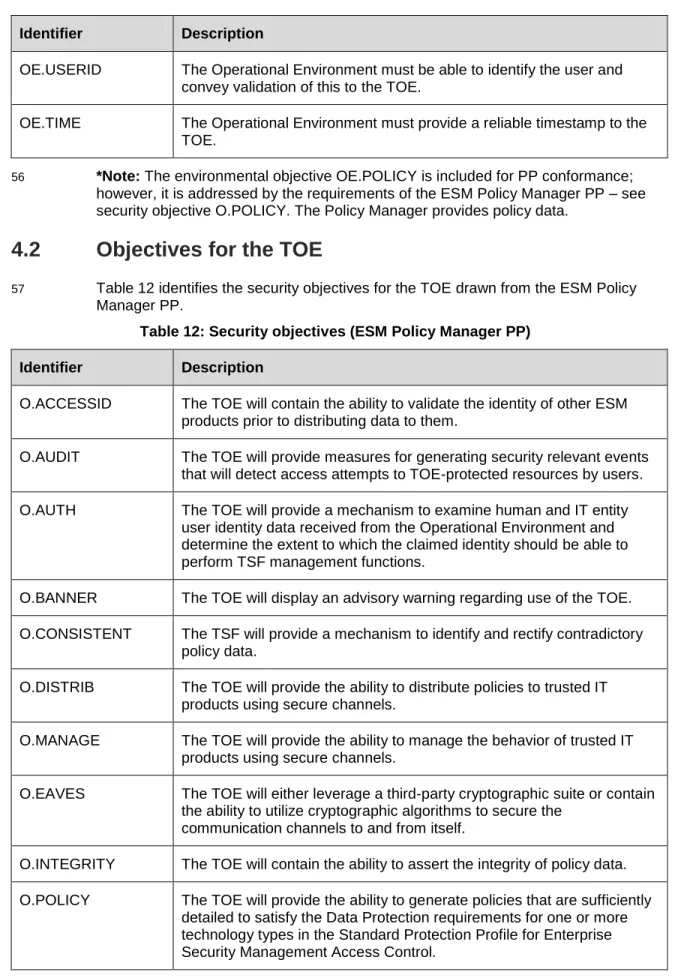
55 Table 11 identifies the objectives for the operational environment drawn from the
ESM Access Control PP.
Table 11: Operational environment objectives (ESM Access Control PP)
Identifier Description
OE.AUDIT The Operational Environment will provide a remote location for storage
of audit data.
OE.INSTAL Those responsible for the TOE must ensure that the TOE is delivered,
installed, managed, and operated in a manner that is consistent with IT security.
OE.POLICY* The Operational Environment will provide a policy that the TOE will
enforce.
OE.PROTECT The Operational Environment will protect the TOE from unauthorized
Identifier Description
OE.USERID The Operational Environment must be able to identify the user and
convey validation of this to the TOE.
OE.TIME The Operational Environment must provide a reliable timestamp to the
TOE.
56 *Note: The environmental objective OE.POLICY is included for PP conformance; however, it is addressed by the requirements of the ESM Policy Manager PP – see security objective O.POLICY. The Policy Manager provides policy data.
4.2
Objectives for the TOE
57 Table 12 identifies the security objectives for the TOE drawn from the ESM Policy
Manager PP.
Table 12: Security objectives (ESM Policy Manager PP)
Identifier Description
O.ACCESSID The TOE will contain the ability to validate the identity of other ESM
products prior to distributing data to them.
O.AUDIT The TOE will provide measures for generating security relevant events
that will detect access attempts to TOE-protected resources by users.
O.AUTH The TOE will provide a mechanism to examine human and IT entity
user identity data received from the Operational Environment and determine the extent to which the claimed identity should be able to perform TSF management functions.
O.BANNER The TOE will display an advisory warning regarding use of the TOE.
O.CONSISTENT The TSF will provide a mechanism to identify and rectify contradictory
policy data.
O.DISTRIB The TOE will provide the ability to distribute policies to trusted IT
products using secure channels.
O.MANAGE The TOE will provide the ability to manage the behavior of trusted IT
products using secure channels.
O.EAVES The TOE will either leverage a third-party cryptographic suite or contain
the ability to utilize cryptographic algorithms to secure the communication channels to and from itself.
O.INTEGRITY The TOE will contain the ability to assert the integrity of policy data.
O.POLICY The TOE will provide the ability to generate policies that are sufficiently
detailed to satisfy the Data Protection requirements for one or more technology types in the Standard Protection Profile for Enterprise Security Management Access Control.
Identifier Description
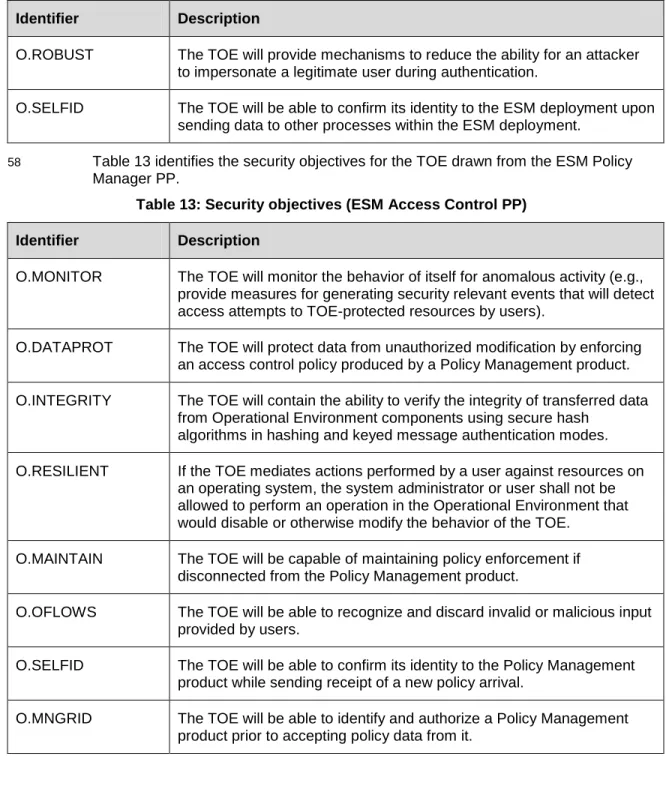
O.ROBUST The TOE will provide mechanisms to reduce the ability for an attacker
to impersonate a legitimate user during authentication.
O.SELFID The TOE will be able to confirm its identity to the ESM deployment upon
sending data to other processes within the ESM deployment.
58 Table 13 identifies the security objectives for the TOE drawn from the ESM Policy
Manager PP.
Table 13: Security objectives (ESM Access Control PP)
Identifier Description
O.MONITOR The TOE will monitor the behavior of itself for anomalous activity (e.g.,
provide measures for generating security relevant events that will detect access attempts to TOE-protected resources by users).
O.DATAPROT The TOE will protect data from unauthorized modification by enforcing
an access control policy produced by a Policy Management product.
O.INTEGRITY The TOE will contain the ability to verify the integrity of transferred data
from Operational Environment components using secure hash algorithms in hashing and keyed message authentication modes.
O.RESILIENT If the TOE mediates actions performed by a user against resources on
an operating system, the system administrator or user shall not be allowed to perform an operation in the Operational Environment that would disable or otherwise modify the behavior of the TOE.
O.MAINTAIN The TOE will be capable of maintaining policy enforcement if
disconnected from the Policy Management product.
O.OFLOWS The TOE will be able to recognize and discard invalid or malicious input
provided by users.
O.SELFID The TOE will be able to confirm its identity to the Policy Management
product while sending receipt of a new policy arrival.
O.MNGRID The TOE will be able to identify and authorize a Policy Management
5
Security Requirements
5.1
Conventions
59 This document uses the following font conventions to identify the operations defined
by the CC:
a) Assignment. Indicated with italicized text.
b) Refinement. Indicated with bold text and strikethroughs. c) Selection. Indicated with underlined text.
d) Assignment within a Selection: Indicated with italicized and underlined text. e) Iteration. Indicated by appending the iteration number in parenthesis, e.g.,
(1), (2), (3).
5.2
Extended Components Definition
60 Table 14 identifies the extended components which are incorporated into this ST. All
extended components are reproduced directly from the Protection Profiles to which this ST claims conformance and therefore no further definition is provided in this document.
Table 14: Extended Components
Component Title Source
ESM_ACD.1 Access Control Policy Definition ESM Policy Manager PP
ESM_ACT.1 Access Control Policy Transmission ESM Policy Manager PP
ESM_ATD.1 Object Attribute Definition ESM Policy Manager PP
ESM_ATD.2 Subject Attribute Definition ESM Policy Manager PP
FAU_SEL_EXT.1 External Selective Audit ESM Policy Manager PP
FAU_STG_EXT.1 External Audit Trail Storage ESM Policy Manager PP
ESM Access Control PP
FMT_MOF_EXT.1 External Management of Functions Behavior ESM Policy Manager PP
FMT_MSA_EXT.5 Consistent Security Attributes ESM Policy Manager PP
FTA_SSL_EXT.1 TSF-initiated session locking ESM Policy Manager PP
5.3
Functional Requirements
Table 15: Summary of SFRs
Requirement Title Source
ESM_ACD.1 Access Control Policy Definition ESM Policy Manager PP
ESM_ACT.1 Access Control Policy Transmission ESM Policy Manager PP
ESM_ATD.1 Object attribute definition ESM Policy Manager PP
ESM_ATD.2 Subject attribute definition ESM Policy Manager PP
FAU_GEN.1 Audit Data Generation ESM Policy Manager PP
ESM Access Control PP
FAU_SEL.1 Selective Audit ESM Access Control PP
FAU_STG.1 Protected Audit Trail Storage (Local Storage) ESM Access Control PP
FAU_SEL_EXT.1 External Selective Audit ESM Policy Manager PP
FAU_STG_EXT.1 External Audit Trail Storage ESM Policy Manager PP
ESM Access Control PP
FCO_NRR.2 Enforced Proof of Receipt ESM Access Control PP
FDP_ACC.1 Access Control Policy ESM Access Control PP
FDP_ACF.1 Access Control Functions ESM Access Control PP
FIA_AFL.1 Authentication Failure Handling ESM Policy Manager PP
FIA_SOS.1 Verification of Secrets ESM Policy Manager PP
FIA_UAU.2 User Authentication Before Any Action ESM Policy Manager PP
FIA_UID.2 User Identification Before Any Action ESM Policy Manager PP
FIA_USB.1 User-Subject Binding ESM Policy Manager PP
FMT_MOF.1(1) Management of Functions Behavior ESM Access Control PP
FMT_MOF.1(2) Management of Functions Behavior ESM Access Control PP
FMT_MOF_EXT.1 External Management of Functions Behavior ESM Policy Manager PP
FMT_MSA.1(1) Management of Security Attributes (internal
attributes)
Requirement Title Source
FMT_MSA.1(2) Management of Security Attributes (external
attributes)
ESM Policy Manager PP ESM Access Control PP
FMT_MSA.3 Static Attribute Initialization ESM Policy Manager PP
ESM Access Control PP
FMT_MSA_EXT.5 Consistent Security Attributes ESM Policy Manager PP
FMT_SMF.1 Specification of Management Functions ESM Policy Manager PP
ESM Access Control PP
FMT_SMR.1 Security Management Roles ESM Policy Manager PP
ESM Access Control PP
FPT_FLS_EXT.1 Failure of Communications ESM Access Control PP
FPT_RPL.1 Replay Detection ESM Access Control PP
FPT_STM.1 Reliable Time Stamps ESM Policy Manager PP
FRU_FLT.1 Degraded Fault Tolerance ESM Access Control PP
FTA_SSL_EXT.1 TSF-initiated Session Locking and Termination ESM Policy Manager PP
FTA_SSL.4 User-initiated termination ESM Policy Manager PP
ESM Access Control PP
FTA_TAB.1 TOE Access Banner ESM Policy Manager PP
FTP_ITC.1(1) Inter-TSF Trusted Channel (prevention of
disclosure)
ESM Policy Manager PP ESM Access Control PP
FTP_ITC.1(2) Inter-TSF Trusted Channel (detection of
modification)
ESM Policy Manager PP ESM Access Control PP
FTP_TRP.1 Trusted Path ESM Policy Manager PP
5.3.1
Enterprise Security Management (ESM)
ESM_ACD.1
Access Control Policy Definition
Hierarchical to: No other components.
ESM_ACD.1.1 The TSF shall provide the ability to define access control policies for
ESM_ACD.1.2 Access control policies defined by the TSF must be capable of containing the following:
a) Subjects:
Service Clients (Source: Identity Provider) and b) Objects:
SOAP Web Services (Source: TOE Published Services); and c) Operations:
Service Request (Source: Service Client) d) Attributes:
Access Control assertion attributes:
o Authentication Credentials (Source: Service Client via Service Request)
o User/Group (Source: Identity Provider)
Service Availability assertion attributes:
o Context attributes – time or day (Source: the Gateway) o Source IP address (Source: Service Client via Service
Request)
ESM_ACD.1.3 The TSF shall associate unique identifying information with each policy.
Dependencies: No dependencies
Application Note: The Policy Manager defines access control policies for consumption by
the Gateway.
ESM_ACT.1
Access Control Policy Transmission
Hierarchical to: No other components.
ESM_ACT.1.1 The TSF shall transmit policies to compatible and authorized Access
Control products under the following circumstances: immediately following creation of a new or updated policy, no other circumstances.
Dependencies: ESM_ACD.1 Access control policy definition
ESM_ATD.1
Object attribute definition
Hierarchical to: No other components.
ESM_ATD.1.1 The TSF shall maintain the following list of security attributes belonging
to individual objects:
Object: SOAP Web Services:
o Attributes: Associated policy assertions
ESM_ATD.1.2 The TSF shall be able to associate security attributes with individual
Dependencies: No dependencies.
ESM_ATD.2
Subject attribute definition
Hierarchical to: No other components.
ESM_ATD.2.1 The TSF shall maintain the following list of security attributes belonging
to individual subjects:
Subject: Service Clients
o Attributes: Authentication Credentials, User/Group
ESM_ATD.2.2 The TSF shall be able to associate security attributes with individual
subjects.
Dependencies: No dependencies.
5.3.2
Security Audit (FAU)
FAU_GEN.1
Audit Data Generation
Hierarchical to: No other components.
FAU_GEN.1.1 The TSF shall be able to generate an audit record of the following
auditable events:
a) Start-up and shutdown of the audit functions; and
b) All auditable events identified in Table 16 for the not specified level of audit; and
c) No additional events.
FAU_GEN.1.2 The TSF shall record within each audit record at least the following
information:
a) Date and time of the event, type of event, subject identity (if
applicable), and the outcome (success or failure) of the event; and b) For each audit event type, based on the auditable event definitions of
the functional components included in the PP/ST, information specified in column three of Table 16.
Dependencies: FPT_STM.1 Reliable time stamps
Table 16: Auditable events
Component Event Additional Information
ESM_ACD.1 Creation or modification of
policy
Unique policy identifier
ESM_ACT.1 Transmission of policy to
Access Control products
Destination of policy
Component Event Additional Information
ESM_ATD.1 Association of attributes with
objects.
Identification of the object and the attribute.
ESM_ATD.2 Definition of subject attributes. Identification of the attribute defined.
ESM_ATD.2 Association of attributes with
subjects.
Identification of the subject and the attribute.
FAU_SEL.1 All modifications to audit
configuration
None
FAU_SEL_EXT.1 All modifications to audit
configuration
None
FAU_STG_EXT.1 Establishment and
disestablishment of communications with audit server
Identification of audit server
FCO_NRR.2 The invocation of the
non-repudiation service
Identification of the information, the destination, and a copy of the evidence provided
FDP_ACC.1 Any changes to the enforced
policy or policies
Identification of Policy Management product making the change
FDP_ACF.1 All requests to perform an
operation on an object covered by the SFP
Subject identity, object identity, requested operation
FIA_AFL.1 The reaching of an
unsuccessful authentication attempt threshold, the actions taken when the threshold is reached, and any actions taken to restore the normal state.
Action taken when threshold is reached
FIA_SOS.1 Rejection or acceptance by the
TSF of any tested secret
None
FIA_SOS.1 Identification of any changes
to the defined quality metrics
The change made to the quality metric
FIA_UAU.2 All use of the authentication
mechanism
None
FIA_UID.2 All use of the identification
mechanism
Component Event Additional Information
FIA_USB.1 Successful and unsuccessful
binding of user attributes to a subject
None
FMT_MOF.1 All modifications to TSF
behavior
None
FMT_MSA.1 All modifications of security
attributes
None
FMT_MSA.3 All modifications of the initial
values of security attributes
Attribute modified, modified value
FMT_SMF.1 Use of the management
functions
Management function performed
FMT_SMR.1 Modifications to the members
of the management roles
None
FPT_FLS_EXT.1 Failure of communication
between the TOE and Policy Management product
Identity of the Policy Management product, Reason for the failure
FPT_RPL.1 Detection of replay Action to be taken based on the
specific actions
FTP_ITC.1(1) All use of trusted channel
functions
Identity of the initiator and target of the trusted channel
FTP_ITC.1(2) All use of trusted channel
functions
Identity of the initiator and target of the trusted channel
FTP_TRP.1 All attempted uses of the
trusted path functions
Identification of user associated with all trusted path functions, if available
FAU_SEL.1 Selective Audit
Hierarchical to: No other components.
FAU_SEL.1.1 The TSF shall be able to select the set of events to be audited from the
set of all auditable events based on the following attributes: a) event type; and
b) no additional attributes.
Dependencies: FAU_GEN.1 Audit data generation
FMT_MTD.1 Management of TSF data
Application Note: The selective audit capability is exercised by the Policy Manager, not by
FAU_SEL_EXT.1
External selective audit
Hierarchical to: No other components.
FAU_SEL_EXT.1.1 The TSF shall be able to select the set of events to be audited by an
ESM Access Control product from the set of all auditable events based on the following attributes:
a) event type; and b) no additional attributes.
Dependencies: FAU_GEN.1 Audit data generation
FMT_MTD.1 Management of TSF data
Application Note: The external selective audit capability is exercised by the Policy
Manager, not by a user directly accessing the Gateway.
FAU_STG.1
Protected Audit Trail Storage (Local Storage)
Hierarchical to: No other components.
FAU_STG.1.1 The TSFshall protect 200 mb locally stored audit records in the audit
trail from unauthorized deletion.
FAU_STG.1.2 The TSFshall be able to prevent unauthorized modifications to the
stored audit records in the audit trail.
Dependencies: FAU_GEN.1 Audit data generation
FAU_STG_EXT.1
External audit trail storage
Hierarchical to: No other components.
FAU_STG_EXT.1.1 The TSF shall be able to transmit the generated audit data to a Syslog
server and/or TOE-internal storage.
FAU_STG_EXT.1.2 The TSF shall ensure that transmission of generated audit data to any
external IT entity uses a trusted channel defined in FTP_ITC.1.
FAU_STG_EXT.1.3 The TSF shall ensure that any TOE-internal storage of generated audit
data:
a) protects the stored audit records in the TOE-internal audit trail from unauthorised deletion; and
b) prevent unauthorised modifications to the stored audit records in the TOE-internal audit trail.
Dependencies: FAU_GEN.1 Audit data generation
FTP_ITC.1 Inter-TSF Trusted Channel
5.3.3
Class FCO: Communication
Hierarchical to: FCO_NRR.1 Selective proof of receipt
FCO_NRR.2.1 The TSF shall enforce the generation of evidence of receipt for received
policies at all times.
FCO_NRR.2.2 The TSF shall be able to relate the software name, version, node, time,
policy update message, user, source IP of the originator of the information, and the stored internal data identifying allowable Policy Management products of the information to which the evidence applies.
FCO_NRR.2.3 The TSF shall provide a capability to verify the evidence of receipt of
information to the Policy Management productgiven30 seconds.
Dependencies: FIA_UID.1 Timing of identification
5.3.4
FCS: Cryptographic Support
61 The TOE utilizes third-party cryptographic suites and therefore does not claim any of
the optional cryptographic SFRs per guidance at Annex C.4 of the ESM Policy Manager PP and Annex C.3 of the Access Control PP.
5.3.5
Class FDP: User Data Protection
FDP_ACC.1 Access Control Policy
Hierarchical to: No other components.
FDP_ACC.1.1 The TSF shall enforce the access control Security Function Policy (SFP)
on
Subjects: Service Clients (on behalf of users)
Objects: SOAP Web Services; and
Operations: Service Request
Dependencies: FDP_ACF.1 Security attribute based access control
Application note: The Gateway enforces the access control SFP.
FDP_ACF.1
Access Control Functions
Hierarchical to: No other components.
FDP_ACF.1.1 The TSF shall enforce the access control SFP to objects based on the
following: all operations between users and objects based upon the attributes defined in ESM_ACD.1.
FDP_ACF.1.2 The TSF shall enforce the following rules to determine if an operation
among controlled subjects and controlled objects is allowed: rules received from the Policy Manager.
FDP_ACF.1.3 The TSF shall explicitly authorize access of subjects to objects based on
FDP_ACF.1.4 The TSF shall explicitly deny access of subjects to objects based on the following additional rules: if a requested object is not explicitly allowed by policy, then the access to the requested object is denied by default.
Dependencies: FDP_ACC.1 Subset access control
FMT_MSA.3 Static attribute initialization
5.3.6
Class FIA: Identification and Authentication
FIA_AFL.1
Authentication failure handling
Hierarchical to: No other components
FIA_AFL.1.1 The TSF shall detect when an administrator configurable positive integer
within a range of 1 and 20 unsuccessful authentication attempts occur related to login at the Policy Manager.
FIA_AFL.1.2 When the defined number of unsuccessful authentication attempts has
been met, the TSF shall lock the account for an administrator defined period of time.
Dependencies: FIA_UAU.1 Timing of authentication
Application note: This requirement relates only to the Policy Manager component of the
TOE as the SFR is drawn from the ESM Policy Manager PP.
FIA_SOS.1
Verification of secrets
Hierarchical to: No other components.
FIA_SOS.1.1 The TSF shall provide a mechanism to verify that secrets meet the
following:
a) For password-based authentication, the following rules apply: 1. Passwords shall be able to be composed of a subset of the following character sets: all printable ASCII characters that include the following values 26 uppercase letters, 26 lowercase letters, 10 numbers, and 10 special characters "!", "@", "#", "$", "%", "^", "&", "*", "(", and ")". ; and 2. Minimum password length shall settable by an administrator, and support passwords of 16 characters or greater; and
3. Password composition rules specifying the types and numbers of required characters that comprise the password shall be settable by an administrator; and
4. Passwords shall have a maximum lifetime, configurable by an administrator; and
5. New passwords must contain a minimum of an administrator-specified number of character changes from the previous password; and
6. Passwords must not be reused within the last administrator-settable number of passwords used by that user;
b) For non-password-based authentication, the following rules apply: 1. The probability that a secret can be obtained by an attacker during the lifetime of the secret is less than 2-20.
Dependencies: No dependencies.
FIA_UAU.2
User authentication before any action
Hierarchical to: FIA_UAU.1 Timing of authentication
FIA_UAU.2.1 The TSF shall require each user to be successfully authenticated before
allowing any other TSF-mediated actions on behalf of that user.
Dependencies: FIA_UID.1 Timing of identification
FIA_UID.2
User identification before any action
Hierarchical to: FIA_UID.1 Timing of identification
FIA_UID.2.1 The TSF shall require each user to be successfully identified before
allowing any other TSF-mediated actions on behalf of that user.
Dependencies: No dependencies.
FIA_USB.1
User-subject binding
Hierarchical to: No other components.
FIA_USB.1.1 The TSF shall associate the following user security attributes with
subjects acting on the behalf of that user: username, role.
FIA_USB.1.2 The TSF shall enforce the following rules on the initial association of user
security attributes with subjects acting on the behalf of users:
The TSF determines the username from the credentials presented for authentication.
The TSF associates the role with the corresponding username
FIA_USB.1.3 The TSF shall enforce the following rules governing changes to the user
security attributes associated with subjects acting on the behalf of users: Once a user’s session is established, the security attributes associated with a subject acting on behalf of a user cannot be changed for the duration of that user’s session.
Dependencies: FIA_ATD.1 User attribute definition
5.3.7
Class FMT: Security Management
FMT_MOF.1(1)
Management of Functions Behavior
Hierarchical to: No other components.
FMT_MOF.1.1(1) The TSFshall restrict the ability to query the behavior of, modify the
behaviour of the functions: audited events, repository for remote audit storage, Access Control SFP, policy being implemented by the TSF, Access Control SFP behavior to enforce in the event of communications outage, no other functions to an authorized and compatible Policy Management product.
Dependencies: FMT_SMF.1 Specification of management functions
FMT_SMR.1 Security roles
FMT_MOF.1(2)
Management of Functions Behavior
Hierarchical to: No other components.
FMT_MOF.1.1(2) The TSFshall restrict the ability to query the behaviour of the functions:
policy being implemented by the TSF, no other functions to an authorized and compatible Enterprise Security Management product.
Dependencies: FMT_SMF.1 Specification of management functions
FMT_SMR.1 Security roles
FMT_MOF_EXT.1
External management of functions behavior
Hierarchical to: No other components.
FMT_MOF_EXT.1.1 The TSF shall restrict the ability to query the behavior of, modify the
functions of Access Control products: audited events, repository for remote audit storage, Access Control SFP, policy version being implemented, Access Control SFP behavior to enforce in the event of communications outage, Gateway configuration to the roles
Administrator (query and modify), Operator (query only).
Dependencies: FMT_SMF.1 Specification of management functions
FMT_SMR.1 Security roles
Application note: The TOE supports numerous roles (refer to Table 17) of which the
Administrator and Operator are the superset.
FMT_MSA.1(1)
Management of security attributes (internal attributes)
Hierarchical to: No other components.
FMT_MSA.1.1(1) The TSF shall restrict the ability to perform the operations in Table 17 on