Unified
communications
thinking
Defying fragmentation and silos
Angus Jenkinson
Professor of Integrated Marketing Luton Business School
Contents
Need for unified communications thinking 3
What does the solution need? 4
Unified thinking 5
Permission is given for this paper to be copied, forwarded, distributed or quoted from provided that the authorship is acknowledged.
Need for unified communications
thinking
The marketing communications industry has a wide variety of different methods and criteria that vary by discipline, media and audience type. Each discipline tends to apply different metrics, which are often only loosely connected with sustainable brand success but are relatively easy to capture within the discipline, for example:
• Advertising is frequently measured by awareness
• PR is frequently measured by column inches of copy or similar media related metrics
• Direct marketing is typically measured by response rates
• Personal selling is typically measured by call volumes and sales
• Events are measured by number of participants and follow on leads
• Sales promotion is measured by short-term market share and sales volume gains
Until now there has been no planning and evaluation methodology that enables common practice and perspectives across all disciplines, communication groups and agencies. There has been no way to plan communication from top to bottom and across all methods, media and touch points with a single tool kit, although the excellent work of firms like Ninah Consulting, PointLogic, Billett, Ogilvy, Integration and ATG MindShare demonstrates the urgency of the quest.
The absence of a unified method means that marketers and other change agents can neither specify communication objectives nor evaluate results to a common or universal standard. This makes comparison and discussion between the methods difficult and makes it hard or impossible to collate, compare and analyse results across either parallel communication projects or multiple communication projects over time. The absence of universal standards has held back development of numerous industries including the information
disciplines described above are equivalent to that in the information technology industry pre-Internet protocols.
What does the solution need?
You can’t solve a problem at the same level as the problem. The solution therefore requires a new practical theory based on an elevated perspective and genuine realities rather than traditional assumptions.
Our research with a significant range of senior marketers and brands across the UK backed by reconsideration of existing knowledge suggests the need for a revised approach to both IMC and CRM. This revised approach regards IMC and CRM as a single unified planning and evaluation discipline that also accommodates all communication avenues available to the brand, including for example the sales force and PR, internal marketing and design, even merchandising and R&D. We call it just plain Integrated Marketing.
This is not an issue of functional power, but rather of shared thinking and collaborative process. Nor is it a question of creating monotonic communication: the point of the unified approach is to maximise creative potential by working with and choosing from the full palette of possibility.
The labels IMC and CRM have had a certain usefulness because each of them expresses a particular focus of excellence, namely the
emphasis on integration and harmonisation across communication by IMC, which is methodological, and the parallel CRM emphasis on the
goal of managing and enhancing customer relationships towards greater customer lifetime value and therefore customer and brand equity. These therefore clearly express complementary aspects and objectives.
IMC has also tended to be more significant in the world of FMCG and CRM in business-to-business and more service based markets, including financial services, where one-to-one direct communication
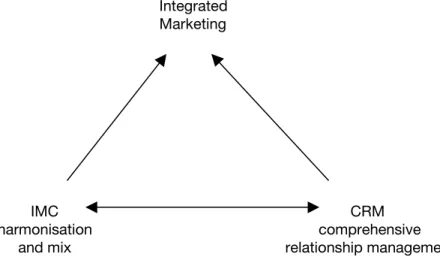
may be more important. However, the argument that this means that they are fundamentally different is flawed. IBM, the biggest business-to-business brand in the world, calls its marketing communication function IMC. This might just be ignorance on their part, except that it isn't. As well as Mars, Lloyds TSB, or the Automobile Association, IBM, to get anywhere close to optimising their communication, need to ensure that it is managed as an integrated, efficient, harmonised whole. So do all other brands, whether so-called corporate or product. The concepts of IMC are fundamental to this. Thus a unified solution develops both IMC and CRM to its next stage, as shown in Figure 1
Figure 1: Getting on top of the communication problem Integrated Marketing IMC harmonisation and mix CRM comprehensive relationship management
Unified thinking
This unified thinking would lead to superior approach in four ways:
1. Better objectives: applying a universal, neutral, common currency planning framework for any and all communication 2. Better communication methods: taking advantage of the
convergence of technique (see below)
3. Better media selection: unprejudiced wide-media planning mean that media work harder
4. Better learning: Pan-communication econometrics for rigorous evaluation with shared learning involving all participants
Communications convergence potential is based on four powerful principles (which we have identified and validated in our research):
1. All communication in any medium is brand defining and relationship and sales influencing (this includes bad or weak communication alongside ‘good’ communication). Terms such as above and below the line are unhelpful and potentially pejorative.
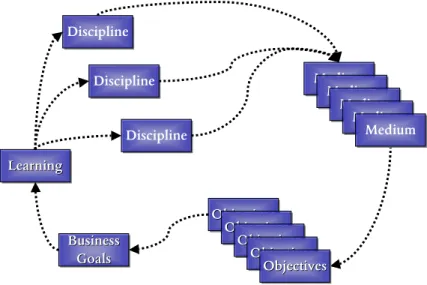
2. Any discipline can be used within any medium or media to achieve any objective. The right combination takes improved rigour and creative insight. (The combination of discipline and medium constitutes a ‘channel’.)
3. Any communication activity (sales call, TV ad, mail pack, PR event, etc.) in any medium can converge insights and methods from the communication disciplines to create new channels.
4. The best mix of communication disciplines using the best mix of media (for a given audience community) to achieve the best mix of objectives will optimise a communication project.
Figure 2 indicates how these propositions are applied in a learning cycle.