I
NTERNSHIP
S
URVEY
A
NALYSIS
MIM
A
FFAIRS
,
2010
CEMS
S
TUDENT
B
OARD
TABLE OF CONTENTS
1. I
NTRODUCTION_____________________________________________________________ 1
2. S
UMMARY AND SUGGESTIONS____________________________________________________ 1
3. M
OTIVATION FOR THE PROJECT___________________________________________________ 4
4. T
HES
AMPLE______________________________________________________________ 5
5. S
TATUSQ
UO______________________________________________________________ 6
6. T
IMING OF THE INTERNSHIP_____________________________________________________ 7
7. I
NTEREST IN DIFFERENT INDUSTRIES________________________________________________ 8
8. R
EASONING FOR COMPANY CHOICE_________________________________________________ 9
9. S
EARCHING FOR AN INTERNSHIP_________________________________________________ 10
10. A
PPLICATIONS
TEPS________________________________________________________ 11
11. N
UMBER OFA
PPLICATIONS___________________________________________________ 12
12. F
INDING ANDE
XPECTING TOF
INDI
NTERNSHIPS______________________________________ 13
13. C
ORPORATEP
ARTNERS______________________________________________________ 15
14. E
VALUATION OF INTERNSHIP PROCESS_____________________________________________ 18
15. V
ALUABLES
KILLS_________________________________________________________ 19
16. S
UMMARY OF ADDITIONAL COMMENTS____________________________________________ 21
1.
INTRODUCTION
Failure to complete an internship abroad is one of the major reasons for MIM students not being able to graduate on time. This triggered the Student Board’s curiosity on the matter, and the MIM Affairs team decided to investigate the issue. The project was launched during the Student Board’s meeting in Cologne (Germany) in December 2009, and aims at uncovering reasons why not as many students as desirable can confirm completion of their internship by graduation.
2.
SUMMARY AND SUGGESTIONS
The analysis we have carried out benefits from a highly diverse sample of respondents, in total 847. The survey was sent to current CEMS students and CEMS alumni and thus all 25 CEMS schools and 64 different nationalities are represented. Hence the following findings can be seen as valid for the whole CEMS community.
Breaking down all answers and further discussions has led us to supporting the three following notions:
1. CEMS students’ company choice criteria lead to uniform preferences.
2. Students in search of internships do not make use of career services; this
includes both home and host school career services and cems.org.
3. Corporate partners are not a main source of internships for CEMS students.
In the following we will discuss implications of the three points mentioned above and suggestions as to how these challenges can be met.
ADD1:UNIFORM PREFERENCES
Students choose internships primarily based on geographic and company reputation criteria
(see section 8. Reasoning for company choice). In addition, some industries are clearly
preferred to other industries, namely consulting, accounting/audit and marketing firms/FMCG (further information is provided in section 7. Interest in different industries). Via counting the number of applications that students sent to corporate partner, the following ranking has been identified: PwC (consulting) is the most favoured corporate partner with 16% of all respondents applying to this company, Henkel second (marketing, 14%), L’Oreal third (marketing, 13%), Shell (company reputation, 9%) and AT Kearny (consulting, 8%).
this problem is to communicate and provide more information on available internships in less know industry sectors as well as less main-stream companies.
• Improve information offered on cems.org
Firstly, cems.org could feature links to websites publishing postings for jobs and internships. An example is the global student organization Aiesec that provides a database with numerous internships which aren’t necessarily offered by large multinational companies, but can provide rich learning experiences.
Beyond cems.org, we recommend CEMS Clubs to foster relations with Aiesec or similar organizations, also local ones, or the local career office, so that the CEMS Club can function as a facilitator for the flow of information on internships.
• Collect internship reports from each student
A second idea is to request, starting as soon as possible, brief reports from the students who complete their internships. These reports are stored in a database on cems.org, and can be viewed by students who are looking for internships to gain inspiration and new ideas. This way it would become clear that candidates do not only complete their internships in well-known multinationals in the large capitals of the world, but also for instance in smaller, local companies in developing countries, among other possibilities. Summing up, the main idea is that there is a need to improve the information and communication on available internships across the globe. There are many internship possibilities that students are not aware of and thus guidance would be needed in these directions. We have mentioned two creative possibilities, but there is for sure more that could be done in this area.
ADD 2:CAREER SERVICES
The second issue that came up during the research, is that students do not make any use of career services – especially not when they’re on their exchange semester (refer to section 14. Evaluation of the internship process for further information). Again many students are not aware of the availability of these career services and the flow if information has to be improved.
• Make students aware of career services
Therefore, we suggest CEMS coordinators to make students more aware of the career services available (if this is the case) and to encourage them to make use of these.
• Offer skills seminars preparing students for the job application process
Moreover, we support the idea of skills seminars on writing of CVs and cover letters, interview skills and problem solving that can be useful to master the application process. Concern has been expressed and supported by the results of this survey (see section 10. Application Steps) that CEMS students do not possess the skills to submit impressive job applications.
• Provide CEMS-wide guidelines
Another suggestion for CEMS is to provide guidelines on how to apply for an internship, how to write a good CV and motivation letter, and by which criteria to choose an internship, as discussed above. An improved internship guide could be worked on, taking into consideration the difficulties students face as discovered through this project or through supplementary investigations.
ADD 3:CORPORATE PARTNERS
Students are highly interested in internship opportunities at corporate partners. Nevertheless, the number of students who actually received an internship at a CEMS corporate partner is comparably low.
• Make students aware of different options
Therefore, as mentioned before students should be encouraged to not only apply to corporate partners, but to take other companies to which they might not have been exposed much during their studies, into consideration.
• Foster relations with non-corporate partners
Furthermore CEMS coordinators and CEMS clubs are not obliged to solely organise events, company presentations, skills seminars, etc. with cooperate partners. It could be interesting to explore relations with companies as well.
Concluding, the focus on more efficient and better information to candidates and improved awareness on the use of career services could have a very positive effect. We must however not ignore that internships, besides being a great opportunity to put knowledge in practice in a real situation and obtain life experience, place a considerable burden on the curriculum of the individual candidate. Is ten weeks too long? Does the internship have to be international? Could the internship be optional? Could any work experience – not only entry-level experience relevant to our studies – be accepted?
These are all questions which were raised by our project and which we believe should be kept in mind going forward, and the possibility to act upon these questions should be weighed against how big and obstacle internships really represent to candidates’ graduation.
3.
MOTIVATION FOR THE PROJECT
The internship is a differentiator in the CEMS program. Many other master programs do not require such a work experience, and even more hardly so if the work experience is international. It is true that CEMS does not necessarily offer employers students with international work experience – the internship can, in fact, be substituted by the first period of a full-time job, if said position is abroad. We believe, however, that having international work experience as a standard exit requirement makes two statements: • CEMS students have put theory into practice by using their academic background in a
real work situation
• CEMS students have valuable international experience which proves, both for the individual student and for CEMS as an institution, that CEMS walks the talk on international capacity
There is probably nothing to indicate that the internship requirement should be abolished or even modified. The length represents a minimum for any relevant internship – and in the end, most students succeed indeed in this requirement. We think, however, that information and assistance from CEMS and its member schools have improvement potential, and that students may have too high expectations before beginning to look for an internship. With this project we seek to gather student’s impressions to draw information that can be useful to share with CEMS students, so as to make their search for a suitable internship easier in the future.
Aim of the project: The demand side of the internship market
We have focused on the demand side of the internship market, i.e. the students, for two reasons: Firstly, it is the students we represent, and we believe their experiences in detail have been underrepresented in past polls. Secondly, the supply side is to a large extent inaccessible to us. We might have had some access to CEMS Corporate Partners, but they might not have been willing to share their recruitment policies with us, and we do respect that CEMS is not their only pool of candidates, and so we acknowledge that CEMS students do face competition from outside the Alliance, even for Corporate Partners. Moreover, CPs are not representative of the international internship supply market, as CEMS accepts internships not only at large, prestigious multinationals but also at smaller companies. For these reasons, we thought it best to focus our project on the demand side.
Nevertheless, we keep in mind that a supply side does exist, and that according to economic theory, in equilibrium demand equals supply. We also assume that the internship market is not in equilibrium.
Thus our main question is, assuming we are not in equilibrium, and that the reason for this is excess demand – what are the reasons? Our aim is to give possible answers to this question and share these with our fellow stakeholders.
4.
THE SAMPLE
Our research benefits from a highly diverse sample of respondents, in total 847. The survey was sent to all CEMS students and CEMS alumni and thus all 25 CEMS schools and 64 different nationalities are represented by our respondents. The CEMS School participation is as shown by the diagram below:
Figure 1: School participation
Most responses to the survey are contributed by current CEMS students, accounting for 83.4% of respondents, with the remaining 16.6% being CEMS alumni. Hence, while collecting responses from alumni was allowed to broaden the sample size, responses based on recent experience are assumed to be more reliable. Moreover, responses from candidates struggling to find an internship are particularly valuable to us; CEMS alumni have already graduated, and may or may not remember the difficulties they faced.
5.
STATUS QUO
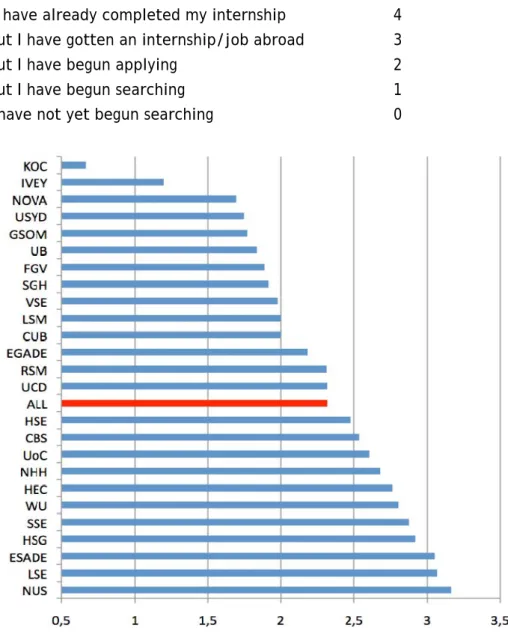
Of the future CEMS graduates, 46.7% have found an internship abroad; including already completed, ongoing or yet to start internships. This number was reached by measuring the degree of completion of the internship via assigning a numerical value to the question “Have you met the internship requirement?” The following numerical values were used:
Yes, I have already completed my internship 4 No, but I have gotten an internship/job abroad 3
No, but I have begun applying 2
No, but I have begun searching 1
No, I have not yet begun searching 0
Figure 2: Degree of completion of the internship requirement
In interpreting the results, care must be taken to consider the number of respondents, and the distribution of classes, at each school. Koc and Ivey score the lowest as these two schools are recently ratified full academic members. Highest-scoring schools are NUS (6 non-graduate respondents) and LSE (15 non-graduates). Nevertheless, it should be noted that these schools have low participation in the survey, and that the score might be attributed to casualties.
6.
TIMING OF THE INTERNSHIP
Among all survey respondents, 361 have either already completed the internship or know when they are going to complete it. The internships are timed as follows:
Internship before CEMS year: 29.9% Internship during CEMS year: 31.3% Internship after CEMS year: 38.8%
The numbers show that more respondents complete the CEMS internship requirement the later their stage with respect to the CEMS year. Naturally, this may be linked to the fact that a full-time job abroad is approved for the CEMS criterion, and is normally found after the CEMS year. The differences are not tested for significance, and could be casual, and their difference in level not considerable. Under this assumption, internship timing is evenly distributed over the course of the CEMS student’s last years of study.
Summarizing additional comments to the question, the main learnings are:
•
Many students try to take advantage of the summer break to do an internship. Nevertheless depending on the students home/host school combination the summer break is often not 10 weeks long.•
Aside from the summer break, there are few 10-week intervals during the year that make it possible to do an internship without missing a considerable part of the semester (Exception: spring semester UoC)•
Many internships last longer than 10 weeks. Accepting for instance a 6-month internship will lead to CEMS students not graduating on time.•
10 weeks is too short a time for those who need a VISA to obtain said document. Therefore those students would have to accept internships of longer duration. Moreover, finding an internship is more time consuming for these students than for those without VISA issues.Hence, the students see especially the timing as problematic. The internship requirement places a considerable burden on the curriculum of the individual candidate. Therefore for further investigations questions such as: Is ten weeks too long? Does the internship have to be international? Could the internship be optional? Could any work experience – not only entry-level experience relevant to our studies – be accepted?, should be raised.
7.
INTEREST IN DIFFERENT INDUSTRIES
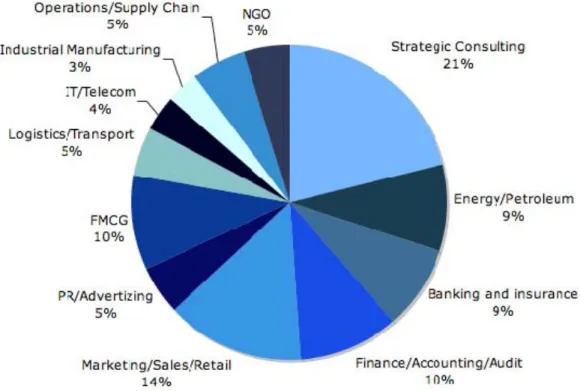
Student in general show the highest interest strategic consulting (21%) and marketing & sales (14%), as well as finance (10%), the energy (9%) and banking sector (9%).
Figure 3: Interest in different industry sectors
Additionally mentioned were the following areas: star-up and high growth companies, real estate, business development, aviation, human resources, CSR, Internet business, music industry, pharmaceuticals, public sector, automotive industry, natural resources, sports industry and luxury goods.
Given the high concentration of students interested in the consulting, finance and banking as well as marketing industry, schools might be interested in offering skills seminars, company meetings and/or speaker’s series focused on these areas.
8.
REASONING FOR COMPANY CHOICE
As can be drawn from the chart most students base their company decision on the company’s reputation and geography; 18% each.
In contrast feedback received during the internship plays a minor role. This could be based on the fact, that it is hard to get hold of this specific information. Most probably personal reports from previous interns would be necessary in order to get the knowledge about feedback received during the internship.
Salary and long-term career opportunities hold equal with 11% of students each finding these measures important. This is followed by career prospects and job description with 12% each and working climate with 14%.
Figure 4: Reasoning for company choice
Although most students (79.2%) think about future job opportunities with the company at which they do their internship, only a few (19.3%) still work at their internship employer.
9.
SEARCHING FOR AN INTERNSHIP
Almost 50% of all students started their internship search more than 6 months prior to their internship starting date. The grand majority of the remaining part used 3-5 months in order to find a position; 42%. Only a small minority 10% assigned two months and 4% one month for the actual internship search.
Figure 5: Duration of the internship search
Hence, students in general are planning ahead and are aware of the fact that they have to apply early to companies in order to find a suitable position.
10.
APPLICATION STEPS
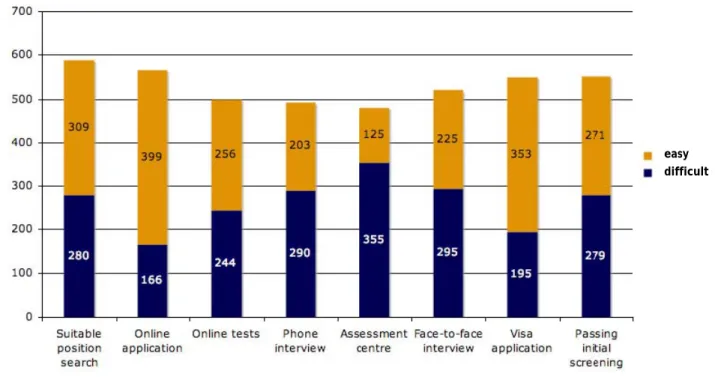
The following diagram treats the question of how difficult students found various application steps during their internship search. Possible answers ranked from 5 – very difficult to 1 – very easy.
In order to simplify the graphical demonstration values 4 and 5 have been summarized as “difficult” and the values 1 and 2 as “easy” while the value 3 has been neglected.
easy difficult
Figure 6: Application steps
The online application has been seen as the easiest step in the application, while the assessment centre was the hardest part, followed by face-to-face and phone interview. Surprisingly high ranked with regards to difficulty is the search for a suitable position which might indicate missing support from home and host schools respectively. Skills seminars on career planning can help students to segment the job market and searching more concretely for matching positions. Furthermore a CEMS guide offering tips and guidelines with regards to the application process is seen as helpful.
Passing the initial screening has been classified as fairly difficult as well. This might on the one hand indicate the need of further spreading of the CEMS brand, while on the other hand show lack of support from home and host schools again. Most CEMS schools offer career services of which students are often not made aware of.
11.
NUMBER OF APPLICATIONS
Regarding the number of applications sent out, most students wrote 3 or more applications with 24% of all students applying to more than 10 positions.
Figure 7: Number of applications send out
Thereby a positive correlation between students who started their internship search early and increasing number of applications send out was found. Thus, encourage students via a short reminder e-mail in November after the CEMS Career Forum to start their internship search and to apply to as many companies as possible might help to increase the probability of most students receiving an internship.
12.
FINDING AND EXPECTING TO FIND INTERNSHIPS
The vast majority of respondents who have gotten an internship have received satisfactory offers in accordance with their choices. 85.5% received an internship in their desired field, and 62.6% received their internship of first choice. 85% of the respondents who have gotten an internship have gotten one or two offers.
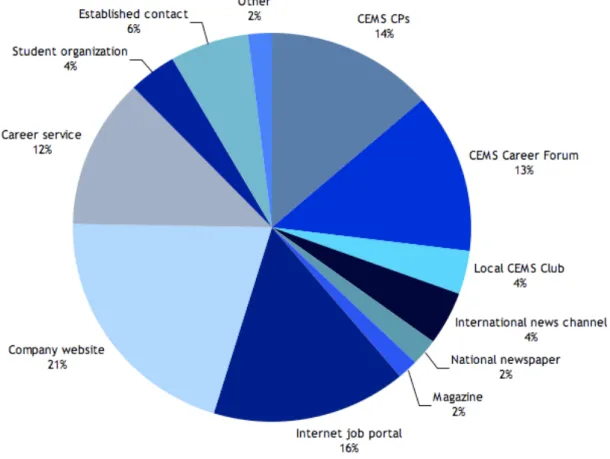
Students mainly expect to find internships through company websites (21%), Internet job portals (16%) and the CEMS Career Forum (13%) or CEMS coporate partners (14%).
Figure 8: Expectation to find an internship
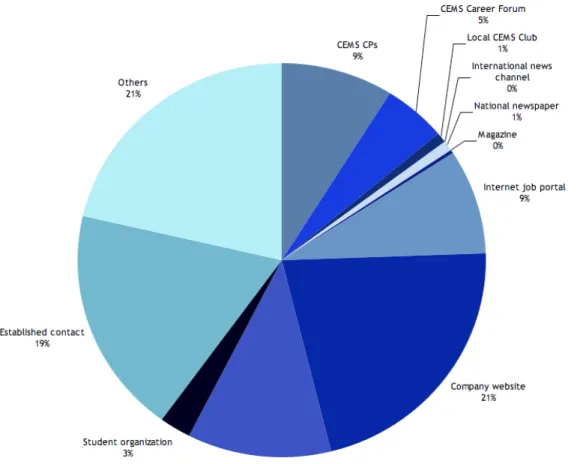
Most students find internships from company websites or other channels; together 42%. Third most important source are establish contacts. In addition it should be noted here, that only 5% of all students find an internship position at the CEMS career forum and overall only 9% get an internship with CEMS corporate partners.
Figure 9: Channels used to find an internship
Therefore, in general there is a good match between channels students plan to use and where students have found internships. Nevertheless there are two larger mismatches, namely in CEMS related channels (career forum and corporate partners) and establish contacts. Students expectations of finding internships from the CEMS career forum and corporate partners is too high as compared to reality, while they underestimate the power of established contacts.
13.
CORPORATE PARTNERS
To analyze the number of students applying to CEMS corporate partners two groups have been identified:
• Group A: Students who have already found an internship • Group B: Students who are still searching for an internship.
The majority of Group A applied to corporate partners as well as most students of Group B intend to apply to corporate partners. For both groups, some corporate partners are favoured against others, which is correlated to earlier finding; consulting companies rank highest and larger companies receive more applications. In numbers PwC ranks first with 16% of all respondents applying to the company, Henkel second with 14%, L’Oreal third with 13%, Shell 9% and AT Kearny 8%. The exact contribution of number of applications per corporate partner can be seen in the following chart:
As can be identified in the second chart, students who have not found internships appear to be more open in applying a bigger variety of corporate partners:
Figure 11: Group B – Number of applications to Cps
Thus, students are highly interested in job and/or internship opportunities at corporate partners. Nevertheless, the number of students who actually received an internship at a CEMS corporate partner is relatively low.
Corporate partner who have employed five or more of our respondents are shown below:
Company Number Respondents with internship
Henkel 22 15.83%
L'Oréal 18 12.95%
Deutsch Bank 10 7.19%
Pricewaterhouse Coopers 10 7.19%
Procter & Gamble 8 5.76%
Siemens Management
Consulting 8 5.76%
Unicredit Group 6 4.32%
Shell 5 3.60%
UBS 5 3.60%
As can be seen from this table, corporate partners do not provide a major source of internships for CEMS students. Altogether 16% of our respondents (139 out of 847 students) received an internship at a corporate partner.
Therefore students should be encouraged to not only apply to corporate partners, but to take other companies to which they might not have been exposed much during their studies, into consideration. Furthermore CEMS coordinators and CEMS clubs are not obliged to solely organise events with cooperate partners. It could be interesting to explore other relations with companies as well.
14.
EVALUATION OF INTERNSHIP PROCESS
The following table summarizes the evaluation of the internship process. Each item is valued on a scale from 1 to 5 where 1 means low agreement and 5 is high agreement.
Item Mean St.dev.
I am satisfied with my internship 4.09 1.14
It was easy to find an internship 3.11 1.31
Career service of my home school helped me with the process 2.17 1.33
Career service of my host school helped me with the process 1.95 1.23
The internship is an important element of the CEMS curriculum 4.24 1.16
Respondents both value and are satisfied with their internships. The difficulty of finding an internship is rated with a high standard deviation, showing that the responses are quite evenly distributed between 1 and 5.
The usefulness of career services at CEMS schools is questionable. The low means suggest two possible interpretations: Either the career services have limited resources to help students finding internships, or students do not make sufficient help of their career services.
Also, the mean score for the host school career service is lower than for the home school. It should be investigated whether exchange students are encouraged by CEMS coordinators to use the career office, whether the career service is at all available to exchange students and if students at all take the initiative to use the host school’s career service.
15.
VALUABLE SKILLS
Furthermore students have been asked which skills they perceive as valuable and important in their future job:
As seen by students before they have found an internship
Figure 12: Group A – Valuable Skills
Although the possession of those skills does not have a direct effect on students receiving an internship they are later on important once the students start their internship. CEMS students are perceived as the best management students in the world and therefore we have to offer more than good theoretical knowledge. How students perform on the job will directly reflect on the CEMS brand and thus students have to be trained on those additional skills as well. A separate survey has be launched by the Student Board with regards to skills seminars an the identified skills should be taken into consideration by all CEMS coordinators when setting the agenda for skills seminars.
16.
SUMMARY OF ADDITIONAL COMMENTS
At the end of the survey students were asked to raise any issues that have not been addressed by questions before.
COMMENTS CONCERNING ALL MEMBER SCHOOLS:
• Lack of support and information form school in the search process.
• CEMS corporate partners do not know about CEMS MIM internships requirements.
• CEMS corporate partners should offer internship specifically for CEMS students.
• Request for a database to gather all corporate partners job/internships postings.
• Uncertainness about the length of the internship: 10 weeks internship is seen as
too long by some and too by other students.
• Visa complications for non-European students.
COMMENTS ADDRESSED AT SPECIFIC MEMBER SCHOOLS: • Austria
More help, clearer instructions and requirements are needed. Little time to do internship during studies.
• Czech Republic
Some CEMS corporate partners offer CEMS students to enter the recruitment process on an more advanced stage than other applications.
• France
Request for a high number of internships offers and need of more detailed information. • Germany
50% of students from UoC stated, that they need more help and that university is not helpful with finding internships.
• Hungary
Students commented that some corporate partners facilitating the process for CEMS students.
Furthermore the following has been raised: ”The CEMS office has to continue focusing on marketing the programme to corporate partners as effectively as it has done in the past, which should significantly enhance the student's chances to get internships they are interested in.”
Students raised interest in a CEMS internship ”fair” at Bocconi. • The Netherlands
50/50: Lack of support together with positive comments have been stated. • Non-European Schools (Singapore, Brazil, Mexico, Russia, Turkey, Canada)
Especially visa issues (6 times) and difficulties in finding an offer in general (7 times) came up. Following up, lack of help from home schools and European host schools to find internships has been raised.
Students complaint, that corporate partners do not differentiate between CEMS and CEMS students and questioned the oppenness of corporate partners with regards to non-European applicants”. Students ask for agreements between CEMS and corporate partners on internships offer.
• Nordic Schools (Denmark, Finland, Norway, Sweden)
Students see a narrow focus on particular type of organisations and a need to widen the view on it and on diverse cooperation with corporate partners. They have difficulties to find an internship and no help is provided by schools.
More info in advance would be needed and the term “abroad” is not clearly defined. Nevertheless, many mentioned that CEMS internship was a good experience and it should maintain mandatory, otherwise, there are no incentives to find one: “I believe it is positive that the students have to handle most things on their own as that is part of the learning process.”
• Poland
10 weeks is seen as too short for an internship. • Spain
Request for an internship search tool at cems.org was formulated. • Switzerland
Students raised the issue of ensuring that more CPs use cems.org to post open positions. • United Kingdom
Lack of information and question of transparency in the selection process at the career forum cameup.
ADDITIONAL COMMENTS FROM STUDENTS:
“The expectations of the tasks the student should work on are too high for a 10 week internship. Many students should have difficulties in finding something appropriate in that context. Even the corporate partners do not offer projects as required by CEMS.“
“I dislike that it has to be an internship in a corporation. I believe we would also profit from 10 weeks of voluntary work somewhere in the world, so I believe it should also count as an internship.”
“It's nearly impossible to do the internship during the CEMS year, as the block seminar cut the summer holidays into two pieces, which where both too short to do the internship.” “I think CEMS in the future will need to organise itself more like AIESEC in order to provide all students with international internships. It is hard bordering on impossible to find a 10-week internship in the short summer vacation at an international company. I was only able to do a 10-week placement because I knew somebody on the executive level. Either we need to incorporate 6-month-long internships into the curriculum (like they do at business schools in France), or commit the CPs to actually offering 10-week placements in the summer to the students.”
“The CEMS Career Forum seems more like an advertising campaign for the companies rather than a real interest in employing students for internships. It is quite disappointing to a lot of students. Some companies did not even send any feedback after the interview at the Career Forum.”
“ I would have preferred to have better possibilities to find an internship in the non-profit sector - the CEMS job site only provides jobs at the big companies.”
“The CEMS internship is an important part of the CEMS curriculum. However, there were not enough information about the CEMS internship from my home school. I think the internship process would be significantly improved if my home school had taken a greater role in facilitating and encouraging students to begin the internship application process right after admission to the CEMS program, in order to fulfill the requirements before graduation.”
“Like: Compulsory standing makes it guaranteed to have an experience & International standing of the internship is great for career Dislike: Need more positive attitude towards CEMS students from CEMS partners & Lack of guidance from school” “Databases at schools with lists and offers of corporate partners, with names of recruiters and reports of former internships.”