United Nations
DP/FPA/2020/04 (Part I)Executive Board of the
United Nations Development
Programme, the United Nations
Population Fund and the United
Nations Office for Project Services
Distr.: General 17 April 2020 Original: English
Annual session 2020
1 June to 5 June 2020, New York Item 9 of the provisional agenda
UNFPA – Annual report of the Executive Director
United Nations Population Fund
Annex 1: Output scorecard and updated integrated results and resources
framework
Integrated midterm review and progress report on implementation of
the UNFPA strategic plan, 2018-2021
Report of the Executive Director
Summary
This annex contains output scorecard and indicator updates as of 2019 and adjustments introduced in the midterm review of the strategic plan, 2018-2021.
Content
Introduction 2
Section A: 2018-2019 cumulative progress scorecard 3
Section B. midterm review adjustments 4
Table 1: Summary of midterm review adjustments 1
Table 2. Indicator update, integrated results and resources framework of the UNFPA strategic plan,
2018-2021 4
Introduction
This annex presents the (a) 2018-2019 progress of the integrated results and resources framework targets of the UNFPA strategic plan, 2018-2021 and (b) the midterm review adjustment made to the results and resources framework.
Section A: 2018-2019 cumulative progress scorecard
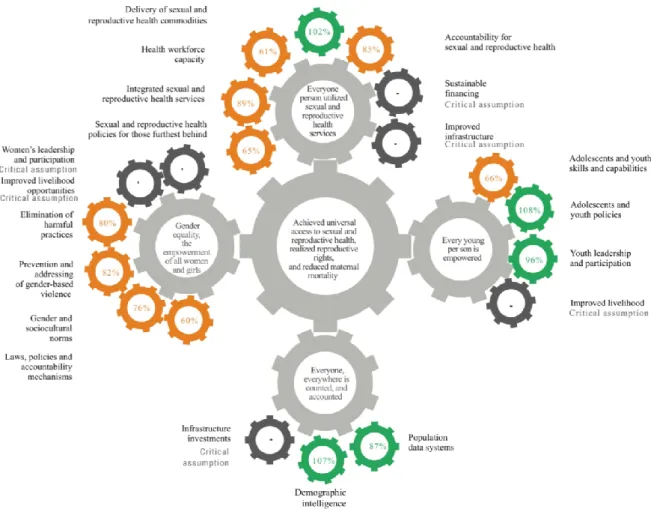
The analysis of the 2018-2019 results shows that UNFPA progressed1 as planned and achieved the
results it sought to achieve in these two years. There are 14 strategic plan development results outputs. For five of those outputs, UNFPA progress toward the targets was 90 per cent and above. For nine of the outputs, UNFPA progress was between 60 and 90 per cent of the targets. UNFPA fully achieved all four outputs of organizational effectiveness and efficiency. There are no outputs with progress of less than 60 per cent (not achieved) of their targets. Figure 1 below provides an overview of the output achievement. Table 2 illustrates the indicator updates of the results and resources framework of the strategic plan.
Overall, the strategic plan outputs focusing on leaving no one behind posted relatively lower performance compared to the other outputs. The midterm review found that the output implementation leaving no one behind remains a challenge. The overall reasons for the limited progress included: (a) gaps in availability of data and information about left behind populations, (b) inadequate financial resources and skills (such as advocacy) to reach furthest behind populations (c) pushback on recognizing some marginalised populations. The specific reasons are explained below.
(a) The output on policies and programmes for prioritizing the furthest left behind populations of outcome 1 performed 65 per cent. This was due to: (a) cultural and political sensitivity to prioritise furthest behind populations; (b) lack of required skills of staff to advocate for furthest behind populations; (c) resource intensiveness to reach those populations, and (d) lack of data to count and account the furthest behind populations.
(b) The achievement of the output on advancing adolescent and youth skills and capabilities of outcome 2, was marked as 66 per cent. This was due to the challenges of reaching the marginalised girls and the limited resources and time to implement the out-of-school sexuality education and align it to the international standards.
(c) The achievement of the output on advancing policy, legal and accountability frameworks for empowering women and girls, including marginalized and excluded groups, to exercise their reproductive rights of outcome 3 achieved 60 per cent. The limited progress was partly because of the limited know-how and limited resources; reaching marginalised and excluded groups can be resource-intensive.
1The four agencies, UNDP, UNICEF, UNFPA and UN-Women common methodology for assessment of progress achieved towards output targets:90 per cent and above- fully achieved, 60-89 per cent - partially achieved, and Less the 60% - not achieved.
Figure 1: Scorecard as of 2019
(Green) – progress, 90% and above [fully achieved] (Orange) – progress, between 60% and 90% [partially achieved]
(Red) – progress, less than 60% [not achieved]
Section B. midterm review adjustments
This section presents the midterm review adjustments introduced to the integrated results and resources framework of the UNFPA strategic plan, 2018-2021. UNFPA considered the midterm review process as a focused exercise looking at ways to accelerate and scale up progress; there were no adjustments introduced to the goal, outcomes and output statements of the results framework. The results and resources framework continue to have 14 integrated development and outputs and four organizational effectiveness and efficiency outputs. UNFPA introduced some adjustments to the results framework, demonstrating organizational adaptiveness and fitness-for-purpose. The overall adjustments introduced to the results framework were primarily based on following dimensions:
(a) Strengthening the thematic focus,
(b) Addressing challenging areas for achieving results, (c) Strengthening the “How” - way of doing business,
(d) Strengthening the “How” - organizational effectiveness and efficiency.
In addition, the midterm review of the integrated results and resources framework introduced some adjustments to improve the accountability and measurement. For example, UNFPA introduced a
shown in Table 1. The updated results and resources framework is available in Table 3 of this document.
The results and resources continued to align to the Sustainable Development Goals Framework and the Programme of Action of the International Conference on Population and Development. Sixty per cent of the outcome and impact indicators are Sustainable Development Goal indicators. The 17 Sustainable Development Goal indicators prioritized by UNFPA are captured in the integrated results and resources framework, at various levels, and 53 per cent of the outcome and impact indicators are common indicators with other United Nations organizations, including UNDP, UNICEF and UN-Women.
UNFPA did not introduce any major adjustments to the theory of change of the strategic plan 2018-2021. However, UNFPA institutionalised innovation into core drivers for delivering the results and it will be factored into the theory of change as a new strategy to accelerate the results.
The integrated results and resources framework continues to include critical assumptions at the output level. A critical assumption is defined as a condition that must exist for the outputs to achieve an outcome, but UNFPA is not accountable for attaining that condition. Instead, UNFPA will advocate, coordinate and form partnerships to progress achievement of the condition. UNFPA programme designs and implementation take into consideration the critical assumptions and set indicators to track their trends, in order to mitigate the risks of not achieving the outcomes. Outcome and impact indicators are disaggregated by selected characteristics, including sex, age, wealth quintile, location (urban or rural) and disability status to unmask inequalities and vulnerabilities. The disaggregated results will be reported annually with the Executive Director’s Annual Report to the Executive Board.
To complement the revised integrated results and resources framework, UNFPA will update the metadata sheets for each indicator. Metadata sheets provide definitions and other metric specifications of an indicator, to ensure standard interpretation of the indicator information. The metadata sheets also detail the method of calculation, the data source, and how the targets were set.
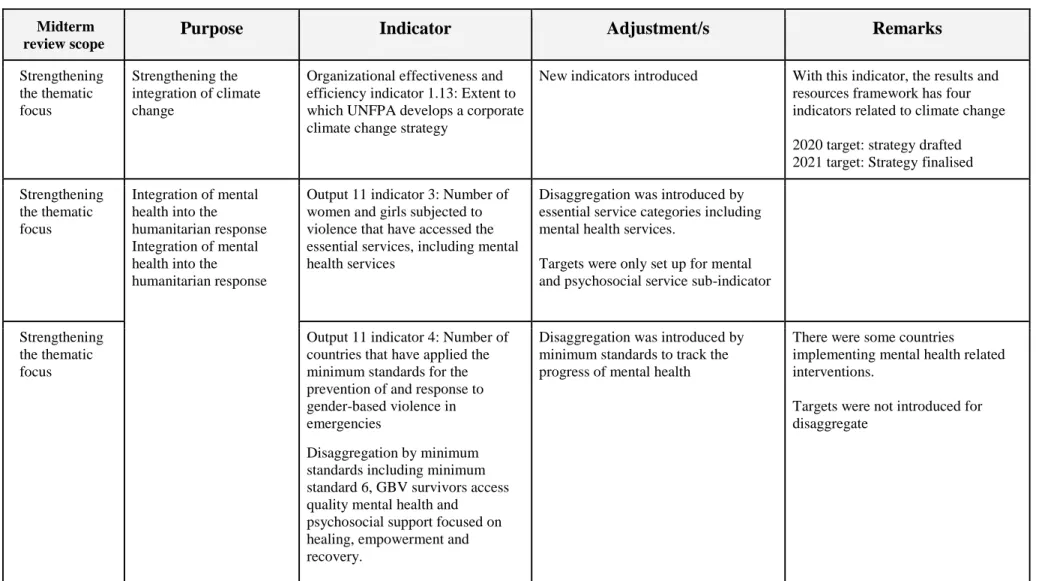
Table 1: Summary of midterm review adjustments
Midtermreview scope
Purpose
Indicator
Adjustment/s
Remarks
Strengthening the thematic focus Strengthening the integration of climate change
Organizational effectiveness and efficiency indicator 1.13: Extent to which UNFPA develops a corporate climate change strategy
New indicators introduced With this indicator, the results and resources framework has four indicators related to climate change 2020 target: strategy drafted 2021 target: Strategy finalised Strengthening
the thematic focus
Integration of mental health into the humanitarian response Integration of mental health into the humanitarian response
Output 11 indicator 3: Number of women and girls subjected to violence that have accessed the essential services, including mental health services
Disaggregation was introduced by essential service categories including mental health services.
Targets were only set up for mental and psychosocial service sub-indicator
Strengthening the thematic focus
Output 11 indicator 4: Number of countries that have applied the minimum standards for the prevention of and response to gender-based violence in emergencies
Disaggregation by minimum standards including minimum standard 6, GBV survivors access quality mental health and psychosocial support focused on healing, empowerment and recovery.
Disaggregation was introduced by minimum standards to track the progress of mental health
There were some countries implementing mental health related interventions.
Targets were not introduced for disaggregate
Midterm review scope
Purpose
Indicator
Adjustment/s
Remarks
Support the areas demonstrated limited performance Scaling up UNFPA response to reaching furthest behind populations
Organizational effectiveness and efficiency indicator 1.14; Extend to which UNFPA developed leaving no one behind strategy
New indicator added in 2018-2019 period, the outputs related to furthest behind populations demonstrated a limited performance 2020 target: strategy finalised 2021 target: strategy rolled out Support the areas demonstrated limited performance Introducing a comprehensive package of sexual and reproductive health interventions focusing the life cycle to improve the quality of care
Output 1 indicator 1: Number of countries that have a costed integrated national sexual and reproductive health plan prioritizing access to a
comprehensive package of sexual and reproductive health
information and services for adolescents, key populations and marginalized groups
Target adjusted: reduced because the essential service package has expanded
The comprehensive sexual and reproductive health package defined in the metadata of the indicator updated
Output 1 indicator 2: Number of countries where essential sexual and reproductive health services are included as part of risk pooling and prepayment schemes
Target adjusted: reduced because the essential service package has expanded
The comprehensive sexual and reproductive health package defined in the metadata of the indicator updated
Output 2 indicator 3: Number of countries in which at least 25 per cent of public health facilities provide quality-assured, adolescent-friendly integrated sexual and reproductive health services
Target adjusted: reduced because the essential service package has expanded
The comprehensive sexual and reproductive health package defined in the metadata of the indicator updated
Midterm review scope
Purpose
Indicator
Adjustment/s
Remarks
Strengthening the “how” - organizational effectiveness and efficiency
Better align to the United Nations reform and quadrennial
comprehensive policy review framework
Organizational effectiveness and efficiency indicator 1.1: Proportion of country programme documents that meet quality criteria
Target adjusted The Programme Review Committee
criteria for country programme documents] has been revised to better align with new United Nations Sustainable Development Cooperation Framework Organizational effectiveness and
efficiency indicator 3 .3:
Contribution in cash provided to the resident coordinator system (in millions of dollars)
Target adjusted- UNFPA doubled the contribution to
the resident coordinator system
Improve measurability and acceleration
Improve the measurement of youth empowerment
Outcome 2 indicator: Rating in youth empowerment index
New indicator added This indicator supplements the current outcome indicator of comprehensive HIV knowledge of young people
Targets to be defined in 2020 after developing the index.
Support the implementation of the voluntary national commitments, including those formulated in Government announcements, national policy and planning documents, voluntary national reviews, and in response to Nairobi Summit on ICPD25, to accelerate
the implementation of
Proportion of new UNFPA country programmes that, as appropriate, integrated voluntary national commitments,
including those formulated in Government announcements, national policy and planning documents, voluntary national reviews, and in response to Nairobi Summit on ICPD25, to accelerate the implementation of
the Programme of Action of the International Conference on Population and Development and
New sub-indicator added 2021 target: Where appropriate, all new country programmes as appropriate, integrated
voluntary national commitments, including those formulated in Government announcements, national policy and planning documents, voluntary national reviews, and in response to Nairobi Summit on ICPD25, to accelerate the implementation of the Programme of Action of the International
Midterm review scope
Purpose
Indicator
Adjustment/s
Remarks
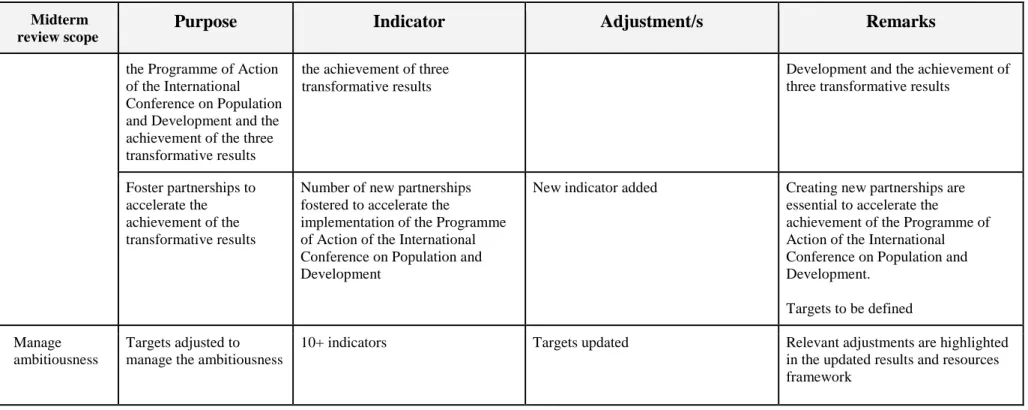
the Programme of Action of the International Conference on Population and Development and the achievement of the three transformative results
the achievement of three transformative results
Development and the achievement of three transformative results
Foster partnerships to accelerate the achievement of the transformative results
Number of new partnerships fostered to accelerate the
implementation of the Programme of Action of the International Conference on Population and Development
New indicator added Creating new partnerships are
essential to accelerate the
achievement of the Programme of Action of the International Conference on Population and Development.
Targets to be defined Manage
ambitiousness
Targets adjusted to manage the ambitiousness
10+ indicators Targets updated Relevant adjustments are highlighted
in the updated results and resources framework
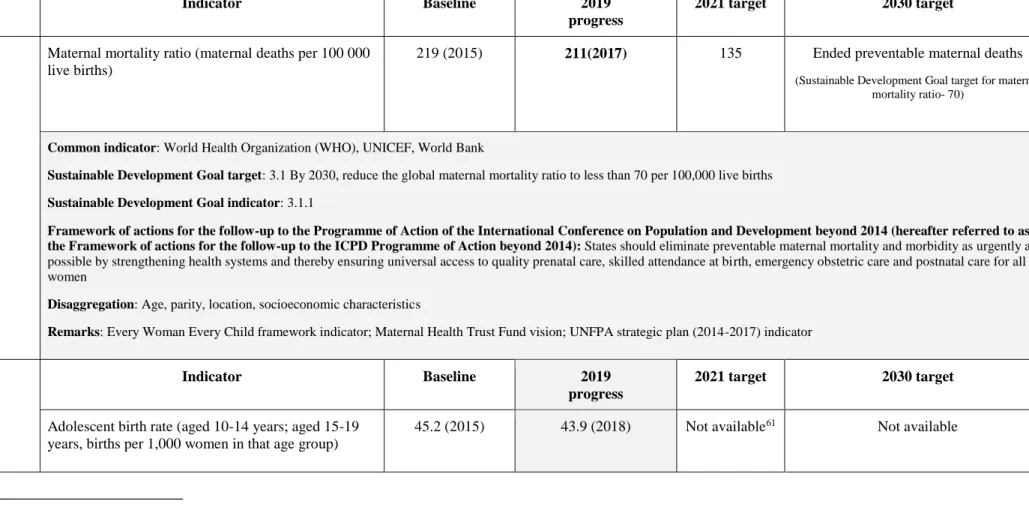
Table 2. Indicator update, integrated results and resources framework of the UNFPA strategic plan, 2018-2021
Goal: Achieved universal access to sexual and reproductive health, realized reproductive rights, and reduced maternal mortality to accelerate progress on the International Conference on Population and Development agenda, to improve the lives of adolescents, youth and women, enabled by population dynamics, human rights, and gender equality
Indicator Baseline 2019
progress
(Sustainable Development Goal target for maternal mortality ratio- 70)
Trends in maternal mortality
Common indicator: World Health Organization (WHO), UNICEF, World Bank
Sustainable Development Goal target: 3.1 By 2030, reduce the global maternal mortality ratio to less than 70 per 100,000 live births Sustainable Development Goal indicator: 3.1.1
Framework of actions for the follow-up to the Programme of Action of the International Conference on Population and Development beyond 2014 (hereafter referred to as the Framework of actions for the follow-up to the ICPD Programme of Action beyond 2014): States should eliminate preventable maternal mortality and morbidity as urgently as possible by strengthening health systems and thereby ensuring universal access to quality prenatal care, skilled attendance at birth, emergency obstetric care and postnatal care for all women
Disaggregation: Age, parity, location, socioeconomic characteristics
2 Indicator Baseline 2019 progress
2021 target 2030 target
Adolescent birth rate (aged 10-14 years; aged 15-19 years, births per 1,000 women in that age group)
45.2 (2015) 43.9 (2018) Not available2 Not available
Trends in adolescent birth rates
Common indicator: None
Sustainable Development Goal target: 3.7 By 2030, ensure universal access to sexual and reproductive health-care services, including for family planning, information and education, and the integration of reproductive health into national strategies and programmes
Sustainable Development Goal indicator: 3.7.2
Framework of actions for the follow-up to the ICPD Programme of Action beyond 2014: States should implement their commitments to promote and protect the rights of girls by enacting and implementing targeted and coordinated policies and programmes that concretely address: (a) ensuring gender parity in access to school; (b) providing comprehensive sexuality education; (c) reducing adolescent pregnancy; (d) enabling the reintegration of pregnant girls and young mothers into education at all levels, with a view to empowering the girl child and young women to achieve their fullest potential; and (e) elimination of harmful traditional practices, such as child, early and forced marriage and female genital mutilation/cutting.
Remarks: Family Planning 2020 indicator; UNFPA strategic plan (2014-2017) indicator
3 Indicator Baseline 2019 progress 2021 target 2030 target
Proportion of women aged 20-24 years who were married or in a union before age 15
6.4 (2012) 5% (2017) 3.0% Less than 1%
(Eliminated child marriage)
Trends in child marriage (before age 15)
Indicator Baseline 2019 progress 2021 target 2030 target
Proportion of women aged 20-24 years who were married or in a union before age 18
22.2% (2012) 20.9 (2017) 16.0% Less than 1%
Trends in child marriage (before age 18)
Common indicator: UNICEF, UN-Women
Sustainable Development Goal target: 5.3 Eliminate all harmful practices, such as child, early and forced marriage and female genital mutilation Sustainable Development Goal indicator: 5.3.1
Framework of actions for the follow-up to the ICPD Programme of Action beyond 2014: States should preserve the dignity and rights of women and girls by eradicating all harmful practices, including child, early and forced marriage
Disaggregation: Age, income, place of residence, geographical location, education, ethnicity (for some countries) Remarks: UNFPA strategic plan (2014-2017) indicator
Proportion of girls and women aged 15-49 years who have undergone female genital mutilation/cutting by age 3
39% (2015) 34% (2019) 15% Less than 1%
(Eliminated female genital mutilation)
Trends in female genital mutilation
Common indicator: UNICEF
Sustainable Development Goal target: 5.3 Eliminate all harmful practices, such as child, early and forced marriage and female genital mutilation Sustainable Development Goal indicator: 5.3.2
Framework of actions for the follow-up to the ICPD Programme of Action beyond 2014: States should develop, support and implement comprehensive and integrated strategies for the eradication of female genital mutilation/cutting
Disaggregation: Age, income, place of residence, geographical location, education
Remarks: Direct measurement of the UNFPA strategic plan (2018-2021) transformative result: “End gender-based violence and all harmful practices, including child marriage”; UNICEF-UNFPA joint programme on female genital mutilation/cutting, phase III indicator
3
Indicator moved to the impact level. This was an outcome 3 indicator of the IRRF presented to the 2017 second regular session of the Executive Board. Baseline and target were calculated using the latest available FGM prevalence data for girls 0-14 years based on DHS or MICS. In some cases, the FGM prevalence data for girls and women 15-19 years is used when data for girls 0-14 years is not available.
5 Indicator Baseline 2019 progress 2021 target 2030 target
Number of new HIV infections per 1,000 uninfected population, by sex, age and key populations
0.27 (2015) 0.25 (2017) 0.24 female 0.26 male 0.09 children (0-14) 0.40 adult (15-49) 0.06 0.02
Estimated HIV incidence rate, both sexes, all ages (Per 1,000 uninfected population)
Common indicator: Joint United Nations Programme on HIV/AIDS (UNAIDS), UNDP, UNICEF
Sustainable Development Goal target: 3.3By 2030, end the epidemics of AIDS, tuberculosis, malaria and neglected tropical diseases and combat hepatitis, water-borne diseases and other communicable diseases
Sustainable Development Goal indicator: 3.3.1
Framework of actions for the follow-up to the ICPD Programme of Action beyond 2014: States and global health partners should address the stark disparities in the success of HIV prevention in different parts of the world, and among different population groups
Disaggregation: Key populations, sex, age, HIV fast-track countries
6 Indicator Baseline 2019 progress 2021 target 2030 target
Number of maternal deaths averted 154,000
(2014-2017) 121,000 (2018-2019) 216,000 (2018-2021) 650,0004
Common indicator: None
Related Sustainable Development Goal target: 3.1 By 2030, reduce the global maternal mortality ratio to less than 70 per 100,000 live births Related Sustainable Development Goal indicator: 3.1.1 Maternal mortality ratio
Framework of actions for the follow-up to the ICPD Programme of Action beyond 2014: States should eliminate preventable maternal mortality and morbidity as urgently as possible by strengthening health systems and thereby ensuring universal access to quality prenatal care, skilled attendance at birth, emergency obstetric care and postnatal care for all women. States must, as a matter of urgency, provide widespread and high-quality information and counselling regarding the benefits and risks of a full range of affordable, accessible, quality contraceptive methods, with special attention to dual method use with male or female condoms, given the continuing risk of sexually transmitted infections and HIV, and ensure access to both contraceptive knowledge and commodities, irrespective of marital status
Disaggregation: None
Remarks: Model-based estimates; indicator is aligned with the UNFPA strategic plan (2018-2021) transformative result: “end preventable maternal deaths”
7 Indicator Baseline 2019 progress 2021 target 2030 target
Number of unintended pregnancies averted5 35 million
(2014-2017) 44 million (2018-2019) 36 million (2018-2021) 100 million6
Common indicator: None
Related Sustainable Development Goal target: 3.7 By 2030, ensure universal access to sexual and reproductive health-care services, including for family planning, information and education, and the integration of reproductive health into national strategies and programmes; 3.1 By 2030, reduce the global maternal mortality ratio to less than 70 per 100,000 live births
Related Sustainable Development Goal indicator: 3.7.1 Proportion of women of reproductive age (aged 15-49 years) who have their need for family planning satisfied with modern methods; 3.1.1 Maternal mortality ratio
Framework of actions for the follow-up to the ICPD Programme of Action beyond 2014: States must, as a matter of urgency, provide widespread and high-quality information and counselling regarding the benefits and risks of a full range of affordable, accessible, quality contraceptive methods, with special attention to dual method use with male or female condoms, given the continuing risk of sexually transmitted infections and HIV, and ensure access to both contraceptive knowledge and commodities, irrespective of marital status
Disaggregation: None
Remarks: Model-based estimate
8 Indicator Baseline 2019 progress 2021 target 2030 target
Number of unsafe abortions averted7 11 million
(2014-2017) 12.8 million (2018-2019) 12 million (2018-2021) 40 million8
Common indicator: None
Related Sustainable Development Goal target: 3.1 By 2030, reduce the global maternal mortality ratio to less than 70 per 100,000 live births; 3.7 By 2030, ensure universal access to sexual and reproductive health-care services, including for family planning, information and education, and the integration of reproductive health into national strategies and programmes
Related Sustainable Development Goal indicator: 3.1.1 Maternal mortality ratio; 3.7.1 Proportion of women of reproductive age (aged 15-49 years) who have their need for family planning satisfied with modern methods
Framework of actions for the follow-up to the ICPD Programme of Action beyond 2014: States should strive to eliminate the need for abortion by providing universal access to comprehensive sexuality education starting in adolescence, and sexual and reproductive health services, including modern methods of contraception, to all persons in need. States must, as a matter of urgency, provide widespread and high-quality information and counselling regarding the benefits and risks of a full range of affordable,
7
Represents only UNFPA programme countries 8
accessible, quality contraceptive methods, with special attention to dual method use with male or female condoms, given the continuing risk of sexually transmitted infections and HIV, and ensure access to both contraceptive knowledge and commodities, irrespective of marital status
Disaggregation: None
Remarks: Model-based estimates; Family Planning 2020 indicator
9 Indicator Baseline 2019 progress 2021 target 2030 target
Total lives saved9 46 million
(2014-2017) 30 million (2018-2019) 50 million (2018-2021) 150 million10
Common indicator: None
Related Sustainable Development Goal target: 3.1 By 2030, reduce the global maternal mortality ratio to less than 70 per 100,000 live births; 3.7 By 2030, ensure universal access to sexual and reproductive health-care services, including family planning, information and education, and the integration of reproductive health into national strategies and programmes; 5.2: Eliminate all forms of violence against all women and girls in the public and private spheres, including trafficking and sexual and other types of exploitation;
5.3 Eliminate all harmful practices, such as child, early and forced marriage, and female genital mutilation
Related Sustainable Development Goal indicator: 3.1 By 2030, reduce the global maternal mortality ratio to less than 70 per 100,000 live births; 3.7.1 Proportion of women of reproductive age (aged 15-49 years) who have their need for family planning satisfied with modern methods; 5.2.1 Proportion of ever-partnered women and girls aged 15 years and older subjected to physical, sexual or psychological violence by a current or former intimate partner in the previous 12 months, by form of violence and by age; Proportion of women and girls aged 15 years and older subjected to sexual violence by persons other than an intimate partner in the previous 12 months, by age and place of occurrence; 5.3.1 Proportion of women aged 20-24 years who were married or in a union before age 15 and before age 18; 5.3.2 Proportion of girls and women aged 15-49 years who have undergone female genital mutilation/cutting, by age
Framework of actions for the follow-up to the ICPD Programme of Action beyond 2014: States should eliminate preventable maternal mortality and morbidity as urgently as possible by strengthening health systems and thereby ensuring universal access to quality prenatal care, skilled attendance at birth, emergency obstetric care and postnatal care for all women. States should adopt and implement legislation, policies and measures that prevent, punish and eradicate gender-based violence within and outside the family, as well as in conflict and post-conflict situations. States must, as a matter of urgency, provide widespread and high-quality information and counselling regarding the benefits and risks of a full range of affordable, accessible, quality contraceptive methods, with special attention to dual method use with male or female
condoms, given the continuing risk of sexually transmitted infections and HIV, and ensure access to both contraceptive knowledge and commodities, irrespective of marital status
Disaggregation: None
Remarks: Model-based estimates
10 Indicator Baseline 2019 progress 2021 target 2030 target
Number of deaths, missing persons and directly affected persons attributed to disasters per 100,000 population
Not available11 Not available Not available Not available
Common indicator: UNDP, UNICEF, UN-Women
Sustainable Development Goal target: 1.5 By 2030, build the resilience of the poor and those in vulnerable situations and reduce their exposure and vulnerability to climate-related extreme events and other economic, social and environmental shocks and disasters
Sustainable Development Goal indicator: 1.5.1
Framework of actions for the follow-up to the ICPD Programme of Action beyond 2014: States should develop, strengthen and implement effective, integrated, coordinated and coherent national strategies to eradicate poverty and break the cycles of exclusion and inequality as a condition for achieving development
Disaggregation: Type of hazard
Remarks: Sendai Framework for Disaster Risk Reduction 2015 - 2030 indicator
11 Indicator Baseline 2019 progress 2021 target 2030 target
11
Proportion of population below the international poverty line, by sex, age, employment status and geographical location 8.6 (2015) 8% (2018) 7.8% male 8.3% female 7.4% female adult 14.0% female youth 7.0% male adult 13.2% male youth 6.0% 3.0%
Common indicator: UNDP, UN-Women
Sustainable Development Goal target: 1.1 By 2030, eradicate extreme poverty for all people everywhere, currently measured as people living on less than $1.25 a day Sustainable Development Goal indicator: 1.1.1
Framework of actions for the follow-up to the ICPD Programme of Action beyond 2014: States should develop, strengthen and implement effective, integrated, coordinated and coherent national strategies to eradicate poverty and break the cycles of exclusion and inequality as a condition for achieving development
Disaggregation: Sex, age, employment status and geographical location, urban/rural setting
Remarks: In line with the Quadrennial Comprehensive Policy Review: focusing on the eradication of poverty in its all forms and dimensions
Outcome 1: Every woman, adolescent and youth everywhere, especially those furthest behind, has utilized integrated sexual and reproductive health services and exercised reproductive rights, free of coercion, discrimination and violence
Indicator Baseline 2019 progress 2021 target 2030 target
1 Number of women who have utilized integrated sexual and reproductive health services
53 million (2014-2017) 46 million (2018-2019) 60 million (2018-2021) 100 million12
Number of adolescents who have utilized integrated sexual and reproductive health services
2 million (2014-2017) 5.6 million (2018-2019) 7 million13 (2018-2021) 15 million
Number of youth who have utilized integrated sexual and reproductive health services14
3 million (2014-2017) 16 million (2018-2019) 20 million15 (2018-2021) 15 million
Number of disabled women, adolescent and youth who have utilized integrated sexual and reproductive health services 100,000 (2014-2017) 32,700 (2018-019) 500,000 (2018-2019) 2 million
Common indicator: None
Related Sustainable Development Goal target: 3.7 By 2030, ensure universal access to sexual and reproductive health-care services, including for family planning, information and education, and the integration of reproductive health into national strategies and programmes
Related Sustainable Development Goal indicator: 3.1.2 Proportion of births attended by skilled health personnel; 3.8.1 coverage of essential health services; 3.7.1 Proportion of women of reproductive age (aged 15-49 years) who have their need for family planning satisfied with modern methods
Framework of actions for the follow-up to the ICPD Programme of Action beyond 2014:States should implement full integration of HIV and other sexual and reproductive health services by greatly expanding access to quality services for the diagnosis and treatment of sexually transmitted infections. States should urgently undertake the necessary long-term investments in training, recruiting and rewarding health-care workers to increase their numbers and strengthen their capacity, with a focus on ensuring that human resources are available to provide universal access to quality sexual and reproductive health services. States should reorient the health system to enable continuity of care. States should adopt policies and programmes on sexual health to better meet the changing sexual needs of older persons. States should guarantee persons with disabilities, in particular young people, the right to health, including sexual and reproductive health and rights, as well as the right to the highest standard of care, States should enhance their capacity to recognize and prevent violence, ensure the provision of services that can mitigate the consequences of violence and enable the full rehabilitation of those who experience it.
Disaggregation: Sex,age, disability, indigenous people, humanitarian context
2 Indicator Baseline 2019
progress
2021 target 2030 target
Proportion of births attended by skilled health personnel
68.6 % (2009) 81.1 % (2018) Not available Universal coverage
14
The age group of adolescent and youth is overlapping 15
Common indicator: UNICEF, WHO
Sustainable Development Goal target: 3.1 By 2030, reduce the global maternal mortality ratio to less than 70 per 100,000 live births Sustainable Development Goal indicator: 3.1.2
Framework of actions for the follow-up to the ICPD Programme of Action beyond 2014: States should eliminate preventable maternal mortality and morbidity as urgently as possible by strengthening health systems and thereby ensuring universal access to quality prenatal care, skilled attendance at birth, emergency obstetric care and postnatal care for all women, including those living in rural and remote areas
Disaggregation: Wealth quintile, residence, age, geographical location
Remarks: Maternal Health Trust Fund indicator; UNFPA strategic plan (2014-2017) indicator
3 Indicator Baseline 2019
progress
Coverage of essential health services Not available16 64 (2015) Not available Not available
Common indicator: WHO, World Bank
Sustainable Development Goal target: 3.8 Achieve universal health coverage, including financial risk protection, access to quality essential health-care services and access to safe, effective, quality and affordable essential medicines and vaccines for all
Sustainable Development Goal indicator: 3.8.1
Framework of actions for the follow-up to the ICPD Programme of Action beyond 2014: States should ensure mechanisms for: (a) the fair and affordable participation of all potential beneficiaries in their country; (b) the inclusion of essential sexual and reproductive health services within universal health coverage packages and the realization of comprehensive sexual and reproductive health care, especially for young people and the poor; and (c) the assurance of fairness and equality through the participation of civil society, independent commissions and advocacy groups in the oversight of allowable procedures, providers and reimbursements
Disaggregation: To be decided
16
4 Indicator Baseline 2019 progress
2021 target 2030 target
Proportion of women of reproductive age (aged 15-49 years) who have their need for family planning satisfied with modern methods
76.5 (2017) 76.7 (2019) 82.4% 93.9%
Common indicator: None
Sustainable Development Goal target: 3.7 By 2030, ensure universal access to sexual and reproductive health-care services, including for family planning, information and education, and the integration of reproductive health into national strategies and programmes
Sustainable Development Goal indicator: 3.7.1
Framework of actions for the follow-up to the ICPD Programme of Action beyond 2014: States must, as a matter of urgency, provide widespread and high-quality information and counselling regarding the benefits and risks of a full range of affordable, accessible, quality contraceptive methods, with special attention to dual method use with male or female condoms, given the continuing risk of sexually transmitted infections and HIV, and ensure access to both contraceptive knowledge and commodities, irrespective of marital status
Disaggregation: Countries under the UNFPA Supplies programme Remarks: Family Planning 2020 core indicator
5 Indicator Baseline 2019 progress 2021 target 2030 target
Contraceptive prevalence rate for modern contraceptives (married women)
56.5 (2017)
56.7 (2019)
Common indicator: None
Related Sustainable Development Goal target: 3.7 By 2030, ensure universal access to sexual and reproductive health-care services, including for family planning, information and education, and the integration of reproductive health into national strategies and programmes
Related Sustainable Development Goal indicator: 3.7.1 Proportion of women of reproductive age (aged 15-49 years) who have their need for family planning satisfied with modern methods
Framework of actions for the follow-up to the ICPD Programme of Action beyond 2014: States must, as a matter of urgency, provide widespread and high-quality information and counselling regarding the benefits and risks of a full range of affordable, accessible, quality contraceptive methods, with special attention to dual method use with male or female condoms, given the continuing risk of sexually transmitted infections and HIV, and ensure access to both contraceptive knowledge and commodities, irrespective of marital status
Disaggregation: Location, quintile, age, countries under the UNFPA Supplies programme
Remarks: Family Planning 2020 core indicator; indicator of the UNFPA Supplies programme; UNFPA strategic plan (2014-2017) indicator
6 Indicator Baseline 2019 progress 2021 target 2030 target
Unmet need for family planning (percentage of women of reproductive age, either married or in a union, who have an unmet need for family planning)
11.3 (2017)
11.3 (2019)
2.15 Less than 1%
(Eliminated unmet need family planning)
Common indicator: None
Related Sustainable Development Goal target: 3.7 By 2030, ensure universal access to sexual and reproductive health-care services, including for family planning, information and education, and the integration of reproductive health into national strategies and programmes
Related Sustainable Development Goal indicator: 3.7.1 Proportion of women of reproductive age (aged 15-49 years) who have their need for family planning satisfied with modern methods
Framework of actions for the follow-up to the ICPD Programme of Action beyond 2014:States must, as a matter of urgency, provide widespread and high-quality information and counselling regarding the benefits and risks of a full range of affordable, accessible, quality contraceptive methods, with special attention to dual method use with male or female condoms, given the continuing risk of sexually transmitted infections and HIV, and ensure access to both contraceptive knowledge and commodities, irrespective of marital status
Remarks: Direct measurement of the transformative result: “End the unmet need for family planning”; Family Planning 2020 core indicator; indicator of the UNFPA Supplies programme; UNFPA strategic plan (2014-2017) indicator
7 Indicator Baseline 2019 progress 2021 target 2030 target
Proportion of countries reporting no contraceptive stockouts in at least 60 per cent of service delivery points during the last three months
Not available 65%17 83% 90%
Common indicator: None
Related Sustainable Development Goal target: 3.7 By 2030, ensure universal access to sexual and reproductive health-care services, including for family planning, information and education, and the integration of reproductive health into national strategies and programmes
Related Sustainable Development Goal indicator: 3.7.1 Proportion of women of reproductive age (aged 15-49 years) who have their need for family planning satisfied with modern methods
Framework of actions for the follow-up to the ICPD Programme of Action beyond 2014: States must, as a matter of urgency, provide widespread and high-quality information and counselling regarding the benefits and risks of a full range of affordable, accessible, quality contraceptive methods, with special attention to dual method use with male or female condoms, given the continuing risk of sexually transmitted infections and HIV, and ensure access to both contraceptive knowledge and commodities, irrespective of marital status
Disaggregation: Location, countries under the UNFPA Supplies programme
Remarks: Indicator of the UNFPA Supplies programme; Family Planning 2020 core indicator
Output 1: Enhanced capacities to develop and implement policies, including financial protection mechanisms, that prioritize access to information and services for sexual and reproductive health and reproductive rights for those furthest behind, including in humanitarian settings
Indicator Baseline 2018 target 2018 actual 2019 target 2019 actual
1.1 Number of countries that have a costed integrated national sexual and reproductive health plan prioritizing access to a comprehensive package of sexual and reproductive health information and services for adolescents, key populations and marginalized groups
32 50 38 66 55
1.2 Number of countries where essential sexual and reproductive health services are included as part of risk pooling and prepayment schemes
43 57 52 63 56
1.3 Number of countries that have budgeted emergency preparedness and response and disaster risk reduction plans which integrate sexual and reproductive health
18 34 28 45 35
Output 2: Strengthened capacities to provide high-quality, integrated information and services for family planning, comprehensive
maternal health, sexually transmitted infections and HIV, as well as information and services that are responsive to emergencies and fragile contexts Indicator Baseline 2018 Target 2018 actual 2019 target 2019 actual
2.1 Number of countries meeting coverage of emergency obstetric and newborn care, as per the international recommended minimum standards
2.2 Number of women and girls living with obstetric fistula receiving treatment with the support of UNFPA18
22,114 23,000 19,702 23,600 18,444
2.3 Number of countries in which at least 25 per cent of public health facilities provide quality-assured, adolescent-friendly integrated sexual and reproductive health services
23 32 33 46 40
2.4 Number of countries in which at least 60 per cent of public health facilities provide the essential health services package for survivors of sexual violence
33 38 35 44 41
2.5 Number of countries in which at least 25 per cent of public health facilities offer cervical cancer screening services
61 64 61 67 66
2.6 Number of countries that have applied the sexual and reproductive health/HIV integration index
5 11 9 12 21
Output 3: Strengthened capacities of the health workforce, especially those of midwives, in health management and clinical skills for high-quality and integrated sexual and reproductive health services, including in humanitarian settings
Indicator Baseline 2018 target 2018
actual
2019 target
2019 actual
3.1 Number of countries in which all accredited midwifery schools follow the national pre-service curriculum based on the International Confederation of Midwives/WHO
standards
34 42 37 49 37
18
3.2 Proportion of newly graduated midwives who are deployed in public health facilities within one year of graduation, with support from UNFPA
11% 13% 36% 15% 8%
3.3 Number of countries in which the needs of persons with disabilities are included in the pre-service curricula of midwives
37 37 38 45 40
3.4 Number of health service providers and managers trained on the minimum initial service package with support from UNFPA
6,370 12,734 11,359 19,044 21,576
3.5 Number of countries in which adolescent health
competencies are included in the pre-service curricula of health professionals
37 41 39 52 46
3.6 Number of countries in which the prevention of stigma and discrimination is included in the pre-service curricula of health professionals
60 60 61 68 66
Output 4: Strengthened capacities to effectively forecast, procure, distribute and track the delivery of sexual and reproductive health commodities, ensuring resilient supply chains
Indicator Baseline 2018 target 2018 actual 2019 target 2019 actual
4.1 Number of countries where a costed supply chain
management strategy is in place and that take into account recommended actions of the UNFPA/WHO implementation guide on ensuring rights-based contraceptive delivery
4.2 Number of countries using a functional logistics
management information system, including “reaching the last mile”, for forecasting and monitoring essential medicines and supplies, including sexual and reproductive health commodities
45 56 51 62 58
4.3 Total couple-years of protection for contraceptives procured by UNFPA, including condoms
35.2 million 35.2 million 68.2 million 35.5 million 69.3 million
Output 5: Improved domestic accountability mechanisms for sexual and reproductive health and reproductive rights through the involvement of communities and health-system stakeholders at all levels
Indicator Baseline 2018 target 2018 actual 2019 target 2019 actual
5.1 Number of countries in which sexual and reproductive health indicators, disaggregated at least by age and sex, are periodically collected as part of the national health
information system, and made publicly available
9 2419 14 25 19
5.2 Number of countries conducting routine patient satisfaction surveys on the provision of sexual and reproductive health services that make the results publicly available
4 16 7 27 8
5.3 Number of countries in which at least 25 per cent of the estimated maternal deaths are notified
56 70 82 78 87
5.4 Proportion of countries affected by a humanitarian crisis that have a functioning inter-agency sexual and
reproductive health coordination body as a result of UNFPA guidance and leadership
43% 44% 52% 46% 54%
19
Critical assumption 1: Improved sustainable financing
1.1 Number of countries that annually increase their budget for sexual and reproductive health
Not available - Not available - Not available
1.2 Proportion of official development assistance that is dedicated to sexual and reproductive health
52% (2011) - 42 % (2016) - 42% (2017)
Note: the share of donor funding for health going to sexual reproductive health and rights (SRHR) gradually declined, from 52 percent in 2011 to 42 per cent in 2016 and 2017. Donor funding for non-HIV SRHR as a share of overall health aid also declined, from 14.7% in 2016 to 12.5% in 2017.
Critical assumption 2: Improved infrastructure, including road networks, facility buildings, water supply, electrical grids and a communication network
2.1 Number of countries meeting the ratio of health facilities per 10,000 population
(In collaboration with WHO)
Not available - Not available - 2.7 (2011)
(Hospital beds for 1,000 population)20
Outcome 2: Every adolescent and youth, in particular adolescent girls, is empowered to have access to sexual and reproductive health and reproductive rights, in all contexts
1 Percentage of women 15–24 years old who correctly identify both ways of preventing the sexual
transmission of HIV and reject major misconceptions about HIV transmission21
21.4%22 Not available 29.0% 44.0%
Percentage of men 15–24 years old who correctly identify both ways of preventing the sexual
transmission of HIV and reject major misconceptions about HIV transmission
30.8% Not available 39.0% 55.0%
Common indicator: UNAIDS
Related Sustainable Development Goal target: 3.3 By 2030, end the epidemics of AIDS, tuberculosis, malaria and neglected tropical diseases and combat hepatitis, water-borne diseases and other communicable diseases
Related Sustainable Development Goal indicator: 3.3.1 Number of new HIV infections per 1,000 uninfected population, by sex, age and key populations
Framework of actions for the follow-up to the ICPD Programme of Action beyond 2014: States should guarantee for boys, girls, adolescents and young people the opportunities, mentoring and skills to build healthy social relationships, harmonious coexistence and a life free from violence through multisectoral strategies and education that engage peer groups and families, and promote tolerance and appreciation of diversity, gender equality, self-respect, conflict resolution and peace. States and global health partners should address the stark disparities in the success of HIV prevention in different parts of the world, and among different population groups
Disaggregation: Age, sex
Remarks: UNFPA strategic plan (2014-2017) midterm review indicator
2 Number of countries that engaged adolescents and youth, including marginalized adolescents and youth, in the formulation of national sexual and reproductive health policies
55 67 101 123
21
Numbers only for UNFPA programme countries. Targets calculated based on the historical trends between 2010 and 2014 22
Common indicator: None
Related Sustainable Development Goal target: All the Sustainable Development Goal targets mentioned under the UNFPA strategic plan goal and under outcomes 1 and 3 Related Sustainable Development Goal indicator: All the Sustainable Development Goal indicators mentioned under the UNFPA strategic plan goal and under outcomes 1 and 3 Framework of actions for the follow-up to the ICPD Programme of Action beyond 2014: States should guarantee persons with disabilities, in particular young people, the right to health, including sexual and reproductive health and rights protected
Disaggregation: Region, small island developing States, least developed countries
Output 6: Young people, in particular adolescent girls, have the skills and capabilities to make informed choices about their sexual and reproductive health and rights, and well-being
Indicator Baseline 2018 target 2018 actual 2019 target 2019 actual
6.1 Number of marginalized girls that are reached by life skills programmes that build their health, social and economic assets23
1.3 million 2.2 million 2.6 million 2.3 million 1.6 million
6.2 Number of countries that operationalized school-based comprehensive sexuality education curricula in accordance with international standards
22 31 29 44 37
6.3 Number of countries with a national mechanism or strategy in place to deliver out-of-school comprehensive sexuality education in accordance with international standards
24 33 27 54 42
Output 7: Policies and programmes in relevant sectors tackle the determinants of adolescent and youth sexual and reproductive health, development and well-being
Indicator Baseline 2018 target 2018 actual 2019 target 2019 actual
7.1 Number of countries in which at least two sectors, apart from the health sector, have strategies that integrate the sexual and reproductive health of adolescents and youth, including those marginalized
65 69 72 77 78
Output 8: Young people have opportunities to exercise leadership and participate in sustainable development, humanitarian action and in sustaining peace
Indicator Baseline 2018 target 2018 actual 2019 target 2019 actual
8.1 Number of countries that have institutional mechanisms for the participation of young people in policy dialogue and programming, including in peacebuilding processes
65 70 70 81 82
8.2 Proportion of countries responding to humanitarian crises that include young people in decision- making mechanisms in all phases of the humanitarian response
19% 25% 58% 37% 32%
Critical assumption 1: Improved youth livelihoods
1.1 Youth unemployment rate
(in collaboration with the International Labour Organization)
12.87 (2017) - 12.75 (2018) - 12.75 (2018)
Outcome 3: Gender equality, the empowerment of all women and girls, and reproductive rights are advanced in development and humanitarian settings
1 Proportion of women aged 15-49 years who make their own informed decisions regarding sexual relations, contraceptive use and reproductive health care
52% 56.7 (2014) 67% 100%
Common indicator: UN-Women
Sustainable Development Goal target: 5.6: Ensure universal access to sexual and reproductive health and reproductive rights as agreed and in accordance with the ICPD Programme of Action and the Beijing Platform for Action and the outcome documents of their review conferences
Sustainable Development Goal indicator: 5.6.1
Framework of actions for the follow-up to the ICPD Programme of Action beyond 2014: States should ensure equal opportunities for women to contribute to society as leaders, managers and decision makers, granting them access to positions of power equal to that of men.
Disaggregation: Age
2 Indicator Baseline 2019 progress 2021 target 2030 target
Proportion of ever-partnered women and girls aged 15 years and older subjected to physical, sexual or psychological violence by a current or former intimate partner in the previous 12 months, by age and place of occurrence
- 17.8 (2017) 7.0% Less than 1% (Eliminated gender- based
violence)
Common indicator: UNDP, UN-Women
Sustainable Development Goal target: 5.2: Eliminate all forms of violence against all women and girls in the public and private spheres, including trafficking and sexual and other types of exploitation
Sustainable Development Goal indicator: 5.2.1
Framework of actions for the follow-up to the ICPD Programme of Action beyond 2014: States should adopt and implement legislation, policies and measures that prevent, punish and eradicate gender-based violence within and outside the family, as well as in conflict and post-conflict situations. Laws that exonerate perpetrators of
Disaggregation: Form of violence, age
Remarks: Direct measurement of the UNFPA strategic plan (2018-2021) transformative result: “End gender-based violence and all harmful practices, including child marriage”; UNFPA strategic plan (2014-2017) midterm review indicator
3 Indicator Baseline 2019 progress 2021 target 2030 target
Proportion of women and girls aged 15 years and older subjected to sexual violence by persons other than an intimate partner in the previous 12 months, by age and place of occurrence
Not available24 Not available25 Not available Not available
Common indicator: UNDP
Sustainable Development Goal target: 5.2: Eliminate all forms of violence against all women and girls in the public and private spheres, including trafficking and sexual and other types of exploitation
Sustainable Development Goal indicator: 5.2.2
Framework of actions for the follow-up to the ICPD Programme of Action beyond 2014: States should adopt and implement legislation, policies and measures that prevent, punish and eradicate gender-based violence within and outside the family, as well as in conflict and post-conflict situations. Laws that exonerate perpetrators of violence against women and girls, including provisions that allow them to evade punishment if they marry the victim, or are the partners or husbands of the victim, should be revised. States should enhance their capacity to recognize and prevent violence, ensure the provision of services that can mitigate the consequences of violence and enable the full rehabilitation of those who experience it.
Disaggregation: Age and place of occurrence
Remarks: Direct measurement of the UNFPA strategic plan (2018-2021) transformative result: “End gender-based violence and all harmful practices, including child marriage”
4 Indicator Baseline 2019 progress 2021 target 2030 target
24
SDG indicator. Data not yet available 25
Number of countries with laws and regulations that guarantee full and equal access to women and men aged 15 years and older to sexual and reproductive health care, information and education
Not available Not available26 Not available Not available
Common indicator: None
Sustainable Development Goal target: 5.6 Ensure universal access to sexual and reproductive health and reproductive rights as agreed and in accordance with the Programme of Action of the International Conference on Population and Development and the Beijing Platform for Action and the outcome documents of their review conferences
Sustainable Development Goal indicator: 5.6.2
Framework of actions for the follow-up to the ICPD Programme of Action beyond 2014: States should adopt and implement legislation, policies and measures that prevent, punish and eradicate gender-based violence within and outside the family, as well as in conflict and post-conflict situations.
Disaggregation: Region
5 Indicator Baseline 2019 progress 2021 target 2030 target
Proportion of population reporting having personally felt discriminated against or harassed in the previous 12 months on the basis of a ground of discrimination prohibited under international human rights law
Not available Not available27 Not available Not available
Common indicator: Office of the United Nations High Commissioner for Human Rights
Sustainable Development Goal target: 10.3 Ensure equal opportunity and reduce inequalities of outcome, including by eliminating discriminatory laws, policies and practices and promoting appropriate legislation, policies and action in this regard
Sustainable Development Goal indicator: 10.3.1
Framework of actions for the follow-up to the ICPD Programme of Action beyond 2014: States should adopt and implement legislation, policies and measures that prevent, punish and eradicate gender-based violence within and outside the family, as well as in conflict and post-conflict situations
Disaggregation: By ground of discrimination, place where the discrimination occurred
Output 9: Strengthened policy, legal and accountability frameworks to advance gender equality and empower women and girls to exercise their reproductive rights and to be protected from violence and harmful practices
Indicator Baseline 2018 target 2018 actual 2019 target 2019 actual
9.1 Number of countries using strategies to align their laws, policies and regulations on reproductive rights with international human rights standards
49 59 53 68 56
9.2 Number of countries that have a national mechanism to engage men and boys in national policies and programmes to advance gender equality and reproductive rights, with support from UNFPA
27 42 34 52 39
9.3 Number of countries, with support from UNFPA, that have rolled out intervention models or strategies that empower marginalized and excluded groups to exercise their reproductive rights, and that enable their rights to be protected from gender-based violence and harmful practices
17 37 26 54 32
9.4 Number of countries that,as part of their engagement with international human rights mechanisms, have established platforms for dialogue on reproductive rights, with support from UNFPA, fully engaging civil society, including faith-based and state actors
9.5 Number of countries in which a national human rights institution has conducted an inquiry of the exercise of reproductive rights
37 41 38 49 41
Output 10: Strengthened civil society and community mobilization to eliminate discriminatory gender and sociocultural norms affecting women and girls
Indicator Baseline 2018 target 2018 actual 2019 target 2019 reported
10.1 Number of countries that have completed the social norm assessment or mapping, based on the social norm framework developed by UNFPA
32 36 35 48 36
10.2 Number of countries that utilize the UNFPA manual on social norms and change
16 24 20 34 31
10.3 Number of communities that developed advocacy platforms, with support from UNFPA, to eliminate discriminatory gender and sociocultural norms that affect women and girls
1,684 2,000 4,907 2,200 2,646
Output 11: Increased multisectoral capacity to prevent and address gender-based violence using a continuum approach in all contexts, with a focus on advocacy, data, health and health systems, psychosocial support and coordination
11.1 Number of countries that have a national mechanism to engage multiple stakeholders, including civil society, faith-based organizations, and men and boys, to prevent and address gender-based violence
35 62 45 74 54
11.2 Number of countries that have national systems to collect and disseminate disaggregated data on the incidence and prevalence of gender-based violence
33 53 40 63 45
11.3 Number of women subjected to violence that have accessed the essential services package28
284,000 285,000 627,020 300,000 335,172
Number of girls subjected to violence that have accessed the essential services package
281,732 285,000 265,416 300,000 318,394
Number of disabled women and girls subjected to violence that have accessed the essential services package
4,348 4,500 48,065 5,000 11,642
11.4 Number of countries that have applied the minimum standards for the prevention of and response to gender-based violence in emergencies
41 60 56 72 60
11.5 Proportion of countries affected by a humanitarian crisis that have a functioning inter-agency gender-based violence coordination body as a result of UNFPA guidance and leadership
79% 90% 69.5% 90% 50%
Output 12: Strengthened response to eliminate harmful practices, including child, early and forced marriage, female genital mutilation and son preference
28
Indicator Baseline 2018 target 2018 actual 2019 target 2019 actual
12.1 Number of countries that have developed a costed national action plan to address harmful practices
23 33 26 45 30
12.2 Number of girls who receive, with support from UNFPA, prevention and/or protection services and care related to child, early and forced marriage29
900,000 1.0 million 1.84 million 1.5 million 1.1 million
12.3 Number of girls and women who receive, with support from UNFPA, prevention and/or protection services and care related to female genital mutilation30
145,800 800,000 468,439 315,600 203,437
12.4 Number of communities that made public declarations to eliminate harmful practices, including child, early and forced marriage and female genital mutilation, with support from UNFPA
4,100 6,600 7,001 9,400 9,599
Critical assumption 1: Improved livelihood opportunities for women
1.1 Unemployment rate (Female)31
(in collaboration with UNDP and UN-Women)
5.521 (2017)
- 5.4222 (2018) - 5.433
(2019)
Critical assumption 2: Improved women’s leadership and participation
2.1 Proportion of women in managerial positions (in collaboration with UNDP and UN-Women)
22.3 (2015)32 - 23.4 (2018) - 23.4
(2018)
Outcome 4: Everyone, everywhere, is counted, and accounted for, in the pursuit of sustainable development
1 Indicator Baseline Progress as of 2019 2021 target 2030 target
Proportion of countries that: (a) have conducted at least one population and housing census during the last 10 years 89 % (2017) 89 % (2017) 100% 100%
Proportion of countries that have conducted at least one population and housing census in the last 10 years
32
Source: Demographic and Social Statistics Branch, United Nations Statistics Division (UNSD), Department of Economic and Social Affairs, United Nations.
Proportion of countries that: (b) have achieved 100 per cent birth registration
58.1 (2012-2017)
58.1 (2012-2017)
Not available Not available
Source: Demographic and Social Statistics Branch, United Nations Statistics Division (UNSD), Department of Economic and Social Affairs, United Nations.
Proportion of countries that: (b) have achieved 80 per cent death registration
60.6 (2012-2017)
60.6 (2012-2017)
Not available Not available
Source: Demographic and Social Statistics Branch, United Nations Statistics Division (UNSD), Department of Economic and Social Affairs, United Nations.
Common indicator: None
Sustainable Development Goal target: 17.19 By 2030, build on existing initiatives to develop measurements of progress on sustainable development that complement gross domestic product, and support statistical capacity-building in developing countries
Sustainable Development Goal indicator: 17.19.2
Framework of actions for the follow-up to the ICPD Programme of Action beyond 2014: States should strengthen national capacity to generate, disseminate and effectively use data on population dynamics, including data from birth and death registration, censuses and periodic representative surveys. Attention should be given to the need for training and career development of young demographers in developing countries, especially training in the newer technologies
Disaggregation: Region
Proportion of population expected to be counted as per 2020 census round schedule (2015-2024), that is actually counted33
62.2 (2017) 67.1 (2019) 80 100%
Common indicator: None
Related Sustainable Development Goal target: 17.19 By 2030, build on existing initiatives to develop measurements of progress on sustainable development that complement gross domestic product, and support statistical capacity-building in developing countries
Related Sustainable Development Goal indicator: 17.19.2 Proportion of countries that: (a) have conducted at least one population and housing census during the last 10 years; and (b) have achieved 100 per cent birth reg