Electrical Engineering
& Computer Science
Department
Undergraduate
Study
Manual
2014-2015
M
c
Cormick
Northwestern Engineering
TABLE OF CONTENTS
1. Welcome from the Chair 3
1.1 Message from the Associate Chair for the Undergraduate Program 4
2. Electrical Engineering Curriculum 5
2.1 Mission Statement 5
2.2 Background on Electrical Engineering Curriculum 6 2.3 Details of the Electrical Engineering Curriculum 8 2.4 Preferred Schedule for Electrical Engineering Curriculum 11
2.5 Electrical Engineering Course Prerequisites 12
2.6 Electrical Engineering Study Plan 13
2.7 Conformance with ABET Guidelines 14
2.8 EECS 399 Design Requirement Form. 16
3. Computer Engineering Curriculum 17
3.1 Mission Statement 18
3.2 Background on Computer Engineering Curriculum 19
3.3 Details of Computer Engineering Curriculum 20
3.4 Preferred Schedule for Computer Engineering Curriculum 24
3.5 Computer Engineering Course Prerequisites 25
3.6 Computer Engineering Study Plan 26
3.7 Conformance with ABET Guidelines 27
4. Computer Science Curriculum (B.S., B.A.-CS) 29
4.1 Background 30
4.2 Core 31
4.3 Breadth 31
4.4 Depth 32
4.5 Project Course Requirement 35
4.6 Restrictions 35
Appendix A Mapping to the McCormick Framework 36
Appendix B Mapping to the Weinberg Framework 38
Appendix C Minor in Computer Science 39
4.7 CS Undergraduate Curriculum Prerequisite Graph 40
4.9 CS EA/EDC Form
5. Electives and Non-technical Courses 41
6. Special Programs, Honors Programs, Certificates 42
7. Student Advising 44
8. Electrical Engineering and Computer Science Faculty 45
9. Laboratory and Computer Facilities 49
1 Welcome from the Chair
My name is Alan Sahakian, Chair of EECS, and I am pleased to inform you about the opportunities available to you as an undergraduate in our department.
To major in Electrical Engineering (EE), Computer Engineering (CE), or Computer Science (CS) is to choose an excellent and lucrative career path, with many options available to you after graduation. Our graduates immediately go to work at such illustrious companies as Google,
Microsoft, Pixar, Motorola, Mobility, Tesla Motors, Apple, Ford, General Motors, IBM, Intel, Yahoo, Sun, HP, and Northrup Grumann. Some have started their own companies. Many go on to graduate school, and a degree from Northwestern assists in placement in top graduate programs for PhD and professional degrees.
Currently our undergraduate majors number about 250. Many work in our research labs alongside professors and graduate students doing real research and publishing papers. Our students are involved in Design Competition, developing competing robots, building and racing NU's solar car, creating games and numerous other exciting projects. Economics, optoelectronics, journalism and technology, networking and communications, linguistics, graphics, networks, theory, distributed computing -- and more are found within EECS. Take a look at our research groups list, which is always evolving.
Degree options are wide-ranging. Besides degrees in CS, EE and CE, we offer also an option to get your Masters degree simultaneously with your BS degree, or to choose a course of study in Computer Science within the Weinberg School of Arts & Sciences, as an alternative to the McCormick School of Engineering.
Non-majors can also learn about computers and programming by making use of our NU Programming curriculum, an invaluable resource.
Our popular mentoring program links up undecided freshmen with upperclassmen at a meal at a local restaurant, paid for by the department. Read more about it on our page for First-Years.
I invite you to explore our website and learn more about us. If you have questions, or would like specific information about one or more of our programs, please phone us at 847-491-3451 or email
We look forward to hearing from you!
Sincerely,
Alan V. Sahakian, Professor and Chair
1.1 Welcome from the Associate Chair of the EECS
Undergraduate Program
As associate chair of the undergraduate program for the
Department of Electrical Engineering and Computer Science, it is a pleasure to welcome you to the department. The EECS department is the largest department in the McCormick School with well over 50 full-time faculty, who have numerous distinctions in both their teaching and research. The size of the department is due in part to the enormous breadth of EECS, which includes artificial
intelligence, computer and communications systems, human-computer interaction, nanoelectronics, and photonics. Technologies and systems based on these areas are pervasive in modern society and provide essential tools for improving the lives of people around the world.
EECS offers undergraduate degrees in computer science, computer engineering and electrical engineering. These degrees can lead to a wide range of career paths including careers in traditional EECS industries such as software or hardware companies, graduate studies in EECS or related fields, and careers in other fields such as law, medicine, journalism, consulting, and finance. A number of exciting multidisciplinary studies can be pursued within EECS. For example, in collaboration with the Medill school, students can
participate in a multidisciplinary project course on innovation in Journalism and Technology. As another example, Electrical engineering provides a biomedical track to facilitate a biomedical or premedical focus. Other ties include strong connections to Cognitive Science, Economics, Mechanical Engineering, the Learning Sciences and Physics. We also offer the possibility of a Computer Science degree through Weinberg school of Arts and Sciences, enabling one to pursue a liberal arts background while obtaining a CS degree. In addition to our majors, EECS also offer a minor in computer science for both McCormick and Weinberg students, providing a way for students to develop a strong competence in computer science while major in another area. The degree programs in EECS are continually being examined and improved. This work is led by curriculum committees for each major, which are currently chaired by Prof. Robby Findler for Computer Science, Prof. Russ Joseph for Computer Engineering, and myself for Electrical Engineering. Recent changes include completely re-vamping EECS 203, the introductory course in computer engineering as well as changing the format of EECS 101, an introductory course in computer science.
Again, welcome to EECS. I look forward to meeting each of you and following your progress during your studies.
Sincerely,
Randall Berry, Ph.D. Professor of EECS
Associate Chair of the EECS Undergraduate Program
2. Electrical Engineering Curriculum
Electrical Engineering involves the development and application of electronic and optical technologies for generating, communicating, and processing information. Our EE curriculum includes courses in electronic circuits, solid-state electronics, electromagnetics, optics, lasers, controls, digital signal processing, communications and networks.
Individual engineers may work in one or more of a large number of functional capacities in support of a total engineering effort. For example, engineers may choose system design and specification, component design, research and development, university teaching and research, consulting, production and quality control, sales, cost analysis, or management.
Students may specialize in any of a number of areas, including:
• Circuits and Electronics • Solid State Engineering
• Electromagnetics and Photonics
• Systems including Digital Signal Processing, Communications and Control
The electrical engineering program is accredited by the Engineering Accreditation Commission of ABET, http://www.abet.org.
2.1 Mission Statement for our Undergraduate Program in EE
The Electrical Engineering (EE) program involves the design and analysis of electronic devices and circuits, photonics, electromagnetics, and analog and digital systems, including control, communication, and information systems. It encompasses several broad areas and a core of fundamental knowledge, as well as many subfields of specialization.The goal of the EE undergraduate program is to educate electrical engineers in the fundamentals and applications of electrical engineering via a curriculum that allows sufficient flexibility to encompass graduates directly entering the work force and graduates pursuing graduate education. Graduates of the program should have a solid foundation in the theory underlying the field as it’s practiced, and be able to communicate effectively both in oral and written forms. A distinguishing feature of our program is the fact that the EE department at Northwestern is relatively small, which allows small class sizes and close interaction between students and faculty.
Electrical Engineering Undergraduate Mission Statement
To educate undergraduates in the basic principles and modern practices of the field of electrical engineering and train our students to think independently, to master the systematic approach to problem solving, and
to have a keen awareness of the role of engineering in a modern technological society.
The broad objectives we expect graduates to obtain from our program are:
Career Preparation: Graduates will apply their electrical engineering skills to a variety of challenges in industry, academia or in the pursuit of other fields.
Professionalism and leadership: Graduates will attain careers in which they become leaders in their chosen fields, work in multi-disciplinary teams, make decisions that are socially
responsible, and communicate effectively.
Intellectual curiosity: Graduates will continuously learn new concepts, identify new directions, and adapt in response to the needs of a rapidly changing world.
To prepare our graduates to achieve these objectives, we intend for students of the Electrical Engineering program to graduate with the following knowledge and skills:
1. Knowledge of continuous and discrete math
2. Knowledge of core Electrical Engineering topics
3. An ability to use modern engineering techniques for analysis and design
4. An ability to apply knowledge of math, science and engineering to the analysis of Electrical Engineering problems
5. Knowledge of probability and statistics
6. An ability to design and conduct scientific and engineering experiments, as well as to analyze and interpret data
7. An ability to design systems which include hardware and/or software components
8. An ability to identify, formulate and solve novel Electrical Engineering problems
9. An ability to function in multidisciplinary teams
10.An understanding of ethical and professional responsibility
11.An ability to convey technical material through oral presentation and interaction with an audience
12.An ability to convey technical material through formal written papers and reports
13.A broad education and knowledge of contemporary issues
14.A recognition of the need for, and an ability to engage in, life-long learning
15.The ability to get a good job or admission to a top graduate school.
2.2 Background on Electrical Engineering Curriculum
In the year 2000, in response to feedback from our students, employers, and alumni, we designed a new electrical engineering curriculum.
The common themes in our EE curriculum are:
1) Reduced total number of required courses to allow more flexibility.
2) Freshman/Sophomore level courses which provide broad overviews of the fields of electrical engineering and computer engineering.
3) Several fundamentals courses to provide in-depth introductions to various sub-fields of electrical engineering; these courses would also form the pre-requisites for all subsequent advanced courses in those sub-fields.
4) Exciting hands-on labs and computer labs to complement all our lecture classes.
5) An exciting curriculum and courses relevant to current applications of electrical engineering.
6) Requiring students to do team-based design projects and encouraging students to do undergraduate research.
The Electrical Engineering curriculum is compatible with a premedical program of study. If you are interested in this option, please discuss it with your academic adviser.
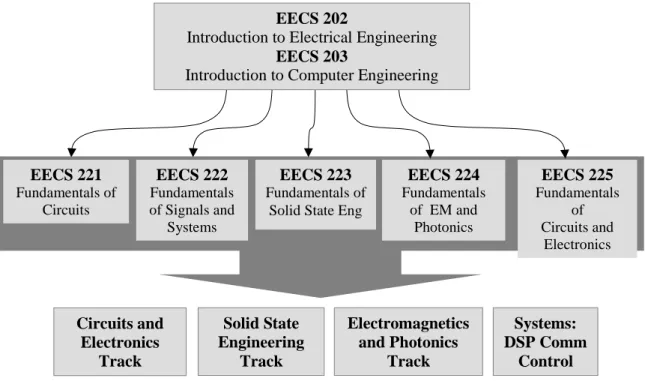
We offer two courses that are suitable for freshmen and sophomores and are required of both EE and CE majors and provide a one quarter overview of the fields of computer engineering and electrical engineering along with exciting labs involving the design of a robot and a CD player.
EECS 202: Introduction to Electrical Engineering
EECS 203: Introduction to Computer Engineering We also offer five fundamentals courses:
EECS 221: Fundamentals of Circuits
EECS 222: Fundamentals of Signals and Systems
EECS 223: Fundamentals of Solid-State Engineering
EECS 224: Fundamentals of Electromagnetics and Photonics
EECS 225: Fundamentals of Electronics
These five courses are required of all EE students and provide fundamental knowledge in each field of electrical engineering. Subsequently, students will be able to take the rest of the technical electives from a wide range of choices in each field.
In addition all EE students are required to take one of the capstone design class projects and encouraged to take two 399 independent research units.
EECS 347-1: Microprocessor Systems Design Projects
EECS 347-2: Microprocessor Systems Projects
EECS 392: VLSI Systems Design Projects
EECS 398: Electrical Engineering Design
EECS 399: Project
An overview of the electrical engineering curricular concept is illustrated in Figure 1.
Figure 1. An Overview of our EE Curriculum.
2.3.
Details of the Electrical Engineering Curriculum
Total Requirements- forty-eight courses
Engineering Analysis - four courses
GEN_ENG 205-1: Engineering Analysis 1 - Computational Methods and Linear Algebra GEN_ENG 205-2: Engineering Analysis 2 - Linear Algebra and Mechanics
GEN_ENG 205-3: Engineering Analysis 3 - Dynamic System Modeling GEN_ENG 205-4: Engineering Analysis 4 - Differential Equations Engineering Design and Communications – three courses
DSGN 106-1/English 106-1: Engineering Design and Communications I DSGN 106-2/English 106-2: Engineering Design and Communications II
GEN_CMN 102 or 103: Public Speaking or Analysis and Performance of Literature Mathematics - four courses
Math 220,224,230: Calculus I, II, III
Math 234: Multiple Integration and Vector Calculus Basic Sciences - four courses
Physics 135-2,3: General Physics
Two additional science courses (The courses selected must be consistent with the list of approved Basic Sciences for the McCormick school.)
Basic Engineering - five courses Electrical Engineering:
EECS 202: Introduction to Electrical Engineering Computer Architecture and Numerical Methods:
EECS 203: Introduction to Computer Engineering Programming
EECS 230: Programming for Engineers EECS 222 Fundamentals of Signals and Systems EECS 223 Fundamentals of Solid State Eng
EECS 224 Fundamentals of EM and Photonics EECS 221 Fundamentals of Circuits EECS 225 Fundamentals of Circuits and Electronics Circuits and Electronics Track Solid State Engineering Track Electromagnetics and Photonics Track Systems: DSP Comm Control EECS 202
Introduction to Electrical Engineering
EECS 203
Introduction to Computer Engineering
or
EECS 211: Fundamentals of Programming (C++) Probability, Statistics, and Quality Control:
EECS 302: Probabilistic Systems and Random Signals One course chosen from the following four categories:
(The courses selected must be consistent with the list of approved basic engineering courses for the McCormick school.)
Thermodynamics Fluids and Solids
Systems Engineering and Analysis Materials Science
Unrestricted Electives - five courses
Social Science - Humanities Requirement - seven courses Electrical Engineering Departmental Program - five courses
EECS 221: Fundamentals of Circuits
EECS 222: Fundamentals of Signals and Systems EECS 223: Fundamentals of Solid State Engineering
EECS 224: Fundamentals of Electromagnetics and Photonics EECS 225: Fundamentals of Electronics
Technical Electives - ten courses
Technical Electives can be used to tailor a program to a particular area of specialization. What follows are recommended courses for specialization in each of the EE tracks. At least six of the ten technical electives must be chosen from the following list of courses. Two additional courses must be 300-level Technical elective courses from the EECS department, or Biol 210-1,2,3 or Chem 210-1,2,3, or from the list of courses below. The remaining two courses can be 300-level Technical courses from science, mathematics, computer science or engineering courses and may include the following courses. Circuits and Electronics
EECS 303: Advanced Digital Logic Design EECS 353: Digital Microelectronics
EECS 391: Introduction to VLSI Design
EECS 393/493: Design and Analysis of High-Speed Integrated Circuits EECS 355: ASIC and FPGA Design
EECS 346: Microprocessor System Design EECS 347-2: Microprocessor Systems Projects Solid State Engineering
EECS 250: Physical Electronics and Devices EECS 381: Electronic Properties of Materials EECS 384: Solid State Electronic Devices EECS 385: Optoelectronics
EECS 388: Nanotechnology
ME 381: Introduction to Microelectromechanical Systems Electromagnetics and Photonics
EECS 308: Advanced Electromagnetics and Photonics EECS 379: Lasers and Coherent Optics
EECS 382: Photonic Information Processing EECS 383: Fiber-Optic Communications
EECS 386: Computational Electromagnetics and Photonics Systems
Digital Signal Processing
EECS 332: Digital Image Analysis EECS 359: Digital Signal Processing EECS 363: Digital Filters
Communications Systems
EECS 307: Communications Systems
EECS 333: Introduction to Communications Networks EECS 378: Digital Communications
EECS 380: Wireless Communications
Control
EECS 360 – Introduction to Feedback Systems
or
ME 391: Fundamentals of Control Systems EECS 374: Introduction to Digital Control EECS 390: Introduction to Robotics ME 333: Introduction to Mechatronics
Biomedical Systems
BME 325: Medical Imaging
BME 383: Cardiovascular Instrumentation BME 327: Magnetic Resource Imaging
BME 333: Modern Optical Microscopy and Imaging BME 317: Biochemical Sensors
Electrical Design Requirement – one course
To satisfy the Department’s EE design capstone course requirements, students must elect to take at least one course from the following menu:
EECS 398: Electrical Engineering Design
EECS 392: VLSI Design Projects (391 is prerequisite)
EECS 347-1: Microprocessor System Projects (346 is prerequisite) EECS 399: Project (where the 399 is structured as a design project)*
*Students must file a form, included in this handbook, for this 399 to be counted as the design requirement.
At most two units of EECS 399 will be allowed as Technical electives and one as the design requirement in the Electrical Engineering curriculum. Additional units of EECS 399 may be taken, but will be counted as unrestricted electives.
Upon completion of the design project, students are required to prepare a report using the template provided at http://www.eecs.northwestern.edu/images/docs/forms/capstonedesign.pdf
ELECTRICAL ENGINEERING P/N POLICY STATEMENT:
Among the 16 departmental courses, the P/N option may only be used within the ten technical electives. In addition, students may only have two P or D grades in the 16 departmental courses.
REQUIREMENT FOR GRADUATION In addition to McCormick graduation requirements, a student must receive a C– or better in EECS 202 and EECS 203 in order to continue in the EE program.
2011-2012
FALL WINTER SPRING
Freshman Math 220 Math 224 Math 230
Chem-101 Chem-102 EECS 203 (F,W)
GenEng 205-1 GenEng 205-2 GenEng 205-3
GenCmn 102 or 103 DSGN- 106-1 DSGN - 106-2
Sophomore EECS 202 (W,S) EECS 221 (S) EECS 223 (F)
Physics 135-2 Physics 135-3 EECS 230 (W)
GenEng - 205-4 Math 234 EECS 302 (F)
SS/Hum SS/Hum SS/Hum
Junior EECS 222 (W) EECS 225 (F) Tech Elective
Non Co-op EECS 224 (S) Tech Elective Tech Elective
SS/Hum Tech Elective Unres Elective
SS/Hum SS/Hum
Senior Tech Elective Tech Elective Tech Elective
Non Co-op Basic Eng. EE Design Tech Elective
Unres Elective Tech Elective Unres Elective
SS/Hum Unres Elective Unres Elective
Junior Tech Elective Tech Elective Work
Co-op Tech Elective Tech Elective
Tech Elective Tech Elective
SS/Hum SS/Hum
Pre-Senior Tech Elective Work Tech Elective
Co-op Basic Eng Tech Elective
Tech Elective Unres Elective
SS/Hum SS/Hum
Senior Work Tech Elective Tech Elective
Co-op Tech Elective Tech Elective
Unres Elective EE Design
Unres Elective Unres Elective
* Note that 221 and 223 must be taken before 225
2.4 Preferred Schedule for Electrical Engineering
DSGN 106-1
2.5 Electrical Engineering Course Prerequisites
Math 220 GEN ENG 205-1 Physics 135-2 DSGN 106-2 GEN ENG 205-2 GEN ENG 205-3 GEN ENG 205-4 Math 230 Comm. &
Networks Signal Proc. Photonics Controls
223 381 384 385 388 ME 381 Math 224 308 382 383 386 379 332 221 202 222 225 302 250 307 360 or ME 391 353 359 363 333 378 380 374 224 347-1 347-2 ME 333 Biomedical Math 234 203 230 or 211 205 303 391 346 393 392 390 BME 317 BME 333 Physics 135-3 BME 325 BME 327 BME 383
Solid State Circuits
L E G E N D Required courses See course description
Unrestricted elective
Technical elective
355
Name 2.6 ELECTRICAL ENGINEERING STUDY PLAN 2010-2011 1 2 3 4 5 6 7 8 9 10 11 12 13 14 15 16 17 18 1 2 3 4 5 6 7 8 9 10 11 12 13 14 15 16 17 18 G_E 205-1 EECS 221 G_E 205-2 EECS 222 G_E 205-3 EECS 223 G_E 205-4 EECS 224 DSGN 106-1 EECS 225 DSGN 106-2 Math 220 Math 224 Math 230 Math 234 Phy 135-2 Phy 135-3 EECS 202 EECS 203 EECS 230 EECS 302 G_C102 or 103 Unrestricted General Engineering, Mathematics, Basic Science Departmental Program
Capstone Design
Communications & Social Science/Humanities Basic Engineering
Technical Electives
2.7 Conformance of the Electrical Engineering Curriculum
with ABET Guidelines
The followingtable indicates how the Electrical Engineering curriculum conforms to the guidelines established by ABET Engineering Accreditation Commission.
Year &
Quarter Course
(Department, Number, Title)
Curricular Area (quarter course units)
Math & Basic Sciences
Engineering Topics Check if Contains
Design (√) EducationGeneral Other
1, Fall Math 220, Calculus 1
1, Fall Basic Science Elective 1
1, Fall GEN_ENG-205-1, Computational Methods
and Linear Algebra 0.8 0.2
1, Fall General Communication 102 or 103 1
1, Winter Math 224, Calculus II 1
1, Winter Basic Science Elective 2 1
1, Winter GEN_ENG_205-2, Linear Algebra and
Mechanics 0.5 0.5
1,Winter DSGN 106-1, Engineering Design and
Communications I 0.5 √ 0.5
1, Spring Math 230, Vectors and Partial Derivatives 1 1, Spring GEN_ENG-205-3, Dynamic System
Modeling 0.8 0.2
1, Spring DSGN 106-2, Engineering Design and
Communications II 0.5 √ 0.5
1, Spring EECS 203, Intro to Computer Engineering 1 √
2, Fall EECS 202, Intro to Electrical Engineering 1
2, Fall Physics 135-2, Electricity and Magnetism 1
2, Fall GEN_ENG-205-4, Differential Equations 0.9 0.1
2, Fall Hum/Social Science Elective 1 1
2, Winter EECS 221, Fundamentals of Circuits 0.25 0.75 2, Winter Math 234 – Calculus and Analytical
Geometry 1
2,Winter Physics 135-3, Waves 1
2, Winter Hum/Social Science Elective 2 1
2, Spring EECS 223, Fund of solid-state 0.25 0.75
2, Spring EECS 230, Programming for Eng or EECS
211, Fundamentals of Programming (C++) 1 √
2, Spring EECS 302, Probability 0.5 0.5
2, Spring Hum/Social Science Elective 3 1
3, Fall EECS 222, Fundamentals of Signals
and Systems 0.25 0.75
3, Fall EECS 224, Fundamentals of
Electromagnetics and Photonics 0.25 0.75
3, Fall Technical Elective 1 1 √ *
3, Fall Social Science Elective 4 1
3, Winter EECS 225, Fundamentals of
Electronics 1 √
3, Winter Technical Elective 2 1 √ *
3, Winter Technical Elective 3 1 √ *
3, Winter Social Science Elective 5 1
3, Spring Technical Elective 4 1√ *
3, Spring Technical Elective 5 1√ *
3, Spring Unrestricted Elective 1 1
3, Spring Social Science Elective 6 1
4, Fall Technical Elective 6 1√ *
4, Fall Basic Engineering elective 1
4, Fall Social Science Elective 7 1
4, Fall Unrestricted Elective 2 1
4, Winter Technical Elective 7 1√ *
4, Winter Technical Elective 8 1√ *
4, Winter Capstone Design 1√
4, Winter Unrestricted Elective 3 1
4, Spring Technical Elective 9 1√ *
4, Spring Technical Elective 10 1√ *
4, Spring Unrestricted Elective 4 1
4, Spring Unrestricted Elective 5 1
TOTALS-ABET BASIC-LEVEL REQUIREMENTS 12.5 21.5 14 OVERALL TOTAL QUARTER UNITS FOR THE DEGREE : 48
PERCENT OF TOTAL 26% 44.8% 29.2% Total must satisfy
either credit hours or percentage
Minimum Quarter Units 12 Units 18 units Minimum Percentage 25% 37.5 %
*Many but not all technical electives contain engineering design.
2.8 EECS 399 Design Requirement Form
Electrical Engineering and Computer Science Department McCormick School of Engineering
Northwestern University Evanston, Il 60208
Request for Approval to use EECS 399 as design credit in the EE major
This form is to be used to recognize the use of EECS 399 as meeting the departmental design requirement for Electrical Engineering majors and thus should only be filled out for Electrical Engineering Majors. This form should not be confused with a permission form to take EECS 399.
It should be completed by the instructor and given to the student at the time of giving the student the permission number for EECS 399. All information on the form must be filled out. The student should register on line for EECS 399 and submit this completed form to the Academic Services Office, L269, in order to have the 399 posted as design credit.
Please print clearly:
Students Name: _________________________________________
Student's Empl Id (7 digit ID #): ___________________________
Student’s Major: __________________________________
Section Number:__________________________________
Quarter and Year taken:______________________________________
By signing this form, the instructor certifies that this 399 meets the ABET definition of a major design experience in Electrical Engineering, including engineering standards and realistic constraints.
Instructor's Name: (printed)__________________________________________
Instructor's Signature: _________________________________________________
Date: ________________________________________
EECS Undergraduate Study Manual 16 2/10/2014
3. Computer Engineering Curriculum
The Computer Engineering program teaches the design of complex digital systems, from transistors to software systems. It deals with digital circuit and system design, computer architecture, robotics, microprocessors, software systems, and embedded systems. The interrelationships between and appropriate roles of hardware and software are emphasized. Our Computer Engineering curriculum involves courses in digital logic, electronic circuits, computer architecture, robotics, VLSI design, VLSI CAD, software development, operating systems, microprocessor-based systems, and parallel computing.
Students who are interested in pursuing a curriculum in computing that emphasizes understanding of computer hardware and the hardware/software interface should sign up for a B.S., M.S. or Ph.D. degree in Computer Engineering in the EECS Department.
Computer engineers have broad professional employment opportunities including design and management responsibilities, working with microchips and computers, application-specific hardware-software systems, computer-aided design (CAD) tools for digital systems, aerospace systems, defense systems, and networked systems.
Our Computer Engineering curriculum has strong lab-based learning emphasis and culminates in three design-projects-based courses. Interested undergraduates can get involved earlier in significant project or research work. Our teaching laboratories have recently been upgraded with the latest computer workstations, computer-controlled instruments and new experiments in newly renovated labs.
The Computer Engineering curriculum allows students to focus on a particular area of specialization. The areas include
• High-Performance Computing • VLSI and Computer Aided Design • Embedded Systems
• Software
The computer engineering program is accredited by the Engineering Accreditation Commission of ABET, http://www.abet.org.
3.1. Mission of our Undergraduate Program in Computer
Engineering
The Computer Engineering (CE) program involves the design and engineering of computers including hardware and software design. It is a carefully chosen synthesis of computer engineering, computer science, and electrical engineering courses to train students how do design complex digital systems, from transistors to software. Computer engineering is a broad area involving many possible areas of specialization. These include Computer Architecture, VLSI Systems, Computer-Aided Design, Software Design, Robotics, Computer Vision, and Embedded Systems.
EECS Undergraduate Study Manual 17 2/10/2014 Computer Engineering Mission Statement
To educate undergraduates in the basic principles and modern practices of the field of computer engineering, and train our students to think independently, to master the systematic approach to
problem solving, and to have a keen awareness of the role of engineering in a modern technological society.
The broad objectives we expect graduates to obtain from our program are:
1. Career Preparation: Graduates will apply their electrical engineering skills to a variety of challenges in industry, academia or in the pursuit of other fields.
2. Professionalism and leadership: Graduates will attain careers in which they become leaders in their chosen fields, work in multi-disciplinary teams, make decisions that are socially responsible, and communicate effectively.
3. Intellectual curiosity: Graduates will continuously learn new concepts, identify new directions, and adapt in response to the needs of a rapidly changing world.
To prepare our graduates to achieve these objectives, we intend for students of the Computer Engineering program to graduate with the following knowledge and skills:
1. Knowledge of continuous and discrete math
2. Knowledge of core Computer Engineering topics
3. An ability to use modern engineering techniques for analysis and design
4. An ability to apply knowledge of math, science and engineering to the analysis of Computer Engineering problems
5. Knowledge of probability and statistics
6. An ability to design and conduct scientific and engineering experiments, as well as to analyze and interpret data
7. An ability to design systems which include hardware and/or software components
8. An ability to identify, formulate and solve novel Computer Engineering problems
9. An ability to function in multidisciplinary teams
10.An understanding of ethical and professional responsibility
11.An ability to convey technical material through oral presentation and interaction with an audience
12.An ability to convey technical material through formal written papers and reports
13.A broad education and knowledge of contemporary issues
14.A recognition of the need for, and an ability to engage in, life-long learning
EECS Undergraduate Study Manual 18 2/10/2014
3.2 Background on Computer Engineering Curriculum
Our curriculum is continuously revised based on feedback from our constituents, e.g., our advisory board, industrial affiliates, and students. The common themes in the Computer Engineering curriculum follow:
1) A moderate number of required courses to allow flexibility in plans of study. 2) Freshman/Sophomore level courses that provide broad overviews of the fields of
electrical engineering and computer engineering.
3) Exciting hands-on labs and computer labs to complement lectures.
4) A curriculum and courses relevant to current applications of computer engineering. 5) Requiring team-based design projects and encouraging undergraduate research. The Computer Engineering curriculum is compatible with a premedical program of study. If you are interested in this option, please discuss it with your academic adviser.
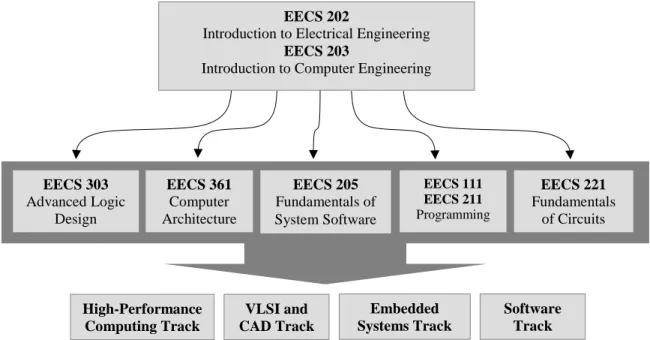
We offer two courses that are suitable for freshmen and sophomores and are required of both EE and Computer Engineering majors. These courses provide one-quarter overviews of the fields of electrical engineering and computer engineering along with exciting labs involving the design of a robot and a CD player.
EECS 202: Introduction to Electrical Engineering
EECS 203: Introduction to Computer Engineering
These six courses have been identified as essential to Computer Engineers and are required.
EECS 111: Fundamentals of Computer Programming I
EECS 211: Fundamentals of Computer Programming II
EECS 205: Fundamentals of Computer Systems Software
EECS 221: Fundamentals of Circuits
EECS 303: Advanced Digital Logic Design
EECS 361: Computer Architecture
Computer Engineers are also required to take two of the following relevant courses:
EECS 213: Introduction to Computer Systems
EECS 222: Fundamentals of Signals and Systems
EECS 223: Fundamentals of Solid-State Engineering
EECS 224: Fundamentals of Electromagnetics and Photonics
EECS 225: Fundamentals of Electronics
These five courses provide fundamental knowledge in each field of electrical engineering. Subsequently, students will be able to take some of the Technical Electives from a wide range of choices in each field within the field of EE.
EECS Undergraduate Study Manual 19 2/10/2014 In addition all Computer Engineering students are required to take one of the three capstone design classes listed below:
EECS 347-1, 347-2: Microprocessor Systems Design Projects
EECS 362: Computer Architecture Project
EECS 392: VLSI Systems Design ProjectsComputer Engineering students are encouraged to take two 399 independent research units. They should also consider taking a graduate-level course in an area of interest as a technical elective.
An overview of the computer engineering curricular concept is illustrated in Figure 2.
Figure 2. An Overview of our Computer Engineering Curriculum.
3.3. Details of Computer Engineering Curriculum
Total Requirements – forty-eight courses
Engineering Analysis – four courses
GEN_ENG-205 1: Engineering Analysis 1 – Computational Methods and Linear Algebra GEN_ENG 205-2: Engineering Analysis 2 – Linear Algebra and Mechanics
GEN_ENG 205-3: Engineering Analysis 3 – Dynamic System Modeling GEN_ENG 205-4: Engineering Analysis 4 – Differential Equations
EECS 202
Introduction to Electrical Engineering
EECS 203
Introduction to Computer Engineering
EECS 361 Computer Architecture EECS 205 Fundamentals of System Software EECS 111 EECS 211 Programming EECS 303 Advanced Logic Design EECS 221 Fundamentals of Circuits High-Performance Computing Track VLSI and CAD Track Embedded Systems Track Software Track
EECS Undergraduate Study Manual 20 2/10/2014 Engineering Design and Communications – three courses
DSGN 106-1/English 106-1: Engineering Design and Communications I DSGN 106-2/English 106-2: Engineering Design and Communications II
GEN_CMN 102 or 103: Public Speaking or Analysis and Performance of Literature Mathematics – four courses
Math 220,224,230: Calculus I, II, III
Math 234: Multiple Integration and Vector Calculus Basic Sciences – four courses
Physics 135-2,3: General Physics
Two additional science courses. (The courses selected must be consistent with the list of approved Basic Sciences for McCormick.)
Basic Engineering – five courses Electrical Engineering:
EECS 202: Introduction to Electrical Engineering Computer Architecture and Numerical Methods:
EECS 203: Introduction to Computer Engineering Programming
EECS 211: Fundamentals of Computer Programming II Probability, Statistics, and Quality Control:
EECS 302: Probabilistic Systems and Random Signals One coursechosen from the following four categories:
(The courses selected must be consistent with the list of approved basic engineering courses for the McCormick school.)
Thermodynamics Fluids and Solids
Systems Engineering and Analysis Materials Science
Unrestricted Electives – five courses
Social Science - Humanities Requirement – seven courses Computer Engineering Departmental Program – five courses
EECS 111: Fundamentals of Computer Programming I EECS 205: Fundamentals of Computer System Software EECS 303: Advanced Logic Design
EECS 221: Fundamentals of Circuits EECS 361: Computer Architecture
EECS Undergraduate Study Manual 21 2/10/2014 Technical Electives – ten courses
Students must take at least five courses from the following four areas and two courses from the Fundamental EECS courses listed below. The remaining three Technical Electives can be any 300-level course from science, mathematics, computer science or engineering and may include the following courses. Biol 210-1,2,3 and Chem 210-1,2,3 may be used as Technical Electives. Furthermore, 400-level courses can be used to fulfill Technical Elective requirements with a petition and advisor consent. Some suggested examples are included in the lists below. For all courses listed below students should check the yearly course offerings.
Technical Electives can be used to tailor a program to a particular area of specialization. In the following, suggested courses for each area are listed. It is not required to follow a specific area in its entirety, they are suggestions to better structure one’s major. Also, this is not an exhaustive list and other related 300- and 400-level courses can be taken based on advisor approval.
At most two units of 399 will be allowed as Technical Electives in the Computer Engineering curriculum. Additional units of EECS 399 may be taken, but will be counted as an unrestricted elective.
Area 1. High-Performance Computing
EECS 328: Numerical Methods for Engineers
EECS 333: Introduction to Communication Networks EECS 339: Introduction to Database Systems
EECS 350: Introduction to Computer Security EECS 354 - Network Penetration and Security EECS 358: Introduction to Parallel Computing EECS 362: Computer Architecture Projects
EECS 368: Programming Massively Parallel Processors with CUDA EECS 452: Advanced Computer Architecture
EECS 453: Parallel Architectures Area 2. VLSI & CAD
EECS 353: Digital Microelectronics EECS 355: ASIC and FPGA Design EECS 357: Introduction to VLSI CAD EECS 391: VLSI Systems Design
EECS 392: VLSI Systems Design Projects
EECS 393/493: Design and Analysis of High-Speed Integrated Circuits EECS 459: VLSI Algorithmics
Area 3. Embedded Systems
EECS 332: Digital Image Analysis
EECS 346: Microprocessor System Design
EECS 347-1, 347-2: Microprocessor System Projects EECS 390: Introduction to Robotics
EECS Undergraduate Study Manual 22 2/10/2014 BME 384: Biomedical Computing
Area 4. Algorithm Design and Software Systems
EECS 212: Mathematical Foundations of Computer Science EECS 214: Data Structures and Data Management
EECS 321: Programming Languages EECS 322: Compiler Construction
EECS 336: Design and Analysis of Algorithms EECS 339: Introduction to Database Systems EECS 343: Operating Systems
EECS 395: Introduction to the Theory of Computation Fundamental EECS Courses
EECS 213: Introduction to Computer Systems EECS 222: Fundamentals of Signals and Systems EECS 223: Fundamentals of Solid State Engineering
EECS 224: Fundamentals of Electromagnetics and Photonics EECS 225: Fundamentals of Electronics
Computer Engineering Capstone Design Requirement – one course
To satisfy the Department’s Computer Engineering design capstone course requirements, students must elect to take at least one course from the following menu:
EECS 347-1: Microprocessor System Projects (346 is prerequisite) EECS 362: Computer Architecture Projects (361 is prerequisite) EECS 392: VLSI Design Projects (391 or 355 is prerequisite)
Upon completion of the design project, students are required to prepare a report using the template provided at
http://www.eecs.northwestern.edu/images/docs/forms/capstonedesign.pdf COMPUTER ENGINEERING P/N POLICY STATEMENT:
Among the 16 departmental courses, the P/N option may only be used within the three technical electives that can be any 300-level course from science, mathematics, computer science, engineering or the areas (but beyond the required five courses from the area and the two fundamental EE courses). In addition, students may have no more than two P or D grades within the 16 departmental courses.
REQUIREMENT FOR GRADUATION In addition to McCormick graduation
requirements, a student must receive a C– or better in EECS 202 and EECS 203 in order to continue in the Computer Engineering program.
2013-14
FALL WINTER SPRING
Freshman Math 220 Math 224 Math 230
Chem 101 or Basic Science Chem 102 or Basic Science EECS 203 (F,W)
GenEng- 205-1 GenEng - 205-2 GenEng 205-3
GenCmn 102 or 103 IDEA 106-1 IDEA 106-2
Sophomore EECS 205 (W) Physics 135-3 EECS 214
Physics 135-2 EECS 202 (F,S) EECS 221 (W)
GenEng - 205-4 EECS 211 (F,S) EECS 303 (F)
SS/Hum Math 234 SS/Hum
Junior EECS Fund *(W,S) Tech Elective EECS 302 (F)
Non Co-op EECS 361(W) Tech Elective Tech Elective
Basic Eng EECS Fund* (F,S) Unres Elective
SS/Hum SS/Hum SS/Hum
Senior Tech Elective Tech Elective Tech Elective
Non Co-op Tech Elective CE Design (F,S) Tech Elective
Unres Elective Unres Elective Unres Elective
SS/Hum SS/Hum Unres Elective
Junior EECS Fund* (W,S) EECS Fund (F,S) Work
Co-op EECS 361(W) Tech Elective
Basic Eng Tech Elective
SS/Hum SS/Hum
Pre-Senior EECS 302 (S) Work Tech Elective
Co-op Tech Elective Tech Elective
Unres Elective Unres Elective
SS/Hum SS/Hum
Senior Work Tech Elective Tech Elective
Co-op CE Design (S) Tech Elective
Unres Elective Unres Elective
SS/Hum Unres Elective
* Any two of the following EECS Fundamentals Courses: EECS 213, 222, 223, 224, 225.
Note that 221 and 223 must be taken before 225.
Updated April 4, 2013 RJ/ja
3.4 Preferred Schedule for Computer Engineering
DSGN 106-1
3.5 Computer Engineering Course Prerequisites
Math 220 GEN ENG 205-1
Physics 135-2 DSGN 106-2 GEN ENG 205-2 GEN ENG 205-3 GEN ENG 205-4 Math 230 Track 3 Embedded Systems Track 1 High-Performance Computing 223 BME 384 Math 224 359 221 202 222 225 302 250 360 353 333 374 224 362 Math 234 203 211 205 346 357 347 392 390 Physics 135-3 Track 2 VLSI & CAD
Track 4 Algorithm Design and Software Systems L E G E N D Required courses
Two of these required
Capstone design 358 351 214 303 361 343 322 332 336 212 213 328 339 394 391
Name: 3.6 COMPUTER ENGINEERING STUDY PLAN 2010-2011 1 2 3 4 5 6 7 8 9 10 11 12 13 14 15 16 17 18 1 2 3 4 5 6 7 8 9 10 11 12 13 14 15 16 17 18 G_E 205-1 EECS 205 G_E 205-2 EECS 221 G_E 205-3 EECS 303 G_E 205-4 EECS 214 IDEA 106-1 EECS 361 IDEA 106-2 Math 220 Math 224 Math 230 Math 234 Phy 135-2 Phy 135-3 EECS 202 EECS 203 EECS 211 EECS 302 G_C102 or 103 Unrestricted General Engineering, MathematiEECS, Basic Science Departmental Program
Capstone Design
Communications & Social Science/Humanities
Technical Electives: Tracks
Technical Electives: EE Fundamentals
Technical Electives: Remaining Three Basic Engineering
3.7 Conformance of the Computer Engineering Curriculum
with ABET Guidelines
The followingtable indicates how the Computer Engineering curriculum conforms to the guidelines established by ABET Engineering Accreditation Commission.
Year &
Quarter Course
(Department, Number, Title)
Curricular Area (quarter course units)
Math & Basic Sciences
Engineering Topics Check if Contains
Design (√) EducationGeneral Other
1, Fall Math 220, Calculus I 1
1, Fall Basic Science Elective 1
1, Fall GEN_ENG-205-1, Computational Methods
and Linear Algebra 0.8 0.2
1, Fall General Communication 102 or 103 1
1, Winter Math 224, Calculus II 1
1, Winter Basic Science Elective 2 1
1, Winter GEN_ENG_205-2, Linear Algebra and
Mechanics 0.5 0.5
1,Winter DSGN 106-1, Engineering Design and
Communications I 0.5 √ 0.5
1, Spring Math 230, Vectors and Partial Derivatives 1 1, Spring GEN_ENG-205-3, Dynamic System
Modeling 0.8 0.2
1, Spring DSGN 106-2, Engineering Design and
Communications II 0.5 √ 0.5
1, Spring EECS 203, Intro to Computer Engineering 1 √
2, Fall EECS 205, Fundamentals of Computer
System Software 1
2, Fall Physics 135-2, Electricity and Magnetism 1
2, Fall GEN_ENG-205-4, Differential Equations 0.9 0.1
2, Fall Hum/Social Science Elective 1 1
2, Winter EECS 202, Intro to Electrical Engineering 1 2, Winter Math 234 – Calculus and Analytical
Geometry 1
2,Winter Physics 135-3, Waves 1
2, Winter EECS 211, Fundamentals of Programming 1 √
2, Spring EECS 221, Fund of circuits 0.25 0.75
2, Spring EECS 214 (formerly 311), Data Structures
and Data Management 0.2 0.8
2, Spring EECS 303 Advanced Digital Logic Design 1 √
2, Spring Hum/Social Science Elective 2 1
3, Fall EECS Fundamental 1 0.25 0.75
3, Fall EECS 361 Computer Architecture I 1 √
3, Fall Basic Engineering elective 1
3, Fall Hum/Social Science Elective 3 1
3, Winter EECS Fundamental 2 0.25 0.75
3, Winter Technical Elective 1 1 √ *
3, Winter Unrestricted Elective 1 1
3, Winter Hum/Social Science Elective 4 1
3, Spring EECS 302, Probability 0.5 0.5
3, Spring Technical Elective 2 1√ *
3, Spring Unrestricted Elective 2 1
3, Spring Hum/Social Science Elective 5 1
4, Fall Technical Elective 3 1√ *
4, Fall Technical Elective 4 1√ *
4, Fall Social Science Elective 6 1
4, Fall Unrestricted Elective 3 1
4, Winter Technical Elective 5 1√ *
4, Winter Social Science Elective 7 1
4, Winter Capstone Design 1√
4, Winter Unrestricted Elective 4 1
4, Spring Technical Elective 6 1√ *
4, Spring Technical Elective 7 1√ *
4, Spring Technical Elective 8 1√ *
4, Spring Unrestricted Elective 5 1
TOTALS-ABET BASIC-LEVEL REQUIREMENTS 12.45 21.55 14 OVERALL TOTAL QUARTER UNITS FOR THE DEGREE : 48
PERCENT OF TOTAL 26% 44.8% 29.2% Total must satisfy
either credit hours or percentage
Minimum Quarter Units 12 Units 18 units Minimum Percentage 25% 37.5 %
*Many but not all technical electives contain engineering design.
EECS Undergraduate Study Manual 28 2/23/2015
4.0 Computer Science Undergraduate Curriculum
Bachelor of Science in Computer Science (McCormick CS) Bachelor of Arts in Computer Science (Weinberg CS) Majors in Computer Science (McCormick and Weinberg) Minors in Computer Science (McCormick and Weinberg) Second Major in Computer Science for ISP Students (Weinberg)
The purpose of this document is to explain the Computer Science (CS) Undergraduate Curriculum. CS is offered as a major within both McCormick and Weinberg, with identical in-major requirements.
Additionally, minors are available in both schools, again with identical in-minor requirements.
Because of this dual-school nature, this document is structured differently from a typical McCormick (BS) or Weinberg (BA) curriculum. The document focuses on describing the elements of the major in a manner independent of the frameworks of both schools. This description is intended to explain the nature of the degree to students who may be unfamiliar with the frameworks, and to external readers. Appendix A then shows how the major curriculum is mapped into the McCormick framework to lead to a BS in CS, while Appendix B shows how it is mapped into the Weinberg framework to lead to a BA in CS. In both schools, second majors in CS are possible with identical requirements to those listed for the BS and BA. The second major in CS for ISP students has slightly different requirements, which are also explain in Appendix B. The minor is a strict subset of the major, and is explained in detail in Appendix C, including how it maps in both McCormick and Weinberg.
Students should consult with their advisors in case of ambiguity or special cases.
1. Philosophy
Computer Science as a field grew out of Electrical Engineering, Mathematics, and Psychology over 50 years ago. It synthesized aspects of these fields and grew exponentially over the past half century, both in terms of the number of Computer Science practitioners, and its economic and social impact on the world. The field continues its exponential growth. In November, 2005, the U.S. Bureau of Labor Statistics estimated that almost 60% of new science and engineering jobs and net replacements in the United States through 2014 would be for computer specialists. The National Association of Colleges and Employers (NACE) 2010 survey found that Computer Science had the 5th highest average starting salary ($61,407) of any college degree.
Given this growth, and the sheer breadth and scale of the Computer Science enterprise in industry and academia, what are the goals of the Northwestern undergraduate degree? A Northwestern Computer Science graduate will
Comprehend the breadth of Computer Science, its key intellectual divisions and questions, and its past and likely future impacts on engineering, science, medicine, business, and law;
Approach problems from the algorithmic perspective, understanding the nature of and broad reach of computation and how to apply it abstractly;
Approach problems from the systems perspective, understand the evolving layers of the software/hardware stack and how to use and extend them;
Approach problems from the intelligence perspective, understanding how to make progress against seemingly intractable problems;
Design and implement complex software systems, individually and as a team member; and
Design and implement effective human-computer interfaces.
Additionally, Northwestern graduates also will have had the opportunity to broaden their education by taking advantage of Computer Science’s strong connections to Northwestern programs in Computer Engineering,
EECS Undergraduate Study Manual 29 2/23/2015 Cognitive Science, and the Learning Sciences. Northwestern graduates may have also participated in directed research.
A Northwestern graduate will be imminently employable in the computer and software industries, and well beyond, as skills such as these are widely sought after. Our program will also provide effective preparation for graduate studies in Computer Science.
2. Engineering or Liberal Arts
Northwestern offers Computer Science degrees within McCormick, the Engineering and Applied Sciences School, and Weinberg, the Arts and Sciences School. The Computer Science-specific elements/requirements of the two degrees are identical. The McCormick degree offers a background in engineering, while the Weinberg degree offers a background in liberal arts.
3. Prerequisite Graph and Schedule
A detailed prerequisite graph is available as a separate document, as is a typical schedule.
4. Components of the Curriculum
The Northwestern Computer Science Degree (the major) is composed of five distinct sets of requirements. Background requirements build up the student’s engineering skills. The Core requirements represent
essential knowledge for all computer scientists. The Breadth requirements provide exposure to every critical subfield of Computer Science. The Depth requirements provide the student with the opportunity to learn about two specializations in depth, leading to a project, and perhaps graduate courses and research. The Project requirement gives the student the experience of designing and building a complex software artifact. The minor in Computer Science consists of some of the Background requirements, all of the Core
requirements, and some of the Breadth requirements.
4.1 Background
Background courses are those courses that fulfill the general requirements of the University and the School (i.e., McCormick or Weinberg), as well as non-CS courses that the faculty believe are foundational for or helpful for understanding Computer Science.
Because background courses are strongly dependent on the School, in this section we present the CS background requirements at a high level. Appendices A and B give detailed descriptions of required or recommended courses within the two Schools. We require students to take courses that teach the following:
Continuous Mathematics. Students must learn univariate differential and integral calculus, multivariate differential calculus, and linear algebra.
Probability and Statistics. Students must learn basic probability theory, and basic statistics, including descriptive statistics and hypothesis testing.
Physical and Life Sciences. Students must meet the requirements of their school. We recommend that students choose physics and biology courses.
Social Sciences and the Humanities. Students should acquire a firm grounding in these areas, ideally choosing courses that integrate into a theme.
Communication Skills. Students must learn the fundamentals of effective written, graphical, and oral communication.
Students, who have never programmed before, in any language, are encouraged to take one of the following courses as part of their background:
EECS 110 (C) – An Introduction to Programming for Non-majors using the C programming language. C is a widely used systems programming language.
EECS 110 (Python) – An Introduction to Programming for Non-majors using the Python programming language. Python is a widely used scripting language.
EECS Undergraduate Study Manual 30 2/23/2015
4.2 Core
The core courses reflect what the faculty expects every graduate to know. The core courses, all of which are required, consist of:
EECS 101 – An Introduction to Computer Science for Everyone. This course should ideally be taken in the freshman year. This course can also be replaced with any course that would satisfy a breadth requirement.
EECS 111 – Fundamentals of Computer Programming I. This course teaches principles and practices of computer programming using a functional programming language.
EECS 211 – Fundamentals of Computer Programming II. This course teaches further principles and practices of computer programming using an imperative, object-oriented programming language.
EECS 212 (formerly 310) – Discrete Mathematics. This course introduces the mathematics underlying much of Computer Science.
EECS 213 – Introduction to Computer Systems. This course teaches how the computer system works, from the level of transistors to the level of distributed systems, with a particular focus on instruction set architecture, compilers, and operating systems.
EECS 214 (formerly 311) – Introduction to Data Structures. This course introduces software structures and algorithms for storing, accessing, and transforming information and their implementation
4.3 Breadth (Essential Areas)
The breadth courses reflect the areas of Computer Science that the faculty believe you should be exposed to. A student must take one course in each of the following areas. Each course can only count for a single area. It is possible to use EECS 399 (independent study) courses within breadth, with advisor and committee
approval. This is rare and requires a petition.
Theory: Theory courses study the nature of computation, the nature of computational problems, and the design of algorithms for solving these problems efficiently. The following courses are considered appropriate for satisfying the theory breadth requirement. The courses with asterisks are especially recommended.
* EECS 335 – Introduction to the Theory of Computation
* EECS 336 – Design and Analysis of Algorithms
EECS 328 – Numerical Methods
EECS 356 – Formal Specification and Verification
Systems: Systems courses study the layers of the hardware/software stack, and the design, implementation, and evaluation of complex software systems, including computer security. The following courses are appropriate for satisfying the systems breadth requirement. The courses with asterisks are especially recommended.
* EECS 321 – Programming Languages
* EECS 322 – Compiler Construction
* EECS 339 – Introduction to Databases
* EECS 340 – Introduction to Networking
* EECS 343 – Operating Systems
* EECS 354 – Network Penetration and Security
EECS 303 – Digital Logic Design
EECS 345 – Distributed Systems
EECS 346 – Microprocessor Systems Design
EECS 350 – Introduction to Security
EECS 358 – Parallel Systems
EECS 361 – Computer Architecture
EECS 369 - Introduction to Sensor Network
EECS Undergraduate Study Manual 31 2/23/2015
EECS 395/495 - (Special Topics) Embedded Systems
EECS 399 - Independent Study
EECS 440 – Advanced Networking
EECS 441 – Resource Virtualization
EECS 443 – Advanced Operating Systems
EECS 450 – Internet Security
Artificial Intelligence: Those in the field of Artificial Intelligence seek scientific understanding of the mechanisms underlying thought and intelligent behavior and look to embody these mechanisms in machines. Intelligent learning environments, computer games, and music retrieval systems are some applications of AI technology. The following courses are appropriate for satisfying the AI breadth requirement. The courses with asterisks (*) are especially recommended.
* EECS 325 – AI Programming
* EECS 337 – Semantic Information Processing
* EECS 344 – Design of Computer Problem Solvers
* EECS 348 – Introduction to AI
* EECS 349 – Machine Learning
EECS 360 – Introduction to Feedback Systems
EECS 371 – Knowledge Representation
EECS 372/472 - Designing and Constructing Models with Multi-Agent Languages
EECS 395/495 – Knowledge, Representation & Reasoning for Game Characters
EECS 395/495 – Machine Learning: Foundations, Applications, and Algorithms
EECS 395/495 – Simulation-Based Virtual Characters for Interactive Entertainment
Interfaces: Courses in this area study the human-computer interface, including computer graphics and multimedia processing. The following courses are appropriate for satisfying the interface breadth requirement. The courses with asterisks are especially recommended.
* EECS 330 – Human-Computer Interaction
* EECS 351 – Introduction to Computer Graphics
* EECS 352 – Machine Perception of Music
* EECS 370 – Computer Game Design
EECS 332 – Digital Image Analysis
EECS 395/495 (LRN_SCI 451) – Tangible Interaction Design and Learning (Horn)
EECS 395/495 – Game Development Studio
EECS 395/495 – Geospatial Vision and Visualization
EECS 395/495 – Intermediate Computer Graphics
EECS 395/495 – Introduction to Computational Photography
EECS 395/495 – Social Computing and Crowd Sourcing Seminar
Software Development: Courses in this area provide opportunities to experience larger-scale software development in teams. Scaling software development is an important challenge. The following courses are appropriate for satisfying the software development breadth requirement. The courses with asterisks are especially recommended.
* EECS 338 – Practicum in Intelligent Information Systems
* EECS 394 – Software Project Management
* EECS 473-1,2 NUvention: Web (both quarters for 1 credit, alternative to 394)
EECS 395/495 - Game Development Studio
4.4 Depth
Students are expected to acquire depth in two of the areas listed below. Students should consult with their advisor to choose the two most appropriate areas of study for them. A total of six courses should be taken in the two chosen areas, with three courses in each area.
EECS Undergraduate Study Manual 32 2/23/2015 A student may petition to be allowed to focus on a single area, if desired. This petition needs to be approved by the student’s advisor, but we intend for this to be straightforward.
A student may petition to use independent study courses (EECS 399s) in depth areas that permit them. This petition needs to be approved by the student’s advisor and the committee. Again, we intend for this to be straightforward.
A student interested in defining his/her own depth area is encouraged to provide a justification for the proposed set of depth courses to his/her advisor, who may in turn petition the Computer Science Curriculum Committee for its approval.
The Computer Science Curriculum Committee will meet once per year, in the fall quarter, to consider additions, deletions, or changes to the depth areas and the list of appropriate courses for each areas. Theory: Theory courses study the nature of computation, the nature of computational problems, and the design of algorithms for solving these problems efficiently. The following courses are considered appropriate for satisfying the theory depth area. The courses with asterisks are especially recommended.
* EECS 335 – Introduction to the Theory of Computation
* EECS 336 – Design and Analysis of Algorithms
* EECS 457 – Advanced Algorithms
EECS 328 – Numerical Methods for Engineers
EECS 356 – Introduction to Formal Specification and Verification
EECS 357 – Introduction to VLSI CAD
EECS 395/495 – Algorithmic Techniques for Bioinformatics
EECS 395/495 – Computational Geometry
EECS 399 – Independent Study
EECS 428 – Information Theory
EECS 459 – VLSI Algorithmics
Systems: In the depth area of systems, a student will learn about the issues and principles involved in the design, implementation, measurement, and analysis of the complex software and software/hardware systems upon which applications are built. Students will learn how computer systems work, from the level of the hardware to the level of worldwide distributed communication and computation. The principles and issues involved have broad utility and the skills that student will learn are in high demand.
* EECS 321 – Programming Languages
* EECS 322 – Compiler Construction
* EECS 339 – Introduction to Databases
* EECS 340 – Introduction to Computer Networking
* EECS 343 – Operating Systems
* EECS 361 – Computer Architecture I
EECS 345 – Distributed Systems
EECS 350 – Introduction to Computer Security
EECS 354 – Network Penetration and Security
EECS 358 – Introduction to Parallel Computing
EECS 368/468 – Programming Massively Parallel Processors with CUDA
EECS 369 – Introduction to Sensor Networks
EECS 395/495 – (Special Topics) Embedded Systems
EECS 395/495 – Art of Multicore Concurrent Programming
EECS 395/495 – Networking Problems in Cloud Computing
EECS 395/495 – Technology Infrastructure: Concepts, Requirements, Design and Operation
EECS 399 – Independent Study
EECS Undergraduate Study Manual 33 2/23/2015
EECS 441 – Resource Virtualization
EECS 443 – Advanced Operating Systems
EECS 450 – Internet Security
Artificial Intelligence: Those in the field of Artificial Intelligence seek scientific understanding of the mechanisms underlying thought and intelligent behavior and look to embody these mechanisms in machines. Intelligent learning environments, computer games, and music retrieval systems are some applications of AI technology. The following courses are appropriate for depth in AI. The courses with asterisks are especially recommended.
* EECS 301– Introductory Robotics Laboratory
* EECS 325 – AI Programming
* EECS 337 – Semantic Information Processing
* EECS 344 – Design of Computer Problem Solvers
* EECS 348 – Introduction to AI
* EECS 349 – Machine Learning
* EECS 371 – Knowledge Representation
EECS 360 – Models with Multi-agent Languages
EECS 372/472 - Designing and Constructing Models with Multi-Agent Languages
EECS 395/495 –(Special Topics) Innovation in Journalism & Technology
EECS 395/495 – Building Next-Generation AI Applications with IBM Watson
EECS 395 – Cognitive Simulation for Virtual Characters
EECS 395/495 – Computational Geometry
EECS 395/495 – Knowledge, Representation & Reasoning for Game Characters
EECS 395/495 – Probabilistic Graphical Models
EECS 395/495 – Simulation-Based Virtual Characters for Interactive Entertainment
EECS 399 – Independent Study
Interfaces: Courses in this area study the human-computer interface, including computer graphics and multimedia processing. The following courses are appropriate for satisfying depth in interfaces. The courses with asterisks are especially recommended.
* EECS 330 – Human-Computer Interaction
* EECS 351 – Introduction to Computer Graphics
* EECS 352 – Machine Perception of Music
* EECS 370 – Computer Game Design
EECS 332 – Digital Image Analysis
EECS 395 – Intermediate Computer Graphics
EECS 395 – Advanced Computer Graphics
EECS 395/495 (LRN_SCI 451) – Tangible Interaction Design and Learning (Horn)
EECS 395/495 – Game Development Studio
EECS 395/495 – (Special Topics) Innovation in Journalism & Technology
EECS 395/495 – Cognitive Simulation for Virtual Characters
EECS 395/495 – Design, Technology, and Research
EECS 395/495 – Geospatial Vision and Visualization
EECS 395/495 – Intermediate Computer Graphics
EECS 395/495 – Introduction to Computational Photography
EECS 399 – Independent Study
Security: This area focuses on the fundamental principles of computer and communication security as well as their implications and applications in various domains of information technology. The following courses are appropriate for satisfying the security depth area. The courses with asterisks are especially recommended.
* EECS 350 – Introduction to Computer Security
EECS Undergraduate Study Manual 34 2/23/2015
* EECS 450 – Internet Security
* EECS 510 – Computer Security and Information Assurance
�