Thank you to Emily Bell for suggesting this report, and for our sprawling discussions about ad tech. Thanks to Kathy Zhang and Katie Johnston for their unflagging support, Ava Sirrah for her suggestions, and Sam Thielman for his keen eye on the ad industry and what makes it tick. Thanks to Bill Grueskin and Dr. Adam Klein for their course on the Business of Journalism, which provided invaluable material. Thanks both to Sam and Abigail Hartstone for their eagle-eyed edits. Lastly, thanks to my unflagging advisers Dr. David Stark, Dr. Michael Schudson, Dr. Chris Anderson, Susan E. McGregor, and Andie Tucher.
Journalism
A Tow/Knight Report
GUIDE TO
ADVERTISING
TECHNOLOGY
ELIZABETH ANNE
WATKINS
Contents
Executive Summary 1
Introduction:
Why Do Journalists Need to Know How Ad Tech Works? 3
Review of Ads:
Display, Branded, Targeted, and Programmatic 7
From branding to targeting . . . 7
Display ads on news sites . . . 14
Advertising’s Influence on News: Bloat, Clicks, and Bots 17 Usability and ad bloat . . . 17
Ad tech, privacy, and security . . . 18
News? Or revenue-generating product? . . . 20
Fraud and bots . . . 22
The Turn Against Advertising 25 Blockers . . . 25
Print dollars and digital dimes . . . 26
Paywalls and subscriptions . . . 27
Ads on Social 31 Walled gardens and the growth of surveillance economics . . . 31
From targeting to influencing . . . 32
Facebook and the news . . . 34
Ads on Search 39 Targeting to intent . . . 39 News on search . . . 40 Conclusion 43 Further reading . . . 43 Glossary 45 Citations 49
Executive
Summary
Advertising technology has built a massive technical infrastructure. The technology and motivations of advertising undergird the economy of the internet. News sites are no exception. The information we seek about our world is underpinned with, and shaped by, advertising and its needs. Jour-nalists need to know more about these technologies, how they work, and how they influence the practice, distribution, and perception of journalism.
Advertising technology may threaten the reputation and economic viabil-ity of news publishers in various ways. Ad tech promotes a specific type of audience engagement, and its incentive structures have been shown to alter how news gets produced, potentially undermining readers’ trust in pub-lishers to provide objective coverage. Ad tech’s push of user data through opaque systems, and in some cases deposit malware onto readers’ devices, threatens reader privacy and safety and can further damage publishers’ rep-utations. The slow load times and distracting user experience of display ads can hamper the performance of news websites and drive readers towards walled information gardens like private apps and social-media platforms. This may siphon audiences away from professional journalism outlets and may render them more vulnerable to manipulative information operations, patterns which academics and policy-makers are only beginning to under-stand. Policies around advertising on social platforms threaten to blur the line between news and political messaging, and may incentivize so-called “influencers” to bypass publishers entirely and create their own content. Search-engine companies, meanwhile, have been accused of exploiting their power over how users find and access information.
In producing this report we were driven by a set of questions, including: What’s the relationship between news publishers and advertisers? What’s changing? What’s contested? And how does the contemporary arrangement of advertising, writers, readers, and devices influence the news?
Key findings:
• Advertising was fundamental to the development of the modern newspa-per and objective reporting. Today’s advertising messages, delivered via an interconnected system of software programs, data servers, marketing agencies, and data markets, still support most news production yet are understudied in professional journalism training.
• News publishers’ dependence on ad tech facilitates the harvesting and movement of reader data through opaque systems, which may threaten readers’ trust in news.
• Ad tech and its metrics have been found to alter the internal production of news, which may be at odds with classic journalistic commitments to objective coverage.
• The hyperefficient market for programmatic display ads has driven down their prices, reducing revenue for publishers.
• Ad tech is plagued with fraud in the form of bot viewing, causing many marketers to shift their ad spending to social media and search, further reducing revenue for publisher sites.
• Ad tech’s damaging effects on the user experience (distracting visuals, slow loading times, and expensive burden on users’ data plans) may drive readers (and the revenue derived from their attention) away from news websites and towards private apps and social-media platforms.
• Social media’s relationship with news publishers represents an asymmet-rical power dynamic and has been found to effect publishers attempting to reach audiences, especially local publishers.
• Platforms’ control over the display of news items has pushed some pub-lishers towards the use of influencers, which in turn may hasten the growth of service firms providing both tailored content and algorithmi-cally produced websites to influencers. Platforms have begun to write policies against influencer distribution, but these may be tough to en-force.
• Social media’s advertising mechanisms, specifically hyper-targeting, are prone to weaponization by malicious actors.
• All journalists, from reporters to editors, need to keep informed about the changing markets for, and consumption of, news and information.
Introduction:
Why Do Journalists
Need to Know How
Ad Tech Works?
Imagine a young woman named Molly, working as an events coordinator in Chicago. During the planning of a daylong workshop, she and her col-leagues have a good-natured groan about the post-lunch slowdown that always plagues these types of events. To jazz up the flow of conversation Molly decides to stock the room with candy. She uses her personal laptop to go onto the retail website Amazon.com and buy several packets of candy. The next day, Molly sees that Amazon is suggesting more types of candy for her to browse. Soon, however, she notices that her digital life has been transformed into a candy land. Peppermint patties and lollipops parade across her screen on nearly every website she visits. That night, looking for information about a serious presidential announcement, she visits sev-eral reputable news sites and is surprised to find that even the most serious articles are wallpapered with saltwater taffy and gummy bears.Advertising undergirds the economy of the internet. “Advertising tech-nology” is an umbrella term for the system of software programs, data servers, marketing agencies, and data markets which facilitate the sale of user data and the display of advertising messages to users of the internet, including search engines and social-media sites and apps. The vast ma-jority of websites and social media platforms are supported by ad tech. News publishing is no exception. Troublingly, in journalism schools little attention is paid to the political economy of advertising on news sites. The user experience across devices, the loss of control over what’s displayed on publisher sites, and how this loss may impact brand reputation have all gone understudied by professional journalism curricula. This is a worrisome
trend, as ad tech may influence the production, distribution, and perception of journalism in both obvious and subtle ways.
Social media, in particular, has disrupted the control that publishers once had over information and advertising, and a multi-device environ-ment has upended the command those publishers long enjoyed over readers’ attention. Experimentation in ad formats has blurred the once-bright di-viding line between the business and editorial departments within news outlets. Ambiguity is now the rule of the day. Jill Abramson, the one-time executive editor of The New York Times, tellingly reflected on her values in the past tense, with a sense of nostalgia: “Maybe I was too hard-line, but I believed in the wall [between the business and news sides of the newspa-per].”1 This “Guide to Advertising Technology” is intended to explain how
all this happened and what it means for practicing journalism today by offering a usable education in the history and political economy of digital advertising technologies. It begins with a short history of modern advertis-ing in news and a review of the fundamentals of marketadvertis-ing. What follows are technical descriptions of how digital display advertising works, the con-tours of the ad tech space, and the material impact ad tech has on the user experience. The report then looks at the resulting patterns of news and ad consumption, how consumers and market forces reacted against digital display advertising, and how the marketing industry responded by investing heavily in social platforms and search engines.
We also cover how ad tech creates incentive structures, which may shape how reporters and editors alike think about news production, and how advertising technologies risks to the relationship between publishers and readers, including news brand and reputation. That journalistic institu-tions, which have decreed a commitment to informing citizens in a free democracy, willingly participate in advertising’s technical stack—which has reportedly violated reader privacy—is a serious ethical quandary. Technol-ogy and society are embedded in and construct each other, and journalists need a grip on both to do the storytelling that our democracy demands.
Finally, it’s worth noting that this report is a library case, meaning that its primary sources, rather than interviews, are general and industry press pieces, academic literature from the fields of marketing and journalism studies, marketing industry handbooks, and business-school cases.
Advertising technology is a rapidly developing field, so we caution that material details may be subject to change. The political and philosophical lessons, however, will remain salient.
Review of Ads:
Display, Branded,
Targeted, and
Programmatic
From branding to targeting
To get context on the world in which display ads are bought and sold, it helps to offer a bit of history on the largest themes in advertising over the last 30 years.
For the latter half of the 20th century, the ad industry’s focus was on branding. Branding ads are large, sweeping, image-based messages, which associate a product with a set of values. Consumers who feel those values represent them, or who want to signal to others that they hold those values, may be enticed to purchase a company’s product. Branding campaigns take place most often through television commercials, as televi-sion has been called the “consummate branding medium.”2If you’ve ever
seen a beer commercial that focuses more on parties, girls, and good times than anything about the beer itself (remember the ratio of entertainment to information), then you’ve seen a branding ad.
Advertisements tend to rely on branding when there are a lot of similar, high-quality competitors on the market:
Companies like Procter & Gamble, General Foods and Unilever developed the discipline of brand management, or marketing as we know it today, when they noticed the quality levels of products being offered by competi-tors around them improve. A brand manager would be responsible for giv-ing a product an identity that distgiv-inguished it from nearly indistgiv-inguishable competitors.3
are soft drinks which, as products, are almost indistinguishable—so a lot of money is poured into their branding campaigns to distinguish them from one another. Coca-Cola pursues associations with values like iconic togetherness, international community, and happiness. Pepsi, on the other hand, seeks out qualities like progressiveness, energy, and youth.4
Perception of a brand and brand values, advertisers believe, can have an influence on consumers’ spending decisions. Procter & Gamble, a consumer-goods manufacturer and one of the largest advertisers on the planet, delib-erately advertises its suite of different products, including Ivory soap, Tide detergent, and Dawn dishwashing liquid as a unified “family of brands.” Chief Brand Officer Marc Pritchard said, “We’ve found a lot of times that when people know a brand is from P&G, they feel better about the brand. And when they know P&G has all these brands, they feel better about P&G.”5 This approach was exemplified in P&G’s advertising on the 2010 Winter Olympics, which combined 18 different P&G products under one brand-focused (rather than product-focused) banner.6
In the midst of branding-oriented advertising, digital display ads were born in the late 1990s.7 Digital display advertisements are the
rect-angular ads which appear on websites visited through a browser on a desktop computer, tablet, or smartphone. They come in several formats, which the marketing industry trade group the Interactive Advertising Bureaunames for both their longest edge and width-to-height ratio, such as Horizontal 2:1, Horizontal 4:1, and Vertical 1:2 (see Figure 1).8
Display ads are expected to adhere to standards and practices set up by the IAB.9As consumer attention has split between phones and tablets,
alongside television, radio, magazines, newspapers, and billboards, adver-tisers have had to compete for the increasingly scarce and valu-able resource of attention in a marketplace termed the “attention economy”10 and a practice referred to as “the economics of atten-tion.”11 Among such stiff competition, advertising has shifted in focus from
branding to targeting.12
Branding campaigns are designed to appeal to large portions of the pop-ulation. Targeted ads are the opposite: they’re crafted to be as persuasive as possible to particular people.13This process is calledtargeting. To
un-Figure 1: Acceptable display ad ratios as determined by the Interactive Advertising Bureau, shown on different devices.
derstand how ad targeting works, it’s necessary to look at which data is collected on consumers, and how that data is collected.
First, websites gather data about you both from your browser and from something called“tracking cookies.” Tracking cookies are bits of code like HTML and Javascript that websites deposit onto a user’s browser. These bits of code track users, recording and re-porting back to the website about which future sites you visit and the things you purchase.14 Websites aggregate all this information into
two buckets: 1) behavioral data they have on what kinds of sites you’ve looked at, how much time you’ve spent on them, and whether you bought anything, and 2) demographic information that they’ve estimated based on these online behaviors, such as your age, educational level, family status, income bracket, and interests. This information is then used to tailor ads to users along two different parameters: 1)what you do (i.e., behavioral targetingand2) who you are (i.e., demographic targeting).
hardware-based data collection takes place on Google’s Android phones and operating systems. A journalist at The Guardian requested a copy of Google’s data file on them, finding that Google had saved every term they’d ever searched (roughly 90,000 in all), every image downloaded, every website accessed, every event listed on their Google Calendar, what time the event was, and every item the user had saved in their Google Drive. The journalist had also connected their FitBit to Google, and Google had recorded all their steps taken, workouts, and yoga and meditation routines. Further, because the reporter had an Android phone with a Google operating system, Google had saved every single photo ever taken with the phone, including metadata on where and when the photos had been captured.15
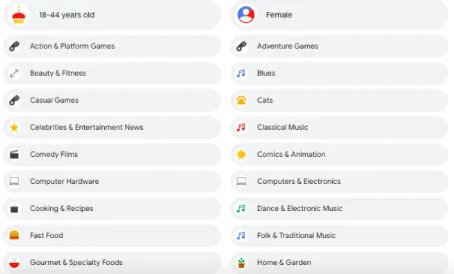
Google has made the use of this data for ad targeting transparent to users of its Chrome browser. All Chrome users can access a page called “ad personalization” to examine the demographic and interest-based attributes that have been collected and estimated about them (see Figure 2 for the author’s attributes).
This information is not only useful for targeting ads directly to you, but also for targeting ads to people like you. Websites aggregate all the data from their users to build a snapshot of their visitors’ demo-graphics, including average age range, ethnicity, where users live and work, income, and educational level. This user data, called “inventory,” is then used to sell ad space to brands and adver-tisers via ad agencies. The industry metric for buying inventory is the “impression,”also known as how many “impressions” an ad has osten-sibly made on viewers. Impressions are sold in CPM, or “cost per thousand views,”a term borrowed from television advertising measured by Nielsen ratings even though digital ad impressions are of a very differ-ent quality. The “M” comes from “mille,” the Latin word for “thousand.” Advertisers typically set their impressions targets and spending limits to-gether: “We want to reach [Y] number of impressions, and we will spend [X] amount for them.”16
Publishers can offer alternative pricing models based on other viewer ac-tions (outside of just impressions), such asCPC, Cost Per Click (when a viewer clicks on an ad), or CPA, Cost Per Action (when a viewer clicks on an ad and then immediately makes a purchase).17
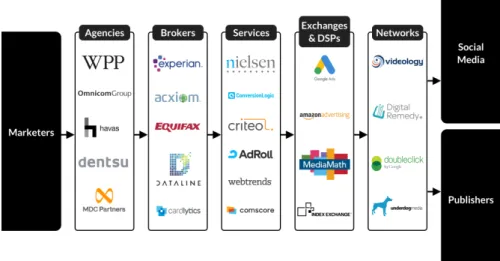
To return to the history of advertising, online ads exploded in the 1990s and 2000s. Websites were selling more and more impressions to more and more advertisers. Publishers were soon handling billions of impressions and thousands of advertisers. In this noisy space, a layer of service providers sprang up (see Figure 3).
Figure 3: The Ad Tech Landscape18
This figure is a rough representation of how ads are placed online. Mar-keters, on the left, begin the process, working with a landscape of compa-nies including ad agencies, data brokers, service providers, and more until at last the display ads land on websites and apps belonging to publishers and social media companies. Each rectangle (“Agencies,” “Brokers,” etc.) represents a significant step in this process, accompanied by logos of some of the companies working at each step (by no means an exhaustive list, as thousands of companies work in this space).
“Agencies”Here we see companies called Ad Agencies. Ad Agencies are made up of marketers who offer creative and strategic services to clients who wish to advertise their products or services. Agencies produce and place advertisements across the internet, apps, search engines, and social platforms.
“Brokers”Here we we see Data Brokers. Data brokers aggregate data from a variety of sources and then clean and process the data before selling
it to marketers, who buy data to help them plan, produce, and target their ads.19
“Services”Marketers enlist companies offering services to help them fine-tune their work. These services can be creative, with firms that help marketers produce ad content, or media planning, to assist in ad place-ment. Other companies perform services on user data (remember all the behavioral and demographic user data that websites gathered using track-ing cookies). These services include optimization, i.e. testtrack-ing and analyztrack-ing data more extensively to better target ads;,20 retargeting, i.e. targeting
your ads to audiences even after they leave your site21(remember how
Molly kept seeing candy ads even after she left Amazon.com?) and ad at-tribution, i.e. performing data analysis of ad viewers’ buying habits to determine which ad actually led to the final purchase.22 One data broker in
the ad exchange business explained their services for advertisers this way:
[We can] develop a custom audience segment modeled after visitors to your site ([in a process called] Look-Alike Modeling); find households that have the greatest propensity to purchase specific products or brands (MRI Lifestyle Clusters); if you’re sponsoring an AOL page, retarget consumers who have visited it (Sponsorship LeadBack); find your ideal female au-diences on the sites they are most likely to visit (Subnet Targeting); find women who are searching for information about fashion or home & gar-dening; explicitly target households with females present (Age/Gender Targeting).23
“Exchanges and DSPs”All of this aggregation, and the mind-boggling number of impressions bundled, soon led to a confusing environment in which advertisers didn’t know where their ads were being placed or who was buying them.24 Soon enough, ad buyers sought more transparency
around what they were getting for the money they were spending. This led to the creation of ad “exchanges:” digital marketplaces enabling advertisers and publishers to buy and sell advertising space, often through real-time bidding, most often display, video and mobile ad inventory.25 Agencies use Demand-Side Platforms (or DSPs), software
programs used to purchase advertising in an automated fashion,26to track money spent, ad prices and placement, audience data and metrics, and targeted audiences.
web-sites with comparable inventory into bundles, making it easier for advertisers to centralize their ad purchases. This way advertis-ers can buy large numbadvertis-ers of ads to show to similar usadvertis-ers visiting different websites, and more efficiently hit their impression targets (number of im-pressions they want their ads to make on viewers).27
It’s on ad exchanges, via ad networks, where programmatic and real-time bidding take place. Programmatic bidding is an automated process, where publishers place ad inventory (measured in impressions on viewers) on an auction block and advertisers bid on this inventory using computer pro-grams (hence, “programmatic”). Advertisers tell their propro-grams what sort to inventory to buy based on several parameters. The programs bid high or low depending on how well the inventory matches their targets for their clients’ ad campaigns, based on their budget. Real-time bidding (RTB) is a subset of programmatic bidding, referring to when these auctions take place in real time, in a few milliseconds, every time a user load a webpage.28
Display ads on news sites
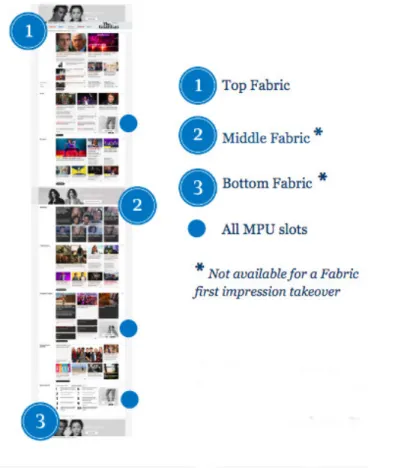
News institutions publish standards describing the formats that advertisers can expect of them, as well as the terms and conditions that the publisher sets for advertisers. In terms of formatting, these guidelines include visual templates. On The Guardian’s “Digital Advertising Production Format Guide,”29 these include ad formats like “Cascade,” “Expanding Billboard,”
“Fabric Video,” “Filmstrip,” “Focus,” and “Sliding Doors.” The Guardian provides screenshots to advertisers showing how their ads will look on the news site across a collection of devices (see Figure 4 and Figure 5). The New York Times’s “Media Kit”30 likewise provides a full suite of specs and
Figure 4: The Guardian’s ad format specs
Terms and conditions outline what is expected from advertisers. Some publishers describe requirements for the “truthfulness” of the ads them-selves (The Guardian’s advertising “Terms and Conditions” sheet specifies that ads be “legal, decent, honest and truthful”).31 Others make a good-faith attempt to call for reliability from advertisers around their technical specs. For example, The Guardian’s “Terms and Conditions” states that “all digital Advertisements submitted for publication online will be free of any viruses, adware, malware, bit torrents, and no Advertisement will cause an adverse effect on the operation of the Website.”32 The New York Times’s
“Media Kit Guidelines and Requirements” specify that “all 3rd party tags (creative serving AND tracking-only) and accompanying technologies be-ing served by the tags must be SSL Compliant (HTTPS).”33 Despite these
requirements, there have been reported problems created by both the tech-nical infrastructure of advertising, and by the political economy in which this infrastructure is embedded.
Advertising's
Influence on
News: Bloat,
Clicks, and Bots
The ad tech ecosystem introduces many issues to the production, distribu-tion, and consumption of news. First, it has material impact on the user experience. Second, ad tech creates incentive structures, which may shape how reporters and editors think about news production.
Usability and ad bloat
The Wall Street Journal recently reported that advertising, in the digi-tal age, is weighed down by history: digidigi-tal ads are saddled with the old-fashioned thinking of marketers who grew up in the branding age.34 Large, image-based ad ideas that performed well on television are now being in-jected into tiny digital ads,35or have contributed to large, more intrusive forms of online advertising—such as “roadblock” messages that take over the entire screen for a few seconds—that upset the user experience.
In addition to disrupting the quality of the user experience, digital ads’ technical infrastructure slow down the performance of web browsers. Re-member all the tracking cookies (i.e., Javascript and HTML code) embed-ded inside ads, in addition to the innumerable transactions and technical complexity of real-time bidding auctions, running millions of lines of code and sending data to, and receiving instructions from, thousands of servers in milliseconds. This puts a heavy load on web browsers, weighing down news sites and even further disrupting the user experience.
theLos Angeles Times measured 5.7 megabytes. Journalistic content, how-ever, made up only 1.6 megabytes—roughly 73 percent of data pushed to users’ devices was due to ads.36This made the site odious to visit, both in terms of load times (the ads caused the site to take an additional seven sec-onds to load, an increase of 175 percent over its normal load time) and cost to users, especially if they were accessing a web page via a mobile phone or tablet—which is increasingly how users view the news. Indeed, as early as 2015, 99 of 110 major news websites had more tablet and smartphone visi-tors than desktop visivisi-tors.37 “Some carriers, like AT&T and Verizon, charge
fees if you surpass your data allotment. So the websites with bloated ads not only take longer to load, but they can pad data consumption and phone bills.”38Users on such data plans are, in effect, paying in both time and
money to look at ads that may cover up or distract from the news content they’re trying to read.
Ad targeting can even further shape the world that readers see online because of how ads are targeted to particular audiences, meaning some people will be offered different products, services, and experiences than others. University of Pennsylvania professor Joseph Turow described this process in The Atlantic:
Consider a fictional middle-class family of two parents with three children. ... both [parents] Larry and Rhonda are getting ads from check-cashing services and payday-loan companies. And Larry notices sourly on auto sites he visits that the main articles on the home page and the ads throughout feature entry-level and used models. His bitterness only becomes more acute when he describes to his boss the down-market Web he has been seeing lately. Quite surprised, she tells him she has been to the same auto sites recently and has just the opposite impression: many of the articles are about the latest German cars, and one home-page ad even offered her a gift for test-driving one at a dealer near her home.39
Ad tech, privacy, and security
In addition to these usability, financial, and targeting issues, advertising technology also presents privacy and security issues. Even as publishers’ specs require that ads contain no malware, the complex technical
infras-tructure of advertising has led news outlets to serve malicious and danger-ous code to readers.40
In 2009, The New York Times fell victim to what it called a “mali-cious ad swap” when what looked like a legitimate advertiser suddenly switched to serving malware to readers41 42 43—“malware” meaning soft-ware intended to “damage or do other unwanted actions on a computer sys-tem.”/autocitemalware It’s also been reported that both the BBC and The New York Times have served ransomware (software code embedded in an ad that “attempts to find any back door it can into the target’s computer, where it will install ... software, which encrypts the user’s hard drive and demands payment in bitcoin for the keys to unlock it”).44 In another
in-stance of news-publisher-owned sites serving code violating readers’ devices, The Guardian reported that CBS-owned Showtime was caught mining bit-coins from their users, in an article titled “Ads Don’t Work So Websites Are Using Your Electricity to Pay the Bills”:
US video streaming service Showtime ... [was] discovered to be sending mining code to users. ... Cryptocurrencies, such as bitcoin and its succes-sors, are backed by a system of “miners”, who race to be the first to solve tricky computing problems in exchange for a reward ... [This requires an] extraordinarily large amount of computing power [and] also consumes a huge amount of electricity ... Website-based mining short circuits that: the electricity bills are paid by the visitor, but it’s the website that gets the reward.45
Joe Stewart, a director of malware research at the security services com-pany SecureWorks, commented, “The development of multimedia ads, mini-applications, and social networking tools is far outpacing the speed of the thinking process about the security that goes into those applications.”46
All of these threats to readers’ user experience and privacy may endan-ger the trust that readers have in news institutions. In sum, it should come as no surprise that advertising technologies present a serious risk to news brands and reputation. Similarly, ad tech and its demarcations of what is valuable in the attention economy stand to alter the organizational and professional practice of journalism.
News? Or revenue-generating product?
Outside of usability and privacy issues, the incentives and infrastructures of ad tech may tempt news organizations into producing and distributing spe-cific types of news. Economics of scale dictated by advertising mean that ad dollars only become tangible when large numbers of people view them. Journalistic investigations47 48 and academic studies inside newsrooms49 50
have shown that reporters and editors feel pressured to produce news and make operations decisions according to the demands of advertising struc-tures and metrics.
As the publishing industry adopts organizational roles, routines, and metrics inherited from the tech industry,51as well as the ad sales industry, more metrics-oriented design decisions have come to shape how news is distributed and consumed. Engagement metrics are measurements of how an audience engages with a website. This includes clicks (how many peo-ple click on ads on a site), hits (pageviews), sessions (everything a reader does while on a site), uniques (number of unique visitors to the site), and more.52 Even the words “article” and “content” denote different values
and priorities in news production. Whereas the word “article” is used in journalism, and is ostensibly imbued with journalistic commitment to in-form the public with a dedication to objective coverage, the word “content” comes from the tech industry and denotes the written word’s role within a larger infrastructure of content delivery built for specific goals, such as driving engagement and generating revenue.
The Columbia Journalism Review wrote extensively on these competing motivations in its coverage of the 2014 departure of Jill Abramson, the executive editor of The New York Times, and the rise of her successor, Dean Baquet. CJR reported that Baquet believes the traditional “wall” between the editorial and business sections of the paper must be blurred in order to ensure the precarious survival of the Times: “Baquet ... says flatly that the traditional news-advertising divide has become a luxury the Times can no longer afford. ... Pulling that off, he says, required cooperation with the business side.”53 Jill Abramson, however, remarked the opposite: “I
didn’t want the energy of our journalists focused on revenue-producing products.”54
Angele Christin, a communications scholar at Stanford, conducted a study on one newsroom each in the United States and Europe, finding that both reporters and editors internalize and respond to the analytics and metrics of advertising, and ad tech’s engagement programs.55 “Engagement programs” are software programs, such as the popular ChartBeat,56 which measure and display engagement metrics.57
Christin found that while different in their exact responses, neither news-room was immune to the influence of engagement programs. Either re-porters, or editors, took these numbers into account when making decisions about what sort of stories to write, how to write them, and how to manage, incentivize, and promote reporters:
Web analytics are used by some editors as performance indicators for man-aging their personnel, especially when deciding how to promote and com-pensate journalists. ... At several [news] sites in New York and Paris, this correlation between revenue and traffic is even more clear: writers are “paid by the click,” as a percentage of the advertising revenues that their articles attract. They might also receive substantial bonuses when their articles are highly shared on social media.58
This is a dramatic shift from prior generations of journalists, who wrote primarily for the approval of their peers and reputational rewards.59
YouTube provides a stark example of how engagement metrics change what sort of content is incentivized and algorithmically distributed in the attention economy. Media critic Zeynep Tufekci wrote about a Wall Street Journal investigation reportedly showing that YouTube’s recommendation algorithm pushes viewers toward videos that are ever more extreme, poten-tially facilitating viewers’ radicalization:
What keeps people glued to YouTube? Its algorithm seems to have con-cluded that people are drawn to content that is more extreme than what they started with—or to incendiary content in general. ... The Wall Street Journal conducted an investigation of YouTube content ... It found that YouTube often “fed far-right or far-left videos to users who watched rela-tively mainstream news sources,” and that such extremist tendencies were evident with a wide variety of material. If you searched for information on the flu vaccine, you were recommended anti-vaccination conspiracy videos.60
Journalists should reflect on the relationship between publishers and advertisers, usability and privacy issues presented by ad tech, how the
structures of advertising incentivize specific operational and organizational decisions inside newsrooms, and whether it’s a reasonable expectation that advertising continue to underwrite journalism. With that in mind, let’s turn to one of the actors in this system siphoning money away from both advertisers and publishers: fraud.
Fraud and bots
For all of its sophisticated algorithms, complex technical stack, and vast array of service firms, the ad industry is rife with fraud. Advertising writer Akit Kohli notes, “Advertising fraud is typically done by creating fake ad traffic using content-scraping websites or other environments or cre-ating other fictitious mechanisms for delivering ads that are not seen by consumers.”61 “Bot viewing” is a common complaint. “Bots” are software
programs carrying out automated tasks on the internet (“bot” is derived from “robot,” which is itself derived from the Czechoslovakian word for “work”). “Bot viewing” or “bot traffic” is when such programs are “de-signed to mimic users and inflate audience numbers.”62Such programs and their services are easily available for purchase online. A Google search for “viewing bots” includes a service for people looking to boost their own videos on YouTube.63
These bots are used to defraud advertisers, tricking them into thinking that millions of people have clicked on their video ad, when some of that engagement was actually non-human. Some Russian-engineered bots even mimic publishers, imitating news websites to steal money from advertisers.
While advertisers thought they were advertising on real websites, they were in fact buying counterfeit ad inventory on facsimile sites visited by bots. The researchers report that the scam affected more than 6,000 top publishers’ websites, including the Huffington Post, The Economist, ESPN, Vogue, CBS Sports, Fox News, even Fortune.64
The MIT Technology Review wrote in 2014 that 36 percent of internet traffic was from non-human machines.65 The Interactive Advertising Bureau estimated in its 2015 report, “What Is an Untrustworthy Supply Chain Costing the Digital Advertising Industry?,” that the ad industry loses 4.6 billion dollars a year to bots.66 The Wall Street Journal reported that in
mid-2017 Procter & Gamble—which, remember, is one of the largest and therefore most-watched advertisers in the world—cut its digital ad spend by 100 million dollars, with the company’s finance chief saying, “We were serving bots as opposed to human beings.”67 By the end of that year, cuts on digital ads had doubled to 200 million dollars.68
Some advertisers have turned to blockchains to combat fraud, seeking out the technology’s secure and transparent transaction ledgers.69
The Turn Against
Advertising:
Blockers, Dimes,
and Walls
Given the usability and financial issues for readers, threats to readers’ pri-vacy and devices, how the metrics of ad tech may influence the practice of journalism, and an ad tech system itself riddled with fraud, it’s unsurpris-ing that we’ve seen a consumer and publisher backlash against ad tech.
Blockers
Consumers have begun to sidestep the entire infrastructure of advertising via ad blockers. Ad blockers are browser plug-ins (digital tools that can be downloaded and added on to your browser), which block the download-ing of embedded code: ad blockers prevent ads from downloaddownload-ing trackdownload-ing cookies onto users’ devices, and also block ads’ attempts to communicate with their ad-exchange servers.70The Wall Street Journal reported that publishers have become aware of the annoyances their ads create for read-ers, and the growing backlash, writing:
According to many publishers, ad agencies consistently produce oversized, tracking-laden digital ad files and often deliver them at the last minute without enough time for publishers to push back. This behavior is con-tributing to how slowly some Web pages are loading, encouraging the grow-ing use of ad-blockgrow-ing software among consumers.71
Since 2015, the popularity of ad blockers has skyrocketed.
Browser companies have also adopted ad blockers: In 2017, Apple dealt a significant blow to online advertisers moving into the mobile space with
the automatic inclusion of ad blockers in the mobile version of Safari, the native web browser on the iPhone.72 Google followed his in 2018 by making moves to automatically block what it called “intrusive” ads in its Chrome browser, which is employed by over half of internet users.73
Even as users and developers alike push toward the adoption of ad block-ers,74 we’re seeing more evidence that even those ads that do get seen are
bringing in less money for publishers.
Print dollars and digital dimes
Not only does the ad experience drive users away from browsing news on the web, but the hyper-efficient market for ads has driven down the value of ads themselves. In what’s been dubbed the “print dollars, digital dimes” tradeoff—first coined by esteemed journalist David Carr in 200875—digital
ads represent a smaller and smaller share of publishers’ overall revenue picture.
The [NYT’s] revenue source profile has shifted dramatically away from advertising, which accounted for 71% of income in 2000, but only 37% as of the 2016 filing. The shift has been steady and clear: Between 2010 and 2015, print advertising revenues dropped 16% (from 44% of revenue to 28%) and its digital counterpoint only saw a 2% boost (10% to 12%).76
The widespread transparency, efficiency, and availability of data drove the price of impressions down, as noted by The New York Times in its 2014 annual report:
Digital advertising networks and exchanges, real-time bidding and other programmatic buying channels that allow advertisers to buy audiences at scale are also playing a more significant role in the advertising marketplace and causing downward pricing pressure.77
Not only have market pressures decreased the value of digital ads, but their relative efficacy at actually reaching consumers is in question: one marketing group used statistics released by Google AdWords to calculate that the average click-through rate (or percent of people who actually click on a display ad) is less than one percent.78
Publishers have reckoned with the low click-through rates and low com-parative revenue yielded by display advertising by experimenting with
alter-native ad models. One such model is affiliate advertising, which means that an advertiser works with affiliates (i.e., websites and publishers) to place sponsored posts or promoted products, and those affiliates get a commission when a sponsored post or product on their site leads to a sale.79Advertisers obviously will pay more for these higher-engagement actions, but they’re risky for publishers, since the revenue stream is contingent on getting view-ers to actually click on ads—a difficult endeavor. The New York Times purchased a product-review site called WireCutter, where some reviews fea-ture affiliate links. If a viewer makes a purchase through one of these links, the NYT makes a commission. The Times addressed the potential issues of biased reviewing on the “About” section of WireCutter’s site:
Up front: Our writers and editors are never made aware of which companies may have established affiliate relationships with our business team prior to making their picks. If readers choose to buy the products we recommend as a result of our research, analysis, interviews, and testing, our work is often (but not always) supported through an affiliate commission from the retailer when they make a purchase. ... There’s no incentive for us to pick inferior products or respond to pressure from manufacturers—in fact, it’s quite the opposite. We think that’s a pretty fair system that keeps us committed to serving our readers first.80
Taken together, a stormy picture emerges of digital ad tech. Usability and financial issues drive readers away from news sites, just as the readers that do stick with them are using ad blockers or clicking on ads at severely low rates. Meanwhile, newer ad models like affiliate marketing are risky in that they may bring about biased reporting. It’s no surprise that both publishers and advertisers have begun to look for different strategies.
Paywalls and subscriptions
One way that publishers have turned away from the advertising model is through paywalls and subscriptions. As ad revenue has dropped, the rev-enue brought in from subscriptions has risen for many publishers. In 2000, subscriptions were only 23 percent of the total revenue picture for The New York Times, but by 2015 that figure had risen to 54 percent.81 By building paywalls, publishers can attempt to leverage digital readers’ behaviors and
nudge them toward buying subscriptions. A paywall is a digital system to prevent readers from reading content without a subscription.82 There are roughly three kinds of paywalls:
1. Hard: all readers need to pay for access to all articles across all devices. 2. Metered: a certain number of articles are free per month, after which
readers have to pay for access.
3. Leaky/porous: while only a certain number of articles are free, readers can access content when they come into the news site from a search engine or a social platform.
There’s a psychology at play in building these walls: readers who come into the publishers’ site from a search engine or social site are considered “new” or “casual” users, with no demonstrated loyalty to the outlet. By showing them free content with either a metered or porous paywall, pub-lishers hope to build reader loyalty, which can then hopefully be converted into a subscription. Some publishers are further customizing subscription packages according to specific audiences, such as the sports fan or readers of crime stories.83 However, publishers face a steep challenge in building
a paywall that can successfully convert loyal audiences into subscribers, while being porous enough not to lose ad revenue brought in by casual readers. Publishers also must make tough calls about whether to drop pay-walls in times of crisis, such as after the September 11th attacks on the World Trade Center. A variety of rationales have been cited by publishers for temporarily suspending their paywalls, including “informing the public during crises and emergencies; increasing exposure to planned events and special occasions; providing wider access to non-emergency content seen as publicly valuable; using advertisers as short-term site-wide sponsors.”84 Journalism scholars Mike Ananny and Leila Bighash argue that this hetero-geneity shows the variety of subjective purposes to which news publishers are committed.85
Negative pressures on digital display ads (downward pricing pressures, poor usability, the mismatch between branding-oriented professionals and small display ad formats, privacy violations, and the turn toward subscrip-tions) have pushed the marketing industry to look for new channels for delivering their messages to consumers—some of which include serving ads
on social platforms and through search engines. While there are many so-cial media and search companies, our focus is on the biggest player in each sector: Facebook for social media and Google for search. For our purposes, these two—referred to as the “duopoly” of digital advertising, making by far the most money in the industry (see Figure X)— are sufficiently repre-sentative of issues for journalists and journalism.
In their professional work, however, journalists should look beyond these two companies to examine the actions and implications of the many other companies in these spaces. Amazon, for example, is a quietly rising force in the digital ad space,86 already introducing novel ways of reaching
Ads on Social
Advertising on social media platforms contains a complex sociotechnical system of platform companies, advertisers, publishers, devices, servers, algo-rithms, and readers. This arrangement introduces a number of professional, social, and economic complications into the advertising-news relationship.i
Walled gardens and the growth
of surveillance economics
While some readers use ad blockers to shield themselves from display ad-vertising, others have abandoned the open web altogether and shifted their news consumption to walled-garden apps optimized for the mobile experi-ence and owned by private conglomerates. Examples include Apple News and Facebook.87 According to recent Pew research, 43 percent of Americans
self-report that Facebook is a primary place to find news88(see Figure 4).ii
You can imagine what a boon it was for advertisers to enter into the social media age, just as falling prices for CPMs and the rise of ad block-ers began to choke off the flow of cash coming into the ad industry. Social media’s almost limitless data on users’ lives and centralized control over what users see afford powerful targeting opportunities. Users not only sup-ply data directly, by writing into their profiles details about their favorite movies, music, foods, TV shows, and clothing, but they also perform tasks on these platforms such as uploading photos, tagging their friends, watch-ing videos, clickwatch-ing on links, markwatch-ing their “likes,” joinwatch-ing “fan pages,” and sending messages to friends—all of which is recorded and tracked.
The 2018 European Union’s GDPR laws forced social media companies to make available to EU users all of the data those platforms had gathered
i. For a more in-depth look at how social platforms and news publishers influence each other, see the Tow Center for Digital Journalism’s recent report, “Friend and Foe: The Platform Press at the Heart of Journalism.”
ii. Use of this and other content created by the Pew Center does not imply, suggest, or attribute a particular policy or lobbying objective or opinion to the Center, or is a Center endorsement of a cause, candidate, issue, party, product, business, organization, religion or viewpoint.
Figure 4:According to recent Pew research, 43 percent of Americans self-report that Facebook is a primary place to find news.89
about them for the first time. When journalists began writing about their experiences downloading and reviewing data that companies had gathered on them, one reporter noted that the size of the file Facebook had on him was equivalent to 400,000 Word documents, and included every message he’d ever sent or been sent, all of the contacts in his phone, everything he’d ever “liked,” every application he’d ever connected to Facebook, and a record of every time he’d logged in and from which device.90
From targeting to influencing
Meanwhile, another type of persuasion takes place on social media takes place not through targeting based on behavioral and demographic data, but rather by leveraging individuals who hold persuasive power within commu-nities of consumers. In the ad business, these are called “influencers.” “An influencer is someone who has a strong relationship with his or her audi-ence, [who can] affect their purchase decisions because of the knowledge and authority they have” within that audience.91
industries from beauty to energy drinks to toys.92 Some marketers have
termed this “growth hacking,” growing their audiences by piggybacking onto influencers’ existing social networks.93 The news industry itself has used influencer marketing, with publishers Mic, Refinery29, and Slate hiring entertainer George Takei to promote their articles on his popular Facebook page.94Mic saw a triple-digit jump in engagement (measured in comments)
on an article once Takei shared it (see Figure 5).95
Figure 5: Mic saw a triple-digit jump in engagement (measured in comments) on an article posted to Facebook when an influencer (actor George Takei) shared it.96
Influencers have proven so popular that a cottage industry has popped up to offer services between advertisers and influencers. Digiday reported one firm working with over 100 publishers, including Slate and Entrepreneur.97
In late 2017, Digiday pointed out that such paid promotions make spon-sored content look like an authentic opinion or endorsement, skirting the rules on what Facebook’s Terms of Service consider commercial content and what is organic user activity, violating audience trust and the platform’s Terms of Service: “Facebook rules require verified page owners to disclose any commercial nature of the content posted to those pages, something that these celebs do not do.”98
to design new strategies, offering to step in and replace news with their own content, an option more lucrative for the influencer while cutting news publishers out of the loop.
A growing number of celebrity and influencer pages are using ... services that create content for the influencers in-house, then publish it directly to sites they create for the celebs themselves or, in Providr’s case, its own page, where the celeb gets a share of the total revenue generated by the reader’s visit.99
Further, some of these influencer pages, displaying potentially dubious content untouched by any journalistic institution, were created using so-phisticated AI tools and tracking software to mimic the websites the user has already visited.
[Influencer services company] Providr uses machine learning to customize the look and feel of its site depending on which influencer page a reader is coming from, to keep them on the site longer and serve more ads. “Our AI learns what a user is more prone to enjoy,” Gary Lipovetsky, the co-founder of Providr, said.100
In the overhaul of rules surrounding branded content and content sharing since the 2016 US presidential election, Facebook took steps to address these influencer workarounds. In early 2018, Digiday reported that “page owners were not permitted to accept anything of value’ in exchange for sharing content that they did not have a hand in creating through their pages.”101One CEO of an influencer-services company, however, is less
concerned with the new rules and believes the challenging enforcement of these rules will slow their impact, asking, “How is Facebook supposed to know if George Takei posted something because he liked it or if he posted it because he got paid?”102
Facebook and the news
Facebook is a social media company offering both desktop and app versions of its popular networking service. The web statistics site Statista reports that “as of the second quarter of 2018, Facebook had 2.23 billion monthly active users”103—nearly one-third of the planet’s population.
Following the 2016 American presidential election, it came to light that Facebook and its advertising tools (alongside a number of other social media platforms) were key technologies through which Russian information operations intended to “sow discord among the electorate.”.104 Jonathan Albright, research director at the Columbia Journalism School’s Tow Center for Digital Journalism, remarked:
Facebook built incredibly effective tools which let Russia profile citizens here in the U.S. and figure out how to manipulate us. ... Facebook, es-sentially, gave them everything they needed.” [Albright] added that many of the tools that the Russians used, including those that allow ads to be targeted and that show how widespread an ad becomes, still pervade Face-book.105
Facebook acknowledged that 150 million Americans had been exposed to Russian propaganda on the platform, and the platform has been called on by both the general public and Congress to make changes to how it handles news and disinformation. In response, the company announced changes to its News Feed algorithm, which its spokespeople said would de-prioritize news articles and content from brands.106The company also introduced
policy changes around how news and advertising are shared on the plat-form, principally 1) how news sources are evaluated for trustworthiness and 2) how political advertising is policed.107
News and trust
In early 2017, Facebook’s CEO Mark Zuckerberg, said the company would start ranking publishers by their perceived “trustworthiness.”108Later, at
a Facebook developer conference, Zuckerberg spoke about the early impact these algorithmic changes were having on how news items were displayed on the platform’s News Feed:
“[Facebook] has gathered data on how consumers perceive news brands by asking them to identify whether they have heard of various publications and if they trust them. We put [that data] into the system, and it is acting as a boost or a suppression, and we’re going to dial up the intensity of that over time,” he said. ”We feel like we have a responsibility to further [break] down polarization and find common ground.”109
(pub-lished in full by BuzzFeed)110used for “trustworthiness” rankings doesn’t
acknowledge the complexity and multiple definitions of trust, especially its political utility:
Not only do people not trust the media much in general, but their level of trust emerges predictably from their political orientation. Using data from an ongoing multi-subject survey out of the University of Michigan, a 2010 study in the journal American Behavioral Scientist said that three things predicted whether someone will trust the news media: how far they leaned to the left, politically; how trusting they are in general; and how well they think the economy is doing.111
Similarly, a Pew study from May 2017 found a deep division in trust in the news media along party lines (see Figure 6).112
Political ad or political news?
Another piece of Facebook’s response to the public outcry over information operations on the platform has been to implement new policies around how political ads are purchased and classified. This includes more strident rules around who can purchase a political ad, labeling every political ad with the name of the person who purchased it, and creating a publicly searchable archive for these ads.114ProPublica reported that “Facebook is betting
that a combination of voluntary disclosure and review by both people and automated systems will close a vulnerability that was famously exploited by Russian meddlers in the 2016 election.”115
This policy, however, introduces new complications into the relationship between Facebook and news publishers. A New York Times reporter cov-ered a panel held at the Tow Center for Digital Journalism, which included Times CEO Mark Thompson and Facebook’s head of news partnerships, Campbell Brown, writing:
Publishers have been vocal in their protests of being included in the same archive as political ads. This month, organizations representing more than 20,000 publishers in the United States wrote to Facebook to object to the policy, and some outlets, like New York Media and The Financial Times, have vowed to suspend their paid promotions on Facebook if the policy is not changed. Facebook has agreed to create a distinction between publish-ers’ content and political ads, but it has not yet built a separate archive.116
This policy is reportedly acute in its impact on local publishers, who say they may not have the resources to jump over the hurdles now required to steer clear of political-ad blacklisting. Digiday reported:
“In trying to combat the spread of fake news and other disinformation ahead of 2018’s elections, Facebook is putting barriers in front of legitimate news organizations that want to get their stories in front of a wider audi-ence,” ... One local publisher called Facebook’s addition of publishers to the political ad policy “wildly infuriating,” saying Facebook blocked promotion of a story about a county fair because the story mentioned a politician, even though the politician wasn’t running for re-election.117
We see here a surreal inverse of the pre-modern commercial press. Whereas the first “news” papers provided only political coverage sponsored by local parties, we now have news publishers tasked with proving their coverage is
not party-sponsored. Again, as history has shown, political, economic, and technological issues are irrevocably intertwined.
Ads on Search
Turning from advertising on platforms to advertising on search, let’s look at the other arm of the ad duopoly, Google, the world’s most popular search engine. Statista reported that as of July 2018 Google had cornered 63 percent of the desktop search market and 94 percent of the mobile search market, handling nearly 12 billion search queries every day.118
Targeting to intent
A classic idiom in the marketing industry is that nobody pays attention to an ad until they’re in the market for that product. One way to capture the attention of people who are in the market for a product is to target them with advertising while they’re searching for information on that product. This makes advertising on search engines a valuable endeavor for marketers.
There are two kinds of listings on search engines, one of which is an ad: “paid search” is when a website appears at the top of search results because a marketer paid the search engine for that spot. The other, “or-ganic search,” is when the search engine’s algorithm determines a website is the best match for a user’s search query (see Figure X, where the paid search listings are outlined in red, and organic search listings are outlined in blue).:119
Targeting consumers who are in the middle of searching for a product is called “targeting to intent”120and takes place at a lucrative spot in what’s
known as the “consumer decision journey.”.121 The consumer decision
jour-ney is the process through which consumers initially and then actively contemplate a purchase, research that purchase, ultimately buy a product, and then experience that product in their lives.122
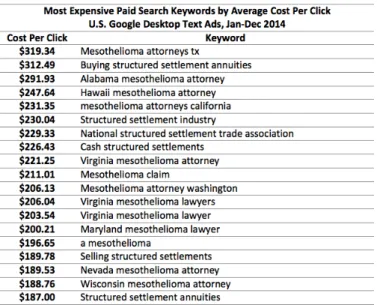
To illustrate how valuable this spot is, consider this statistic: in 2014, 13 out of the 20 most valuable ad spots on Google Search (bid on pro-grammatically via the ad exchange Google AdWords) included the terms “mesothelioma,”123 because the disease is often searched for by those who are potential clients for lucrative class-action lawsuits (see Figure 7).
Figure 7: The Most Expensive Google Paid Search Keywords124
these ads. Remember that the average display ad garners a CTR lower than one percent, where the rates for these valuable search terms range from 3.08 to 7.79 percent.125
Google’s advertising practices have come under scrutiny from regula-tors. In 2017, a European Union court accused the company of antitrust violations, claiming it had tailored its algorithm to push its own invested or owned services to the top of organic search126—an accusation which Google disputes and has appealed.127
News on search
As digital personalization has grown more sophisticated, some critics have become increasingly concerned that digital news consumption may be tak-ing place within a “filter bubble.” A filter bubble, first coined by academic Eli Pariser in the 2011 book of the same name,128 is a state of information
isolation wherein digital services like search engines and social media algo-rithmically tailor content recommendations according to a user’s consump-tion histories, to the point that the user is only shown informaconsump-tion that
conforms with their preexisting biases.129Recent research, however, has
disputed that Google is a vehicle of filter bubbles when it comes to news: empirical testing found that between conservatives and liberals, Google’s news recommendations were consistently identical.130
Still, as the ubiquity of computational tools allows companies to explore ever greater integration with adjacent industries, the onus is on journalists to understand how these moves will affect the marketplace for, and regula-tion and consumpregula-tion of, news and informaregula-tion.
Conclusion
Without advertising, history would not have seen the rise of autonomous news coverage, free from the yoke of political support.131
Subscription-based models of information distribution ensure that only people with means have access; advertising makes information available to everybody. And without advertising, it’s doubtful that the internet would have grown as quickly, and served so many people all over the globe.132 Yet, these
infrastructures also brought about unforeseen challenges to the production and distribution of news. Technology investor John Battelle, in writing about the damage that digital advertising has wrought, quoted author Steven Johnson (who himself was quoting economist and Nobel laureate Thomas Schelling): “One thing a person cannot do, no matter how rigorous his analysis or heroic his imagination, is to draw up a list of things that would never occur to him.”133
This is where journalists come in. Journalists need to be more thorough in their understanding of, and curiosity about, the sociotechnical ecosystem and political economy of advertising. This is not only because their work is distributed within it, but also because as citizens of a capitalist democratic republic we need journalistic coverage of the complex relationships between our elected officials, the information-distribution infrastructures we rely on, and the information provided for us by news publishers.
Further reading
• The Daily You: How the New Advertising Industry Is Defining Your Identity and Your Worth by Joseph Turow (Yale University Press, 2013)
• Weaponizing the Digital Influence Machine: The Political Perils of On-line Ad Tech, by Anthony Nadler, Matthew Crain, and Joan Donovan (Data & Society, 2018)
• The Attention Merchants: The Epic Scramble to Get Inside Our Heads by Tim Wu (Vintage, 2017)
• “Digital Marketing Strategy, Course Overview Note,” Harvard Business School, by Thales Teixeira (Harvard Business School, 2013)
• Frenemies: The Epic Disruption of the Ad Business (and Everything Else) by Ken Auletta (Penguin Press, 2018)
• Discovering the News: A Social History of American Newspapers by Michael Schudson (Basic Books, 1981)
• “Friend and Foe: The Platform Press at the Heart of Journalism,” Tow Center for Digital Journalism report
• Weapons of Math Destruction: How Big Data Increases Inequality and Threatens Democracy by Cathy O’Neil (Broadway Books, 2016)
• “Grappling with the Weirdness of Advertising” by Caroline Jack, Data & Society Points blog
Glossary
Ad attribution—an analysis of ad viewers’ buying habits to determine which ad actually led to the final purchase
Ad blocker—a browser plug-in (digital tool that can be downloaded and added onto a browser), which blocks ads from showing content on users’ screens, prevents ads from downloading tracking cookies onto users’ devices, and also blocks ads’ attempts to communicate with their ad-exchange servers
Ad exchange—open platforms for comparing the price and quality of impressions and buying them
Ad fraud—creating fake ad traffic by way of content-scraping websites or other environments or creating other fictitious mechanisms for delivering ads that are not seen by consumers (see also “Bots” and “Bot viewing”)
Ad network—companies which aggregate websites with comparable inventory into bundles, making it easier for advertisers to centralize their ad purchases
Ad optimization—testing and analyzing data more extensively to better target ads
Ad tech—umbrella term for the system of software programs, data servers, marketing agencies, and data markets which facilitate the sale of user data and the display of advertising messages to users of the internet, including search engines and social-media sites and apps
Affiliate advertising—when an advertiser works with affiliates (i.e., websites and publishers) to place sponsored posts or promoted products, and those affiliates get a commission when a sponsored post or product on their site leads to a sale
Attention economy—the marketplace for the increasingly scarce and valuable resource of consumer attention
Bots—software programs carrying out automated tasks on the internet Bot viewing/bot traffic—when software programs are designed to mimic users and inflate audience numbers
Branding—image-based messages which associate a product with a set of values
Consumer decision journey—the process through which consumers initially and then actively contemplate a purchase, research that purchase, ultimately buy a product, and then experience that product in their lives
CPM—“cost per thousand of views” (a term borrowed from television advertising measured by Nielsen ratings). The “M” comes from “mille,” the Latin word for “thousand”
CPC—Cost Per Click, paid to a publisher when a viewer clicks on an ad CPA—Cost Per Action, paid to a publisher when a viewer both clicks on an ad and makes a purchase
Display ad—rectangular ads which appear on websites visited through a browser on a desktop computer, mobile phone, or tabletEngagement metrics—measurements for how an audience engages with a website. This includes clicks (how many people click on ads on a site), hits (pageviews), sessions (everything a reader does while on a site), uniques (number of unique visitors to the site), and more.
Engagement programs—software programs, such as the popular ChartBeat, which measure and display engagement metrics
Filter bubble—theoretical state of information isolation, where users’ digital services like search and social media algorithmically tailor content recommendations according to the user’s consumption histories, to the point that the user is only shown information that conforms with their preexisting biases
Impression—industry metric for buying ad ”views,“ or evidence that someone using the product selling the advertising saw a specific advertise-ment.
Influencer—someone who has a strong relationship with his or her audience and can affect their purchase decisions because of the knowledge and authority they have
Interactive Advertising Bureau—the marketing industry trade group that sets standards for digital display ads
Malware—software intended to damage or do other unwanted actions on a computer system
Paid search—when a website appears at the top of search results be-cause a marketer paid the search engine for that spot
without a subscription. Roughly, there are three kinds of paywalls: hard, where all readers need to pay for access to all articles across all devices; metered, where a certain number of articles are free per month, after which readers have to pay for access; and leaky/porous, where a certain number of articles are free but readers can access content when they come to the news site from a search engine or social platform.
Real-time programmatic bidding—the live auction for viewers’ attention, taking place in milliseconds every time an ad loads
Retargeting—targeting your ads to audiences even after they leave your site
Targeting—tailoring an ad to appeal to specific types of viewers, based on one or both of two different parameters: who you are (i.e., demographic targeting) and what you do (i.e., behavioral targeting)
Tracking cookies—bits of code like HTML and Javascript which can track users, recording and reporting back to a website which sites they visit and the things they purchase