DOCUMENT
DE TRAVAIL
N° 300
THE CASE FOR A FINANCIAL APPROACH TO
MONEY DEMAND
Xavier Ragot
DIRECTION GÉNÉRALE DES ÉTUDES ET DES RELATIONS INTERNATIONALES
THE CASE FOR A FINANCIAL APPROACH TO
MONEY DEMAND
Xavier Ragot
October 2010
Les Documents de travail reflètent les idées personnelles de leurs auteurs et n'expriment pas nécessairement la position de la Banque de France. Ce document est disponible sur le site internet de la Banque de France « www.banque-france.fr ».
Working Papers reflect the opinions of the authors and do not necessarily express the views of the Banque de France. This document is available on the Banque de France Website “www.banque-france.fr”.
The Case for a Financial Approach to Money Demand
Xavier Ragot
Banque de France and Paris School of Economics
Correspondence to: Xavier Ragot, Banque de France, 41-1422, 31 rue Croix des Petits Champs, 75049 Paris Cedex 01, France. Tel.: + 33 1 42 92 49 18. Email: [email protected]. I have bene…ted from helpful comments from Yann Algan, Fernando Alvarez, Gadi Barlevy, Marco Bassetto, Je¤ Campbell, Edouard Challe, Andrew Clark, Mariacristina DeNardi, Jonas Fisher, Per Krusell, François Le Grand, Francesco Lippi, Dimitris Mavridis, Frédéric Lambert, Benoit Mojon, Monika Piazzesi, Vincenzo Quadrini and François Velde. I also thank seminar participants at the Banque de France, the Federal Reserve Bank of Chicago, CEF 2008, ESEM 2008, the CEPR 2009 ESSIM, the SED 2009 conferences and the "2010 Consumer Payment Choice" Workshop in Vienna. This paper has bene…ted from support from the French ANR, No. JCJC0157. Usual disclaimers apply.
Résumé en français: Les inégalités de détention de monnaie entre les ménages est très proche des inégalités de richesse, et très di¤érente des inégalités de niveaux de consommation entre les ménages. On montre tout d’abord que ce fait constitue une énigme pour de nombreuses théories de la monnaie qui associe demande de monnaie et consommation des ménages, comme les théories de la monnaie dans la fonction d’utilité, ou la théorie des encaisses préalables. Cet article montre qu’une distribution réaliste de monnaie, richesse …nancière et consommation peut être obtenue dans un modèle à agents hétérogènes, dans lequel des frictions sont introduites sur les marchés …nanciers, comme dans le modèle de Baumol-Tobin, en plus de frictions sur le marché des biens. Une analyse quantitative du modèle conclut que les frictions …nancières expliquent 85% de la demande de monnaie.
Codes JEL :E40, E50
Mots clés : Demande de monnaie, distribution de la monnaie, agents hétérogènes.
Abstract: The distribution of money across households is much more similar to the distribution of …nancial assets than to that of consumption levels. This is a puzzle for theories which directly link money demand to consumption. This paper shows that the joint distribution of money and …nancial assets can be explained in an heterogeneous agent model where both a cash-in-advance constraint and …nancial adjustment costs, as in the Baumol-Tobin literature, are introduced. Studying each friction in turn, I …nd that the …nancial friction explains 85% of total money demand.
JEL codes: E40, E50.
1
Introduction
Why do households hold money? Various theories of money demand have answered this question by focusing on the transaction role money plays in goods markets (e.g., shopping-time and cash-in-advance (CIA) models), transaction costs in …nancial markets (Baumol [8]; Tobin [40]) or simply assuming a liquidity role for money, as in the models with money in the utility function (MIUF). These theories are observationally equivalent in aggregate data: they can be realistically calibrated to match various estimates, such as the interest elasticity of money demand. In this paper, I show that microeconomic data can be used to quantify the contribution of the previous frictions to money demand. Indeed, the shape of the distribution of money across households is similar to the distribution of …nancial wealth but not close to the distribution of consumption levels. Using a heterogeneous agent model, I show that reproducing this money distribution allows us to quantify the contribution of goods-market frictions and …nancial-market frictions. In addition to its theoretical interest, the ability to reproduce the distribution of money is crucial for the assessment of the real and welfare e¤ects of in‡ation.
More precisely, in both Italian and US data, the distribution of money (M1) is similar to that of …nancial wealth, and much more unequally distributed than that of consumption (as measured by the Gini coe¢ cient, for example). In the US in 2004, the Gini coe¢ cients are around0:3 for the distribution of consumption levels across households, 0:5 for income, 0:8 for net wealth and 0:8 for money. This stylized fact, further detailed below, holds for di¤erent de…nitions of money, various time periods, and after controlling for life-cycle e¤ects. This distribution of money cannot be understood in standard macroeconomic models where money demand is modeled only by frictions on the goods markets, via CIA, MIUF or shopping-time considerations. In these models, real money balances are proportional to consumption, and money holdings and consumption should be equally distributed across households (i.e. have the same Gini coe¢ cient). As shown below, this property holds even when we consider more general transaction technologies in the goods market, which may produce scale economies.
can be reproduced when a friction on …nancial markets is introduced in addition to a transaction friction on goods markets. The friction in the goods market considered here is a standard cash-in-advance constraint which states that household must hold money to consume. The friction in …nancial markets follows the Baumol-Tobin literature. I assume that there exists a …xed adjustment cost for the …nancial portfolio: money holdings can be freely adjusted, but there is a …xed cost of adjusting the quantity of …nancial assets. The initial Baumol-Tobin model considered a cost of going to the bank and thus modeled the choice between currency and bank deposits. Following many others, I consider instead a …xed cost of adjusting the …nancial portfolio, in order to model the choice between money (including bank deposits) and other …nancial assets. This portfolio-adjustment cost creates a …nancial motive to hold money: households hold monetary balances to smooth consumption without paying the …xed cost of adjusting the …nancial portfolio. They only go infrequently on …nancial markets to replenish their money account, which is the standard result of the Baumol-Tobin model.1 This portfolio choice together with the cash-in-advance constraint are introduced into a produc-tion economy where in…nitely-lived agents face uninsurable income ‡uctuaproduc-tions and borrowing con-straints, a framework often described as the "Bewley-Huggett-Aiyagari" environment. In this type of economy, households choose between two assets with di¤erent returns, but also di¤erent adjustment costs, in order to smooth uninsurable idiosyncratic income ‡uctuations. This type of economy does not introduce life-cycle considerations and is thus well-suited for the analysis of heterogeneity within generations. The model is calibrated to reproduce the idiosyncratic income ‡uctuations faced by US households, as estimated by Heathcote [24]. The average in‡ation rate is targeted to its average value in 2004 in the US, the year for which the shape of the money distribution is available for US households. The adjustment cost and the severity of the cash-in-advance constraint are chosen to match the average quantity of money held by households in the US economy and the high degree of inequality in money holdings.
The main result of this paper is that the model generates a realistic joint distribution of money and …nancial assets, when both frictions on …nancial and goods market are introduced. Removing
1This friction alone generates a positive price for money in equilibrium, as the early work of Heller [26] and
each of the two frictions in turn, I …nd that frictions on the goods market are necessary to explain why many households hold only small amounts of money. The friction on the …nancial market explains why a few households hold large quantities of money. This last friction is thus required to generate the considerable inequality in money holdings. The explanation of this result is that households go infrequently to …nancial markets to replenish their money holdings due to the adjustment cost. However, as the opportunity cost of holding money is high, households rapidly decumulate their money holdings, and wait before going back to the …nancial market. As a result, a few households temporarily hold large quantities of money, which contributes to money inequality. Removing the two motives to hold money in the quantitative exercise, I …nd that transaction motives account for 15% of the total money stock, whereas …nancial motives account for 85%, motivating the title of this paper. A few households have to hold large amounts of money to reproduce the observed inequality in money, which is possible only if the …nancial motive is su¢ ciently large.
Related Literature
To my knowledge this paper is the …rst to reproduce a realistic distribution of money. It can be related to two strands of the existing literature. The …rst is the heterogeneous agents literature, which tries to reproduce inequality in the distribution of various assets as an equilibrium outcome. The second is the literature on money demand, which has a theoretical and an empirical component. First, as noted by Heathcote, Storesletten and Violante [25], the heterogeneous agents literature has largely bypassed monetary economics, except for few papers listed below. The initial work in the heterogeneous agents literature considered money as the only available asset for self-insurance against idiosyncratic shocks (Bewley [9] and [10]; Scheinkman and Weiss [35]; Imrohoroglu [28]). More recent papers have introduced another …nancial asset with some additional frictions to justify positive money demand. Imrohoroglu and Prescott [27] use a per-period cost, so that households hold either money or …nancial assets, but never both, and consider the real e¤ects of various monetary arrangements. Erosa and Ventura [20] introduce a cash-in-advance constraint and a …xed cost of withdrawing money from …nancial markets to study the in‡ation tax, but do not characterize the money distribution. Akyol [2] analyzes an endowment economy where the timing of market openings
implies that only high-income agents hold money. More recently Algan and Ragot [1] considered the e¤ect of in‡ation in an incomplete market economy where money is introduced in the utility function. To my knowledge, none of these papers is able to reproduce a realistic distribution of money.2
Second, the paper belongs to the literature on money demand, and more speci…cally to the Allais-Baumol-Tobin model in general equilibrium. Alvarez, Atkeson and Kehoe [3] introduce both a …xed transaction cost and a cash-in-advance constraint in a general-equilibrium setting. To simplify their analysis of the short-run e¤ect of money injections, they assume that markets are complete and, in consequence, that all agents have the same …nancial wealth. I depart from the complete-market assumption to try to match the money distribution. This paper is also related to the empirical work which has estimated money demand using household data. Mulligan and Sala-i-Martin [32] introduce a …xed adoption cost of the technology to participate in …nancial markets, in addition to a shopping-time constraint. They estimate the adoption cost via various economic and econometric models using US household data. Attanasio, Guiso and Jappelli [5] estimate a shopping-time modelà la McCallum and Goodfriend [31], using Italian household data. Finally, Alvarez and Lippi [4] use Italian household data to estimate a model where households face a cash-in-advance constraint, a …xed transaction cost and a stochastic cost of withdrawing money. They show that this stochastic component improves the outcome of the model as compared to a deterministic Baumol-Tobin framework. Although I also use household data, my goal is di¤erent: I reproduce a realistic joint distribution of money, wealth, and consumption as a general-equilibrium outcome, and show that simple frictions in …nancial markets are enough to generate the results.
The paper is organized as follows. Section 2 presents empirical facts about the distribution of money in Italy and the US, and Section 3 shows that the usual assumptions regarding money demand fail to reproduce these facts. Section 4 describes the …xed transaction-cost model, and the parameterization appears in Section 5. Section 6 presents the results and the distribution of money and assets, and Section 7 discusses some robustness tests. Finally, Section 8 concludes.
2Recent papers in the search-theoretic literature (Chiu and Molico, [13]) also study inequality in money holdings.
At this stage, these papers do not have a realistic …nancial market environment. The distribution of wealth is thus not consistent with the data.
2
The Distribution of Money
This section presents some empirical facts about the distribution of money and assets in Italy and the US. Although the model below will be calibrated using US data, I use Italian data to check that the properties of the distribution of money are similar across countries. In the following, I use a narrow de…nition of money, M1, to emphasize the distinction between money and other …nancial assets. The robust stylized fact is that the distribution of money is similar to the distribution of assets. The same analysis has been carried out for various monetary aggregates and the results are quantitatively similar. As a summary of the following analysis, Figure 1 depicts the Lorenz curves of the money, income and net worth3 distributions in the 2004 Survey of Consumer Finance, and those
of consumption, income, net worth, and money distributions in data from the 2004 Italian Survey of Households’ Income and Wealth. In both cases, I only consider households whose head is aged between 35 and 44 to avoid life-cycle e¤ects. Money is more unequally distributed than are income and net wealth in both countries.
Figure 1: Lorenz Curves of Income (y), Money (m1), Wealth (w) and Consumption (c), in Italy (left) and the US (right), for households whose head is aged between 35 and 44.
3As is fairly usual, I use net worth as a summary statistic for all types of assets. The Lorenz curve of …nancial
2.1
Italian Data
This section uses the 2004 Italian Survey of Households’Income and Wealth to examine the distribu-tion of money. This periodic survey provides data for various deposit accounts, currency, income and wealth in the Italian population. Each survey is conducted on a sample of about 8,000 households, and provides representative weights. A number of recent papers have used this data set to analyze money demand at the household level (Attanasio, Guiso and Jappelli [5]; and Alvarez and Lippi [4], amongst others).
Table 1: Distribution of Money and Wealth, Italy 2004 Gini coe¢ cient of Cons. Income Net W. Money Total Population .30 .35 .59 .68 Popn., 35 Age 44 .29 .32 .61 .70 Popn., 35 Age 44, 99%. .27 .31 .57 .63
Table 1 shows the Gini coe¢ cient of the distributions of consumption, income, net worth and money (in columns) for three di¤erent types of households (in rows). The …rst column presents the Gini coe¢ cient for total consumption, and the …rst row shows the …gure for the whole population. This is fairly low, at .30. To avoid life-cycle e¤ects the second line focuses on households whose head is aged between 35 and 44. The Gini coe¢ cient is almost unchanged at .29. The second column shows the results for the distribution of income. The Gini coe¢ cient is a little higher than that of consumption at :35, falling to :32 for the 35-44 age group. The third column performs the same exercise for the distribution of net wealth. This is more dispersed than consumption or income: the Gini coe¢ cient for net worth is :59, increasing slightly to :61for the 35-44 age group.
I use Italian data to construct the quantity of money (M1) held by each households, as the sum of the amount held in currency and in checking accounts. Although checking accounts are interest-bearing in Italy, the interest rate is low enough for this aggregation to be relevant: the average interest rate on checking accounts is below 1%, whereas the average yearly yield of Italian 10-year securities was over 4% in 2004. The last column of Table 1 shows the distribution of money. The Gini coe¢ cient is very high here, at:68, and increases to:70for the 35-44 age group. As a robustness
check, I consider the distribution of money without including the 1% of the households who hold the most money. Some households may hold money in their checking accounts for a few days prior to buying very expensive durable goods (such as houses). If the survey interview occurs during this period, we will observe high levels of money balances that are not relevant.4 The Gini coe¢ cient on
money holdings falls from:70 to:63after this exclusion, thus remaining high.
The distribution of money is thus similar to that of net wealth, and is very di¤erent from that of consumption. For space reasons, this section has characterized the distribution by the Gini coe¢ cient. However, other measures of inequality yield the same results. This can be seen graphically in Figure 1, which shows the four Lorenz curves for the population aged between 35 and 44.
Table 2 presents the empirical correlations between money holdings, consumption levels, income and wealth. Money is positively correlated with consumption, income and wealth, with a coe¢ cient of between:2and:3. The correlation between the ratio of money over total …nancial assets and wealth is negative. That is, the share of money in the …nancial portfolio falls with wealth. This property of the money/wealth distribution had previously been noted in US data by Erosa and Ventura [20].
Table 2: Empirical Correlations, Italy 2004, 35 age 44 Money & Income .21
Money & Consumption .27 Money & Net Wealth .30 (Money/Fin. W.) & Net .W. -0.13
2.2
US Data
US data do not allow us to carry out the same detailed analysis: Income, money and …nancial wealth come from by the Survey of Consumer Finance (SCF), and the distribution of consumption can be found in the survey of Consumer Expenditures (CE). Hence, we cannot calculate the correlation
4I carry out this exercise even though it is problematic to justify the exclusion of this1%of households. If households
keep money to buy a house over a period of one week, and buy a new house as often as every …ve years, the probability that they will be observed with this money the day of the interview is only(1=52) (1=5) = 0:4%:
between consumption and money. I use a conservative de…nition of money, which is the amount held in checking accounts. This is the only fraction of M1 which is available in the data. I also provide statistics for the amount held in all transaction accounts, which corresponds to the M2 aggregate.
The distribution of income in the SCF5 2004 is given in the …rst column of Table 3. The Gini
coe¢ cient is .54 and decreases to .47 (second row) if we consider households whose head is aged between 35 and 44. It decreases further to .41 if we exclude the 1% money-richest households (in the third row).
The results for the distribution of net wealth are given in column 2. The values of the Gini coe¢ cient are very similar between speci…cations, and range between .81 and .73.
The Gini coe¢ cient of the distribution of money6 held in checking accounts is given in column 3:
this is very high at .81. Excluding life-cycle e¤ects in the second row, the Gini coe¢ cient increases to .83. Finally the third row excludes the 1% money-richest households: the Gini coe¢ cient falls, but remains high at .75. The fourth column performs the same analysis for money held in all transaction accounts, such as checking, savings and money market accounts. The Gini coe¢ cient here is of the same order of magnitude, and falls from .85 to .79. excluding the 1% money-richest households. The Gini coe¢ cient for money is higher than that of the distribution of income for all de…nitions of money and for all sets of households. As a result, the distribution of money is much closer to the distribution of net wealth than to the distribution of income.
Table 3: Distribution of Money and Wealth, US 2004 labelDistrib1 Gini coe¢ cient of Income Net. W Check. Acc. Trans.Acc. Total Population .54 .81 .81 .85
Pop., 35 Age 44 .47 .80 .83 .85 Pop., 35 Age 44, 99%. .41 .73 .75 .79
5The same exercise can be carried out for a number of years of the SCF. The results are quantitatively similar. 6This considerable inequality in money holdings does not depend on the year of the survey. The Gini coe¢ cient
for the amount in checking accounts is .74 for the SCF 2001 survey and .72 for the SCF 1998 survey. Note that the nominal interest rate (the Fed’s fund rate) was above 5% on average so that the opportunity cost of holding this liquidity was high during this period.
The correlation between money (checking account), income and other assets is presented in Table 4. Money is positively correlated with both income and net wealth: richer households hold more money on average. The last line of Table 4 shows the correlation between the ratio of money in …nancial wealth and total net wealth. This correlation is negative. As in the Italian data, richer households hold more money, but as a smaller percentage of their …nancial wealth.
Table 4: Empirical Correlations US, 2004, 35 age 44
Money & Income .12 Money & Net Wealth .17 (Money/Fin. W.) & Net Wealth -0.08
Table 5 below presents some additional properties of the joint distribution of money and assets in the US economy, which will be used to illustrate the model’s outcome. The table shows the fraction of total wealth and total money held by the richest 1% of the population (line 1), the richest 10% (line 2), the richest 20% (line 3) and the poorest 40% (line 4). First, the richest households hold a signi…cant fraction of money, whereas the 40% poorest households hold a much lower fraction. Second, we can check that the proportion of money in total wealth is higher for poorer than for richer households. Poor households hold relatively more money than …nancial assets, but they hold a smaller fraction of the total quantity of money.
Table 6 summarizes the distribution of money in the US in 2004, for the relevant age group. The …rst line gives the fraction of the population which holds the least money, the second line shows the fraction of total money held by this group. For instance, the 60% of the population who hold the least money, holds3:6%of the total money in checking accounts. This table shows that the money is very unequally distributed, as the top 5% of the money distribution hold 69.2% of the total amount of checking-account money. This empirical distribution will be used to assess the ability of the model to reproduce a relevant money distribution.
Table 5: Asset Holding Distribution US, 35 Age 44
Fract. of Wealth Fract. of Checking Wealth 99-100 32.7% 10.9%
Wealth 90-100 70.0% 60.8% Wealth 80-100 82.4% 72.6% Wealth 0-40 1.03% 5.4%
Table 6: Money Distribution US, 2004, 35 Age 44
Fract of Pop. 40% 50% 60% 70% 80% 90% 95% Fract.of Checking 0.9% 1.7% 3.6% 7.1% 12.2% 21.1% 30.8%
Finally, the distribution of consumption can be obtained from the survey of Consumer Expendi-tures (CE). Krueger and Perri [29] note that the distribution of consumption is much less unequally distributed than that of income. The consumption Gini coe¢ cient is around 0.27 and changes only little over time. I calculate the same Gini coe¢ cient for total consumption using the NBER extract of the Consumer Expenditures survey in 2002, which is the latest year available. I …nd a Gini coef-…cient of :28. There is substantial empirical debate about the quality of the data and the estimated changes in consumption inequality (Attanasio, Battistin, Ichimura [6]). The consensus view is that consumption levels are less unequally distributed than is income. As a result, the distribution of money is much closer to the distribution of total wealth than to that of consumption.
To summarize these US and Italian …ndings: 1) inequality in money holdings is more similar to inequality in net wealth and very di¤erent from inequality in consumption; 2) money is positively correlated with wealth, income and consumption levels; and 3) the ratio of money over …nancial assets falls with wealth.
3
Some Di¢ culties in Linking Money and Consumption
Simple models of money demand. Simple models linking money demand to consumption cannot reproduce the shape of the distribution of money. These models assume that the real money holdings of a householdi, mi, are simply proportional to consumption,ci
mi =Aci
where A is a scaling factor, the same for all households, which may depend on the nominal interest rate, real wages and preference parameters. This form is used for instance in Cooley and Hansen [14] to assess the welfare cost of in‡ation. It is also found in all models with money-in-the utility function (MIUF), where the utility function is homothetic in money and consumption in the sense of Chari, Christiano and Kehoe [12], which is the benchmark case in this literature. It also pertains in a simple speci…cation of the shopping-time model (McCallum and Goodfriend [31]).
In these models, the distributions of money and consumption are homothetic, and their Gini coe¢ cients are the same. This is at odds with the data, as shown in Section 2.
Economies of scale in the transaction technology. A number of authors have noted that the share of money holdings in total wealth falls with total wealth, and have concluded that the transaction technology exhibits scale economies: richer households, even if they consume more, need less money because they buy more goods via credit. Dotsey and Ireland [19] provide a microfoundation of this transaction technology, which uses the ‡exibility provided by the de…nition of cash and credit goods in Stokey and Lucas [36]. Erosa and Ventura [20] use this formulation in a heterogenous-agents setting. This implies that the quantity of money and the consumption level of householdisatisfy the following relationship:
mi
ci =A c
i with >0 (1)
However, this speci…cation is not able to reproduce a realistic distribution of money. With moderate returns (a low value of ), the distribution of money is more equally distributed than the distribution of consumption, because households with more consumption hold fewer real balances. A more dispersed distribution of money can only be obtained via a implausibly high increasing
returns in the transaction technology. In this case, households who consume the most hold almost no money, whereas households who consume little hold higher levels of money balances. However, one implication of this assumption is that consumption and money should be negatively correlated, as higher consumption implies lower money holdings and vice versa. This correlation is rejected by the data.
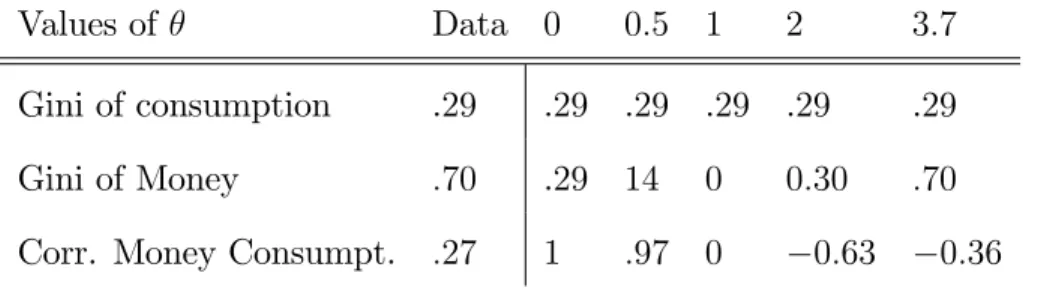
To illustrate, I consider the distribution of consumption of Italian households aged between 35 and 44. I generate …ctitious money distributions with various transaction technologies, using the general form of the transaction technology (1) for various values of . I …nally analyze the distributional properties of the joint distribution of money and consumption.
Table 7: Properties of the Distribution of Money for Di¤erent Transaction Technologies Values of Data 0 0:5 1 2 3:7
Gini of consumption .29 .29 .29 .29 .29 .29
Gini of Money :70 .29 14 0 0:30 :70
Corr. Money Consumpt. :27 1 :97 0 0:63 0:36
Table 7 presents the value of the Gini coe¢ cient and the correlation between money and con-sumption for various values of :For values of less than1, the distribution of money is more equally distributed than is the distribution of consumption. To obtain a more inequal distribution of money, the returns on the transaction technology must be higher than1, but the correlation between money and consumption then becomes negative, which is at odds with the data.
The same type of experiment can be carried out with the US Data. Using the distribution of money, I generate a …ctitious distribution of consumption using (1). I determine the value of for which the distribution of consumption is realistic in terms of the Gini coe¢ cient. Again, we need a value of of over3 to obtain a Gini coe¢ cient above:47, which is the Gini coe¢ cient on income.
Finally, note that the microfoundation of money demand with scale economies in Dotsey and Ireland [19] requires increasing returns to scale to obtain the correct sign on the interest elasticity of money demand.
To summarize, economies of scale in the transaction technology alone can not generate a realistic distribution of money. This is because money is at the same time positively correlated with consump-tion and much more dispersed than consumpconsump-tion levels. The following model proves than we can obtain a realistic distribution of money by focusing on transaction frictions in the …nancial market in addition to the frictions in the goods markets. The correlation between money and consumption will appear as an outcome, rather than as a speci…c utility function imposed on households.
Unobserved Heterogeneity. The discussion above made no reference to unobserved heterogeneity. The relationship between money demand and consumption could indeed take the form
mi =Aici (2)
where any heterogeneity inAi could yield considerable dispersion in money holdings.7 Nevertheless,
explanations based on unobserved heterogeneity are not satisfactory. The extent of unobserved heterogeneity needed to match the data is considerable. Using Italian data, for which data on consumption are available, the Gini coe¢ cient over the Ai coe¢ cients is 0:66, and is thus greater than the Gini coe¢ cient on consumption or income. This value is so high because the correlation between money and consumption is low. As a result, the heterogeneity assumed is of the order of magnitude of the value to be explained. The strategy of this paper is to focus on a structural model to reproduce the distribution of money across households as an equilibrium outcome, without assuming any unobserved heterogeneity.
4
The Model
The economy is populated by a unit mass of households and a representative …rm. There is a consumption-investment good and there are two assets: money and a riskless asset issued by …rms. Time is discrete andt = 0;1; ::denotes the period. There is no aggregate uncertainty, but households face idiosyncratic productivity shocks. These shocks are not insurable, and households can partially self-insure by holding money or riskless assets. Households must pay a …xed cost in terms of the
7This reduced form formulation can be obtained with a MIUF, cash-in-advance or shopping-time framework. (see
…nal good8 to enter the …nancial market in order to adjust their …nancial position, and pay no cost to adjust their monetary holdings. Moreover, households must hold money in order to consume according to a simple transaction technology.
4.1
Households
There is a continuum of length1of in…nitely-lived households who enjoy utility from consumption c
and disutility from hours workedn. For simplicity only, I follow Greenwood, Hercowitz and Hu¤man [22] and Domeij and Heathcote [18] in assuming the following functional form for the period utility function (see also Heathcote [24], for a discussion of the properties of this functional form):
u(c; n) = 1 1 2 4 c n 1+1" 1 + 1=" !1 1 3 5
In this speci…cation,"is the Frisch elasticity of labor supply, scales labor supply, and is the risk-aversion coe¢ cient. In each period, a householdican be in one of three states according to its labor market status. Productivityei
tis then eithere1; e2 ore3. For instance, a household with productivity
e1which worksnthours earns labor income ofe1ntwt, wherewtis the after-tax wage by e¢ ciency unit. Labor productivityeit follows a three-state …rst-order Markov chain with a transition matrix denoted
T. Nt = [Nt1; Nt2; Nt3]0 is the distribution vector of households according to their state on the labor market in period t= 0;1:::. The distribution in period t isN0Tt. Given standard conditions, which
will be ful…lled here, the transition MatrixT has an unique ergodic setN =fN1; N2; N3gsuch that
N T =N . To simplify the dynamics, I assume that the economy starts with the distributionN of households.
The variables ait and mit denote respectively thereal quantity of …nancial assets and money held at the end of periodt 1, and rt is the after-tax real interest rate on the riskless asset between t 1 and t. Note that we denoteai
t+1 and mit+1 as the real quantity of …nancial assets and money chosen
in periodt, for symmetry in the notation. Pt denotes the money price of one unit of the investment-consumption good, and t = Pt=Pt 1 is the gross in‡ation rate between periods t 1 and t. The
real income at thebeginning of period t of a household holding ait and mit is thus mit
t + (1 +rt)a
i t.
Households pay proportional taxes on capital and labor income: capt is the tax rate on capital and lab
t is the tax rate on labor. The variables w~t and r~t are respectively the real wage and the real interest rate before taxes:
wt= 1 labt w~t and rt= (1 capt ) ~rt
In periodt, each household can choose to participate or not in the …nancial market. If the household participates, it pays a cost of and can freely use the total monetary and …nancial resources mit
t +
(1 +rt)at to consume the amount cit; and to save the quantities ait+1 of …nancial assets and mit+1 of
money. If the household does not participate, it can only use its monetary revenuemi
t= tto consume
ci
t and to keep a fractionmit+1 in money. It is assumed that …nancial wealth is reinvested in …nancial
assets:9 ait+1 = (1 +rt)ait. This participation choice is summarized by the dummy variableIti, which equals1 when the household participates and 0otherwise.
Households must hold cash before consuming. I follow Lucas [30] in assuming that …nancial markets and money markets open before the goods market. As a consequence, and with our choice of notation, households face the following cash-in-advance constraint:
ct mt+1
Here mt+1 is the quantity of money decided in period t and is a technology parameter which
re‡ects the consumption velocity of money.10
Note that there are two reasons to hold money in this model. First, money is necessary to consume because of the cash-in-advance constraint: this summarizes the transactions role of money in the goods market. Second, money can be also held for "…nancial motives", which is to avoid the portfolio adjustment cost in …nancial markets.
9This is the standard assumption made by Romer [34] for instance. The quantitative results do not change if
interest is paid in money.
10This timing convention is more convenient here than that of Svensson [39]. In the latter, households must choose
their money holdings one period before consuming. As a consequence, households cannot adjust their money holdings after their idiosyncratic productivity shock, or adjust their consumption within the period, but would be able to adjust their …nancial portfolio. This would create a discrepancy between money and …nancial assets, which is problematic in the context of the current paper.
Last, no private households can issue money mit+1 0, and households face a simple borrowing limit when participating in …nancial markets: ai
t+1 0; for t= 0;1:: and i2[0;1].
The program of householdi can be summarized as follows:
max fmi t+1;ait+1;cit;nit;Itigt=0;1:: E0 1 X t=0 t u cit; nit subject to cit+mit+1+Iti ait+1 (1 +rt)ait+ =e i twtnit+ mi t t 1 Iti ait+1 (1 +rt)ait = 0 ct mt+1 cit; nit; mit+1; ait+1 0; Iti 2 f0;1g ai0; m0i given Recursive Formulation
The program of the households can be written recursively as follows (see Bai [7], for a proof of the existence of Bellman equations in this type of economy). De…neVtpar(ait; mit; eit)as the maximum utility that a household with productivity eit can reach in period t if it participates in …nancial markets at period t and holds amounts mi
t and ait of monetary and …nancial wealth respectively;
Vex
t (ait; mit; eit) is the analogous utility if the household does not participate. The Bellman value Vtpar(ai
t; mit; eit) then satis…es Vtpar mit; ait; eit = max ai t+1;mit+1;nit;cit fu cit; nit + EtmaxfVtpar+1 m i t+1; a i t+1; e i t+1 ; V ex t+1 m i t+1; a i t+1; e i t+1 gg subject to mit+1+ait+1+cit =wteitn i t+ mi t t + (1 +rt)ait ct mt+1 cit; nit; ait+1; mit+1 0
When participating in …nancial markets, the household faces a single budget constraint, where the participation cost has to be paid. The household maximizes its current utility anticipating that next period’s participation decision will be made next period, when next period’s idiosyncratic shock is revealed. The expectation operatorE is then taken over the idiosyncratic shock.
The value Vex t (ait; mit; eit)satis…es Vtex mit; ait; eit = max mi t+1;nit;cit fu cit; nit + EmaxfVtpar+1 mit+1; ait+1; eti+1 ; Vtex+1 mit+1; ait+1; eit+1 gg subject to mit+1+cit = wtetin i t+ mi t t ait+1 = ait(1 +rt) ct mt+1 cit; nit; mit+1 0
When not participating in …nancial markets, the household cannot change its …nancial position, but does anticipate that it may or may not participate next period
Finally, the maximum utility that a household with productivity ei
t and assets mit and ait can reach is Vt mit; a i t; e i t = maxfV par t mit; a i t; e i t ; V ex t m i t; a i t; e i t g
According to this expression, the household either chooses to participate, in which case Ii
t = 1; or not, Ii
t = 0.
The solution of the household’s problem produces a set of optimal decision rules which are func-tions of productivity, the set of assets andE =fe1; e2; e3g:
ct(:; :; :) :R+ R+ E !R+ at+1(:; :; :) :R+ R+ E !R+ mt+1(:; :; :) :R+ R+ E !R+ nt(:; :; :) :R+ R+ E ![0;1] It(:; :; :) :R+ R+ E ! f0;1g 9 > > > > > > > > > > > = > > > > > > > > > > > ; t= 0;1; :::
4.2
Firms
The consumption-investment good is produced by a representative …rm in a competitive market. Capital depreciates at a rate of and is installed one period before production. We denote by Kt andLt the aggregate capital and aggregate e¤ective labor used in production in period t. Output Yt is given by
Y =F (Kt; Lt) = Kt L
1
t ,0< <1 E¤ective labor supply is:
Lt=e1L1t +e2L2t +e3L3t whereL1
t, L2t and L3t is the aggregate labor supply of workers of productivity1;2 and 3respectively. Pro…t maximization yields the following relationships
~
wt = FL0 (Kt; Lt) (3)
~
rt+ = FK0 (Kt; Lt) (4)
wherew~t and r~t are before-tax real wages per e¢ cient unit and the real interest rate.
4.3
Monetary Policy
At each period t, monetary authorities create an amount of new money t. Let Mt be the total amount of nominal money in circulation at the end of period t. The law of motion of the nominal quantity of money is thus
Mt =Mt 1+ t (5)
The real value of the in‡ation tax is thus t=Pt.
I focus below on stationary equilibria where monetary authorities create a quantity of money proportional to the total nominal quantity of money of the previous period, with a coe¢ cient of . In this case t= Mt 1 and the revenue from the in‡ation tax is Mt 1=Pt.
4.4
Government
The Government …nances a public good, which costs Gt units of goods in period t. It receives the in‡ation tax t=Ptand the proportional taxes on capital and labor income, with coe¢ cients capt and
lab
t respectively. It is assumed that the Government does not issue any debt. Its budget constraint is Gt= capt r~tKt+ labt L 1 te 1 t +L 2 te 2 t +L 3 te 3 t w~t+ t Pt (6) whereL1
t, L2t and L3t are total labor supply of type1;2 and 3households respectively.
4.5
Market Clearing
Denote t :R+ R+ E ![0;1]as the joint distribution of households over …nancial assets, money holdings and productivity in periodt. Money and capital market equilibria state that money is held by households at the end of each period, and that …nancial savings are lent to the representative …rm. These can be written as, fort 0 :
Mt = Z R+ R+ E Ptmt+1(a; m; e)d t(a; m; e) (7) Kt+1 = Z R+ R+ E at+1(a; m; e)d t(a; m; e) (8)
Goods-market equilibrium requires that the amount produced is either consumed by the State, in-vested in the …rm, consumed by the households, or destroyed in the transaction cost. This can be written as Gt+Kt+1+ Z R+ R+ E ct(a; m; e)d t(a; m; e) + Z R+ R+ E It(a; m; e)d t(a; m; e) =F (Kt; Lt) + (1 )Kt (9)
4.6
Equilibrium
For a given path of Government spendingfGcapt gt=0::1and money creationf tgt=0::1, an equilibrium
overR+ R+ fe1; e2; e3gfor t= 0::1, sequences of pricesfPtgt=0::1, f!~gt=0::1 and f~rgt=0::1, and
sequences of taxes f lab
t gt=0::1 and f capgt=0::1 such that:
1. The functions ct(:; :; :), at+1(:; :; :); mt+1(:; :; :); nt(:; :; :) It(:; :; :) solve the household’s problem for a sequence of prices fPtgt=0::1,f!~gt=0::1 and fr~gt=0::1, and taxesf labt gt=0::1 and f capgt=0::1.
2. The joint distribution t over productivity and wealth evolves according to the decision rules and the transition matrixT.
3. Factor prices are competitively determined by …rm optimal behavior (3)-(4). 4. The quantity of money in circulation follows the law of motion (5).
5. Markets clear: equations (7)-(9). 6. Tax rates f lab
t gt=0::1 and f capt gt=0::1 are such that the government budget (6) is balanced.
A stationary equilibrium is an equilibrium where the nominal money growth rate, the values
G; lab; cap,r,w, the gross in‡ation rate = Pt
Pt 1, the joint distribution and the decision functions
c(:; :; :), a(:; :; :); m(:; :; :); n(:; :; :) I(:; :; :) are time-invariant. In such an equilibrium, the aggregate
real variables are constant whereas the nominal variables all grow at the same rate.
5
Parameterization
The model period is one quarter. Table 8 summarizes the parameter values at a quarterly frequency in the stationary benchmark equilibrium.
Table 8: Parameter Values
" cap lab
0:36 0:99 117 1 0:3 0:397 0:296 0:015 0:007 0:20 0:035
Preference and …scal parameters
The preference and technology parameters have been set to standard values. The capital share is …xed at = 0:36(Cooley and Prescott [15]) and the depreciation rate is = 0:015, such that the annual depreciation rate is 6% (Stokey and Rebelo [37]). The discount factor is set to 0:99, to obtain a realistic annaul capital-output ratio of around 3. The risk-aversion parameter, , is set to
1. The Frisch Elasticity of labor supply" is estimated to be between0:1 and 1. I use a conservative value of0:3. Given this value, is set such that aggregate e¤ective labor supply is close to0:33. The …scal parameters are calibrated to match the actual tax distortions in the US economy. Following Domeij and Heathcote [18], the average tax rate on capital income cap is 39.7 percent, whereas the average tax rate on labor income lab is 26.9 percent. The implied government consumption to annual output ratio is 0:24, which is a little higher than, but not too dissimilar to, the U.S. average of 0:19 over the 1990-1996 period.
The household productivity process
Di¤erent models of the income process are now used in the literature. Our modeling strategy is to use a simple process which yields realistic distributions for consumption, income and wealth. I consequently use that in Domeij and Heathcote [18], with endogenous labor used at a quarterly frequency. They estimate a three-state Markov process, which reproduces the process for logged labor earnings using PSID data. The Markov chain is estimated under two constraints: (i) The …rst-order autocorrelation in annual labor income is 0:9; and (ii) The standard deviation of the residual in the wage equation is 0:224. These values are consistent with estimations found in the literature (Storesletten, Telmer and Yaron, [38], amongst others).
The transition matrix is
T = 2 6 6 6 6 4 0:974 0:026 0 0:0013 0:9974 0:0013 0 0:026 0:974 3 7 7 7 7 5
The three productivity levels are e1 = 4:74, e2 = 0:848, e3 = 0:17. The long-run distribution of
productivity across the three states is N = [0:045 0:91 0:045]0. This parameterization yields a
realistic distribution of both wealth and consumption, which is very useful for the issue that we address.
Monetary Parameters
The other parameters concern monetary policy and the transaction cost. First, I take the US annual in‡ation rate in 2004, 2:8 percent. Consequently, the quarterly in‡ation rate is = 0:007. The two remaining parameters concern the portfolio adjustment cost and the transaction constraint
. I have optimized over the values of these two parameters to …nd 1) a realistic ratio of aggregate money to aggregate income and 2) a realistic equilibrium money distribution. Money is de…ned as above as the amount in checking accounts in SCF 2004. The ratio of money over income is 8% for households between35 and 44years old. I choose the parameters to obtain a money distribution as close as possible to the empirical one given in Table 6. I …nd a portfolio adjustment cost = 0:2
and a transaction cost = 0:035: A robustness check is provided below. To summarize the results analyzed in detail below, a large value of is necessary to obtain considerable inequality in money holdings. A low but positive transaction parameter is required to reproduce the money holdings of the poorest households. Scaling by average income per capita in the US of $43000, I …nd an annual transaction cost for …nancial markets for the riskless asset of around$1500. To my knowledge, there is no consensus in the empirical literature regarding the level of such costs. The empirical strategy of Mulligan and Sala-i-Martin [32] and Paiella [33] only provides the median cost or the lower bound of the participation cost. Some insights can be obtained from the literature which estimates the cost of participating in the risky-asset market. Vissing-Jorgensen [41] estimates this participation cost to be as high as 1100 dollars in order to understand the transaction decisions of 95% of non-participants, whereas a cost of260 dollars su¢ ces to explain the choices of 75% of non-participants. In consequence, although the cost is towards the top-end of these estimates, it is not inconsistent with current empirical results.
I now present the result of the model. I …rst present the outcome of the general model. I then remove successively the frictions on the goods and on the …nancial markets. This exercise will allow me to quantify the contribution of each motive for total money holdings.
6
Results of the General Model
This section …rst presents the household policy rules and then the properties of the distribution of consumption, income, money and total wealth.
6.1
Households Behavior
Money Holdings. Table 9 …rst represents the quantity of money held by each type of household. The inequality between types is not particularly high. For instance, type 3 households, the low income households, hold a higher fraction of money than their share in the total population. The inequality in money holdings will thus come from the heterogeneity within types of households.
Table 9: Money Holdings pet Type of Agents Agents Type1 Type2 Type3
Fraction of Money 26:3% 68:5% 5:2%
Faction of Pop 4:5% 91% 4:5%
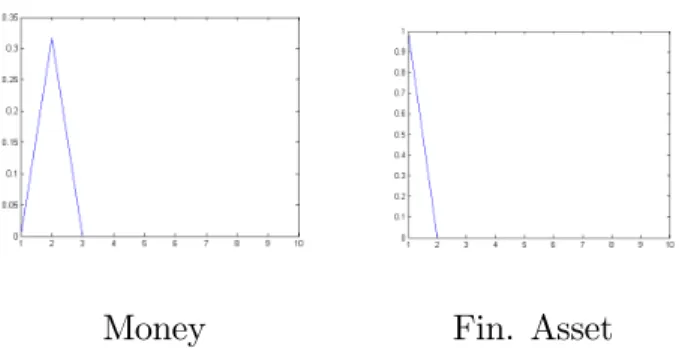
To provide a better understanding of the sources of inequality in money holdings, Figures 2-4 depict the saving behavior in money and …nancial assets of an agent who is always of type1;2 or3
respectively, with the same initial portfolio composed of 1unit of …nancial assets. Note that, in this exercise, household productivity does not change, whereas some change is expected to occur from the transition matrix T. As a consequence, these Figures should be read as particular household histories.
The choice of a type-3 household, which has the lowest labor income, is presented in Figure 2. The household decumulates all …nancial wealth down to 0 in one period. It …rst transfers a part of its wealth into money in the second period and then holds just a small amount of money which is necessary in order to consume, because of the transaction constraint on the goods market. These agents thus hold only little money after a short period.
The portfolio choice of a type-2 household is shown in Figure 3. When a threshold for …nancial assets is reached, the household participates only infrequently. When the household participates in …nancial markets, it replenishes its money holdings by selling …nancial assets. This bu¤er stock is quickly reduced to a small amount consistent with the transaction constraint on the goods market, after 3 periods. Indeed, the opportunity cost of holdings money is high, as its return is negative.
Money Fin. Asset
Figure 2: Portfolio Evolution of type 3 Households
The amount of money held thus exhibits an uneven pattern: only few agents hold a large quantity of money, which explains the inequality in money holdings.
Money Fin. Asset
Figure 3: Portfolio Evolution of Type 2 Households
Finally, in Figure 4, we see that the behavior of a type-1 household, with the highest labor income, consists of di¤erent phases. These households save and accumulate high bu¤er stocks. First, the type-1 household accumulates some money and participates often (every three periods) in the …nancial market to buy some assets. This yields a rapid accumulation of …nancial assets. After a while, the type-1household no longer participates in the …nancial market and only holds the quantity of money necessary to consume because of the transaction constraint. The household lets the amount of …nancial assets accumulate via the interest paid. Third, the households participate in …nancial markets to sell some assets to obtain money and to consume. Fourth, the household holds only …nancial assets, and is then rich enough not to care about the adjustment cost.
In conclusion, households participate infrequently in …nancial markets, which creates inequality in money holdings across households. Moreover, more productive households often hold more money than less productive ones, but this ranking is not constant and depends on household wealth. This will explain the correlation between money and wealth given in the next section.
Money Fin. Asset
Figure 4: Portfolio Evolution of Type 1 Households
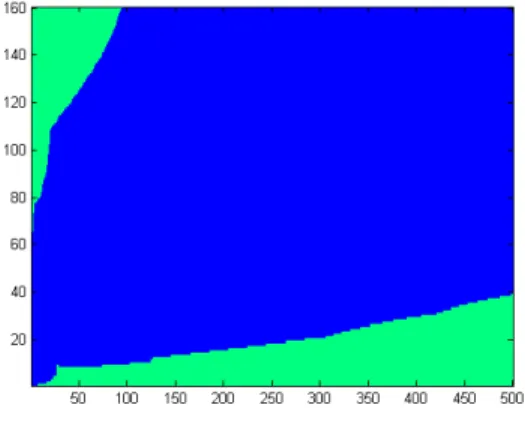
Participation Decisions. Households’participation decisions help to explain infrequent …nancial market participation. Figure 5 represents the participation decision in …nancial markets for type-2 households (which are the most numerous). The decision rule of other agents is discussed below.
Figure 5: Participation Decision of Type 2 Households. a is on thex-axis and m is on they-axis
The graph should be read as follows: The x axis measures the quantity of …nancial assets held at the beginning of the period, denoted bya. They axisrepresents the real quantity of money held at the beginning of the period, denoted bym. Each point on the graph is thus a beginning-of-period portfolio(a; m). The graph plotsI(a; m;2)which is the dummy variable indicating the participation decision. The dark area represents the set of values, (a; m); for which I(a; m;2) = 0, that is the set of initial portfolios for which the household chooses not to participate in …nancial markets. The lighter area represents the set of values (a; m) for which I(a; m;2) = 1, that is the set of portfolios for which households choose to participate in …nancial markets.
Households holding a high quantity of money and a small quantity of …nancial assets (a low,
m low) both participate in …nancial markets. Households who are inbetween do not participate. Households with a large amount of money and few assets participate to actually save in …nancial assets and dis-save money: These households hold a large quantity of money and want to transfer it to their …nancial account to bene…t from the remuneration of …nancial savings. Households with little money and many …nancial assets participate to dis-save in …nancial assets and save in money: These households prefer to increase their money stock in the current period to avoid paying portfolio adjustment costs in the future. There is a large inaction region, where households choose not to participate in …nancial markets. In this case, they smooth consumption only with money and let the remuneration of …nancial savings accumulate on their …nancial account. This participation decision is very similar to those obtained in the (S; s) models …rst studied in Grossman and Laroque [23], among others, with one asset. Households thus hold both money and …nancial assets in equilibrium, although the (marginal) return on money is lower than that on …nancial assets.
Finally, the participation decision of type-1and type-2households are comparable. Type-1 house-holds participate more often to save in …nancial assets and less often to save in money, because they have a higher labor income. The reverse is true for type-3 households.
6.2
The Distribution of Money and Financial Assets
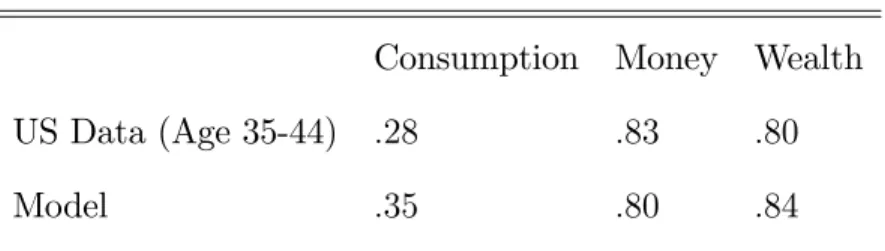
The distribution of consumption, money and …nancial wealth is summarized in Table 10, which presents the associated Gini coe¢ cients.
Table 10: Gini coe¢ cients
Consumption Money Wealth US Data (Age 35-44) :28 :83 :80
Model :35 :80 :84
First note that the model performs quantitatively well in reproducing the inequality in the distri-bution of consumption, income, money and wealth. The Gini of the total wealth distridistri-bution is0:84.
The Gini coe¢ cient for money is0:80, which is similar to that actually observed in the US economy. The Gini coe¢ cient for consumption is a little higher than its empirical counterpart.
Table 11 presents the summary statistics for the distribution of money. The model does a good job in reproducing the distribution of money of the households who hold the lowest quantity of money. The bottom 50% of the population holds 1.7% of the money stock in the US data, whereas it holds 1:3% of the total money stock in the model. Moreover, the bottom 80% of the population holds 12:2% of the money stock in the US data and roughly the same amount, 13:3%, in the model. Although the model is able to reproduce the considerable inequality in money holdings, and thus high Gini coe¢ cients, it does not fully capture the empirical inequality in money holdings at the top of the distribution.11.
Table 11: Money Holding Distribution US, 2004, 35 Age 44
Fract of Pop. 40% 50% 60% 70% 80% 90% 95% US Data 0.9% 1.7% 3.6% 7.1% 12.2% 21.1% 30.8% Model 1.1% 1.3% 1.6% 3.0% 13.3% 35.6% 58%
Table 12 below investigates other distributional properties of the model. As in Table 5 above, the table shows the fraction of wealth and money held by various subpopulations, ranked by their wealth. The right-hand side of the table presents the values produced by the model. For ease of comparison, the left-hand side reproduces the empirical counterparts in the US in 2004. The model performs relatively well in reproducing the wealth and money holdings of the poorest households.
Table 13 presents the correlations between money, income and …nancial wealth generated by the model. The left-hand side shows the values in US data for the relevant age groups, and the right-hand side shows the model results. All of the model correlations have the right signs. Further, the
11The di¢ culty in fully capturing inequality at the top of the distribution is well known in this class of models (see
Table 12: The Distribution of Asset Holdings
US Data, 35 Age 44 Model
Fract. of Wealth Fract. of Checking Fract. of Wealth Fract. of Money Wealth 90-100 70.0% 60.8% 74.6% 26.2%
Wealth 80-100 82.4% 72.6% 91.5% 67.4%
Wealth 0-40 1.0% 5.4% 0.3% 9.3%
correlation between money and wealth is roughly the same in the model (:22) and in the data (:17). Last, the model is able to reproduce the sign of the correlation between wealth and the ratio of money to total wealth, but the negative correlation is too high in the model, 0:32, compared to that in the data, 0:08:
Table 13: Empirical Correlations,
US Data Model Money & Income .12 . Money & Consumption - .43 Money & Wealth .17 .22 (Money/ Wealth) & Wealth -.08 -.32
These results present the best equilibrium money distribution I was able to obtain. Both the …nancial and the transaction motives shape the distribution of money. To see this, the next two Sections close o¤ in turn the …nancial and transaction motives to show how they matter for the distribution of money.
7
Analysis of the frictions on goods and …nancial markets
The previous section has shown that transaction frictions on both goods and …nancial markets can produce a realistic money distribution. In this section, I study each friction separately.
7.1
Frictions on the Goods Market Only
I …rst remove the friction on the …nancial market by setting to0the value of the portfolio-adjustment cost. As a consequence, households hold money only because of the transaction friction on the goods market. The other parameters provided in Table 8 remain unchanged. The resulting distribution of consumption, money and …nancial wealth is summarized in Table 14.
Table 14: Gini coe¢ cients
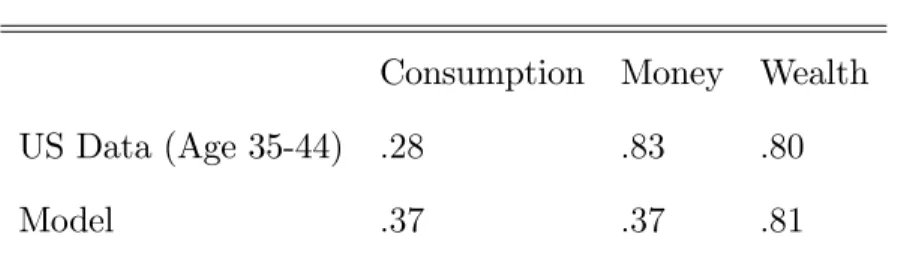
Consumption Money Wealth US Data (Age 35-44) :28 :83 :80
Model :37 :37 :81
As expected, this speci…cation of the model cannot reproduce a realistic distribution of money: the Gini coe¢ cient on money holdings is the same as that on consumption, 0:37. This can be seen in Table 15, which presents the results concerning the money distribution. Money is too equally distributed. For instance, the bottom 50% of the money distribution hold only 1:7% of the money stock in the data as compared to 26% in the model.
This exercise con…rm that introducing only transaction motives for holding money does not Table 15: Money Holding Distribution
US, 2004, 35 Age 44
Fract of Pop. 40% 50% 60% 70% 80% 90% 95% US Data 0.9% 1.7% 3.6% 7.1% 12.2% 21.1% 30.8% Model 17% 26% 32% 40% 51% 64% 77%
produce a satisfactory money distribution. This result is robust to changes in the value of .
7.2
Frictions on Financial Markets Only
I now close the transaction motive by setting = 0. In this economy, households only hold money to avoid the portfolio-adjustment cost in …nancial markets. The other parameters provided in Table
8 remain unchanged. The distribution of consumption, money and …nancial wealth is summarized in Table 16. The model is able to reproduce realistic levels of inequality for consumption, money and wealth. Nevertheless, the underlying shape of the money distribution is not realistic.
Table 16: Gini coe¢ cients
Consumption Money Wealth US Data (Age 35-44) :28 :83 :80
Model :34 :87 :83
Table 17 below shows that too many households do not hold money in this economy. Section 6.1 discussed why this comes about. Households hold money for only a few periods after participating in …nancial markets, because the opportunity cost of holding money is high. They thus rapidly drive their money balances down to 0. Only few households hold large quantities of money, which drives this result. But, as a consequence, too many households do not hold any money.
Table 17: /The Distribution of Money Holding US, 2004, 35 Age 44
Fract of Pop. 40% 50% 60% 70% 80% 90% 95% US Data 0.9% 1.7% 3.6% 7.1% 12.2% 21.1% 30.8% Model 0% 0% 0% 0% 0.2% 24% 51%
The result from the comparison of the two previous economies is that frictions on the goods markets have to be introduced to explain why many households hold a small amount of money. The friction on the …nancial market is necessary to understand why few households hold large amounts of money.
7.3
An Alternative Calibration
This section provides an alternative calibration where transaction motives have a higher weight, to show that this calibration does not match the empirical shape of the money distribution. I consider
a transaction parameter equal to 0:055 and a portfolio adjustment cost of 0:17. The other parameters provided in Table 8 remain unchanged. With these values, I obtain a quantity of money over income equal to 8%. Table 18 presents the new monetary parameters.
Table 18: Parameter Values
0:17 0:055
First, this alternative calibration provides inequality …gures for consumption and …nancial wealth close to those obtained in the benchmark calibration, as can be seen in Table 19. The inequality in money holdings is smaller than that in the data, because the transaction motive has more weight and yields less inequality in money holdings.
Table 19: Gini coe¢ cients
Consumption Money Wealth US Data (Age 35-44) :28 :83 :80
Model :35 :72 :84
This can also be seen in the shape of the money distribution given in Table 20. In this calibration money is too equally distributed. For instance, the …rst80%of money distribution holds 21.3% of the money stock in this calibration, whereas they actually hold 12.2% in the US data. The corresponding …gure was 13.3% in the benchmark calibration.
Table 20: The Money Holding Distribution US, 2004, 35 Age 44
Fract of Pop. 40% 50% 60% 70% 80% 90% 95% US Data 0.9% 1.7% 3.6% 7.1% 12.2% 21.1% 30.8% Model 2% 2.52% 4.26% 10.3% 21.3% 44.3% 64%
I conclude from this exercise that frictions on the goods market must be small enough to produce a high enough …gure for inequality in money holdings.
7.4
A Quanti…cation of Money Demand Motives
I can now provide a quanti…cation of the contribution of each friction to money demand. I can compare the quantity of money obtained in three di¤erent economies: …rst, that in the benchmark economy; second that in the economy with frictions on the goods market only; and third that in the economy with frictions on the …nancial market only.
The results are summarized12 in Table 21. The …rst line refers to the benchmark economy where
both frictions are introduced: = :2; = :0355. The second column gives the value of the real amount of money in this economy: .39:The third column provides the value of the quantity of money over annualized GDP. We here …nd the value of 8%; which was the value targeted. The second line refers to the economy with frictions on the goods market only: = 0. The quantity of money falls to the value of :02, which corresponds to a value of money over GDP of only:5%. The real quantity of money obtained in this economy corresponds to only5:1% of the quantity of money obtained in the benchmark economy. This …rst comparison leads to the conclusion that …nancial frictions represent roughly 95% of total money demand in the benchmark economy.
The third line is the economy with only …nancial motives, where the friction on the goods market has been removed , = 0. We …nd a quantity of money equal to :33, which corresponds to 6:5% of money over GDP. This amount of money corresponds to 85% of the quantity of money obtained in the benchmark economy. This suggests that frictions on the …nancial markets explain 85% of total money demand.
Table 21: Quanti…cation of Money Demand Motives Economies Money Money/GDP
=:2; =:0355 :39 8%
=; =:0355 :02 :5%
=:2; = 0 :33 6:5%
12Quarterly GDP in the three economies are very close to1:25:This allows us to simply compare the value of money
An additional insight from these comparisons is that both frictions interact in a non-linear way. The money obtained when both frictions are introduced is greater than the sum of the quantity of money for each friction separately. Households which go infrequently to …nancial markets have to hold a higher quantity of money when frictions on the goods market are introduced, because they now have to hold more money to be sure of ful…lling the cash-in-advance constraint in future periods. Comparing these three economies, we deduce that the amount of money demanded due to …nancial motives represents between 85% and 95% of the total quantity of money. This result has been anticipated since Section 2, where the empirical money distributions were presented: considerable departures from the transaction motive on the goods market are necessary to reproduce both high inequality in money holdings and low inequality in consumption.
8
Conclusion
I …rst document that the distribution of money across households is similar to the distribution of …nancial assets, and very di¤erent from the distribution of consumption. This fact appears as a puzzle for theory of money demand which directly links money demand and consumption. The contribution of this paper is to show that the distribution of money can be reproduced as an equilibrium outcome when transaction frictions are introduced on both the goods and …nancial markets. The friction on the goods market is a standard cash-in-advance constraint, and the friction on the …nancial markets is a portfolio adjustment, as in the Baumol-Tobin literature.
It is shown that both motives are necessary to obtain a realistic shape of the money distribution and a high value of inequality in money holdings. The transaction motive is necessary to explain why many people hold a small amount of money. The …nancial motive appears important to explain why a few people hold large amounts of money. Considering the transaction and the …nancial motives in turn, it is found that the …nancial motive alone explains more than 85% of the quantity of money in circulation. One path for future research would be to search for simple shortcuts to introduce …nancial frictions in simpler macroeconomic models.
A
Appendix
A.1
Equilibrium Values
The following table provides the equilibrium values of the model, at quarterly frequency
K M Y C L r w
14:69 0:39 1:25 0:67 0:31 0:95% 1:87
A.2
Computational Strategy
The computational strategy for the stationary equilibrium of the type of model used in this paper is now well-de…ned. I describe here the main steps.
1) I …rst consider a given real interest rate r and tax rates over labor lab and capital cap. These de…ne the post-tax real interest rate and wage, r and w.
2) I then iterate over the six value functions fVjpar(:; :; e); Vex
j (:; :; e)ge=1;2;3, using the
value-function iteration procedure, as previously used in Algan and Ragot (2010). This method is known to be slow but does not require di¤erentiability, which is not ensured in this model. More precisely, I iterate over the value functions,fVjpar(:; :; e); Vex
j (:; :; e)ge=e1;e2;e3 solving the following maximization,
for e=e1; e2; e3: Vjpar+1(m; a; e) = max a0;m0;n;cfu(c; n) + EmaxfVjpar(m0; a0; e0); Vjex(m0; a0; e0)gg m0+a0+c=wen+m + (1 +r)a c m0 and c; n; a0; m0 0
and Vjex+1(m; a; e) = max m0;n;cfu(c; n) + EmaxfVjpar(m0; a0; e0); Vjex(m0; a0; e0)gg m0 +c = wen+ m a0 = a(1 +r) ct m0 and c; n; m0 0
I …rst solve the maximizations assuming that the cash-in-advance constraint c m0 does not
bind. If it is not the case, I solve the maximizations imposing c= m0.
To initialize the process I simply set V0par(:; :; :) =Vex
0 (:; :; :) = 0. Note that the in‡ation rate
is given and is an exogenous parameter.
I consider 20 800 portfolios values for(m; a), and the maximization over m0; a0 is taken over a square grid with 18000 720000 values. Convergence is ensured when Vj (:; :; e) Vj+1(:; :; e) <
10 5 for all e =e
1; e2; e3 and all =par; ex. After convergence, I can extrapolate policy functions
using the optimal value functions.
3) I …nd the stationary distribution by iterating the policy functions. I …rst consider a initial distribution j over a grid of initial portfolios and agent types(m; a; e). I then apply the policy rules to each portfolio and the transitions probabilities over types T to obtain a new distribution j+1 (m0; a0; e);. When a targeted portfolio(m0; a0) is not on the grid, I reallocate it to its three closest portfolios. Convergence is obtained whenk j+1(:; :; e) j(:; :; e)k<10 6 for e=e1; e2; e3.
4) After convergence, I can compute the ex-post capital stock and the real interest rate. Moreover, using the budget constraint of the State (6), I can deduce the level of public spending. I iterate over
r and the taxes cap to lab until the capital market clears. I check that the level of public spending is realistic.
References
[1] Algan, Yann and Xavier Ragot (2010), "Monetary Policy with Heterogenous Agents and Bor-rowing Constraints", Review of Economic Dynamics, 13(2), 295-316.
[2] Akyol, Ahmet. 2004. "Optimal monetary policy in an economy with incomplete markets and idiosyncratic risk",Journal of Monetary Economics, 51(6): 1245-1269.
[3] Alvarez, Fernando, Andrew Atkeson and Patrick J. Kehoe. 2002. "Money, Interest Rates, and Exchange Rates with Endogenously Segmented Markets.",Journal of Political Economy, 110(1): 73-112.
[4] Alvarez, Fernando and Francesco Lippi, (2007). "Financial Innovation and the Transactions Demand for Cash",Econometrica, 77(2): 363-402.
[5] Attanazio, Orazio, Luigi Guiso and Tulio Jappelli. 2002. "The Demand for Money, Financial Innovation and the Welfare Cost of In‡ation: An Analysis with Household Data", Journal of Political Economy, 110(2): 317-351.
[6] Attanasio, Orazio, Erich Battistin and Hidehiko Ichimura. 2004. "What really happened to consumption inequality in the US?", NBER Working Paper 10228.
[7] Bai, Jinhui. 2005. "Stationary Monetary Equilibrium in a Baumol-Tobin Exchange Economy: Theory and Computation", Georgetown University Working Paper.
[8] Baumol, William. 1952. "The Transaction Demand for Cash: An Inventory Theoretic Ap-proach", Quarterly Journal of Economics, 66(4): 545-556.
[9] Bewley, Truman. 1980. "The optimum quantity of money", In: Kareken, J.H, Wallace, N., (Eds),
M