E. Corchado et al. (Eds.): IDEAL 2006, LNCS 4224, pp. 1337–1345, 2006. © Springer-Verlag Berlin Heidelberg 2006
Fuzzy Rules
James F. Smith III and ThanhVu H. Nguyen
Code 5741 Naval Research Laboratory Washington, DC, 20375-5320
Abstract.A data mining procedure for automatic determination of fuzzy deci-sion tree structure using a genetic program is discussed. A genetic program (GP) is an algorithm that evolves other algorithms or mathematical expressions. Methods for accelerating convergence of the data mining procedure are exam-ined. The methods include introducing fuzzy rules into the GP and a new inno-vation based on computer algebra. Experimental results related to using com-puter algebra are given. Comparisons between trees created using a genetic program and those constructed solely by interviewing experts are made. Con-nections to past GP based data mining procedures for evolving fuzzy decision trees are established. Finally, experimental methods that have been used to validate the data mining algorithm are discussed.
Keywords: Genetic Programs, Fuzzy Logic, Data Mining, Control Algorithms, Planning Algorithms.
1 Introduction
Two fuzzy logic based resource managers (RMs) have been developed that automati-cally allocate resources in real-time [1-3]. Both RMs were evolved by genetic pro-grams (GPs). The GPs were used as data mining functions. Both RMs have been subjected to a significant number of verification experiments.
The most recently developed RM is the main subject of this paper. This RM auto-matically allocates unmanned aerial vehicles (UAVs) that will ultimately measure atmospheric properties in a cooperative fashion without human intervention [2,3]. This RM will be referred to as the UAVRM. It consists of a pre-mission planning algorithm and a real-time control algorithm that runs on each UAV during the mission allowing the UAVs to automatically cooperate.
The previous RM was evolved to control electronic attack functions distributed over many platforms [1]. It will be referred to as the electronic attack RM (EARM).
This paper introduces many novel features not found in the literature. These in-clude several new approaches for improving the convergence of the genetic program that evolves control and planning logic. Such procedures involve the use of symbolic algebra techniques not previously explored, a terminal set that includes both fuzzy concepts and their complements, the use of fuzzy rules, etc. The control algorithm
evolved by a GP is compared to one created through expertise. Experiments to vali-date the evolved algorithm are discussed.
Section 2 gives a brief discussion of fuzzy decision trees (FDTs), how FDTs are used in the UAVRM, genetic programs and GP based data mining (DM). Section 3 describes the UAVRM’s FDT that assign UAVs to paths. Section 4 examines how a fuzzy decision tree for the UAVRM was created through GP based data mining. Sec-tion 5 discusses experiments that have been conducted to validate the FDT that as-signs UAVs to paths (AUP). Finally, section 6 provides a summary.
2 Fuzzy Decision Trees and Genetic Program Based Data Mining
The particular approach to fuzzy logic used by the UAVRM is the fuzzy decision tree [1-5]. The fuzzy decision tree is an extension of the classical artificial intelligence concept of decision trees. The nodes of the tree of degree one, the leaf nodes are la-beled with what are referred to as root concepts. Nodes of degree greater than unity are labeled with composite concepts, i.e., concepts constructed from the root concepts [6,7] using logical connectives and modifiers. Each root concept has a fuzzy mem-bership function assigned to it. Each root concept memmem-bership function has parame-ters to be determined. For the UAVRM, the parameparame-ters were set based on expertise.
The UAVRM consists of three fuzzy decision trees. Only the creation of the FDT by GP based data mining for assigning UAVs to paths will be considered in this paper. This FDT is referred to as the AUP tree; and the associated fuzzy concept, as AUP. The AUP tree makes use of the risk tree which is discussed in the literature [2, 3].
Data mining is the efficient extraction of valuable non-obvious information em-bedded in a large quantity of data [8]. Data mining consists of three steps: the con-struction of a database that represents truth; the calling of the data mining function to extract the valuable information, e.g., a clustering algorithm, neural net, genetic algo-rithm, genetic program, etc; and finally determining the value of the information ex-tracted in the second step, this generally involves visualization.
In a previous paper a genetic algorithm (GA) was used as a data mining function to determine parameters for fuzzy membership functions [7]. Here, a different data min-ing function, a genetic program [9] is used. A genetic program is a problem inde-pendent method for automatically evolving computer programs or mathematical expressions.
The GP data mines fuzzy decision tree structure, i.e., how vertices and edges are connected and labeled in a fuzzy decision tree. The GP mines the information from a database consisting of scenarios.
3 UAV Path Assignment Algorithm, the AUP Tree
Knowledge of meteorological properties is fundamental to many decision processes. The UAVRM enables a team of UAVs to cooperate and support each other as they measure atmospheric meteorological properties in real-time. Each UAV has onboard its own fuzzy logic based real-time control algorithm. The control algorithm renders each UAV fully autonomous; no human intervention is necessary. The control algo-rithm aboard each UAV will allow it to determine its own course, change course to
avoid danger, sample phenomena of interest that were not preplanned, and cooperate with other UAVs.
The UAVRM determines the minimum number of UAVs required for the sampling mission. It also determines which points are to be sampled and which UAVs will do the sampling. To do this, both in the planning and control stages it must solve an op-timization problem to determine the various paths that must be flown. Once these paths are determined the UAVRM uses the AUP fuzzy decision tree to assign UAVs to the paths.
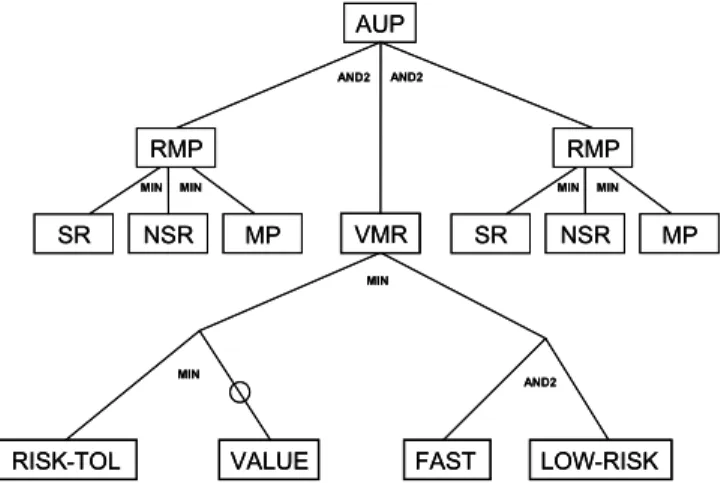
The AUP fuzzy decision tree is displayed in Figure 1. The various fuzzy root con-cepts make up the leaves of the tree, i.e., those vertices of degree one. The vertices of degree higher than one are composite concepts.
Starting from the bottom left of Figure 1 and moving to the right, the fuzzy con-cepts “risk-tol,” “value”, “fast,” and “low risk,” are encountered. These concon-cepts are developed in greater mathematical detail in the literature [2,3]. The fuzzy concept “risk-tol” refers to an individual UAV’s risk tolerance. This is a number assigned by an expert indicating the degree of risk the UAV may tolerate. A low value near zero implies little risk tolerance, whereas, a high value near one implies the UAV can be subjected to significant risk.
The concept “value” is a number between zero and one indicating the relative value of a UAV as measured against the other UAVs flying the mission. The concept “value” changes from mission to mission depending on which UAVs are flying.
MP MP RISK-TOL VALUE MIN FAST LOW-RISK AND2 VMR MIN RMP SR NSR MP MIN MIN RMP SR NSR MIN AUP MIN AND2 AND2 RISK-TOL VALUE MIN FAST LOW-RISK AND2 VMR MIN RMP SR NSR MP MIN MIN RMP SR NSR MIN AUP AND2 AND2 MIN
Fig. 1. The AUP subtree for the UAVRM
The concept “fast” relates to how fast the UAV is and builds in measures of the UAV’s reliability estimates as well as its risk tolerance and the mission’s priority.
The rightmost concept is “low risk.” It quantifies experts’ opinions about how risky the mission is. It takes a value of one for low risk missions and a value near zero for high risk missions.
These four fuzzy root concepts are combined through logical connectives to give the composite concept “VMR.” Although four concepts are now used to construct
VMR it originally only used the concepts related to value and mission risk, and was called the Value-Mission-Risk (VMR) subtree.
Each vertex of the “VMR” tree uses a form of “AND” as a logical connective. In fuzzy logic, logical connectives can have more than one mathematical form. Based on expertise it was useful to allow two types of ANDs to be used. The two mathe-matical forms of AND used are the “min” operator and the algebraic product denoted in Figure 1 as “AND2.” When a “min” appears on a vertex then the resulting com-posite concept arises from taking the minimum between the two root concepts con-nected by the “min.” When an “AND2” appears it means that the resulting composite concept is the product of the fuzzy membership functions for the two concepts con-nected by the AND2.
The final subtree of AUP that needs to be described is the reliability-mission prior-ity (RMP) subtree. The RMP tree appears twice on the AUP tree. RMP consists of a “min” operation between three fuzzy concepts. These concepts are “sr” which refers to an expert’s estimate of the sensor reliability, “nsr” which refers to an expert’s esti-mate of the non-sensor system reliability and “MP” a fuzzy concept expressing the mission’s priority.
The AUP tree is observed to consist of the VMR subtree and two copies of the RMP subtree with AND2 logical connectives at each vertex. These fuzzy concepts and their related fuzzy membership functions, as well as additional details are given in much greater detail in [2, 3].
The AUP tree given in Figure 1 was originally created using human expertise alone. The rediscovery of this tree using GP based data mining is described in the next section.
4 GP Creation of the AUP Tree
The terminal set, function set, and fitness functions necessary for the GP to be used as a data mining function to automatically create the AUP tree are described below. The terminal set used to evolve the AUP tree consisted of the root concepts from the AUP tree and their complements. The terminal set, T, is given by
T={risk-tol, value, fast, low-risk, sr, nsr, MP, not-risk-tol, not-valuable,
not-fast, not-low-risk, not-sr, not-nsr, not-MP}. (1) Let the corresponding fuzzy membership functions be denoted as
{
}
. , , , , , , , , , , , , , MP not nsr not sr not risk low not fast not valuable not tol risk not MP nsr sr risk low fast value tol risk − − − − − − − − − − − μ μ μ μ μ μ μ μ μ μ μ μ μ μ … … (2)When mathematical expressions are constructed by a GP that reproduce the entries in a database within some tolerance, the process is referred to as symbolic regression [10]. It is found in symbolic regression that candidate solutions are frequently not in algebraic simplest form and this is the major source of their excess length. When candidate solutions are too long this is referred to as bloat [10].
By including in the terminal set a terminal and its complement, e.g., “risk-tol,” and “not-risk-tol”; “value” and “not-valuable”; etc., it is found that bloat is less and con-vergence of the GP is accelerated. This is a recent innovation which was not used when the EARM was evolved using GP based data mining (DM) [1]. Additional bloat control procedures are described below.
The mathematical form of the complement whether it appears in the terminal set or is prefixed with a “NOT” logical modifier from the function set is one minus the membership function. To make this more explicit
( )A not A A
NOT
μ
μ
μ
=
−=
1
−
, (3)where NOT(A) refers to the application of the logical modifier NOT from the function set to the fuzzy concept A from the terminal set. The notation, not-A refers to the ter-minal which is the complement of the terter-minal A.
The function set, denoted as F, consists of
F={AND1, OR1, AND2, OR2, NOT}, (4)
where the elements of (4) are defined in (5-9). Let A and B represent fuzzy member-ship functions then elements of the function set are defined as
( )
A,B min( )
A,B 1 AND = ; (5)( )
A,B max( )
A,B 1 OR = ; (6)( )
A,B A B 2 AND = ⋅ ; (7)( )
A,B A B A B 2 OR = + − ⋅ ; (8) and( )
A 1 A NOT = − . (9) The database to be data mined is a scenario database kindred to the scenario data-base used for evolving the EARM [1]. In this instance scenarios are characterized by values of the fuzzy membership functions for the elements of the terminal set plus a number from zero to one indicating the experts’ opinion about the value of the fuzzy membership function for AUP for that scenario.GPs require a fitness function [9]. As its name implies the fitness function meas-ures the merit or fitness of each candidate solution represented as a chromosome. The fitness used for data mining is referred to as the input-output fitness.
The input-output fitness for mining the scenario database takes the form
(10)
where ejis the jth element of the database; ndb is the number of elements in the
data-base; μgp(ej) is the output of the fuzzy decision tree created by the GP for the ith
element of the population for database element ej; and μexpert(ej) is an expert’s estimate
as to what the fuzzy decision tree should yield as output for database element ej.
( )
( )
. 1 exp,
2
1
1
)
,
(
∑
−
⋅
+
≡
= db n j gp j ert j db IOe
e
i
n
i
f
μ
μ
The AUP tree is evolved in three steps. The first step involves evolving the VMR subtree; the second step, the RMP subtree and the final step, the full AUP tree. In the second and third steps, i.e., evolving the RMP subtree and full AUP tree from the RMP and VMR subtrees, only the input-output (IO) fitness in (10) is calculated, i.e., the rule-fitness described below is not used.
When evolving the VMR subtree a rule-fitness is calculated for each candidate so-lution. Only when the candidate’s rule fitness is sufficiently high is its input-output fitness calculated. The use of the rule-fitness helps guide the GP toward a solution that will be consistent with expert rules. Also the use of the rule fitness reduces the number of times the IO fitness is calculated reducing the run time of the GP. After some preliminary definitions of crisp and fuzzy relations, a set of crisp and fuzzy rules that were used to help accelerate the GP’s creation of the VMR subtree are given. The rules are combined to formulate the rule fitness. The mathematical form of the rule fitness has not been included due to space limitations.
Let T be a fuzzy decision tree that represents a version of the VMR subtree, that is to be evolved by a genetic program. Let Aand Bbe fuzzy concepts. Then let
(
T,A,B)
1share =
γ if Aand Bshare a logical connective denoted as C and
(
T,A,B)
0share =
γ , otherwise.
Furthermore, define the fuzzy relation
(
)
⎪⎩ ⎪ ⎨ ⎧ = = = otherwise OR or OR C if AND or AND C if C B A T com , 0 2 1 1 . 0 2 1 4 . 0 , , , μ . (11)The following is a subset of the rules used to accelerate the GP’s convergence and to help produce a result consistent with human expertise.
R1. “not-valuable” and “risk-tol” must share a logical connective, denoted as C1, i.e., it is desired that γshare
(
T,not−valuable,risk−tol)
=1R2. “not-valuable” and “risk-tol” strongly influence each other, so they should be connected by AND1 or AND2. So it is desired that
(
T,not−valuable,risk−tol,C1)
=.4com μ
R3. “fast” and “low-risk” have an affinity for each other. They should share a logical connective, denoted asC2, i.e., it is desired that γshare
(
T,fast,low−risk)
=1R4. The fuzzy root concepts “fast” and “low-risk” strongly influence each other, so they should be connected by AND1 or AND2. So it is desired that
(
T,fast,low−risk,C2)
=.4com
μ .
R5. There is an affinity between the fuzzy root concepts C1
(
not−valuable,risk−tol)
and C2
(
fast,low−risk)
, they are connected by a logical connective denoted as C3, i.e., it is desired that,(
) (
)
(
T,C1 not valuable,risk tol ,C2 fast,low risk)
1share − − − =
When the EARM was evolved by GP based data mining [1] bloat was controlled using adhoc procedures based on tree depth and parsimony pressure. Most of the bloat in evolving mathematical expressions with a GP arises from the expressions not being in algebraic simplest form [10]. With that observation in mind, computer alge-bra routines have been introduced that allow the GP to simplify expressions. The following is a partial list of algebraic simplification techniques used during the evolu-tion of the EARM and the AUP tree. The simplificaevolu-tion routines used when evolving AUP are more sophisticated than those applied to the creation of EARM [1].
One routine simplifies expressions of the form NOT(NOT(A)) = A. This can be more complicated than it initially appears, since the NOT logical modifiers can be separated on the fuzzy decision tree.
Another simplification procedure consists of eliminating redundant terminals con-nected by an AND1 logical connective. An example of this is AND1(A,A) =A. Like the case with the logical modifier NOT there can be a separation between the AND1s and the terminals that add complexity to the simplification operation.
The third algebraic simplification example is like the second. It involves simplify-ing terminals connected by OR1s. Like AND1, separation between terminals and OR1 can increase the complexity of the operation.
Other types of algebraic simplification use DeMorgan’s theorems in combination with the above procedures. This can significantly reduce the length of an expression.
Another algebraic procedure that reduces the length of expressions includes re-placement of forms like AND2(A,A) by the square of “A,” i.e., A2. Still another length reducing simplification includes replacing NOT(A) with not-A, its complement from the terminal set listed in (1).
(1,1) (2,1) (3,1) (4,1) (5,2) (6,2) (7,2) (9,2) AL T IT U DE (m ile s) 0 2 4 6 8 10 12 14 0 5 10 15 20 25 30 35 40 45 50 RANGE (miles) PLANNING PHASE (8,2) UAV 1 path Base Taboo pt Sample pt Index, priority degree (a,b) UAV 2 path 1.0 .50 .75 (1,1) (2,1) (3,1) (4,1) (5,2) (6,2) (7,2) (9,2) AL T IT U DE (m ile s) 0 2 4 6 8 10 12 14 0 5 10 15 20 25 30 35 40 45 50 RANGE (miles) PLANNING PHASE (8,2) UAV 1 path Base Taboo pt Sample pt Index, priority degree (a,b)
UAV 2 path
1.0 .50 .75
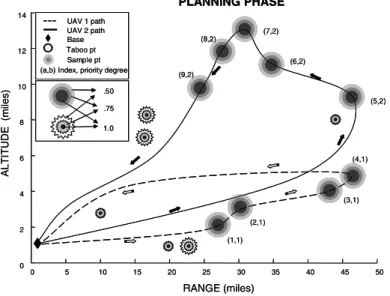
Fig. 2. Trajectory of two UAVs as determined by the planning algorithm and their paths as-signed by AUP
There is always a question of how much algebraic simplification should be con-ducted from generation to generation as such the simplification algorithm allows lev-els of simplification. If a low level of simplification is selected then some parts of an expression remain that might be eliminated during full simplification. This has two advantages: it leaves chromosome subcomponents that may prove useful during muta-tion or crossover and it takes less CPU time.
Algebraic simplification produces candidate solutions in simpler form making it easier for human observers to understand what is being evolved. Having candidate solutions that are easier to understand can be an important feature for improving the evolution of GPs.
5 Computational Experiments
The AUP tree described above has been the subject of a large number of experiments. This section provides a description of an experiment that is representative of the type of scenarios designed to test the AUP tree. Due to space limitations only an experi-ment involving two UAVs is discussed.
In Figure 2 a scenario using two UAVs illustrates how AUP properly assigns the UAVs to the best path. The two paths were created by the planning algorithm so that the UAV could most efficiently sample the atmosphere’s electromagnetic index of refraction [2, 3].
Sample points are labeled by concentric circular regions colored in different shades of gray. The lighter the shade of gray used to color a point, the lower the point’s grade of membership in the fuzzy concept “desirable neighborhood.” [2, 3] The leg-end provides numerical values for the fuzzy grade of membership in the fuzzy con-cept “desirable neighborhoods.” If the fuzzy degree of desirability is high then the index of refraction is considered to be close to the index of refraction of the sample point at the center of the desirable neighborhood. This allows the UAV to make sig-nificant measurements while avoiding undesirable neighborhoods.
Each sample point is labeled with an ordered pair. The first member of the ordered pair provides the index of the sample point. The second member of the ordered pair provides the point’s priority. For example, if there are nspsample points and the
th
q sample point is of priority p, then that point will be labeled with the ordered pair (q,p).
Points surrounded by star-shaped neighborhoods varying from dark grey to white in color are taboo points. As with the sample points, neighborhoods with darker shades of gray have a higher grade of membership in the fuzzy concept “undesirable neighborhood.” The legend provides numerical values for the fuzzy grade of mem-bership in the fuzzy concept “undesirable neighborhood.” UAVs with high risk toler-ance may fly through darker grey regions than those with low risk tolertoler-ance.
UAVs start their mission at the UAV base which is labeled with a diamond-shaped marker. They fly in the direction of the arrows labeling the various curves in Figure 2.
Figure 2 depicts the sampling path determined by the planning algorithm for an ex-periment involving two UAVs. The first, UAV(1) follows the dashed curve; the sec-ond, UAV(2), the solid curve. The UAVs were assigned to the different paths by the
AUP fuzzy decision tree described in section 2. UAV(1) is assigned to sample all the highest priority points, i.e., the priority one points. UAV(2) samples the lower prior-ity points, i.e.; those with priorprior-ity two. Due to the greedy nature of the point-path assignment algorithm, the highest priority points are assigned for sampling first.
6 Summary
A genetic program (GP) has been used as a data mining (DM) function to automati-cally create decision logic for two different resource managers (RMs). The most re-cent of the RMs, referred to as the UAVRM is the topic of this paper. It automatically controls a group of unmanned aerial vehicles (UAVs) that are cooperatively making atmospheric measurements.
The DM procedure that uses a GP as a data mining function to create a subtree of UAVRM is discussed. The resulting decision logic for the RMs is rendered in the form of fuzzy decision trees. The fitness function, bloat control methods, data base, etc., for the tree to be evolved are described. Innovative bloat control methods using computer algebra based simplification are given. A subset of the fuzzy rules used by the GP to help accelerate convergence of the GP and improve the quality of the results is provided. Experimental methods of validating the evolved decision logic are dis-cussed to support the effectiveness of the data mined results.
References
1. Smith, III, J. F.: Fuzzy logic resource manager: decision tree topology, combined admissible regions and the self-morphing property, In: Kadar, I. (ed.): Signal Processing, Sensor Fu-sion, and Target Recognition XII: Vol. 5096, SPIE Proceedings, Orlando (2003) 104-114. 2. Smith, III, J. F., Nguyen, T., H.: Distributed autonomous systems: resource management,
planning, and control algorithms, In: Kadar, I. (ed.): Signal Processing, Sensor Fusion, and Target Recognition XIV: Vol. 5096, SPIE Proceedings, Orlando (2005) 65-76.
3. Smith, III, J. F., Nguyen, T., H.: Resource manager for an autonomous coordinated team of UAVs, In: Kadar, I. (ed.): Signal Processing, Sensor Fusion, and Target Recognition XV: 62350C, SPIE Proceedings, Orlando (2006) 104-114.
4. Blackman, S., Popoli, R.: Design and Analysis of Modern Tracking Systems. Artech House, Boston (1999)
5. Tsoukalas, L.H., Uhrig, R.E.: Fuzzy and Neural Approaches in Engineering: John Wiley and Sons, New York (1997)
6. Zimmerman, H. J.:Fuzzy Set Theory and its Applications. Kluwer Academic Publishers Group, Boston (1991)
7. Smith, III, J.F., Rhyne, II, R.: A Resource Manager for Distributed Resources: Fuzzy De-cision Trees and Genetic Optimization. In: Arabnia, H. (ed.): Proceeding of the Interna-tional Conference on Artificial Intelligence, IC-AI’99, Vol. II. CSREA Press, Las Vegas (1999) 669-675.
8. Bigus, J.P.: Data Mining with Neural Nets. McGraw-Hill, New York, (1996).
9. Koza, J.R., Bennett III, F.H.: Andre, D., Keane, M.A.: Genetic Programming III: Darwin-ian Invention and Problem Solving. Morgan Kaufmann Publishers, San Francisco (1999). 10. Luke, S., Panait, L.: Fighting Bloat with Nonparametric Parsimony Pressure. In: Guervos,
J.J.M (ed.): Parallel Problem Solving from Nature - PPSN VII, 7th International Confer-ence. Proceedings. LNCS Vol. 2439, Springer-Verlag, Berlin, (2002) 411-421.