c
°Rinton Press
MODEL-DRIVEN WEB USAGE ANALYSIS
FOR THE EVALUATION OF WEB APPLICATION QUALITY
PIERO FRATERNALI, PIER LUCA LANZI, MARISTELLA MATERA, ANDREA MAURINO
Dipartimento di Elettronica e Informazione - Politecnico di Milano, Piazza L. da Vinci, 32 20133 - Milano - Italy
[fraterna,lanzi,matera,maurino]@elet.polimi.it
Received March, 2004 Revised October 31, 2004
So far, conceptual modeling of Web applications has been used primarily in the upper part of the life cycle, as a driver for system analysis. Little attention has been put on exploiting the conceptual specifications developed during analysis for application evalu-ation, maintenance and evolution. This paper illustrates an approach for integrating the use of conceptual models in the lower part of the application life cycle. The approach is based on the adoption of conceptual logs, which are Web usage logs enriched with meta-data deriving from the application conceptual specifications. In particular, the pa-per illustrates how conceptual logs are generated and exploited in Web usage evaluation and mining, so as to achieve a deeper and systematic quality evaluation of Web applica-tions. A prototype tool supporting the generation of conceptual logs and the evaluation activities is also presented.
Keywords: Web Usage Analysis, Web Usage Mining, Quality Evaluation, Conceptual Modeling, WebML.
Communicated by: R Baeza-Yates 1 Introduction
Current Web applications are very complex and high sophisticated software products, whose quality, as perceived by users, can heavily determine their success or failure. A number of methods have been proposed for evaluating their usability [21]. Some of them focus on analyzing the correctness and consistency of design specifications [19, 23]. Such techniques certainly allow designers to improve the quality of the final product. However, they focus on a static description of the application, and do not take into account dynamic usage aspects, that can be only revealed by monitoring and analyzing the behavior of users interacting with the application. On the other hand, a menagerie of products exists that permits Web masters to analyze the Web server logs and extract information on application usage [21]. However, these tools are unaware of the conceptual schema of the application (if its specification does exist), and thus understanding the relationships between the tool’s output and the structure of the application is a non-trivial task, especially if the application is large and complex.
The main contribution of this paper is a model-driven framework that integrates the model-based design and development of Web applications with quality evaluation, based on the static (i.e., compile-time) analysis of conceptual schemas and on the dynamic (i.e.,
time) collection of Web usage data that are automatically analyzed and contrasted with the conceptual schema of the application.
In some previous papers [10, 18], we have shown how, given the conceptual schema of a Web application, it is possible to automatically analyze it with respect to some attributes for the quality of conceptual specifications, and anticipate at design time the identification of weaknesses that reduce the usability of the final application. In this paper we concentrate more on the analysis of usage data, dynamically collected during the Web application’s life.
The main novelty of our work with respect to previous approaches to Web usage analysis is the integration of common Web logs with additional log data, related to hypertext components the users interact with (from basic content units to pages and to areas clustering pages), and the contents dynamically extracted from the application data source for populating such components. The resulting log data are called conceptual logs, because the enrichment is operated through the integration of concepts deriving from the application conceptual schema. They are specified in XML, and are analyzed by an XSL-enabled tool, which is also fed with the XML representation of the conceptual schema of the application. The tool is therefore able to interpret the log conceptual enrichments, and provide feedbacks to the conceptual designer by referencing explicitly conceptual schemas produced during model-driven design.
Our model-driven approach is therefore based on the adoption of conceptual models for application design and development. So far, its experimentation has been conducted over Web applications developed with WebML (Web Modeling Language) [7], a modeling language for data-intensive Web applications, and its supporting CASE tool, WebRatio [8]. However, we believe that the illustrated results are of general validity and apply to any application that has been designed using a model-driven approach, provided that the conceptual schema is available and the application runtime architecture permits the collection of customized log data.
The paper is organized as follows: Section 2 introduces the motivation behind our work, and illustrates some background concepts about the WebML model and its associated de-velopment process. Section 3 introduces our evaluation framework, by shortly describing the Design Schema Analysis, the original core of the framework, and then introducing the
Web Usage Analysistechnique, able to elaborate rich log data for verifying design soundness against user behavior, and theWeb Usage Miningtechnique, able to extract interesting asso-ciations and sequential patterns from the same rich logs. Section 4 illustrates the architecture of the software tool supporting the automatic execution of the three evaluation techniques. Section 5 shows the framework at work for the evaluation of webml.org, the official Web site of the WebML team. Section 6 illustrates the main features of some relevant related works. Finally, Section 7 draws our conclusions.
2 Rationale and background
Modern software development methodologies advocate an agile approach, whereby a small team of designers works side by side with the application stakeholders to implement fast prototypes and evolve them into an application that meets the user’s requirements [22, 11]. This process demands for pervasive evaluation, in an iterative process enabling the continuous identification of modifications necessary to cope with changed or new requirements. Since the boundary between the development phase and the operational life of applications is fuzzy,
evaluation is required both at design time, through inspection methods that reason on the application design, and after application deployment, when real usage data become available. Iterative development methods have gained substantial benefits from the application of conceptual modeling techniques, which let developers express application requirements and/or design schemas at a high level, and automatically generate (part of) the application code [7, 20, 27]. However, the conceptual specification resulting from the initial design activities are rarely used to support quality assessment, due to the lack of model-driven evaluation methods and tools [23].
We have defined a model-based evaluation framework, able to support the analysis of Web applications, both at design time and after the application is deployed. The framework is model-based because it exploits the conceptual schemas produced in the design phase in two complementary ways: i)at design time, when real usage data are not available, the application conceptual schema is used for identifying design errors and inconsistency that potentially reduce the usability of the final application [10, 18];ii) after the application is deployed, the conceptual schema is used for enriching Web usage logs with information referring to the hypertext conceptual schema and to the contents extracted from the application data source for computing hypertext pages. These reach logs are calledconceptual logs; they are used for precisely reconstructing user navigation and user access to information objects, as well as for mining interesting associations among visited pages and contents.
Our evaluation framework has been defined in the context of a specific conceptual model, WebML [7], and has been implemented by extending a commercial CASE tool [8, 29]. How-ever, we claim that the overall approach is of general validity, and can be easily adapted to other model-driven Web design methods and tools. As it will be shown along this paper, the ingredients for its implementation are the availability of an XML representation of the application conceptual schema, and the adoption of logging mechanisms for enriching Web logs with information referring to the application conceptual schema.
In the rest of this section we will shortly introduce some basic concepts about the WebML model, which are useful for the comprehension of our evaluation approach. The reader al-ready familiar with WebML is demanded to Sections 3-5, where the evaluation framework, some architectural issues, and excerpts of an evaluation session conducted over a real Web application are presented.
2.1 WebML models
WebML (Web Modeling Language) is a conceptual model that provides a set of visual primi-tives for specifying the design of the information content and the hypertexts of data-intensive Web applications [7]. It is also complemented with a development methodology that, in line with other model-based development methods [4, 20, 22, 27], consists of different phases, centered around the definition and/or the refinement of the application conceptual design. Thanks to the use of a CASE tool enabling the automatic code generation [8], the conceptual design can be automatically transformed into a running prototype. This greatly facilitates the evaluation activities since the early phases of development.
WebML consists of aData Model and a Hypertext Model, for specifying respectively the content structure of a Web application and the organization and presentation of contents in one or more hypertexts.
The WebMLData Modelallows designers to express the organization of data, through well-known notations (namely, the Entity-Relationship and UML class diagrams). For simplicity, in this paper, we will refer to the Entity-Relationship (E/R) model, which mainly consists of entities, defined as containers of data elements, and relationships, defined as semantic connections between entities.
The WebMLHypertext Modelallows describing how contents, whose organization is spec-ified in the data model, are published through elementary units, calledcontent units, whose composition makes uppages. It also specifies how content units and pages are interconnected by links to constitutesite views, i.e., the front-end hypertexts.
The WebML Hypertext Model therefore includes:
• Thecomposition model, concerning the definition of pages and their internal organiza-tion in terms ofcontent units. Content units offer alternative ways of arranging contents dynamically extracted from entities and relationships of the data schema. The binding between the hypertext and the data schema is represented by thesource entityand the
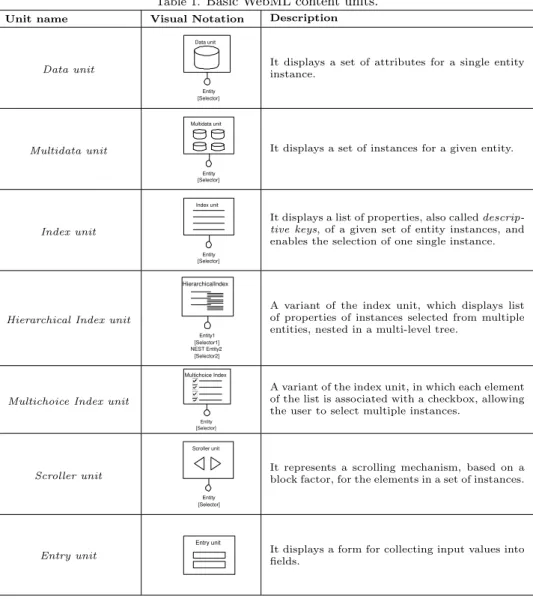
selector of the content units: the former specifies the type of objects published by a content unit, by referencing an entity of the E/R schema; the latter is a filter condition over the instances of the source entity, which determines the actual objects published by the unit. WebML offers six predefined units (data,multidata,index,multichoice index,hierarchical index, andscroller). A further unit (calledentry unit) rep-resents entry forms for inputting data. The visual notation of WebML units is reported in Appendix A, Table 1.
• Thenavigation model, describing links, between pages and content units, that supports information location and hypertext browsing. Links are represented as oriented arcs, and have the double role of enabling user navigation and transporting parameters needed for unit computation.
• The operation model, consisting of a set of operation units specifying the creation, updating and deletion of contents, and the interaction with external services. The visual notation of the basic WebML operation units supporting content management is reported in in Appendix A, Table 2.
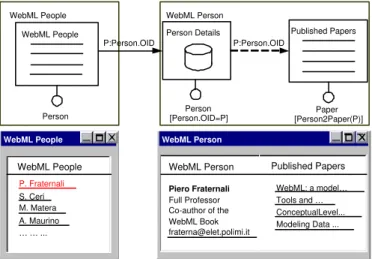
Figure 1 shows the WebML Hypertext specification, and a possible rendition, for two pages taken from the design of the WebML.org application (http://www.webml.org). As better described in Section 5, this application is the official Web site of the WebML team and research. It has been developed with the WebML method, and we have used it for experimenting our evaluation framework.
TheWebML People page contains theWebML People index unit, that is defined over the entityPerson, and shows the list of people belonging to the WebML team. The link departing from the index unit, represented as an arrow, allows users to select one person from the list and navigate to the pageWebML Person. It transports the identifier of the selected person, which is used by the data unit Person Details, placed in the WebML Person page, for showing some attributes of the previously selected person. TheWebML Person page also includes the index unit Published Papersthat shows a list of papers published by the selected person. The definition of this unit is based over a selector condition, specified below the unit, that
WebML Person WebML People WebML People P. Fraternali S. Ceri M. Matera A. Maurino … … ... Piero Fraternali WebML Person Full Professor Co-author of the WebML Book [email protected]
WebML People WebML Person
Person [Person.OID=P] Person Details WebML People Person Published Papers Paper [Person2Paper(P)] Published Papers WebML: a model… Tools and … ConceptualLevel... Modeling Data ... P:Person.OID P:Person.OID
Fig. 1. Example of WebML specification (top) and a possible rendition (bottom).
01 <PAGE id="page11"name="WebML Person"> 02 <CONTENTUNITS>
03 <DATAUNIT entity="Person" id="dau8" name="WebML Person">
04 <LINK name="ToPapers" newWindow="no" to="inu55" type="transport"/> 05 <DISPLAYATTRIBUTE attribute="Name"/>
06 <DISPLAYATTRIBUTE attribute="Bio"/> 07 <DISPLAYATTRIBUTE attribute="Email"/> 08 </DATAUNIT>
09 <INDEXUNIT id="inu55" entity="Paper" name="Published Papers"> 10 <SORTATTRIBUTE attribute="Position" order="ascending"/> 11 <LINK name="See" newWindow="no" to="dau86"/>
12 <DISPLAYATTRIBUTE attribute="Title"/> 13 <SELECTOR>
14 <SELECTORCONDITION name="Person Papers" 15 attributes="OID" 16 predicate="in" 17 relationship="Person2Paper"/> 18 </SELECTOR> 19 </INDEXUNIT> 20 </CONTENTUNITS> 21 </PAGE>
Fig. 2. XML representation of page WebML Person, reported in Figure 1.
retrieves all the instance of the entity Paper associated to the selected person by means of the relationship Person2Paper, defined in the data schema between the two entitiesPerson andPaper.
Besides having a visual representation, WebML primitives are also provided with an XML-based textual representation, used to specify additional detailed properties, not conveniently expressible in the graphic notation. WebML specifications can be therefore represented as visual diagrams, as well as XML documents. As an example, Figure 2 reports the (simplified) XML specification of the page WebML person, whose WebML visual schema is depicted in Figure 1. For further details on WebML, the reader is referred to [7].
2.2 Implementation and deployment of WebML applications
The XML representation of WebML schemas enables the automatic code generation by means of CASE tools. In particular, WebML is supported by the WebRatio CASE tool [8], which translates the XML specifications into concrete implementations.
WebRatio offers a visual environment for drawing the data and hypertext conceptual schemas, and an interface to the data layer that assists designers to automatically mapping the conceptual-level entities, attributes and relationships to physical data structures in the data sources, where the actual data will be stored. The core of WebRatio is a code generator, based on XML and XSL technologies, which is able to generate automatically the application code to be deployed on the J2EE platform. More specifically, the code generator produces the queries for data extraction from the application data sources, the code for managing the application business logic, and the page templates for the automatic generation of the application front-end.
The generated applications run in a framework implemented on top of an application server. The runtime framework has a flexible, service-based architecture that allows the customization of components. In particular, the logging service can be extended with user-defined modules, so as to log the desired data. This service has been used for gathering the conceptual data needed for the enrichment of theconceptual logs.
3 The evaluation framework
Our quality evaluation framework supports three types of analysis.
• Design Schema Analysis(DSA) verifies the correctness and consistency of design specifi-cations [10, 18], to enhance the quality of the final application by looking for errors and irregularities in the application design. This phase focuses only on a static description of the application and does not take into account dynamic usage aspects. It is useful for inspecting the application specification, with the aim of discovering some structural problems that influence the usability of the final application. Typically, designers or expert evaluators perform this activity by hand, without using any kind of automatic tool. The automatic support can thus foster a more precise and systematic analysis.
• Web Usage Analysis(WUA) operates on log data dynamically collected at runtime, and produces reports on content access and navigation sequences. This analysis exploits the
conceptual logs, that are “enriched” Web logs integrating the conventional data about HTTP page requests with information about the elementary page units and link paths accessed by the users, and the database objects used to populate pages. The aim of Web usage analysis is twofold:
– On one hand they provide the designers with access statistics that can help iden-tifying contents or hypertext pages and areas that are worth to be emphasized for responding either to users’s needs (as it happens for the most requested data or pages), or to the application communication goals (as it happens when some con-tents or pages achieve few users’access, while the application stakeholder consider them mission-critical).
– On the other hand the analysis of users navigation paths can help discover some interaction problems due to usability lacks.
• Web Usage Mining (WUM) operates on the same enriched log data as WUA, and applies mining techniques for discovering interesting (sometimes unexpected) associations
be-tween accessed data. The aim is to identify possible amendments for accommodating newly discovered user needs.
The three analyses are centered on the existence of an application schema, expressed by means of a conceptual model, and exploit the schema knowledge in different manners. In particular, DSA and WUA use a top-down, goal-directed paradigm, in which evaluators have in mind precise analysis tasks, and use the application schema for formulating well targeted queries. WUM instead follows a bottom-up, inductive approach. It applies over conceptual logs for extracting “interesting” associations, which reflect user behaviors not foreseen by the application designers and that can be the symptom of design lacks, not necessarily errors. In order to specify mining queries, evaluators activate tasks for extracting associations among any logged element. Conceptual schema is then used for better interpreting the mined associations. In the following, we will describe in details the three analysis techniques. DSA and the software module supporting the automatic analysis have been already described in [18, 10]. Therefore, their main features will be shortly recalled in Section 3.1. We will then concentrate onWUAand WUM, which are the original contributions proposed by this paper.
3.1 Design Schema Analysis
DSA is centered on the identification within WebML conceptual schemas of configurations, which we callschema analysis patterns, representing some potential sources of problems, with respect to some attributes of a model for the quality of conceptual schemas [10]. The analysis patterns consist of specific compositions of hypertext elements (pages, units, operation, links) serving a typical application purpose. Examples could be the arrangement of pages, units, and links for supporting the navigation between two relevant information objects, for accessing an information object via one or more access paths, or for creating a new information item through a content management operation.
Each quality attribute considered in our analysis is associated with:
(i) A set of analysis pattern descriptions, specifying the hypertext configurations to be searched within the global application schema.
(ii) An analysis task for verifying some properties of the retrieved evaluation pattern in-stances. It comprises:
• Ametrics computation function, generating aggregated numerical values that quan-tify the level of satisfaction of the considered quality attribute;
• A condition checking rule, which highlights potential problems.
An example of metrics computation function could be the variance with which alterna-tive patterns implementing the same function (e.g., the deletion of an information item) occur in the global application schema, whereas an example of condition checking rule may be a rule that warns the designer when s/he uses too many different hypertext pat-terns for solving the same problem, because this practice may contribute to increasing the users’ disorientation.
Design schema analysis is automatically performed over the XML representation of WebML schemas, by a software module calledDesign Schema Analyzer. For more details about this module and its application to the analysis of complex applications, the reader is referred to [18].
3.2 Web Usage Analysis
WUA takes an orthogonal approach to quality evaluation. It starts from run-time collected log data about the usage of the application and helps the designer evaluate if the application conceptual schema accommodates the actual way in which users browse the hypertext. Any discrepancy between the design schema and the actual usage experienced at runtime is a potential candidate for correction.
The distinguishing feature of our WUA technique is the exploitation of the application conceptual schema, which takes place in two ways:
• The raw log data are enriched with additional information, referring to the WebML content units included within pages accessed by the users, and to the data objects used for populating them. This enrichment generates theconceptual logs.
• The result of analyzing the user navigation behavior is displayed directly on top of the graphical representation of the hypertext schema, thus facilitating the understanding of quality assessment results.
WUA is supported by a software module, namedWeb Usage Analyzer, that elaborates the conceptual logs, by computing some access statistics coded as XSL rules. As for the Design Schema Analyser, the conceptual log computation is based on two sets of rules, one dictating the elements to be retrieved in the log, the other specifying analysis tasks to be executed over them.
The present version of the Log Analyzer supports two kinds of assessments,access analysis
andnavigation analysis, which will be described in the sequel.
3.2.1 Access Analysis
For the majority of log analyzers, access analysis consists of computing statistics on user accesses to pages. However, our model-based approach, which separates the structure schema and the hypertext schema, supports two types of analysis:
• Data Access Analysis, which computes statistics on the access to database entities and their instances, purposely ignoring the hypertext interface.
• Hypertext Access Analysis, which focuses on the usage of the hypertext pages, areas, and site views.
Data Access Analysis can for example respond to such questions as“Which is the most/least accessed entity?” or“Which is the most/least accessed instance of Entity X?”.
Hypertext Access Analysis extends the statistics normally offered by state-of-the-practice log analysis tools. First, it enables the analysis of accesses to hypertext components at different levels of granularity, covering not only page visits, but also accesses to site views, i.e., entire hypertexts defined as application front-ends, areas within site views, i.e., cohesive sets of pages publishing contents about some core objects of the application, and individual content units within pages. Second, thanks to the cross-links among the log entries, the elements of the data schema, and the elements of the hypertext schema provided in the conceptual logs, Hypertext Access Analysis may take into account the actual data objects used to fill-in the requested pages. Therefore, it can respond to such questions as“Which is the most/least accessed page/area/site view displaying the content of Entity X?” or “Which
is the most/least frequently used page for displaying a specific instance of Entity X?. These results greatly help designers evaluate the effectiveness of the hypertext in delivering the core content of the application.
An important aspect of the Web Usage Analyzer is that the evaluator can pose quality evaluation queries involving the accessed information objects, without being aware of the physical structure of the application’s URLs and, in particular, of the parameters that identify the actual objects used at runtime to fill-in the page. Objects identifiers are managed by the runtime logs and abstracted as XML elements in the conceptual logsa.
3.2.2 Navigation Analysis
Besides access analysis, also navigation analysis plays a central role in hypertext quality eval-uation. While access analysis is relevant for understanding if published data are accessed by users, and for identifying possible elements that need more emphasis in the application interface, Navigation Analysis concentrates on verifying if the hypertext topology supports content accessibility, or if conversely it presents some usability problems. In particular, it allows reconstructing navigation paths adopted by users for reaching some core information objects by means of access paths. This analysis is based on a WebML methodological as-sumption that distinguishes among different roles that information concepts can play within the Web application [9]. In particular, information concepts can be classified as:
• Core concepts, when they are the “central” objects, forming the main asset and ex-pressing the mission of the Web application (e.g., the product sold in a B2C site, or the personal message published in a community canter).
• Access concepts, when they support the location of core concepts.
• Interconnection concepts, when they interconnect core concepts; they are typically ex-pressed by means of relationships, which the user can navigate to move the focus from one core concept to another related one.
In order to perform well focused navigation analyses, evaluators can therefore select in the hypertext schema units and pages publishing core information objects. Based on this input, Navigation Analysis then reconstructs access paths, defined over access entities categorizing the core entities, andinterconnection paths, defined over relationships interconnecting the core entities. The analysis of the reconstructed paths, and their comparison with the conceptual schema then permit to highlight critical points, or also deviations with respect to paths provided by the designer (for example, when users make frequent use of the browser’s back button or neglect some navigation paths provided by the designer, or when users incur in some loops).
3.3 Web Usage Mining
WUM operates on conceptual logs, and applies XML mining techniques for discovering inter-esting (sometimes unexpected) associations among visited hypertext elements and among accessed data.
aIn real Web sites, identifying the accessed objects may be difficult due to URL scrambling for security
reasons, or due to the heavy use of POST-based HTTP requests, as common, for example, in the Microsoft .NET platform.
The execution of mining statements over conceptual logs produces:
• XML association rulesof the formX ⇒Y, stating that when the log elementX(called therule body) is found, it is likely that the log elementY(called the rule head) will be also found. Depending on the adopted mining statement, the retrieved association can be related to database entities or instances, hypertext components (areas, pages, content units), or also hypertext components coupled with their populating data instances.
• XML sequential patterns, in which the rule body and head are also bounded to their position in the log sequence, so as to indicate the existence of a temporal relation. Appendix A reports an example of sequential pattern mined from the webml.org con-ceptual logs. As can be observed, extracted patterns are enclosed within the root tag
<Sequences>. Each single pattern is then enclosed by the tag <SequenceRule>, while the rule body and the rule head are respectively enclosed by the tags <Antecedent> and
<Consequent>. As it will be better explained in Section 4, with the aim of facilitating their interpretation and supporting deeper analyses, extracted rules also include adjunctive prop-erties and data that are not present in HTTP requests, but are retrieved from the application conceptual schema.
Based on the extraction of such rules, so far we have focused on three specific mining tasks:
• Finding areas or pages that are often visited together, through the mining of association rules between areas or pages in the same user session.
• Finding data that are often accessed together, considering as transaction a user request, implemented through the mining of association rules between data entities and instances accessed within the same user session. It is worth noting that such associations are not easily discovered in traditional logs that do not record data instances used to populate dynamic Web pages, and generally require several post-processing efforts.
• Analyzing user navigation sequences for accessing core contents, by mining sequential patterns related to sequences of pages and content units within the same user session. The WebML characterization of information concepts and content units allows filter-ing sequences, concentratfilter-ing the analysis on relevant navigation paths leadfilter-ing to some selected core concepts.
4 The framework architecture
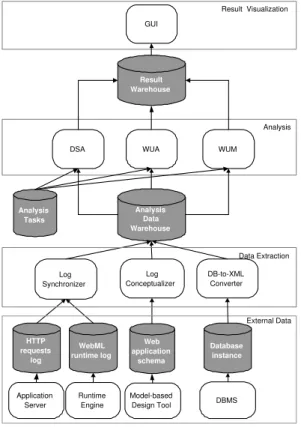
Figure 3 illustrates the overall architecture of the WebML quality evaluation framework. It is based on three layers: theData Extraction layer, in charge of gathering and pre-processing input data, theAnalysis layer, which computes log data gathered though the data extraction layer, and theResult Visualization layer, which visualizes the analysis results.
Among layers: the Analysis Tasks repository stores the analysis procedures, which can be expressed both in XSL and XQuery; the Analysis Data Warehouse stores data needed for analysis, represented in XML format; theResult Warehouse then stores the XML-based representation of the results produced by the analysis, which is then used by the graphical user interface for generating and visualizing the analysis reports.
Result Visualization Analysis Model-based Design Tool Runtime Engine Application Server Web application schema HTTP requests log WebML runtime log Log Conceptualizer Analysis Data Warehouse Analysis Tasks WUA WUM DSA Result Warehouse GUI External Data Log Synchronizer Data Extraction Database instance DB-to-XML Converter DBMS
Fig. 3. The evaluation framework architecture.
It is worth noting that the ubiquitous use of XML technologies improves the number of strategies the evaluator can adopt in order to manipulate and query data. Also, the quality evaluation framework results to be very flexible and extensible: new analysis tasks can be easily specified and added to the framework. Therefore, each design team can define its own quality criteria, code their measures in XSL or XQuery, two extensively used W3C standards, and adding them within the theAnalysis Tasksrepository. Additionally, the use of warehouses between layers enables adding new software modules in a given layer, for example for performing new kinds of analysis, without affecting other components.
The rest of this section is devoted to describing the input data of the framework and the pre-processing applied over them for gathering conceptual logs, and the modules composing the three layers.
4.1 Input data processing
The input to the framework consists of:
• HTTP requests log generated by the application server in the ECLF format [30], also including user session IDs, for univocally identifying page requests belonging to a same user session. This feature greatly simplifies the pre-processing necessary for recon-structing users’ sessions [13]; it also allows distinguishing among requests coming from
different user agents, even when proxies filter them or when users turn off cookie support on their browser. Figure 4 reports some lines, extracted from the application server log, that represent the request of a page from the webml.org application (the same page specified in Figure 2). For privacy reasons, the IP address of the requesting host has been replaced with a sequence ofXs. The logs include theJSESSIONIDfield, whose value (acbTwnzgkSz6) identifies the user session.
• TheWebML runtime log, an XML log file storing events and data produced and con-sumed by the application runtime for serving page requests. Runtime log data are generated thanks to an extension of the WebML runtime environment that is based on Log4J, an open source package distributed by the Apache Software Foundation [2]. They include all the events generated by the application runtime when serving a re-quested page and populating its content units. An event can represent either the request of a page, or the computation of an individual unit within the page. Since each page request is managed by a specific thread, the events generated for a single page request are characterized by the same thread number. In the log file each event is delimited by the<event>tag that may also contain further sub-tags:
• The <message> tag, comprising the event parameters. In case of content units population, it also includes the list of identifiers (OIDs) of the objects extracted from the data source.
• The <NDC> tag, storing the identifier of the conceptual element (page or unit) to which the event refers.
Figure 5 shows an extract of the runtime log generated for the same page request illustrated in Figure 4. The recorded events are characterized by the same thread (tcpConnection-80-17). The first event (lines 1-7) denotes the page request. The other events (lines 8-14 and 15-21) denote the population of the units of the page. For example, the second event (line 8-14) refers to the population of a data unit (dau84). Its <message> tag (lines 10-12) includes the unit ID (dau84), the client IP address and SessionID, and a value (17) representing the OID of the single database instance extracted for populating the data unit. The third event (lines 15-21) refers to the population of an index unit (inu9). Its<message>tag includes a list of values (line 18) representing the OIDs of the three database objects extracted for populating the index unit.
• The XML representation of the application conceptual schema, automatically generated by the model-based design tool.
• The application data source, whose knowledge within the evaluation framework is needed for interpreting the identifiers of data instances logged in the WebML runtime log.
4.2 Data Extraction layer
TheData Extraction Layeris in charge of gathering the input data previously described, and importing them into theAnalysis Data Warehouse, after performing three main actions:
01 XXX.XXX.XXX.XXX[29/Mar/2003:02:03:34 +0100] 02 "GET page11.do HTTP/1.1" 200 122018 http://webml.org "Mozzilla/4.0"
03 (compatible;MSIE 6.0; Windows NT 5.0)" JSESSIONID=acbTwnzgkSz6}
Fig. 4. Extract from the application server log.
01 <log4j:event timestamp="Sat, 29 March 2003 - 02:03:34.959" 02 thread="tcpConnection-80-17"> 03 <log4j:message>
04 Requested page service for id=page11 05 </log4j:message>
06 <log4j:NDC>page11</log4j:NDC> 07 </log4j:event>
08 <log4j:event timestamp="Sat, 29 March 2003 - 02:03:34.962" 09 thread="tcpConnection-80-17"> 10 <log4j:message> 11 [dau8][XXX.XXX.XXX.XXX,acbTwnzgkSz6]4 12 </log4j:message> 13 <log4j:NDC>dau8</log4j:NDC> 14 </log4j:event>
15 <log4j:event timestamp="Sat, 29 March 2003 16 - 02:03:34.969" 16 thread="tcpConnection-80-17"> 17 <log4j:message> 18 [inu55][XXX.XXX.XXX.XXX,acbTwnzgkSz6]15,24,10,11,16,9,14 19 </log4j:message> 20 <log4j:NDC>inu55</log4j:NDC> 21 </log4j:event>
Fig. 5. Extract from the runtime log.
• Synchronizing log data stored in the application server log and in the WebML runtime log, thus obtaining thesynch log. This action is performed by a software module called
Log Synchronizer.
• Enriching the synch log, by relating each logged request with the corresponding elements specified in the conceptual schema. The aim is to make log files more readable and easily analyzable, by means of the semantics deriving from the conceptual schema. This action is performed by a software module calledLog Conceptualizer, and generates the
conceptual logs.
• Generating an XML dump of the data source, through the use of a DB-to-XML con-verter [28]. The aim is to gather a uniform format, based on XML, for all the data needed for executing the evaluation tasks.
In the following, the Log Synchronizer and Log Conceptualizer modules are described in more details.
4.2.1 Log Synchronizer
This module synchronizes the application server log and the WebML runtime log, and gen-erates a unified XML representation of all the available log data. Not all the requests stored in the application server log need to be considered for synchronization. Requests generated by software agents (spiders, Web crawlers, search engines, etc.), or requests of image files included within pages can be filtered out. Also, errors generated by incorrect user requests or server exceptions, which are characterized by status code 400 or 500, can be excluded from synchronization, but they are however stored in different files used for calculating statistics
01 <Request Request_Id="3178"> 02 <LocalTime> 03 <DD>29</DD> <Month>Mar</Month> <YY>2003</YY> 04 <hh>02</hh><mm>03</mm><ss>34</ss> 05 <Timestamp>+0100</Timestamp> 06 </LocalTime> 07 <User> 08 <IPaddress>XXX.XXX.XXX.XXX</IPaddress> 09 <jSessionID>acbTwnzgkSz6</jSessionID> 10 <Browser>MSIE</Browser> 11 <Version>6.0</Version> 12 <Platform>compatible</Platform> 13 <OS>Windows NT 5.0</OS> 14 <CountryName/> 15 </User> 16 <Page SchemaRef="page11"> 17 <PageContent> 18 <Unit> 19 <UnitSpecs SchemaRef="dau8"/> 20 <Data_Oid>4</Data_Oid> 21 </Unit> 22 <Unit> 23 <UnitSpecs SchemaRef="inu55"/> 24 <Data_Oid>15</Data_Oid> 25 <Data_Oid>24</Data_Oid> 26 <Data_Oid>10</Data_Oid> 27 <Data_Oid>11</Data_Oid> 28 <Data_Oid>16</Data_Oid> 29 <Data_Oid> 9</Data_Oid> 30 <Data_Oid>14</Data_Oid> 31 </Unit> 32 </PageContent> 33 </Page> 34 </Request>
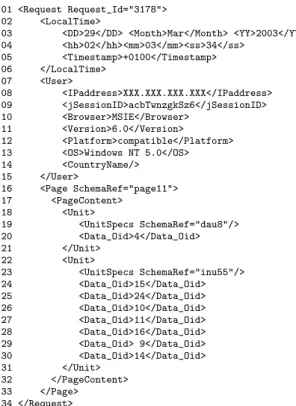
Fig. 6. Extract from the synch log.
about application faults. As reported in Figure 6, each request in the application server log is extended with the corresponding events and data coded in the runtime log, namely:
• The identifiers of the units composing the page are delimited by the<UnitSpecs> tag.
• The OIDs of the database objects extracted for populating units are delimited by the <Data Oid>tag.
Finally, requests are sorted by user session. The result is thesynch logXML file. A fragment of such a file, deriving from the synchronization of the two logs shown in Figure 4 and Figure 5, is reported in Figure 6.
It is worth noting that the attributeSchemaRef, defined for pages and units nodes, rep-resents values that univocally identify pages and units within the application conceptual schema. Therefore it provides a reference for retrieving additional properties, not traced by the logging mechanism, but represented in the conceptual schema, and to integrate them in the conceptual log.
4.2.2 Log Conceptualizer
TheLog Conceptualizeris in charge of generating the final conceptual log, which merges the synch log with relevant structural properties specified in the XML-based conceptual schema of the application, such as names of pages, of areas enclosing pages, of page units and their source entities, etc. Figure 8 shows an extract of the conceptual log generated for the webml.org
application. The binding between log data and the conceptual schema elements is obtained through theSchemaRefattribute that characterizes pages and units in the synch log.
One relevant enrichment operated by the Log Conceptualizer is thelink reconstruction, which identifies WebML links selected by users to move among pages. For each request, the HTTP server registers the referrer page only, that is the page from which the link is started, but it cannot identify which link, among the ones departing from the referrer page, is followed by the user. Such information is thus retrieved by means of a link reconstruction algorithm
that, given the request for a page:
• Identifies the referrer page from which the request originates.
• Analyzes the schema of the referrer page and the parameters appended to the HTTP request.
• Retrieves the WebML link departing from the referrer page that transports the request parameters, and adds its identifier within the conceptual log, delimited by the tag EntryLink(see Figure 8 for an example).
Such a log enrichment enables the precise reconstruction of user navigation paths, including the identification of the use of the browser back button, an interesting navigation behavior that can reveal some usability problems [26].
Back identification is based on the comparison, for each requested page, between the referrer page and the previously requested page. The common situation found in log files is in fact that, given a request, its referrer page corresponds to the previously logged page request. When the user uses the back button, the HTTP page request of the target page does not appear in the log. This is because actually the page is not requested to the HTTP server, since it is maintained in the browser cache. Therefore, an indicator of the back use can be, for a given request, the mismatch between its referrer page and the previously requested page.
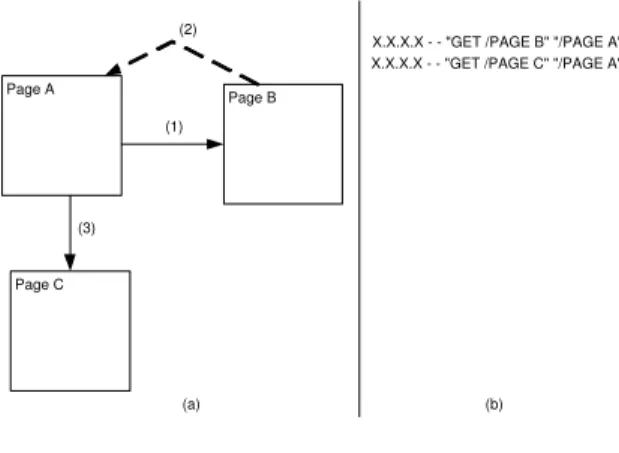
Figure 7(a) shows such a situation where a user, starting from Page A, visits Page B (arrow 1), then, by means of the back browser button, comes back again to Page A (arrow 2), and finally sees Page C (arrow 3). The ECLF log file (Figure 7(b)) will register the request of Page B from Page A, and of Page C from Page A, but it will not log the request of Page A from Page B, because it does not require an explicit HTTP request. We call this navigation pattern shadow request, because it is hidden to the server - and does not appear in the log. Once identified, shadow requests are registered into the synch log by adding, for the page requested after the back navigation, aReferrerelement withSchemaRef="Shadow", and an EntryLinkelement withSchemaRef="Back".
The conceptual log reported in Figure 8 shows an example of shadow request identification. According to such a log, a user accesses theWebML Paper page (lines 01-13), after s/he has visited the Category Paperspage (line 03). Navigation from page41 to page92 occurs by means of link38 (line 04). Then, s/he uses the browser back button to come back to the Category Papers page (lines 14-27); after that, s/he navigates again link38 and accesses theWebML Paperpage (lines 28-41), to see another paper (Data Oid equals 4 in line 36). 4.3 Analysis layer
The Analysis layer represents the core of our architecture: it computes evaluation results from data stored in theAnalysis Data Warehouse. The layer is composed of three software
[h] Page A Page C Page B (1) (2) (3)
X.X.X.X - - "GET /PAGE B" "/PAGE A" X.X.X.X - - "GET /PAGE C" "/PAGE A"
(a) (b)
Fig. 7. Example of use of back browser button (a) and the corresponding (simplified) ECFL file. components that implement the three types of analysis described in Section 3:
• TheDSA module analyzes the XML representation of hypertext conceptual schemas, by means of two sets of XSL rules, stored in theAnalysis Tasks repository:
– Analysis Pattern Description rules, representing the XSL specification ofanalysis patterns to be retrieved and analysed within the schema.
– Analysis Task rules, representing the XSL specification of the analysis procedures to be performed over analysis patterns retrieved with the previous rules.
For more details about theDSAcomponent, the reader is referred to [18].
• TheWUA moduleelaborates the conceptual logs using two kinds of rules stored in the
Analysis Tasksrepository:
– Usage Pattern Descriptionrules, representing the log elements to be retrieved and analyzed. A usage pattern can be a data element (an entity or an entity instance), a hypertext component (a page or an area) and the data instances used for their computation, or a core unit for which one wants to reconstruct the access and interconnection paths navigated by users.
– Statistics Computation rules, representing procedures for computing analysis over the retrieved usage patterns.
• TheWUMmodulealso elaborates conceptual logs, by executing some mining tasks stored in theAnalysis Tasksrepository. It is implemented on top of XMINE, a tool developed for mining interesting relations from native XML documents [5]. The interoperability between this module and those generating the conceptual logs is guaranteed by the extensive use of XML technologies. The mining tasks thatWUMis able to execute are ex-pressed through a set ofXMINEstatements that resemble many similarities with XQuery statements. The execution of theseXMINEstatements over the conceptual logs produces rules, in form ofXML association rulesorXML sequential patterns. This output is then filtered by means of XQuery statements, to select most interesting results.
CategoryPapers
01 <Request Request_Id="162">
02 <Page SchemaRef="page92" Name="WebML paper" Area="Research">
03 <ReferrerPage SchemaRef="page41" Name="Category Papers" Area="Research"/> 04 <EntryLink SchemaRef="link38"/>
05 ...
06 <PageContent> 07 <Unit>
08 <UnitSpecs SchemaRef="dau39" Name="Paper" SourceEntity="Paper"/> 09 <Data_Oid>3</Data_Oid> 10 </Unit> 11 </PageContent> 12 </Page> 13 </Request> 14 <Request RequestId="163">
15 <Page SchemaRef="page41" Name="Papers Category" Area="Research"> 16 <ReferrerPage SchemaRef="Shadow">
17 <EntryLink SchemaRef="Back"/>
18 ...
19 <PageContent> 20 </Unit>
21 <UnitSpecs SchemaRef="dau47" Name="Category" SourceEntity="PaperCategory"/> 22 <Data_Oid>15</Data_Oid> 23 </Unit> 24 </PageContent> 25 </Page> 26 ... 27 </Request> 28 <Request RequestId="164">
29 <Page SchemaRef="page92" Name="WebML paper" Area="Research">
30 <ReferrerPage SchemaRef="page41" Name="Category Papers" Area="Research"/> 31 <EntryLink SchemaRef="link38"/>
32 ...
33 <PageContent> 34 <Unit>
35 <UnitSpecs SchemaRef="dau39" Name="Paper" SourceEntity="Paper"/> 36 <Data_Oid>4</Data_Oid> 37 </Unit> 38 </PageContent> 39 </Page> 40 ... 41 </Request>
Fig. 8. Fragment of conceptual log.
4.4 Result Visualization layer
The last layer of our software architecture allows evaluators to invoke the analysis tasks stored in the Analysis Tasks repository, and shows the results, through a graphical user interface developed in JAVA. Some visualization examples will be shown in the following section. 5 Case study
In order to prove the effectiveness of our framework, we have applied it to thewebml.org appli-cation (http://webml.org), the official reference site about Web modeling and the WebML language. It publishes a rich set of resources, including excerpts of the WebML book, or-ganized by chapters, downloadable materials, papers written by WebML researchers and by other research groups, tutorials and exercises useful for WebML teachers and students. The site has been designed with WebML and deployed with WebRatio on a J2EE platform. It consists of two site views:
• Acontent management site view, for gathering, storing and updating contents dynami-cally published in the public Web site. It is organized along eight different areas, whose
Fig. 9. Consistency analysis computation in the Design Schema Analyzer.
pages allow invoking content management operations, such as creating, modifying and deleting database objects. The access to such a site view is restricted to registered users only.
• Apublic site view, accessible from any unregistered user interested in retrieving contents about Web Modeling, the WebML language, and its related initiatives. The public site view consists of seven different areas (Overview, Book, News, People, Teaching, Research, Industry, and Community).
The data schema ofwebml.orgis centered on a few core entities (Book,Paper,Material, Exercise), which are interconnected among them and associated with a few additional access entities (e.g.,MaterialType, PaperCategory, and so on) serving the purpose of categorizing the site’s content.
The hypertext schema is quite complex and permits the users to reach the same piece of content (e.g., an exercise on hypertext modeling) in different ways. The application has been published online on 28/03/2003 and has an average of 60 unique visitors per day.
5.1 Design Schema Analysis
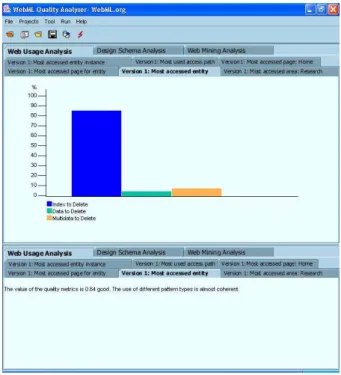
Figure 9 reports the result visualization for the consistency analysis of delete operations applied over the conceptual schema ofwebml.org. Delete operations are used for specifying the deletion of some information objects. The analysis procedure identifies all the Delete operations specified within the schema, and verifies if they are designed coherently. The bar chart shows that:
• In the 87% of cases the deletion is activated by selecting the object to delete from a list of candidate objects, described by few key attributes (Index To Deleteconfiguration).
• In the 8% of times the deletion is activated by selecting the object from a list where each object is fully described by means of all its attributes (MultiData To Delete con-figuration).
• Only in the 5% of cases the deletion is performed by first displaying the list of candidate objects, then the details of one single object selected from the list, and then activating the operation (Data To Deleteconfiguration).
The distribution of occurrences of the last two configurations highlights a lack of consis-tency. A corrective action could therefore consist of adopting the same design solution every time a delete operation occurs in the hypertext. It is worth noting that in some cases incon-sistencies are caused by conscious design choices, needed for responding to specific application constraints. However, in the situation above described, as also confirmed by the application designers, the inconsistency was not an explicit choice, but a mistake that needed to be fixed. 5.2 Access Analysis
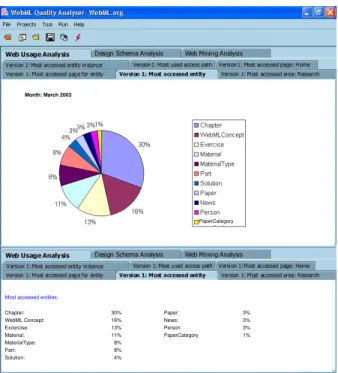
Figure 10 shows a data access analysis graph, generated by the Web Usage Analyzer from log data relative to a period of 15 days in March 2003. The graph shows that the most accessed entity is the one that represents the WebML book chapters, which gets 23% of the user’s requests. By clicking on an entity, it is then possible to drill down to the distribution of accesses across the entity instances. In the specific case, Chapter TOC(Table Of Content) results the most accessed one.
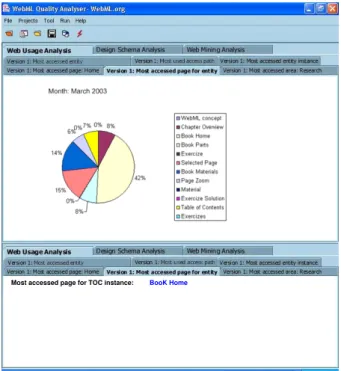
Access Analysis permits to obtain further results. For example, Figure 11 ranks all the hypertext pages that have been used to access the TOC chapter, sorted by the number of users’ accesses. Book Homepage, contained in theBooksection of the site, is the most used, featuring 42% of the total accesses toTOC. The second most used page, with 15% of accesses, isSelected Page; inside theBooksection, it displays sample pages, in PDF format, extracted by a given chapter.
Based on the previous results, designers have been suggested to accommodate the user preferences, facilitating the access to the most requested data. They might enrich the key pages of the site, for example the Home Page, with navigation shortcuts to the most requested pages publishing the bookTOC(Book Homeor Selected Page), for letting users access such contents in one click [24].
5.3 Navigation Analysis
We have applied Navigation Analysis for analyzing access paths followed by users to reach the content unitPaperDetails. The aim was to verify the accessibility level by users for the core entityPaper. In fact, the unitPaperDetails publishes data about a WebML paper within theResearchsection of the public Web site.
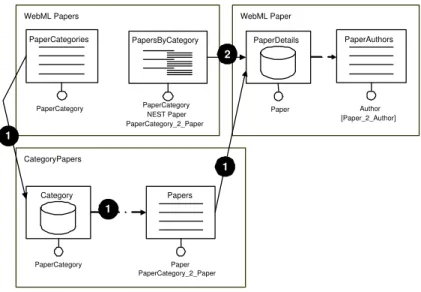
Figure 12 shows two access paths, as defined by designers in the application conceptual schema, both leading to the content unitPaperDatails:
1. A path exploiting the access entityPaperCategory. It comprises the index unit named PaperCategories (in page WebML papers), presenting the list of the available cate-gories, the data unitCategory(in pageCategoryPapers), representing data about one
Most accessed entities:
Chapter: 30% Paper: 3%
WebML Concept: 16% News: 3%
Excercise: 13% Person: 3% Material: 11% PaperCategory 1% MaterialType: 8% Part: 8% Solution: 4% Month: March 2003 PaperCategory a)
Fig. 10. A report for the “Most accessed entity” analysis task.
selected category, and the index unitPapers, which presents the list of papers in the selected category.
2. A second path, still exploiting the access entity PaperCategory. It is composed of a hierarchical index unit (PapersByCategory) placed in page WebML Papers, which publishes the list of papers hierarchically organized with respect to paper categories, and allows users to select one paper and navigate to the paper data directly, bypassing pageCategoryPapers.
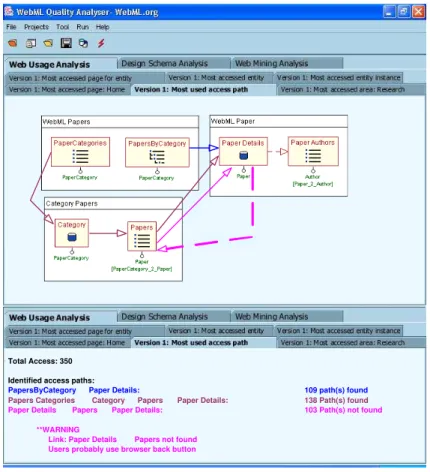
Figure 13 illustrates the reconstruction of access paths, as resulting from the webml.org
conceptual logs. As can be noted, the user navigation is represented directly over the hypertext conceptual schema, thus facilitating the comparison. The analysis highlights that in the majority of cases, users access the PaperDetails unit by following one of the two defined access paths (39% of times for path 1 and 32% of times for path 2). However, navigation analysis has also highlighted that in the 29% of times, after reaching thePaperDetailsdata unit, users resort to the back button of the browser to go back to theCategory Paperspage, select a new paper from thePapersindex unit, and access a new paper instance. The use of back button is highlighted in the schema by means of dotted lines. It is discovered through the algorithm already described in Section 4.2.2.
The results of this analysis highlights that:
• Several users, after accessing a given paper, are interested in accessing other papers in the same category.
Most accessed page for TOC instance: BooK Home
b)
Fig. 11. Accesses distribution of the most accessed instance along the different pages publishing its data.
• in order to select a new paper, users are asked to perform some navigation steps that are not supported by an explicit link, and for this reason adopt the back button. Therefore, the duplication of the index of papers in theWebML Paper WebML Paperpage can provide users with a mechanism for moving among papers of a given category; it also reduces the number of navigation [24].
5.4 Web Usage Mining
One of the analysis tasks applied over WebML conceptual logs has consisted of mining navi-gation sequences leading to core contents.
The sequential pattern reported in Appendix A represents an interesting result. It in-dicates that there exists a temporal relation between (i) the access to the page Overview (lines 4-26), introducing general concepts about WebML, and (ii) the access to page WebML Material(lines 29-44), publishing a tutorial on WebMLb. The support of the pattern is 0.04
(line 2); it indicates that in the 4% of the navigation sequences, users who access theOverview page also access the WebML tutorial in one of the following navigation steps. Most important, the pattern confidence is 0.12 (line 2), showing that, if users access theOverviewpage, there
bThe identification of the content for pageWebML Materialis possible thanks to the log enrichment through
OIDs of the data objects populating the accessed pages. The value11for the elementDataInstance(line 35) of the unitMaterial Details(line 34), havingMaterialas source entity (line 34), in the XML dump of the data source corresponds to a PDF file of the WebML tutorial.
WebML Paper Paper PaperDetails PaperAuthors Author [Paper_2_Author] WebML Papers PapersByCategory PaperCategory NEST Paper PaperCategory_2_Paper PaperCategories PaperCategory CategoryPapers PaperCategory Category Papers Paper PaperCategory_2_Paper 1 2 1 1
Fig. 12. Portion of the webml.org schema, representing the two access paths for reaching papers.
is an estimated probability of 12% that an access to the tutorial page will be also found in the next page requests.
From the conceptual schema it results that between the two pagesOverviewand WebML Materialthere is no direct navigation path; therefore, the retrieved relation between the two pages highlights an unexpected user behavior, not supported by the hypertext interface, and therefore difficult to identify though the simple analysis of navigation paths, as performed by theWUAmodule. This finding suggests two possible ways of reconstructing pageOverviewfor accommodating this discovered user need: (i)the page could include a link to the instance of WebML Material page publishing the WebML tutorial; (ii) from the page, it should be possible to directly download the WebML tutorial.
6 Related work
Web application quality has been so far pursued mostly by proposing best practices and design principles [24], or by means of structured model-based development methods [4, 20, 27].
Some tools have been developed for the automatic analysis of Web page design [21]. How-ever, they mostly operate over the HTML coding of pages, with the aim of discovering pre-sentation problems, while they neglect structural and navigation problems. The evaluation method illustrated in [23] addresses such issues, by prescribing a design inspection technique. However, it does not offer automatic support. Our DSAmodule can be therefore considered one of the first initiatives for the automatic analysis of conceptual schemas.
Several methods and tools have been proposed for the automatic analysis of Web logs. They have two emerging goals: (i)calculating statistics about site activities, and(ii)mining data about user profiles to support personalization. The majority of the public and share-ware tools (see for example [1, 3, 6]) are traffic analyzers. As also described in [15], their functionality is limited to producing:
Total Access: 350 Identified access paths:
PapersByCategory Paper Details: 109 path(s) found
Papers Categories Category Papers Paper Details: 138 Path(s) found
Paper Details Papers Paper Details: 103 Path(s) not found
**WARNING
Link: Paper Details Papers not found Users probably use browser back button
Fig. 13. Visualization of results for the analysis of access paths over the core unitPaperDetails.
• Reports about site traffic, such as total number of visits, average number of hits, average view time, etc.
• Diagnostic statistics, such as server errors and pages not found.
• Referrer statistics, such as search engines accessing the application.
• User statistics, such as top geographical regions.
• Client statistics, such as user’s Web browsers and operating systems.
Only few of them (for example [3]) also track user sessions and present specific statistics about individual users’ accesses.
In addition to calculating traffic statistics, ourWUAmodule is able to compute advanced statistics, related to database entities and instances, and to hypertext components of any granularity. In the majority of other approaches such kinds of analysis are not supported and, if provided (see for example [17]), they require extra-efforts for the inclusion of some scripts buried in the page code that are able to generatead hoc log data. In our approach, the production of conceptual logs does not require any additional activity during the appli-cation development. Thanks to the model-based approach, at runtime the appliappli-cation engine instantiates elements of the conceptual schema. Therefore, it is also able to “naturally” log
execution data that reflect the defined conceptual schema. Also, the logged data have minimal size and their calculation does not impact sensibly the overall runtime performance.
Thanks to the intensive use of the application conceptual schema, our framework also introduces a number of advantages with respect to Web usage mining. Several data mining projects have demonstrated the usefulness of a representation of the structure and content organization of a Web application [14, 15, 25]. As affirmed in [12], “the description of the application structure is considered a critical input to the pre-processing algorithms that can be used as filter before and after pattern discovery algorithms, and can provide information about expected user behaviors”. However, Web usage mining approaches often require additional, sometimes complex, computations for reconstructing the application schema [12, 16].
As shown by this paper, the conceptual logs, which characterizes our approach, can be easily tailored on specific mining algorithms used in Web Usage Mining, with the great ad-vantage of eliminating the typical Web Usage Mining preprocessing phase completely. In fact, according to our approach: (i) Data cleaningis mainly encapsulated by the Log Synchronizer module; (ii) the identification of user sessions is done by the WebML runtime; (iii) post-mining retrievalof content and structure information is unnecessary since this information is available from the WebML conceptual schema, and is also integrated into the final conceptual logs.
7 Conclusions
The ever-increasing spread of the Web asks for new methods for improving the quality of Web applications. Most current Web applications are centered on large sets of data and require very complex hypertext structures that very often are difficult to understand by users and do not meet their requirements. Quality enforcement has been so far pursued mostly by addressing the application analysis and design with the help of structured development methods, possibly based on conceptual models of Web applications. However, although conceptual modelling does improve the final quality of the application by fostering regularity and the definition and reuse of effective design patterns, a gap exists between the model-driven analysis and design phases and the application maintenance and evolution phases, where most of the quality evaluation activities and of the corrective actions are performed thanks to the implicit or explicit feedback of “real” users. In particular, the conceptual schemas developed in the “upper” part of the application life cycle are not used in the post-delivery phases.
This paper has proposed a framework for quality evaluation based on the integration of the design-time conceptual schemas of the application and the usage data collected at runtime. The original features of the proposed technique and tool can be summarized as follows:
• Web usage data are expressed in the same vocabulary as the conceptual models (e.g., they refer to entities, relationships, content units, pages, areas, and so on). This elimi-nates the impendence mismatch between log data and design documents, which occurs when conventional, low-level log analysis tools are used, and even permits to display Web usage statistics directly on the conceptual design diagrams.
• Thanks to the ubiquitous use of XML and XSL, the quality evaluation framework is very flexible and extensible: new evaluation queries and measures can be easily specified by means of XSL rules and added to the rule repositories. In this way, each design team can define its own quality criteria, and code their measures within WQA by simply
writing XSL code, an extensively used W3C standard.
• The proposed framework is easily implementable and adapts well to any Web conceptual model. The pre-requisites for its implementation is the capability of logging a few data on the objects and object types involved in the computation of page contents. The required data have minimal size and their calculation does not impact sensibly the overall runtime performance.
Our future work will concentrate on applying the proposed evaluation framework to larger Web applications, so as to further validate our method and tools, and on the incremental en-richment of the quality metrics and statistics based on Web usage data. In its current version, the framework concentrates on the evaluation of two quality factors, namely design correct-ness and usability of the final application. However, thanks to its flexibility, the framework architecture and the supported analyses can be easily extended, to cover the evaluation of other quality factors, such as performance, availability and security.
We are also working on the definition of a user interface for allowing designer to define new quality evaluation queries and reports, without the need of manual XSL programming. Bibliography
1. Analog. Analog 5.32: Introduction., 2003. http://www.analog.cx/docs/Readme.html. 2. Apache. HTTP Server Project, 2003. http://httpd.apache.org/docs.
3. AWSD. WebLog, 2003. http://awsd.com/scripts/wevlog/index.shtml.
4. L. Baresi, F. Garzotto, and P. Paolini. Extending UML for Modeling Web Applications. InProc.
of HICSS’01, Maui (USA), January 2001. IEEE Press, January 2001.
5. D. Braga, A. Campi, S. Ceri, M. Klemettinen, and P. Lanzi. A Tool for Extracting XML
Asso-ciation Rules. In Proceedings of ICTAI’02, 4-6 November, Crystal City, USA. IEEE Computer
Society, 2002.
6. CapeCom. WebLogs, 2003. http://www.cape.com.
7. S. Ceri, P. Fraternali, A. Bongio, M. Brambilla, S. Comai, and M. Matera. Designing
Data-Intensive Web Applications. Morgan Kauffmann, 2002.
8. S. Ceri, P. Fraternali, A. Bongio, S. Butti, R. Acerbis, M. Tagliasacchi, G. Toffetti, C. Conserva, R. Elli, F. Ciapessoni, and C. Greppi. Architectural Issues and Solutions in the Development of
Data-Intensive Web Applications. In Proceedings of CIDR 2003, January 2003, Asilomar, CA,
USA, 2003.
9. S. Ceri, P. Fraternali, and M. Matera. Conceptual Modeling of Data-Intensive Web Applications.
IEEE Internet Computing, 6th(4):20–30, July-August 2002.
10. S. Comai, M. Matera, and A. Maurino. A Model and an XSL Framework for Analyzing the Quality
of WebML Conceptual Schemas. In Proceeding of the ER’02-IWCMQ’02 Workshop, Tampere,
Finland, October 2002, volume 2784 ofLNCS, pages 339–350. Springer Verlag, 2002.
11. J. Conallen. Building Web Applications with UML. Object Technology Series. Addison Wesley,
2002.
12. R. Cooley. The Use of Web Structures and Content to Identify Subjectively Interesting Web Usage
Patterns. ACM TOIT, 3(2), May 2003.
13. R. Cooley, B. Mobasher, and J. Srivastava. Data Preparation for Mining World Wide Web
Brows-ing Patterns. Knowledge and Information Systems, 1(1):5–32, January 1999.
14. R. Cooley, P. Tan, and J. Srivastava. Discovery of Interesting Usage Patterns from Web Data.
LNCS/Lecture notes in Artificial Intelligence. Springer Verlag, 2000.
15. M. Eirinaki and M. Vazirgiannis. Web Mining for Web Personalization. ACM TOIT, 3(1),
16. F. Facca and P. Lanzi. Recent Developments in Web Usage Mining Research. InProceedings Of
DaWaK 2003, Prague, Czech Republic, September 2003, LNCS. Springer Verlag, 2003.
17. FireClick, 2003. http://www.fireclick.com.
18. P. Fraternali, M. Matera, and A. Maurino. WQA: an XSL Framework for Analyzing the Quality of
Web Applications. InProceedings of IWWOST’02 - ECOOP’02 Workshop, Malaga, Spain, June
2002, 2002.
19. M. Genero, J. Nelson, and G. Poels, editors. Proceedings of IWCMQ’02 - ER’02 International
Workshop on Conceptual Modeling Quality, Tampere, Finland, October 2002, LNCS. Springer
Verlag, 2002.
20. J. Gomez, C. Cachero, and O. Pastor. Conceptual Modeling of Device-Independent Web
Appli-cations. IEEE MultiMedia, 8(2), March-April 2001.
21. M. Ivory and M. Hearst. The State of the Art in Automating Usability Evalaution. ACM
Com-puting Surveys, 33(4):470–516, December 2001.
22. P. Kruchten. Rational Unfied Process. An introduction. Addison Wesley, 2nd edition, 2000.
23. M. Matera, M. Costabile, F. Garzotto, and P. Paolini. SUE Inspection: an Effective Method for
Systematic Usability Evaluation of Hypermedia. IEEE Trans. on SMC, 32(1), January 2002.
24. J. Nielsen. Web Usability. New Riders, 2000.
25. P. Pirolli, J. Pitkow, and R. Rao. Silk from a Sow’s Ear: Extracting Usable Structures from the
Web. InProceedings of Confernece on Human Factors in Computing Systems CHI’96, April 1996.
ACM Press, April 1996.
26. J. Pitkow. In Search of Reliable Usage Data on the WWW. InProc. of 6th International
Confer-ence on World Wide Web, pages 451–463, May 1997.
27. G. Rossi, D. Schwabe, L. Esmeraldo, and F. Lyardet. Engineering Web Applications for Reuse.
IEEE Multimedia, 8(1):20–31, January 2001.
28. V. Turau. DB2XML, 2003. http://www.informatik.fh-wiesbaden.de/ turau/DB2XML/. 29. WebRatio. Site Development Studio, 2003. http://www.webratio.com.
Appendix A. WebML content and operation units Table 1. Basic WebML content units.
Unit name Visual Notation Description
Data unit
Entity [Selector] Data unit
It displays a set of attributes for a single entity instance.
Multidata unit
Multidata unit
Entity [Selector]
It displays a set of instances for a given entity.
Index unit
Index unit
Entity [Selector]
It displays a list of properties, also called
descrip-tive keys, of a given set of entity instances, and enables the selection of one single instance.
Hierarchical Index unit
HierarchicalIndex
Entity1 [Selector1] NEST Entity2 [Selector2]
A variant of the index unit, which displays list of properties of instances selected from multiple entities, nested in a multi-level tree.
Multichoice Index unit
Multichoice Index
Entity [Selector]
A variant of the index unit, in which each element of the list is associated with a checkbox, allowing the user to select multiple instances.
Scroller unit
Scroller unit
Entity [Selector]
It represents a scrolling mechanism, based on a block factor, for the elements in a set of instances.
Entry unit
Entry unit
It displays a form for collecting input values into fields.
Table 2.Basic WebML operation units.
Unit name Visual Notation Description
Create unit
Create