Covenant Journal of Communication (CJOC) Vol. 5 No. 1, June 2018
An Open Access Journal, Available Online
Press coverage of Corporate Social Responsibility
Performance in Ghana
Fortune Tella, Benjamin B. Opoku & Henrietta Abayie
Department of Communication Studies Christian Service University College
Kumasi, Ghana
Correspondence: [email protected]
Abstract: This work examines the role press reports on corporate social responsibility (CSR) play in the reputation-building of two telecom companies (MTN and Vodafone) in Ghana. Content in 480 editions of Daily Graphic and Business and Financial Times(B&FT)
were analyzed from January to December, 2015. Findings show that 102 CSR stories were published by the newspapers at 40.2 and 59.8 per cent respectively. In both cases. most of the stories were positive and published on pages inside while not more than two stories existed on the front page. The insignificant front-page exposure suggests that these telecom companies should upgrade their credential in terms of the impact their CSR activities make on their audiences.
Keywords: Corporate social responsibility, content analysis, media report, reputation enhancement, Ghana.
Introduction
One of the ways responsible organizations reach out to their
publics or stakeholders is by being socially responsible (Cecilia & Schants, 2007, Rockson, 2012).
They want to be seen as good neighbors, working alongside individuals and government agencies to address social problems (Lattimore et al, 2012) and not as entities working with big data to make profit (Yartey et.al., 2018). Recent years have witnessed increasing importance of CSR, demonstrated by visible narratives in the mainstream media especially in the areas of climate change (Shah, 2007), poverty, resource depletion, globalization, demographic shift (Ezendu, 2006) and so on. Businesses depend on media reportage to publicize their activities because the media are vehicles for advertising and active information molders. (Fombrun & Shanley, 1990).
Media’s spotlights on CSRs can set the agenda for the public by raising awareness about issues relating to such responsibilities (Tang, 2012). The media have impressive roles independent monitors of CSR practices in the public interest and negotiators in the CSR process. (Chaudhri, 2007). How the media tell their stories about corporate social responsibility has significant impact on the public and policy makers’ expectation which eventually shapes how businesses conduct their activities in a more socially responsible manner (Tang, 2012).
Many CSR initiatives undertaken in Ghana, in terms of frequency and magnitude of investments, are attributed to telecom, mining, oil and gas firms as well as banks (Oppong, 2016). These companies are mostly foreign-owned and their CSR initiatives focus on education, health, environment, social entrepreneurship and sports development. These initiatives have to be publicized in order to have the desired effect on the companies. This study investigates how reports in two newspapers on CSR aided the reputation of two telecom companies.
The study helps establish the important role of the Ghanaian print media in highlighting key areas of CSR performance of MTN and Vodafone. The content analysis approach provides a comprehensive scope on CSR issues that attracted the most mentions in the Daily Graphic and Business and Financial Times.
Literature Review
Corporate Social Responsibility and its practice in Ghana
CSR practice in Ghana is spearheaded largely by multi-national organizations in the telecommunication and mining sectors, amongst others. However, the extractive industries whose activities have direct negative impact on the environment, are
Fortune Tella, et al CJOC (2018) 5(1) 22-39
lackadaisical in their commitment to the CSR agenda (Rockson, 2012). Companies’ understanding of CSR focuses on the external environment to the neglect of the operators of the internal environment (Dartey-Baah, 2013). Mensah (2015) concludes that on the contrary, the rural banking industry in Ghana has a policy of setting aside part of the profit made to provide assistance to communities they operate in.
Corporate Social Responsibility Initiatives
CSR initiatives undertaken over the years by organizations in Ghana have shown that companies concentrate more on community-based social intervention programs as a component of their CSR policies (Ansah, 2013). CSR policies of corporate institutions revolve around helping poverty-ridden people living in deprived communities with financial support in the areas of education, health, agriculture, building social amenities, entertainment and sports (Mensah, 2015; Ansah, 2013). Bode-Williams (2014) notes that until recently, companies believed that CSR ended with donation to the needy. But today, institutions are beginning to understand that CSR includes issues relating to staff welfare, adherence to acceptable industry standards, good corporate governance, protection of the environment, amongst others.
Ghanaian telecommunication companies and the practice of CSR
There are six major telecommunication companies in Ghana namely MTN, Vodafone, Tigo, Airtel, Glo and Expresso. MTN and Vodafone are leading with market shares of 47.70% and 22.05% respectively (NCA, 2016) – the rationale for selecting them for investigation in this study.
Vodafone and MTN are noted for implementing CSR initiatives. These companies, observers assert, see CSR as a strategic tool in creating awareness about their products and services and enhancing their corporate image (Amponsah-Tawiah and Dartey-Baah 2016). They are visible in the areas of health, education, economic empowerment and entertainment (Amponsah-Tawiah and Dartey-Baah 2016).
The Media’s role in Corporate Social Responsibility
The media do influence CSR initiatives (Nash et al, 2016) and can enhance or ruin a company’s reputation asset. A media’s CSR engagement can have an upshot of goodwill for stakeholders (Tang, 2012). Evidence from research indicates that people’s opinions about an organization are largely shaped by what is reported by the media (Deephouse & Heugens
2009) as readers become aware of that organization and its activities. Media exposure do help in improving the reputation of the organization (Cabral 2016:739). Tong (2013:471) asserts that some investors rely on the media in obtaining information about organizations. In essence, media reports on the CSR activities of organizations potentially can influence the decisions of investors. In countries where the media operate freely, the overall performance of an organization is linked to its engagement in environmentally and socially relevant activities (Ghoul et al, 2016). By keeping the staff on their toes, the media serve as a watch-dog of companies, thereby making them accountable (Taylor, 2008). According to KPMG (2015), companies’ improvement in stakeholder engagement suggests that they are responsible in the interconnected world. High quality stakeholder engagement is a good ground for an organization to distinguish itself from the pack (KPMG, 2015).
The Media’s role in Public Relations
One of the media’s public relations functions is to bring groups together, articulate their needs and pressure governments or organizations to respond to those
needs – a potent way of building a civil society (Taylor 2008). According to Supa (2014), the media constitute the outlet through which public relations practitioners communicate with stakeholders. This social responsibility gesture is an indirect way of endorsing as credible the communication of PR consultants. This makes the role of the media in PR activity very important (Shaw & White, 2004). Apart from projecting the image of an organization, the media also prickle conscience by constantly reminding corporations about the need to look beyond profits and give back to the society.
The gap in CSR reports literature of Ghana
The extant research on CSR in Ghana is not visible enough in recognizing media’s role in enhancing corporate reputation through reportage. Most studies conducted have largely focused mainly on the relationship between law and the actions of corporate organizations and its implications for corporate social responsibility (Anku-Tsede & Deffor, 2014); the usage of corporate social responsibility concept in Ghana (Amponsah-Tawiah & Dartey-Baah, 2011); the recognition, nature and content of corporate social responsibility actions by firms (Ofori & Hinson, 2007); motives underlying corporate social
Fortune Tella, et al CJOC (2018) 5(1) 22-39
responsibility practices and the outcome of such practices etc. (Kuada & Hinson, 2012).
This study fills the gap in literature by analyzing the contents of the Daily Graphic and Business and Financial Times (B&FT) newspapers to determine whether their reports enhance the reputation of telecom clients, MTN Ghana and Vodafone Ghana in particular. Daily Graphic is regarded as Ghana’s most widely circulated daily newspaper and is popular within the business community. B&FT focuses mainly on business news and it is the only newspaper in Ghana that has devoted pages for CSR issues. MTN and Vodafone have the largest number of mobile phone services subscribers in Ghana (NCA 2016).
Theoretical Framework in Brief Stakeholder Theory
The Stakeholder Theory basically argues that stakeholders have significant influence on an organisation and its choice of decision-making, how to execute decisions and how much prominence is given to that execution (Donaldson & Preston, 1995; Omojola, 2008.). The interest of stakeholders is of fundamental value because each group deserves consideration for its own sake and not simply because of its capacity to further the interests of some other groups. Stakeholders bring positive changes if well appreciated, and
they could be destructive weapons for organizations if not handled properly. One of the sources stakeholders rely on is media content to take decisions concerning the organization.
Media Dependency Theory
Media Dependency theory relies on the notion that the more dependent an individual is on the media for having his or her needs fulfilled, the more important the media will be to that person (DeFleur & Ball-Rokeach, 1967). The authors assert that the potential for messages to achieve an effect scales up when the media systems serve as unique and delivery outlets. That potential is made more manifest if there is a high occurrence of structural instability in the society arising from conflict and change. The Stakeholder and the Media Dependency theories tend to align companies’ practices with the expectation of society as a whole. The theories conceptualize CSR within the remit of ‘community’. Organizations make public their CSR activities through the media to show a socially responsible image, so as to look good based on the expectations of the community they exist in (Odiboh, 2017; Hinson et al., 2010).
Agenda Setting Theory
The agenda setting theory focuses on the media creating the public agenda by highlighting and placing
a focus on certain issues (McCombs & Shaw, 1972). The agenda-setting theory operates on two assumptions. First, the media create reality rather than reflecting reality. Second, the more prominence the media give an issue, the higher the issue becomes relevant (Weaver, 1984 as cited by Tang 2012: 274). These views of agenda setting assert that the media’s coverage of CSR issues such as employee volunteerism, environment, health, safety and the like, has an impact on the importance stakeholders place on CSR issues and the reputation accorded the organization (Tang 2012:274). Thus, the Daily Graphic and B&FT newspapers, through their editorial policies, can set the agenda on what issues to cover, how the issues are presented and why the issues have to be covered. Incidentally, these two newspapers have content on CSR that easily make them target of this study.
Agenda Building Theory
The Agenda building theory as proposed by Carroll and McCombs (2003) also supports the study’s framework. The theory asks the question “Who sets the media agenda?” and the theory’s main focus is how an agenda is formed (Cobb & Elder 1971). Organizations establish relationships with stakeholders such as the media in order to achieve goals that advance the cause of the organization. The
agenda building theory can help in the deployment of media relations strategies that ensure that the media focus their reports on issues important to the organization. Research has established that positive association exists between the important issues organizations strategically provide media outlets, and the important issues that dominate media coverage or reportage (Ragas et al 2011). This theory provides the researchers an angle in assessing the treatment of CSR issues in the Daily Graphic and B&FT. The theories of stakeholder, agenda setting and agenda building are appropriate for this study as they together provide a framework that reechoes Chaudhri’s (2007) description of media roles in CSR reporting namely: a channel through which organizations communicate to the public; an independent auditor through which organizations communicate to the public; and a stakeholder who is actively involved in negotiating what constitutes CSR.
The media through their narratives on CSR help get stakeholders aware of the responsibility of organizations toward the society (Tang 2012:285). Tang (2012:285) asserts that when the media report that CSR activities of organizations are for philanthropy purposes, the judgment of stakeholders will likely perceive the organization as good,
Fortune Tella, et al CJOC (2018) 5(1) 22-39
thereby generating some reputation for the organization. Once the media reports elicit reputation enhancement, firms may likely continue doing the good that satisfy the desires of its publics
Research Questions
In view of the foregoing review of literature the following research questions are set:
RQ1: How do the reports of the Daily Graphic and B&FT on CSR enhance the reputation of MTN and Vodafone?
RQ2: Which CSR issues of Vodafone and MTN dominated in the Daily Graphic and B&FT reports?
RQ3: What was the tone of CSR reports on MTN and Vodafone in the Daily Graphic and B&FT?
Method Data Collection
This study used the content analysis method to gather data from Daily Graphic and B&FT newspapers. The researchers assessed texts, photographs and so forth in each CSR story in order to draw inferences regarding how these stories enhanced the reputation of MTN and Vodafone. The population studied comprised 288 and 192 editions of Daily Graphic and B&FT respectively in the period under review. A coding sheet made
up of 18 items was used in collecting data from the two newspapers (see Results below). Two undergraduate students of communication studies teamed up with the researchers, making a total of five coders. To test for intercoder reliability, 25 per cent of the stories were randomly selected, resulting in the agreement index of (Cohen’s Kappa) .88. Most of the single measures ended as .99.
Results
Descriptive statistics
The researchers studied 480 editions of the Daily Graphic and B&FT published from January to December 2015. The purpose was to assess how CSR stories enhanced the reputation of two telecom clients - MTN and Vodafone via their placement, tone, treatment, use of photographs and so on. Results showed that 102 stories representing 21.3% were gathered from the 480 editions of the Daily Graphic and B&FT. Forty-one stories (40.2%) out of 102 were published in Daily Graphic while B&FT published 61 (59.8%).
Story Placement
The story placement focuses on front page, inside page and back page. Results are presented in the following tables. It is important to state that every section of a newspaper has a role to play in sending a message to readers.
According to Popoola (2014), front and back pages have limited spaces but feature the most important news items to readers (Popoola 2014). Readers’ attention is more attracted to front and the back pages than the interior pages (Popoola 2014). Front and back pages are considered prominent – a reason why organizations deeply appreciate stories published about them in those key positions.
Story Placement in the Daily Graphic
From Table 1, the CSR stories on the two companies were prominent in the inside pages more than any other section. More than 95 per cent of the stories were found inside. This is understandable. Interior pages can contain more stories.
.
Table 1: Story Placement in the Daily Graphic
Story Placement f %
MTN story on front page 0 0 Vodafone story on front page 1 2.44 MTN stories in inside pages 27 65.9
Vodafone stories in inside pages 12 29.3 MTN stories on back page 0 0 Vodafone stories on back page 1 2.44
Total 41 100
On Table 2 MTN and Vodafone both had 56 (91.8%) CSR stories (figures italicized) placed in the
inside pages of B&FT, similar to what obtains in the case of Daily
Graphic.
Table 2 Story Placement in the B&FT
Story Placement f %
MTN story on front page 1 1.6
Vodafone story on front page 1 1.6 MTN stories in inside pages 23 37.7
Vodafone stories in inside pages 33 54.1
MTN stories on back page 0 0
Vodafone stories on back page 3 4.9
Total 61 100
Content Categorization
Stories in newspapers are treated under news, features, editorial, business, comment, political, sport and others. The news stories discuss current issues that are of benefit and help the readers to get a better understanding of the issue as and when the incident happened (Bawah 2014). Bawah (2014) asserts that feature stories are detailed and offer a broader reportage of an issue while editorials and opinions express the views of the public and the views of the newspaper.
Content Categorization in Daily Graphic
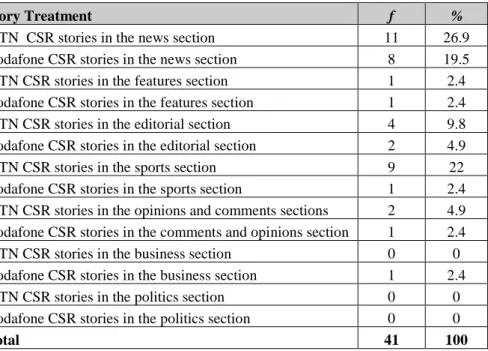
Results from Table 3 show that together, CSR stories on MTN (26.9%) and Vodafone (19.5%), had 46.4% treatment as news more than any other category in Daily
Graphic. The “politics” section had
no CSR stories on the two companies. From the table, with the exception of the business section, CSR stories focused more on MTN (66 %) in Daily Graphic than Vodafone. Vodafone stories, however, were featured in six of the seven categories as against five for MTN
Table 3: Content categories in Daily Graphic
Story Treatment f %
MTN CSR stories in the news section 11 26.9 Vodafone CSR stories in the news section 8 19.5 MTN CSR stories in the features section 1 2.4 Vodafone CSR stories in the features section 1 2.4 MTN CSR stories in the editorial section 4 9.8 Vodafone CSR stories in the editorial section 2 4.9 MTN CSR stories in the sports section 9 22 Vodafone CSR stories in the sports section 1 2.4 MTN CSR stories in the opinions and comments sections 2 4.9 Vodafone CSR stories in the comments and opinions section 1 2.4 MTN CSR stories in the business section 0 0 Vodafone CSR stories in the business section 1 2.4 MTN CSR stories in the politics section 0 0 Vodafone CSR stories in the politics section 0 0
Total 41 100
Content Categorization in B&FT
Results in Table 4 indicate that more than half of CSR stories (54.1%) on MTN and Vodafone were published as news with MTN enjoying 19.7 per cent, leaving Vodafone with 34.4 per cent. The “opinion” and “politics” sections
had no CSR stories on MTN and Vodafone. The foregoing figures in the three Table figures show that whereas Daily Graphic treated majority of MTN CSR stories under news than Vodafone, B&FT, on the other hand, devoted its news section to more Vodafone CSR stories than MTN.
Table 4: Story Treatment in B&FT
Story Treatment f %
MTN CSR stories in the news section 12 19.7
Vodafone CSR stories in the news section 21 34.4 MTN CSR stories in the features section 9 14.8
Vodafone CSR stories in the features section 8 13.11 MTN CSR stories in the editorial section 0 0
Vodafone CSR stories in the editorial section 1 1.6
MTN CSR stories in the sports section 3 4.92 Vodafone CSR stories in the sports section 1 1.6
MTN CSR stories in the opinions and comments sections
0 0
Vodafone CSR stories in the comments and opinions section
0 0
MTN CSR stories in the business section 2 3.3
Vodafone CSR stories in the business section 4 6.6
MTN CSR stories in the politics section 0 0 Vodafone CSR stories in the politics section 0 0
Total 61 100
Photographs in CSR Stories
Sub editors consider photographs as a critical component that attract
news readers (Lester, 2011). A photograph can have a thousand words and readers require less
Fortune Tella, et al CJOC (2018) 5(1) 22-39
formal education to understand a photograph (Miś, 2013). Photographs do enhance the credibility of a story, serving as evidence that authenticates that story (Ehidiamen, 2008).
The use of photographs in Daily Graphic
From Table 5, the Daily Graphic’s
use of photographs was prominent on the two companies as more than three-fourth (78%) of the stories had photographs. Majority of the stories on MTN (46.3% and Vodafone (31.7%) had pictures.
Table 5: Daily Graphic use of photographs in the CSR Stories
Use of Photographs f %
MTN CSR stories with photographs 19 46.3 Vodafone CSR stories with photographs 13 31.7 MTN CSR stories without photographs 8 19.5 Vodafone CSR stories without photographs 1 2.4
Total 41 100
Photographs in B&FT
Results from Table 6 shows that collectively, less than a fifth (19.7%) of the CSR stories on MTN and Vodafone had no stories with photographs. The B&FT also used
photographs in more than two-thirds (80.3%) of the CSR stories on the two companies. From the results, it is clear that the two newspapers understand the importance of using photographs in reporting.
Table 6: B&FT ‘s use of photographs in its CSR Stories
Use of Photographs f %
MTN CSR stories with photographs 20 32.8 Vodafone CSR stories with photographs 29 47.5 MTN CSR stories without photographs 5 8.2 Vodafone CSR stories without photographs 7 11.5
Total 61 100
Dominant CSR issues in Daily Graphic
As presented in Table 7 below, the most dominant CSR activities for both MTN and Vodafone was about
leadership, vision and values
(24.4%). The activities were spread over empowerment, training and corporate governance. The two companies’ activities are also visible
in sports in Daily Graphic (22%). Health, education and stakeholder
engagement were also covered by the newspaper.
Table 7: Dominant CSR issues in the Daily Graphic
CSR Issues/Activities f %
Leadership, Vision and Values 10 24.4 Marketplace activities 3 7.3 Workforce activities 3 7.3 Community activities 2 4.9 Stakeholders’ engagement 3 7.3 Environmental activities 1 2.4 Education 4 9.8 Health 5 12.2 Sports 9 22 Total 41 100
Dominant CSR issues in B&FT
The results in Table 8 shows that in
B&FT, activities about leadership, vision and values were the most reported, making up over one-third (36.1%) of the CSR issues covered
in B&FT. Comparatively, Daily
Graphic and B&FT did a lot more
CSR stories on leadership, vision and value as well as sport activities of MTN and Vodafone. Marketplace activities which include responsible customer relations and marketing had close to a fifth (19.7%) coverage in B&FT, scoring higher than sport reports.
Table 8: Dominant CSR issues in B&FT
CSR Issues/Activities f %
Leadership, Vision and Values 22 36.1 Marketplace activities 12 19.7 Workforce activities 2 3.3 Community activities 3 4.9 Stakeholders’ engagement 2 3.3 Environmental activities 1 1.6 Education 3 4.9 Health 5 8.2 Sports 11 18 Total 61 100
33
Fortune Tella, et al CJOC (2018) 5(1) 22-39
Tone of CSR stories
One of the objectives of this study is to assess the tone of CSR reports on MTN and Vodafone in the two papers and establish the role it played in enhancing the reputation of the two companies. Tone can be positive, neutral or negative. Positive means the story is favorable, negative is critical while neutral is neither favorable nor critical (Taylor, 2007).
Tone of CSR stories in the Daily Graphic
As captured in Table 9, over four-fifth (82.9%) of the CSR stories on MTN and Vodafone in Daily
Graphic had positive tone and hence
favorable to the reputation of the companies. The absence of negative CSR stories is significant to enhancing stakeholder relationship.
Table 9: Tone of CSR stories published in the Daily Graphic
Tone of story f % MTN Positive 23 56.1 Vodafone Positive 11 26.8 MTN Negative 0 0 Vodafone Negative 0 0 MTN Neutral 4 9.8 Vodafone Neutral 3 7.3 Total 41 100
Tone of CSR stories in B&FT
The results in Table 10 show that close to four-fifth of the CSR stories published in the B&FT was positive. It is clear from the two tables that both Daily Graphic and
B&FT newspapers treatment of
CSR stories of MTN and Vodafone was largely positive and the positive treatment bodes well for reputation enhancement.
Table 10: Tone of CSR stories published in the B&FT
Tone of story f % MTN Positive 19 31.2 Vodafone Positive 25 41 MTN Negative 0 0 Vodafone Negative 0 0 MTN Neutral 6 9.8 Vodafone Neutral 11 18 Total 61 100
34
Discussion
The results presented offer an insight into CSR activities of MTN and Vodafone, and how Daily Graphic and B&FT ‘s reports on those activities affect the reputation of the two telecom companies. The study specifically set out to assess how the placement and categorization of CSR stories, use of photographs and tone of those stories contribute to the reputation enhancement of MTN and Vodafone.
The placement of CSR stories was key in projecting the image of MTN and Vodafone. Most of the stories in both newspapers were published inside the pages. Placement of stories in the inside pages allows for detailed explanation of issues (Popoola 2014). The inference here is that the stories in the inside pages provided Daily Graphic B&FT
readers with more details on the two companies’ CSR initiatives, thereby helping in the enhancement of their reputation since placement has been identified as a predictor of the criterion enhancement.
The results also established that most of the CSR stories were treated as news in the two newspapers. It is sensible to extrapolate that readers got a firsthand understanding of the CSR issues of MTN and Vodafone since news would normally be the foremost genre. By placing the CSR
stories as news, readers were placed at the receiving end of agenda setting which make them appreciate those CSR news as important (Bawah, 2014).
The use of photograph in a story attracts more attention from readers than a story without one (Lester, 2011). When used without an ulterior motive, they are a mileage generator. The results show that majority of CSR stories in both newspapers had pictures. Photographs explain issues better than a thousand words as noted earlier. As most of the CSR stories had photographs, it makes meaning to assert that the published photographs contributed in enhancing the reputation of MTN and Vodafone in respect of their CSR initiatives.
The researchers also needed to establish those CSR issues and activities on MTN and Vodafone that dominated the pages of Daily Graphic and B&FT. The results disclosed that most of the stories were about leadership, vision and values; specifically, about empowering people to make them get better at what they do. This lends credence to the assertion that some companies are interested in encouraging self-leadership and building bridges of trust (Economy, 2014) through their CSR. When narratives on those activities appeal
Fortune Tella, et al CJOC (2018) 5(1) 22-39
to readers, they serve as reputation enhancer for the individual or organization that the stories are about.
Sports activities were also visible in the coverage of the two newspapers. Generally, the assertion exists that the most recurring CSR activities by telecom companies are in the arena of sports (Abukari 2014) in several African countries. Sports have been found to be the magnet that attracts goodwill to sponsors. If this premise is transposed to MTN and Vodacom whose CSR stories appeared significantly in the press, then the conjecture can be accepted that readers would have had a positive perspective of the two companies, leading to an enhanced reputation. Overall, the results of this analysis have shown that CSR stories of MTN and Vodafone reported in the Daily Graphic and B&FT newspapers made some significant contributions to the enhancement of the reputation of MTN and Vodacom.
Remark: There is a Caveat
Facts from the study do show clearly that the two telecom
companies have enjoyed some good reputation as an upshot of the CSR stories published about them. But there is a caveat. They had substantial number of stories published inside the pages but had no appreciable news on the cover of the two newspapers.
The implication of this is that the stories inside lacked the worth that could make them fit for the front page. The connotation here is that the what, who, when, why and how
of those stories are in the two- rather than three-dimensional mode (Omojola, 2012). According to the author, 2-D reporting limits narratives as the five parameters have highly loaded portfolio that should be explored beyond their façade. The 3-D reporting explores “the what behind what, the who behind who, the when behind when and the why behind why” (p.127), which give a story its front-page potential. In addition to this, the telecom companies will have to upgrade their CSR portfolio significantly to make them fit for the cover page.
References
Abukari, A. J. (2014). Corporate social responsibility reporting
in the telecommunications
sector in Africa. (Doctoral
dissertation). University of Ghana, Legon.
Alhassan, Y. (2013). Corporate social responsibility of the
mobile telecommunication industry in Ghana; The case of Vodafone Ghana -Tamale main
branch. (Unpublished thesis).
Kwame Nkrumah University of Science and Technology, Kumasi.
Amponsah-Tawiah, K. &Dartey-Baah, K. (2011). Corporate Social Responsibility in Ghana.
International Journal of
Business and Social Science, 2,
17, 107 - 112. Retrieved June 5, 2017, from http://www.ijbssnet.com. Amponsah-Tawiah, K.,
&Dartey-Baah, K. (2016). Corporate social responsibility in Ghana:
A sectorial analysis in
corporate social responsibility
in sub-Saharan Africa.
University of Ghana, Legon. Ansah, M.O. (2013). Corporate
Social Responsibility in Ghana: A Comparative Analysis and Business Imperative. International Review of Management and
Marketing, 3, 184-189.
Bawah, A. (2104). A content analysis of the daily graphic’s coverage of fire outbreaks between January 2013 and
December 2013. (Unpublished
undergraduate thesis). Christian Service University College, Kumasi.
Ball-Rokeach, S.J., & Defleur, M. L.(1976). A dependency model of mass–media effects.
Communication Research,
3(1), 3-21.
Bode-Williams, K. & Abotsi, M. (2014). Ghana rewards
Companies for corporate
social Responsibility. Retrieved October 15, 2016 from http://www.ghananewsagency. org/economics/ghana-rewards- companies-for-corporate-social-responsibility-74577 Chaudhry, K. (2007). Impact of
corporate social responsibility and transformational leadership on brand community an experimental study. Global
Business Review, 8(2),
205-220.
Dartey-Baah, K. (2013). Corporate Social Responsibility in Ghana.
International Journal of
Business and Social Science, 2(17), 107-112
Donaldson, T., & Preston, L. E. (1995). The stakeholder theory of the corporation: Concepts, evidence, and implications.
Academy of management
Review, 20(1), 65-91.
Ezendu, E. (2006).Essay on
corporate social responsibility.
Retrieved May 7, 2016 from
http://vimohacy.now-ip.xyz/p.php
Economy, P. (2014). Empowerment play: Why you should put people first. Retrieved June 6,
2016 from
37
Fortune Tella, et al CJOC (2018) 5(1) 22-39
economy/empowerment-play- why-you-should-put-people-first-html
Ehidiamen, J. (2010). Usage of news pictures in newspaper a content analysis of front-page photographs in the guardian
and the punch newspaper.
Basic Research & Academic Essay.
Ghoul, S., Guedhami, O., Nash, R. C., & Patel, A. (2016). New evidence on the role of the media in corporate social
responsibility. University of
Alberta, Alberta.
Fombrun, C.& Shanley, M. (1990). What's in a name? Reputation building and corporate strategy. Academy of
Management Journal, 33(2),
233-258.
Hinson, R., Boateng, R., & Madichie, N. (2010). Corporate social responsibility activity reportage on bank websites in Ghana. International Journal
of Bank Marketing, 28(7),
498-518.
Kauda, J. & Hinson, R. E. (2012). Corporate social responsibility (CSR) practices of foreign and local companies in Ghana.
Thunderbird International Business Review, 54(4), 521-536. KPMG. (2015). Currents of change: The KPMG Survey of Corporate Responsibility. Accra: KPMG.
Lattimore, D., Baskin, O., Heiman, S.T. and Toth, E. (2012).
Public relations: The
profession & the practice.
Columbus, OH: McGraw-Hill Education Press.
Mensah, H. K. (2015). An exploratory study of corporate social responsibility practices among rural and community
banks in Ghana. (Doctoral
dissertation). Kwame Nkrumah University of Science and Technology, Kumasi.
Mis, K. (2013). Copy of photo presentation. Retrieved May 8,
2016 from
https://prezi.com/cupniu5hnwi p/copy-of-photo-presentation. National Communication Authority.
(2016). Mobile Phone
Subscriber statistics. Accra:
National Communication Authority.
Odiboh, O., Omojola, O., Ekanem, T. & Oresanya, (2017). Non-governmental organizations in the eyes of newspapers in Nigeria: 2013–2016 in focus.
Covenant Journal of
Communication, 4(1), 66-92.
Omojola, O. (2012). From two- to three-dimensional reporting. In T. Popoola (ed.), Specialized reporting: A global trend in media training. Lagos: NUJ, pp. 120-142.
Omojola, O. (2008). Toward Global Ethics: Exploring the Perspectives of Local Media
Stakeholders. Ecquid Novi:
African Journalism Studies, 29
(2), 173 – 187.
Hinson, R. E. & Ofori, D.F. (2007). Corporate social responsibility (CSR) perspectives of leading firms in Ghana. Corporate Governance: The international journal of business in society, 7(2), 178-193.
Oppong, S. (2016). Corporate social responsibility in the
Ghanaian context. African
University College of Communications, Accra. Otchere-Ankrah, B., & Tenakwah,
E. (2015). Impact of corporate social responsibility on buyer behavior within the mobile telecommunication sector: A case of MTN and Vodafone Ghana Limited. The
International Journal of
Business & Management, 3(1),
374-381.
Rockson, K. (2011). Mainstreaming corporate social responsibility (CSR) in public policy in Ghana: The threats and the
opportunities. Ghana Institute
of Journalism, Accra.
Rockson, K. (2012). Mainstream corporate social responsibility (CSR) in public policy in Ghana: the threats and the
opportunities. Ghana Institute
of Journalism, Accra.
Supa, D. W. (2014). The academic inquiry of media relations as both a tactical and strategic function of public relations. Research Journal of
the Institute for Public
Relations, 1(1), 1-15.
Tang, Z., & Tang, J. (2012). Stakeholder–firm power difference, stakeholders' CSR orientation, and SMEs' environmental performance in China. Journal of Business
Venturing, 27(4), 436-455.
Taylor, M. (2008). Public perception of how media and NGOs contribute to civil society in Croatia’s accession to EU. International Journal of Communication, 2, 1226 – 1247.
Yartey, D.; Odiboh, O.; Ekanem, T.: Adesina, E.; Omojola, O. & Adeyeye, B. (2018). Big data,
eEducation and mass
communication in Nigerian
universities. 31st IBIMA
Conference: 25-26 April 2018, Milan, Italy. Retrieved May 10, 2018 from http://ibima.org/accepted- paper/big-data-eeducation-and- mass-communication-in-nigerian-universities/.