ABOUT THE
PEER EXCHANGE
FHWA’s RSPCB Peer-to-Peer Program (P2P) supports and sponsors peer exchanges and
workshops hosted by agencies. Date
May 14, 2013 Hosts FHWA Office of Safety
Key Participants
Delaware Department of Transportation FHWA Delaware Division Office Illinois Department of Transportation
FHWA Illinois Division Office Iowa Department of Transportation
FHWA Iowa Division Office Kentucky Transportation Cabinet Maryland Department of Transportation
FHWA Maryland Division Office Michigan Department of Transportation
FHWA Michigan Division Office Minnesota Department of Transportation
FHWA Minnesota Division Office New Jersey Department of Transportation
FHWA New Jersey Division Office Ohio Department of Transportation
FHWA Ohio Division Office Wisconsin Department of Transportation
FHWA Wisconsin Division Office FHWA Resource Center
U.S. DOT Volpe Center
FHWA’s Office of Safety sponsors P2P events.
Learn more.
Horizontal Curves Virtual Peer Exchange
Introduction and Background
This report provides a summary of a peer-to-peer videoconference sponsored by the Federal Highway Administration (FHWA) Office of Safety. The videoconference was the third in a series of roadway departure-focused peer exchanges sponsored by the Office of Safety as a follow-up to face-to-face peer exchanges held with roadway departure Focus States in 2008 and 2009.
The Office of Safety invited nine States — Delaware, Illinois, Iowa, Maryland, Michigan, Minnesota, New Jersey, Ohio, and Wisconsin— to participate in this virtual peer exchange. The selected States were chosen based on the number and percentage of fatal crashes on horizontal curves, as well as geographic location. It was noted that of the States participating in this event, the percentage of crashes on curves is approximately the same as the national average. Nationally, 28 percent of fatal crashes are on curves. Also among the participant States, the ratio of crashes on the State roadway system versus the local roadway system is approximately 50/50.
The event allowed States to learn from peers who demonstrated innovative
approaches to safety on horizontal curves, including high friction surface treatments (HFST) and pavement marking and signage programs. Peer presentations were made by the Kentucky Transportation Cabinet (KYTC), Michigan Department of Transportation (MDOT), Minnesota Department of Transportation (MnDOT), Wisconsin Department of Transportation (WisDOT), and Iowa Department of Transportation (Iowa DOT).
Eighty-one participants representing Departments of Transportation (DOTs), Local Technical Assistance Programs (LTAPs), and FHWA Division Offices attended the virtual peer exchange (see Appendix A for the complete list of event participants). The peer exchange discussions and presentations focused on the following topics (see Appendix B for the full agenda):
Experience with HFST;
Innovative pavement marking and signage programs for curves;
Identification of curve information on local roads; and
Implementation of systemic curve improvements.
Facilitated roundtable discussions on each of the topics were a significant
component of the event. During the discussions, each State shared its experiences in addressing safety on horizontal curves, including innovative practices and programs.
Peer Exchange Proceedings
Welcoming Remarks
An FHWA Office of Safety representative welcomed participants to the peer exchange. Attendees then introduced themselves and briefly described what they were hoping to learn from the event.
Peer Presentations
Peers presented on a number of topics related to addressing safety on horizontal curves. The following section provides an overview of their presentations.
High Friction Surface Treatments
Tracy Allen Lovell, P.E., Kentucky Transportation Cabinet, Division of Traffic Operations
KYTC’s Transportation Engineer presented on Kentucky’s current crash and fatality statistics and discussed Kentucky's experience using HFST. Kentucky is a roadway departure Focus State with more than 60 percent of all highway fatalities being caused by roadway departure. In 2011, Kentucky had 670 fatal crashes resulting in a total of 721 fatalities and an economic cost estimated at over $2.1 billion. Kentucky has a Roadway Departure Implementation Plan with a number of countermeasures to reduce roadway departures. The plan includes:
Enhanced signs/pavement markings,
Rumble strips,
Tree removal,
Corridor enforcement,
Median barriers,
HFST, and
Traffic calming measures.
Kentucky has nearly completed a pilot program installing HFST on horizontal curves with a high risk of roadway departure. To date, Kentucky has installed HFST at 79 sites, including over 100 curves, with an additional 17 sites due to be installed during the 2013 construction season. Kentucky initially began with a preliminary contract for two projects using the traditional design-bid-build method. Both projects were small and utilized a manual installation method. A subsequent systemic contract was developed covering 96 sites. The systemic contract is an “on call” contract which primarily utilizes a mechanical installation method. Kentucky is currently developing a future design-bid-build contract, as well as regional contracts (multiple sites per contract).
Kentucky presented the following project descriptions to demonstrate the success of the project:
Fayette County Route 922
o 8 wet crashes and 5 dry crashes in the three years prior to installation of HFST o 1 wet crash in the 2.4 years after installation of HFST
o 91 percent reduction in crashes
Oldham County Route 22 (in addition to HFST, rumble strips and signing were added) o 53 wet crashes and 3 dry crashes in the three years prior to installation of HFST o 5 wet crashes and 0 dry crashes in the three years after installation of HFST o 91 percent reduction in crashes
Fayette County Interstate 75 off ramp Exit 113 (signage was also added)
o 18 wet crashes and 10 dry crashes in the three years prior to installation of HFST o 0 wet crashes and 1 dry crash in the 2.4 years after installation of HFST
o 96 percent reduction in crashes
KYTC has a six-year plan for reconstruction projects; projects are selected on curves that won’t be re-built in the near future. Additional details on Kentucky’s program include:
Average cost of mechanical installation is $28 per square yard; for manual application, cost is slightly higher (costs do not include budget for lane closures/maintenance of traffic).
Pavement markings are avoided when possible. Mechanical application can be applied right up to the edge of the striping. The markings must be removed if HFST is to be applied over them. Thermoplastic markings can be re-applied on top of HFST, and this works well. Paint can be applied over HFST, but a very high quantity is required due to the pavement texture. Tape does not adhere well and is not recommended.
Noise is not an issue for adjacent residents after the installation of HFST; however, few sites have been close to homes due to the rural nature of the projects.
The set time for the binder is approximately four hours, depending on the ambient temperature, which is typically 50 degrees. Different types of binder are available for different temperature conditions.
HFST is generally applied 50 to 100 feet beyond the curve in each direction.
A visual inspection is made to determine if the structural integrity of road is sufficient for HFST. HFST will not hold up if there is roadway base failure.
A conservative estimate for the life expectancy of HFST is five to seven years.
Kentucky has not had to re-apply any HFST yet but would re-install it on top of the existing HFST unless the road is going to be resurfaced. If a road is resurfaced, the recommended minimum time between laying the asphalt and applying HFST is six weeks.
Michigan – Optical Speed Bars
Gary Loyola, Michigan Department of Transportation
MDOT’s Traffic and Safety Engineer presented on Michigan’s use of optical speed bars to reduce vehicle speeds. MDOT placed optical speed bars on the off-ramp of exit 12 on Interstate 94 in southwest Michigan. The ramp had experienced 13 roadway departure crashes in the past five years, mostly due to driver speeding. Half of these crashes occurred in dark conditions. The ramp’s Average Daily Traffic (ADT) is 2,500 vehicles, including 30 percent trucks. The deceleration lane is unusually long, approximately one-quarter mile before entering a right-hand curve of a partial cloverleaf interchange.
The optical speed bars are 12 inches wide and 18 inches long and are placed perpendicular to the direction of travel outside of the vehicle wheel path. The spacing between the bars decreases as the curve approaches, creating an optical illusion to the driver that is intended to reduce their speed. The optical speed bars begin approximately 700 feet from the curve where the initial spacing between bars is 26 feet. This decreases to a spacing of 9 feet just prior to the point of curvature.
After installation of the optical speed bars, the average speed of drivers negotiating the ramp decreased only slightly, but the number of drivers negotiating the ramp at high speed (above 60 miles per hour) dropped significantly. In the three year period prior to installation, there were 13 crashes, 7 due to wet pavement and 5 at night. In the two and a half years after installation, the number of crashes was reduced to 6, 5 of which were at the ramp terminus (not on the curve) with only 1 wet surface roadway departure crash on the curve.
Minnesota – Implementing Curve Improvements
Brad Estochen and Julie Whitcher, Minnesota Department of Transportation
MnDOT’s traffic safety engineers presented on Minnesota’s experience in implementing horizontal curve improvements. Minnesota has 140,000 miles of roadway and in 2012 had 395 fatalities on its roadways and 1,042 severe injury crashes; 40 percent of the fatal crashes occurred on the State roadway system. Minnesota is pursuing diversity in its safety engineering program. It is implementing systemic deployment of safety improvements using a risk-based approach, but is also maintaining an ability to react to specific locations that experience multiple severe crashes. Minnesota distributes its $19.6 million in statewide Highway Safety Improvement Program (HSIP) funds based on each district’s share of fatal and serious injuries.
The State has pursued a primarily systemic approach to safety funding distribution because, among other reasons, there are very few “black spots,” or individual curves with a disproportionate number of severe crashes. Of nearly 20,000 curves that the State evaluated,
95 percent had zero crashes in the past five years and an additional 2 percent had just one severe crash in the past five years. There were no curves that averaged one or more crashes per year. Though roadway departure crashes are over-represented in crashes on horizontal curves, not all curves are good candidates for safety improvements, and the presence of crashes is not a good indicator of relative risk. The systemic approach uses crash data plus geometric and traffic conditions to evaluate the entire system and identify target areas for safety investment.
MnDOT found that there was a higher crash density within certain ranges of each of the following four criteria used to evaluate the risk on curves:
Radius Range: Crashes on curves with radii between 500 and 1200 feet greatly exceed the proportion of curves in that space.
ADT range: There is an over-representation of crashes on curves with an ADT between 400 and 1000 vehicles per day.
Intersections on curves: Crash density is higher on curves where an intersection is present.
Visual Trap: Visual cues that might imply a road is going straight when in fact there is a curve (tree line, power lines, etc.) are a contributing factor on horizontal curves; these conditions were over-represented in roadway departure crashes.
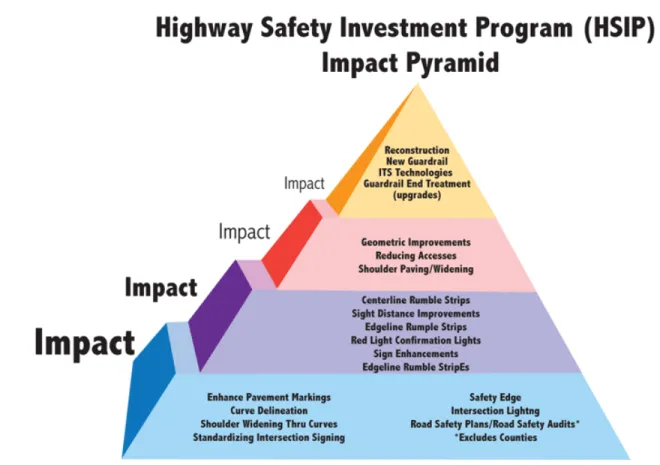
As a result of the adoption of the systemic approach and risk rating criteria, counties and local agencies in Minnesota have been able to better identify projects for HSIP funding. The response to the 2014-2016 solicitation for HSIP funds was the largest ever: MnDOT received 137 applications for a total of $29.5 million, of which MnDOT funded $23 million in projects representing 45 counties. Figure
1
explains MnDOT’s approach to spending HSIP funds.Figure 1
Iowa – Horizontal Curve Signing Program and Pavement Marking Experiment for Horizontal Curves
Jeremy Vortherms, Iowa Department of Transportation
Iowa DOT’s State Transportation Safety Engineer made a presentation regarding Iowa’s horizontal curve sign program. Iowa allocates a percentage of the State’s gas tax to a safety fund and has used a portion of this funding for county signing projects. Once a year, counties can submit an application that includes a spreadsheet to assist with curve computations and cost and materials estimates. The goal of the program is to create a low paperwork environment and give counties flexibility in deciding which curves to treat. To date, approximately 20 counties have used the program, and some have applied multiple times. Iowa DOT uses workshops and other methods of outreach to inform counties of the program. The next step in the program is for Iowa DOT to provide maps and pre-screening tools to identify curves with the greatest need.
The State Transportation Safety Engineer also presented on Iowa’s experimentation with pavement markings approaching horizontal curves. Iowa has piloted a pavement marking treatment at two sites similar to one used in Pennsylvania as shown in Figure 2. At both sites, it was inconclusive whether the markings had an effect on average speeds, but “higher end” speeding was reduced. One disadvantage is that the markings wear off, creating a maintenance issue. Iowa DOT is not currently considering the pavement markings as a treatment to deal with crash issues on horizontal curves.
Figure 2
Wisconsin - Automated Extraction of Curve Information
Rebecca Szymkowsk, Wisconsin Department of Transportation
WisDOT’s State Traffic Engineer of Operations discussed the “Curve Finder” software (an ArcGIS add-in tool) that was developed at the Traffic Operations and Safety Lab at the University of Wisconsin. Within the State trunk roadway system, the Curve Finder uses photo logs and existing geographic information system (GIS) roadway maps to access curve information/data including length, radius, and degree of curvature. WisDOT has found this tool useful in identifying curves on the local road system. The software can be shared with other States.
Wisconsin Regional Safety Improvement Plans
Greg Helgeson, Wisconsin Department of Transportation
WisDOT’s Northwest Region Traffic Safety Engineer discussed Wisconsin’s Regional Safety Improvement Plans. The plans focus on low-cost systemic and sustainable treatments and have studied rural horizontal curves, evaluating risk factors including:
Curve radii, and
Advisory speed posting.
The plans have identified several treatments to address curves, including pavement markings, rumble strips, and chevrons. WisDOT has allocated three million dollars in maintenance funds for systemic improvements.
Roundtable Discussion
GroupDiscussionThe participants addressed a number of key topics during the roundtable discussions; these topics are summarized in this section. Q. How do States integrate locals into their safety program?
Delaware
o The State maintains nearly all roads in the State; therefore, funding is focused on the State system. o Funds are allocated to roads that function as local roads, but are actually State maintained.
Illinois
o Previously allocated $750,000 towards local roads. Since the passage of the current surface transportation bill, Moving Ahead for Progress in the 21st Century (MAP-21), the local roads budget has increased to $12 to $15 million.
o Illinois DOT hosts HSIP workshops for locals regarding how to go through the application process and how to perform road safety assessments.
o Recently 60 percent of safety funding has been spent on the local system.
o Illinois is in final stages of creating guidelines for systemic safety improvements for locals. o Districts are encouraged to work with the locals.
Maryland
o The Strategic Highway Safety Plan (SHSP) and HSIP are State driven. The State typically handles all SHSP and HSIP funds.
o Roadways in local jurisdictions are maintained by the municipality (e.g., Baltimore City maintains all roads in Baltimore except for Interstate 95); other local agencies are connected with their local metropolitan planning organizations (MPOs).
Michigan
o The State has local safety initiatives for its 60 counties and 20 cities and villages.
o The State assists by acting as a consultant in identifying problem areas and funding opportunities and providing tools to locals.
New Jersey
o New Jersey has dedicated 25 percent of HSIP funding to local roadways.
o Three MPOs provide assistance and support to local agencies to advance the 25 percent funding. o New Jersey’s LTAP at Rutgers Transportation Research Resource Center provides support to locals.
o The State does not perform any curve-specific analysis; the High Risk Rural Roads (HRRR) program is used to work with locals.
Ohio
o There are 2,300 local agencies in Ohio; 83 percent of the statewide roadway system is on the local system. The local road safety program is data driven. Locals have access to the GIS Crash Analysis Tool program.
o Ohio’s LTAP center is part of the DOT and as a result, has expanded beyond a training role to provide technical assistance.
o The Rural Road Safety Assistance (RRSA) program targets counties with high percentage of crashes and helps perform road safety assessments.
o The RRSA also administers a county and township signage improvement program, which is based on crash data and provides $2.3 million in funding.
o As part of the SHSP, the State DOT is incorporating local road safety plans and hosting a local peer exchange in August 2013.
o Local projects compete with State projects for HSIP funding.
o WisDOT researched its HRRR-classified roads and identified the top 10 crash corridors. The plan is to contact and work with the counties to put together applications to fund those projects.
Q. Has your State developed local safety plans? Any success stories of using those plans to get projects funded and built?
Minnesota’s county safety plans have been important for funding projects. In the past, it was challenging to get local governments to submit plans for systemic projects; most wanted projects at traditional hot spot locations.
Now, with the plans, the State has more good projects than funding. The State previously underestimated the need for technical support at the local level; safety plans provided a greater understanding of local needs.
Illinois prioritized counties into tiers, and then asked each county to set up safety committees. The county safety committees provide an ideal forum to discuss HSIP project submittals.
In Ohio, local road safety plans and audits have been successful by targeting counties which have a high percentage of routes/corridors in the “top 100.” Counties that have participated have seen significant improvements. Local peer exchanges have been effective by allowing locals to share their experience with their peers.
Q. How are States addressing compliance for curves in the new Manual on Uniform Traffic Control Devices (MUTCD)? Are compliance updates being done systematically? Are States collecting speed data or using posted speed limits?
Delaware is reviewing curves on collectors with ADT greater than 1,000; the next step is to address curves on arterials.
Illinois is using only posted speeds and ball banking many curves. Its focus is first on the highest ADT roads and then curve crashes. The effort is decentralized, so each district is implementing it differently. Some districts are starting with ramps.
Iowa has had a policy in its traffic and safety manual to establish advisory speeds for curves for many years. The State currently uses ball banking and compares the results against the posted speed limit. Iowa does not fully conform to the new MUTCD table because the ball bank method is conservative compared to MUTCD, resulting in low advisory speeds. Iowa does not want to systemically change that right now because it is concerned with not meeting driver expectations.
Each district office in Maryland is responsible for implementation of the new MUTCD standards and may do so either systematically or through projects.
Michigan has a two-step process: addressing curves during its annual re-signing program and documenting information on superelevation for pavement inventory. It will use a database in the future for systemic countermeasures on curves. Ball banking results conform to the new MUTCD guidance for setting speed limits.
Minnesota has been promoting road safety programs statewide; however, it has not fully addressed how to comply with new MUTCD on curves. Some counties and most districts use ball banking; some use other methods to determine advisory speeds. There is no statewide policy.
New Jersey uses ball banking, but it is not doing a systemic update for the latest MUTCD standards.
Ohio follows MUTCD guidelines and has a systemic program to update advisory speeds. It has ball banked all curves and updated to new standards. The State also has a sign upgrade program for counties and townships utilizing ball bank indicators and new MUTCD tables.
Wisconsin follows MUTCD requirements. The State has taken a systemic approach with the new standards which ensures continuity within a county or from town-to-town on a given corridor.
Kentucky has a systemic program in place to update advisory speeds. The State is using a consultant to re-ball bank 600 to 900 miles of roadway.
Q. What experimental measures are States pursuing and how do they feel about the risk in being experimental?
Wisconsin is installing dynamic chevrons, which light up as drivers drive along the curve, at four pilot locations. Settings are based on approach speeds of vehicles.
Michigan has experimented with flashing beacons, quiet rumble strips, and new guard rail systems.
The greatest benefit of the virtual peer exchange was having multiple State agencies gathered and hearing about practices, reports, and coordination. This was an excellent opportunity for dialogue and information sharing.
‐ State DOT, Traffic Engineering Design Division Chief
Q. Do any States have a roadway departure plan or other systemic program developed by FHWA?
Ohio has a roadway departure plan that will be available in June. The State is looking at creating a list that evaluates the clear zones on the State roadway system. A threshold has been developed that is fixed object related. Each district will develop a “top 10” list. The State also received a grant to purchase the Highway Safety Manual for county engineers.
New Jersey is working to install guardrail on unprotected bridge parapets on the county system. The State also has a utility pole mitigation program, for which it has developed a list of high hit locations of utility poles and will be implementing a relocation plan and installing energy absorbing poles.
Key Areas of Interest and Next Steps
At the conclusion of the roundtable discussions, States discussed key areas of interest based on information that emerged from the peer exchange, as well as topics that they intend to explore in the future. Several States indicated that specifications are still needed for HFST. The moderator noted that several States do have specifications that can be shared, such as Kentucky, Maryland, and West Virginia. As a final roundtable, participants indicated what they plan to do differently based on what they learned during the peer exchange:
Wisconsin would like to do a better job at coordinating with local agencies. By State statute, every county has a traffic safety commission; WisDOT representatives and other State officials attend, but some counties are more active than others. The State would like to make a better effort at improving local road safety. As Wisconsin updates its SHSP, it would like to incorporate implementation plans and may look to FHWA for assistance.
Ohio is interested in the investment impact pyramid in the Minnesota presentation. The State is currently moving towards a more predictive risk-based approach and addressing vegetation/clear zone management on horizontal curves to reduce crash severity.
New Jersey is interested in developing local safety plans for capital projects. Participants also noted that they are excited about developing curve model tools for targeting treatments and will contact Wisconsin regarding the tools they have developed.
Minnesota would like to try HFST and plans to research opportunities for demonstrations. The State is also interested in clear zone management as a systemic approach.
Michigan would like to distribute the Minnesota investment impact pyramid. Participants indicated that the State benefits from peer exchanges and would like to host an in-state peer exchange at the local level.
Maryland would like to develop a data-driven program for HFST. The State is looking to enhance partnerships with counties by discussing safety issues and using peer reviews.
Iowa would like to develop a curve identification program for HFST. Participants plan to reach out to Kentucky and other States about the appropriate epoxy to use. They also want to do data assessments on curves to identify the correct locations to treat.
Delaware is interested in using a curve extraction tool. The State would like to go from a hot spot approach to a systemic approach. Participants noted that the State is implementing a rumble strip program for two-lane locals and collectors; they are interested in learning more about Kentucky’s experience with HFST as Delaware moves forward with developing
specifications.
Feedback and Suggestions
The results of the evaluation distributed to participants after the event indicated that the virtual peer event was a success. Participants noted that the dual video conference/web conference made it more interactive compared to a webinar. They appreciated that each of the participating agencies could be seen on the screen in conjunction with the presentation slides on another screen. One participant said that the format was “much
better than if the exchange had been audio all day.” Participants identified several other highlights from the event, such as:
Discovering what other States are doing to address the MUTCD compliance date issue for horizontal curve warning signage.
Learning about Wisconsin’s horizontal curve extraction GIS tool.
Hearing what other States are doing in how they approach their curve crashes and how they are treating them.
For States implementing their first HFST program, understanding some of the lessons learned from Kentucky’s program.
Realizing the importance of structuring crash data capture and storage to use the most critical/compelling crash types as a launching point for evaluation of an appropriate treatment of curves (or other issues).
Participants also provided suggestions on how the event could have been improved, such as:
Including cost comparisons between different treatment alternatives in the presentations.
Repeating questions prior to being answered to make sure all participants heard them clearly.
Addressing the use of highway lighting for horizontal curves to improve delineation, or superelevation needs or corrections as part of an HSIP project. Should superelevation be addressed prior to applying a skid resistant surface if the current rate is deficient?
Including more representation from State’s district office staff and crash data specialists at the peer exchange. One State noted that these individuals would have added insights that would have benefitted the entire group.
Overall, the general consensus was that the focused approach presented at the peer exchange was much more worthwhile than a broad overview of these topics. One participant noted, “The greatest benefit was being able to interact with other State agencies that share the same problems without having to travel.” Another said that the roundtable discussion was beneficial in making sure everyone could offer their input. A State DOT division chief summed up a number of participants’ thoughts: “The greatest benefit of the virtual peer exchange was having multiple State agencies gathered and hearing about practices, reports, and coordination. This was an excellent opportunity for dialogue and information sharing.” Figure 3 below shows a screen shot of the video interface, featuring ten States, the Resource Center, and Office of Safety participating in the event.
Figure 3
Appendix A: Event Participants
FHWA/Volpe Dick Albin Safety Engineer Organization: FHWA Resource Center Business Phone Number: 303‐550‐8804 Business Email: [email protected] Frank Julian Safety Engineer Organization: FHWA Resource Center Business Phone Number: 404‐562‐3689 Business Email: [email protected] Nicholas Artimovich Highway Engineer Organization: FHWA Office of Safety Business Phone Number: 202‐366‐1331 Business Email: [email protected] Jay Monty Planner Organization: US DOT/Volpe Business Phone Number: 617‐494‐3952 Business Email: [email protected] Joe Cheung Engineer Organization: FHWA Office of Safety Business Phone Number: 202‐366‐6994 Business Email: [email protected] Cathy Satterfield Safety Engineer Organization: FHWA Office of Safety Business Phone Number: 708‐283‐3552 Business Email: [email protected] Brian Fouch Team Leader, Safety Design Organization: FHWA Office of Safety Business Phone Number: 202‐366‐0744 Business Email: [email protected] Susan Smichenko Community Planner Organization: US DOT/Volpe Business Phone Number: 617‐494‐3438 Business Email: [email protected] Mike Griffith Office Director, Safety Technologies Organization: FHWA Office of Safety Business Phone Number: 202‐366‐9469 Business Email: [email protected] DELAWARE Patrick Kennedy Operations and Safety Engineer Organization: FHWA ‐ Delaware Business Phone Number: 302‐734‐5326 Business Email: [email protected] Adam Weiser Safety Programs Manager Organization: Delaware Department of Transportation Business Phone Number: 302‐659‐4073 Business Email: [email protected] Jim Pappas Assistant Director Organization: Delaware Department of Transportation Business Phone Number: 302‐760‐2379 Business Email: [email protected] ILLINOIS Anthony Baratta, P.E. Local Roads Field Engineer Organization: Illinois Department of Transportation‐ Region2/District 2 Business Phone Number: 815‐284‐5384 Business Email: [email protected] Dan Long Systems Planning and Services Engineer Organization: Illinois Department of Transportation Business Phone Number: 815‐284‐5966 Business Email: [email protected] Leonel Crespo Acting Geometrics Engineer Organization: Illinois Department of Transportation Business Phone Number: 309‐671‐3456 Business Email: [email protected] Marshall Metcalf Traffic Operations Engineer Organization: Illinois Department of Transportation Business Phone Number: 217‐785‐5312 Business Email: [email protected]Kim Cummins Local Roads Field Engineer Organization: Illinois Department of Transportation, District 6 Business Phone Number: 217‐785‐5342 Business Email: [email protected] Tim Sheehan Safety Design Unit Chief Organization: Illinois Department of Transportation Business Phone Number: 217‐782‐3568 Business Email: [email protected] Don Ernat D3 Local Roads and Streets Engineer Organization: Illinois Department of Transportation Business Phone Number: 815‐434‐8426 Business Email: [email protected] Peter Stresino Traffic Studies Engineer Organization: Illinois Department of Transportation Business Phone Number: 847‐705‐4135 Business Email: [email protected] Lisa Heaven‐Baum Traffic Programs Engineer Organization: Illinois Department of Transportation District 1 Business Phone Number: 847‐705‐4158 Business Email: lisa.heaven‐[email protected]
Priscilla Tobias State Safety Engineer Organization: Illinois Department of Transportation Business Phone Number: 217‐782‐3568 Business Email: [email protected] Kahn Kellams CE III Organization: Illinois Department of Transportation Business Phone Number: 217‐342‐8247 Business Email: [email protected] Kevin Trapp Operations Plans & Designs Engineer Organization: Illinois Department of Transportation District 5 Business Phone Number: 217‐466‐7233 Business Email: [email protected] Randall Laninga Traffic Engineer Organization: Illinois Department of Transportation Business Phone Number: 309‐671‐4477 Business Email: [email protected] Riyad Wahab Safety Implementation Section Chief Organization: Illinois Department of Transportation Business Phone Number: 217‐558‐1793 Business Email: [email protected] Jonathan Lloyd Crash Analysis Engineer Organization: Illinois Department of Transportation Business Phone Number: 847‐705‐4137 Business Email: [email protected] James Wessel Design and Planning Engineer Organization: Illinois Department of Transportation Business Phone Number: 618‐346‐3273 Business Email: [email protected] Greg Piland Safety Specialist Organization: FHWA Illinois Division Business Phone Number: 217‐492‐4645 Business Email: [email protected] IOWA Nicole Fox Secondary Roads Engineer Organization: Iowa Department of Transportation Business Phone Number: 515‐239‐1506 Business Email: [email protected] Jerry Roche Safety and Traffic Operations Engineer Organization: FHWA Iowa Division Office Business Phone Number: 515‐233‐7323 Business Email: [email protected] Jan Laaser‐Webb Transportation Engineer Specialist Organization: Iowa Department of Transportation Business Phone Number: 515‐239‐1349
Business Email: jan.laaser‐[email protected] Steven Schroder Transportation Engineer Organization: Iowa Department of Transportation Business Phone Number: 515‐239‐1623 Business Email: [email protected]
Terry Ostendorf Program Planner Organization: Iowa Department of Transportation Business Phone Number: 515‐239‐1077 Business Email: [email protected] Jeremey Vortherms State Transportation Safety Engineer Organization: Iowa Department of Transportation Business Phone Number: 515‐239‐1267 Business Email: [email protected] KENTUCKY Tracy Lovell Transportation Engineer Organization: Kentucky Transportation Cabinet Business Phone Number: 502‐564‐3020 Business Email: [email protected] MARYLAND Paulo DeSousa Assistant Chief, Pavement and Geotechnical Division Organization: Maryland State Highway Administration Business Phone Number: 443‐572‐5061 Business Email: [email protected] Dilip Patel Assistant Division Chief Organization: Maryland State Highway Administration Business Phone Number: 410‐787‐5811 Business Email: [email protected] Breck Jeffers Operations and Safety Engineer Organization: FHWA ‐ Maryland Division Office Business Phone Number: 410‐779‐7153 Business Email: [email protected] Michael Paylor Division Chief Organization: Maryland State Highway Administration Business Phone Number: 410‐787‐4027 Business Email: [email protected] MICHIGAN Mark Bott Engineer of Traffic & Safety Organization: Michigan Department of Transportation Business Phone Number: 517‐335‐2625 Business Email: [email protected] David Morena Highway Safety Specialist Organization: FHWA Michigan Division Business Phone Number: 517‐702‐1836 Business Email: [email protected] Mary Bramble Transportation Engineer Organization: Michigan Department of Transportation Business Phone Number: 517‐335‐2837 Business Email: [email protected] Jill Morena Pavement Marking Specialist Organization: Michigan Department of Transportation Business Phone Number: 517‐373‐3340 Business Email: [email protected] Tracie Leix Safety Programs Unit Supervisor Organization: Michigan Department of Transportation Business Phone Number: 517‐373‐8950 Business Email: [email protected] Sarah Woolcock Coloma TSC Operations Engineer Organization: Michigan Department of Transportation Business Phone Number: 269‐217‐7805 Business Email: [email protected] Gary Loyola Coloma TSC Traffic Safety Operations Engineer Organization: Michigan Department of Transportation Business Phone Number: 269‐849‐2346 Business Email: [email protected] MINNESOTA Brad Estochen State Traffic Safety Engineer Organization: Minnesota Department of Transportation Business Phone Number: 651‐234‐7011 Business Email: [email protected] Will Stein Safety Engineer Organization: FHWA ‐ Minnesota Division Office Business Phone Number: 651‐291‐6122 Business Email: [email protected]
Sulmaan Khan Assistant Project Development Engineer Organization: Minnesota Department of Transportation Business Phone Number: 651‐366‐3829 Business Email: [email protected] Julie Whitcher Assistant State Traffic Safety Engineer Organization: Minnesota Department of Transportation Business Phone Number: 651‐234‐7019 Business Email: [email protected] Derek Leuer Traffic Safety Engineer Organization: Minnesota Department of Transportation Business Phone Number: 651‐234‐7372 Business Email: [email protected] Almin Ramic Grad 2 Engineer Organization: Minnesota Department of Transportation Business Phone Number: 651‐366‐4696 Business Email: [email protected] NEW JERSEY Chris Barretts Manager Organization: New Jersey Department of Transportation Business Phone Number: 609‐530‐2600 Business Email: [email protected] Janet Leli Director Organization: NJ LTAP Business Phone Number: 848‐445‐2906 Business Email: [email protected] Evan Bossett Organization: CAIT/Transportation Safety Resource Center Business Phone Number: 732‐445‐2882 Business Email: [email protected] Jennifer Marandino Team Leader ‐ Capital Programming & Safety Organization: South Jersey Transportation Planning Org. Business Phone Number: 856‐794‐1941 Business Email: [email protected] Yosy Cosme Assistant Engineer Organization: New Jersey Department of Transportation Business Phone Number: 609‐530‐8737 Business Email: [email protected] Angela Quevedo Senior Engineer Organization: New Jersey Department of Transportation Business Phone Number: 609‐530‐4677 Business Email: [email protected] George Fallat Traffic Engineer Organization: Mercer County Business Phone Number: 609‐989‐6642 Business Email: [email protected] Virgilio Tan Senior Engineer Traffic Organization: New Jersey Department of Transportation Business Phone Number: 609‐530‐5696 Business Email: [email protected] Andy Kaplan Senior Transportation Safety Engineer Organization: Rutgers Transportation Safety Resource Center Business Phone Number: 609‐213‐6252 Business Email: [email protected] Andrew Tracy Assistant Planner Organization: South Jersey Transportation Planning Organization Business Phone Number: 856‐794‐1941 Business Email: [email protected] Matthew Lawson Principal Planner Organization: County of Mercer, NJ Business Phone Number: 609‐989‐6551 Business Email: [email protected] Caroline Trueman Safety Engineer Organization: FHWA New Jersey Division Business Phone Number: 609‐637‐4234 Business Email: [email protected] OHIO Michael B. Armstrong Safety Engineer Organization: FHWA Ohio Division Business Phone Number: 614‐280‐6855 Business Email: [email protected] Victoria Beale LTAP Center Director Organization: Ohio LTAP Center/Ohio Department of Transportation Business Phone Number: 614‐466‐3129 Business Email: [email protected]
Michael McNeill Transportation Engineer Organization: Ohio Department of Transportation Business Phone Number: 614‐387‐1265 Business Email: [email protected] WISCONSIN Andrea Bill Associate Researcher Organization: Traffic Operations and Safety Laboratory University of Wisconsin‐Madison Business Phone Number: 608‐890‐3425 Business Email: [email protected] David Jolicoeur Safety Engineer Organization: FHWA ‐ Wisconsin Division Office Business Phone Number: 608‐829‐7520 Business Email: [email protected] Allison Blackwood Traffic Operations Engineer Organization: Wisconsin Department of Transportation Business Phone Number: 262‐521‐5367 Business Email: [email protected] Tony Kemnitz Traffic Safety Engineer Organization: Wisconsin Department of Transportation Business Phone Number: 715‐421‐8023 Business Email: [email protected] John Bridwell Standards Development Engineer Organization: Wisconsin Department of Transportation Business Phone Number: 608‐266‐8664 Business Email: [email protected] Karen Martens Traffic Engineer Organization: Wisconsin Department of Transportation Business Phone Number: 262‐548‐6892 Business Email: [email protected] Dan Dedrick Safety Engineer Organization: Wisconsin Department of Transportation, SE Region Business Phone Number: 262‐548‐5894 Business Email: [email protected] Eric Perea Traffic Operations Engineer Organization: Wisconsin Department of Transportation Business Phone Number: 262‐574‐5422 Business Email: [email protected] Erik Emerson Standards Development Engineer Organization: Wisconsin Department of Transportation Business Phone Number: 608‐266‐2842 Business Email: [email protected] Stacey Pierce Traffic Engineer Organization: Wisconsin Department of Transportation Business Phone Number: 262‐548‐5958 Business Email: [email protected] Joshua Falk Civil Engineer‐ Signing & Pavement Marking Organization: Wisconsin Department of Transportation Business Phone Number: 920‐492‐7165 Business Email: [email protected] Rebecca Szymkowski State Traffic Engineer of Operations Organization: Wisconsin Department of Transportation Business Phone Number: 608‐266‐9381 Business Email: [email protected] Greg Helgeson Traffic Safety Engineer Organization: Wisconsin Department of Transportation, NW Region Business Phone Number: 715‐836‐2980 Business Email: [email protected] Amy Taetsch CE‐Trans Organization: Wisconsin Department of Transportation Business Phone Number: 262‐548‐8641 Business Email: [email protected]
Appendix B: Event Agenda
Horizontal Curve Peer Exchange
Tuesday, May 14, 2013
Central Time - 9:30am to 2:00 pm
9:30 – 11:30 MORNING SESSION Welcome, Overview and Introductions
Presentation and Q&A High Friction Surface Treatments, Tracy Lovell, KYTC
Roundtable Discussions on Pavement Treatments for Curves
HFST experience, challenges, questions
Other pavement treatments: other friction improvements, drainable pavements
Widening Lanes or Shoulders at Curves
Roundtable Discussions on Delineation and Warning Practices for Curves
Optical Speed Bars, Michigan DOT (Gary)
Advance Warning Pavement Marking for Curves, Iowa DOT (Jeremy)
Compliance with MUTCD Advisory Speed Requirements for Curves, DelDOT (Adam)
Experiments vs. Treatments with CMFs – why take the risk?
11:30 – 12:15 LUNCH
12:15 – 2:00 AFTERNOON SESSION
Roundtable Wrap-Up on Delineation/Warning
Automatic Extraction of Curve Information, WisDOT (Rebecca)
Presentation Implementing Curve Improvements, Brad Estochen, MnDOT
Roundtable Discussion on Implementing Curve Programs
Horizontal Curve Program for Counties, Iowa DOT (Jeremy)
Challenges to treating local roads – funding, alignment, lack of design, etc.
Regional Safety Improvement Plans, WisDOT (Regional Safety Engineer)
Selecting implementation strategies (Systemic, Hot Spot, other)
Selecting which treatments/countermeasures to apply
Prioritizing projects
Take-Away Items
Where do we go from here?
o What will you do differently
o What concerns still need to be resolved