#2011-052
Size,
competition,
and
innovative
activities:
a
developing
world
perspective
By Abdul Waheed
Maastricht Economic and social Research institute on Innovation and Technology (UNU‐MERIT) email: [email protected] | website: http://www.merit.unu.edu
Maastricht Graduate School of Governance (MGSoG)
email: info‐[email protected] | website: http://mgsog.merit.unu.edu
Keizer Karelplein 19, 6211 TC Maastricht, The Netherlands Tel: (31) (43) 388 4400, Fax: (31) (43) 388 4499
UNU-MERIT Working Papers ISSN 1871-9872
Maastricht Economic and social Research Institute on Innovation and Technology, UNU-MERIT
Maastricht Graduate School of Governance MGSoG
UNU-MERIT Working Papers intend to disseminate preliminary results of research carried out at UNU-MERIT and MGSoG to stimulate discussion on the issues raised.
1
Size, competition, and innovative activities: a
developing world perspective
Abdul Waheed*
United Nations University (UNU-MERIT) Maastricht, the Netherlands
Abstract
The impact of size and competition on firm-level innovative activities has obtained considerable attention in developed countries, but the focus is still lacking in developing world. This paper is an attempt to contribute in this direction by including 14 Latin American countries, and by using Enterprise Survey data of the World Bank. We consider both input and output innovation to observe the influence of firm size and of market concentration on innovative activities, and to interrogate the differences in influences of innovation determinants in different size classes and competition statuses.
Our analysis reveals that employment increases the likelihood of R&D and product innovation, and its influence on R&D expenditures is positive but at less than proportionate rate. We find that product market competition increases the probability of both R&D decision and innovation output, but it has no influence on R&D intensity. We observe no relationship between R&D expenditures per employee and product innovation. Country and industry differences also contribute substantially towards firm-level R&D activities and product innovation. Moreover, large or small firms do no tend to be advantageous for employment and competition in order to influence R&D activities; however, for product innovation, competition is a more significant stimulus for large firms compared to small ones. Our results suggest that firms’ R&D productivity is independent of size classes and competition environments. All of the determinants (of innovation) are jointly observed to have different effects, for large and small firms, as explanatory factors of both R&D intensity and product innovation, and for different competition environments only for product innovation.
JEL classification: L11; L12; L13; O32
Keywords: R&D; Product innovation; Firm size; Product market competition
2
1. Introduction
Innovation is pervasive in every aspect of life, but its importance becomes clearer still when observed in the context of economic growth. It is considered to be a substantially influential determinant of business growth (Rogers, 2004) and economic development (Fagerberg & Srholec, 2008). Innovative activities have been widely studied at the firm level, and a mass of research is available to interrogate the explanatory factors which arguably influence firms’ decisions concerning innovation (see for example, Freitas, Clausen, Fontana, & Verspagen, 2011; Evangelista & Mastrostefano, 2006 for developed countries; Ayyagari, Demirguç-Kunt, & Maksimovic, 2007 for the developing world). Two contributing factors of innovative activities, among others, could be firm size and market concentration, and scholars have been trying to reach a general consensus on the debate whether Schumpeter’s view regarding these two characteristics could be corroborated or not. In the 1960s, scholars like Mansfield (1963), Hamberg (1964), Scherer (1965a, 1965b, 1967), and Comanor (1967), to name a few, started their work in order to investigate the so-called Schumpeter hypothesis regarding industrial innovation, which can simply be explained as: (1) innovation and firm size are positively associated (and more strictly “innovative activities increase more than proportionately with firm size”); (2) innovation thrives in monopolistic markets.
A key way to interrogate such relationships is to measure innovationa, and researchers have used
inter alia R&D-related measurements (Cohen, Levin, & Mowery, 1987; Lunn & Martin, 1986),
patents (Arvanitis, 1997), and a number of innovations (Acs & Audretsch, 1987; Pavitt, Robson, & Townsend, 1987)b. Broadly speaking, we can distinguish these measurements as inputs into the innovation process, and innovation outputsc. When considering the stricter version of Schumpeter’s hypothesis on firm size – more than proportionate increase in innovative activities than size – the literature favoured mostly a less than proportionate increase (Lee & Sung, 2005; Santarelli & Sterlacchini, 1990), with some strong opposite voices as well (Soete, 1979). However, researchers in general seem to agree on a positive impact of firm size on both innovation input and output. For innovation output, however, we can even find a negative relationship (Hansen, 1992; Stock, Greis, & Fischer, 2002). The reason for such an inverse relationship between size and innovation output could be explained by the findings of Acs & Audretsch (1991a) who contended that although large firms are more R&D-intensive, their R&D productivity diminishes with firm size. Regarding competition, the most-established phenomenon – for both input and output innovation – is the inverted-U relationship, implying that neither monopoly nor perfect competition is conducive to innovative activities, but the
a
One of the major reasons, of course, for the use of different measurements of innovation can be explained by the availability of the relevant information.
b
A brief overview of the literature of the size-innovation and the competition-innovation relationships is discussed in Acs & Audretsch (1991b). A comprehensive review of the relationship of size and market structure with innovative activities is available in Kamien & Schwartz (1982) and, more recently, in Gilbert (2006).
c
Patents sometimes are avoided to be used as an output measure and are criticized because of the following reasons: (1) All inventions are not patented; (2) All Patents could not be commercialized; (3) Industrial differences do exist in patenting activities; some technologies have more propensities to be patented than others.
3
suitable market structure is the moderately competitive market (Aghion, Bloom, Blundell, Griffith, & Howitt, 2005; Scherer, 1967).
One common parameter of all of the above stated outcomes is their emergence from the studies of developed countries. So far, a minuscule amount of research has been done with particular reference to developing countriesd. This paper is an attempt to move forward in this direction, and to probe any possible difference of the effects of firm size and of market concentration on innovation when input and output proxies are considered. Moreover, we directly compare the findings of developing countries – particularly Latin America – with those that are well-established for developed countries. The motivation for such a comparison is to observe whether any differences at the input and output stages of innovative activities exist both within our dataset and for our data compared to developed world outcomes. We were motivated to do such a comparative study because we believe that developing countries have less formalized R&D structures, less knowledgeable workforces, and relatively greater influence of bureaucratic hurdles; and all these shortcomings inhibit firms from producing optimal R&D results. Thus we can expect differences between firms’ adherence to R&D activities and their performance concerning product innovation. In addition, we explore what pattern of such differences exists (if it exists) for different size classes and market competition environments. Hence, by following Acs & Audretsch (1987, 1988), we analyse whether the influence of determinants of innovation (input and output) differ in small and large firms and extend such a comparison also to different competition environments. To our knowledge, research has not so far included multiple countries in size-innovation and competition-innovation studies. Our analysis includes 14 countriese, which gives us the opportunity to seek whether country-specific factors contribute towards input and output innovative activities and how such contribution behaves in different firm sizes and competition statuses.
Our results for the size-innovation relationship are consistent with developed countries outcomes, since we observe that employment increases the likelihood of R&D and product innovation, and it increases the R&D intensity at less than proportionate rate. Regarding competition, we observe the refutation of the Schumpeter hypothesis (and also no indication of an inverted-U relationship) because our analysis reveals that product market competition increases the likelihood of R&D decision and product innovation, and we find no relationship between competition and R&D intensity. Our analysis produces a statistically insignificant coefficient of the relationship between product innovation and R&D expenditures per employee, interestingly suggesting that firms do not rely on their R&D activities to produce product innovation. We witness the significance of country-and industry-specific characteristics in order to explain both input and output innovations. We notice that the effects of employment and competition do not differ significantly in small and large firms in order to explain R&D decision
d
The possible reasons might be the non-availability of dataset, and carelessness at institutional and individual levels to fully understand the needs of innovation for economic growth.
e
4
and expenditures. Moreover, large-and small-firm employment again do not differ as a determinant of product innovation; however, competition is a more important stimulus of product innovation for large firms than small units. Our results show that both exports and imports have a significantly positive impact on R&D activities and product innovation, and large firms’ trade orientation (both imports and imports) has a more significant impact on R&D intensity as compared to small firms’ trade. However, only large importers have a more significant influence on product innovation as compared to small ones. Country-and industry-specific characteristics play significantly different roles in small and large firms for R&D intensity, but not for innovation output. Moreover, country and industry differences have no relative advantage in one competition environment or the other for firms’ R&D activities. However, for product innovation we notice significant difference in industry-specific characteristics while observing different competition statuses.
This paper is organized as follows. Section2 provides the short overview of the studies of the relationships of innovative activities and their potential determinants. Data description and some summary statistics are discussed in section 3. Section 4 depicts the methodology and empirical results with discussion. Section 5 concludes the paper.
2. Firm size, competition, and other control variables as determinants of
innovative activities
2.1. Firm size and innovative activities
The size-innovation relationship has been investigated rigorously in order to observe whether the Schumpeterian perspective of advantage of large firms exists. The advantage of economies of scale in R&D activities considers perhaps the most striking argument in favour of large-sized firms. Large research groups can provide an environment to engage with more colleagues, to the division of labour according to their expertise and, as a consequence, improve the individual’s productive performance. Moreover, large-sized firms have more chances to diversify their R&D activities in order to get more beneficial results (Kamien & Schwartz, 1982). It is further claimed that large firms have substantial funds to invest in innovation-related activities, and they have opportunities to access to wider range of knowledge. In large firms, R&D activities could be more productive due to the complementarities with other nonmanufacturing processes. The contrary arguments can also be observed in the literature of the size-innovation relationship. Bureaucratic hurdles created by innovation-hostile culture of the red tape are considered to be a drawback of large-sized firms. The rewards/incentives of innovative activities are less likely to be directly related to individuals in large firms; therefore, they are relatively less motivated for innovational activities as compared to small ones. Holmstrom (1989) argued that, due to their existing reputation, large firms are highly risk-averse to embark on innovative activities, but the situation is less severe in small firms. Audretsch & Vivarelli (1996) asserted that small firms are more capable to harvest benefits of R&D spillover from outside the firm, in particular from universities.
5
On empirical grounds, the size-innovation relationship studies tried to focus on linear as well as non-linear (if possible) impact of firm size on innovative activities. For the case of a non-linear increase, the studies produced mostly less than proportionate increase (for example, Lee & Sung, 2005; Santarelli & Sterlacchini, 1990); however, we can also find strong voices in favour of more than proportionate increase (for example, Soete, 1979). In general, however, there seems to be a virtual consent that firm size and innovative activities have a positive association. The calculation relies both on input and output measures of innovation. For innovation input, Hamberg (1964), by using only large U.S. firms of fortune 500, concluded a positive and significant correlation (.69) between R&D employment and employment, and a positive and significant correlation (.55) between R&D employment and assets. The general conclusion of Scherer (1965a) was that the R&D employment increases with size up to a threshold level of $500 million, and declining tendency sat in afterwards. At industry level, he observed virtually similar findings except chemicals which showed increasing tendency throughout the sales volume. Bound, Cummins, Griliches, Hall, & Jaffe (1984) observed that the slope of the regression equation of logarithm of R&D on logarithm of sales is close to unity, implying a positive relationship between R&D activities and firm size. They went further to analyse the nonlinear relationship and concluded that both small and large firms are more R&D intensive as compared to medium size firms. For developing countries, Kumar & Saqib (1996) concluded that likelihood of R&D activities has an inverted-U relationship with firm size; however, R&D intensity and firm size has a linear, positive relationship. In the particular Latin American context, Braga & Willmore (1991) showed, for Brazilian firms, that firm size (measured by the average value-added of the firm for fiscal year 1978-80) increases the odds of R&D activities, but such effect is rather small, although significant. For Chile, Benavente (2006) concluded that firm size is a significantly positive determinant of the probability to engage in R&D activities; he did not find any link between size and the amount of R&D expenditures relative to employees. In terms of an output measure, Scherer (1965b) concluded that patented inventions increase with firm sales at less than proportionate rate. Santarelli and Sterlacchini (1990), using the percentages of innovative firms corresponding to the number of employees for Italian firms, came to the conclusion that innovation activities increase with firm size but such increase does not faster than firm size. Henderson and Cockburn (1996) empirically proved that large firms are better to produce patent outputs, while observing pharmaceutical industry. According to Acs & Audretsch (1987), large firms have innovative advantage in capital-intensive, concentrated, and advertising-intensive industries while small firms are in an advantageous position in the industries where high share of skilled labour required and which have relatively high proportion of large firms. Innovation output also produced negative relationship with firm size (Hansen, 1992; Stock et al., 2002) and it is often argued that R&D productivity decreases along with firm size (Acs & Audretsch, 1991a). In case of developing economies, the literature has observed positive relationship between firm size and innovation output (de Mel, McKenzie, & Woodruff, 2009 for Sri Lankan firms; Benavente, 2006 in Latin American context (Chilean firms)).
6 2.2. Competition and innovative activities
There have been numerous debates to investigate whether monopoly provides the consummate milieu to thrive innovation or not, and we can find both favourable and unfavourable claims. The firm realizing extraordinary profit through the possession of monopoly power is in a better position to finance research internally in order to avoid the disclosure of its technological secrets, thereby hires more R&D personnel and strengthens its R&D department. It is further claimed that a firm enjoying monopoly power through being to introduce certain product into the market (in terms of, for example, patents, trademarks) have an advantageous position over its rivals. A monopolist firm’s reaction against new innovation will be nimble, and it will endeavour to control the market again by improving its old product or by introducing some new product, in order to retain its monopoly profit. Although the industrial organization literature provides arguments in favour of increased market concentration, we can also notice the opposite. If a monopolist firm earns enough profits already (especially through innovation), it will show sluggish behaviour towards innovation and will not be eager to promote innovativeness as compared to new entrants. This sluggishness is more inhospitable for technological development when the monopolist firm raises huge non-technology-intensive entry barriers (advertising and capital, for example) and wants to retain the status quo.
On the empirical front, similar to the size-innovation relationship, the impact of monopoly power has been studied by using both input and output inventive activities. In terms of input activities, although Scherer (1967) found a positive relationship between innovative activities (measured by employment of scientists and engineers) and market power up to the concentration ratio of almost 55%, he also found disadvantage of market power when concentration ratio exceeds 55%, implying an inverted-U relationship. Levin, Cohen, & Mowery (1985) cast serious doubts on the notion that market concentration increases innovative inputs, after observing the inverted-U relationship between R&D intensity and four-firm concentration ratio; however, significance of such relationship disappears when they included some other variables related to technological opportunity. Hamberg (1964) found a weakly positive correlation between R&D and market concentration. Subodh (2002) observed that market concentration has no influence on the decision to perform R&D and on R&D intensity for the Drugs and pharmaceutical and Electronics industries in India. For an output measure, Acs & Audretsch (1988), used a more direct measure of innovative activity obtained from the data gathered by the U.S. Small Business Administration, concluded that number of innovations in 1982 decreased with the four-firm concentration ratio. However, Blundell, Griffiths, and Van Reenen (1999) asserted that the numbers of innovations successfully commercialized by UK firms between 1945-1983 (SPRU dataset) are positively associated with competition. Tang (2006) generally found a positive relationship between competition and innovation. Similar to commonly observed findings for innovative inputs, an inverted-U relationship is found to be a general pattern between market competition and innovative output (Aghion et al. 2005, for example).
7 2.3. Other control variables
To observe the innovation phenomenon more intensively, and to obtain more robust results, we include several control variables in our regressions. The control variables in our study are export intensity, import intensity, foreign ownership (foreign owners have more than 10% of the company’s share), age of the firm, percentage of unionized and skilled workforce, and education of production workers.
The impact of a firm’s trade orientation on its innovative performance has been studied many a time in scholarly works of innovation determinants. Pla-Barber & Alegre (2007) found a positive relationship between innovation outcomes and export intensity for French biotechnology industry. For developing countries, export is often observed to be conducive to innovative activities (see, for example, Braga & Willmore, 1991; Subodh, 2002). Şeker (2009) used 43 developing countries and showed that firms’ trade (both import and export) has substantial effect on their innovativeness. Regarding foreign ownership, Dachs, Ebersberger, & Lööf (2008), by using the community Innovation Survey in five European countries, empirically found that foreign-owned firms do not have any positive influence on their decision to adopt innovation activities; in effect, they observed a negative relationship for two (Austria and Norway) of these five countries. Moreover, they were also unable to find any relationship between foreign ownership and innovation expenditures but Norway (negative relationship again). However, they concluded that foreign ownership increases the firms’ innovation output except Austria. For developing countries (case of Brazil), Braga & Willmore (1991) showed a positive influence of (more than 10% of) foreign ownership on five different input and output innovation activities; however, the relationship was insignificant for R&D expenditures. The work of Hansen (1992) by using National Science Foundation (NSF) dataset revealed that firm age is inversely related to innovation, while Radas & Božić (2009) demonstrated that firm age has no influence on both product and process innovation for the Croatian firms. Leiponen (2005) asserted that highly educated workforce in a firm is significantly helpful for its innovative activities. Moreover, Radas & Božić (2009) found a positive relationship between education level and radical product innovation; however, they did not find any relationship of education with process innovation. Acs & Audretsch (1988) found that innovation is negatively related to unionization, and the relationship between skilled labour and innovation is positive.
3. Dataset description and summary statistics
The dataset used in this research are obtained from the Enterprise Survey (Investment Climate Survey) conducted by the World Bank in 2006 and cover the detailed business environment at the firm levelf. More specifically, we use only manufacturing sector companies of 14 Latin American countriesg, which cover 8 two-digit (ISIC Rev. 3.1) industrial sectorsh. As usual with
f
The detailed information of the Enterprise Survey can be seen at http:// www.enterprisesurveys.org.
g
For details of countries, see Table 1. Although we have 14 countries, the survey with homogeneous questionnaire was launched in all of these countries, which precludes any sort of bias attributable to the aggregation of relatively mismatched survey questions in order to get unique information.
h
8
firm-level survey data, after cleaning for missing observations, outliers, and non-responses we are left with 6917 firms. The maximum fraction is covered by Mexican firms (16.78%), while Panama contributes the least with a representation of only 0.03%. We plan to use both input and output measurements of firms’ innovative activities. Besides R&D-related activities, the survey includes information whether firm is a product innovator or not which is extracted from the following question:
During the last three years, did this establishment introduce into the market any new or significantly improved products?
[Please insert Table 1] [Please insert Table 2]
Table 1 and 2 report the summary statistics of R&D activities and product innovation for countries and industries respectively. According to Table 1, Bolivian firms are the most often product innovators, 75.75%, followed by Argentina having slightly below proportion as 75.27%; Mexico is observed to be the least one with 34.58% of firms are reported to be product innovators. In case of R&D, Argentina stands first with 49.77% of firms are engaged in R&D activities, followed by Ecuador, 49.30%. Again, Mexico has the minimum percentage of R&D performing companies. Moreover, we also observe the average R&D expenditures of R&D performing firms to get more rigorous picture of R&D activities in different countries. It should be emphasized here that all pecuniary-related information in the survey was gathered in terms of respective currency units of each country. To achieve homogeneity, we convert them into USD using corresponding annual average exchange rates downloaded from Thomson DataStream. All monetary variables were measured for the one year preceding the survey. Therefore, the year 2005 is used to calculate exchange rates since the year of conduct of survey was 2006. The statistics reveal that, among R&D performers, Colombia spends maximum annual average R&D expenditures amounted to $142.98 thousands, and Paraguay is at the bottom by incurring the amount of $24.51 thousands. By considering the summary statistics presented in Table 1, we can argue that differences in countries’ innovative activities (either input or output) are observed considerably. These differences are consistent with the findings of Crespi & Zuñiga (2010): they studied six Latin American countries (5 of them are also included in our study; the only exception is Costa Rica). Regarding industries, Table 2 discloses that chemical industry has the maximum percentage of product innovators and R&D performers as 72.77% and 53.87% respectively, whereas electronics happens to be the minimum-innovators industry with 37.50% of product innovators and 18.75% of R&D performersi. Similar to countries, disparity (attributable to the technological opportunities) in industries is observed. Although country and
i
Since Electronics is a high-tech industry, these low percentages are somehow surprising. One possible reason could be very limited number of observations (approximately 1.25% of total sample) for this sector in order to assess R&D and product innovation. If we have more information, the results might change.
9
industry differences are observed descriptively, we will interrogate such discrepancies more rigorously by including their dummies in the regression analysis in the subsequent section.
[Please insert Table 3]
Table 3 provides the summary statistics of product innovation and R&D activities in terms of firm size and competition. It should be emphasized that, in order to observe market competition, we do not use traditional measures such as concentration ratio and Lerner index, but we are inclined to follow Tang (2006) and prefer to apply a firm’s perception of market competitionj. We are observing innovative activities at the firm level, so a firm’s innovation efforts would be explained more precisely by using measurement directly related to a firm instead of an industry as a whole. Moreover, we consider firms with more than 200 employees as large firmsk. Table 3 reveals that large firms are more often product innovators than small firms. In terms of annual average R&D expenditure (for R&D performers only), large firms spend $434.79 thousands, which is significantly higher than small-sized establishments, $35.02 thousands. These huge differences, between large and others, disclose the fact that large firms spend relatively quite a bit expenditure on R&D activities. Large firms are 19.55% more often product innovators than small ones, but such difference is 34.24% in case of R&D performers. These findings conform to the notion which is already established for developed countries that R&D underestimates the innovative activities in small firms (Archibugi, Evangelista, and Simonetti, 1995), and we believe that such underestimation would be more severe for developing countries because of less formalized R&D structure, particularly for small units. For competition, low competition has the highest proportion of product innovators, and slightly below is the proportion of high competition. For monopoly and duopoly, the percentages of innovators are relatively below than that of low and high competition, but quite close to each other, with marginally less for duopoly. In terms of R&D performers, low competition again has the maximum proportion of R&D performers, followed by high competition while monopoly has the minimum percentage of R&D activists. The statistics for R&D expenditures reveal that firms doing their business in highly
j
It was asked to the firms to give information regarding the number of competitors they are facing in the main market where they sell their main products. See Table 4 for descriptions of the competition-related dummy variables we are using in this paper.
k
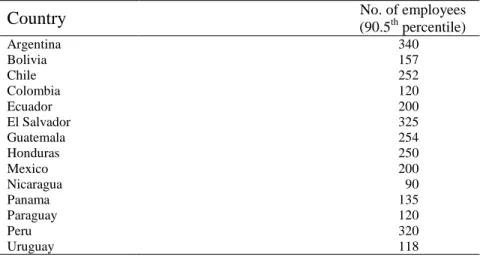
Until now, no clear-cut threshold has been defined to make distinction between small and large firms, and most of the size-innovation relationship studies relied on the arbitrary size classification. We adopt unique threshold of 200 employees for whole of the countries in our data set. Another possibility could be to use non-unique threshold level for different countries; we also try it and determine the size classification as follows. We observe that, as a whole, the employment of 200 (our unique threshold) is at 90.5th percentile. We extend the threshold of 90.5th percentile to each country and find different employment values to be considered as small and large firms for different countries (see Table A.1 in appendix). The reason why we prefer to use unique threshold is our understanding that it is unjustified to pool a firm with very low threshold, for example, 90 employees in case of Nicaragua, with a firm having very high threshold, say, 340 employees for Argentina, in order to make a group of large firms. It could be argued that non-unique threshold would be a plausible choice because each country has its own industrial structure, which could affect firm size in a way to be conducive to one particular size or the other. It is a valid argument in its own, but it does not mean that the behaviour of a firm with, say, 400 employees in a pro-small firm size country will be different than a same- sized firm in a pro-large firm size country, just because of specific country’s industrial structure. Having said that, it is very hard to decide an appropriate threshold; however, we get support from our above stated argument and prefer to use unique threshold.
10
competitive markets need to spend significantly more annual average R&D expenditures than that of all other competition statuses. In general, these summary statistics suggest that, contrary to the stand of disciples of Schumpeter, competition propels firms to do R&D and product innovation. These findings are simply based on summary statistics; therefore, at this stage of our analysis, we are reluctant to completely stick to them. To fully comprehend such relationship, we shall explore such phenomenon more extensively in next section by using regression analysis.
4. Regression
Besides descriptive analysis, we observe the results more rigorously using regression. Table 4 provides the detailed information (labels and descriptions) of variables used in our regression analysis.
[Please insert Table 4]
We have already viewed country -and industry - specific differences in Table 1 and 2. To capture heterogeneity caused by these differences, we include dummy variables for countries and industries in our regression models. The reference categories are Mexico and other manufacturing for countries and industries respectively. The introduction of dummies also allows us to probe intercountry and interindustry differences in their adherence to R&D activities and product innovation. Our regression equations also include dummies for competition statuses taking high competition as a reference category. In addition to that, control variables discussed in the subsection 2.3 are also included in order to explore the innovative phenomenon more extensively. We use (log of) employment as a measurement of size.
Table 2 has given us the information that only 35.61% of the firms are R&D performers, implying that the R&D intensity variable includes a whole bunch of zeros (if we replace zeros for non-R&D-performers), and continuous data only for 35.61% of the firms. In such case , OLS regression of R&D intensity would provide misleading conclusions because it relies only on the firms with positive amount of R&D expenditures, and ignores the bulk of information since they are unavailable for rest of the sample. In what follows, it is quite unrealistic to extend the empirical evidences obtained from a selected portion of a sample to the whole population. Hence, we use Heckman selection two-step procedure in order to avoid the erroneous conclusions attributable to such sample selection bias.
4.1 Heckman selection model
Heckman selection model rectifies selectivity bias by introducing two equations commonly known as selection equation and outcome equation. Firstly, selection equation estimates the relationship of the R&D determinants on firms’ selection to perform R&D, and is estimated by probit regression (because of the binary nature of R&D decision variable). In the second step, the outcome equation describes the influence of explanatory variables on R&D intensity, after incorporating the selectivity problem.
11
SupposeRDi* is the unobserved utility difference, for ith firm, between R&D and non-R&D, and
x
1iis a vector of determinants influencingith firm’s R&D decision, then:RDi*= x1′i
β
1 +ε
1i (4.1) The all we know (i.e. 0 & 1 for R&D decision variable) follows the decision rule:0 * 0 0 * 1 ≤ = > = i i i i RD if RD RD if RD (4.2) where RD is (dummy of) R&D decision for i ithfirm. Moreover,
RDIi*=x2′i
β
2 +ε
2i (4.3) where RDIi* is the observed value of R&D intensity for ithfirm, which is some positive amount if ithfirm is R&D performers, and zero otherwise, i.e.0 ) ( 0 1 * = = = = i i i i i RD if assumed RDI RD if RDI RDI (4.4) i
x2 is a vector of all determinants possibly influencing ithfirm’s R&D intensity. Note that eqs. (4.1) and (4.3) also include random error terms, which jointly follow the distributional assumptions: 1 , 0 0 12 12 2 1 2 1
~
σσ σ ε ε NID i iHeckman selection model corrects the selectivity bias and estimates the conditional expectation of R&D intensity as:
E(RDIi RDi =1)= x′2i
β
2 +σ
12λ
(x2′iβ
2) (4.5) whereλ
, called the inverse mills ratio, is obtained asφ
(x′2iβ
2) Φ(x2′iβ
2), (.)φ and Φ(.)are density function and cumulative distribution function of a standard normal distribution respectively.We consider both innovation input and innovation output. For innovation output, we have a binary response variable which calls for the probit model.
4.2. Probit model
12
we define, for say firm i , the unobserved utility difference of doing product innovation and not doing it as:
PDINNi*=xi′
β
+ε
i ,ε
i ~ NID(0,1) (4.6) where xi is a vector of all potential predictors in our regression, which can explain such utility differences. A firm will do product innovation, if its utility difference exceeds certain threshold level, and we assume such threshold level to be zero. Hence, the probit model can be written as: 0 * ) ( 0 0 * ) ( 1 ≤ = > = i i i i PDINN if innovators product a not is firm PDINN PDINN if innovator product a is firm PDINN (4.7) 4.3. Empirical resultsThe results of Heckman selection two-step procedure are depicted in Table 5 by using LRDI as a dependent variable. The variable selection for the vectorsx1iand x2i is a very critical aspect of the application of Heckman selection model. Our likely explanation to exclude FIXED from outcome equation is that it is a variable that shows improvement in a firm’s infrastructure (machinery, equipment, etc.), which is one of the basic necessities before a firm decides R&D activities. Secondly, in developing countries R&D is not a firm’s first choice; however, when it perceives that it has a sufficient infrastructure to start its R&D activities, it decides to perform in order to obtain optimal results. So, we anticipate a positive influence of FIXED on R&D decision, but it seems less likely to have an influence of FIXED on R&D budget allocation.
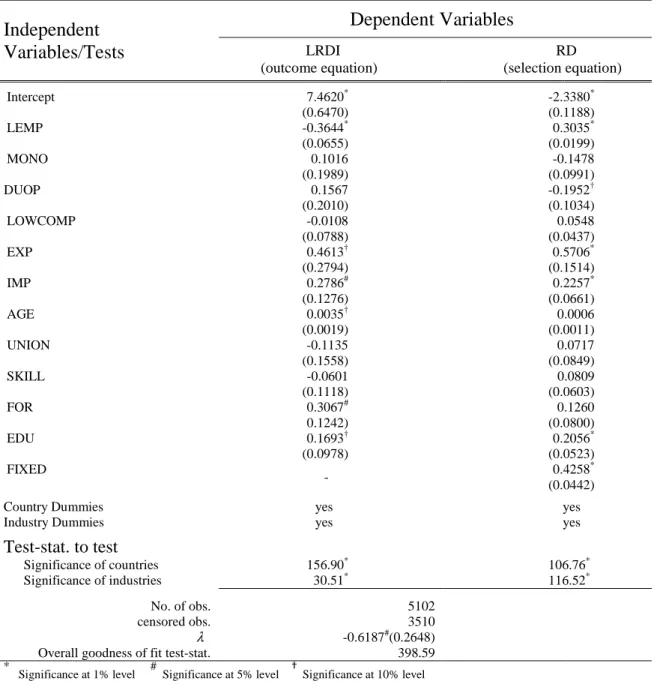
[Please insert Table 5]
Another advantage of Heckman selection model is that it provides the framework to analyse the determinants of R&D decision (column 2 of Table 5) and the influence of these determinants on the actual R&D expenditures (column 1 of Table 5). The significance of
λ
provides an empirical support to the use of Heckman selection model. Moreover, the Wald chi-square appears highly significant, implying that model as a whole (with reference to only the intercept) provides a good fit. In line with the well-established notion for developed world, size has significantly positive impact on firms’ decision to do R&D, and it increases R&D expenditures but at less than proportional rate. Regarding competition, our results indicate that firms’ R&D expenditures per employee are not influenced by any form of market competition (all competition-related dummies are insignificant). However, we find that competitive pressure has an influence on firms’ R&D decision (although a negative coefficient of DUOP is significant at 10% level, the coefficient of MONO, though insignificant, also has a negative sign). Although we have competition-related variable in discrete form, our results hint an absence of inverted-U relationship between R&D and competition. Trade orientation (both export and import) increases both the likelihood of R&D and R&D intensity. However, such significance is more vital in case of R&D decision. Firm age has no influence on its R&D decision, but it increases its R&D intensity at 10% level. Our results reveal that percentage of unionized workers and skilled13
production workers have no influence on R&D-related variables. At first glance it could contend that skill has a positive influence on R&D activities, but the intuition of insignificant coefficient is that in our dataset skill is a production workers professional skill, which is quite different from the scientific and technological knowledge of the workers. Of course, the advantage of professional skill is to implement production process efficiently, but it does not have a significant influence on innovativeness. We observe that foreign ownership has no influence on firms’ R&D decision, but it increases the R&D intensity, and education, quite intuitively, increases probability of and expenditures on R&D activities. Similar to trade orientation, significance of education is more vital in R&D decision. Finally, those firms that purchase fixed assets have significantly more chance to perform R&D. Wald tests on overall significance of countries and industries show that country- and industry-specific characteristics are jointly significant in order to explain both types of R&D activities (R&D decision and expenditures). Table 6 shows the results of probit regression on product innovation.
[Please insert Table 6]
We run two probit regressions by excluding and including LRDI as a determinant of PDINN, and the results are shown in column 1 and 2 respectively. Our objective to include R&D intensity as an explanatory factor is to observe the effect of R&D on firms’ innovation output. To control for endogenous nature of R&D intensity in PDINN equation, we prefer to use an instrumental variable for LRDI which will be arguably correlated with LRDI and uncorrelated with the error term of PDINN equation. To serve as an instrument, we use predicted values of LRDI, which are obtained from the Heckman selection model in Table 5l. Note that most of the results in column 1 and 2 are same. Significance of model as a whole is confirmed by the likelihood ratio test. According to Table 6, firm size and product market competition increase the likelihood of product innovation. The comparison of the relationship of competition and innovation output with those that are observed for R&D intensity reveals that firms rely more on product innovation as compared to enhance their R&D expenditures, in order to combat competitors. The reason might be that firms’ perception of controlling of product market by their competitors (because what we mean by competition is product market competition) demands a prompt response towards product innovation, and it can be done by relatively less R&D-intensive activities like slight modification of existing product or imitation of developed world innovation. Interestingly, our results reveal that R&D intensity does not have any influence on product innovation. Similar to R&D determinants, exports and imports increase the probability of innovation output. These findings are in line with the general agreement that trade orientation would induce firms to innovate. We witness that firm age, foreign ownership and workers’ skill has no influence on the likelihood of product innovation. Recall that firms’ maturity has a
l
Note that by including predicted values of LRDI, we are able to use substantially more observations compared to actual values of LRDI. To obtain the predicted values of LRDI, the explanatory variables used are same, except FIXED, as to the predictors in the probit regression of PDINN (column 1 of Table 6). Therefore, to avoid the possible multicollinearity (and, in turn, to use the predicted values of LRDI as a valid instrument, we exclude some of the controls from the probit regression of PDINN, which include LRDI as one of the predictors (column 2 of Table 6).
14
positive impact on their R&D intensity, but in case of innovation output, it might be offset by the innovative efforts (at the innovation output phase) of relatively young firms, which they have to do in order to encounter the threat of their exit exerted by their mature rivals. As expected, education is a significantly positive determinant of the firms’ chance of product innovation. Our results show that the probability of product innovation increases with the percentage of unionized workers. Similar to R&D activities, country and industry dummies have a significant impact on product innovation, implying that intercountry and interindustry differences play important roles in firms’ achievements towards product innovation.
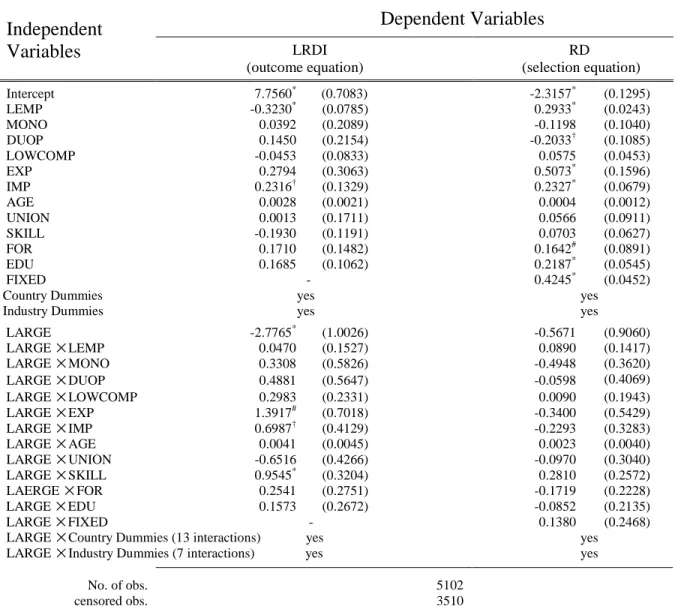
We explore further the innovation phenomenon in small and large firms and use the interaction terms of the dummy of large firms (LARGE) with all explanatory variables (including country and industry dummies) used previously. Table 7 shows the results of the Heckman selection model, after including interaction terms.
[Please insert Table 7]
Again, the significance of goodness of fit test, and especially of
λ
, corroborate our choice of the Heckman selection model. Since all variables are interacted with LARGE, the by-product is that the coefficients which indicate the main effects (the coefficients of variables without interaction terms) provide the information of the behaviour of these variables in small firms only. We do not go in details to discuss the variables in small firms only because our objective to use interaction terms is to explore whether the effects of innovation determinants do remain the same in small and large firms or do notm. The significant negative coefficient of LARGE for R&D intensity indicates that small firms spend more R&D expenditures per employee than large firms. Recall that the summary statistics in Table 3 revealed that large firms are more R&D intensive. The joint interpretation of these findings would be that although large firms spend more on R&D, their expenditures per employee are less than small firms. It is also a way to understand why in Table 5 we find that R&D expenditures increase with size but less than proportionally. The results in Table 7 reveal that R&D decision is not influenced by size classificationn. We observe that the effects of employment and competition do not differ in small and large firms both for R&D intensity and decision, but EXP, IMP and SKILL (although IMP is significant at 10 % level) are more significant indicators of R&D intensity in large firms relative to small ones. All other control variables have no significant differences in small and large firms in order to explain R&D intensity. Similar to employment and competition, we cannot find any significant difference in small and large firms if we consider the influence of each control variables on R&D decision.[Please insert Table 8]
m
Having said that, we report the coefficients without interaction terms and their significance as well. The interesting readers can see in Table 7.
n
This result is based on insignificance of LARGE as a determinant of R&D decision. However, in Table 5, we note that employment itself is a significantly positive determinant of R&D choice.
15
We also observe such differences (between small and large firms) for innovation output (product innovation in our case), and the results are reported in Table 8o. Similar to Table 6, we run regressions with and without inclusion of predicted values of LRDI (and their interaction with LARGE)p. It is again visible that both regressions provide virtually similar results. Highly significant likelihood ratio test indicates the fact that our probit model is an appropriate choice to explain the product innovation. Contrary to R&D intensity, we do not observe the significance of LARGE, implying that there is no difference between large and small firms in explaining the likelihood of product innovation. Our results reveal that HIGHCOMP is a significantly more important stimulus for large firms than small ones because the coefficient of interaction term of LARGE with DUOP and with LOWCOMP is significantly negative. The implication of such result is that we empirically observe the refutation of Schumpeter’s notion of favour of large firms in monopolistic environment. In other words, in high product market competition large firms are major source of product innovation than small firms. We observe that interaction of LARGE with LRDI produces insignificant results, implying that, contrary to Acs & Audretsch (1991a) for developed countries, there is no indication of increase or decrease of R&D productivity with firm size. We also notice that importers’ influence on probability of product innovation is more significant in large firms relative to small ones. We have already established in Table 6 that importers are significant determinant of product innovation, but large firms provide relatively better environment to utilize these imports towards the product innovation. Another significant (and positive) interaction term is for SKILL, implying that although percentage of skilful workers in explaining product innovation is itself insignificant, its influence is more important in large firms relative to small establishments. All other interaction terms produce insignificant coefficients, suggesting that the behaviour of rest of the control variables is almost same for both size classes.
So far, we observe the significance of interaction terms for each predictor (except country and industry dummies) separately. We also analyse the differences in innovation determinants (both R&D and product innovation) in small and large firms at aggregate levelq. Firstly, we observe the overall differences in determinants of innovation in small and large firms by investigating the joint significance of interactions of LARGE with LEMP, MONO, DUOP, LOWCOMP, all controls, country, and industry dummies, and test the following hypothesis:
1) H0: There is no disparity, as a whole, between the behavior of determinants
of innovation in small and large firms.
Secondly, we interrogate the overall disparity in behavior of determinants, other than countries and industries, of innovation in small and large firms by observing the joint significance of
o
Similar to Table 7, although we do not discuss the main effects in small firms only, we report them (with their significance) in Table 8 for interesting readers.
p
We exclude similar set of controls as in Table 6, when we use LRDI as an explanatory variable.
q
It should bear in mind that we run two probit regressions: excluding and including LRDI as a determinant of PDINN. To observe the overall significance, we stick to the former (i.e. first column of Table 8).
16
interactions of LARGE with LEMP, MONO, DUOP, LOWCOMP, and all controls. Hence, for this purpose, we test the hypothesis:
2) H0: There is no disparity, as a whole, between the behavior of innovation
determinants, other than countries and industries, in small and large firms.
For RD, the interaction of LARGE with FIXED is also included in both of the above stated cases. Thirdly, we also investigate the overall differences of countries in small and large firms, and observe the joint significance of interactions of LARGE with country dummies. Statistically, we investigate the following hypothesis:
3) H0: There is no disparity, as a whole, between the behavior of countries in
small and large firms.
Finally, the interactions of LARGE with industry dummies are also observed in a similar fashion, and the null hypothesis to be tested is:
4) H0: There is no disparity, as a whole, between the behavior of industries in
small and large firms.
[Please insert Table 9]
Table 9 provides the significance of the p-values of the Wald tests used to analyse the above mentioned null hypotheses, both for R&D (dummy and intensity) and product innovation. We have already noticed in Table 7 that effect of each predictor on R&D decision is same for both size classes; the second column of Table 9 also indicates that the determinants of R&D decision jointly do not influence differently in small and large firms except countries. An entirely different picture emerges when we consider R&D intensity as we obtain significant results for whole rows of column 1, suggesting that all factors jointly (including countries and industries as well), only predictors (excluding countries and industries), countries, and industries have different influence in small and large firms. In case of product innovation, country- and industry-specific differences do not play different role in small-and large-sized firms. Moreover, all determinants jointly (for both cases: including and excluding countries and industries) have slightly different (significance at 10% level) influence in small and large firms. What general picture emerges from Table 9 is that innovation determinants behave differently in small and large firms both for R&D intensity and innovation output, and such differences are more vital for innovation input. For R&D-related activities, country-specific characteristics play substantially more different role in small and large firms as compared to industry-specific characteristics. One of our objectives in this paper is to shed light on the disparity of explanatory factors of innovation for different size classes and competition statuses. Therefore, similar to interaction with LARGE, we analyse the interaction effect of different potential predictors of innovation when interacted with competition. Here, we divide our competition variable into two categories: firms having at most one product market competitor, called non-competition and denoted by
17
MODU, and more than one competitor. The Heckman selection (for R&D) and probit model (for product innovation) results including interaction with MODU are depicted in Table 10 and 11 respectivelyr.
[Please insert Table 10] [Please insert Table 11]
The
λ
coefficient again favours the Heckman selection model. All interaction terms for LRDI are interestingly insignificant, meaning that competition does not provide a favourable (unfavourable) environment to any explanatory factor in order to influence R&D intensity positively (negatively). For R&D decision, most of the interactions are again insignificant; however, we find two exceptions: AGE and FOR. Both of these variables provide significantly negative coefficients, suggesting that competition is a noticeable stimulus for mature firms and foreign ownership, to be decisive for R&D. For product innovation, similar to Table 6 and 8, we run both regressionss and again obtain almost similar results. The significant negative coefficient of interaction of MODU with LEMP indicates that employment is a more significant determinant of innovation in competitive markets than monopoly or duopoly. The coefficient of interaction of MODU with LRDI reveals that influence of R&D expenditures (per employee) on product innovation is independent of the competition environments they are manufacturing in. Similar to R&D decision, foreign ownership induces firms to do product innovation more in competition than non-competition. Rest of the interaction terms produce insignificant coefficients.In addition to observe the significance of interaction terms of MODU with each predictor (except country and industry dummies) separately, we observe the overall significance of these interactions as we did in case of LARGEt. To achieve this end, we observe, exactly similar to interactions of LARGE, the joint significance of: (1) the interactions of MODU with LEMP, all control variables, country, and industry dummies; (2) the interactions of MODU with LEMP and all control variables; (3) the interactions of MODU with country dummies; and (4) the interactions of MODU with industry dummies. For RD, the interaction of MODU with FIXED is also included in (1) and (2). Table 12 shows the significance of the p-values of the tests on the above stated interaction terms (and the corresponding hypotheses which are stated exactly in the same lines as LARGE)
[Please insert Table 12]
For R&D-related variables, all results are insignificant, implying that all factors jointly (including and excluding countries and industries), countries, and industries do not behave differently in competition and non-competition environments. Note that in Table 10 we find two significant interaction terms when we consider them separately, but overall insignificance
r
See footnote 13 and 15.
s
We again exclude same set of controls as in Table 6 and 8, for the probit regression including LRDI as one of the determinants.
t
18
indicates that the significance of these two interaction terms is swamped by the insignificance of rest of the variables. In case of product innovation, we find, however, significant p-values but interactions with countries. It means that all determinants jointly (both including and excluding country and industry dummies) and industries have significantly different influence on product innovation when there is more than one competitor as compared to at most one competitor. All these results suggest that, contrary to the size, for different competition statuses, innovation determinants do not behave differently in order to explain R&D intensity; however, for product innovation, we observe differences (in influence of innovation determinants), which are even stronger than the size.
5. Conclusions
Firm size-innovation and market competition-innovation relationships have been studied intensively in developed countries, but there remains a clear paucity for the developing world. In this paper, we try to contribute in this direction by using both input and output innovation.
According to our analysis, the impact of size on innovation shows the behaviour which is similar to developed countries since we find that employment has a significantly positive impact on the likelihood of R&D and product innovation, and employment increases R&D expenditures at less than proportional rate. We observe that product market competition is a positive stimulus for product innovation, but it has no influence on R&D expenditures per employee. The reason for these findings could be that the pressure from competitors in the product market entails an immediate response in terms of the final product. Since R&D is a long term process to be fruitful as an innovation output, firms prefer to combat competitive pressure through slight modification of existing products and/or imitation of developed countries innovation, which could be achieved in a relatively short time period and without intensive R&D expenditures. Country-specific and industry-specific characteristics are observed to be significant factors of both innovation input and output.
We find no significant relationship between R&D intensity (R&D expenditures per employee) and the likelihood of product innovation. Two likely interpretations of such finding could be: (1) firms do not have a formal R&D structure (in developing countries), thereby they perhaps do not know their exact spending on R&D activities, or what they do know is less than their actual expenditures, which leads to an underestimation of the significance of their R&D expenditures; (2) developing countries are more involved in imitation (of developed countries products) rather than radical product innovation, which entails relatively less R&D expenditures. Moreover, we observe that the relationship between R&D intensity and product innovation is independent of size classes and market competition statuses.
Our results show that firms’ foreign links, as importers and exporters, contribute substantially in their pursuance of R&D activities and product innovation. Another important determinant of all of our innovation measurements is education (of production workers), which shows a positive effect on R&D (decision and expenditures) and product innovation. We notice that firm age has a
19
significantly positive impact on R&D intensity, but it has no influence on product innovation. Our interpretation of these results is that mature firms quite intuitively spend more R&D expenditures per employee since they are old players and have sufficient resources to do so, to protect their market worth and to get benefits from their established infrastructure. However, it might be offset by the product innovation of relatively young firms (and extreme case is newly established firms) which they have to do in order to survive in the market at least in their early years.
We observe that the effects of employment and competition on R&D activities, and the effect of employment on product innovation, are the same for large and small firms. However, competition is a more significant stimulus of product innovation for large firms compared with small ones. Hence, our results for developing countries contradict Schumpeter’s view that monopoly tends to be advantageous to large firms. Our analysis reveals that large-firms trade orientation (both import and export) has more significant influence on R&D expenditures per employee than small firms. For product innovation, we find the same findings, but only for imports. Although we do not observe a significant influence of skilful workers on innovation (both input and output), our empirical findings suggest that, in comparative analysis, worker skill has a more significant effect for large firms than small ones, both for R&D intensity and product innovation. There is no evidence of differences between small and large firms when considering the effects of firm age, unionization, education of production workers, and (more than 10%) foreign ownership, on both types of innovation. We find that, for R&D activities, country-specific characteristics have a significantly more different role in small and large firms than industry-specific characteristics; however, these specific characteristics (both countries and industries) do not behave significantly different in both size classes in case of product innovation, suggesting that large and small firms’ strategy towards innovation output does not influence by the geographical region they are situated in and by the specific product they are manufacturing. Moreover, both country and industry differences are not observed to be too substantial to behave differently in competition and non-competition environments, for R&D activities. As the determinants of product innovation, however, industry-specific characteristics are significantly different for both competition environments.
Our results suggest that determinants of R&D as a whole have disparate effects for small and large firms, but they have the same impact when we consider them in competition and non-competition environments. This suggests that firm size is a more significant factor than market competition status for these determinants to behave differently, in order to influence firm-level R&D activities; but jointly the difference of influence of these determinants on innovation output is more significant for different competition environments than for different size classes, suggesting the opposite (to R&D) for product innovation.
20
References
Acs, Z. J., & Audretsch, D. B. (1987). Innovation, market structure, and firm size. The Review of
Economics and Statistics, 69(4), 567–574.
Acs, Z. J., & Audretsch, D. B. (1988). Innovation in Large and Small firms: An Empirical Analysis. The American Economic Review, 78(4), 678–690.
Acs, Z. J., & Audretsch, D. B. (1991a). R&D, firm size and innovative Activity. In Z. J. Acs & D. B. Audretsch (Eds.), Innovation and Technological Change: An International
Comparison. New York: Harvester Wheatsheaf.
Acs, Z. J., & Audretsch, D. B. (1991b). Innovation and Technological Change: An overview. In Z. J. Acs & D. B. Audretsch (Eds.), Innovation and Technological Change:An International
Comparison (pp. 1-23). New York: Harvester Wheatsheaf.
Aghion, P., Bloom, N., Blundell, R., Griffith, R., & Howitt, P. (2005). Competition and Innovation: An Inverted-U Relationship. Quarterly Journal of Economics, 120(2), 701–728. Archibugi, D., Evangelista, R., & Simonetti, R. (1995). Concentration, firm size and innovation:
evidence from innovation costs. Technovation, 15(3), 153–163.
Arvanitis, S. (1997). The impact of firm size on innovative activity–an empirical analysis based on swiss firm data. Small Business Economics, 9(6), 473–490.
Audretsch, D. B., & Vivarelli, M. (1996). Firms size and R&D spillovers: Evidence from Italy.
Small Business Economics, 8(3), 249–258.
Ayyagari, M., Demirguç-Kunt, A., & Maksimovic, V. (2007). Firm innovation in emerging markets: The roles of governance and finance. World Bank Policy Research Paper No.
4157.
Benavente, J. M. (2006). The role of research and innovation in promoting productivity in Chile.
Economics of Innovation and New Technology, 15(4), 301-315.
Blundell, R., Griffiths, R., & Van Reenen, J. (1999). Market share, market value and innovation in a panel of British manufacturing firms. Review of Economic studies, 66(3), 529–554. Bound, J., Cummins, C., Griliches, Z., Hall, B. H., & Jaffe, A. (1984). Who does R&D and who
patents? In Z. Griliches (Ed.), R & D, Patents, and Productivity (pp. 21-54). University of Chicago Press.
Braga, H., & Willmore, L. (1991). Technological imports and technological effort: an analysis of their determinants in Brazilian firms. The Journal of Industrial Economics, 39(4), 421-432.
21
Cohen, W. M., Levin, R. C., & Mowery, D. C. (1987). Firm size and R & D intensity: a re-examination. The Journal of Industrial Economics, 35(4), 543–565.
Comanor, W. S. (1967). Market structure, product differentiation, and industrial research. The
Quarterly Journal of Economics, 81(4), 639–657.
Crespi, G., & Zuñiga, P. (2010). Innovation and productivity: evidence from six Latin American countries. IDB Working Paper No. IDB-WP-218.
Dachs, B., Ebersberger, B., & Lööf, H. (2008). The innovative performance of foreign-owned enterprises in small open economies. The Journal of Technology Transfer, 33(4), 393-406. Evangelista, R., & Mastrostefano, V. (2006). Firm size, sectors and countries as sources of
variety in innovation. Economics of Innovation and New Technology, 15(3), 247–270. Fagerberg, J., & Srholec, M. (2008). National innovation systems, capabilities and economic
development. Research Policy, 37(9), 1417–1435.
Freitas, I. M. B., Clausen, T., Fontana, R., & Verspagen, B. (2011). Formal and informal external linkages and firms’ innovative strategies. A cross-country comparison. Journal of
Evolutionary Economics, 21(1), 91-119.
Gilbert, R. (2006). Looking for Mr. Schumpeter: Where Are We in the Competition-Innovation Debate? In A. B. Jaffe, J. Lerner, & S. Stern (Eds.), Innovation Policy and the Economy (pp. 159-215). The MIT Press.
Hamberg, D. (1964). Size of firm, oligopoly, and research: The evidence. Canadian Journal of
Economics and Political Science, 30(1), 62–75.
Hansen, J. A. (1992). Innovation, firm size, and firm age. Small Business Economics, 4(1), 37– 44.
Henderson, R., & Cockburn, I. (1996). Scale, scope, and spillovers: the determinants of research productivity in drug discovery. Rand Journal of Economics, 27(1), 32–59.
Holmstrom, B. (1989). Agency costs and innovation. Journal of Economic Behavior &
Organization, 12(3), 305–327.
Kamien, M. I., & Schwartz, N. L. (1982). Market Structure and Innovation. Cambridge: Cambridge University Press.
Kumar, N., & Saqib, M. (1996). Firm size, opportunities for adaptation and in-house R & D activity in developing countries: the case of Indian manufacturing. Research Policy, 25(5), 713-722.