Content Management in Mobile
Wireless Networks
August 17, 2012
Supervisors:
Dr. Chadi Barakat, INRIA
Prof. Matthias Grossglauser, EPFL
Dr. Thrasyvoulos Spyropoulos, EURECOM
Dr. Thierry Turletti, INRIA
Student:
Francisco Neves dos Santos
´
In memory of my Grandfather,
Eng. Manuel Jo˜ao das Neves.
Contents
1 Introduction. . . 1
1.1 Problem Statement . . . 1
1.2 State of the Art . . . 3
1.3 Contribution . . . 6
2 Background . . . 9
2.1 The CCNx Protocol . . . 9
2.2 Delay Tolerant Networks . . . 10
2.3 Wireless-Medium Access Control . . . 12
3 Solution. . . 15
3.1 Designing the Solution . . . 15
3.1.1 Defining the Delivery-Rate Utility . . . 16
3.1.2 Estimating the Delivery-Rate Utility . . . 20
3.2 Content Optimal-Delivery Algorithm . . . 21
3.2.1 Processing Application Queries . . . 22
3.2.2 Processing Incoming Content . . . 24
3.2.3 Implementation of CODA . . . 25 4 Evaluation . . . 29 4.1 Simulation of CODA . . . 29 4.2 Analysis of Results . . . 32 5 Conclusion . . . 37 References . . . 39
A Combining Unbiased Rate-Estimates. . . 41
Acronyms
List of abbreviations.
ACK Acknowledgement
ASF Atom syndication format
CCA Clear-channel assessment
CCN Content-centric network
CO Content object
CODA Content optimal-delivery algorithm
CTS Clear to send
CS Content store
CW Contention window
DCF Distributed coordination-function
DIFS Distributed inter-frame spacing
DR Delivery rate
DTN Delay-tolerant network
EIFS Extended inter-frame spacing
FIB Forwarding-information base
GBSD Global knowledge-based scheduling and drop
HBSD History-based scheduling and drop
HM Hello message
IM Interest message
MAC Medium-access control
NAV Network allocation-vector
NTP Normalized throughput
PCF Point coordination-function
PIM Pending-interests message
PIT Pending-interests table
PHY Physical (layer)
RTS Request to send
RV Random variable
SIFS Short inter-frame spacing
viii Acronyms
TFT Tit for tat
Symbols
List of symbols.
p(i) Probability that a node receives a replica of contenti
q(i) Request rate of contenti
ˆ
q(i) Estimator for the request rate of contenti
n(i) Number of replicas of contenti
DR(i) Delivery rate of contenti
ˆ
DR(i) Estimator for the delivery rate of contenti
MR(i) Miss rate of contenti
U(i)(DR) Delivery-rate utility of contenti
TTL Average information-request lifetime
B Buffer capacity per node
L Number of network nodes
T Total simulation time
R Number of contents requested by a node per unit of time
bhello Backoff counter for computing the delay between hello messages
bPIM Backoff counter for computing the delay between pending-interests
messages
dhello Transmission delay of the next hello message
dminhello Minimum delay between hello messages
dPIM Transmission delay of the next pending-interests message
dminPIM Minimum delay between pending-interests messages
α Weight given to the most recent request-rate estimate
β Weight given to the most recent delivery-rate estimate
γ Exponent of the Zipf distribution of content popularity
λ 1/λis the average node inter-meeting time
ς Lagrange multiplier
Chapter 1
Introduction
Abstract Approximately one billion users have access to mobile broadband, through which they intend to obtain the same data they can reach using a wired connection. Because of the cost of transmitting data over a mobile-broadband con-nection and given that 3G networks are quickly reaching their data-transfer capacity, some researchers envision the inter-connection of mobile devices using Wi-Fi, form-ing a challenged network. Such networks suffer from high latency, low data rates, and frequent disconnections; because end to end paths between pairs of nodes may not always exist, a mobile device must store content before delivering it to the in-tended receivers. We designed the content-optimal delivery algorithm (CODA) for distributing named data over a delay-tolerant network (DTN), which is a network of challenged networks. Current content-dissemination techniques for DTNs consist mainly of the following items: a content store, for caching and indexing retrieved content, and a query and response mechanism to search the network for matching content. Some algorithms attempt to optimize an objective function, such as the total delivery-delay. While disseminating content, CODA maximizes the network throughput by computing the utility of each item published: a device with a full buffer drops content in order of increasing utility and transmits content in order de-creasing utility. We implemented CODA over the CCNx protocol, which provides the basic tools for querying, caching, and transmitting content.
1.1 Problem Statement
The Internet, drafted in the 60s, was intended as a means to share the access to mainframe computers among users, enabling them to perform complex computa-tions remotely [11][19]; it supports the communication between two hosts, a source and a target, each referenced by a network address that is stored in the header of an IP packet [19]. The emergence of the World Wide Web and the reduction in com-puter prices changed the way we benefit from the Internet [9][19]. Fifty years since the advent of the Internet, the sharing of data from single hosts to multiple recipients
2 1 Introduction is the principal contributor to IP traffic growth [30]. Users want to access data, such as text, sound, or video files, without worrying about its location [19]. The difficulty in linking content to IP addresses using the existing Internet architecture lead to the
emergence of thecontent-centric networks(CCN) [19]. A CCN implements an
al-ternative communication model whereby a user requests data by name and any node with matching content can respond with the appropriate data [19][25]; CCN nodes replicate content amongst themselves in order to improve the network’s ability to satisfy user requests.
An estimated 1 billion people worldwide subscribe to mobile-broadband [20][18], through which they intend to access the same data they can obtain using a wired connection. However, because of the high bandwidth required for sharing data, es-pecially video, this option can be costly [32]. Additionally, 3G networks are quickly reaching their data-transfer capacity [10][25]. To avoid these pitfalls and because many phones feature WiFi connectivity, some researchers advocate the direct con-nection of mobile devices using wireless standards [25], such as the IEEE 802.11
[14], to form achallenged network[8]. In such networks, end-to-end paths between
any two nodes may not always exist, forcing nodes to store content before deliver-ing it to the intended receivers, and data transmissions occur when pairs of nodes are within range. Additionally, we envision inter-connecting these groups of devices through a delay-tolerant network. A DTN is a network of challenged-networks that support long delays and data loss between and within challenged networks [8]. In this work, we study the problem of disseminating content to multiple receivers over a delay-tolerant network [6] using memory- and battery-constrained devices. We propose the content optimal-delivery algorithm (CODA) that aims to optimize the
delivery rateof all content exchanged in such a network, measured as the number of content replicas delivered to the intended receivers per unit of time. We assume that (i) a node moves randomly and independently of its peers, (ii) node inter-meeting
times are exponentially distributed with a constant rateλ, (iii) a node may enter and
leave the network at any time, and (iv) each node has a reduced buffer for storing messages.
A node operating in this network can have the following three roles: source,
for-warder, and receiver. A source node generates data and wraps it as acontent object
(CO), which contains the following items: a unique name, the data’s issue time, the validity, which indicates for how long the information is accurate, and the data it-self. A forwarder node stores content it receives from peers and delivers it to other nodes it meets; this process produces new replicas of the original content object. Because a node has a reduced buffer space for storing content, the forwarder must choose wisely which replicas it caches in order to optimize the global delivery-rate. Additionally, a forwarder must decide which replicas to send first to a node it meets in order to improve the global delivery-rate; this is because the meeting time be-tween both nodes might be insufficient for the forwarder to send all content replicas
to its peer. A node acting as a receiver requests data through aninterest message
(IM), which identifies the name of the content it wants to obtain and the amount of time it is willing to wait for the requested data. To assess CODA’s performance, we
1.2 State of the Art 3 simulate the effect of varying the storage capacity per node, network load, and the distribution of content popularity.
1.2 State of the Art
In this section we present existing solutions for delivering information to users over a delay tolerant network. Such a network suffers from frequent topology changes and, consequently, content publishers and subscribers are seldom connected simul-taneously. To counter this problem, a node must replicate content received from a publisher so that the data remains available to potential receivers after the publisher disconnects. We adopted several strategies proposed in this section in developing our own algorithm for delivering content in DTNs.
ContentPlace [4] is a content-distribution system designed for opportunistic net-works; each data source organizes content into channels to which several receivers can subscribe. The authors assume that users have friends in the network and exploit these social relationships in order to increase the fraction of satisfied data-requests (hit rate), an idea that was previously applied to message forwarding in [16]; each
user is affiliated with a home community and can also be associated with other
communities, dubbed acquainted communities. A node initiates a dialog with a
single peer at a time; it calculates the utility of all locally-cached objects and those stored in its partner’s buffer, picks the objects that maximize the utility of its own cache, downloads the requested objects from its peer’s buffer, and, finally, discards from its own buffer data-items that are not part of the previous selection. Specifi-cally, when two nodes meet, each node solves an optimization problem whose goal is to maximize the utility of the content it stores, subject to the space constraints of its own buffer. A node calculates the utility of an object by considering the value this data has according to each community it is affiliated with, multiplied by the strength of the user’s bond to this community; hence, the utility equation consists of a weighted sum of the data-item’s worth to each community the user is associated with. A device estimates the usefulness of an object to a community by multiplying
the data’saccess probabilitywith itscostand dividing by its size; intuitively, as
an object permeates a community, it becomes easier to locate and the need for its replication subsides. The authors validate the proposed solution by measuring the hit rate in simulation scenarios with forty-five and ninety nodes, dispersed over a grid of width one kilometer, where each node seeks data at an average rate of 3 re-quests per 10 min and each device subscribes to just one data-channel. For the social strategy used in ContentPlace to produce a noticeable improvement on the hit-rate, the authors assume an unbounded delay for the interest messages. In our own work, we propose an algorithm that delivers content for higher request-rates.
The authors in [12] propose a middleware system that allows users to publish and
subscribe content in opportunistic networks. The system extends theatom
syndica-tion format(ASF) [29] and organizes content intofeeds, where each feed consists
4 1 Introduction
multipleenclosures. Each feed and entry has a permanent globally unique identifier,
generated by the publisher, a title and a timestamp, which indicates the time of the last update. An enclosure is a file that holds audio, video, or textual data; the middle-ware divides this file into small chunks of 16 kB before transmission to increase the
chance of delivering the feed successfully. A node sends periodichello messages
to its link-layer neighbors through the discovery module; this message includes the id of the node performing the discovery, along with the revision number of its con-tent store. The discovery module stores the revision counter for each peer met; an increment in the revision value means new content is available for download since
the last synchronization. When a node discovers a peer, it sends arequest message
to solicit a specific feed or learn of existing content for download; its peer sends a
reply messagewith the matching content (if available) or the set of feeds available in its cache, depending on the type of request. The middleware system uses a Bloom filter [5] to reduce the amount of space occupied by the content index and to shorten the time necessary for a subscriber to determine which feeds are currently buffered by the publisher. This type of filter is subject to false-positive errors, meaning that subscribers may find content id’s in the filter that do not point to actual data in stor-age. Because false-negative errors cannot occur in Bloom filters [5], id’s not found in the filter imply the content is not available in the publisher’s buffer. A content publisher can serve multiple subscribers and a subscriber can download feeds from several subscribers in parallel. Because this content-dissemination system is purely interest driven, a node only stores and forwards content it is personally interested in. We use an identical mechanism for discovering peer devices as implemented in the discovery module; however, CODA accepts to store and forward unsolicited content in order to improve the delivery rate.
The authors in [15] consider the problem of disseminating information among
wireless nodes in an ad hoc network; they define achannelas a source of content
that generates new data periodically. Their goal is to find the optimal strategy for al-locating forwarders to channels in order to reduce the overall content
dissemination-time. To study this problem, they consider a system ofNwireless nodes that must
spread the data originating from J channels over an ad hoc network. Each node
u subscribes to a fixed set of channelsS(u)and has a buffer capacityC(u),
mea-sured in channel units; hence,umust dedicateC(u)− |S(u)|storage units to help
forward other network content. In the proposed framework,sjdenotes the
propor-tion of nodes that subscribe to channel j, fj(x)represents the fraction of nodes that
forward channel j, and each channel jhas a utility functionUj(tj)that quantifies
the satisfaction of a subscriber of j given the dissemination timetj and is a
non-increasing function oftj. In the same framework,Vj(fi) =Uj(tj(fj))expresses the
utility of channel jwith respect to the fraction of forwarders fj; as the portion of
channel forwarders increases, content is delivered faster, andVj(fi)increases.
The chosen framework [15] uses a standard definition of system welfare given by the weighted sum of the channel utilities, for positive weightsw1, . . . ,wJ. The
authors analyze two forms of the system welfare: (i) the channel-centric form,
where each channel has a weight equal to one, and (ii) theuser-centricform, where
1.2 State of the Art 5 optimal allocation of forwarders to channels, they [15] use a centralized greedy-algorithm that, at each iteration, finds a channel for which there is a node with enough capacity to forward it and such that the increment in the system welfare is highest; if such a channel exists, the algorithm increments the number of helpers for that channel; if no such channel is found, the algorithm outputs the channel forwarding strategy.
To assign forwarders to channels using a distributed algorithm, the authors [15]
suggest the following algorithm: when two nodes, uandv, meet, nodeu picks a
channel juniformly at random from its set of helped channels and selects another
channel j0 uniformly at random from its peer’s set of forwarded channels. Node
u computes the probability for exchanging j for j0, which is proportional to the
fraction of forwarders of jwith respect to portion of transmitters for j0, fj/fj0, and
to the improvement in the system’s welfare. Every node u maintains an estimate
of fj, ˆfj, for every channel j in the network. The results show that the distributed
method for assigning channels to forwarders approaches the optimal solution, found using the centralized algorithm. In our own work, we use an estimation method
similar to the one used for finding fj. CODA aims to optimize the delivery rate
and not the dissemination time; however, by using a utility function such as the one proposed here, we could adapt our solution to optimize the time to propagate content. One fundamental difference between CODA and this framework is that we do not assume nodes meet for a sufficiently long time to exchange useful content between themselves.
Wireless ad hoc podcasting [27] is a technique for sharing content between mo-bile nodes in a peer to peer fashion, based on the atom syndication format [29]; content is organized into feeds and a node solicits entries for one or more feed chan-nels. A user’s mobile device stores feeds that may be of interest to other devices, in addition to the data subscribed by the user. Each device posts the set of feeds
that it currently holds through thediscovery channel; the set is implemented as a
Bloom filter, just like in [12]. The device [27] stores feeds in two separate buffers:
(i) theprivate cache, which contains data subscribed by the user, and (ii) the
pub-lic cache, which holds data intended for other users. A mobile node may act as acontent provider(server), acontent solicitor(client), or both roles simultane-ously. When two devices meet, the client seeks data of interest to the user from its peer’s discovery channel and the serving node replies to the incoming requests; after obtaining all content subscribed by the user, the client device looks for feeds to fill its public cache. There are five methods to load a device’s public cache: (i) most solicited, fills the public cache with the most popular content, based on pre-vious requests, (ii) least solicited, privileges content that is seldom requested, (iii) uniform, a device loads the cache with random-content that it has seen in the past, (iv) inverse proportional, selects feeds with a probability that is inversely propor-tional to the content’s popularity, and (v) no caching, using this strategy, the device simply eliminates its public cache. For each strategy, they measure the overall and
per channel mean-freshnessandfairness; freshness is the amount of time elapsed
between the receipt of a feed and its publication and fairness quantifies how well each channel is served, irrespective of its popularity. All strategies score better than
6 1 Introduction “no caching”; hence, buffering unsolicited channels improves system performance. Given that users request content according to a Zipf distribution, it is surprising that the “uniform” strategy achieves the best overall performance [27].
MobiTrade [24] is a content-dissemination system for DTNs that uses a tit for tat strategy (TFT) to penalize selfish users, which attempt to share only the content they personally consume. According to this strategy, if two nodes meet, a node trades one
content for each content it receives from its peer. The reward obtained by a nodea
following a data-exchange with a nodebis equal to the amount of contentaretrieves
fromb. TFT encourages a node to look for content of interest to its peer in order to increase the amount of data it can gather from the data-exchange. A MobiTrade user
requests a set of contents through achannel record, comprising a set of keywords
that describe the data of interest. A node predicts the channel’s demand by comput-ing the exponentially weighted movcomput-ing average of the previous demand and the sum of the current demand with a speculation component; it then allocates buffer space for each channel in proportion to the reward it expects to obtain for selling this con-tent. The authors [24] compare the performance of MobiTrade to Podcasting [27] by measuring the average delivery-rate, defined as the amount of content received divided by the total content generated, for each channel subscribed by a user; fur-ther, they [24] quantify the gain in performance of the tit for tat strategy. The results show that MobiTrade with the TFT strategy outperforms Podcasting; however, in the presence of selfish users, the performance of MobiTrade with and without TFT is identical. We follow a similar approach as in [24], but employ a different utility function; CODA aims to optimize the delivery rate of content in the network. Fur-ther, we deploy our solution over the content-dissemination protocol CCNx [31] in order to benefit from standard procedures to request, store, and forward content.
1.3 Contribution
The authors in [24] present two message scheduling and drop policies for delay tol-erant networks, GBSD and HBSD, that optimize the delivery of individual messages to single targets. The first policy (GBSD) requires complete network knowledge in order to operate while the second (HBSD) estimates network-parameters using data that is locally available to each DTN node. Both policies aim at optimizing one of two possible metrics: delivery rate and delivery delay. By optimizing with respect to the delivery rate, nodes maximize the number of messages reaching the intended destination; using the delivery-delay metric, nodes minimize the average delay for a message to reach the intended receiver. We leverage on this work to implement our own solution for transmitting data over a DTN and extend it to consider multiple targets instead of a single information-receiver.
We propose the content optimal-delivery algorithm, CODA, that distributes con-tent to multiple receivers over a DTN. CODA assigns a utility to each concon-tent item published in the network; this value gauges the contribution of a single content replica to the network’s overall delivery-rate. CODA performs buffer management
1.3 Contribution 7 by first calculating the delivery-rate utility of each cached content-replica and then discarding the least-useful item. When an application requests content, the node supporting the application will look for the content in its cache. It will immediately deliver it to the application if the content is stored in memory. In case the request cannot be satisfied immediately, the node will store the pending request in a table. When the node meets another device, it will send the list of all pending requests to its peer; the peer device will try to satisfy this list by sending the requester all the matching content stored in its own buffer. A meeting between a pair of devices might not last long enough for all requested content to be sent. We address this problem by sequencing transmissions of data in order of decreasing delivery-rate utility. A content item with few replicas in the network has a high delivery rate utility; these items must be transmitted first to avoid degrading the content delivery-rate metric. The node delivers the requested content to the application as soon as it receives it in its buffer. We implement CODA over the CCNx protocol [31], which provides the basic tools for requesting, storing, and forwarding content.
Chapter 2
Background
Abstract In this chapter we provide background knowledge on the CCNx proto-col, delay-tolerant networks, and the IEEE 802.11 wireless medium-access control protocol, which is required to understand the forthcoming sections of the report. CCNx is a transport protocol for delivering content to multiple recipients; it de-fines two message types: an interest message, through which a user requests con-tent, and a content object, which comprises the requested data. Each CCNx device manages the following data structures: a content store, where it buffers retrieved data objects, a pending-interests table, which holds all unsatisfied content-queries, a forwarding-information base, comprising a list of peer addresses through which it attempts to satisfy pending interests, and a face, which denotes a generic interface for communicating with other network peers. A delay-tolerant network is a network of challenged networks, whose links are characterized by high latency, low data-rates, and recurrent disconnections. A DTN gateway provides a store and forward service between heterogeneous networks and offers a message switching interface to the upper layer protocols. The IEEE 802.11 defines two medium access protocols for the MAC layer: the point coordination function (PCF) and the distributed coordi-nation function (DCF); we focus our analysis on the DCF access method. The DCF is based on the carrier sense multiple access with collision avoidance algorithm: a source node transmits data if it senses the medium idle, otherwise it waits a random amount of time before attempting to transmit again.
2.1 The CCNx Protocol
The CCNx protocol [31][19] is a transport protocol for delivering named content to multiple targets in content-centric networks. It defines two message types: interest messages and content objects; an interest message is used to query data by name and a content object is the data itself. The name given to a content instance is inde-pendent of its physical location and it has a hierarchical structure. A CCNx name in an interest message may target a specific chunk of data or multiple chunks, in which
10 2 Background case the name is a prefix of all matched content names, in the same way that an IPv4 network-address is a prefix of all member hosts [31]. A CCNx node uses the
following four data structures: acontent store(CS), which is a buffer for storing
received content objects, aforwarding information base(FIB), containing a list
of destinations for forwarding interest-messages that have no matching object in the
CS, apending interest table(PIT), which stores interest-messages that have been
forwarded using the FIB and are pending an answer, and aface, which is a generic
interface through which messages are sent and received.
Upon receiving an interest message, a node searches for matching content objects in the CS; if one or more objects are found, the node sends the best matching object through the requester’s face. When the node fails to retrieve a matching content object from the CS, it checks if the PIT does not yet contain a copy of the interest message, forwards the interest message using the FIB, and adds an new entry to the FIB containing the requester’s face; if the FIB contains a copy of the interest message, the node has already forwarded the message to other nodes, in which case the requester’s face is simply added to the existing FIB entry. When a node receives a content object, it searches the CS for an existing copy; if a matching object is found, the received content is a duplicate and can be discarded. The node searches for matching interest messages in the PIT and sends the object to all faces that have requested this data. If no match is found in the PIT, the content object is unsolicited and is evicted.
The CCNx protocol provides a set of tools that are convenient for the develop-ment of our own work, such as the caching of content items, delivery of data based on information requests, removal of duplicate objects and the verification of the in-tegrity of data objects. By implementing our algorithm over the CCNx framework, we can concentrate on managing each node’s buffer space and scheduling the trans-missions in order to maximize the total content delivery-rate.
2.2 Delay Tolerant Networks
A delay-tolerant network [8][6] aims to inter-connectchallenged networks, whose
links are characterized by high latency, low and (possibly) asymmetric data-rates, and frequent disconnections. Node mobility and devices with short duty-cycles are the fundamental cause of disconnections in wireless networks [8]. Motion-induced
disconnections can bepredictable, e.g. satellite motion, oropportunistic, such as
when a node comes within communication-range of a peer device by following a random walk. Disconnections due to short duty-cycles occur frequently among low power devices, such as sensor nodes, and are often predictable. The frequent discon-nections lead to long queueing delays, in the order of hours or days; furthermore, the lack of transmission opportunities makes source-driven retransmissions expensive. This implies that messages must be stored within the network for long periods of time. In some challenged networks, nodes may have a lifespan that is shorter than the time to deliver a message to a receiver; in such cases, conventional end-to-end
2.2 Delay Tolerant Networks 11 acknowledgments are useless and reliability must be implemented on a hop-by-hop basis.
A delay tolerant network works above existing protocol-stacks, offers a store and forward service between heterogeneous networks, and provides a convenient message-switching interface to the upper layers [8]; in this context, messages are
also known as bundles[33] and message routers are dubbed DTN gateways or
bundle forwarders. Figure 2.1 illustrates the fundamental components of the DTN architecture. A DTN gateway extending across two regions consists of two units, each unit functions above the transport protocols of each region; two nodes belong to
the sameregionif they communicate without requiring a DTN gateway. Whenever
a source application requires reliable delivery, the gateway must store bundles in nonvolatile storage (illustrated as “Data” in Figure 2.1). The gateway uses the name
tuple in the DTN message header to route the packet to a specific region; aname
tupleconsists of two variable length sections: (i) the region name and (ii) the entity name. The region name is hierarchically structured and is globally unique; the entity name is resolvable within a specific region and is not (necessarily) globally unique. A DTN routing-protocol uses the region name to forward the message through mul-tiple regions, interconnected by gateways, until it reaches the destination region; at this point, the last gateway translates the entity name into a protocol-standard name (or address) that can be recognized within this region. The DTN architecture does not assume the existence of a path between a source and destination; rather it expects a node to forward a message to its next-hop neighbor whenever a communication-opportunity arises. The goal of routing protocols within each region is to find the path to a destination node by exploiting such transmission opportunities and, assum-ing that pairwise node contacts are short-lived, choose which messages to send first to the next-hop node; examples of such algorithms include HBSD [24] and RAPID [2].
An application using a DTN disposes of three classes of service to deliver mes-sages: bulk, normal, or expedited [33]; additionally, the source application can re-quest a delivery receipt, confirming that the target node received the bundle. The
DTN architecture supports areliable deliveryoption that requires each node to
ac-knowledge receipt of the message to the previous-hop node, a procedure known as
custody transfer[8]. The DTN architecture considers two types of routers: per-sistent (P), which have capacity to store messages, and non-perper-sistent (NP), which might lack caching capabilities. A persistent DTN node participates in the custody-transfer protocol, unless it is unable or unwilling; it clears expired messages from its buffer and rejects oversized bundles. When a persistent router receives custody of a message, it must store it in non-volatile memory until it delegates the delivery responsibility to the next-hop P node; it sequences the next-hop transmissions based on each message’s priority and lifespan.
12 2 Background Gateway
Region A
Data Host1 {A, Host1} Host2 {B, Host2} Host1 {B, Host1} {A, GW1} {A, GW2} GatewayRegion B
Data {B, GW3} {B, GW2} Gateway DataFig. 2.1: The delay-tolerant architecture [8]. A name tuple comprises two units of
variable length:{region name, entity name}; the region name is globally unique
and the entity name is unique within a specific region. Host1 connects to regionA
through gateway{A,GW1}. The gateway with interfaces{A, GW2}and{B, GW2}
interconnects regionsAandB; it provides a store and forward service between hosts
of each region. RegionBcontains two hosts,{B, Host1}and{B, Host2}; note that
the name “Host1” is not globally unique.
2.3 Wireless-Medium Access Control
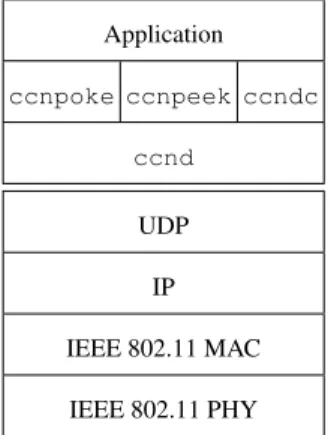
Due to the popularity of the IEEE 802.11 wireless standard [14] among wireless devices, we analyze the performance of CODA assuming that mobile nodes com-municate using the medium access control (MAC) and physical (PHY) layers de-fined by this standard [17][28]. A wireless network abiding to this norm has two
operating modes:infrastructureandad hoc[28]. An “infrastructure” WLAN
re-quires an access point to act as a hub, through which mobile devices communicate; a network functioning in “ad hoc” mode does not require an access point and mobile nodes inter-connect dynamically to form an arbitrary topology. For our purposes, we assume that all mobile devices function in “ad hoc” mode.
The standard [17] defines two medium access mechanisms for the MAC layer: point coordination function (PCF) and distributed coordination function (DCF). The PCF is a centralized medium-access method whereby a base station polls each sender for data. In our network scenario, we assume that mobile devices use the DCF
2.3 Wireless-Medium Access Control 13 method to access the wireless medium, which is based on the carrier sense multiple access with collision avoidance algorithm [28]. If a source node senses the medium
busy, it chooses a randombackoff timefrom the interval[0,CW), where CW
de-notes thecontention window. This backoff time is measured in slot times, where
aslot timeis sum of the receiver to transmitter turnaround time, MAC processing delay, and the clear-channel assessment (CCA) time. The source node decrements the backoff time by one for each DIFS period during which it perceives the medium
to be idle; thedistributed inter-frame spacing time(DIFS) is equal toshort
inter-frame spacing time(SIFS) plus twice the slot time: DIFS=SIFS+2(slot-time). The wireless device freezes the timer whenever it detects activity in the medium and resumes the count down as soon as it senses the medium idle for a DIFS. The CW is doubled upon each unsuccessful transmission, up to a maximum of
CWmax+1, where CWmaxis a characteristic of the physical layer. The node
trans-mits the data packet when the timer drops to zero and if it senses the medium
idle [1]. Wireless nodes overhearing this radio communication configure their
net-work allocation vector(NAV), which contains an estimate of the duration of the transmission [28]. Whenever a node recognizes an incorrect frame, it postpones its
transmission for anextended inter-frame spacing(EIFS) period, which lasts for
SIFS+ACKtime+DIFS seconds. Figure 2.2 describes a typical message-exchange
for the basic access-method of the DCF.
sender
receiver
other devices
data DIFS SIFS ACK DIFS datacontention window
waiting time
Fig. 2.2: Basic medium-access mechanism for the distributed coordination function [28]. The sender transmits a data packet after sensing the medium idle for DIFS. Upon receiving the data packet, the receiver waits for SIFS to allow the sender enough time to become a receiver; then the receiver acknowledges receipt of the data packet. Other devices wait until the medium is idle for a DIFS period and start decrementing the backoff timer before transmitting.
14 2 Background The optional medium-access method of the DCF requires a transmitter to re-serve the wireless medium before it sends a data packet. This access mode is based
on the MACAW protocol [3] and introduces two control-frames:request to send
(RTS) andclear to send(CTS) [28]. A node that wants to send data, transmits a
RTS frame indicating for how long it wants to reserve the channel [1]; upon re-ceiving the RTS frame, the target device replies with a CTS, containing the chan-nel reservation time minus the sum of the duration of the CTS message and SIFS:
reservation time−(CTStime+SIFS). A wireless terminal overhearing a RTS or CTS
frame, updates its NAV to reflect the duration of the reservation and refrains from any communication during this period. Figure 2.3 illustrates a message-exchange example for the optional channel-access mechanism of the DCF. The RTS-CTS
mechanism handles thehidden terminalproblem [1]. This problem occurs when
two wireless devices,aandb, cannot hear each other, but a third node,c, can listen
to both; if terminalsa andb send a packet at the same time,cmay be unable to
receive the data successfully. Using the DCF’s optional mode,aandbsend a RTS
frame tocbefore transmitting their data packets; in turn,creserves the medium for
eithera orb. In practice, if the RTS and CTS frames are lost, collisions can still
occur at the receiverc. A device transmits control frames, such as RTS, CTS, and
ACK frames, at the lowest possible transmission-rate to insure robustness against interference [21]; because devices transmit data at much higher data rates, the RTS and CTS frames pose a significant bandwidth-overhead [1]. For these reasons, the optional DCF mode is usually turned off.
sender receiver other devices RTS DIFS SIFS data DIFS data contention window defer access
CTS SIFS SIFS ACK
NAV (RTS) NAV (CTS)
Fig. 2.3: Optional medium-access mechanism for the distributed coordination func-tion [28]. Upon sensing the medium idle for a DIFS, the sender reserves the shared medium by sending a request to send frame. As it has received no other RTS mes-sages, the receiver replies with a clear to send frame. Other devices overhearing the RTS and CTS messages adjust their network allocation vector and refrain from transmitting during the reserved period.
Chapter 3
Solution
Abstract The content optimal-delivery algorithm receives interest messages from the application and attempts to retrieve matching content from the device’s buffer. If no corresponding content is found, CODA stores the unsatisfied request in the pending-interests table. Periodically, each device issues a hello message to signal its presence; this message prompts CODA to send a pending-interests message with the list of all unsatisfied queries. A neighboring device tries to satisfy this list by fetch-ing content from its own cache. We introduce a mechanism that regulates the delay between hello messages to avoid congesting the network. CODA aims to maximize an objective function while disseminating content: this function measures the total delivery-rate or network throughput. For this purpose, our algorithm calculates the per-content utility, defined as the gradient of the objective function, by estimating the content’s request- and delivery-rate using local network data. To optimize the network throughout, CODA endeavors to equalize the utility for all content: when a device’s cache is full, CODA discards the least-useful replica first; similarly, it sequences content transmissions by decreasing utility. In order to implement CODA over CCNx, we introduce two new fields in the protocol’s content object that carry the request- and delivery-rate estimates, disable the propagation of interest messages in CCNx, and introduce two control packets to implement the hello and pending-interests messages.
3.1 Designing the Solution
The content optimal-delivery algorithm distributes content to multiple users over a
delay-tolerant network while maximizing the total delivery-rate (DR); thedelivery
rateis the number of satisfied content-requests per unit of time. To achieve this, we
derive a utility function,U(i)(DR), that measures the marginal gain in the total DR
with respect to the number of existing copies of contentiin the network. A device
determines the utility of a content using information that it gathers locally. We prove that if nodes use this utility function to eject less-useful content from a full buffer
16 3 Solution and to prioritize data-transmissions, the delivery-rate utility of all content will,
ulti-mately, be equal:∀k
j=1U(j)(DR) =const.; in other words, our algorithm drops the
same number of copies for each content, regardless of its popularity. Finally, we describe CODA’s operation and detail the steps necessary to implement CODA over the CCNx protocol [31].
3.1.1 Defining the Delivery-Rate Utility
We now define the delivery-rate utility (U(i)(DR)) for a content i and devise a
method to compute this value by estimating the request rate and the delivery rate
of contenti, using information that is locally available to each node. In our model,
we assume that node inter-meeting times follow an exponential distribution with a
constant parameterλ; in other words, if nodeameetsb, it expects to meetbagain
after 1/λ seconds elapse. Under this assumption, the probability that a receiver
ob-tains a replica of contentiis defined as follows:
Definition 1 Given the node contact-rateλ, the average lifetime for an information request TTL, and the number of replicas n(i), the probability that a node obtains a copy of content i is equal to
p(i)=1−exp{−λTTL·n(i)} . (3.1)
Hence, by duplicating content (n(i)), increasing the average information-request
life-time (TTL), or augmenting the contact rate (λ), we improve the likelihood that a
device obtains a copy of contenti(p(i)).
The delivery rate measures the number of replicas of a particular contentithat
are delivered to the intended destinations per unit of time:
Definition 2 Given the request rate (q(i)) and the probability of receiving a replica of content i (p(i)), we define the delivery rate for content i as
DR(i)=q(i)·p(i) . (3.2)
Intuitively, as we increase the number of replicas of a contenti, the probability that
a node receives a copy ofi increases and the delivery rate grows proportionally.
CODA maximizes the total delivery rate, which is the sum of the delivery rates of
each disseminated contenti, subject to the following constraints: the total number
of replicas of all content cannot exceed the amount of storage of all network nodes,
a node cannot store duplicate copies of a content item i, and there must exist at
least one replica of each contentiin the network. This corresponds to the following
3.1 Designing the Solution 17 maximize n(1),...,n(k) f(n (1), . . . ,n(k)) = k
∑
i=1 DR(i) subject to k∑
i=1 n(i)−LB≤0,n(i)−L≤0 for all contenti,
n(i)≥1 for all contenti,
(3.3)
wherekis the number of distinct content items,L is the number of nodes in the
network, andBis the buffer capacity of each node.
Given that the constraints in (3.3) are linear [24] and assuming thatn(1),. . . ,n(k) are real random variables (and not integers), then this is a convex optimization prob-lem, which can be solved efficiently [24]. CODA solves the above optimization
problem in a distributed fashion by adopting agradient ascentstrategy [24], where
the gradient of the objective function is the delivery-rate utility:∇f =U(DR). In
other words, the delivery-rate utility of content iis the marginal gain in the total
delivery-rate with respect to the number of replicas of contenti(n(i)):
Definition 3 Given the delivery rates for all k content types, DR(1), . . . ,DR(k), the delivery-rate utility is defined as
U(i)(DR) = ∂ ∂n(i) k
∑
j=1 DR(j) . (3.4)Using the definition of the delivery rate (3.2), we can expressU(i)(DR)in a more
convenient form, as explained next.
Lemma 1 The delivery-rate utility is proportional to the request-rate for content i (q(i)) and decays exponentially with the number of replicas n(i):
U(i)(DR) =q(i)(λTTL)exp{−λTTL·n(i)} . (3.5)
In other words, as nodes replicate a particular contenti, the marginal gain in the
delivery rate ofiis gradually smaller; asn(i) tends to infinity,U(i)(DR)tends to zero.
Proof. Substituting (3.1) and (3.2) in (3.4) results in
U(i)(DR) = ∂ ∂n(i) k
∑
j=1 DR(j) , = k∑
j=1 ∂ ∂n(i) DR(j) , =q(i)∂p (i) ∂n(i) , =q(i)(λTTL)exp{−λTTL·n(i)} . (3.6)18 3 Solution Lemma 2 The delivery-rate utility U(i)(DR)can, alternatively, be expressed as
U(i)(DR) =λTTL(q(i)−DR(i)) . (3.7)
Proof. We can re-write (3.6) in terms of the probability of receiving a replica of
contenti(3.1) as follows:
U(i)(DR) =q(i)(λTTL)exp{−λTTL·n(i)} ,
=q(i)(λTTL)(1−(1−exp{−λTTL·n(i)})) ,
=λTTL(q(i)−q(i)·p(i)) ,
=λTTL(q(i)−DR(i)) .
From (3.7), we know that the DR utility is proportional to themiss rate, defined
as the number of unsatisfied requests for contentiper second: MR(i)=q(i)−DR(i).
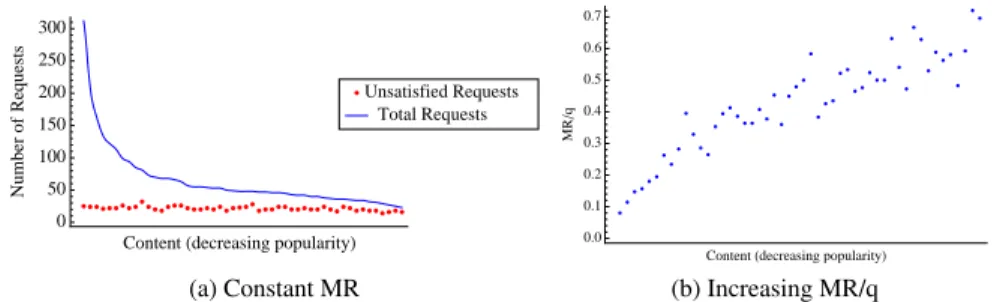
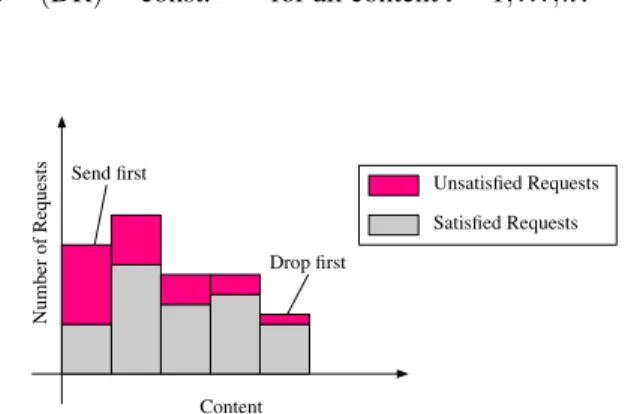
CODA attempts to equalize this quantity for all content, irrespective of its request rate (or popularity). When a device’s buffer is full, CODA discards the content replica with the lowest number of unsatisfied requests; by definition, this copy has the smallest impact on the total DR. If a node drops a content item, the network will have fewer replicas of this data, thus raising its DR utility (3.6). When a node meets a peer, it schedules the transmission of content according to the same utility function. In this case, the node chooses to send the content item with the greatest number of unsatisfied requests; by replicating this item, the device will increase the probability that a receiver obtains a copy of this content, thus reducing its utility (3.7). This gradient ascent strategy, illustrated in Figure 3.1, will converge to the
number of replicas per content that maximizes the objective functionf in (3.3),
pro-vided the iteration step is such that CODA converges to the optimal solution before the network changes substantially [24]. We now show that CODA will converge to a constant miss-rate per content by following the aforementioned strategy.
Theorem 1 If nodes drop content by order of increasing delivery-rate utility, the following relationship will eventually hold:
U(i)(DR) =const. for all content i=1, . . . ,k . (3.8) In other words, the proposed method drops the same number of replicas for each content type, regardless of its popularity.
Proof. Assume that all nodes have a full buffer. Letπ−=arg miniU(i)(DR)and π+=arg maxiU(i)(DR). Nodearequests contenti, such thatU(π+)(DR)≥U(i)(DR)
>U(π−)(DR). A nodebthat forwardsiand that has not yet bufferediwill discard the least useful content jin its buffer, whereU(i)(DR)>U(j)(DR)≥U(π−)(DR).
Then the delivery-rate utility of content jat timetcan be expressed as follows:
Ut(j)(DR) =q(t−j)1exp{−λTTL(n(t−j)1−1)} ,
3.1 Designing the Solution 19
Analogously, the delivery-rate utility of contentiwill be updated as described next:
Ut(i)(DR) =q(ti−)1exp{−λTTL(n(t−i)1+1)} ,
=Ut(−i)1(DR)exp{−λTTL} .
BecauseλTTL>0, exp{λTTL}>1>exp{−λTTL}and the delivery-rate utility
ofiwill decrease while that of jwill increase.
If j=π−andU(π −)
t−1 (DR)exp{λTTL} ≤U
(t)
k (DR), for any contentk, then
Ut(π−)(DR) =Ut(−π1−)(DR)exp{λTTL} .
Analogously, ifi=π+andU(π
+)
t−1 (DR)exp{−λTTL} ≥U
(t)
k (DR), for any content
k, then
Ut(π+)(DR) =Ut(−π1+)(DR)exp{−λTTL} . Eventually, we reach a timet∗whereUt(∗π+)(DR) =U(π
−
)
t∗ (DR), at which time the
following will hold
U(i)(DR) =const. for all contenti=1, . . . ,k.
N um be r of Re que st s Satisfied Requests Unsatisfied Requests Content
(ordered by decreasing # unsatisfied requests) Drop first Send first
Fig. 3.1: CODA attempts to equalize the DR utility of all content. A device with a full buffer drops the content item with the lowest number of undelivered copies; discarding a content replica reduces the number of replicas in the network and in-creases the content’s DR utility. When the same device meets a peer, it transmits the content item with the greatest number of unsatisfied requests; by increasing the number of content replicas, the probability that a receiver obtains a copy of this content rises, thus reducing the content’s utility.
20 3 Solution
3.1.2 Estimating the Delivery-Rate Utility
To calculate the delivery-rate utility for a contenti, a node must estimate the rate
of request and delivery fori; it performs this estimate by recording the time when
the application requests content i and when these requests are fulfilled. In order
to improve this approximate value, a node merges its own rate estimates with those received from other network peers. Using the two approximate values for the request
and delivery rate, the node computes the utility of contentiby applying (3.7). Next,
we define unbiased estimators forq(i)andp(i).
Definition 4 Let Xn(i) be a RV denoting the n-th measurement of the number of
re-quests for content i per node, issued by the application in the past W seconds, such thatE[Xn(i)] =q(i)W . Then our estimator for the request rate for content i, q(i), is
given by ˆ qn(i)=αqˆn(i−)1+ (1−α)X (i) n W , (3.9)
whereqˆ(ni)is the value of the estimatorqˆ(i)after considering the n-th node meeting
andα∈(0,1)is the weight given to the old estimate of the request-rate for content i,qˆ(ni−)1.
In other words, the estimator for the request rate of content iis computed as the
exponentially weighted moving average (EWMA) of the observed samples X0(i),
X1(i), . . . , applying a weight of(1−α)to the most recent sample,Xn(i). We can show
that the estimator obeys the following property:
Lemma 3 The estimator for the request rate,qˆ(i), is unbiased: E[qˆ(i)] =q(i) .
Proof. First note that ˆq(0i)=X0(i)/W, so E[qˆ0(i)] =E[X0(i)/W] =q(i). We can compute the expectation of ˆq(i)as follows:
E[qˆ(i)] =E[qˆ(ni)] , =E[αqˆ(ni−)1+ (1−α)Xn(i)/W] , =αE[qˆn(i−)1] + (1−α)E[X (i) n /W] , =αq(i)+ (1−α)q(i) , =q(i) .
We now define the estimator for the delivery rate as follows.
Definition 5 Let Yn(i)be a RV denoting the n-th measurement of the number of
sat-isfied requests for content i issued in the past t seconds, where t∈[TTL,W+TTL], and such thatE[Yn(i)] =p(i)q(i)W . Then, our estimator for the delivery rate of content
3.2 Content Optimal-Delivery Algorithm 21 i,DRˆ (i), is given by ˆ DRn(i)=βDRˆ n(i−)1+ (1−β)Y (i) n /W , (3.10)
whereDRˆ (ni) is the value of the estimator after considering the n-th node meeting andβ ∈(0,1)is the weight given to the previous estimate of DR(i).
In other words, the estimator for the delivery rate of contentiis computed as the
exponentially weighted moving average of the observed samplesY0(i),Y1(i), . . . , ap-plying a weight of(1−β)to the most recent sample,Yn(i). Here we shift back the
time window by TTL seconds to allow the information requests issued in the last TTL seconds to receive an answer or, if none is received, to be classified as “unsat-isfied”. This estimator obeys the following property:
Lemma 4 The estimator for the delivery rate,DRˆ (i), is unbiased: E[DRˆ (i)] =DR(i) .
Proof. First observe that ˆDR(0i)=Y0(i), so E[DRˆ 0(i)] =E[Y0(i)/W] =DR(i). We can
now compute the expected value of ˆDR(i)as described next:
E[DRˆ (i)] =E[DRˆ (ni)] , =E[βDRˆ (ni−)1+ (1−β)Yn/W] , =βE[DRˆ n(i−)1] + (1−β)E[Y (i) n /W] , =βDR(i)+ (1−β)DR(i) , =DR(i) .
A mobile node couples its approximation of the request and delivery rate of a content
iwhen it sends a replica ofito another device; this allows local estimates to
per-meate the network. CODA combines two estimates of the same rate by computing their arithmetic mean, which yields an unbiased estimate of the rate. An alternative approach consists in weighing each rate estimate by its inverse variance [7][22]. We analyze the properties of this combined estimator in Appendix A.
3.2 Content Optimal-Delivery Algorithm
The content optimal-delivery algorithm sits between the application and the net-work layer; it receives interest messages from the application and attempts to find matching content cached in the mobile device’s buffer or available from a neighbor-ing peer. When CODA fails to find matchneighbor-ing content in the local buffer, it writes the query to the pending interests table of the CCNx protocol [31] until it can satisfy the
22 3 Solution
request. Periodically, each mobile device issues ahello message(HM) that signals
its presence. When CODA captures a hello message it prepares a message with all
its pending queries, known as thepending interests message(PIM); a mobile node
within range attempts to satisfy the pending requests by searching its local storage and sending all matching content. CODA relies on a node’s ability to estimate the re-quest and delivery rate, ˆq(i)and ˆDR(i), for a content in order to compute its delivery-rate utility,U(i)(DR). We assume that each content objecticarries in its header the estimates for the two rates, which are calculated by the object’s sender. When a mo-bile device’s buffer is full, CODA uses the content utility to erase the least useful object from memory; similarly, when exchanging content with a neighbor, it prior-itizes transmissions by decreasing utility. This insures that the most useful content reaches its neighbor in case both nodes part before the data-communication ends. Throughout this section, we analyze the aforementioned features in detail.
3.2.1 Processing Application Queries
When the application issues a content query, expressed as an interest message (IM),
CODA records the time at which it received the interest (line 1 of Alg1) in the
statis-tics tableand searches the mobile device’s buffer for matching content; the statistics table is a data structure, independent of the content buffer, that stores the time when requests are issued and when they are satisfied, from which CODA calculates the request and delivery rate of each content seen. If the buffer contains the desired content, CODA delivers this data immediately to the application, as shown in line 3 (Alg 1); otherwise, the device stores the query in the pending-interests table (line 6). The pending-interests table is a data structure that stores all the unsatisfied queries issued by the application; an interest remains in the PIT until CODA retrieves this data from a network peer. Periodically, CODA iterates through the statistics table to update the request and delivery rates of all content seen using equations (3.9) and (3.10).
Algorithm 1Process interest messages from the application.
Input: interest for contentifrom application 1: recordtime of request foriin statistics table 2: ifbuffer containsithen
3: delivercontentito application
4: recordtime when request forisatisfied in statistics table 5: else
6: writeinterest to pending-interests table 7: end if
A mobile device cannot satisfy all content requests with its cache alone; in such cases, the device stores the query in the PIT while waiting for a response.
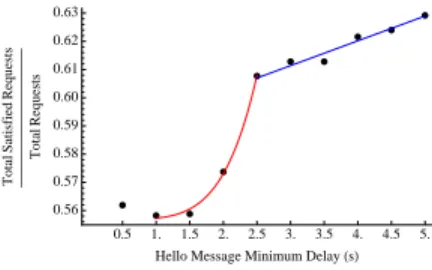
Peri-3.2 Content Optimal-Delivery Algorithm 23 odically, a device emits a hello message, which serves to alert other nodes of its
presence; the delay for transmitting the next HM,dhello, is calculated as follows:
dhello=dhellomin (bhello+r) , (3.11)
wheredminhellois the minimum delay between HM messages,bhello∈[0,bmaxhello]is the
hello backoff-counter,bmax
hellois the maximum hello-backoff, andr∈[0,1]is a
ran-dom value. By ranran-domizing the transmission delay of the HM, CODA reduces the probability of interfering with ongoing but yet undetected transmissions. When a mobile device receives a hello message, it delays the transmission of its own
peri-odic message by increasing the backoff counter (bhello), as shown in lines 1–3 of Alg.
2; this avoids congesting the network with an excessive amount of hello packets. As a response to the hello message, CODA prepares a pending-interests message, com-prising the application’s unsatisfied requests, and schedules the transmission of the message to all device’s within range (lines 4–8 of Alg. 2).
Algorithm 2Processing of hello messages.
Input: hello message from network
1: ifa hello message is waiting to be sentthen
2: delaytransmission of hello message 3: end if
4: createnew pending interests message
5: foreach interest in the pending interests tabledo
6: writeinterest to pending interests message 7: end for
8: scheduletransmission of pending interests message
Our algorithm computes the transmission delay of the PIM,dPIM, as follows:
dPIM=dminPIM(bPIM+r) , (3.12)
where dPIMmin is the minimum waiting time before transmitting the PIM, bPIM ∈
[0,bmaxPIM]is the PIM backoff-counter, bounded by 0 and the maximum backoff (bmaxPIM),
andr∈[0,1]is a random value. When a node receives a PIM, it defers the
trans-mission of a (possibly) pending PIM by increasing the backoff counter,bPIM(lines
1–3 of Alg. 3); this enables a mobile device to satisfy part or all of its own pending interests by overhearing the upcoming data-exchange, thus reducing the number of entries in its next PIM. To process an incoming PIM, a node retrieves from its buffer all the content items that satisfy the interests expressed in the PIM (lines 4–8 of Alg. 3); it then orders the sought content by decreasing DR utility and couples the estimated request and delivery rates to each content object sent (lines 9–13 of Alg. 3).
24 3 Solution Algorithm 3Processing of pending-interests messages.
Input: pending interest message from network
1: ifa pending interests message is waiting to be sentthen
2: delaytransmission of pending interests message 3: end if
4: foreach interest in the pending-interests messagedo
5: ifexists matching contentiin bufferthen
6: writecontentito list 7: end if
8: end for
9: sortlist in order of decreasing DR utility 10: foreach contentiin the listdo
11: writerequest and delivery rate to contenti
12: scheduletransmission of contenti
13: end for
3.2.2 Processing Incoming Content
Whenever a mobile device receives a content object, it checks the PIT for interests corresponding to this data; in case the content object matches an interest in the PIT, CODA delivers the data to the application and records the time at which the interest was satisfied (lines 1–4 of Alg. 4). As each mobile device may have its own estimate of the request and delivery rates, CODA computes the arithmetic mean of the two estimates and updates the statistics table, as shown in lines 5–6 (we discuss the properties of this combined estimate in Appendix A). Finally, CODA caches the
replica of contentiif no such copy exists in the device’s buffer (line 10).
Algorithm 4Process incoming content from the network.
Input: datagram with contentifrom network 1: ifexists pending interest for contentithen
2: delivercontentito application
3: recordtime when request forisatisfied in statistics table 4: end if
5: averagerequest-rate in statistics table and rate in datagram (A.3) 6: averagedelivery-rate in statistics table and rate in datagram (A.3) 7: ifbuffer containsithen
8: discardcontenti
9: else
10: STORE-CONTENT(i) 11: end if
Function STORE-CONTENT implements CODA’s buffer management strategy
(Alg. 5). Our algorithm accepts to store all unique content replicas published by the user and those received from the network as long as there is enough storage capacity (lines 2–5). Whenever the device’s buffer is full, CODA selects the replica with the
3.2 Content Optimal-Delivery Algorithm 25
lowest delivery-rate utility from memory, saym, and compares it with the utility of
replicai; CODA keeps only the replica with the highest utility from the pair{i,m}
(lines 6–12). By definition, the replica with the lowest utility has the least impact on the total content delivery-rate, if dropped.
Algorithm 5Store content in the buffer. 1: functionSTORE-CONTENT(i)
2: ifbuffer not full then
3: writecontentito buffer 4: returntrue
5: end if
6: letm←content with lowest DR utility in buffer 7: ifi’s utility>m’s utilitythen
8: replacereplicamwithiin buffer 9: returntrue 10: end if 11: discardcontenti 12: returnfalse 13: end function
3.2.3 Implementation of CODA
In this section we describe the necessary steps to implement CODA over the latest
revision of the CCNx protocol1 [31]. The CCNx protocol implementation is
di-vided into two main components: the client, which acts as a mediator between the server and the application and provides an interface for the application to issue data requests and obtain content objects from the network, and the server, which prop-agates data requests to the network and obtains content objects from other servers. The principal changes required to deploy CODA over CCNx consist in modifying the header of the content object to include the request and delivery-rate estimates, disabling the propagation of interest messages to network peers, and introducing two control packets that implement the hello and pending-interests messages.
A content object contains four units:Signature,Name,SignedInfo, and
Content, as illustrated in Figure 3.2. TheSignaturecontains a digest of the Name,SignedInfo, andContentcomponents, computed using a signature
al-gorithm [31]; theNameunit holds the hierarchical CCNx name of the content; the
SignedInfocomponent specifies the signer of the message, the time instant when the object was signed, the type of content conveyed, and the message’s expiration time. The original CCNx server stores each content object received from the net-work in a hash table. For each content replica received, the server divides the
con-tent object into two parts: the first part comprises theSignatureandNameunits
and the second consists of the remaining components of the content object. The 1At the time of this writing, the latest revision of the CCNx protocol was 0.6.0.
26 3 Solution server computes a hash value of the first part of the content object to index each replica stored in the buffer. We introduced the estimates of the request and delivery
rates as two integer fields in theSignedInfosection of the message. Because the
SignedInfosection belongs to the second half of the content object, recomputing the two rate estimates for each stored replica does not affect its hash value; hence, the server can still locate content in the buffer after updating the rate estimates of the stored replicas.
Signature DigestAlgorithm Witness SignatureBits Content Object Name SignedInfo PublisherPublicKeyDigest Timestamp Type? FeshnessSeconds? FinalBlockID? KeyLocator? ParamA ParamB Content
Fig. 3.2: The structure of the CCNx content object [31][19]. A content object com-prises four main compartments: signature, name, signed info, and content. A host generates the digital signature based on the binary encoding of the name, signed info, and content sections of the content object. The signed info component con-tains data that helps a CCNx device verify a digital signature. The name sec-tion identifies the data stored in the object; it comprises a sequence of compo-nents, where each component contains a succession of zero or more bytes (e.g. /epfl.ch/IC/videos/welcome.mpg). Lastly, the content portion carries the actual data. Each field marked with a “?” sign is optional. We added the two
fields marked in red to the content object, param-A and param-B, that carry the
request- and delivery-rate, respectively.
A message in the CCNx protocol is encoded using theCCNx binary(CCNB)
format [31]. Each section of a message is labeled by aDTAG, which is a unique
identifier drawn from an internal dictionary. The parser or decoder outputs the byte number at which each message element starts and ends. We encode each estimate
3.2 Content Optimal-Delivery Algorithm 27
DTAG, and modify the content-object parser so as to locate the boundaries of the
two values. By usingBLOBs of fixed length, we can recompute the estimates for the
two rates, encode them using the CCNB format, and replace the old values in the content object without generating a new message-header. Figure 3.2 illustrates the components of the content object, including the section where we encode the two estimated rates.
To compute the value of the two rates, we added a statistics table to the server to record the history of content requests; by storing content-requests as a separate data structure we ensure that its lifespan is independent of other server events, such as the removal of stale content from the buffer. Each table entry contains a list of
all requests issued and satisfied in the precedingW+TTL seconds for a specific
content, whereW denotes the sampling period and TTL is the average lifetime of
an information request; each entry is indexed by the CCNx name of the content
being tracked. To calculate the value of the request-rate estimator, ˆq(i), we apply
(3.9) and measureXn(i)by counting the number of requests sent in the precedingW
seconds recorded in the content-requests table. We estimate the delivery rate, ˆDR(i),
using (3.2), and evaluateYn(i) by tallying all the satisfied requests transmitted in
the preceding[TTL,W+TTL]seconds. Knowing the two estimates, ˆq(i)and ˆDR(i),
we determine the utility of content i using (3.7) and record this value alongside
each replica stored in the buffer. Whenever the buffer exceeds a storage threshold,
which is controlled by the parameterCCND CAP[31], we sort the buffer in order of
increasing utility and discard the least-useful replicas until the buffer size is below the storage limit.
We implement CODA’s hello and pending-interests messages as content objects.
The hello message consists of a content object withNameset to/coda/hello,
type field set to CCN CONTENT HELLO, and having an empty Content
sec-tion. A pending-interests message has a CCNx name of/coda/pit,typefield
set toCCN CONTENT PIT, and theContentsection of the message holds a list
of the content-names requested by the application and stored in the source node’s pending-interests table; this message is generated as a response to a hello message. Upon receiving a pending-interests message, CODA reads each name entry in the PIM’s payload and locates matching content in the device’s memory; the algorithm sorts all matching content by decreasing utility before scheduling each transmis-sion. We use CCNx’s inbuilt scheduler to implement the transmission delay equa-tions (3.11) and (3.12) for the PIM and HM, respectively. Additionally, we rely on CCNx’s procedure for sending data that introduces an additional random delay be-fore each transmission; this helps reduce the likelihood of colliding with ongoing communications. The CCNx protocol’s forwarding-information base comprises a list of IP addresses for dispatching interest messages for which there is no matching content in the local content-store. Because we use the hello and pending-interests messages for a similar purpose, we disabled the interest-forwarding procedure found
in CCNx. However, we use the FIB table to store a default entry with CCNx name/
that points to CODA’s multicast address; a device always uses this address to send data to its peers over the network.
Chapter 4
Evaluation
Abstract We want to confirm if CODA maximizes the throughput of the network by equalizing the delivery-rate utility of all disseminated content. Additionally, we want to measure the effect of the buffer capacity per node, network load, and the dis-tribution of content popularity on the network throughput. For this purpose we de-ploy CODA in a simulation network comprising 50 nodes that move according to a random-direction model. Nodes moving according to this model have exponentially distributed or, at least, exponentially tailed inter-meeting times, which agrees with our initial design assumptions. We simulate our proposal using network simulator 3 (NS3) and use the direct-code execution (DCE) feature to deploy the same ver-sion of CODA conceived for real mobile-devices on the simulation nodes. Although this simulation method posed a significant performance penalty, our results gained credence. According to the outcome of the simulation, CODA achieves a constant DR utility for all content, given enough time and network resources. The conges-tion avoidance mechanism effectively scales down data traffic when the network is overloaded. Increasing the buffer capacity per node raises the network throughput as long as this capacity does not exceed the total number of disseminated contents. By raising the Zipf exponent, nodes request only a fraction of the available con-tents and can satisfy most user-requests with less buffer space, which justifies the proportional increase in the network throughput.
4.1 Simulation of CODA
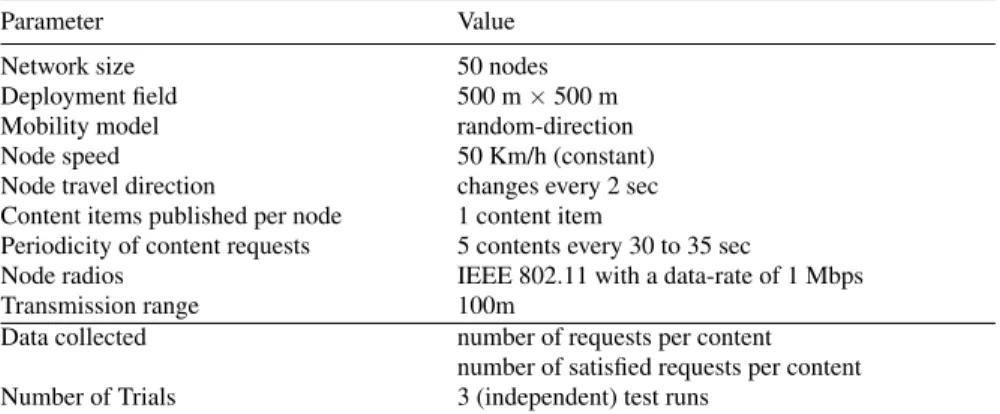
The purpose of simulating CODA is to verify if it maximizes the total delivery-rate by equalizing the DR utility of all content; hence, for a sufficient number of content requests, the DR utility should converge to a constant, as claimed by Thm 1. To test our proposal, we deploy CODA in a network of 50 nodes, which move according to a random-direction model, travel at a constant speed of 50 Km/h within a square field of width 500m, and change direction every two seconds. The authors in [24] show that nodes moving according to a random-direction model have
![Fig. 2.1: The delay-tolerant architecture [8]. A name tuple comprises two units of variable length: {region name, entity name}; the region name is globally unique and the entity name is unique within a specific region](https://thumb-us.123doks.com/thumbv2/123dok_us/9916873.2484733/22.918.261.646.156.473/tolerant-architecture-comprises-variable-length-region-globally-specific.webp)
![Fig. 2.2: Basic medium-access mechanism for the distributed coordination function [28]](https://thumb-us.123doks.com/thumbv2/123dok_us/9916873.2484733/23.918.214.694.539.752/fig-basic-medium-access-mechanism-distributed-coordination-function.webp)
![Fig. 2.3: Optional medium-access mechanism for the distributed coordination func- func-tion [28]](https://thumb-us.123doks.com/thumbv2/123dok_us/9916873.2484733/24.918.204.698.576.746/fig-optional-medium-access-mechanism-distributed-coordination-func.webp)
![Fig. 3.2: The structure of the CCNx content object [31][19]. A content object com- com-prises four main compartments: signature, name, signed info, and content](https://thumb-us.123doks.com/thumbv2/123dok_us/9916873.2484733/36.918.326.577.307.611/structure-content-object-content-object-compartments-signature-content.webp)