Research Article
Bias Modeling for Distantly Supervised Relation Extraction
Yang Xiang, Yaoyun Zhang, Xiaolong Wang, Yang Qin, and Wenying Han
Key Laboratory of Network Oriented Intelligent Computation, Harbin Institute of Technology Shenzhen Graduate School, Shenzhen 518055, China
Correspondence should be addressed to Yang Xiang; [email protected] Received 24 March 2015; Accepted 11 August 2015
Academic Editor: Chih-Cheng Hung
Copyright © 2015 Yang Xiang et al. This is an open access article distributed under the Creative Commons Attribution License, which permits unrestricted use, distribution, and reproduction in any medium, provided the original work is properly cited. Distant supervision (DS) automatically annotates free text with relation mentions from existing knowledge bases (KBs), providing a way to alleviate the problem of insufficient training data for relation extraction in natural language processing (NLP). However, the heuristic annotation process does not guarantee the correctness of the generated labels, promoting a hot research issue on how to efficiently make use of the noisy training data. In this paper, we model two types of biases to reduce noise: (1)bias-distto model the relative distance between points (instances) and classes (relation centers); (2)bias-rewardto model the possibility of each heuristically generated label being incorrect. Based on the biases, we propose three noise tolerant models:MIML-dist, MIML-dist-classify, andMIML-reward, building on top of a state-of-the-art distantly supervised learning algorithm. Experimental evaluations compared with three landmark methods on the KBP dataset validate the effectiveness of the proposed methods.
1. Introduction
With the explosion of web resources, traditional supervised machine learning, which relies on a small set of manually annotated training samples, may not be able to catch up with the up-to-date information needs. Likewise for relation extraction, a hot research issue in NLP predicts semantic relations for a pair of name entities.
DS (distant supervision/weak supervision) annotates a large scale of free text with relation mentions from existing KBs, providing a way to alleviate the problem of insufficient training data for relation extraction. DS initially assigns relation labels to sentences according to relation mentions when a sentence contains a certain pair of entities but does not care about whether it actually conveys the corresponding semantic relation. Therefore, the heuristic annotation process does not guarantee the correctness of the generated labels, promoting a hot research issue on how to efficiently make use of the noisy training data.
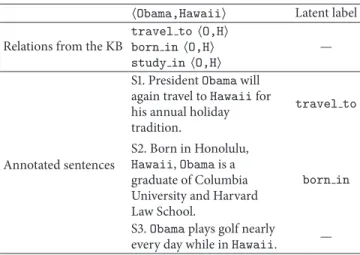
For example, suppose a name entity pair ⟨Obama,
Hawaii⟩ has three valid relation labels, travel to,
born in, and study in; according to the KB (i.e.,
Freebase), multiple sentences containing this entity pair from large-scale free text will be marked to convey either of
the three relations (see S1–S3 in Table 1). However, we are not able to decide the specific relation label for each sentence in advance according to these annotations. Therefore, it is difficult for traditional supervised learning algorithms to learn directly from these heuristically annotated sentences. In addition, due to the incompleteness problem of either the KB or the free text, false negatives (FNs) and false positives (FPs) are inevitable, giving rise to noisy training labels. For example, at least one sentence in S1–S3 (Table 1) should be labeled with study in according to the heuristics for DS, but actually none of them conveys this relation due to the incompleteness of free text. Similarly, because of the incompleteness of the KB, we can hardly find any relation from the KB that S3 can express.
Previous researches presented several methods to utilize the heuristically generated labels and train weak classifiers to predict unseen relations: single-instance learning (SIL) [1], multi-instance learning (MIL) [2], multi-instance multilabel learning (MIML) [3, 4] and some related extensions [5, 6], the embedding model [7] and the matrix factorization method [8, 9], and so on. Among them, multi-instance multilabel learn-ing for relation extraction (MIML-RE) proposed by [4] is one of the state-of-the-art learning paradigms. MIML-RE treats multiple sentences (i.e., S1–S3) that contain a certain pair of Volume 2015, Article ID 969053, 10 pages
Table 1: Examples for DS annotated sentences.
⟨Obama,Hawaii⟩ Latent label
Relations from the KB
travel to⟨O,H⟩ born in⟨O,H⟩ study in⟨O,H⟩
—
Annotated sentences
S1. PresidentObamawill again travel toHawaiifor his annual holiday tradition.
travel to
S2. Born in Honolulu, Hawaii,Obamais a graduate of Columbia University and Harvard Law School.
born in
S3.Obamaplays golf nearly
every day while inHawaii. —
name entity as a bag (multi-instance) and has all possible labels (i.e., travel to, born in,and study in) marked to these sentences (multilabel). Through modeling the dis-tantly labeled data from the bag-level as well as the instance-level, MIML-RE transfers the data to styles that traditional supervised learning algorithms can easily deal with (see more details in Section 4).
Nevertheless, as mentioned above, the data generated by DS heuristics contain noises such as wrong labels; it is necessary to equip the learning algorithms with noise reduction methods. In addition, we argue that theinstance
diversity problem is prevalent for training weak classifiers.
That is, we cannot guarantee that all the instances we collected and labeled through the DS heuristics are of high quality just like those labeled by human labelers.
The noisy problem can also be learned about from previous researches such as [10]. In [10], the authors manually annotated over 1800 sentences from free text and compared them to the KB. They finally got 5.5% FNs and 2.7% FPs, which is a good evidence for using noisy reduction strategies. Besides, from our observations toward the training data, we found that the instance diversity problem is remarkable in the dataset, reflected by the distributions for expectations (see Figure 2).
In this paper, we model two types of biases for noise reduction: (1)bias-distto model the relative distance between points (instances) and classes (relation centers); (2) bias
-rewardto model the possibility of each heuristically
gener-ated label being incorrect. Bias-dist is modeled to weaken
the maximum probability assumption (the class with the
maximum probability should be assigned) during the EM process in MIML-RE, so that it is not always true that the class with the maximum probability is accepted. This bias is proposed according to the diverse qualities of training instances. Bias-reward is modeled to weaken the impact of wrong labels, resulting in the case that wrong labels would be with low predicting confidence. This bias aims at efficiently modeling the noisy group-level labels. Based on the biases, we propose three methods,MIML-dist(multi-instance mul-tilabel learning with distance), MIML-dist-classify (multi-instance multilabel learning with distance for classification),
andMIML-reward(multi-instance multilabel learning with
reward), building on top of the MIML-RE framework. There-fore, this work can be seen as an extension of MIML-RE.
We set up experiments on one of the most popular benchmark datasets, the KBP dataset built by Surdeanu et al. [4]. Evaluation results compared with three landmark algorithms validate the effectiveness of the proposed meth-ods. Particularly, MIML-dist-classify is built in the predicting phase, which is simple and fast to complete, boosting the
𝐹1 from the baseline 27.3% to 29.03%. MIML-dist-reward converges much faster than the original algorithm which reaches 29.01% on𝐹1.
The contributions of this paper can be summarized as follows: (1) We are the first to explicitly model the bias related to the instance diversity problem and gain considerably better results; (2) the modeling methods toward the two types of biases are both validated to be efficient through the experiments.
The rest of the paper is organized as follows: Section 2 briefly introduces the literature; Section 3 describes the two types of biases; the models are detailedly described in Section 4. Sections 5 and 6 are the implementations and experiments. Discussion and conclusion are arranged at last.
2. Related Work
In this section, we briefly introduce the literature of distantly supervised relation extraction and the noise reduction meth-ods for it.
2.1. Relation Extraction. Relation extraction (RE) is a hot
research issue in NLP. In early researches, various approaches based on rich syntactic and semantic features were proposed. For example, Zelenko et al. introduced various subtree kernels with Support Vector Machine and Voted Perceptron learning algorithms [11]. In [12], the authors proposed three types of subsequence kernels for RE on protein-protein interactions and top-level relations from newspapers. Zhou et al. used tree kernel-based method with rich syntactic and semantic information and a context-sensitive convolution tree kernel [13]. Recent work focused mostly on deep neural network based structures, that is, single convolutional deep neural network based model [14, 15] and the combination of recursive neural network and convolutional neural network based model [16].
2.2. Distant Supervision for Relation Extraction. Distant
supervision was firstly introduced in the biomedical domain by mapping databases to medical texts [17]. Since then, DS gained much attention in both information extraction (IE) and further RE. Most of the earlier researches include [18, 19] used single-instance learning according to the assumption that one pair of entity only corresponds to a single relation. In recent years, distant supervision is widely used in open IE to map Wikipedia infoboxes to wiki contents or web-scale texts [20, 21]. For RE, distant supervision is also employed for mapping Freebase relations to large scales of free text (i.e., New York Times) and predicting relations for
unseen entity pairs [1–4]. Most aforementioned work used SIL, MIL, or MIML to train classifiers, which set strong baselines in this field. In addition, recent researches also include embedding based models that transferred the relation extraction problem into a translation model like ℎ + 𝑟 ≈
𝑡[22–24], nonnegative matrix factorization (NMF) models [8, 9] with the characteristics of training and testing jointly, integrating active learning and weakly supervised learning [25], integer linear programming (ILP) [26], and so on.
2.3. Noise Reduction Methods for DS. One type of noise is
that we cannot decide the actual label for each instance and can only estimate them according to some constrains.
At-least-one is a representative constrain which considers
that one relation label is positive when at least one of the mentions in the bag gets the label but discards the others. Related work directly modeled the noisy training data with multi-instance frameworks and learned model parameters through several times of EM iterations [2–4]. Intxaurrondo et al. [27] employed several heuristic strategies to remove useless mentions. Xu et al. [10] employed a passage retrieval model to expand the training data from instances with high confidence. Takamatsu et al. [28] directly model the patterns that express the same relation. Another type of noise is the wrong bag-level labels due to the incompleteness of either the KB or the textual corpus. Min et al. [5] put another layer to the MIML-RE architecture to model the true labels of a bag to model the incompleteness of the KB. Ritter et al. [6] added two parameters to directly model the missing of texts and the missing of KBs and set them with fixed values; they considered some side information such as popularity of entities as well. Fan et al. [9] added a bias factor𝑏in their model to represent the noises. The idea of considering the instance diversity problem which relates to data quality in this work is a bit similar to Xu’s passage retrieval model [10] but we are from a distinct perspective. The bias modeling idea is something like [6] but we model the missing in an indirect way which employs ranking-based measures.
3. Biases
In this section, we generally describe the two types of biases we propose.
3.1. Bias-Dist. Bias-dist (bias related to distance) aims at
tackling the instance diversity problem rising from the DS annotation process. In traditional supervised machine learn-ing, when human annotators label training instances, they incline to label those instances that they are confident of and discard the others so that a pure training set can be created. A typical example is theannotation agreement standardfor evaluating a corpus and the instances whose labels are with hardly any disagreements are usually considered as being of high quality. On the contrary, there is no human intervention for the DS annotation; hence the quality of training samples cannot be guaranteed. As a result, when we use the classifier to assign relation labels to instances, it is likely that the
0 0.1 0.2 0.3 0.4 0.5 0.6 0.7 0.8 0.9 1 0 1 2 3 4 5 6 7 x y p(x) q(x)
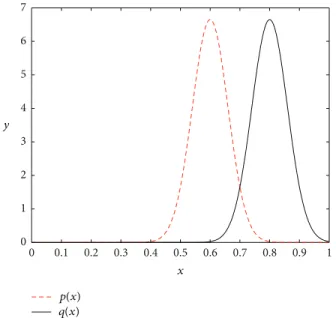
Figure 1: Gaussian distributions for illustrating the instance diver-sity problem.
predicting score for the true relation label is lower than that for a false label.
More clearly, we assume that the predicting scores for the instances from two relation classes are drawn from two individual Gaussian distributions and show the case described above in Figure 1. Suppose𝑝(𝑥)and𝑞(𝑥)are two Gaussian distributions with expectations 𝜇𝑝 and 𝜇𝑞 (0 <
𝜇𝑝 < 𝜇𝑞 < 1), respectively. We further assume that the predicting scores for class 𝑝 and class 𝑞 follow these two distributions. The𝑥-axis of Figure 1 denotes the predicting probabilities (scores) which range from 0 to 1. Suppose that a point 𝑡𝑖 (i.e., 𝑖 = 0.8) on the 𝑥-axis indicates a high probability (score) when predicting a certain instance 𝑚 using a multiclass classifier. For both of the two classes,𝑡𝑖 may be an acceptable predicting score based on which we can classify the corresponding instance𝑚into the positive areas for both of them. However, the distances from𝑡𝑖 to
𝜇𝑝 and 𝜇𝑞 reflect that distribution𝑞(𝑥) has much stronger ability to generate𝑡𝑖than𝑝(𝑥). Thus in this case, according to the predicting score𝑡𝑖 and the mean for the two classes, the instance𝑚should be classified to𝑞rather than𝑝.
To conclude, if the predicting scores for instances on different relation classes distribute diversely, the maximum probability assumption may not work well. Bias-dist is proposed to weaken this assumption through replacing the absolute predicting score to a relative form.
3.2. Bias-Reward. Bias-reward (bias according to label
reward) is proposed to model the incompleteness of the KB and the textual corpus. The most typical setting for multi-instance learning in the literature is thetraining bags; that is, multiple instances containing a certain pair of name entities would fall into the same bag and share the same sets of labels.
As illustrated in Table 1, the bag-level labels come from the KB and would endure the incompleteness problem of the KB or free text. Further, many works [4, 29, 30] define bag-level positive labels as those from the KB and negative labels as the relations that the key entity (the first name entity in the pair) does not have according to the KB. As crucial constraints for distant supervision, noisy bag-level labels have bad effect on the models. Much formally, the constraints emphasize that
(𝑧𝑚𝑖 = 𝑙 : ∀𝑙 ∈ 𝑃𝑖, ∃𝑚 ∈x𝑖)
∧ (𝑧𝑖𝑚= 𝑙: ∀𝑙∈ 𝑁𝑖, ¬∃𝑚∈x𝑖) , (1)
where x𝑖stands for the𝑖th bag,𝑃𝑖and𝑁𝑖denote the positive and negative label sets for this bag, and 𝑧𝑚𝑖 is the relation label for the𝑚th instance in the bag. If the KB is incomplete, the bag would have wrong negative labels. And if the textual corpus is not complete, the bag may be associated with wrong positive labels.
The problem of incompleteness is inevitable and has become a popular issue for distant supervision. We also take the entity Barak Obamaas an example. If the KB we refer to is a year 2005’s version but the free texts are recently collected, it is likely that the relation president of ⟨Obama, U.S.⟩
is a wrong label and the sentences containing Obama
and U.S.would be divided into the negative instances for the relation president of.
To reduce the bad effects by incorrect negative labels, we add a reward to each bag-level negative label and multiply it by a weighting factor that reflects the likelihood of being non-negative. Meanwhile, we add a penalty to each positive label and a weighting factor that reflects the likelihood of being nonpositive. We use a ranking-based method to determine the likelihood by computing rankings among all possible labels. More details would be described in Section 4.4.
4. Bias Modeling for Multi-Instance
Multilabel Learning
In this section, we introduce the details of our methods for bias modeling.
4.1. Notations and Concepts. MIML takes a number of bags
as the training data, learns a two-layer (the instance-level and the bag-level) weak classifier, and predicts relations for unseen sentences. For an easier description of MIML-RE and our methods, we define the following notations and concepts:
(i)D, the whole textual corpus;
(ii)R, the set of all known relation labels;
(iii)L, the set of known relations for a certain entity (the first/key entity in a pair) from KB;
(iv)instance, sample, a sentence that contains the target
entity pair and its quantized version for classification, respectively;
(v)bag/group, a set of instances that contain the same
entity pair;
(vi) w𝑧, the instance-level classifier (𝑧-classifier), a multi-class multi-classifier;
(vii) w𝑦, the bag-level classifier (𝑦-classifier), a set of binary classifiers;
(viii)𝜇𝑘, the expectation/mean of the probability distribu-tion on predicting scores for reladistribu-tion𝑘;
(ix)𝜎𝑘, the variance of the probability distribution on predicting scores for relation𝑘;
(x)𝑥, an instance in the dataset; (xi) x𝑖, the𝑖th bag;
(xii)𝑃𝑖, the positive label set of the𝑖th bag; (xiii)𝑁𝑖, the negative label set of the𝑖th bag.
In addition, we use𝑙, 𝑧, 𝑟, and𝑦to denote class labels and 𝜏, 𝑐, 𝑡, 𝛼, 𝛽, 𝛾, 𝜂, and 𝜃 for predefined constants. Thus, the training data for MIML-RE is constructed as the following: multiple instances containing the same pair of entities constitute abagx𝑖, with all possible relations for the pair as its positive label set𝑃𝑖andL\ 𝑃𝑖as the negative label set𝑁𝑖.
4.2. MIML-Dist. We construct two individual models based
on bias-dist: (1) MIML-dist adds bias-dist to the training steps of MIML-RE and updates the label assignment process (𝐸-step); (2)MIML-dist-classifysimply adds bias-dist in the testing step for predicting new sentences. Following MIML-RE, MIML-dist uses the maximum likelihood estimation (MLE) to model the whole training data (2) and the hard expectation maximization (EM) algorithm to learn the model parameters (w𝑦and w𝑧) iteratively ((3)–(6)). Consider
𝑝 (D) =∏𝑛 𝑖=1 𝑝 (y𝑖|x𝑖,w𝑦,w𝑧) =∏𝑛 𝑖=1 𝑝 (y𝑖,z𝑖|x𝑖,w𝑦,w𝑧) , 𝑝 (y𝑖|x𝑖,w𝑦,w𝑧) =∏𝑀𝑖 𝑚=1𝑝 (𝑧 𝑚 𝑖 |w𝑧) ∏ 𝑟∈𝑃𝑖∪𝑁𝑖 𝑝 (𝑦𝑖𝑟|z𝑖,w𝑟𝑦) . (2)
E-Step. For each instance in a bag, its label is decided by both
the instance-level classifier and the bag-level classifier. One has 𝑧𝑚𝑖 =arg max 𝑧 𝑝 (𝑧 | 𝑥 𝑚 𝑖 ,w𝑦,w𝑧, 𝜇𝑧) =arg max 𝑧 𝑝 (𝑧 | 𝑥 𝑚 𝑖 ,w𝑧, 𝜇𝑧) ∏ 𝑟∈𝑃𝑖∪𝑁𝑖 𝑝 (𝑦𝑖𝑟|z𝑖,w𝑟𝑦) , (3)
where z𝑖 denotes the bag labels in which the label for the current instance𝑚has been updated by the𝑧-classifier and
𝑥𝑚
𝑖 stands for the𝑚th instance in the𝑖th bag. Consider log𝑝 (𝑧 | 𝑥𝑚𝑖 ,w𝑧, 𝜇𝑧)
= 𝛾log𝑝 (𝑙 | 𝑥𝑚𝑖 ,w𝑧)
+ (1 − 𝛾)log𝑝 [𝑝 (𝑙 | 𝑥𝑚𝑖 ,w𝑧) | 𝜇𝑧]𝑡,
(4)
where𝜇𝑧is the mean value of the predicting scores for class
𝑧and
𝑝 [𝑝 (𝑧 | 𝑥,w𝑧) | 𝜇𝑧] = [𝑝 (𝑧 | 𝑥,w𝑧) − 𝜇𝑧]𝑡. (5) We assume that the predicting scores for each relation follow a Gaussian distribution and𝜇𝑧is its expectation. The variance𝜎𝑘had little effect on the result according to our early experiments so we discard it.
Then the model parameters are updated through the𝑀 -step by (6).
M-Step. Consider the following:
w∗𝑧 =arg max w 𝑛 ∏ 𝑖=1 ∏ 𝑚∈𝑀𝑖 𝑝 (𝑧𝑖𝑚| 𝑥𝑚𝑖 ,w) , w𝑟𝑦∗=arg max w 1≤𝑖≤𝑛,𝑟∈𝑃∏ 𝑖∪𝑁𝑖 𝑝 (𝑦𝑖𝑟|z∗𝑖,w) . (6)
The following two equations are used to infer the instance-level and bag-level labels through corresponding classifiers.
Inference. Consider the following:
𝑧𝑖𝑚∗ =arg max 𝑧 𝑝 (𝑧 | 𝑥 𝑚 𝑖 ,w𝑧) , 𝑦𝑟 𝑖 =arg max {0,1} 𝑝 (𝑦 | 𝑧 ∗ 𝑖,w𝑦𝑟) . (7)
In the testing phase, similar to MIML-RE, MIML-dist also employs aNoisy-ormodel instead ofat-least-oneto avoid data sparsity.
Noisy-or Model. Consider the following:
Noisy-or(𝑟)𝑖= 1 − ∏ 𝑚∈𝑀𝑖
[1 − 𝑝 (𝑧 | 𝑥𝑚𝑖 ,w𝑧)] . (8) We show MIML-dist in Algorithm 1 (the procedures of MIML-dist-classify and MIML-reward are similar except for several tiny steps). The expectation 𝜇𝑘 for each class 𝑘 is computed and stored after each label update in training (1.6-1.7 in Algorithm 1).
4.3. MIML-Dist-Classify. Analogous to dist,
MIML-dist-classify also assumes that the predicting score for each relation follows a Gaussian-like distribution. The differ-ence between them is that MIML-dist-classify computes
(1) Training phase:
(1.1) foreach iteration𝑒in𝑇
(1.2) foreach instance𝑥in each bag𝑖 (1.3) foreach label𝑙inR (1.4) 𝑙 =arg max 𝑙 𝑝 (𝑙 | 𝑥,w𝑦,w𝑧, 𝜇𝑙) =arg max 𝑙 𝑝 (𝑙 | 𝑥,w𝑧, 𝜇𝑙) × ∏ 𝑟∈𝑃𝑖∪𝑁𝑖 𝑝 (𝑦𝑖= 𝑟 |l𝑖,w𝑦𝑟) (1.5) if 𝑙!=𝑙org then
(1.6) 𝜇org←𝑁org× 𝜇org− 𝑝 (𝑙org|w𝑧, 𝑥) 𝑁org− 1 (1.7) 𝜇𝑙←𝑁𝑙× 𝜇𝑙+ 𝑝 (𝑙 |w𝑧, 𝑥) 𝑁𝑙+ 1 (1.8) end if (1.9) end foreach (1.10) 𝑧∗=arg max 𝑧 𝑝 (𝑧 | 𝑥,w𝑧) (1.11) 𝑦𝑟∗=arg max {0,1} 𝑝 (𝑦 |z ∗ 𝑖,w𝑟𝑦) (1.12) end foreach (1.13) w𝑧∗=arg max w 𝑛 ∑ 𝑖=1 ∑ 𝑚∈𝑀𝑖 log𝑝 (𝑙𝑚∗𝑖 | 𝑥𝑚𝑖,w) (1.14) w𝑙∗𝑦 =arg max w ∑𝑖,𝑙log𝑝 (𝑦 𝑙 𝑖| 𝑧∗𝑖,w) (1.15) end foreach (2) Testing phase:
(2.1) Predict the bag-level labels using Noisy-or model.
Algorithm 1: MIML-dist.
the expectations after all the training iterations and thus is much easier and simpler than MIML-dist. It normalizes the predicting probability in the testing phase by
log𝑝 (𝑙 | 𝑥, 𝜇𝑙,w𝑧)
= 𝜏log𝑝 (𝑙 | 𝑥,w𝑧)
+ (1 − 𝜏)log[𝑝 (𝑙 | 𝑥,w𝑧) − 𝜇𝑙]𝑡.
(9)
When comparing MIML-dist with MIML-dist-classify, from the perspective of time complexity, MIML-dist com-putesbias-distof each relation label for each instance, which costs much when the scale of the training data is large or labels are updated frequently. Moreover, the time complexity makes the parameter tuning process more difficult. Comparatively, MIML-dist-classify changes very little the original training process, and if the model is trained (i.e., MIML-RE), it need not be changed any more. The parameter tuning only locates in the testing phase which is simple and fast.
To conclude, MIML-dist-classify is a kind of parameter tuning strategy on the classification hyperplanes. It is efficient for distant supervision because the training data in this task suffer from the instance diversity problem much heavier than most other supervised learning tasks, the training data of which are carefully polished by annotators. It is very likely that the probability distribution for each relation class diversify from each other very much. MIML-dist is
a more direct way to model bias-dist, in that it changes the label assignment strategy by considering the impact of data diversity. Compared with MIML-RE, MIML-dist lowers down the chances of trapping into local minimums and thus is expected to perform better than MIML-RE.
4.4. MIML-Reward. Different from the previous two
meth-ods which modify the probabilities produced by the 𝑧 -classifier, MIML-reward updates the probabilities generated by the 𝑦-classifier. Concretely, the multiplication item in (3) is updated by bias-reward. As mentioned above, we import a ranking-based method to determine the likelihood of each bag-level label being incorrect and add a reward or penalty from the original probability. Formally, we define the following notions:
(i) For a positive label, 𝑙-𝑙is potentially wrong if some irrelevant (negative or unlabeled) labels have higher ranks than𝑙.
(ii) For a negative label,𝑙-𝑙is potentially wrong if it has a higher rank than some positive labels.
Moreover, we define 𝐾𝑙 as the instance that has the maximum predicting confidence for label𝑙(the key instance for𝑙) in the bag and𝑅(𝑙)as the number of labels that has a higher rank than𝑙:
𝐾𝑙=arg max 𝑚∈𝑀𝑖 𝑝 (𝑧𝑚𝑖 = 𝑙 |w𝑧, 𝑥𝑚𝑖 ) , 𝑅 (𝑙) = ∑ 𝑙∈𝑅 𝐼 [𝑝 (𝐾𝑙 |w𝑧,x𝑖) > 𝑝 (𝐾𝑙|w𝑧,x𝑖)] (10)
in which𝐼[𝑡]is the indicator function (if𝑡 > 0,𝐼[𝑡] = 1) and
𝑅can be any label set. Intuitively, for a positive label𝑙in a bag, the bigger𝑅(𝑙)is, the more possible this label is wrong when setting𝑅to be the nonpositive label set, while, for a negative label𝑙, the smaller𝑅(𝑙)is, the more possible this label tends to be wrong, when setting𝑅to be the positive label set. We employ two constants,𝛼and𝛽(𝛼 > 0,𝛽 > 0), to denote the intensity of the above tendencies and take them as a reward or penalty to a single label. The posterior probabilities at the bag-level are computed instead by (𝑙represents a positive label and
𝑙represents a negative label) log𝑝 (𝑦𝑖= 𝑙) =log{{ { 𝑝 (𝑦𝑖= 𝑙 |z𝑖,w𝑙𝑦) −𝛼 Ζ𝑙∈𝑅\𝑃∑ 𝑖 𝐼 [𝑝 (𝐾𝑙 |w𝑧,x𝑖) > 𝑝 (𝐾𝑙|w𝑧,x𝑖)] + 𝜂}} } , log𝑝 (𝑦𝑖= 𝑙) =log{{ { 𝑝 (𝑦𝑖= 𝑙|w𝑙𝑦) +Ζ𝛽∑ 𝑙∈𝑃𝑖 𝐼 [𝑝 (𝐾𝑙 |w𝑧,x𝑖) > 𝑝 (𝐾𝑙|w𝑧,x𝑖)] + 𝜃}} } , (11)
where 𝑍 is the normalized factor which is set to be the number of irrelevant labels (for each positive label) or the number of positive labels (for each negative label).𝜂and 𝜃 are smoothing factors.
To conclude, MIML-reward is proposed to alleviate the problem of noisy labels. As we can read from (3), the label assignment is partly contributed by the bag-level labels (the second multiplication item), which is built on the assumption that all the bag-level labels are correctly annotated. However, noisy labels are inevitable according to our previous analysis. The penalty and reward mechanism for bias-reward is to weaken the assumption, allowing that some labels could be wrong and can be discovered and considered during training. Similar ideas can be seen in [6, 8] who also took into account the incorrectness of bag-level labels.
5. Implementation Details
For a fair comparison, most of the settings in implementation follow MIML-RE including the number of training iterations
𝑇for EM (up to 8 times) and the number of folds𝐹for cross validation to avoid overfitting(𝐹 = 3). The constants𝛾and
𝜏were optimized on the developing set and were finally set to be 0.7 and 0.5 for MIML-dist and MIML-dist-classify, and the constant𝑡was set to be 2 for both the two methods. The penalty and reward parameters 𝛼and 𝛽were set to be 0.2 and 0.2, respectively. For the smoothing parameters 𝜂 and
𝜃in MIML-reward, we simply set them to 0.01. In addition, we use the same features as MIML-RE which takes multiple syntactic and semantic𝑧-level features and dependency based
𝑦-level features. In addition, we added bias-dist only on those positive labels but discarded the negative label NIL. We also sampled 5% negative examples for training.
6. Experiments
6.1. Dataset Description. We test on the KBP dataset, one
of the benchmark datasets in this literature constructed by Surdeanu et al. [4]. The resources are mainly from the TAC KBP 2010 and 2011 slot filling shared tasks [25, 26] which contain 183,062 and 3,334 entity pairs for training and testing. The free texts come from the collection provided by the shared task, which contains approximately 1.5 million documents from a variety of sources, including newswire, blogs, and telephone conversation transcripts. The KB is a snapshot of the English version of Wikipedia. After the DS annotation, we finally got 524,777 bags including 950,102 instances for training. For testing, 200 queries (a query means a key entity) from the TAC KBP 2010 and 2011 shared tasks containing 23 thousand instances are adopted, in which 40 queries constitute the developing set. The relation labels include slots of person (per) and organization (org), and the total number of labels is 41.
6.2. Experiments. We will show the evaluation metrics,
experiment results, and some observations from the data in this section.
6.2.1. Evaluation Metrics
P/R Curve. Following previous work, we report the stability
of the algorithms by figuring 𝑃/𝑅 curves. A 𝑃/𝑅 curve is generated through computing precision and recall by selecting different proportions of the testing data. Generally, the higher the position of a𝑃/𝑅curve is in the figure, the more stable the corresponding algorithm is.
Final Precision, Recall, and F1. The metrics precision, recall,
and𝐹1are used to evaluate the performance of the models on the whole testing dataset. And we denote them byFinal
P,Final R,andFinal F1to distinguish them from other PRFs
with part of the testing data.
To specify, the testing set has the same data format as the training set which is constituted by groups. And the above metrics are computed according to the KBP slot filling tasks [31, 32] (on the entity level) rather than sentential classification.
6.2.2. Expectations for Each Relation. To show the
inspira-tions for proposing bias-dist, we computed the expectainspira-tions (means) for each relation after initialization (before training epochs denoted bymean b) as well as at the end of training (denoted bymean e). The values were computed by averaging all the predicting scores for those instances that are classified to that relation. This process was carried out on MIML-RE to show the instance diversity problem that the algorithm may suffer from. We report the distributions of expectations with an error bar (Figure 2). In the figure, each circle denotes the average predicting expectation among all the training epochs for the relation corresponding to the𝑥-axis, and the upper error and the lower error stand for the maximum and the minimum expectations during training. Thus, the uneven curve shows the diversities between relations. We see that the maximum average expectation is about 0.94 (index =
2, per:date of birth) but the minimum one is only 0.3
(index = 25, org:members). Since the𝑧-classifier considers only the absolute predicting confidence (both in training and testing), it is likely that the actual relation label for an instance just gets a small predicting score. Hence, a relative predicting score is necessary due to the diversity.
Another interesting thing we observe is the upper and lower errors. The distance between the upper and lower error for one relation indicates the change of class center and members during training. We see that several relations have their predicting expectations almost unchanged during the whole training process. We guess one reasonable explanation is that the instances of these relations are indeed pure enough for classification, so that the labels for these instances may hardly change during EM.
6.2.3. Baselines. We compare our models with three
base-lines:Hoffmann,Mintz++, andMIML-RE. Hoffmann is one of the representative MIML-based algorithms which uses
deterministic-ordecision instead of relation classifiers and it
also enables relation overlaps [3]. Minz++ [4] is a modified version of the original Mintz model [1] in which each mention is treated independently and multiple predictions are enabled
0.1 0.2 0.3 0.4 0.5 0.6 0.7 0.8 0.9 1 Exp ec ta tio n 5 10 15 20 25 30 35 40 0
Relation label index
Figure 2: Diversities on expectations for different relations (rela-tions that have no instances have been removed).
MIML-dist-classify MIML-RE Hoffmann Mintz++ 0.05 0.1 0.15 0.2 0.25 0.35 0 0.3 0.4 Recall 0.2 0.3 0.4 0.5 0.6 0.7 0.8 P re cisio n
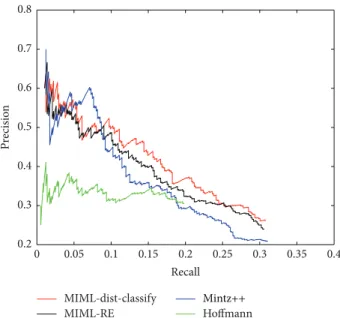
Figure 3:𝑃/𝑅curves of MIML-dist-classify and baselines.
by applying Noisy-or. The performance of Mintz++ signifi-cantly outperforms the original Mintz model. As to MIML-RE, we choose the better model (also named as MIML-RE in [4]), which contains a modified version of𝑦-level features from at-least-one.
6.2.4. Results. We firstly report the𝑃/𝑅curves of our
pro-posed models compared with the three baseline methods mentioned above (Figures 3–5). The curves of the proposed methods are generated after tuning parameters on the devel-oping set, aiming at maximizing Final𝐹1.
For comparison, the best curve of MIML-dist-classify is tuned only based on the model generated by the last training epoch (𝑇 = 8). From Figure 3 we read that MIML-dist-classify has higher precision scores in both the low and the
MIML-dist MIML-RE Hoffmann Mintz++ 0.05 0.1 0.15 0.2 0.25 0.35 0 0.3 0.4 Recall 0.2 0.3 0.4 0.5 0.6 0.7 0.8 P re cisio n
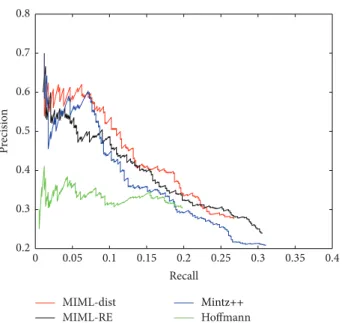
Figure 4:𝑃/𝑅curves of MIML-dist and baselines.
MIML-dist MIML-RE Hoffmann Mintz++ 0.05 0.1 0.15 0.2 0.25 0.35 0 0.3 0.4 Recall 0.2 0.3 0.4 0.5 0.6 0.7 0.8 Pre ci si on
Figure 5:𝑃/𝑅curves of MIML-reward and baselines.
high recall proportions compared with the baselines but is worse than Mintz++ in the low recall proportion (0.05∼0.1). However, the precision of Mintz++ drops down fast when recall goes beyond 0.1, not as stable as the other methods. Thus we conclude that although MIML-dist-classify is simple, it shows that bias-dist is beneficial to the final results.
MIML-dist has considerable good performance as MIML-dist-classify (Figure 4) especially in the low recall region (<0.15). We notice that when we fix the recall in 0.05–0.1, the precision of MIML-dist can be 5–10% points higher than MIML-RE. Other than MIML-dist-classify, the curve of MIML-dist has better overall performance than Mintz++.
Figure 5 shows the results generated by MIML-reward. We see that MIML-reward gains considerable improvements compared to MIML-RE in the low-recall region (<0.1) but falls beneath the model as the recall increases. Similar to MIML-dist, MIML-reward performs better than Hoffmann and Mintz++ almost over all the recall proportions.
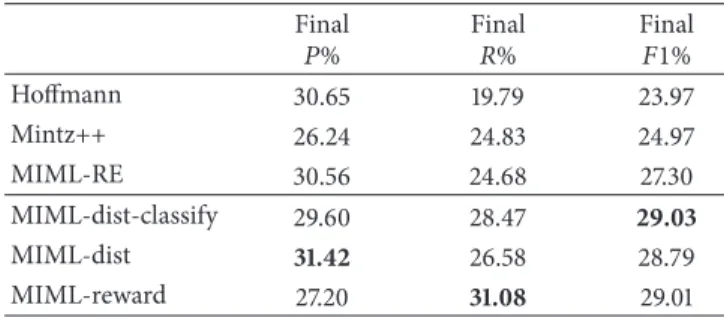
Final𝑃, Final𝑅, and Final𝐹1are metrics that evaluate the methods on the whole testing set, which are also important performance measures in this literature. We can read from Table 2 that MIML-dist-classify improves the baselines by nearly 4% on recall while still keeping a relatively high precision. MIML-dist improves both precision and recall and achieves the maximum Final𝑃among all the models. MIML-reward has the maximum Final 𝑅 but its performance is at the cost of some precision points. We noticed that all the three methods we propose can enhance the baseline MIML-RE on𝐹1by over 1.5%. And compared with the other baselines, Hoffman and Mintz++, we observed that Final𝐹1 is significantly improved by the proposed methods.
6.2.5. Case Study. We analyzed the predicted results of the
proposed methods and compare them with those predicted by MIML-RE, which is a direct baseline of our work. To make it clear, we show in what kinds of cases our methods can make up the deficiency of the baseline.
Take one of the testing samples as an example: a sentence is predicted to org:city of headquarterswith the prob-ability of 0.56 and to the negative class label NILwith the probability of 0.43. According to the center of the positive class (0.82) which is far from 0.56, the sentence will not be predicted to the class any more after being normalized by bias-dist. We also figured that several positive predictions were directly replaced by the negative class after adding bias-dist, which is a contribution to the overall precision.
The effect of bias-reward can be indirectly read from the training bags to some extent since it depends on the bag-level labels which cannot be extracted from the testing set. According to the EM algorithm in MIML, the only supervision (weak supervision) is the bag-level labels, and the algorithm follows: if a label is positive in a bag, its ranking is higher than any other label. Hence, if the bag-level label is potentially wrong, it is likely that the algorithm falls into local minimums. We counted the number of different label assignments in each training epoch for MIML-reward and MIML-RE and found that it is really a large number (i.e., 352,192 different assignments in 950,102 when𝑇 = 1). We believe that this large number of differences can easily lead the training algorithm to converge to distinguishing directions.
Another thing we found is that the improvements dis-tributed a bit evenly rather than focusing only on several specific relation labels. This indicates that the biases we propose are reasonable and efficient to all relations.
7. Discussion
We see that the proposed models work well on the whole testing dataset (Table 2) but from the𝑃/𝑅curves we realize (Figures 3–5) that the improvements on different proportions
Table 2: Best KBP2010 scores generated by the models. Final 𝑃% Final𝑅% Final𝐹1% Hoffmann 30.65 19.79 23.97 Mintz++ 26.24 24.83 24.97 MIML-RE 30.56 24.68 27.30 MIML-dist-classify 29.60 28.47 29.03 MIML-dist 31.42 26.58 28.79 MIML-reward 27.20 31.08 29.01
of testing data are not so consistent, especially for MIML-dist and MIML-reward which perform much better at the low recall proportion but get a bit depressing when recall increases. We argue that there are several possible reasons: (1) the parameters (i.e., constants or biases) are tuned on the developing set to maximize the performance on Final
𝐹1but not the𝑃/𝑅curve. So it is possible that other sets of parameters that do not perform well on Final𝐹1may generate a better curve (we indeed validated this through changing the parameter𝑇); (2) the cases of each relation are a bit different that a fixed parameter toward all relation classes is not quite appropriate (i.e.,𝛼and𝛽in MIML-reward); it is likely that the parameters only work well over all the testing set rather than some proportion. We need to further improve the learning algorithm so that more noises can be reduced or discarded. In addition, the hard EM training process suffers from the local minimum problem and how to tackle it should be further developed.
Another phenomenon we notice is that MIML-dist and MIML-reward have lower time complexity than MIML-RE. MIML-dist achieves the best result when𝑇 = 6and MIML-reward gets the optimum when 𝑇 = 2. It is believed that the biases especially bias-reward heavily change the label assignments so that the algorithm can converge much faster. As a result, we improve the time efficiency of the MIML algorithm. MIML-reward only needs 4-5 hours’ running time, compared with MIML-RE whose training may last about 20 hours according to the authors.
Sometimes a simple method can achieve a good result, such as MIML-dist-classify, which only modifies the label assignment process in testing but boosts MIML-RE by 1.7% on𝐹1. Besides, bias-dist can be applied in any probability classification model and bias-reward can also be integrated in any MIL framework which takes a bag as the basic training unit. However, we realize that there is still a long way for weak (distant) supervision to go since the results are still far behind what those supervised learning methods can achieve. Perhaps some more work can be down on either feature engineering or parameter selection.
8. Conclusion
In this paper, we propose three methods for distantly super-vised relation extraction based on two types of biases. Among them, MIML-dist-classify and MIML-dist aim at tackling the instance diversity problem for different relations via
adding bias items either in the testing step or in the training step. MIML-reward is introduced to model the bag-level label noise by adding rewards for wrong negative labels and penalties for wrong positive labels. Experimental results on a landmark dataset validate the effectiveness of the proposed methods, boosting Final𝐹1by 1.5%–1.7%. In the future, more flexible approaches would be researched to model the noises caused by DS.
Conflict of Interests
The authors declare that there is no conflict of interests regarding the publication of this paper.
Acknowledgments
This work was supported in part by National 863 Program of China (2015AA015405) and NSFCs (National Natural Science Foundation of China) (61402128, 61473101, 61173075, and 61272383). The authors thank the anonymous reviewers for their insightful comments.
References
[1] M. Mintz, S. Bills, R. Snow, and D. Jurafsky, “Distant supervision for relation extraction without labeled data,” inProceedings of the 47th Annual Meeting of the Association for Computational Linguistics, August 2009.
[2] S. Riedel, L. Yao, and A. McCallum, “Modeling relations and their mentions without labeled text,” in Proceedings of the 2010 European Conference on Machine Learning and Knowledge Discovery in Databases, pp. 148–163, 2010.
[3] R. Hoffmann, C. Zhang, X. Ling, L. Zettlemoyer, and D. S. Weld, “Knowledge-based weak supervision for information extraction of overlapping relations,” inProceedings of the 49th Annual Meeting of the Association for Computational Linguistics, pp. 541–550, June 2011.
[4] M. Surdeanu, J. Tibshirani, R. Nallapati, and C. D. Manning, “Multi-instance multi-label learning for relation extraction,” in Proceedings of the 50th Annual Meeting of the Association for Computational Linguistics, pp. 455–465, July 2012.
[5] B. Min, R. Grishman, L. Wan et al., “Distant supervision for relation extraction with an incomplete knowledge base,” in Proceedings of the Conference of the North American Chapter of the Association for Computational Linguistics (NAACL ’13), 2013. [6] A. Ritter, L. Zettlemoyer, Mausam, and O. Etzioni, “Modeling missing data in distant supervision for information extraction,” Transactions of ACL, vol. 1, pp. 367–378, 2013.
[7] J. Weston, A. Bordes, O. Yakhnenko, and N. Usunier, “Con-necting language and knowledge bases with embedding models for relation extraction,” in Proceedings of the Conference on Empirical Methods in Natural Language Processing, 2013. [8] S. Riedel, L. Yao, A. McCallum, and B. M. Marlin, “Relation
extraction with matrix factorization and universal schemas,” inProceedings of the 2013 Conference of the North American Chapter of the Association for Computational Linguistics: Human Language Technologies, pp. 74–84, June 2013.
[9] M. Fan, D. Zhao, Q. Zhou, Z. Liu, T. F. Zheng, and E. Y. Chang, “Distant supervision for relation extraction with matrix completion,” inProceedings of the 52nd Annual Meeting of the
Association for Computational Linguistics, pp. 839–849, June 2014.
[10] W. Xu, R. Hoffmann, L. Zhao, and R. Grishman, “Filling knowl-edge base gaps for distant supervision of relation extraction,” inProceedings of the 51st Annual Meeting of the Association for Computational Linguistics (ACL ’13), pp. 665–670, August 2013. [11] D. Zelenko, C. Aone, and A. Richardella, “Kernel methods for relation extraction,”The Journal of Machine Learning Research, vol. 3, no. 6, pp. 1083–1106, 2003.
[12] R. C. Bunescu and R. J. Mooney, “Subsequence kernels for relation extraction,” inProceedings of the Annual Conference on Neural Information Processing Systems (NIPS ’05), pp. 171–178, December 2005.
[13] G. D. Zhou, J. Su, J. Zhang, and M. Zhang, “Exploring various knowledge in relation extraction,” inProceedings of the 43rd Annual Meeting of the Association for Computational Linguistics (ACL ’05), pp. 427–434, June 2005.
[14] D. Zeng, K. Liu, S. Lai, G. Zhou, and J. Zhao, “Relation classifi-cation via convolutional deep neural network,” inProceedings of the 25th International Conference on Computational Linguistics (COLING ’14), pp. 2335–2344, Dublin, Ireland, August 2014. [15] C. N. dos Santos, B. Xiang, and B. Zhou, “Classifying relations
by ranking with convolutional neural networks,” inProceedings of the 53rd Annual Meeting of the Association for Computational Linguistics, pp. 626–634, Beijing, China, July 2015.
[16] Y. Liu, F. Wei, S. Li, H. Ji, M. Zhou, and H. Wang, “A dependency-based neural network for relation classification,” inProceedings of the 53rd Annual Meeting of the Association for Computational Linguistics, pp. 285–290, July 2015.
[17] M. Craven and J. Kumlien, “Constructing biological knowledge bases by extracting information from text sources,” in Proceed-ings of the 7th International Conference on Intelligent Systems for Molecular Biology, pp. 77–86, Heidelberg, Germany, August 1999.
[18] R. C. Bunescu and R. J. Mooney, “Learning to extract relations from the web using minimal supervision,” inProceedings of the 45th Annual Meeting of the Association for Computational Linguistics, pp. 576–583, June 2007.
[19] K. Bellare and A. McCallum, “Learning extractors from unla-beled text using relevant databases,” inProceedings of the 6th International Workshop on Information Extraction on the Web, 2007.
[20] F. Wu and D. S. Weld, “Autonomously semantifying wikipedia,” inProceedings of the 16th ACM Conference on Information and Knowledge Management (CIKM ’07), pp. 41–50, November 2007. [21] O. Etzioni, M. Banko, S. Soderland, and D. S. Weld, “Open information extraction from the web,”Communications of the ACM, vol. 51, no. 12, pp. 68–74, 2008.
[22] A. Bordes, N. Usunier, A. Garcia-Dur´an, J. Weston, and O. Yakhnenko, “Translating embeddings for modeling multi-relational data,” inProceedings of the 27th Annual Conference on Neural Information Processing Systems (NIPS ’13), December 2013.
[23] Z. Wang, J. Zhang, J. Feng, and Z. Chen, “Knowledge graph embedding by translating on hyperplanes,” inProceedings of the 29th AAAI Conference on Artificial Intelligence, pp. 1112–1119, July 2014.
[24] Y. Lin, Z. Liu, M. Sun, Y. Liu, and X. Zhu, “Learning entity and relation embeddings for knowledge graph completion,” in Pro-ceedings of the 30th AAAI Conference on Artificial Intelligence, Canberra, Australia, 2015.
[25] G. Angeli, J. Tibshirani, J. Wu, and C. D. Manning, “Combining distant and partial supervision for relation extraction,” in Proceedings of the 2014 Conference on Empirical Methods in Natural Language Processing (EMNLP ’14), pp. 1556–1567, Doha, Qatar, October 2014.
[26] A. Nagesh, G. Haffari, and G. Ramakrishnan, “Noisy or-based model for relation extraction using distant supervision,” in Proceedings of the Conference on Empirical Methods in Natural Language Processing (EMNLP ’14), pp. 1937–1941, Doha, Qatar, October 2014.
[27] A. Intxaurrondo, M. Surdeanu, O. L. de Lacalle, and E. Agirre, “Removing noisy mentions for distant supervision,” Proce-samiento del Lenguaje Natural, vol. 51, pp. 41–48, 2013. [28] S. Takamatsu, I. Sato, and H. Nakagawa, “Reducing wrong labels
in distant supervision for relation extraction,” inProceedings of the 50th Annual Meeting of the Association for Computational Linguistics, pp. 721–729, July 2012.
[29] A. Sun, R. Grishman, W. Xu, and B. Min, “New York University 2011 system for KBP slot-filling,” in Proceedings of the 4th Text Analysis Conference (TAC ’11), Gaithersburg, Md, USA, November 2011.
[30] M. Surdeanu, S. Gupta, J. Bauer et al., “Stanford’s distantly supervised slot-filling system,” inProceedings of the Text Ana-lytics Conference, 2011.
[31] H. Ji, R. Grishman, H. T. Dang, K. Griffitt, and J. Ellis, “Overview of the TAC 2010 knowledge base population track,” inProceedings of the Text Analytics Conference, Gaithersburg, Md, USA, November 2010.
[32] H. Ji, R. Grishman, and H. T. Dang, “Overview of the TAC 2011 knowledge base population track,” inProceedings of the 4th Text Analysis Conference (TAC ’11), Gaithersburg, Md, USA, November 2011.
Submit your manuscripts at
http://www.hindawi.com
Hindawi Publishing Corporation
http://www.hindawi.com Volume 2014
Mathematics
Journal ofHindawi Publishing Corporation
http://www.hindawi.com Volume 2014
Mathematical Problems in Engineering
Hindawi Publishing Corporation http://www.hindawi.com
Differential Equations International Journal of
Volume 2014
Hindawi Publishing Corporation
http://www.hindawi.com Volume 2014 Hindawi Publishing Corporationhttp://www.hindawi.com Volume 2014
Hindawi Publishing Corporation
http://www.hindawi.com Volume 2014 Mathematical PhysicsAdvances in
Complex Analysis
Journal of Hindawi Publishing Corporationhttp://www.hindawi.com Volume 2014
Optimization
Journal ofHindawi Publishing Corporation
http://www.hindawi.com Volume 2014
Combinatorics
Hindawi Publishing Corporation
http://www.hindawi.com Volume 2014
International Journal of
Hindawi Publishing Corporation
http://www.hindawi.com Volume 2014
Journal of
Hindawi Publishing Corporation
http://www.hindawi.com Volume 2014
Function Spaces
Abstract and Applied Analysis Hindawi Publishing Corporation
http://www.hindawi.com Volume 2014 International Journal of Mathematics and Mathematical Sciences
Hindawi Publishing Corporation http://www.hindawi.com Volume 2014
The Scientific
World Journal
Hindawi Publishing Corporationhttp://www.hindawi.com Volume 2014
Hindawi Publishing Corporation
http://www.hindawi.com Volume 2014
Discrete Dynamics in Nature and Society Hindawi Publishing Corporation
http://www.hindawi.com Volume 2014
Hindawi Publishing Corporation
http://www.hindawi.com Volume 2014
Discrete Mathematics
Journal ofHindawi Publishing Corporation
http://www.hindawi.com Volume 2014 Hindawi Publishing Corporationhttp://www.hindawi.com Volume 2014