Guidance on resource efficient construction
Resource efficiency through BIM:
A Guide for BIM Managers
Guidance for BIM Managers on systems and processes to enable
resource efficiency to be considered through design, construction and
asset management
February 2013 Issue 1.0 Shared model and data Rapid analysis and quantification Design development and optimisationWRAP’s vision is a world without waste,
where resources are used sustainably.
We work with businesses, individuals and
communities to help them reap the
benefits of reducing waste, developing
sustainable products and using resources
in an efficient way.
Find out more at
www.wrap.org.uk
Document reference: [e.g. WRAP, 2006, Report Name (WRAP Project TYR009-19. Report prepared by…..Banbury, WRAP]
Written by: Adam Mactavish and Nahim Iqbal
Edited by: Dave Marsh, WRAP
WRAP and Sweett Group believe the content of this report to be correct as at the date of writing. However, factors such as prices, levels of recycled content and regulatory requirements are subject to change and users of the report should check with their suppliers to confirm the current situation. In addition, care should be taken in using any of the cost information provided as it is based upon numerous project-specific assumptions (such as scale, location, tender context, etc.).
The report does not claim to be exhaustive, nor does it claim to cover all relevant products and specifications available on the market. While steps have been taken to ensure accuracy, WRAP cannot accept responsibility or be held liable to any person for any loss or damage arising out of or in connection with this information being inaccurate, incomplete or misleading. It is the responsibility of the potential user of a material or product to consult with the supplier or manufacturer and ascertain whether a particular product will satisfy their specific requirements. The listing or featuring of a particular product or company does not constitute an endorsement by WRAP and WRAP cannot guarantee the performance of individual products or materials. This material is copyrighted. It may be reproduced free of charge subject to the material being accurate and not used in a misleading context. The source of the material must be identified and the copyright status acknowledged. This material must not be used to endorse or used to suggest WRAP’s endorsement of a commercial product or service. For more detail, please refer to WRAP’s Terms & Conditions on its web site: www.wrap.org.uk
Resource efficiency through BIM: A Guide for BIM Managers
Contents
1.0 Introduction ... 4
2.0 Resource Efficiency in Construction ... 5
2.1 Overview ... 5
2.2 Opportunities to improve resource efficiency ... 5
2.3 Why focus on resource efficiency? ... 6
2.4 Measuring performance ... 7
2.5 Resource Management Plans (RMP) ... 8
3.0 The approach for addressing resource efficiency through BIM, and the role of the BIM Manager ... 9
3.1 Key actions and steps ... 9
3.2 Important considerations ... 10
4.0 Defining resource efficiency objectives ... 11
5.0 Embedding the approach within the BIM Execution Plan ... 12
5.1 Structure of a typical BIM Execution Plan ... 12
5.2 Incorporating resource efficiency information ... 12
6.0 Applying resource efficiency information to BIM objects ... 16
6.1 Internal data association ... 16
6.2 External data association ... 17
6.3 Practical considerations ... 17
6.4 Data requirements ... 18
6.5 Adding data to BIM objects ... 20
7.0 Managing project data to benchmark and improve performance ... 21
7.1 Benchmarking resource efficiency performance ... 21
7.2 Tracking performance over time ... 21
7.3 WRAP tools to help track project performance ... 22
8.0 Defining and communicating your approach ... 22
Appendix A: Example of BIM Execution Plan incorporating resource efficiency elements ... 23
Appendix B: Partial proforma for assessing design team competency and approach to BIM implementation ... 58
Resource efficiency through BIM: A Guide for BIM Managers 4
1.0 Introduction
The adoption of Building Information Modelling and Management (BIM) is a major evolution in the ways in which information on construction projects is generated, shared and
managed. BIM brings the potential for widespread efficiencies in project delivery. This Guide considers just one of these: the more efficient use of natural resources, and specifically focuses on the role of the BIM manager in helping deliver these benefits.
Resource efficiency involves achieving the required project outcomes using fewer resources (carbon, energy, materials, and water) resulting in reduced impacts (climate change, resource depletion, carbon emissions, water scarcity, and project costs). Ultimately, successful organisations will be able to closely manage their use of increasingly scarce and expensive resources; demonstrating greater value for money by reducing costs and meeting environmental objectives.
BIM is not essential to improving a project’s resource efficiency. However, incorporating resource efficiency into BIM implementation makes sense because BIM processes and data can be used directly to achieve efficiencies and also to help estimate performance and identify the biggest opportunities to save money and carbon.
This Guide is part of a series of complementary guidance on using BIM effectively to improve resource efficiency in construction projects.
Information Note
A succinct summary for senior decision makers in projects and construction companies so they can buy-in to the process.
BIM Manager’s Guide (this Guide)
Shows how resource efficiency can be incorporated into an organisation’s BIM processes, datasets and methods.
BIM User’s Guide
Explains practical approaches for using the BIM design workflow to help identify opportunities for improve resource efficiency, and to help estimate the environmental and cost impacts and benefits.
This Guide does not focus in detail on BIM itself and assumes that the reader is suitably familiar with BIM tools and delivery processes; rather it considers how they can be applied to the challenge of making better use of construction resources. Other WRAP publications provide further detailed information on resource efficiency.
Throughout the Guide key sources of further information are indicated in the format below.
Further information on resource efficiency
www.wrap.org.uk/construction
Background information and articles on BIM
www.thenbs.com/topics/bim www.building.co.uk/bim
Resource efficiency through BIM: A Guide for BIM Managers 5
2.0 Resource Efficiency in Construction
2.1 Overview What?
Resource efficient construction makes best use of materials, water and energy over the lifecycle of built assets to minimise embodied and operational carbon. This prioritises consideration of:
reducing materials use and wastage;
increasing reuse and recycled content, and enabling reuse and recyclability at end of life; matching the durability and lifespan of assets to proposed service life;
using resources with no scarcity and source security issues; using products with lower embodied carbon and embodied water; reducing energy and water use during construction; and
enabling energy efficiency and water efficiency in use.
When?
Resource efficiency opportunities exist throughout the construction lifecycle – including product manufacture, design, construction, operation, refurbishment, and at end of life. Why?
Business benefits, including:
reducing costs and project risk; stimulating innovation;
demonstrating compliance with regulations, standards and planning requirements; supporting industry objectives; and
improving reputation.
Environmental benefits, including:
helping to achieve climate change targets; reducing depletion of natural resources; and helping to tackle water scarcity.
How?
Best results will be achieved where there is a strong client lead together with
co-ordinated action from the supply chain utilising effective Resource Management Planning
Process and technical innovations can support resource efficiency in construction,
including BIM, Lean, offsite construction and logistics solutions. 2.2 Opportunities to improve resource efficiency
Whilst much of this Guide focuses on efficiencies in the design and construction process, consideration must also be given to the impact of design decisions on operational
performance, the longevity and flexibility of the asset and its end of life management. For a new or refurbished building, the key opportunities include:
Prepare
Understand the site and the opportunities and constraints it presents. Target the
Resource efficiency through BIM: A Guide for BIM Managers 6 Design
Develop the minimum amount of space that will fully achieve the functional
requirements (e.g. reducing the overall space requirement by improving the net to gross ratios or creating flexible multiuse spaces).
Design an operationally efficient (including energy, water and facilities management)
building that is flexible to accommodate future changes in use.
Use as few materials as necessary.
Choose materials with low lifecycle impacts (e.g. embodied energy, water and carbon)
and a durability that reflects their life span within the building.
Source products that make good use of resources by using recycled content,
sustainably sourced renewable materials and energy, material and water efficient manufacturing and supply.
Construct
Manage materials to minimise costs and wastage during transport, delivery and
installation.
Maximise the recovery and reuse of surplus material and wastes from construction
and if removed at demolition / refurbishment.
Use energy and water efficiently on site.
Operate
Enable efficient operations by encouraging responsible use, careful management
and maintenance of equipment and facilitating investment in new more efficient technologies.
For any given project the priorities and opportunities will vary considerably. Successfully reducing resource use on a project requires the input and collaboration of many parties and the ongoing sharing of information. BIM tools and processes have an important role in this process by helping project teams identify, investigate and implement these opportunities in a co-ordinated way. BIM data also provide a powerful resource for helping to estimate
resource efficiency, benchmark and identify improvement opportunities thereby informing decision making, and monitoring and reporting outcomes.
2.3 Why focus on resource efficiency?
The Government’s Low Carbon Construction Action Plan, and the subsequent establishment of the Green Construction Board all signify that the UK construction sector is critical to the growth and decarbonisation of the economy. To meet this challenge it is imperative that the industry is able to work more efficiently, getting better value for the cost and carbon
involved in project delivery.
Resource efficiency delivers powerful benefits by:
reducing project costs;
demanding a focus on quality and co-ordination throughout the design and construction
process;
encouraging innovation and a creative approach; and reducing the environmental impacts of construction.
Resource efficiency through BIM: A Guide for BIM Managers 7 The importance of making efficient use of all resources will continue to grow as global
demand for materials, energy and water increases and it becomes harder to dispose of waste. Those organisations taking proactive steps to be more resource efficient will be more cost competitive and better able to meet their stakeholders requirements, be they
customers, policy makers, employees or regulators.
BIM is a key tool helping the industry achieve these efficiencies; making better and wider use of information to co-ordinate, test and improve decision making from the outset of a project to its completion and use. However, the adoption of 3D modelling and other BIM tools will not in itself change behaviours and performance. BIM Managers are responsible for helping their organisation maximise the benefits of adopting BIM. This includes making good use of the data in each model by setting up processes for timely provision of robust and accessible information.
The Low Carbon Construction Action Plan
www.bis.gov.uk/policies/business-sectors/construction/low-carbon-construction-igt
Green Construction Board
www.greenconstructionboard.org 2.4 Measuring performance
Measuring the impact of any resource efficiency actions is important in assessing their value for money. BIM is a useful tool to support measurement but nonetheless it is important to take a proportionate approach and ensure that time spent on measuring performance is justifiable in the context of overall project and the potential savings.
A wide range of metrics could be used to measure the different elements of resource efficiency, however it is recommended that the initial focus is on few priority metrics.
The following metrics are considered to generally represent current priorities of resource efficient construction:
Embodied carbon, including emissions associated with manufacture, supply and
installation of construction products (tCO2e).
Non-renewable energy use from onsite activities (MJ GCV or kWh, split by energy
type).
Waste produced (tonnes, split by hazardous, non-hazardous and inert and whether this
is construction, demolition or excavation waste).
Recycled content of materials used (% by value). Water use onsite (m3, split by water source).
These metrics do not address all response efficiency elements, however they enable practical action through design and construction, and provide a robust starting point to inform
decision making and performance benchmarking.
The above metrics can also be used to report performance indicators by dividing by
an appropriate measure of either the spatial area developed (e.g. m2 gross internal
floor area), the function delivered (e.g. per pupil, bedspace, patient, etc) or for specific project elements (e.g. per m2 of external wall area). In combination, these
Resource efficiency through BIM: A Guide for BIM Managers 8 measures can enable project teams and clients to assess if their design and
specification is resource efficient and if it has been delivered in an efficient way. See section 7 for further discussion on benchmarking and reporting performance.
2.5 Resource Management Plans (RMP)
Resource management planning is an effective process for improving the resource efficiency of a project. The RMP defines the scope and priorities for resource efficiency for the project and provides a framework for recording actions, estimating their impacts, monitoring
performance and reporting. Many of the actions within an RMP are routinely undertaken on many projects. For example, site waste management planning, design co-ordination and clash prevention, logistics strategies, etc. In addition, depending on the scope determined for the project, an RMP might include actions to reduce embodied carbon or increase recycled content during product selection.
BIM data and tools can have a significant role in improving project resource efficiency, and these opportunities (see Section 3 for examples) should be recognised within the RMP and actions defined for ensuring that BIM activities support the project’s resource efficiency objectives. Similarly, the project BIM Execution Plan should specify in more detail how BIM will be used to input to the RMP, for example by defining the processes, tools and data that will be used at different stages (see Section 4 for further information).
Further information on Resource Management Plans
www.wrap.org.uk/construction
Further information on materials logistics planning
Resource efficiency through BIM: A Guide for BIM Managers 9
3.0 The approach for addressing resource efficiency through BIM, and the role of the BIM Manager
3.1 Key actions and steps
A BIM Manager can help their organisation to improve and demonstrate resource efficiency through four key actions:
Defining resource efficiency objectives
Embedding resource efficiency actions within the approach to BIM Execution Planning. Developing or using an object library that contains industry standard classification (e.g.
Uniclass) systems, and ideally contains embedded resource efficiency data.
Managing project data to enable benchmarking and refinement of the resource
management planning process.
These are each considered in the following sections of this Guide.
The BIM Manager should liaise closely with their organisation’s environmental / sustainability manager (if there is one) to ensure coordination between the strategy for reducing resource use and the BIM processes, data and reporting outputs (e.g. COBie files) at key project stages.
Figure 1 illustrates the key steps involved – identification of the scope for the project followed by action planning and periodic estimation and monitoring of performance.
Figure 1 Steps in building resource efficiency into a BIM based project process
Resource efficiency through BIM: A Guide for BIM Managers 10 3.2 Important considerations
The requirements of each organisation and the right approach to embedding resource efficiency within a BIM process will vary according to size, discipline (see Table 1), sector, experience and capability, and project or company priorities and objectives. It is vitally important that these are proportionate and practicable, and there should not be an aim to do everything. If the demands on the project team are unreasonable then they are likely to be unfulfilled, completed badly, or lead to loss of interest or enthusiasm for improving resource efficiency.
For example, an engineer that already has well developed BIM design capabilities may find it reasonably straightforward to incorporate analysis of embodied carbon in materials by embedding this data within their library of BIM objects. Alternatively, an architects’ practice that is still establishing its BIM capabilities may not wish to undertake quantification of resource use within BIM, but may instead choose to use BIM tools to minimise wastage through effective clash prevention and design co-ordination. Then over time as experience is gained, this practice is likely to start incorporating analysis to draw on the additional benefits brought through measurement and benchmarking.
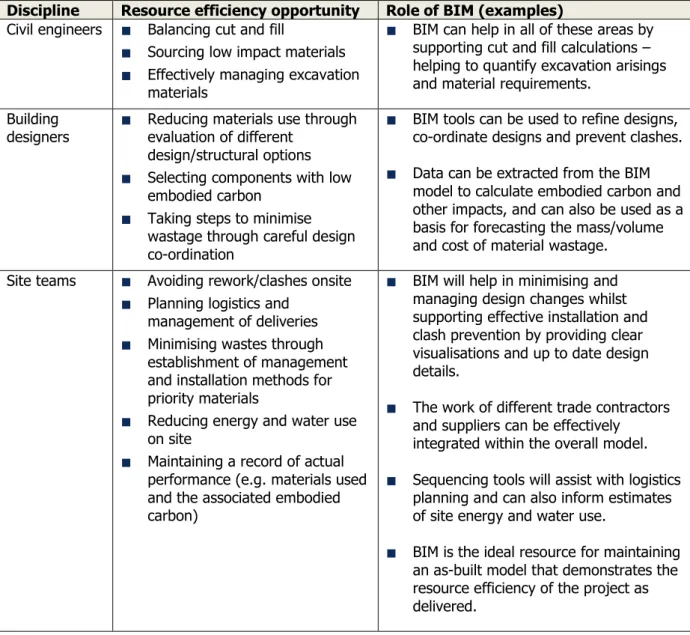
Table 1 Examples of using BIM in delivering resource efficiency by different disciplines
Discipline Resource efficiency opportunity Role of BIM (examples) Civil engineers Balancing cut and fill
Sourcing low impact materials Effectively managing excavation
materials
BIM can help in all of these areas by
supporting cut and fill calculations – helping to quantify excavation arisings and material requirements.
Building
designers Reducing materials use through evaluation of different design/structural options
Selecting components with low
embodied carbon
Taking steps to minimise
wastage through careful design co-ordination
BIM tools can be used to refine designs,
co-ordinate designs and prevent clashes.
Data can be extracted from the BIM
model to calculate embodied carbon and other impacts, and can also be used as a basis for forecasting the mass/volume and cost of material wastage.
Site teams Avoiding rework/clashes onsite Planning logistics and
management of deliveries
Minimising wastes through
establishment of management and installation methods for priority materials
Reducing energy and water use
on site
Maintaining a record of actual
performance (e.g. materials used and the associated embodied carbon)
BIM will help in minimising and
managing design changes whilst supporting effective installation and clash prevention by providing clear visualisations and up to date design details.
The work of different trade contractors
and suppliers can be effectively integrated within the overall model.
Sequencing tools will assist with logistics
planning and can also inform estimates of site energy and water use.
BIM is the ideal resource for maintaining
an as-built model that demonstrates the resource efficiency of the project as delivered.
Resource efficiency through BIM: A Guide for BIM Managers 11
4.0 Defining resource efficiency objectives
If a resource efficiency strategy is already in place within the project or company then this should be the reference for determining the role of BIM tools and processes.
If a formal strategy is not in place, then the following questions may help in identifying resource efficiency priorities and requirements.
What are the key sources of resource use and potential savings for typical projects or
activities undertaken?
What internal policy objectives have been set?
Which project requirements are frequently requested? Are these requirements likely to
change in the future?
The aim should be to develop a practical set of resource efficiency objectives that meet all internal and typical external requirements and address the key opportunities to reduce cost, carbon and other impacts.
BIM Managers should consider the following questions when assessing how they can best to support their organisation’s or project’s key resource efficiency objectives.
What level of detail is practical for estimating resource efficiency performance for different
topics and at different project stages?
What existing tools and systems can be developed or modified to support resource
efficiency? For example, refinement of the BIM Execution Plan (see Section 5)
What new tools1, or systems, are needed to support this analysis? Are new schedule
templates and or calculations required?
What sources of resource efficiency data could be used to identify opportunities and
quantify performance (see section 6)?
How should resource efficiency data be managed?
For example, by:
o embedding resource efficiency data into BIM library objects; or
o linking information from the model with external datasets (e.g. WRAP’s resource efficiency benchmarks).
Is the organisation and its suppliers competent to take the steps necessary to meet the
resource efficiency objectives using BIM? If not, what training is required?
How could resource efficiency be incorporated within the organisation’s template
approach to BIM execution planning?
Consulting with colleagues (including the environmental / sustainability lead) will be helpful in gaining a detailed understanding of the potential benefits and existing capabilities of the organisation.
Further information on setting and responding to resource efficiency
objectives
www.wrap.org.uk/procurement
Resource efficiency through BIM: A Guide for BIM Managers 12
5.0 Embedding the approach within the BIM Execution Plan
5.1 Structure of a typical BIM Execution Plan
A BIM Execution Plan is the core co-ordinating tool that defines how BIM will be
implemented on a project. It is important that resource efficiency elements that are relevant to BIM are incorporated within the plan. This content should refer to, and need not repeat, detail within the project Resource Management Plan (if one exists).
A UK standard BIM Execution Plan template does not currently exist, although examples are emerging. The need for its development and implementation on design projects has been emphasised by leading organisations i.e. HM Government, RICS, CPIC (Construction Project Information Committee) and Constructing Excellence. In this Guide a BIM Execution Plan template developed by BIM Academy2 is used as the reference, although as BIM adoption
escalates this template will be developed and refined.
The BIM Execution Plan should define all BIM-related aspects that will be applied to the project (including the objectives, activities, data and design protocols), typically comprising the following components:
1.0 Executive summary 2.0 Introduction
3.0 Project Information 4.0 Key Project Contacts
5.0 Project Goals, BIM Uses and Capabilities 6.0 Roles and Responsibilities
7.0 BIM Process Design
8.0 Model Element LOD and Responsibility Worksheet 9.0 Facility and Asset Management Requirements 10.0 Collaboration Procedures
11.0 Quality Control
12.0 Technological Infrastructure Needs 13.0 Model Standards and Guidelines 14.0 Delivery Strategy Agreement 15.0 Appendices
The detail of the templates in use by different organisations will vary. However, their purpose and overall structure is not likely be too dissimilar from that described above. Appendix A contains a model BIM Execution Plan, with information on resource efficiency added and highlighted; this is discussed further below.
5.2 Incorporating resource efficiency information
To date, resource efficiency considerations have not typically been specified within BIM Execution Plans; however there is potential for including relevant information that will help deliver a co-ordinated approach. Key sections where information can be added include:
5.0 Project goals – these relate to high level objectives e.g. improve design quality,
support reliable decision making and enhance communication. Project goals are achieved through the deployment of one or more BIM uses and resource efficiency can be
included in this section, ideally in the form of a specific goal with performance measures / targets. For individual projects the objectives, measures and targets should reflect
Resource efficiency through BIM: A Guide for BIM Managers 13 client or other project requirements and ideally be those stated within the project
Resource management plan (if one exists).
6.0 Roles and responsibilities – following the identification of project goals, the
responsibility of individual team members for delivery of the required information, analysis or decisions is specified. Teams are often assessed through an interview process to identify level of capability for each BIM use. Resource efficiency can be incorporated into the assessment process thereby identifying capacity and training requirements.
Appendix B provides a proforma for assessing design team competency and approach to BIM implementation.
7.0 BIM Process Design – this is a technique used to summarise the BIM uses that will
be deployed at different project stages and to identify those responsible for delivery. Various outputs from BIM uses e.g. 3D models, schedules and visualisations, are defined. Activities to enhance resource efficiency should be incorporated into this workflow
together with relevant outputs such as a Resource Management Plan report.
9.0 Facility and Asset Management Requirements – this section of the plan
specifies the reporting deliverables that will be provided detailing the facility and its intended management regime. For public sector projects this will take the form of COBie data files (see section 6 of this Guide) delivered at key stages in the project. The COBie files can include information on resource efficiency performance, although this
information can also be reported separately (e.g. within a Resource Management Plan).
10.0 Collaboration Procedures – these identify the basic requirements for
collaborative working practices and communication e.g. emails, video conferencing and meetings. In addition meeting requirements are specified in reference to type, project stage, frequency, participants and location. Resource efficiency specific procedures should be detailed e.g. workshops and review periods.
12.0 Technological Infrastructure Needs – in this section all members of the project
team are required to specify the technologies to be deployed to support the delivery of each BIM use. The data, methods and tools required to meet the project’s resource efficiency objectives should be specified.
13.0 Model Standards and Guidelines – this section sets out the approach to data
management and the data systems that will be used across the project team. The
relevant set of resource efficiency data parameters and sources (see Section 6) should be specified here.
Figure 2 illustrates key resource efficiency activities and how these map into the BIM Execution Plan.
Other sections of the BIM Execution Plan, e.g. Quality Control (which focuses on design co-ordination and clash prevention) are highly relevant to the overall performance of the project, but it is not necessary to specifically mention resource efficiency in relation to these activities.
The BIM Execution Plan is ideally initiated at a workshop session involving the client and wider project team. This is the best time to highlight and agree the approach to
Resource efficiency through BIM: A Guide for BIM Managers 14 It is important to remember that the BIM Execution Plan is not a BIM manual and should not include detailed processes for undertaking different studies. Instead it is a vehicle for clearly stating the protocols that will be followed when undertaking the project. As such resource efficiency requirements should be incorporated clearly, but concisely, with appropriate reference to other more detailed information sources – such as WRAP guidance and tools.
Resource efficiency through BIM: A Guide for BIM Managers 15
Figure 2 Incorporating resource efficiency within the BIM Execution Plan
BIM Execution Plan element
Resource efficiency through BIM: A Guide for BIM Managers 16
6.0 Applying resource efficiency information to BIM objects
Whilst many of the steps in a BIM delivery process will help improve resource efficiency, the greatest insights into performance and opportunities for improvement come from making use of data associated with the objects in the model to estimate the resource efficiency benefits and impacts of the design.
There are two main ways of associating and using resource efficiency data:
Internal data association
Adding resource efficiency data directly to the objects used in the model and undertaking calculations within the BIM package.
External data association
Extracting quantity and specification information from the BIM model and combining this with resource efficiency data in external software packages to undertake calculations outside the BIM design package.
6.1 Internal data association
This is most effectively done by adding resource efficiency data to objects in the BIM object library.
Until recently, organisations have focussed on the creation of object libraries in an evolutionary way as projects are undertaken. These often have no standardised data structure and a bias towards basic property reporting rather than analysis and downstream management processes. If resource efficiency data is to be associated with the objects within the BIM package then a clearly structured library is required – the BIM Manager needs to ensure that object data fields are
defined to hold each resource efficiency parameter, reports/schedules are set up to enable data to be extracted, and possibly sub-routines/macros written to perform calculations.
This approach can therefore be time intensive to set up, but once done it enables the BIM Users to very quickly and easily estimate the resource efficiency benefits and impacts of design
decisions. For example, an embodied carbon analysis of the modelled design can be produced by the BIM package as easily as it produces a cost plan.
This approach also ensures that all BIM Users work in a consistent and auditable way –
particularly important when producing results required to demonstrate contractual compliance – and gives controlled future-proofing and updating of the systems.
But it requires the data to be maintained within the source BIM library and increases the quantity of data held within the system.
Resource efficiency through BIM: A Guide for BIM Managers 17 6.2 External data association
This approach makes use of export functions and template schedules readily available in most BIM packages and therefore requires little, if any, additional setting up of the system by the BIM Manager.
For example, it might involve exporting a schedule from the BIM model into a spreadsheet and then adding resource efficiency data to the schedule manually, or by matching objects within the BIM schedule to those held in a separate database using common referencing such as a Uniclass code.
As there is reliance on external software and datasets they should of course be stated in the BIM Execution Plan. These external resources required will vary depending on the complexity of the exported model data and the types of analysis required. For simple scenarios spreadsheet calculations may be sufficient; otherwise, specialist software may be required3. Many BIM Users
should however be familiar with this approach as it is often used for assessing thermal
performance, daylight, and acoustics for example. Several software developers are in the process of developing tools for taking BIM data and analysing resource efficiency aspects such as
embodied carbon, but as yet these are not commercially available.
When creating schedules of information for studying resource efficiency, it is important to export all of the necessary information. For example, to assess embodied carbon it will be necessary to have sufficient information about the material to be able to apply an embodied carbon emission factor (typically kg CO2 or kgCO2e per kg). This would require information on material type(s),
quantity, and density of material per unit of quantity. However, where the object is relatively generic (e.g. an external wall or ground floor system) then it may only be necessary to know the area of the system as the benchmark information will also be area based.
6.3 Practical considerations
Analysing performance outside the BIM package requires less ongoing maintenance than
embedding resource efficiency data within the BIM objects. If studies are only being undertaken infrequently this approach could be more effective than having to maintain and update a further set of object parameters within the library. However, if analyses are being undertaken on a routine basis (e.g. on every project, perhaps several times) then it is worth considering adding resource efficiency information directly into the BIM object library.
In practice, it is likely that a hybrid approach will be most suitable where resource efficiency data is added to some BIM objects, e.g. those that represent proprietary products or frequently used components, and third party data is used for other project elements / components, particularly where the data is likely to change over time.
Whichever method is used, it is important that the base datasets and model information can be available to enable all of the analysis studies required. This again highlights the importance of ensuring the resource efficiency objectives are realistically set, are recorded in the BIM Execution Plan, and are coordinated with other BIM considerations such as software availability and user capability.
Furthermore, for either approach to work successfully it is imperative that good modelling
practices are applied. For example, there should be no gaps in geometry and projects should be
Resource efficiency through BIM: A Guide for BIM Managers 18 built from appropriately classified objects/families. If the base model is of insufficient quality then subsequent analysis will be compromised.
BS8541-1:2012 Library objects for architecture, engineering and construction – identification and classification – Code of practice provides guidance on suitable classification systems that can be applied and recommends that at least one of the UK specific systems4 is used to define all of the
objects in a model. The COBie data schema uses the Uniclass classification system and will be required for government projects (see Box 1).
Box 1: The COBie data format
COBie (Construction Operations Building information exchange) is a file format for holding information on a facility. Many BIM design tools can export a tabular representation of the construction project into a COBie excel spreadsheet. The data in this sheet can then be analysed directly or imported into other compatible tools.
The COBie format is based on unique ‘types’, these entities may be components or groups of components (called systems). Components and/or systems are assigned to spaces (which may be grouped into zones) and floors within the facility. The COBie file will provide information on each type and then specify where different types are used within the facility.
Information on the cost and environmental impacts of can be assigned at any level (from specific ‘types’ or at the level of the whole facility). Impact information includes its:
cost and environmental impacts (primary energy consumption, water consumption, climate change (t CO2e) and hazardous and non-hazardous wastes)5 at different stages in its lifecycle(e.g. production, installation, maintenance, replacement, use and reuse); and
the duration and repetition of these impacts.A COBie file structure therefore a suitable means of storing resource efficiency information within a BIM library and also provides a framework for exporting this information for use in estimation or other forms of analysis.
Further information on COBie
www.bimtaskgroup.org www.buildingsmart.org.uk 6.4 Data requirements
Table 2 illustrates the key reference data required to estimate resource efficiency performance. This data can be held within the COBie6 data structure using existing COBie parameters although
new parameters would be required to report specifically on material mass and recycled and reused content.
4 I.e. Uniclass, BCIS Standard forms of Cost Analysis or the RICS New Rules of Measurement. 5 This initial list can be extended to include other impact areas such a recycled content. 6 Version 2 release 4. See www.buildingsmart.org.uk/standards/bsst1/
Resource efficiency through BIM: A Guide for BIM Managers 19
Table 2 Reference data required to estimate the impact of resource use
Resource
aspect Data required Comments Relevant COBie parameter for reporting result (shown as ‘impact stage: impact category’) Materials use volume / area
/ unit to mass conversions
Likely to be included within many proprietary BIM objects. Generic reference data is available at an elemental level for many typical elements (see Appendix A).
No COBie impact category in
default set but Mass (kg) could be added, e.g.
Installation: Mass
Waste wastage rates
for each component element
Generic reference data is available at an elemental level for many typical elements (see Appendix A).
Installation: HazardousWaste / NonHazardousWaste / InertWaste / RadioactiveWaste Reused and recycled content recycled content benchmarks showing achievable recycled content levels
Generic reference data is available at an elemental level for many typical elements.
More detailed information at a component level and / or for specific products can be sourced from published datasets7 or manufacturers.
No COBie impact category in
default set but Recycled Content (%) could be added, e.g.
Installation: RecycledContent Embodied carbon in materials embodied carbon (kg CO2e) per unit of resource use, e.g. Nr, m2, m3 or tonnes
Generic reference data is available at an elemental level for many typical elements. More detailed information at a component level and / or for specific products can be sourced from published datasets8 or manufacturers. Production: ClimateChange Energy and water use in construction site energy
and water use for high, medium and low intensity site work. source of energy and water, i.e. fuel, grid, electricity, etc.
Generic benchmarks for energy and water use on site and for transportation of materials to site (kWh or litres per person per day). To estimate carbon
emissions these
benchmarks need to be combined with impact factors for the specific type of energy or water use.
Installation: NonRenewableEnergyConsumption Installation: RenewableEnergyConsumption Installation: ClimateChange Installation: WaterConsumption
7 See WRAP Recycled Products Guide http://rcproducts.wrap.org.uk/ 8 Such as the Inventory of Carbon and Energy, created by Bath University
Resource efficiency through BIM: A Guide for BIM Managers 20 Therefore, where an organisation’s BIM library includes COBie 2.4 based parameters it should be possible to embed resource efficiency information directly to the systems (e.g. elements),
components and types used to build the model and then to export this data within the COBie format for analysis.
Other resource efficiency dimensions such as embodied water, materials scarcity and use of hazardous substances are currently difficult to quantify using impact factors. A suitable approach for considering these issues would be to add risk flags (with comments) to objects where these issues are of particular significance, this would, as a minimum, act as a prompt to the BIM user to further understand the issue and manage it appropriately.
6.5 Adding data to BIM objects
BIM objects can store a wide range of information about the properties of the object, its source, physical characteristics, parametric interactions with other objects, etc. As shown in Table 2, COBie impact parameters are the most suitable means of storing most resource efficiency
information within a BIM object file. The base COBie parameters can be supplemented with data on various resource efficiency aspects such as recycled content.
Objects held in many BIM libraries, such as the National BIM Library (from NBS9) and BIMStore10,
contain COBie parameters by default, but it is unlikely that all the object parameters will be detailed and those relating to resource efficiency may be blank.
If COBie parameters are absent from required object(s), the easiest way of adding these parameters is to apply a COBie template to the relevant object(s) which will add the necessary parameters to the file(s). COBie templates can be downloaded from various sources11.
Resource efficiency data can be gathered from a range of sources and at different levels of detail. For generic objects (e.g. in situ concrete or a brick wall) it should be possible to source the
necessary resource efficiency information from publically available datasets, such as those from WRAP, albeit that the base data may need to be adapted to ensure the units are compatible with the units of quantification used within the modelling tool12.
Where an object represents a proprietary product then resource efficiency data should be sought from the manufacturer.
Where resource efficiency data is being embedded within the BIM objects in a BIM library (at either a project or corporate level), it is important that a nominated member of staff has responsibility for ensuring that the data is maintained and kept current.
9www.thenbs.com, The National BIM Library is a free to use web-based resource of BIM objects and systems in standardised data format, based on recognised industry data classification systems (Uniclass) delivered in IFC platform neutral format as well as native file formats for the commonly used BIM software programmes.
10www.bimstore.co.uk
11 including www.bimtaskgroup.org/cobie/about.html. BIM managers that want to work extensively in generating, modifying and managing BIM objects should consider tools such as xBIM (www.xbim.codeplex.com) or Ideate BIMlink (www.ideatebimlink.com) . 12 These calculations could be embedded within the modelling tool (e.g. taking volume and density to determine mass and then applying a mass based emission factor to determine embodied carbon).
Resource efficiency through BIM: A Guide for BIM Managers 21
7.0 Managing project data to benchmark and improve performance
To take full advantage of the opportunities for quantification presented by BIM tools it is
important to store and manage project data so that it can be used to track progress and inform future projects. Benefits include:
benchmarking project and element level performance to provide an indication of the likely
performance of a project at an early design stage and also helping demonstrate improvements in performance over time; and
tracking resource efficiency throughout the design and construction phases to ensure project
targets are achieved and to understand how performance evolves between the concept and ‘as built’ stages, thereby improving forecasting for future projects.
7.1 Benchmarking resource efficiency performance
In line with the recommended approach to cost benchmarking for Government Construction13
project benchmarks can be classified into:
Type 1: Spatial measures – e.g. per m, m2, etc.
Type 2: Functional measures – e.g. per pupil, place, bedspace, etc.
Type 3: Bespoke measures – e.g. key ratios or other measures that illustrate the efficiency of
the project.
Type 4: Elemental quantity measures – e.g. per m of foundation or per m2 of window area,
etc.
Of these it is recommended that resource efficiency data be generated for Type 1, 2 and 4 benchmarks against priority metrics from those described in Section 2.3.
If resource efficiency data is being stored within the COBie format then data exported into the Impacts section of a COBie workbook can be used to derive Type 1,2 or 4 benchmarks derived by filtering the impact data to show only the desired objects and impacts (e.g. embodied carbon in manufacture, or water use on site).
To enable consistency within the benchmarks it would be sensible to adopt a common approach to classifying the various Spaces and Zones within the project and the level of elemental detail that will be used in Type 4 benchmarks. The level of detail in benchmarking might vary with project type but should be agreed corporately and with the relevant project teams to ensure data is presented in a useable format to meet internal and client requirements.
7.2 Tracking performance over time
Five data drops are recommended at key stages of public projects (see Figure 1). These stages provide suitable points to consider resource efficiency performance and to assess whether the project is on track to meet its targets, or is performing favourably against sector benchmarks.
Resource efficiency through BIM: A Guide for BIM Managers 22 As the project progresses, data on targeted (or actual) performance will become increasingly detailed, e.g. as data for generic elements or components is replaced with more specific
information. The aim should be to continue to move towards the Good end of the spectrum by taking decisions that reduce resource use or its associated impacts.
Also as the project progresses, and particularly when recording actual information from onsite activities, it may become apparent that the original benchmarks used in the study were not sufficiently accurate or were not wholly applicable to the project context. In these instances the benchmarks can be refined or, if appropriate, a new benchmark can be created for the specific application.
7.3 WRAP tools to help track project performance
WRAP’s forthcoming Resource Efficiency Reporting Portal will be able to store and report benchmark data on a wide range of projects. Users will be able to upload COBie workbooks directly in to the online resource and then track project performance as the project progresses. They will also be able to generate average performance benchmarks for different project types and track how the performance of their completed projects has changed over time.
WRAP has published benchmarks for waste and recycled content and is
developing ones covering a wider set of resource efficiency aspects www.wrap.org.uk/construction
www.wrap.org.uk/procurement
8.0 Defining and communicating your approach
Given BIM’s emerging status in the UK construction industry and the wide variety of tools and options being developed, it is important that organisations clearly set out their systems and default approaches so that their BIM Users are clear about the tools and guidance available and what is expected of them. This is an important role of the BIM Manager.
The BIM Execution Plan template is a key resource because it describes the approach to using BIM processes and tools in project delivery. However, supplementing the template with a clear Practice Note will ensure project teams understand the available tools, data and resources and use them correctly and consistently.
The content of a Practice Note, or equivalent, will vary according to the approach taken but could include the following:
Position statement covering:
o resource efficiency objectives or link to resource efficiency policy; and
o role of BIM in delivering these objectives and the default approaches to be applied to
projects.
Approach to incorporating resource efficiency within BIM processes. This would include
reference to the BIM Execution Plan and other relevant method statements.
Resource efficiency data held within BIM libraries and how this is used. Process for reporting and reviewing performance at key project stages.
In many instances a project team will need to adapt the organisation’s standard approach to fit with other members of the project team or client requirements; however this will be easier if a clear default position is established.
Resource efficiency through BIM: A Guide for BIM Managers 23
Appendix A: Example of BIM Execution Plan
incorporating resource efficiency elements
Resource efficiency through BIM: A Guide for BIM Managers 24
BIM Project Execution Plan Template
Document details
Project name Project code Client Document date Prepared byVersion control
Resource efficiency through BIM: A Guide for BIM Managers 25
Contents
1.0 Executive summary 2.0 Introduction
3.0 Project Information 4.0 Key Project Contacts
5.0 Project Goals, BIM Uses and Capabilities 6.0 Roles and Responsibilities
7.0 BIM Process Design
8.0 Model Element LOD and Responsibility Worksheet 9.0 Facility and Asset Management Requirements 10.0 Collaboration Procedures
11.0 Quality Control
12.0 Technological Infrastructure Needs 13.0 Model Standards and Guidelines 14.0 Delivery Strategy Agreement 15.0 Appendices
Resource efficiency through BIM: A Guide for BIM Managers 26
1.0 Executive summary
Resource efficiency through BIM: A Guide for BIM Managers 27
2.0
Introduction
2.1 Overview
Building Information Modelling (BIM) is an integrated digital process providing coordinated, reliable information about a project throughout all phases, from design through construction and into operation.
BIM represents a major change to the tools and processes used to design, construct and manage buildings and infrastructure. The use of BIM is increasing and is likely to accelerate in the near future following the UK Government’s announcement to mandate its use on public sector projects valued at £5 million or more. Drivers for implementation include improved quality of information, lifecycle programme efficiency, enhanced operational workflows and achievement of sustainability objectives.
BIM provides a multitude of benefits, derived from the use of accurate and consistent datasets, graphically representing design and construction information. Ultimately improving communication and engagement between stakeholders and eliminating errors to support better informed decision making through design development, construction and handover. Data is created, managed and coordinated by teams through
collaborative working and integration of operational processes. Intelligent virtual technologies are deployed thorough the
lifecycle to support the efficient creation, exchange and re-use of data, without loss or misinterpretation.
Building owners can realise cost efficiency through streamlining design, construction and operations processes. Examples of BIM deployment to achieve this benefit include use of technologies enabling automated quantity takeoff, building performance analysis, Design for Manufacture and Design for Assembly, systematic clash detection and construction sequencing in the virtual environment. In addition owners are able to seamlessly integrate building information with life cycle costing tools, to monitor and reduce whole life and operating costs. Facilities Management is also optimised through the deployment of the
Resource efficiency through BIM: A Guide for BIM Managers 28 CoBIE data format, which enables direct linking with intelligent 3D BIM models and design information.
The use of 3D visualisation improves communication, engagement and understanding of space, supporting strategy development and carbon footprint reduction. Design consultants are able to concurrently consider multiple design options and design coordination is more effective and accurate through the use of a single multi-disciplinary model. The stated capabilities enable enhanced control/dissemination of data
throughout the project.
In addition constructors are able to rapidly establish construction sequences by working with subcontractors to identify health and safety risks earlier on, optimise resource efficiency and conduct ‘what if’ scenario planning to streamline build sequences in line with time, cost and resource requirements.
2.2 BIM execution planning Add text summarising BEP process 2.3 BIM mission statement
Resource efficiency through BIM: A Guide for BIM Managers 29
3.0 Project information
3.1 Project owner Add text 3.2 Project name Add text3.3 Project location and address Add text
3.4 Contract type / delivery method Add text
3.5 Brief project description Scheme Type eg residential
Add text
3.6 Project schedule / phases / milestones (Example)
Project Phase / Milestone Proposed Start Date Proposed Completion Date
Consultant Appointments Stage B
Stage C Stage D
Planning Application Submission Committee Conditional Approval Planning to Site Start
Resource efficiency through BIM: A Guide for BIM Managers 30
4.0 Key project contacts
4.1 Contacts for each organisation on the project. For role definitions refer to section 5.
(Example)
Role Organisation Contact Name Email Phone
Client and Project Manager Design Team
BIM Leader(s) BIM Manager(s)
Resource efficiency through BIM: A Guide for BIM Managers 31
5.0 Project goals, BIM uses and capabilities
5.1 BIM specific
This section defines how BIM will be used to maximise project value (e.g. design alternatives, cost estimating, pre-fabrication opportunities, construction planning, etc). In addition, project team capabilities have been assessed (refer to Appendix 5 for interview response form template) in reference to each BIM use and will be updated according to progress made in corresponding project stages.
BIM use (images are indicative) BIM goal(s) Priority
(High / Med / Low)
Design Authoring Description
Development of information rich 3D model(s) using
parametric tools with powerful automated functionalities ie quantity takeoff and schedules.
Goal(s)
Support reliable decision making Better quality of design
Improve understanding of design intent
Inform resource efficiency through improved optimisation of materials and components
E.g. High Team
Resource efficiency through BIM: A Guide for BIM Managers 32
BIM use (images are indicative) BIM goal(s) Priority
(High / Med / Low)
Spatial Validation Description
Assess design performance in regards to spatial
requirements ie analyse space and understand complexity of space standards and regulations.
Goal(s)
Area scheduling, tracking and validation Identify deviations from space requirements Improve speed and accuracy of cost analysis
Team
Member Capability Level
Library of Assemblies / Systems /
Components Description
Comprehensive library of generic objects embedded with intelligent parametric relationships and a rich dataset eg material, supplier and specification information.
Goal(s)
Time saving through optimisation and standardisation Improve integration between design and manufacturing
Inform resource efficiency through improved optimisation of materials and components
Enable estimation of resource efficiency performance through relevant data applied to the model objects
Team
Resource efficiency through BIM: A Guide for BIM Managers 33
BIM use (images are indicative) BIM goal(s) Priority
(High / Med / Low) Building Environmental Analysis Description
Measure building performance using analysis tools ie solar analysis, wind analysis and energy usage. Ensure the building is operating to specified design and sustainable standard.
Goal(s)
Analyse and optimise building environmental performance
Inform resource efficiency by optimising energy and water usage
Reduce carbon emissions
Team
Member Capability Level
Engineering Analysis Description
Determine effective engineering methods based on design specifications eg structural analysis. Additional examples include CFD analysis and planning of emergency evacuation using pedestrian flow modelling.
Goal(s)
Analyse, test and optimise performance of design elements Support more reliable decision making
Optimise structural elements to minimise materials use and overall building mass
Team
Resource efficiency through BIM: A Guide for BIM Managers 34
BIM use (images are indicative) BIM goal(s) Priority
(High / Med / Low)
3D Coordination Description
Use of clash detection software during the coordination process to determine field conflicts by comparing 3D models of building systems.
Goal(s)
Elimination of site conflicts Reduce RFI’s
Increase site productivity
Improve resource efficiency by reducing material waste
Team
Member Capability Level
Design Reviews Description
Use of 3D models to showcase and review the design in the virtual environment.
Goal(s)
Informed decision making
Improve understanding of design intent and explore options for improving resource efficiency
Enhanced communication Reduce RFI’s
Team
Resource efficiency through BIM: A Guide for BIM Managers 35
BIM use (images are indicative) BIM goal(s) Priority
(High / Med / Low)
Digital Fabrication Description
Considering opportunities for future fabrication, i.e. communicating information in a format that enables prefabrication of objects directly from a 3D model. Goal(s)
Improve integration between design and manufacturing Improve speed and accuracy of fabrication
Improve resource efficiency by optimising use of materials and reducing construction waste on site
Team
Member Capability Level
Rapid Prototyping Description
Integration of 3D models with Rapid Prototyping processes to create and test physical models under controlled
conditions eg wind tunnel testing. Goal(s)
Analyse, test and optimise building performance Support reliable decision making
Improve resource efficiency by minimising resource use and waste arising from trials and rework on site
Team
Resource efficiency through BIM: A Guide for BIM Managers 36
BIM use (images are indicative) BIM goal(s) Priority
(High / Med / Low)
Visualisation Description
Use of visualisation technologies to develop high quality renders and animations.
Goal(s)
Support marketing initiatives
Improve resource efficiency by ensuring usability and client acceptance in a virtual space, so minimising resource use and waste arising from late stage changes and rework on site
Team
Member Capability Level
Phase Planning (4D Modelling) Description
Linking 3D model elements with a construction programme enabling real time visualisation of build sequence.
Goal(s)
Improve materials logistics to reduce wastage from damage in site storage
Coordination of trades to reduce rework and damage of installations
Increase site productivity and minimise material, water and energy consumption
Support health and safety planning
Team
Resource efficiency through BIM: A Guide for BIM Managers 37
BIM use (images are indicative) BIM goal(s) Priority
(High / Med / Low) Support more reliable decision making
Identify and reduce risk Cost Estimation (5D Modelling) Description
Generate accurate quantity take-offs and cost estimates. Providing ‘what if’ analysis capabilities to assess
modifications to design or programme. Goals
Improve speed and accuracy of cost analysis
Team
Resource efficiency through BIM: A Guide for BIM Managers 38
BIM use (images are indicative) BIM goal(s) Priority
(High / Med / Low) Space Management and Tracking Description
Effectively allocate, manage and track assigned workspaces and related resources.
Goals
Informed decision making
Deliver accurate record information
Team
Member Capability Level
Asset Management Description
3D model based system that will efficiently aid in the maintenance and operation of a facility and its assets. QED will be provided with structured information (user manuals, equipment schedules etc) aligned with the CoBIE format. Goal(s)
Informed decision making
Deliver accurate record information
Support resource efficient RMI
Optimise building performance in operation to minimise energy and water use
Team
Resource efficiency through BIM: A Guide for BIM Managers 39
BIM use (images are indicative) BIM goal(s) Priority
(High / Med / Low)
Resource efficiency Description
Analysis of materials use, onsite energy and water consumption and waste arisings. Analysis based around the quantity and type of materials included in the design and associated construction activities. Resource efficiency should include consideration of materials quantity, materials wastage, recycled content, embodied carbon, water use, embodied water, life span (e.g. durability), end of life potential (e.g. reuse; recyclability), resource scarcity & security
Outputs will be exported in CoBIE format.
Goal(s)
Minimise resource use (carbon, energy, materials, and water) and associated impacts (climate change, resource depletion and water scarcity)
Team
Resource efficiency through BIM: A Guide for BIM Managers 40 5.2 Project objectives
The project has the following stated objectives and targets:
Insert project objectives and targets to which use of BIM can have a direct role or influence in delivery.
Resource efficiency
Embodied carbon (tCO2e per m2) =
Water use on site (m3 per m2) = Energy use on site (kWh per m2) = Recycled content (% by value) = Etc.
Resource efficiency through BIM: A Guide for BIM Managers 41
6.0 Roles and responsibilities
6.1 General project responsibilities (Example)
Role Responsibilities
Client and Project Manager High level responsibility for the overall project and associated
workstreams. Supporting the creation of clear and attainable project objectives, building the project requirements, and managing cost, time, and quality through various stages, in line with client
requirements.
Design Team Delivery of discipline specific output required to support the
successful completion of the overall project.
BIM Leader Providing strategic direction and support to clients, project managers,
discipline leaders, BIM managers, technicians and BIM modellers. Key focus is supporting the development and implementation of the BEP and associated workstreams according to client requirements.
BIM Manager(s) Company specific BIM champions leading implementation of BIM
uses. Individuals are required to attend BIM workgroup meetings and provide input to support development of BEP.
BIM Modellers / Technicians Implementation of BIM workstreams e.g. clash detection, design reviews, 4D/5D modelling
6.2 BIM responsibilities
6.2.1 Add text describing BIM project specific responsibilities
Resource efficiency through BIM: A Guide for BIM Managers 42
7.0 BIM process design
7.1 Level One process map The Level One process map provides:
a detailed plan for execution of each BIM use aligned with project stages; identification of responsible stakeholders for each use; and
corresponding information output.
This process map is detailed in Appendix 1
Resource efficiency through BIM: A Guide for BIM Managers 43 7.2 Level Two process map
The Level Two process map is detailed in Appendix 2.
Following discussion with the project team there is no current requirement for process maps for each BIM use. Opportunity for development in Stage C will be agreed collectively with the project team.
Resource efficiency through BIM: A Guide for BIM Managers 44
8.0 Model element Level of Development (LOD) and responsibility worksheet
8.1 Model elements by discipline, Level of Detail (LOD), and any specific attributes important to the project are to be documented using the LOD and Responsibility worksheet (refer to Appendix 3). This needs to be reviewed in conjunction with appointment terms.
8.2 LOD refers to the five basic levels of development created by the American Institute of Architects (AIA), which do not reflect specific modelling guidelines for any particular software, rather a generic definition of model content. Full explanation of levels is provided in AIA E202 (www.aia.org/contractdocs/training/bim/aias078742) and is summarised below.
Resource efficiency through BIM: A Guide for BIM Managers 45 LOD summary
LOD 100 - Essentially the equivalent of conceptual design, the model would consist of overall building massing and the downstream users are authorized to perform whole building types of analysis (volume, building orientation, cost per square foot, etc.)
LOD 200 - Similar to schematic design or design development, the model would consist of "generalized systems or assemblies with
approximate quantities, size, shape, location and orientation." Authorized uses would include "analysis of selected systems by application of generalized performance criteria."
LOD 300 - Model elements are suitable for the generation of traditional construction documents and shop drawings. As such, analysis and simulation is authorized for detailed elements and systems.
LOD 400 - This level of development is considered to be suitable for fabrication and assembly. The MEA for this LOD is most likely to be the trade contractor or fabricator as it is usually outside the scope of the architect's or engineer's services or would constitute severe risk exposure if such parties are not adequately insured.
LOD 500 - The final level of development represents the project as it has been constructed - the as-built conditions. The model is suitable for maintenance and operations of the facility.
Resource efficiency through BIM: A Guide for BIM Managers 46
9.0 Facility and asset management requirements
9.1 Add text describing the Client’s requirements for the use of BIM models and associated data for future asset management. 9.2 Resource consumption and associated impacts are to be reported using the COBie file format.
Resource efficiency through BIM: A Guide for BIM Managers 47
10.0 Collaboration procedures
10.1 Collaboration strategy
Project teams will be required to collaborate via telephone, office meeti