DOCUMENT RESUME
ED 198 748 HE 013 442
AUTHOR Richardson, Richard C., Jr.: Walsh, Richard T. TITLE Differences and Similarities in the Practices of
Institutions Offering the Ph.D. and Ed.D. Programs in Higher Education.
INSTITUTION Arizona State Univ., Tempe. Dept. of Higher and Adult Education.
PUB DATE [78]
NOTE 13p.
EDRS PRICE MF01/PC01 Plus Postage.
DESCRIPTORS Comparative Analysis: *Degree Requirements; *Doctoral Degrees: *Doctoral Programs: *Education Majors:
Followup Studies: Graduate Study: Higher Education: *Postsecondary Education As a Field of Study;
Professional Education: Schools of Education; School Surveys: Trend Analysis
ABSTRACT
The differences between the Ph.D. and Ed.D. degree Programs were studied as a follow-up to 1960 and 1970 surveys of-graduate institutions. Questionnaire responses were received from 38 graduate institutions: 12 offering only the Ed.D., eight offering
only the Ph.D., and 18 with both degrees. The trend toward similarities tetween the two degree programs indicated by the
previous surveys has continued at least in the field of higher education. The only major difference concerns the administrative unit: a majority of Ph.D. programs are administered by the graduate college, while the administration of Ed.D. program is administered by the graduate college or the college of education. The length of the two prOgt-ams are the same, and the lack of a foreign language
requirement is common to both degrees. Statistics and research design are required ty more than BO percent of both programs. Examination requirements are similar, and less than four percent of either
Program permits deviation from the traditional dissertation. References are included. (SW)
*********************************************************************** Reproductions supplied by EDRS are the best that can be made
from the original document.
"PERMISSION, TO REPRODUCE THIS MATERIAL HAS BEEN GRANTED BY
ARIZONA STATE UNIVERSITY
COL_EGE OF EDUCATION
DEPARTMENT OF HIGHER AND ADULT EDUCATION
Differences and Similarities tn the Practices cf Institutions Offering the TO THE EDUCATIONAL RESOURCES
INFORMATION CENTER (ERIC)."
Ph.D. and Ed. D. Pro rams in Hi her Education
1)
3)
0%
There has been continuing interest in the nature ofdif-r4
C3
ferences between the Ph.D. and Ed.D. degree programs in highereducation. Historically, the Ph.D. was awarded in the Arts and by
Richard C. Richardson, Jr. and Richard T. Walsh
OlzaA a0-nce-mO,,mw i wwiEuo-1- oOEM* J WIL wZ0).-L) 4010 >o,_,1,7,j W4W tioliPOEZE Xg.F-4 4 u.U0i M N.- ..1.. 011it0 timWg4B,15wz 4011:1%.5 xrc'o,Y,2t) 7.0.J 1).C40°AZ4'-;moo zc,..-z;;; 04ZW wr,oz0.10 4u0 l'2(52.11°' la 00 1-4 'Dx 0 1.- 8 :-, 8 O
,
0 tu . ,-,
LL -.,, c101P-Wati 6 tti,oitu "'ow xDro-,-w-- 4 z,D 1-0o-4old1WSciences. However, the growth of professional schOols and their
interest in awarding the Ph.D. caused concern among Arts and
Sciences faculties in four main areas:
1. They doubted that professional fields possessed
a body of scholarly knowledge suitable for offering
the Ph.D.
2. They objected to the research topics considered
suitable by professional groups.
3. They disapproved of the tendency to use unorthodox
research tools and techniques.
4. They opposed waiving the foreign language
require-ment. (Hollis, 1945).
In the field of education, these differences led in 1922
to the creation. of the Ed.D. at Harvard University. (Spurr, 19/0).
The degree was designed to serve the practitioner.
2
more rapidly than the Ph.D. (Eells, 1962). Despite the original
intent of creating a separate but equal degree, the Ed.D. came to
be regarded as an inferior doctorate. However, it was easier to
obtain than, the Ph.D. and its holders were found in
proportion-ately the same positions as holders of the Ph.D. Over time, the
-two degrees have tended to converge (Hollis, 1945).
In 1960, the American Association of Collages for Teacher Education surveyed 81 institutions that offered the doctoral
de-gree in education. As a result of their analysis, they concluded:
. . . the data did not reveal as much differentiation
between the two degrees as traditional statements of purpose would have indicated." (1961, p.73)
They did find that the Ph.D. still retained emphasis on two
foreign languages or some flexible foreign language requirement. Less than four percent of the Ph.D. programs permitted deviation
from the traditional dissertation requirement 3th_ile 22 percent of
Ed.D. programs did. In addition, a number of Ed.D. programs were
assigned to the administrative jurisdiction of the College of Education, while Ph.D. programs were almost exclusively adminis-tered by the Graduate College.
Ten years later, the 1960 study was replicated. The
con-clusions this time, in part, read:
"Traditional statements of purposes of the two degrees stress the differentiation between these
programs. The data generated in this study did not reveal differences to the degree expected.
In fact, there was a surprising level of similarity existing between the two programs." (1971, p.67)
The study revealed: (1) a trend toward elimination of the foreign language requirements; (2) virtually no differences in disserta-tion requirements: and (3) a decrease in programs administered exclusively by either the College of Education or the Graduate
College. The group concluded:
"This study indicated the purposes and functions of the Ph.D. and Ed.D. were perceived to be quite
similar." (1971, p. 72)
What has happened since 1970? More specifically, what are
the practices in the field of Higher Education? To get the
an-swers to these questions, a modified version of the 1960 and 1970 surveys was mailed to 68 graduate institutions listing
faculty as members of the Association for the Study of Higher
in the return of surveys from 46 institutions, 38 of which
pro-vided information usable for the purposes of this study. These
responses were then tabulated and analyzed on two levels:
(1) total completion of all responses; and (2) a compilation of
responses based.on the degree offerings of the institution - Ed.D.
only, Ph.D. only, or both.
The survey responses represented 26 Ph.D. programs and 30 Ed.D. programs with the following breakdown by institution:
twelve offering only the Ed.D., eight offering only the Ph.D., and
eighteen with both degrees. These institutions awarded a total of
500 Ph.D.'s and 443 Ed.D.'s during the three year period, 1975-1978. The data from Nova University has been excluded since they
report-ed 571 Ed.D.'s for the same period representing more than all the
other institutions offering the Ed.D., combined.
During the 1977-78 academic year, these 38 doctoral programs
enrolled 1752 students. Of these, 601 were enrolled full-time
(nine or more semester hours) and 1151 were part-time, almost
a two to one ratio..
Enrollments were distributed almost equally between the Ph.D. and Ed.D. programs, with only a slight margin in favor of
the former.
DESCRIPTION OF THE PROGRAMS
Better than half of the programs are organized as programs
within a department. Another 30 percent function as separate
5
"organized separate department" are institutions that offer both
degrees. In contrast, those institutions offering one degree
tend to be organized as programs within a department. On the
average, during the 1977-78 academic year, these programs in-cluded four full-time and five part-time faculty concerned with preparing professionals for positions in the field of higher
education.
Slightly over one-half of the institutions require an
earn-ed Master's degree for admission. In addition, better than 75
percent place importance on the undergraduate grade point average and more than 90 percent require either two or three letters of
recommendation. Slightly more than 75 percent of these 38
in-stitutions make use of entrance examination scores with a definite
preference toward the Graduate Record Examination. Approximately
seven out of every ten institutions allow provisional status. Only one-third of the institutions required personal interviews. Another 40 percent indicated the personal interview, while not
- required, wasthighly recommended.
In
addiAn
to any foreign language requirement, thefollow-ing courses were designated as core subjects required in doctoral
programs. The number in parenthesis following each is the per-cent reporting that requirement:
Administration of Higher Education (73)
History and Philosophy of Higher Education (62) Curriculum and Instruction (49)
Higher Education Finance (41) Community Junior College (35)
Only those courses reported by more than one-third of the
in-stitutions have been included. The estimates of time required
for degree completion ranged from two to five years, depending upon whether or not a student could devote full-time to the
program.
Those institutions offering both the Ph.D. and the Ed.D.
differ from all institutions in several ways. The average
faculty size increases to six full-time and six part-time; more
programs require a personal interview; and the estimates of time
in years for degree completion shortens to from three to four and
one half years. These differencei probably reflect the greater
enrollment of full-time students in these programs. Only fifteen
percent of institutions offering one or the other of the two
doctorates indicated any plans for offering the second degree.
COMPARISONS BETWEEN-ED.D. AND PH.D. PROGRAMS
The data from 'this survey is quite similar to the surveys
- of 1960 and 1970 and suggests a continuing convergence of the
two degree prOgrams. There are far more similarities than
dif-ferences indicated with those difdif-ferences emphasized by theory
and history failing to materialize.
The one major difference that did present itself involved
the unit having administrative responsibility within institutions
offering both degreei. Most of the Ph.D. programs are
adminis-tered by the Graduate College (52 percent) or a dual arrangement
-of the Graduate College and the College -of Education (27 percent). Conversely, the Ed.D. programs are administered either by the
7
Graduate College (40 percent) or the College of Education (40
per-cent).
The only other area of difference involves the foreign lan-guage requirement; five of the 26 Ph.D. programs have foreign
language requirements. Of the five with a requirement, four
have policies that permit a waiver. Only one institution
re-tains foreign language as a requirement.
Many similiarities are highlighted as a result of the
sur-vey. These include:
. On the average, both the Ph.D. and Ed.D. programs
require 93 graduate hours to earn a doctoral
de-gree (range 60-180). For institutions offering
both degrees, the requirement is the same for both programs in 72 percent of the institutions.
. On the average, both the Ph.D. and Ed.D. programs
require 50-60 hours beyond the Master's degree
(range 32-68). The policy is the same for both degrees in 72 percent of the institutions that offer both degrees.
. Only one Ed.D. program and one Ph.D. program
re-port the absence of a residency requirement for earning a degree.
8
Thirteen of eighteen programs offering both degrees
have identical residencyrequirements for both
de-grees.
. Better than 30 percent of both degree types require
statistics and research design.
. A formal .dissertation is required in all but one
of each program type.
Examination policies for both the Ph.D. and Ed.D. programs are quite similar:
- 73 percent of Ph.D. programs require admissions examinations as compared with 60 percent of Ed.D.
programs.
- 89 percent of Ph.D. programs require candidacy exams compared with 84 percent of Ed.D. programs.
A combination of written and oral is the most
common for both degrees.
- 89 percent of Ph.D. programs require an oral dis-sertation examination compared with 93 percent
for Ed.D. programs. These percentages converge
when considering only those institutions offering
both programs.
Respondents from programs offering both Ph.D. and Ed.D.
9
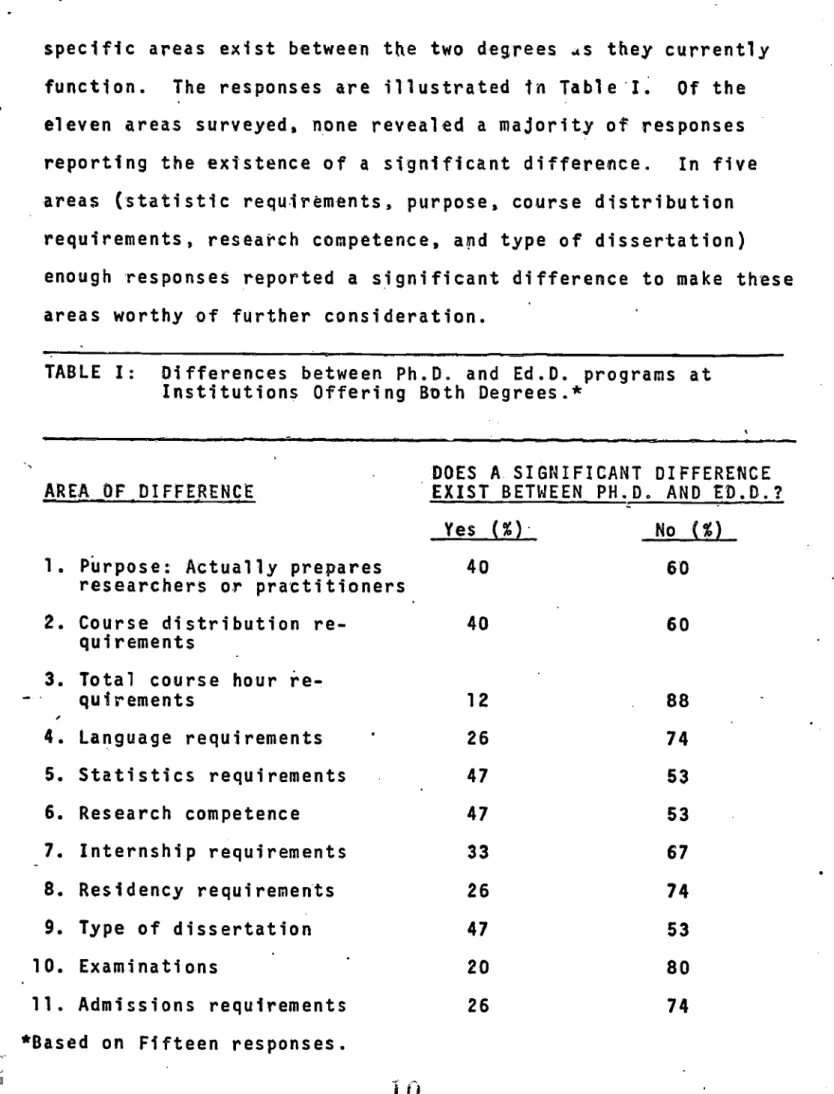
specific areas exist between the two degrees AS they currently
function. The responses are illustrated in Table I. Of the
eleven areas surveyed, none revealed a majority of responses
reporting the existence of a significant difference. In five
areas (statistic requirements, purpose, course distribution requirements, research competence, and type of dissertation) enough responses reported a significant difference to make these areas worthy of further consideration.
TABLE I: Differences between Ph.D. and Ed.D. programs at Institutions Offering Both Degrees.*
AREA OF DIFFERENCE
DOES A SIGNIFICANT DIFFERENCE EXIST BETWEEN PH.D. AND ED.D.?
No (%) Yes (70
1. rurpose: Actually prepares 40 60
researchers or practitioners
2. Course distribution re- 40 60
quirements
3. Total course hour
re-quirements 12 88 4. Language requirements 26 74 5. Statistics requirements 47 53 6. Research competence 47 53 7. Internship requirements 33 67 8. Residency requirements 26 74 9. Type of dissertation 47 53 10. Examinations 20 80 11. Admissions requirements 26 74
10
Table I suggests that the differences reported between the Ph.D. and Ed.D. by professionals in the field of higher education
are more philosophical than operational. Inconsistencies were
observed between the perceptions of differences as reported for
this table and responses on the rest of the survey.
SUMMARY
The trend toward similarities and convergence indicated in
the 1960 and 1970 surveys has continued at least in the field of
higher education. The only major difference identified concern-ed the unit within the institution responsible for administering
the degrees. .A majority of Ph.D. programs are administered by
the Graduate College while the administration of Ed.D. programs
is divided between the Graduate College and the College of
Edu-cation.
Ph.D. and Ed.D. programs in higher education are more simi-lar than dissimisimi-lar in those areas reported to be different
traditionally. The length of the programs was the same. The
lack of a foreign language requirement was common to both degrees.
Equal percentages of both programs include residence requirements
and these are quite similar. Statistics and research design are
required by more than 80 percent of both programs. Examination
requirements are similar and less than four percent of either
program permits deviation from the traditional dissertation.
These similarities persisted even when considering only those
in-stitutions offering both degrees.
Any differences that may exist between the two degrees are
not evident from an examination of explicit practices of the
REFERENCES
The American Association of Colleges for Teacher Education The Doctorate in Education:An In uir into Conditions
Affectin Pursuit of the Doctoral Degree in the field
of 'ucation. Vo ume three- Conference Report.
Washitgton D C.- AACTE,
Berelson, Bernard Graduate Education in the United States.
New York: McGraw-Hill Book Company, 1960.
Brown, Lawrence D.; and Slater, J. Malone The Doctorate in Education: An Inquiry into Conditions Affecting Pursuit of the Doctoral Degree in the Field of Education.
Volume I-The Graduates. Washington, D.C: AACTE, 1960.
Carmichael, Oliver C. Graduate Education: A Critique and a
'Program. New York: Harper and Brother, Publishers, 1961.
Eells, Walter Crosby Degrees in Higher Education. Washington,
D.C.: The Center for Applied Research in Education, Inc.,
1963.
Ferguson, Donald G. "Basic Requirements and 'Conditions
Affect-ing the Pursuit of Doctoral Degrees in Education." Un-published Doctors Dissertation, The University of Denver, Co., 1960.
Grigg, Charles M. Graduate Education. New York: The Center
for Applied Research in Education, Inc., 1965.
Hollis, Ernest V. Toward Improving Ph.D. Programs. Washington,
D.C.: American Council on Education, 1945.
Mayhew, Lewis B.; and Ford, Patrick F. Reform in Graduate and
Professional Education. San Francisco: Jossey-Bass
, Publishers, 1974.
Moore, Harold E.; Russel, John H.; Ferguson, Donald G. The Doctorate in Education: An Inquiry' Into Conditions Affect-ing Pursuit of the Doctoral De ree in the Field of Education.
Volume II - The Institutions. Was ington, D.C.: AACTE, 1960
Schweitzer, George K. The Doctorate: A Handbook Springfield,
IL: Charles C. Thomas, Publisher, 1965.
Spur, Stephen H. Academic Degree Structures: Innovative
Approaches: Principles of Reform in Degree Structures in
the United States. Report prepared for the Carnegie
Commission on Higher Education. New York: McGraw-Hill Book Company., 1970.
Walters, Everett Graduate Education Today. Washington, D.C..:
American Council on Education, 1965.
.12
RESPONDING INSTITUTIONS
Arizona State University Auburn University
Boston University
Claremont Graduate School
Columbia University- Teachers College Indiana University
Iowa State University Kansas State University Memphis State University Michigan State University Mississippi State University Montana State University Nova University
Pennsylvania State University Stanford University
State University of New York at Buffalo Texas A & M University
University of Arizona University of Arkansas
University of California, Berkeley
University of Denver. University of Florida University of Georgia University of Iowa University of Kentucky University of Massachusetts University of Michigan University of Nebraska University of Oregan
University of the Pacific University of Pittsburg
University of Texas at Austin University of Utah
University of Virginia University of Wyoming
Virginia.Polytechnic Institute Washington State University Wayne State University