Archive University of Zurich Main Library Strickhofstrasse 39 CH-8057 Zurich www.zora.uzh.ch Year: 2012
Modeling working memory: an interference model of complex span
Oberauer, Klaus ; Lewandowsky, Stephan ; Farrell, Simon ; Jarrold, Christopher ; Greaves, MartinAbstract: This article introduces a new computational model for the complex-span task, the most popular task for studying working memory. SOB-CS is a two-layer neural network that associates distributed item representations with distributed, overlapping position markers. Memory capacity limits are explained by interference from a superposition of associations. Concurrent processing interferes with memory through involuntary encoding of distractors. Free time in-between distractors is used to remove irrelevant representations, thereby reducing interference. The model accounts for benchmark findings in four areas: (1) effects of processing pace, processing difficulty, and number of processing steps; (2) effects of serial position and error patterns; (3) effects of different kinds of item-distractor similarity; and (4) correlations between span tasks. The model makes several new predictions in these areas, which were confirmed experimentally.
DOI: https://doi.org/10.3758/s13423-012-0272-4
Posted at the Zurich Open Repository and Archive, University of Zurich ZORA URL: https://doi.org/10.5167/uzh-63536
Journal Article Published Version Originally published at:
Oberauer, Klaus; Lewandowsky, Stephan; Farrell, Simon; Jarrold, Christopher; Greaves, Martin (2012). Modeling working memory: an interference model of complex span. Psychonomic Bulletin Review, 19(5):779-819.
THEORETICAL REVIEW
Modeling working memory: An interference model
of complex span
Klaus Oberauer&Stephan Lewandowsky&
Simon Farrell&Christopher Jarrold&Martin Greaves
Published online: 20 June 2012
#Psychonomic Society, Inc. 2012
Abstract This article introduces a new computational model for the complex-span task, the most popular task for studying working memory. SOB-CS is a two-layer neural network that associates distributed item representations with distributed, overlapping position markers. Memory capacity limits are explained by interference from a superposition of associa-tions. Concurrent processing interferes with memory through involuntary encoding of distractors. Free time in-between distractors is used to remove irrelevant representations, there-by reducing interference. The model accounts for benchmark findings in four areas: (1) effects of processing pace, process-ing difficulty, and number of processprocess-ing steps; (2) effects of serial position and error patterns; (3) effects of different kinds of item–distractor similarity; and (4) correlations between span tasks. The model makes several new predictions in these areas, which were confirmed experimentally.
Keywords Working memory . Computational modeling
Working memory can be characterized as a system for holding a limited amount of information available for pro-cessing. Its limited capacity has been shown to have con-siderable generality across various contents and methods of measurement (Kane et al., 2004; Oberauer, Süß, Schulze, Wilhelm, & Wittmann,2000). Variations in working mem-ory between groups and between individuals have been shown to correlate with performance in a broad range of complex cognitive activities (for a review, see Conway, Jarrold, Kane, Miyake, & Towse,2007).
The most commonly used paradigm for measuring work-ing memory capacity is the complex-spanparadigm. There are several variants of complex span, the earliest being the reading span (Daneman & Carpenter, 1980) and counting span (Case, Kurland, & Goldberg, 1982) tasks, later fol-lowed by operation span (Turner & Engle,1989) and spatial variants of the paradigm (Shah & Miyake, 1996). The general schema of all complex-span tasks is that encoding of a list of memoranda (e.g., words, letters) for serial recall is interleaved with a distracting processing task (e.g., read-ing a sentence or verifyread-ing an equation). The termcomplex span has been coined in contrast to simple span, which refers to immediate serial recall without a parallel distractor task.
Multiple variants of complex span have been validated as measures of working memory capacity by the findings that they correlate well with each other and with other indicators of working memory capacity (Oberauer et al.,2000; Schmiedek, Hildebrandt, Lövdén, Wilhelm, & Lindenberger, 2009) and that they are good predictors of a range of performance indicators in tasks that are theoretically assumed to require working memory, such as tests of reasoning and fluid intelli-gence (Conway, Kane, & Engle,2003), text comprehension (Daneman & Merikle,1996), and explicit learning of a rule (Unsworth & Engle, 2005), as well as a number of
Electronic supplementary material The online version of this article
(doi:10.3758/s13423-012-0272-4) contains supplementary material, which is available to authorized users.
K. Oberauer (*)
Department of Psychology—Cognitive Psychology, University of Zurich,
Binzmühlestrasse 14/22, 8050 Zürich, Switzerland
e-mail: [email protected] K. Oberauer
:
S. Farrell:
C. Jarrold:
M. Greaves University of Bristol,Bristol, England, UK S. Lewandowsky
University of Western Australia, Crawley, Western Australia, Australia DOI 10.3758/s13423-012-0272-4
experimental tasks requiring cognitive control, such as the Stroop task (Kane & Engle,2003) and the antisaccade task (Unsworth, Schrock, & Engle,2004). Therefore, understand-ing the cognitive processes in the complex-span paradigm would be a fundamental step toward understanding the capac-ity limits of cognition. The success of complex span as a measure of working memory capacity has inspired much experimental work and various theoretical efforts directed at analyzing the underlying processes (e.g., Barrouillet, Bernardin, & Camos, 2004; Bayliss, Jarrold, Gunn, & Baddeley,2003; Engle, Cantor, & Carullo, 1992; Oberauer & Lewandowsky, 2011; Towse, Hitch, & Hutton, 2000; Unsworth & Engle,2007).
With few exceptions, theories of the processes involved in complex span, like theories of working memory in general, have so far remained verbal descriptions of mechanisms. This is problematic because it is generally acknowledged that working memory is a complex system, and comprehensive theories of working memory typically assume numerous mechanisms and processes that operate together (Baddeley,
1986; Cowan,1995). With theories of such complexity, un-ambiguously determining predictions for a specific set of circumstances easily surpasses our human reasoning abilities (Farrell & Lewandowsky,2010). The problem is often com-pounded by the vagueness of verbal theories, which leave many critical details unspecified (for an example, see Lewandowsky & Farrell, 2011). These problems can be addressed using computational modeling. Writing a theory as a computer program forces the theorist to specify the model in sufficient detail for the program to run. Moreover, running the program provides a means to derive precise and unambig-uous predictions from the model. Every single decision on the way from the general principles of a theory to its detailed implementation, and every step on the way to its predictions for a specific experiment, is fully transparent in the program-ming code.
Computational modeling has been applied fruitfully to one experimental paradigm of working memory research, the serial-recall task (Burgess & Hitch, 1999; Farrell & Lewandowsky,2002; Henson,1998b; Page & Norris,1998). The goal of the present work is to apply what we have learned from modeling of serial recall to developing a computational model of behavior in the complex-span paradigm. This is no trivial step, because complex span appears to rely on core cognitive abilities to a far greater extent than does simple span. For example, even though the surface similarity between different complex-span tasks (e.g., operation span vs. sentence span) is far less than the surface similarity between simple-span tasks from different domains, performance correlates more highly across domains for the complex-span than for the simple-span task (Kane et al.,2004). Moreover, because the complex-span task shares many features with other para-digms of working memory research—short-term retention of
information, a requirement to retain serial order, distraction by a concurrent task, and coordination of multiple competing processes—a computational model of complex span will serve as a springboard for more precise theorizing in the field as a whole.
One central theoretical question about working memory is why it has limited capacity. Many theories explain the capacity limit by assuming that representations in working memory quickly decay over time unless they are actively maintained by rehearsal or refreshing (Baddeley, 1986; Barrouillet et al.,2004). This assumption has been incorpo-rated into the only two computational models of complex span proposed so far (Daily, Lovett, & Reder, 2001; Oberauer & Lewandowsky,2011). The assumption of rapid time-based decay, however, has been repeatedly questioned by empirical observations (for a review, see Lewandowsky, Oberauer, & Brown, 2009). One common alternative to decay is that working memory capacity is limited by inter-ference between representations (Jonides et al., 2008; Nairne, 2002; Saito & Miyake, 2004). To date, however, the concept of interference has remained underspecified, thus limiting its theoretical utility (Jonides et al., 2008). We overcome this limitation here by instantiating the inter-ference notion in a detailed computational model of com-plex span.
Our model attributes the capacity limit of working mem-ory entirely to interference. The model accounts for all of the findings that provided the initial empirical support for a decay-based theory of complex span, the time-based resource-sharing (TBRS) theory of Barrouillet, Camos, and colleagues (Barrouillet et al., 2004; Barrouillet, Bernardin, Portrat, Vergauwe, & Camos,2007). The TBRS theory has, arguably, been the strongest contender for explaining complex-span performance to date, and therefore we will compare our new model to a computational implementation of the TBRS theory (Oberauer & Lewandowsky,2011).
This article proceeds as follows: We start by presenting our model—first informally as a set of theoretical assump-tions, and then formally as a computational instantiation. We then apply the model to four sets of empirical findings. These represent benchmark findings from the complex-span paradigm that should serve as priority targets for mod-eling. The first is a set of findings concerning the relation between short-term retention and the temporal parameters of concurrent processing. These findings provided the empiri-cal basis for the TBRS theory (Barrouillet et al., 2007; Barrouillet, Portrat, & Camos, 2011). The second set of findings represents a detailed analysis of recall errors in complex span, which has proved highly informative for models of simple span. The third set of findings concerns the effects of different kinds of similarity between memory items and distractors. The fourth set pertains to the pattern of correlations between span tasks across different domains
that arises from the study of individual differences. The model is shown to handle all four sets of findings.
A distributed neural-network model for complex span Our model is an extension of the SOB (“ serial-order-in-a-box”) model, a distributed neural-network model of serial recall (Farrell & Lewandowsky,2002). The initial SOB was an auto-associator in the tradition of the brain-state-in-a-box (BSB) architecture (Anderson, Silverstein, Ritz, & Jones,
1977), from which the model derived its name. The second version, called C-SOB (Farrell, 2006; Lewandowsky & Farrell, 2008b), has a two-layer structure, with one layer representing serial positions and the other representing items (the prefix “C” stands for “context,” because the position representations are a form of context). Both item and posi-tion representaposi-tions are distributed—that is, they consist of patterns of activation across a large number of processing units in the network. Different items are represented by different patterns across the same set of units. Thus, item representations have well-defined similarity relations to each other, reflected in the similarity of the patterns repre-senting them; the same holds for positions. Items are encoded in C-SOB through Hebbian associations between item and position representations: The first list item is asso-ciated with the first position representation (a.k.a. aposition marker), the second item is associated with the second position marker, and so on. Memory for order is maintained by the patterns of association in the weight matrix that connects position markers to item representations. The use of context markers to represent order is a standard tool among memory theorists and has gained substantial empir-ical support (Lewandowsky & Farrell,2008b).
Memory performance is limited because all item-to-position associations are superimposed in the same weight matrix, so that at the point of recall the matrix represents each individual association only in a distorted fashion. One feature of both SOB and C-SOB, which is at the heart of much of the models’ predictive power, is that encoding strength is determined by an item’s novelty. Novelty is assessed by computing an expectation for each incoming item, on the basis of already-encoded memories, and deter-mining the similarity between this expectation and the actual item. The more novel the incoming item is, the more strong-ly it is encoded. This process of assessing novelty to deter-mine an item’s encoding strength is termed “novelty-gated encoding.”The assumption of novelty-gated encoding has been part of SOB since its inception, and has received independent empirical support (Farrell & Lewandowsky,
2003).
Our new model, SOB-CS (CS for “complex span”), builds directly on C-SOB (Farrell,2006; Lewandowsky &
Farrell,2008b), maintaining its original theoretical principles but slightly updating its mathematical formalization (see
Electronic Supplementary Materialfor an explanation of these technical details). In addition, SOB-CS incorporates two fur-ther theoretical assumptions whose introduction was necessi-tated by the presence of distractors in the complex-span task. First, we assume that processing a distractor, such as reading a word or carrying out an arithmetic operation, inevitably results in the encoding of a representation of the distractor into working memory in the same way as the memoranda (Oberauer & Lewandowsky, 2008). There is considerable precedent in the literature for this assumption (e.g., Logan, 1988). Therefore, distractors create interfer-ence with encoded item representations. Novelty-gated encoding applies to distractors in the same way that it applies to items, so that repeatedly processing the same distractor incurs less interference than does processing dif-ferent distractors.
Second, like most models of working memory, ours assumes that the system engages in active restoration of an unimpaired memory state when time allows. This assump-tion is motivated by the finding that memory performance in complex span is better when distractor operations are demanded at a slower pace, leaving more free time between each distractor and the next stimulus (Barrouillet et al.,
2004; Barrouillet et al., 2007). Whereas in decay-based models, active restoration typically refers to boosting decayed traces up to their original strength (by some sort of rehearsal or refreshing mechanism), active restoration must be conceptualized differently in interference-based models. When the main limiting factor for performance is interference, active restoration must reduce the impact of interference. This can be accomplished in several ways. For reasons of parsimony, we have so far implemented only one of them in SOB-CS, by applying a mechanism that is already embodied in all SOB models to date—namely, the removal of interfering material from memory, which by implication restores the quality of earlier memories. Because the removal notion is central to SOB-CS, it deserves to be placed into a broader theoretical context.
One general theoretical insight that emerged from our modeling work is that a successful model must have a mechanism for clearing working memory of no-longer-relevant contents. Without this, the system would soon be overloaded with outdated material. For example, when men-tally solving an expression such as “24 × 3,” it would be inopportune to retain “3” in working memory during the final step of adding“12”to“60”—even though the concept “3”necessarily had to be brought to mind a brief moment before in order to compute“12.”In general, rapid updating of working memory would be impossible without a clearing or removal mechanism, because the system would soon be choked by proactive interference, and demonstrably, this
does not happen (Kessler & Meiran, 2008; Oberauer & Vockenberg,2009).
In decay-based models, removal of old contents from mem-ory occurs by default (viz., they simply fade away), and active maintenance must be engaged to retain contents that are still relevant. Interference-based models operate by the reverse logic: All contents are maintained by default, and active re-moval is necessary to remove those that are no longer relevant. Thus, whereas decay-based models must be equipped with a mechanism for active maintenance, interference-based models must include a mechanism for active removal.
This necessary link between interference and removal has been largely ignored in the literature (for an exception, see Hasher, Zacks, & May,1999). SOB-CS provides a precise mechanism explaining how removal is accomplished when-ever there is free time in-between distractor operations—for example, during a pause between solving a distracting equa-tion and presentaequa-tion of the subsequent memorandum. During those pauses, the immediately preceding distractor representation is gradually removed from memory using Hebbian antilearning. This operation gradually undoes the association between the distractor and the position marker (see Kessler & Meiran,2008, for the related idea of “ dis-mantling”outdated bindings in an updating task).
The assumption of distractor removal (or“unbinding”) is a generalization of an assumption that is common in models of serial recall: Once a list item is recalled, it is removed from memory to avoid perseveration. There is strong evidence to support such a mechanism for response suppression (Farrell & Lewandowsky,2004; Henson,1998a), and it has been imple-mented in many models of serial recall (G. D. A. Brown, Preece, & Hulme,2000; Burgess & Hitch, 1999; Page & Norris,1998). In all versions of SOB, response suppression has been modeled using the mechanism of Hebbian antilearn-ing. Accordingly, response suppression is an instance of re-moving no-longer-relevant information from memory. Here, we simply generalize this notion to distractors.
By specifying how information is removed from working memory, we flesh out one basic operation for controlling the contents of memory. Control over which information is held in working memory is being recognized as an important source of individual differences in working memory capac-ity (Hasher et al.,1999; Jost, Bryck, Vogel, & Mayr,2010; Vogel, McCollough, & Machizawa,2005). Explicitly mod-eling the control processes operating on the contents of working memory is a prerequisite for understanding why working memory capacity also correlates with various con-trol processes in tasks with little involvement of memory (Kane, Conway, Hambrick, & Engle,2007).
To summarize, strong conceptual considerations mandate the presence of some control process that can clear working memory of unwanted contents. The removal notion is sup-ported by data and theoretical precedent, and in SOB-CS we
instantiate the removal process using a mechanism of prov-en theoretical utility.
In SOB-CS, removal of distractors plays a role similar to that of rehearsal or refreshing of memory items in other theories. Our model does not presently include a mainte-nance process for the strengthening of items (e.g., rehearsal or refreshing), for three reasons. First, rehearsal or refresh-ing are necessary mechanisms of maintenance when mem-ory traces are assumed to decay over time; however, in a model that attributes forgetting to interference, the threat to remembering comes from the presence of interfering mate-rial, not from the decay of memoranda, and therefore, the most effective way of protecting memory is to remove the sources of interference. Second, the existing evidence does not yield strong support for a causal role of rehearsal in complex-span tasks. While there is no doubt about the existenceof articulatory rehearsal, the evidence for it being causally responsible for superior memory performance is less than compelling. For example, people who report using articulatory rehearsal in a complex-span task do not perform much better than those who report just reading the memory items as their strategy, and more effective strategies, such as elaboration, are reported by only a minority of participants (Dunlosky & Kane,2007; Kaakinen & Hyönä,2007). Third, as we show below, we have successfully modeled bench-mark findings cited in support of refreshing without actually requiring the refreshing of memory items, and we therefore have omitted that mechanism for reasons of parsimony.
We remain open to the possibility that a rehearsal or refreshing mechanism might become necessary in a future extension of the model, if new results become available that mandate its inclusion. To summarize this crucial point: We do not claim that people do not rehearse during complex-span tasks. The existence of rehearsal is beyond dispute. We also do not rule out the possibility that rehearsal benefits memory; however, the evidence to date has turned out to be inconclusive upon closer inspection. What we demonstrate in the remainder of this article is that rehearsal is not needed to account for benchmark data in complex span.
In addition to the two new assumptions just discussed, we make explicit two hitherto tacit assumptions in SOB. First, previous versions of SOB have—for simplicity—modeled basic processes as time invariant, on the basis that in all paradigms to which the theory has been applied to date, sufficient time was available for processes to run to com-pletion. Under those circumstances, the theory could leave temporal aspects of those processes unspecified for parsi-mony’s sake. By contrast, in SOB-CS, we must explicitly model the time dependence of encoding and retrieval pro-cesses because, in complex span, performance is strongly influenced by temporal parameters (Barrouillet et al.,2004). In particular, we make the uncontroversial assumption that the degree of encoding and the extent of removal of stimuli
increases up to a point, as more time is available to those processes. There is considerable evidence that encoding into short-term memory takes time to be accomplished (Jolicœur & Dell’Acqua,1998). Likewise, there is evidence that re-moval of information from working memory takes time (Oberauer,2001).
Second, we make explicit the notion of a focus of atten-tion in SOB-CS. The last stimulus encoded into working memory, or the last item manipulated, typically enjoys a privileged status of heightened availability (Garavan,1998; McElree, 2006; Oberauer, 2003a), supporting the notion that, by default, the last representation operated upon remains in the system’s focus of attention. In SOB-CS, as in other distributed neural-network models, there is at any point in time a pattern of activation in each layer of units that (more-or-less accurately) represents an event (i.e., an item or a distractor in a specific position). We regard this currently active representation as the content of the focus of attention. The active representations in the focus of attention are those that are available for processes such as encoding (through Hebbian learning) and removal (through Hebbian antilearning, as explained below). By default, the last-presented stimulus (item or distractor), together with its serial position, is in the focus of attention, and thereby the association between that stimulus and its position can be encoded or removed.
The following sections present SOB-CS formally. To facilitate exposition, the variables used in the equations and their roles in the model are summarized in Table 1. The MATLAB model code is available as Supplementary Materialsfor this article.1
Architecture and representations
SOB-CS consists of two layers of units that are fully interconnected by a weight matrixW. The item layer, with 150 units, represents items; the position layer, comprising 16 units, represents the serial positions in the current list. Items are represented by vectors of +1 and–1, constructed at random in accordance with constraints on their similarity structure. Position markers are constant vectors of values between –1 and +1, constructed such that their similarity reflects their ordinal relation. The similarity between any two position markers (expressed as their cosine) decreases exponentially with their absolute ordinal distance:
cospi;pj¼spðji jjÞ; ð1Þ whereiandjare the positions of theith andjth items,piand pj are vectors representing positional markers at those
positions, andspis a fixed parameter determining the degree of overlap of successive positional markers (sp0.5 through-out, as in Farrell, 2006, and Oberauer & Lewandowsky,
2008).2
Whereas position markers are shared by all tasks requiring memory for serial order, the representations of stimuli depend on the category of items and the distractors involved in a task. We constructed representations for four categories of stimuli used in the experiments that we simulated: letters, digits, words, and generic visuospatial stimuli, each of which can serve as memory items or as distractors. For letters, we used the representations of 16 consonants (six similar and ten dis-similar) constructed by Farrell (2006) and Lewandowsky and Farrell (2008a) for use with C-SOB. The similarity structure between these 16 vectors reflects a three-dimensional multidi-mensional scaling solution for an empirical confusion matrix between these letters (Hull, 1973). The average similarity between consonant representations, computed as their cosine, was .65 for the similar and .50 for the dissimilar subsets.
Nine vectors were constructed to represent digits. These were created from a common prototype such that their average similarity was .50; this value reflects the fact that digits are, on average, less confusable than letters (Jacobs,
1887). Finally, we created nine sets of nine words each. The words within each set were similar to each other (cosine0 .65), and words from different sets were dissimilar (cosine0 .5). For simulations of experiments not manipulating simi-larity, we used a random mixture of similar and dissimilar letters or words for all memory lists and distractor sets. Visuospatial stimuli (used in Simulations 5 and 6) were generated in the same way as the words, except that they are represented in a separate section of the item layer.
Distractor representations were created in the same way as the item representations—that is, by sampling individual dis-tractors from a distractor prototype. For simulations in which items and distractors came from the same broad category (i.e., digits, letters, or words), we used the same prototype for generating both items and distractors, so that the average similarity between an item and a distractor equaled that be-tween two items and bebe-tween two distractors. For simulations in which the items and distractors came from different catego-ries, we derived the prototype of the distractors from the prototype of the items, so that they had a similarity governed by the item–distractor similarity parametersc, which was set to .35, the same value as in previous simulations (Oberauer & Lewandowsky,2008).3
1
The program code is also available at our web pages:www.cogsciwa. com; www.psychologie.uzh.ch/fachrichtungen/allgpsy/Team/ Oberauer_en.html;http://seis.bris.ac.uk/~pssaf/publications.html.
2The similarity between neighboring positions was labeledt cin pre-vious publications; here we rename it tospto avoid confusion with the time parameters.
3The actual similarity between items and distractors is lower (e.g., about 0.1 in the case of letters and digits) because items are derived from the item prototype and distractors are derived from the distractor prototype.
Encoding and recall
Figure 1 provides a schematic illustration of the encoding process in SOB-CS. Each presented memory item activates its representation in the item layer, and at the same time, the representation of the next available list position is activated in the position layer. The representations active in the item layer and the position layer jointly constitute the current focus of attention. Encoding into working memory occurs by associating the item representation with the position representation in the focus. Once associative encoding is completed, that item–position pair is replaced in the focus by the next item–position pair. Encoding uses standard Hebbian learning (see, e.g., Anderson,1995):
$W¼ηeðiÞvipiT; ð2Þ
whereWis the weight matrix connecting the position layer to the item layer, vi is the vector representing theith pre-sented item, andpiis the positional marker for theith serial position, which is transposed for computing the outer prod-uct of the two vectors.
We model encoding as a time-dependent process: The encoding strengthηefor theith item,ηe(i), is calculated as a function of the time spent encoding the item:
ηeðiÞ ¼AðiÞð1 expð teRÞÞ; ð3Þ whereΑ(i) is the asymptote of the encoding strength of item i, R is the rate of encoding, and te is the time spent on encoding. Thus, the encoding strength ηe that determines the strength of Hebbian association is assumed to grow toward asymptote at an encoding rate of R. The asymptote itself is a function of the novelty of the incoming item, which is defined as the energy between the to-be-learned association and the information captured by Wup to that point. Specifically, the asymptote A(i) for the encoding strength of itemiis a logistic function of that item’s energy, Ei:
AðiÞ ¼ 1
1þexpð ðEi eÞgÞ
; ð4Þ
where eand g are the threshold and gain parameters, re-spectively, of the logistic function. For all simulations,ewas set to –1,000 andg to 0.0033. Simulations of simple span have shown that these values generate the highest level of memory accuracy without producing empirically unrealistic serial-position curves. The use of a logistic function smoothly restrictsA(i) to fall between zero and unity, thus preventing the occurrence of implausible (e.g., <0) encoding weights. Constraining encoding strength in this way represents an improvement over previous instantiations of the model, in
Table 1 Definition of variables in SOB-CS
Symbol Role Description
pi Representation Vector representing list positioni vi Representation Vector representing list itemi vi' Representation Vector retrieved when weight
matrix is cued withpi dj,k Representation Vector representing distractork
following list itemj
W Representation Weight matrix connecting item
layer and position layer
sp Fixed parameter Similarity between neighboring positions
sdis Fixed parameter Similarity between dissimilar
list items
ssim Fixed parameter Similarity between similar list items
sc Fixed parameter Similarity between item prototype and distractor prototype
R Free parameter Encoding rate for memory items
and distractors
r Free parameter Removal rate for memory items
and distractors
e Free parameter Threshold for logistic function transforming energy into encoding strength
g Free parameter Gain for logistic function
transforming energy into encoding strength
No Free parameter Output interference: Noise added to weight matrix after each recall event
c Free parameter Discriminability between recall
candidates (0steepness with which similarity falls off with Euclidean distance from retrieved vector)
Ei;Ej,k Computed values
Energy of itemi; Energy of distractor
kfollowing itemj A(i);A(j,k) Computed
values
Asymptotic encoding strength of item
iand of distractorkafter itemj, respectively
Ω(i);Ω(j,k) Computed values
Asymptotic strength of antilearning for itemiand for distractorkafter itemj, respectively
ηe(i) Computed value Encoding strength for encoding item
i, computed fromA(i),te, andR
ηe(j,k) Computed value Encoding strength for encoding distractorkfollowing itemj, computed fromA(j,k),td, andR
ηs(i) Computed value Antilearning strength for removing itemi, computed fromΩ(i),ts, andr
ηs(j,k) Computed value Antilearning strength for removing distractordj,k, computed from
Ω(j,k),ts, andr
te Estimated
variable
Time spent attending to, and thereby encoding, an item
td Estimated
variable
Time spent attending to, and thereby encoding, a distractor
ts Estimated
variable
Time spent removing an item or distractor
which the encoding strength was not bounded, without altering the basic principle of energy-gated encoding.
The energy of theith association is given by
Ei¼ viTWpi: ð5Þ
(see Lewandowsky & Farrell,2008b). The computation of energy can be interpreted as the generation of an expectation for the item in positioni, given the current state of memory as reflected in the state of the weight matrix before encoding of itemi. The expectation is computed by cueing the weight matrixWwith the new position pi. Energy is the negative dot product between the expectation (computed asWpi) and the actual item vi, and it reflects the degree of mismatch between the expectation and the actual item—that is, the
item’s novelty. Equation 4 implies that more novel items, which have less negative (or even positive) energy values, are encoded more strongly. The use of energy to compute the weighting of incoming information is a core principle of SOB that turns out to be critical for the model’s predictions for complex span. Recent research on the processing of novelty in the hippocampus lends support to a mechanism very similar to the one assumed for SOB-CS (Kumaran & Maguire,2007).
Our computation of encoding strength in SOB-CS differs from previous instantiations of SOB in that it makes encod-ing strength time-dependent. The duration of encodencod-ing an item into working memory can be estimated from dual-task studies (Jolicœur & Dell’Acqua, 1998) and from studies using masked presentation of visual stimuli (Vogel,
-2000 -1000 0 500 0 .0 0 .2 0 .4 0 .6 0 .8 1 .0 E(i) A sy. S tr e ng th 0.0 0.5 1.0 1.5 2.0 0. 0 0 .2 0. 4 0 .6 0. 8 1 .0 time E nc o di ng S tr e n gt h Asy Input: vi item layer position layer Mismatch (novelty)
energy E(i) more positive
-1 1 -1 1 position layer item layer piT = 1 -1 1 -1 ∆W=ηe*vi*piT -1 1 -1 1 Input: vi y i
Fig. 1 Schematic illustration of encoding in SOB-CS. Top left panel:
State of the weight matrix after encoding stimulusi–1,Wi–1. The new position vectorpiis activated in the position layer, and its activation is forwarded throughWi–1to generate an expectation (0Wi–1pi) for the incoming stimulus in the item layer. Activation values of the units in the position and item layers are coded by shade (white0–1, gray00,
black0 1). A new stimulus, represented by vector vi, is initially matched against the expected vector. The degree of match is measured as energyEi. Top right panel: EnergyEiis translated into the asymptote of encoding strength,A, by the logistic function, governed by free parameterseandg. Parametereis the point on theEiscale at whichA0
0.5 (illustrated by the dotted line), and parameterg determines the steepness of the function around that point. The dashed line shows
the resulting A for a stimulus withEi0 –300. Bottom left panel:
Encoding strength ηe for encoding stimulus i is computed as a negatively accelerated exponential function of the time t spent on encoding. The dotted line shows the resulting encoding strength for an item encoded for 1.5 s; the dashed line shows encoding strength for a distractor encoded for 0.3 s. Bottom right panel: Updating of the weight matrix according to the outer product of the position representation piT and the item representation vi, multiplied by the encoding strength ηe. Bold lines are the con-nection weights increased in this learning event because they connect units with same-signed activation. Thin lines are connec-tion weights that are decreased because they connect units with opposite-signed activation
Woodman, & Luck,2006). These studies converge on an estimate of 150–300 ms as the average time for encoding an item into working memory. Jolicœur and Dell’Acqua ap-plied a formal model to three of their experiments, from which we estimated the encoding rate for individual letters to be about six items per second.4 We therefore set the encoding rate to R 0 6 in Eq. 3. This value implies that ηe(i) reaches 95 % of its asymptote after 500 ms. Thus, with encoding times of 500 ms or more, encoding in SOB-CS is virtually indistinguishable from encoding in previous ver-sions of C-SOB, and Eq. 3 functionally reduces to the simple equalityηe(i) 0 A(i) that—bar the use of a logistic squashing function—is familiar from earlier applications of C-SOB.
Retrieval proceeds by reinstating the position markers in their original order, one by one, as cues for the items with which they were associated. For position i, retriev-al is cued by presenting the activation pattern for posi-tional marker pi in the position layer and updating the activation in the item layer by forwarding activation through the weight matrix:
vi 0
¼Wpi; ð6Þ
where the resultant vector in the item layer, vi', is a distorted version of the original item vector vi, consist-ing of a blend of vi and the other item representations involved in the trial, which will all have been associated to partially overlapping positional markers. To determine which item to recall, the retrieved vector vi' is matched to all vectors vj of known retrieval candidates in long-term memory. The similarity of vi' to each retrieval candidate is computed as s vi 0 ;vj ¼exp cD vi 0 ;vj 2 : ð7Þ
In this equation, the Euclidean distance measure D is weighted by the free parameter c, which determines the discriminability between retrieval candidates. With larger values of c, similarity falls off more steeply with distance, so that the most similar retrieval candidate is more clearly discriminated from the less similar ones. For computational reasons, Dis normalized by subtracting the minimum dis-tance across all of then retrieval candidates from the dis-tance for each candidate.
The probability of recalling an item jis computed from these similarities by the Luce choice rule:
PðvjÞ ¼ sðvi 0 ;vjÞ Pn k¼1 svi 0 ;vk ð Þ ; ð8Þ
wherenis the number of retrieval candidates. A candidate is then selected for recall by random sampling among the candidate set, with the probability of sampling for each candidate being determined by Eq.8. The intact representa-tion of the candidate selected for output, vo,i, replaces the originally retrieved vectorvi', thus placing a clearly identi-fied retrieval candidate into the focus of attention. Figure2
provides an illustration of retrieval in SOB-CS.
The set of recall candidates includes not only the list items but also other items in the experimental vocabulary. This enables the model to generate extralist intrusion errors. When the distractors come from the same stimulus category as the items (e.g., both are words), we assume that the dis-tractors are also included in the candidate set, so that intru-sions of distractors in recall can be modeled. (When distractors are categorically different from the memoranda, they are excluded from the set of candidates because people can prevent intrusions on the basis of categorical information.) Overt recall itself impairs memory for the remaining items; this effect is known as output interference (Cowan, Saults, Elliott, & Moreno, 2002; Fitzgerald & Broadbent,
1985; Oberauer, 2003b). In SOB-CS, as in C-SOB, we implemented output interference by adding Gaussian noise with a standard deviationNoto each weight inWafter recall of each item.
A common assumption in models of serial recall is that recalled items are suppressed in order to avoid persevera-tion. Response suppression has been modeled in SOB by Hebbian antilearning (Anderson,1991). Hebbian antilearn-ing operates in the same way as Hebbian learnantilearn-ing, except that a negative encoding strength is used. The negative sign implies that the association between the recalled item, vo,j, and its position is removed from the weight matrix: ΔW¼ ηsðjÞvo;jpjT; ð9Þ where j is the output position and ηs(j) is the strength of suppression at output positionj.
4
Jolicœur and Dell’Acqua (1998) fitted a model to the data of three of their experiments. In that model one parameter,τ1i, is the mean of an exponentially distributed time variable that represents the sum of the times for sensory and perceptual processing and for short-term consol-idation of a single item. These means were estimated to be 0.304, 0.150, and 0.275 s for the three modeled experiments (4, 6, and7), respectively. The rate of the exponential function is the inverse of the mean: that is, 3.3, 6.7, and 3.6, respectively, for the three experiments. The rate is higher for Experiment 6 than for the other experiments, and Jolicœur and Dell’Acqua argued that this could be because in Experiment 6, a single letter was to be encoded into memory on every trial, whereas the other experiments involved a mixture of trials with one and with three letters. In this regard, Experiment 6 might be the most representative one for the encoding of single letters in a serial-recall task.
Like Hebbian learning during encoding, Hebbian anti-learning during response suppression takes time, and SOB-CS explicitly represents this. Therefore, the antilearning strength of suppression,ηs(j), is a function of time: ηsðjÞ ¼ΩðjÞð1 expð tsrÞÞ; ð10Þ wheretsis the time devoted to response suppression of item j(set to 1s for all simulations, the approximate duration of serial recall of letters; Farrell & Lewandowsky,2004, Exp. 2), andris the rate of removal of representations from working memory.Ω(j) is the asymptotic value of antilearning strength, computed by a logistic function from the item’s energy: ΩðjÞ ¼ 1
1þexp EEj
1
; ð11Þ
whereEjis the just-recalled item’s energy andE1is the energy of the item recalled at the first output position. Dividing by E1 corrects for the overall energy of the list. That is, when more items are stored, or positional markers over-lap more, the energy computed during recall will on average be higher, and dividing by E1 effectively uses the energy of the first item to correct for this potential variability. For the first output position, a default value
Ω(j) 0 1 is used. The energy of the recalled item j is computed using the same formula as Eq.5, but with the presented item replaced by the recalled item:
Ej¼ vo;jTWjpj: ð12Þ
Distractor encoding and removal
Following our previous work (Oberauer & Lewandowsky,
2008), we assume that all distractors are associated with the position of the immediately preceding item. That item’s position is still held in the focus of attention because
position representations are updated only when a new mem-ory item is presented. Distractors are represented in the same way as items, as random vectors of –1 and +1 generated according to the category of stimuli (digits, consonants, or words), as described earlier. Processing of a distractor implies activating that distractor in the focus of attention, upon which Hebbian learning automatically associates it with the currently active position marker, using the same mechanism as for the learning of list items (Eq.2): ΔW¼ηeðj;kÞdj;kpjT; ð13Þ whereWis the weight matrix,dj,kis the vector representing distractor k following item j, pj is the position marker of position j, andηe(j,k) is the encoding strength of the dis-tractor. The asymptotic encoding strength of thekth distrac-tor following item jis computed, like that of an item, as a logistic function of its energy:
Aðj;kÞ ¼ 1
1þexp Ej;k eg
: ð14Þ
The energy of every distractorkfollowing itemj,Ej,k, is computed as before, according to Eq.5, using the position representation of the preceding item,pj. Because distractors are associated with positions already occupied by an item, and because all representations within a content domain are at least moderately positively correlated, distractors are typ-ically encoded with less strength than are items, because of energy-gated encoding. Like encoding of items, encoding of distractors is a process that takes time, such that the ing strength increases with the duration of distractor encod-ing,td: ηeðj;kÞ ¼Aðj;kÞð1 expð tdRÞÞ: ð15Þ c 0.2 1.3 2.0 s(vi‘, vj) = exp(-cD(vi‘,vj)2) vi: 1 1 -1 1 vj: 1 -1 -1 -1 vk: -1 1 -1 -1 . . . vn 1 1 1 -1 Compute Distance D item layer position layer vi‘ recall candi- dates c 0.2 1.3 2.0 s(vi‘, vj) = exp(-cD(vi‘,vj)2) vi: 1 1 -1 1 vj: 1 -1 -1 -1 vk: -1 1 -1 -1 . . . vn 1 1 1 -1 Compute Distance D item layer position layer vi‘ recall candi- dates
Fig. 2 Schematic illustration of
retrieval in SOB-CS. Left pan-el: The positional cuepiis activated in the position layer and forwards its activation through the weight matrixWto the item layer, creating an approximation of the item vec-tor,vi′. This vector is compared to all vectors of retrieval candi-dates, and their distance
D(vi′,vj) is computed for all retrieval candidates. Right pan-el: Distance is converted into similarity by a Gaussian gradi-ent. Three gradients are shown, for the three values ofcused in different simulations in this article
The distractor is encoded while attention is devoted to it (Phaf & Wolters,1993). Like items, distractors reach near-asymptotic encoding strength after about 500 ms.
As noted earlier, any free time during complex-span processing is used to remove the immediately preceding distractor, using the same mechanism of Hebbian antilearn-ing introduced above for response suppression:
ΔW¼ ηrðj;kÞdj;kpjT; ð16Þ where ηr(j, k) is the antilearning strength for distractor dj,k, which is the kth distractor following the item in position j. Removal is a gradual process that, as compared to encoding, proceeds relatively slowly. Therefore, the strength of antilearning is computed as a function of the available free time,tf, and the asymptotic removal strength of the distractor,
Ω(j,k):
ηrðj;kÞ ¼Ωðj;kÞ 1 exp tfr
; ð17Þ
whereris the rate of removal, which also governs the rate of response suppression (Eq. 10). The asymptote of removal strength is computed in the same way as the strength of response suppression:
Ωðj;kÞ ¼ 1 1þexp Ej;k
E1;1
; ð18Þ
where E1,1 is the energy of the first distractor in the first processing episode. For the first distractor in a trial,Ω(1, 1)01. Estimates from experiments in which participants were instructed to (temporarily or permanently) remove part of the contents of working memory have shown that removal takes between 1 and 2 s (Oberauer,2001,2002). Therefore, we setrto 1.5, which implies that the rate of antilearning for removal has reached 95 % of its asymptoteΩ(j,k) after 2 s.
To summarize, SOB-CS has four fixed parameters and six free parameters (see Table1). We regard as fixed param-eters those that were treated as fixed paramparam-eters in previous versions of C-SOB and whose values we did not change; they all pertain to the similarity between representations. We regard as free parameters those that we adjusted manually— either on the basis of independent evidence, as in the case of the rate parameters for encoding and removal, or to find values that generated good model fits to the benchmark data. We set the free parameters to the same values in all simu-lations reported in this article, except in a few cases, which will be explicitly noted: the threshold and gain parameters of the logistic function that translates energy into encoding strength, e 0 –1,000 and g 0 0.0033; the encoding rate, R06; the removal rate,r01.5; the confusability parameter for items during retrieval,c0 1.3; and the output interfer-ence parameter,No01.5.
Before moving on to describe the application of SOB-CS to data from the complex-span paradigm, we first will briefly summarize an alternative account of complex-span perfor-mance, TBRS* (Oberauer & Lewandowsky, 2011), as that model serves as an important baseline for assessing SOB-CS’s account of several key phenomena.
An alternative theory: The time-based resource-sharing (TBRS) model
A new model must at the very least explain the data that constitute the main empirical support for extant theories and models. One contender for explaining performance in com-plex span is the time-based resource-sharing (TBRS) theory (Barrouillet et al.,2004), which has recently been instanti-ated in a computational model, TBRS* (Oberauer & Lewandowsky, 2011). TBRS* is the most sophisticated implementation yet of two popular assumptions about work-ing memory: that memory traces decay rapidly over time, and that decay can be prevented by some form of active maintenance (i.e., rehearsal or refreshing). It is clear from the foregoing discussion that those assumptions stand in diametric opposition to the architecture of SOB-CS. Our first goal in this article is therefore to demonstrate that SOB-CS can explain the key phenomena cited in support of TBRS and TBRS* without committing to the core assumptions of the TBRS theory. Here, we summarize the TBRS theory and the key findings in its support.
The TBRS theory rests on two basic assumptions: First, forgetting is driven by time-based decay, and this decay must be offset by reactivation or refreshing of items to prevent loss of that information. Second, work-ing memory has at its disposal a general attentional mechanism that can be devoted to only one task at a time. In the complex-span paradigm, this mechanism must engage with the distracting processing demands in-between encoding items. However, attention can rap-idly switch between processing operations (e.g., carrying out an addition in an operation span task) and refresh-ing memory items, thereby usrefresh-ing even small temporal gaps between individual operations to carry out refresh-ing. As a consequence, the model predicts that memory performance will decline with increasing time during which attention is occupied by distractor processing, and that it will improve with increasing free time that can be devoted to refreshing. These predictions can be summarized by the concept of cognitive load, defined as the proportion of available processing time between two memory items during which attention is captured by the distractor task:
with N representing the number of operations in a processing episode, a the time demand of each individ-ual operation, and T the total time available for that processing episode. The TBRS theory predicts that memory is a monotonically declining function of in-creasing cognitive load, as less time is proportionally available for refreshing items. Additionally, when cog-nitive load is held constant, Barrouillet et al. (2004) predicted that the number of distractor operations would have no effect on memory.
To test these predictions, Barrouillet, Camos, and their colleagues developed a version of the complex-span para-digm that increases experimental control over participants’ scheduling of individual processing steps in the task (Barrouillet et al.,2004; Barrouillet et al.,2007). Following presentation of each memory item, participants work through a computer-paced sequence of processing steps (e.g., reading aloud a digit or making a speeded choice judgment). Figure3
shows the schematic flow of events in this version of com-plex span. Presentation of each item is followed by a pro-cessing episode of fixed durationT, which is broken down intoNprocessing steps. In each processing step, a relatively elementary cognitive operation is carried out on a distractor
stimulus (e.g., reading a word, carrying out an arithmetic operation, or classifying a stimulus by a keypress). This operation is assumed to capture central attention for duration a. The remainder of the available time during each processing step is free time that, according to the TBRS theory, is used for refreshing memory traces.
Experiments within this paradigm have revealed three consistent regularities that lend support to the cognitive-load equation: First, memory performance decreases as the pace at which processing steps are required increases (Barrouillet et al.,2004; Barrouillet et al.,2007). This effect has been found across a large variety of memory materials and distractor tasks (Hudjetz & Oberauer,2007; Vergauwe, Barrouillet, & Camos,2010), and with children as well as adults (Barrouillet, Gavens, Vergauwe, Gaillard, & Camos,
2009; Portrat, Camos, & Barrouillet,2009). In terms of the cognitive-load equation, increasing the pace means increas-ing the ratio ofaNtoTby increasingN, reducingT, or both. Second, when pace is held constant and the time demand of individual operations is increased by making the opera-tions more difficult, memory suffers (Barrouillet et al.,
2007). This is predicted by the theory because increasing the time demand a while holding the ratio of N and T
Item 1 Distr. 1.1 Distr. 1.4 Distr. 1.2 Distr. 1.3 Item 2 Distr 2.1 Distr 2.4 Distr 2.2 Distr 2.3 Presentation time
Operation duration (a) Free time
Processing episode
Total time (T)
Fig. 3 Schematic flow of
events of the complex-span paradigm of Barrouillet et al. (2004). Presentation of each memory item is followed by a processing episode that consists of a computer-paced series of distractor stimuli, each demanding a response, followed by a free-time interval until the onset of the next distractor.Operation duration
refers to the time for which generation of a response to a distractor captures the central attentional mechanism, which is not directly observable but can be approximately inferred from response latencies. Cognitive load is defined asaN/T, where
Nis the number of distractors in a processing episode,ais the operation duration, andTis the total time
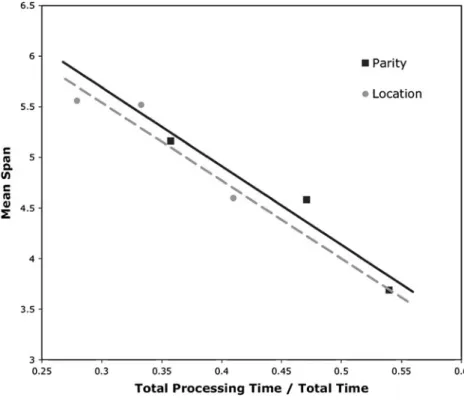
constant increases cognitive load. Figure 4 illustrates the first two effects: Memory span declined as the pace of the processing task was increased, and span was lower for the processing task with longer response times overall (i.e., the parity judgment task).
Third, when the pace and the time demands of individual operations are held constant, increasing the number of oper-ations following each memory item—and, hence, the total duration for each processing episode—has often been found to leave memory performance unaffected (Barrouillet et al.,
2004; Oberauer & Lewandowsky, 2008). This is predicted by the cognitive-load equation: Increasing the number of operations at a constant pace means increasing bothNandT by the same proportion, so cognitive load is unchanged. This third finding, however, needs to be qualified: In a series of experiments using word reading as the distractor task, we varied the number of distractor words to be read aloud after each memory item. If the same word was repeated four times, memory was as good as when reading a single word, but when three different distractor words followed each item, additional forgetting was observed (Lewandowsky, Geiger, Morrell, & Oberauer,2010).
In sum, the TBRS theory and its computational imple-mentation, TBRS*, currently offer the strongest alternative account to SOB-CS for explaining key experimental results from the complex-span paradigm. We therefore regard the findings that provided initial crucial support for TBRS as the first set of benchmark results that our new model needs to explain.
Complex span: Benchmark findings and new predictions There are no established criteria for what constitutes a benchmark finding in a field. This is an unfortunate situa-tion, because it enables theorists to focus on those results that their preferred model handles best. To rein in this opportunistic selection of phenomena, we here state our selection criteria explicitly. We argue that benchmark find-ings should meet two criteria: (1) They should be theoreti-cally informative; that is, they should count as support for, or a challenge to, the most successful theories in the field. (2) They should be robust; that is, they should be replicable across variations of theoretically unimportant features of method and materials. The findings that we selected as benchmarks for a model of complex span, summarized in Table2, meet both of these criteria.
The benchmarks and the accompanying new predictions can be grouped into four sets. The first set consists of effects related to the interplay between short-term retention and processing, which is a longstanding topic of research and theorizing on working memory (Bayliss et al.,2003; Case et al., 1982; Towse et al., 2000). These are the effects that constitute the empirical support for the TBRS, described above. The second set consists of serial-position curves, error patterns, and transposition gradients. These are find-ings that, although given relatively little attention so far in the working memory literature, have been important in constraining models of serial recall. The third set pertains to the effects of similarity between memory items and
Fig. 4 Effect of cognitive load
on memory span. Participants remembered consonants and carried out one of two distractor tasks (parity judgment or location judgments) that differed in their mean response times. Pace was manipulated by demanding 4, 6, and
8 judgments within a constant total time of 6.4 s. From“Time and Cognitive Load in Working Memory,”by P. Barrouillet, S. Bernardin, S. Portrat, E. Vergauwe, and V. Camos,2007,
Journal of Experimental Psychology: Learning, Memory, and Cognition,33, pp. 570–585. Copyright 2007 by the American Psychological Association. Reproduced with permission p. 577
distractors. These similarity effects are diagnostic for the mechanisms of interference in working memory. We test a new prediction arising from the assumptions in SOB-CS about the interference between items and distractors, and address the longstanding question of whether the disruption of immediate memory (“storage”) by distrac-tor processing is domain-general or domain-specific. The fourth set concerns individual differences, which have been a major topic of research with the complex-span task. One of the reasons that so much interest has focused on complex span (and other working memory tasks) is that 50 % of the variance in working memory capacity across individuals is shared with measures of fluid intelligence (Conway et al., 2003). In addition, there has been considerable interest in the patterns of correlations between simple-span and complex-span tasks; we focus on those correlations because they fall within the scope of SOB-CS. In the remainder of this article, we will report the simulations through which we applied SOB-CS to these four groups of benchmark findings and present new model predictions, together with data testing them.
Cognitive load and the number of operations
The cognitive-load effect (Barrouillet et al., 2004) is an important regularity concerning the interplay between mem-ory and processing in working memmem-ory. It implies that whereas the processing of distractors impairs memory, more generous intervals of free time between individual process-ing steps can be used to restore memory. The TBRS theory (Barrouillet et al., 2004) identifies decay as the cause of forgetting during processing operations, and refreshing as the beneficial force in the free intervals between operations. In contrast, SOB-CS assumes that distractor processing damages memory via the interference introduced from dis-tractor representations entering working memory (Eqs. 13–
15), and that the beneficial effect of free time arises from the gradual removal of distractor representations in-between pro-cessing steps (Eqs.16–18).
In Simulation 1, we investigated the behavior of SOB-CS by simulating a hypothetical experiment that combined the three independent variables that have been manipulated in separate behavioral experiments to establish the first set of
Table 2 Benchmark findings from complex span (regular font) and new predictions from SOB-CS (italics)
Finding Brief Description References
Cognitive-load effect Increasing pace of processing operations impairs memory. Increasing operation duration while holding pace constant impairs memory.
Barrouillet et al. (2004); Barrouillet et al. (2007) ; Hudjetz & Oberauer (2007); Liefooghe, Barrouillet, Vandierendonck, & Camos (2008) Effects of operation
duration and free time
The effect of operation duration is smaller than that of free time
Present experiments (Electronic Supplementary Material)
Effect of number of operations
At constant cognitive load, number of operations has no effect on memory when distractors are identical, and it impairs memory when distractors differ.
Barrouillet et al. (2004); Lewandowsky et al. (2010); Oberauer & Lewandowsky (2008) Serial-position curve Serial-position curves are characterized by extended
primacy and small recency.
Present reanalysis of Lewandowsky et al. (2010); analyses of reading span and operation span in Oberauer & Lewandowsky (2011)
Serial-position curves of complex span are parallel to those of simple span.
Error types The proportion of order errors follows an inverted U-shaped function over serial position; the proportion of item errors increases monotonically.
Present reanalysis of Lewandowsky et al. (2010); analyses of reading span and operation span in Oberauer & Lewandowsky (2011)
More order errors than item errors occur with simple span; the reverse is true for complex span.
Transposition gradients Transpositions follow the“locality constraint”: They are more likely to occur to close than to distant positions.
Present reanalysis of Lewandowsky et al. (2010); analyses of reading span and operation span in Oberauer & Lewandowsky (2011)
Transposition gradients are equally steep for simple and complex span.
Item–distractor similarity: Proximity
Similar distractors interfere less with memory than do dissimilar distractors if they immediately follow items that they are similar to.
Oberauer et al. (2012)
Item–distractor similarity: Categorical
Recall is worse when distractors come from the same category as the items than when they come from different categories.
Conlin et al. (2005); Turner & Engle (1989) Item–distractor similarity:
Feature-space overlap
Processing tasks in the same content domain interfere more with memory than do processing tasks in a different domain.
Bayliss et al. (2003); Myerson et al. (1999) Correlation of simple and
complex span
Simple- and complex-span measures load on separate but correlated factors.
Gathercole et al. (2004); Kane et al. (2004) Correlation across content
domains
Span tasks with verbal and visuospatial content load on separate but correlated factors.
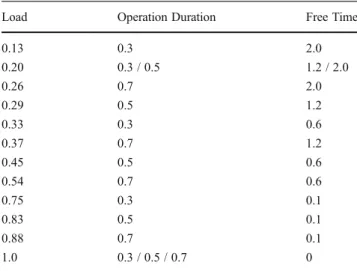
benchmark findings. The simulated experiment was the same as the one we used to demonstrate the feasibility of TBRS* (Oberauer & Lewandowsky, 2011, Simulation 1). The independent variables were (1) number of distractor operations per episode (zero, one, four, or eight), where zero operations defines the simple-span baseline; (2) operation duration (0.3, 0.5, or 0.7 s)—that is, the duration of atten-tional capture for each operation; and (3) free time following each operation (0, 0.1, 0.6, 1.2, or 2 s). Crossing of the latter two variables generated 15 levels of cognitive load, com-puted as operation duration divided by the sum of operation duration and free time (for a summary of the cognitive-load values, see Table3). The simulated experiment used letters as memory items and digits as distractors, as did most of the experiments of Barrouillet et al. (2004). The simulated ex-periment involved 500 virtual participants, each of whom completed three trials for each list length (one to nine) in each condition.
Cognitive load
Figure5shows memory performance as a function of cog-nitive load for the four levels of number of operations (the simple-span baseline was replicated 15 times, generating one data point plotted at each level of load; the variability between these 15 identical replications provides an estimate of random noise in the simulated data). The top panel presents performance expressed as span, computed as in Barrouillet et al. (2004), and the bottom panel presents results as the proportions of items recalled in correct order for seven-item lists. Both figures show that memory accu-racy declined in an approximately linear fashion with in-creasing cognitive load, in accordance with the data.
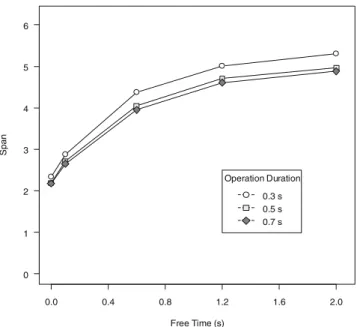
The span-over-load function produced by SOB-CS is not entirely linear; it contains small but systematic nonmonoto-nicities. These deviations from linearity can be explained by looking at the effects of the two variables that constitute cognitive load, the duration of each operation and the free time following it. Figure 6 plots span as a function of operation duration and free time (averaging conditions with one, four, and eight operations). Operation duration has only a very small effect, and hardly any effect beyond 0.5 s,
Table 3 Levels of cognitive load for Simulations 1 and 5
Load Operation Duration Free Time
0.13 0.3 2.0 0.20 0.3 / 0.5 1.2 / 2.0 0.26 0.7 2.0 0.29 0.5 1.2 0.33 0.3 0.6 0.37 0.7 1.2 0.45 0.5 0.6 0.54 0.7 0.6 0.75 0.3 0.1 0.83 0.5 0.1 0.88 0.7 0.1 1.0 0.3 / 0.5 / 0.7 0
Combinations of operation duration and free time that result in the same cognitive load are listed in a single row
0 1 2 3 4 5 6 7 Cognitive Load Sp a n 0.0 0.2 0.4 0.6 0.8 1.0 0.0 0.2 0.4 0.6 0.8 1.0 0 Operations 1 Operation 4 Operations 8 Operations 0.0 0.2 0.4 0.6 0.8 1.0 Cognitive Load Pr op o rt io n C o rr ec t 0 Operations 1 Operation 4 Operations 8 Operations
Fig. 5 Results of Simulation 1. Top: Memory span as a function of
cognitive load and number of distractor operations. Bottom: Propor-tions of correct-in-position recall as a function of cognitive load and number of operations. Dashed lines are best-fitting linear regression slopes. The 15 data points for “0 operations”are exact replications because cognitive load was not defined for that condition; their vari-ability reflects the amount of random noise in the simulated data. The highest level of cognitive load is represented by three data points for each level of number of operations, because for all three operation durations, load01 when free time00
because after 0.5 s the strength of distractor encoding has nearly reached asymptote. Free time has a much larger effect, albeit with diminishing returns. The comparatively small effect of operation duration explains the nonmonoto-nicity in the span-over-load function.5
The results of Simulation 1 clarify how SOB-CS accounts for the first two of the three benchmark results cited in support of the TBRS theory. First, increasing the pace of processing for a fixed total processing duration decreases the free time after each distractor operation, thereby leaving less time to remove the preceding distractor. Second, increasing the dura-tion of individual operadura-tions while holding their pace constant has two effects in SOB-CS. One is that longer attention to each distractor leads to stronger encoding, thereby creating more interference. This effect is small and levels off after 500 ms. The other, more pronounced effect is that as more of the fixed time between two operations is spent on process-ing the distractor, less time is left for removprocess-ing it.
Unpacking cognitive load: Operation duration and free time Cognitive load is determined by two temporal variables, the duration of distractor operations and the free time in between
them. These components play different roles in SOB-CS and TBRS*. In SOB-CS, increasing the operation duration has only a limited effect through increasing the strength of encod-ing of interferencod-ing distractors (up to about 500 ms), whereas increasing the free time has a more pronounced beneficial effect because removal of the preceding distractor is a rela-tively slow process. In TBRS*, extending the operation dura-tion leads to more decay, which continues as long as attendura-tion is captured by the operation, and extending the free time enables more refreshing of memory items. The two models differ in that SOB-CS predicts only a very small effect of operation duration if free time is held constant, whereas TBRS* predicts a much larger effect of operation duration (Oberauer & Lewandowsky,2011, Fig.6).
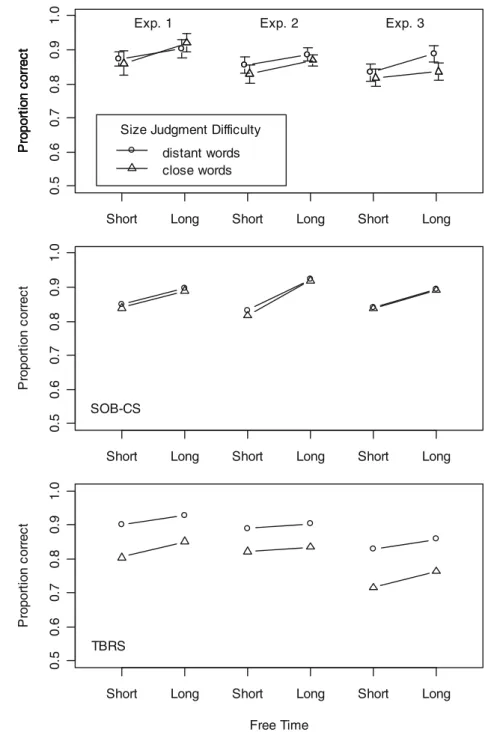
To empirically dissociate operation time and free time, we carried out three new experiments, using a method introduced by Portrat, Barrouillet, and Camos (2008). Participants remembered letters or words, and in between each pair of memoranda they carried out a size judgment task on words presented as distractors, deciding for each distractor whether the object it represented was larger or smaller than a soccer ball. Operation duration was varied between trials by selecting objects close or distant in size to a soccer ball. After each keypress indicating a decision, a predetermined free-time interval was added before display of the next distractor (i.e., the next word to be judged). The amount of free time was varied orthogonally to operation duration. These experiments are described in detail in
Electronic Supplementary Material. The top panel of Fig. 7 shows correct-in-position recall accuracy. Whereas free time had a consistent and sizeable effect across all three experiments, the manipulation of operation duration had only negligible (Exps. 1 and 2) or small (Exp. 3) effects.
In Simulation 2, we modeled these experiments with SOB-CS and, for comparison, with TBRS*. We used the response latencies for size judgments to estimate the opera-tion duraopera-tion (separate estimates were taken for the first operation after each memory item and for successive oper-ations because their latencies differed substantially; see
Electronic Supplementary Material). Overt response laten-cies do not reflect the time for which a cognitive operation captures central attention (Barrouillet et al., 2007; Pashler,
1994) because sensory and motor processing components can be carried out independently of central attention. Estimates of the duration of those noncentral processing components are consistently between 350 and 550 ms (S. D. Brown & Heathcote, 2008; Ratcliff, Thapar, & McKoon,2004,2010). We therefore subtracted a noncentral component of 500 ms from the measured times to obtain an estimate of central processing duration per size judgment. The noncentral 500 ms were added to the nominal free time because this time could be used to remove distractors (SOB-CS) or to refresh memory items (TBRS*). In other words,
5For instance, span at a cognitive-load level .33 is worse than expected from a strictly linear function, and span at the following load level (.37) is better than expected. Between the first and the second of these data points, operation duration is more than doubled (from 0.3 to 0.7), and free time is doubled (from 0.6 to 1.2). The increase of operation duration, however, has only a negligible effect, whereas the increase of free time has a more substantial effect. Therefore, span at the higher load level exceeds that at the lower load level in this particular com-parison, and in the others that generate nonmonotonicities in Fig.5.
0 1 2 3 4 5 6 Free Time (s) Sp a n 0.0 0.4 0.8 1.2 1.6 2.0 Operation Duration 0.3 s 0.5 s 0.7 s
Fig. 6 Results of Simulation 1: Effects of free time and operation