Implementation of the Clockwork Operating
Room Efficiency Model (CORE) to Improve
First Case Start Times -‐ A Prospective Study
Puja Trivedi, DO, Anesthesia Resident Physician Riverside County Regional Medical Center David Ninan, DO, FAOCA Anesthesia Department Chair Riverside County Regional Medical Center Hector D. Ludi, MD, FACS, Surgery Department Vice-‐Chair Riverside County Regional Medical Center Louise O’Rourke, RN, BSN, NM, OR Manager Riverside County Regional Medical Center David Belson, PHD, Professor USC Viterbi School of Engineering Daniel J. Epstein, Department of Industrial and Systems Engineering Abstract
An exponentially increasing patient population, diminishing medical funding, and uncertainty regarding the economic ramifications of recent healthcare reform have resulted in an emphasis on hospital economics in terms of efficiency, productivity, and cost containment. The operating room (OR) is a critical component of an institution’s ability to generate profit while simultaneously accounting for significant expenses. At the core of OR efficiency is how well an institution matches its resources to demands. Riverside County Regional Medical Center (RCRMC) is a 439-‐bed teaching hospital with Level II adult and pediatric trauma services and nine main OR’s. RCRMC’s nine ORs were experiencing
significant delays in beginning cases at their scheduled start times based on data obtained from a pilot study from 2006 to 2007. Collected data showed that only 40% of all scheduled elective first cases started on-‐time resulting in significant inefficiencies. RCRMC formed a Clockwork Operating Room Efficiency (CORE) subcommittee consisting of physician leaders, hospital managers and key OR staff members who created and implemented a formal workflow model to assist in the immediate identification and rectification of delay causes. An additional objective was to encourage individual accountability, responsibility, and value as responsible individuals offered delay prevention insight and suggestions for improvement. Through implementation of the CORE model, the CORE subcommittee enlightened our institution to a large area of unnecessary expenditure, developed and implemented an easily reproducible workflow model, and ultimately resulted in positive changes on multiple levels. Staff morale and patient satisfaction all subsequently improved and surgeons preferred to operate at RCRMC as opposed to other local facilities due to its predictable first case on-‐time starts.
Introduction
An exponentially increasing patient population, dwindling funds, and uncertainty regarding the economic future of healthcare have resulted in an emphasis on healthcare economics in terms of efficiency, productivity, and cost containment without sacrificing quality of care. Recent healthcare
changes may adversely impact healthcare models providing care to underserved areas. California’s safety-‐net hospitals, the core of the state’s public healthcare system including county and academic medical centers, are fighting to keep up with increasing patient demands with a tighter budget and fewer resources than in the past [1a]. The only way for these healthcare models to survive is by a complete reengineering of its infrastructure. An area of focused interest is the operating room (OR), a critical component to an institution’s ability to generate revenue while simultaneously accounting for its greatest expenditure. High overhead costs are attributed to the need for highly specialized physicians; a large volume of trained and certified personnel; expensive equipment with associated costs of repair, sterilization, and periodic upgrades; and OR maintenance including cleaning, airflow management, specialized OR tables, and supplies.
At the core of OR efficiency is how well an institution matches its resources to demands. The planned allocation of resources during a defined time frame makes up the organization’s fixed cost. If the OR is utilized significantly outside of the allocated time, the institution’s variable costs increase and are often significantly higher due to overtime pay [3]. Immeasurable costs of delayed cases include patient dissatisfaction with extended waiting without nourishment, surgeon aggravation when scheduled to follow another surgeon, and staff frustration when asked to work beyond scheduled hours. This ultimately poses a risk to revenue as surgeons choose to operate elsewhere and patient dissatisfaction negatively impacts hospital reimbursements. Cases scheduled later in the day may be cancelled which impacts patients, surgeons, and society due to the increased burden of costs associated with additional length of hospital stay and delayed return to the workforce [3].
One solution lies in an application of management engineering principles and techniques to streamline healthcare systems. Dr. Belson, an award winning engineering professor, had successfully applied management engineering methods to improve productivity and efficiency at some of the world’s largest manufacturing corporations. He understood that similar to manufacturing, the flow of a patient in surgery is a sequential process with multiple steps and areas for potential breakdowns to occur (a). In 2007, the California HealthCare Foundation commissioned Dr. Belson, faculty and students from the USC Viterbi School of Engineering Daniel J. Epstein Department of Industrial and Systems Engineering to demonstrate the application of management engineering principles to safety-‐net hospitals. One of the selected safety-‐net hospitals, Riverside County Regional Medical Center (RCRMC), is a 439-‐bed safety net hospital with Level II adult and pediatric trauma services and nine main ORs. Analyzing data from the hospital’s information system, Dr. Belson quickly identified that the average turnaround time at RCRMC was well above industry benchmarks. Dr. Belson and colleagues applied the following five basic steps of management engineering: (1) problem identification, (2) measurement, (3) analysis, (4) design of solutions, and (5) intervention. The result was a reduction in turnaround time from 49 minutes in November 2007 to 39 minutes in July 2008. Additional areas of process improvement included a redesign which improved patient flow, better use of technology and information services, improved asset utilization, use of checklists with communication checkpoints along the way, and data tracking
which served as a motivational tool helping to change the existing culture into one more responsive to patient needs.
Based on the success of reduced turnaround times, RCRMC formed a process improvement group to focus on first case start times as its next management engineering project. RCRMC’s nine ORs were experiencing significant delays in starting cases as scheduled based on data collected during a pilot study from 2006 -‐ 2007. Collected data showed that only 40% of all scheduled elective first cases started on-‐ time. The delay had a domino effect as succeeding cases were also delayed resulting in over 18 hours per month of lost OR time. RCRMC created a subcommittee of OR staff members with diverse roles and hospital managers to apply learned management engineering principles to improve on-‐time starts while still maintaining a high level of patient care. Together they created an initiative entitled Clockwork OR Efficiency (CORE) to assist in decreasing first case time delays. A consistent theme during literature review of OR management was how inefficiency stemmed from departmental divisions, lack of understandings of what OR efficiency means, ineffective communication, and that the need for teamwork was necessary for sustained change [4,5,6]. Therefore, the participation of key OR staff members was a crucial component in the development of our model. The majority of research in the field collected data on causes for first case delays and retrospectively attempted to determine the cause or individual [7]. Our initiative involved early identification of individuals responsible for delays in first case start times and early intervention to correct areas of inefficiency by asking responsible individuals to take responsibility for the event and offer suggestions as to how the event may be prevented on both the individual and hospital management level. This contributed to a supportive environment where staff members felt valuable as their feedback resulted in immediate change and helped to unite staff under a common goal of improving patient satisfaction and care. Through this initiative, elective first case time improved, lost OR time decreased, and most importantly staff morale, patient and surgeon satisfaction greatly improved.
Methods
A CORE subcommittee was formed consisting of the Assistant Hospital Administrator, Anesthesiologist (Chair), General Surgery (Chair), OR Nurse Manager, and Quality Management Overseer. Data was collected from scheduled first cases performed in the nine main OR suites. A case was considered a “first case” if it was scheduled by noon one working day prior to surgery. Analysis was limited to scheduled workdays and excluded holidays. Trauma, emergency, and obstetric procedures were excluded. The following protocol was implemented to reduce first case delays by promoting personal accountability, creating a supportive environment to encourage communication, bringing value to responsible individuals by allowing them to provide input, and allowing the formation of an OR team with the same universal goal of patient care despite departmental divisions. First, a patient had to be in the preoperative area a minimum of 30 minutes prior to the scheduled start time [Workflow 1]. If they arrived late, a reason was listed by the OR Nurse Manager and reported to the CORE subcommittee. The next timed measure in the protocol was that a representative from the surgical team and the
circulating nurse had to sign off on the patient 15 minutes prior to the scheduled start time. If either member failed to sign off in a timely manner, the OR Nurse Manager or Surgery Division Chair evaluated the situation and reported this back to the CORE subcommittee for review. The final measured step was for the anesthesia care team to bring the patient into the OR suite at the prescheduled time. If they failed to do so, the Anesthesia Chair evaluated the circumstances and reported to the CORE
subcommittee.
The CORE subcommittee held weekly meetings and adhered to the following procedures for notifying physicians and nonmedical departments of all first case delays attributed to their service or department: 1. Physicians received a delay notification memo by email requiring 10-‐business day turnaround
response.
2. If no response, the chief of the service received a second memo by email requiring a 5 day response. 3. Subsequent failure to respond to second notification resulted in formal reports to the chief medical officer, the CORE subcommittee, Performance Improvement Committee and the Medical Executive Committee.
4. Non-‐medical departments were required to appear for an in-‐person response at the monthly CORE subcommittee meeting to address departmental issues identified from the prior month’s case delays and how said delays will be resolved to prevent repetition in the future along with any additional suggestions for possible improvements.
Workflow 1: Clockwork Operating Room Efficiency Model
The Clockwork Operating Room Efficiency Model provides an algorithm which can be easily followed through each time-‐measured step. Endpoints include an on-‐time start, an appropriate turn around response which is recorded, or no response resulting in a formal report being sent to the chief medical officer, CORE subcommittee, Performance Improvement Committee, and Medical Executive Committee. Project results were displayed in key locations within the OR suite using graphs and charts of first case delay outcomes and progress for all OR staff to review.
Results
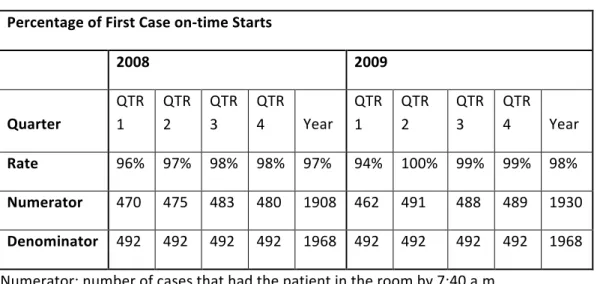
During the two-‐year study, 3,936 cases were scheduled to start at 7:30 a.m. on Monday, Tuesday, Thursday, Friday and 8:30 a.m. on Wednesday. In 2008, 1,908 out of 1,968 cases were in compliance resulting in a 97% on-‐time start rate. This number slightly improved to 1,930/1,968 in 2009 resulting in a 98% compliance rate [Table 1, Graph 1]. The most commonly reported reasons for delays included a lack of appropriate patient preoperative preparation (including lab work, surgical consent, updated history and physical), wrong equipment, patient tardiness, and surgeon unavailability.
Table 1: Percentage of First Case On-‐Time Starts by 3 Month Quarters Post Intervention Percentage of First Case on-‐time Starts
2008 2009 Quarter QTR 1 QTR 2 QTR 3 QTR 4 Year QTR 1 QTR 2 QTR 3 QTR 4 Year Rate 96% 97% 98% 98% 97% 94% 100% 99% 99% 98% Numerator 470 475 483 480 1908 462 491 488 489 1930 Denominator 492 492 492 492 1968 492 492 492 492 1968 Numerator: number of cases that had the patient in the room by 7:40 a.m.
Denominator: total number of scheduled cases per quarter
Table 1: The number and percentage of on-‐time first case starts was recorded in 3 month quarters for the year 2008 and 2009 after the institution of CORE measures
Graph 1: Percentage of First Case On-‐Time Starts by 3 Month Quarters Post Intervention
Graph 1: A bar graph was created based on the number of cases with on-‐time first case starts to visually display side-‐by-‐side quarterly improvements in the year 2008 and 2009 after institution of CORE
Discussion
RCRMC made measurable progress surpassing the CORE subcommittees expectations in OR efficiency by auditing causes of first case delays, creating an effective workflow model, determining the individual whose actions were at the root of the delay, brainstorming ways the delay can be avoided in the future through ideas from both the individual and as a subcommittee, and displaying delay data in highly visible hospital staff locations. RCRMC achieved an improvement in elective first case start times from 40 to 95%. Lost OR hours decreased from 18 hours to 5.2 hours per month, a 72% decrease in delayed hours. The number of delayed cases from a baseline of 131 cases dropped to 7 cases per month. By holding individual physicians and staff members accountable for OR first case start delays and having them feel involved by being open to his/her suggestions, intangible improvements were made in the areas of personal responsibility, accountability, and communication. Regular meetings with OR staff members with diverse roles and under different departments led to an improved team atmosphere and the OR staff began to act as a cohesive unit to promote an appreciation for hospital efficiency while still maintaining a high level of patient care and safety.
In looking at the applicability of the results it is important to highlight the definition, measurements taken, and identify challenges to implementation. The start times were defined as when the patient was physically in the operating room. So while the initiative was highly successful in improving this time it did not necessarily correlate with improved operating room utilization. Presumably this improvement would trickle down to efficiency and this was our anecdotal experience, however it was not part of this initial study.
Another potential confounding variable resulting from our definition was the availability of attending physicians to begin the procedure. Like many academic training sites at RCRMC, resident physicians are primarily responsible for the steps necessary to get the patient into the operating room. At times there were delays in the arrival of the Anesthesia/Surgery Attending to the operating theatre. This
confounding variable as pertains to anesthesia has been previously described by Epstein and Dexter [8] and our experience was similar. There could be significant delays if an Anesthesia Attending was
supervising two patients and was busy inducing one patient, while the second patient was waiting in the operating room. Similarly there were delays if the Surgery Attending was busy outside of the operating room and not immediately available after induction. This potential for delay was unmeasured since the patient was considered an on-‐time start as long as they were physically in the OR. This potential contribution to increased length of surgery is an area needing further study and is currently being investigated at our institution.
As an academic institution, an important emphasis is placed on the instruction and development of competent residents. The months of June and July, a time notoriously known for a steep learning curve as new interns and residents enter both the anesthesia and surgical arenas of the OR, was included [8]. Based on the quarter totals, no significant increase in delays was noted during quarters 2 and 3, a fact likely due to the greater involvement of attending and senior residents to ensure all necessary steps are
taken in a timely manner to allow smooth OR case flow. Upon achievement of the goals set forth by the CORE task force, all aspects of the CORE workflow model were abandoned and no measure had been instituted to evaluate long-‐term sustainability. A recent survey of on-‐time starts for scheduled first cases has fallen to pre-‐intervention levels. By not building in assessment measures to continue evaluating progress post-‐intervention, critical trends in delayed start times were missed and it became increasingly difficult to determine what factors contributed to a reversal of the progress achieved under the CORE workflow model.
Additionally, a 10-‐minute leeway was allowed in OR start times, for example a patient entering the OR at 7:40 a.m. was still considered “on-‐time” and did not constitute a delay. Potentially even something as short as a ten minute interval multiplied over multiple operating rooms has the potential to rapidly become significant.
In implementing the CORE workflow model, unanticipated challenges emerged which need to be highlighted as it is very likely these hurdles exist in all hospital models to varying degrees. As most operating staff members were paid based on shifts, it became more challenging to keep staff motivated and actively facilitating efficiency as it approached the end of shift time. For example, efficiently getting a case into the operating room at 2:30 p.m. often resulted in a staff member having to stay overtime to complete additional patient charting if their shift ended at 3:00 p.m. More importantly, staff may want to avoid a handover as a surgery begins to avoid miscommunication, potential errors, and ensure
patient safety. It was also found that there was a lack of uniformity in the ways policies were understood and executed on multiple departmental levels which may be avoided by ensuring staff receive the same department specific training by the same supervisor and are observed periodically to ensure compliance to policies/clarify misunderstanding. It was interesting to observe the dichotomy between operating room personnel in terms of what efficiency meant, i.e. a Surgeon may think of efficiency in terms of the cases he/she completes within a set time period versus an Infection Control Nurse who would put more emphasis on efficiency as the number of post-‐operative infections. Despite formal patient outcome measures, it became impossible to reconcile different thoughts on what efficiency meant to each staff member but this discrepancy must be acknowledged especially when it becomes difficult to implement a new policy. Job security fears made it difficult to obtain accurate data at times as employees were scared of being blamed inadvertently if they revealed the source of delay while visiting/travelling staff were more likely to ignore warnings. Communication fall outs continued to occur despite formal organized meetings.
Although OR start time is only one factor in OR efficiency, by focusing on an easy-‐to-‐measure parameter with limited influence by external factors (case takes longer than scheduled, turnover, etc.) and
developing a formal workflow to assist in the immediate identification and rectification of delay causes, we were able to enlighten our institution to a large area of unnecessary expenditure which has
promoted positive change. Staff morale and patient satisfaction all subsequently improved and surgeons preferred to operate at RCRMC as opposed to other local facilities due to its predictable first case on-‐ time start.
References
[1a]. Belson D, Mary KS, and Overton L. “Improving Efficiency in the Safety Net: Management Engineering Practice and Cases.” California Healthcare Foundation; March 2010.
[1]. Macario A. “What does one minute of operating room time cost?” J Clin Anesth. 2010 Jun; 22(4):233-‐6.
[2]. Shippert RD. “A study of time-‐dependent operating room fees and how to save $100,000 by using time-‐saving devices.” Am J Cosmetic Surg 2005:22(1); 25–35.
[3]. Wachtel RE, Dexter F. “Influence of the operating room schedule on tardiness from scheduled start times.” Anesth Analg. 2009 Jun; 108(6):1889-‐1901.
[4]. Girotto JA, Koltz PF, Drugas G. “Optimizing your operating room: or, why large, traditional hospitals don't work.” Int J Surg. 2010; 8(5):359-‐67. Epub 2010 May 15.
[5]. Dexter EU, Dexter F, Masursky D, Garver MP, Nussmeier NA. “Both bias and lack of knowledge influence organizational focus on first case of the day starts.” Anesth Analg. 2009 Apr; 108(4):1257-‐61. [6]. Overdyk FJ, Harvey SC, Fishman RL, Shippey F. “Successful strategies for improving operating room efficiency at academic institutions.” Anesth Analg. 1998 Apr; 86(4):896-‐906.
[7]. Shelver SR, Winston L. “Improving surgical on-‐time starts through common goals.” AORN J. 2001 Oct; 74(4):506-‐8, 510-‐1, 513.
[8]. Epstein RH, Dexter F. “Influence of supervision ratios by anesthesiologists on first-‐case starts and critical portions of anesthetics.” Anesthesiology. 2012 Mar; 116(3):683-‐691.
[9]. Dexter F, Epstein RH. “Typical savings from each minute reduction in tardy first case of the day starts.” Anesth Analg. 2009 Apr; 108(4):1262-‐7.
[10]. Gupta B, Agrawal P, D'souza N, Soni KD. “Start time delays in operating room: Different perspectives.” Saudi J Anaesth. 2011 Jul; 5(3):286-‐8.
[11]. Harvey EJ. “Why don't my surgeries start on-‐time?” Can J Surg. 2010 Jun; 53(3):148-‐9.
[12]. Koenig T, Neumann C, Ocker T, Kramer S, Spies C, Schuster M. “Estimating the time needed for induction of anaesthesia and its importance in balancing anaesthetists' and surgeons' waiting times around the start of surgery.” Anaesthesia. 2011 Jul; 66(7):556-‐62. Epub 2011 May 13.
[13]. Masursky D, Dexter F, Isaacson SA, Nussmeier NA. “Surgeons' and anesthesiologists' perceptions of turnover times.” Anesth Analg. 2011 Feb; 112(2):440-‐4. Epub 2011 Jan 6.
[14]. Mazzei WJ. “Operating room start times and turnover times in a university hospital.” J Clin
[15]. McIntosh C, Dexter F, Epstein RH. “The impact of service-‐specific staffing, case scheduling, turnovers, and first-‐case starts on anesthesia group and operating room productivity: a tutorial using data from an Australian hospital.” Anesth Analg. 2006 Dec; 103(6):1499-‐1516.
[16]. Truong A, Tessler MJ, Kleiman SJ, Bensimon M. “Late operating room starts: experience with an education trial.” Can J Anaesth. 1996 Dec; 43(12):1233-‐1236.