InterBase 5.5
Embedded
Installation
Guide
100 Enterprise Way, Suite B2, Scotts Valley, CA 95066 http://www.interbase.com
InterBase
®Table of Contents
Introduction . . . 5
About this document . . . 5
In a nutshell . . . 6 Installation checklist . . . 6 Uninstallation checklist . . . 6 Overview of components . . . 7 Installation Procedure . . . 9 Preinstall checks . . . 9
Installing GDS32.DLL and INTERBASE.MSG . . . 12
Installing other files . . . 12
Minimum server installation . . . 13
Minimum client installation . . . 13
Installing software activation keys . . . 13
Windows registry information . . . 14
Use of the Windows registry database . . . 14
Installing InterBase registry information . . . 14
InterBase use count . . . 14
Shared files and reference counts . . . 15
Configuring the TCP/IP services entry . . . 15
Windows service configuration . . . 16
Configuring InterBase as an NT service . . . 16
Configuring InterBase as a Windows 95 peer-to-peer server . . . 17
Starting InterBase services . . . 17
ODBC installation . . . 18
Uninstallation Procedure . . . .19
Stopping the InterBase service . . . 19
Uninstalling InterBase . . . 19
Files by Component . . . .23
InterBase Registry Reference . . . .28
CHAPTER
1
Chapter 1
Introduction
About this document
This document is a guide for InterBase developerswho want to include the InterBase software in the installation of vertical applications on the Wintel platform. This guide contains the details you need to customize the installation and configuration of an InterBase client or server, and to integrate it within the installation of your own software product. This kind of configuration is called an embedded installation of InterBase.
This document contains guidelines for embedded installation of InterBase Client and Server 5.5 for Windows NT and Windows 95.
The guide is not meant to cover InterBase software versions other than 5.5. If you use this guide to design embedded installations for other versions of InterBase, the software is likely to be installed improperly and might not function.
Do not use this document for customizing installation of the InterBase Server for Novell NetWare, SCO OpenServer, Linux, or any brand of UNIX. These instructions cover only InterBase for Windows NT 4.0 and Windows 95.
The system to which you deploy your product might or might not already have InterBase installed as part of another vertical software application. There are certain checks you must perform as part of your installation to ensure that your product is harmonious with other software.
Note Throughout this document, the variable %SYSTEM32% refers to the Windows system directory. This is most often C:\Windows\System on Windows 95 and C:\WinNT\System32 on Windows NT. Any installation of these operating systems can override these default locations for the system directory. The Windows API call GetSystemDirectory() returns the true location of the system software.
In a nutshell
InterBase Software Corp. tries to make deployment of InterBase software as easy as possible: 1. Copy all or a subset of the files in the InterBase product, and include them in your
product installation.
2. Activate the software with InterBase keys that you include with the copy of InterBase you deploy.
3. Pay deployment royalties to InterBase Software Corp. based on the number of copies of InterBase software you deploy.
Installation checklist
The following is a high-level summary of installation procedure for InterBase client and server: 1. Perform pre-install checks for an existing InterBase installation. See “Preinstall
checks” on page 9.
2. Copy the InterBase client library GDS32.DLL to the Windows system directory and the Messages file INTERBASE.MSG file to the InterBase root directory, unless newer versions of these files exist on the system. See “Installing GDS32.DLL and INTERBASE.MSG” on page 12.
3. Copy all other required files and desired optional files to the target directory.
4. Merge the new keys with any existing key file. See “Installing software activation keys” on page 13.
5. Configure the InterBase registry keys. Set new reference counts to 1; increment existing reference counts. See “Windows registry information” on page 14.
6. Enter shared files into the shared DLL section of the Windows registry. See “Shared files and reference counts” on page 15.
For InterBase clients, skip the next step:
7. Configure and start the InterBase Server and Guardian services. See “Windows service configuration” on page 16.
Uninstallation checklist
The following is a high-level summary of the uninstallation procedure for the InterBase client and server. Make sure it is safe to do these steps without interfering with another application that uses InterBase. See later sections in this document for details on how to perform each step.
1. Make sure the InterBase server is not running.
2. Remove the InterBase Server service and the InterBase Guardian service from the Windows NT services or the Windows 95 Run registry key.
3. Remove InterBase registry information from the Windows registry database. Remember to decrement shared DLL key values. Do not delete the keys unless you reduce the values to zero.
EMBEDDED INSTALLATION GUIDE 7
NOVEMBER 13, 1998 InterBase 5.5
Overview of components
The InterBase product is a collection of files, but you can think of these files as comprising a number of logical groups, or components. See Appendix A, “Files by component,” for a detailed list of files included in each component listed below.
Component Description
Server 32-bit multi-user server
Client 32-bit client required to connect to InterBase servers Command tools:
...database management GBAK.EXE, GFIX.EXE, GSPLIT.EXE
...user management GSEC.EXE
...database query ISQL.EXE
GUI tools:
...database management Graphical server administration, data definition, and query tools for Win32; required to administer user accounts
...database query WISQL.EXE for Win32 ...user management GSEC.EXE, used by IBMGR.EXE
ODBC INTERSOLV® InterBase ODBC 3.0 compliant driver for InterBase for Win32 Developer tools C/C++ Language header and library files for developing applications using
the native InterBase API
Online documentation On-line documentation for InterBase; requires Adobe Acrobat Reader With Search, which is on the InterBase 5.5 CDROM, and can also be downloaded from the web site
http://www.adobe.com/prodindex/acrobat/readstep.html
Distributing Acrobat Reader With Search is royalty free; refer to the license documentation with that product, and fill out the redistribution paperwork on the Adobe web site.
Examples:
...databases A sample personnel management and sales database
...API programming Sample InterBase applications using embedded SQL, Dynamic SQL (DSQL), and the InterBase API
CHAPTER
2
Chapter 2
Installation Procedure
This chapter details the steps necessary to install InterBase programmatically. It assumes that you have the requisite files and that you know how to extract them from your compressed installation image.
The chapter also assumes that you are a qualified Windows programmer and need no instruction on how to perform programming tasks with your installation technology (for instance,
InstallShield). In particular, you should be familiar with performing file versioning and Windows registry database manipulation using your installation authoring tools.
Preinstall checks
There are a number of checks you should perform before installing InterBase. These ensure that you do not conflict with an existing copy of InterBase.
1. Check the platform.
This InterBase 5.5 Embedded Installation Guide documents installation customization on Microsoft Windows NT 4.0 or Windows 95 on Intel hardware only. InterBase 5.5 does not support DEC Alpha hardware or the Windows NT 3.51 operating system.
The full InterBase product including the online documentation and Acrobat Reader With Search requires approximately 36MB of disk space. A minimal server installation requires 11MB. This does not include space used by your databases themselves, the space used by growth of the InterBase log file, or temporary space used during data sorting operations. If you choose to install a subset of files, refer to the file sizes listed in the table in Appendix A: “Files by Component.”
IMPORTANT You cannot install InterBase software or databases onto mapped drives or UNC paths. The software and databases must be on a drive local to the machine on which you are using InterBase.
2. Check for an existing copy of GDS32.DLL. Check the following locations for GDS32.DLL: - %SYSTEM32%
An older version of InterBase might not have GDS32.DLL installed in the Windows system directory. Check the following locations:
- Subdirectory bin under the directory named in the registry value: HKEY_LOCAL_MACHINE
SOFTWARE
InterBase Corp InterBase
CurrentVersion: RootDirectory
- Subdirectory bin under the directory named in the registry value: HKEY_LOCAL_MACHINE
SOFTWARE Borland
InterBase
CurrentVersion: RootDirectory - Directories named in registry value:
HKEY_CURRENT_USER
Environment: path (Windows NT only) - Directories named in registry value:
HKEY_LOCAL_MACHINE System
CurrentControlSet Control
Session Manager
Environment: path (Windows NT only) - Directories named in registry value:
HKEY_LOCAL_MACHINE SOFTWARE
Borland
Database Engine: DLLPATH
- Directories named in the PATH environment variable in C:\AUTOEXEC.BAT
If you don’t find GDS32.DLL at any of these locations, you can be confident that your installation is executing on a “clean” system that doesn’t have a previous copy of InterBase installed.
If you find GDS32.DLL, use your installation authoring tool to check the file version of the DLL. Such tools often do version checking automatically.
If GDS32.DLL is present, but has no DLL version information, it is the InterBase library from version 4.0 or 4.1. You must abort your installation at this point, and direct the user to remove the old InterBase software before installation of InterBase 5.5 can proceed. The InterBase 5.5 software cannot install over InterBase 4.0 or 4.1.
IMPORTANT It’s okay to upgrade GDS32.DLL with a newer version, but do not replace an existing DLL with an older version. Many installation authoring tools perform version checking automatically.
EMBEDDED INSTALLATION GUIDE 11
NOVEMBER 13, 1998 InterBase 5.5
3. Find the key file and messages file.
If an existing version of InterBase is installed, find the InterBase home directory in the Windows registry: HKEY_LOCAL_MACHINE SOFTWARE InterBase Corp InterBase CurrentVersion: RootDirectory
In the root directory denoted in that registry key, find the files IB_LICENSE.DAT and INTERBASE.MSG.
For InterBase 4.2.1 and earlier, you will find the configuration in: HKEY_LOCAL_MACHINE
SOFTWARE Borland
InterBase
CurrentVersion RootDirectory
The files in the indicated directory might adhere to the 8.3 naming style, and have the names IB_LICEN.DAT and INTERBAS.MSG.
If these two files are not present, you can be confident that you are installing on a clean system (or an invalid installation of InterBase). If the files and registry keys are present, you must assume that a copy of the InterBase software exists on the system.
4. Check if an InterBase server is running.
If an InterBase server is running, abort your installation, require the user to shut down the InterBase server, and resume installation. To detect a running InterBase server, use the Windows API to find the InterBase service by its window class name in the following way:
EXAMPLE 2.1 Checking if an InterBase server is running
if (FindWindow("IB_Server", "InterBase Server") || FindWindow("IB_Guard", "InterBase Guardian")) {
/* Issue an error message and abort */ }
An uninstall should also fail if a server is running. 5. Find the security database.
On InterBase server hosts, you might find the security database ISC4.GDB present in the InterBase root directory. If the file is not present, copy a new one from your product install. IMPORTANT If ISC4.GDB is present, do not overwrite it. It might contain user entries on which another
application depends. The same applies to ISC4.GBK.
If you need to set up users for your InterBase application, it is safest to configure them after InterBase is installed and running, by executing the GSEC tool, or programmatically by calling the user administration API functions in InterBase 5.5, specifically isc_add_user( ). This function creates users without destroying the existing user entries in the security database. Refer the InterBase API Guide for details.
Note Once InterBase 5.5 accesses ISC4.GDB, the internal structure of the security database alters to a slightly different format and InterBase 4.2 and earlier might not read it correctly. Use the GBAK tool in the InterBase 4.2 product to make a backup of the security database in a format that is upwardly compatible.
IMPORTANT Do not delete ISC4.GDB when you uninstall. It is nearly impossible to safely remove the security database, given that another InterBase-enabled application might have added user configurations to the file before or after you installed your application.
Installing
GDS32.DLL
and
INTERBASE.MSG
GDS32.DLL is the client application interface library, and INTERBASE.MSG contains the text of all the client and server error messages. These files are required both in a client installation and in a server installation.
CIf you found an existing copy of GDS32.DLL on the system during the preinstall checks, you
should not install your copy of GDS32.DLL over the existing one unless yours is a more recent version. Use the Windows API to determine the file version of an existing copy of the DLL. If there is no file version, then this DLL is from InterBase 4.0 or 4.1. Do not install over version 4.0 or 4.1 files—you should abort the installation at this point and insist that the user remove the old version of InterBase.
CDo not install GDS32.DLL over a copy of that DLL that is newer than the one you are installing. CAfter you have followed all the guidelines above to determine that it is appropriate to do so, copy
GDS32.DLL into the Windows system directory, %SYSTEM32%.
CYou should make sure the messages file is matched with the GDS32.DLL. If you install an
upgraded GDS32.DLL, you must also install a new INTERBASE.MSG. If you do not install GDS32.DLL because a newer copy already exists on the system, do not install INTERBASE.MSG. Compare the modification date of the MSG file with that of the DLL file; they will have similar modification dates if they go together. As of InterBase 5.0 and later, the dates of all InterBase product files are artificially set to reflect the release date and product version.
CAfter you have installed these files, update the registry to reflect a reference count for
C:\PROGRAM FILES\INTERBASE CORP\INTERBASE\INTERBASE.MSG and %SYSTEM32%\GDS32.DLL. See “Shared files and reference counts” on page 15.
Installing other files
You should install all other files for client or server operation at this stage. Most files go in the InterBase root directory as denoted by the registry value:
HKEY_LOCAL_MACHINE SOFTWARE
InterBase Corp InterBase
CurrentVersion RootDirectory This is noted as %INTERBASE% in the lists below.
EMBEDDED INSTALLATION GUIDE 13
NOVEMBER 13, 1998 InterBase 5.5
Minimum server installation
The minimum set of files necessary for server operation are: · %INTERBASE%\BIN\IBSERVER.EXE
· %INTERBASE%\IBCONFIG
· %INTERBASE%\IB_LICENSE.DAT
(see “Installing software activation keys” on page 13) · %INTERBASE%\INTERBASE.MSG
(see “Installing GDS32.DLL and INTERBASE.MSG” on page 12) · %INTERBASE%\ISC4.GBK and %INTERBASE%\ISC4.GDB
· %SYSTEM32%\GDS32.DLL
· %SYSTEM32%\MSVCRT.DLL
Minimum client installation
The minimum set of files necessary for client operation are: · %INTERBASE%\IB_LICENSE.DAT
(see “Installing software activation keys” on page 13) · %INTERBASE%\INTERBASE.MSG
(see “Installing GDS32.DLL and INTERBASE.MSG” on page 12)
· %SYSTEM32%\GDS32.DLL
(see “Installing GDS32.DLL and INTERBASE.MSG”) · %SYSTEM32%\MSVCRT.DLL
Installing software activation keys
There are multiple options for activating InterBase client functionality and server functionality. Refer to Chapter 3 of the InterBase 5.5 Operations Guide for details on these options. InterBase software functionality is activated by keys representing distinct client and server options. Installing each key correctly is important for both client installations and server installations.
The keys are stored as ASCII strings in the file IB_LICENSE.DAT in the InterBase root directory. Software activation keys appear one per line.
You can install the keys while you install the InterBase software, before you start the InterBase service. If you install them after the service has started, they do not take effect until you restart the service. The InterBase service does not start if there are no valid server keys.
You must append to rather than overwrite an existing key file, because another installation of InterBase might have installed keys to enable other functionality. If IB_LICENSE.DAT does not exist prior to your installation, create it first.
The capabilities activated on the server are the union of the capabilities activated by each key line. Therefore, appending one key file to another effectively merges the two.
Use only keys that you have been given expressly as deployment keys from InterBase Software Corporation. Refer to LICENSE.TXT in the InterBase root directory for the legal text of the InterBase license agreement.
Windows registry information
A crucial step during installation of InterBase client or server is to configure entries in the Windows registry database. Without properly performing the registry configuration, InterBase might not function at all for your application or for other applications which use InterBase on the same host.
Use of the Windows registry database
There are several reasons for entries in the registry:
· To provide information about the directory where InterBase files are installed · To configure automated invocation of the InterBase service
· To track reference counts on shared files so that uninstallation does not remove a file on which another package depends
· To allow access to InterBase files on the system path (Windows NT only; use the PATH environment variable in C:\AUTOEXEC.BAT on Windows 95)
Installing InterBase registry information
The following command-line tool, which is included in the InterBase distribution, performs the majority of the registry configuration. It does not maintain reference counts on files. You can invoke this command from your installation application.
instreg install "C:\Program Files\InterBase Corp\InterBase"
The argument is the directory in which you installed InterBase; substitute your choice in for the path given above.
You can also create registry key items with your installation authoring tools, or with the Windows API.
InterBase use count
When you install the InterBase software, increment the registry value UseCount at each level shown below:
HKEY_LOCAL_MACHINE Software
InterBase Corp: UseCount InterBase: UseCount
CurrentVersion: UseCount
This indicates that you have installed a copy of InterBase. In the event that another application installs and subsequently uninstalls InterBase, the UseCount dictates whether the uninstallation routine should delete the InterBase registry key and product files or leave them in place. Only when the uninstallation decrements the UseCount and it reaches zero is it okay to remove the InterBase registry key and files.
EMBEDDED INSTALLATION GUIDE 15
NOVEMBER 13, 1998 InterBase 5.5
Shared files and reference counts
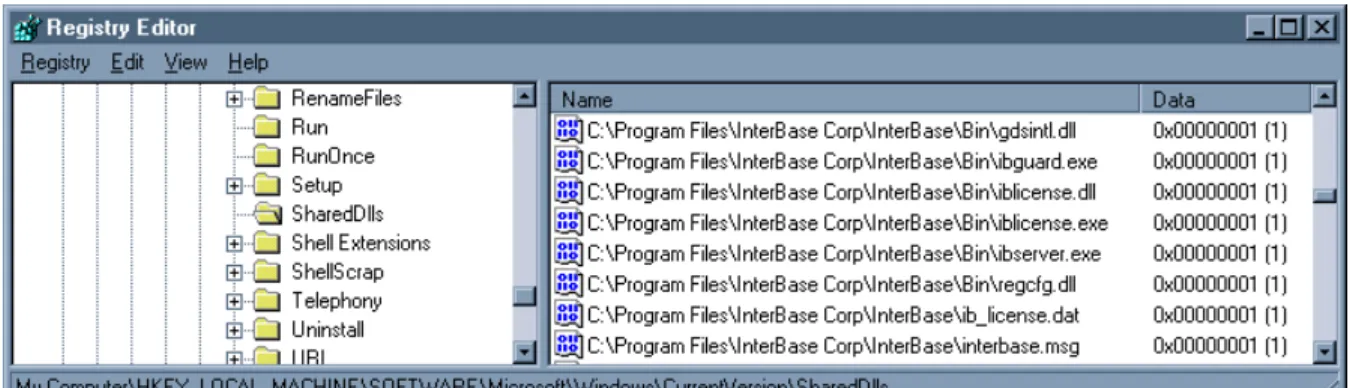
Files that are shared between multiple packages, or multiple installations of the same package, must maintain reference counts in the registry.
Even if your install does not copy a given file to the system because a newer version already exists, you should still update the reference count so that the uninstallation of another package does not delete a file on which your package depends.
FIGURE 2.1 SharedDLLs registry key
The key of the registry is: HKEY_LOCAL_MACHINE Software Microsoft Windows CurrentVersion SharedDLLs
The named values in this key are full pathnames of files that maintain reference count information.
The value data are numbers, indicating the number of software packages that depend on the respective file. When you install InterBase, you should increment the number associated with each file. When you uninstall, you should decrement the number.
See Appendix B, “InterBase Registry Reference,” for a list of the files to track in the SharedDLLs key.
Configuring the TCP/IP services entry
InterBase must have an entry in the SERVICES file to provide the mapping between the InterBase service by name and its port address on the server.
Note This is necessary on both server and client. It is necessary on Windows 95, Windows NT, and any other client or server operating system.
Check the file for an entry that reads:
If the entry is not there, add it to the file. SERVICES is a simple ASCII format file, and it is okay to append the gds_db entry to the end of the file, as long as it occupies a line of text by itself, with CR/LF (newline) characters at the end of the line.
The SERVICES file is located in:
· C:\WINDOWS\SERVICES on Windows 95
· %SYSTEM32%\DRIVERS\ETC\SERVICES on Windows NT
If the SERVICES file is not present, then TCP/IP is not installed on the system. You must install TCP/IP and configure the SERVICES file before connecting to a remote database.
Note You don’t need to configure the SERVICES file if you don’t use TCP/IP. For example, if you use NetBEUI for an InterBase client to connect to Windows NT server, or IPX/SPX for an InterBase client to connect to a NetWare server.
Windows service configuration
On Windows NT, InterBase can run as a service, that is, in the background even when no user is logged in at the NT console. This section describes the steps necessary to configure and start the InterBase service.
Windows 95 does not support services.
Make sure that the InterBase Server is not running while you are installing, configuring, and starting InterBase. See “Check if an InterBase server is running.” on page 11.
Configuring InterBase as an NT service
Use the following command-line utility that is included with InterBase 5.5 to configure the InterBase service on Windows NT:
instsvc install "C:\Program Files\InterBase Corp\InterBase" -auto
Note that instsvc configures only the InterBase server to run as an NT service; the InterBase Guardian service is not configured by instsvc. Guardian is a process that monitors the InterBase server process and restarts it if it terminates abnormally. Guardian is optional, but if you choose to run it, you must use the Windows API to configure it as a service.
EXAMPLE 2.2 Creating the Guardian service
SC_HANDLE service;
if (!(service = CreateService((SC_HANDLE) manager, "InterBaseGuardian",
"InterBase Guardian", SERVICE_ALL_ACCESS,
SERVICE_WIN32_OWN_PROCESS|SERVICE_INTERACTIVE_PROCESS,
SERVICE_AUTO_START, /* alternative is SERVICE_DEMAND_START */ SERVICE_ERROR_NORMAL,
"C:\\Program Files\\InterBase Corp\\InterBase\\bin\\ibguard.exe -s", NULL, NULL, NULL, NULL,NULL)))
EMBEDDED INSTALLATION GUIDE 17
NOVEMBER 13, 1998 InterBase 5.5
if (!(service = CreateService((SC_HANDLE) manager, "InterBaseServer",
"InterBase Server", SERVICE_ALL_ACCESS,
SERVICE_WIN32_OWN_PROCESS|SERVICE_INTERACTIVE_PROCESS,
SERVICE_DEMAND_START, /* must be DEMAND if Guardian starts it */ SERVICE_ERROR_NORMAL,
"C:\\Program Files\\InterBase Corp\\InterBase\\bin\\ibserver.exe -s -g", NULL, NULL, NULL, NULL,NULL)))
return 1; /* error */ CloseServiceHandle(service); return 0;
Configure the entries with the -s option to invoke them as services. The ibserver service should also be invoked with the -g option if and only if it is used with Guardian.
Note A process that configures services must have Administrator privileges.
Configuring InterBase as a Windows 95 peer-to-peer server
InterBase can function as a database server on Windows 95, but you should not use Windows 95 as a server platform when you require a high-performance, stable server for multiple clients. To configure the InterBase service to start upon boot of a Windows 95 host, add ibserver.exe to the Run registry key. See Appendix B, “InterBase Registry Reference” for details on the Run key. If you choose to run the Guardian service, add ibguard.exe instead to the Run key; in that configuration, the Guardian starts the InterBase server.
Starting InterBase services
Once the InterBase service is registered with the system, you can start the service by running the command-line tool:
instsvc start
Instsvc does not start the Guardian service. You must do this with the Windows API.
EXAMPLE 2.3 Starting the Guardian service
SC_HANDLE service;
if (!(service = OpenService(manager, "InterBaseGuardian", SERVICE_ALL_ACCESS))) return 1; /* error */ if (!StartService(service, 0, NULL)) { CloseServiceHandle(service); return 1; /* error */ } CloseServiceHandle(service); return 0;
If you start Guardian, it starts the InterBase service. You must not manually start both. Note A process that configures services must have Administrator privileges.
ODBC installation
To enable client applications to use the INTERSOLV® InterBase ODBC 3.0 driver, you must install the files listed in the table below. These files are distributed as part of the InterBase 5.5 product.
ODBC client installation also requires installation and configuration of the InterBase client files. See “Installing GDS32.DLL and INTERBASE.MSG” on page 12.
Note InterBase Software Corporation cannot legally provide the ODBC redistribution procedure to detail driver manager configuration and data source configuration.
To get the ODBC redistribution instructions, see the Microsoft ODBC 3.0 SDK documentation. You can download the ODBC SDK from the Microsoft web site and read the Microsoft ODBC SDK license terms and documentation. Refer to the following URL:
http://www.microsoft.com/data/odbc/download.htm
File pathname Purpose
%SYSTEM32%\IBINT13.DLL
%SYSTEM32%\IBBAS13.DLL
%SYSTEM32%\IBUTL13.DLL
%SYSTEM32%\IVODBC.LIC
INTERSOLV® InterBase ODBC driver
%SYSTEM32%\IBDRV13.HLP
%SYSTEM32%\IBDRV13.CNT
%SYSTEM32%\IBINT13.HLP
INTERSOLV® InterBase ODBC driver Windows help files
CHAPTER
3
Chapter 3
Uninstallation Procedure
This chapter details steps you should take to uninstall an embedded copy of InterBase as part of your own product uninstallation.
Stopping the InterBase service
Make sure you can stop the InterBase service without interfering with other applications that use InterBase. Another application package might be in operation, connecting to the same service you are uninstalling.
The safest policy is to abort the uninstall routine if the InterBase service is running (see “Check if an InterBase server is running.” on page 11), and insist that the user manually stop the service using the Windows NT Control Panel.
Uninstalling InterBase
Follow the steps below to remove the InterBase server product entirely. You can use the InterBase utilities for some of this, or implement code to do it using the Windows API.
1. Decrement reference counts.
Before removing any InterBase services or files, first decrement the reference counts: HKEY_LOCAL_MACHINE
Software
InterBase Corp: UseCount InterBase: UseCount
CurrentVersion: UseCount Microsoft
Windows
SharedDLLs: *
See Appendix B, “InterBase Registry Reference” for a list of InterBase-related files in the SharedDLLs registry key.
Note If the reference counts are greater than zero after you decrement them, another package has installed InterBase, and may need to use it. If this is the case, stop here and do not proceed to the following steps.
Do not remove the product if the reference count is zero before you decrement it: it could mean that another uninstall improperly registered a file and its reference count in the registry, and therefore your uninstall cannot infer that it is safe to remove the file without affecting another application.
2. Shut down the service.
If you are certain that it is safe to stop the service programmatically, use the InterBase utility: instsvc stop
This stops both the InterBase service and the Guardian service. Alternately, you can use the Windows API to stop the service.
EXAMPLE 3.1 Stopping the Guardian service
SC_HANDLE service;
SERVICE_STATUS svc_status;
if (!(service = OpenService(manager, "InterBaseGuardian", SERVICE_ALL_ACCESS)))
return 1; /* error */
if (!ControlService(service, SERVICE_CONTROL_STOP, &svc_status)) {
CloseServiceHandle(service); return 1; /* error */
}
/* Wait for the service to actually stop before returning. */ do { if (!QueryServiceStatus(service, &svc_status)) { CloseServiceHandle(service); return 1; /* error */ }
} while (svc_status.dwCurrentState == SERVICE_STOP_PENDING); CloseServiceHandle(service);
return 0;
Note A process that configures services must have Administrator privileges. 3. Remove the service.
You can remove InterBase from its place as a Windows NT service using instsvc: instsvc remove
You can remove the Guardian service and the InterBase service using the Windows API:
EXAMPLE 3.2 Removing the Guardian service
SC_HANDLE service;
EMBEDDED INSTALLATION GUIDE 21 NOVEMBER 13, 1998 InterBase 5.5 if (!DeleteService(service)) { CloseServiceHandle(service); return 1; /* error */ } CloseServiceHandle(service) return 0;
4. Remove registry items.
If the UseCount of InterBase reaches zero, you can remove registry items using your installation authoring tools.
Refer to Appendix B, “InterBase Registry Reference,” for a list of registry items you should consider removing.
5. Delete files.
If a reference count in the SharedDLLs key reaches zero, you can safely delete the file. If UseCount reaches zero, delete the files under the InterBase root directory and also the GDS32.DLL library in the Windows system directory.
Do not delete ISC4.GDB and ISC_CONFIG. It is customary to leave configuration files like these even after uninstalling the software. The user may choose to reinstall and the information in these files may not exist anywhere else.
APPENDIX
A
Appendix A
Files by Component
Below is a list of all files in the InterBase product.
A full installation of InterBase 5.5 including documentation and shared DLL’s uses a total of 23,846KB in the InterBase installation directory and 2843KB in the Windows system directory. Most of the filenames given below are relative to the InterBase installation root. This is typically C:\Program Files\InterBase Corp\InterBase\. Other paths are in the Windows system directory, %SYSTEM32%..
The table below describes each file’s function and any special considerations. The table also gives information about which files are essential for proper functioning of the client and the server, and whether reference counts for the files should be tracked in the registry. Files that appear in more than one component are marked with an †.
Filename Size Description / Notes
Req’d on client Req’d on server Shared DLL InterBase: Server 4578KB
.\Bin\ibguard.exe 22KB InterBase Guardian executable no no Yes
.\Bin\ibserver.exe 1318KB InterBase Server executable no Yes Yes
.\Bin\gdsintl.dll 581KB International character sets and collation information no no Yes
.\ibconfig 1KB File of server configuration information no Yes no
.\ib_license.dat 1KB File with keys that enable client or server functionality; put deployment keys in this file
Yes Yes Yes
.\interbase.log — Error log is created by client and server if not present; you do not distribute it
no no no
.\interbase.msg† 117KB Error messages for client and server software Yes Yes Yes
.\isc4.gbk 3KB Backup of factory-ship (empty) security database, used if the security database is corrupted
no Yes no
.\isc4.gdb 244KB Security database, storing usernames and passwords; never uninstall or overwrite this file
.\license.txt† 18KB Legal text of InterBase client and server license agreement;
you must distribute this with all copies of InterBase client and server
Yes Yes no
.\readme.txt† 2KB Brief notes about this InterBase version, pointers to documentation
no no no
.\ReleaseNotes.pdf† 455KB InterBase 5.5 summary; viewable with Acrobat Reader no no no .\Bin\iblicense.exe†
.\Bin\iblicense.dll†
30KB 20KB
InterBase License Manager no no Yes
.\Bin\iblockpr.exe 69KB Lock table analysis; required to be installed on the server to enable lock statistics report by Server Manager for Windows (IBMGR32)
no Yes no
.\Bin\instreg.exe† 6KB Utility to install/remove most InterBase registry database entries; use either this or the Windows API
no no no
.\Bin\instsvc.exe† 8KB Utility to install/start/stop/uninstall the InterBase service; use either this or the Windows API
no no no
.\Bin\gstat.exe 25KB Database analysis; required to be installed on the server to enable database statistics report by Server Manager for Windows (IBMGR32) no Yes no .\Bin\regcfg.exe .\Bin\regcfg.dll 30KB 311KB
InterBase Service Configuration Tool
InterBase Service Configuration application extension
no no no Yes .\Bin\Ibserver.hlp .\Bin\Ibserver.cnt 21KB 1KB
InterBase server-specific help and contents no no no .\Bin\Perform.hlp
.\Bin\Perform.cnt
33KB 1KB
Brief tips on improving performance, help and contents no no no
%SYSTEM32%\ mfc42.dll 933KB Microsoft runtime library no Yes Yes
%SYSTEM32%\ gds32.dll† 328KB InterBase client library; used by server for local access Yes Yes Yes
InterBase: Client 1342KB
.\interbase.msg† 117KB Error messages for client and server software Yes Yes Yes
.\license.txt† 18KB Legal text of InterBase client and server license agreement;
you must distribute this with all copies of InterBase client and server
Yes Yes no
.\readme.txt† 2KB Brief notes about this InterBase version, pointers to documentation
no no no
.\ReleaseNotes.pdf† 455KB InterBase 5.5 summary; viewable with Acrobat Reader no no no .\Bin\iblicense.exe†
.\Bin\iblicense.dll†
30KB 20KB
InterBase License Manager no no Yes
Filename Size Description / Notes
Req’d on client Req’d on server Shared DLL
EMBEDDED INSTALLATION GUIDE 25
NOVEMBER 13, 1998 InterBase 5.5
.\Bin\instsvc.exe† 8KB Utility to install/start/stop/uninstall the InterBase service; use either this or the Windows API
no no no
.\Bin\Ib32.hlp .\Bin\Ib32.cnt
57KB 3KB
Master help file, has contents of other help files no no no
.\Bin\Ibgloss.hlp .\Bin\Ibgloss.cnt
25KB 1KB
InterBase glossary & definitions help and contents no no no
%SYSTEM32%\ gds32.dll† 328KB InterBase client library; used by server for local access Yes Yes Yes
InterBase: Command tools 377KB Total of Command tools subcomponents InterBase: Command tools:
database management 232KB
.\Bin\gbak.exe 177KB Backup utility; required to be installed on the server to enable backup or restore by Server Manager for Windows (IBMGR32)
no Yes no
.\Bin\gfix.exe 33KB Database configuration utility; required to be installed on the server to enable database configuration by Server Manager for Windows (IBMGR32)
no Yes no
.\Bin\gsplit.exe 22KB Splits output of GBAK into multiple files no no no
InterBase: Command tools:
user management 27KB
.\Bin\gsec.exe† 27KB Security database utility; required to be installed on the server to enable user administration by Server Manager for Windows (IBMGR32)
no Yes no
InterBase: Command tools:
database query 118KB
.\Bin\isql.exe 118KB Console-mode query shell and SQL script interpreter no no no
InterBase: GUI tools 1699KB Total of GUI tools subcomponents InterBase: GUI tools:
database management 1398KB .\Bin\comdg32.exe .\Bin\comdg32.dll .\Bin\comdg32.ini 235KB 92KB 1KB
Communications Diagnostics Tool no no no
.\Bin\Comdg32.hlp .\Bin\Comdg32.cnt
12KB 1KB
Communications Diagnostics tool help and contents no no no .\Bin\ibmgr32.exe
.\Bin\gbak32.dll
786KB 192KB
InterBase Server Manager for Windows no no no
.\Bin\Ibmgr32.hlp .\Bin\Ibmgr32.cnt
74KB 5KB
InterBase Server Manager help and contents no no no
InterBase: GUI tools: user
management 27KB
Filename Size Description / Notes
Req’d on client Req’d on server Shared DLL
.\Bin\gsec.exe† 27KB Security database utility; required to be installed on the server to enable user administration by Server Manager for Windows (IBMGR32)
no Yes no
InterBase: GUI tools:
database query 274KB
.\Bin\wisql32.exe 243KB Windows Interactive SQL query tool no no no
.\Bin\Wisql32.hlp .\Bin\Wisql32.cnt
29KB 2KB
Windows ISQL help and contents no no no
InterBase: ODBC 790KB INTERSOLV® InterBase ODBC 3.0
%SYSTEM32%\ ibint13.dll %SYSTEM32%\ ibbas13.dll %SYSTEM32%\ ibutl13.dll 130KB 301KB 293KB
ODBC driver libraries; required on client host to enable ODBC client applications to interface with InterBase client library
no no Yes
%SYSTEM32%\ ivodbc.lic 1KB ODBC license file no no Yes
%SYSTEM32%\ ibdrv13.hlp %SYSTEM32%\ ibdrv13.cnt %SYSTEM32%\ ibint13.hlp 46KB 2KB 17KB
ODBC driver Windows help files no no Yes
InterBase: Developer tools 626KB
.\Bin\gpre.exe 322KB Embedded SQL code preprocessor; used only during application development
no no no
.\Include\ibase.h 81KB C/C++ header file for InterBase client SDK interface no no no .\Include\ib_util.h
.\Include\ib_util.pas
1KB 1KB
Utility functions to supplement InterBase API; C and Pascal include files
no no no
.\Include\iberror.h 27KB InterBase error code definitions; automatically included by ibase.h
no no no
.\Lib\gds32.lib 39KB Borland C++ client import library no no no
.\Lib\gds32_ms.lib 145KB Microsoft Visual C++ client import library no no no
.\Lib\ib_util.lib 1KB Utility import library no no no
.\Lib\ib_util_ms.lib 2KB Utility import library no no no
.\Lib\ib_udf.dll 7KB InterBase standard UDF dynamic library no Yes no
.\Lib\ib_util.dll 4KB Utility dynamic library no Yes no
InterBase: Documentation 16086KB Online books; viewable with Acrobat Reader
.\Doc\APIGuide\APIGuide.pdf 3220KB InterBase 5.5 API Guide no no no
.\Doc\DataDef\DataDef.pdf 2236KB InterBase 5.5 Data Definition Guide no no no
.\Doc\LangRef\LangRef.pdf 2622KB InterBase 5.5 Language Reference no no no
Filename Size Description / Notes
Req’d on client Req’d on server Shared DLL
EMBEDDED INSTALLATION GUIDE 27 NOVEMBER 13, 1998 InterBase 5.5 .\Doc\Tutorial\Tutorial.pdf .\Doc\Tutorial\*.sql 745KB 60KB
Teach Yourself InterBase 5.5 no no no
.\Doc\IB5index.pdx .\Doc\IB5index\*
2KB 1945KB
Acrobat index, to enable online books to be searchable no no no
InterBase: Examples 1298KB InterBase: Examples:
Database 1089KB
.\Examples\database\ employee.sql
2KB Script to act on EMPLOYEE.GDB no no no
.\Examples\database\ employee.gbk
72KB Backup of EMPLOYEE.GDB no no no
.\Examples\database\ employee.gdb
458KB Employee & sales database no no no
.\Examples\database\ intlemp.gbk
80KB Backup of INTLEMP.GDB no no no
.\Examples\database\ intlemp.gdb
477KB EMPLOYEE.GDB with international character sets no no no
InterBase: Examples: API 209KB
.\Examples\API\ *.h, *.c, *.e, *.def, *.sql
177KB Example API and embedded SQL programs: C source and supporting DDL files
no no no
.\Examples\API\Makefile.bc 9KB Borland C++ Makefile for examples no no no
.\Examples\API\Makefile.ms 9KB Microsoft Visual C++ Makefile for examples no no no .\Examples\ib_udf.sql 16KB SQL script to enable UDFs in a given database no no no
InterBase: Common 1139KB
.\ibuninst.exe 277KB ISC uninstallation application Yes Yes Yes
.\ibinstall.dll 65KB ISC installation application extension; called by ibuninst.exe and setup.exe
Yes Yes Yes
%SYSTEM32%\ setupapi.dll 316KB Win32 setup API, called by ibinstall.dll; never deleted or overwritten
Yes Yes Yes
%SYSTEM32%\ cfgmgr32.dll 57KB Win32 setup API, called by ibinstall.dll; never deleted or overwritten
Yes Yes Yes
%SYSTEM32%\ msvcrt.dll 272KB Microsoft runtime library; never deleted Yes Yes Yes
%SYSTEM32%\ odbccp32.dll 86KB ODBC core file; ODBC installer; never deleted
Yes Yes Yes
%SYSTEM32%\ odbcint.dll 66KB ODBC core file; translation resources for installer; never deleted
Yes Yes Yes
.\ibuninst.xxx — ISC uninstall information no no no
Filename Size Description / Notes
Req’d on client Req’d on server Shared DLL
B
Appendix B
InterBase Registry Reference
HKEY_LOCAL_MACHINE
Software\InterBase Corp UseCount
The “UseCount” item denotes how many times the InterBase product has been installed on this server. Earlier versions of InterBase did not set this item in the registry, so if your install code finds the “Software\InterBase Corp” key, but no UseCount item, assume that the UseCount data was meant to be “1”, and your code should create the item and set its value to “2”. If the UseCount item does exist, increment it when you install InterBase. Decrement when you uninstall InterBase. If you reduce the value to zero, delete the registry key.
You should create the UseCount value under the InterBase Corp, InterBase, and subordinate CurrentVersion registry keys.
Software\InterBase Corp\InterBase UseCount
See UseCount above.
Software\InterBase Corp\InterBase\CurrentVersion UseCount
See UseCount above. DefaultClientMode = “-r”
You can safely ignore this value in your custom installation application. It is used only by the old-style multi-process InterBase server technology.
DefaultMode
You might see this value after installing InterBase; however it created by mistake in some versions of the InterBase installer; it is supposed to be the DefaultClientMode value. It is safe to ignore this value in your installation application.
EMBEDDED INSTALLATION GUIDE 29
NOVEMBER 13, 1998 InterBase 5.5
RootDirectory = “C:\Program Files\InterBase Corp\InterBase”
This determines where the ibserver process looks to find IB_LICENSE.DAT and INTERBASE.MSG.
ServerDirectory = “C:\Program Files\InterBase Corp\InterBase\bin\” This is the location where IBSERVER.EXE and IBGUARD.EXE are installed. Version = “WI-V5.5.0”
This is the version of InterBase you are installing. Software\Microsoft\Windows\CurrentVersion\Run
Note Configure only one of the following server Run items on Windows 95. Also note that use of these registry items is mutually exclusive with use of the Windows 95 Startup program group. Do not configure both.
InterBase Server = “C:\Program Files\InterBase Corp\InterBase\Bin\ibserver.exe” Use this item on Windows 95 to configure the system to start the InterBase Server
automatically during boot. This configuration is not used on Windows NT; instead configure InterBase as a service.
InterBase Guardian = “C:\Program Files\InterBase Corp\InterBase\Bin\ibguard.exe” Use this item on Windows 95 to configure the system start the InterBase Guardian
automatically during boot. This configuration is not used on Windows NT; instead configure InterBase as a service.
Software\Microsoft\Windows\CurrentVersion\SharedDlls C:\Program Files\InterBase Corp\InterBase\iblicense.dat C:\Program Files\InterBase Corp\InterBase\interbase.msg C:\Program Files\InterBase Corp\InterBase\bin\ibserver.exe C:\Program Files\InterBase Corp\InterBase\bin\ibguard.exe C:\Program Files\InterBase Corp\InterBase\bin\gdsintl.dll C:\Program Files\InterBase Corp\InterBase\bin\iblicense.dll C:\Program Files\InterBase Corp\InterBase\bin\iblicense.exe C:\Program Files\InterBase Corp\InterBase\bin\regcfg.dll %SYSTEM32%\GDS32.DLL
%SYSTEM32%\mfc42.dll %SYSTEM32%\msvcrt.dll
%SYSTEM32%\ODBCCP32.DLL
%SYSTEM32%\ODBCINT.DLL
These items in the SharedDlls key are the reference counts for shared InterBase files. See “Shared files and reference counts” on page 15.
Note The SharedDlls registry key is not present on a freshly installed Windows system that has no other software. Your installation application must contain logic to check that the key is present before creating values under that key. The SharedDlls registry key is created by most software packages, including those that make use of InstallShield technology.
Software\Microsoft\Windows\CurrentVersion\Uninstall\InterBase
Note This following items are used only by the InterBase product uninstallation. You as a VAR writing a customized install/uninstall should implement your own uninstall solution. They are included here only for historical documentation purposes.
DisplayName = InterBase
UninstallString = "C:\Program Files\InterBase Corp\InterBase\ibuninst.exe" "C:\Program Files\InterBase Corp\InterBase\ibuninst.001"