Filtering Spam Mail in Non-Segmented Languages Using Hybrid
Approach: the Integration of Stopword Removal, N-gram Extraction
and Classification Techniques
Ployphailin Khumsong, Todsanai Chumwatana, and Supanit Augsirikul
Rangsit University, Thailand, {ploypailin.k54; todsanai.c; supanit.a}@rsu.ac.th
ABSTRACT
Junk mail or spam mail has been regarded as a major problem in today’s world. The spam mail can lead to cybercrime that impacts all individuals and organization. Many people and businesses seek for spam mail prevention technique in order to protect their own data and computer system. The spam mails normally contain advertise products or services contents and also conveys viruses, malwares, spywares and so forth. Many people thought spam mails do not cause any damage. In fact, the spam mails made a management cost increased and resources will be used ineffectively. Therefore, verifying and filtering spam mails need to be taken into consideration. The objective of this paper is to introduce the hybrid approach, which combines three techniques including stop-word removal, n-gram extraction and data classification, for filtering spam emails and simplifies system development. The proposed hybrid approach can be widely applied for all different languages due to being language independent technique. To examine the approach, CSDMC2010 spam mail corpus comprising of 198 common emails, 202 spam mails, and 10 selective emails were used in experimental study. The results showed that the proposed technique enabled to monitor whether the email is spam with 93.2% accuracy. Hence, this hybrid approach could provide benefits for all users and organization to decrease the computer risk.
Keywords: Spam mail, N-gram extraction,
Classification, Stop-word removal, Non-segmented languages
I INTRODUCTION
In Thailand, the Internet recently plays a significant role which makes the communication easier for people in all areas. Electronic mails or e-mail serve as the popular communication channel which widely used due to cost and time saving. More importantly, the e-mail is an online service and unlimited that can be sent to multi people in different places at a time.
Regarding the advantages, the email has become a primary way for online communication among the Internet users (Statistics and facts of email marketing, 2013) With the rapid growth and various benefits of the email, some groups of people make an effort to
earn their income by using email containing soliciting message to advertise, promote or selling their products and services. This potential threat is known as “Spam Mail”. The spam mail or unsolicited message email causes the interruption to any receiver in which they are offended their privacy and waste their time to eliminate those spam mails. The spam mails steadily increase on the Internet because it is instant and very cost-effective medium (Puckdeewongs, 2003). Consequently, the spam mail is used for money purpose. Furthermore, the large growth of spam mail also impacts to all people and organization in the aspect of computer risk since spam mail embeds not only persuasive texts but also viruses, malwares, spywares, and so forth. These are harmful to all users including individuals, organizations and a group of agencies.
In general, the spam mail are basically prevented or detected by examining words which are comprised in any sections of emails such as the title or the content (Tubsee, 2010). Words used in the email content are separated and brought to investigate the characteristic of spam mail. Nevertheless, procedures in separating words of each language are different, for example, English words are separated by white space. In contrast to English language, many Asian languages (e.g. Chinese, Japanese, Thai and Korean) are written without spaces. Thus, the traditional technique can be only applied with English languages. Regarding to the limitation, n-gram has become more important technique for separating words from email content because it can be used with all different languages without considering the meaning of words. Moreover, the study of Stop-word removal for more accuracy in filtering the spam mails should be concerned. Based on the survey, the email both normal and spam mails mainly composed of Stop-word approximately 30 to 50% of the content in many languages. The set of Stop-word is normally shared by most emails which make the accuracy of distinguishing and filtering the spam mails is lower. Hence, this research aims to propose the hybrid approach integrating three techniques: Stop-word Removal, N-gram and Data Classification, for better categorization and filtering spam mails.
II RELATED WORKS
Spam mail is a term of unsolicited commercial message which has been sent to numerous recipients without their permission or reception (Yusuk, 2013). Those spam mails are unwanted mail which encompasses with product, services, advertisement, online gamble contents (Rojkangsadan, 2016). In traditional way, screening the spam mails can be done through data classification technique, which previous data are collected and brought to train the system and then to establish a new model for testing. The classification technique consists of three main procedures: 1) creating a new model by analyzing the previous data with a variety of data classification techniques, 2) testing the efficiency of the build model, and 3) applying the model for screening new upcoming data (Pacharawongsakda, 2014).
Before classifying the data, information extraction (IE) process is primarily used for classifying the proper information. Many algorithms may be adopted in the information extraction in order to enhance computer system for greater comprehension on any document, texts, and data (Mansamut, 2010). Another technique is to employ Natural Language Processing (NLP), the artificial intelligence that enables a computer program to understand intended meaning of any human languages. Nevertheless, the diversity of human speech reflects various kinds of language difficulties such as ambiguity, pronouns, reference and ellipsis. As a result, the classification of text documents can be divided into two main techniques: language dependent and language independent (Todsanai, 2014).
In the language dependent approach, there are several techniques proposed to split non-segmented texts such as Chinese (Kwok), Japanese (Croft, 1993), Korea (Ahn, 1996) and Thai (Smith, 2001) into term tokens. A word segmentation technique is usually required to extract a bag of words before they can be used in classification process. This technique usually rely on language analysis or on the use of dictionary. The preparation of such method is very time consuming. Therefore, word segmentation has become a challenging task in Natural Language Processing (NLP) for many languages.
Apart from language dependent technique, there is other technique, called n-gram technique, which is language-independent (Adams, 1991). This technique is a language-independent approach which has been adapted in word delimitation process. n-gram is a sequence of items which typically collected from either spoken and written texts. The n-gram model word type provides more efficient to establish “Language Statistic Model” and to retrieve any information without language dependency ( Majumder, 2002). For instance, the analysis of a word
‘university’ by bi-grams resulted as : un, ni, iv, ve, er, rs, si, it, ty, y_, using ‘_’ for space.
Both language dependent and independent approaches have been applied in several previous studies in the area of document classification in multi-languages. The study of Majumder investigated five groups of Indian language adhering to Algorithm theory proposed by Cavnar (Majumder, 2002). The researchers selected a set of 100 documents from five different Indian languages for creating n-gram profiles and examining the shortest space. Their findings showed that using alphabets and words building n-gram profiles offer positive results in both cases.
Another study is done by Mansur (Mansur, 2006) employing n-Gram Algorithm to categorize Bangla in Prothom-Alo newspapers which was published for a year. The overall results revealed that 2-gram or 3-gram could perform as the most proper methods for data classification. Furthermore, Zhihua adopted text representative and data selection techniques to classify data in Chinese language (Zhihua, 2009). They examined n-grams for three main purposes: 1) to compare the effectiveness on performance of data selection features, 2) to compare the sparseness, and 3) to compare the ability among three weight methods.
The data from Chinese corpus TanCorpV1.0 (over 14,000 texts divided into 12 classes) were used as the source of data in their study. Their research findings are detailed as follows: 1) by using less than 3000 features, the n-gram frequency basically provides better outcomes rather than those selected by text frequency (absolute or relative). Relative frequency results reflect more negative consequences than absolute frequency. In the cause of using greater than 3000 features, both absolute and relative frequency results contained much similarity, 2) the selective method using n-gram frequency caused a dense of “text feature” matrix, which was more than the relative frequency, 3) the n-gram frequency selection generated the feature which carried less correlation than those selected in the text frequency, and 4) text representation at TF weight contained similar performance to those text using tf*idf , in which both methods had greater capability than 0/1 logical weight.
III FILTERING SPAM MAIL IN NON-SEGMENTED LANGUAGE USING HYBRID APPROACH: THE INTREGATION OF STOP-WORD REMOVAL, N-GRAM EXTRACTION
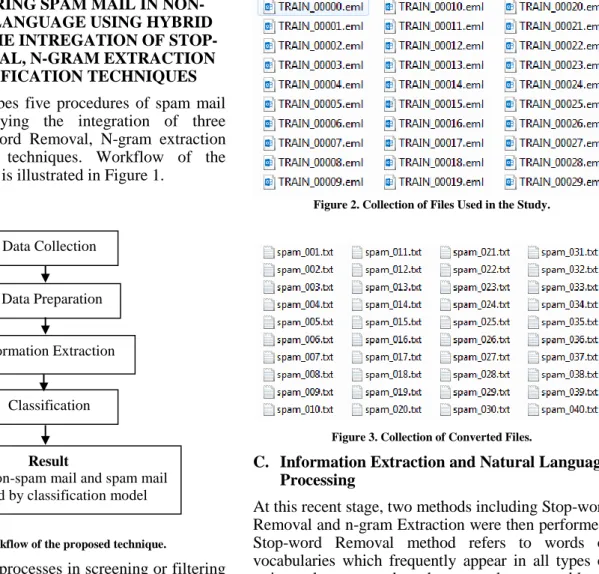
AND CLASSIFICATION TECHNIQUES This section describes five procedures of spam mail filtration by applying the integration of three techniques: Stop-word Removal, N-gram extraction and classification techniques. Workflow of the proposed technique is illustrated in Figure 1.
Figure 1. Workflow of the proposed technique.
From Figure 1, the processes in screening or filtering spam mails are divided into four steps including data collection, data preparation, information extraction and classification. These four steps comprise of distinct function as given below.
A. Data Collection
For data collection (Spam email datasets, 2010), all data was gathered from CSDMC2010 SPAM corpus by selecting the content of emails and used to experiment spam mail filtering system. 410 sets of information were brought and grouped into three folders: 1) 198 normal electronic mails, 2) 202 junk mails or spam mails, and 3) 10 selected mails opened with outlook program for sighting all content in the mails.
B. Data Preparation
The data preparation is the second procedure which aims to select the information from email content and to convert the data. Before information extraction, ‘.eml’ files were converted into ‘.txt’ or text document files for being used in the other steps. The data preparation stage is presented in Figure 2 and 3.
Figure 2. Collection of Files Used in the Study.
Figure 3. Collection of Converted Files.
C. Information Extraction and Natural Language Processing
At this recent stage, two methods including Stop-word Removal and n-gram Extraction were then performed. Stop-word Removal method refers to words or vocabularies which frequently appear in all types of written documents, but those words are unable to represent the focal meaning of the message such as a, an, the, and, about, is, am, are in English language as shown in figure 4. Typically, many languages in the world have their own stop word list which appears approximately 30 to 50% of the content. The frequent occurrence of those stop words would make most email are similar to each other which makes it difficult in distinguishing the spam mail from non-spam mails. This is because most emails share the same stop words in emails. Consequently, these stop words should be excluded from the email before information extraction can be performed.
Data Collection
Result
Group of non-spam mail and spam mail predicted by classification model
Data Preparation
Information Extraction
Figure 4. Example of Stop Words in English.
At this step, stop words are eliminated by creating Hash Table for all stop words and compare with email content in the collection. After that, stop words shown in the email were then deleted; only important content remains in the document. The next step is extracting n-gram from the emails. All emails without stop words were processed in the information extraction by using n-gram technique. In this paper, 2-gram, 3-gram, 4-gram and 5-gram were used as a dimension of gram in information extraction process which will be described in the following.
Assume that email d consists of a string s of characters a1, a2, ..., aN. An n-gram term is a substring of n overlap or non-overlap successive characters extracted from the string. Extracting a set of n-gram terms from the email d can be done by using the 1-sliding technique. Therefore, the ith n-gram term extracted from email d is the substring ai, ai+1, ..., ai+n. Table 1 shows 2-gram, 3-gram, 4-gram, 5-gram overlap sequence of the email d containing the string s ‘you won’
Table 1. Samples of 2-gram, 3-gram, 4-gram, 5-gram of string s ‘you won’.
n-gram List of n-gram terms
2-gram terms yo, ou, u_, _w, wo, on 3-gram terms you, ou_, u_w, _wo, won 4-gram terms you_, ou_w, u_wo, _won 5-gram terms you_w, ou_wo, u_won
After dividing terms with n difference, the researcher produced the model for information processing and predicting types of emails in the next procedures.
The different size of n (2-5) was used to assess the performace and to investigate the propotion of n which reflects the most effective results.
D. Data Classification
The research was conducted using data mining techniques which includes Decistion Tree, Naïve Bayes, K-NN and SVM with the same set of data. The results of SVM technique is appropriate for the data sets and the highest performance. Therefore, SVM technique is used as a model applied in this research. In this step, the SVM model were constructed from training data method. After extracting n-gram terms from emails, the SVM model was tested with a set of testing data for assessing the accuracy of the model. The researcher emperimented the model three rounds with the specific different random seed staring from 500, 1000, and 1500. In addition, the comparison of model performance with differenct size of n from 2 to 5 was assessed. The average or mean of various n-gram performance are presented in Table 2.
Table 2. Percentage of accuracy for diffent grams.
Random Seed 2-gram 3-gram 4-gram 5-gram 500 75.06 90.93 91.18 93.2 1000 74.81 90.93 91.18 93.2 1500 76.07 92.19 91.18 93.2 Average 75.31 91.35 91.18 93.2
From table 2, result shows the percentage of accuracy of predicting or categorizing whether the sample emails are normal or spam mails. The accuracy of the analysis would be monitored. The experimental study and result will described in detail in next section.
IV EXPERIMENTATL STUDY
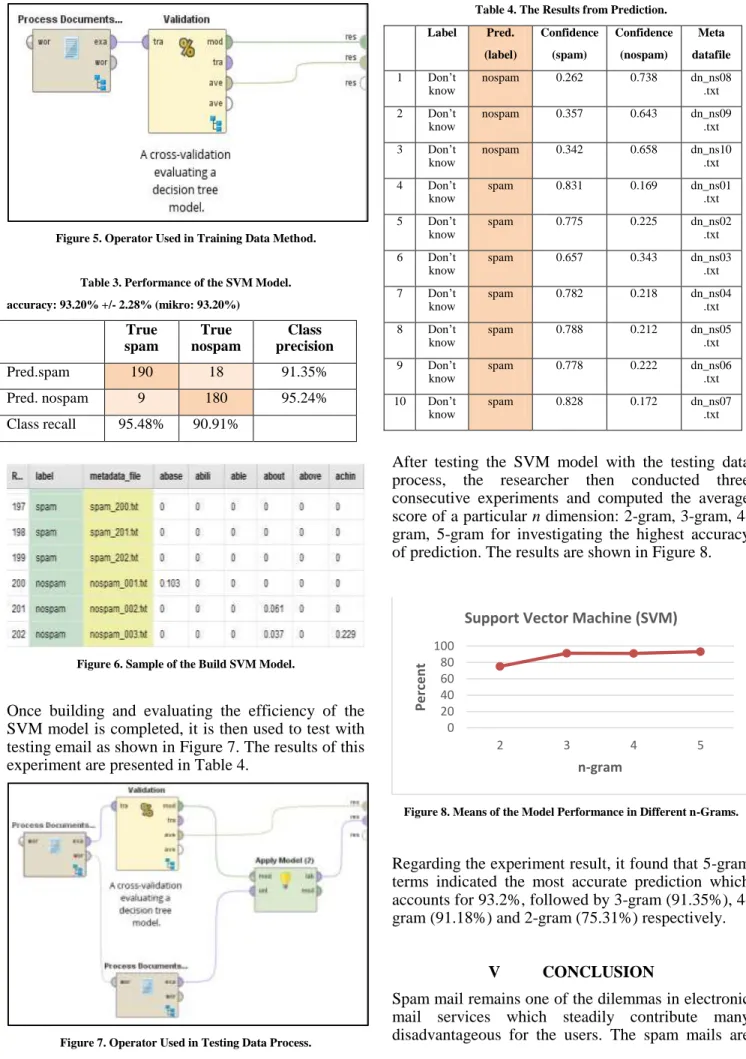
Set of input emails used in this paper were collected from CSDMC2010 SPAM Corpus (from: http://csmining.org/index.php/spam-email-datasets-.html). The researcher gathered 410 data which were separated into three sets: 198 normal mails, 202 spam mails, and 10 testing emails. These email will be sent to Stop-word removal and Information Extraction processes. Then the SVM model were created and learn from the data set by using 10-Fold Cross Validation method. The operator used in training process is shown in Figure 5. Moreover, the performance of the SVM model and the build SVM model are presented in Table 3 and Figure 6.
Figure 5. Operator Used in Training Data Method.
Table 3. Performance of the SVM Model. accuracy: 93.20% +/- 2.28% (mikro: 93.20%) True spam True nospam Class precision Pred.spam 190 18 91.35% Pred. nospam 9 180 95.24% Class recall 95.48% 90.91%
Figure 6. Sample of the Build SVM Model.
Once building and evaluating the efficiency of the SVM model is completed, it is then used to test with testing email as shown in Figure 7. The results of this experiment are presented in Table 4.
Figure 7. Operator Used in Testing Data Process.
Table 4. The Results from Prediction.
Label Pred. (label) Confidence (spam) Confidence (nospam) Meta datafile 1 Don’t know nospam 0.262 0.738 dn_ns08 .txt 2 Don’t know nospam 0.357 0.643 dn_ns09 .txt 3 Don’t know nospam 0.342 0.658 dn_ns10 .txt 4 Don’t know spam 0.831 0.169 dn_ns01 .txt 5 Don’t know spam 0.775 0.225 dn_ns02 .txt 6 Don’t know spam 0.657 0.343 dn_ns03 .txt 7 Don’t know spam 0.782 0.218 dn_ns04 .txt 8 Don’t know spam 0.788 0.212 dn_ns05 .txt 9 Don’t know spam 0.778 0.222 dn_ns06 .txt 10 Don’t know spam 0.828 0.172 dn_ns07 .txt
After testing the SVM model with the testing data process, the researcher then conducted three consecutive experiments and computed the average score of a particular n dimension: 2-gram, 3-gram, 4-gram, 5-gram for investigating the highest accuracy of prediction. The results are shown in Figure 8.
Figure 8. Means of the Model Performance in Different n-Grams.
Regarding the experiment result, it found that 5-gram terms indicated the most accurate prediction which accounts for 93.2%, followed by 3-gram (91.35%), 4-gram (91.18%) and 2-4-gram (75.31%) respectively.
V CONCLUSION
Spam mail remains one of the dilemmas in electronic mail services which steadily contribute many disadvantageous for the users. The spam mails are
0 20 40 60 80 100 2 3 4 5 Pe rc e n t n-gram
unwanted or unsolicited message that not only sent for commercial purpose, but also transmit viruses, malwares, and spywares to users’ computer systems. To reduce computer risk, this paper proposed the integrated approach combing three techniques: Stop-word Removal, N-gram extraction and Classification for screening or filtering spam mail precisely and effectively. This hybrid approach is available to all language used in the world. The experimental result shows that the proposed technique is able to identify spam mail with performance 93.2% of accuracy. Furthermore, the researcher discovered that the number of n dimension which conveys the most precise prediction was 5-grams, following by 3-grams (91.35%), 4-gram (91.18%), and 2-gram (75.31%). Based on the results, it can be concluded that the proposed technique can serve as the effective model to categorize spam mail from other emails. Significantly, the model may be helpful for users either individuals or organizations to avoid and computer risk and cybercrimes. It also can be applied to any other method or theory. To achieve a more accurate prediction
REFERENCES
Adams, E. (1991). A Study of Trigrams and Their Feasibility as Index Terms in a Full Text Information Retrieval System. PhD thesis,
George Washington University, USA, 1991.
Ahn, J. (1996). Using n-Grams for Korean Text Retrieval, In Proc. Int’l
Conf. on Information Retrieval, ACM SIGIR, Zurich, Switzerland, pp.
216-224.
Croft, W. (1993). A Comparison of Indexing Techniques for Japanese Text Retrieval, In Proceedings of ACM SIGIR International
Conference on Research and Development in Information Retrieval,
pp. 237-246.
Kwok, L. (1997). Comparing Representations in Chinese Information Retrieval," in Proceedings of the 20th Annual International ACM SIGIR Conference on Research and Development in Information on 27-31 July. Philadelphia, PA: ACM Publication , 34-41.
Majumder, M. M Mitra and B.B. Chaudhuri. (2002). N-gram a language independent approach to IR and NLP, Kolkata.
Mansamut, K. (2010). Information Extraction (IE). Retrieved 2015 April 21, From : https://ejeepss.wordpress.com/2007/10/01/information-extraction-ie/.
Mansur, M. Naushad UzZaman and Mumit Khan. (2006). Analysis of N-Gram Based Text Categorization for Bangla in a Newspaper Corpus (Bacherlor’s Thesis). Department of Computer Science and Engineering, BRAC University, Bangladesh.
Pacharawongsakda, E. (2014). An Introduction to Data Mining Techniques. (2nd ed.). Bangkok : Asia Digital Printing Limited. Puckdeewongs, A. (2003). Anti-Spam Mail System. Master thesis, M.S.,
King Mongkut’s Institute of Technology North, Bangkok
Rojkangsadan, T. (2016). Cognizant of spam. Retrieved 2015 April 22, From : http:// www.dailynews.co.th/it/376076.
Spam email datasets. (2010). Retrieved 2016 April 26, From : http://csmining.org/index.php/spam-email-datasets-.html. Statistics and facts of email marketing. (2013). Retrieved 2015 April 22,
From : http:// thumbsup.in.th/2013/06/email-marketing-2013-and-beyond.
Todsanai, C. (2014). Using Clustering Techniques for Non-segmented Language Document Management: A Comparison of K-mean and Self Organizing Map Techniques. In the Knowledge Management International Conference (KMICe), 12-15 August. Langkawi, Malaysia.
Tubsee, H. (2010). Thai Spam Mail Filter Using Neural Network. Master thesis, M.S., King Mongkut’s Institute of Technology North, Bangkok. Yusuk, S (2013). junk mail. Retrieved 2015 April 22 From :
http://www.cdoae.doae.go.th/56/ked-it/15.pdf.
Zhihua, W., Jean-Hugues, C., Rui, Z., and Wen, L. (2009). N-grams based feature selection and text representation for Chinese Text
Classifiacation. International Journal of Computational Intelligence Systems, 2(4), pp. 365-374.