University of Arkansas, Fayetteville
ScholarWorks@UARK
Theses and Dissertations12-2014
Managing Warehouse Utilization: An Analysis of
Key Warehouse Resources
Vitaly Brazhkin
University of Arkansas, Fayetteville
Follow this and additional works at:http://scholarworks.uark.edu/etd
Part of theBusiness Administration, Management, and Operations Commons, and the Operations and Supply Chain Management Commons
This Dissertation is brought to you for free and open access by ScholarWorks@UARK. It has been accepted for inclusion in Theses and Dissertations by an authorized administrator of ScholarWorks@UARK. For more information, please [email protected], [email protected].
Recommended Citation
Brazhkin, Vitaly, "Managing Warehouse Utilization: An Analysis of Key Warehouse Resources" (2014).Theses and Dissertations. 2136. http://scholarworks.uark.edu/etd/2136
Managing Warehouse Utilization: An Analysis of Key Warehouse Resources
Managing Warehouse Utilization: An Analysis of Key Warehouse Resources
A dissertation submitted in partial fulfillment of the requirements for the degree of
Doctor of Philosophy in Supply Chain Management
by
Vitaly Brazhkin
Moscow State Pedagogical College of Foreign Languages Diploma Degree in Foreign Languages, 1987
University of Arkansas
Master of Business Administration in Business Administration, 1995
December 2014 University of Arkansas
This dissertation is approved for recommendation to the Graduate Council.
______________________________________ Dr. John Ozment
Dissertation Director
______________________________________ ____________________________________
Dr. Matthew A. Waller Dr. Terry L. Esper
ABSTRACT
The warehousing industry is extremely important to businesses and the economy as a whole, and while there is a great deal of literature exploring individual operations within warehouses, such as warehouse layout and design, order picking, etc., there is very little literature exploring warehouse operations from a systems approach.
This study uses the Theory of Constraints (TOC) to develop a focused resource management approach to increasing warehouse capacity and throughput, and thus overall warehouse performance, in an environment of limited warehouse resources. While TOC was originally developed for reducing operational bottlenecks in manufacturing, it has allowed companies in other industries, such as banking, health care, and the military, to save millions of dollars (Watson et al., 2007; Polito et al., 2006; Bramorski et al., 1997; Gardiner et al., 1994; Demmy and Petrini, 1992). However, the use of TOC has been limited to case studies and individual situations, which typically are not generalizable. Since the basic steps of TOC are iterative in nature and were not designed for survey research, modifications to the original theory are necessary in order to provide insight into industry-wide problems.
This study further develops TOC’s logistics paradigm and modifies it for use with survey data, which was collected from a sample of warehouse managers. Additionally, it provides a process for identifying potentially constrained key warehouse resources, which served as a foundation of this study. The findings of the study confirm that TOC’s methods of focused resource capacity management and goods flow scheduling coordination with supply chain partners can be an important approach for warehouse managers to use in overcoming resource capacity constraints to increase warehouse performance.
ACKNOWLEDGEMENTS
This work would not have come to fruition if it had not been for the many individuals whose efforts I would like to recognize here.
I would like to thank the members of my dissertation committee: Dr. John Ozment, Dr. Matt Waller, and Dr. Terry Esper. Dr. Ozment, my committee chairperson, has spent countless hours guiding me in this journey from beginning to end in a way that only he can master: hearing me out, letting me play on my own at times and then gently pushing me in the right direction, offering his ideas, experience and guidance, and caring about my motivation by providing numerous examples and stories from his experience and an occasional lunch – thank you for that! I could not have wished for a better adviser and friend.
Dr. Matt Waller’s support has been the cornerstone of this research effort. Thank you for suggesting this research area as a dissertation topic, finding sources of financial support for it and believing in me.
I am very grateful to Dr. Terry Esper, whose quick grasp of the matter and to-the-point advice has made this study better.
A number of individuals not on my dissertation committee have contributed to making this thesis a reality. I would like to thank Dr. Christian Hofer for trying to keep me on track. Dr. Adriana Rossiter-Hofer’s passion for theories was my inspiration in developing the theory for this study. Dr. Dub Ashton’s attitude to stand strong despite incredible odds gave me the strength to brave any challenges along the way. Invariably, in many small ways, I have always felt the encouragement from all the faculty and doctoral students in the department, the staff of the college and the supportive Dean Dr. Eli Jones.
There is a group of people who went beyond support; they made a true sacrifice. This is my family. My wife Irina and my daughter Olga abruptly changed the regular course of their lives and their lifestyles, left their relatives and friends behind and came here to join me. I am forever indebted to them for their love and faith in me. Writing a dissertation took long hours, the time that I would have loved to spend with them and my daughter Masha. I am grateful to you all for your understanding and ability to make every short moment we were together count as the happiest time an eternity cannot compare with.
By defending the dissertation I am following in the footsteps of my father Boris and I am proud to be his son. If my mother Talina had lived to this moment, I know she would have been very happy.
DEDICATIONS
To the loving memory of my Mother and
TABLE OF CONTENTS
Page
I. INTRODUCTION ……… 1
Importance of the Study……….…. 1
Focus of the Study ..……… 3
Research Questions and Model……….……...…… 5
Contributions to Theory and Practice..……….……… 8
Plan of the Dissertation .……….. 9
II. LITERATURE REVIEW ………. 11
Introduction ………. 11
Warehouse Design and Operations……….. 11
Theory of Constraints .………. 24
III. THEORY DEVELOPMENT ……… 29
Adapting TOC to the Warehousing Context .……….. 29
Need for modifications ………. 29
Applicability to warehousing in principle ……… 29
Processes vs. resources ……… 32
Key Warehouse Resources……… 34
Definition and tests ……… 34
Relation to RBV and RMT ……… 35
Typology ……… 37
Development of Conceptual Model………... 43
Page
The notion of a constraint and model development……. 44
TOC elements: five focusing steps……… 45
TOC elements: buffering and scheduling ……… 50
TOC outcomes……….. 51
Warehouse performance……….. 52
Initial Model Validation ...…………..………. 54
Hypotheses ………..……… 60
IV. METHOD ……….. 63
The Survey Instrument Design and Administration ……… 63
Data collection ……… 63
Data screening ………. 65
Addressing Potential Bias ……… 66
General considerations ……… 66
Remedies against bias used in this study ………. 68
Behavioral issues in data validation ……… 70
Construct Measures Development ……… 75
General considerations ………. 75
Scale structure analysis and purification ………. 76
Validity and reliability of scaled variables ……….. 77
Scaled variables construction ……….. 79
Formative constructs ……… 79
Page
Choice of an Estimation Technique ……… 84
V. RESULTS ………. 86 Sample Overview ……… 86 Scales ……….. 92 Tests of Hypotheses ……… 95 Hypotheses 1a and 1b ………. 95 Hypotheses 2a and 2b ………. 96 Hypothesis 3 ……… 97 Hypothesis 4 ……… 98 Summary of Findings ……….. 99 VI. CONCLUSIONS ……….. 101
Contributions Made By This Study………. 101
Contributions to theory ……… 101
Contributions to applied research ……… 102
Contributions to methodology ……….. 104 Contributions to practice ………. 105 Conclusion ……… 108 Limitations ……… 108 Future Research ……… 109 REFERENCES ……… 111 APPENDICES ………. 123
Page
B. Research Protocol Approval Letter ………. 132
C. Full Regression Tables for Multiple Regression Analysis ……….. 133
LIST OF TABLES
Page
1. Profiles of a Typical Respondent and Warehouse ……….. 86
2. Frequency and Severity of Constraints ……… 89
3. Descriptive Statistics for the Elements of TOC’s Logistics Paradigm ……… 91
4. Factors and item descriptions ……….. 93
5. EFA Pattern Matrix and Communalities ………. 94
6. Reliability of the Scales ……… 95
7. Regression Results for Hypotheses 1a and 1b ……….. 96
8. Regression Results for Hypotheses 2a and 2b ……….. 97
9. Regression Results for Hypothesis 3 ……… 98
LIST OF FIGURES
Page
1. Research Framework ……… 8
2. Flow of Goods in a Warehouse ……… 33
3. Flow of Goods in a Warehouse, Including the Putaway Operation ………. 39
4. TOC Impact Model ……….. 43
5. General Model Adapted for Warehousing ……… 43
6. Contextualized General Model ………. 45
7. Rahman’s Representation of the On-Going Cyclical Nature of the 5-Step Process …… 47
8. TOC Focusing Process Flowchart from Reid (2007) ……….. 49
9. Full Conceptual Model ……… 54
10. Adjusted Full Conceptual Model ……….. 59
11. Consolidated Model Showing All Hypotheses ……… 61
1 CHAPTER I INTRODUCTION Importance of the study
The importance of this study stems from the importance of warehousing. Warehouses are an integral part of the modern supply chain of a firm as well as a major industry by itself. Thus, warehousing can be looked at from the macroeconomic perspective of the national economy and the microeconomic perspective of a firm. The North American Industry Classification System (NAICS) groups establishments whose primary activity is warehousing and storage of goods into the Warehousing and Storage subsector, NAICS code 4931. In 2013, there were approximately 16,000 establishments in this category, employing approximately 710,000 employees (Bureau of Labor Statistics, 2014). Many more warehouses are auxiliary parts of companies that fall under different NAICS codes based on their primary activities.
Private warehousing or purchased warehousing services are a part of logistics cost in many industries. In 2012, the total cost of business logistics in the United States was $1.33 trillion, 8.5% of the GDP. The total cost of warehousing was $130 billion, about 10% of the total logistics costs (CSCMP’s Annual State of Logistics Report, 2013). Two decades before, this amount was close to $60 billion (Delaney, 1992). Obviously, warehouses are an important and growing part of the US economy.
In addition to the government statistics, the importance of warehousing is also borne out by recent academic research within the supply chain management domain. In an empirical study using social network analysis of archival panel data for two decades, Iyengar et al. (2012) demonstrated that, “over time, logistics and warehousing have not only become more powerful,
2
but have gone from being peripheral activities to being increasingly central and important in the larger economy” (p. 373).
Private (i.e., company-owned) warehouses were an overwhelming part of the business model throughout the end of the 20th century (Maltz, 1994). They accounted for over 85% of all domestic warehousing services in the early 1990s (LaLonde and Maltz, 1992; Maltz, 1994). Traditionally, private warehouses were viewed as logistics cost centers (Murphy and Poist, 1992). Firms emphasized the facility and equipment side of warehousing with little regard for human resources and information technology (Murphy and Poist, 1992; Faber et al., 2002). Private warehouse investment decisions were based on a combination of analysis (such as formal capital budgeting) and intuition or just on intuition (McGinnis et al., 1990). Outsourcing of warehousing was not popular because third-party warehouses were perceived to be lacking on the service side (Maltz, 1994).
However, since the 1990s, warehousing has gone through fundamental changes driven by rising costs of money and labor, rapid development of technology and information technology in particular, fierce global competition and rising customer expectations (Dadzie and Johnston, 1991; Raney and Walter, 1992; Faber et al, 2002). Warehouses have experienced a dramatic increase in productivity and throughput rate, level of automation, reliance on information technology systems, expanded menus of services, improved service quality, and reduction of lead times and order processing costs (Dadzie and Johnston, 1991; Stank et al., 1994; Faber et al, 2002). However, the most important changes were at the strategic level.
After the influential work of Porter (1985) on competitive advantage of firms and business strategies and its adaptation to warehousing by McGinnis et al. (1987) and McGinnis and Kohn (1988), warehousing started to be viewed as a part of a broader business strategy, both
3
in business and in research (Murphy and Poist, 1992). It has been recognized that warehouses are not merely cost centers but they are part of the value creation chain and can contribute to the cost leadership strategy through advantages in operating costs and the differentiation strategy through improved service quality (McGinnis and Kohn, 1988; Murphy and Poist, 1992; Stank et al., 1994).
In summary, warehousing has been getting higher prominence in the US economy, in business strategies of firms seeking competitive advantage, and in academic research. Recent academic literature has emphasized the need for further research focusing on management of warehouse processes as an integrated system (Rouwenhorst et al., 2000; Gu et al., 2007) and on, “identifying the antecedents and consequences of managerial performance in obtaining financial, market, and logistics goals” (Stank et al., 2011). Thus, the importance of this study is established by its addressing a matter of high economic significance to the society and business community and by answering the specific calls for academic research.
Focus of the study
The primary role of warehouses is to serve as buffers in the flow of inventory along the supply chain (Baker, 2007; Gu et al., 2007). During the 21st century, total US business
inventories have been growing consistently and reached $2.269 trillion in 2012 (CSCMP, 2013). The growth of inventories demands an increase in the warehouse capacities. However, capacity increases can only occur in much higher increments than inventory changes and result in a substantial cost. In 2012, the total logistics costs in the US and the total inventory carrying costs grew by 3.4% and 4%, respectively, while the cost of warehousing, a part of inventory carrying costs, increased by 7.6% (CSCMP, 2013).
4
Just as volume of product flow through the supply chain has grown over the years, so has its velocity, driven by the development of e-commerce, globalization, quick response, value-added activities and ever increasing consumer expectations (Ackerman, 1999; Frazell, 2002). The cycle times from order to delivery for consumer products have become particularly short. Retailers involved in e-commerce, such as Walmart and Amazon, are paving the way for the same-day delivery market (CSCMP, 2014). This puts the resources of warehouses to the test: they need to cope with the growing speed of the goods flow as well as the overall increasing level of inventory.
Thus, modern warehouses face a double-sided challenge of accommodating the ever-increasing demands on capacity and throughput, especially during periods of peak demand. Failure to meet these challenges will mean imposing constraints on the ability of the warehouse to store the required volume of goods, or handle the required goods flow, or both. In the long term, a single warehouse firm can address the growth of operations through planned warehouse expansion, such as moving to larger premises or renting adjacent or remote warehousing space to complement the existing facility. Larger multi-warehouse firms may have an additional option of redistributing finished goods flows based on changing the product mix or geographical areas served by individual warehouses. Warehouses of raw materials for manufacturing firms may lack this option.
Moving to a larger facility or constructing a new warehouse is a major decision likely to be made by senior management since it involves substantial capital resources and coordination across the departments of the organization beyond warehousing. It is also one that takes considerable planning and time. It is rare that this long-term process can be precisely
5
words, the warehouse may reach limits in its storage capacity or throughput well before the long-term solution arrives. In situations like this, managers often are plagued with problems such as overflowing product in storage, long lines of trucks waiting for loading and unloading,
complaints from customers and/or managers in other departments within their own organizations, or countless other challenges arising at times of limited or inadequate capacity of warehouse resources.
Naturally, this can lead to service failures and/or increasing costs as managers struggle to find on-the-fly solutions. It is the decision processes of managers in situations where warehouse resources are inadequate during periods of peak demand or are being strained due to the
increasing overall volume of goods moving through the warehouse that is the focus of this study. More specifically, this study explores warehouse utilization problems and solutions under
constrained capacity or throughput.
Research questions and model
Current academic literature on warehousing looks at warehouses as systems comprised of processes, resources and organization (e.g. Rouwenhorst et al., 2000). The basic processes are receiving, storage, order picking, and shipping (Gu et al., 2007). Warehouse resources are most frequently understood to include personnel, material handling equipment, a computer system, and a storage system (Hackman et al., 2001; Rouwenhorst et al., 2000). Storage and order picking have received the most coverage, while research on other processes is clearly lacking (Gu et al., 2007).
The inability of a warehouse manager to fully cope with increased storage and throughput requirements is an indication of inadequate levels of one or more of its resources. However, there
6
is little agreement on what constitutes a warehouse resource. For example, some view bar code scanners and carton boxes as resources (Rouwenhorst et al., 2000). The inclusion or exclusion of resources from the warehouse resource lists seems to be arbitrary. An argument can easily be made to consider as warehouse resources a pen and paper as well as the lighting and ventilation systems. There does not appear to be a comprehensive definition of warehouse resources based on attributes of the resources, which allows them to be grouped into a useful typology.
Academic literature has another division. Researchers tend to delineate problems of warehouse design from warehouse operations (Gu et al., 2007; Gu et al., 2010). As a result, some warehouse features that have a major impact on operations, such as doors and dock space, have not been considered in the research domain of warehouse operations except for a specific case of cross-docking operations (Gu et al., 2007).
Therefore, before an empirical study of the influence of warehouse resources on its performance and factors that moderate that influence can be undertaken, a conceptual understanding of what constitutes a warehouse resource must be developed. This study undertakes a comprehensive review of warehouse resources with a goal to come up with classification principles and a key warehouse resource typology that is useful in practical operations and provides a more cogent basis for theoretical research. This was accomplished through a comprehensive literature review and industry survey with a subsequent analysis. Thus, the first research question of the study is:
RQ1. What are the key warehouse resources?
Despite a considerable body of literature on warehousing design and operations, there are very few academic papers that addressed the problem of warehouse expansion. Most studies have assumed that warehouse space is given and matches the required capacity, and these studies
7
typically focused on cost minimization by considering the warehouse storage layout, material handling, or both. This literature is reviewed in Chapter II. The few studies that addressed warehouse expansion (such as Cormier and Gunn, 1996, 1999) focused on optimization of a capacity expansion schedule, assuming a given inventory policy and constant or arbitrary demand growth.
It is evident that simulation techniques used in operations research are not very useful tools for finding practical solutions for constrained resources capacity problems. A management theory that specifically deals with constraint resources may offer a better insight. According to the Theory of Constraints (TOC) originally proposed for manufacturing (Goldratt and Cox, 1986), every system has at least one resource constraint. Formally identifying it and
implementing measures to alleviate it has been shown to lead to higher performance (Gardiner et al., 1994). The principles of TOC have been transferred to and tested in other fields, including supply chain management (Gupta, 1997; Perez, 1997, Rahman, 2002). However, there does not appear to be any research broadly applying these principles in a warehouse setting. To address this gap, it is of interest to determine through which mechanisms the application of the TOC logic could lead to increased performance in warehousing. Therefore, the second research question of the proposed study is:
RQ2. How does the use of TOC logic to manage warehouse resources in order to
alleviate constraints in warehouse operations lead to better warehouse performance?
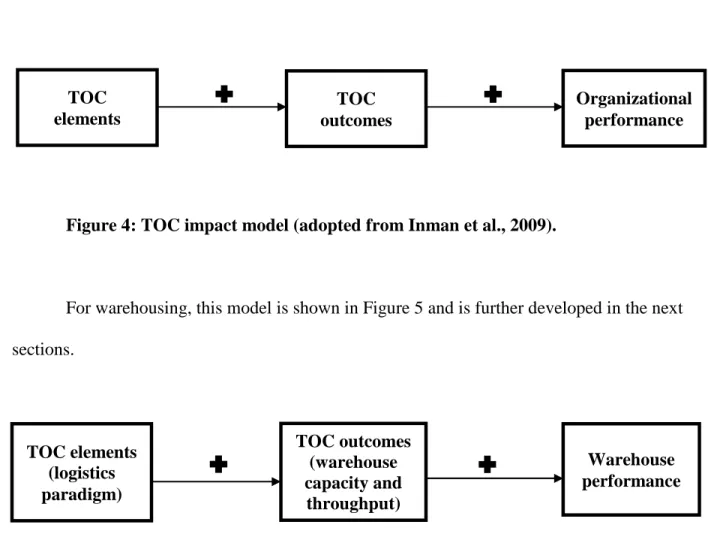
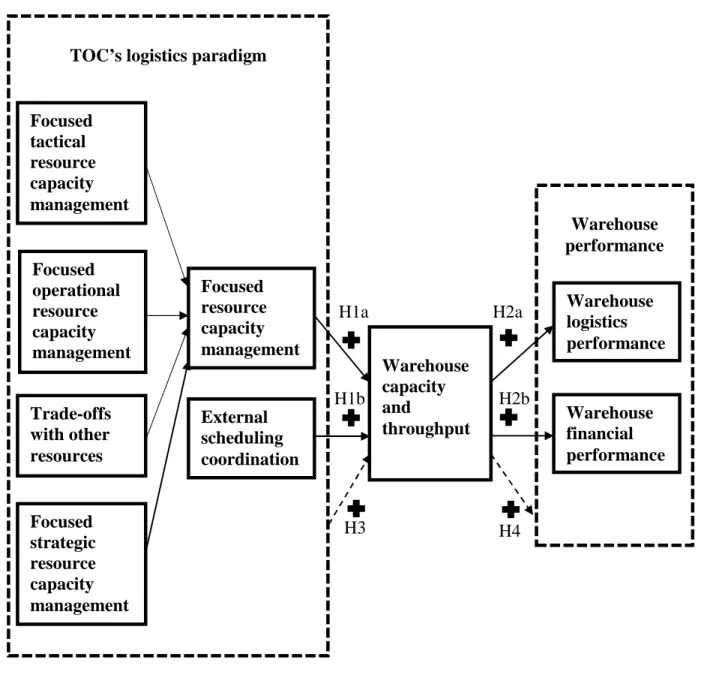
The model in Figure 1 represents the general framework for this research.
TOC outcomes Warehouse performance TOC elements
8 Figure 1: Research framework.
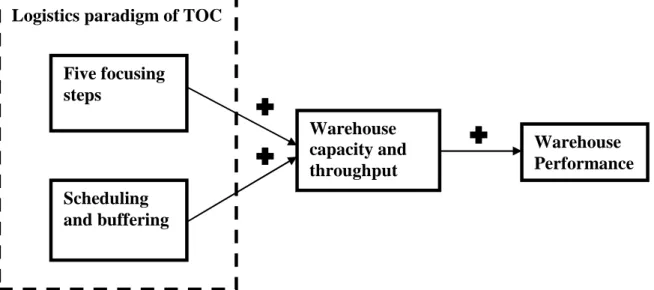
A discussion and a more detailed model are presented in Chapter III.
Contributions to theory and practice
This study is expected to make contributions to theory and practice in several ways. First, various warehouse resources have been analyzed and those that are critical for its mission have been identified. Resources were selected based on important attributes, such as the potential to become a long-term constraint on warehousing operations, critical for the constant flow of goods, etc. This analytical exercise resulted in a group of six key warehouse resources two of which were not previously identified as such in warehousing research. Development of this typology will be a contribution to the academic literature on warehousing as well as providing managers with a new perspective of their warehouse operations.
Second, TOC is modified for use with survey data for analysis of problems in the warehousing industry. The development of measurable constructs within TOC, which are suitable for survey-based research, should increase the attractiveness of this theory for use in future empirical studies that seek results that are generalizable on an industry-wide basis. Opening the door to explore the logistics paradigm of TOC in detail, beyond the traditional general boundaries, is an important contribution to TOC-focused empirical research.
Third, previous research in warehousing has used an empty box approach, assuming that operations can be modeled from scratch. The current research is based on the business needs of
9
existing warehouses through which volumes have grown such that the initial capacity is no longer sufficient, especially during periods of peak demand. This is a common situation in industry but it has been overlooked by academic research due to negligible collaboration with industry (Gu et al., 2007). To overcome this shortfall, warehouse managers are provided with an evaluation of methods for dealing with constraints in existing warehouses, which is supported by solid theory.
Lastly, the identification of key warehouse resources and TOC elements for the
warehouse will give managers a better understanding of their options in resource management and will help managers to focus their efforts on improving existing operations, even if they choose to act outside of the TOC paradigms.
Contributions of this study are discussed in more detail in Chapter VI.
Plan of the dissertation
Chapter I introduced the problem of warehouses reaching the full originally planned capacity of their resources while trying to adjust to the growing volume of operations as the focus of this study. It has also stressed the importance of this study for industry as well as outlined the theoretical contributions it aspires to make.
Chapter II provides a review of relevant academic literature on the subjects of
warehousing and the theory of constraints and summarizes the conclusions that can be drawn from previous studies to be used in this research.
Chapter III develops a detailed framework for the study. It applies TOC to the
warehousing context, discusses the notion of a key warehouse resource, and develops a model and a set of hypotheses to be tested in the empirical part of the study.
10
Chapter IV discusses the methodology of the study. The operationalization of the constructs, data collection and the method of analysis are be explained.
Chapter V provides the findings of the empirical research and conclusions that can be drawn from them.
Chapter VI concludes this work with a detailed discussion of contributions of this study, its limitations and suggestions for future research.
11 CHAPTER II LITERATURE REVIEW Introduction
In this section, the literature relevant to this research is reviewed. There is an abundance of academic literature on warehousing, however, most papers deal with narrow well-defined problems (Rouwenhorst et al., 2000), so general classifications of warehouse resources and processes can only be found in practitioners’ handbooks, such as Frazell (2002) and Tompkins (2003), or in academic papers whose main purpose is literature review, such as Gu et al. (2007), Gu et al. (2010), Cormier and Gunn (1992), and Rouwenhorst et al. (2000).
Most literature reviews on warehousing separate design and operations into two different frameworks. Warehouse resources largely fall under design, while warehouse processes are covered in the warehouse operations research. There is also a large body of literature on the theory of constraints, which will be modified for use in analyzing the management of warehouse resources. Thus, for the purposes of this study, it is expedient to split the literature review into two sections: warehouse design and operations, and the theory of constraints.
Warehouse design and operations
It has been noted that research on warehouse design is very disjointed, dealing with specific problems, and that integrative methods of warehouse design have not been proposed (Rouwenhorst et al., 2000; Goetschalckx et al., 2008). Gu et al. (2010) proposed a framework of warehouse design that consists of five components: overall structure, sizing and dimensioning, department layout, equipment selection, and operation strategy selection. However, there is a considerable overlap in many papers dealing with these topics, and very few of them seem to fall
12
strictly within one of the five categories (e.g., Rosenblatt and Roll, 1984), which is
understandable, given how interconnected these categories are. For the purposes of this literature review, the only research that was included dealt with the storage area (whether sizing or layout), other areas (departments) of the warehouse, and/or equipment selection.
The layout of a storage area in conjunction with a particular storage system emerges as a key focus area of warehouse design research. One direction of research was determining the optimum size of the storage area with a view to minimize the total storage and handling cost. One of the early works in this research stream was undertaken by Francis (1967). He developed mathematical models that minimized the total annual costs of an item’s movement between an outside point (a loading/unloading dock) and any point within a rectangular shaped storage area containing one or multiple items. His models took into account costs associated with warehouse perimeter construction and maintenance costs for a fixed warehouse dimensions (surface area and height). However, the models were based on some restrictive assumptions which do not reflect modern real-world warehouse operations. He assumed a single point of goods loading and unloading (dock) and equal probability of an item movement between the dock and any point in the warehouse.
Francis (1967) did not consider the inner structure of the storage area beyond its size and rectangular shape. A key characteristic of storage is its capacity (Rouwenhorst et al., 2000). In addition to its size and shape it depends on its internal layout and storage systems used. Three types of storage systems are widely considered in the literature: floor storage (block stacking), racks, and automated storage and retrieval systems (AS/AR). Storage of goods on the floor is the simplest way of storing. It has its advantages (flexibility) and disadvantages (honey-combing and poor utilization of the volume of the storage area). The AS/AR systems, as the name suggests, is
13
a combination of the two processes, storage and retrieval, performed with a certain degree of automation. When automation is achieved through automatic storage and retrieval systems, the rigid design of processes and capacity of automated warehouses does not allow much room for maneuvering in terms of finding untapped reserves of warehouse resources, so we formally control for this condition in this study.
Further research relaxed some of the simplifying assumptions of Francis (1967). Following previous research, Berry (1968) equated the optimum efficiency of the warehousing operation to the one that minimizes the total costs, which are made up of two categories: costs associated with the storage area or volume occupied, and material handling costs. He
investigated in detail two layouts: a rectangular block with aisles parallel to the two walls and a perpendicular connecting aisle along another wall; and a rectangular block with a single diagonal aisle. He actually considered and rejected as inferior a number of other layouts: those with cross aisles, multiple radial aisles and others. In addition to block storage on the floor, he considered storage on racks of various height as well as different storage allocation policies (random and dedicated) and fast and slow moving SKU’s. He proposed a number of recommendations to be taken into account in warehouse design.
One of his main conclusions important for this study is that he explicitly stated the trade-off between the space utilization and material handling costs in a warehouse: “The warehouse layout which gives maximum utilization of space is different from one which minimizes handling distance” (p.115). It should be noted that travel distance, as well as time, in the warehouse are routinely used as a proxy for material handling costs (e.g., Rosenblatt and Roll, 1984: Goetschalckx and Ratliff, 1988; Ashayeri & de Booy, 2008; Ellis et al., 2008). In a conventional warehouse, material handling costs are incurred through the use of personnel and
14
lift trucks. It is common knowledge that distance traveled is a product of time and speed of travel. In, a warehouse setting, the typical travel speed of a person or a lift truck are perceived as known since they are limited by the physical ability of a person, technical specifications of the machine, and, often, safety rules. This makes the shortest travel time and distance
interchangeable objectives for cost minimization.
Bassan et al. (1980) incorporated the same material handling and warehouse perimeter costs as Francis (1967) but considered two scenarios of aisles in a rectangular shaped storage area: aisles going lengthwise (parallel to the long side of the storage area) and aisles going across (parallel to the short side of the storage area). The authors developed an optimization model for these parameters and proposed some guidelines to execute a warehouse layout for these
scenarios.
The stream of research concerned with the layout of the storage area has been very potent. The most typical attributes of layout considered are: lane depth and orientation in block-stacking pallet storage (e.g., Moder and Thornton, 1965; Berry, 1968; Marsh, 1979;
Goetschalckx and Ratliff, 1991), and number of aisles and their configuration (e.g., Berry, 1968; Larson et al., 1997; Bassan et al., 1980; Pandit and Palekar, 1993). Most recently,
unconventional aisle configurations (flying V, fishbone, leaf, butterfly and chevron) were explored by Gue and Meller (2006), and Öztürkoğlu et al. (2012). The details of particular layouts considered by these and other papers in this stream are not important for our research and are therefore not discussed here. However, we note as relevant for our research the explicit conclusion that the reduction of retrieval travel time comes at a cost of a loss of storage space utilization (Öztürkoğlu et al., 2012). Or in more general terms, there is a tradeoff between
15
storage capacity and material handling cost, a conclusion already stated by Berry (1968) and in many research papers that followed.
Another problem of storage area design arises because of separating the area into picking and reserve areas, also referred to as forward and reserve. One of the earliest studies of this type was performed by Bozer (1985). He split the pallet rack horizontally into a lower picking area and an upper reserve area. The forward picking area, whether it is lower or closer to the center of the aisle, saves handling time, but requires periodic replenishment from the reserves. The
objective of his and many other studies that followed (e.g., Hackman and Rosenblatt, 1990; van den Berg et al., 1998) was to minimize material handling cost (especially picking time), and thus increase the throughput capacity of the storage area.
Starting from White and Francis (1971), researchers have recognized that there is a cost of not having enough storage capacity. Consequently, they have incorporated this cost into their optimization models. Rosenblatt and Roll (1984), who made an attempt at integrating several warehouse design problems (size, layout and storage policy), also included a cost of load rejection due to lack of storage space in their model. For a warehouse with pallet racks, they considered a combination of two types of storage policies: zoning and degree of randomness. The zoning of the storage area dictates that the whole incoming load of pallets must be stored within the same zone. The degree of randomness of storage implies that under the grouped storage policy all of the pallets of the incoming load must be stored together, while under the random storage policy, it is not a requirement. The authors make an important conclusion that there are trade-offs involved in the storage space utilization (and associated costs) and storage policies. The best space utilization is achieved with no zoning and complete randomness of
16
storage; the worst (and higher level of load rejection due to capacity shortage) is likely to occur in a storage area split into small zones combined with the grouped storage policy.
Their work described above is representative of the stream of research by these authors exploring factors that affect storage capacity (e.g., Roll and Rosenblatt, 1983). In their later work (Rosenblatt and Roll, 1988), they introduced the concept of service level in the determination of capacity. The service level is defined as, “the proportion of days (or any other unit of time) for which the given warehouse capacity is sufficient for accommodating the required replenishment shipments” (p. 1847). They found that for a predetermined service level the required warehouse capacity is affected by the number of SKUs stored, the demand characteristics (picking), and the replenishment policy.
Previously reviewed work typically considers one storage area. In reality, available space may be allocated to several competing activity areas (e.g., pallet racks, block stacking, receiving buffer and shipping staging area). Pliskin and Dori (1982) compared seven suggested area assignments for a tools warehouse, a part of a metal-cutting operation, by considering trade-offs among four space categories. They proposed a method of multi-attribute value functions which assigned a score and permits the ranking of options according to the decision maker’s
preferences. Of relevance to our research here is an explicit consideration of trade-offs among several space categories.
Tradeoffs between allocating a limited resource (floor space) to two different storage systems (a random access system and a rack system) were studied by Azadivar (1989). Under the random storage system, the throughput is higher because every storage slot is immediately accessible from the floor level but the storage capacity is lower (only one tier). The rack system has the opposite characteristics: its throughput is lower but the storage capacity is higher (several
17
tiers). The objective of the study was to find the best tradeoff between the two systems that balances the storage capacity and operational efficiency.
While Azadivar’s study was performed in the context of an automated storage and retrieval system operating in the rack storage and a nonautomated material handling system operating in the random access storage area, its principal tenet applies to completely
conventional warehouses as well. For example, the problem he solved for an automated storage system warehouse is similar to deciding between the share of racks with narrow aisles, which provide better storage capacity but slower pallet putaway and retrieval, and the share of racks with regular (wide) aisles, where capacity is decreased due to more floor space taken by the aisles but the operational efficiency is higher, in a conventional warehouse.
Park and Webster (1989) pursued an even more integrated approach to comparing three-dimensional pallet storage systems. They proposed a model that, “simultaneously considered the following factors: control procedures, handling equipment movement in an aisle, storage rules, alternative handling equipment, input and output patterns for goods flow, storage rack structure, component costs and the economics of each storage system” (p. 985) with appropriate
optimization targets.
Several studies reviewed above (e.g., Francis, 1967; Bassan et al., 1980) as well as others have included assumptions about the location of doors relative to the storage area in their travel time optimization models. However, there is practically no academic literature on warehouse doors that considers their capacity and potential to constrain the goods flow or their potential to relieve other constrained resources. The scarce cross-docking literature considers the optimum door layout for truck assignments (Gue, 1999) or travel and waiting time minimization due to congestion (Bartholdi and Gue, 2000). However, these works are not applicable to the door
18
capacity problem considered in our study. The number of doors can be a serious constraint or, in some instances, can be used to relieve other constrained resources.
Selection of material handling equipment such as lift trucks is part of any warehouse design. It is often considered together with the selection of the storage system. Baker and Canessa (2007) reviewed the literature on individual steps in warehouse design from 1973 through 2006. Of the 14 studies reviewed only 5 list designing or selecting material handling equipment as separate steps. Šraml et al. (2008) used discrete simulation to analyze the efficiency of four principal warehouse transportation vehicles: a counterbalance lift truck, a reach truck, a narrow-aisle lift truck, and a stacker crane. There is paucity of academic studies on lift truck selection but advice to practitioners can be found in popular warehousing handbooks.
In Baker and Canessa’s (2007) review of research on warehousing design steps, only two papers identify calculation of staffing needs as a step. Most studies consider personnel implicitly when optimizing material handling costs. As Rowenhorst et al. (2000) observed, “minimizing operational costs in particular often boils down to minimizing the required work force” (p. 522).
Ashayeri and de Booy (2008) looked at warehouse personnel from a different
perspective. They addressed the issue of workload balancing in order to reduce response time, an increasingly important objective in modern warehousing operations. They proposed a three-phased framework, the middle phase of which is workforce planning. They presented three different models of workforce planning (capacity assignment, mean value analysis, and CAN-Q approach) and evaluated them using simulation.
Outside of operations research, a considerable body of literature on warehouse human resources management has been published in supply chain management journals. Most studies recognize the critical importance of availability and effective management of human resources to
19
warehouse operations (e.g., Autry and Daugherty, 2003). There are also indications of problems with employee job satisfaction and turnover in warehouses, with turnover exceeding 100% in the worst cases (Murphy and Poist, 1992). However, smaller warehouses were found to do a better job of attracting and retaining human resources (Min, 2007). Only two ways to match the workload with the availability of personnel appear to be considered in the academic literature. Some studies emphasized efficient labor scheduling and workload forecasting that, “minimizes labor costs while maintaining service commitments” (Sheehan, 1989; Sanders and Ritzman, 2004), whereas most other work considered ways to simply attract more employees and do a better job of retaining them, such as through higher job satisfaction (e.g., Murphy and Poist, 1993; Autry and Daugherty, 2003).
There does not appear to be literature that considered the possibility of operational tradeoffs between warehouse labor and other resources. The closest to this was the study by Sanders and Ritzman (2004) that considered the flexibility of warehouse personnel in itself (e.g., through cross-training) to be used as a tool to offset workload forecast errors. However, labor is frequently the most flexible resource in the warehouse.
Academic supply chain literature also has focused on information technology in the warehouse and tracked its evolution from humble beginnings as electronic data interchange (EDI) between warehouses and customers (see for example, Raney and Walter, 1992) to the modern “smart” warehouse management systems (WMS). WMS are information technology systems used to “plan, optimize, and execute operations” (Autry et al., 2005, p. 167), the definition we will use in this study.
Researchers have studied WMS from a variety of perspectives. The antecedents of WMS have been examined, revealing that the introduction of information technology in the warehouse
20
was largely driven either by customers or by top management who saw it as a tool to gain a competitive advantage (e.g., Raney and Walter, 1992; Rogers et al., 1996; Autry et al., 2005). Best practices were reviewed in detail in case studies (e.g., Min, 2009) and “buy standard” vs. “get one tailor-made” decisions were analyzed (e.g., Faber et al., 2002). More importantly, most researchers who studied the link between the degree of WMS implementation (degree of
sophistication, level of investment, dedicated personnel, etc.) and organizational performance appear to agree that there is a significant positive relationship between the two (e.g., Rogers et al., 1996; Faber et al., 2002; Autry et al., 2005).
Another important finding is that a functionally inadequate WMS may be a constraint in warehouse operations by forcing management to compromise, “…between the way a warehouse wants to work and the way the system allows the warehouse to work” (Faber et al., 2002, p. 381).
Most warehouse design literature is concerned with planning new warehouse facilities. There is very limited research on optimization of existing operations, and attributes of existing facilities are usually considered to be static. This literature is largely limited to the relocation of storage items (SKUs). For example, it may become necessary to relocate SKUs if changes in demand cause former fast-moving items to become slow-movers, leading to longer picking times. Two representative papers are briefly described below.
Christofides and Colloff (1973) solved the problem of movement cost minimization for such transfer under assumptions of moving all items one at a time, using only one vehicle, and that the time when an item is not located in a proper warehouse location is at its minimum.
Sadiq et al. (1995) studied the problem of periodically reassigning stock items to create a dynamic stock mix that correlates with dynamically changing demand. They used cluster
21
analysis to develop a heuristic Dynamic Stock Location Assignment Algorithm which appeared to be superior to the well-known cube-per-order index (Heskett, 1963; Kallina and Lynn, 1976; Janea and Laihb, 2005) in dynamic environments.
A more radical approach to designing warehouses that are able to accommodate change was presented by Ackerman (1999). He lists several trends that affect the function and operations of warehouses: faster cycle times, high inventory turns, growth of cross-docking operations, and increased use of information technology. These changes will impose new requirements on warehouse design and operations: more dock doors, different door locations (close to each other on one side of the building rather than on the opposite sides) and flexible door allocation (no doors dedicated to a customer or particular operation); brighter lights to accommodate night shifts; higher quality floors for high velocity operations; more office space and storage
flexibility. Information technology allows to constantly analyze the quickly changing 80/20 rule of item velocity based slotting. To implement changes flexible storage systems are necessary. They should replace the efficient but inflexible automated storage systems. Hence, the emphasis should be on flexibility and not on efficiency or storage capacity.
Ackerman (1999) illustrates the right tradeoff (balance) between efficiency and flexibility with an example of warehouse dock doors. Since dock doors are expensive, it is common to design and build a warehouse with a limited number of doors sufficient to cover the present time operation. However, flexibility dictates a higher number of doors. One practical way to balance the costs and flexibility is to install just the required number of doors but prepare the foundation and the walls for future door additions by depressing the building footer. This emphasis on flexibility over cost minimization and efficiency is a dissonance from the traditional warehouse operations research literature.
22
In summary, there are several important conclusions from the reviewed body of literature on warehousing that are relevant for this research:
1. Storage capacity is important. It has been a primary focus of academic research on warehouse design. Storage capacity is influenced by many factors of warehouse design (storage area size, layout, storage system, separation into zones, storage policy and others).
2. Academic literature recognizes a negative effect on performance when there is a shortage of capacity. The capacity shortage results in a rejection of incoming loads. The sufficient capacity can be expressed as a service level. Thus, it is expressly recognized that capacity may be a major constraint in a warehouse.
3. There are trade-offs involved in optimizing storage capacity and minimizing costs
associated with other warehouse resources. Academic literature expressly recognizes that it is impossible to maximize storage capacity and minimize material handling costs at the same time. These costs are linearly proportional to the amount (quantity) of resources used (such as labor hours of warehouse personnel and machine hours of lift trucks; the needed work hours in turn largely determine the quantity of the required personnel and machines in the warehouse).
4. The studies aimed at optimization of material handling costs implicitly consider
personnel and lift trucks. Behavioral human characteristics were not taken into account in warehouse operations research. Supply chain literature raised a few issues relating to human resources which are relevant to this study. In particular, the literature notes the high importance of this resource, the need for its effective management, and ways to increase its capacity. The literature also suggested warehouse size as a potential control
23
variable, since warehouses were found to differ on employee satisfaction and turnover based on size. Flexibility was identified as a property of this resource with a cost savings potential.
5. Other components of warehouse layout (doors, shipping and receiving areas) received very little coverage in the academic literature.
6. Selection of warehousing equipment, specifically, lift trucks, did not receive much attention from scholars either. However, there is a considerable body of research on optimization of their use (costs, time, distance) within the framework of existing operations by manipulating storage policies (which affects storage capacity) or picking policies holding existing storage policies and picking area layout constant.
7. Information technology plays a prominent role in a modern warehouse in the form of a WMS. Limited functionality of the WMS may lead to lower warehouse efficiency (act as a constraint), whereas higher level of WMS implementation is positively associated with warehouse performance.
8. Academic studies of warehousing design and operations are either concerned with initial selection of warehouse parameters (such as storage area) or assume that they are already given. There is little work on adjusting existing operations to accommodate changes in demand, product types, etc.
9. Flexibility in warehouse design and operations is regarded by some as a contemporary alternative to a traditional focus on efficiency in the academic operations research literature.
These conclusions support the need to focus on basic warehouse resources: storage space; personnel; equipment; doors; dock space; and information systems. They also suggest the need to
24
consider these resources as potential constraints in the flow of inventory through the warehouse, which can lead to inefficient and ineffective warehouse operations. Finally, they suggest that managers should understand that there are trade-offs among these resources, and that one resource can be used to relieve a constraint created by another, effectively increasing the capacity of the warehouse without adding physical expansion.
However, some gaps in this literature are evident. They refer to both the domain of the research and the methods used. Supply chain literature addresses warehousing problems at a very general level. It tends to use a firm as the smallest unit of an analysis and is usually not
concerned with the operations of a warehouse as an organizational unit of a firm. On the other hand, operations research looks at warehousing problems very narrowly. The complexity involved in the mathematical modeling and simulation, the traditional tools of operations research, require imposition of very restrictive assumptions, which severely limits the practical uses of the research results.
We hope that this study, which takes the tools of supply chain management research and brings them down from the “30,000 feet level” of the whole organization to the “bird’s eye view” of operations in a warehouse as one organizational unit of the firm, will pave the path to eventually closing this literature gap.
Theory of constraints
One management theory that addresses bottlenecks in operations is the Theory of Constraints (TOC). TOC was proposed by Eliyahu Goldratt in the 1980-s and popularized in a number of books (Goldratt and Cox, 1986; Goldratt and Fox, 1986; Goldratt, 1994). TOC is widely accepted in business and is extensively used in academic research.
25
The purpose of TOC is to make a firm more competitive by running its operations in a more efficient way (Polito et al., 2006). TOC originally appeared as a scheduling algorithm for manufacturing and was marketed as a software package. However, there was a need to explain to the users how it works, so the book The Goal (Goldratt and Cox, 1986) was published.
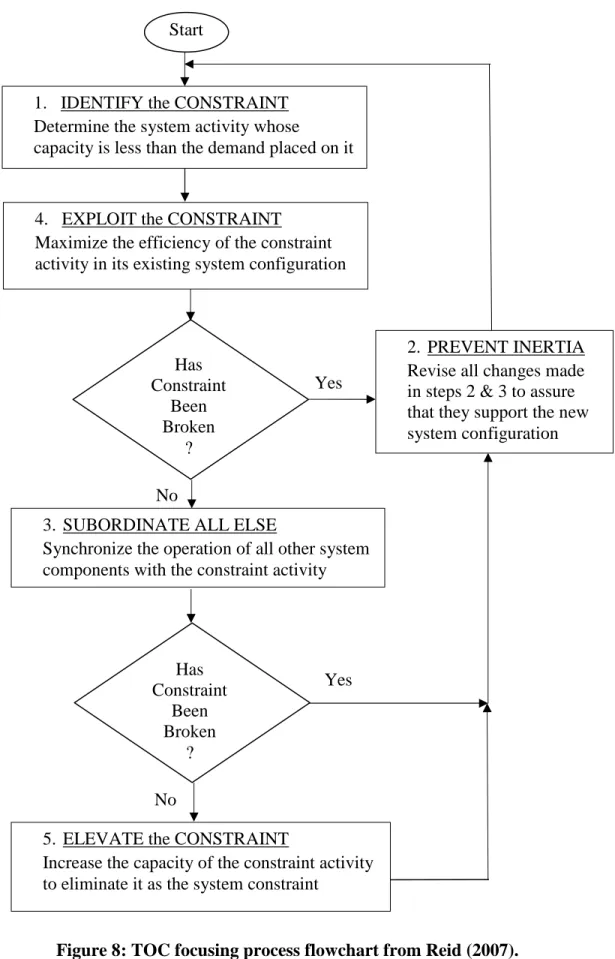
According to it, the firm’s business is viewed as a combination of throughput (rate of generating money through sales), inventory (everything purchased in order to be sold), and operational expense (money spent on turning inventory into throughput). The underlying premise is that the system will have at least one constraint, since infinite throughput is not possible. The constraint slows down the whole system’s throughput and prevents the firm from achieving higher financial performance. To rectify the situation it is first necessary to understand what needs to be changed and the process for the change. Five focusing steps are proposed for the purpose:
1. identify the constraint;
2. decide how to maximize the throughput through it;
3. subordinate the whole organization and processes to this decision; 4. implement measures that will relax this constraint;
5. repeat from the beginning (Goldratt and Cox, 1986).
The five focusing steps are an alternative method of continuous improvement. It is different from other methods, such as total quality management in that it focuses on a single or very limited number of constraints rather than attempting to improve quality everywhere (Gardiner et al., 1994).
Based on the five focusing steps a specific production scheduling technique called drum-buffer-rope (DBR) was proposed. The allusion is to a scout troop march illustrative example in
26
The Goal. The drum represents the constraint that sets the rate of output of the whole system. It
is critical to keep this resource operating at maximum capacity. For this reason, there is a buffer of material for processing in front of the constrained resource and a space buffer for processed inventory right behind it. This ensures that the constrained resource will keep operating during temporary disruptions up or down the stream. The rope represents the fixed lead time of releasing raw materials into the processing chain based on the rate of operation of the
constrained resource. This ensures that the resource is never starved for materials, but also that no more materials are released than actually needed for the operation of that resource, even if other resources may temporarily be idle. Under TOC, buffer management is the only production control technique that is needed (Gardiner et al., 1994).
The specific methods discussed above are said to comprise the logistics paradigm of TOC (Rahman, 1998). As physical constraints are overcome one by one, eventually the next constraint will be found outside the production floor. The constraint may be nonphysical and completely external, e.g., insufficient market demand to support the increased level of production of the firm, or internal but elsewhere within the organization, e.g., managerial constraints in the form of restrictive policies (Simatupang et al., 2004). In response, a thinking process (TP) was developed to address any problems in general. Using a specific set of tools (current reality tree, evaporating cloud, future reality tree, prerequisite tree and transition tree), managers should be able to find answers to the three main questions of initiating change:
• what to change;
• what to change to;
27
The problem solving paradigm of TP complements the logistics paradigm and is believed to be the most lasting contribution of the TOC philosophy because it can be applied in a very general way (Rahman, 2002).
TOC was compared to and in many cases was found superior to kanban, JIT, MRP, linear programming and total quality management (Rahman, 1998; Gardiner et al., 1994; Luebbe and Finch, 1992; Sale and Inman, 2003). In addition to manufacturing, the primary industry for which it was originally designed, TOC was successfully applied in the airline industry, health care, banking, military logistics and many others, where companies like Proctor and Gamble, Ford, GM and others saved millions of dollars by implementing the logistics or problem solving paradigms of TOC or both (Watson et al., 2007; Polito et al., 2006; Bramorski et al., 1997; Gardiner et al., 1994; Demmy and Petrini, 1992).
Boyd and Gupta (2004) attempted to integrate TOC, along with JIT, economic order quantity and a number of other theories, into a more general Constraint Management Theory. They suggested for future empirical studies (but did not test empirically themselves) several hypotheses based on TOC as part of Constraint Management Theory, including one whose parts are in line with our treatment of TOC:
There is a significant positive relationship between the degree of throughput orientation and organizational performance.
Process improvements … at a constraint will have significantly greater positive impact on performance than similar improvements at a non-constraint (p. 365).
Instead of being currently recognized as consisting of the two main parts (the logistics and problem solving paradigm), TOC was initially seen as a rather eclectic collection of smaller components. Spencer (1993, p. 37) listed seven of them: “…the five focusing steps, V-A-T analysis, effect-cause-effect analysis, drum-buffer-rope scheduling, buffer management, the
28
performance measurement system, and the thought process.” His illustrative paper appears to be the only attempt to apply a part of TOC to warehousing. His work is based on an argument that a warehouse is merely a type of a production facility, which allows us to apply automatically the V-A-T logical structure analysis for manufacturing to warehousing (where the letters V-A-T refer to three potential shapes of a logical structure of goods flow in a warehouse) (Spencer, 1993). Even though his paper concedes that, “warehouse operations may be less rigidly defined” than in manufacturing (p. 37), the reader is left with an impression that the rigid production structure is forced upon warehouse operations, particularly when the case of value-added assembly activities is chosen as an illustration. The paper provides advice on identifying a particular operation that constrains the whole output and assumes that creating a buffer of materials and proper scheduling (i.e., using buffer management and DBR scheduling techniques of TOC) will solve the problem, but it does not address the problems of severe resource
shortages or resource sharing between independent operations. The author concludes that, “[d]ifferent warehouses have different processes and require different management” (p. 46). In contrast, our study examines common approaches under TOC to management of warehouse
resources rather than processes and does not treat warehousing as a variety of manufacturing.
Kim et al. (2008) reports that TOC received much attention in academic literature in the functional areas of supply chain management and human resources management. However, there are very few empirical studies of TOC and there is no evidence of research involving the TOC logistics paradigm in the context of traditional warehousing operations. Major survey-based empirical work on TOC is absent from operations research (Gupta and Boyd, 2008).
29 CHAPTER III
THEORY DEVELOPMENT Adapting TOC to the warehousing context
Need for modifications
In this study we seek better understanding of warehouse resources and their management using the theory of constraints (TOC). TOC was originally suggested for the manufacturing environment. In The Goal (Goldratt and Cox, 1986), the five-step focusing process was
introduced in a hypothetical but realistic manufacturing setting (Reid, 2007). The product flow went through a fixed sequence of machines, one of which had a low capacity and constrained the whole system’s throughput. Solutions offered by TOC were intended to be generalized to many manufacturing enterprises.
The use of TOC to analyze warehousing resources on an industry-wide basis requires some modifications to the basic theory. These modifications are necessary for several reasons. First, warehousing is substantially different from manufacturing in many important respects. Second, our study covers a period of three years that is not necessarily synchronous with a TOC cycle at any particular warehouse. Third, the originally developed logistics paradigm of TOC is not conducive to survey research, yet the survey method is a very important technique for studying a variety of warehouses in such a diverse industry. In this chapter, we consider these reasons for TOC modification and explain the ways we do it in detail.
Applicability to warehousing in principle
To decide whether TOC can automatically be extended to warehousing without
30
have listed examples of other industries (airlines, banking, etc.) where TOC was successfully applied. We have also reviewed what appears to be the sole academic paper attempting to apply one TOC element to warehousing. This can be interpreted as an indication that TOC is not limited to manufacturing and can in fact be used in different contexts, including warehousing.
On the other hand, there are arguments that appear to offer support to the opposing view. First, the prevailing view is that warehousing is not manufacturing. Sanders and Ritzman (2004) describe warehouses as, “service organizations whose ‘product’ is not the creation of tangible goods, but the ability to efficiently mix and move goods at short notice” (p. 251). To determine if TOC solutions for manufacturing can be automatically extended to warehousing, we need to consider how similar these industries are for the TOC relevant characteristics. Specifically, we need to establish if warehousing has the type of manufacturing throughput process described above: a fixed set of machines and a continuous rigid sequence of inventory flow through the system.
Warehouses do not have stationary machines like in manufacturing with the exception of automated storage / automated retrieval systems (AS/AR), machines for value-added processing (e.g., promotional sets packaging) and some auxiliary machines (e.g., to shrink-wrap a pallet). In this research, we only consider traditional warehouse operations and disregard the manufacturing functions of the warehouses. Any auxiliary equipment by definition is outside the primary
warehousing operations we are focusing on. Thus, the traditional warehouse operations are not built around a set of stationary machines that processes raw materials into inventory of finished goods and are more flexible.
The seeming similarity of presence of inventory and its flow in a manufacturing plant and a warehouse is also deceptive. Inventory buffering options (a major part of TOC in
31
manufacturing) such as inventory safety stock for made-to-stock items are not available in warehousing (Sanders and Ritzman, 2004). Warehouse buffers may be of a different nature (e.g., time buffers created by a queue of picking orders to process or trucks to unload) and may be resource specific.
The product flow is different, too. The primary function of a traditional warehouse is storage (Gu et al., 2007; Frazell, 2002). In the storage area, the flow of goods is broken. Vogt and Pienaar (2007) clearly state that, “[t]he storage of the stock in the warehouse completely segregates the inbound and outbound processes” (p. 87). The inventory placed in storage may remain there for a long time and even become obsolete (Rouwenhorst et al., 2000). While this will have a negative impact on the financial performance of a private warehouse, in case of a public warehouse, the warehousing company will still receive revenue by providing this storage service to its customers. This is in sharp contrast with manufacturing where an accumulation of unsold finished inventory is definitely a negative factor (Goldratt and Cox, 1986).
In any case, the interruption of the goods flow in a warehouse makes treating the TOC goal of increasing throughput in the same manner as for a manufacturing plant impossible: the throughput of a warehouse is broken into the inflow and outflow, with storage separating the two. The processes generating the incoming and outgoing flows may compete for the same warehouse resources. Some literature (e.g., Elton and Roe, 1998; Steyn, 2002) suggests that TOC may not be fully applicable to concurrent competing projects as they will compete for the same resources, a situation that seems to fit the disjoint but concurrent warehouse flows.
The arguments above offer grounds to doubt TOC’s automatic applicability to
warehousing without modification. Given the contradictory evidence from literature and logical analysis, empirical research is definitely warranted. Due to the differences between the two
32
contexts, some special tools need to be found to translate TOC for manufacturing into
warehousing for testing in empirical research. Manufacturing is the original but not the sole TOC domain. In academic research, TOC has been used outside manufacturing, most often in a
service industry. However, most papers were case studies or general illustrative applications (e.g., Bramorski et al., 1997; Olson, 1998; Roybal et al., 1999; Zadry and Yosuf, 2006; Polito et al., 2006, Reid, 2007). Research that produced hypotheses and scales to test TOC empirically (e.g., Boyd and Gupta, 2004; Moss, 2007; Inman et al., 2009) has not focused on the logistics paradigm of TOC we are interested in and is still too general to be applied to warehousing as is. Thus, we are unable to base TOC modification on prior research and must undertake the
complete task of adapting TOC to warehousing. This includes changes to some of its constructs and relationships among them.
Processes vs. resources
As the initial step of TOC adaptation, we turn to the core of TOC. Reid (2007) suggested that TOC’s single unique characteristic as a managerial philosophy is an emphasis on
identification of a single or a few factors, such as a resource or process, that actually limit the performance of the whole system.
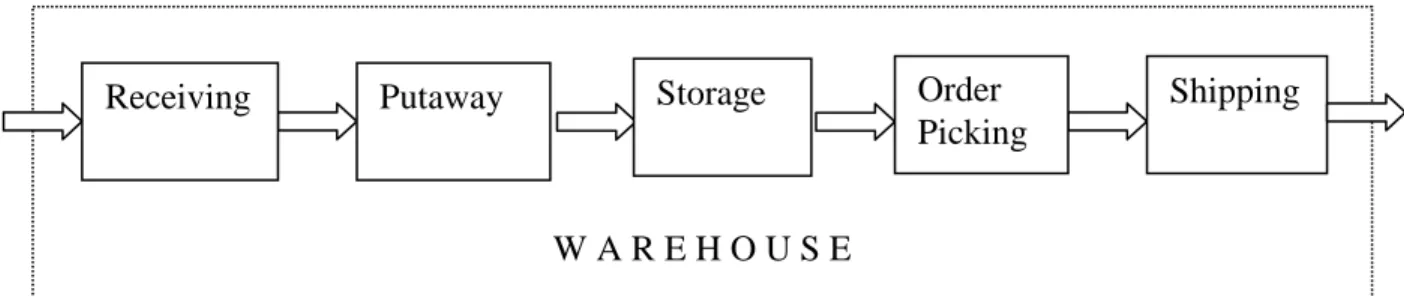
Let us consider the possibility of process constraints in the warehouse first. According to Gu et al. (2007), a typical warehouse operation can be viewed as a flow of goods first entering the warehouse then consecutively going through the processes of receiving, storage, order picking and shipping and then physically leaving the warehouse, as shown in Figure 2.
33
Figure 2: Flow of goods in a warehouse (adopted from Gu et al., 2007).
It is very obvious that many of these processes can be performed using the same space, personnel and material handling equipment. In other words, they share certain resources. In case the actual productivity (throughput) of a process is not meeting the demand, management can shift the resources to the lagging process quickly. However, if the total quantity of a particular resource is not sufficient to cover all the required processes, then the total system throughput will decrease. The relative ease of allocation and reallocation of warehouse resources to the
operational processes indicates that it is not warehouse processes but the capacity of the resources that may be a true constraint in a warehouse. Thus, for the purposes of TOC application, we will need to focus on warehouse resources, not warehouse processes.
Clearly, every warehouse uses a big variety of inputs that may be treated as resources. Lack of capacity of some of them may present only a trivial problem, whereas a shortage of some other resources may be difficult to overcome. We turn to the warehousing literature again to identify the most critical resources that have a potential to become a constraint in a typical warehouse. W A R E H O U S E Order Picking Storage Receiving Shipping