RESEARCH AND
STATISTICS DIVISION
METHODOLOGICAL
SERIES
The Effectiveness of
Restorative Justice Practices:
A Meta-Analysis
THE EFFECTIVENESS OF
RESTORATIVE JUSTICE PRACTICES: A META-ANALYSIS
Jeff Latimer
Senior Research Officer
Research and Statistics Division
Craig Dowden Principal Researcher The Action Group
&
Danielle Muise Research Assistant
Research and Statistics Division
Research and Statistics Division
2001
The views expressed herein are solely those of the authors and do not necessarily reflect those of the Department of Justice Canada.
Foreword
I
am pleased to introduce The Effectiveness of Restorative Justice Practices: A Meta-Analysis. This is the first in a series of publications from the Research and Statistics Division that will profile innovative policy research methods. Through this series readers will be introduced to some of the more interesting and progressive method-ological work being undertaken by the Division. Each report in the series will address a justice-related policy research question which has been examined using a different research method.In this current report, the authors have tackled a rather difficult question — Is restorative justice an effective response to criminal behavior? — using one of the most comprehensive quantitative
About the Research and Statistics Division
The Research and Statistics Division is staffed by social science researchers drawn from a broad range of disciplines including criminology, sociology, anthropology, education, statistics, political science, psychology, and social work. We conduct social science research in support of the activities and programs of the Department of Justice Canada. We also provide statistical data, methodological services and analytical advice and undertake public opinion research and compre-hensive environmental analyses.
We recognize that to be useful, research must be accessible. In an effort to make our research more accessible we have created new products tailored to the needs of a diverse group of users, such as a research series, Qs&As, fact sheets, and this methodological series.
For further information on our research activities, please visit our Web site at http://canada.justice.gc.ca/ps/rs.
research methods. Simply put, meta-analysis refers to an meta-analysis of analyses. It is a statistical analysis of a collection of studies for the purposes of integrating the various and, oftentimes, discrepant findings from a body of literature. This report is a good example of our efforts to support the Department in its evidence-based decision making process.
I would like to acknowledge the contri-bution made by Jeff Latimer, Senior Research Officer, in carrying out this project from conception to final prod-uct, as well as co-authoring the report.
We would welcome any feedback on the series.
Roberta J. Russell, Ph.D.
Director, Research and Statistics Division Department of Justice Canada
Foreword ii Acknowledgements iv List of Tables iv List of Figures iv 1.0 Introduction 1 2.0 Meta-Analysis 3 3.0 Method 5 3.1 Literature Review:
Study Identification Criteria 5 3.2 Data Collection:
Coding Procedures 6 3.3 Data Analysis:
Effect Size Calculations 7
4.0 Results 9 4.1 Victim Satisfaction 9 4.2 Offender Satisfaction 11 4.3 Restitution Compliance 12 4.4 Recidivism 14 5.0 Discussion 17 5.1 Self-Selection Bias 17 5.2 Appropriate Treatment 18 5.3 Moderating Variables 18 5.4 Additional Research Issues 19
6.0 Research Recommendations 21 7.0 Conclusion 23 8.0 Bibliography 25
Acknowledgements
W
e would like to sincerely thankthe following individuals who provided constructive com-ments on an earlier draft of this report: Roberta Russell, David Daubney, Danny Graham, Ivan Zinger, Kwing Hung and Daniel Antonowicz.
Further acknowledgements go to the numerous individuals who posed thought-provoking questions and offered instructive comments on our presentation of this meta-analysis at the “Restorative and Community Justice: Inspiring the Future” conference, in Winchester, England on March 30, 2001.
List of Tables
Table 1. Primary Variables
in Meta-Analysis 6 Table 2. Descriptive Program/
Study Characteristics 9 Table 3. Moderator Analyses
for Victim Satisfaction 11 Table 4.1. Moderator Analyses
for Offender Satisfaction
(With Outlier) 13
Table 4.2. Moderator Analyses for Offender Satisfaction
(Without Outlier) 13 Table 5. Moderator Analyses
for Recidivism 15
List of Figures
Figure 1. Distribution of Effect Size Estimates
(VICTIM SATISFACTION) 10 Figure 2. Distribution of
Effect Size Estimates
(OFFENDER SATISFACTION) 12 Figure 3. Distribution of
Effect Size Estimates
(RESTITUTION COMPLIANCE) 14 Figure 4. Distribution of
Effect Size Estimates
all the parties with a stake in a particular offence come together to resolve collec-tively how to deal with the aftermath of the offence and its implications for the future” (cited in Braithwaite, 1999, p. 5).
Essentially, the restorative justice para-digm begins with the premise that crime is a violation of people and relationships (Zehr, 1990) rather than merely a viola-tion of law. The most appropriate response to criminal behaviour, there-fore, is to repair the harm caused by the wrongful act (Law Commission, 2000). As such, the criminal justice system should provide those most closely affected by the crime (the victim, the offender and the community) an oppor-tunity to come together to discuss the event and attempt to arrive at some understanding about what can be done to provide appropriate reparation.
According to Llewellyn and Howse (1998), the main elements of the restora-tive process involve voluntariness, truth telling and a face-to-face encounter. Consequently, the process should be completely voluntary for all participants; the offender needs to accept responsibil-ity for the harm and be willing to openly and honestly discuss the criminal behav-iour; and the participants should meet in a safe and organized setting to collec-tively agree on an appropriate method of repairing the harm.
Models of restorative justice can be grouped into three categories: circles, conferences and victim-offender mediations (VOM). While somewhat distinct in their practices, the princi-ples employed in each model remain similar.1A restorative justice program may be initiated at any point in the
1.0 Introduction
C
urrent activity at governmental and community levels suggests that restorative justice, in its many forms, is emerging as an increas-ingly important element in mainstream criminological practice. While first dis-cussed in the 1970s by both Barnett (1977) and Eglash (1977) in the context of restitution, restorative justice has been more clearly integrated into crim-inological thinking through such works as Braithwaite (1989), Marshall (1985), Umbreit (1994a) and Zehr (1990). Rather than focussing on the traditional reha-bilitation versus retribution debate, many researchers and policy makers now consider restorative justice and, more precisely the concept of restora-tion, as a valid third alternative (Zehr, 1990). Numerous countries have adopted restorative approaches, including Canada, England, Australia, Scotland, New Zealand, Norway, the United States, Japan and several European countries (Hughes & Mossman, 2001).Despite the increased attention given to restorative justice, the concept still remains somewhat problematic to define as numerous responses to criminal behaviour may fall under the “restora-tive umbrella.” The term has been used interchangeably with such concepts as community justice, transformative jus-tice, peacemaking criminology and rela-tional justice (Bazemore & Walgrave, 1999). Although a universally accepted and concise definition of the term has yet to be established, Tony F. Marshall’s definition appears to encompass the main principles of restorative justice: “Restorative justice is a process whereby
criminal justice system and need not be used simply for diversionary pur-poses. Currently, there are five identified entry points into the criminal justice system where offenders may be referred to a restorative justice program:
1. police (pre-charge) 2. Crown (post-charge) 3. courts (pre-sentence) 4. corrections (post-sentence) 5. parole (pre-revocation)
Proponents of restorative justice claim that the process is beneficial to both victims and offenders by emphasizing recovery of the victim through redress, vindication and healing, and by encour-aging recompense by the offender through reparation, fair treatment and habilitation (Van Ness & Strong, 1997). In the process of coming together to restore relationships, the community is also provided with an opportunity to heal, reconstitute and strengthen itself through the reintegration of victims and offenders (Llewellyn & Howse, 1998).
Despite the intuitive appeal of restora-tive justice, it is imperarestora-tive to fully eval-uate the impact of this approach on several important outcomes. Previous evaluation research focussing on this area has ranged from purely anecdotal accounts to more rigorous designs using comparison groups and, in some cases, random assignment into control and treatment groups (Bonta, Wallace-Capretta, & Rooney, 1998). These studies have examined the impact of restorative
justice on victim and offender satisfac-tion, restitution compliance, recidivism, procedural fairness, as well as several others.
Given that the field of restorative justice research has been maturing, a need existed to aggregate the present body of empirical knowledge. In this regard, several authors have recently provided comprehensive literature reviews of this area of research (Braithwaite, 1999; Latimer & Kleinknecht, 2000; Marshall, 1999). Summarizing the research through narrative or qualitative
approaches, however, may fail to objec-tively analyse the available data and draw the appropriate conclusions. Cooper and Rosenthal (1980) directly tested the reliability of synthesizing literature through narrative reviews by providing test subjects with a set of seven studies that measured the rela-tionship between two variables. Despite the fact that the set of studies showed a clear statistically significant relation-ship between the variables, 73 percent of the reviewers found limited or no support for the hypothesis. This sug-gested that traditional narrative reviews suffer a considerable loss of power and that the incidence of Type II errors may be common. In addition, the criteria for selecting literature for a narrative review are rarely systematic and consistent. The introduction of meta-analytic tech-niques, however, has marked a major step forward in summarizing research by providing a more objective method of aggregating knowledge.
1For a more detailed discussion of the nature and principles of restorative justice, and the core program
models, see Restorative Justice in Canada: A Consultation Paper (May 2000) developed by the Federal/ Provincial/Territorial Working Group on Restorative Justice and available from the Department of Justice Canada (http://canada.justice.gc.ca/en/ps/voc/rjpap.html).
research synthesis compared to tradi-tional narrative reviews as the former are “more systematic, more explicit, more exhaustive, and more quantita-tive” (Rosenthal, 1991, p.17). Meta-analytic techniques have been used across such diverse fields as educa-tion and medicine, and have more recently been adopted within the social sciences (Lipsey & Wilson, 1993). In the area of criminal justice research in particular, meta-analytic studies have investigated the prediction (Bonta, Law, & Hanson, 1998; Dowden & Brown, in press; Gendreau, Little, & Goggin, 1996; Hanson & Bussière, 1998) and treat-ment (Andrews et al., 1990; Dowden & Andrews, 1999, 2000; Latimer, 2001; Lipsey, 1995; Losel, 1995; Whitehead & Lab, 1989) of criminal behaviour.
Critics argue that one of the major limi-tations of meta-analytic techniques is that the sampling procedures are biased in favour of including predominantly published studies. It is surmised that the probability of publishing a study is increased by the statistical significance of the results so that published studies are not actually representative of the entire body of research that has been conducted in that area. Consequently, a calculated effect size, based exclu-sively on published studies, may be overestimating the relationship. Coined the “file drawer problem” (Rosenthal, 1991, p. 103), this suggests that if unpublished studies were included in the meta-analysis, the effect size estimate would be smaller.
Bonta, Wallace-Capretta, and Rooney (1998) conducted a preliminary meta-analysis of programs that contained elements of restorative justice and
2.0 Meta-Analysis
S
imilar to traditional quantitative research methods, the meta-analytic process involves three basic steps:1. literature review — identifying and gathering relevant research studies 2. data collection — extracting data
through pre-determined coding procedures
3. data analysis — analysing the aggregated data using statistical techniques
A meta-analysis can be understood as a statistical analysis of a collection of studies that aggregates the magnitude of a relationship between two or more variables (Glass, McGaw, & Smith, 1981). These studies may differ on several important characteristics, such as oper-ationalization of independent and dependent variables, sample size, sam-ple selection techniques and design quality. Meta-analytic statistics can describe the typical strength of the effect under investigation, the degree of statistical significance, the variability, as well as provide researchers the oppor-tunity to explore and identify potential moderating variables. The outcome of a meta-analysis is an effect size, which can be interpreted as the estimated effect of the independent variable on the dependent variable. For example, an average effect size estimate of +.10 translates into the independent variable accounting for a 10 percent change in the dependent variable (Rosenthal, 1991).
Meta-analytic reviews are generally regarded as a superior method of
exclusively focussed on their role in reducing offender recidivism. The results revealed that these programs yielded mild reductions in re-offending (+.08). However, the authors used a very broad operational definition of restora-tive justice as they included both court-ordered restitution and community service programs. This definition is somewhat problematic as it fails to fully
incorporate some of the fundamental principles of restorative justice — namely, the voluntary nature of both offender and victim participation and the face-to-face encounter. A need therefore existed to quantitatively aggregate the findings of the literature using a more precise definition of restorative justice.
tion compliance and recidivism, as these were the only ones that were suf-ficiently available to be subjected to a meta-analysis. Furthermore, these four outcomes are clear and quantifiable determinants of the effectiveness of restorative justice.
3.1 Literature Review:
Study Identification Criteria To gather eligible studies for the meta-analysis, we conducted a com-prehensive search of the restorative justice literature over the last 25 years. The studies were primarily drawn from the Internet, social science journals, and governmental and non-governmental reports. A secondary search was con-ducted using the bibliographies of the identified studies and by contact-ing researchers active in the field to identify new, unpublished and/or undiscovered research. An explicit set of criteria was established in order to select studies for inclusion in the meta-analysis:
1. The study evaluated a restorative justice program that fell within our working definition.
2. The study used a control group or a comparison group that did not participate in a restorative justice program.
3. At least one of the following four outcomes was reported for both the treatment and control/comparison group — victim satisfaction,
offender satisfaction, restitution compliance and/or recidivism. 4. Sufficient statistical information
was reported in order to calculate an effect size.
3.0 Method
F
ollowing the techniques of Rosenthal (1991), a meta-analysis was designed to test the effec-tiveness of restorative justice practices. One of the major issues in conducting this form of research is agreeing on a definition of restorative justice. Generally, it is much easier to identify a non-restorative approach than it is to provide a precise definition of what constitutes restorative justice. For the purpose of this meta-analysis, the following operational definition was developed: restorative justice is a voluntary, community-based response to criminal behaviour that attempts to bring together the victim, the offender and the community in an effort to address the harm caused by the crimi-nal behaviour.While this may be open to debate, an operational definition is necessary to conduct research. Therefore, for the present meta-analysis, programs that contained “restorative” elements, such as restitution or community service, but did not attempt to bring together the victim, the offender and the community, were not considered. This definition provided us with a guide for the study selection process and ensured that we were examining a consistent response to criminal behaviour.
We also needed to identify appropriate outcomes that were measurable and linked directly to the goals of restora-tive justice. Although several outcome measures have been used, we selected victim and offender satisfaction,
restitu-3.2 Data Collection: Coding Procedures
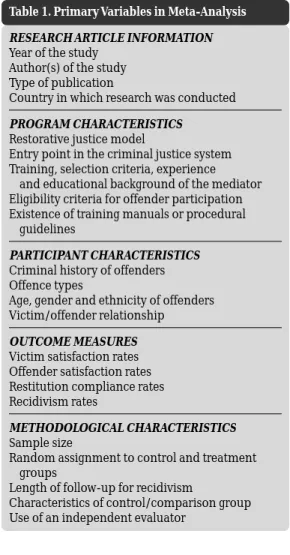
The standardized information con-tained in Table 1 was drawn from each study using a pre-designed coding manual. In designing a coding manual, the definition of certain variables can be problematic. For example, several stud-ies chose to operationalize recidivism differently. In keeping with standard meta-analytic practice, we accepted multiple definitions of recidivism (i.e. a new criminal conviction, a new criminal charge, pre-post test offending). We also accepted two definitions of restitution compliance (proportion of offenders who repaid their restitution and pro-portion of total restitution dollars repaid by offenders).
For an overall mean effect size, in cases where multiple control/comparison groups were used in a single study, we combined the results to generate a sin-gle effect size for each program. In addi-tion, where multiple follow-up periods were reported in a single study, we selected the longest at-risk period. To examine the impact of follow-up length and the use of different control/ comparison groups, we did, however, also code multiple effect sizes for each program. The results of the two coding methods will be presented separately.
Since a large proportion of programs accepted referrals along multiple entry points, we coded both the earli-est and the latearli-est entry points in the criminal justice system. This provided us with two methods of conducting analysis on the entry point of the pro-gram and its subsequent impact on each outcome.
While we did identify those programs that randomly assigned participants to treatment and control groups, it should be noted that this is somewhat misleading. While participants are initially assigned to either group, restorative justice participation by definition is voluntary so participants can choose to withdraw from a program. Consequently, the problem of self-selection bias, which random assign-ment strives to eliminate, remains as the attrition rate in many studies was quite high.
Table 1. Primary Variables in Meta-Analysis RESEARCH ARTICLE INFORMATION
Year of the study Author(s) of the study Type of publication
Country in which research was conducted
PROGRAM CHARACTERISTICS
Restorative justice model
Entry point in the criminal justice system Training, selection criteria, experience
and educational background of the mediator Eligibility criteria for offender participation Existence of training manuals or procedural
guidelines
PARTICIPANT CHARACTERISTICS
Criminal history of offenders Offence types
Age, gender and ethnicity of offenders Victim/offender relationship
OUTCOME MEASURES
Victim satisfaction rates Offender satisfaction rates Restitution compliance rates Recidivism rates
METHODOLOGICAL CHARACTERISTICS
Sample size
Random assignment to control and treatment groups
Length of follow-up for recidivism
Characteristics of control/comparison group Use of an independent evaluator
3.3 Data Analysis:
Effect Size Calculations
The relationship between participation in a restorative justice program and each of the four outcomes (victim satis-faction, offender satissatis-faction, restitution compliance and recidivism) was calcu-lated from the raw statistics reported within each study. The phi coefficient (Pearson’s r product moment correlation applied to dichotomous data) was used as the effect size estimate. If the neces-sary data were not contained in an individual study, but a non-significant relationship between participation in a restorative justice program and the outcome was reported, the effect size was recorded as zero.
Once the effect sizes from each of the studies were calculated, we conducted a series of analyses across each of our four outcome measures of interest. First, the overall mean effect size, along with the corresponding confidence intervals and standard deviation (SD), was calcu-lated. It should be noted that both the weighted and unweighted mean effect sizes were calculated but only the unweighted estimates were used in interpreting the results and in the moderator analyses. This was done because, as stated previously, we had to estimate the actual number of victims, thus reducing the reliability of the weighted estimates. Furthermore, the weighted mean effect sizes were only marginally lower or higher than the unweighted effect sizes and would not have made a significant difference to the results of the analysis.
We also determined whether the overall difference between the restorative To effectively compare victim and
offender satisfaction between restora-tive and traditional approaches, it was necessary to create a binary satisfaction variable. This was achieved by coding positive measures of satisfaction as “satisfied” whereas neutral and nega-tive responses were collapsed into an “unsatisfied” category. For example, if a study employed a five-point scale to measure satisfaction (i.e. very satisfied, somewhat satisfied, neutral, somewhat dissatisfied, very dissatisfied), we selected the top two categories as indi-cating satisfaction and considered the last three as unsatisfied.
In certain studies, the actual number of victims was not indicated but the study reported the percentage of satis-fied versus unsatissatis-fied victims. In these cases, we assumed the number of vic-tims was equal to the number of offend-ers in order to calculate an effect size. In meta-analytic work, there is usually a trade-off between the comprehen-siveness of the research and the preci-sion of the coding techniques due to the reporting practices contained in most studies.
To test the reliability of the coding procedures, a second individual coded six randomly selected studies contain-ing a total of 15 effect sizes. The general rate of agreement between the coders ranged from 47 percent to 100 percent, with an overall rate of agreement of 91 percent. In cases of coder disagree-ment, both coders discussed the dis-crepancy until a consensus was reached and this decision was then entered as the final code. Those variables that fell below 80 percent agreement were not included in the analysis.
programs and the non-restorative control/comparison groups was statis-tically significant by conducting a one-sample t-test. This determines if the mean effect size is significantly different from zero (a zero effect size would indi-cate that participation in restorative justice had no effect on the subsequent outcomes). Additional analyses were conducted to explore whether certain
variables, such as demographic or study characteristics, had a moderating impact on effect size magnitude. For example, if adequate information was available, we explored whether the age of the study sample (adult versus youth) had a significant effect on program outcome. This provided us with a mechanism whereby specific program impacts could be isolated for further study.
justice program resulted in higher vic-tim satisfaction ratings when compared to a comparison group in all but one of the 13 programs examined.
It should be noted that the one negative result was found in the only program that operated at the post-sentence (or correc-tions) entry point. Compared to victims who participated in the traditional jus-tice system, victims who participated in restorative processes were significantly more satisfied (t (12) = 3.89, p < 0.01).
4.0 Results
T
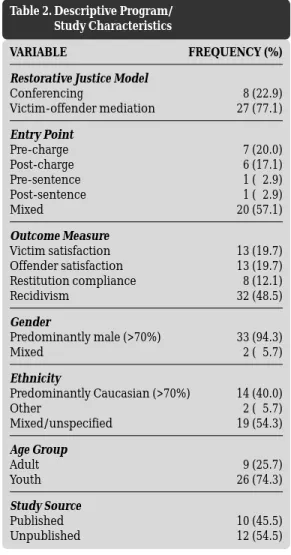
wenty-two unique studies that examined the effectiveness of 35 individual restorative justice programs generated 66 effect sizes. A summary of specific study characteris-tics is presented in Table 2. The frequen-cies presented in Table 2 are based upon the 35 programs with the exception of the type of outcome measure and study source, which are based upon 66 effect sizes and 22 unique studies respectively.The vast majority of the effect sizes were derived from programs that targeted predominantly male (94%), young (74%) offenders. Interestingly, a large propor-tion of the effect sizes was drawn from studies that were not published in peer-reviewed academic journals (55%), which, as discussed previously, is typi-cally not the case in meta-analytic work.
As shown in Table 2, studies commonly included one or more of the following outcome measures: victim satisfaction, offender satisfaction, restitution com-pliance and recidivism reduction. Each of these issues will be discussed accord-ingly in the following subsections.
4.1 Victim Satisfaction
The overall mean effect size for the 13 tests of treatment that explored the impact of restorative justice program-ming on victim satisfaction was +0.19 (SD=.18) with a 95 percent confidence of +0.30 to +0.08 (see Figure 1). Although the effect sizes ranged from +0.44 to -0.19, the latter was the only negative value found in the distribution. In other words, participation in a restorative
Table 2. Descriptive Program/ Study Characteristics
VARIABLE FREQUENCY (%)
Restorative Justice Model
Conferencing 8 (22.9) Victim-offender mediation 27 (77.1) Entry Point Pre-charge 7 (20.0) Post-charge 6 (17.1) Pre-sentence 1 ( 2.9) Post-sentence 1 ( 2.9) Mixed 20 (57.1) Outcome Measure Victim satisfaction 13 (19.7) Offender satisfaction 13 (19.7) Restitution compliance 8 (12.1) Recidivism 32 (48.5) Gender Predominantly male (>70%) 33 (94.3) Mixed 2 ( 5.7) Ethnicity Predominantly Caucasian (>70%) 14 (40.0) Other 2 ( 5.7) Mixed/unspecified 19 (54.3) Age Group Adult 9 (25.7) Youth 26 (74.3) Study Source Published 10 (45.5) Unpublished 12 (54.5)
Given the relatively wide range of effect sizes, additional analyses were con-ducted to explore whether characteris-tics of the study sample or methodologi-cal considerations could explain this variability. Initially, we had hoped to explore a relatively large number of potential moderators, such as gender, ethnicity, criminal history, offence type, etc. The relative homogeneity of the offenders in the studies, how-ever, as well as the large amount of missing data, rendered many of these analyses untenable. On the other hand, this homogeneity increases our confi-dence in the generalizability of the find-ings to this population. Therefore, the analyses focus on six factors: random assignment, offender age, publication source, restorative justice model, entry point and control/comparison group type.
As indicated previously, we used two coding methods for capturing information on the control/comparison group used in the studies. First, we combined multi-ple control/comparison groups from the same study to calculate a single effect size; second, we calculated individual effect sizes for each control/comparison group. For the compar-ison of control groups in Table 3 (and subsequent Tables), we used the latter coding technique. This allowed us to compare restorative justice pro-grams with individuals who were referred to a restorative justice program but refused participation ver-sus all other control group types (i.e. probation, court, prison).
The mean effect sizes for each value of the moderator variable, along with their corresponding significance tests, are presented in Table 3. Although these variables did not yield significant between-group differences, studies using non-randomized comparisons and studies published in academic jour-nals displayed a higher mean effect size than their counterparts. In addition, VOM models tended to display higher victim satisfaction rates than confer-encing models when compared to the non-restorative approaches. The lack of significance between moderating variables might be due to the low num-ber of effect sizes.
0 1 2 3 4 5 6 7 8 .40 to .49 .30 to .39 .20 to .29 .10 to .19 0.0 to 0.9 -.10 to -.01 -.20 to -.11 -.30 to -.21 E ffect siz e
Number of effect sizes Figure 1. Distribution of Effect Size Estimates
two negative effect sizes contributing to this result, the -0.71 was a clear outlier. Moreover, given that the sample size used in this outlier study was extremely small (n=7), we removed the study from the analysis. This increased the mean effect size to +0.17 and substantially reduced the standard deviation (SD=.13). Furthermore, and more importantly, removal of this study resulted in the confidence interval not including zero, thus suggesting that these programs have a moderate to weak positive impact on offender satisfaction. The difference in offender satisfaction between restorative and non-restorative participation also becomes significant (t (11) = 4.52, p < 0.01). Interestingly, the -.71 effect size was drawn from the same post-sentence entry point program as the only negative victim satisfaction effect size.
4.2 Offender Satisfaction The overall mean effect size for the 13 tests of the impact of restorative justice programming on offender satis-faction was +0.10 (SD=.28), while the effect sizes ranged from +0.31 to -0.71 (see Figure 2). While offenders who participated in restorative justice pro-grams displayed higher satisfaction with the process than their compar-isons, the one-sample t-test indicated that this difference was not statistically significant. Since the 95 percent con-fidence interval included zero, this further decreased our confidence that these programs have had any discernible impact on offender satisfaction.
This conclusion is mitigated, however, by the finding that although there were
Table 3. Moderator Analyses for Victim Satisfaction
EFFECT SIZE T value VARIABLE N Unweighted (p)
AGE Youth 8 .20 -.09
Adult 5 .19 (ns)
RANDOM ASSIGNMENT Yes 3 .14 .94
No 10 .21 (ns)
STUDY SOURCE Published 3 .30 -1.42
Unpublished 10 .16 (ns)
ENTRY POINT (earliest) Pre-charge 6 .16 -.31
Other entry points 6 .18 (ns)
ENTRY POINT (latest) Pre-charge 3 .15 -.32
Other entry points 9 .18 (ns)
MODEL Conferencing 4 .14 .94
V-O mediation 9 .21 (ns)
CONTROL GROUP Non-participation 9 .22 .62
Other control 6 .18 (ns)
v-o = victim-offender ns = not significant
pensation for the harm caused by the criminal activity and the offenders would be actively accept-ing responsibility. The results of the studies that included a measure of restitution compliance are reported below.
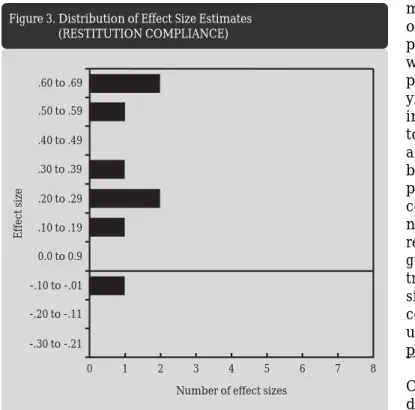
Only eight studies exam-ined the impact of restora-tive justice programming on restitution compliance. Although this number may seem small, it may have been, in part, due to the inclusion criteria for this meta-analysis (i.e. the study used a com-parison group). Overall, the mean effect size of +0.33 (SD=.24) was quite high, indicating that offenders who participated in restorative justice pro-grams tended to have substantially higher compliance rates than offend-ers exposed to other arrangements. Furthermore, there was a great deal of variability in the effect sizes found in these studies, with values ranging from +0.63 to -0.02 (see Figure 3). Compared to the comparison/control groups not participating in a restorative justice program, offenders in the treatment groups were significantly more likely to complete restitution agreements (t (7) = 3.87, p < 0.01).
The small number of effect sizes (k=8) made conducting the moderator analy-ses inappropriate.
To account for this substantial discrep-ancy, we presented the results both with the outlier (Table 4.1) and without the outlier (Table 4.2). Given this extreme outlier, interpreting these results was inappropriate as the conclusions would be drastically different in each case based upon the inclusion or exclusion of one value.
4.3 Restitution Compliance One of the potential advantages of a restorative justice approach is that it could be more effective in ensuring offender compliance with restitution agreements. This would be a significant contribution as the victims would have a greater likelihood of receiving
com-0 1 2 3 4 5 6 7 8 .40 to .49 .30 to .39 .20 to .29 .10 to .19 0.0 to 0.9 -.10 to -.01 -.20 to -.11 -.30 to -.21 E ffect siz e
Number of effect sizes
*Does not include -.71 outlier
Figure 2. Distribution of Effect Size Estimates (OFFENDER SATISFACTION*)
Table 4.1. Moderator Analyses for Offender Satisfaction (With Outlier)
EFFECT SIZE T Value VARIABLE N Unweighted (p)
AGE Youth 8 .15 -.47
Adult 5 .05 (ns)
RANDOM ASSIGNMENT Yes 4 .09 .17
No 9 .12 (ns)
STUDY SOURCE Published 1 .08 .00
Unpublished 12 .11 (ns)
ENTRY POINT (earliest) Pre-charge 8 .15 .17
Other entry points 5 .03 (ns)
ENTRY POINT (latest) Pre-charge 5 .09 -.13
Other entry points 8 .11 (ns)
MODEL Conferencing 6 .11 .12
V-O mediation 7 .09 (ns)
CONTROL GROUP Non-participation 8 .10 .02
Other control 7 .10 (ns)
v-o = victim-offender s = not significant
Table 4.2. Moderator Analyses for Offender Satisfaction (Without Outlier)
EFFECT SIZE T Value VARIABLE N Unweighted (p)
AGE Youth 8 .15 1.71
Adult 4 .22 (ns)
RANDOM ASSIGNMENT Yes 4 .09 1.33
No 9 .21 (ns)
STUDY SOURCE Published 1 .08 .00
Unpublished 11 .18 (ns)
ENTRY POINT (earliest) Pre-charge 8 .15 -1.02
Other entry points 4 .22 (ns)
ENTRY POINT (latest) Pre-charge 5 .09 -1.79
Other entry points 7 .23 (ns)
MODEL Conferencing 6 .11 .12
V-O mediation 6 .23 (ns)
CONTROL GROUP Non-participation 7 .21 1.93
Other control 7 .10 (ns)
v-o = victim-offender ns = not significant
4.4 Recidivism
Arguably, one of the most important outcome variables for any form of crimi-nal justice intervention is recidivism. Considerable public and institutional support for correctional programming rests on its ability to reduce future crim-inal activity. Therefore, the ability of restorative justice programs to reduce recidivism was felt to be particularly important for this meta-analysis.
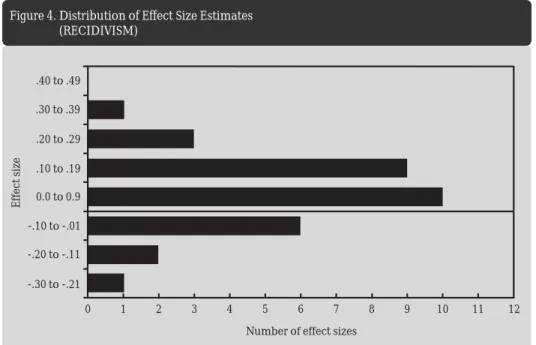
The overall mean effect size for the 32 tests that examined the effectiveness of restorative justice programming in reducing offender recidivism was +0.07 (SD=.13) with a 95 percent confidence interval of +0.12 to +0.02. Although the effect sizes ranged from +0.38 to -0.23,
more than two thirds of the effect sizes were positive (72%). In other words, restorative justice programs, on average, yielded reductions in recidivism compared to non-restorative approaches to criminal behaviour. In fact, com-pared to the comparison/ control groups that did not participate in a restorative justice pro-gram, offenders in the treatment groups were significantly more suc-cessful during the follow-up periods (t (31) = 2.88, p < 0.01).
One of the major areas of debate in the correctional treatment literature is the impact of different methodological and demographic characteristics on program effective-ness. Subsequently, we conducted mod-erator analyses to explore the impacts of several variables on recidivism reduc-tion. The results of these analyses are presented in Table 5 and are discussed below.
As stated previously, one of the primary criticisms lodged against meta-analysis is its predominant reliance on published studies and the subsequent problem of potential publication bias. This issue has been addressed in the present meta-analysis by conducting searches of governmental and non-governmental reports, graduate theses and disser-tations and by directly contacting researchers active in the field for
0 1 2 3 4 5 6 7 8 .40 to .49 .30 to .39 .20 to .29 .10 to .19 0.0 to 0.9 -.10 to -.01 -.20 to -.11 -.30 to -.21 E ffect siz e
Number of effect sizes .50 to .59
.60 to .69
Figure 3. Distribution of Effect Size Estimates (RESTITUTION COMPLIANCE)
Table 5: Moderator Analyses for Recidivism
EFFECT SIZE T value VARIABLE N Unweighted (p)
AGE Youth 24 .06 .60
Adult 8 .10 (ns)
RANDOM ASSIGNMENT Yes 8 .06 .33
No 24 .07 (ns)
STUDY SOURCE Published 12 .12 -1.73
Unpublished 20 .04 (ns)
ENTRY POINT (earliest) Pre-charge 16 .07 .17
Other entry points 16 .06 (ns)
ENTRY POINT (latest) Pre-charge 8 .06 -.16
Other entry points 24 .07 (ns)
MODEL Conferencing 8 .06 .22
V-O mediation 24 .07 (ns)
CONTROL TYPE Non-participation 9 .02 -1.73
Other control 31 .12 (ns) v-o = victim-offender ns = not significant 0 1 2 3 4 5 6 7 8 9 10 11 12 .40 to .49 .30 to .39 .20 to .29 .10 to .19 0.0 to 0.9 -.10 to -.01 -.20 to -.11 -.30 to -.21 E ffect siz e
Number of effect sizes Figure 4. Distribution of Effect Size Estimates
unpublished research. Nevertheless, we directly tested the impact of publication source on effect size. Inspection of Table 5 reveals that the mean effect size for studies from published sources was somewhat higher than the mean effect
size found in unpublished sources. This, in combination with the difference reported in victim satisfaction rates, lends support to the “file-drawer” problem in meta-analytic work.
argued that there was no treatment effect on recidivism from participation in restorative justice beyond a self-selection effect.
This is an inherent problem in restora-tive justice research. It is not possible to truly randomly assign participants to treatment and control conditions. Once an individual is forced to participate in a restorative justice program, most would argue that the program is no longer truly restorative. Given this, we believe that an alternative method of determining the effectiveness of restorative justice is necessary. We recommend administer-ing questionnaires designed to measure participants’ motivation prior to pro-gram participation. This would allow researchers to examine the motivation of the control group, restorative justice participants and those who refused par-ticipation. A research design such as this would provide a comparison of highly motivated, moderately motivated and unmotivated individuals in each group. If the satisfaction or recidivism rates, for example, were improved in the restora-tive justice group, and motivation was controlled for in the analysis, we would be more convinced that there is a treatment effect from participation in restorative justice processes.
Notwithstanding the issue of self-selection bias, the results of this meta-analysis, at present, represent the best indicator of the effectiveness of restorative justice practices (i.e. those individuals who choose to participate in restorative justice programs find the process satisfying, tend to display lower recidivism rates and are more likely to adhere to restitution agreements).
5.0 Discussion
G
enerally, compared to traditional non-restorative approaches, restorative justice was found to be more successful at achieving each of its four major goals. In other words, based on the findings of this meta-analysis, restorative justice programs are a more effective method of improv-ing victim/offender satisfaction, increas-ing offender compliance with restitu-tion, and decreasing the recidivism of offenders when compared to more traditional criminal justice responses (i.e. incarceration, probation, court-ordered restitution). In fact, restorative programs were significantly more effec-tive than these approaches in all four outcomes (with the exclusion of the offender satisfaction outlier).5.1 Self-Selection Bias
The positive results of this meta-analysis are tempered, however, by the self-selection bias evident in controlled outcome studies on restorative justice programs. Restorative justice, by its very nature, is a voluntary process. This cre-ates a treatment group of participants (both offenders and victims) who have chosen to participate in the program and may therefore be more motivated than the control group. This concern is elevated by the high rate of attrition within many of the studies in this meta-analysis. McCold and Wachtel (1998), for example, found clear differences in the recidivism rates of restorative justice participants (20%) versus individuals who refused participation in the pro-gram (48%) versus the comparison group (35%). In fact, these authors
5.2 Appropriate Treatment While the effects of restorative justice participation on recidivism remains somewhat uncertain due to the self-selection bias, many argue that it is naïve to believe that a time-limited intervention such as a VOM will have a dramatic effect on altering criminal and delinquent behaviour (Umbreit, 1994b). Additional factors, such as anti-social peers, substance abuse and crimino-genic communities, which have been linked to criminal behaviour (Hawkins et al., 1998; Lipsey & Derzon, 1998), are not adequately addressed in the restora-tive process. Andrews and Bonta (1998) have also identified several crimino-genic needs that they maintain are imperative to address in the treatment of offenders in order to reduce recidi-vism effectively. Generally, they identi-fied anti-social attitudes, pro-criminal associates, personality factors, family factors and low levels of educational and employment attainment. In fact, previ-ous meta-analytic work conducted by Dowden (1998) and Andrews et al. (1990) found that “appropriate” correc-tional treatment (i.e. those programs that adhered to the clinically relevant principles of risk, need and responsiv-ity2) displayed an appreciably higher mean effect size (+.26 and +.30, respec-tively) for recidivism compared to the findings for restorative justice programs (+.07) presented here. In other words, although restorative justice programs may yield reductions in recidivism compared to more traditional criminal justice responses to crime, they did
not have nearly as strong an impact on re-offending as psychologically informed treatment.
It has been argued, however, that restorative justice and rehabilitative treatment are rather complementary approaches (Crowe, 1998). The utiliza-tion, therefore, of both restorative jus-tice processes and “appropriate treat-ment” as a comprehensive response to criminal behaviour would be a valuable and theoretically directed experiment. This combination would enable both approaches to capitalize on their strengths and minimize their weak-nesses. More specifically, the restora-tive processes could increase victim/ offender satisfaction and restitution compliance while the rehabilitative processes could have a significant impact on recidivism.
5.3 Moderating Variables
Although we did not discover any signif-icant differences in reported outcomes based on model type (i.e.VOM versus conferencing), VOM models did have higher victim satisfaction ratings and offender satisfaction ratings (excluding the outlier). The low number of effect sizes, however, coupled with the lack of a significant difference, does not allow for a firm conclusion. Theoretically, the large number of participants in a con-ference compared to a VOM could be contributing to the reported lower victim/offender satisfaction ratings. There is concern in the restorative justice literature that coming to a
2For a detailed description of the principles of risk, need and responsivity and their importance in
the criminal history of the offenders (i.e. first-time offenders versus repeat offenders), the specific offences (i.e. minor versus serious offences, property versus violent offences), and the relationship between offenders and victims (i.e. family, neighbour, stranger).
In general, we were unable to provide an adequate explanation for the large range of reported effect sizes in each of the outcomes. It is possible that the signifi-cant factors in determining a more suc-cessful restorative justice program are those that were not reported in the literature (i.e. facilitator characteristics, offence types, criminal history). To facilitate a better understanding of the effectiveness of restorative justice, we recommend that future studies report outcomes, such as recidivism or satis-faction, separately for groups of offend-ers using such variables as gender, age, criminal history, offence types and rela-tionship between victim and offender. In addition, we recommend that studies provide more detailed information on the processes used within the restora-tive justice programs and the facilitators.
5.4 Additional Research Issues Another issue that future studies may wish to explore is the effect that offender compliance with restitution agreements has on victim satisfaction. The restric-tions of meta-analytic procedures pre-clude such an analysis. Morris and Maxwell (1998), however, did report that the reason most frequently reported for victim dissatisfaction in an evalua-tion of a family group conference pro-gram in New Zealand was a failure to receive the appropriate restitution. satisfactory agreement in a session is
sometimes difficult, particularly when there are numerous individuals from various backgrounds participating in the process (Hooper & Busch, 1996). This possibility is certainly increased in the case of conferences.
Interestingly, we did not discover differ-ences among programs that operate along different entry points to the crimi-nal justice system, with the exception of offender satisfaction. This difference is not convincing, however, because of the outlier issue and the fact that the entry points were difficult to code (more than half of the programs had mixed entry points). Thus, we recommend that researchers more explicitly code the entry point for their program and/or separate the analyses by this variable.
There were several questions that we were unable to answer due to a lack of data reported in the literature. For example, we were interested in explor-ing whether the characteristics of the facilitator had a significant moderating impact on restorative justice program effectiveness. However, very few, if any of the studies, provided information concerning the education, professional background or training of the facilita-tors. This is particularly noteworthy as facilitators within restorative justice programs can have a significant impact on the outcome of a session. Support for this assertion may be found within the correctional treatment literature where program staff characteristics and behav-iours have been found to have a signifi-cant impact on program effectiveness (Dowden & Andrews, under review). There was also rather limited data on additional important variables, such as
More empirical research into the restitu-tion condirestitu-tions (i.e. type of restiturestitu-tion, size of restitution, length of time given to comply) that lead to successful com-pliance would also be appropriate. Moreover, the same type of analysis could be completed on restitution con-ditions and victim/offender satisfaction.
And finally, there is no research in the literature that examines the longer term effects for victims who participate in a restorative justice process. An exami-nation of whether victims still feel that they have experienced some closure and healing six months or a year after the restorative process would be beneficial.
■ more specific reporting practices
when presenting outcomes (i.e. by age groups, gender, criminal history, offence type);
■ more detailed information in
research reports/articles on the processes involved in the programs and program facilitators;
■ the effectiveness of a combination of
restorative justice and “appropriate treatment” approaches;
■ the effectiveness of restorative
justice for female offenders;
■ controlled evaluations of circle
sen-tencing models and healing circles;
■ the relationship between restitution
and satisfaction; and
■ follow-up research into the longer
term effects on victims.
6.0 Research
Recommendations
S
urprisingly, given the current levelof restorative justice activity in Canada, there were only three Canadian studies and no appropriate empirical evaluations of circle sentenc-ing models or healsentenc-ing circles. This is due, in some part, to our selection criteria, which required the use of a control/comparison group but also because the field of restorative justice research in Canada is not as well devel-oped as it is in other countries. In addi-tion, as with a large proportion of crimi-nal justice research, there was a dearth of information on the effectiveness of restorative justice for female offenders. As such, we are recommending that future Canadian research focus on the following issues:
■ more evaluations of restorative
justice programs using randomly assigned treatment and control conditions with an examination of restorative justice participants’ motivation in order to address the inherent self-selection bias;
not as strong as “appropriate correc-tional treatment,” restorative justice does appear to reduce recidivism for those who choose to participate. Finally, offenders in restorative justice programs report moderate increases in satisfac-tion compared to offenders in the tradi-tional system.
The proliferation of restorative justice programming worldwide is, therefore, not surprising. Both the theory and empirical research tend to offer sup-port for such a response to criminal behaviour. The next critical step for both research and program develop-ment is to obtain a better understand-ing of the effect of self-selection bias that currently diminishes our confi-dence in these results. To more defini-tively claim restorative justice as an effective response to criminal behav-iour, we need to be able to address this limitation inherent in restorative justice research methods.
7.0 Conclusion
T
he traditional criminal justice system, which has been often criticized as too formal, punitive and adversarial, is clearly changing. The large increase in the number of restorative justice programs operating in Canada is undoubtedly having an impact on criminal justice theory and practice. We are currently in a period of substantial change; but, as the results of this meta-analysis indicate, we are moving in a positive direction. The addition of restorative justice programs has enhanced victim satisfaction in a process that was, by its very nature, rather unsatisfactory. Moreover, this response to criminal behaviour has a strong impact by encouraging more offenders to take responsibility for their actions and repair through restitution some of the harm they have caused. And while the gains made in recidivism areCrowe, A.H. (1998). Restorative justice and offender rehabilitation: A meeting of the minds. Perspectives: Journal of the American Probation and Parole Association 22: 28–41. *Davis, R.C. (1982). Mediation: The Brooklyn experiment. In R. Tomasic and M. Feeley (eds.), Neighbourhood Justice: Assessment of an Emerging Idea. New York: Longman Inc. Dowden, C. (1998). “A Meta-analytic Examination of the Risk, Need and Responsivity Principles and Their Importance within the Rehabilitation Debate.” Unpublished M.A. thesis. Ottawa: Psychology Department, Carleton University. Dowden, C., and Andrews, D.A. (1999). What works for female offenders: A meta-analytic review. Crime and Delinquency 45: 438–452. ___________________________________________________ . (2000). Effective correctional treat-ment and violent re-offending: A meta-analysis. Canadian Journal of Criminology 42: 449–476.
___________________________________________________ . (under review). “The Importance of Staff Characteristics in Delivering Effective Correctional Treatment: A Meta-analytic Review of Core Correctional Practice.” Manuscript submitted for publication. Dowden, C., and Brown, S. (in press). The role of substance abuse factors in predicting recidivism: A meta-analysis. Psychology, Crime, and Law.
Eglash, A. (1977). Beyond restitution: Creative restitution. In J. Hudson and B. Galaway (eds.), Restitution in Criminal Justice. Lexington, Mass.: D.C. Heath. *Evje, A., and Cushman, R.C. (2000). A Summary of the Evaluations of Six California Victim Offender Reconciliation Programs. The Judicial Council of California Administrative Office of the Courts, Center for Families, Children & the Courts. Federal/Provincial/Territorial Working Group on Restorative Justice. (2000).
Restorative Justice in Canada: A Consultation Paper. Ottawa: Department of Justice, Canada.
8.0 Bibliography
*Indicates study used in meta-analysis Andrews, D.A., and Bonta, J. (1998). Psychology of Criminal Conduct (2nd ed.). Cincinnati, Oh.: Anderson Publishing. Andrews, D.A., Zinger, I., Hoge, R., Bonta, J., Gendreau, P., and Cullen, F. (1990). Does correctional treatment work? A clinically relevant and psychologically informed meta-analysis. Criminology 28: 369–404. Barnett, R. (1977). Restitution: A new para-digm of criminal justice. Ethics 87: 279–301. Bazemore, G., and Schiff, M.F. (1996). Community justice/Restorative justice: Prospects for a new social ecology for com-munity corrections. International Journal of Comparative and Applied Criminal Justice 20: 311–335.Bazemore, G., and Walgrave, L. (1999). Restorative Juvenile Justice: Repairing the Harm of Youth Crime. Monsey, N.Y.: Criminal Justice Press.
Bonta, J., Law, M., and Hanson, R.K. (1998). The prediction of criminal and violent recidivism among mentally disordered offenders: A meta-analysis. Psychological Bulletin 123: 123–142.
*Bonta, J., Wallace-Capretta, S., and Rooney, J. (1998). Restorative Justice: An Evaluation of the Restorative Resolutions Project. Ottawa: Solicitor General Canada. Braithwaite, J. (1989). Crime, Shame and Reintegration. Cambridge: Cambridge University Press.
___________________________________________________ . (1999). Restorative justice: Assessing optimistic and pessimistic accounts. In M. Tonry (ed.), Crime and Justice: A Review of Research 25: 1–127.
Cooper, H., and Rosenthal, R. (1980). Statisti-cal versus traditional procedures for sum-marising research findings. Psychological Bulletin 87: 442–449.
*Fercello, C., and Umbreit, M. (1998). Client Evaluation of Family Group Conferencing in 12 Sites in 1st Judicial District of Minnesota. Center for Restorative Justice & Mediation, School of Social Work, University of Minnesota.
Gendreau, P., Goggin, C., and Cullen, F. (1999). The Effects of Prison Sentences on Recidivism. Ottawa: Corrections Research Branch, Solicitor General of Canada.
Gendreau, P., Little, T., and Goggin, C. (1996). A meta-analysis of the predictors of adult offender recidivism: What works! Criminol-ogy 34: 575–607.
Glass, G., McGaw, B., and Smith, M. (1981). Meta-analysis in Social Research. Newbury Park, Calif.: Sage.
Hanson, R.K., and Bussière, M. (1998). Predicting relapse: A meta-analysis of sexual offender recidivism studies. Journal of Consulting and Clinical Psychology 66: 348–362.
Hawkins, J.D., Herrenkohl, T., Farrington, D.P., Brewser, D., Catalano, R.F., and Harachi, T.W. (1998). A review of predictors of youth violence. In R. Loeber and D.P. Farrington (eds.), Serious and Violent Juvenile Offenders: Risk Factors and Successful Interventions. London: Sage.
Hooper, S., and Busch, R. (1996). Domestic violence and restorative justice initiatives: The risks of a new panacea. Waikato Law Review, Special Issue: Domestic Violence 4: 1–19.
Hughes, P., and Mossman, M.J. (2001). “Re-thinking Access to Criminal Justice in Canada: A Critical Review of Needs and Responses.” Unpublished paper for the Department of Justice Canada.
LaPrairie, C. (1995). Altering course: New directions in criminal justice — Sentencing circles and family group conferences. Australian and New Zealand Journal of Criminology, Special Issue: Crime, Criminology and Public Policy : 78–99.
Latimer, J. (2001). A meta-analytic exami-nation of youth delinquency, family treat-ment and recidivism. Canadian Journal of Criminology 43: 237–253.
Latimer, J., and Kleinknecht, S. (2000). The Effects of Restorative Justice Programming: A Review of the Empirical Research Literature. Ottawa: Research and Statistics Division, Department of Justice Canada.
Law Commission. (2000). From Restorative Justice to Transformative Justice: Discussion Paper. Ottawa: Law Commission of Canada. Lipsey, M. (1995). What do we learn from 400 research studies on the effectiveness of treatment with juvenile delinquents? In J. McGuire (ed.), What Works: Reducing Reoffending — Guidelines from Research and Practice. Chichester, Eng.: John Wiley & Sons. Lipsey, M., and Derzon, J. (1998). Predictors of violent or serious delinquency in adoles-cence and early adulthood: A synthesis of longitudinal research. In R. Loeber and D.P. Farrington (eds.), Serious and Violent Juvenile Offenders: Risk Factors and Successful Interventions. London: Sage. Lipsey, M., and Wilson, D. (1993). The efficacy of psychological, educational, and behavioral treatment: Confirmation from meta-analysis. American Psychologist 48: 1181–1209.
Llewellyn, J., and Howse, R. (1998). Restora-tive Justice: A Conceptual Framework. Ottawa: Law Commission of Canada.
Losel, F. (1995). The efficacy of correctional treatment: A review and synthesis of meta-evaluations. In J. McGuire (ed.), What Works: Reducing Re-offending — Guidelines from Research and Practice. Chichester, Eng.: John Wiley & Sons.
Marshall, T. (1985). Alternatives to Criminal Courts: The Potential for Non-judicial Dispute Resolution. Brookfield, Ver.: Gower Publishing Co.
Rosenthal, R. (1991). Meta-analytic Procedures for Social Research. Newbury, Calif.
*Roy, S. (1993). Two types of juvenile restitu-tion programs in two Midwestern counties: A comparative study. Federal Probation 57: 48–53.
*Schneider, A.L. (1986). Restitution and recidivism rates of juvenile offenders: Results from four experimental studies. Criminology 24: 533–552.
*Sherman, L.W., and Strang, H. (2000). Recidivism Patterns in the Canberra Reintegrative Shaming Experiments (RISE). Centre for Restorative Justice, Research School of Social Sciences, Australian National University.
*Strang, H., Barnes, G.C., Braithwaite, J., and Sherman, L.W. (1999). Experiments in Restorative Policing: A Progress Report on the Canberra Reintegrative Shaming Experiments (RISE). Australian Federal Police and
Australian National University.
*Umbreit, M.S. (1989). Crime victims seeking fairness, not revenge: Toward restorative justice. Federal Probation 53: 52–57. ___________________________________________________ . (1994a). Victim Meets Offender: The Impact of Restorative Justice and Mediation. Monsey, N.Y.: Criminal Justice Press. *___________________________________________________ . (1994b). Crime victims confront their offenders: The impact of a Minneapolis mediation program. Research on Social Work Practice 4: 436–447.
*Umbreit, M.S., and Coates, R.C. (1993). Cross-site analysis of victim-offender media-tion in four states. Crime & Delinquency 39: 565–585.
*Umbreit, M.S., Coates, R.C., Kalanj, B., Lipkin, R., and Petros, G. (1995). Mediation of Criminal Conflict: An Assessment of Programs in Four Canadian Provinces — Executive Summary Report. Center for Restorative Justice & Mediation, School of Social Work, University of Minnesota. ___________________________________________________ . (1999). Restorative Justice: An
Overview. London: Home Office, Research Development and Statistics Directorate. *McCold, P., and Stahr, J. (1996). “Bethlehem Police Family Group Conferencing Project.” Paper presented to the American Society of Criminology Annual Meeting, Chicago, November 20–23, 1996.
*McCold, P., and Wachtel, B. (1998). Restorative Policing Experiment: The Bethlehem Pennsylvania Police Family Group Conferencing Project — Summary. Community Service Foundation, Pipersville, Penn.
*Moore, D., and Forsythe, L. (1995). A New Approach to Juvenile Justice: An Evaluation of Family Conferencing in Wagga Wagga. A report to the Criminology Research Council, Centre for Rural Social Research, Charles Sturt University, Wagga Wagga NSW, Australia.
Morris, A., and Maxwell, G. (1998).
Restorative justice in New Zealand: Family group conferences as a case study. Western Criminology Review 1: 1–16.
*Niemeyer, M., and Shichor, D. (1996). A pre-liminary study of a large victim/offender reconciliation program. Federal Probation 60: 30–34.
*Nuffield, J. (1997). Final Report — Evaluation of the Adult Victim-Offender Mediation Program, Saskatoon Community Mediation Services. Saskatoon, Sask.: Saskatchewan Justice.
*Nugent, W.R., and Paddock, J.B. (1995). The effect of victim-offender mediation on severity of re-offence. Mediation Quarterly 12: 353–367.
*___________________________________________________ . (1996). Evaluating the effects of a victim-offender reconciliation program on re-offence. Research on Social Work Practice 6: 155–178.
*Umbreit, M., and Fercello, C. (1997). Interim Report: Client Evaluation of the Victim/ Offender Conferencing Program in Washington County (MN). Center for Restorative Justice & Mediation, School of Social Work, University of Minnesota. *Umbreit, M.S., Warner Roberts, A., Kalanj, B., and Lipkin, R. (1996). Mediation of Criminal Conflict in England: An Assessment of Services in Coventry and Leeds — Executive Summary. Center for Restorative Justice & Mediation, School of Social Work, University of Minnesota.
*URSA Institute. (1993). Final Evaluation Report: Community Involvement in
Mediation of First and Second Time Juvenile Offenders Project of the Community Board Program of San Francisco. Washington, D.C.: U.S. Department of Justice.
Van Ness, D., and Strong, K.H. (1997). Restoring Justice. Cincinnati, Oh.: Anderson Publishing.
Whitehead, J.T., and Lab, S.P. (1989). A meta-analysis of juvenile correctional treat-ment. Journal of Research on Crime and Delinquency 26: 276–295.
*Wynne, J. (1996). Leeds mediation and repa-ration service: Ten years’ experience with victim-offender mediation. In B. Galaway and J. Hudson (eds.), Restorative Justice: International Perspectives. Monsey, N.Y.: Criminal Justice Press.
Zehr, H. (1990). Changing Lenses: A New Focus for Crime and Justice. Scottsdale, Penn.: Herald Press.
Zellerer, E. (1996). Community-based justice and violence against women: Issues of gen-der and race. International Journal of Comparative and Applied Criminal Justice 20: 233–244.