Ranking Up by Moving Out:
The Effect of the Texas Top 10% Plan on Property Values
Kalena E. Cortes*
The Bush School of Government and Public Service Texas A&M University
4220 TAMU, 1049 Allen Building College Station, TX 77843
Andrew I. Friedson Department of Economics University of Colorado Denver Campus Box 181, PO Box 173364
Denver, CO 80217
This version: June 15, 2012 Abstract
Texas engaged in a large-scale policy experiment when it instituted the Top 10% Plan. This policy guarantees automatic admission to their state university of choice for all high school seniors who graduate in the top decile of their high school class. We find evidence that households reacted strategically to this policy by moving to neighborhoods with lower-performing schools, increasing property values in those areas. The effect is strongest among schools that were very low-performing before the change in policy; and weaken as the previous performance of the school district increases. We also find evidence that these strategic reactions were influenced by the number of local schooling options available: areas that had fewer school choices showed no reaction to the Top 10% Plan.
JEL Classifications: H31, H41, H73, I20
Keywords: Property Values, College Choice, Affirmative Action, Top 10% Plan.
* We are indebted to Catherine Kilgore, Property Tax Division, Texas Comptroller of Public Accounts for making the data available for this project. We would like to thank David E. Card, Jeffrey D. Kubik, Christopher Rohlfs, Stuart Rosenthal, Cecilia E. Rouse, Michael J. Wasylenko, and John Yinger for all of their encouragement and most valued advice throughout this research. A special thank you to Julie Berry Cullen for sharing her Stata macro programs for the extraction of the Academic Excellence Indicator System data, the Texas Education Agency, and to Katie Fitzpatrick for excellent research assistance. Also, we would like to thank seminar participants at the University of Kentucky, Syracuse University, Tufts University, Harvard University, University of Connecticut, Texas A&M University; and conference participants from the National Tax Association (NTA), American Economic Association (AEA), and the American Education Finance Association (AEFA). We are thankful to the Maxwell School of Citizenship and Public Affairs at Syracuse University for providing an internal grant in support of this project. Institutional support from the Center of Policy Research at the Maxwell School of Citizenship and Public Affairs, Texas A&M University, Harvard University, and the National Bureau of Economic Research are also gratefully acknowledged. Research results, conclusions, and all errors are naturally our own.
1. Introduction
Texas engaged in an unforeseen large-scale experiment when it replaced the use of affirmative action policies in its college admissions with the Top 10% Plan admissions policy. The Top 10% Plan guarantees admission into any of Texas’ public universities to all high school seniors who finish within the top decile of their graduating class. This includes the most selective state universities: The University of Texas at Austin and Texas A&M at College Station. For school districts that had poor acceptance rates to postsecondary institutions this admissions policy suddenly provided a valuable local amenity: improved access.
In this study, we analyze the effect of the Top 10% Plan on property values. More specifically, we analyze whether the change in admissions policies led to an increase of the value of residential homes in school districts with low-performing high schools relative to school districts with higher-performing high schools. Though theoretically it is possible for any school district to gain in property values relative to any other district with higher initial school quality as a result of the policy change, we find that school districts with the lowest-performing high schools are the areas where property values are most responsive to the policy change. This is unsurprising because it is at these schools where access to selective public colleges was improved the most. We also find less reaction to the Top 10% Plan in areas with high-quality schools: this is also unsurprising as these high schools are more likely to place their top 10% of graduates in highly ranked postsecondary institutions, the Top 10% Plan would do much less to increase access.
Using a difference-in-differences methodology, we find that, as a consequence of the change in admissions policy, residential property values in the areas served by schools in the bottom quintile of school quality grew more rapidly relative to areas served by schools in the 2nd quintile (second from the bottom). We also find that the bottom quintile grew relative to other quintiles in the school quality distribution, although the effect attenuates further away from the bottom of the distribution.
We also compare the 4th quintile with the top quintile and find that the growth in home values did not occur in the top end of the school quality distribution.
Furthermore, we observe that changes in property values are sensitive to the number of schooling options locally available. If a household is going to react strategically to the Top 10% Plan by moving, then moves would be easier in areas with a large number of local schooling options (e.g., a shorter distance to find a new school would not require finding a new job). Specifically, counties with a relatively high Herfindahl-Hirschman Index (HHI) for schooling would show little to no reaction to the change in policy, whereas counties with a relatively low HHI for schooling would show the greatest reaction to the policy change. This is precisely the case: we find that the disproportionate growth of property values in the bottom quintile of school quality relative to the 2nd quintile did not occur in counties that were more monopolistic, but did occur in counties that were more competitive.
Lastly, our analysis estimates that the Top 10% Plan had a rate of return of 4.9 percent in relative average property value gains of the lowest quintile of school quality compared to the 2nd quintile of school quality. As property values vary greatly from district to district before the policy shift and property tax rates also vary greatly it is easy to see how the Top 10% Plan had a powerful impact not only on admissions decisions, but also on school finance and local taxation decisions. 2. Background of the Top 10% Plan and Literature Review
2.1 The Top 10% Plan
The 5th Circuit Court’s decision in Hopwood v. University of Texas Law School judicially banned the use of race as a criterion in admissions decisions in all public postsecondary institutions in Texas.1 The end of affirmative action admissions policies was overwhelmingly felt, especially at the two most selective public institutions, The University of Texas at Austin and Texas A&M
University at College Station, where the number of minority enrollees plummeted (Tienda et al. 2003; Bucks 2004; Walker and Lavergne 2001). In response to this ruling, Texas passed the H.B.588 Law on May 20, 1997–more commonly known as the Top 10% Plan. The Top 10% Plan guarantees automatic admission to any public university of choice to all seniors who graduate in the top decile of their graduating high school class.2,3 This is similar to other states’ percent plans (e.g., California and Florida), but is unique in the sense that it gives students the choice of which public institution they would like to attend rather than assigning the institution outright.4
Proponents of the plan believed that it would restore campus diversity because of the high degree of segregation among high schools in Texas. Their logic was that the number of minority students who would be rank-eligible under the Top 10% Plan would be sufficient to restore campus diversity in the university system. Even though the goal of the Top 10% Plan was to improve access for disadvantaged and minority students, the use of a school-specific standard to determine eligibility may have led to some unintended effects if households responded strategically. In a recent study, Cullen, Long, and Reback (2011) find that a large number of students increased their chances of being in the top 10% by choosing a high school with lower-achieving peers. They analyze student mobility patterns between the 8th and 10th grades before and after the policy change, and conclude that the change in admissions policies in Texas did indeed influence the high school choices of students. This evidence of students changing districts strategically goes a long way towards explaining the changes in enrollment probabilities for minority and non-minority students found in Tienda et al. (2003), Bucks (2003), Walker and Lavergne (2001), Niu et al. (2006), and Cortes (2010).
2 In 2009, Texas placed some limits on student choice: the University of Texas at Austin is now allowed to cut off the proportion of Top 10% Plan students in a given freshman class at 75 percent.
3 Although private universities are duty-bound by the Hopwood ruling, they are not subject to the automatic admissions guarantee (Tienda et al. 2003).
4 In both California and Florida students are accepted into the state university system by rank eligibility but are not given a choice of which institution they would like to attend.
If households are moving strategically between schools then their valuation of those schools must have changed due to the policy. Our analysis pushes this idea further by looking for evidence of this change through households’ maximum willingness to pay for housing services. This is reflected in changes in property values in school districts whose desirability changed when the Top 10% Plan was implemented.
2.2 Related Literature
The Top 10% Plan changed how much certain households are willing to pay for school district quality through their housing prices. This sort of reaction is best illustrated with bidding and sorting models, which are a part of the local public finance literature. This branch of the literature is widely seen as starting with Tiebout (1956) who put forth the idea that households shop for property tax and public service packages through their choice of location, and compete for entry into communities with more desirable packages by bidding on housing. This forms the cornerstone of bidding and sorting models in which different income and taste classes of households sort themselves based on their maximum willingness to pay for a quality adjusted unit of housing in communities with different tax and service packages.5 Ross and Yinger (1999) provide a discussion of this class of model as well as a review of the capitalization literature that analyzes how differing property tax or public service levels are reflected in housing prices.
The part of this literature that is germane to our analysis deals with estimating the capitalization of school district characteristics. The main empirical hurdle with these studies is disentangling the capitalization of school district characteristics from the capitalization of neighborhood characteristics and taxes because these attributes are also spatially linked. A popular solution to this empirical hurdle is to use school districts that have more than one school in them
5 Households sort along income for both property taxes and public services, but they only sort along preferences for public services. This is because regardless of tastes any household is willing to pay a maximum of one dollar to avoid one dollar of taxes.
and identify capitalization effects using variation across boundaries inside of the school district. Variations on this strategy have been used by Bogart and Cromwell (1997), Black (1999), as well as Weimer and Wolkoff (2001).
Another possibility is to use panel data and difference out the undesired effects; this allows analysis of the capitalization of school district characteristics that vary over time. Barrow and Rouse (2004) use school district fixed effects to see how differences in state aid to schools are capitalized into property values. Their identification strategy is similar to Clapp, Nanda and Ross (2008) who use census tract fixed effects to study the capitalization of differences in state standardized test scores and school district demographics over time. Also, a study by Figlio and Lucas (2004) uses repeat sales data, which allows for property level fixed effects, to look at the effect of school report card grades on property values.
Our identification strategy is closer to the second set of papers: we tackle neighborhood and tax effects by differencing over time as part of our difference-in-differences estimator. However, our analysis is different in that we are not interested in the level of public service capitalization into property values as much as we are interested in how property values change in response to a policy shift. There are not a lot of studies that take such an approach, the only paper that we are aware of is by Reback (2005), who analyzes how property values respond to the introduction of a school choice program in Minnesota.
3. Theoretical Framework: The Effect of the Top 10% Plan on Property Values
This section presents the conceptual model that sheds light on our identification strategy. Our hypothesis is that after the implementation of the Top 10% Plan property values will increase in lower-quality school districts relative to higher-quality school districts. To explain why we expect this
to be the case we will briefly introduce a model of bidding and sorting. Following Ross and Yinger (1999), we make the following assumptions:6
(A.1) Household utility depends on consumption of housing, public services (in our case school district quality), and a composite good. Furthermore we will assume that the households utility function takes on a Cobb-Douglas functional form, this will make the specific effect of the Top 10% Plan easier to see algebraically.
(A.2) Every household falls into a distinct income and taste class of which there are a finite number.
(A.3) Households are perfectly mobile homeowners.
(A.4) All households in the same school district receive the same level of school district quality, and the only way to gain access to a school district is to reside within its borders. (A.5) There are many school districts with varying levels of quality that finance themselves
through a local property tax. 7
We will use the following notation: S is the level of local public services (school district quality), H is housing, measured in quality adjusted units of housing services with a price of P per unit. Z is the composite good, with a price normalized to one. The effective property tax rate is t, the total tax payment is T, which equals t times V, and the value of a property is given by V PH
r
,
where r is the discount rate. T can be simplified by noticing that T t V t PH t PH r
. This
yields a household budget constraint of: Y Z PH
1 t
.
6 For a complete treatment of this and similar types of bidding models as well as a review of the relevant bidding and sorting literature refer to Ross and Yinger (1999).
7 An alternate to this assumption is to assume a proportional tax on housing services consumed. This is essentially a property tax, but does allow for the possibility of renters, allowing (A.3) to be slightly relaxed. An implementation of this assumption can be found in Epple, Filimon, and Romer (1993).
To capture competition for entry into desirable communities, the household utility maximization can be viewed as a bidding problem: How much is a household willing to bid for a unit of housing in a more desirable community? This is shown by rearranging the budget constraint to solve for a household’s maximum bid:
,
1 H Z Y Z Max P H t (1)
0
, ; Subject to U Z H S U YSetting up the Lagrange function, the household’s optimization problem becomes the following:
0 , L , ; 1 H Z Y Z Max U Z H S U Y H t (2) The household’s maximization problem has the following first order conditions for an interior solution:
2 : 0 1 H L Y Z U H H t (3)
1
: 0 1 Z L U Z H t (4)These results allow us to solve for the Lagrange multiplier, which will be needed later to get comparative statics via the envelope theorem. There are two possible solutions for the Lagrange multiplier. Using the first order condition with respect to housing, H, the solution is:
2 1 H Y Z H t U (5)And using the first order condition with respect to the composite good, Z, the solution is:
1 1
Z
H t U (6)
These are both apt expressions for the Lagrange multiplier, λ, however, the second expression lends itself to ease of interpretation in the next step. If we recognize that school district
quality, S, is a parameter in this setup, then we can solve for the impact of S on the bid P by applying the envelope theorem to equation (1):
S S
P U
(7) We can then substitute in equation (6) for λ to get,
* * 1 1 1 S S Z MB U P U H t H t (8) This is greatly simplified by our use of the second expression for λ, since SZ
U
U is the marginal benefit of a unit of S (as the price of a unit of Z has been normalized to one). PS is an
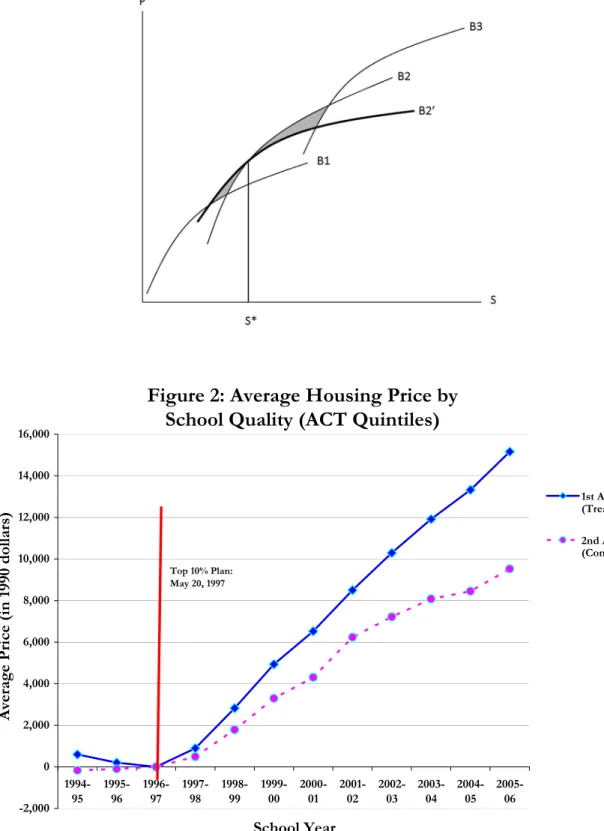
expression for the slope of a bid-function (i.e., maximum willingness to pay for a quality adjusted unit of housing) with respect to S for an arbitrary income and taste class. If we notice that the value of this slope will be different for different income and taste classes then we can display a group of bid-functions B1, B2, and B3 as shown in Figure 1.
Hence, B1, B2, and B3 represent bid-functions for three different income and taste classes. Since housing is purchased by the highest bidder, the market bid-function is the upper envelope of the bid-functions of all income and taste classes. To look at the theoretical impact of the Top 10% Plan, consider a Cobb-Douglas utility function:
, ;
ln
ln
1
lnU Z H S S Z H 0 < α, β < 1, α + β < 1 (9) The Top 10% Plan makes school district quality (i.e., ACT test scores) less valuable to a specific income and taste class, namely households whose children would now benefit from having peers who perform more poorly. This can be viewed as a decrease in the parameter α, which captures the household’s taste for school district quality. Hence, we can find the effect of the Top
10% Plan on housing prices through a change in the parameter α by substituting equation (9) into equation (1) and then applying the envelope theorem:
*
* * ln ln ln ln 1 Z S H P S H H t U (10)Equation (10) is positive if S > H, negative if S < H, and zero when the two are equivalent. Suppose B2 is the bid-function for the income and taste class that will be affected by the Top 10% Plan, then as shown in Figure 1, B2’ is the income and taste class bid function after the Top 10% Plan is enacted.
Since S and P are both in per quality adjusted unit of housing terms, there exists some S* such that there is one unit of school district quality per unit of housing. For school districts with higher quality than S* the affected income and taste class will have a smaller bid after the policy is enacted, and for school districts with lower quality than S* the affected income and taste class will have a larger bid after the policy is enacted. If we compare the upper envelope of B1, B2, and B3 to the upper envelope of B1, B2’, and B3 the impact of the Top 10% Plan is clear. The two wedges to either side of S* show the potential distortion in housing prices caused by the policy change. It should be noted that the part of the B2’ bid function that is mapped to S* will not necessarily be part of the market function envelope. This means that the part of the post-policy market bid-function that comes from the affected income and taste class could be either greater or less than it was prior to the policy change. That is, housing prices will solely increase on the affected portion of the bid-function if S* is to the right of or equal to the point where B2’ and B3 intersect, whereas housing prices will solely decrease on the affected portion if S* is to the left of or equal to the point where B2’ and B1 intersect. Which case prevails does not change the qualitative result of the policy change. The Top 10% Plan makes school districts of lower quality than S* increase in value relative
to those school districts of higher quality than S*. Whether the relative gain is because of an increase in value for low-quality school districts, a decrease in value for high-quality school districts, or some amalgam of the two is uncertain.
Realistically the Top 10% Plan will influence multiple household types all at the same time. This can be visualized as an overall flattening of the distribution of bid functions. This allows for any district to potentially gain value relative to any other district with higher initial school quality. However, households that have more to gain by improved access may flatten their bid functions to a larger extent, which would lead to larger effects for the households with lower initial school quality. Though there is some uncertainty as to the specific mechanism by which the property values change, evidence presented by Cullen, Long, and Reback (2009) points towards changes in property values being driven by households making strategic moves. However, it is also possible that the relative change in property values is driven by households that change their willingness to pay for housing in their current district. These households could change residence without leaving the district and have their new willingness to pay capitalized into their property’s value.
4. Empirical Strategies and Model Specification 4.1 Difference-in-Differences Analysis
We use a difference-in-differences analytic approach to study the effect of the Top 10% Plan on property values. We compare changes in home values before and after the Top 10% Plan was enacted by differencing property values in the pre-policy period (1994-95 school year through 1996-97 school year) from property values in the post-policy period (191996-97-98 school year through 2005-06 school year). This removes any effects that are constant between the pre and post-periods such as omitted neighborhood effects. The second difference is between the 1st and 2nd quintiles of school quality. This should yield the net effect of the Top 10% Plan on home values in the 1st (bottom)
quintile relative to the 2nd quintile. Our identification strategy hinges on the assumption that there were no other exogenous factors that could have caused these differences in this time frame.
Several models of the following form are estimated by ordinary least squares (OLS) with interest on the parameter , the difference-in-differences estimator,
ln Y jt Postt Treatmenti Post Treatmentt i Ltrendt
it kt jt
X C
(11)
where the dependent variable ln
Y jt indicates the log of the average price of a single family home in school district j in year t. Postt is a binary variable indicating the period after the law was passed(i.e., equal to 1 for the 1997-98 through 2005-06 school years or equal to 0 for the 1994-95 through 1996-97 school years). Treatmentiis a binary variable indicating low-performing high school campuses
(i.e. campuses with poor pre-policy access to universities), these campuses are identified by their median American College Test (ACT) scores (i.e., equal to 1 for the 1st ACT quintile or equal to 0 for the 2nd ACT quintile).8 Post
t multiplied by Treatmenti is the interaction of these two indicator
variables. Ltrendtis a linear time trend. Xit is a vector of time varying characteristics associated with
high school i in year t. Cktis a vector of time varying characteristics associated with county k in year t, and is a vector of Metropolitan Statistical Area (MSA) fixed effects. Lastly, jt is a normally distributed random error term.
More specifically, the vectors described in equation (11) contain the following variables: Xit
is comprised of the high school demographic controls and variables for the degree of urbanization at the high school’s location. The high school demographics include: the percentage of minority students, the percentage of economically disadvantaged students, the percentage of gifted students, average teacher experience, and the teacher-to-student ratio. The urbanization controls are dummy
8 We can observe ACT scores on the individual high school level, but our dependent variable is measured at the district level. This introduces an aggregation bias towards finding no response from the policy change.
variables for the school campus being located in a large or small city, a large or small urban fringe, or in a town. Rural campuses are the omitted category. Cktis a vector of time varying county characteristics and has controls for the percentage of the population that is black, the percentage of the population that is Hispanic, the average number of persons per housing unit, the percentage of housing units that are owner-occupied, violent crimes per 1,000 people, and the percentage of county residents with a college degree.
Our theoretical model from the previous section cannot tell us whether the relative price change is driven by low or high-quality school districts, and neither can the difference-in-differences estimator. However, the difference-in-differences estimator has some nice properties when faced with some highly probable types of misspecification. Incorrect specification of S* the border between the treatment and control groups will bias the difference-in-differences estimator towards zero. Moreover, incorrectly specifying the bottom edge of the treatment group or the top edge of the control group will also bias the difference-in-differences estimator towards zero.
Also, high school switching could realistically happen between any two schools of differential quality in the lower end of the school quality distribution. Not all switches will be from the 2nd ACT quintile of school quality to the bottom ACT quintile of school quality – there is a possibility for intra-quintile switches. However, if we assume that all switches inspired by the policy change are from higher to lower-quality schools, then failing to capture price changes coming from these intra-quintile switches will bias the difference-in-differences estimation towards finding no effect from the legislative change.
Our estimation strategy allows us to identify effects from the part of the distribution of school quality that should be most responsive to the policy shift. The astute reader will notice the opportunity to check other parts of the distribution for policy effects. Specifically we can estimate the effect of the Top 10% Plan on all quintiles relative to the bottom quintile. We would expect to see the quintiles closest to the bottom of the distribution to have the largest effect, and to see the
effects attenuate as we look further and further away from the bottom quintile. This can be done by estimating the following model specification:
ln Y jt Postt Qtilei Post Qtilet i Ltrendt
it kt jt
X C
(12)
where Qtile is a vector of dummy variables for the 2nd, 3rd, 4th and top quintiles (the bottom quintile is the omitted category). The different realizations of , the coefficient on the interactions between the dummy variables and the post period indicator will give the effect of the policy on the different quintiles relative to the bottom quintile.
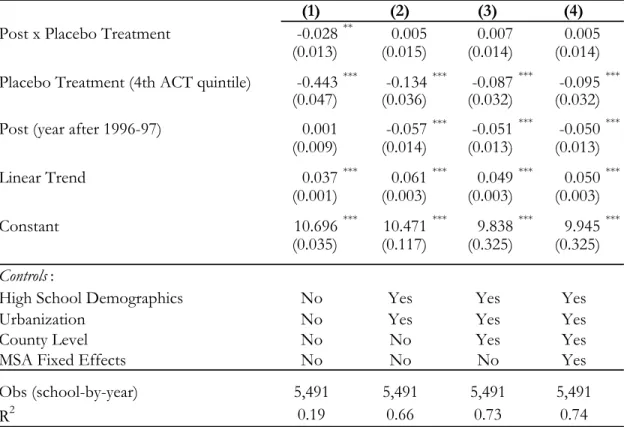
We can also run the difference-in-differences analysis for the top two ACT quintiles of the school quality distribution. High schools with top levels of academic performance should be placing much more than their top 10% of graduates into institutions of quality and as such should be largely unaffected by the implementation of the Top 10% Plan. If in the top end of the school quality distribution, relatively “poor” performing school districts (4th ACT quintile) are gaining in property value relative to better performing school districts (5th ACT quintile), then our proposed mechanism for property value changes in the bottom end of the school quality distribution would be called into serious doubt. Such a result would show that migration from higher to relatively “lower” quality school districts occurred in a part of the school quality distribution where the Top 10% Plan should have little to no effect, making it likely that any changes observed in the bottom part of the school quality distribution were caused by some other phenomenon all together. Our hypothesis will be greatly strengthened if there are noticeable difference-in-differences between the bottom two (2nd and 1st) ACT quintiles but not between the top two (5th and 4th ) ACTquintiles.
4.2 Herfindahl-Hirschman Index Analysis
Our second estimation strategy investigates if the number of schooling options available influenced the effect of the Top 10% Plan on property values. If it is costly to change school
districts, which is the proposed mechanism for the property value changes, then it is less likely that households will react to the policy change. Therefore, if there are more local schooling options then it should be less costly to change school districts and there should be a larger reaction. For example, a move across the state to find a more strategic school seems unlikely because of the costs of finding new employment for the parents. However, a move of a smaller distance such as a couple blocks seems much more reasonable.9
One approach is to measure how concentrated the schooling industry is at the county level. This can be done by calculating the Herfindahl-Hirschman Index (HHI) for each county,
2 2 county the in students of # Total school high each in students of # Total
k i k i k i i k s HHI (13)where si is the market share of each high school i in county k. For schooling, a measure of the
market share is the number of students at the high school divided by the total number of students in the county. A HHIkvalue close to 1 indicates a more monopolistic county, whereas a HHIk value close to 0 indicates a more competitive county.
To analyze whether the number of schooling options available influenced the effect of the Top 10% Plan on property values, we interact the pre-policy county level HHIk measure with our difference-in-differences estimator, yielding the following triple-difference specification,
ln Y jt Postt Treatmenti Post Treatmentt i Ltrendt
k i t k i k t
k Post HHI Treatment HHI Post Treatment HHI
HHI jt kt it C X (14)
where is now the parameter of interest, estimating the effect of the county HHIk on the relative impact of the Top 10% Plan on property values.
9 It is not necessary for the household to move because of the policy change to get a resulting change in property values. A change in values may be driven by households that were already planning to move and simply found lower-performing schools to suddenly be more desirable.
A negative value for the coefficient would imply that counties with less school choice showed a smaller reaction to the Top 10% Plan. This coefficient will tell us if school choice matters, but does not give us any information as to which part of the school competition distribution could be driving the result. To get at this point we split counties into quintiles based on their pre-policy years’ HHIk value. We then estimate a different-in-differences regression (equation 11) for each
k
HHI quintile separately. This allows us to show how the effect of the Top 10% Plan differed for areas with different amounts of local schooling options in greater distributional detail by comparing difference-in-differences estimates for the HHIk quintile subsamples.
5. Data Sources and Sample Characteristics
5.1 Data Sources
The data for this study was compiled from five sources: the Texas Comptroller Property Tax Division (TCPTD); the Academic Excellence Indicator System (AEIS) from the Student Assessment Divisions of the Texas Education Agency; the National Center for Education Statistics (NCES); the U.S. Census Bureau; and lastly, the Federal Bureau of Investigation’s Uniform Crime Reporting (UCR) database. The TCPTD, AEIS, and NCES all utilize Independent School District unique identification numbers that are identical across datasets and enable the linkage of variables in each of these datasets to their specific high school campuses.
The TCPTD database, contains information on total appraised home values for all school districts from 1994-95 to 2005-06, which covers both pre and post-policy years. This value is an aggregation of all residential homes that are served by a specific school district. Our analysis uses property values for single family homes only. We exclude multiple family dwellings and condominiums as well as all non-residential properties from our analysis. The TCPTD data also has information on the number of residential housing units in each school district. We use this information to construct our dependent variable by dividing the aggregate value of all residential
homes in a school district by the number of housing units in that district. All home values are normalized to 1990 dollars.
Property appraisals in Texas follow a specific procedure. A property must be reappraised by its appraisal district at least once every three years, but this can be done more frequently. If a property is sold in a given year, then the sale price of the property is automatically used as the new appraised value of the property. For properties that do not sell, they are assigned a value based on how their characteristics compare to the characteristics of properties that were sold recently. The tax assessors generate a model based on recent sales and then use that model to predict what the assessment should be for the unsold properties. There are also limits on how much an appraisal can increase over the previous year’s appraisal.10 Given how Texas calculates its home appraisals our data accounts fairly well for property value changes as reflected by housing transactions.
We use the AEIS data in the pre-policy years (i.e., 1994-95 through 1996-97) to identify low-performing high school campuses using the median American College Test (ACT) scores of the graduating class. The mean of the median ACT scores in the pre-policy years is then used to sort campuses into quintiles. This allows for the identification of poor-performing schools that are most likely to be targeted by parents who chose to move in order to increase the chances of their children being rank-eligible for automatic admission. While some states use the ACT as their assessment measure for the No Child Left Behind Act (NCLB) to hold schools accountable, this is not the case in Texas. Texas has its own state assessment test, the Texas Assessment of Academic Skills (TAAS). Thus, using the ACT scores allows us to more reliably identify low-performing schools relative to higher-performing schools.11,12
10 An appraisal may not increase to more than the lesser of: a) The sale price of the property if it sold that year, or
b) 110 percent of the previous year’s appraisal plus the market value of any new improvements on the property. 11 Our analysis was also conducted using the Scholastic Aptitude Test (SAT) scores and found similar results to that of the ACT analysis.
The AEIS data also contains detailed information on student and teacher demographic variables; this allows us to calculate the percentage of minority students, the percentage of economically disadvantaged students (i.e., those who qualify for reduced price school lunch), the percentage of students that participate in a gifted program, average teacher experience, and the teacher-to-student ratio at a given high school. Our analysis is restricted to “regular” high schools; any alternative or magnet high schools as well as any juvenile delinquency centers are dropped from the analytic sample.
The NCES data link high school campuses to the urbanization level of their surrounding area. For the purposes of this study, campuses are considered to be located in a large city if they are in the central city of a Consolidated Metropolitan Statistical Area (CMSA) with a population greater than 250,000. Campuses are considered to be located in a small city if they are in the central city of a CMSA with a population less than 250,000. Campuses located in large and small fringes refer to addresses that are within the CMSAs for large and small cities respectively, but are not located in the central city of that CMSA. Campuses located in towns are in areas that are not incorporated into the above definitions and also have a population greater than or equal to 2,500. All other campuses are considered to be located in a rural setting, which is the omitted category in our analysis.
In addition, we use the U.S. Decennial Census and UCR data to merge in additional controls needed in the analysis. We use the 1990 and 2000 U.S. Decennial Censuses to create county-level variables to capture the trends in the percentage of the population that is black, the percentage of the population that is Hispanic, the average persons per housing unit, and the percentage of housing units that are owner-occupied. Lastly, the UCR database provides us with county-level variables on
12 For purposes of our analysis ACT scores are superior to TAAS scores because the TAAS unlike the ACT (or SAT) is not used in college admissions decisions and is not necessarily a good indicator of a school’s access to universities.
violent crimes (i.e., murder, rape, robbery, and assault).13 Combining the UCR data with the Census data allows us to use estimates of the county-level violent crime rate for the school years of interest. 5.2 Sample Characteristics
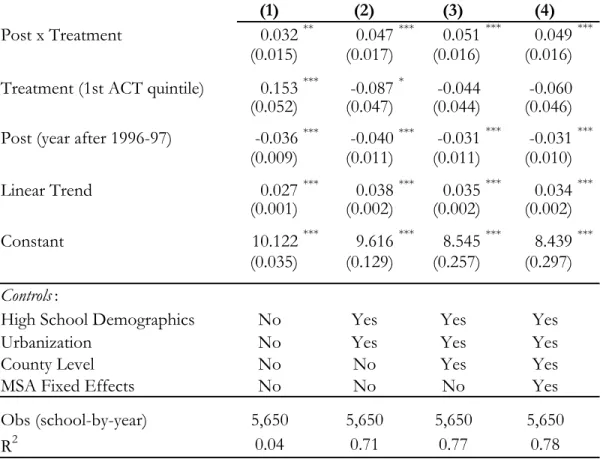
Table 1 reports means and standard deviations for the variables used in our analysis. It also reports the data for the relevant subsamples. For our main specifications the subsample of interest is the bottom two quintiles of school quality with regards to the ACT score distribution. The 1st quintile (bottom) serves as the treatment group and the 2nd quintile as the control group. The 1st quintile of schools represents schools that are most likely to be targeted by parents seeking to take advantage of the Top 10% Plan. The 2nd quintile is a good approximation for schools that a strategic parent would want to move their child from in order to gain the benefits available in the bottom quintile. This is because the 2nd quintile is most similar to the bottom quintile in terms of academic performance and pre-policy access to selective state colleges and universities.
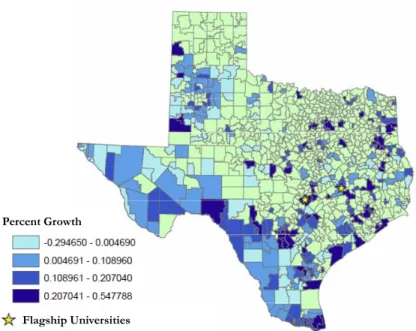
It is immediately noticeable that the 1st and 2nd quintiles are actually quite different in many of their other characteristics. One such characteristic is that property values are far greater in the bottom quintile than in the 2nd quintile. This is largely because the bottom quintile contains many more large urbanized areas (34.8 percent versus 11.5 percent). Further evidence of this is found in Figure 2 that shows the time trends for the property values of the treatment and control groups. The 1st and 2nd quintiles appear as if they may be on different growth paths in the post period. This provides us with reason to control for trends in property values in our analysis. But even without these controls, it appears at first glance that the 1st quintile does have a jump in property values after the Top 10% Plan is enacted on May 20th, 1997, however, less of a discernible jump in property values is observed for the 2nd quintile. Figure 2 also indicates that prior to the implementation of the Top 10% Plan the slopes of the treatment and control groups trend lines seem to be quite close.
13 There are several measures of crime available in the UCR database. We use violent crimes because they are largely not financially motivated and thus exogenous with respect to local property values, as opposed to an alternate measure of property crimes (grand theft auto, larceny, etc.), which are highly endogenous.
Additionally, Table 2 reports the differences without a linear time trend (or controls) for levels and logs of property values. As seen in panel B of Table 2, we observe a 2.9 percent increase in residential home values for low-performing school districts relative to the second quintile after the policy change.
6. Discussion of Results
6.1 Overall Results: Difference-in-Differences Analysis
The results for the regression adjusted difference-in-differences analysis are summarized in Table 3. This table only reports the estimated coefficients on the post indicator variable interacted with the treatment indicator variable, treatment indicator, post indicator, and the linear time trend. The layout of Table 3 is as follows: column (1) presents the unadjusted baseline effects, column (2) controls for high school demographics and urbanization characteristics, column (3) is the fully controlled regression specification (i.e., high school characteristics, urbanization characteristics, and county level controls), and lastly, column (4) is the fully controlled regression specification with the addition of MSA fixed effects.
There is a positive and statistically significant difference-in-differences estimate for all model specifications. The point estimate on the difference-in-differences estimator ranges between 0.032 and 0.051.14 Our preferred specification (shown in column (4)), estimates a 4.9 percent increase of housing prices in low-performing school districts. This lends credence to our hypothesis of the Top 10% Plan influencing property values in the lower end of the school quality distribution. Specifically, this suggests that the benefit offered by the increased likelihood of college admissions from attending a lower-quality school has caused property values in the bottom quintile to increase in value relative to those in the 2nd quintile. Though the magnitudes of the point estimates do vary, the directions of these estimates are not sensitive and are fairly robust to the addition of controls and
MSA fixed effects. Our point estimates are comparable in size to effects found in other studies looking at the capitalization of schooling attributes. Our results are larger than the estimated effect on property values of a one standard deviation increase in test scores of around 1 percent as found in studies such as Clapp, Nanda and Ross (2008) and Black (1999); but smaller than the 7 percent effect found by Figlio and Lucas (2004) for top marks on school report card grades. Reback (2005), whose methodology is closest to our own, finds around a 2 percent effect for gaining access to a high school choice program.
As for the point estimates on the control variables for property values, the point estimate on percent of minority students is positive. This is not surprising as this variable is negatively correlated with the variable for percent of economically disadvantaged students. Property values also appear to be positively related to schools with more students in gifted programs and a higher teacher-to-student ratio. The urbanization controls all have positive point estimates that increase in magnitude as the school’s location increase in population size. This is consistent with the standard urban economics result of higher land prices in more urbanized areas. Lastly, county education level has a positive and significant effect on property values.15
6.1.1 Analysis of Other Parts of the School Quality Distribution
The results for the entire distribution of school quality relative to the bottom of the distribution are presented in Table 4. Table 4 has the same table layout as Table 3. The negative point estimates for the interaction terms indicate that the quintile in question is losing value relative to the bottom quintile. Or, the bottom quintile is gaining relative to the quintile in question. Table 4 shows a clear story for the distribution of school quality: the effect of the Top 10% Plan is strongest in the quintiles closer to the bottom of the distribution and attenuates with distance.
Lastly, the results from the difference-in-differences regression analysis for the top of the school quality distribution are summarized in Table 5. This analysis uses the top two quintiles of school quality instead of the bottom two quintiles. The treatment group is thus the 4th quintile and the control group is the 5th quintile. The most important result in Table 5 is that all of the difference-in-differences point estimates are either negative or statistically insignificant. This is not the effect that one would expect to see if the Top 10% Plan had caused strategic high school switching in the top of the school quality distribution.
Taken all together, our results suggests that the benefit offered by the increased likelihood of college admissions from attending a lower-quality school caused property values in the bottom quintile to increase in value relative to those in the 2nd quintile. Thus, the Top 10% Plan makes school district quality less valuable to a specific income and taste class, namely households whose children would now benefit from having peers who perform more poorly.
6.2 Robustness Analysis
It is possible that our findings could be the result of events other than the implementation of the Top 10% Plan. In fact, the time period around the implementation of the Top 10% Plan contains many policy changes in Texas that also affect schooling. These changes could serve as alternative explanations that would invalidate the interpretation of our difference-in-differences estimates. In this section, we present additional analyses that rule out these policy changes as alternatives to our interpretation.
6.2.1 Pre-existing Trends
A concern that arises when conducting a difference-in-differences analysis is that the treatment and control groups are on different growth paths before the policy is enacted. In order for our previous analysis to provide unbiased estimates of the effect of the Top 10% Plan, it must be
the case that the treatment and control groups exhibit common trends in the pre-policy period. This assumption in the difference-in-differences framework is commonly known as the parallel-trends assumption. Even though we use a linear time trend in our analysis it is still a possibility that the treatment and control groups are on different growth paths even after this inclusion. Figure 2 suggests that this assumption holds for our analytic sample. We can also formally test the parallel-trends assumption. To do so, we drop all post-policy observations (i.e., 1997-98 to 2005-06) and redefine the “post” variable to a “fake year” (i.e., 1995-96), choosing a year when the Top 10% Plan was not in effect. The results of this analysis are reported in Table 6. None of the regressions show any significant difference-in-differences point estimates, that is, there are no statistically significant differences between our treatment (1st ACT quintile) and the control (2nd ACT quintile) groups prior to the implantation of the Top 10% Plan.
6.2.2 Open Enrollment, No Child Left Behind, and Texas School Accountability
Open Enrollment
In 1995 Texas enacted open enrollment laws that gave students in poorly performing school districts the option to enroll in higher-quality schools without changing residence. This could have potentially increased property values in low-performing school districts making the effects we are attributing to the Top 10% Plan simply a residual change from the enactment of open enrollment. However, it is very unlikely that the open enrollment laws had any effect on property values at the school district level. This is because though school districts were required to accept transfer requests from within the district they were not required to accept out of district transfer requests. This made across district switches extremely rare and unlikely to influence property values. To verify this, the above test of the parallel trends assumption also coincides with the enactment of open enrollment laws. Since none of the regressions reported in Table 6 show any significant
difference-in-differences point estimates, this helps to rule out open enrollment as an alternative explanation of our results.
No Child Left Behind
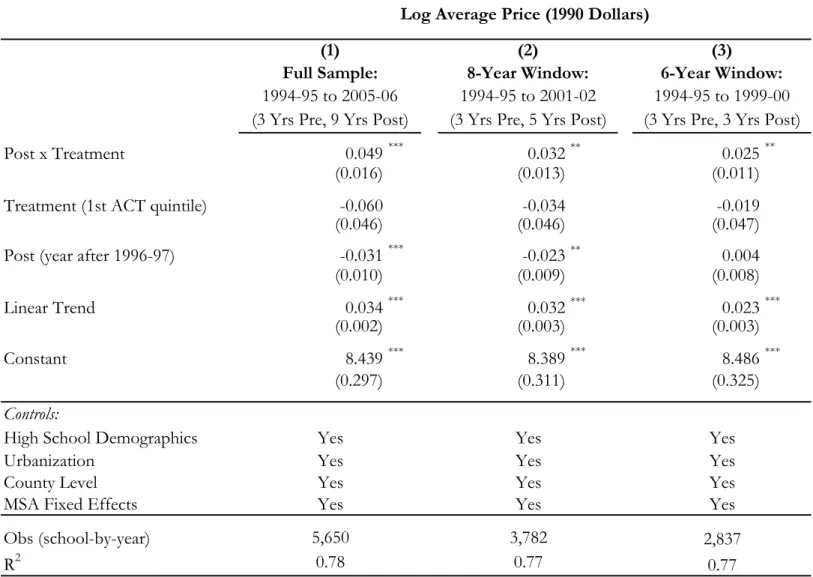
It is also possible that the passing of the No Child Left Behind (NCLB) Act on January 8, 2002 causes our results. The first school year affected by the NCLB was 2002-03. To check against such a possibility and gauge the stability of the point estimates shown in Table 3, we re-run our difference-in-differences analysis using different sized post-period windows. Table 7 reports alternative regression results using three different sized post-period windows. Column (1) reports results using the full twelve year sample, which are the results from Table 3. Column (2) reports results using an eight-year period subsample, this analysis drops all of the school years in which NCLB was in effect: school years 2002-03, 2003-04, 2004-05 and 2005-06. Column (3) further restricts the sample to a six-year period window, three years in the pre-policy period, and an equal number in the post-policy period. The difference-in-differences point estimates are positive and significant in all of the alternative subsample analyses. Thus, the results shown in Table 3 are robust to considering smaller windows around the implementation of the Top 10% Plan, and most importantly the results from column (3) also helps us rule out the passing of the NCLB Act as driving our results.
Texas School Accountability
Another important policy change is the Texas school accountability requirements, which were introduced in 1993. The school accountability measure likely affects low-performing schools more than high-performing schools. If the school accountability requirements became more stringent around 1997, then we may also observe larger performance improvement of low-performing than high-low-performing schools. This would manifest itself in the housing market. We
address this concern by analyzing the Texas Assessment of Academic Skills (TAAS) pass rates for 7th and 8th grades as the outcome. These results are reported in Table 8.16 Most of the point estimates shown in Table 8 are insignificant; in particular, for 8th graders, all estimates are negative. Estimates are negative and significant for the 2nd and 3rd quintiles, suggesting that low-performing schools actually performed worse relative to the top schools in the post-Top10 years. Overall, there is no consistent evidence of larger improvement in academic achievement for low-performing schools following the Top 10% policy; therefore, the estimates in Table 3 are unlikely to be driven by changes in school accountability in Texas.
6.2.3 Robin Hood Plan
Another schooling policy that likely did influence property values in Texas was the “Robin Hood Plan.”17 The Robin Hood Plan, true to its name was a scheme that redistributed recaptured tax revenues of school districts with a lot of property wealth per adjusted pupil to districts with little property wealth per adjusted pupil. It is very possible that the Robin Hood Plan lowered property values in property rich places relative to values in property poor places.
We can rule out Robin Hood on two counts. The first is that Robin Hood was implemented in the 1993-94 school year. This coincides with the beginning of our sample, so any time invariant effects of the Robin Hood Plan will difference out in our difference-in-differences estimator. The only way remaining that the Robin Hood Plan could serve as an alternative explanation for our results would be if the plan had time varying effects that intensified over time and if property poor districts coincide with poorly performing districts. If this is the case, then we would expect the lowest quality school districts to receive a larger amount of funding as the effect of the Robin Hood Plan intensifies over time. We can test for this by running our difference-in-differences estimator
16 The model estimated in Table 8 is the same as presented in equation (12), except that the top, rather than the bottom quintile is omitted.
with the amount of spending per pupil as a dependent variable. Table 9 presents the results of this analysis. All estimates are both negative and insignificant, which further discredits the Robin Hood Plan as an alternative explanation of our results.
6.2.4 Longhorn Opportunity Scholarships
One further policy of note is the introduction of Longhorn Opportunity Scholarships in 2001. Longhorn Scholarships are offered through the University of Texas at Austin (UT-Austin) and are tied to the Top 10% Plan. These scholarships are aimed at helping students from schools that did not historically place many students at UT-Austin. To be eligible you must attend a school identified by UT-Austin as historically under or non-represented at UT-Austin and be rank eligible under the Top 10% Plan. These students get a scholarship of $5,000 per year for four years. It is possible that our results are inflated by the effect of the Longhorn scholarships.
To eliminate the effect of these scholarships we re-estimate our difference-in-differences estimator after dropping all schools listed by UT-Austin as eligible for Longhorn Opportunity Scholarships from the sample.18 The results of this estimation are reported in Table 10. The results are nearly identical to those presented in Table 3, which rules out the effect of these scholarships as an alternative explanation for our results.
6.3 School Competition: Herfindahl-Hirschman Index Analysis
The results for the number of schooling options are presented in Tables 11 and 12. Table 11 shows results from estimating equation (14). All controls used in column (3) of Table 3 are used in the regressions for Table 11. The coefficient of interest is the interaction between the difference-in-differences estimator and the county level HHIk. The interaction is negative and significant,
implying that the more monopolistic the county, the less the school districts in that county reacted to the implementation of the Top 10% Plan.
Table 12 shows the difference-in-differences estimates from subsamples of counties that are the most monopolistic (i.e., have a higher HHIk value for schooling) at the bottom of the table, and the least monopolistic (i.e., having a lower HHIk value for schooling) at the top of the table. Only the difference-in-differences estimators are reported, and each coefficient represents a separate regression. Again, all controls used in column (3) of Table 3 are used in the regressions for Table 12.19 The difference-in-differences point estimates only measure positive and significant in the locations with the largest amount of school choice. Specifically, counties that were more monopolistic in nature were unresponsive to the policy shift. In other words, areas where there are not a lot of local high school options to switch to did not respond to the Top 10% Plan. In contrast, the responsive areas were counties with the lowest fifth of HHIk measures: the difference-in-differences point estimates are only positive and significant for the least monopolistic school districts. Our results show that for counties with the lowest fifth of HHIk measures, the average price grew by 3.4 percent in low-performing school districts.
Thus, the HHI analysis suggests that if the changes in property values are due to households moving strategically, then these moves are likely short distance. Furthermore, the HHIk analysis reinforces the results presented in the previous section, as these results help to rule out alternative explanations. For instance, it is possible that the growth in property values in low-quality school districts was due to the housing bubble and rapid growth of subprime mortgages in the early years of the 2000s. However, any growth in property values due to this housing bubble should be orthogonal to the schooling option variation used in the HHIk analysis.
19 MSA fixed effects were not included because they are too closely related the quintile of HHI values to be used reliably given the sample size of the subsamples.
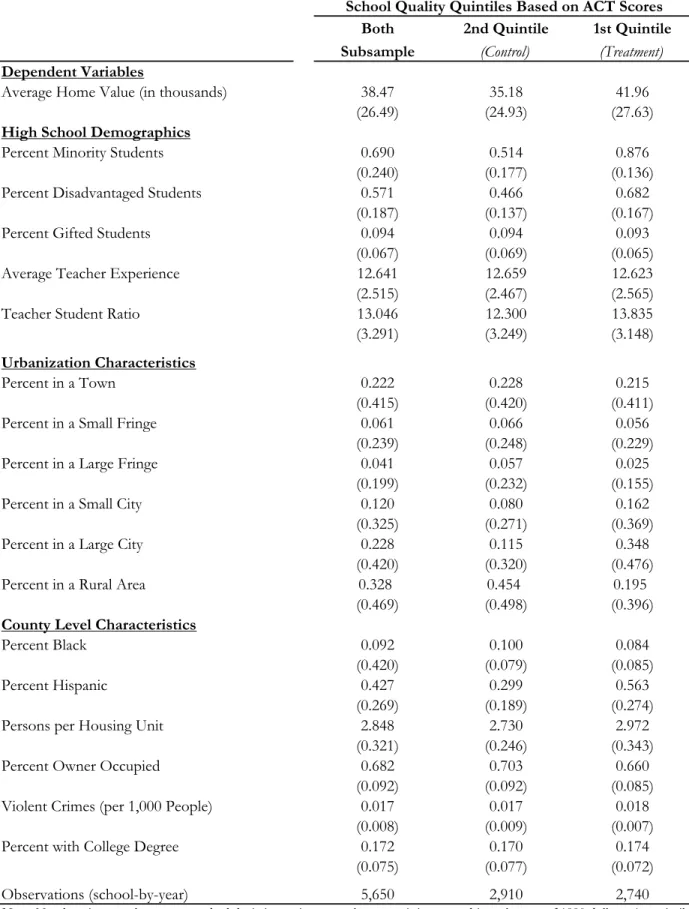
Lastly, Figures 3 and 4 show the growth in property values from the pre-policy period to the post-policy period. Figure 4 overlays the location of the least monopolistic counties from Table 12 onto the map in Figure 3. This overlay illustrates that the growth in home values is spread across the state, and is not just relegated to specific areas. These figures along with the HHI analysis provide a strong backing to our proposed mechanism of families moving to drive changes in property values. It also helps to reinforce our earlier findings of a change in property values in response to the Top 10% Plan.
7. Conclusion
Since its implementation over 10 years ago, the Top 10% Plan has received only mixed reviews. One of the main criticisms of this policy is that it is unfair to high-achieving students who attend elite high schools. Because the Top 10% Plan is solely based on class rank and this criterion is applied to all high schools that use grade point averages to rank students, there is redistribution in the university system from students who graduate from high-performing high schools to automatically admitted students who graduate from low-performing high schools. On the other hand, while the goal of the Top 10% Plan was to improve access for disadvantaged and minority students, the use of a school-specific standard to determine eligibility has led to some other unintended effects.
The estimate from our preferred specification implies that the implementation of the Top 10% Plan raised property values by 4.9 percent. We can get a rough sense of the total effect on the tax base by running our main estimation strategy on the dependent variable of total appraised property value in a school district. The results of such a regression show a 16.6 percent increase in the total property tax base. If we arbitrarily divide the 16.6 percent evenly (i.e., assuming an 8.3 percent gain in aggregate property values in the bottom quintile and an 8.3 percent loss in aggregate property values in the second quintile) then one can see that the effect of the Top 10% Plan on the
property tax base was potentially quite large. The average district in the bottom quintile would have gained $344.9 million in their tax base and the average district in the 2nd quintile would have lost $129.9 million in their tax base. If we apply an arbitrary property tax rate of 0.4796 percent (i.e., the property tax rate in the city of Austin, Texas in 2008) then there would be an additional $1.65 million in property taxes for the average district in the bottom quintile and $0.6 million less in property taxes for the average district in 2nd quintile. These property tax estimates are by no means exact, especially since we do not know how the relative value shift is distributed between 2nd quintile losses and bottom quintile gains, and because these are only changes in single family homes and do not include other taxable properties that could have been affected. However, these tax estimates do illustrate the type of effect that the Top 10% Plan had on the property tax landscape in Texas.
The results from the HHI analysis reinforce this point even further. The effects of the Top 10% Plan appear to be both spatially concentrated and of larger magnitude in places with many schooling options. This implies that these places were likely hit with particularly large distortions to their property tax bases. Any future implementations of or modifications to top x-percent plan admissions policies should bear in mind that the redistribution of educational resources will not be the only effect of such a policy change.
References
Barron’s College Division (2002). Barron’s Profiles of American Colleges: 25th Edition 2003
(Hauppauge, NY: Barron’s Educational Series, Inc.).
Barrow, L. and C.E. Rouse (2004). “Using market valuation to assess public school spending,” Journal of Public Economics 88: 1747-1769.
Black, S.E. (1999). “Do better schools matter? Parental valuation of elementary education,” Quarterly Journal of Economics 114(2): 577-600.
Bogart, W.T. and B. Cromwell (1997). “How much is a good school district worth?,” National Tax Journal 50: 215-232.
Bucks, Brian (2003). “The Effects of the Top Ten Percent Plan on College Choice,” University of Wisconsin-Madison, Department of Economics, unpublished manuscript.
Clapp, J.M. Nanda, A. and S.L. Ross (2008). “Which school attributes matter? The influence of school district performance and demographic composition on property values,” Journal of Urban Economics 63: 451-466.
Cortes, Kalena E. (2010). “Do Bans on Affirmative Action Hurt Minority Students? Evidence from the Texas Top 10% Plan.” Economics of Education Review 29(6): 1110-1124.
Cullen, B. Julie, Mark C. Long, and Randall Reback (2011). “Jockeying for Position: Strategic High School Choice Under Texas’ Top-Ten Percent Plan.” National Bureau of Economic Research, Working Paper 16663.
Epple, Dennis, Radu Filimon, and Thomas Romer (1993). “Existence of Voting and Housing Equilibrium in a System of Communities with Property Taxes,” Regional Science and Urban Economics 22(3): 585-610.
Figlio, D.N. and M.E. Lucas (2004). “What’s in a Grade? School Report Cards and the Housing Market,” American Economic Review 94(3): 591-604.
Hopwood v. University of Texas Law School (1996). 78 F.3d 932, 944, 5th Cir.
Hoxby, Caroline M. and Ilyana Kuziemko (2004). “Robin Hood and His Not-So-Merry Plan: Capitalization and the Self-Destruction of Texas’ School Finance Equalization Plan,” National Bureau of Economic Research, Working Paper 10722.
Jenks, George F. (1967). “The Data Model Concept in Statistical Mapping,” International Yearbook of Cartography 7: 86-190.
Niu, Sunny, Marta Tienda, and Kalena E. Cortes (2006). “College Selectivity and the Texas Top 10% Law: How Constrained are the Options?” Economics of Education Review 25(3): 259-27.
Niu, Sunny and Marta Tienda (2006). “Capitalizing on Segregation, Pretending Neutrality: College Admissions and the Texas Top 10% Law.” American Law and Economics Review 8(2): 312-346.
Reardon, Sean F. and John T. Yun (2001). “Suburban Racial Change and Suburban School Segregation.” Sociology of Education 74: 79-101.
Reback, R (2005). “House prices and the provision of local public services: capitalization under school choice programs,” Journal of Urban Economics 57: 275-301.
Ross, S.L. and J. Yinger. “Sorting and Voting, a Review of the Literature on Urban Public Finance,” in Handbook of Urban and Regional Economics, Vol. III, Applied Urban Economics, edited by P. Cheshire and E.S. Mills (Amsterdam: Elsevier, 1999).
Tiebout, C.M. (1956). “A pure theory of local expenditures,” Journal of Political Economy 64: 416-424.
Tienda, M., K. T. Leicht, T. Sullivan, M. Maltese, and K. Lloyd (2003). “Closing the gap?: Admissions and enrollments at the Texas public flagships before and after affirmative action.” Working Paper 2003-1, Princeton University, Office of Population Research.
Texas Education Code 29.201 – 29.204
Walker, B. and G. Lavergne (2001).“Affirmative action and percent plans: What we learned from Texas,” The College Board Review 193: 18-23.
Weimer, D.L. and M. J. Wolkoff (2001). “School Performance and Housing Values: Using Non-Continuous District and Incorporation Boundaries to Identify School Effects” National Tax Journal 54(3): 231-253.
Figure 1: Bid-Functions for Several Income and Taste Classes – Before and After the Top 10% Plan
Figure 2: Average Housing Price by
School Quality (ACT Quintiles)
-2,000 0 2,000 4,000 6,000 8,000 10,000 12,000 14,000 16,000 1994-95 1995-96 1996-97 1997-98 1998-99 1999-00 2000-01 2001-02 2002-03 2003-04 2004-05 2005-06 School Year Average Price (in 1 99 0 dollars) 1st ACT Quintile (Treatment) 2nd ACT Quintile (Control) Top 10% Plan: May 20, 1997
Notes: 1st quintile (treatment group) is defined as the bottom fifth (0-20%) of school quality based on pre-policy ACT Scores. 2nd quintile (control group) is defined as the lower middle (20-40%) of school quality based on pre-policy ACT Scores.
Figure 3: Bottom Two Quintiles of School District Quality –
Percent Growth in Home Values
Percent Growth Flagship Universities Percent Growth Flagship Universities Least Monopolistic County
Figure 4: Bottom Two Quintiles of School District Quality –
Percent Growth in Home Values for Non-monopolistic Counties
Both 2nd Quintile 1st Quintile
Subsample (Control) (Treatment)
Dependent Variables
Average Home Value (in thousands) 38.47 35.18 41.96
(26.49) (24.93) (27.63)
High School Demographics
Percent Minority Students 0.690 0.514 0.876
(0.240) (0.177) (0.136)
Percent Disadvantaged Students 0.571 0.466 0.682
(0.187) (0.137) (0.167)
Percent Gifted Students 0.094 0.094 0.093
(0.067) (0.069) (0.065)
Average Teacher Experience 12.641 12.659 12.623
(2.515) (2.467) (2.565)
Teacher Student Ratio 13.046 12.300 13.835
(3.291) (3.249) (3.148)
Urbanization Characteristics
Percent in a Town 0.222 0.228 0.215
(0.415) (0.420) (0.411)
Percent in a Small Fringe 0.061 0.066 0.056
(0.239) (0.248) (0.229)
Percent in a Large Fringe 0.041 0.057 0.025
(0.199) (0.232) (0.155)
Percent in a Small City 0.120 0.080 0.162
(0.325) (0.271) (0.369)
Percent in a Large City 0.228 0.115 0.348
(0.420) (0.320) (0.476)
Percent in a Rural Area 0.328 0.454 0.195
(0.469) (0.498) (0.396)
County Level Characteristics
Percent Black 0.092 0.100 0.084
(0.420) (0.079) (0.085)
Percent Hispanic 0.427 0.299 0.563
(0.269) (0.189) (0.274)
Persons per Housing Unit 2.848 2.730 2.972
(0.321) (0.246) (0.343)
Percent Owner Occupied 0.682 0.703 0.660
(0.092) (0.092) (0.085)
Violent Crimes (per 1,000 People) 0.017 0.017 0.018
(0.008) (0.009) (0.007)
Percent with College Degree 0.172 0.170 0.174
(0.075) (0.077) (0.072)
Observations (school-by-year) 5,650 2,910 2,740
Table 1: Descriptive Statistics - Means and Standard Deviations
School Quality Quintiles Based on ACT Scores
Notes: Numbers in parentheses are standard deviations. Average value per unit is reported in real terms of 1990 dollars. 1st quintile (treatment group) is defined as the bottom fifth (0-20%) of school quality based on pre-policy ACT Scores. 2nd quintile (control group) is defined as the lower middle (20-40%) of school quality based on pre-policy ACT Scores.
Sources: Texas Comptroller Property Tax Division (TCPTD), 1995 to 2006; Academic Excellence Indicator System (AEIS), Texas Education Agency (TEA), 1994-95 to 2005-06; National Center for Education Statistics (NCES), 1994-95 to 2005-06; U.S. Census Bureau Decennial Census, 1990 and 2000; and the Federal Bureau of Investigation’s Uniform Crime Reporting (UCR) database,