B
Anmari Viljamaa, Juha Tall, Elina Varamäki,
Slavica Singer and Susanne Durst (eds.)
Business Transfer
ecosysTems and
awareness raising
acTiviTies
situation analysis of five
european countries
Anmari Viljamaa, Juha Tall, Elina Varamäki,
Slavica Singer and Susanne Durst (eds.)
Business Transfer
ecosysTems and awareness
raising acTiviTies
situation analysis of five
european countries
a. Tutkimuksia
Research reports
B. raportteja ja selvityksiä
Reports
c. oppimateriaaleja
Teaching materials
seamK julkaisujen myynti: Seinäjoen korkeakoulukirjasto Kalevankatu 35, 60100 Seinäjoki puh. 020 124 5040 fax 020 124 5041 [email protected] ISBN 978-952-7109-33-5 (PDF) ISSN 1797-5573 (PDF)
Anmari Viljamaa, Juha Tall, Elina Varamäki, Slavica Singer and Susanne Durst (eds.) 2015. Business Transfer Ecosystems and Awareness Raising Activities: Situation Analysis of Five European Countries. Publications of Seinäjoki University of Applied Sciences B. Reports 108, 119 p.
According to estimates, approximately 450 000 firms are being transferred annually across Europe affecting two million employees and around 150 000 companies are not being transferred due to system inefficiencies, causing a risk of losing 600 000 jobs. In order to promote economic stability and SME growth, system inefficiencies in business transfers should be targeted and business transfer ecosystems designed so as to promote successful transfers. Since early planning and preparation improves the business transfer success rate, one of the issues to be tackled is firms’ and other stakeholders’ preparedness for business transfers, the key antecedent of which is awareness of the issue.
This report is a part of an ongoing effort to bring SME business transfers and their ecosystems to the transnational level, allowing recommendations for national and European level frameworks to be drawn. The project Business Transfer Awareness Raising - Developing activities and tools to advance business transfer success is funded by European Commission, DG Enterprise and Industry (CIP), and co-funded by the partners (Seinäjoki University of Applied Sciences, Grenoble Ecole de Management, Universitat Jaume I, J.J. Strossmayer University of Osijek and University of Skövde). The main objective of the project is to develop an ideal model of awareness raising measures for SME business transfers in Europe. As a step towards this goal, this report presents and summarizes the current state of business transfer ecosystems and awareness raising activities related to business transfers in five European countries: Croatia, Finland, France, Spain and Sweden. Analysis demonstrates the heterogeneity of business transfer ecosystems in Europe. Legislative environments differ widely, as do financing and business support structures. There are also considerable differences in the breadth and intensity of awareness raising activities. A lack of systematic and long-term approach regarding the implementation of business transfer awareness raising activities is noted. In conclusions it is recommended that the following should be considered 1) widening the scope of awareness raising activities, 2) using national advisory boards on business transfers to coordinate activities and support policy development, and 3) developing of impact measures for awareness raising activities.
Keywords: Business transfer, European Union, SMEs, growth, policy
contact information: Anmari Viljamaa, Seinäjoki University of Applied Sciences, School of Business and Culture, Kampusranta 11, Frami F, FI-60320 Seinäjoki, [email protected]
ABSTRACT
Anmari Viljamaa, Juha Tall, Elina Varamäki, Susanne Durst and Slavica Singer Introduction: business transfer ecosystems and awareness raising ...5 Mirela Alpeza, Nives Biskupic, Slavica Singer, Sunčica Oberman Peterka,
Anamarija Delic and Petra Mezulic
Situation analysis: Croatia ...14 Juha Tall, Elina Varamäki ja Anmari Viljamaa
Situation analysis: Finland ...26 Erno Tornikoski, Christophe Bonnet, Bérangère Deschamps, Gilles Lecointre and Mickael Buffart
Situation analysis: France ...51 Andreu Blesa, Maria Ripollés and J. Xavier Soler
Situation analysis: Spain ...75 Susanne Durst
Situation analysis: Sweden ...96 Juha Tall, Anmari Viljamaa, Elina Varamäki, Slavica Singer
and Susanne Durst (eds.)
Summary and conclusions: Business transfer ecosystems and awareness raising activities in partner countries ...112
IntroDUctIon: bUsIness transFer
ecosYsteMs anD aWareness raIsInG
Anmari Viljamaa, Elina Varamäki and Juha Tall Seinäjoki University of Applied Sciences Susanne Durst
University of Skövde Slavica Singer
J.J. Strossmayer University of Osijek
1 BACKGROUND AND AIMS
SMEs, by numbers, dominate the world and European business environment. In the 27 countries of the European Union, SMEs account for 99,8 % of all enterprises, employ 67 % of all workers and contribute 58 % of gross value added (Wymenga et al. 2012; Edinburgh Group 2013). The ability of SMEs to survive and grow in the increasingly dynamic economic environment is hence crucial for overall economic climate.
National policies on entrepreneurship tend to focus on start-ups and growth. According to “Small Business Act” increased attention should be given to the contribution of business transfers to promoting business and growth. In this connection the support of SMEs is vital because 90 % of all business transfers occur with limited resources in the micro-firm segment (European Commission 2002; Van Teeffelen 2007, 2012). Taking in the volumes of SMEs, majority of businesses transferred or not-being transferred can be classified as SMEs. According to some recent surveys, approximately 20–25 % of SMEs will find a successor inside the family while almost 40 % of firms are looking for external buyers (Battisti & Okamuro 2010; Varamäki et al. 2012). Already established firms available for business transfer offer great potential for other entrepreneurs to develop their existing businesses by the means of an acquisitive strategy. Additionally, individuals can become entrepreneurs by buying such a firm.
Business transfers support business growth (e.g. Penrose 1959; Barkema & Schijven 2008; Uhlaner & West 2008). Transferred businesses outperform start-ups with respect to survival, turnover, profit, innovativeness and employment (e.g. Meijaard 2007; Van Teeffelen 2012). Survival for five years, depending on the economic climate, generally ranges somewhere between 35–50 % for start-ups, while the figure for transferred firms is 90–96 % (Geerts, Herrings & Peek 2004; KWF 2009). All in all one can conclude
that business transfers are essential to the vitality and performance of national economies (e.g. Dyck et al. 2002; Meijaard 2007; KWF 2009; Van Teeffelen 2012). Each year approximately 450 000 firms are being transferred across Europe affecting two million employees. Around 150 000 companies are not being transferred due to system inefficiencies, causing a risk of losing 600 000 jobs in Europe (European Commission 2011). Empirical data shows a considerable variety in forms of business discontinuity among countries (Singer et al. 2014). Based on the Global Entrepreneurship Monitor survey, for example, in Croatia only 0,8 % of all exits are based on opportunities to sell vs. 5,3 % in Sweden; 15 % of exits in Finland are caused by the business non-profitability vs. 56 % in Spain; and the problem of getting finance is the reason for 24 % of exits in Croatia and for only 2,7 % in Sweden (GEM data set 2014).
Not surprisingly, the vast majority of buyers and sellers in SME business transfer markets have no previous business transfer experience. This is the case especially with aging entrepreneurs. For most of them business transfer is a once in a lifetime experience. Insufficient preparedness and planning is a major problem and reason for failure in business transfers. Accordingly, it is anticipated that a well-developed business transfer ecosystem will support making the ownership transfer markets more dynamic and hence support growth and survivability of SMEs.
This suggests that in order to promote economic stability and growth, system inefficiencies in business transfers should be targeted and business transfer ecosystems developed. Since early planning and preparation improves the business transfer success rate (Sharma, Chrisman & Chua 2003), one of the issues to be tackled is increasing preparedness for business transfers.
The execution of business transfers requires unique knowledge and process-specific skills not used in everyday business operations and often not learned. Hence, specialized advisors may be needed and, most importantly, both buyers and sellers should start their planning processes earlier. Sellers need to be aware of suitable selling strategies, while buyers need to develop acquisitive (non-organic) growth strategies when preparing themselves for business transfer. Sadly, buyers and sellers seem relatively uninformed of the need to plan for business transfers (Ip & Jacobs 2006).
The problem is not a new one. There have been a wide range of national and regional level awareness raising measures. Examples of such measures include awareness raising letters and events, promotion of business transfer media visibility, publications, regional business transfer information centers, on-line marketplaces, phone call campaigns, educational programs, special business transfer financing services and research activities. Systematic utilization and review of the results is however lacking.
This report forms a part of an ongoing attempt to bring SME business transfers and their ecosystems to the transnational level, allowing recommendations for national and European level frameworks to be drawn. Ultimately the aim is to help increase the number of successful business transfers. The project Business Transfer Awareness Raising - Developing activities and tools to advance business transfer success is funded by European Commission, DG Enterprise and Industry (CIP), and co-funded by the partners. The coordinator and lead partner of the project is Seinäjoki University of Applied Sciences, Finland. Other partners are Grenoble Ecole de Management in France, Universitat Jaume I in Spain, J.J. Strossmayer University of Osijek in Croatia, and University of Skövde in Sweden.
The main objective of the project is to develop an ideal model of awareness raising measures for SME business transfers in Europe. As a step towards this goal, this report presents and summarizes the current state of business transfer ecosystems and awareness raising activities related to business transfers in five European countries: Croatia, Finland, France, Spain and Sweden.
2 BUSINESS TRANSFER ECOSYSTEM AND
AWARENESS RAISING
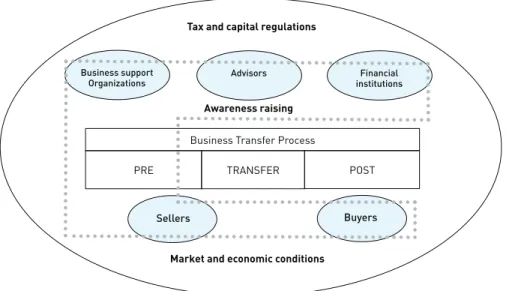
The purpose of this report is to present the key elements and content of the business transfer ecosystem (Figure 1) in the five partner countries. Ecosystem thinking in general combines various perspectives from e.g. management and economics to biological and evolutionary analogies. The fundamental hope behind ecosystems thinking is to expand the capabilities of individual actors beyond their own boundaries through collaboration (e.g. Adner 2006). Thus, ecosystems are not a matter of single actors, but of interacting populations of actors residing in an environment. Entrepreneurial ecosystems are conceptual frameworks intended to foster economic development via entrepreneurship, innovation and small business growth (Mazzarol 2014). Moreover, government policy settings and also the legal and regulatory frameworks, along with infrastructure, financial sector, education and research are components of entrepreneurial ecosystems (see World Economic Forum 2013; Mazzarol 2014).
Business Transfer Process TRANSFER
PRE POST
Tax and capital regulations
Awareness raising
Market and economic conditions
Sellers Buyers
Business support
Organizations Advisors institutionsFinancial
FIGURE 1. Business transfer ecosystem.
A business transfer is here understood as a change of ownership of any firm or business to another person or legal entity assuring the continuous existence and commercial activity of the enterprise when more than 50 % of the assets or shares are transferred (see e.g. Sten 2006; Van Teeffelen 2012). This definition includes all varieties of business transfers, i.e. both successions within the family and transfer to an external buyer; for the sake of brevity, the term “seller” is frequently used for both sellers in transfers to external parties and predecessors in family successions, and the term “buyer” for both successors and external buyers. In the context of business transfer ecosystems market and economic conditions together with tax and other legal frameworks make up the environment in which buyers and sellers, the key actors of business transfers, act. Also financing is one of the key issues in business transfers, since most buyers need external financing, and hence financial institutions are one of crucial elements in a business transfer ecosystems. Furthermore, external advisors are significant stakeholders in business transfers from both seller’s and buyer’s perspective (Van Teeffelen 2012; CSES 2013). Thereby, both general business support organizations and private advisors should be considered in analyzing a business transfer ecosystem. Awareness raising can also be considered a key element in a business transfer ecosystem. Awareness raising usually refers mainly to activities related to sellers and buyers at the pre phase of a business transfer process. The aim of awareness raising is generally to promote earlier planning and thus increase preparedness for business transfer. The motivation for developing awareness raising has traditionally been related to the aging of entrepreneurs and the need to ensure the continuity of healthy firms. However, as researchers and policy makers increasingly view business
transfers as a vital part of safeguarding healthy dynamics in the economy, awareness raising activities also seek to promote business transfers as a normal strategic action of firms and to strengthen the business transfer culture.
3 METHODS
In each participating country data on the national business transfer ecosystem were collected by local research teams who are familiar with the business transfer phenomenon. A total of 16 researchers participated in the data collection.
The research followed a case study approach. Eisenhardt (1989) has defined the case study as a research strategy focusing on understanding the dynamics present within single settings. A case study is an excellent method to explore complex phenomenon and produce rich descriptions about systems (Patton 1990; Yin 2009). The case study approach also enables exploring a phenomenon in its context. Further, multiple case studies, in this case the ecosystems in different countries, give a wider view of the phenomenon, allowing comparison across cases. Case studies can be used for different purposes (descriptive, exploratory and explanatory) and should be based on a number of different sources of evidence (Yin 2009). In the present study the emphasis was on description, and as sources of evidence a combination of primary data (e.g. interviews, expert testimonials, field observations) and secondary data (reports, barometers, statistics, etc.) was used to produce each country case.
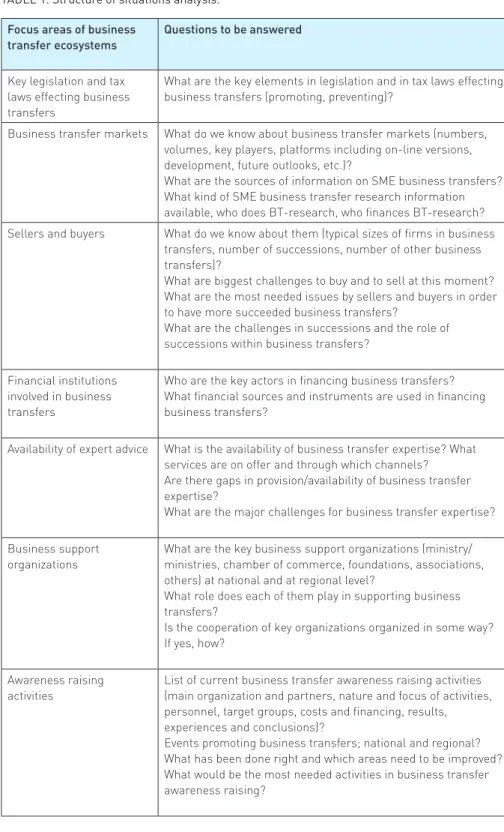
The data for the cases presented here were collected between December 2014 and March 2015. Each national team used a shared conceptual framework despite the variety of conditions in the different countries. The ecosystems were explored through seven focus areas: 1) key legislation and tax laws effecting business transfers, 2) business transfer markets, 3) sellers and buyers, 4) financial institutions involved in business transfers, 5) availability of expert advice, 6) business support organizations, and 7) awareness raising activities. The structure of the situation analysis is presented in more detail in Table 1.
TABLE 1. Structure of situations analysis.
Focus areas of business
transfer ecosystems Questions to be answered
Key legislation and tax laws effecting business transfers
What are the key elements in legislation and in tax laws effecting business transfers (promoting, preventing)?
Business transfer markets What do we know about business transfer markets (numbers, volumes, key players, platforms including on-line versions, development, future outlooks, etc.)?
What are the sources of information on SME business transfers? What kind of SME business transfer research information available, who does BT-research, who finances BT-research? Sellers and buyers What do we know about them (typical sizes of firms in business
transfers, number of successions, number of other business transfers)?
What are biggest challenges to buy and to sell at this moment? What are the most needed issues by sellers and buyers in order to have more succeeded business transfers?
What are the challenges in successions and the role of successions within business transfers?
Financial institutions involved in business transfers
Who are the key actors in financing business transfers? What financial sources and instruments are used in financing business transfers?
Availability of expert advice What is the availability of business transfer expertise? What services are on offer and through which channels? Are there gaps in provision/availability of business transfer expertise?
What are the major challenges for business transfer expertise? Business support
organizations
What are the key business support organizations (ministry/ ministries, chamber of commerce, foundations, associations, others) at national and at regional level?
What role does each of them play in supporting business transfers?
Is the cooperation of key organizations organized in some way? If yes, how?
Awareness raising activities
List of current business transfer awareness raising activities (main organization and partners, nature and focus of activities, personnel, target groups, costs and financing, results, experiences and conclusions)?
Events promoting business transfers; national and regional? What has been done right and which areas need to be improved? What would be the most needed activities in business transfer awareness raising?
Individual reports were written for each country and ecosystem. These country reports were then shared among all researchers and in a next step a joint meeting was organized. At this two day meeting an analysis and comparison were carried out in order to identify similarities and differences between the ecosystems.
This report presents both the original country level analyses and the key results of the joint summary analysis.
REFERENCES
Adner, R. 2006. Match your innovation strategy to your innovation ecosystem. Harvard business review 84, 98–110.
Barkema, H. & Schijven, M. 2008. Toward unlocking the full potential of acquisitions: The role of organizational restructuring. Academy of management journal 51 (4), 696–722.
Battisti, M. & Okamuro, H. 2010. Selling, passing on or closing? Determinants of entrepreneurial intentions on exit modes. Tokyo: Hitotsubashi University. Global CEO hi-stat discussion paper series 151.
CSES. 2013. Evaluation of the implementation of the 2006 commission communication of business transfers: Final report.
Dyck, B., Mauws, F. Starke, A. & Mischke, G. 2002. Passing the baton: the importance of sequence, timing, technique and communication in executive successions. Journal of business venturing 17 (2), 143–162.
Edinburgh Group. 2013. Growing the global economy through SMEs. [Online publication]. [Ref. 3 June 2015]. Available at: http://www.edinburgh-group.org/ media/2776/edinburgh_group_research_-_growing_the_global_economy_ through_smes.pdf
Eisenhardt, K. 1989. Building theories from case study research. Academy of Management review 14 (4), 532–550.
European Commission. 2002. Final report of the expert group on the transfer of small and medium sized enterprises. Brussels: European Commission.
European Commission. 2011. Business dynamics: start-ups, business transfers and bankruptcy. Brussels: European Commission.
European Commission. 2011. Business dynamics: start-ups, business transfers and bankruptcy. [Online publication]. Bruxelles: European Commission. [Ref. 3 June 2015]. Available at: http://ec.europa.eu/enterprise/policies/sme/business-environment/files/business_dynamics_final_report_en.pdf
Geerts. A., Herrings, W. & Peek, M. 2004. Change of ownership creates new prospects in SME sector: SME special 2004. Amsterdam: ING.
Ip, B. & Jacobs, G. 2006. Business succession planning: a review of the evidence. Journal of small business and enterprise development 13 (3), 326–350.
KWF Research. 2009. KWF-grundunsmonitor 2009. Frankfurt am Main.
Mazzarol, T. 2014. Growing and sustaining entrepreneurial ecosystems: What they are and the role of government policy. [Online publication]. Small Enterprise Association of Australia and New Zealand (SEAANZ). White Paper WP01-2014. [Ref. 1 June 2015]. Available at: http://www.seaanz.org
Meijaard, J. 2007. Overmemer vaak beter dan ‘vers’ starten. Zoetermeer: EIM business & policy research.
Patton, M. 1990. Qualitative evaluation and research methods. Newbury Park: Sage. Penrose, E. 1959/2009. The theory of the growth of the firm. 4th ed. Oxford: Oxford
University Press.
Sharma, P., Chrisman, J. J. & Chua, J. H. 2003. Predictors of satisfaction with the succession process in family firms. Journal of business venturing 18, 667–687. Singer, S., Amorós, J. E. & Arreola, D. M. 2014. Global entrepreneurship monitor: 2014
Global Report. London: Global Entrepreneurship Research Association.
Sten, J. 2006. Transfers of family businesses to non-family buyers: the selling business family perspective. Helsinki: Swedish School of Economics and Business Administration. Ekonomi och samhälle 160.
Uhlaner, R. & West, A. 2008. Running the winning M&A shop. McKinsey quarterly 2, 106–113.
Van Teeffelen, L. 2007. Dutch small business transfers. Utrecht: HU/Dutch Chambers of Commerce.
Van Teeffelen, L. 2012. Avenues to improve success in SME business transfers: reflections on theories, research and policies. Utrecht: Hogeschool Utrecht. Varamäki, E., Tall, J., Sorama, K. & Katajavirta, M. 2012. Valtakunnallinen
omistajanvaihdosbarometri 2012. Helsinki: Omistajanvaihdosten valtakunnallinen koordinointi, TEM.
World Economic Forum. 2013. Entrepreneurial ecosystems around the globe and company growth dynamics: Report summary for the annual meeting of the new champions 2013. [Online publication]. [Ref. 1 June 2015]. Available at: http:// www3.weforum.org/docs/WEF_EntrepreneurialEcosystems_Report_2013.pdf Wymenga, P., Spanikova, V., Barker, A., Konings, J. & Canton, E. 2012. EU SMEs in
2012: at the crossroads. Rotterdam: Ecorys. Annual report on small and medium-sized enterprises in the EU, 2011/12.
sItUatIon anaLYsIs: croatIa
Mirela Alpeza and Nives Biskupic
CEPOR – SMEs and Entrepreneurship Policy Centre Zagreb
Slavica Singer, Sunčica Oberman Peterka, Anamarija Delic and Petra Mezulic J.J. Strossmayer University of Osijek in Croatia
1 BACKGROUND
The business transfer market in Croatia is not developed yet. Lack of information and statistical monitoring of the business transfer market is one of the key issues currently faced by policy makers, research organizations, advisors and entrepreneurs in Croatia. The situation analysis of the business transfer ecosystem in Croatia presented in this report is based on the secondary and primary research results. Primary research includes conducting of in-depth interviews with 8 key institutional actors, which are supposed to play important role in business transfer ecosystem in Croatia, and a focus group of representatives of all relevant stakeholders implemented in a form of a national workshop held on April, 9th, 2015 in Zagreb.
2 BUSINESS TRANSFER ECOSYSTEM IN CROATIA
2.1 Key legislation and tax laws
Legal and tax regulations in Croatia do not represent a barrier for the business transfer process in Croatia. The legal framework consists of the following laws:
• Labour Law
• Crafts Act
• Law on Local and Regional Self-government
• Civil Obligations Act
• Companies Act
• Inheritance Act
• Accounting Act
• Family Law
Business transfer of crafts is regulated in 2013 with the “new” Crafts Law that represents favorable legal framework for business transfer in different occasions:
death of the owner of craft, retirement and transfer of the ownership of the craft to third parties.
In case of company inheritance, the Companies Act stipulates that business shares can be inherited. The Inheritance Act also recognizes legal and testamentary inheritance, where in the first inheritance order the company is inherited by children and spouse, in equal parts. This law is regulating the inheritance process in detail, especially in case of testamentary inheritance. According to the Law on Local and Regional Self-government, the tax on inheritance and gifts are not paid by spouse, blood relative in a straight line, adopted children and adoptive parents of the deceased or the person giving the company. The inheritance of business shares for others is subject to tax on inheritance at the rate of 5%. In this case, the tax base is the market value of financials and other assets, after deduction of debts and expenses relating to the property on which tax is paid.
In case of selling the company, the cost of services of notary public is the only compulsory expense. The competitive price of service depends on the agreed selling price of the company, and the minimum cost is 500 EUR. Additional provisional costs are the lawyer costs and the cost of changing the owner of the company which has to be published in the Official Gazette. The money that the seller gains by the selling of the company is considered as capital gain, and as such, it is not taxed in Croatia.
2.2 Business transfer markets
As noted, there is a lack of information on business transfers in Croatia. Based on the secondary research data, it is evident that the biggest shareholder in a company is aged 55 years or older in around 1/3 of all SMEs in Croatia, ranging from 34,9 % - 27,5 % in all the counties in Croatia (Figure 2).
34,9% 34,7% 33,5% 32,8% 32,0% 32,0% 31,9% 31,7% 31,5% 31,3% 31,0% 30,4% 29,8% 29,6% 29,4% 29,2% 29,2% 29,2% 28,5% 27,5% 27,5% 20,0% 22,0% 24,0% 26,0% 28,0% 30,0% 32,0% 34,0% 36,0%
The share of enteprises with co-owners older than 55 years in the total number of enterprises in county
FIGURE 2. Proportion of the SMEs with the biggest shareholder aged 55 years or older, across counties in Croatia (CEPOR – SMEs and Entrepreneurship Policy Centre, based on data from Financial Agency, 2013)
SMEs, especially micro companies, usually go through the business transfers process by themselves, without using the services of consulting companies. The services offered by consulting companies are adjusted to the needs of medium and large companies, while micro and small companies are facing limited consulting services that are usually not tailored to their needs and size.
There are no on-line matching platforms for SMEs sellers and buyers in Croatia. CEPOR – SMEs and Entrepreneurship Policy Centre in Croatia, one of the key players in the SME business transfer ecosystem is in the process of developing a project proposal for creation and implementation of an on-line platform in Croatia. The already conducted phases in preparation of the project proposal include: identification of key national stakeholders, analysis of on-line platforms in the EU (“Working Group Matching Platforms, Transeo report, 2012) and study visit to Sowaccess (Liege, Belgium) – potential benchmark for implementation of an on-line platform in Croatia. One of the biggest challenges for development of an on-line platform in Croatia is in identification of sources of funding (e.g. EU call, national funds, private investors), development of additional services, development of professional infrastructure for supporting the consultancy needs of sellers and buyers, and achieving the financial sustainability of the platform.
All data currently available on the state of business transfer ecosystem in Croatia is gained through secondary research conducted from December 2014 – February
2015, as well as through in-depth interviews conducted within the BTAR project by researchers from the J.J. Strossmayer University of Osijek, Faculty of Economics in Osijek and CEPOR. The interviews were conducted with 8 representatives from all major institutional stakeholders that should be involved in activities related to business transfer (Ministry of Entrepreneurship and Crafts, Ministry of Finance, HAMAG BICRO – Croatian Agency for SMEs, Innovation and Investments, Croatian Chamber of Trades and Crafts, Croatian Chamber of Economy, Croatian Employers’ Association). The data gathered from these interviews represent an important source of data on this topic. No official databases on business transfers exist in Croatia.
The only research that partially provides data related to business transfer process in Croatia is GEM - Global Entrepreneurship Monitor survey. GEM data in 2014 in Croatia (Table 2) indicates that business transfer process was not (properly) prepared, and business transfer was not implemented in the following cases: 12.95% founders pursued another job or business opportunity, but without selling the company; in 2.51% retirement of business owner resulted with termination of the business activity of the company, which means that the opportunity for business transfer was not exploited. In case the business transfer was planned, the owner would pursue the opportunity to sell the business prior to his / her retirement, so the business would not be closed. In 25.13% personal reasons and incident influenced termination of the business which means that business transfer was also not properly planned. GEM research in Croatia is co-financed by the Ministry of Entrepreneurship and Crafts, J.J. Strossmayer University of Osijek, Faculty of Economics in Osijek, and CEPOR – SMEs and Entrepreneurship Policy Centre Zagreb.
TABLE 2. Reasons for discontinuation of business activity – comparison between EU, North America and Croatia, 2014 (Source: GEM data 2014, CEPOR – SMEs and Entrepreneurship Policy Centre)
reasons for discontinuation of
business (% of exits) eU north america croatia
Opportunity to sell 3.32 8.28 0.83
Business not profitable 33.24 18.59 33.60 Problems getting finance 11.50 7.50 23.55 Another job or business opportunity 11.62 17.48 12.95 Exit was planned in advance 5.18 2.20 1.44
Retirement 6.08 11.50 2.51
Personal reasons 23.83 26.54 17.87
From March – May 2015 CEPOR is conducting the first research on business transfer in Croatia – Business Transfer Barometer, with the support of the Ministry of Entrepreneurship and Crafts. The sample in this research consists of 200 SME owners aged 55 years and older (combination of CATI and CAWI methods). The methodological approach (questionnaire) in this research was developed based on the research Business Transfer Barometer conducted in Finland by Seinajoki University of Applied Sciences, so it is expected that the results of the research in Croatia will be partially comparable to the research results from Finland. This study will considerably increase the data available on business transfers. At this time there is no data available. The biggest challenges for sellers and buyers of SMEs in Croatia at this moment are: (1) Long-term recession in Croatian economy without projections for more evident recovery in the next year; (2) Low level of entrepreneurial activity in Croatia in general, as indicated by GEM survey; (3) Government focuses almost exclusively on supporting start-up entrepreneurs, and neglecting other phases of a venture’s life cycle (growing phase as well as the phase of business takeovers as a potential for increasing economic activity and employment; (4) Lack of trust among entrepreneurs; (5) Lack of awareness among potential entrepreneurs about advantages and opportunities of becoming an entrepreneur through business takeover; (6) Lack of established channels for finding a buyer for the company; (7) Lack of professional consultancy support in the process of business transfer; (8) Lack of knowledge for valuation of the company among entrepreneurs, banks and professional consultants; (9) Lack of financial instruments for buying the company.
The most important issues for sellers and buyers for increasing the success of business transfer are:
• Government support for business transfer process (equal to the support available for start-up entrepreneurs, such as guarantee schemes, loans for financing business takeovers, availability of co-financing of consultancy services, awareness raising activities, etc.);
• Establishment of seller and buyer matching on-line platforms;
• Raising the competence and availability of professional consultancy
infrastructure in business transfer process (lawyers, M&A experts, tax advisors, accountants, brokers, etc.)
• Training services for SME owners to enable them for better understanding this phase of business venturing, and empower their negotiating skills
2.3 Financial institutions
There are currently no financial institutions supporting the process of SME business transfer in Croatia. The financing instruments of banks and other financing institutions
are primarily focused on financing start-ups or investment projects of already established companies. However, the key actors / financial institutions in Croatia that should finance business transfer are (1) HAMAG BICRO - Croatian Agency for SMEs, Innovation and Investments, (2) HBOR - Croatian Bank for Reconstruction and Development, and (3) other commercial banks offering their services to SMEs. The key actors in financing business transfers in Croatia have not developed financial sources and instruments which can be used in financing business transfers. As indicated by the representatives of HBOR and HAMAG BICRO during the national stakeholder workshop organised within the BTAR project on April 9th, 2015, their institutions have no intention of creating financial instruments for supporting business transfer in the near future, while commercial banks are offering only restructuring loans to their clients, and also are not considering the development of financial sources and instruments for business transfer at the moment.
2.4 Advisors
The availability of expertise focused specifically on SME business transfer is very low in Croatia. As established through secondary research, only two institutions have been identified as institutions providing special advisory support to SMEs in the process of business transfer – (1) CEPOR through educational programs and workshops specially designed for SME owners dealing with any aspect of business transfer (subsidized by the Ministry of Entrepreneurship and Crafts) and (2) Adizes Institute providing commercial education – seminars with special focus on family businesses and their business transfer processes (the title of the seminar is “The owner, owner’s company, owner’s children”).
Commercial consulting companies are offering their consulting services to companies in the M&A process, with special focus on company valuation, preparation of the company for selling, and negotiation with potential sellers and buyers. However, most of the consulting companies that deal with these processes are members of The Big 4 consultancy companies, focused mainly on large and medium sized enterprises. Their experience, understanding of the customers, cost of the services and approach is mostly adjusted to the medium and large companies’ market segment. Therefore, micro and small enterprises are finding it very difficult to understand the “language” of consulting companies and to find resources to finance those services.
In general, SMEs in Croatia lack sufficient number of advisors with particular expertise and experience in dealing with SME business transfer issues. Consultants in Croatia usually have general knowledge about the business but don’t have specific expertise in the area of business transfer.
The major challenges for business transfer expertise are the lack of education on specific topics of business transfer, non-existence of information about the business transfer market in Croatia, low level of development, awareness and education of the demand side of the business transfer consultancy market, lack of statistical data and monitoring on business transfers, small number of business support organizations initiating awareness raising activities targeting entrepreneurs and providing education on this topic. In addition, the absence of experience and good practice examples are also some of the major challenges for advisors in providing high quality, knowledge-based advice on business transfer.
2.5 Business support organizations
The key business support organizations dealing with the issues of business transfer in Croatia are described below.
CEPOR – SMEs and Entrepreneurship Policy Centre. This is an independent policy centre focused on entrepreneurship and SMEs, emphasizing holistic approach in building an efficient entrepreneurship ecosystem in Croatia.
CEPOR has been dealing with the business transfer topic since 2009, when it became involved in organization of annual family business conference initiated and organized by the weekly business magazine Lider. Since 2013, CEPOR intensified its activities related to promotion of SME business transfer issue among all relevant stakeholders. In 2014 CEPOR established CEPRA - the Centre for Family Business and Business Transfer, whose main role is to support SMEs in the business transfer process, through organization of workshops, conferences, round table discussions and forums on various issues affecting SMEs when going through the process of business transfer. In 2015 CEPOR initiated the first business transfer research in Croatia among 200 SME owners aged 55 years or older; it has created the publication: Mini guide for entrepreneurs “Business transfer” in 2014; it is implementing several business transfer awareness raising projects; and it is developing the project proposal for creation of an on-line matching platform for SMEs, with a special focus on micro enterprises, which account for 90% of all enterprises in Croatia. Since 2014, CEPOR is a member of TRANSEO – European Association for SME Transfer.
Weekly business magazine Lider. Lider has for the last 5 years organized family business conferences, and has in 2015 created the Family Business Club, aiming to promote the importance of family businesses in Croatia.
Adizes Institute. The Institute organizes workshops on the commercial basis intended specifically for family businesses going through the process of business transfer. Adizes
Institute is also offering consultancy programs tailored to the needs of a particular company. Those programs, called “Organizational Therapy”, last from six months to two years, depending on the size and complexity of the enterprise and they provide assistance to the enterprise in various aspects of the business transfer – releasing the company from founder traps, coping with the challenges of fast growing companies, rejuvenation of bureaucratized organizations and improving the profitability and productivity of the enterprise.
Croatian Chamber of Trades and Crafts. The Chamber provides information related to business transfer of crafts (topics such as managing craft after the death of the owner, closing the craft – how to close the craft, where to close it, how to make a partnership agreement – an option for transferring a craft, etc.);
Ministry of Entrepreneurship and Crafts. The Ministry is currently providing support to SME business transfer through the grant allocated to CEPOR for conducting the first survey on business transfer practice in Croatia (September 2014 – September 2015). The activities that will be implemented within this project are: conducting research on SME business transfer, preparation and delivery of 8 workshops (4 awareness raising workshops for entrepreneurs, and 4 workshops aimed at raising the capacity of business support institutions for providing support for local entrepreneurs in business transfer process), organization of the Family business forum, and updating of CEPOR’s website with the information related to SMEs’ business transfer.
J.J. Strossmayer University of Osijek. The Faculty on Economics in Osijek is involved through the implementation of the “BTAR – Business Transfer Awareness Raising” project activities in Croatia.
Law Office “Cikač”. The Law Office is promoting the role of mediation in solving the conflicts among family members in the process of business transfer in family firms; Consulting company “Mreža znanja”. In 2010, the consulting company has prepared the “Guide to Selling Your Business”. The guide provides the information on the methodology of due diligence process, development of the plan for selling the business, preparation of presentation materials of the company, selection of potential buyers, access to potential buyers, negotiation processes, as well as advising companies on structuring transactions with the selected partner, and on the preparation for the process of in-depth analysis of companies and the conclusion of transactions. The cooperation of key organizations supporting business transfer in Croatia is not established and coordinated. CEPOR has initiated the process of identification of all relevant stakeholders, creation of networks and establishing partnerships in order to successfully promote business transfer and create supportive environment for SME business transfer in Croatia.
3 BUSINESS TRANSFER AWARENESS RAISING ACTIVITIES IN CROATIA
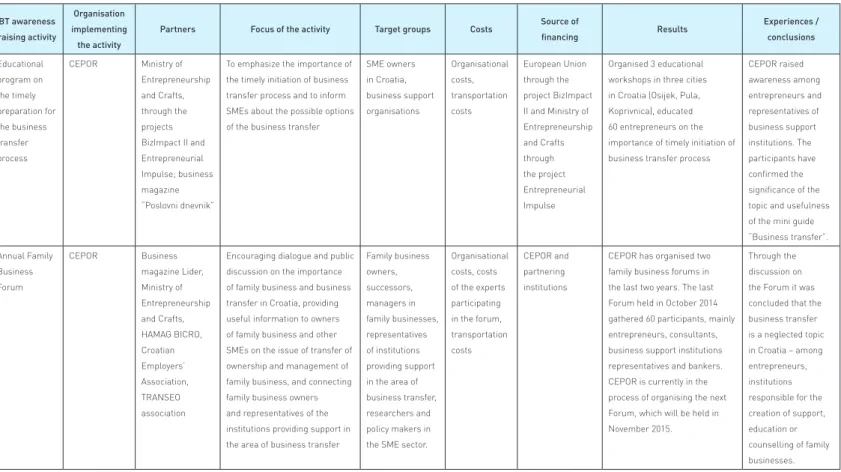
Current (since 2014) business transfer awareness raising activities in Croatia are listed in Table 3.
TABLE 3. Current awareness raising activities in Croatia.
bt awareness raising activity
organisation implementing the activity
Partners Focus of the activity target groups costs source of
financing results experiences / conclusions Educational program on the timely preparation for the business transfer process CEPOR Ministry of Entrepreneurship and Crafts, through the projects BizImpact II and Entrepreneurial Impulse; business magazine “Poslovni dnevnik”
To emphasize the importance of the timely initiation of business transfer process and to inform SMEs about the possible options of the business transfer
SME owners in Croatia, business support organisations Organisational costs, transportation costs European Union through the project BizImpact II and Ministry of Entrepreneurship and Crafts through the project Entrepreneurial Impulse Organised 3 educational workshops in three cities in Croatia (Osijek, Pula, Koprivnica), educated 60 entrepreneurs on the importance of timely initiation of business transfer process
CEPOR raised awareness among entrepreneurs and representatives of business support institutions. The participants have confirmed the significance of the topic and usefulness of the mini guide “Business transfer”. Annual Family Business Forum CEPOR Business magazine Lider, Ministry of Entrepreneurship and Crafts, HAMAG BICRO, Croatian Employers’ Association, TRANSEO association
Encouraging dialogue and public discussion on the importance of family business and business transfer in Croatia, providing useful information to owners of family business and other SMEs on the issue of transfer of ownership and management of family business, and connecting family business owners and representatives of the institutions providing support in the area of business transfer
Family business owners, successors, managers in family businesses, representatives of institutions providing support in the area of business transfer, researchers and policy makers in the SME sector.
Organisational costs, costs of the experts participating in the forum, transportation costs CEPOR and partnering institutions
CEPOR has organised two family business forums in the last two years. The last Forum held in October 2014 gathered 60 participants, mainly entrepreneurs, consultants, business support institutions representatives and bankers. CEPOR is currently in the process of organising the next Forum, which will be held in November 2015.
Through the discussion on the Forum it was concluded that the business transfer is a neglected topic in Croatia – among entrepreneurs, institutions responsible for the creation of support, education or counselling of family businesses.
Promotion of mini guide “Business transfer” CEPOR Ministry of Entrepreneurship and Crafts through the project BizImpact II
The mini guide is providing information on the importance of business transfer process, possible solutions for this issues and relevant regulatory framework affecting this issue.
SME owners, business support institutions, research organisations, lawyers, bankers, tax advisors, consultants, and all other interested individuals. Expert costs, cost of organising the promotion of mini guide, marketing costs CEPOR and European Union through the project BizImpact II
Three presentation of mini guide were organised, approximately 1000 copies of mini guides were disseminated, and electronic version of mini guide has been sent to all relevant institutions, as well as has been published on websites of all relevant business support institutions.
This mini guide is the only publication providing information to entrepreneurs on business transfer issues in Croatia. The communication with entrepreneurs and all other stakeholders pointed out the importance of this mini guide, as well as the need for the continuous development of information materials on this topic. Family Business Club Business magazine Lider
CEPOR Providing support to medium and large enterprises going through the process of BT, encouraging dialogue and public discussion on the importance of family business and BT
Medium and large family business owners Information not available Business magazine Lider, membership fees
Business Magazine Lider is currently in the process of identifying activities of the Club, and the Club will start with its operations in the second half of 2015. Information not available Seminars intended specially for family businesses going through the process of business transfer
Adizes Institute Impact Hub Providing seminars for family business owners and their successors on the topics related to business transfer, such as planning the process of selling the company, managing change, and the topics specially focused on family business owner, children and company
Family business owners and their children, potential successors, and other family business members involved in the business transfer process The fee of Adizes consultants, training material costs and catering costs The seminar is implemented on a commercial basis
Adizes is organising this one-day seminars. Additionally, Adizes Institute is also specialized in programs which are tailored to the special needs of single family business, called “Organizational therapy” (lasts for 6 months). Information not available Mediation in business transfer Law office “Cikač” Information not available
Promoting the role of mediation among family members going through the process of business transfer
Family business owners and their children
Organisational costs and fee for experts
Seminar is implemented on a commercial basis
Law office “Cikač” is organising this mediation seminars in two parts: 1) mediation from theoretical aspect, 2) mini sketch on mediation.
Information not available
The events promoting business transfers in Croatia are, in brief, annual conferences on family businesses organized by Lider (2009 – 2014), Family Business Club meetings (initiated in 2015, by Lider); Family business forum, round table discussions, workshops and educational programs organised by CEPOR; seminars on mediation organised by Law Office Cikač; and seminars targeting family businesses organised by the Adizes Institute.
All in all awareness raising activities reflect the fact that business transfer support in Croatia is still undeveloped, with only a couple of initiatives aimed at raising the awareness of entrepreneurs on the importance of timely initiation of the process. Areas that need to be improved are further development of educational programs specifically designed for entrepreneurs, consultants, lawyers and all other stakeholders having an impact on the business transfer process, or being impacted by that process. Those educational programs should be based on research, and should be tailored to special needs of participants. In addition, further development of specialized professional support and availability of professionals specialized in supporting micro and small enterprises in this process are of crucial importance.
One of the most needed activities in business transfer awareness raising is a business transfer campaign, which would promote business transfer in major Croatian cities, and would be organized in cooperation with local business support institutions. Other activities are continuous organization of the Family business forum, which gathers together entrepreneurs and representatives of business support institutions, workshops and seminars intended for SME owners.
4 SUMMARY OF BUSINESS TRANSFER ECOSYSTEM
AND AWARENESS RAISING IN CROATIA
Business transfer ecosystem in Croatia is still undeveloped. The quality of business transfer ecosystem can be evaluated based on the recommendations provided by the European Commission in 2006 (“Implementation of the 2006 Commission Communication on Business Transfers”, EC, 2006): awareness raising activities; business transfer – friendly legal framework; creation of financial instruments for financing business takeover; strengthening of professional support in the business transfer process and development of on-line matching platforms.
Considering these five areas which compose the business transfer ecosystem in Croatia, it can be concluded that the only business transfer supportive segment of the ecosystem is the legal framework, which enables tax-free business transfer process in case of inheriting the business from predecessors or selling / buying the company.
Areas that are lacking, but should represent important initiatives for raising the quality of the business transfer ecosystem in Croatia are: development of an on-line platform; development of data gathering and statistical monitoring of business transfers; development of financial instruments supporting business transfer; and development of support programs coming directly from governmental support organizations. The evaluation of Croatian business transfer ecosystem has shown a lack of on-line matching platforms in Croatia. The only initiative in this segment is led by CEPOR, and it is in its initial phase of identification of the stakeholders, creation of business plan, identification of sources of funding and benchmarks and development of a sustainable business model for implementation of an on-line matching platform in Croatia. The research has also identified a lack of financial instruments for financing business takeover in Croatia. Moreover, the representatives of commercial banks interviewed during the initial phase of the project did not indicate any interest of their banks to develop these kinds of the products in the near future, while the representatives of HAMAG BICRO – Croatian Agency for SMEs, Innovation and Investments indicated strong focus of the Agency on supporting exclusively start-up entrepreneurs.
Professional support in SME business transfer process is also lacking. The main focus of the supply side of the business transfer consultancy service market is on medium and large enterprises (“Big 4” consulting companies indicated interest in business transfer transactions above 700 000 EUR). The availability and quality of professionals specialized in supporting micro and small companies in the business transfer process is very low, in all types of related service providers: M&A experts, lawyers, tax advisors and accountants.
BTAR project is focused on raising awareness of business transfer issues among several target groups: sellers, buyers, business support organizations and consultancy service providers. In Croatia, there are several awareness raising activities focused on potential sellers, but at the same time, there are no awareness raising activities focused on buyers, business support organizations and consultancy service providers. Main actors in awareness raising activities targeting entrepreneurs (sellers) are Lider (business weekly magazine, organizer of annual conferences on family businesses), CEPOR (conducting research, organization of seminars on business transfer issues, and preparation of publication on business transfer for entrepreneurs), Adizes Institute (organizing seminars and consultancy for family businesses in business transfer process), and Cikač Law Office (organizing seminars and providing mediation services for solving conflicts among family members in family businesses).
Future awareness raising activities need to be more intensified, with wider geographical coverage, covering different stakeholder groups (sellers, but also buyers, consultancy services providers and representatives of business support institutions).
sItUatIon anaLYsIs: FInLanD
Juha Tall, Elina Varamäki and Anmari Viljamaa Seinäjoki University of Applied Sciences
1 BACKGROUND
In Finland the phenomenon of business transfers has been in the focus of economic development policy mainly because of the aging entrepreneurs exiting from entrepreneurship during the last ten years. In Finland the average age of the entrepreneurs is a little bit higher compared to entrepreneurs in Europe. The share of 55–74 years old entrepreneurs among all entrepreneurs is growing, being 33 % in 2013. According to the national business transfer barometer, within the next ten years about 28 000 firms are about to be transferred to new ownership (Varamäki, Tall, Sorama and Katajavirta 2012c). Among the firms of aging entrepreneurs about 14 800 firms are planning succession and 20 000 firms are planning to close down, when the present entrepreneur exits the firm. The magnitude of these figures is significant. Based on the facts mentioned above, the focus of business transfer related economic policy and development measures has been on the aging entrepreneurs and the business transfers of their firms. This has been justified because business transfers have greater impact to national economy compared to start-ups (e.g. Van Teeffelen 2010). According to previous research, 57 % of start-ups close down within the first five years after starting (Yrittäjyyskatsaus 2011). It is important for existing firms to find new owners within or outside the family and succeed in the business transfers. In order to function properly the business transfer market needs both sellers and buyers. During the last few years buyers have been more and more in the focus with different key actors. There are a few main reasons for this. First, an increasing number of firms need a buyer outside the family. The share of successions in business transfers is decreasing. Second, business transfer is an attractive option for becoming an entrepreneur. Third, a business transfer is an excellent opportunity to develop and grow an existing firm. Business transfers are connected to contexts of new and growth entrepreneurship.
2 BUSINESS TRANSFER ECOSYSTEM IN FINLAND
2.1 Key legislation and tax laws
The legislative environment in Finland is relatively stable regarding business transfers and does not really hinder business transfers except in some family businesses. Inheritance and gift tax is a major issue for many family firms. In acquisitions, the seller pays capital gains tax. In Finland the economic outlook is right now influenced by aging and recession. There are no particular laws promoting business transfers in Finland. The overall picture is that the changes in legislative environment are usually minor, although both small scale improvements and setbacks do occur. All this makes the legislative environment reasonably predictable, which can be considered a factor promoting business transfers in Finland.
During last few years the government in Finland has faced major challenges. First, there has been significant pressure to increase all kinds of taxes. Second, any kinds of decisions have been very difficult to make. In this recent climate setbacks in legislation related to business transfers have occurred more often than improvements. The key legislation hindering business transfers includes transfer tax and inheritance and gift tax. Transfer tax is 4 % for real estate and 2 % for the shares of apartments and real estate limited partnerships. Two major setbacks in 2013 were the increase of the latter from 1,6 % to 2,0 % and expansion of the tax base for the 4 % tax. Now tax is calculated from the real value, whereas prior to 2013 the buyer could deduct the amount of debt related to the real estate. Transfer tax is payable by the buyer.
Starting 2015 inheritance and gift tax is 8–20 % for the first category, which includes the spouse and the children and is the dominant category in successions. Previously the inheritance and gift tax was 7–19 %. The taxable value of the inheritance and gift is based on the fair market value of the property at the date of death/donation. Perhaps more importantly, an on-going political debate about the future of gift and inheritance tax has created an atmosphere of unpredictability, which has an impact on business transfers. Family firms in particular are uncertain on whether transfers should go ahead or wait.
In taxation of individual shareholders dividend from publicly listed companies are 85 % taxable capital income and 15 % tax-exempt. The flat rate for capital income is 30 % up to 30 000 €/year (2015) and 33 % after that.
2.2 Business transfer markets
There is no public database on business transfers in Finland. However, there is a private database of business transfers over 500 000 € (annual turnover of target business). This database collects information about 500–900 acquisitions annually and the information is for sale for about 3 000 € (www.talouselama.fi). The information for the database is collected from public sources such as stock exchange releases and media.
Based on the Seinäjoki University of Applied Sciences research stream, business transfers are becoming more popular also with small businesses. Estimates about the number of business transfers do vary, but about 2 000 acquisitions annually is one of the most-cited figures. Also, a business transfer is an excellent way to become an entrepreneur and to grow a firm (Varamäki, Viljamaa, Tall & Länsiluoto 2014c). About a fifth of aging entrepreneurs are planning to implement successions (Figure 3). Of the 2 843 respondents to the Finnish Business Transfer Barometer (Varamäki et. al. 2012c; Varamäki, Tall & Viljamaa 2014a), 38 % are planning to sell the firm to an outside buyer at the time they give up the main responsibility and 28 % are planning to close down the firm. Two in ten (20 %) believe they will find a successor within the family. Of those expecting succession within the family, 69 % know who the successor will be, although less than a third of the entrepreneur parents had discussed the future of the firm with their children. In one out of ten cases a co-owner or co-owners are willing to take over the business when the entrepreneur him/herself steps aside. The highest expected close down rate was among the entrepreneurs with an academic education and the lowest among the entrepreneurs with the lowest level of education. Aging increased pessimism concerning the business transfer, which is in line with the results of Allinson et al. (2007) in the United Kingdom. Close down of firms is an essential part of a dynamic business ecosystem, but the key question is whether one third is the right rate.
4 10 20 28 38 0 % 10 % 20 % 30 % 40 % 50 % other other owners of the firm will continue the business
family succession the firm will be closed down the firm will be sold to external
buyer
Future of the firm after the respondent has passed on his ownership
n=2830
FIGURE 3. Future of the firm after the respondent has passed on his ownership (Varamäki et al. 2012c).
Looking at the successions, the background of the firm (i.e. the size of the firm, industry, family entrepreneurship and previous business transfers) has an effect on the outlook for succession. Succession is significantly more likely to occur in a firm with more than ten employees compared to smaller firms. More than half (55 %) of one-person-enterprises will close down. The close down expectation is more rare among firms with fewer than five employees (20 % among firms with 2–4 employees) and only 6 % among those with 5 or more employees.
Firms operating in manufacturing have a higher rate of expectation for business transfer than firms in construction, trade and services. Closing down is expected for 35 % of the firms in services, 31 % in construction, 21 % in trade and 15 % in manufacturing. It should be noted, however, that closure is not necessarily a negative phenomenon; healthy entrepreneurial dynamics naturally include closing down as well as starting up firms.
If the firm is owned and run by the family members, the future outlook of business transfer is more positive. Close to one third (30 %) of the family firms believed in succession while with non-family firms the share was only 6 %. Business closure is almost twice as likely to happen among non-family firms (42 %) than in family firms (22 %). Succession experience in the firm increases likelihood of another succession and decreases the likelihood of firm closure.
Business transfers of small firms are a very local phenomenon. Small firms also rely heavily on public business services. Together these two facts suggest that there is
a need to maintain and strengthen local availability of advice on transfer processes. Brokers are usually not interested in the very smallest firms and, at the same time, the smallest firms usually have the least financial resources to invest in private sector services. Yet micro firms are collectively extremely important in local economies, and a large proportion of business transfers occur in micro firms. Municipalities and regions should therefore show an active interest in addressing the issue. In small municipalities even a single small business transfer can be very important factor for the economic climate.
Online market platforms in Finland consists of one national platform with regional partners, www.yritysporssi.fi by Federation of Finnish Enterprises (FFE) with about 400 ads active, and dozens of independent regional/private online platforms (Viljamaa, Tall & Oikarinen 2014). There are roughly about 1 000 ads altogether active in online market platforms. There is a tendency for private actors to focus on bigger firms. Hence, public online platforms are particularly relevant for micro size and small businesses. FFE has published a business transfer activity index. The index reflects development of business transfer activity in Finland. This national and regional index provides a ’wake-up’ call for regions that are not doing well.
Business transfers have been studied from three perspectives in Finland: family business and succession research (University of Turku, University of Jyväskylä, Lappeenranta Technology University, Hanken School of Economics), SME research (Seinäjoki University of Applied Sciences) and M&A research (Hanken School of Economics). About 20 doctoral dissertations have been presented in the field of M&As and about the same number in the field of successions and family firms. Business transfer research hasn’t had any special sources for research funding. Earlier there was one professorship of family business in University of Jyväskylä, but it no longer exists. The most active actor in the field of SME business transfers has been Seinäjoki University of Applied Sciences (SeAMK) which has studied business transfers from several different perspectives of the business transfer ecosystem (sellers, potential sellers, buyers, potential buyers, advisors). SeAMK has also implemented five national surveys or barometers in business transfer field: a national BT barometer 2012 from the point of view of potential sellers (Varamäki et al. 2012c), a national survey for BT advisors 2011 (Varamäki et. al. 2011), a national survey for buyers and successors 2013 (Varamäki et al. 2013), a national survey for unfinished business transfers 2014 (Varamäki et al. 2014b) and a national survey for predecessors 2015 (forthcoming). In an ideal model research should be an important and integrated part of the business transfer ecosystem, i.e. researchers should have close cooperation with buyers, sellers, advisors and business policy actors. This has at least partly succeeded in Finland.
2.2.1 Sellers and buyers
Sellers and buyers are the most prominent players in business transfers. The business transfer market, however, is a buyer’s market at the moment. There are more businesses for sale than there are buyers on the market (Varamäki, Tall & Viljamaa 2014a; see also Stone et al., 2004). According to a previous national survey targeted to buyers, 65 % of the buyers and successors are men and 35 % women (Varamäki et al. 2013). Their age varies from 23 to 70 years, the average being 45 years. Half (49 %) of the buyers have a university level education and almost half (42 %) have a vocational level education. Buyers´ business transfer experience is low. More than two thirds (68 %) of the buyers were first time buyers. Only a fourth (26 %) of the buyers have previous business sale experience. More than half of the buyers were private persons. One third (30 %) of the buyers were team buyers and one fifth (17 %) other firms.
The average size of the target business (seller firms) was 10,5 employees and the median size 4 employees (Varamäki et al. 2013). The majority (72 %) of the business transfers involve micro size firms; about half of the target businesses had five or less employees. The most typical (36 %) size group was firms with 2–4 employees.
Majority of business transfers are very local, with sellers and buyers coming from the very same community or from the neighboring communities. Also, when the buyer is a firm, the target business tends to be similar to the buyer. From the seller’s perspective, this means that a buyer is often to be found among similar firms.
Business transfers of small businesses are generally successful. Afterwards about 80 % of the buyers consider the business transfer successful, and the buyers also develop the business after the transfer (Varamäki et al. 2014c). Half of the buyers thought the paid price was right. One fourth (23 %) of the buyers considered the price low and one fourth (25 %) considered the price high.
2.2.2 The challenges to buying, selling and succession at the moment
The most commonly mentioned reasons for transfer failure in business transfer research in general include lack of business transfer planning followed by the inability to find an appropriate buyer, delay or postponement of the transfer because of emotional attachment, failure to obtain financing from a bank, lack of trust between seller and buyer and lack of agreement about the sale price.
In the Finnish small business transfer research there are a number different approaches into challenges on business transfers. These approaches include potential sellers (aging entrepreneurs), buyers with experience of implementing
business transfer, successors, business transfer experts, business transfer services and unfinished business transfers. It is a bit surprising that potential sellers seem to see more challenges in business transfers than the buyers who actually have recently acquired a business. Business valuation is common challenge to all the approaches mentioned above.
In line with several previous studies (Stone, Allinson & Braidford 2004; Stokes & Blackburn 2002; Varamäki et al. 2011), the potential sellers in Finland considered finding the buyer/successor the biggest challenge of business transfer. Close to half of the Finnish entrepreneur respondents viewed finding the buyer/successor a significant problem followed by valuation and transfer of knowledge to the buyer (Varamäki, Tall & Viljamaa 2014a). Even though it is challenging to find a buyer, majority (63 %) of the entrepreneurs had not been active in finding a buyer and one in four (26 %) entrepreneurs had done nothing to find a buyer. This is alarming since finding a buyer and completing the actual business transfer may take couple of years and sometimes even longer. Even developing a buyer from within the business (e.g. Sambrook 2005) may similarly take years. Sellers look for buyers too late. From the sellers´ point of view, business transfers are sensitive processes with an exceptionally high need for confidentiality.
According to family firms, the biggest challenges in successions are linked to taxes (inheritance and gift and other taxes), to finding a successor within the family (Varamäki et al. 2012c), and to financing the succession. The bigger the family firm, the more challenging they regard the inheritance and gift and other taxes.
More than half (56 %) of the entrepreneurial parents giving up their business estimate they adhere to the culture of freedom. This means their children may decide themselves whether they want to carry on their parents’ business activities or not. There are, however, fewer parents that definitely wish their children to continue their firms than parents who do not wish it. One third (30 %) of the entrepreneurial parents represent weaning culture and only 14 % obligation culture (Varamäki et. al. 2012c).
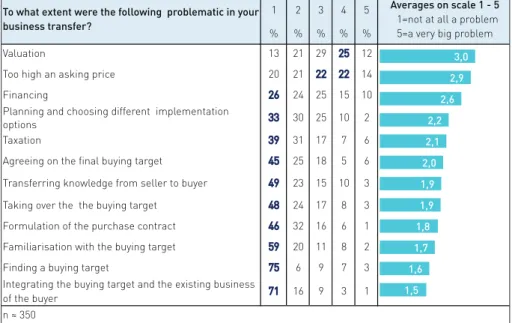
Buyers primarily meet difficulties in financing the transaction, the lack of management or professional experience, and legal and fiscal issues (Van Teeffelen 2012). Valuation and high asking prices of sellers have traditionally been the most common problems in the business transfer processes (cf. Ip & Jacobs 2006). This has been the case in Finland as well as shown in the following Figure 4.