Title Commitment or Entrenchment?: Controlling Shareholders and Board Composition
Author(s) Yeh, Yin-Hua; Woidtke, Tracie Citation
Issue Date 2004-06
Type Technical Report
Text Version publisher
URL http://hdl.handle.net/10086/13898 Right
Center for Economic Institutions
Working Paper Series
CEI Working Paper Series, No. 2004-8
Commitment or Entrenchment?: Controlling Shareholders and Board Composition
Yin-Hua Yeh Tracie Woidtke
Center for Economic Institutions
Working Paper Series Institute of Economic Research
Hitotsubashi University
2-1 Naka, Kunitachi, Tokyo, 186-8603 JAPAN Tel: +81-42-580-8405
Fax: +81-42-580-8333
Commitment or Entrenchment?: Controlling Shareholders and Board
Composition
Yin-Hua Yeh a,* and Tracie Woidtke b
a
Graduate Institute of Finance, Fu-Jen Catholic University, Taipei, Taiwan
b
Department of Finance and Corporate Governance Center, University of Tennessee, Knoxville, TN 37996 Journal of Banking and Finance (SSCI), forthcoming
Abstract
This paper examines the determinants of board composition and firm valuation as a function of board composition in Taiwan — a country that features relatively weak protection for investors, firms with controlling shareholders, and pyramidal groups. The results suggest that there is poor governance when the board is dominated by members who are affiliated with the controlling family but good governance when the board is dominated by members who are not affiliated with the controlling family. In particular board affiliation is higher when negative entrenchment effects — measured by (1) divergence in control and cash flow rights, (2) family control, and (3) same CEO and Chairman — are strong and lower when positive incentive effects, measured by cash flow rights, are strong. Moreover, relative firm value is negatively related to board affiliation in family-controlled firms. Thus, the proportion of directors represented by a controlling family appears to be a reasonable proxy for the quality of corporate governance at the firm level when investor protection is relatively weak and it is difficult to determine the degree of separation between ownership and control.
The authors would like to thank two anonymous referees, Don Fraser, and Scott Lee for helpful comments. Any remaining errors are our own.
*
Corresponding author. Tel.: +886-2-2903-1111 ext.2725; fax: +886-2-2901-9779.
Commitment or Entrenchment?: Controlling Shareholders and Board Composition Abstract
This paper examines the determinants of board composition and firm valuation as a function of board composition in Taiwan — a country that features relatively weak protection for investors, firms with controlling shareholders, and pyramidal groups. The results suggest that there is poor governance when the board is dominated by members who are affiliated with the controlling family but good governance when the board is dominated by members who are not affiliated with the controlling family. In particular board affiliation is higher when negative entrenchment effects — measured by (1) divergence in control and cash flow rights, (2) family control, and (3) same CEO and Chairman — are strong and lower when positive incentive effects, measured by cash flow rights, are strong. Moreover, relative firm value is negatively related to board affiliation in family-controlled firms. Thus, the proportion of directors represented by a controlling family appears to be a reasonable proxy for the quality of corporate governance at the firm level when investor protection is relatively weak and it is difficult to determine the degree of separation between ownership and control.
Commitment or Entrenchment?: Controlling Shareholders and Board Composition 1. Introduction
Is corporate board structure indicative of corporate governance in firms with concentrated ownership? Does shareholder concentration allow controlling shareholders to select board members that are more likely to monitor or provide expertise? Or does shareholder concentration allow controlling shareholders to select board members that enable them to expropriate wealth from minority shareholders? Does the independence of the board appear to matter in firms with concentrated ownership? These are important questions that have not been fully addressed in the literature. Existing studies on corporate boards of directors are generally restricted to large U.S. firms with disperse ownership and generally treat board composition as exogenous (see Hermalin and Weisbach, 2003, for a survey). It remains an open question whether results in existing studies can be generalized to firms with controlling shareholders.
Hermalin and Weisbach (1988) argue that understanding how directors are chosen is crucial to understanding the roles the board can play and how effectively it can play them. Existing studies suggest CEOs wield major influence in selecting new board members when ownership is disperse (Mace, 1971; Lorsch and MacIver, 1989; Shivdasani and Yermack, 1999).1 Moreover, Shivdasani and Yermack find that when CEOs are involved in selecting directors, they choose directors who are less likely to monitor. However, several recent studies suggest that ownership tends to be more concentrated and agency
problems tend to be more severe in countries with weaker investor protection (e.g., La Porta, Lopez-de-Silanes, Shleifer, and Vishny, 1999 and 2000).
On the one hand, concentrated ownership arises when investor protection is weaker to help solve the managerial agency problem because controlling shareholders have the power and incentive to discipline management (e.g., Grossman and Hart, 1988). On the other hand, concentrated ownership creates the conditions for a new agency problem because the interests of controlling and minority shareholders are not perfectly aligned, especially when there is a divergence between control and ownership (e.g., Bebchuk et al., 2000; Claessens, Djankov, Fan, and Lang, 2002). In such instances, corporate boards could play an important role in limiting the power of controlling shareholders to expropriate the interests of minority shareholders by ratifying and monitoring important decisions (Fama and Jensen, 1983). However, board composition is likely to be influenced by controlling shareholders in such instances. Therefore, a firm’s board structure could serve as an important indicator of whether the controlling shareholder is committed to good corporate governance or is entrenched.
Taiwan represents an ideal setting to examine these issues because it features relatively weak protection of minority shareholders, high ownership concentration, a predominance of family control, and an abundance of pyramidal groups and cross-holdings—characteristics common to many countries (La Porta et al., 1999; Claessens, Djankov, and Lang, 2000; and Faccio and Lang, 2002).2 In this environment, it
2 According to La Porta et al. (1998), only three of six legal rights designed to protect shareholders are included in Taiwan’s Law. The inclusion of three shareholder rights is weak compared to both the inclusion of five shareholder rights in the Law for the U.S. and the average inclusion of four shareholder rights in the Law for common law countries. However, the average inclusion in La Porta et al.’s sample when civil law countries are included is three.
may be difficult for minority investors to determine whether positive incentive or negative entrenchment effects dominate. The use of pyramidal groups and cross-holdings makes it easy for large shareholders to separate ownership and control and difficult for minority investors to detect the degree of separation. Thus, a firm’s board structure may be viewed as a strong indicator of the controlling shareholder’s commitment to corporate governance, especially in weaker investor protection countries. Controlling shareholders may select board members that are more likely to both monitor and provide professional expertise when the positive incentive effects of ownership are high. In this situation, controlling shareholders would gain more from increasing shareholder wealth than they would lose in foregoing expropriation. In contrast, controlling shareholders may select board members that are less likely to monitor and more likely to support their decisions in order to entrench themselves further when the entrenchment effects of excess control outweigh the positive incentive effects of cash flow ownership. In this situation, the net personal benefit of expropriation is greater than the net personal benefit of shareholder wealth maximization. We examine the determinants of board composition and firm valuation as a function of board composition in Taiwan. We carefully identify the ownership and control structures for a sample of Taiwanese firms to measure the positive incentive and negative entrenchment effects of the controlling shareholder. Specifically, we use cash flow rights to measure positive incentive effects and the divergence between cash flow and control rights to measure negative entrenchment effects. We find that the fraction of board members affiliated to a firm’s largest shareholder is higher when that shareholder: (1) has a greater divergence in control and cash flow rights, (2) is a member of the controlling family, and (3) is the firm’s CEO and chairman. We also find that family-controlled firms
have lower firm value when the fraction of board members affiliated to the controlling family is higher. These results suggest that controlling shareholders do wield influence over board member selection and that corporate boards are good indicators of a firm’s governance structure when ownership is concentrated, protection of minority investors is relatively weak, and determining the degree of separation between ownership and control is difficult (i.e., the controlling shareholder is a family). In particular, boards that are closely linked to controlling families are associated with strong, negative entrenchment effects, and firms with these board structures are valued less by investors. In contrast, boards that are independent of controlling families are associated with strong, positive incentive effects, and firms with these board structures are valued more highly by investors.
The remainder of the paper is organized as follows. Section 2 describes the corporate governance environment in Taiwan. Section 3 describes the sample and provides summary statistics. Section 4 presents the empirical analysis. Section 5 concludes.
2. Corporate governance in Taiwan
Several internal and external governance mechanisms in the U.S. — such as ownership by institutions, the market for corporate control, and the composition of the board of directors — may provide incentives for managers to maximize shareholder wealth. However, the degree to which these mechanisms come into play can vary dramatically across countries. For example, Yeh, Lee, and Woidtke (2001) find that Taiwanese listed
companies have similar ownership characteristics to publicly traded companies in most countries around the world. They are characterized by a high degree of ownership in general and are predominantly family-controlled (see La Porta et al., 1999; Claessens, Djankov, and Lang, 2000; and Faccio and Lang, 2002 for ownership characteristics in countries around the world). However, unlike the U.S., Taiwan is characterized by low institutional ownership and an inactive market for corporate control. Moreover, stockholders have fewer rights in Taiwan than in the U.S., though they have approximately the same number of rights as the average reported for 49 countries in La Porta et al. (1998). Thus, Taiwan provides a natural setting for examining the influence of positive incentive and negative entrenchment effects on board composition. Our results are more likely to be indicative of the board’s role in most countries than results using U.S. firms, not only because large shareholders are more likely to play an important role in director selection but also because alternate corporate governance mechanisms are less likely to play as critical a role in countries where family control is predominant.
2.1. Corporate boards in Taiwan
Similar to German boards, corporate boards in Taiwan are comprised of two separate organizations—a board of directors and board of supervisors. Directors are responsible for managing the company, while supervisors are responsible for monitoring the directors. Specific director responsibilities include the following: managing business operations; appointing, dismissing, and compensating management; appointing, dismissing, and compensating external auditors; legally representing the company within the limits of their authority; and approving equity and debt issues. Managerial decisions
within a firm are determined by the vote of its directors during board meetings. The minimum number of directors required by law for our sample of Taiwanese firms is three.
On the other hand, supervisors do not participate in the decision-making or the voting process but are designated to monitor the board of directors. They are responsible for scrutinizing decisions made by directors, reviewing and auditing the reports provided by directors, and resolving any disputes arising between shareholders and directors. The supervisors are to oversee business operations and can investigate a firm’s finances or operations at any time. Moreover, supervisors can individually exercise their rights. A consensus is not required. For example, a single supervisor can require directors or managers to address any question or concern (s)he has regarding the company’s operations or financial statements. If the supervisor finds the directors or managers have either transgressed the law or hurt firm value, (s)he can sue the directors or managers. Because supervisors can individually exercise their rights, Taiwanese companies tend to have a small number of supervisors. The minimum requirement by law for our sample of Taiwanese firms is one supervisor.
Unlike German boards, Taiwanese boards of directors and supervisors are parallel organizations. In other words, supervisors do not have the right to approve directors’ decisions. Even though they may ask managers or directors to address questions, directors and managers have some influence over what information is given to supervisors. Thus, a lawsuit is unlikely unless a supervisor is willing to actively monitor and investigate directors’ or managers’ actions. Moreover, Taiwan’s Corporate Law stipulates that both supervisors and directors are to be elected by shareholders and only current shareholders are qualified candidates, but the regulations do not stipulate that independent directors or
independent supervisors must be included on a corporation’s board.3 Even though Taiwan’s Corporate Law stipulates that no current employees or directors can serve as supervisors, it does not prohibit family members of current employees or directors from serving as supervisors. As a result, it is common to see family members of controlling shareholders serve as supervisors.4 In addition, because Taiwan’s Corporate Law allows institutional shareholders to elect representatives to the board, controlling families have the ability to increase their influence over the board by creating nominal investment companies that in turn become institutional shareholders in the company.
2.2. Positive incentive versus negative entrenchment effects
La Porta et al. (1999), Claessens, Djankov, and Lang (2000), and Faccio and Lang (2002) find that controlling shareholders of publicly traded firms in most countries typically have significant control in excess of their cash flow investment. When large shareholders have control in excess of their cash flow rights, they might try to expropriate wealth by seeking personal benefits at the expense of minority shareholders.5 Consistent with this view, Claessens, Djankov, Fan, and Lang (2002) find that a greater divergence in control rights and cash flow rights is associated with lower firm value. Given the latitude controlling shareholders in Taiwan have in selecting both directors and supervisors, they can strengthen their control by selecting family members or persons they trust as both
3 Taiwan’s Corporate Law relaxed the restriction that directors and supervisors be firm shareholders at the
end of 2001, and the Taiwan Stock Exchange began requiring that IPO firms listing from January 2002 on include two independent directors and one independent supervisor on the board. Security Exchange Law also increased the minimum requirements in 2001 to be 5 directors and 3 supervisors for newly listed companies.
4 The only limitations regarding corporate boards in Taiwan are: (1) terms for both directors and supervisors
are three years; (2) the board must be comprised of at least three directors and one supervisor; and (3) directors and supervisors must be selected separately.
5 See Grossman and Hart (1988), Harris and Raviv (1988), Shleifer and Vishny (1997), La Porta et al. (1999),
directors to make decisions in their favor and as supervisors to not question those decisions.
Controlling shareholders may alternatively commit to increase shareholder wealth by selecting professional managers to serve as directors based on their expertise rather than affiliation. Similarly, they may commit to limit expropriation by selecting supervisors that are more likely to monitor. When cash flow investment is high or divergence in control rights and cash flow rights is low, the benefit controlling shareholders receive from increasing shareholder wealth increases relative to their loss from limiting expropriation. In this situation, controlling shareholders may select professional managers without family ties or independent supervisors to increase shareholder wealth. Semkow (1994) examines excessive nepotism and finds that firms are filling senior management and board positions with non-family professionals demonstrating traditional “structural family” characteristics instead of family members incapable of maintaining and enhancing the business left by the founder. In addition, Yeh, Lee, and Woidtke (2001) find a positive valuation effect in a sample of Taiwanese firms when controlling families hold less than 50% of a firm’s board seats. Finally, Anderson, Mansi, and Reeb (2002) and Bhoraj and Sengupta (2002) find that independent boards are associated with lower costs of debt financing, suggesting that independent directors serve a certification role for firms.6
To the extent that controlling shareholders commit to limit expropriation (entrench themselves further) through selecting unaffiliated (affiliated or family) board members, we
6 Existing studies in the U.S. provide mixed support for the role of independent directors. For example,
Rosenstein and Wyatt (1990) find a positive market reaction to the addition of outside directors; and Byrd, Fraser, Lee, and Williams (2002) find that thrifts surviving the thrift crisis had more independent directors than those that failed. On the other hand, Baysinger and Butler (1985), Hermalin and Weisbach (1991), Mehran (1995), and Bhagat and Black (2001) find no significant correlation between the fraction of
expect a negative (positive) relation between the fraction of affiliated board members and measures of positive incentive effects (negative entrenchment effects).
3. Sample and summary statistics
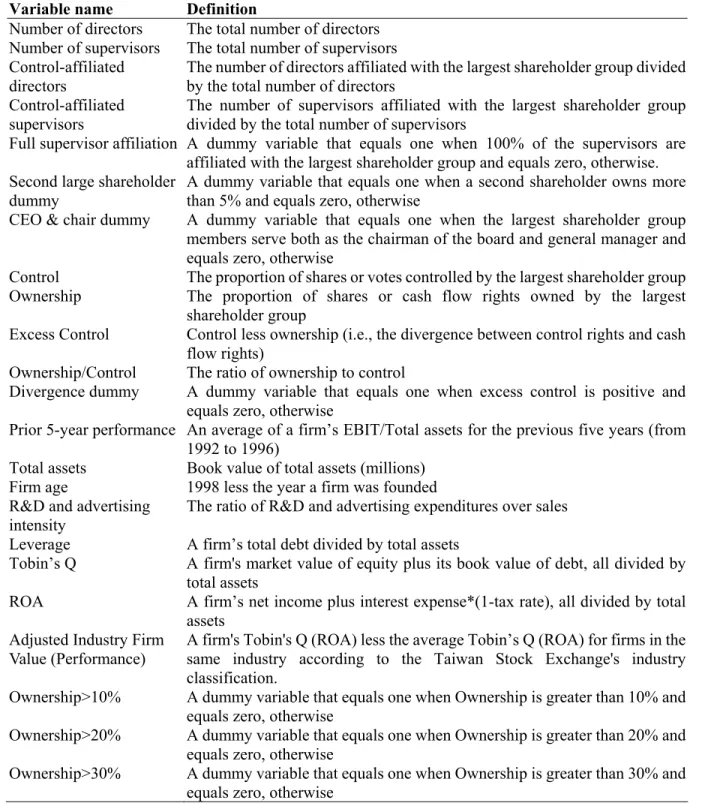
The sample includes non-financial companies publicly listed in Taiwan in 1998. The board composition, control rights, and cash flow rights data are collected from company prospectuses and "Business Groups in Taiwan," a book published annually by the China Credit Information Services LTD. Other company information is collected from the Taiwan Economics Journal (TEJ) database. Complete data are available for 251 companies or about 71% of all non-financial companies publicly listed in Taiwan.7 We take the 1998 year-end value for each company. A summary of variable names and definitions are presented in Table 1, and descriptive statistics are presented in Table 2.
3.1 Ownership versus control
Data on both the cash flow rights and voting rights are required to measure the divergence between ownership and control. Following the concept of ultimate control in La Porta et al. (1999), the ownership of a family group rather than the ownership of a single person serves as the unit of analysis where the family group is defined as a group of people that are related through blood or marriage ties. As in Claessens et al. (2000), we calculate
independent directors on a firm’s board and either accounting or long-term stock performance.
7 Because company prospectuses are needed to calculate both cash flow and control rights and companies
only issue a prospectus when they issue new equity or corporate bonds, we are unable to calculate these measures for 29% of the non-financial companies in 1998. However, the industry distribution is similar between our sample and the population of listed non-financial companies; and the average market capitalization value (book value of assets) for our sample is not significantly different from that for the population.
ownership based on cash flow rights and control based on voting rights. We therefore carefully trace the chain of ownership and use pyramiding schemes and cross-holdings to distinguish between cash flow rights and voting rights. We define the controlling shareholder as the shareholder or family group found to have the largest control rights when summing direct and indirect voting rights.
Ultimate owners of Taiwanese listed companies often enhance their control rights through nominal investment companies and other entities. We thus identify both nominal investment companies and other entities founded by ultimate owners and companies under the same business group from “Business Groups in Taiwan,” a news database of listed companies and company prospectuses. Unfortunately, some of these nominal investment companies and other entities are private companies; and hence, the complete ownership structure is not available. In these situations, we assume that the ultimate owners and the companies they control put up 50% of the capital for these nominal investment companies when calculating cash flow rights. We also use 0% and 100% when calculating cash flow rights and get similar results.
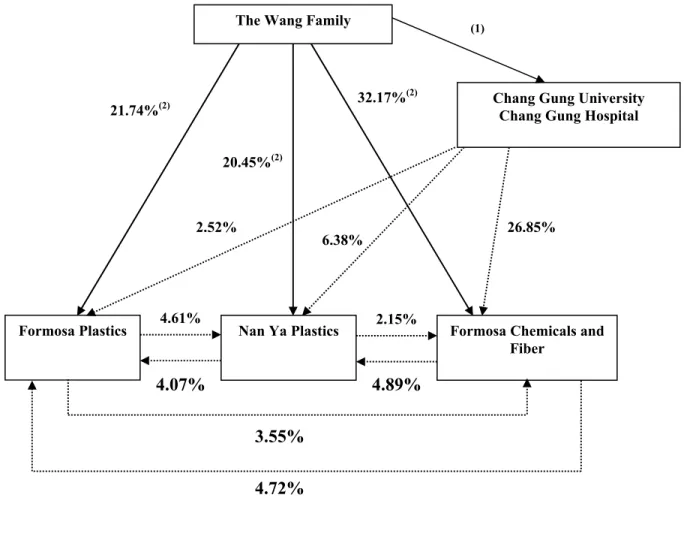
Take the Formosa Plastics Group as an example. The diagram for Formosa Plastics in Figure 1 illustrates the complexity of calculating cash flow and control rights separately when cross-holdings and pyramids are used. Following the methodology in Claessens et al. (2000), direct voting rights are based on the proportion of shares registered to the ultimate owner, and indirect voting rights are based on the weakest link in the chain of shares held by entities that are in turn controlled by the ultimate owner.8 Yung-Ching Wang is the founder of Formosa Plastics, and the Wang family directly owns 21.47% of
Formosa Plastics’ shares. As can be seen in Figure 1, two non-profit organizations controlled by the Wang family (Chang Gung University and Chang Gung Hospital) and two other publicly-listed companies controlled by the Wang family (Nan Ya Plastics and Formosa Chemicals and Fiber) also own shares in Formosa Plastics. We therefore calculate the Wang’s control rights to be 33.05%, which equals 21.74% (the Wang family’s direct control) + min[20.45%, 4.07%] (the weakest link in the chain of control through Na Ya Plastics) + min[32.17%, 4.72%] (the weakest link in the chain of control through Formosa Chemicals and Fiber) + min[100%, 2.52%] (the weakest link in the chain of control through the Chang Gung organizations). In contrast, the cash flow rights in Formosa Plastics are calculated to be 24.09%, which equals 21.74% (the Wang family’s direct cash flow rights) + 0.2045*4.07% (the Wang family’s portion of Na Ya Plastics’ cash flow rights) + 0.3217*4.72% (the Wang family’s portion of Formosa Chemicals and Fiber’s cash flow rights) + 0.0*2.52% (the Wang family controls but has no claim to cash flow rights in the Chang Gung organizations).
8 Other papers using this methodology include Claessens et al. (2002) and Faccio and Lang (2002).
Indirect control Direct control (1) 26.85% 6.38% 2.52% 3.55% 4.72% 4.89% 2.15% 32.17%(2) 21.74%(2) 20.45%(2) 4.07% 4.61%
Chang Gung University Chang Gung Hospital
Formosa Chemicals and Fiber
Nan Ya Plastics Formosa Plastics
The Wang Family
(1) The Chang Gung University and Chang Gung Hospital were built up by the donations of the Wang family. The Wang family therefore has much influence over the two nonprofit organizations. However, because the Wang family’s influence derives from donations, they have no claims to the organizations’ cash flows. (2) The Wang family directly owns 21.74% of Formosa’s shares, 20.45% of Nan Ya Plastics’ shares, and 32.17% of Formosa Chemicals and Fiber’s shares, respectively. These shares include the shares owned by the family members and the shares owned by the Chin’s International Investment Co. and Wan-Shoon International Investment Co., both founded by the Wang family. These two investment companies are 100% founded by the Wang family, so we include the shares owned by the two investment companies as direct shareholding.
Panel A in Table 2 presents measures of ownership and control for the sample.
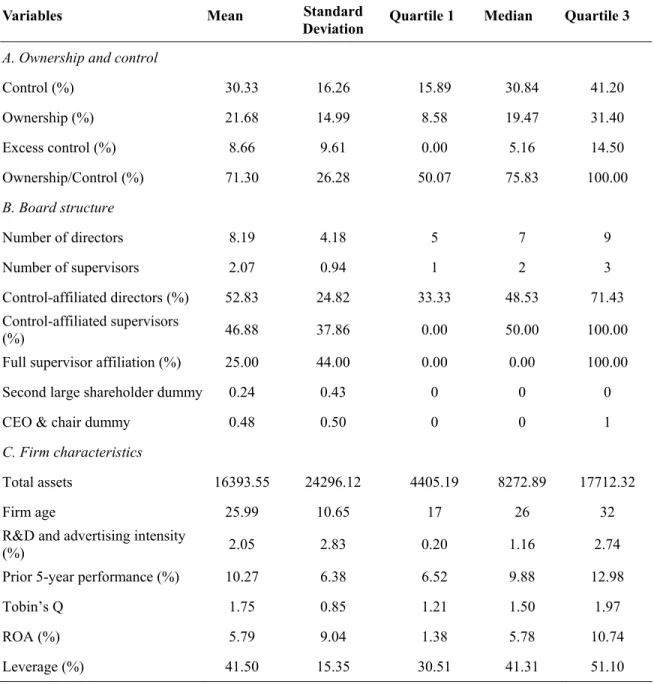
Ownership is defined as the cash flow rights of the largest shareholder. Control is defined as the voting rights of the largest shareholder as described above. Excess Control is defined as Control less Ownership, and Ownership/Control is the ratio of ownership to control for the largest shareholder. Similar to ownership patterns in many other countries, ownership is concentrated, and the largest shareholder has control rights in excess of cash flow rights. Average ownership in the sample is 21.7% while average control is 30.3%. The difference results in excess control of 8.6% and an ownership/control ratio of 71.3% on average. However, some variation exists in the divergence measures. For example,
Excess Control (Ownership/Control) is 0.0% (1.00) or there is no divergence at the 25th (75th) percentile. On the other hand, Excess Control (Ownership/Control) is 14.5% (0.50) at the 75th (25th) percentile.
3.2. Board composition
We define board affiliation with respect to a company’s controlling or largest shareholder to examine whether the positive incentive and negative entrenchment effects for the controlling shareholder appear to influence the board selection process. Even though board affiliation is not specifically defined with respect to management, Claessens et al. (2000) find that management in approximately 80% of Taiwanese listed firms is from the controlling family. Board seats, including both directors and supervisors, are classified as affiliated when they are held either by the firm’s largest shareholder, by the largest shareholder’s identifiable relatives9, or by legal representatives from other companies or entities controlled by the largest shareholder. In the few instances when the controlling
shareholder is the government or a widely held corporation, the delegates appointed to the board by the government or widely held corporation are classified as affiliates of the controlling shareholder. We analyze board composition using three different measures of affiliation. Control-affiliated directors is defined as the number of affiliated directors divided by the total number of directors. Control-affiliated supervisors is defined as the number of affiliated supervisors divided by the total number of supervisors. Finally, Full
supervisor affiliation is a dummy variable that equals 1 when Control-affiliated
supervisors equals 100% and equals 0, otherwise. Since supervisors can act on an individual basis, we include both Control-affiliated supervisors and Full supervisor affiliation to see whether the fraction or simply the existence of an unaffiliated supervisor appears to be important.
Referring back to Formosa Plastics. The Wang family is the controlling family of Formosa Plastics, and they occupy 3 of 17 director seats. Legal representatives of the Chang Gung Memorial Hospital and Nan Ya Plastics Corporation, legal entities and corporations founded and controlled by the Wang family, additionally hold 2 of 3 board supervisor seats. Thus, Control-affiliated directors would be 18%, Control-affiliated supervisors would be 67%, and Full supervisor affiliation would be 0 for Formosa Plastics. Panel B in Table 2 presents descriptive statistics for board composition in our sample of Taiwanese companies. The average number of directors is 8, and the average number of supervisors is 2. The average (median) values for Control-affiliated directors and Control-affiliated supervisorsare both similar and range from 47% to 53%. Note that 33% of director seats are affiliated at the 25th percentile compared to 0% of the supervisor
seats. On the other hand, 100% of the supervisors are affiliated at the 75th percentile compared to approximately 70% of directors. Table 2 shows that 25% of the sample has full supervisor affiliation.
We create two dummy variables to indicate (1) whether the largest shareholder exerts control through both the company and the board and (2) whether another large shareholder with some influence may exist. Controlling shareholders that occupy upper level management positions and serve as chairman of the board are able to both set the agenda for meetings and direct discussions. The lack of separation between these positions could therefore mitigate monitoring by others and be detrimental to other shareholders. For example, Pi and Timme (1993) find a positive association between separation of these roles and bank performance. Similarly, Byrd, Fraser, Lee, and Williams (2002) find that failed thrifts during the thrift crisis were more likely to have a joint CEO-chairman. In contrast, Brickley, Coles, and Jarrell (1997) argue that the practice would not be so widespread among U.S. firms if it undermined shareholder wealth and suggest that the costs of information sharing and lack of succession planning more than offset any monitoring benefits from keeping the posts independent. Consistent with this view, Baliga, Moyer, and Rao (1996) find no evidence that separation of CEO and chairman posts provides benefits. To examine the potential for entrenchment through joint posts, the CEO and chair dummy is set equal to 1 when the largest shareholder serves as both general manager and chairman of the board and 0, otherwise. The largest shareholder holds both posts in approximately 48% of the sample.
daughters-in-law, brothers and sisters-in-law.
Finally, a second large shareholder sitting on a company’s board may mitigate the conflict of interest arising from a separation of ownership and control. We therefore set
Second large shareholder dummy equal to 1 when a shareholder unaffiliated to the largest shareholder owns more than 5% and holds a board seat in a company and 0, otherwise. Approximately 24% of the firms in our sample have another large shareholder with some influence on the board.
3.3. Other firm characteristics
Panel C of Table 2 includes control variables and firm value. Yeh, Lee, and Woidtke (2001) argue that a controlling shareholder can effectively gain control with lower levels of ownership as ownership concentration decreases. To the extent that ownership among minority shareholders becomes more widely dispersed as a firm ages and grows larger, controlling shareholders’ effective control, and thus, influence over board member selection might increase. We therefore include the natural log of both a firm’s age and its total book value of assets as additional factors that may influence board composition. Average (and median) firm age for the sample is 26 years with a standard deviation of 10.65 years. Average (median) size is NT $16.4 ($8.3) billion.
Klein (1998) finds that boards of large U.S. firms have more outside directors with business relations when information needs of a firm are higher. To the extent that controlling shareholders select professional managers as board members for information and advisory services, firms with higher information needs may have fewer control-affiliated board members. We use the proportion of sales spent on R&D and advertising as a proxy for information needs. R&D and advertising expenses are 2.1% (1.2%) of sales on average (for the median firm).
Past firm performance may additionally influence board composition. Semkow (1994) finds that promotion of descendants within the corporate ranks dilutes the pool of non-family talent and leads to corporate failure when family members are not capable of maintaining and enhancing the business left by the founder. Consequently, family members are not promoted to senior management or board positions unless they have gained extensive experience first. In contrast, non-family individuals with professional training are filling these positions because of their demonstration of traditional family values, such as trust, loyalty, and predictability. In addition, Hermalin and Weisbach (1988), Gilson (1990), and Kaplan and Minton (1994) find that board structure changes and more outside directors are appointed after poor past performance. We therefore include a firm’s Prior 5-year performance, or average EBIT/Assets for the previous 5-year period, as an additional control.
We measure firm value using both Tobin’s Q and Return on Assets (ROA).10 Because the replacement cost of assets is not available from the Taiwan Stock Exchange, we follow La Porta et al. (2002) and Claessens et al. (2002) and calculate Tobin’s Q as the sum of the market value of equity and the book value of debt divided by the book value of assets. We measure ROA as after-tax earnings before interest divided by total assets. We calculate Leverage as total debt divided by book value of total assets. The sample has an average Tobin’s Q of 1.75, and average ROA of 5.8%, and an average debt ratio of 41.5%
10 Tobin’s Q is widely used as a measure of firm value (e.g., Morck, Shleifer, andVishny,1988; McConnell
and Servaes, 1990; Lang and Stulz, 1994; and Cho, 1998). Return on assets (ROA) or profit rates are common alternative measures of performance (e.g., Holderness and Sheehan, 1988; Morck et al., 1988; Kang
4. Empirical Results
4.1. Ownership structure and board composition
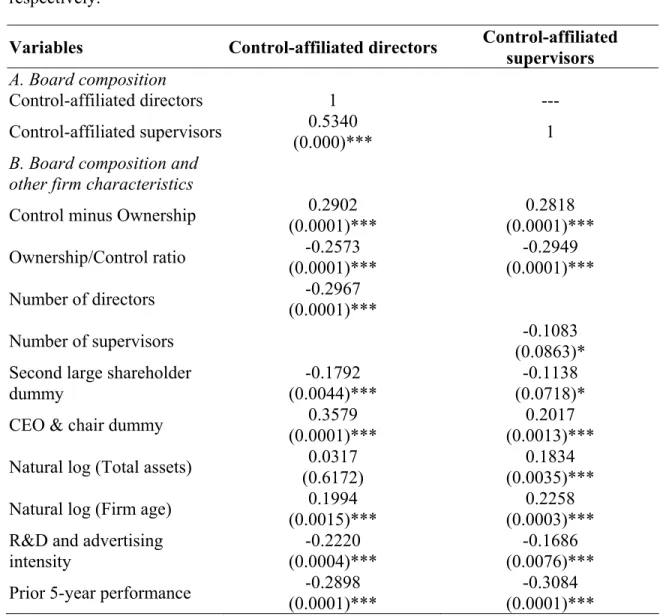
Panel A of Table 3 presents the correlation coefficients between the two proportional measures of board affiliation. Director affiliation and supervisor affiliation are positively correlated at the 1% significance level with a coefficient of 0.53. The correlation coefficients between board affiliation and factors potentially influencing board composition are presented in Panel B of Table 3. Both measures of board affiliation are positively correlated with Excess Control and negatively correlated with Ownership/Control. For example, the correlation coefficient between Control-affiliated directors (%) and Excess Control (Ownership/Control) is 0.29 (-0.26). These correlations suggest that controlling shareholders use their influence to select directors that are more likely to make decisions in their favor and supervisors that are less likely to monitor as the divergence between their control rights and cash flow rights increases. We also find that board affiliation is higher when controlling shareholders assume both management and chairman roles.
The different measures of board affiliation are each negatively correlated to the corresponding measures of board size, prior performance, the presence of a second large shareholder, and the proportion of sales spent on R&D and advertising. Thus, boards appear to be less affiliated when new positions are added, when another large shareholder is present, and when firms have higher information needs. However, board affiliation is greater in Taiwanese firms experiencing poor prior performance. In contrast to the
and Shivdasani, 1995; and Qi et al., 1998).
prediction that firms with poor performance would be more likely to assign a larger proportion of unaffiliated board members, the negative correlation suggests that greater board affiliation is a proxy for entrenchment. Finally, both measures of board affiliation are positively correlated with firm age, but only supervisor affiliation is positively correlated with firm size. These results suggest that controlling shareholders increase their control in older firms through selection of both affiliated directors and supervisors, but that they increase their control in larger firms through the selection of supervisors alone.
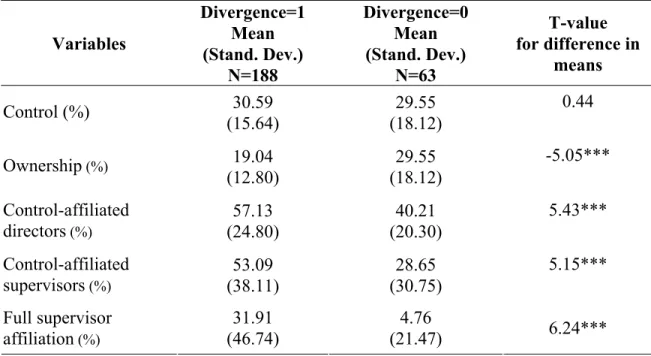
To examine the effect of divergence in control and ownership further, we divide the sample according to whether controlling shareholders’ voting rights exceed their ownership or cash flow rights. We then compare the individual components of divergence, control and ownership, and board affiliation across the two sub-samples. The results are presented in Table 4. Control exceeds ownership in 188 firms and is equal to ownership in 63 firms. In other words, a divergence in cash flow and control rights is present in 75% of the firms. Controlling shareholders in both sets of firms control around 30% of the firm’s voting rights, on average, but controlling shareholders in firms with a divergence only own 19% of the firm’s cash flow rights. Thus, the divergence appears to be the result of maintaining control while decreasing ownership. Moreover, both measures of board affiliation are higher for firms with a divergence. When control exceeds ownership, over 50% of both directors and supervisors are affiliated. In contrast, when control equals ownership, less than 50% are affiliated. The largest difference appears in supervisor affiliation. Fifty-three percent of supervisors are affiliated in the divergent set, but only 28% are affiliated in the non-divergent set. In fact, 32% of divergent firms have full supervisor affiliation but only 5% of non-divergent firms have full supervisor affiliation.
Taken together, these results suggest that controlling shareholders in divergent firms may use their influence over board selection to actually increase control or further entrench themselves as ownership declines.
Table 5 presents values according to the degree that control exceeds ownership. For example, Excess Control equals 0% when the largest shareholder controls 30% of a firm’s votes and owns 30% of its cash flows, but Excess Control equals 10% when the largest shareholder controls 30% of a firm’s votes but owns only 20% of its cash flows. Excess Control is greater than 0% and less than 10% for the majority of firms. For this group of firms, ownership is 19.4%, and it comprises 76% of the controlling shareholder’s voting rights, on average. Director affiliation is greater than 50%, but supervisor affiliation is slightly less than 50%. Approximately 28% of these firms have full supervisor affiliation.
Ownership generally decreases and all three measures of board affiliation increase as Excess Control increases. For example, ownership decreases from 29.6% to 17.4%, and director affiliation increases from 40.2% to 68.6% as excess control increases from 0% to greater than 30%. Moreover, around 44% of firms with excess control greater than 30% have full supervisor affiliation compared to only 5% of firms with no excess control. Taken together, the results in Tables 4 and 5 suggest that stronger negative entrenchment effects are associated with the selection of affiliated board members, and stronger positive incentive effects are related to the selection of unaffiliated board members.
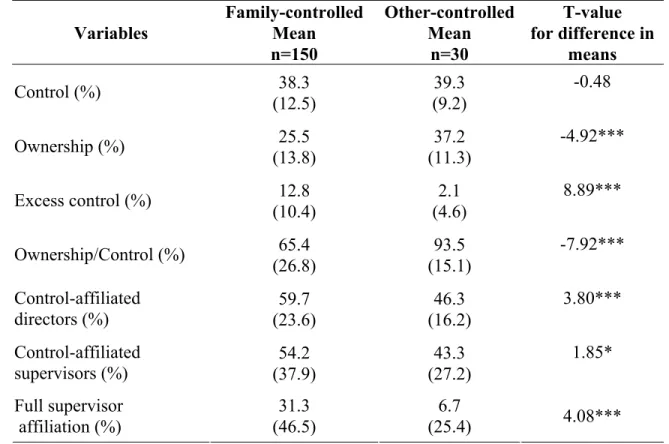
Taiwan is predominantly family-controlled, a characteristic of most countries with concentrated ownership (La Porta et al., 1999; Claessens et al., 2000; Faccio and Lang, 2002). As in the case of Formosa Plastics, detecting the degree of separation between ownership and control may be particularly difficult in family-controlled companies because of the difficulty in tracing the complex pyramids and cross-holdings used by families to leverage their control. We therefore present ownership characteristics separately for firms controlled by families and for firms controlled by non-families to see if controlling families influence boards differently than other controlling shareholders in Table 6. Following La Porta et al. (1999), Claessens et al. (2000), and Faccio and Lang (2002), a firm is classified as being controlled when the largest shareholder controls at least 20% of the firm’s voting rights. A 20% requirement results in 180 of 251 firms being classified as controlled firms. Of these, 150 or 83% are controlled by a family, and 30 are controlled by another type of large shareholder.
Both groups control slightly less than 40% of a firm’s voting rights, on average. However, family ownership is significantly smaller than non-family ownership. Families own 25.5% of a firm’s cash flow rights, resulting in excess control of 12.8% on average. In contrast, non-families own 37.2% of a firm’s cash flow rights, resulting in excess control of only 2.1% on average. Because of the larger degree of separation and perhaps more difficulty in tracing the separation in family-controlled firms, the incentive and entrenchment effects may be more pronounced in these firms.
Table 6 shows that 59.7% (54.2%) of directors (supervisors) are affiliated with the controlling family in family-controlled firms, but only 46.3% (43.3%) of directors (supervisors) are affiliated with the controlling shareholder in other control firms on
average. In addition, 31% of family-controlled firms have full supervisor affiliation, compared to only 7% of other-controlled firms. With the exception of control, the difference in means is significant for all variables. Thus, the divergence in control and cash flow rights appears to occur primarily in family-controlled firms, and the majority of board members are affiliated with or belong to the controlling family in these firms. In fact, 31% of family-controlled firms have no unaffiliated supervisors in place to monitor its board of directors. On the other hand, very little divergence between control and cash flow rights exists in other control firms, and the majority of board members are unaffiliated with the controlling shareholder in these firms. Moreover, more than 93% of these firms have at least one unaffiliated supervisor in place to monitor their directors. These univariate results suggest the entrenchment effects are more pronounced in family-controlled firms, which is the predominant type of firm with a controlling shareholder in the countries studied by La Porta et al. (1999).
4.2. Determinants of board composition
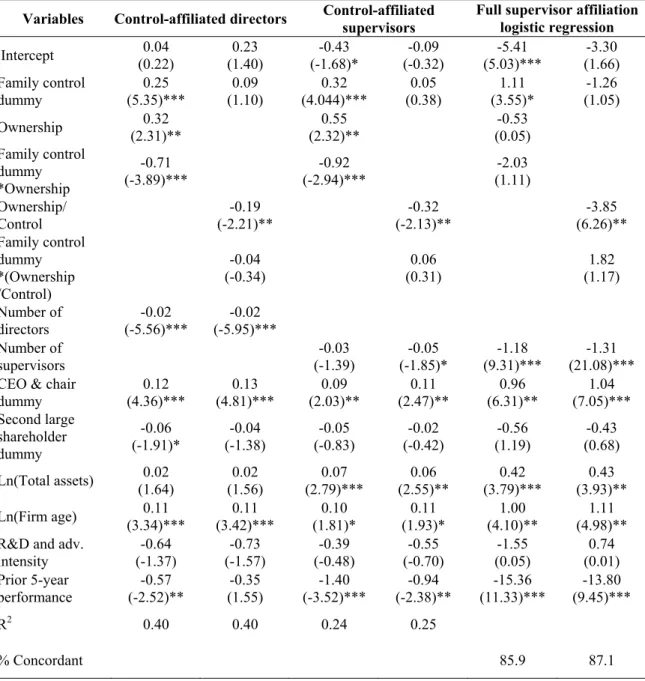
We examine the relation between ownership structure and board composition further using a multiple regression framework to analyze the importance of both ownership and control structures as determinants of board composition once we control for other factors. The dependent variable is either Control-affiliated directors or Control-affiliated supervisors. Because it is not clear whether the fraction or simple existence of unaffiliated supervisors is more important, we also conduct a logistic regression with Full supervisor affiliation as the dependent variable. We separately include Ownership, Ownership/Control, Excess Control and a Divergence dummy in four specifications to measure different aspects of a firm’s ownership structure. The results are qualitatively
similar across the different measures of ownership and control. For the sake of brevity, we only report the results using Ownership since it directly measures the positive incentive effect and Ownership/Control since it best measures the positive incentive effect relative to the entrenchment effect of the controlling shareholder.
Given the predominance of family control in most countries and the different univariate results we find for family-controlled firms, we include a Family-control dummy, which equals 1 when a firm has a controlling shareholder that is a family and 0, otherwise. Furthermore, the Family-control dummy is interacted with the ownership and control measures to see if incentive and entrenchment effects influence board composition differently for family-controlled firms. Finally, we include indicators both of whether the controlling shareholder is CEO and chairman and of whether a second large shareholder has influence in addition to measures of board size, prior performance, firm size, firm age, and firm information needs. The results are presented in Table 7.
Consistent with earlier results, director affiliation and supervisor affiliation (full supervisor affiliation) are both significantly higher (is more likely) in family-controlled firms than in other firms when a separate measure of divergence in cash flow and control rights is not included. However, no significant difference is found for family-controlled firms in the specification including a direct measure of divergence, the Ownership/Control ratio. Instead, a significant, negative relation is only found between board affiliation and the Ownership/Control ratio. Thus, divergence may be greater in family-controlled firms because it is easier for families to retain their control, but the actual divergence in ownership and control appears to be more important in determining board affiliation than whether the controlling shareholder is a family.
All aspects of board affiliation are positively related to whether the largest shareholder is both general manager and chairman of the board, but are negatively related to board size. In particular, director affiliation appears to decrease as the number of directors increases, and the likelihood of electing an unaffiliated supervisor appears to increase as the number of supervisors increases. Little evidence is found suggesting a second large shareholder significantly influences board affiliation. Finally, board affiliation is negatively related to prior performance and positively related to firm age, and supervisor affiliation is positively related to firm size.
These results suggest that both ownership and control structure are important determinants of board composition in firms characterized by concentrated ownership. In particular, controlling shareholders appear to select a higher proportion of affiliated board members, both supervisors and directors, as their control increases relative to their ownership both through higher voting rights and holding both CEO and Chairman posts; and this divergence is greater in family-controlled firms. The negative relation between board affiliation and past performance is also consistent with controlling shareholders entrenching, or protecting, themselves through exerting greater influence over the board. However, controlling families appear to select more non-family members to commit to increase shareholder wealth or limit expropriation when their ownership or cash flow rights increase.
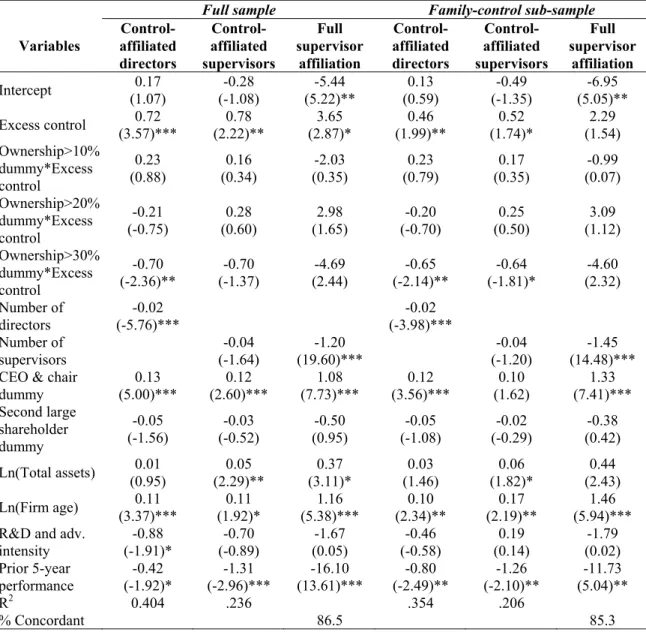
The significant, negative coefficient for the Ownership/Control ratio in Table 7 suggests that increased board affiliation is associated with stronger, negative entrenchment effects as measured by divergence in ownership and control. To examine the interaction between negative entrenchment and positive incentive effects in more detail, we
disentangle the entrenchment and incentive effects by replacing the Ownership/Control ratio with Excess Control alone and interact Excess Control with three dummy variables indicating increasing levels of ownership in Table 8. Recall that Excess Control is the amount by which control rights exceed cash flow rights. Ownership>10%, Ownership>20%, and Ownership>30% are each dummy variables set equal to 1 when ownership or cash flow rights exceed 10%, 20%, and 30%, respectively, and set equal to 0, otherwise. Therefore interacting Excess Control with the different ownership dummies should allow us to see at what level of ownership the negative entrenchment effects associated with Excess Control is diminished by the positive incentive effects associated with higher levels of ownership. Table 8 presents results for both the whole sample and the sub-sample of family-controlled firms. Consistent with the results in Table 7, both measures of board affiliation increase as excess control increases. This is true for both the entire sample and the family-controlled sub-sample. Moreover, Ownership>30%*Excess control has a significant, negative coefficient similar in value to Excess Control, indicating that the negative entrenchment effects associated with excess control are offset by the positive incentive effects of ownership when ownership is greater than 30%. This relation is particularly strong with respect to director affiliation. The results for full supervisor affiliation in the logistic regressions are similar but are not as significant. One way to interpret these results is that, on average, the costs associated with expropriating wealth from minority shareholders through the appointment of family members or controlled company representatives as employees and directors outweigh the potential benefits when ownership exceeds 30%. We examine the relation between board composition and firm value in the next section.
4.3. Board composition and firm value
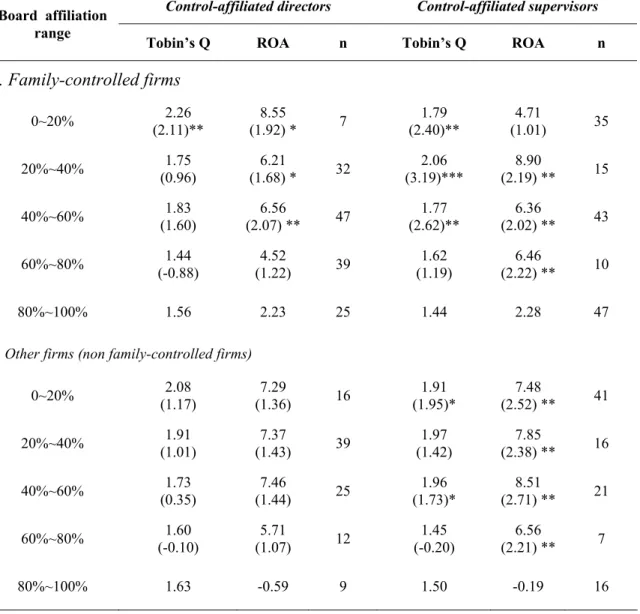
The results in Tables 7 and 8 suggest that the negative entrenchment and positive incentive effects for controlling shareholders are important determinants of board composition. We compare firm value between firms with different degrees of board affiliation in order to further examine patterns of board affiliation and whether board affiliation is negatively related to firm value. Firms are grouped according to the degree of director and supervisor affiliation using 20% increments. Panel A presents the average Tobin’s Q, the average ROA, and number of firms in each range for family-controlled firms. Panel B presents the same for the remaining sample firms. P-values are also given for the difference in mean Tobin’s Q (ROA) for firms in the 80%-100% director (supervisor) affiliation range and mean Tobin’s Q (ROA) for firms in each of the other ranges.
Only 7 (5%) firms have director affiliation between 0 and 20% compared to 25 (17%) that have director affiliation between 80 to 100% in the family-controlled sample. In contrast, 16 (16%) firms have director affiliation in the lowest range, but only 9 (9%) firms have director affiliation in the highest range in the sample of firms that are not family-controlled. The difference in number of firms between the lowest and highest ranges according to supervisor affiliation is less pronounced in the family-controlled firms but is more pronounced in the other firms. Thirty-five (23%) firms have supervisor affiliation in the 0 to 20% range compared to 47 (31%) in the 80 to 100% range in the family-controlled sample. On the other hand, 41 (41%) firms have supervisor affiliation in the 0 to 20% range compared to only 16 (16%) in the 80 to 100% range in the other firms.
Overall, both Tobin’s Q and ROA tend to decrease as director affiliation increases for both family-controlled and other firms. However, this pattern is not significant for firms that are not family-controlled. In contrast, average Tobin’s Q for firms in the lowest range of director affiliation, is significantly greater than average Tobin’s Q for firms in the highest range of affiliation for the family-controlled sample. Similarly, ROA is significantly higher for all sub-groups of family-controlled firms with director affiliation less than 60% when compared to those with director affiliation greater than 80%.
Consistent with the results for director affiliation, both Tobin’s Q and ROA are significantly higher for firms with supervisor affiliation less than 80% when compared to firms with supervisor affiliation greater than 80%.11 Unlike the results for director affiliation, the difference is significant for both family-controlled and non family-controlled sub-samples. Furthermore, beyond the 80% cutoff, performance does not increase monotonically with each decrease in supervisor affiliation as it did with director affiliation. For example, both Tobin’s Q and ROA is lower for firms with supervisor affiliation between 0% and 20% than for those with supervisor affiliation between 20% and 40%. These results suggest that (1) director affiliation is more closely related to firm performance in family-controlled firms, but supervisor affiliation is related to firm performance in both family-controlled and non family-controlled firms and (2) the degree of director affiliation or director votes is important, but the degree of supervisor affiliation is less important than the existence of at least one unaffiliated supervisor since supervisors can act independently.
11 We also compare firms with 100% supervisor affiliation to firms with at least one unaffiliated supervisor and find similar results.
To examine whether the negative relation between firm value and board affiliation persists once we control for other factors that may affect firm value, we conduct a multiple regression analysis in Table 10. Similar to Woidtke (2002), we measure relative firm value with industry-adjusted Tobin’s Q, or a firm’s Q less the average Q for all firms with the same industry classification code according to the Taiwan Stock Exchange. We measure a firm’s industry-adjusted ROA in the same manner. Because we are particularly interested in the relation for family-controlled firms, the Family control dummy is included and interacted with measures of board affiliation. Consistent with the results in Table 9, relative firm value is significantly related to director affiliation and full supervisor affiliation in firms that are family-controlled. Relative firm value is only marginally related to proportional supervisor affiliation in family-controlled firms and not significantly related to affiliation for non family-controlled firms. The negative coefficients for both director affiliation and full supervisor affiliation interacted with the Family-control dummy suggests that relative firm value decreases as director affiliation increases or when 100% of the supervisors are affiliated in family-controlled firms.12 Taken together with the results for board composition, these results are consistent with negative entrenchment effects being associated with a larger proportion of affiliated members being appointed as board members, which in turn is associated with negative valuation effects when it is difficult to determine the degree of divergence, or in family-controlled firms.
12 These results are based on the inference that the separation of the controlling shareholder’s ownership from control determines their influence over board selection, which in turn affects firm value. As a robustness check, we use a Three Stage Least Squares model to test these interactions. Our results are robust to this simultaneous equations framework.
5. Conclusion
We examine whether a firm’s corporate board is indicative of its corporate structure in an environment where ownership is concentrated, investor protection is relatively weak, and determining the degree of separation of ownership and control is difficult. Existing studies indicate that ownership structures tend to be concentrated in most countries outside the U.S. Yet studies on corporate boards of directors are generally restricted to large U.S. firms, where investor protection is strong and ownership is disperse, and treat board composition as being exogenous. Our results suggest that controlling shareholders influence the board selection process, and a firm’s board structure is indicative of the quality of its corporate governance when ownership is concentrated, investor protection is relatively weak, and determining the degree of separation between ownership and control is difficult. In particular, boards that are closely linked to controlling families are associated with strong, negative entrenchment effects or larger agency problems, and firms with these board structures are valued less by investors. In contrast, boards that are independent of controlling families are associated with strong, positive incentive effects or smaller agency problems, and firms with these board structures are valued more highly by investors.
These findings have important implications for potential investors. Existing studies of firms with concentrated ownership structures primarily use the divergence between control and ownership as a measure of the agency conflict between majority and minority shareholders. However, the divergence measure can be difficult for investors to calculate accurately, especially when families use pyramids and cross-holdings to leverage control.
It is also possible that effective board oversight could mitigate agency conflicts in these situations. The results in this paper, however, suggest that controlling shareholders entrench themselves further by selecting both board members that are more likely to make decisions favoring controlling shareholders and those that are less likely to monitor when divergence is higher. Moreover, the resulting increase in board affiliation is associated with negative valuation in family-controlled firms. In sum, our results are consistent with larger agency conflicts and weaker corporate governance existing when the majority of directors and all of the supervisors belong to the controlling family. In contrast, a minority of affiliated directors and at least one unaffiliated supervisor appear to indicate smaller agency conflicts and stronger corporate governance. Thus, board affiliation seems to be a reasonable proxy for the degree of agency conflicts in family-controlled firms.
References
Anderson, R.C., S.A. Mansi, and D.M. Reeb, 2002, “Boards and bonds,” Working paper, American University.
Baliga, B.R., R.C. Moyer, and R.S. Rao, 1996, “CEO duality and firm performance: What’s the fuss?” Strategic Management Journal 17, 23-41.
Baysinger, B. and H. Butler, 1985, “Corporate governance and the board of directors: Performance effects of changes in board composition,” Journal of Law, Economics, and Organization 1, 101-124.
Bebchuk, L., R. Kraakman, and G. Triantis, 2000, “Stock Pyramids, Cross-Ownership, and Dual Class Equity: The Creation and Agency Costs of Separating Control from Cash Flow Rights,” in Randall K. Morck, ed., Concentrated Corporate Ownership, NBER Conference Report Series, University of Chicago Press, Chicago.
Berle, A. and G. Means, 1932, The modern corporation and private property, Macmilian, New York, N.Y.
Bhagat, S., and B. Black, 1999, “The Uncertain Relationship between Board Composition and Firm Performance,” Business Lawyer 54, 921-963.
Bhagat, S., and B. Black, 2001, “The non-correlation between board independence and long-term firm performance,” Journal of Corporation Law.
Bhojraj, S. and P. Sengupta, 2002, “Effect of corporate governance on bond ratings and yields: The role of institutional investors and outside directors,” Journal of Business
76, 455-475.
Brickley, J.A., J.L. Coles, and G. Jarrell, 1997, “Leadership structure: Separating the CEO and chairman of the board,” Journal of Corporate Finance 3, 189-220.
Brickley, J.A., J.L. Coles, and R.L. Terry, 1994, “The board of directors and the enactment of poison pills,” Journal of Financial Economics 35, 371-390.
Byrd, J.W., D.R. Fraser, D.S. Lee, and T.G.E. Williams, 2002, “Financial crises and the role of the board: Evidence from the thrift crisis, Working paper, Texas A&M University.
Byrd, J.W. and K.A. Hickman, 1992, “Do outside directors monitor managers?” Journal of Financial Economics 32, 195-221.
Chan, S. H., Martin, J., and J. Kensinger, 1990, “Corporate Research and Development Expenditures and Share Value,” Journal of Financial Economics 26, 255-276.
Cho, M. H., 1998, “Ownership Structure, Investment and the Corporate Value: An Empirical Analysis,” Journal of Financial Economics 47, 103-121.
Claessens, S., S. Djankov, and L. Klapper, 1999, “Resolution of Corporate Distress: Evidence from East Asia’s Financial Crisis,” The First Annual World Bank Group-Brookings Institution Conference, Palisades, New York.
Claessens, S., S. Djankov, and L. H. P. Lang, 2000, “The Separation of Ownership and Control in East Asian Corporation,” Journal of Financial Economics 58, 81-112. Claessens, S., S. Djankov, J. Fan, and H. P. Lang, 2002, “Disentangling the Incentive and
Craswell, A. T., S. L. Taylar, and R. A. Saywel, l997, “Ownership Structure and Corporate Performance: Australian Evidence,” Pacific-Basin Finance Journal 5,301-323. Eisenberg, T., S. Sundgren, and M. T. Wells, 1998, “Larger Board Size and Decreasing
Firm Value in Small Firms,” Journal of Financial Economics 48, 35-54.
Faccio, M., and L. H. P. Lang, 2002, “The Ultimate Ownership in Western European Corporations,” Journal of Financial Economics 65, 365-395.
Fama, E., and M. Jensen, 1983, ”Separation of Ownership and Control,” Journal of Law and Economics 26, 301-325.
Gilson, S., 1990, “Bankruptcy, Boards, Banks, and Blockholders: Evidence on Change in Ownership and Control When Firms Default,” Journal of Financial Economics
27,355-388.
Grossman, S., and O. Hart, 1988, “One-Share, One-Vote, and the Market for Corporate Control,” Journal of Financial Economics 20, 175-202.
Harris, M. and A. Raviv, 1988, “Corporate Governance: Voting Rights and Majority Rules,” Journal of Financial Economics 20, 203-235.
Hermalin, B. E., and M. Weisbach, 1988, “The Determinants of Board Composition,”
RAND Journal of Economics 19, 589-606.
Hermalin, B.E. and M. Weisbach, 1991, “The effects of board composition and direct incentives on firm performance,” Financial Management 20, 101-112.
Hermalin, B.E. and M. S. Weisbach, 2003 “Endogenously chosen boards of directors and their monitoring of the CEO,” American Economic Review 88, 96-118.
Kaplan S. N., and B. A. Minton, 1994. “Appointments of Outsiders to Japanese Boards: Determinants and Implications for Managers,” Journal of Financial Economics 36, 225-258.
Jensen, M. C., and W. H. Meckling, 1976, “Theory of the firm: Managerial behavior, agency cost and ownership structure,” Journal of Financial Economics 3, 305-360. La Porta, R., F. Lopez-de-Silanes, A. Shleifer, and R. Vishny, 1998, ”Law and
finance,“ Journal of Political Economy 106,1113-1155.
La Porta, R., F. Lopez-de-Silanes, and A. Shleifer, 1999, ”Corporate ownership around the world,” Journal of Finance 54, 471-517.
La Porta, R., F. Lopez-de-Silanes, A. Shleifer, and R. W. Vishny, 2000, “Investor Protection and Corporate Governance,” Journal of Financial Economics 58, 3-27. La Porta, R., F. Lopez-de-Silanes, A. Shleifer, and R. W. Vishny, 2002, “Investor
Protection and Corporate Valuation,” Journal of Finance 57, 1147-1171.
Lang, L. H. P., and R. M. Stulz, 1994, “Tobin’s Q, Corporate Diversification and Firm Performance,” Journal of Political Economy 102, 1248-1280.
Lehn, K., J. Netter and A. Poulsen, 1990, ”Consolidation Corporate Control: Dual Class Recapitalisations versus Leverage Buyout,” Journal of Financial Economics 27,347-376. Lorsch, J. L., and E. M. MacIver, 1989, Pawns or Potentates? The Reality of American’s
McConnell, J., and C. Muscarella, 1985, “Corporate Capital Expenditure Decisions and the Market Value of the Firm,” Journal of Financial Economics 14, 399-422.
Morck, R., A. Shleifer, and R.W. Vishny, 1988, “Management Ownership and Market Valuation: An Empirical Analysis,” Journal of Financial Economics 20, 293-315. Rosenstein, S., and J. G. Wyatt, 1997, “Inside Directors, Board Effectiveness and
Shareholder Wealth,” Journal of Financial Economics 44, 229-250.
Semkow, B. W., 1994, “ Chinese Corporate Governance and Finance in Taiwan,” Journal of International Banking and Financial Law, December, 528-540.
Shivdasani, A., and D., Yermack, 1999, “CEO Involvement in the Selection of New Board Members: An Empirical Analysis,” Journal of Finance 54,1829-1853.
Shleifer, A., and R. Vishny, 1997, “A Survey of Corporate Governance,” Journal of Financial Economics 52, 737-783.
Woidtke, T., 2002, “Agents watching agents?: Evidence from pension fund ownership and firm value,” Journal of Financial Economics 63, 99-131.
Wolfenzon, D., 1999, “A theory of pyramidal structures,” Working paper, Harvard University.
Yeh, Y. H., T. S. Lee and T. Woidtke, 2001, “Family Control and Corporate Governance: Evidence for Taiwan,” International Review of Finance 2, 21-48.
Yermack, D., 1996, “Higher Market Valuation of Companies with a Small Board of Directors,” Journal of Financial Economics 40, 185-211.
Table 1. Summary of variable definitions
Definitions are given for variables used in the paper. Data on ownership, control, and board structure are obtained from company prospectuses and “Business Groups in Taiwan.” Data on other firm characteristics are obtained from the Taiwan Economics Journal database.
Variable name Definition
Number of directors The total number of directors Number of supervisors The total number of supervisors Control-affiliated
directors
The number of directors affiliated with the largest shareholder group divided by the total number of directors
Control-affiliated supervisors
The number of supervisors affiliated with the largest shareholder group divided by the total number of supervisors
Full supervisor affiliation A dummy variable that equals one when 100% of the supervisors are affiliated with the largest shareholder group and equals zero, otherwise. Second large shareholder
dummy
A dummy variable that equals one when a second shareholder owns more than 5% and equals zero, otherwise
CEO & chair dummy A dummy variable that equals one when the largest shareholder group members serve both as the chairman of the board and general manager and equals zero, otherwise
Control The proportion of shares or votes controlled by the largest shareholder group
Ownership The proportion of shares or cash flow rights owned by the largest
shareholder group
Excess Control Control less ownership (i.e., the divergence between control rights and cash flow rights)
Ownership/Control The ratio of ownership to control
Divergence dummy A dummy variable that equals one when excess control is positive and
equals zero, otherwise
Prior 5-year performance An average of a firm’s EBIT/Total assets for the previous five years (from 1992 to 1996)
Total assets Book value of total assets (millions)
Firm age 1998 less the year a firm was founded
R&D and advertising intensity
The ratio of R&D and advertising expenditures over sales
Leverage A firm’s total debt divided by total assets
Tobin’s Q A firm's market value of equity plus its book value of debt, all divided by
total assets
ROA A firm’s net income plus interest expense*(1-tax rate), all divided by total
assets Adjusted Industry Firm
Value (Performance)
A firm's Tobin's Q (ROA) less the average Tobin’s Q (ROA) for firms in the same industry according to the Taiwan Stock Exchange's industry classification.
Ownership>10% A dummy variable that equals one when Ownership is greater than 10% and equals zero, otherwise
Ownership>20% A dummy variable that equals one when Ownership is greater than 20% and equals zero, otherwise
Ownership>30% A dummy variable that equals one when Ownership is greater than 30% and equals zero, otherwise
Table 2. Descriptive statistics
Descriptive statistics are presented for a sample of 251 Taiwanese firms for the year 1998. Panel A presents measures of ownership and control where ownership is the proportion of cash flow rights owned and control is the proportion of voting rights controlled by the largest shareholder group. Panel B provides descriptive statistics on board structure. Control-affiliated directors (supervisors) is the number of directors (supervisors) affiliated with the largest shareholder group divided by the total number of directors (supervisors). Full supervisor affiliation is a dummy variable that equals one when 100% of the supervisors are affiliated with the largest shareholder group and equals zero, otherwise. Second large shareholder dummy equals one when a second shareholder owns more than 5% and equals zero, otherwise. Panel C includes firm characteristics. Data on ownership, control, and board structure are obtained from company prospectuses and “Business Groups in Taiwan.” Data on other firm characteristics are obtained from the Taiwan Economics Journal database. Complete variable definitions are given in Table 1.
Variables Mean Standard
Deviation Quartile 1 Median Quartile 3
A. Ownership and control
Control (%) 30.33 16.26 15.89 30.84 41.20 Ownership (%) 21.68 14.99 8.58 19.47 31.40 Excess control (%) 8.66 9.61 0.00 5.16 14.50 Ownership/Control (%) 71.30 26.28 50.07 75.83 100.00 B. Board structure Number of directors 8.19 4.18 5 7 9 Number of supervisors 2.07 0.94 1 2 3 Control-affiliated directors (%) 52.83 24.82 33.33 48.53 71.43 Control-affiliated supervisors (%) 46.88 37.86 0.00 50.00 100.00
Full supervisor affiliation (%) 25.00 44.00 0.00 0.00 100.00
Second large shareholder dummy 0.24 0.43 0 0 0
CEO & chair dummy 0.48 0.50 0 0 1
C. Firm characteristics
Total assets 16393.55 24296.12 4405.19 8272.89 17712.32
Firm age 25.99 10.65 17 26 32
R&D and advertising intensity
(%) 2.05 2.83 0.20 1.16 2.74
Prior 5-year performance (%) 10.27 6.38 6.52 9.88 12.98
Tobin’s Q 1.75 0.85 1.21 1.50 1.97
ROA (%) 5.79 9.04 1.38 5.78 10.74