Disciplining Agricultural Support
through Decoupling
JOHN BAFFES
THE WORLD BANK
HARRY DE GORTER
CORNELL UNIVERSIY
CORRESPONDENCE: John Baffes The World Bank 1818 H Street, NW
Washington, DC 20433, U.S.A. tel. (202) 458-1880
fax: (202) 522-3564
email: [email protected]
World Bank Policy Research Working Paper 3533, March 2005
The Policy Research Working Paper Series disseminates the findings of work in progress to encourage the exchange of ideas about development issues. An objective of the series is to get the findings out quickly, even if the presentations are less than fully polished. The papers carry the names of the authors and should be cited accordingly. The findings, interpretations, and conclusions expressed in this paper are entirely those of the authors. They do not necessarily rep-resent the view of the World Bank, its Executive Directors, or the countries they reprep-resent. Policy Research Working Papers are available online at http://econ.worldbank.org.
We would like to thank Ataman Aksoy, John Beghin, Gaston Gohou, Bernard Hoekman, John Nash, and Marcelo Olarreaga for helpful comments and suggestions on earlier drafts. The paper has benefited from discussions with Uri Dadush, Tassos Haniotis, Richard Newfarmer, and Nick Stern. Comments received from participants at the 2003 ABCDE-Europe Conference and semi-nars at the University of Georgia and the World Bank are greatly appreciated. An earlier (shorter) version of this paper appeared in Global Agricultural Trade and Developing Countries, edited by Ataman Aksoy and John Beghin (World Bank 2004).
Public Disclosure Authorized
Public Disclosure Authorized
Public Disclosure Authorized
Public Disclosure Authorized
C
ONTENTS ACRONYMSAND ABBREVIATIONSSUMMARY
I. INTRODUCTION
II. NATUREAND TRENDSOF AGRICULTURAL SUPPORT
How High Is Agricultural Support? Consequences of Agricultural Support Objectives of Agricultural Support Disciplining Agricultural Support III. DECOUPLINGASA CONCEPT
What Is Decoupling?
The Economics of Decoupling
Decoupling as a Subsidy Disbursing Mechanism Decoupling and the Costs of Taxpayer Funds The Micro-Side of Decoupling
IV. DECOUPLINGIN PRACTICE
Experience with Broad Decoupling Attempts Decoupling Efforts in the United States
Decoupling Efforts in the European Union Decoupling Efforts in Mexico
Decoupling Efforts in Turkey Experience with Buyouts
The 1984 New Zealand Exit Grant
The 1995 Canada Railway Subsidy (“Crow Rate”) Buyout The 2002 US Peanut Quota Buyout
The 2004 US Tobacco Quota Buyout V. ASSESSING DECOUPLING
ENDOTES
BOXES
Box 1: The Political Rhetoric of Agricultural Support
Box 2: Early Decoupling Proposals in the United States and Europe Box 3: The Minister’s View of Decoupling
Box 4: Brazil vs. the United States
Box 5: Sectoral Initiative in Favor of Cotton
Box 6: The 1949 Brannan Plan in the United States and the 1968 Mansholt Plan in Europe
TABLES
Table 2: The Road to (and from) Doha—WTO Ministerials Table 3: Composition of Agricultural Support in OECD
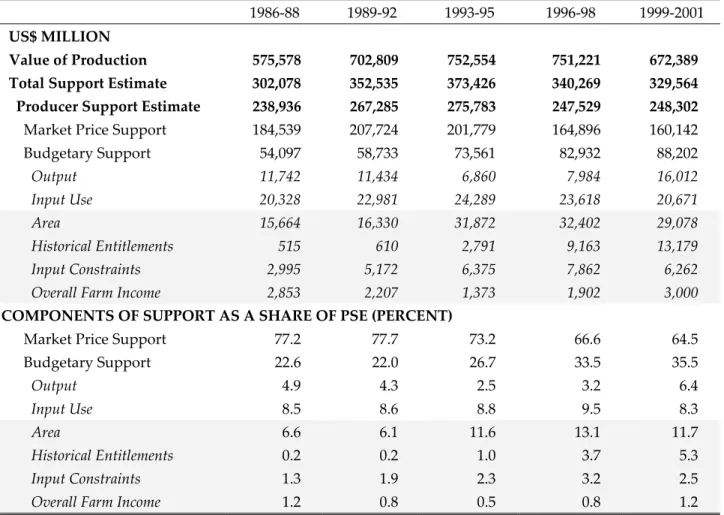
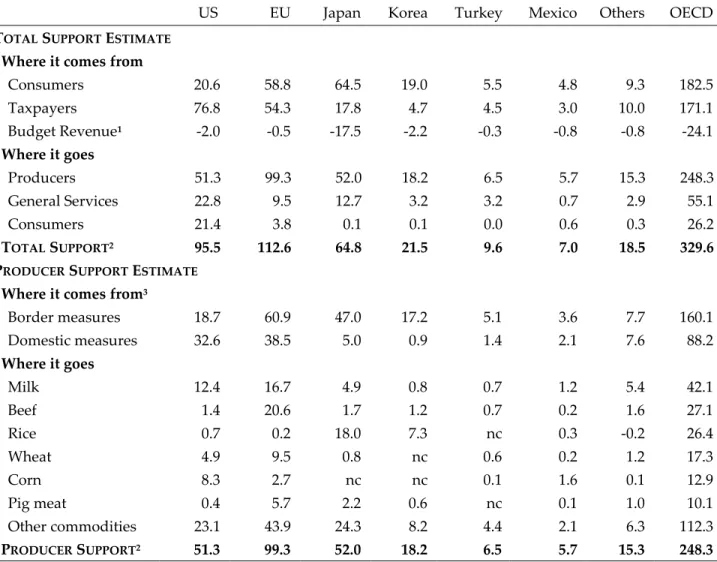
Table 4: Agricultural Support in OECD, 1999-2001, average (US $ billion) Table 5: Characteristics of Agricultural Support in OECD, 1999-2001 average Table 6: Decomposing Producer Support in OECD Countries
Table 7: PSE—Smaller and Large Impacts on Production and Trade Table 8: Transfer Efficiency of Agricultural Support
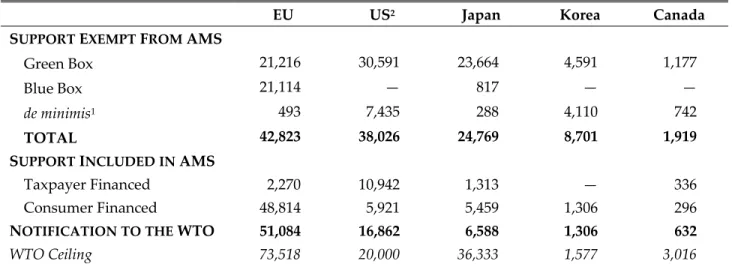
Table 9: The Nature of the AMS, 1999 (US$ million) Table 10: Comparing the PSE and AMS, 1997-99
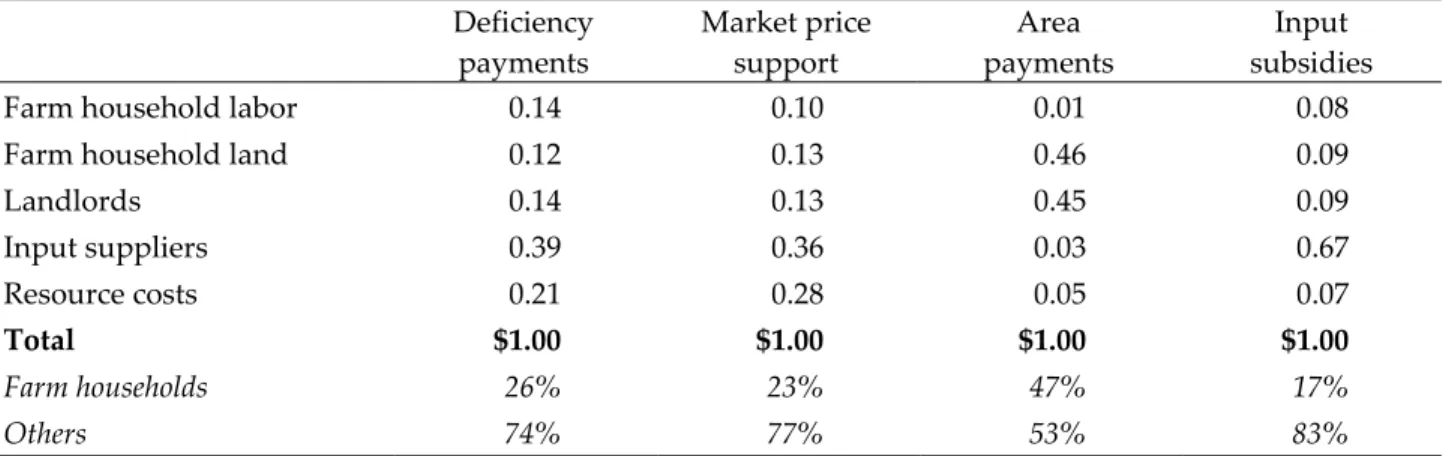
Table 11: The Distributional Impact of a Hypothetical Decoupled Support Program Table 12: Chronology of Significant Decoupling and Recoupling Episodes
Table 13: Characteristics of four Decoupled Support Programs Table 14: Composition of Agricultural Support in the US Table 15: Composition of Agricultural Support in the EU Table 16: Composition of Agricultural Support in Mexico Table 17: Composition of Agricultural Support in Turkey
FIGURES
Figure 1: Measures of Domestic Support and OECD Figure 2: Measures of Domestic Support and WTO Figure 3: Production Subsidy of a Large Exporter Figure 4: Import Tariff of a Large Importer
A
CRONYMSANDA
BBREVIATIONSABARE Australian Bureau of Agricultural and Resource Economics
AMS Aggregate Measurement of Support
CAP Common Agricultural Policy
CONASUPO Compania Nacional de Subsistencias Populares
CSE Consumer Support Estimate
DIS Direct Income Support
EBA Everything but Arms
ECSC European Coal and Steel Community
EEC European Economic Community
ERS Economic Research Service
EURATOM European Atomic Energy Community
FAIR Federal Agricultural Improvement and Reform
GATT General Agreement on Tariffs and Trade
GDP Gross Domestic Product
GSSE General Services Support Estimate
IF Integrated Framework for Trade Related Technical Assistance IFPRI International Food Policy Research Institute
LDC Least Developed Country
MERCOSUR Mercado del Sur
NAFTA North-America Free Trade Agreement
NGO Non-Governmental Organization
OECD Organization of Economic Cooperation and Development
PROCAMPO Programa de Apoyos Directos al Campo
PSE Producer Support Estimate (Production Subsidy Equivalent prior to 1991)
TSE Total Support Estimate
URRA Uruguay Round Agreement on Agriculture
USDA United States Department of Agriculture
A
BSTRACTAgricultural protection and subsidies, particularly in high-income countries, have in-duced overproduction, thereby depressing world commodity prices and reducing export shares of countries which do not support agriculture. One—and perhaps the only— effective way to bring a socially acceptable and politically feasible reform is to replace payments linked to current production levels, input use, and prices by payments which are decoupled from these measures. This paper describes the objectives and conse-quences of agricultural support, surveys the theory and practice of decoupling agricul-tural support, and gives a number of policy recommendations on how to improve de-coupled support mechanisms.
Overall, the experience with decoupling has been mixed while the switch to less distorting support has been uneven across commodities and countries. Ideally, compen-sation programs would be universal (open to all sectors in the economy, not just agricul-ture) or at least non-sector specific within agriculture. The paper describes a simple and minimally distorting scheme that would maintain government credibility and reduce uncertainty.
E
XECUTIVES
UMMARYAgricultural protection and subsidies, particularly in high-income countries, have in-duced overproduction, thereby depressing world commodity prices and reducing export shares of countries which do not support agriculture. Furthermore, not only is support costly, but it also goes to unintended beneficiaries—unintended as they relate to the stated objectives—thus exacerbating rather than eliminating the presumed income ine-qualities that justified its introduction in the first place. The stated objectives of such pro-tection are numerous, but raising income to small farms appears to have been by far the most frequently used justification.
Given the harmful effects of such support on world markets along with the mis-match of stated objectives and ultimate outcomes, advocating outright elimination of support would be the natural way to proceed but this would reduce farm income in some instances and not be politically feasible. Thus, the relevant question is not the exis-tence of support but what can be done with respect to the way it is given. One—and per-haps the only—effective way to bring a socially acceptable and politically feasible reform is to replace payments linked to current production levels, input use, and prices by pay-ments which are decoupled from these measures.
The current WTO negotiations use the domestic support disciplines in the Uru-guay Round’s Agreement on Agriculture as a starting point and so it is important to un-derstand how support is evolving and to assess the outcomes of decoupling efforts to date. This paper describes the objectives and consequences of agricultural support, sur-veys both the theory and practice of decoupling agricultural support, and gives a number of policy recommendations on how to improve decoupling support mechanisms.
Total direct support to agricultural producers as measured by the producer sup-port estimate has remained fairly constant over time, averaging $248 billion in 1999–2001 with most support concentrated in a few sectors (milk, meats, and rice). But the share of border support has declined from 77 percent in 1986-88 to 63 percent in 1999-2001 as tax-payer-financed subsidies paid directly to farmers have increased significantly. On the other hand, budget transfers to farmers rose 60 percent during this period, with large impact programs (i.e., output and input subsidies) increasing moderately compared with the substantial increases in so-called smaller impact programs (i.e., area payments, his-torical entitlements, and payments based on input use restrictions and overall farm in-come). However, several countries have made little progress in reforming the composi-tion of support away from border support to domestic support (Japan, Korea), while oth-ers have not needed substantial reforms (many memboth-ers of the CAIRNS Group).
The move from transfers with large impact on production and trade to transfers with a smaller impact on production and trade is often referred to as decoupling. How-ever, decoupling has different meanings to economists, policymakers, and trade negotia-tors. Some see it as a transition mechanism to a fully competitive sector. Others see it as another support program, with less production- and trade-distorting effects. Some use
decoupling only to refer to programs for transferring income to producers; others use it much more broadly, to include, for example, programs to improve the environment. Sometimes decoupling is assessed according to the policy’s long-run impact on output through such factors as uncertainty, investment, and expectations.
Early agricultural policy reform attempts with decoupling elements failed (e.g. the 1949 Brannan plan in the United States and the 1972 Mansholt Plan in Europe). The first attempt toward decoupling was taken by the United States with the 1985 Farm Bill
whereby support was based on historical rather than current yields. The European Union partially replaced intervention prices by decoupled payments following the Common Agricultural Policy reform of 1992. Mexico replaced price support with decoupled pay-ments in 1994 with the introduction of PROCAMPO. The United States replaced defi-ciency payments with decoupled support in the 1996 farm bill. More recently Turkey re-placed part of price support and input subsidies by decoupled payments. In addition to decoupled attempts there have been numerous one-time buyouts, including New Zea-land’s exit grant in 1984, Canada’s grain transportation subsidy buyout, and more re-cently the buyout of the US peanut marketing quota under the 2002 Farm Bill.
Overall, the experience with decoupling agricultural support has been mixed while the switch to less distortive support has been uneven across commodities and countries. Rules have changed with new decoupling programs added so expectations about future policies affect current production decisions. Time limits were not imple-mented and if so, were overruled. Ideally, compensation programs would be universal (open to all sectors in the economy, not just agriculture) or at least non-sector specific within agriculture. A simple and minimally distorting scheme would be a one-time un-conditional payment to everyone engaged in farming or deemed in need of compensa-tion that is nontransferable, along the lines of one-time buyouts without remaining sub-sidies. To maintain government credibility and reduce uncertainty, eligibility rules need to be clearly defined and not allowed to change. The time period on which payments are based, the level of payments and the sectors covered should all remain fixed. Support to specific sectors within agriculture should be in the form of taxpayer-funded payments. There should be no requirement of production. Land, labor, and any other input should not have to be in “agricultural use.”
I. I
NTRODUCTIONFor most of the past half-century industrial countries have had high levels of agricultural protection, provided by import tariffs, quantitative restrictions, and domestic support. Among the numerous claimed objectives of these policies, boosting the income of small family farms is by far the most frequently cited. Because most of this support is based on current output, input use, and prices, it induces overproduction. Given the weight of in-dustrial countries in the global trading system, the aggregate effect of such support is to depress world commodity prices, hence reducing the export shares of countries that do not protect their agricultural sectors. Moreover, such support is costly for the subsidizing countries and often goes to unintended recipients, thus exacerbating rather than eliminat-ing the presumed income inequalities that justified support in the first place.
Considering the harmful effects of such support on world markets and the mis-match between stated objectives and ultimate outcomes, its outright elimination has been often advocated. But societies have the right to transfer income to groups as they deem necessary. Thus, the relevant question is how support can be given without creating negative externalities for the rest of the world—how to increase farmers’ incomes with-out distorting production and consumption. Perhaps the only effective way to achieve socially acceptable and politically feasible reform is to decouple payments from current production levels, input use, and prices.
Reforming agricultural support at a global level was first considered during the Uruguay Round (1986-94) of multilateral trade negotiations under the aegis of the Gen-eral Agreement on Tariffs and Trade (GATT).1 Under the Uruguay Round Agreement on Agriculture (URAA) it was agreed that disciplines on agricultural protection would ad-vance along the so-called pillars of agricultural support, namely market access, export subsidies, and domestic support. It was also agreed that all three types of protection would be subject to reduction commitments within a specific timetable (see table 1 for a summary of the three pillars of agricultural support).
Further disciplining agricultural support became part of WTO’s mandate. The third WTO Ministerial meeting that took place in Seattle in November of 1999 was sup-posed to produce the basic framework and eventually launch what would have been the Seattle Round. However, the Ministerial ended in failure and hence no framework was adopted. Negotiations began again in early 2000 leading to the fourth WTO Ministerial in Doha in November of 2001. Following the meeting, the Doha Development Agenda was formally launched. The fifth Ministerial took place in Cancùn in September 2003, but ended in failure. Negotiations, however, continued and eventually led to a decision adopted by the WTO’s General Council in August 2004 (see table 2).
In view of the complex nature of agricultural support as well as the difficulties faced by policy makers to reduce it (or even change its nature), this paper will address the following three issues: First, it will describe the objectives and consequences of
agri-both the theory and practice of decoupling agricultural support; and third, it will give a number of policy recommendations on how to improve decoupling support mechanisms.
The paper proceeds as follows. The next section discusses the nature and trends of agricultural support, including its objectives, consequences, how high it has been and the disciplines imposed by the Uruguay Agreement on Agriculture. The third section looks at the concept of decoupling, especially its various definitions as well as the basic eco-nomic principle behind moving from domestic or border protection to decoupled sup-port. Section IV looks at decoupling in practice. The first part of the section reviews the decoupling attempts by the United States, staring with the 1985 farm bill, the 1996 farm bill, and policy reversals with the introduction of the emergency payments in 1998 and their legitimization with the 2002 farm bill. The section also looks at the European Union, beginning with the 1992 CAP reform, followed by Agenda 2000 and the more recent de-coupling attempts of the so-called Mediterranean products. The second part of the sec-tion examines four cases of buyouts, namely the 2002 US peanut quota buyout, the 1984 New Zealand exit grant, Canada’s 1995 buyout of the railway subsidy for grain shippers, and the recent US tobacco buyout. The last section evaluates the effectiveness of these de-coupling programs and derives a number of policy conclusions.
II. N
ATUREANDT
RENDSOFA
GRICULTURALS
UPPORTHow High Is Agricultural Support?
The OECD annually monitors and evaluates direct and indirect transfers to (and from) agriculture of its member countries since 1986. Its measure of total support, the Total Support Estimate (TSE), consists of Producer Support (PSE), General Services Support (GSSE), and Transfers to Consumers (CSE)—table 3 summarizes the composition of agri-cultural support in OECD countries while figure 1 gives a diagrammatic illustration of the OECD measures of support.2
The PSE is defined as:
The annual monetary value of gross transfers from consumers and taxpayers to support agricul-tural producers, measured at farm gate level, arising from policy measures, regardless of their nature, objectives or impacts on farm production or income. … The PSE is a gross notion im-plying that any costs associated with those policies and incurred by individual producers are not deducted. It is also a nominal assistance notion implying that increased costs associated with import duties on inputs are not deducted.
In others words, PSE is the additional money producers receive in a particular year be-cause of government interventions in agricultural markets.
The PSE consists of two components. The first component, the market price sup-port, is derived from border protection and it is defined as:” value of gross transfers from consumers and taxpayers (e.g., export subsidies) to agricultural producers arising from policy measures that create a gap between domestic and market prices of a specific agri-cultural commodity, measured at the farm gate level.” The second component is taxpayer financed and includes direct payments to producers based on output, area planted or animal numbers, historical entitlements, input use, input constraints, or overall farm in-come. Note that export subsidies are both transfers from taxpayers and consumers but are in the border measure category.
The General Services Support Estimate is defined as:
An indicator of the annual monetary value of gross domestic transfers to services provided col-lectively to agriculture and arising from policy measures which support agriculture, regardless of their nature, objectives and impacts on farm production, income, or consumption of farm products. It includes taxpayer transfers to: improve agricultural production (research and devel-opment); agricultural training and education (agricultural schools); improving off-farm collec-tive infrastructures, including downstream and upstream industry (infrastructures); assist marketing and promotion; meeting the costs of depreciation and disposal of public storage of ag-ricultural products (public stockholding); and other general services that cannot be disaggre-gated and allocated to the above categories due, for example, to a lack of information.
The total support estimate to all OECD countries averaged $330 billion annually during 1999-2001, with the European Union, United States, and Japan accounting for 29, 34, and 20 percent, respectively (table 4). Of the $330 billion of total support, consumers’
burden was $183 billion while the taxpayers’ burden was $171 billion. This adds to $354 billion, of which $24 billion remained with the respective treasuries. The producer sup-port estimate averaged $248 billion during 1999-2001.
On a commodity basis, the largest beneficiary was the milk industry ($42.1 billion in 1999-2001), followed by beef ($27 billion), rice ($26 billion), wheat ($13 billion), and pig meat ($10 billion). The three top subsidized commodities by a single country/region are $21 billion for beef in the European Union, $18 billion for rice in Japan, and $17 billion for milk in the European Union (the subsidies to the beef and milk industries have been sub-ject to political rhetoric, see box 1). Not all commodities are included in the PSE but the market price support is prorated upward for all of agriculture. One notable exception is cotton, whose annual budgetary outlays in the United States and the European Union averaged $4 billion during 1999-2001.
A number of middle-income countries support agriculture (see table 5). For exam-ple, in 1999-2001 total transfers to agriculture averaged $21.4 billion in Korea, $7.0 billion in Mexico, $1.9 billion in Poland, and $9.6 billion in Turkey. Although these numbers seem small compared to the combined total transfers of $273 billion made by the Euro-pean Union, United States, and Japan, when considering this support as a proportion to the GDP of these countries, the results are striking: 5.0 percent in Korea and 5.1 percent in Turkey, almost 4 times the OECD average of 1.3 percent. Support per full time farmer averaged $25,000 per annum in Korea, more than twice the OECD average of $11,000.
Developing countries generally taxed agriculture before major policy reforms in the mid-1980s with import barriers on inputs, overvalued exchange rates and parastatal marketing boards and price controls/export taxes for individual commodity sectors. Most developing countries generate the bulk of agricultural GDP in lower efficiency produc-tion for the domestic market, supplying the world market with tropical commodities. Limited amounts are exported under preferential-access programs in products for which they competed with industrial countries, such as sugar and beef. But in the last decade, developing countries shifted from taxing agriculture to protecting it. Import restrictions on manufactured products have declined dramatically, exchange rates have been deval-ued, multiple exchange rate systems penalizing agriculture have been abandoned, and export taxes have effectively disappeared (Jansen et al. 2002; Quiroz and Opazo 2000; World Bank 2003).
Protection for agriculture seems higher for developing countries if comparing av-erage tariffs but several difficulties make agricultural tariff calculations difficult. While some tariffs are underestimated, others are overestimated because of ‘phantom’ tariff lines—i.e., many tariff lines within a commodity category are redundant either because the country is an exporter of that commodity in question or imports are not directly competing with the domestic commodity that is being protected (Aksoy 2004). For exam-ple, China and India have high tariffs on products which are exported. Other reasons abound. For example, there can be imports due to seasonal swings in world prices, due to
regional differences in domestic prices (one part of China is a natural exporter; the other an importer), or due to differentiated products. But even with imports in these circum-stances, the country is often an exporter in different markets or at autarky, thus tariffs contain “water” in the sense that they do not actually protect. Developed countries, on the other hand, have high tariffs only on commodities that directly compete with domes-tic production so the tariff equivalent rate of protection as reported by the OECD is much higher than average tariffs for these same countries (World Bank 2003). Meanwhile, stud-ies show that countrstud-ies like India and China have been taxing agriculture on average in the last ten years (see, for example, Orden and Mullen 2004).
OECD (2001) has ranked the various producer support measures based on their relative impact on production and trade. The highest impact comes from input use, fol-lowed (in order of less impact) by market price support, payments based on output, area, historical entitlements, input constraints, and overall farm income. While the OECD does not link this ranking to its (or other) definition of decoupled support, one may argue that payments based on area, historical entitlements, input constraints, and farm income are decoupled from current production decisions and hence have a ‘smaller’ impact on pro-duction and trade. Correspondingly payments based on output and input use have a ‘large’ impact on production and trade.
Table 6 decomposes PSE into market price support and budgetary support for the 1986-88 and the 1999-2001 periods. Likewise, table 7 decomposes Producer Support into ‘smaller’ and ‘large’ impact on production and trade for the same periods. A number of interesting findings emerge from the tables. First, producer support has remained at similar levels in nominal terms. Second, there has been a small shift from border support measures to domestic measures (market price support averaged 77 percent of PSE during 1986-88 and 64 percent during 1999-2001). Third, there has been a noticeable shift from support with high impact on production and trade to support with smaller impact on production and trade (the latter accounted for 91 percent during 1986-88 and 79 percent during 1999-2001).
In conclusion, it should be emphasized again what the PSE does and what it does not do. The PSE answers two questions: (i) What is the level of the transfers to agricul-ture? (ii) What is the direction of these transfers? However, it does not answer the follow-ing three questions: (i) Who are the end beneficiaries of these transfers? (ii) What is the impact of these transfers on production and trade? (iii) What is the social cost of these transfers?
Consequences of Agricultural Support
One of the main problems of the existing income transfer mechanisms is the efficiency losses. For example, the imposition of an import tariff, in addition to transferring income from consumers to producers and the treasury, also raises domestic prices consequently using resources to produce the commodity domestically that would otherwise have been
imported at lower cost. These are the so-called dead-weight losses. Export subsidies have similar inefficiency effects in that both production and consumption are distorted. Do-mestic subsidies only affect production directly and so they are considered in general less distorting than border measures (see the general theory of domestic divergences in Cor-den 1974 and Feenstra 1986).
According to OECD, no support policy linked to agricultural activity succeeds in delivering more than half the monetary transfers from consumers and taxpayers as addi-tional income to farm households. In the case of market price support and deficiency payments, the share is one-fourth or less; for input subsidies it is less than one-fifth (see table 8). Only 25 percent of producer support on average actually reaches the farmers.
In the case of market price support and deficiency payments, the stimulus to out-put, and hence to input demand, implies that much of the increase in revenue is paid back out to input suppliers or capitalized into land values. Not surprisingly, input sup-pliers receive most of the benefits of input subsidies. In the case of area payments, nearly all the benefits are absorbed in increased land values. This raises costs for farmers buying or leasing land. Farmers that own land do benefit, but this increase in wealth should not be interpreted as additional income, since it does not improve the long-term economic welfare of farm households as a whole. While there is a wealth gain for farmers that own land at the time such policies are introduced, farmers who subsequently rent or purchase land at these higher prices will face reduced profitability and lower incomes (OECD, 2003c).
The portion of domestic support that is capitalized into land values depends not only on the type of subsidy program but on the economic characteristics of the commod-ity sector in question like the share of land costs in the total costs of production, the elas-ticity of supply of the inputs, and the elaselas-ticity of substitution between land and non-land inputs. If non-land is very inelastic in supply and a large share of total costs, then the benefits of a subsidy program will have larger impacts on the price of land (especially if the elasticity of substitution between land and non-land inputs is low).
As for differing types of subsidies, a subsidy on purchased inputs has a lower im-pact on land prices than a subsidy on output, both of which have a lower imim-pact than an area payment (a direct subsidy to land in the form of historical entitlement payments). The OECD provides estimates of the distribution of benefits for these three types of pro-grams and finds that 91 percent of area payments go to land, while only 26 percent of price support payments and 18 percent of input subsidies. In each case, almost half of the benefit goes to the landowner and the other half as returns to land for farm operators.
The distribution of benefits going to land owners is an important policy issue be-cause up to 45 percent of land in the United States is operated by someone other than the landowner, with over half of the latter being non-farmers. If a large proportion of the benefits go to land owners and not farm operators, then the desired effect of helping farm families is mitigated. Numerous studies have shown that a large portion of subsidies are
capitalized into land values.3 Estimates of the change in the price of land due to subsidy programs in the United States are in the range of 10 to 40 percent. Gardner (2002) esti-mates that $1 of payments generates $3 of land value.
Agricultural policies of major producers also have important international spill-overs. Existing policies provide significant incentives to produce, thereby increasing global supplies and lowering world prices, to the detriment of suppliers that receive no subsidies. A telling example of these spillover effects is the recent cases in the cotton in-dustry brought to the WTO by Brazil and four West Africa cotton producers whereby they argued that subsidies given to the cotton sector of industrial countries affect the world price and hence cause injury to non-subsidized cotton producers. As well, trade policies, in particular prohibitive tariffs but also export competition policies that convey advantages to domestic suppliers, are in place to enable many of the existing domestic support policies to continue to operate. This is particularly the case for commodities where prices are supported above the level at which imports would be available if mar-kets were more open. The long-term trend of agricultural productivity growing more rapidly than demand implies continued adjustment pressures at the global level. Trade protection does not change this fact; it simply shifts the burden of adjustment, in this case, to non-subsidizing countries.
Objectives of Agricultural Support
Increasing farm income and saving the family farm is the most common stated objective of agricultural policies. However, a number of other objectives are also stated. Winters (1989-90) analyzed the economics of the officially stated cases for agricultural support in selected OECD countries. After surveying numerous official country documents, he found a number of stated objectives: ensure satisfactory and equitable standard of living for farmers; stabilize income; stabilize domestic agricultural prices; ease adjustment to exogenous shocks; maintain healthy rural communities; boost regional development; preserve and encourage family farming; protect the environment; ensure stable and suf-ficient food supplies; ensure fair prices to consumers; improve agricultural efficiency and competitiveness. More recently ABARE (2001) gave the following four motives, which drive agricultural support in the United States and the European Union: (i) maintain cur-rent farm lifestyle; (ii) provide prefecur-rential access; (iii) link support to environment; (iv) expand market access abroad.
Some of these objectives have been brought together under the umbrella of multi-functionality, which according to OECD (2001b, p. 11) is an economic activity that “may have multiple outputs and, by virtue of this, may contribute to several societal objectives at once. Multifunctionality is thus an activity oriented concept that refers to specific properties of the production process and its multiple outputs.” The key elements of mul-tifunctionality are (again, according to OECD, p. 13): “The existence of multiple commod-ity and non-commodcommod-ity outputs that are jointly produced by agriculture and the fact that
some of the non-commodity outputs exhibit the characteristics of externalities of public goods, with the result that markets of these goods do not exist or function poorly.” Vatn (2002) outlines a broader list of the various public aspects of a multifunctional agriculture which includes environmental effects such as landscape (biological diversity, recreation, aesthetics), cultural heritage, pollution (changes in matter cycles, genetic pollution, etc.); food security (availability in different situations); food safety (quality and phytosanitary status); and rural concerns (rural settlement, rural economic activity).
Yet the objective of increasing the income of small farmers fails to be met as there is a well-documented gap between intended and actual transfers. There are two sources of the gap: (i) economic costs, which result from distortions in the use of resources and its incidence on production and trade patterns and (ii) distributive leakages, whereby some of the benefits of support accrue to groups other than the intended beneficiaries. This lat-ter category includes benefits accruing to bureaucrats adminislat-tering programs, input suppliers or downstream industries, and landowners, as discussed earlier. When the country in question is large, such as the United States and the European Union, there are international spillovers whereby large quantities of the subsidized commodities are di-rected into the world markets consequently depressing prices. The sum of these ‘unilat-eral’ policies in depressing world prices can cause some countries to react by raising their protection or subsidies to compensate, thereby contributing to the ever increasing down-ward spiral in world prices.
Disciplining Agricultural Support
Disciplining agricultural support falls under the three pillars introduced earlier. This par-ticular classification does not necessarily reflect any economic significance in terms of what type of support is most damaging or where priority for reform should be given. It just reflects the realities at the time as well as the complicated nature of agricultural sup-port.4 Nevertheless, as Roberts (2003) noted, having separate pillars made negotiations manageable and ensured that all forms of assistance were covered.
The WTO classifies domestic support into measures which are disciplined and thus subject to reduction commitments (also known as Amber box payments) and meas-ures which are exempted from reduction commitments.5 The Amber box includes market price support as well as some product- and non-product-specific budgetary outlays (see figure 2).
Support which is not subject to reduction commitments consists of the following:
Green box. It includes non-distorting payment programs which are not subject to reduc-tion commitments such as decoupled income support to farmers, general government services (e.g., research, disease control, infrastructure and food security stockholding), direct payments for environmental improvement, and structural adjustment and re-gional assistance.
limit production with the use of a fixed base of land area, crop yields, number of head of livestock, or production.
de minimis payments. They do not exceed 5 (10) percent for developed (developing) countries of the value of production of individual products and 5 percent (10) percent in developed (developing) countries of the value of total agricultural production for non-product-specific support;
Development programs. Measures which encourage agricultural and rural development in developing countries.
An important element of the URAA was the Peace Clause which expired at the end of 2003. It specified that domestic support policies were non-actionable (e.g., no countervailing duties). A wider list of policies of developing countries is exempt and some least developed countries are exempt from any subsidy reduction commitments.
In order to monitor compliance with the reduction commitments, the Aggregate Measurement of Support (AMS) has been devised. It is defined as:
An index that measures the monetary value of the extent of government support to the sector. The AMS as defined in the [Uruguay Round] Agreement on Agriculture, includes both budgetary outlays as well as revenue transfers from consumers to producers as a result of policies that dis-tort market prices. The AMS includes actual or calculated amounts of direct payments to produc-ers (such as deficiency payments), input subsidies (on irrigation water, for example), the esti-mated value of revenues transferred from consumers to producers as a result of policies that dis-tort market prices (market price supports), and interest subsidies on commodity loan programs.
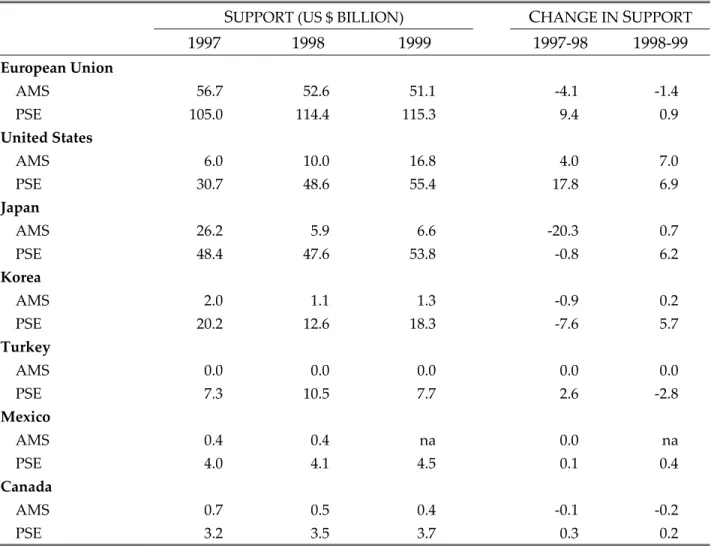
Each country’s AMS was agreed to be reduced by 20 percent from a 1986-88 base over a 6-year period (1995 to 2000). The AMS reduction commitment for developing countries is 13.3 percent over a 10-year implementation period. To illustrate, table 9 re-ports the WTO notifications of the European Union, United States, Japan, Korea, and Canada for 1999. The first two rows include support under the Green and Blue Box which is not subject to reduction commitments. The third row reports the sum of the product and non-product specific de minimis exemptions. The two rows under the head-ing “Support Included in AMS” denote the share of the AMS that comes from taxpayer funded subsidies and consumer transfers through higher market prices resulting from border protection.
Several conclusions emerge from table 9. Perhaps, the most important one is that consumer transfers account for a substantial part of the AMS. For example, during 1999, they accounted for 96 and 83 percent in the European Union and Japan, respectively. The share for the United States was 35 percent. Another conclusion is that the US is the larg-est user of the green box and de minimis exemptions. Third, the notified AMS is well be-low the ceiling, implying that substantial cuts in the AMS will be required for an actual reduction in support to take place.
The implication of the figures reported in table 9 are not surprising considering the way in which the consumer transfer component of the AMS is calculated, that is, as
(Ptofficial - P1986-88)*Qteligible. Note all three variables of interest, i.e., the current official price, the
1986-88 world reference price, and the quantity eligible for support may or may not have anything to do with the actual level of border protection.6 Hence, countries are able to ad-just official administered prices in order to “achieve” reduction commitments without necessarily reducing support. A telling example of how poor measure of support the AMS can become is the decision by Japan to lower the “official” price or rice, effectively reducing its AMS notification to the WTO from $26.2 billion in 1997 to $5.9 billion in 1998, without actually changing the actual level of support. In fact, PSE remained almost unchanged during these two years (see table 10).7
III. D
ECOUPLINGAS AC
ONCEPTBroadly speaking, decoupling is the move from support based on current production (and hence trade-distorting) decisions to support not based on current production (and thus not trade-distorting) decisions. This definition, however, while it specifies where in-come transfers should not be linked to, it does not specify where they should be linked to. Furthermore, it does not say anything about the way in which decoupled payments are financed. On the other hand, it is important to emphasize that because decoupled support is not affected by production decisions, it does not necessarily imply that de-coupled support does not affect production decisions. This section elaborates on the defi-nitional issues regarding the concept of decoupling as well as the economics of decoup-ling, especially relating to the source of funding.
What Is Decoupling?
Decoupling has different meanings to economists, policymakers, and trade negotiators. Some see it as a transition mechanism to a fully competitive sector. Others see it as an-other support program, with less production- and trade-distorting effects. Some use de-coupling only to refer to programs for transferring income to producers; others use it much more broadly, to include, for example, programs to improve the environment. Sometimes decoupling is assessed according to the policy’s long-run impact on output through such factors as uncertainty, investment, and expectations.
Although decoupling has been discussed in the academic literature as early as 1946 (see box 3), perhaps the first analyst to explicitly advocate a well-defined decoupled support program in the U.S. agriculture was Swerling (1959).8 Two characteristics of Swerling’s proposal are especially interesting. First, he advocated a safety net mechanism for agriculture, similar to safety nets in other sectors of the economy (such as unemploy-ment insurance). Second, he proposed linking the benefits of the decoupled support to income declared in tax returns during the recent past, not to historical production or area, which was the common recommendation defined in other decoupling proposals.9
Another early decoupling proposal was put forward by Nash in Europe: (1961, p. 188):10
Instead of obstructing the withdrawal of farmers from an industry which cannot adequately re-ward them, … an unconditional payment to all those at present engaged in farming, or to those of them deemed to be need of compensation, calculated by the reference to the difference between the incomes now earned under the protective system and those capable of being earned under a sys-tem of free market prices. An annuity calculated in this way and payable for life to all engaged in farming, but not transferable to their successors, would, in theory at least, make it possible to bring the protective system to an end while fully making good the loss of income to its present beneficiaries. There is no doubt that compensation of this kind is feasible—a scheme with some re-semblances to the present proposal has in fact been applied to the cotton industry;11 and even if it
the indefinite retention of the existing protective system.
Van Riemsdijk (1973) questioned the purpose of the Common Agricultural Policy (CAP) in Europe and argued that it must be changed fundamentally towards a direct compensation system and asked (p. 164): “… what kind of action should be taken to get agriculture adapted to the lower prices in such a way that it will be able to provide itself income parity by means of its own capabilities, i.e., without getting more help than is of-fered by a market and price policy designed to smooth price variations of an undistorted world market and to avoid any other form of protection.”
The proceedings of the workshop “Decoupling: The Concept and Its Future in Canada” contains numerous definitions of decoupling (Finkle and Cameron 1990). Con-sider the following two rather contrasting views. Van Donkersgoed (1988) of the Chris-tian Farmers Foundation of Ontario defined decoupling as (p. 40): “a program in which eligibility is not linked to production, the production potential of resources or the pro-duction effort of a farm entrepreneur; rather eligibility is linked to stewardship farming practices, marketing, the maintenance of rural communities, diversified ownership of the assets of production, moderate-sized family enterprises and other rural, non-production valuables that add to the quality of Canadian life.” Spriggs and Sigurdson (1988) on the other hand, simply stated (p. 93): “In fact, a program to eliminate subsidies would be the ultimate in decoupling. It is the only truly decoupled program that there is.”
Cahill (1997, p. 351) defines a policy as fully decoupled from production that “does not influence production decisions of farmers receiving payments, and that per-mits free market determination of prices (facing all farmers, whether or not receiving in-come support).” A policy is effectively fully decoupled if “the provision of the compensa-tory payment package results in production that, for any crop, does not exceed that level that would exist without compensation.” OECD (2000a) defines decoupling in a similar way. The US Department of Agriculture (2003) refers to decoupled payments as lump-sum income transfers to farm operators that do not depend on current production, factor use, or commodity prices and for which eligibility is based on fixed, historical criteria (USDA 2003).
Hennessy (1998) includes as decoupling payments triggered by ex post market or production conditions, as long as the payment level is not conditioned on an individual’s specific level of production. Disaster relief measures, for example, would be considered decoupled because they are not affected by the individual’s level of production.
Goodwin and Mishra (2002) argue that a fully decoupled payment must be fixed and guaranteed and thus is not influenced by ex post realizations of market conditions (such as low prices or area yields). This is the most narrow definition because neither payments nor the rules of eligibility and the base criteria can be changed. If a time limit is added to this definition, then decoupling simply implies a number of annual payments to producers. Where financial markets function efficiently, these bonds can be converted into a single payment. In such a setting, decoupling would consist of an administrative
decision to remove distortions followed by a single payment—a radical, but sensible, pol-icy initiative.
Swinbank (2004) advocated a decoupling proposal for the CAP in which farmers would be guaranteed a future stream of payments, akin to a government bond, the dis-counted present value of which could be traded in the stock exchange. Under their ‘bond scheme’ “… farmers would no longer have to sow crops or keep livestock to qualify for the annual payments, or even farm their land.” (p. 1).12
The Uruguay Round Agreement on Agriculture (URAA) uses the term decoupling in connection with direct payments to producers that satisfy the following conditions (URAA Annex 2.6):
Eligibility for such payments shall be determined by clearly-defined criteria such as income, status as a producer or landowner, factor use or production level in a defined and fixed base period. The amount of such payments in any given year shall not be related to, or based on, the type or volume of production (including livestock units) undertaken by the producer in any year after the base period. The amount of such payments in any given year shall not be related to, or based on, the prices, domestic or international, applying to any production undertaken in any year after the base period. The amount of such payments in any given year shall not be related to, or based on, the factors of production employed in any year after the base period. No production shall be required in order to receive such payments.
According to this definition, payment levels can technically change with market prices, as long as production is not related to these changes. The key factor is that the rules for eligibility and the criteria upon which payments are based upon originally (like the vol-ume of production or use of input or status of a farmer) cannot change once the decoup-led program is set in place.
The above definition of decoupling is for payments motivated by farm income con-cerns only. If the rationale for the policy is to correct for market failures and provide pub-lic goods, then the definition of decoupling above is inappropriate. Popub-licies correcting for market failures or providing public goods require effects on production like pollution re-ductions and so should be analyzed in a different context, namely, minimal trade distort-ing. Because governments have consolidated these two motives in their call for exempt-ing direct payments or border protection to fulfill the multiplicity of goals under the ru-bric of ‘multifunctionality’, it is important to keep the distinction and ensure that farm income goals are not achieved through the back door under the rubric of multifunctional-ity.
Payments are decoupled as defined by the URAA, if eligibility is clearly defined by criteria in a defined and fixed base period, where production is not required nor related to the type or volume of production after the base period. Payment levels can change with market prices, but funds to finance such transfers can only be obtained from tax-payers. The key factor is that the rules for eligibility and the criteria upon which pay-ments are based upon originally (like the volume of production or use of input or status
of a farmer) cannot change once the program is set in place.
Notice that this definition of decoupling concerns with the disbursement of pay-ments to farmers, not the effects of raising the taxpayer funds in the first place. The URAA, however, does not exclude taxpayer transfers funded from a specific tax on the individual commodity for which the producer is receiving the decoupled payment—the only transfer that is prohibited is a direct transfer from the consumer to the farmer in the same market through, for example, a price support scheme. A consumer tax on tobacco that goes into the general treasury is perfectly legitimate while at the same time having decoupled support payments to tobacco farmers that come from the same general pool of funds for all taxpayer expenditures.
The definition of “decoupling” does not include all programs in the green box be-cause the latter includes expenditures that always do not involve direct payments to ag-ricultural producers (e.g., food aid). Neither does ‘decoupling’ always refer to direct payments to producers in the green box because several programs (e.g., environmental) involve direct payments to producers but inevitably vary with the type and volume of inputs and output in order to achieve a particular level of environmental benefit (which itself can change from year to year). Direct payments under an environmental program therefore can have significant effects on production. Nevertheless, trade can be distorted because a ‘polluter pay’ principle will have production occur in countries with compara-tive advantage and hence minimize trade distortions.
Hence, the URAA definition of decoupling is more than specific enough to fulfill strict economic definitions of decoupling due to production and consumption effects of direct payments designed to transfer income to farmers. But the condoning of payments to farmers for other programs that correct for market failures or provide public goods can have a deleterious effect on international trade and have production in regions that do not have comparative advantage. The rule for payments under environmental programs merely states: “The amount of payment shall be limited to the extra costs or loss of in-come involved in complying with the government program.”
The Economics of Decoupling
Decoupling can be viewed as two distinct transition mechanisms: one replacing domestic support and one replacing border measures. The key variable driving this distinction is the source of financing for the original support measures: consumers, taxpayers, or a combination. In what follows, the welfare implications of moving from coupled to de-coupled support are discussed for the case of a production subsidy and an import tariff. The discussion is followed by the marginal excess burden of taxation, and lastly by the implications of decoupling at a micro level. Because decoupling in the case of replacing border measures requires changing the structure of taxation (from a consumption tax to other type of tax as well as ruction in tariff revenue), any decoupling proposal must in-volve decisions made by the ministry of finance, in addition to the ministry of agriculture
and trade. To illustrate the importance of this issue, box 3 outlines a hypothetical conver-sation between an agriculture and finance minister on the issue of decoupling.
Decoupling as a Subsidy Disbursing Mechanism
Let DdDd and SdSd denote domestic demand and supply of the commodity in question for
an exporter (figure 3). In a closed economy setting the market clears at quantity and price dictated by the intersection of domestic demand and supply (panel A). If the economy is open and small, the price is Pm as dictated by the intersection of the exporter’s supply to
the world (Sw) and the demand schedule of the rest of the world (Dw) (panel B). Because
of the small country assumption, the demand of the rest of the word is depicted in panel B as a horizontal line. Domestic producers supply OQ1. Domestic consumption is OQ0
and the remaining (Q0Q1) is exported. This is the competitive outcome.
Assume now that the policy maker’s objective is to increase producer’s income. One way to accomplish this is to introduce a production subsidy, say, s (=Ps-Pm)
Follow-ing the introduction of the subsidy, producers will receive Ps and they will supply Q3.
Again, under the small country assumption the world price will not change (i.e. it will remain at Pm). Domestic consumers will demand Q0 (as previously) and pay Pm while Q0Q3 will be exported. The welfare implications of this policy move are straightforward.
The cost of the subsidy (i.e. the cost to taxpayers) is the rectangular area α+β+γ. The in-crease in revenues to producers is the area α+β+γ+η+θ. Total costs of production increase by the area γ+η+θ so the net gain to producers is the area α+β. The triangle γ corresponds to the deadweight loss for producing the additional output at a higher cost than the com-petitive price Pm.
The idea of decoupling in this setting is simple. Producers receive α+β and part of
γ in lump sum form and hence they are made better off. Taxpayers retain the remaining of γ and they are also better off. Hence, the move is deemed Pareto improvement as both producers and taxpayers are better off while the welfare of the consumers does not change since they consume the same amount and pay the same prices.
If the country is a large player in the commodity market in question, then the de-mand curve facing the country is downward slopping (D’w in panel B). This implies that
following the introduction of the subsidy the world price will decline from Pm to Pw.
There a number of additional welfare implications. First, taxpayers pay more since the cost of the subsidy increases by the rectangular are defined between Pm and Pw and to the
left of Q3. Second, domestic consumers gain the trapezoidal area δ because they face
lower prices. Third, the triangular area ε becomes the consumer’s deadweight loss of overconsumption. Finally, the rectangular area ζ+η become welfare transfers to foreign consumers. The implications of decoupling in this case are also more complex since Pareto optimality in this setting would involve transfers to/from foreign producers and consumers as well as domestic consumers who now consume more and pay less.
the form of an import tariff (figure 4). Let DdDd and SdSd denote domestic demand and
supply of the commodity in question. In a closed economy the market clears at quantity and price dictated by the intersection of domestic demand and supply. If the economy is open and small, price is Pm, and the supply for the commodity becomes SdSm. Domestic
producers supply OQ1, while the remaining (O1Q0) is imported. This is the competitive
outcome.
Assume now that the policy maker’s objective is to increase producers’ income. One way to accomplish this it is to introduce an import tariff, say, t. Following the intro-duction of the tariff, the domestic supply schedule becomes SdSd. At Pt (the new price),
consumers will demand Q2. Domestic producers will supply OQ3 while the remaining
(Q3Q2) is imported. An import tariff has three resource allocation-related effects: First,
consumers pay a higher price (from Pm to Pt) and consequently demand less (from OQ0 to OQ2). Second, domestic producers receive a higher price and hence produce more (from OQ1 to OQ3). Third, the treasury receives tariff revenue γ (equal to the tariff rate times the
quantity imported).
The monetary burden on consumers (reduction in consumer surplus) due to the tariff is the rectangular area α+β+γ of which the area γ (the tariff revenue) goes to the treasury; the trapezoidal area α (the change in producer surplus or change in profits) goes to the producers; the triangular area β (the excess cost of producing the additional output Q1Q3) is the deadweight loss, that is, the additional resources required to produce
domestically the commodity that would have been saved, had the corresponding amount of the commodity been imported. Finally, the triangular area δ denotes the welfare loss to consumers, or reduction in consumer surplus that is not offset by revenue to the treasury. Total deadweight losses equal the sum of the two triangles (β+δ).
A similar outcome would arise if, instead of taxing imports, the country limits the imported quantity to Q3Q2. The importers then receive a rent equivalent to the tariff
revenue net of the cost of obtaining an import license. Under certain assumptions, im-porters competing for the import licenses would pay the same in the aggregate for li-censes as the tariff forgone. Alternatively, the quota can be allocated to a certain export-ers, a common practice employed as an aid tool through preferential trade arrangements whereby only a few countries are allowed to fulfill the quota.
Decoupled support calls for: (i) eliminating the tariff, (ii) raising additional taxes, and (iii) redistributing these taxes as a lump-sum transfers to producers. Producers plus importers (consumers) supply (demand) OQ0 at price Pm as in the no-tariff scenario.
Pro-ducers receive as compensation for their “losses” the lump-sum transfer α plus part of the triangular area β and therefore are better off; the treasury receives the area γ and therefore is better off; consumers save α+β+γ—part of which was transferred to produc-ers and part to the treasury—but they retain the remaining part of the two triangular ar-eas and therefore are better off. Thus, from a sectoral point of view, the move to decoup-ling is a Pareto improvement. However, Pareto improvement cannot be established from
an economy-wide point of view because taxpayers are worse off—note that the burden of support shifts from one group (consumers) to another (taxpayers). The next section dis-cusses this issue.
If the country is an important player in the world market, it faces an upward slop-ing supply schedule (panel 2, figure 4). Numerous welfare changes will take place fol-lowing the introduction of a tariff, in addition to those outlined in the small country case. First, because quantities of the commodity that would otherwise have been imported will be diverted into the world market, the world price will decline from Pm to Pw, implying
that the welfare of other exporters will decline. Second, a higher tariff is required now in order to maintain the same level of income to producers (Pt-Pw instead of Pt-Pm). Third,
the treasury gains the additional area ε because of the higher tariff.
The effects subsidies in the large country case were exemplified recently by a number of developments in the cotton market. On September 27, 2002, Brazil requested consultation with the United States regarding export subsidies and domestic support provided to its United States cotton industry (see box 4).13 The WTO panel ruled in favor of Brazil, concluding that that United States should withdraw the export subsidies and the export credit guarantees given to its cotton industry. The panel also ruled regarding domestic support that “the US is under an obligation to take appropriate steps to the ad-verse effects or withdraw the subsidy” (WTO 2004, pp. 351).
In a similar move, four West African cotton producing countries—Benin, Burkina Faso, Chad, and Mali—submitted a joint proposal to the WTO on April 31, 2003 asking for compensation for losses in export revenues incurred because of the subsidies given to the cotton sectors of rich countries (the so-called ‘cotton initiative’, see box 5). In terms of figure 3 (assuming that the left panel represents the cotton sector of the United States and the right panel represents the cotton sectors of the four West African countries), the com-pensation by the four West African countries would consist of the product of the price difference (Pm - Pw) times the loss in the export share (the maximum of which is the
dif-ference between X2, the “competitive” export quantity, and X0, actual exports).
Decoupling and the Costs of Taxpayer Funds
The discussion on decoupling so far has focused primarily on disbursing taxes. Decoup-ling, however, implies that support will be financed entirely by the treasury. The portion of the decoupled support that replaces budgetary outlays (e.g. direct subsidies) does not introduce any new equity or efficiency issues in terms of raising the funds since the de-coupled support will be financed entirely by existing taxes—hence the Pareto improve-ment outcome in the production subsidy case. However, the portion of decoupled sup-port that replaces border measures (e.g. tariffs) requires new funds from the treasury and hence new taxes or higher tax rates of existing taxes. Unless these new taxes are lump-sum (i.e. decoupled from labor and conlump-sumption decisions), they will create their own deadweight losses, which is why establishing Pareto improvement in this case requires
strong assumptions regarding the relative size of deadweight losses.14 This is a very im-portant issue, especially considering that two thirds of the OECD support to agriculture is in the form of border protection.15
The issue of shifting taxation to finance decoupled programs has generated some skepticism among economists regarding the efficiency of decoupling as a policy alterna-tive. Consider, for example, what Munk (1989, p. 88) contends:
For a system of transfer payments to be lump-sum it needs to be non-distortive on both the reve-nue side and the expenditure side. No government obtains a sizeable share of its tax revereve-nue from lump-sum taxes and there are no compelling reasons why a system of lump sum transfers to agricultural households, financed by, say, ordinary income taxation, should be superior to other support instruments. This tends often to be forgotten by advocates of direct income sup-port.
Alston and Hurd (1990, p. 155) echoed similar thinking:
Currently it is fashionable to argue for ‘decoupling’ farm programs in the sense that income transfers should be achieved with minimal consequences for commodity markets. Along with the benefits from transparency, the benefits from decoupling may be illusory. The issue here is whether the costs of distortions in commodity markets are necessarily greater than the costs of distortions introduced elsewhere in the economy to finance ‘decoupled’ transfers.
Moschini and Sckokai (1994), however, argued that the welfare losses of raising new taxes to finance decoupling are unlikely to be larger than the welfare gains from de-coupling. Winters (1989-90) argued that unless the outlays are very high, it is unlikely that other support measures will outweigh the advantages of a direct income support. In terms of empirical estimates, Beghin el al. (2003) found that in Korea it costs taxpayers $1.61 for every $1 transferred to agricultural producers. Using a general equi-librium model, Parry (1997) concluded that the efficiency cost of taxpayer-financed lump-sum transfers to agriculture equals 27 percent of the amount of the income transfer. Feld-stein (1999), however, argued that traditional analyses of the income tax greatly underes-timate deadweight losses by ignoring its effect on forms of compensation and patterns of consumption. The relative deadweight loss caused by increasing existing tax rates may exceed $2 per $1 of revenue raised.
Since most of the support is at the border, decoupling may not always result in a welfare improvement, depending critically on the marginal excess burden of taxpayer fi-nanced funds relative to that of consumer fifi-nanced transfers. It should be noted that the latter could also be high with rent seeking so it is not a foregone conclusion that taxpayer financed funds are more costly (Krueger 1974). However, special consideration should be given for developing countries without adequate income tax infrastructure whereby con-sumer transfers through import taxes can be more efficient. Otherwise, decoupled
schemes should be encouraged, even with a higher marginal excess burden of taxation, given the lower distortions in world commodity prices and trade with decoupled pay-ments. But there is a political economy issue here in that governments may face higher
tax costs to maintain the same level of farm income and lose a potentially lucrative source of tax revenues through import tariffs. Higher tax costs and lower tax revenues can ex-pose governments to political opposition while import tariffs are less visible and so less prone to create political opposition.
The Micro-Side of Decoupling
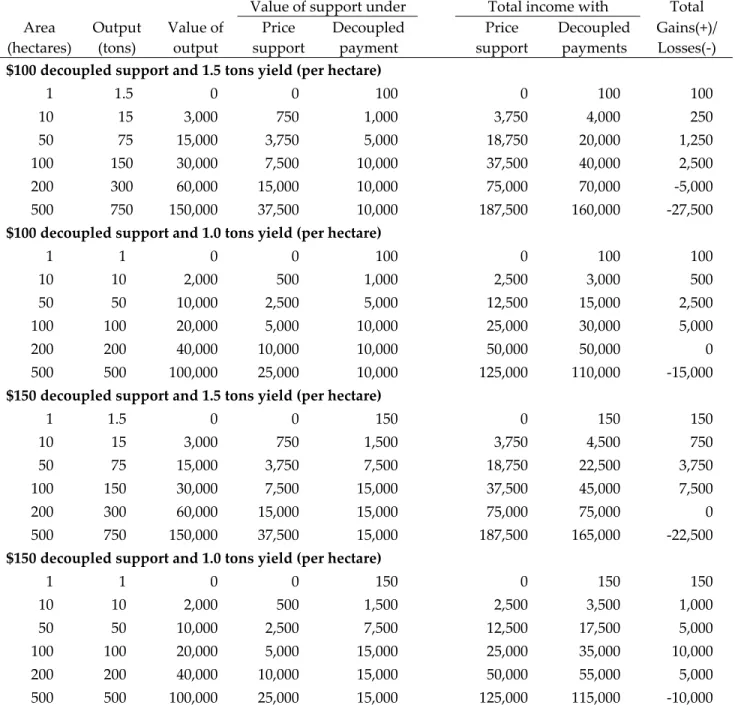
While Pareto optimality may be achieved in the case of moving from production subsidy to decoupled payments, when it comes to actual implementation, this may no longer be the case. To see this, consider the following simplified setting. A 50-hectare wheat pro-ducing farm, with yield of 1.5 tons per hectare would make $15,000 when the price of wheat is $200 per ton. A price support mechanism of $50 per ton would boost income to $18,750, assuming output does not change. Now assume that instead, a $100 per hectare decoupled support is given. That would boost income to $20,000, a net gain of $1,250 (see table 11). The benefit of this decoupled payment based on land may all go to the land-owner in the form of higher land rental rates so farm operators may not receive any bene-fits, and at most, only part of the subsidy.
Now suppose that an upper limit of 100 hectares is imposed, implying that for any hectare above that limit producers receive no support. In such a scenario, owners of farms above 100 hectares realize losses compared to an open ended production subsidy or price support. As shown in Table 11, the larger the farm, the more loss it incurs com-pared to a price support.
To make the reform politically feasible, sometimes decoupled programs become very expensive policy instruments. As mentioned earlier, one of the main reasons behind the Brannan’s Plan failure in the United States was that it lost political support due to high potential cost. As it will be discussed later, concerns regarding the costs of Mexico’s decoupled program were raised as soon as the program was discussed. It been argued very often that the United States was able to proceed with the 1996 Farm Bill, because of high commodity prices, which in turn made the program expensive considering that con-sumers were paying high prices and taxpayers were financing decoupled payments.16
IV. D
ECOUPLINGINP
RACTICEEarly attempts at decoupling failed. The 1949 Brannan Plan in the United States, which proposed cash payments to farmers whose overall income fell below a certain level, was defeated in the U.S. Congress. Similarly in Europe, the Mansholt Plan of 1967, which ad-vocated support in order to finance mandatory retirement for older farmers, also failed (see box 6 for a summary on these two plans).17
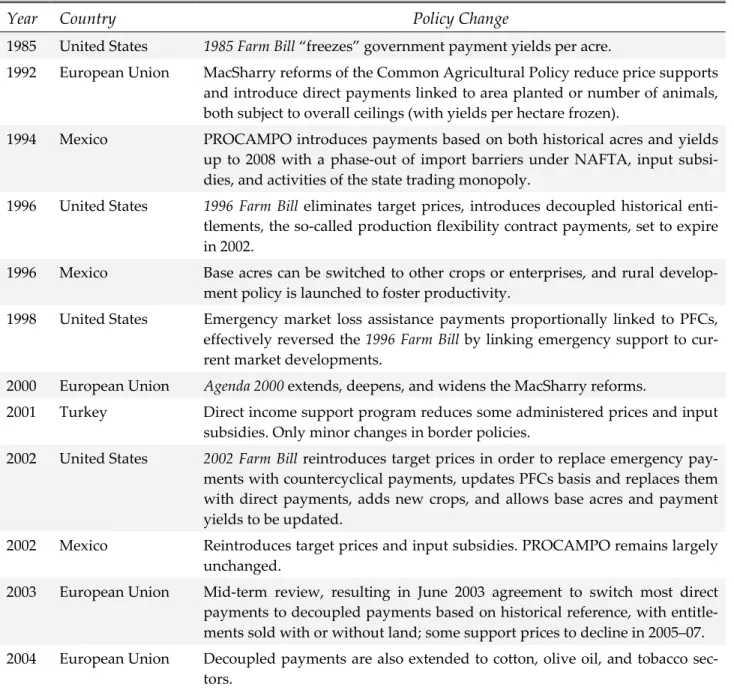
The first attempt at decoupling came in the United States with the 1985 Farm Bill, which shifted the base of support from current yields to historical yields. The European Union partially replaced intervention prices with direct payments following the Com-mon Agricultural Policy reform of 1992. Mexico replaced price supports with direct payments in 1994 with the introduction of the National Program for Direct Assistance to Rural Areas (Programa de Apoyos Directos al Campo, or PROCAMPO). The United States replaced deficiency payments with decoupled support in the 1996 Farm Bill. More recently, Turkey replaced some price support and input subsidies with direct payments (table 12 outlines the chronology of significant decoupling and recoupling efforts while table 13 summarizes the characteristic of the main four decoupling programs). In addi-tion to broad decoupling programs, there have been numerous one-time buyouts, includ-ing New Zealand’s exit grant in 1984, the buyout of Canada’s grain transportation sub-sidy in 1995, the buyout of the U.S. peanut marketing quota under the 2002 Farm Bill, and the 2004 tobacco buyout in the US.
Experience with Broad Decoupling Attempts
Decoupling Efforts in the United States
The budgetary outlays for most U.S. commodity programs are authorized by Congress (and subsequently approved by the president) every few years through farm bills. There have been 20 such bills since the first one of 1929. The central feature of the New Deal farm programs of the 1930s was price supports achieved through taxpayer-funded pro-duction subsidies and supply controls (acreage set-asides as well as accumulation, main-tenance, and disposal of public stocks). Payments were based on the difference between the target price set by the government and the higher of the market price or the price at which the government would value crops used as collateral for loans made by a public corporation. The total payment was equal to the yield per acre multiplied by a farm’s eli-gible payment acreage (the amount of land devoted to cultivation of the crop in ques-tion). This portfolio of policy instruments was the primary means of price support for the major field crops for decades until the 1980s.
The Food Security Act of 1985 set a new trend for major field crops by reducing the role of acreage set-asides and public stockholding and moving toward decoupling, with a “freeze” on payment yields (farmers were paid on the basis of fixed output per
acre regardless of what actually was produced). Payment yield was established for each farm by the Department of Agriculture, based on average yields in 1981–85.
Acreage set-asides and public stockholding were largely abandoned by the mid-1990s and eliminated soon thereafter with the introduction of the Federal Agricultural Improvement and Reform (FAIR) Act in 1996. FAIR also banished the target price used in calculating deficiency payments but maintained the lower fixed price, called the loan rate, which had triggered public stock purchases in the past. In place of the links between support, prices, and production, production flexibility contract payments were intro-duced. Participating producers received payments in proportion to what they had re-ceived during 1990–95, or would have rere-ceived had they been enrolled. These historical benefits were in turn determined by a farmer’s historical production levels. Each partici-pating producer received a fixed schedule of payments, which was to gradually decline through 2002. Although not specifically stated, it was implicitly assumed that the pay-ments would end by 2002.
The effect of the 1996 Farm Bill on the structure of budgetary outlays is shown in table 14. It breaks the producer support estimate down into market price support (a measure of border protection) and budgetary support (a measure of domestic support). Budgetary support is further decomposed into support based on output and input use (considered as having a large impact on production and trade, or fully coupled support) and support based on area, historical entitlements, inpu