Critical Factors in Developing Knowledge Management Systems
Sanath Sukumaran
1,
S.M.F.D. Syed Mustapha2, and Kanchana Chandran3 1Tayylor’s University, Malaysia, [email protected]2Taif University, Saudi Arabia, [email protected] 3Sunway University, Malaysia, [email protected]
ABSTRACT
Over the past several years, we have seen many articles, research and survey findings highlighting the failures in Knowledge Management (KM) implementation in general and KM Systems (KMS) in particular. Clearly, there is a need to examine the state of KM from a broader perspective to determine the viability of prevailing KM frameworks and if the need for a new approach is required. This paper was inspired by the recent findings in the KM Survey 2016 published by Knowledge Management Professional Society (KMPro) on the critical factors contributing to organisational KM success and failures. The authors of this paper revisited the survey findings of KMPro to determine whether the critical success factors do indeed lead to a successful Knowledge Management System. The outcome of this paper is a conceptual framework and a catalogue of KMS functionalities deemed “critical” to boost the success rate of KM Systems in the future. Keywords: Knowledge Management (KM), Knowledge Management Systems (KMS), Activity Theory (AT), Tacit Knowledge.
I BACKGROUND
This conceptual paper is based on the recent survey findings by KMPro (Knowledge Management
Professional Society, 2016) spanning 1,576
organisations in nearly 60 countries. The study which was commissioned in 2015 involved the corporate, governmental and military sectors, in which “Five
Primary Critical Factors Contributing to
Organisational Knowledge Management Successes & Failures” were identified. The study is believed to be the most comprehensive study of Knowledge Management implementation ever conducted to date. The primary purpose of the KMPro study was to determine the effectiveness of KM implementation within a broad range of organisational types, and to then attempt to identify any significant factors that impacted both successes and failures during the implementation.
The FIVE (5) critical success factors as espoused by KMPro in the aforementioned survey are discussed as follows:
KM Strategy: This is essential for effective and successful KM implementation. Provides policies and guidance towards a strategic and structured KM implementation to realise organisational goals. KM strategy must therefore have strong ties to the organisational strategy (Knoco, 2011). Mainstream KM systems tasked to manage KM in an organisation are somewhat separated from everyday organisational work practices and business processes resulting in loss of context rendering knowledge contributed defunct and redundant. Most knowledge workers therefore do not see KM efforts as an integral and significant aspect of their work Therefore, it is important that KMS in the future no longer operate in silos like its counterparts of yesteryears. This calls for a KM Strategy in place. KM Measurement: This is required to determine the impact of KM activities. It aims to provide useful metrics and/or statistics as to how knowledge is
created, disseminated and leveraged for
organisational gain. These measures drive and guide KM effort. Organisations today generally do not sufficiently recognize knowledge contributions because the conceptualization and measurement of knowledge capital as a primary organisational asset remains rudimentary. Hence, without a realistic and robust measure of knowledge capital built within an existing KM system, organisations will continue to revert to economic capital (status quo) instead of viewing KMS as a means to generate knowledge capital.
KM Tools: This refers to the extent to which technology may be used as an enabler to enhance and improve upon an organisation’s KM initiatives. KM tools alone cannot guarantee that KM will succeed. KM tools can only be used where appropriate, given the overall KM strategy of the organisation.
Leadership Support: Refers to the extent to which there is support from senior leaders for KM initiatives to thrive. Conversely, leaders who do not “walk the talk” by providing support have resulted in KM initiatives becoming a “white elephant” leading to KM implementation failures.
Organisational Culture: Refers to the extent to which the organisation has embraced the right culture to facilitate KM activities. It also includes having an
appropriate reward and recognition system in place to promote a “healthy” KM environment.
It is important to note that the findings from the 2016 survey published by KMPro is aimed at understanding critical factors contributing to successes and failures of KM implementation in general but not specifically to KMS. Hence, taking into account the critical success factors outlined above in Section I, the research was set out to understand to what extent can the same critical success factors be used as means to guide KMS development efforts and to propose a conceptual framework to achieve the same.
II LITERATURE REVIEW
The literature was examined in relation to the objectives of the research namely, the role of KMS and importance of tacit knowledge elicitation using Activity Theory (AT).
A. Knowledge Management Systems (KMS) It is commonly believed that an effective implementation of KMS enhances an organisation’s competitive advantage manifested in service quality improvement, significantly lower operational cost, improved coordination, etc. (Gupta et al., 2004). KMS improves the operational process integration and customer relationship interaction (Su and Yang, 2010), cost and time reductions, strengthened
relationships among colleagues and quicker
knowledge creation (Su & Lin, 2006; Huang & Lai, 2012). In comparison with other traditional systems such as document management system, knowledge management system can provide better help in avoiding duplicating efforts whilst assisting in the systematic coordination of capturing people’s knowledge and experience (Xu & Quaddus, 2012). Although most organisations are at least aware of what their corporate knowledge assets are, managing these assets and making use of them to gain maximum returns is a different ball game altogether. Ironically, most KM systems deployed are not able to address this paradox despite the understanding and value they place on intellectual capital (Edwards, Shaw & Collier, 2005). Hence, it is no surprise that KM Systems today have failed to live up to its expectations and in some cases appear no more than an illustrious off-the-shelf content management system (Sukumaran & Chandran, 2014).
B. Tacit Knowledge Elicitation
It is important to reiterate that for KM systems to be deemed useful, the focus must be towards contextualised tacit knowledge (Sukumaran & Chandran, 2014). However, this in itself is a
challenge because it is widely recognized that the existence of tacit knowledge poses a unique problem and is a source of difficulty for the knowledge and requirements elicitation process (Christel, 1992; Gourlay, 2006; Friedrich & Van Der Poll, 2007). Sukumaran and Chandran, 2014 mentioned the need to examine the impact and purpose of a KM System from two perspectives. Frist the understanding and characteristics of tacit knowledge (experience and know-how). Secondly, what constitutes and shapes tacit knowledge. If these aspects are not adequately dealt with, the goal of eliciting tacit knowledge seems rather far-fetched as it has always been. Hence, with the above being said, in addition to the FIVE (5) critical success factors espoused by KMPro, it is important that due emphasis and attention is given towards eliciting tacit knowledge over explicit knowledge. This is also due to the fact that prevailing KM systems are inundated with explicit knowledge leaving most mainstream KMS in operation no different than a typical content management or document management system. Much of these phenomena is due to the fact that tacit knowledge elicitation is a cumbersome process coupled with an absence of a suitable methodology to structure and guide elicitation of tacit knowledge. It is therefore not uncommon to witness a shift of focus amongst KM vendors and tool developers deploying functionalities that are focused primarily towards explicit knowledge as opposed to tacit knowledge. Much of these tools are garnished with over the top features that do not support KM. However, it is important to point out that tacit knowledge elicitation is the crux of a KM system (while not ruling out the importance of explicit knowledge) and is certainly the corner stone of a successful KM System. Functionalities like data analytics is as good as it gets and can only serve to generate rich analytics (i.e. output) assuming knowledge input was of significance. Therefore as the expression goes, "garbage in, garbage out” the importance and impact of tacit knowledge (i.e. knowledge input) cannot be discounted in churning out content that is of significance to the organisation. C. Activity Theory
Arguably one of the key success factors of KM initiative lies in the context in which knowledge is captured, made relevant and leveraged for organizational gains (Alawi and Tiwana, 2002). This is however easily said than done. Lichtenstein and Swatman, (2002) argued that the human context within which a software system will operate is fundamental to its requirements. What is evident is that although the human context may not appear to
be very much related to the system, it is nonetheless very relevant in achieving its successful adoption and operationalisation of the ensuing KM System (Tan, 2009). Taking Tan’s view in mind, there has to be a renewed approach to elicit knowledge in the context of KMS. The conventional approach in eliciting knowledge is unsuitable given the tacit and
contextualized nature of knowledge. This
phenomena has led the KM researcher to contemplate on the use of other supporting theories to aid in tacit knowledge elicitation. One such approach is the use of Activity Theory (AT). Activity Theory is not a "theory" in the strict interpretation of the term. AT is a paradigm for the analysis of human groups focused on their contextualized acts (Fernandez, Gomez and Pavon, 2009). AT through the use of an Activity System is also a guiding framework and a tool to facilitate elicitation of tacit understanding from a subject matter expert. Given the promise offered by AT, it remains to be seen if it does indeed fill the gap in being able to facilitate elicitation of contextualized tacit knowledge. Should this be the case, AT may well address the gap plaguing KMS of yesteryears.
III METHODOLOGY
Since the premise of the study was based upon the survey outcome of KMPro, it is imperative that the same instrument used in the KMPro survey is closely examined in this study. The authors have therefore scrutinised the survey question by extrapolating a list of 34 questions (See Appendix A) spanning across all five critical success factors namely KM Strategy, KM Measurement, KM Tools, Leadership Support and Organisational Culture. This exercise is crucial to review which of the elements within the survey questions were relevant inclusions in the conceptual framework and the ensuing KM System. The authors would like to make it known that the survey elements in Appendix A were produced entirely by the authors extrapolated using the official survey report released by KMPro. Therefore, at no time did KMPro release the survey elements. The listing in Appendix A does not necessarily constitute the actual contents of the survey instrument that was used by KMPro. Nonetheless, for all intents and purposes, the listing in Appendix A serves as a detailed breakdown and analysis of each of the five critical factors revisited in this study. To begin with, an analysis of 34 questions in Appendix A was carried out. Each question in the list were further categorised into two parts i.e. ‘Relevance to KMS’, ‘Inclusion to the Framework’ or both. ‘Relevance to KMS’ denotes that a particular survey element can be translated
into a potential KMS functionality whereas ‘Inclusion to the Framework’ espouses the fact that the outcome of the survey question is an important consideration in the framework development. Taking question 33 in Appendix A as an example, “Employees in the organisation are evaluated based on sharing of critical knowledge”; this statement does not influence the framework development but does shape the functionality of a KMS. Therefore, only the column ‘Relevance to KM’ was checked.
IV CONCEPTUAL FRAMEWORK
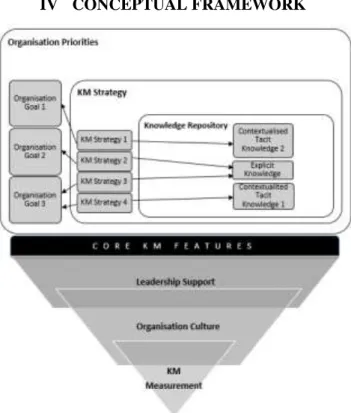
Figure 1. Conceptual Framework – Critical Factors for Development of KM Systems
Figure 1 summarizes the outcome of the findings. At the core of the proposed conceptual framework is the Knowledge Repository i.e. a repository of contextualised knowledge, tacit and/or explicit. Contextualised tacit knowledge will be elicited using tenets of Activity Theory discussed in section III of this paper. Knowledge stored in the repository needs to be mapped against one or more KM strategies. Similarly, KM strategies are mapped against one or more organisational goal(s). The outcome of the findings also reiterates the impact and relevance of leadership support, organisational culture and KM measurements as critical factors in the development of KMS. Therefore, these factors were also included in the framework to support knowledge elicitation. Finally the conceptual framework is augmented using ‘Core KM Features’ which is a list of KM functionalities listed in Appendix B.
The conceptual framework in Figure 1 by no means provides an adequate insight for KM developers and researchers to develop a successful KM System due to its highly abstract nature. Therefore, to develop a successful KM System, a detailed listing of specific KM functionalities (or features) is deemed necessary - see Appendix B.
Appendix B is a categorical list of 25 survey questions relevant to KMS (as opposed to 35 questions in Appendix A) spanning across FOUR (4)
critical factors namely KM Strategy, KM
Measurement, Leadership Support and Organisation Culture. A total of 48 KMS functionalities were subsequently derived and hereafter termed ‘Core KMS Features’ as shown in Figure 2.
Figure 2. Critical Factors – Core KMS Features
V DISCUSSION
The development of a KMS cannot commence without identifying organisational goals and its subsequent link to KM strategies. Similarly, the elicitation of tacit knowledge is achieved using tenets of Activity Theory (AT) elaborated at length in Sukumaran & Chandran (2014). The ‘Core KM Features’ which was mapped against the four critical factors could be statistically tested using procedures like confirmatory factor analysis to test its relevance. Regression tests could be undertaken to understand if non-adherence to one or more critical factors could result in the failure or breakdown of the ensuing KMS. Further qualitative evaluations with subject matter experts are necessary to validate the ‘Core KM Features’ and its operational feasibility. Finally yet importantly, a KMS can be developed adorned with ‘Core KMS Features’ and deployed across several organisations in an attempt to triangulate the findings. It must be noted however, that the successful rollout and adoption of a KMS depends on many other factors such as seamless user interface, business process integration, motivational factors, change management, HR involvement, KM pilots, etc. which are beyond the scope of this paper.
VI CONCLUSION
The startling revelation based on the outcome of the recent 2016 KMPro survey opened a plethora of research opportunities. The KMPro study in general pointed out the impact of critical factors contributing to the success and failures of KM implementation.
This study dwelled on the findings of the abovementioned KMPro survey to ascertain if the same critical factors could guide successful KMS implementation and if specific KMS requirements or functionalities could be consequently extrapolated. Indeed a KMS is integral to any KM implementation project given that a KMS is typically deployed at the tail end of a KM implementation and is part of the overall KM strategy. This being the case, it is not surprising to observe significant correlations between critical success factors in implementing KM and the critical success factors to implement a KMS.
The findings of the research essentially unplugged the same. Conversely, the listing of ‘Core KMS Features’ as shown in Appendix B further exemplifies key elements to be considered in implementing a KMS. The proposed high-level conceptual framework provides the much needed building blocks in developing KMS of the future. The conceptual framework when used together with the catalogue of ‘Core KMS Features’ provides a guiding framework for KMS development efforts in the future.
REFERENCES
Alavi, M., & Tiwana, A. (2002). Knowledge integration in virtual teams: The potential role of KMS. Journal of the American Society for Information Science and Technology, 53(12), 1029-1037.
Alsène, E. (2007). ERP systems and the coordination of the enterprise, Business Process Management Journal, Vol. 13 Iss: 3, pp.417 - 432 Christel, M. G., & Kang, K. C. (1992). Issues in requirements elicitation
(No. CMU/SEI-92-TR-12). Carnegie-Mellon University Pittsburgh PA Software Engineering Institute.
Edwards, J-S., Shaw, D, Collier, P-M (2005). Knowledge Management Systems – Finding a Way with Technology, Journal of Knowledge Management, Emerald Group Publishing Limited, Vol. 9 No. 1
2005, pp. 113-125, ISSN 1367-3270, doi:
10.1108/13673270510583009
Engeström, Y. (1987). Learning by Expanding: An Activity Theoretical Approach to Devel-opmental Research, Helsinki: Orienta-Konsultit, OY. Finland
Ferna´ndez, R.F, Go´mez-Sanz, J.J. Pavo´n, J. (2009). Understanding the human context in requirements elicitation, Springer-Verlag, Requirements Eng (2010) 15:267–283. doi: 10.1007/s00766-009-0087-714
Gupta, S. and Lehman, D. R. (2005). Managing Customers as Investments, Upper Saddle River, NJ: Wharton School
Friedrich, W. R., & Van Der Poll, J. A. (2007). Towards a methodology to elicit tacit domain knowledge from users. Interdisciplinary journal of information, knowledge, and management, 2(1), 179-193. Gourlay, S. (2006). Towards conceptual clarity for ‘tacit knowledge’: a review of empirical studies. Knowledge Management Research & Practice, 4(1), 60-69.
Huang, L. S., & Lai, C. P. (2012). An investigation on critical success factors for knowledge management using structural equation modeling. Procedia-Social and Behavioral Sciences, 40, 24-30. Kaptelinin, V., & Nardi, B. A. (1997). Activity theory: basic concepts
and applications. In CHI'97 Extended Abstracts on Human Factors in Computing Systems (pp. 158-159). ACM.
Knoco Ltd. (2016).Knowledge Management Reference. Knowledge
Management FAQ. [ONLINE] Retrieved from:
Knowledge Management Professional Society (KMPro) (2016). Retrieved from http://kmpro.org/
Lichtenstein, S. and Swatman, P.M.C (2002). Sustainable knowledge management systems : inte-gration, personalisation and contextualisation, Deakin University School of Information Sys-tems, Geelong, Vic.
Su, H. Y., & Lin, Y. (2006). Enhancing knowledge-based service quality: A knowledge management perspective. The Service Industries Journal, 26(7), 787-800.
Sukumaran, S., & Chandran, K. (2014). Knowledge Management Systems – The End of the Road ?: Position Paper, 1, 186–194. doi:10.1007/978-3-319-08618-7.
Wang, D. Zhongfeng, Su. and Yang, D. (2011). Organisational culture and knowledge creation capability, Journal of Knowledge Management, Vol. 15 Iss: 3, pp.363 - 373
Xu, J., & Quaddus, M. (2012). Examining a model of knowledge management systems adoption and diffusion: A Partial Least Square
No Survey Questions Relevance to KMS
Inclusion to the Framework Critical Factor #1: Knowledge Management Strategy
1.
There is a perceived lack of KM strategy within the
organisation.
2.
One of the most critical challenge faced in KM Implementation is the difficulty in getting top management buy-in, i.e. for top management to clearly understand what KM is and how organisational knowledge directly (or indirectly) connects to competitive advantage and innovation.
3. knowledge for competitive advantage? To what extent is your organisation able to use its 4.
In your understanding, what knowledge makes the organisation unique (in terms of effectiveness, competitive advantage or innovation)?
5.
Do you have any metrics (stats) to substantiate the benefits of archived knowledge held in repositories in your organisation?
6. Are you aware of the terms tacit and explicit knowledge?
7. explicit knowledge? What is the knowledge focus of your organisation – tacit or
8. What is the organisation’s main strategy in focusing on
tacit knowledge?
9. Does the organisation provide specific guidelines to assist
in documenting tacit knowledge?
10.
What percentage of the organisation’s KM effort was spent capturing the knowledge held by people vs implementing KM technology?
11. The approach of capturing of knowledge held by people in
your organisation is best explained by:
12. What is the primary mechanism for capturing knowledge
held by people in your organisation?
13.
How effective or useful was the knowledge captured from people had resulted in improved effectiveness, competitive advantage or innovation?
14. organisation? What is the primarily role of KM technology in your 15. organisation aligned to the organisation’s strategic goals? Are the contents of the document repository in your
16. The organisation has a KM Strategy in place?
17. organisation goals? Does the organisation’s KM strategy fully support the
18. The organisation has conducted a “Knowledge Gap”
analysis as an input into the KM strategy?
Appendix A – Survey Questions mapped to ‘Relevance to KMS’ & ‘Inclusion to the
Framework’
Critical Factor #2: Knowledge Management Measurement
19. What do you think is the No. 1 anticipated benefit of KM? 20. Are there metrics (stats) within the organisation to
determine the impact of KM upon decision making?
21.
Are there metrics (stats) within the organisation to validate contributions (knowledge) on how it achieved organisation goals?
22.
The organisation is familiar with the concept of Knowledge Value-Added (KVA) measurement and it has been used as a KM performance indicator?
23. The organisation has made no effort to quantify the actual
value of the organisational knowledge?
24.
Are there metrics (stats) developed to measure the value-added contribution of knowledge to either of innovation or organisational effectiveness or competitive advantage.
Critical Factor #3: Knowledge Management Tools 25.
There is a near total focus upon the usage of IT tools as the primary component (or in many cases, the sole component) of the KM effort in the organisation.
26.
KM tool was selected and put into place in the organisation without any regard for any KM strategy or even any needs-based or performance gap analysis?
27. The KM tool chosen was inadequate or had failed to best meet needs and achieving the organisation goals? 28. No efforts were made to replace the bad tool presumably
because:
Critical Factor #4: Leadership Support / Governance 29.
Non-KM managers within the organisation feel that they had no responsibility or role in supporting KM within the organisation.
30.
KM roles are decentralized within the organisation, with little to no connectivity between their separate areas, and no coordination between their managers regarding the KM strategy.
31.
There are no specific measurements in place to hold non-KM managers within the organisation accountable for knowledge sharing, transfer or utilization within their own areas of responsibility.
Critical Factor #5: Organisation Culture 32.
The organisation strives to build a knowledge sharing culture was a top- priority by putting in place recognition and reward systems.
33. Employees in the organisation are evaluated based on
sharing of critical knowledge.
34.
The organisation strives to validate whether employees had an adequate understanding of their role in ensuring that critical knowledge is created, captured, shared and leveraged.
No Survey Question KMS Functionality Critical Factor #1: Knowledge Management Strategy
1. There is a perceived lack of KM strategy within the
organisation. Manage KM Strategy
2.
One of the most critical challenge faced in KM Implementation is the difficulty in getting top management buy-in, i.e. for top management to clearly understand what KM is and how organisational knowledge directly (or indirectly) connects to competitive advantage and innovation.
Manage Stakeholders Analytics – KVA Analytics – Knowledge
Accessed
3. To what extent is your organisation able to use its
knowledge for competitive advantage?
Analytics-Knowledge Mapped
to KM Strategy
Analytics-Knowledge Mapped to KM Strategy & Accessed
4.
In your understanding, what knowledge makes the organisation unique (in terms of effectiveness, competitive advantage or innovation)?
Manage KM activities mapped against KM Strategy
Retrieve knowledge-by project / activity / lessons learned
5.
Do you have any metrics (stats) to substantiate the benefits of archived knowledge held in repositories in your organisation?
Knowledge log
6. What is the knowledge focus of your organisation – tacit
or explicit knowledge?
Manage tacit knowledge Manage (Add, Update, Delete,
View, Search) explicit knowledge
7. What is the organisation’s main strategy in focusing on
tacit knowledge?
Compute knowledge asset (by project / employee / activity / group)
Manage Organisation Goals
8. Does the organisation provide specific guidelines to
assist in documenting tacit knowledge? Manage KM policy
9. The approach of capturing of knowledge held by people
in your organisation is best explained by:
Manage expertise – tacit or explicit (by project / activity / group)
10. What is the primary mechanism for capturing knowledge
held by people in your organisation?
Manage content - flowchart / document / natural language
11.
How effective or useful was the knowledge captured from people had resulted in improved effectiveness, competitive advantage or innovation?
Manage rating
12. What is the primarily role of KM technology in your
organisation?
Generate report
Ask Me
Quick search Advanced search
13. Are the contents of the document repository in your
organisation aligned to the organisation’s strategic goals? Document tagging
14. Does the organisation’s KM strategy fully support the
organisation goals?
Map KM Strategy against Organisation Goals
15. The organisation has a conducted a “Knowledge Gap”
analysis as an input into the KM strategy? Document Knowledge Gap
No. Survey Question KMS Functionality Critical Factor #2: Knowledge Management Measurement
16. Are there metrics (stats) within the organisation to determine
the impact of KM upon decision making?
Analytics – Knowledge Retrieved Analytics – KM Individual Awareness Ratio KM Poll 17.
Are there metrics (stats) within the organisation to validate contributions (knowledge) on how it achieved organisation goals?
Analytics-Organisation Goals index (percentage of knowledge mapped against KM strategy & KM strategy mapped against Organisation Goals
18.
The organisation is familiar with the concept of Knowledge Value-Added (KVA) measurement and it has been used as a KM performance indicator?
Measure KVA
19. The organisation has made no effort to quantify the actual
value of the organisational knowledge?
Add knowledge value
Manage knowledge
20.
Are there metrics (stats) developed to measure the value-added contribution of knowledge to either of innovation or organisational effectiveness or competitive advantage.
Measure KVA
Add best practices Add business processes Critical Factor #4: Leadership Support / Governance
21.
Non-KM managers within the organisation feel that they had no responsibility or role in supporting KM within the organisation. Manage knowledge worker Manage knowledge manager 22.
There are no specific measurements in place to hold non-KM managers within the organisation accountable for knowledge sharing, transfer or utilization within their own areas of responsibility. Analytics-Knowledge sharing index KM Push notification KM Reminders Analytics-Knowledge utilisation index Critical Factor #5: Organisation Culture
23.
The organisation strives to build a knowledge sharing culture was a top- priority by putting in place recognition and reward systems.
Manage rewards Manage ranking Manage privacy Manage confidentially Request knowledge
24. Employees in the organisation are evaluated based on
sharing of critical knowledge.
Analytics-Employee KM index
25.
The organisation strives to validate whether employees had an adequate understanding of their role in ensuring that critical knowledge is created, captured, shared and leveraged.
Verify knowledge* Validate knowledge* *workflow based approval