Vegetated Roofing Technology: An Evaluation
Ellen England, PhD, MSA, CIH, CSP1 Benjamin Morgan, M.S.1
Lowell Usrey2 Michael Greiner, PhD1 Charles Bleckmann, PhD1 1
Department of Systems and Engineering Management, Air Force Institute of Technology, Wright-Patterson AFB, OH
2
Aeronautical Systems Center, Wright-Patterson AFB, OH
Introduction
Governing Regulations
Laws and regulations that direct the federal government and private industry to conserve energy and practice good environmental stewardship include the Clean Air Act, Clean Water Act, and the National Environmental Policy Act. Executive Orders (E.O.) 13148 “Greening the Government through Leadership in Environmental Management” and 13123 “Greening the Government through Efficient Energy Management,” as well as military service-specific policy letters, require sustainable design be incorporated into government buildings. E.O. 13148 addresses the areas of environmental accounting, life cycle assessment, environmental landscaping, pollution prevention, and environmental leadership (USEPA, 2000). E.O. 13123 mandates improved energy management to reduce energy consumption and associated air emissions (FEMP, 1999).
Private industry is being increasingly encouraged by consumers and business owners to use sustainable design practices, predominantly through the adoption and implementation of the Leadership in Energy and Environmental Design (LEED)
standards or its equivalent (USGBC, 2003). For those who recognize the potential
environmental and cost benefits of sustainable design techniques, LEED standards cannot be incorporated or embraced quickly enough. The green roof is one sustainable
environmental design technique that can assist architects and engineers in meeting requirements for sustainable design under the preceding mandates and guidelines. Green Roof Design
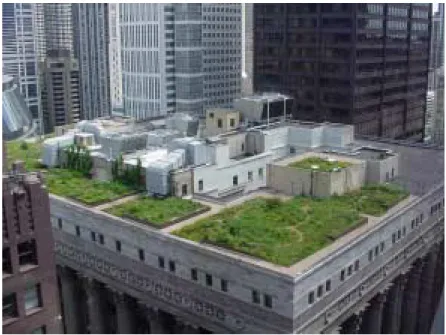
Green, or vegetated, roofs have been used throughout the millennia. Historic references include the hanging gardens of Babylon, Roman roof gardens, English thatched roofs, sod roofs of the Great Plains settlers, and the earth shelters of the 20th century (Kiers, 2002). Contemporary green roofs are widely embraced in Europe but are not frequently employed in North America. A few green roofs in the United States have been constructed by prominent, profit-motivated businesses including The Gap (Burke, 2003) and Ford Motor Corporation (FMC, 2003). Municipalities, including Chicago, IL (City of Chicago, 2003) and Portland, OR (O’Brien, 2003), colleges (McDonough and Braungart, 2002), and private citizens (Hutchinson, 2003) have chosen the vegetated roof for some of their buildings. The Chicago City Hall green roof and adjacent county office building with a built up asphalt roof are shown in Figure 1.
Figure 1. Chicago City Hall intensive green roof. Note the black, asphalt built-up roof on the county’s portion of the building, back right.
Modern green roofs vary substantially in design and appearance, depending upon their intended use and function, building insulation requirements, building code
restrictions, and climatic conditions. However, green roofs typically contain a few standard components--the water proofing membrane, drainage layer, growing medium, and vegetation. A representative green roof configuration is shown in Figure 2.
Figure 2 (American Wick Drain Inc., 2003). Typical green roof components. Most green roofs include at least a waterproofing membrane, drainage layer, growing medium and vegetation, however, each green roof is designed for the specific application and location.
The waterproofing membrane, affixed securely to the roof deck, is typically made of thermoplastic materials such as polyvinyl chloride and may be rolled out in a sheet or applied as a liquid coating. A quality membrane will meet Forschungsgesellschaft
Landschaftsentwicklung Landschaftsbau (FLL) Standards (O’Brien, 2001). These are the only internationally recognized standards for green roof waterproofing membranes
(O’Brien, 2001), although the American Society for Testing and Materials (ASTM) is currently drafting standards for the U.S. (Velasquez, 2004). If the membrane does not have inherent root protection, a barrier is applied to prevent roots from penetrating the waterproofing membrane and causing leaks. Root protection may consist of copper foil or copper powder incorporated into the membrane - high copper concentrations causes plant roots to stop growing or to grow in a different direction (Haupt, 2003; Perry,
2003a). A layer of rigid insulation, such as polystyrene, may be added next to improve energy efficiency.
A drainage layer removes excess water when the plants and growing medium are saturated. Proper drainage is critical to the effectiveness of any green roof (Perry, 2003b). Excess standing water can kill plants, stress the roof structure, cause the waterproofing membrane to breakdown, and eventually penetrate the roof (Osmundson, 1999). Drainage systems may consist of honeycombed plastic structures, expanded polystyrene beads, or lengths of perforated polystyrene tubing among others. A filter fabric prevents soil particles from entering and clogging the drainage layer. This filter material must be lightweight, rot-proof, and permanent (Osmundson, 1999). If the roof pitch is greater than 20 degrees, a grid or lath to prevent erosion is normally installed atop the filter fabric.
The growing medium, or substrate, rests on the filter fabric. The growth medium depends on plant type but is typically lava rock, sand, and humus; not simply top-soil. A typical blend normally consists of 60% mineral rocks, 20% sand, and with no more that 20% of the soil mix organic (Perry, 2003b). In some cases soil may not be necessary at all (Osmundson, 1999). Xeroflor, a green roof company based in Germany, performed tests in which little or no soil was present (Liesecke, 2003). The vegetation, chosen carefully for climatic conditions, can be planted by hydro-seeding, inserted as plugs, or rolled onto the roof as pre-grown vegetated mats. Most plants for green roofs are selected because they have little vertical growth and require no mowing or trimming. Factors such as rainfall, temperature, sunlight, wind, and maintenance requirements must also be carefully considered (Osmundson, 1999).
Green roofs are categorized as extensive or intensive, depending on substrate depth and vegetation type. An intensive green roof resembles a roof garden, with both large and small plants. Intensive roofs accommodate human visitors with aesthetically pleasing plants, walking paths, observation decks, and park benches. Extensive green roofs typically consist of low growth height, succulent plants (sedums) or native grasses (Scholz-Barth:2001). Extensive green roofs typically require less growing substrates and less maintenance than an intensive green roof and are not generally designed to
accommodate frequent foot traffic by humans. An extensive green roof employing sedums is shown in Figure 3.
Figure 3. An extensive green roof atop an apartment building in Germany. Note the low growth height of the sedums.
Methodology
To investigate the feasibility of a vegetated roof installation in the Air Force a literature search, case studies (Yin, 1994), site visits, and a life cycle cost evaluation for an Air Force facility in Dallas, TX were completed by Air Force Institute of Technology
personnel. The literature search was completed to identify benefits noted by other authors and owners of green roofs. Case studies and site visits collected data on multiple green roofs and noted similarities and differences between them.
A life cycle cost evaluation was completed by examining the costs of a new asphalt built-up roof compared to installation of an extensive green roof at Building 15, Air Force Plant 4. Costs for each roofing system were acquired from installers and engineers (Building Logics in Virginia Beach, VA and Lockheed Martin) associated with the potential installation and included removal and disposal of current roof, installation of the new roof, maintenance, and energy savings derived from the roofing system. The Net Present Value of each roofing system was calculated (Fabrycky and Blanchard, 1991). Because there was a range of possible energy savings noted for green roofs and a range of installation costs for the asphalt built-up roof, several iterations of the Net Present Value model were run to determine a range of possible costs.
Results and Discussion
Literature Search, Case Studies, and Site Visits
Published information and data gathered during case studies and site visits with green roofs owners suggest vegetated roofs offer several advantages over conventional asphalt built up roofs. Benefits include reductions in storm water run-off (Rowe et al., 2003; Hutchinson et al., 2003)and reductions in any associated European “rain taxes” (Scholz-Barth, 2001), increased longevity (Perry, 2003a; Scholz-Barth, 2001;
Osmundson, 1999), due to protection of the membrane from temperature variations and UV exposure, with life spans exceeding 45 years, improved thermal insulation and reduced roof temperatures (Liu and Baskaran, 2003), and associated reductions in air
conditioning, reductions in the “urban heat island effect” (Dawson, 2002; Perry, 2003b), improved aesthetics (Burton, 2003) and microclimate(Russell, 2003), increased wildlife habitat, and reduced sound transmission (Burke, 2003).
Life Cycle Cost Evaluation
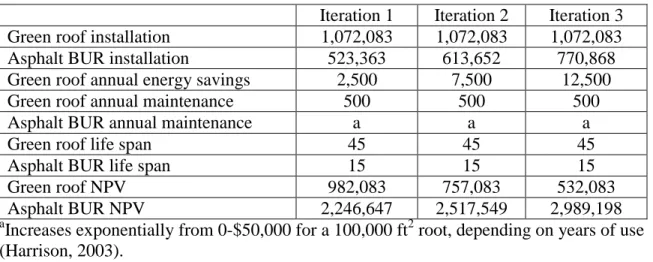
To complete the life cycle cost evaluation, the initial and annual costs of a vegetated roof and asphalt built-up roof, both appropriately designed for the Dallas, TX area, were compared over a 45-year life span. Annual energy use reductions and the associated savings for the green roof were included in the cost model as were annual maintenance expenditures for both roofing systems. Several iterations of the cost model were performed with a range of input values for built up roof installation costs and green roof energy cost savings. Cost information from the model iterations is shown in Table 1. The initial installation cost of the green roof was found to 30-100% higher than the cost of the asphalt built-up roof, however, the maintenance costs of the asphalt roof far exceeded those of the green roof. However, the life cycle cost, as a net present value, of the green roof was shown to be 17-50% of the asphalt built-up roof system, depending upon the initial installation costs of the built-up roof and the energy savings assumed. Table 1. Cost in dollars ($) for three iterations of the life cycle cost model.
Iteration 1 Iteration 2 Iteration 3 Green roof installation 1,072,083 1,072,083 1,072,083 Asphalt BUR installation 523,363 613,652 770,868 Green roof annual energy savings 2,500 7,500 12,500
Green roof annual maintenance 500 500 500
Asphalt BUR annual maintenance a a a
Green roof life span 45 45 45
Asphalt BUR life span 15 15 15
Green roof NPV 982,083 757,083 532,083
Asphalt BUR NPV 2,246,647 2,517,549 2,989,198
a
Increases exponentially from 0-$50,000 for a 100,000 ft2 root, depending on years of use (Harrison, 2003).
Conclusions
Green roofs offer many benefits including reduced storm water run-off and roof surface temperature and increased longevity as compared to conventional roofing systems. Although initial installation costs may be high compared to an asphalt built-up roof, results of this study suggest the green roof may be a cost effective and
environmentally friendly alternative when total life cycle costs are considered. Federal and state government engineers may wish to consider green roofs as an option to meet environmentally beneficial landscaping and life cycle assessment requirements set forth in E.O.13148, energy reduction requirements set forth in E.O. 13123 and other policy mandates. Additionally, architects and engineers may wish to include green roofs as a cost effective strategy to meet L.E.E.D criteria.
References American Wick Drain, “Roof Garden Components”
http://www.americanwick.com/greenroof/grcomponents.shtml
Burke, Kevin. “Green Roofs and Regenerative Design Strategies – The Gap’s 901 Cherry Project.” Proceedings of Greening Rooftops for Sustainable Communities, The First North American Green Roof InfrastructureConference, Awards and Trade Show, May 29-30, 2003, Chicago, IL. pp 1-6.
Burton, Brian. “Green roof designs are growing,” RSImag.com, March 2003.
City of Chicago. “Rooftop Garden on Chicago’s City Hall.” Fact Sheet. Distributed by Chicago Department of Environment. 2003. pp.1-4.
Dawson, Donald. “Plant-Covered Roofs Ease Urban Heat,” National Geographic News, Article, n.p. November 15, 2002.
http://news.nationalgeographic.com/news/2002/11/1115_021115_GreenRoofs.html.
Fabrycky, W.J. and Benjamin S. Blanchard. Life-Cycle Cost and Economic Analysis. Englewood Cliffs, NJ: Prentice Hall, Inc., 1991.
Federal Energy Management Program (FEMP). “EO 13123 Greening the Government Through Efficient Energy Management.” Executive Order. no. pag.
http://www.eere.energy.gov/femp/pdfs/eo13123.pdf . June 1999
Ford Motor Corporation (FMC). “Ford Rouge Center: World’s Largest Living Roof.” Brochure. 2003.
Harrison, Scott A. Facilities Engineer, Lockheed Martin Aero, Ft. Worth TX. Personal Correspondence. 27 June – 17 December 2003.
Haupt, Bertram. President, Famos GmbH, Kyritz, Germany. Personal Correspondence. July 2003.
Hutchinson, Doug and others. “Stormwater Monitoring Two Ecoroofs in Portland, Oregon, USA,” Proceedings of Greening Rooftops for Sustainable Communities, The First North American Green Roof Infrastructure Conference, Awards, and Trade Show. Chicago, IL. May 29 - 30, 2003. pp.1-18.
Kiers, Haven. “Greenroofs: The Last Urban Frontier.” Thesis. University of California at Berkeley. May 2002.
Liesecke, Hans-Joachim.“Test program for construction techniques in USA.” 28 June 2003. Xeroflor: construction techniques for arid regions and the USA, Wolfgang Behrens Systementwicklung 2003.
Liu, Karen, Ph.D. and Bas Baskaran. “Thermal Performance of Green Roofs Through Field Evaluation,” Proceedings of Greening Rooftops for Sustainable Communities, The First North American Green Roof Infrastructure Conference, Awards, and Trade Show. Chicago, IL. May 29 - 30, 2003. pp.1-10.
McDonough, William and Michael Braungart. Cradle to Cradle. New York: North Point Press, 2002.
O’Brien, Mike. “Green City.” City of Portland’s Green Building Program Quarterly Newsletter, Spring 2001, pp 1-4. accessed 3 October 2003.
http://www.sustainableportland.org/G-Rated 20Newsletter.pdf .
Osmundson, Theodore. Roof Gardens. New York: W.W. Norton & Company, Inc. 1999. Perry, Michael. President, Building Logics. Virginia Beach, VA. Personal
Correspondence. July 2003a.
Perry, Michael. “Green Roofs Offer Environmentally Friendly Alternative.” Plant Engineering Magazine, 2003. Article. 20 Aug 2003b.
Rowe, D. Bradley, PhD. and others. “Green Roof Slope, Substrate Depth, and Vegetation Influence Runoff,” Proceedings of Greening Rooftops for Sustainable Communities, TheFirst North American Green Roof Infrastructure Conference, Awards, and Trade Show. Chicago, IL. May 29 - 30, 2003. pp.1-9.
Russell, Donald. Manufacturing Sustainability Manager, Environmental Quality Office, Ford Motor Company, Dearborn, MI. Personal Interview. July 2003.
Scholz-Barth, Katrin. “Green Roofs: Stormwater Management From the Top Down,” Environmental Design and Construction, January 2001.
U.S. Environmental Protection Agency. “EO 13148 Greening the Government Through Leadership in Environmental Management.” Legislation. April 2000.
http://www.epa.gov/fedsite/eo13148.htm.
U.S. Green Building Council (USGBC). “Leadership in Energy & Environmental Design”, homepage. 15 September, 2003. http://www.usgbc.org/leed/leed_main.asp.
Velasquez, Ralph. Engineer, Building Logics. Virginia Beach, VA. Personal Correspondence. January 2004.
Yin, Robert K. “Case Study Research: Design and Methods (2nd edition), Thousand Oaks, California: SAGE Publications, Inc., 1994.