A CASE STUDY OF HIGHER EDUCATION COMPETENCY MODELS UTILIZING AN ASSESSMENT FRAMEWORK
BY Copyright 2012 JAYME UDEN
Submitted to the graduate degree program in Educational Leadership and Policy Studies and the Graduate Faculty of the University of Kansas in partial fulfillment of
the requirements for the degree of Doctor of Education.
________________________________ Chairperson Lisa Wolf Wendel ________________________________ Susan Twombly ________________________________ Dongbin Kim ________________________________ Jennifer Ng ________________________________ Tom Krieshok
The Dissertation Committee for Jayme Uden
certifies that this is the approved version of the following dissertation:
A CASE STUDY OF HIGHER EDUCATION COMPETENCY MODELS UTILIZING AN ASSESSMENT FRAMEWORK
________________________________ Chairperson Lisa Wolf-Wendel
A Case Study of Higher Education Competency Models Utilizing an Assessment Framework
Abstract
The overall purpose of this study is to explore the creation and implementation of competency models in higher education masters level preparation programs. The study answers five research questions. Why and how did two higher education preparation programs create a professional competency model for the graduate students in the program and what are the
characteristics of those competency models? What outcomes and assessment measures have been identified? How have faculty members and graduate assistantship supervisors created intentional experiences that lead to the identified outcomes? How have assessment results been used to improve learning? How do stakeholders perceive the competency model and its effectiveness? Through case studies of two student affairs preparation programs at Colorado State University and Bowling Green State University, which have already created and implemented competency models for their master’s level graduate students, I provide guidance and direction for other preparation programs that are hoping to implement models in the future or programs that are hoping to revise their models to better meet students. The case studies included document analysis and interviews with faculty members, graduate assistantship supervisors, and graduate students. I drew five major conclusions from the study. Several factors influenced the adoption of the competency model, but the decision-making process for selecting specific competencies for the model cannot be explained by a theoretical framework. Competency models are more alike than different despite not being exactly the same. Structure and accountability are important for the students in order for them to be successful with the model. A connected social
Acknowledgements
I want to first and foremost thank my family members. They have been a great source of support for me throughout this whole process. Most importantly, Beth, my wife, has been my champion, my challenger, and my shoulder to lean on. I want to thank my advisor, Lisa. She has been a great coach and mentor, while providing me the constructive criticism and direction I needed. I want to express my appreciation to my respondents and contacts at both Bowling Green State University and Colorado State University who provided me with the information necessary to complete my research. I also want to thank my current and past supervisors and colleagues who have provided me the physical and mental time to focus on the research and writing. Completing a dissertation while working full-time would not have been possible without a supportive and understanding place of employment.
Table of Contents
Abstract ... iii
Acknowledgements ... iv
Table of Contents ... v
Chapter One – Introduction, Research Questions, Conceptual Framework ... 1
Chapter Two – Literature Review ... 17
Chapter Three – Methodology ... 30
Chapter Four – Results ... 40
Bowling Green State University ... 40
Colorado State University ... 72
Chapter Five – Comparison and Analysis of Case Study Sites... 101
Chapter Six – Conclusions and Implications ... 135
Appendix A – Definitions ... 156
Appendix B – Bowling Green State University Competency Model ... 159
Appendix C – Colorado State University Competency Model ... 161
Chapter One Introduction
In the summer of 2007, a meeting was held involving supervisors of higher education graduate interns and the faculty within the Higher Education Program at the University of Kansas. The goal was to increase communication between the academic program and the internship sites. As a result of this meeting, a committee was formed to examine the
competencies that higher education interns should acquire. I was asked to serve as the chair for this committee. The committee’s charge was to develop a competency model that could embody all of the diverse internships available for the students in the program. At the time, there was not a master document of competencies for the profession like ACPA/NASPA produced in 2010. The competency model at the University of Kansas was to have three basic purposes. First, it could hopefully bring some uniformity to every intern’s experience. This could increase accountability to the internship sites making sure that the sites and the graduate intern
supervisors provided meaningful experiences for the interns. Second, it would also enable the higher education program to identify the competencies that graduates of the program would be able to acquire. This could be a great recruitment tool for the program. Finally, it would be a great resource to aid and assist in the personal and professional development of the intern.
The committee met biweekly for a year to put together the competency model that is now utilized. Research was gathered from several organizations and institutions. A focus group of interns was used to refine the final draft of the competencies. The competency model consisted of six competencies that each intern should be able to develop and achieve within the internship. These competencies were personal and professional development, multicultural competence, communication, educational skills, programming, and administration and organization
management. The competency tool was created in order to assess the competency range of each intern and then aid them in identifying experiences to develop those competencies. The
competency model was implemented for fall 2008 for both first year and second year graduate students in the higher education program.
My work with this committee was the impetus for my dissertation topic. Throughout my experiences on the committee, I questioned the methods of creating the competency model, the potential effectiveness of it, and the overall experiences of the graduate interns at the University of Kansas. I began to wonder if and how other higher education programs were implementing and using competency models. I believe my research to be very timely for the profession of student affairs. When I first chaired the committee at the University of Kansas, and even when I first started researching for my dissertation topic, not a lot had been done at the national level. The ACPA/NASPA list of competencies was introduced in 2010 and even one of my case study sites decided to change from their own list of competencies to the ACPA/NASPA list the year prior to my study. I hope my research leads to a better understanding of competency-based education in higher education programs for myself and for others as it is an important and hot topic for the field
Competencies in Higher Education
The National Center for Education Statistics (NCES) of the U.S. Department of
Education defines a competency as “the combination of skills, abilities, and knowledge needed to perform a specific task” (Jones & Voorhees, 2002; p. 12). Both Alverno College and Western Governors University (WGU) are long known for their efforts to reform general education around outcomes similar to competencies (Voorhees, 2001; Voorhees, 2001). The core of competency-based curriculum design at Alverno and WGU is to “ensure that learners will be
able to demonstrate their learned capabilities after they have acquired a necessary combination of knowledge, skills, and abilities. Competencies-based initiatives are growing in popularity in all of higher education, and that growth is seeping into student affairs preparation programs (Chyung, Stepich, & Cox, 2006; Voorhees, 2001; Jones & Voorhees; Kuk & Banning, 2009). However, it is important that I separate competency-based education from the competency models discussed in this study and utilized at the two case study sites. Competency-based education is a more comprehensive curriculum design than a competency model. Competency-based education includes identification of competencies, changes in delivery systems and pedagogy, and true assessment of those specific competencies. The competency models
described in this study serve as a guide for student learning, reflection, and professional journey. The programs in this study have a competency model, but utilize traditional delivery methods and both indirect and direct measures of the competencies. According to Chyung, Stepich, and Cox (2006), the clear identification of competency-based education is the use of “criterion-referenced, measurable assessment methods” to determine if a student acquired a specific competency (p. 309).
This is not to say that the competency models implemented in the case study sites do not advance the learning and development of the graduate students. Competencies help the learner and faculty identify the intended and actual outcomes of a learning experience. Kuk and Banning (2009) state that a well-designed competency model “integrates outcome assessment throughout the design and implementation of the curricular and educational process” (p. 492). Competencies not only identify outcomes, though; they also provide students with a clear map and the tools to reach it (Voorhees; Chyung, Stepich, & Cox; Kuk & Banning). Little has been done to research and understand competency models in student affairs preparation programs.
Masters level graduate preparation programs in student personnel exist in order to prepare individuals for careers in student affairs and higher education administration. These programs provide knowledge, research, and experiences in order to assist students in their acquisition of the necessary competencies to be successful student affairs professionals. The ACPA Directory (2010) currently lists over 150 preparation programs in student affairs that meet specific
guidelines: employs at least one full-time faculty member, contains at least four content courses about student affairs and the college student, is at least two academic years in duration, and has at least one practicum opportunity for students. Different programs at different institutions have different core emphases and different curricula; however, the overall goal of preparing student personnel professionals is the same (Badders, 1998; Hyman 1988; Keim, 1991; Meabon & Owens, 1984; Richmond & Sherman, 1991; Waple, 2006). Opinions may also differ in what competencies are necessary for the professionals in the field of student personnel and what competencies are actually acquired during graduate programs. Hyman identified 33 entry level competencies from a literature review, while Herdlein (2004) used 12 knowledge/skill areas and 6 learning outcomes in his study on the relevance of graduate preparation programs. In recent years, the Council for Accreditation of Counseling and Related Educational Programs, or CACREP, (2001) the Council for the Advancement of Standards in Higher Education, or CAS, (2003) and the Council for the Advancement of Higher Education Programs, or CAHEP, (2009) have attempted to standardize the experience of students in these programs. In 2010, NASPA and ACPA also created a list of competencies necessary for all levels of student personnel
professionals.
For ease in discussion within this particular study, certain common key phrases will be used. Student affairs will refer to the field of student affairs, student personnel, and/or student
services. Higher education will be utilized as a term interchangeable with student affairs.
Competencies will be defined as a combination of skills, abilities, and knowledge needed to perform a specific task. Finally, preparation programs will specifically refer to master’s degree graduate programs in student affairs. The decision to choose select phrases merely eases and facilitates discussion and comprehension of the topic; this study does not examine the effectiveness of a chosen phrase over other possible choices. These definitions and other important key terms are included in Appendix A.
Purpose of Study
The purpose of this study is to explore the creation and utilization of competency models in higher education masters level preparation programs, to understand what outcomes and assessment measures have been identified in competency models, to discover how faculty members, graduate students, and graduate assistantship supervisor perceive the competency models and their effectiveness, to look at the experiences that programs provide for graduate students to help them develop the competencies, and to understand how assessment measures have been used to assess learning. Through case studies of two student affairs preparation
programs that have already created and implemented competency models for their master’s level graduate students, this study provides guidance and direction for other preparation programs that are hoping to implement models in the future or programs that are hoping to revise their models to better meet student needs. Through document analysis and interviews of faculty members, graduate assistantship supervisors, and graduate students of two selected preparation programs, I offer descriptive insight into the implementation process of a competency model and what influenced individual decisions about the competency models.
1. Why and how did two higher education preparation programs create a professional competency model for the graduate students in the program?
2. What are the characteristics of those competency models? What outcomes and assessment measures have been identified?
3. How have faculty members and graduate assistantship supervisors created intentional experiences that lead to the identified outcomes?
4. How have assessment results been used to improve learning?
5. How do stakeholders perceive the competency model and its effectiveness?
This study is important because of the lack of consensus of the competencies necessary for student affairs professionals. Kretovics (2002) states that the literature on competencies “reveals no consensus about core competencies for student affairs practitioners” (p. 913). Kuk and Banning (2009) also cite that there is little research regarding competencies or outcomes assessment related to student affairs preparation programs. Though this study will not create consensus, it will provide a descriptive look at how two student affairs preparation programs create and utilize competency models to assist in the education and development of graduate students. NCES emphasizes the importance of ensuring that competencies are both valid and reliable, as well as ensuring that competencies are utilitarian and uniform across contexts and audiences (Jones & Voorhees, 2002).
There are several limitations to the existing research that affect the ability to generalize results to the greater population and that are an impetus for further research. First, there is a lack of sound research studies on the topic of competencies in student affairs in peer-reviewed journals. Second, there is a breadth of literature about assessment, but no research about the assessment of competency models in the field of student affairs. Finally, much of the existing
research is out-dated. Many of the studies used within this review were completed outside the last ten years. Higher education preparation programs are responsible for providing quality educational experiences that will prepare graduates for work in the field of student personnel (CAHEP, 2009; Herdlein, 2004). Establishing learning outcomes and competencies is necessary in order to provide expectations for those quality educational experiences. Critics of these
preparation programs have concerns that programs provide insufficient education and inadequate training in the necessary competencies (Beatty, 1990). Challenges of accountability and
respectability have been present for programs since the inception of the field according to Beatty. Despite these problems of uniformity and accountability, the student affairs field looks to masters level preparation programs to develop young professionals for future careers in student personnel. Programs are seeing the need to establish learning outcomes and/or competency models for their students in order to better prepare them for their entry-level work. The literature is not clear whether specific competencies are developed through practical experiences and if others are developed through coursework. One could assume that both the in-class and out-of-class experiences are important in order to develop the whole professional, but finding
distinctions might be difficult when it comes to assessment. Faculty members have more control over the coursework, while supervisors have more control over the out of class experiences. Regardless, research has pointed to the fact that faculty members and practitioners must collaborate more in order to aid graduate students in the acquisition of these competencies (Foster & Ward, 1996; Nash & Manning, 1996). All of the higher education preparation
programs that I identified originally as possible case study sites require graduate students to have assistantships and to complete a certain number of practica credits to complement the academic coursework. The assistantships and practica will be explained more in detail in Chapter 2 of this
study. Faculty members, department leaders, graduate assistantship supervisors, and the graduate students are all stakeholders in the effort to improve the graduate experience through the use of competencies. This study provides insight into student affairs programs that have created and implemented competency models and how that experience affected the stakeholders. It can also be of benefit to potential and current graduate students of student affairs preparation programs who are hoping to learn more about competency models and the effect they can have on graduate students’ development. By providing relevant research on competencies in higher education, graduate students can reflect on and plan their graduate program experiences in order to be more successful as professionals.
Conceptual Framework
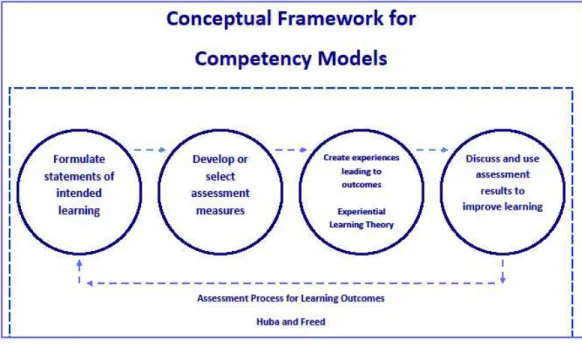
The conceptual framework for this study will be a multi-faceted model utilizing two different theories. This model is depicted in Figure 1. The core of the framework is the learner-centered assessment model by Huba and Freed (1999). This framework provides a
comprehensive depiction of the creation, implementation, utilization, and evaluation of
competency models. One other theory is also important to the study. The Experiential Learning Theory (Dewey, 1986) describes how experiences are created to develop specific competencies. This theory and the entire framework are explored in this section.
Huba and Freed (1999) support learner-centered assessment. They define assessment as “the process of gathering and discussing information from multiple and diverse sources in order to develop a deep understanding of what students know, understand, and can do with their knowledge as a result of their educational experiences; the process culminates when assessment results are used to improve subsequent learning” (p. 684). Huba and Freed identify four
of intended learning outcomes. Second is the development or selection of assessment measures. The creation of experiences leading to the outcomes is the next step. Finally, stakeholders must discuss and use the assessment results to improve learning. This last step leads back to the beginning of the model in case any changes or adaptations need to be made for the future. FIGURE 1 – Conceptual Framework
The first element of learner-centered assessment is the identification of intended learning outcomes, or creation of the competency model. This describes the intentions about what the graduate students should know, understand, or be able to do upon graduation (Huba & Freed, 1999). Developing competencies and intended outcomes helps the student affairs preparation program be learner-centered. When this assessment takes place at the broad program level instead of the course level, it enables only the most important goals to be addressed, according to Huba and Freed. The first and second research questions for this study investigate this element. The programs have identified intended outcomes, or competencies, which are focused on what the learner should develop, or acquire through the experience.
The second step of the assessment process is designing or selecting the assessment measures that will identify whether the learning outcomes, or competencies, have been achieved. Competencies can be evaluated through both direct and indirect measures (Huba & Freed, 1999). Direct measures include projects, portfolios, observations of skills, and written and oral exams. Indirect measures include self-reports by the graduate students or shared perceptions of
supervisors or future employers. To provide the most accurate and useful assessment of
outcomes, both direct and indirect measures should be used according to Huba and Freed. This study investigates both the types of measures that student affairs preparation programs might be using to assess the competencies. I analyze direct measures through document analysis of any projects, written assessments, and student portfolios. Direct measures include anything that enables me to identify what competencies are being addressed and/or developed. Indirect assessment will be formed through interviews with students, faculty members, and graduate assistantship supervisors.
Providing experiences for students to develop their competencies is the third element of the assessment process (Huba & Freed, 1999). For the purpose of this study, Dewey’s Theory on Experiential Learning (1986) is used to explain this element. The experiential learning theory applies directly to the development of competencies. It is through practical experiences and hands-on learning that graduate students in higher education preparation programs get the chance to develop the competencies that they must acquire to be successful in their future careers
(Dewey). Though Dewey’s initial theory focused mostly on experiences in elementary and secondary classrooms, it is applied here to the core experiences that graduate students receive out of the classroom. The graduate assistantship supervisor can act as the guide or leader of a
competencies. The supervisor can help the graduate student identify strengths and challenges, while also making time for opportunities to properly reflect on learning experiences. The components are explained further in later in this chapter.
Huba and Freed (1999) state that student’s learning is affected by the way experiences are organized, sequenced, and connected. The experiences might also be built to address all the competencies that are identified. As the competency model is created, the program could “include activities and experiences that will help students acquire the knowledge, skills, and understand that each of our learning outcomes requires” (Huba and Freed, p. 688). This study examines the experiences within the graduate program that are designed by supervisors or
faculty member to develop competencies, as well as how identified competencies and the desired outcomes are communicated to students and their supervisors.
Finally, stakeholders can discuss and use assessment results to improve learning. Faculty members, assistantship supervisors, and graduate students can utilize results in order to build experiences, make necessary changes, and improve overall student performance (Huba and Freed, 1999). This study examines how all three groups of stakeholders do or do not use the competencies models to reflect on experiences and make future plans. With the assessment results, the stakeholders can adapt the model, competencies, assessment measures, and experiences as necessary. Discussions might not only be happening in individual settings, but also in larger group settings in order to evaluate and adapt the overall model and its
effectiveness.
This overall conceptual framework is considered in full to assess the creation, implementation and use of competency models. Learner-centered assessment supports the attributes of a quality education (Huba & Freed, 1999). It “synthesizes experiences, fosters
ongoing practice of learned skills, and integrates education and experience” (Huba & Freed, p. 694). The constant discussion and evaluation at multiple stages of competency development enhance the overall learning experience. Moreover, focusing on learning outcomes within specific academic programs communicates the importance of certain skills when evaluating professional competence” (Aloi, 2003). That means that the identified competencies can focus on skills and abilities central to the discipline of higher education and based on professional
standards of excellence (Huba & Freed, 2000). Experiential Learning Theory
The Experiential Learning Theory (Dewey, 1986) corresponds to the third step of the Huba and Freed’s assessment model (1999). The Experiential Learning Theory is specifically used to describe the learning experiences of students. As mentioned earlier, Dewey’s theory originally was applied to students in early education. However, the overall purpose of the theory is still relevant for students in higher education. The theory is based on the idea that the
responsibility of educating students involves the entire social environment of the educational system, and not just the faculty member. Knowledge and skills are learned through quality experiences that must be created for the student.
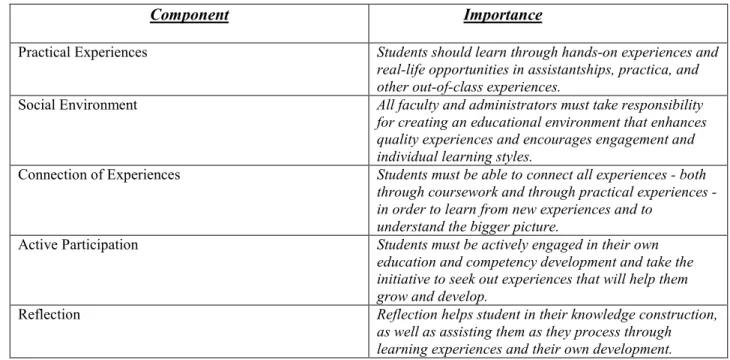
I have identified five components of Dewey’s (1986) Experiential Learning Theory as being important for the purposes of this study. These components are practical experiences, social environment, connection of experiences, active participation, and reflection.A summary of the concepts of the Experiential Learning Theory that are important for this study are located in Figure 2. This study focuses on out-of-the-classroom experiences that are generally provided through assistantships and practica established in higher education programs. Graduate
(Saltmarsh, 2008). I am interested in how the supervisor-graduate assistant relationship influences the success of competency development. Saltmarsh holds that the supervisor can provide the graduate student opportunities to solve complex problems and can address real-life situations that will enhance their knowledge and learning according to the experiential learning theory. Graduate students could spend 20 or 30 hours of their week within their assistantships and their supervisor will likely influence the quality of the assistantship experience they receive. Supervisors can assist their graduate students to develop and acquire the necessary competencies by providing practical experiences in their assistantships. Hands-on learning will enhance
comprehension of and engagement in the subject matter (Dewey, 1986; Foster & Ward, 1996). The question is how does the supervisor provide effective learning experiences for the graduate students in order for them to apply what they learn in classrooms to what they are doing in their internship? This will be asked of the supervisors that are interviewed.
I am also interested in how faculty members might influence what experiences occur through assistantships and practica. What do faculty members require of graduate students and what classroom exercises occur to enhance competency development? In the theory on
experiential learning, “the teacher loses the position of external boss or dictator, but takes on that of leader of group activities” (Roberts, 2003, p. 5). Dewey (1986) criticized traditional
educational approaches for not engaging students and for not addressing the different learning styles of students. Instead, he encourages teachers to be responsible for both subject matter and individual learners. How do faculty members determine what the appropriate learning
experiences are for students to produce desired learning outcomes? I hope to find this out through the study and learn how the faculty attempts to enhance the competency model and its effectiveness.
“Experiences may be so disconnected from one another that, while each is agreeable or even exciting in itself, they are not linked cumulatively to one another” (Dewey, 1986, p. 247). The experiential learning theory is based on the fact that learning is maximized when
experiences are connected for students. How are higher education programs constructed both in the classroom and outside the classroom in order for graduate students to use the theory and learning in one experience in order to make better decisions in future experiences
(Dewey)? Knowledge creation for graduate students is a two-way process as they ideally are both consumers and producers (Saltmarsh, 2008). How do educators and supervisors challenge the students to be active participants in their own experiential learning process? The assumption is that the competency models that are addressed in this study are more effective if the graduate student is self-oriented. Interviews with faculty and supervisors might reveal whether this assumption is true. Dewey believed that education is more effective when the learner is ready and when he or she has the desire to learn more (Stuckart & Glanz, 2007). In this theory, a graduate student who wants to develop competencies is going to be a lot more successful than one who is indifferent or apathetic to the concept. When and how are experiences connected for graduate students? All influences will be addressed in the study and how those influences play in a role in the graduate students overall effectiveness.
The final concept to point out about the experiential learning theory is the importance of reflection (Stuckard & Ganz, 2007; Carpenter, Patitu, Cuyjet, 1999). Much like the need for experiences to be connected for students, Dewey (1986) believed that it is crucial for students to be engaged in some sort of reflection about their experiences. Faculty members and supervisors might have the responsibility of holding their graduate students accountable for this reflection whether it is through papers, portfolios, discussions, or journaling. Examples of reflection
exercises are included as part of the document analysis. Reflection allows the graduate student to create knowledge and apply that knowledge to future experiences. This opportunity for
metacognition advances analytical skills and helps the graduate student understand how to further develop their competencies through further experiences (Stuckard & Ganz). [Learning] develops best “as a result of reflective, strategic, real-world problem-solving action and
experience” (Saltmarsh, 2008, p. 63). I asked all stakeholders if and how reflection was
occurring as an organized and/or informal activity. Dewey’s theory raises several questions for the researcher that tie back to the original research questions for the study. I agree with some of the assumptions and suggestions that Dewey holds in regards to effective experiential learning. These assumptions and suggestions provide a model for which I compare and contrast what is actually happening for graduate students in higher education preparation programs.
FIGURE 2 – Summary of Components of Dewey’s Experiential Learning Theory. These components have been identified by the researcher as areas to research when studying competency models.
Component Importance
Practical Experiences Students should learn through hands-on experiences and real-life opportunities in assistantships, practica, and other out-of-class experiences.
Social Environment All faculty and administrators must take responsibility for creating an educational environment that enhances quality experiences and encourages engagement and individual learning styles.
Connection of Experiences Students must be able to connect all experiences - both through coursework and through practical experiences - in order to learn from new experiences and to
understand the bigger picture.
Active Participation Students must be actively engaged in their own education and competency development and take the initiative to seek out experiences that will help them grow and develop.
Reflection Reflection helps student in their knowledge construction, as well as assisting them as they process through learning experiences and their own development.
I believe this study is very important as there has been very little research involving how effective competencies models are and if they are meeting the desired outcome. The desired outcome is also not uniform across programs. This study does not create uniformity, but it does provide necessary research into the creation, implementation, and utilization of competency models. Outcomes assessment is very important if programs are going to ensure that graduates have obtained the necessary competencies. This study provides a comprehensive description of programs using competency models in order to educate all stakeholders: faculty, graduate assistant supervisors, graduate students, and future employers.
Conclusion
This multi-theory conceptual framework is applied to the study of all aspects of the creation, implementation, and maintenance of a competency model for a higher education master’s level graduate program. Huba and Freed’s Assessment Model (1999) is the core of the framework, while Dewey’s Experiential Learning Theory (1986) is an integral piece and part of the third step in the assessment model. The framework provides the general basis for how I direct the study and provides direct influence on what questions are asked of interviewees and focus group participants. In Chapter Two, I provide literature and past research regarding competencies in higher education, as well as the practical experiences provided in graduate school.
Chapter 2 Literature Review
not discussed in literature, but the wide differences in competency models support the need for this study. In this literature review, I first discuss competency-based initiatives in general education. Second, I discuss past studies regarding competencies specifically in student affairs preparation programs. Third, the identification and establishment of necessary student affairs competencies by professional organizations is covered. Next, I analyze the differences in the literature between the competencies that are important and the competencies that are actually acquired. Finally, the experiences and opportunities commonly utilized by student affairs graduate preparation programs to develop competencies are discussed.
Competency-Based Initiatives in General Education
Interest in the skills needed for employment in the United States increased with the establishment of the National Skills Standards Board of the United States in 2000 (R. Voorhees, 2001). Competency-initiatives have also accelerated recently in other locations like Australia, New Zealand, United Kingdom, and many other European nations (R. Voorhees). Even though Alverno College and Western Governors University are probably the institutions most widely-known for their competency-based education, Kings College and Northwest Missouri State University are also well-known institutions utilizing competency-based education (R. Voorhees; A. Voorhees, 2001).
Alverno College (2012) defines its curriculum based on the abilities that students will need to be effective after they graduate. In its mission, Alverno says that “the curriculum is ability-based and is focused on student outcomes integrated in a liberal arts approach” (p. 1). Students complete a core curriculum plus courses for their selected major and minor, but also develop the eight abilities that Alverno has identified are important for all graduates. These abilities are communication, analysis, problem solving, valuing, social interaction, developing a
global perspective, effective citizenship, aesthetic engagement.
Degrees at Western Governors University are defined not by courses taken within a particular area of study or major requirements, but instead by categories of competencies organized by domains (Voorhees, 2001). The domains may serve one degree or several degrees at once. Students work with faculty and mentors to develop learning plans to a development of the competencies under the domains developed for the desired certificate or degree. The WGU website (2012) markets to students that their focus is “not on class attendance,” but rather on ensuring that graduate possess skills and knowledge necessary for success.
Competencies in Student Affairs Preparation Programs
Hyman (1988) identifies 33 entry level student affairs competencies and places them into the five broad categories of goal-setting, consultation, communication, assessment and
evaluation, and environmental and organizational management. Most other models in the
literature differ in structure and content. Kuk, Cobb, and Forrest (2007) identify four overarching competency factors: individual practice and administrative skills, professional knowledge
content, goal setting and the ability to deal with change, and managing organizations and groups. Likewise, Beatty and Stamatakos (1990) developed six general competency areas for higher education that could hold all specific competencies within: theoretical competence, scholarly competence, functional competence, transferral competence, environmental competence, and human relations competence. Herdlein (2004) uses 12 knowledge/skill areas and six learning outcomes, including complex cognitive skills, knowledge acquisition, interpersonal
development, intrapersonal development, practical competence, and civic responsibility, while Waple (2006) uses 28 selected skills in his study.
studies. Ostroth assesses the importance of 18 specific courses and five general areas of study for higher education: counseling, administration and management, higher education, social and cultural foundation, research and evaluation. Reardon, Lumsden, and Meyer (2005) found employers identified eight general, transferable skills: communication, creativity, critical thinking, leadership, life management, social responsibility, teamwork, and technical/scientific skills. Finally, the Tomorrow’s Higher Education (T.H.E.) model was commissioned by the American College Personnel Association and stresses the combination of six necessary
competencies: goal setting, assessment, instruction, consultation, management, and evaluation (Hyman, 1988; Waple, 2006).
With all of the discrepancies in the research in regards to competencies in the field of higher education, one should address the commonalities. Student development theory,
leadership, research and assessment, communication skills, counseling, and administration and management are all areas of competencies that are identified in at least three studies as being important to student affairs practice (Herdlein, 2004; Hyman, 1988; Lovell & Kosten, 2000; Ostroth; Waple, 2006). However, the ranking of these competencies compared to other
competencies listed differed in importance within each study. It is also important to note that not even these common competencies could be agreed upon across literature. I have created a table (Figure 3) to help readers understand the frequency use of competencies in literature and studies. The first column in the table identifies the specific competency. The second column lists the sources that distinguish the specific competency for use in their study. These competencies listed within Figure 3 are defined specifically in Appendix A. This summary of the literature as well as the work of relevant professional organizations is important to consider as I look at the
that have been identified by the two programs and the competencies listed in the chart.
COMPETENCY
Assessment, Research, & Evaluation
Communication Skills Written and/or Verbal
Budgeting and Finance
Human Resource Management
Counseling
Administrative/Management Skills
Leadership Skills/Development
Computer Skills/Technology
Organization Behavior and Develop
Legal Issues
Program Development and Evaluation
Interpersonal Relations
Time Management
Problem-solving/Decision-making
SOURCE
Beatty,1990; Burkard et al., 2005; Hyman, 1985; Ostroth, 1975; CAHEP, 2009; CAS, 2003; CACREP, 2001; Herdlein, 2004; Kuk, Cobb, & Forrest, 2007; Lovell & Kosten, 2000; ACPA/NASPA, 2010
Ostroth, 1975; CAS 2003; Burkard et al., 2005; Beatty, 1990; Hyman, 1985; CAHEP, 2009; Herdlein, 2004; Kuk et al., 2007; Lovell & Kosten, 2000; Waple, 2006; ACPA/NASPA, 2010 Beatty, 1990; Burkard et al., 2005; Hyman, 1985; CAHEP, 2009; CAS, 2003; CACREP, 2001; Herdlein, 2004; Waple, 2006; ACPA/NASPA, 2010
Beatty, 1990; Hyman, 1985; CAHEP, 2009; CAS, 2003; CACREP, 2001; Herdlein, 2004; Lovell & Kosten, 2000; ACPA/NASPA, 2010
Beatty, 1990; Burkard et al., 2005; Newton, 1976; Ostroth, 1975; CAS, 2003; Herdlein, 2004
Beatty, 1990; Burkard et al., 2005; Newton, 1976; Hyman, 1985; Herdlein, 2004; Kuk et al., 2007; Lovell & Kosten, 2000; Beatty, 1990; Burkard et al., 2005; Hyman, 1985; CAHEP, 2009; CAS, 2003; Herdlein, 2004; Lovell & Kosten, 2000; ACPA/NASPA, 2010
Beatty, 1990; Burkard et al., 2005; Newton, 1976; CAHEP, 2009; Herdlein, 2004; Waple, 2006; ACPA/NASPA, 2010 Beatty, 1990; Burkard et al., 2005; CAHEP, 2009; CAS, 2003; CACREP, 2001; Waple, 2006; ACPA/NASPA, 2010
Hyman, 1985; CAHEP, 2009; CACREP, 2001; CAS, 2003; Herdlein, 2004; Lovell & Kosten, 2000; Kuk et al., 2007; Waple, 2006; ACPA/NASPA, 2010
Beatty, 1990; Hyman, 1985; CAHEP, 2009; CACREP, 2001; CAS, 2003; Kuk et al., 2007; Waple, 2006; ACPA/NASPA, 2010
Beatty, 1990; Burkard et al., 2005; Hyman, 1985; CAS, 2003; CACREP, 2001; Herdlein, 2004; Kuk et al., 2007;
Burkard et al., 2005; Newton, 1976; Hyman, 1985; CAHEP, 2009; CACREP, 2001; Herdlein, 2004; Kuk et al., 2007; Burkard et al., 2005; Hyman, 1985; CAHEP, 2009; Kuk et al., 2007; Waple, 2006;
Teamwork/Collaboration Advising Skills Supervision Skills Crisis Intervention Conflict resolution/mediation Multicultural competence/Ability to work with a Diverse
Population/Inclusivity/Equity Ethical Behavior
Vision
Burkard et al., 2005; Hyman, 1985; CAHEP, 2009; Herdlein, 2004; ACPA/NASPA, 2010
Burkard et al., 2005; Hyman, 1985; CAHEP, 2009; Waple, 2006; ACPA/NASPA, 2010
Burkard et al., 2005; Hyman, 1985; CAS, 2003; Herdlein, 2004; Waple, 2006; ACPA/NASPA, 2010
Burkard et al., 2005; Hyman, 1985; CAS, 2003; CACREP, 2001; Waple, 2006; ACPA/NASPA, 2010
Burkard et al., 2005; Hyman, 1985; Herdlein, 2004; Waple, 2006; ACPA/NASPA, 2010
Burkard et al., 2005; Newton, 1976; Hyman, 1985; CAS, 2003; CACREP, 2001; Herdlein, 2004; Kuk et al., 2007; Waple, 2006; ACPA/NASPA, 2010
Burkard et al., 2005; CAHEP, 2009; CACREP, 2001; CAS, 2003; Herdlein, 2004; Kuk et al., 2007; Waple, 2006; ACPA/NASPA, 2010
Burkard et al., 2005; Hyman, 1985; CACREP, 2001; CAHEP, 2009; ACPA/NASPA, 2010
Professional Organizations
This section of the literature review looks specifically at the competencies identified as important by several different professional organizations. I am specifically interested in investigating if and how the work of these organizations has influenced the creation and implementation of the competency models at the case study sites.
After several efforts from various organizations to produce standards in the area of competencies, the work of two organizations emerged: the Council for the Advancement of Standards in Higher Education, or CAS, and the Council for the Accreditation of Counseling and Other Related Educational Programs, or CACREP. Both organizations reflect the influence of the Association of College Personnel Administrators (ACPA) in their attempt to create graduate standards in order to provide criteria for academic programs to judge their effectiveness (CAS, 2003). The standards created by CAS (2003) address all aspects of the preparation programs
including recruitment and admissions, pedagogy, program evaluation, and equity and access. CAS includes a list of areas in which students must demonstrate competence including student development theory, organization and administration, counseling, and assessment, evaluation, and research. CAS also emphasizes the need for history and philosophical foundations of higher education and student characteristics and effects of college on students. Assistantships are a required standard for students, as well as practica. Interestingly, CAS does not specifically describe what competencies can be developed through practical experiences versus through the formal curriculum.
CACREP (2001) developed standards for all counseling and related educational programs. These standards include professional identity, social and cultural diversity, human growth and development, career development, helping relationships, group work, assessment, and research and program evaluation. It specifically addresses the need for graduates in student affairs programs to demonstrate the necessary knowledge and skills in the areas of foundations for student affairs, contextual dimensions, and knowledge and skill requirements for
professionals. Though many of these core areas are broader in title, CACREP also has some common competency categories found in other literature in which CACREP emphasizes a need for graduate students to acquire. These common competencies include research, assessment, and program evaluation, counseling, legal issues, multicultural competence, student development, and leadership. Similar to CAS (2003), CACREP also has several other areas that are not listed throughout the literature, which include historical foundations, characteristics of students, impact of college environments, and supervision.
Recently, the Ad Hoc Committee on Guidelines and Standards of the Council for the Advancement of Higher Education Programs, or CAHEP, produced a set of self-assessment
guidelines for preparation programs (CAHEP, 2009). This report sets up proposed program guidelines and standards in three broad domains: the program domain, the content domain, and the performance domain. The program domain addresses general program operations and includes the mission and vision, structure, faculty members, department leadership, program culture, credit requirements, and program assessment. The content domain addresses issues of curriculum and content. CAHEP recommends 11 topics that could be included as core content, but does not limit programs to only those 11 topics. The content domain also addresses the need for a capstone experience. The performance domain refers to the knowledge and skills
(competencies) that students should be able to demonstrate as graduates. CAHEP recommends 15 competencies: assessment and evaluation, finance and budget, communication skills, decision making and problem solving, ethical behavior, inclusivity, interpersonal skills, leadership, leadership development, management, resilience, project management, teaming, technological competence, and vision. It is important to note that most of the competencies presented in the CACREP (2001) and CAS (2003) standards are related to the academic curriculum. CAHEP, on the other hand, lists a performance domain including competencies that would be developed through practical experiences.
The two organizations that represent and guide the student personnel profession, the American College Personnel Association, or ACPA and the National Association of Student Personnel Administrators, or NASPA, have also worked together to create a list of outcomes that define the skills, knowledge, and competencies that all professionals in the field should be able to demonstrate. This list of professional competency areas attempts to embody all outcomes, regardless of the professional specialization and level of experience (ACPA/NASPA, 2010). The list is designed to assist professionals as they seek out experiences and opportunities that will
allow them to grow in their professional development. The broad areas that have been identified are advising and helping, assessment, research, and evaluation, equity, diversity, and inclusion, ethical professional practice, history, philosophy, and values, human and organizational
resources, law, policy, and governance, leadership, personal foundations, and student learning and development. It is important to keep the work of all of these professional organizations in mind as one attempts to understand the external influences that affect the creation,
implementation, and utilization of competency models. I believe that it is also beneficial to point out that the document that ACPA/NASPA created in 2010 is a list of competencies with a bulleted action items under each competency. This was designed to help individuals evaluate their level of proficiency within each competency. In my definition and for the purposes of this study, that document is a list; it is not a competency model. A competency model includes not only the competencies, but also the intentional experiences and the entire assessment process.
Discrepancies between Importance and Attainment of Competencies
When addressing the necessary competencies, research often addresses the differences between the importance of those competency goals for practice and the actual attainment of those competency outcomes by graduate students. Sometimes graduates of student personnel
preparation programs “experience a conflict between what they have learned in graduate school and what they encounter in the field” (Kinser, 1993, p. 4). The studies of Herdlein (2004), Hyman (1988), and Waple (2006) all look at these discrepancies between attainment of
competencies in graduate school and the use of competencies in entry-level positions. Herdlein found that chief student affairs officers believe legal knowledge, strategic planning, finance and budgeting, campus politics, assessment and research, and proficient writing skills are all
did not rate graduate students as very high in these competencies. Management, legal issues, and budgeting are also mentioned in Sandeen (1982) as competencies that students needed to learn more about.
Hyman’s study (1998) addresses the differences in possession and importance of competencies as perceived by faculty members, directors of housing, and chief student affairs officers. Hyman identifies significant differences between faculty members and the two
practitioner groups in the perception of the graduates’ acquisition of the competencies in all five categories addressed in the research. Despite all three respondent groups agreeing on the
importance of the competencies, faculty members perceived that the graduate students attained these competencies at a higher level than the practitioners perceived the graduate students did.
In the 28 skills that Waple (2006) looks at, he finds congruence between the degree of attainment and the degree of use in 16 of those skills. Four skills (supervision of staff, strategic planning, budgeting and fiscal management, and use of microcomputers) were attained at a low degree despite being used at a high degree for over 20 percent of the respondents. Both strategic planning and budgeting and fiscal management were listed in Herdlein’s research (2004) in regards to discrepancies. On another note, Waple also finds that three skills (history of student affairs, history of higher education, and research methods) were attained a high degree despite being reported as used at a low rate by entry-level professionals. It is important to consider, as the research shows, that there are some competencies that need to be addressed.
I hope to discover how my research results compares to this literature on discrepancies between attainment versus importance of competencies. I am interested in competencies are easiest to develop or attain, and which ones are the most difficult. The study also is designed to understand how the model and/or experiences are adapted based on the outcomes. This is the
fourth step of the conceptual framework (Huba & Freed, 1999).
Development of Competencies Through Experiences
This section of the literature review discusses how and what experiences are created in order to advance student learning and the development of competencies. The two main
components to the graduates’ education in preparation programs are the coursework and the practical experience. Both are valuable parts of the experience and both have many nuances that are important to consider given the experiential learning theory that has been discussed earlier. Frequently, the knowledge gained through coursework must be applied in practical experiences to be fully understood and appreciated. A big part of the implementation and utilization of the competency model is the development of experiences. The experiential learning theory is used to explain how practical experiences are used to develop competencies. The identified components of Dewey’s theory (1986) are againpractical experiences, social environment, connection of experiences, active participation, and reflection. This section covers the perceptions of
experiential learning and discusses the most prevalent avenues for graduate students in higher education programs to obtain those practical experiences: assistantship, practica, and volunteer experiences.
In Forney (1994), 65 percent of respondents in graduate preparation programs believed that their experiential learning was more valuable to their professional preparation than academic learning and 35 percent desired more experiential emphases and less time in the classroom. Furthermore, 53 percent of the respondents in Forney’s study believed that they learned more from practitioners than from faculty members. “Perhaps some of this information cannot really be taught; it must be experienced to be learned” (Kinser, 1993, p. 13). That is not to say that nothing is learned or attained in the classroom, because much of the knowledge base and theory
are acquired through coursework. Competencies such as communication skills, assessment, research, and legal issues can be developed through proper class requirements and coursework. It is through the experiential education that graduate students are able to take advantage of
opportunities to acquire and test their competencies and to complement their academic work (Sandeen, 1982; Pitts & Benacci, 1992).
Involvement in activities other than coursework and papers can only enhance the learning experience (Gansemer-Topf, Ewing, & Johnson, 2006). Assistantships and internships were terms used simultaneously in research, though they described the same experience.
Assistantships involve full-time service under a qualified professional supervisor in a job that is different than the students’ regular employment (Foster & Ward, 1996). An effective
assistantship “teaches the practical, judgmental, and situated intellectual work that characterizes traditional crafts and occupations with the reflective and elaborative mechanisms that
characterize higher-order thinking” (Shulman, 1998, p. 524). Assistantships give students a chance to be mentored by a supervisor and professional in the field, while they complete professional work and responsibilities. They are able to take an active part in their learning and professional preparation.
Besides assistantships, practica were another component identified in the field of higher education as the “primary means for training and for later career decision making” (Richmond & Sherman, 1991, p. 16). The practica experiences, or for-credit field experiences, are
characterized by coursework or activities that focus on applying conceptual or practical skills in a selected department (Foster & Ward, 1996). It is important to supplement these experiences with guided reflection or regular meetings with an advisor or faculty member, as “experience without reflection is incomplete” (Carpenter et al., 1999, p. 3). Foster and Ward agreed with
Carpenter et al. that practica and assistantships should be a reflective experience.
92 percent of the programs in the study done by Foster and Ward (1996) offered practica and the number, type, and amount of student participating all differed greatly. The research by Forney (1994) found that students favor the experiential learning component over traditional classroom time. These experiences can enable the graduate student to attain the necessary competencies, which they might not be acquiring in their assistantships, while also gaining valuable knowledge about a diverse range of student services. Faculty and assistantship
supervisors could also be encouraging the student to choose a practicum experience that will help them develop their set of skills, learning outcomes, and competencies, instead of an experience that simply seems interesting. I am interested in how intentional and unintentional decisions are made by stakeholders in order for specific students to develop specific competencies.
Graduate students are also encouraged to take part in other service and leadership positions in order to gain valuable experience in diverse areas, make new professional
connections, and to see other areas in student personnel (Carpenter et al., 1999). This can happen on the campus level in volunteer positions and in formal graduate student organizations. Miller and Vacik (1996) found that half of their student personnel preparation program respondents reported offering a formal graduate student organization through their department or academic program. These student organizations offer activities such as brown bag lunches, career advancement activities, discussion groups, mentor-type relationship building, publications, seminars, lectures, and research support. Available service and leadership positions will also happen at the regional and national level. Graduate students can be encouraged to attend conferences, attend in-service training, and assume leadership positions in professional
in special opportunities to enrich their learning experience beyond the formal curriculum, such as student affairs organizations, professional associations, and outreach projects. It is through these experiences that students might be able to improve on existing competencies and also build developing ones.
Conclusion
The literature covers differing competency models in higher education and experiences that student affairs graduate programs provide in order for graduate students to learn. However, there has not been much research on how competency models are created, implemented, and utilized to improve learning and the development of the necessary skills and knowledge for student affairs program graduates. Furthermore, the widespread disparity in competencies used in various competency models motivates me to find more information on how components of competency models have been selected, and how experiences are created in order for graduate students to acquire the identified competencies. This case study of two higher education preparation programs might be able to provide qualitative data that will answer these questions and the established research questions.
Chapter Three Methodology
In order to answer the research questions, I conducted a qualitative case study of two masters level higher education preparation programs. As described and noted in the previous literature review, most, if not all, of the existing research on competencies involves quantitative methodology. I feel it is important to use qualitative data to have a deeper understanding of the perceptions and experiences of the faculty members, graduate students, and graduate
assistantship supervisors who are affected by these competency models. For those who have been involved in the creation of the model, how have their opinions, values, and experiences helped them shape the competency model for the program? What do participants think about these competency models and how do they use them to shape the graduate students’ experiences? How are the competency models implemented into programs and how are students held
accountable to the models in place?
The case study approach faces scrutiny because of its limitations in generalizing to the wider population. I acknowledge these limitations, but provide a descriptive and informative piece that can educate others. I selected two preparation programs in order for readers to learn from the experiences of the programs presented and the participants interviewed. Given the research questions posed, this method is an appropriate approach because of the need for more in-depth responses from participants and the need for document analysis. The amount of time it takes to conduct site visits and interview subjects was considered. I believe that I provide rich data and better analysis because I focused my research efforts on just two institutions versus spending less time on several institutions.
Participant Selection
I used purposeful selection in acquiring the subjects in this study. The research utilizes case studies of two preparation programs in higher education. Both the NASPA Graduate Program Directory in Higher Education, Student Affairs, and Related Fields and the ACPA Directory of Graduate Programs Preparing Student Affairs Professionals list over 150 graduate preparation programs across the nation (ACPA, 2011; NASPA, 2011). I searched U.S. World and News Report to find programs that were ranked high, as well as identified programs that had a strong word-of-mouth reputation. After identifying 15 institutions, I searched the program websites to find if a competency model is being utilized. It was not feasible for me to research and identify what exact percentage of the graduate preparation programs utilize a competency model as no ready list is available. I contacted faculty representatives at a few schools with identified competency models. I contacted schools based on accessibility and previous knowledge. Several programs that I contacted declined my request to be part of my research. One example of a reason that my request was politely declined was the belief that the program’s curriculum would not qualify as a competency model. Another program declined my request because they did not think that their newly-restructured program was ready to be the subject of a case study. In the end, the programs at Colorado State University and Bowling Green State University were chosen. Representatives at both of these institutions expressed the willingness to work with me and provide access to the individuals and documents necessary to complete my research. Both selected programs have also been identified as being accredited with the Council for the Advancement of Standards in Higher Education, or CAS, (2003) and the ACPA
Professional Preparation Commission Standards (ACPA, 2011). I believe that both programs have strong national reputations for the quality of their academic programs and the quality of the
graduates they put out in the field every year. Their reputation as exemplar programs makes it easier for me to provide results that others will want to review and use for their own programs.
The first site is Bowling Green State University. It is a research II institution located in Bowling Green, Ohio. The College Student Personnel (CSP) program there is a 45 credit hour program with about 80 full-time students enrolled. The CSP program currently utilizes the competency model adopted by ACPA and NASPA (2010). Students can develop these
competencies through assistantships and other practical experiences. There are ten competency areas: advising and helping, assessment, evaluation, and research, equity, diversity, and
inclusion, ethical professional practice, history, philosophy, and values, human and
organizational resources, law, policy, and governance, leadership, personal foundations, and student learning and development. This competency list is included in Appendix B.
The second site is Colorado State University. It is a land-grant institution and Carnegie Research University in Fort Collins, Colorado. The Student Affairs in Higher Education (SAHE) program there is a 45 credit hour program with about 40-50 full-time students enrolled. SAHE has established a set of professional competencies that students must develop during their graduate school experience. These competencies include nine knowledge competencies and five professional practice areas: administrative functions and processes, managing self,
communication, working relationships with others, and mobilizing innovation and change. The list is included in Appendix C.
Research Structure and Data Collection
Several sources of data and modes of evidence were gathered to increase the validity of the study. I utilized documents pertaining to the creation of the competency model at the university. Documents include syllabi, official departmental forms, website materials, rubrics,
competency assessment tools, portfolios, and informational forms. An informed consent statement was signed by each subject. Through my informed consent statements, I gained permission to access individual portfolios of graduate students to review.
Interviews were conducted in person with identified individuals at each institution. Each interview lasted about one hour. Each interview was recorded using a digital recorder, and interviews were transcribed after the fact. Because all interviews were transcribed, I was able to quote sources exactly and increase the validity of the data. I took notes during each interview and completed a write-up of the interviews within one week of the site visit in order to create the most comprehensive summary. This also helped me with the analysis as I completed all of the transcription personally and it took several months to do so. Having the write-ups on the
interviews completed while the interview was still fresh helped me recall important information and opinions later. All the data were collected within the interview time, but a few follow-up emails were used to request documents mentioned during interviews.
Interview Participants
At each case study site, I interviewed several participants. At Bowling Green State University, three faculty members and two supervisors were interviewed. I also conducted a focus group with three students. The students were in the summer between their first and second year of the program. At Colorado State University, four faculty members and three supervisors were interviewed. There were four students in that focus group. At CSU, I interviewed the students in September of their second year in the program. The department head at both sites helped me make contact with the interview subject volunteers and helped me set up facilities to conduct the interviews.
The interview questions were chosen to answer the overall research questions. The interview questions were, for the most part, exploratory in nature. I constructed a set of interview questions for each type of participant. These were the guiding questions and I asked more probing questions and/or unlisted questions when necessary. The initial set of questions for each participant is listed below, separated out under each research question.
Why and how did two higher education preparation programs create a professional competency model for the graduate students in the program?
What are the characteristics of those competency models? What outcomes and assessment measures have been identified?
Faculty Members
• How familiar are you with the competency model?
• What were the internal, organizational, and/or external influences that affected the creation of the model?
• What role do the accrediting agencies and/or professional organizations play into your use of the competency model?
• Describe your process for creating the competency model.
• How did certain people on the committee affect how the model was created?
• How did you derive your list of competencies? Did you use other existing models as a basis?
Graduate Assistantship Supervisors
• How familiar are you with the competency model?
• What do you envision your role being in the personal and professional development of the graduate student that you supervise?
• Why do you believe that competency model was created?
Focus Group of Graduate Students
• What role do you envision your practical experiences play in your overall graduate education?
• How familiar are you with the competency model?
• Why do you believe that competency model was created?
• In what ways are you exposed to the competency model? Passively? In classes? In your assistantship?
Additional Questions for Individuals Who Helped Create the Competency Model
• Describe your process for creating the competency model.
• How did you derive your list of competencies? Did you use other existing models as a basis?
• What internal, external, or organizational forces influenced your creation of a competency model?
• How did utilize the competency work from accreditation agencies or professional organizations?
• At the time of creation, how important was it to match other existing competency models?
• Upon reflection, how would you change the competency model in any way?
• Upon reflection, how would you change the creation process of the competency model? How have assessment results been used to improve learning?
Faculty Members, Graduate Assistantship Supervisors, and Individuals Who Helped Create the Competency Model
• How is the model evaluated on a continual basis? Has it ever been changed or adapted? How?
• How are results used to improve the learning?
• If you had the time and resources to do so, how else would you use the model? How have faculty members and graduate assistantship supervisors created intentional experiences that lead to the identified outcomes?
Faculty Members, Graduate Assistantship Supervisors, and Individuals Who Helped Create the Competency Model
• How do you believe the competency model has improved the knowledge and skill sets of the program graduates?
• How well do the competencies cover the necessary learning outcomes and skills for your graduate student?
• What procedures are in place to hold your graduate student accountable to the competencies? How do they work?
Faculty Members
• How do you help students connect all of their experiences? What connection is there between the internship, for-credit practica, and other experiences?
• How do you help students reflect on learning experiences?
• How do you assess what is learned or gained out of the for-credit practicum?
• What factors make the competency model and experiences successful for the student?
• How do you market or communicate to students what the competency model is and how to use it? Do you feel that you should be doing more, or something different in your communication?
Graduate Assistantship Supervisors
• How, if at all, has the competency model influenced the way you have designed the internship experience?
• How do you help students connect all of their experiences?
• How do you help students reflect on learning experiences?
• What factors in an assistantship make the competency model more effective?
• How does the competency model change your supervision style? How do stakeholders perceive the competency