WO R K I N G PA P E R S E R I E S
N O. 5 0 6 / J U LY 2 0 0 5
SETTLEMENT FINALITY
AS A PUBLIC GOOD IN
LARGE-VALUE PAYMENT
SYSTEMS
In 2005 all ECB publications will feature a motif taken from the €50 banknote.
W O R K I N G PA P E R S E R I E S
N O. 5 0 6 / J U LY 2 0 0 5
This paper can be downloaded without charge from http://www.ecb.int or from the Social Science Research Network electronic library at http://ssrn.com/abstract_id=750786.
SETTLEMENT FINALITY
AS A PUBLIC GOOD IN
LARGE-VALUE PAYMENT
SYSTEMS
by Henri Pagès
1and David Humphrey
2The Public Good Factor in TARGET2
This paper is part of the research conducted under a Special Study Group analysing various issues relevant for the design of TARGET2. TARGET2 is the second generation of the Eurosystem’s Trans-European Automated Real-time Gross settlement Express Transfer system, which is planned
to go live in 2007. (See http://www.ecb.int/paym/target/target2/html/index.en.html for further
details on the TARGET2 project). The Special Study Group operated between spring 2003 and summer 2004. It was chaired by Philipp Hartmann, assisted by Thorsten Koeppl (both ECB). The Group was further composed of experts from the ECB (Dirk Bullmann, Peter Galos, Cornelia Holthausen, Dieter Reichwein and Kimmo Soramäki), researchers from national central banks (Paolo Angelini, Banca d’Italia, Morten Bech, Federal Reserve Bank of New York, Wilko Bolt, de Nederlandsche Bank, Harry Leinonen, Suomen Pankki, and Henri Pagès, Banque de France) and academic consultants (David Humphrey, Florida State University, Charles Kahn, University of Illinois at Urbana Champaign, and Jean-Charles Rochet, Université de Toulouse). Following the completion of the Group’s work, the ECB Working Paper Series is issuing a selection of the papers it produced.
© European Central Bank, 2005
Address
Kaiserstrasse 29
60311 Frankfurt am Main, Germany
Postal address
Postfach 16 03 19
60066 Frankfurt am Main, Germany
Telephone +49 69 1344 0 Internet http://www.ecb.int Fax +49 69 1344 6000 Telex 411 144 ecb d All rights reserved.
Reproduction for educational and non-commercial purposes is permitted provided that the source is acknowledged. The views expressed in this paper do not necessarily reflect those of the European Central Bank.
The statement of purpose for the ECB Working Paper Series is available from
C O N T E N T S
Abstract 4
Non-technical summary 5
1 Introduction 6
2 Different degrees of settlement finality 6
3 Past and current cost of providing
settlement finality 8
4 The incremental cost of settlement
9
5 Conclusion 13
Bibliography 14
European Central Bank working paper series 15
JEL classifications: E58, G15, H23, H41. Key words: payments, settlement, public good.
Abstract
Target is a real time gross settlement (RTGS) large value payment network operated by European central banks that eliminates systemic risk. Euro1 is a privately operated delayed net settlement (DNS) network that reduces substantially systemic risk but does not eliminate it. This difference makes RTGS networks more expensive to users even if both networks had the same unit operating costs. This provides an incentive for users to shift payments to the more risky network in normal times and back to Target in times of financial market disruption. The estimated extra cost to a DNS network from posting collateral sufficient to cover all exposures (and eliminate systemic risk) is from 15 to 42 cents per transaction. If full cost recovery on an RTGS system were reduced by this amount, user collateral costs but not risks would be equalized between networks. Full collateralization on DNS networks equalizes both user costs and risks.
Non-technical summary
Target is a real time gross settlement (RTGS) network that eliminates systemic risk by having participants post adequate funds or collateral to cover all payments being made. Euro1 is a delayed net settlement (DNS) network that controls the level of participant net debits and requires the posting of collateral sufficient to cover the single largest net debit. This substantially reduces, but does not eliminate, systemic risk.
RTGS and DNS networks can be made equivalent by either: (a) requiring that DNS networks post collateral to cover all net debits (thereby effectively becoming an RTGS network); or (b), determining the cost of providing full collateralization and reducing the price on a competitive RTGS network by this amount (so as not to provide a price inducement for users to send payments over a more risky network). In normal times, both DNS and RTGS networks can provide the same assurance of payment finality but this need not occur when crises arise. In such a situation, an RTGS system provides greater assurance of payment finality and uninterrupted financial market operation in the event of multiple payment participant failures.
Our estimate of the extra expense of assuring settlement finality on a DNS network through full collateralization of all net debits lies between 15 to 42 cents per transaction. This could be the amount of a per transaction subsidy or “cost offset” that could be applied to an RTGS network to compensate for the fact that DNS networks do not provide the same assurance of settlement finality that exists on an RTGS system. This estimate also represents what the market would likely charge or the opportunity cost that would be incurred if a DNS network (one that currently collateralizes only the largest single net debit) were required to fully collateralize all of its net debit exposures.
1. Introduction
Finality of settlement ensures that transactions made over payment networks will, at some point, be complete and not subject to reversal even if the parties to the transaction go bankrupt or fail. It is the assurance that even in times of financial system uncertainty, turmoil, or crisis the transaction being undertaken will go through. In normal times and for low value transactions, it is enough to monitor and trust one's counterparty since payment regulations, statutes, codes, and case law clearly spell out the rights and liabilities of parties to these transactions. A related consideration would be the extra cost of providing for a "fail-safe" payment arrangement involving restricted access, dedicated communication links, encryption, collateralization, or idle "good funds" in all payment accounts to ensure that a transaction is protected against operational and systemic risk. Such extra precautions are expensive and only well-justified when the amounts being transacted are very large. This is the case for large value (wholesale) financial, business, and government transactions over wire transfer networks but really does not apply to smaller value (retail) card, check, or most giro transactions.
Fifty years ago large value transactions on central bank wire transfer networks were relatively few in number, reserve requirements were higher, and operational systems were still manual enough to monitor account balances to ensure that no or only small uncovered overdrafts occurred. The establishment of private sector large value networks that arose and grew to serve certain types of financial transactions (e.g., foreign exchange, bond trading, etc.) did not have reserve balances against which to function the transactions they processed and so — to minimize costs — adopted delayed net settlement procedures. These initially provided for payment finality on a next day basis (similar to exchanging large value checks which occurred before electronic procedures were developed) or on a multiple day delayed basis (as occurred then, and still occurs now, in the stock market). Had the aggregate amount of these large value transactions stayed small, these delayed net settlement arrangements would probably not have raised the concerns about systemic risk that they raise today. Because of the rapid expansion of foreign exchange, overnight funding, and even business to business payments over the recent decades, the issue of settlement finality and the systemic risk it can create has, since 1974, become an important concern of central banks for ensuring the stability and smooth operation of financial markets.
This paper attempts to value the likely cost of ensuring settlement finality on private sector large value networks. Knowledge of this cost provides an estimate of the extra expense that could be incurred to make a private sector delayed net settlement (DNS) network about as safe, from a systemic risk standpoint, as a central bank operated real time gross settlement (RTGS) network which creates no systemic risk. Alternatively, knowledge of this cost could permit an existing RTGS network to argue that its cost-based price should be subsidized by this amount so that users of competitive DNS networks would not have a price inducement to choose a DNS network which creates a greater degree of systemic risk.
2. Different Degrees of Settlement Finality
Ever since the end-of-day failure in 1974 of Bankhaus Herstatt in Germany after the Mark leg of a foreign exchange transaction was completed, but prior to the
completion of the corresponding U.S. Dollar leg, central banks have been concerned about the credit and systemic risks to the smooth operation of financial markets. These risks stem from possible failures to achieve settlement finality in large value foreign exchange, money market, equity market, and business-to-business payment transactions. This risk has been substantially reduced — but not eliminated — on some large value net settlement networks through the implementation of net debit caps, adjustments to country bankruptcy laws, pooling of collateral to cover the largest single net debit exposure, and other European Finality Directive and BIS Lamfalussy standards (e.g., Euro1 today). Another net settlement network has effectively transformed itself into a partial RTGS network by contributing funds each day sufficient to settle almost all transactions and not releasing payments that can not be finally settled (e.g., CHIPS today).
Still other networks have made the transition to RTGS about as complete as it can be. One network — the Continuous Linked Settlement Bank — requires participants to contribute funds (multiple foreign exchange holdings) sufficient to cover payment exposures. This is backed up with inter-bank foreign exchange swap agreements that could be implemented, if needed, to fund uncovered positions. Delivery versus payment arrangements apply and transactions are matched in time for both sides of a transaction. Except for the fact that settlement takes place with a two-day lag, these comprehensive arrangements approximate an RTGS system. Although participants maintain normal access to central bank liquidity, this private settlement arrangement does not require direct central bank involvement.
Finally, some central banks are directly involved when each participant posts collateral with their central bank to obtain intra-day funding sufficient to finally settle every transaction made on a network (e.g., CHAPS today). Based on the sum of net debit exposures on CHIPS when it earlier posted only enough collateral to cover the single largest net debit (which is the case on Euro1 today), the collateral required to cover the sum of all net debits can be five or more times larger.
For day-to-day operations in non-crisis situations, there is no real difference as to where the settlement takes place — either on the books of a public entity like a central bank or on the books of a private entity like a separately owned settlement bank, clearing house, or non-bank entity.1 It is in crisis situations that provision of payment finality through a central bank, rather than through a private sector organization, is thought to have special benefits for the payment system and thus for society generally. This involves the ability of central banks: (a) to create money and liquidity that far exceeds the capability of any privately owned network; (b) to provide greater legal certainty regarding the ultimate finality of payments in the event of the failure of a participant on an RTGS network compared to a participant on a private network even if these payments were collateralized; and (c), to act as a back-up to private networks that might encounter operational or credit difficulties. Simply put, a central bank cannot fail and so will always be able to meet its obligations while a private entity can fail and so may not meet its obligations or may not meet them until legal issues have been resolved.
1
A good example of a non-bank settlement entity that holds collateral fully covering all book-entry transactions and settles corporate bond and stock transactions in its custody accounts regardless of the exchange they are traded on would be the privately operated Depository Trust Company in New York. Since this institution is also a member of the Federal Reserve, it has access to the Discount Window.
3. Past and Current Cost of Providing Settlement Finality
A purely private sector solution to providing the funds needed for settlement finality would involve overnight or intra-day borrowing among banks where those in a net credit payment position would loan funds to those needing to cover what would otherwise be a net debit. Although overnight balances coupled with the use of queues was initially used on the SIC payment network in Switzerland it was later deemed to be far more expensive to banks than providing intra-day liquidity by posting collateral with the central bank, an arrangement similar to that which currently exists on CHAPS.2
To date, the alternative of borrowing intra-day funds in a private market for settlement purposes has only occurred in Japan. According to the New York office of the Bank of Japan, during the 1980s, banks needing funds to cover intra-day net debit positions could arrange to borrow from banks with net credit positions for a couple of hours. The cost tended to vary between 7 and 11 basis points (annual rate).3
A second example of an intra-day market for funds — although not a private market — concerns the price charged for daylight overdrafts on Fedwire, the Federal Reserve's funds and security transfer network. Currently, the effective price is 27 basis points (annual rate) times the average adjusted daylight overdraft over the 18 hours Fedwire currently operates. The adjustment is in the form of a deductible that provides free liquidity for overdrafts up to 10% of the value of a bank's capital position.4 While there have been some instances of U.S. banks offering to sell intra-day liquidity to other banks, a private intra-intra-day market has failed to develop. This is because the Federal Reserve's price is so low that it dominates the potential competition from other suppliers and its administered price is the market price.
A third example reflects earlier discussions among banks within CHIPS of what the opportunity cost of posting collateral overnight at the Federal Reserve would be to cover their intra-day exposures on the CHIPS net settlement network. This is similar to the arrangement now in place on Euro1. The opportunity cost was determined at the time to be 25 basis points (annual rate). This represented the average spread between the overnight federal funds rate (which represents uncollateralized overnight borrowing) and the overnight repurchase agreement rate (which represents collateralized overnight borrowing).5
2
Since returns earned on the collateral are passed through to the bank that posted it, the cost is lower than borrowing funds overnight only to be held idle for payment purposes during the next day.
3
Others have reported a wider range of from 4 to 15 basis points (annual rate) for the same intra-day market in Japan (Kamata, 1990). Morning borrowing, starting after 9:00 a.m. and ending before 1:00 p.m., was mainly used for withdrawing banknotes from the central bank early in the day, before inflows of sufficient funds arrive. Afternoon borrowing, starting at 1:00 p.m. and ending before 3:00 p.m., was primarily used for settling interbank payment positions at midday settlement (Humphrey, 1989).
4
The 27 basis point effective rate equals the stated overdraft fee of 36 basis points times the ratio (18 hours/24 hours) that Fedwire operates over 24 hours. For example, a bank that incurred per minute overdrafts that summed to $4 billion a day over 18 hours (thus averaging $3,703,704 per minute over the 18 hours) would incur a daily gross cost of $27.78 but, with risk-based capital of $50 million, the value of the deductible would be $21.00 (from: 0.10 x $50,000,000 x .0036 x (10/24) x (1/360) = $21, when rounded, and 10/24 represents the banking day). Thus the daily net cost would be $6.78. This is considerably less than the operational expense that would be involved to transfer funds among banks in a private intra-day funds market. See Federal Reserve System (2002) page 30 for more details on this numerical example.
A fourth and final example concerns current arrangements on CHIPS where $2.4 billion in funds are made available to cover each day's payment transactions. These idle funds permit some 97% of CHIPS payments to be finally settled in real time and released to customers as no net debit is created. The 3% of payments that can not be immediately settled are not released to customers until they are settled at the end of the day. Unlike earlier arrangements on CHIPS, because payments are not now released to receiving banks until adequate funds are in the sending bank's CHIPS account, there is no contractual provision for a payments unwind. However, there can be and has been a refusal of a payment request on CHIPS. This last occurred in the wake of the 9/11/2001 terrorist attack in New York where some bank payment requests were not made because of insufficient funds (and the payment request was returned to the requesting bank).
At a market interest rate of 6%, if the $2.4 billion used to pre-fund CHIPS' accounts each day were obtained from idle cash held overnight, the opportunity cost would be $144 million a year. Dividing this figure by the value of CHIPS' average daily transfers of $1.3 trillion over a year gives a cost of only 1.1 basis points (annual rate) incurred for each dollar transferred on CHIPS. However, dividing this $144 million yearly cost by the number of transactions over a year (64 million) suggests a unit cost of perhaps $2.25 per transaction. While this seems small compared to the $30 or higher fee a bank may charge its customers for a large value payment, it is still a very significant amount compared to the cost of a likely alternative pre-funding arrangement. Although it was only hinted at by CHIPS and Federal Reserve contacts, the daily $2.4 billion pre-funding of CHIPS' accounts would be very small if this funding occurred by debiting Federal Reserve reserve accounts at the opening of business each day. If the $2.4 billion of CHIPS prefunding created a constant per minute overdraft on Fedwire of $2.4 billion for a total of 6 hours (which would largely cover the relevant business day), the likely cost — as a total — would be $6,000 a day. This suggests that the per transaction cost is about 2.4 cents for each of the 253,000 transactions on CHIPS each day.6
4. The Incremental Cost of Settlement Finality in Europe
Although it is possible to structure a private payment network in such a manner to be virtually equivalent to a central bank RTGS system in non-crisis situations, few private networks are so structured today. While the opportunity cost of providing for full settlement finality can be low on a per transaction basis, the volume of payment transactions that would be covered is often large enough to provide an incentive for the private sector to develop halfway measures unless threatened with regulatory action or a potential loss of payment business from substitute networks.
overdrafts on CHIPS would mean that instead of borrowing the needed funds in the repo market, which has a lower rate, they would have to borrow in the overnight market instead, which has a slightly higher rate as the borrowing would not be collateralized. At the time, the average spread in these two markets was 25 basis points, a value that would represent the opportunity cost of collateralizing daylight overdrafts.
6
As shown in a previous footnote, an overdraft that summed to $4 billion over an 18 hour day would cost $27.78. Since a $2.4 billion per minute overdraft maintained for 6 hours would sum to $864 billion over an 18 hour day, the total daily cost would be ($864 billion/$4 billion)$27.78 = $6000. The risk-based capital reduction, if it were not all used to reduce overdraft costs associated with a bank's daily transfers over Fedwire, would lower the cost of prefunding CHIPS to less than 2.4 cents per transaction.
A DNS system can be structured to head off systemic risk by collateralizing what would otherwise accrue as net debits. Thus, the comparison between an RTGS and a DNS system hinges on the opportunity cost of pledging collateralλ vs. the opportunity cost of creating intra-day reservesρ. If, as seen currently on RTGS systems, ρ is equated with the overnight funding rate, conventional wisdom suggests that λ<ρ holds. In that case, the DNS arrangement dominates in terms of finality cost and banks have no incentive to make large value transfers over RTGS systems. However, λ would not be zero if central banks in Europe charged a market rate for the intra-day liquidity they provide in exchange for posted collateral. Nor would ρ equal the overnight rate in a functioning private or public market for intra-day funds. Indeed, it can be argued that λ would equal ρ in such an environment.7
The point here is not that one should necessarily choose the cheaper system. Rather, it is that central banks currently provide liquidity using intra-day repo collateral for a set of DNS networks at a lower price than if the private sector were providing it. As well, participants on RTGS networks who face liquidity constraints will demand a similar arrangement since it can lower the cost of holding overnight reserves to clear payments. The cost associated with posting collateral to obtain intra-day liquidity through a central bank is currently less than it would be if such an arrangement were provided in a market environment, which is why no private market exists.
Given the diversity of settlement arrangements in Europe, it would be best to determine the likely incremental cost of settlement finality for two alternative private payment networks. One involves a private payment network that only applies the BIS Lamfalussy standard of having a net debit cap and does not post any funds or intra-day collateral to cover the net debits incurred on their network. A second case could represent a private payment network where Lamfalussy standards are applied and intra-day collateral is posted with a central bank so that liquidity is provided to cover the single largest net debit on that network. This second case effectively represents Euro1 today. An outline of how this second computation could be implemented follows.
To cope with liquidity and credit risk, Euro1 has put in place a liquidity pool l held at the ECB to insure against the loss of the largest single net debit. It amounts at present to about 1 billion EUR. If this pool were adjusted to the level L consistent with the maximum sum over all net debit exposures, the additional (annual) cost per euro transacted daily on Euro1 would be
where λ is the opportunity cost of pledging collateral and Teuro1 is the average daily turnover on Euro1. This net settlement cost is not being paid privately on a DNS network while full collateralization on Target is costly. This difference gives users an incentive to use the more risky network even if unit operating expenses were the same. A "cost offset" or subsidy could be allocated to Target in order to equalize user collateral costs. For convenience one can express the subsidy on a per transaction
7
Some have suggested that because a private intra-day market does not now exist, it would be
(
)
, euro1 euro1 T l L C =λ −basis as , target euro1 n T C S =
where Ttarget is the average transaction value on Target and n the number of working
days in the year.
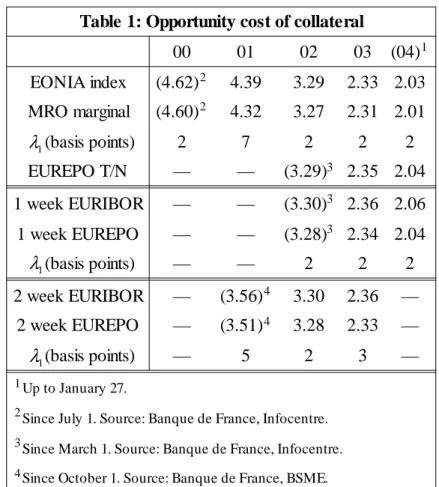
Table 1: Opportunity cost of collateral
00 01 02 03 (04)1 EONIA index (4.62)2 4.39 3.29 2.33 2.03 MRO marginal (4.60)2 4.32 3.27 2.31 2.01 (basis points) 2 7 2 2 2 EUREPO T/N — — (3.29)3 2.35 2.04 1 week EURIBOR — — (3.30)3 2.36 2.06 1 week EUREPO — — (3.28)3 2.34 2.04 (basis points) — — 2 2 2 2 week EURIBOR — (3.56)4 3.30 2.36 — 2 week EUREPO — (3.51)4 3.28 2.33 — (basis points) — 5 2 3 — 1Up to January 27.
2Since July 1. Source: Banque de France, Infocentre. 3
Since March 1. Source: Banque de France, Infocentre. 4Since October 1. Source: Banque de France, BSME.
Table 1 reports some estimates of the opportunity cost of pledging collateral. This cost has two components. The first, already alluded to above, is the spread between uncollateralized and collateralized borrowing rates of the same maturity. The three estimates provided in Table 1 are roughly consistent with each other and yield a spread λ1 between 2 and 7 basis points depending on the time period. For the Euro OverNight Index average, we have used as benchmark the marginal rate of the ECB's main refinancing operations following the switch to variable tenders on June 28, 2000. The estimate is quite variable and sometimes even negative, indicating that some overbidding may be present. Segmentation or microstructure effects seem to dilute the value of collateral at very short horizons, as evidenced by the fact that the overnight rate has been consistently below the rates on tom next repos over the last two years. The other two estimates are the spreads between the EURIBOR offered rates and the EUREPO benchmark rates at the one and two-week maturities. They average 1.9 and 2.8 basis points, respectively, with monthly standard errors of 0.8 and 1.3 basis points over their respective time periods.
The second component is the operational cost of receiving, processing and safekeeping the collateral until it is redeemed by the bank that posted it. Since we do not have a hard estimate of this component we consider only two alternatives, λ2 =0
1 λ 1 λ 1 λ
and λ2 =5 basis points. 8
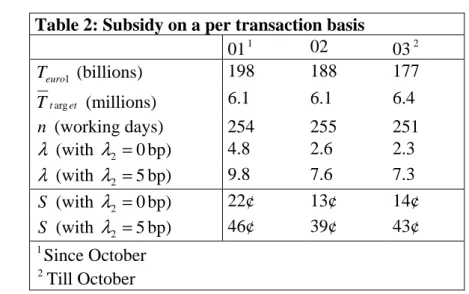
Table 2: Subsidy on a per transaction basis
011 02 032 1 euro T (billions) 198 188 177 et t T arg (millions) 6.1 6.1 6.4 n (working days) 254 255 251 λ (with λ2 =0bp) 4.8 2.6 2.3 λ (with λ2 =5bp) 9.8 7.6 7.3 S (with λ2 =0bp) 22¢ 13¢ 14¢ S (with λ2 =5bp) 46¢ 39¢ 43¢ 1 Since October 2 Till October
Table 2 reports estimates of the subsidy S from equation (2) on the basis of annualized data. For the first component of the opportunity cost of collateral λ1 we have used the two-week spread Euribor vs. Eurepo, which starts only in October 2001 but is relatively immune to short term liquidity effects. Another critical choice is that relating to the full collateralization of Euro1, the variable denoted L in (1). The collateral needed to cover the maximum sum of all net debits is not readily available. If the true structure of bilateral debit limits within Euro1, which constrain the sum of all net debits in the system, were known an estimate of L could be derived. However, the EBA statistics for the ECB provide individual data about the bilateral credit lines received and not the credit lines granted by member participants. For this reason, we are content in this draft with extrapolating from the earlier experience on CHIPS. Since the collateral required to cover the sum of all net debits was adjusted from USD 3.5 billion (the single largest net debit) to USD 15 billion on CHIPS, we posit L=5l
as a first approximation. Finally, we obtain the mean transaction value Ttarget by
averaging cross-border and domestic transactions.
Without compensation for operational costs, the figures for the subsidy we arrive at are in the range 13 to 14 cents per transaction over the last two years. When the operational cost of processing collateral is taken into account (λ2 =5 basis points), the subsidy amounts to about 40 cents. To get some idea of the variability of our estimate we have also computed S on the basis of monthly data from October 2001 to October 2003 (25 observations). With λ2 =0 (resp. λ2 =5 bp) the average subsidy is 15¢ (resp. 42¢) with a standard error of 7¢. Thus, under our assumptions, if Target could not charge its participants more than, say, 20¢ per transaction, its cost per transaction would have to be adjusted to as little as 35¢ or as high as 62¢, depending on the choice of the operational charge for processing collateral.9
8
For example, the difference between the ECB's minimum bid rate on its main refinancing operations and the yield it serves on Euro1's liquidity pool is 15 basis points. Part of that spread may correspond to the operational cost λ2.
9
5. Conclusion
Finality of settlement for large value payments is ensured when these payments are made over an RTGS network. Implementing an RTGS system can be expensive and users may favor routing their payments over a DNS network that, while implementing numerous risk reduction procedures over the last 15 years, still does not have the same level of assurance of settlement finality as does an RTGS system. When a DNS network does not fully collateralize all net debits incurred, it will not have to recover this additional collateral cost. As a result, it can offer large value transaction services at a lower user cost even though the assurance of full and complete finality is less than on an RTGS network. Given the important social benefits of having the highest assurance of settlement finality for financial markets in particular and society in general, policy makers and regulators could induce/require these networks to fully collateralize all net debits. This would remove the likely cost/price advantage they now may enjoy over RTGS networks and also raise their currently lower level of assurance of settlement finality up to that provided by RTGS networks. Alternatively, the extra cost incurred on RTGS networks in fully covering (with collateral or idle balances) what otherwise would be net debits could be approximated and deducted from the full cost price they may charge. Either alternative would tend to adjust the cost needed to be recovered on current DNS and RTGS networks to achieve the same collateral costs and thus remove a likely price incentive for users to adopt — on the basis of cost/price alone — the more risky DNS network to function their payments.
Our estimate of the extra expense of assuring settlement finality on a DNS network through full collateralization of all net debits lies between 15 to 42 cents per transaction. This could be the amount of a per transaction subsidy or "cost offset'' that could be applied to an RTGS network to compensate for the fact that DNS networks do not provide the same assurance of settlement finality that exists on an RTGS system. This estimate also represents the likely extra cost of having a DNS network (one that currently collateralizes the largest single net debit) fully collateralize all of its net debit exposures. It is noted that this per transaction cost estimate is what the market would likely charge, which is currently larger than the non-market determined expenses now incurred on some DNS networks which fully collateralize all net debits. Recent developments may promise more efficient use of collateral than has been the case in the past. Consequently, our estimates of the opportunity cost of posting collateral to cover all net debits on a DNS network could be viewed as an upper bound. We have assumed that the imposition of extra collateral costs on a DNS network or the adoption of an equivalent subsidy to the cost-based price charged on a RTGS network would only affect the trade-off between a private sector or central bank large value networks — and nothing more. Given the considerably larger costs incurred in initiating, monitoring, and processing such transactions by banks and their customers, compared to the much lower fees that may be assessed by DNS or RTGS networks, this assumption seems reasonable.
Bibliography
Kamata, S. (1990), "Managing Risk in Japanese Interbank Payment Systems", Federal Reserve Bank of San Francisco Economic Review: 18-32.
Humphrey, D. (1989), "Market responses to Pricing Fedwire Daylight Overdrafts", Federal Reserve Bank of Richmond Economic Review, May/June: page 32.
Federal Reserve System (2002), Guide to the Federal Reserve's Payment System Risk Policy, Washington, D.C., May: page 30.
European Central Bank working paper series
For a complete list of Working Papers published by the ECB, please visit the ECB’s website (http://www.ecb.int)
466 “Regulated and services’ prices and inflation persistence” by P. Lünnemann and T. Y. Mathä, April 2005. 467 “Socio-economic development and fiscal policy: lessons from the cohesion countries for the new
member states” by A. N. Mehrotra and T. A. Peltonen, April 2005.
468 “Endogeneities of optimum currency areas: what brings countries sharing a single currency closer together?” by P. De Grauwe and F. P. Mongelli, April 2005.
469 “Money and prices in models of bounded rationality in high inflation economies” by A. Marcet and J. P. Nicolini, April 2005.
470 “Structural filters for monetary analysis: the inflationary movements of money in the euro area” by A. Bruggeman, G. Camba-Méndez, B. Fischer and J. Sousa, April 2005.
471 “Real wages and local unemployment in the euro area” by A. Sanz de Galdeano and J. Turunen, April 2005.
472 “Yield curve prediction for the strategic investor” by C. Bernadell, J. Coche and K. Nyholm, April 2005.
473 “Fiscal consolidations in the Central and Eastern European countries” by A. Afonso, C. Nickel and P. Rother, April 2005.
474 “Calvo pricing and imperfect common knowledge: a forward looking model of rational inflation inertia” by K. P. Nimark, April 2005.
475 “Monetary policy analysis with potentially misspecified models” by M. Del Negro and F. Schorfheide, April 2005.
476 “Monetary policy with judgment: forecast targeting” by L. E. O. Svensson, April 2005. 477 “Parameter misspecification and robust monetary policy rules” by C. E. Walsh, April 2005. 478 “The conquest of U.S. inflation: learning and robustness to model uncertainty” by T. Cogley and
T. J. Sargent, April 2005.
479 “The performance and robustness of interest-rate rules in models of the euro area” by R. Adalid, G. Coenen, P. McAdam and S. Siviero, April 2005.
480 “Insurance policies for monetary policy in the euro area” by K. Küster and V. Wieland, April 2005. 481 “Output and inflation responses to credit shocks: are there threshold effects in the euro area?”
by A. Calzaand J. Sousa, April 2005.
482 “Forecasting macroeconomic variables for the new member states of the European Union” by A. Banerjee, M. Marcellino and I. Masten, May 2005.
483 “Money supply and the implementation of interest rate targets” by A. Schabert, May 2005.
484 “Fiscal federalism and public inputs provision: vertical externalities matter” by D. Martínez-López, May 2005.
485 “Corporate investment and cash flow sensitivity: what drives the relationship?” by P. Mizen and P. Vermeulen, May 2005.
486 “What drives productivity growth in the new EU member states? The case of Poland” by M. Kolasa, May 2005.
487 “Computing second-order-accurate solutions for rational expectation models using linear solution methods” by G. Lombardo and A. Sutherland, May 2005.
488 “Communication and decision-making by central bank committees: different strategies, same effectiveness?” by M. Ehrmann and M. Fratzscher, May 2005.
489 “Persistence and nominal inertia in a generalized Taylor economy: how longer contracts dominate shorter contracts” by H. Dixon and E. Kara, May 2005.
490 “Unions, wage setting and monetary policy uncertainty” by H. P. Grüner, B. Hayo and C. Hefeker, June 2005.
491 “On the fit and forecasting performance of New-Keynesian models” by M. Del Negro, F. Schorfheide, F. Smets and R. Wouters, June 2005.
492 “Experimental evidence on the persistence of output and inflation” by K. Adam, June 2005. 493 “Optimal research in financial markets with heterogeneous private information: a rational
expectations model” by K. Tinn, June 2005.
494 “Cross-country efficiency of secondary education provision: a semi-parametric analysis with non-discretionary inputs” by A. Afonso and M. St. Aubyn, June 2005.
495 “Measuring inflation persistence: a structural time series approach” by M. Dossche and G. Everaert, June 2005.
496 “Estimates of the open economy New Keynesian Phillips curve for euro area countries” by F. Rumler, June 2005.
497 “Early-warning tools to forecast general government deficit in the euro area: the role of intra-annual fiscal indicators” by J. J. Pérez, June 2005.
498 “Financial integration and entrepreneurial activity: evidence from foreign bank entry in emerging markets” by M. Giannetti and S. Ongena, June 2005.
499 “A trend-cycle(-season) filter” by M. Mohr, July 2005.
500 “Fleshing out the monetary transmission mechanism: output composition and the role of financial frictions” by A. Meier and G. J. Müller, July 2005.
501 “Measuring comovements by regression quantiles” by L. Cappiello, B. Gérard, and S. Manganelli, July 2005. 502 “Fiscal and monetary rules for a currency union” by A. Ferrero, July 2005
503 “World trade and global integration in production processes: a re-assessment of import demand equations” by R. Barrell and S. Dées, July 2005.
505 “Public good issues in TARGET: natural monopoly, scale economies, network effects and cost allocation”
506 “Settlement finality as a public good in large-value payment systems” by H. Pagès and D. Humphrey, July 2005.