Title:
2014 New York Sweet Corn Pheromone Trap Network (SCPTN) Project leader(s):
Marion Zuefle and Abby Seaman New York State Integrated Pest Management Program
This work was supported by the USDA National Institute of Food and Agriculture, USDA-NIFA project 2013-41534-21062.
Cooperator(s):
Adam Abers, Kennedy; Brian Boerman, ACS; Bill Brennan, Avoca; Dick Davin, Avon; Allie Strub, Eves Crop Advisory Service; Jeff Kubecka, Kirkville; Keith Slocum, Our Green Acres; Jen Masters, independent consultant; Don Sweet, Crop Advantage; Linda Underwood, Preble; Mike Hunter, CCE Jefferson Co.; Callie Musto, Department of Entomology, Cornell University; Elizabeth Buck, John Gibbons; Darcy Telenko; Robert Hadad, Christy Hoepting, and Julie Kikkert, Cornell Vegetable Program; Chuck Bornt, Cara Fraver, Amy Ivy, Laura McDermott, Teresa Rusinek, Crystal Stewart, Maire Ulrich, Eastern New York Commercial Horticulture Program
Abstract:
Four important insect pests of sweet corn, European corn borer, corn earworm, fall armyworm, and Western bean cutworm, cause damage to sweet corn ears in their larval stage. These pests are moths in their adult stage and can be monitored using traps baited with pheromone lures specific for each species. Traps are placed near sweet corn fields to monitor moth flights. The weekly trap catch information allows growers, consultants, Cooperative Extension and vegetable processor field staff to track the flights and make informed decisions about when sweet corn fields need to be scouted or treated with an insecticide. This project is funded in part by in-kind contributions from growers and consultants who host and check traps.
Background and justification:
Sweet corn for the fresh and processing markets is an important crop throughout NY. In 2012 fresh market sweet corn was grown on 21,700 acres in New York with a value of 68.4 million dollars. Four major pests of sweet corn, European corn borer (ECB-E and ECB-Z), corn
earworm (CEW), fall armyworm (FAW) and Western bean cutworm (WBC) can be monitored in their adult stage using pheromone traps. Pest management is an especially important aspect of fresh market sweet corn production because the unhusked ear is marketed, and buyers are frequently very sensitive to insect damage or the presence of larvae in the ear. Harvest quality requirements are different for processing corn, which usually receives fewer insecticide applications than fresh market corn. Integrated pest management practices are widely used on both crops to determine the need for insecticide applications. Pheromone trap catches provide valuable information to growers, consultants, and processor field staff making pest management decisions. Pheromone trap catches help growers and consultants decide when to start scouting fields for egg masses and larvae, reinforce what scouts are finding, help choose the best spray materials for the pest complex that’s present, and alert the industry to the arrival of the migratory pests, CEW and FAW.
Pheromone Trap catches from western NY are an integral part of weekly pest update newsletters sent by the Cornell Vegetable Program to subscribers in eleven counties. The Trap catches are posted weekly to the sweet corn pheromone trap network blog and linked to the NYS IPM Program website, the Network for Environment and Weather Applications website, and posted to a regional website (PestWatch) that includes trap catches from several northeastern states,
making the information available to a large number of growers and extension personnel.
An additional 10 sites in Eastern NY are also monitored weekly. Trap catches for these locations are made available to subscribers of the 16 county Eastern NY Commercial Horticulture
Program (ENYCHP) as well as the regional PestWatch website. Objectives:
1. Establish and maintain a network of pheromone traps for sweet corn pests in NY. 2. Provide regional trapping information and recommendations to extension field staff and
consultants working with sweet corn growers.
3. Provide regional trapping information to growers, along with scouting and threshold recommendations.
Procedures:
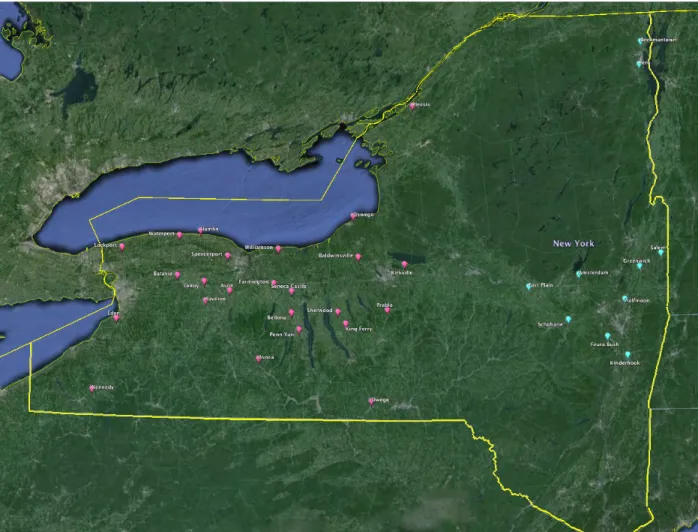
1. Sets of one each of ECB-E, ECB-Z, CEW, FAW, and WBC traps were placed at each of 34 trapping locations, 24 sites in western NY and 10 sites in eastern NY (Figure 1). Scentry Heliothis net traps were used to trap ECB and CEW. The BCS/Agrisense Unitrap was used for FAW and WBC. Lures from Trece Inc. were used for both races of ECB. Lures from Hercon Inc. were used for CEW. Lures from Scentry Inc. were used for FAW and WBC. All lures were replaced every two weeks.
ECB, CEW, and FAW traps were set up in late-May at fresh market locations, and as processing fields approached tassel emergence in other locations. WBC traps were set up in early to mid June.
Traps were placed at least 40 meters apart in grassy areas near sweet corn fields, avoiding areas near hedgerows where air circulation is poor. Heliothis traps were mounted on posts such that the bottom of the trap is ~6" above the grassy canopy. Unitraps were hung from short stakes to which angle brackets had been attached and were placed either in the field or at the edge of the field. Whenever possible, traps were moved to new fields as the previous fields matured (silks became dry) and became less attractive to moths.
2. In Western NY, cooperators checked traps weekly on Monday or Tuesday and sent trap catch numbers to Marion Zuefle via phone or email. Weekly catches for each location were collated and posted, along with interpretation and scouting and thresholds recommendations for fresh market sweet corn, on the sweetcorn.nysipm.cornell.edu website.
3. Information posted on the website was used directly by subscribing growers, incorporated into crop and pest updates distributed weekly by regional extension programs, or
provided to growers via direct contact with collaborating consultants. All catches are also posted on the PestWatch website.
In eastern NY, traps were checked weekly and reported in the weekly Eastern NY Commercial Horticulture Program’s newsletter as well as posted to PestWatch.
Figure 1. Map showing the 24 trap locations in western NY (pink) and the ten trap locations in eastern NY (blue).
Results and discussion:
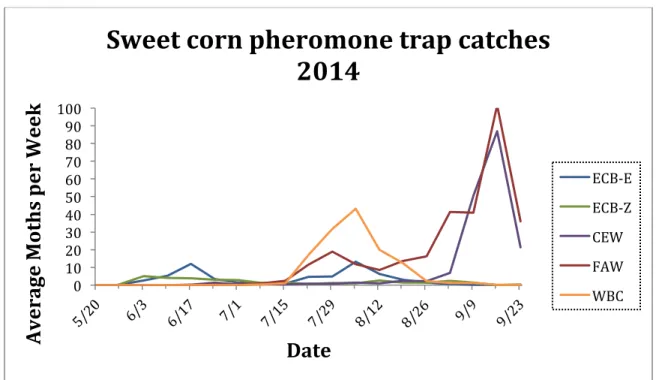
Results for the 24 sites in western NY are given here. European corn borer numbers remained low throughout the season with ECB-E experiencing a small initial flight in mid June followed by a larger second flight in early August (Figure 2). ECB-Z flight began earlier than ECB-E and did not show a clear peak. Flights for both of these moths were higher than in 2013 but are declining overall when looking at the 20-year trend (figure 3) primarily within the last 7-8 years. Western bean cutworm numbers peaked the first week of August with five sites (Avon, Eden, Kennedy, Plessis, and Pavilion) seeing a seasonal combined total of over 100 moths per site. It is recommended that scouting for WBC egg masses begins when cumulative trap catch
numbers reach 100 moth/trap for field corn. Whether this guideline also pertains to sweet corn is not known. WBC was added to the trap network in 2010, since then numbers have increased every year (figure 4).
and FAW peaked the second week in September. The average FAW numbers were slightly above the 20-year average while CEW numbers were slightly below the average.
Figure 2. Average number of moths caught per week for all 24 Eastern NY sites in 2014. 0 10 20 30 40 50 60 70 80 90 100
A
ve
ra
ge
M
ot
h
s
p
er
W
ee
k
Date
Sweet corn pheromone trap catches
2014
ECB-‐E ECB-‐Z CEW FAW WBC 0 5 10 15 20 25 1993 1998 2003 2008 2013A
ve
ra
ge
m
ot
h
s
ca
u
gh
t p
er
location
per week
Sweet corn pheromone trap catches
1993-‐2014
ECB-‐E ECB-‐Z
ECB-‐E average ECB-‐Z average
Figure 3. Average number of European corn borer, both E and Z race, moths caught per trapping location per week from 1993-‐2014.
Figure 4. Average number of corn earworm (CEW), fall army worm (FAW) and western bean cutworm (WBC) moths caught per trapping location per week from 1997-‐2014.
Project location(s):
Avoca, Steuben Co.; Avon, Livingston Co.; Baldwinsville, Onondaga Co.; Batavia, Genesee Co.; Bellona, Yates Co.; Eden, Erie Co.; Farmington, Ontario Co.; Hamlin, Monroe Co.; Kennedy, Chautauqua Co.; King Ferry, Cayuga Co.; Kirkville, Madison Co.; LeRoy, Genesee Co.; Lockport, Niagara Co.; Oswego, Oswego Co.; Owego, Tioga Co.; Pavilion, Genesee Co.; Penn Yan, Yates Co.; Plessis, Jefferson Co.; Preble, Cortland Co.; Seneca Castle, Ontario Co.; Spencerport, Monroe Co.; Waterport, Orleans Co.; and Williamson, Wayne Co.
Samples of resources developed:
Weekly blog posts from 5/27/14 to 9/23/14; totaling 18 posts were posted to the Sweet Corn Pheromone Trap Network Report blog found at:
http://sweetcorn.nysipm.cornell.edu/
Within the last year this blog has received 3,112 page views by 980 unique visitors.
Developed ‘How to scout fresh market sweet corn’ scouting video:
http://sweetcorn.nysipm.cornell.edu/how-‐to-‐scout-‐fresh-‐market-‐sweet-‐corn/
This video has received over 100 views in the last 6 months. 0 5 10 15 20 25 1997 2002 2007 2012