THE INFLUENCE OF THE COMPENSATION AND TRAINING TOWARD EMPLOYEE
PERFORMANCE AT BNI 46 MANADO BRANCH
PENGARUH KOMPENSASI DAN PELATIHAN TERHADAP KINERJA KARYAWAN DI BANK BNI 46 CABANG MANADO
by: Revel Sangkay1
S.L.H.V. Joyce Lapian
2Farlane Rumokoy3
1.2.3
Faculty of Economics and Business,
International Business Administration (IBA), Management Program University of Sam Ratulangi Manado
Email: 1 [email protected] 2 [email protected]
3
Abstract: Banking had a significant influence on the world to set circulation of money. Bank itself have a general function as a place to keeping the money and borrowing money. The things that make a bank can survive is the performance of the employees of the bank. factors that affect the performance of employees include the compensation and training. The objective of the study is to know the influence of the compensation and training toward employee performance at BNI 46 Manado branch. Data was analyzed quantitatively and through use of statistical package for social scientists (SPSS). The research method that used associative analysis with multiple regression analysis using saturated sampling with the sample of the respondents is 79 samples of all the employees at BNI 46 Cabang Manado. The result of this study shown that compensation and training have a significant influence on employee performance at BNI 46 Cabang Manado. For the company in this case BNI 46 Manado branch LW¶V UHFRPPHQGHG WR NHHS HQKDQFLQJ WKH WUDLQLQJ EHFDXVH WKH YDULDEOH KDYH D significant influence to employee performance. And for the compensation have a influence but not significant to employee performance. So the compensation needs to improve, because the compensation also determine the performance from the employee to achieve their goal.
Keywords:compensation, training, employee performance
Abstrak: Perbankan memiliki pengaruh yang signifikan pada dunia untuk mengatur peredaran uang. Bank
memiliki fungsi umum sebagai tempat untuk menyimpan dan meminjam uang. Hal yang membuat bank dapat bertahan adalah kinerja karyawan bank. Faktor yang mempengaruhi kinerja karyawan termasuk kompensasi dan pelatihan. Tujuan penelitian ini adalah untuk mengetahui pengaruh kompensasi dan pelatihan terhadap kinerja karyawan di BNI 46 Cabang Manado. Data dianalisis secara kuantitatif dan melalui penggunaan statistical package for social scientists (SPSS). Metode penelitian yang digunakan analisis asosiatif dengan teknik analisis regresi berganda dengan menggunakan sampel jenuh dengan jumlah responden adalah 79 sampel dari semua karyawan di BNI 46 Cabang Manado. Hasil penelitian menunjukkan kompensasi dan pelatihan memiliki pengaruh yang signifikan terhadap kinerja karyawan di BNI 46 Cabang Manado. Untuk perusahaan dalam hal ini BNI 46 Cabang Manado, dianjurkan untuk terus meningkatkan pelatihan, karena variabel memiliki pengaruh yang signifikan terhadap kinerja karyawan. Dan untuk kompensasi tidak berpengaruh signifikan terhadap kinerja karyawan. Jadi kompensasi perlu ditingkatkan, karena kompensasi juga menentukan kinerja karyawan untuk mencapai tujuan perusahaan.
INTRODUCTION Research Background
In this globalization era, Indonesia as a developing country will face a serious challenge. This happens because in this era of developing countries to deal directly with developed countries which have the advantage in almost every aspect. Start from the technology, capital and human resource. These things have great significance, especially human resources. The issue of compensation has always received great attention from every employee. This is because the compensation is a source of income, the revenues generated for the education and skills that he has, shows the contribution of their work, and is one of the elements of job satisfaction. Satisfaction with compensation of an employee is a key element of the creation of employee satisfaction. That is, the more satisfied an employee of the compensation it receives, the more satisfied the employee to work, and vice versa. While the main elements that will affect employee satisfaction to compensation received is justice felt towards the compensation of any employee. Dissatisfaction with compensation will decrease the attractiveness of work. The decline in the appeal of this work will lead to employee turnover, dissatisfaction with the job and increased absenteeism. Furthermore, unsatisfaction to this work will eventually result in the emergence of employee stress (Lawler in Suhartini, 2005).
Problems that occur at this time is the number of new employees who accepted the job but do not know about the job description should employees do, there is also inefficient in terms of dealing with the customers, so it makes an assessment of the bank itself to be bad, and as for who are not competent in the field because they need to adapt to the work handled.From the problems above companies need in training devised. Training here is held to improve employee performance in terms of knowing his own job description, in addition to the training that employees can be more efficient in dealing with the customers, efficient here talking about can work quickly and precisely in order to avoid the buildup of queues of customers. There are also less competent in his job can learn and adapt to the work that is given to him.
The training program has the ultimate goal of knowledge gained in training can be transferred back into the work. transfer of training is the level of knowledge, skills, abilities or other characteristics that are studied in the training can be applied in the work (Hariyanto, Purnomo and Bawono, 2011). Transfer training, had to be considered, given that the transfer of training to identify the extent to which trainees can apply what is gained from training so as to change the behavior of participants in the execution of their work. Baldwin and Ford (in the journal Edward and Sumarni, 2013) suggested among important factors affecting transfer of training is like training design and the work environment. This view was reinforced by Holton (in juenal Edward and Sumarni, 2013), which states that there are three important factors that affect the transfer of training, namely: the motivation to transfer, transfer climate, and design transfer. The problems that often arise in the training usually participants can not master the training materials that can not transfer them in his work, lack of support or motivation make participants feel that what is acquired during the training must transferred to the job. The company issued a small cost to conduct training for its employees, that is what makes companies so is hoping employees who attend training capable of transferring knowledge into work (Tziner et al, 2007). This study focuses on the banking industry. The banking industry in Indonesia has several classifications according to ownership. The classification is as follows:
1. Bank Milik Negara 2. Bank Milik Daerah 3. Bank Asing
4. Bank Swasta Nasional
From the above classification researchers focused this study on the state-owned Bank of which consists of several major banks in Indonesia, the banks are Mandiri Bank, Bank Rakyat Indonesia (BRI), Bank Negara Indonesia (BNI), Mutiara Bank. From these five banks, researchers are interested to do research at Bank Negara Indonesia 46 (BNI 46) because the researchers wanted to know about the application of the compensation system in supporting employee performance and also the implementation of training for employees in the bank.
In Bank Negara Indonesia 46 Manado branch, they have direct and indirect compensation. Direct FRPSHQVDWLRQ LV VDODU\ 7KH HPSOR\HH¶V VDODU\ ZLOO GHWHUPLQHG E\ WKH JUDGH RU SRVLWLRQ 7KH LQGLUHFW compensation consists of: bonus and reward. Bonus consists of fix bonus and variable bonus. Fix bonus has definite character which means the employees will have the bonus for sure. While variable bonus will be get
when the employees fulfill the target. Reward in this case the employee will have the allowance during three months. Have a high grade or position means that the employees have more responsible and a lot of work. And also to being on that grade or position must be through a lot of hard time. So, the implementation about compensation at BNI 46 Manado branch that the employee that get the salary based on their grade or position is really a good thing, because the employee get their salary depend on what they done and that worth it.
,Q 0DQDGR WKHUH DUH WKUHH LPSOHPHQWDWLRQ WKDW RZQHG E\ %DQN 1HJDUD ,QGRQHVLD WR WKHLU HPSOR\HH¶V candidate which are; the acceptance of front office, the introduction to each unit, and to ride the grade of SHUPDQHQW HPSOR\HH %HIRUH WKH HPSOR\HH¶V FDQGLGDWH LV DFFHSWHG LQ WKH RIILFH WKH\ KDYH WR NQRZ WKH WUDLQLQJ service standard, product knowledge, and the role play which means they have to follow the written and practice tests. The next step is to introduce each unit. They have to move to other unit each week during two months. (DFK HPSOR\HH¶V FDQGLGDWH ZLOO KDYH WKH HYDOXDWLRQ VXFK SUHVHQWDWLRQ WR WKH VXSHULRU DQG ZLOl have the SHUIRUPDQFH HYDOXDWLRQ ZKLFK LV ZLOO EH DFFXPXODWH GXULQJ WZR PRQWKV ,I WKH HPSOR\HH¶V FDQGLGDWH SDVVed those steps, they will have the user account for transaction. But if they didnt passed that steps, they have the last chance to try again. TR WKH HPSOR\HH¶V FDQGLGDWH WKDW SDVVed those steps, their placement will be determined by their score result and will follow the training on job during one until two years. The last step is to ride the grade of permanent employee. Each employee has to follow the test during four years for two different units divided in two years. The implementation of training to employees at BNI 46 Manado branch is well prepared to work on each unit. So, the employees have to follow the training procedure as well as they can. Because in the training procedure so many evaluation and assessment. Thus, it decided where the employee will be placed and also the grade. The research population is 79 employee in BNI 46 Manado branch. So it is reasonable for the researcher to follow up this interesting issue by conducting research with a title analysis the influence of the compensation and training toward employee performance.
Research Objectives
The objectives of this research are to know the influence of:
1. Compensation and Training on Employee Performance at BNI 46 Manado branch simultaneously. 2. Compensation on Employee Performance at BNI 46 Manado branch partially.
3. Training on Employee Performance at BNI 46 Manado branch partially. THEORETICAL REVIEW Human Resource Management
Storey (1995:5) HRM is a distinctive approach to employment management which seeks to achieve competitive advantage through the strategic deployment of a highly committed and capable workforce, using an array of cultural, structural and personnel techniques. Some suggestion also came from Becker and Huselid (1998), they have suggested that some variables that might be include in HRM such employee skills, motivation, job design, leadership and work structure also have a relation and influence on operating performance. Becker and Huselid also said there are some activities include in managing human resources, the activities almost like the variant of HRM Storey had mentioned before, the soft HRM.
Compensation
Compensation is the human resource management function that deals with every type of reward individuals receive in exchange for performing organizational tasks, with a desired outcome of an employee who is attracted to the work, satisfied, and motivated to do a good job for the employer. According to the American CompensaWLRQ $VVRFLDWLRQ¶V LQ )DOROD ,ELGXQQL DQG RORNXQGXP 2014) defined that compensation is the cash and non-cash remuneration provided by an employer for services rendered. It could be financial rewards which refer to any monetary rewards that go above and beyond basic pay. These rewards are separate and not added into basic salary. Examples of these include financial incentives, bonuses, and recognition. Compensation can be described as direct and indirect compensation received by employees in an organization that serves to achieve employee satisfaction and retention as well as improve performance. Direct compensation includes wages, salaries, bonuses or commission. Indirect compensation includes incentives, medical benefits, housing allowance, annual leave allowances and training opportunities. Compensation is the reward employees receive in exchange for performing organizational tasks. Compensation is direct and indirect wages. Direct compensation includes wages, salaries, bonuses or commission based on performances, overtime work, holiday
premium, while indirect compensation is paid as medical benefits, housing allowance, meal allowance, utility allowances, incentive bonus, shift allowances, hospitalization expenses, out of station allowance, vehicle loan benefits, annual leave allowances, car basic allowances, etc.
Training
In the development of organizations, training plays a vital role, improving performance as well as increasing productivity, and eventually putting companies in the best position to face competition and stay at the top. This means that there is a significant difference between the organizations that train their employees and organizations that do not (April, 2010). Training is a type of activity which is planned, systematic and it results in enhanced level of skill, knowledge and competency that are necessary to perform work effectively. There exists a positive association between training and employee performance. Training generates benefits for the employee as well as for the organization by positively influencing employee performance through the development of employee knowledge, skills, ability, competencies and behavior (April, 2010). Organizations that are dedicated to generating profits for its owners (shareholders), providing quality service to its customers and beneficiaries, invest in the training of its employees (Evans and Lindsay, 1999).
Employee Performance
(PSOR\HHV DUH WKH RUJDQL]DWLRQ¶V NH\ UHVRXUFHand the success or failure of organizations center on the ability of the employers to attract, retain, and reward appropriately talented and competent employees. In an attempt to ensure employees optimal performance and retention, organizations need to consider a variety of appropriate ways to reward the employees to get the desired results (in Falola, Ibidunni and olokundum, 2014). The employee performance would be considered as a backbone for organization. The loyalty of employee relies upon knowledge and awareness of culture that improves behavior of organization. The value and norms of HPSOR\HHV¶ EDVHG RQ PDQDJHPHQW LGHQWLILFDWLRQ WKDW KHOSV LQ LPSURYLQJ HPSOR\HH SHUIRUPDQFH 7KH DZDUHQHVV of quality helps in improving organizational and employee development (Awadh and Saad, 2013). The employee performance would be considered as a backbone for organization. The value and norms of HPSOR\HHV¶ EDVHG RQ PDQDJHPHQW LGHQWLILFDWLRQ WKDW KHOSV LQ LPSURYLQJ HPSOR\HH SHUIRUPDQFH 7KH DZDUHQHVV of quality helps in improving organizational and employee development (Awadh and Saad, 2013).
Previous Research
Sultana. Et al (2012) Impact of Training on Employee Performance: A Study of Telecommunication Sector in Pakistan. The aim of this study has been to examine the impact of training on employee performance in Telecommunication sector in Pakistan. The study was conducted with a set of hypotheses which relate directly to the research questions. The fundamental hypothesis states that there is positive effect of training on employee performance. Data was collected through questionnaires; the analysis showed that there is a strong positive effect of training on employee performance. It followed that organizational success relied on the skills and abilities of their employees, and this means that organizational success depends to an extent on considerable and continuous investment in training. This would ensure an adequate supply of staff that is technically and socially competent and capable of being developed into specialists for the relevant departments or management positions. In the organizations there is a continual need for the process of staff development, and training fulfills an important part of this process.
Osibanjo, Et al (2014) Compensation packages: a strategic tool for employees' performance and retention. 7KH DLP RI WKLV VWXG\ ZDV WR H[DPLQH WKH HIIHFW RI FRPSHQVDWLRQ SDFNDJHV RQ HPSOR\HHV¶ MRE performance and retention in a selected private University in Ogun State, South-West Nigeria. A model was developed and tested using one hundred and eleven valid questionnaires which were completed by academics and non academic staff of the university. The collected data were carefully analyzed using simple percentage supported by structural equation model to test the hypotheses and relationships that may exist among the variables under consideration. The results showed strong relationship between compensation packages and HPSOR\HHV¶ SHUIRUPDQFH DQG UHWHQWLRQ 7KH VXPPDU\ RI WKH ILQGLQJV LQGLFDWHV WKDW WKHUH LV VWURQJ correlation between the tested dependent and independent variables (salary, bonus, incentives, allowances, and fringe benefits). Hamed. Et al (2014) Impact of Compensation on Employee Performance (Empirical Evidence from Banking Sector of Pakistan). Compensation is very important for the performance of the employees. Therefore they are very important for the organization too. The purpose of this research is to measure the impact of compensation on employee performance; A questionnaire was designed to collect the data on the factors related
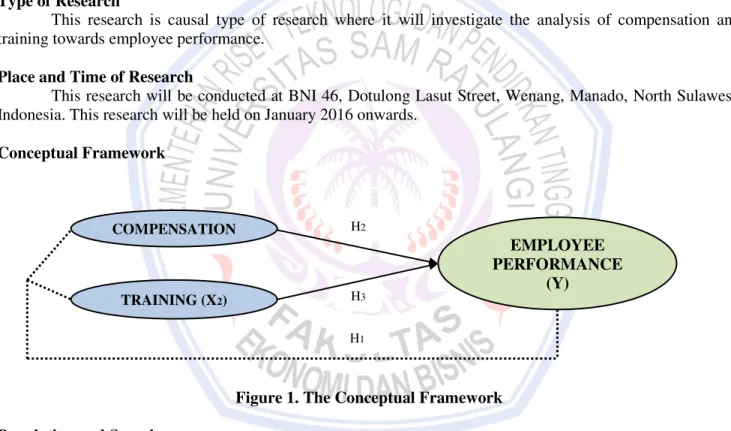
H1
H3
H2
to compensation like salary, rewards, indirect compensation and employee performance. The data was collected from different banks of Pakistan. The data collected were analyzed in SPSS 17.0 Version. Different analytical and descriptive techniques were used to analyze the data. It is concluded from different results that compensation has positive impact on employee performance. It is proved from correlation analysis that all the independent variables have weak or moderate positive relationship to each other. Regression analysis shows that all the independent variables have in significant and positive impact on employee performance.
Research Hypothesis
H1: Compensation and Training have Significant Influence on Employee performance at BNI 46 Manado
branch Simultaneously.
H2: Compensation has Significant Influence on Employee Performance at BNI 46 Manado branch Partially
H3: Training has Significant Influence on Employee Performance at BNI 46 Manado branch Partially
H0: Compensation and training have not Significant influence on Employee Performance at BNI 46 Manado
branch.
RESEARCH METHOD Type of Research
This research is causal type of research where it will investigate the analysis of compensation and training towards employee performance.
Place and Time of Research
This research will be conducted at BNI 46, Dotulong Lasut Street, Wenang, Manado, North Sulawesi, Indonesia. This research will be held on January 2016 onwards.
Conceptual Framework
Figure 1. The Conceptual Framework Population and Sample
The research population is employees at BNI 46 Manado branch. The sample of this research is 79 employees. This research will collect sample of all employees that work at BNI 46 Manado branch.
Data Collection Method
The research data can be obtained from two types of data, Primary Data and Secondary Data. Primary Data refer to information obtained first-hand by researcher on the variable of interest for specific purpose of study. Secondary Data refer to information gathered from sources that already exist as we saw in literature review. (Sekaran and Bougie, 2010:180).
Operational Definition and Measurement of Research Variables
1. The compensation is output and the benefit those employees receive from pay, wages, salary or bonus to increasing employee performance in BNI 46 Manado branch.
COMPENSATION (X ) TRAINING (X2) EMPLOYEE PERFORMANCE (Y)
2. Training is teaching or developing WKH HPSOR\HH¶V VNLOO DELOLW\ DQG SURGXFWLYLW\ WR IDFH WKH FRPSHWLWLRQ WR stay at the top.
3. Employee performance can be explained as the work attitude and motivation to achieve the employee achievement or the goal of the organization.
Data Analysis Method
Validity and Reliability Test
Validity is evidence that the instrument, technique, or process used to measure a concept does indeed measure the intended concept (Sekaran and Bougie 2009:249) to analyze the validity of questionnaire, Pearson Product Moment is used. An instrument measure is valid if the instrument measure what should be measured. Reliability is a test to the consistency and stability of the measuring instrument (Sekaran and Bogie 2009:244). The higher of the coefficient prove the better of measuring instrument.
Multiple Regression Analysis Model
Sekaran and Bougie, (2009:350), stated that multiple regression is a statistical technique that simultaneously develops a mathematical relationship between two or more independent variables and an interval scaled dependent variable. Once gathered the data from the field, the next step to analysis the data and solving the problem using Multiple Regression Method, it also to test the hypotheses that have been stated. The data then inserted into the statistical tools SPSS 22. This method has been chosen to measure analysis the influence of the compensation and training toward employee performance at BNI 46 Manado branch.
RESULT AND DISCUSSION Result
Validity and Reliability
The value of Corrected Item - Total Correlation with SPSS 22 of the indicators is all above the acceptance limit 0.5, therefore the research instrument is valid. The Reliability test is done by looking at the Cronbach Alfa value, in this research the value of Cronbach Alfa for compensation is 0.857, training is 0.801, and employee performance is 0.769 which is above the acceptance limit of 0.6, therefore the research instrument is reliable.
Multiple Regression Analysis Model
Multiple Regression Analysis is a statistical technique that simultaneously develops a mathematical relationship between two or more independent variables and an interval - scaled dependent variable.
Classical Assumption Test Table 1. Multicollinearity Model Collinearity Statistics Tolerance VIF 1 (Constant) Compensation ,999 1,001 Training ,999 1,001
Dependent Variable: Employee Performance Source : SPSS 22, 2016
The tolerance value of compensation is 0.999, training is 0.999, meaning the tolerance value of each variable is more than 0.2. The VIF value of compensation is 0.999, and training is 0.999, meaning the VIF value of each variable is less than 10. Since all the tolerance value is more than 0.2 and the VIF value is less than 10, so this research is free from multicollinearity.
Heteroscedasticity
Heteroscedasticity occurs of the dots form certain patterns. In this research the dots spreading above and below of zero point in ordinate. This is proved that there is no heteroscedasticity in this regression.
Normality
Normality test can be identifying by using graph of P-P Plot. The data will distribute normally if the value of P-P Plot is near diagonal line of the graph. The dots are spreading near the diagonal line and follow the direction of the diagonal line. Therefore the normality test is completed.
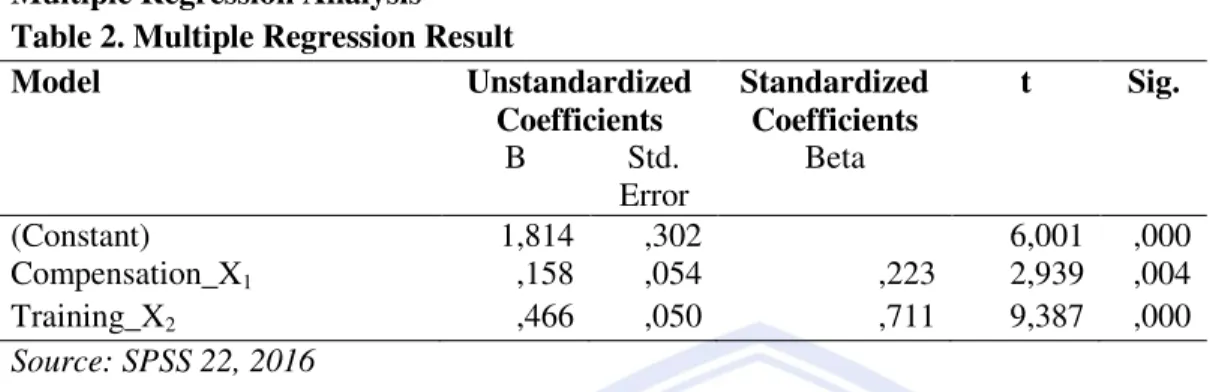
Multiple Regression Analysis Table 2. Multiple Regression Result
Model Unstandardized Coefficients Standardized Coefficients t Sig. B Std. Error Beta (Constant) 1,814 ,302 6,001 ,000 Compensation_X1 ,158 ,054 ,223 2,939 ,004 Training_X2 ,466 ,050 ,711 9,387 ,000 Source: SPSS 22, 2016
The value of R is 0.751 indicating a substantial positive association between the independent variable and dependent variable. The value of R2 is 0.565 means that 56% Compensation (X1) and Training (X2) as
independent variable have strong positive association and affects Employee Performance (Y) while the rest 44% is affected by other factors that are not included into this research.
Hypothesis Testing Table 3. F ± Test Result Model Sum of Squares Df Mean Square F Sig. Regression 8,183 2 4,092 49,292 ,000b Residual 6,309 76 ,083 Total 14,492 78
a. Dependent Variable: Employee Performance b. Predictors: (Constant), Training, Compensation Source: SPSS 22, 2016
The F-test results on Table 3, Fcount = 49.292 with a significance level of 0.000. In this research, Fcount>
Ftable (Fcount is greater than Ftable), then the regression model of F-Test can be 49.292 > 3.96 that means H0 is
rejected and H1 is accepted. The regression model can be used to declare that the independent variable of X1
(Compensation), and X2 (Training), simultaneously affects the dependent variable Y (Employee Performance).
Table 4. T test Model Unstandardized Coefficients Standardized Coefficients t Sig. B Std. Error Beta (Constant) 1,814 ,302 6,001 ,000 Compensation_X1 ,158 ,054 ,223 2,939 ,004 Training_X2 ,466 ,050 ,711 9,387 ,000 Source: SPSS 22, 2016
Compensation and training affect employee performance it means H1 is accepted. Compensation affect
employee performance partially which means H2 is accepted. Training affect employee performance partially
Discussion
The result shows that compensation has influence significant. Most of the employee in BNI 46 Manado branch agrees that compensation influence the employee performance. The results show that Training has a significant influence. Which means, the employees at BNI 46 Manado branch want to develop them self with follow the training procedure, not only want to develop them self, but the employees also want to compete with each other to increase their performance. So, the training gift a positive influence which is made the employee have more ability to do their job.
This result supports the previous research conducted by Hamed A. Et al (2014) It is concluded from different results that Compensation has positive impact on employee performance. It is proved from correlation analysis that all the independent variables have weak or moderate positive relationship to each other. Regression analysis shows that all the independent variables have insignificant and positive impact on employee performance. The other result supports by Sultana A. et al (2012) The fundamental hypothesis states that there is positive effect of training on employee performance. Data was collected through questionnaires; the analysis showed that there is a strong positive effect of training on employee performance.
CONCLUSION AND RECOMMENDATION Conclusion
There are three constructive findings in this research, which are listed as follow:
1. Compensation and training give significant simultaneous influence on employee performance at BNI 46 Manado branch.
2. Variable compensation has significantly influence employee performance on BNI 46 Manado branch. 3. Variable training has significantly influence employee performance on BNI 46 Manado branch. Recommendation
Based on the result and conclusion of the research, the recommendation given is such as follows:
1. To the future research, it is suggested that the future research try to add another variable, because based on the R square the percentage of this research is 56% and for the 44% is influence by another factor that not included in this research.
2. For the organization in this case BNI 46 Manado branch LW¶V UHFRPPHQGHG WR NHHS HQKDQFLQJ WKH WUDLQLQJ because the variable have a significant influence to employee performance. And for the compensation is not significant influence to employee performance. So the compensation needs to improve, because the compensation also determine the performance from the employee.
REFERENCES
April, B. A. 2010. The impact of training on employee performance: A Case Study of HFC Bank (GHANA) Ltd. European Journal. http://www.eajournals.org/wp-content/uploads/Impact-of-Professional-Training-on-Employees----Performance-A-Case-Study-of-Pakistani-Banking-Sector.pdf. Accesed February 10th Pp. 15-17.
Awadh, A. and A. Saad. 2013. Impact of Organizational Culture on Employee Performance. International Review of Management and Business Research Vol.2, Issue.1 www.irmbrjournal.com. http://irmbrjournal.com/download.php?file=papers/1378391601.pdf. Accesed February 3rd 2016 Pp.168-175.
Becker, B. and M. Huselid. 1999. An interview with Mike Losey, Tony Rucci, and Dave Ulrich:three experts respond to HRMJ's special issue on HR strategy in five leading firms. Human Resource Management, http://www.bhbassociates.com/docs/articles/1999_HRMJ_Interviews.pdf. Pp. 353-365. Accesed March 1st 2016 Pp. 38
Edward dan Sumarni. 2013. Pengaruh Iklim Transfer terhadap Motivasi Transfer dan Transfer Pelatihan bagi Para Pegawai Administratif Universitas Jambi. Jurnal Dinamika Manajemen. http://www.online-journal.unja.ac.id/index.php/jmbp/article/view/1453. Accesed March 1st. Pp. 81-93.
Evans, J. R. and M. W. Lindsay. 1999, The Management and Control of Quality. 4th edition. South-Westernllege College Publishing, Cincinnati Ohio, USA.
Falola, H. O., A. S. Ibidunni and A.M. Olokundun. 2014. Incentives Packages and EPSOR\HHV¶ Attitudes To Work: A Study of Selected Government Parastatals in Ogun State, South-West, Nigeria, International Journal of Research in Business and Social Science IJRBS,3(1)
http://www.ljs.academicdirect.org/A25/065_084.htm. Accesed February 2nd 2016 Pp. 2147-4478. Hamed, A., M. Ramzan., K. M. H. Zubair., G. Ali. and M. Arslan. 2014. Impact of Compensation on Employee
Performance (Empirical Evidence From Banking Sector of Pakistan). International Journal of Business and Social Science. Vol. 5, No. 2 http://www.ijbssnet.com/journals/Vol_5_No_2_February_2014/34.pdf Accesed February 4th Pp. 1-8.
Hariyanto, E., R. Purnomo dan R. I. Bawono. 2011. Desain Pelatihan, Dukungan Organisasional, Dukungan Supervisor dan Self Efficacy Sebagai Faktor Penentu Keefektifan Transfer Pelatihan. Jurnal Siasat Bisnis. Vol. 15, No. 2, Edisi Juli 2011. http://www.jurnal.uii.ac.id/index.php/JSB/article/view/3217. Accesed March 1st. Hal. 213-227.
Osibanjo, A. O., A. A. Adeniji., O. H. Falalo., and T. P. Heirsmac. 2014. Compensation Packages : A Strategic WRRO IRU HPSOR\HHV¶ SHUIRUPDQFH DQG UHWHQWLRQ Leonardo Journal of Sciences.
http://www.eprints.covenantuniversity.edu.ng/5216/#.VvBUQ-J95dj. Accesed February 2nd 2016 Pp. 65-84.
Sekaran, U and R. Bougie. 2009. Research Method for Business: A skill Building Approach Fifth Edition. John Wiley and Sons: Danvers, Great Britain.
Sekaran, U and R. Bougie. 2010. Research methods for business: A skill building approach 5th ed. West Sussex, UK: John Wiley & Sons Ltd.
Suhartini. 2005. Keadilan dalam Pemberian Kompensasi. Siasat Bisnis Journal. Vol. 4.
http://www.journal.uii.ac.id/index.php/JSB/article/download/972/881. Accesed March 1st Pp. 103-114 Sultana, A., S. Irum., K. Ahmed., and N. Mehmood. 2012. Impact of Training on Employee Performance : A
Study Of Telecommunication Sector In Pakistan. Interdisciplinary Journal Of Contemporary Research In Business. Vol. 4, No. 6. http://www.journal-archieves24.webs.com/646-661.pdf. Accesed February 2nd Pp. 1-16
Storey, J. 1995. Human Resource Management: Still Marching on, or Marching out? and Human Resource Management: A Critical Text. Routledge. London.
Tziner, A., M. Fisher., T. Senior and J. Weisberg. 2007, Effects of trainee characteristics on training effectiveness. International Journal of Selection and Assessment, Vol. 15 No. 2,
http://www.citeseerx.ist.psu.edu/viewdoc/download?doi=10.1.1.504.104&rep=rep1&type=pdf. Accesed March 1st Pp. 167-174.