WHITE PAPER
U.S. Federal Strategy for the Safe and
Secure Adoption of Cloud Computing
©
2011 APPTIS, INC. - ALL RIGHTS RESERVED. 20110513
Bill Perlowitz, Vice President, Advanced Technology, Apptis, Inc.
Abstract
The private sector is rapidly adopting and advancing cloud services which can be deployed rapidly, reused, and shared. Implementing these technologies can result in substantial cost savings, optimized spending, and cost shift from operations and maintenance to mission fulfillment and expansion. To bring these benefits to the public sector, the United States Federal Government created the Federal Cloud Computing Initiative (FCCI). The mission of the FCCI is to drive the Government-wide adoption of cost effective, green, and sustainable Federal cloud computing solutions. The FCCI is focused on implementing cloud computing solutions for the Federal Government that increase operational efficiencies, optimize common services and solutions across organizational boundaries, and enable transparent, collaborative, and participatory government.
To jumpstart Federal adoption of cloud computing, the White House Office of Management and Budget (OMB), under the guidance of the CIO Council Officers Deputy Director for Management Jeffrey Zients, U.S. CIO Vivek Kundra, and Department of Homeland Security (DHS) CIO Richard Spires, have
implemented a set of policies, plans, and programs that compel Federal departments and agencies to modify their IT portfolios to fully take advantage of the benefits of cloud computing in order to maximize capacity utilization, improve IT flexibility and responsiveness, and minimize cost.
The first part of this paper discusses the policies and plans the Federal Government has put in place to accelerate the adoption of cloud computing. Specifically, we describe OMB Budget Guidance, the Federal Data Center Consolidation Initiative (FDCCI), the 25 Point Implementation Plan to Reform Federal Information Technology Management, and the Federal Cloud Computing Strategy as they relate to the adoption and implementation of cloud computing.
The last part of this paper describes the programs and tools that the Federal Government has or is putting in place to support departments and agencies when designing and implementing their strategic and tactical cloud computing plans. Specifically, we describe Apps.gov, FCCI Governance, the Federal Risk and Authorization Management Program (FedRAMP), National Institute of Standards and
Technology (NIST) Cloud Computing Working Groups, and the Government-wide contract vehicles to be made available to support department and agency efforts.
Contents
Policies and Plans 1
Programs and Tools 7
Summary 13
About the Author | About Apptis 14
Work Sited 15
Policies and Plans
Technology has historically been characterized by steady growth punctuated by leaps forward, usually when new technologies are introduced. NIST Draft Special Publication 800-145 defines cloud computing as “a model for enabling ubiquitous, convenient, on-demand network access to a shared pool of configurable computing resources (e.g., networks, servers, storage, applications, and services) that can be rapidly provisioned and released with minimal management effort or service provider interaction.” This means that cloud computing is not a technology at all, but a model for how technology services are accessed, allocated, controlled, and optimized.
The concepts surrounding cloud computing are the branding of the evolutionary convergence of concepts from grid computing, utility computing, autonomic computing,
virtualization, and Web 2.0. In its simplest form, it is instructive to think of cloud computing as synonymous to insourcing or outsourcing.
What is new about cloud computing is the speed with which the Federal Government has moved to adopt a “cloud first” policy as both a strategic and tactical solution to achieve operational efficiency. The implementation of the cloud first policy will achieve substantial cost savings, allow agencies to optimize
spending, and allow agencies to reinvest in their most critical mission needs.
Section 300 of OMB Circular A-11 establishes the policy for planning, budgeting, acquisition
and management of Federal capital assets, and provides guidance for budget justification and reporting requirements for major IT
investments. To justify funding, each Federal Agency is annually required to submit an Exhibit A-300 report to OMB for each significant IT investment. Once submitted to OMB, it is reviewed for completeness and quality and OMB makes a recommendation about funding. Funding for major IT systems and projects is at risk if A-300s do not accurately and adequately document compliance with OMB criteria.
OMB Budget Guidance
The President’s FY 2011 Budget highlights cloud computing as a major part of the strategy to achieve efficient and effective IT. Chris Kemp, former NASA CTO noted: “Looking at the budget and guidance we get with the budget, we are seeing specific references to cloud computing and this has never happened before.” Indeed, it is the first time that specific guidance about exactly how to achieve specific goals using technology had ever been provided. Under current OMB budget guidance, Federal agencies are to deploy cloud computing solutions to improve the delivery of IT services, where the cloud computing solution has
demonstrable benefits versus the status quo. As noted in the State of Public Sector Cloud
Computing, OMB, as part of the FY 2011 Budget Process, requested all agencies to evaluate cloud computing alternatives as part of their budget submissions for all major IT
• By September 2011: all newly planned or performing major IT investments
acquisitions must complete an alternatives analysis that includes a cloud computing based alternative as part of their budget submissions.
• By September 2012: all IT investments making enhancements to an existing investment must complete an alternatives analysis that includes a cloud computing based alternative as part of their budget submissions.
• By September 2013: all IT investments in steady-state must complete an alternatives analysis that includes a cloud computing based alternative as part of their budget submissions.
The OMB will use the Exhibit A-300 review process to ensure consistency with the FY 2011 – FY 2013 Budget strategy, and will place systems funding at risk if an agency fails to complete a reasonable cloud computing based alternative analysis.
The reported number of Federal data centers grew from 432 in I998 to 2,094 in 2010. This growth in redundant infrastructure investments is costly, inefficient, unsustainable, and has a significant impact on energy consumption. In 2006, Federal servers and data centers
consumed over 6 billion kWh of electricity and
without a fundamental shift in how the
Government deploys technology it could exceed 12 billion kWh by 2011. In addition to the energy impact, information collected from agencies in 2009 shows relatively low utilization rates of current infrastructure and limited reuse of data centers within or across agencies. The cost of operating even a single data center is significant, and includes hardware and software costs, real estate costs, and power and cooling costs.
The FDCCI
The Federal Data Center Consolidation Initiative aims to address these challenges by leveraging the best practices of the public and private sector. The focus of this initiative is to:
• Promote the use of Green IT by reducing the overall energy and real estate footprint of Government data centers
• Reduce the cost of data center hardware, software, and operations
• Increase the overall IT security posture of the Government
• Shift IT investments to more efficient computing platforms and technologies The Federal Government has issued FDCCI guidance for Federal CIO Council agencies, calling for them to inventory data center assets, develop consolidation plans throughout fiscal year 2010, and integrate those plans into FY 2012 budget submissions. Through the FDCCI, a minimum of 800 of these data centers will be closed by 2015.
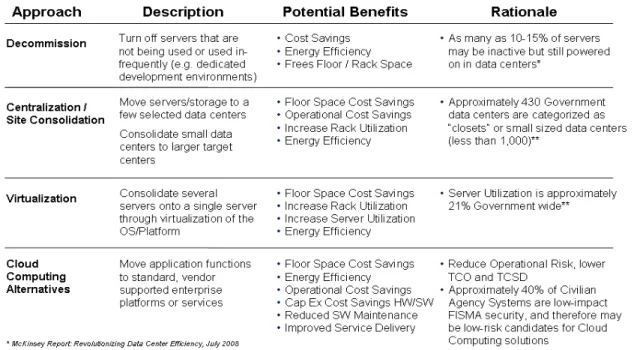
As shown in Figure
1, the Data Center
Consolidation Initiative Agency Consolidation Plan Template provides consolidation via one of the four approaches:Figure 1. DCCI Template Consolidation Approaches
The DCCI define and monitors standard operational metrics across Agencies, and achieves efficiency gains and realize operational cost savings by improving:
• Server (CPU) Utilization (%)
• Rack Space Utilization (%)
• Rack Floor Utilization (%)
• Power Usage / Square Foot
• Power Usage Efficiency (PUE)
As shown in Figure 1, each Federal agency may evaluate cloud computing as one of four options to approach for Data Center
Consolidation on an application-by-application basis. The resulting consolidation of data centers across the Federal Government will
achieve cost savings, reduce energy
consumption, optimize space utilization, and improve IT asset utilization.
The 25 Point Implementation Plan to Reform Federal Information Technology Management will be completed by the end of June 2012, and details how the Federal Government will deliver more value to the American taxpayer. The Plan requires a focus on execution and is designed to establish early successes to garner momentum for continued efforts. The first six points of the Plan describe the application of “Light
Technology” and Shared Solutions, and focus on consolidating existing data centers, reducing
25 Point Implementation Plan
the need for infrastructure growth by
implementing a “cloud first” policy for services, and increasing Government use of available cloud and shared services.
The Plan stipulates that: Beginning immediately, the Federal Government will shift to a “cloud first” policy. The three-part strategy on cloud technology revolves around using commercial cloud technologies where feasible, launching private Government clouds, and utilizing regional clouds with state and local governments where appropriate. When evaluating options for new IT deployments, OMB will require that agencies default to cloud-based solutions whenever a secure, reliable, cost-effective cloud option exists. To facilitate this shift, the Government will be standing up secure Government-wide cloud computing platforms.
To jump-start the migration to cloud
technologies, each Agency CIO is required to identify three “must move” services and create a project plan for migrating each of them to cloud solutions and retiring the associated legacy system. Of the three, at least one of the services must fully migrate to a cloud solution by December 2011; with the remaining two migrated by the end of June 2012.
By December 2011, the Federal CIO will also develop a strategy for shared services. This strategy will build on earlier Federal
Government successes in shared services and include benchmarks on current usage and uptake rates, as well as Service Level
Agreements (SLAs), customer satisfaction levels, costs, and overall economic effectiveness.
Managing partners of shared services will assess the current state of shared services and will each release a roadmap to improve quality and uptake. Ultimately, the managing partners will be responsible for executing these roadmaps and will be held accountable for improvements in SLAs and reductions in cost. These efforts will enable shared services to be accessible
Government-wide at continually higher quality levels.
In FY 2010, approximately thirty cents of every dollar invested in Federal IT was spent on data center infrastructure. Unfortunately, only a fraction of this investment delivers real, measurable impact for American citizens. By using the cloud computing model for IT
services, the Government will be able to reduce data center infrastructure expenditure by approximately 30%. Similar efficiency improvements will be seen in software applications and end-user support. These savings can be used to increase capacity or be reinvested in agency missions, including citizen-facing services and inventing and deploying new innovations.
Federal Cloud Computing Strategy
The Federal Cloud Computing Strategy (“Strategy”) describes how Federal cloud computing holds tremendous potential to deliver public value by increasing operational efficiency and responding faster to constituent needs and how applying cloud technologies across the entire Federal Government can yield tremendous benefits in efficiency, agility, and innovation. These benefits are described in Figure 2.
Figure 2. Federal Cloud Computing Strategy Benefits: Efficiency, Agility, Innovation
The Strategy details that cloud is a fundamental shift in IT that can significantly improve public sector IT. Specific benefits detailed in the Strategy include:
• Efficiency improvements will shift resources toward higher-value activities
• Assets will be better utilized
• Demand aggregation will reduce duplication
• Data center consolidation can be accelerated
• IT will be simpler and more productive
• Agility improvements will make services more responsive
• Services will be more scalable
• Innovation improvements will rapidly enhance service effectiveness
• An entrepreneurial culture will be encouraged by reducing risk
The Strategy includes a structured framework with a strategic perspective for agencies to consider and plan for cloud migration, and presents a number of activities that Federal Government leadership can undertake to
facilitate adoption and mitigate risk. We discuss these in the next section.
The Strategy is also the document that clearly articulates that the policies and plans described in this section are official policy to be acted upon by agencies:
• “Following the publication of this strategy, each agency will re-evaluate its technology sourcing strategy to include consideration and application of cloud computing solutions as part of the budget process.”
• “Consistent with the Cloud First policy, agencies will modify their IT portfolios to fully take advantage of the benefits of cloud computing in order to maximize capacity utilization, improve IT flexibility and responsiveness, and minimize cost.”
Policies and Plans Summary
The Government has recognized a responsibility to achieve the significant cost, agility, and innovation benefits of cloud computing as quickly as possible.
OMB Budget guidance, the Federal Data Center Consolidation Initiative, the 25 Point
Implementation Plan to Reform Federal Information Technology Management, and the Federal Cloud Computing Strategy are the means for the Government to get started immediately. Given that each agency has unique mission needs, security requirements, and IT landscape, the cloud first policy tasks each agency to think through the Strategy and evaluate its technology sourcing strategy so that cloud computing options are fully considered.
To guide and expedite each agency’s strategy and tactics, the Government is assembling a set of programs and tools as resources to agencies. We describe these programs and tools in the remainder of this paper.
Programs and Tools
Leading private sector companies have taken great strides to improve their operating efficiencies. Cloud technologies and
Infrastructure-as-a-Service enable IT services to efficiently share demand across infrastructure assets, reducing the overall reserve capacity across the enterprise. Additionally, leveraging shared services of “commodity” applications such as e-mail across functional organizations allows organizations to redirect management attention and resources towards value-added activities. The massive scale of the Federal Government allows for great potential to leverage these efficiencies.
The policies and plans described above outline the actionable, achievable steps to improve the Government’s operational efficiency. This section describes the programs and tools that will help agencies implement three-part
strategy on cloud technology: using commercial cloud technologies where feasible, launching private Government clouds, and utilizing regional clouds with state and local governments where appropriate.
Apps.gov was originally intended to be “a one-stop source for cloud services,” and is designed to lower costs and push innovation into
Government agencies. The site features business applications, cloud services, productivity apps and social media software that are pre-approved so that agencies can be confident that the offerings are already compliant with various Federal policies. When fully populated, Apps.gov will streamline the complex Federal procurement processes that can slow down deployment.
Apps.gov & Info.Apps.gov
Info.Apps.gov is “a place where agencies can gather information about how cloud computing can help create sustainable, more cost-effective IT Services for the Federal Government.” It is a frequently updated and authoritative source for the latest in Government news, blogs,
documentation, upcoming events, and highlights on Federal cloud computing.
The mission of the Federal Cloud Computing Initiative (FCCI) is to “Drive the Government-wide adoption of cost effective, green, and sustainable Federal cloud computing solutions.” The vision is to establish secure, easy to use, rapidly provisioned IT services for the Federal Government, including:
FCCI Governance
• Agile and simple acquisition and certification processes
• Elastic, usage-based delivery of pooled computing resources
• Portable, reusable, and interoperable business-driven solutions
• Browser-based ubiquitous Internet access to services
• Always on and available, utility-like solutions To effectively manage cloud computing
governance issues in the long-term, the Federal Government needed to lay a stable governance foundation that would outlast single individuals or administrations. To do this, individuals or committees should have explicitly defined roles, non-overlapping responsibilities, and clear decision-making hierarchies, which empower the Government to action, minimizes
unnecessary bureaucracy, and ensures accountability for results. The resulting FCCI governance structure is shown in Figure
3
:Figure 3. Federal Cloud Computing Initiative Governance Structure
Detailed information about FCCI governance is available at the United States General Services Administration FCCI Governance reference provided in the “Works Cited” section below. Within the governance structure, the following high-level responsibilities are assigned:
• The Office of Management and Budget (OMB) coordinates activities across governance bodies, sets overall cloud-related priorities, and provides guidance to agencies
• The Federal CIO Council drives Government-wide adoption of cloud, identifies next-generation cloud
technologies, and shares best practices and reusable example analyses and templates
• The General Service Administration (GSA) develops Government-wide procurement vehicles and develops Government-wide and cloud-based application solutions where needed
• The National Institute of Standards and Technology (NIST) leads and collaborates with Federal, State, and local government agency CIOs, private sector experts, and international bodies to identify and prioritize cloud computing standards and guidance
• The Department of Homeland Security (DHS) monitors operational security issues related to the cloud
• Individual Agencies are responsible for evaluating their sourcing strategies to fully consider cloud computing solutions Collectively, the FCCI governance structure develops and delivers all of the strategies, planning (budget, resource, and technical), and deliverables for implementation of the Federal Cloud Computing Initiative,and coordinates with the Federal Enterprise Architecture for compliance, convergence, and optimization of IT Infrastructure.
The Federal Information Security Management Act (FISMA) and NIST special publications provide Federal Agencies with guidance and framework needed to securely use cloud systems. However, interpretation and application of FISMA requirements and NIST Standards vary greatly from agency to agency. Not only do agencies have varying numbers of security requirements at or above the NIST baseline, many times additional requirements from multiple agencies are not compatible on the same system, which would make cloud computing untenable. A Government-wide risk and authorization program for cloud computing allows agencies to completely leverage the work of an already completed authorization or only require an agency to complete delta requirements (i.e., the unique requirements for that individual agency).
FedRAMP
The Federal Risk and Authorization
Management Program (FedRAMP) has been established to provide a standard approach to Assessing and Authorizing (A&A) cloud
computing services and products. FedRAMP allows joint authorizations and continuous security monitoring services for Government and Commercial cloud computing systems intended for multi-agency use. Joint authorization of cloud providers result in a common security risk model that can be leveraged across the Federal Government. The use of this common security risk model provides a consistent baseline for Cloud based
technologies. This common baseline ensures that the benefits of cloud-based technologies are effectively integrated across the various cloud computing solutions proposed within the
Government. The risk model also enables the Government to "approve once, and use often" by ensuring multiple agencies gain the benefit and insight of the FedRAMP's Authorization and access to each cloud service provider’s
authorization package.
FedRAMP is a Government-wide initiative to provide a single set of security controls and joint authorization services up to the FISMA “Moderate” level in Federal Civilian agencies, and Department of Defense Information Assurance Certification and Accreditation Process (DIACAP) Mission Assurance Category II Sensitive in DoD departments. It began by creating a Joint Authorization Board (JAB) defining unified, Government-wide risk
management controls that work in concert with the security controls contained in NIST Special Publication 800-53, Revision 3. The JAB consists of the CIOs from DoD, DHS, GSA, and the CIO of the agency sponsoring the system to FedRAMP. FedRAMP security requirements identify 13 additional cloud-specific control enhancements for low impact systems and approximately 60 additional control enhancements for moderate impact systems that go beyond those basic requirements defined in NIST SP 800-53. FedRAMP is an optional service to agencies and agencies retain their responsibility and
authority to ensure that the implementation of systems meets their security needs. Assuming there are no delta requirements, the FedRAMP process consists of 9 activities:
1. The Government categorizes the information and information system.
2. The Government creates a Security Specification, including the selection of security controls.
3. The cloud provider implements the security controls.
4. An independent 3rd party assesses the security controls.
5. The cloud provider creates and authorization package.
6. The Government JAB reviews the authorization package and FedRAMP authorizes the system.
7. The Agency wishing to use the cloud provider’s system provides an Agency review of the authorization package and FedRAMP Authorization, and accepts the authorization.
8. The cloud provider continuously monitors the security of the system and reports to FedRAMP.
9. The Government continuously monitors and accepts the ongoing level of risk.
Note that activity 5 above shifts the cost of creating the authorization package and activity 8 above shifts the cost of continuous security monitoring from the Government, where it has historically been incurred, to the cloud service provider. A benefit to the cloud service
provider is that they receive a common baseline of security controls that are uniformly
interpreted and applied for use by multiple agencies. The cloud service provider also need only provide their sensitive security information to FedRAMP in a single format, and need not develop an individual authorization package for each agency wishing to use their cloud service. A benefit to the Agency is that a significant portion of their A&A package is provided to
them by the cloud service provider when they engage the service, reducing the time and cost necessary to authorize and accredit a system using cloud services that have been FedRAMP authorized.
Additional benefits of FedRAMP include:
• Increased security through focused risk management
• Reduced duplication of effort
• Ensured security oversight of outsourced systems
• Independent accountability for
Government-developed systems used by multiple agencies
• integration with Government-wide security efforts
Cloud computing is a convergence of multiple technologies, and the descriptions, best practices, and technical standards needed to ensure cloud services are secure, permit the Government to interoperate between multiple cloud providers (interoperability), and move data seamlessly between cloud providers (data portability) are nascent.
NIST Working Groups
NIST has been designated to accelerate the Federal Government’s secure adoption of cloud computing by leading efforts to develop
standards and guidelines in close consultation and collaboration with standards bodies, the private sector, and other stakeholders. The NIST area of focus is technology, and specifically, interoperability, portability and security requirements, standards and guidance.
The intent is use the strategy to prioritize NIST tactical projects which support U.S.
Government Agencies in the secure and effective adoption of the cloud computing model to support their missions. The expectation is that the set of priorities (“the Roadmap”) will be useful more broadly by industry, Standards Development
Organizations, cloud adopters, and policy makers.
As part of the NIST plan, five Working Groups were created as a public/private ownership to define standards.
Reference Architecture and Taxonomy WG - NIST leads interested U.S. Government agencies and industry to define a neutral cloud
computing reference architecture and
taxonomy to extend the NIST cloud computing model; to use as a frame of reference to facilitate communication; to illustrate and understand various cloud services in the context of an overall cloud computing model and to use as a tool to communicate and analyze candidate security, interoperability, and portability candidate standards and reference implementations.
Standards Acceleration to Jumpstart the Adoption of Cloud Computing (SAJACC) WG - The goal of the SAJACC initiative is to drive the formation of high-quality cloud computing standards by providing worked examples showing how key use cases can be supported on cloud systems that implement a set of documented and public cloud system
specifications. The SAJACC initiative develops and maintains a set of cloud system use cases through an open and ongoing process engaging
industry, other Government agencies, and academia. Simultaneously, the SAJACC initiative collects and generates cloud system specifications through a similarly open and ongoing process. The SAJACC initiative develops tests that show the extent to which specific use cases can be supported by cloud systems that implement documented and public cloud system specifications, and publishes test results on the SAJACC Web portal. The SAJACC web portal provides pointers to known cloud system
implementations and use case documents. These resources serve to both accelerate the development of high-quality cloud computing standards and reduce technical uncertainty during the interim adoption period before many cloud computing standards are formalized. Cloud Security WG - The formation of NIST Cloud Computing Security Working Group is an integral part of the overall NIST effort to facilitate secure adoption of cloud services for the U.S. Government. The objectives of the WG are to gather input from all stakeholders (both within U.S. Government and Industry) regarding security concerns in Cloud Computing Services, and to define and formulate a roadmap for development of security guidance (based on standards and best practices) for ensuring implementation of appropriate security controls (and their monitoring) in the cloud computing services adopted by U.S. Government agencies. Standards Roadmap WG - NIST is leading the development of a U.S. Government Cloud Computing Roadmap. This roadmap defines and prioritizes U.S. Government requirements for interoperability, portability, and security for cloud computing in order to support secure and
effective U.S. Government adoption of Cloud Computing. The NIST Cloud Computing Standards Roadmap Working Group leverages existing, publicly available work, plus the work of the other NIST Working Groups, to develop a NIST Cloud Computing Standards Roadmap that can be incorporated into the U.S. Government Cloud Computing Roadmap.
Business Use Cases WG - NIST leads interested U.S. Government agencies and industry to define target U.S. Government Cloud Computing business use cases (a set of
candidate deployments to be used as examples) for Cloud Computing model options, to identify specific risks, concerns and constraints. The Business Use Cases WG will: create a template for business use cases; develop target business use cases and stories; develop an in-depth use case for email; identify cross-cutting business use cases; and, coordinate with other NIST Cloud Computing working groups.
Federal, state, and local governments will soon have access to cloud-based Infrastructure-as-a-Service (IaaS) offerings. GSA’s IaaS Blanket Purchase Agreement contract award allows 12 vendors to provide Government entities with cloud storage, virtual machines, and Web hosting services to support a continued expansion of Governments’ IT capabilities into cloud computing environments.
Contract Vehicles
After completing security certification, GSA will make a common set of contract vehicles for
cloud-based Infrastructure-as-a-Service solutions available Government-wide. The Software-as-a-Service (SaaS) E-mail Working Group, formed in June 2010, has begun to identify and develop the set of baseline functional and technical requirements for Government-wide cloud email solutions and is working towards developing business case templates for agencies who are considering transitioning to SaaS e-mail. Within 12 months, GSA will utilize these requirements to stand up Government-wide contract vehicles for cloud-based email solutions. GSA will also begin a similar process specifically designed for other back-end, cloud-based solutions.
To guide and expedite each agency’s strategy and tactics, the Government is assembling a set of programs and tools that are resources available to agencies to:
Programs and Tools Summary
• Expedite the process of evaluating cloud candidates, acquire cloud capability, and mitigate risk
• Ensure a secure, trustworthy environment
• Streamline procurement processes
• Establish cloud computing standards These programs and tools serve to both accelerate the implementation of high-quality cloud computing adoption and reduce technical uncertainty during the interim period before many cloud computing standards are formalized.
Summary
The Federal Government’s current information technology environment is characterized by low asset utilization, a fragmented demand for resources, duplicative systems, environments which are difficult to manage, and long procurement lead times. These inefficiencies negatively impact the Federal Government’s ability to serve the American public.
Cloud computing has the potential to play a major part in addressing these inefficiencies and improving government service delivery. The cloud computing model can significantly help agencies grappling with the need to provide highly reliable, innovative services quickly, despite resource constraints. Commercial service providers are expanding their available cloud offerings to include the entire traditional IT stack of hardware and software infrastructure, middleware platforms, application system components, software services, and turnkey applications. The private sector has taken advantage of these
technologies to improve resource utilization, increase service responsiveness, and accrue meaningful benefits in efficiency, agility, and innovation. Similarly, for the Federal
Government, cloud computing holds
tremendous potential to deliver public value by increasing operational efficiency and
responding faster to constituent needs. When evaluating options for new IT deployments, OMB’s “cloud first” policy requires that agencies default to cloud-based solutions whenever a secure, reliable,
cost-effective cloud option exists. The attendant policies and plans include OMB budget guidance, the Federal Data Center Consolidation Initiative, the 25 Point Implementation Plan to Reform Federal Information Technology Management, and the Federal Cloud Computing Strategy.
To facilitate the shift to cloud computing, the Government is providing agencies programs and tools, including Apps.gov, the Federal Cloud Computing Initiative governance structure, the Federal Risk and Authorization Management Program, NIST Working Groups to accelerate cloud security, interoperability, and data portability, and Federal, state, and local government contract vehicles.
The resulting Federal adoptions of cloud computing will bring a wide range of benefits, including:
• Economy: Cloud computing is a pay-as-you-go approach to IT, in which a low initial investment is required to begin, and additional investment is needed only as system use increases
• Flexibility: IT departments that anticipate fluctuations in user demand no longer need to scramble for additional hardware and software. With cloud computing, they can add or subtract capacity quickly and easily
• Speed: Cloud computing eliminates long procurement and certification processes, while providing a near-limitless selection of services
About The Author
Bill Perlowitz, Vice President of Advanced Technology at Apptis, brings over 30 years of dynamic technical and management leadership in support of Federal departments and agencies. Bill brings expertise to the transition of Enterprise Architecture that includes cloud computing, enterprise system strategy, and tactical implementation. A visionary who is a catalyst for organic growth within organizations, he has worked with numerous agencies in the Government including the DoD, DHS, Treasury, DoL, GSA, and HUD. Bill is currently Chairman of TechAmerica’s committee on Public Sector Cloud Computing, which focuses on standards development, Certification and Accreditation, and Government-wide adoption of cloud computing services. Bill is also Deputy Commissioner for the Commission on the Leadership Opportunity in U.S. Deployment of the Cloud (CLOUD2), with the
mandate to provide the Obama Administration with recommendations for how government should deploy cloud technologies and for public policies that will help drive U.S. innovation in the cloud. Prior to joining Apptis, he was CTO of Reliable Integration Services, and had worked for
United Technologies Sikorsky Aircraft and IBM’s Federal Sector Division. Bill has a Bachelor’s Degree in Electrical Engineering, Administration & Management Science, and Economics from Carnegie-Mellon University.
About Apptis
Ranked number 35 on the Washington Technology Top 100 Government Contractors list, Apptis is a leading provider of IT solutions and services for Government and industry. Formed in 1983, Apptis has extensive experience delivering solutions for organizations all major Federal agencies and branches of the military. Apptis employs 1,100 seasoned professionals throughout the world, giving them the professional strength and global geography to deliver solutions
anytime, anywhere.
Work Sited
Garbars, Kurt, and Lewin, Katie, and Mell, Peter, and Tseronis, Peter. (2010) Federal Risk and Authorization Management Program [online]. Available:
http://csrc.nist.gov/groups/SNS/cloud- computing/documents/forumworkshop- may2010/nist_cloud_computing_forum-mell.pdf [accessed 26 March 2011].
Kundra, Vivek. (2010) 25 Point Implementation Plan to Reform Federal Information Technology Management [online]. Available:
Kundra, Vivek. (2011) Federal Cloud Computing Strategy [online]. Available:
2011].
Kundra, Vivek. (26 February 2010)
Memorandum for Chief Information Officers [online]. Available:
http://www.cio.gov/documents/Federal-Data-Center-Consolidation-Initiative-02-26-2010.pdf [accessed 26 March 2011].
Kundra, Vivek. (2010) State of Public Sector Cloud Computing [online]. Available:
http://www.cio.gov/documents/StateOfCloudC omputingReport-FINALv3_508.pdf [accessed 26 March 2011].
National Institute of Standards and Technology. (2011) Special Publication 800-145 (Draft): The NIST Definition of Cloud Computing (Draft) [online]. Available:
[accessed 26 March 2011].
United States General Services Administration. (2011) FCCI Governance [web]. Available: March 2011].
United States Office of Management and Budget. (2010) Data Center Consolidation Initiative Agency Consolidation Plan Template [online]. Available:
http://cio.gov/documents/Data-Center-Consolidation-Plan.doc [accessed 26 March 2011].
Acronym List
A&A – Assessment and Authorization CC – Cloud Computing
CIO – Chief Information Officer CTO – Chief Technology Officer DCC – Data Center Consolidation
DIACAP – DoD IA Certification and Accreditation Process DoD – Department of Defense
DoL – Department of Labor
DHS – Department of Homeland Security ESC – Executive Steering Committee FAS – (GSA) Federal Acquisition Service
FedRAMP – Federal Risk and Authorization Management Program FCCI – Federal Cloud Computing Initiative
FISMA – Federal Information Security Management Act FY – Fiscal Year
GSA – General Services Administration
HUD – Department of Housing and Urban Development IA – Information Assurance
IaaS – Infrastructure as a Service IT – Information Technology
ITL – (NIST) Information Technology Laboratory JAB – Joint Authorization Board
kWh – kilowatt hour
NIST – (U.S. Department of Commerce) National Institute of Standards and Technology OCSIT – (GSA) Office of Citizen Services and Innovative Technologies
OMB – (Executive Office of the President) Office of Management and Budget PaaS – Platform as a Service
PMO – Program Management Office SaaS – Software as a Service
SAJACC – (NIST) Standards Acceleration to Jumpstart Adoption of Cloud Computing SLA – Service Level Agreement
TCSD – Total Cost of Service Delivery WG – Working Group
Apptis” is a registered trademark of Apptis Holdings, Inc. All other trademarks, marks, names, or product names referenced in this publication are the property of their respective owners, and Apptis neither endorses nor otherwise sponsors any such products or services referred to herein.
THE LEADER IN
FEDERAL CLOUD