EDUCATIONAL SOFTWARE FOR METROLOGY USING JAVA APPLETS
Galván C 1, Hernández I. 11
Centro Nacional de Metrología (CENAM), Querétaro, Mexico, [email protected]
Abstract: This paper presents some java applets developed to facilitate learning of some basic dimensional metrology topics in order to support education in metrology. These applets were made in Java programming language, can be accessed from a web page or run in a single user computer.
Key words: Educational software, java applets, dimensional metrology software.
1. INTRODUCTION
The economic impact of the measurements has been increased considerably in recent years, according to Robles[1], in modern industrial societies, the value of transactions in which measurements are used represents 50% of Gross Domestic Product (GDP) , with these values can be inferred that an increase in the average measurement error of 0.1% would mean a total cost of 0.05% of GDP. These numbers shows us an idea of the economic impact and tremendous need to introduce all professionals into the world of metrology, which clearly shows big areas of opportunity by requiring expertise in all different magnitudes (mass, time, pressure, length, etc.)
These numbers suggest that not only people directly related to the measurements, but also any professional should learn the fundamentals of measurements science. Unfortunately, in Mexico and some other countries, not all professional careers include some metrological topics into their subjects. It is important, to introduce metrological information from elementary school up to superior education.
In order to achieve this goal, a first step would be to include some content to cover the essential knowledge of metrology, trying to teach basic concepts.
In order to facilitate understanding of these contents, it is necessary to create different materials to encourage learning. This content should be attractive to the all audience in every classroom around all levels.
We propose to design different software to allow kids to understand different basics metrological concepts, learn how to read basic instruments, understanding how they work. This paper describes a job started some years ago at The Centro Nacional de Metrología (CENAM). Different java applets have been developed to introduce people in the dimensional metrology concepts.
In the next sections we describe why we choose java to develop software and what applications have been designed, not only for beginner but also for specific courses given in at CENAM.
2. JAVA FOR EDUCATIONAL SOFTWARE
The development of computer technology, has led to the emergence of tools that enable the creation of materials that facilitates teaching the concepts of different knowledge matters like metrological subjects.
One such computer tools is the Java programming environment. This tool is a programming language that allows the creation of a large number of types of applications, including web pages, interactive applets, client-server applications, etc. In recent years, Java has grown enormously and has been spreading among software developers worldwide, given its characteristics of free software.
In computing, an applet is any small application that performs one specific task that runs within the scope of a larger program, often as a plug-in [3]. An applet typically also refers to Java applets, i.e., programs written in the Java programming language that can be included in a web page.
Java Applets can provide web applications with interactive features that cannot be provided by HTML (original programming language for web pages). In the wide world of internet, we can find many applets related to educational topics: physics, mathematics, chemistry, etc. Unfortunately only few are related to issues of metrology.
One characteristic of Java is portability, which means that computer programs written in the Java language must run similarly on any supported hardware/operating-system platform. This is very useful when you need to share your applications to any other people, so no restricted to any kind of user.
CENAM is Mexico's National Metrology Laboratory, began some years ago a project about creation of little applications for educational purposes. We decided to implement these tools in java environment given its advantages and even more, java is a free development environment. It is possible to find very good compilers free of charge; also much information about programming issues is also available for free on the internet.
This kind of applications can be posted in a web page, with no special requirements and no big server restrictions. However, it is necessary that final users install a runtime environment called Java Virtual Machine (JVM), which can be downloaded from several places also for free.
3. DESIGNING JAVA APPLETS FOR TRAINING IN METROLOGY
The design of educational software can be a difficult task. There are many publications describing this problem.
The creation of educational programs is a task concerning many different areas. The formation and conformation of development teams is fundamental for this type of educational projects [4].
To do so, it is necessary to consult specialists in software developments, efficient planners and professors familiar with the interest area for which sfotware will be developed, since a pedagogical model will have to be generated for each case according to its particular needs
For this project, work team is composed by several metrology specialists, with a experience of 15 years teaching different metrology courses, from basic topics to specialized one like GD&T for instance. On the software design, team has people, with 10 year experience, designing software for measurements instruments, like Gauge Block Interferometer, Gauge Block Comparator, Line Scale Calibration, CMM measuring fitting routines, etc.
Most of the application has been programmed by students from Universidad Tecnológica del Valle del Mezquital (http://www.utvm.edu.mx/), working in CENAM facilities. First activity for these students is to be trained in the subject to develop, also practicing in java programming environment.
There are several compilers to programming java; one of these compilers has a lot of tools to facilitate application development. We have selected NetBeans IDE like development tool for this project.
NetBeans is an open-source project dedicated to providing rock solid software development products (the NetBeans IDE and the NetBeans Platform) that address the needs of developers, users and the businesses that rely on NetBeans as a basis for their products [5]. The NetBeans IDE and NetBeans Platform, are free for commercial and non-commercial use.
This software has a lot tools integrated in its environment, to integrate different platform for programming. Main disadvantage, is a big software, recommended RAM memory is 2GB and a 1GB of disk space.
One more advantage, is constantly updated, new version of this IDE includes support for JavaFX 2.0. JavaFX is a software platform for creating and delivering rich Internet applications that can run across a wide variety of connected devices. Some experts have speculated JavaFX will compete on the desktop with Adobe AIR, Apache Pivot, OpenLaszlo and Microsoft Silverlight. Actually, we are working with our first JavaFx application, about a dial indicator.
When an education software is been designed, we have several restrictions, one of this is monitor resolution, this can be a very important restriction for development of measuring instrument application. Sometimes, is impossible to reproduce real resolution in a software application, this need to be specified in the scope description.
Applications described in this work, are designed according with last restriction. Instrument ranges are according with a resolution of 800x600 pixels in monitor.
Now days, 8 applications have been designed on different topics: from vernier reading, micrometer reading, up to dimensional tolerances, including one about uncertainty and its impact on manufacturing process. These applications are described in detail in following sections. 3.1. Vernier Applet
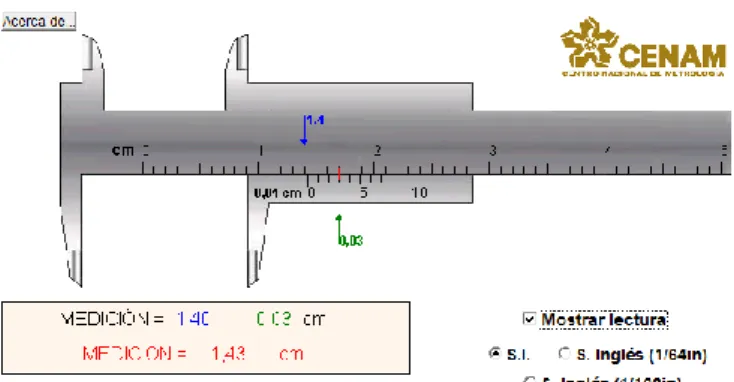
The first application designed (see fig 1), it’s about reading a vernier caliper. These instruments are widely used in metal-mechanical industry. A vernier scale is an additional scale which allows a distance or angle measurement to be read more precisely than directly reading a uniformly-divided straight or circular measurement scale. It is a sliding secondary scale that is used to indicate where the measurement lies when it is in between two of the marks on the main scale.
This application is intended that the user learns how to take the reading of this kind of instruments, directly reading the vernier scale.
In the first phase, software displays a full reading between the main scale and vernier scale of the instrument, allowing the user to become familiar with this process. It shows with graphical lines (different colors), lecture from main scale plus lecture in the vernier scale, it also show numerically addition with both readings. User can move with mouse and also with keyboard, “the vernier” along all scale.
Even more, application can switch between scale in international system (10 µm resolution) and English system (two resolutions 1 / 64 inches and 1 / 128 inches).
Fig. 1. Vernier applet
In the second stage, application allows the user to practice taking readings, allowing the user to enter a value for a given position and verified if the reading is correct, showing a text (fig 2). When user, cannot give a correct answer, he can use the “Show Lecture” option, to obtain graphically, how to take reading correctly.
Fig. 2. Vernier applet, guess reading
This application was first in the applets project, first version included only one resolution in English system, but users asked to have another resolution. In Mexico, and other countries in Central America, some companies use a lot of instruments with this system, due manufacturing for USA products.
An important restriction of this application is measuring range, usually this instruments has a 50mm range, but due monitor resolution, in this case software can show reading up to 4mm only.
3.2. Micrometer Applet
Second application is about reading of a micrometer (fig 3). This applet has similar options to vernier, and some other ones.
Fig. 3. Virtual micrometer
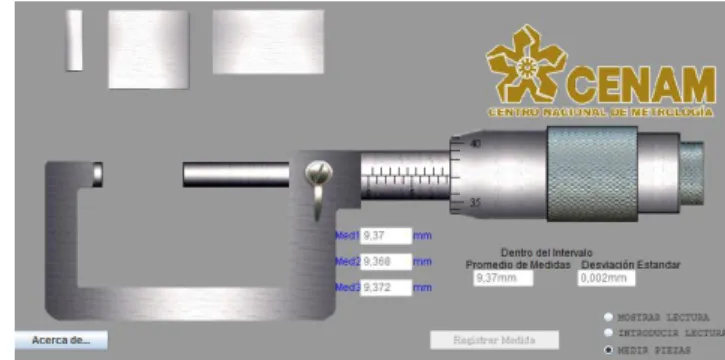
This application shows how to take a reading from instrument, while user moves micrometer screw along all measuring range (20 mm). Resolution for this virtual instrument is 1 µm. It allows two movements: “fast movement” with a resolution of 0.1 mm and “slow movement” with 1 µm resolution. To facilitate readings to the user, application has a zoom option, to make bigger micrometer head, using the mouse. Next option is practicing taking readings.
A new feature not included in vernier application is to measure several rectangular blocks (fig 4), in this role applet locates a block to measure, and user needs to operate the virtual micrometer y take reading for measurement. Last action is repeated 3 times. With this features, applet introduces certain random dispersion in position, showing to user why is important to take more than one reading due several conditions (measuring force, temperature, instrument, measurand etc.). Finally an average and standard deviation reading is shown.
Fig. 4. Measuring with virtual micrometer
The two previous applets, allows great interactivity with the user, so that user can change display mode from learning to capture mode, allowing the same user assess understanding in taking readings with this kind of instruments.
3.3. Size Probe impact on Roughness Measurement Applet Following design is related to roughness measurements. This application shows a different kinds of profile measured with different probes sizes (fig. 5).
Fig. 5. Roughness applet
Roughness measurement are influenced for sixe of probe. This application shows a different kinds of profile measured with different probes sizes (fig. 5 and 6).
With this applet user can choose between 3 different profiles data (random, sinusoidal, step) and different size of probe tip, then user can “measure” roughness and compare values for each size tip.
With this application, user can see how roughness by touch is measured, and why is important to consider size tip for this kind of measurements.
3.4. Geometric dimensioning and tolerance Applets Important topic on dimensional metrology is Geometric Dimensioning and Tolerancing (GD&T). This is very important task in designing, manufacturing and testing procedures for many processes.
Dimensional Metrology division at CENAM teaches a course on this topic several times during a year. Different companies ask for this course to be taught in their own facilities. These topics have a lot of calculations and sometimes a graphical representation for specific problems is necessary.
Due this importance, we have designed several applications like shown in figures 7 and 8.
One of this application is to demonstrate graphically and numerically the variations that can be in one piece when a modifier is applied in the expression of geometric tolerances in accordance with ISO1101 standards and ASME Y14.5M [7] (fig 7).
This application shows a pin-hole arrangement, with a tolerance in position and perpendicularity that can be specified in the application, also can specify values for LST and LSI (Inferior and superior limits), Maximum Material Condition (MMC) and Least Material Condition (LMC).
Given those values, application can show a table with maximum and minimum values, and allows user can introduce an intermediate value for estimation.
In this case, shown values are only for demonstration purposes only, calculation described are valid exclusively to the condition given in the application.
Fig. 7. GD&T applet
After table is calculated and displeayed, an option to show a graphical tolerance zone is shown, user can see an animation with tolerance zone for each value in the table.
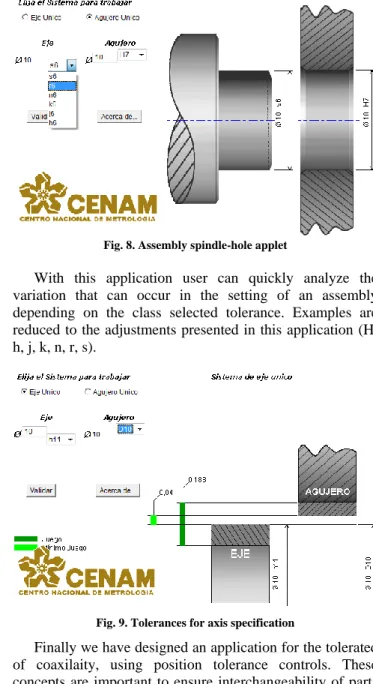
Other application related to GD&T is shown in fig 8. The purpose of this application is to demonstrate how can vary the size and clearance and tightness in the assembly (spindle - hole).
Fig. 8. Assembly spindle-hole applet
With this application user can quickly analyze the variation that can occur in the setting of an assembly depending on the class selected tolerance. Examples are reduced to the adjustments presented in this application (H, h, j, k, n, r, s).
Fig. 9. Tolerances for axis specification
Finally we have designed an application for the tolerated of coaxilaity, using position tolerance controls. These concepts are important to ensure interchangeability of parts without affecting the proper functioning of the mechanism that will integrate.
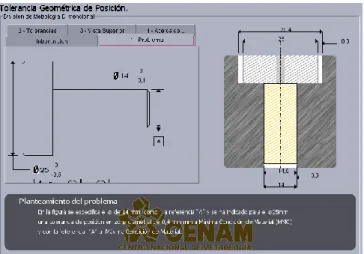
This application shows the problem of a couple of cylinders that intended to be coaxial within certain limits, it uses position tolerance controls for a line or an axis (fig 10).
Fig. 10. Coaxiality tolerances by position tolerance controls
A relationship of coaxiality can be controlled by specifying a tolerance of position Maximum Material Condition (MMC).
An option in this application, user can select specific values for the diameter for each cylinder. Once assigned, user can view an animation of the side view and top view of the array with the values given showing tolerance zone with estimated values (fig. 11).
Fig. 11. Superior and lateral view for Coaxiality animation in applet
3.5. Applet for Uncertainty impact on manufacturing process
Uncertainty is concept that metrology people must to understand, but also other people related with manufacturing process should know.
According with GUM [8], the uncertainty of the result of a measurement reflects the lack of exact knowledge of the value of the measurand. The result of a measurement after correction for recognized systematic effects is still only an estimate of the value of the measurand because of the uncertainty arising from random effects and from imperfect correction of the result for systematic effects.
Like we know, uncertainty is affected by different factors during measuring process. And this value has impacts on the cost on this process.
This application uses a numerical algorithm to simulate the results of a process of producing 10000 pieces of a variable x could be the diameter of each piece for example.
The simulation assumes that the values of x follow a normal distribution with standard deviation S, which is measured with a measurement uncertainty U.
Fig. 12. Uncertaitu impact applet
Application shows a robot classifying balls, each piece produced is randomly assigned an x value of its diameter, according to the distribution of the production process. Pieces produced are classified as:
accepted U T x U T (1) rejected U T U T x o x (2) in doubt u T U T x U T T-U x (3)
Estimated cost of a piece approved for delivery to the customer is given by:
1. Cost of raw material, fixed.
2. Manufacturing cost depends inversely on S [8]. 3. Cost of measurement, depends inversely on U [9] 4. Cost of a rejected part, believes that only raw materials are recovered.
5. Cost of a piece in doubt, considered to be reprocessed at a cost equal to half the cost of raw materials and manufacturing.
This values can be stored, then user can made some changes in uncertainty and/or deviation parameters and after stored can compare cost for each saved example.
Results can be seen on three different displays. When user has two or more examples, application shows a table displaying different parameters: standard deviation, uncertainty, tolerance, number of accepted, rejected, in doubt pieces, and cost per each piece.
Another useful display is a three dimensional graph, where are located a sphere with cost, uncertainty and standard deviation as coordinates for each example stored by user. This graph can be rotated using mouse over the graph.
Like in other applications, calculation about cost for each piece is only demonstrative and under conditions described above.
4. FUTURE WORK
With the results seen so far, we believe that these developments have been successful and project goes ahead.
Actually team is working in a dial indicator applet, in this application user can see how to take a reading from dial indicator, taking reading from panel, etc.
We are exploring new technologies to create Rich Internet Applications (RIA) also.
A rich Internet application (RIA) is a Web application that has many of the characteristics of desktop application software, typically delivered either by way of a site-specific browser, via a browser plug-in, or virtual machines. Adobe Flash, JavaFX, and Microsoft Silverlight are currently the three most common platforms.
We are exploring JavaFx technology in dial indicator development, is possible to create very good graphics but with some programming restrictions to process information from user. However, is possible to create interactivity like an applet.
4. CONCLUSIONS
We have designed several java applets to facilitate the learning of specific topics of dimensional metrology. These tools can be executed from a web page or can be distributed to run on a single computer even without internet access.
It is important to note that the aim of these java applets is to provide enhanced educational and training support to people new in metrology, also for students since middle school.
In a traditional educational environment, software application can improve learning in a cost effective way by establishing a timely connection between theory and practice [12]. Web-based education offers many advantages for every educational level.
Our proposal for educational software includes basic applications such as reading a vernier caliper or micrometer, until more advanced topics such as GD&T.
Users of the applications are very diverse, ranging from teachers and students in high school, up to people who teach basic metrology courses.
From the first time that applications were placed available on website CENAM, we have received many comments from users. CENAM has decided to share this material to promote education in metrology.
This experience encourages us to develop new web applications. These applications have been successfully tested within an different people attending CENAM´s courses, and High School teachers reported a positive experience with its use. The use of these tools tries to be self-explanatory and their reliable operation has been thoroughly tested.
These applications have been allocated in web page http://www.cenam.mx/dimensional/java.aspx, for be accessed worldwide.
Given the interest in these applications, they have been distributed to different people and institutions in Mexico, Argentina, Brazil, Chile, Colombia, Honduras, Venezuela and Guatemala have received a copy of this material to be used offline.
AKNOWLEDMENTS
We would like to thank to teachers and students from Universidad Tecnológica del Valle de Mezquital, to support this project in their classrooms and during staying at CENAM. Also, we thanks to SIDEPRO program by scholarships have given to students for the realization of their staying.
REFERENCES
[1] Robles J.A, Benyon R; “Metrología como ciencia de la medida y su impacto en la sociedad”, Semana de la ciencia, CEM 2007, Madrid Spain November 2007.
[2] Guarneros,O., at all; “Perspectivas de la metrología en el área mecánica y eléctrica de la facultad de ingeniería de la Universidad Autónoma de San Luis Potosí” Memorias Simposio de Metrología 2010, Octubre 2010 Querétaro, México
[3] Web pages on Oxford Dictionaries, http://oxforddictionaries.com/definition/applet?view=uk accessed on June 2011
[4] Lage, F.J; at all; “An extended methodology for educational software design: some critical points”, 31th ASEE/IEEE Frontier in Education Conference October 10-13, 2001 Reno NV, USA
[5] http://netbeans.org/about/index.html, accessed on July 2011 [7] “Geometrical Product Specifications (GPS) -- Geometrical
tolerancing -- Tolerances of form, orientation, location and run-out”, ISO 1121:2004
[8] Klein B. and Mannewitz F; “Statistische Tolerierung Klein”, Vieweg, Kassel, (1993) p. 13
[9] Lazos, R., Apoyos para el curso “Metrología para No-metrólogos”, Centro Nacional de Metrología, El Marqués, Querétaro, Mexico (1996).
[10] F. Wäldele, M. Franke F. Härtig, H. Schwenke and E. Trapet, “Simulationsverfahren für die Koordinatenmesstechnik”, Physikalisch-Technische Bundesanstalt, Braunschweig, Nov. 2004.
[11] Sheikh, Sharif Iqbal, Junaid Siddiqui, “Web Based Engineering Education”, The 6th Saudi Engineering Conference, KFUPM, Dhahran, December 2002, Vol. 1. Pp. 315-324.